
Moon Cycle Tonic Ingredients & Drug Interactions
What is this page for?
First and foremost: checking Moon Cycle Tonic against your medications. The heart of this page is the interaction checker and the full interaction report — how this product’s ingredients may interact with prescription and over-the-counter medicines you may be taking.
Around that, we add a pharmacist’s high-level view of the product as a whole — what’s inside, the evidence for its stated use, how transparent the label is, and what safety data exists — so you can see the full picture in one place. It’s educational information from our licensed clinical databases and the clinical staff at HelloPharmacist — not medical advice — and we don’t sell or endorse products. Our editorial policy
Moon Cycle Tonic is a dietary supplement by Red Moon Herbs with 3 active ingredients. Its ingredients are commonly taken for water retention (diuretic), digestive upset, liver and gallbladder support.Based on those ingredients, 1,053 medications have a known interaction with it, the most serious rated moderate. The ingredients most likely to interact are Vitex, Fresh, Red Clover, Fresh, Dandelion, Fresh. Use the checker below to test your specific medication, or read the full HelloPharmacist Interaction Report.
Check Your Meds Against Moon Cycle Tonic by Red Moon Herbs
Ask about any prescription or over-the-counter medication and we check it for interactions with Moon Cycle Tonic by Red Moon Herbs — and tell you which ingredient is responsible.
AI summaries are generated from our interaction database for education only — always confirm with your pharmacist. How we use AI
Ask the Pharmacist
A licensed pharmacist will answer your question by email — free, usually within 24 hours.
Got it — thank you!
A licensed pharmacist will answer within 24 hours. Keep an eye on your email (worth checking spam, just in case).
HelloPharmacist Scorecard of Moon Cycle Tonic by Red Moon Herbs
Our pharmacy team’s full take, with four database checks built into the cards below — a summary of what is known, not a grade of the product itself.
What’s inside
Low disclosure
Moon Cycle Tonic contains 3 active ingredients in a liquid form: fresh Dandelion, fresh Red Clover, and fresh Vitex. These are combined in a proprietary blend and delivered in a base of water and alcohol.
Dandelion is traditionally used for its nutrient content and diuretic properties. Red Clover contains plant compounds called isoflavones that have estrogen-like activity.
Vitex (also called Chaste Tree) has been studied for hormonal balance. The product also contains water and alcohol as inactive ingredients.
Does it work?
Moderate evidence
The evidence for this product's ingredients is limited. Dandelion has insufficient reliable evidence for joint pain, tonsillitis, or postoperative swelling and pain.
Red Clover also shows insufficient evidence for androgenic alopecia (hair loss), menopausal symptoms, osteoarthritis, and osteoporosis. Vitex (grape) shows possibly effective evidence for chronic venous insufficiency (poor circulation in the legs), but possibly ineffective evidence for chemotherapy-related nausea, hay fever, and weight loss.
Overall, the data we hold does not establish strong effectiveness claims for this product.
How safe is it?
Well-documented data
Dandelion is generally well tolerated when eaten as food, but supplement-strength doses are less studied and may cause allergy or stomach upset. Common side effects include diarrhea, heartburn, and stomach discomfort.
Rare serious effects include anaphylaxis in sensitive individuals, and it can trigger allergic reactions in people sensitive to the ragweed family of plants. Red Clover is generally well tolerated short-term in healthy adults, though its estrogen-like activity requires caution in certain people.
Common side effects are muscle pain, nausea, and vaginal spotting. The safety data advises against using Red Clover during pregnancy because of its estrogen-like effects.
For Vitex (grape), whole grapes as food are safe, and grape seed extract appears generally well tolerated in studies. Common side effects include abdominal pain, diarrhea, dry mouth, indigestion, headache, joint pain, and nausea.
Rare serious effects include anaphylaxis to grape skin.
Meds to double-check
Moderate interaction found
Before taking Moon Cycle Tonic, double-check with your pharmacist if you take any blood thinners or antiplatelet drugs (like warfarin or aspirin) — all three ingredients may increase bleeding risk. Also check if you take diabetes medications, estrogen therapy, methotrexate, tamoxifen, lithium, quinolone antibiotics, cyclosporine, or midazolam.
Additionally, ask about any drug that is metabolized by your liver's cytochrome P450 enzymes (CYP1A2, CYP2C9, CYP2C19, CYP2D6, CYP2E1, or CYP3A4), as these ingredients may alter how your body clears them.
The bottom line
Scorecard at a glanceFormula with limited ingredient disclosure with some supporting evidence for its stated purpose. Moderate medication interactions have been identified, and safety information is well characterized.
This product is not well-studied for specific health claims, and its three active ingredients interact with a very large number of medications—particularly drugs that thin the blood, regulate blood sugar, manage hormones, or work through the liver. If you take any prescription medications, absolutely check them against the interaction tool on this page before starting.
Talk with your pharmacist or doctor about whether this product is right for you.
Educational only — not medical advice; always confirm with your pharmacist. Our editorial policy · How we use AI
Assessment coverage: 3 of 3 active ingredients matched to our full ingredient reviews (monographs). Based on the product label dated Oct 24, 2024.
This Scorecard evaluates available label information, ingredient evidence, and known medication-safety considerations. It does not independently verify product identity, purity, potency, contamination, or manufacturing quality. How these ratings are computed
General information
Key facts about Moon Cycle Tonic, straight from the product label.
| Brand | Red Moon Herbs |
|---|---|
| Barcode (UPC) | 857999002160 |
| Net contents | 1 Fluid Ounce(s); 30 mL |
| Market status | On market |
| Date entered into DSLD | Oct 24, 2024 |
| DSLD ID | 319303 |
| Product type | Botanical |
| Supplement form | Liquid |
| Dietary claims / uses | All Other |
| Intended target group(s) | Adult (18 - 50 Years), Children (All), Infants/Baby (0 - 1 Year), Seniors/Mature (>50 Years) |
Everything in this section is reproduced from the manufacturer’s own product label — it’s the label speaking, not HelloPharmacist. We show it so you can see exactly what the maker states; we don’t verify or endorse those statements.
Supplement Facts
The label details for Moon Cycle Tonic by Red Moon Herbs, sourced from the NIH Dietary Supplement Label Database.
Supplement Facts
| Ingredient | Amount | % DV |
|---|---|---|
| Proprietary Blend | 0 NP | -- |
| Dandelion, Fresh | 0 NP | -- |
| Red Clover, Fresh | 0 NP | -- |
| Vitex, Fresh | 0 NP | -- |
Other ingredients: Water, Alcohol
Tap any ingredient to jump to its full detail below.
These statements are the manufacturer’s wording, reproduced from the product label — the label is saying it, not HelloPharmacist. We don’t verify or endorse them.
Suggested/Recommended/Usage/Directions
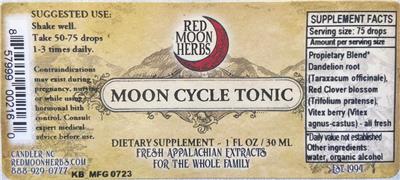
Suggested use: Shake well. Take 50-75 drops 1-3 times daily.
Precautions
Contraindications may exist during pregnancy, nursing, or while using hormonal birth control.
Consult expert medical advice before use.
FDA Statement of Identity
Dietary Supplement
Formula
Fresh Appalachian extracts for the whole family
Formulation
Fresh Appalachian extracts for the whole family
General Statements
Red Moon Herbs Est. 1994
Is this label outdated? Report a formula or label change and our pharmacy team will review it.
Moon Cycle Tonic by Red Moon Herbs label
The label scan from the NIH Dietary Supplement Label Database. Tap to enlarge.
Label images are published by the NIH Dietary Supplement Label Database for the version of this product on file. Always read your actual product label.
View the full label (PDF)The Ingredients in Moon Cycle Tonic by Red Moon Herbs
These are the 3 active ingredients this product is made of. Select any to open its full monograph.
Serving size50 Drop(s) Dosage formLiquid Amounts shown are per serving.
Most supplement products combine several ingredients, and a medication can interact with the product through any one of them. Each ingredient below shows whether it has known drug interactions.
Proprietary Blend
Other (inactive) ingredients: Water, Alcohol. These complete the product’s ingredient list but are not active constituents.
Moon Cycle Tonic by Red Moon Herbs Drug Interactions
HelloPharmacist Interaction Report
Moon Cycle Tonic by Red Moon Herbs contains three active ingredients, each with documented interactions with medications.
The most serious concern involves Vitex (listed here as Grape in the monograph), which has Moderate-severity interactions affecting multiple drug-metabolizing enzymes and blood thinners (anticoagulants/antiplatelets). Dandelion has Moderate interactions with blood thinners, diabetes medications, lithium, antibiotics (quinolones), and several enzyme systems.
Red Clover carries Moderate interactions with estrogen therapy, methotrexate, and tamoxifen, plus Minor interactions with several drug-metabolizing enzymes.
Read the full breakdown — every affected drug type, severity by severity
Altogether, these interactions span 1,041 individual medications.
Because these three ingredients work through different pathways and affect so many medications, it's crucial to check your exact prescriptions before starting this product. Use the medication checker on this page to see if any of your current drugs are affected.
Check your own medications below · Editorial policy · How we use AI
Want to check YOUR meds against Moon Cycle Tonic?
Ask about interactions with your drugs in plain English — “Can I take it with lisinopril?” — and we find you the answer in seconds, ingredient by ingredient.
Go to the checkerIngredients driving the most interactions
Individual Drug Interactions
The ingredients in Moon Cycle Tonic interact with 1,053 drugs. Click any drug to see the details.
3 of the 3 ingredients in Moon Cycle Tonic interact with drugs. Each result below shows which ingredient is responsible. Vitex, Fresh Red Clover, Fresh Dandelion, Fresh
Ado-trastuzumab EmtansineKadcyla
How Ado-trastuzumab Emtansine interacts with Moon Cycle Tonic — through 2 ingredients. Tap an ingredient for the detail:
Vitex, FreshCytochrome P450 3a4 (cyp3a4) Substrates Moderate
Interaction Summary
It is unclear if grape seed extract inhibits or induces CYP3A4; research is conflicting.
Read the full Vitex, Fresh + Ado-trastuzumab Emtansine interactionRed Clover, FreshCytochrome P450 3a4 (cyp3a4) Substrates Minor
Interaction Summary
Theoretically, red clover might increase levels of drugs metabolized by CYP3A4; however, a small clinical study found no effect.
Read the full Red Clover, Fresh + Ado-trastuzumab Emtansine interactionAbciximabReoPro
How Abciximab interacts with Moon Cycle Tonic — through 3 ingredients. Tap an ingredient for the detail:
Dandelion, FreshAnticoagulant/antiplatelet Drugs Moderate
Interaction Summary
Theoretically, taking dandelion root along with anticoagulant or antiplatelet drugs might increase the risk of bruising and bleeding.
Read the full Dandelion, Fresh + Abciximab interactionVitex, FreshAnticoagulant/antiplatelet Drugs Moderate
Interaction Summary
Theoretically, grape extracts may have antiplatelet effects and may increase the risk of bleeding if used with anticoagulant or antiplatelet drugs.
Read the full Vitex, Fresh + Abciximab interactionRed Clover, FreshAnticoagulant/antiplatelet Drugs Minor
Interaction Summary
Although some laboratory research suggests that red clover may have anticoagulant and antiplatelet activity, clinical research has not shown this effect.
Read the full Red Clover, Fresh + Abciximab interactionAbemaciclibVerzenio
How Abemaciclib interacts with Moon Cycle Tonic — through 2 ingredients. Tap an ingredient for the detail:
Vitex, FreshCytochrome P450 3a4 (cyp3a4) Substrates Moderate
Interaction Summary
It is unclear if grape seed extract inhibits or induces CYP3A4; research is conflicting.
Read the full Vitex, Fresh + Abemaciclib interactionRed Clover, FreshCytochrome P450 3a4 (cyp3a4) Substrates Minor
Interaction Summary
Theoretically, red clover might increase levels of drugs metabolized by CYP3A4; however, a small clinical study found no effect.
Read the full Red Clover, Fresh + Abemaciclib interactionAbiraterone
How Abiraterone interacts with Moon Cycle Tonic — through 2 ingredients. Tap an ingredient for the detail:
Vitex, FreshCytochrome P450 3a4 (cyp3a4) Substrates Moderate
Interaction Summary
It is unclear if grape seed extract inhibits or induces CYP3A4; research is conflicting.
Read the full Vitex, Fresh + Abiraterone interactionRed Clover, FreshCytochrome P450 3a4 (cyp3a4) Substrates Minor
Interaction Summary
Theoretically, red clover might increase levels of drugs metabolized by CYP3A4; however, a small clinical study found no effect.
Read the full Red Clover, Fresh + Abiraterone interactionAbiraterone AcetateYonsa, Zytiga
How Abiraterone Acetate interacts with Moon Cycle Tonic — through 2 ingredients. Tap an ingredient for the detail:
Vitex, FreshCytochrome P450 3a4 (cyp3a4) Substrates Moderate
Interaction Summary
It is unclear if grape seed extract inhibits or induces CYP3A4; research is conflicting.
Read the full Vitex, Fresh + Abiraterone Acetate interactionRed Clover, FreshCytochrome P450 3a4 (cyp3a4) Substrates Minor
Interaction Summary
Theoretically, red clover might increase levels of drugs metabolized by CYP3A4; however, a small clinical study found no effect.
Read the full Red Clover, Fresh + Abiraterone Acetate interactionAbrocitinibCibinqo
How Abrocitinib interacts with Moon Cycle Tonic — through 3 ingredients. Tap an ingredient for the detail:
Vitex, FreshCytochrome P450 2c9 (cyp2c9) Substrates, Anticoagulant/antiplatelet Drugs Moderate
Interaction Summary
It is unclear if grape juice or grape seed extract inhibits CYP2C9; research is conflicting.
Read the full Vitex, Fresh + Abrocitinib interactionDandelion, FreshAnticoagulant/antiplatelet Drugs Moderate
Interaction Summary
Theoretically, taking dandelion root along with anticoagulant or antiplatelet drugs might increase the risk of bruising and bleeding.
Read the full Dandelion, Fresh + Abrocitinib interactionRed Clover, FreshCytochrome P450 2c19 (cyp2c19) Substrates, Cytochrome P450 2c9 (cyp2c9) Substrates +1 Minor
Interaction Summary
Theoretically, red clover might increase the levels and clinical effects of drugs metabolized by CYP2C19.
Read the full Red Clover, Fresh + Abrocitinib interactionAcalabrutinibCalquence
How Acalabrutinib interacts with Moon Cycle Tonic — through 2 ingredients. Tap an ingredient for the detail:
Vitex, FreshCytochrome P450 3a4 (cyp3a4) Substrates Moderate
Interaction Summary
It is unclear if grape seed extract inhibits or induces CYP3A4; research is conflicting.
Read the full Vitex, Fresh + Acalabrutinib interactionRed Clover, FreshCytochrome P450 3a4 (cyp3a4) Substrates Minor
Interaction Summary
Theoretically, red clover might increase levels of drugs metabolized by CYP3A4; however, a small clinical study found no effect.
Read the full Red Clover, Fresh + Acalabrutinib interactionAcarboseGlucobay, Prandase, Precose
How Acarbose interacts with Moon Cycle Tonic — through 1 ingredient. Tap an ingredient for the detail:
Dandelion, FreshAntidiabetes Drugs Moderate
Interaction Summary
Theoretically, dandelion might increase the risk for hypoglycemia when used with antidiabetes drugs.
Read the full Dandelion, Fresh + Acarbose interactionAcenocoumarolSintrom
How Acenocoumarol interacts with Moon Cycle Tonic — through 3 ingredients. Tap an ingredient for the detail:
Dandelion, FreshAnticoagulant/antiplatelet Drugs Moderate
Interaction Summary
Theoretically, taking dandelion root along with anticoagulant or antiplatelet drugs might increase the risk of bruising and bleeding.
Read the full Dandelion, Fresh + Acenocoumarol interactionVitex, FreshAnticoagulant/antiplatelet Drugs Moderate
Interaction Summary
Theoretically, grape extracts may have antiplatelet effects and may increase the risk of bleeding if used with anticoagulant or antiplatelet drugs.
Read the full Vitex, Fresh + Acenocoumarol interactionRed Clover, FreshAnticoagulant/antiplatelet Drugs Minor
Interaction Summary
Although some laboratory research suggests that red clover may have anticoagulant and antiplatelet activity, clinical research has not shown this effect.
Read the full Red Clover, Fresh + Acenocoumarol interactionAcetaminophenChildren's Tylenol, Children's Tylenol Meltaways, Tylenol, Tylenol Ex Strength
How Acetaminophen interacts with Moon Cycle Tonic — through 3 ingredients. Tap an ingredient for the detail:
Vitex, FreshCytochrome P450 2e1 (cyp2e1) Substrates, Cytochrome P450 1a2 (cyp1a2) Substrates Moderate
Interaction Summary
Theoretically, grape seed extract might increase the levels of CYP2E1 substrates.
Read the full Vitex, Fresh + Acetaminophen interactionDandelion, FreshCytochrome P450 1a2 (cyp1a2) Substrates, Glucuronidated Drugs Moderate
Interaction Summary
Theoretically, dandelion might increase levels of drugs metabolized by CYP1A2.
Read the full Dandelion, Fresh + Acetaminophen interactionRed Clover, FreshCytochrome P450 1a2 (cyp1a2) Substrates Minor
Interaction Summary
Theoretically, red clover might increase levels of drugs metabolized by CYP1A2; however, a small clinical study found no effect.
Read the full Red Clover, Fresh + Acetaminophen interactionAcetaminophen, AspirinGemnisyn
How Acetaminophen, Aspirin interacts with Moon Cycle Tonic — through 3 ingredients. Tap an ingredient for the detail:
Dandelion, FreshGlucuronidated Drugs, Anticoagulant/antiplatelet Drugs +1 Moderate
Interaction Summary
Theoretically, dandelion might increase the clearance of drugs that are UDP-glucuronosyltransferase substrates.
Read the full Dandelion, Fresh + Acetaminophen, Aspirin interactionVitex, FreshAnticoagulant/antiplatelet Drugs, Cytochrome P450 2e1 (cyp2e1) Substrates +1 Moderate
Interaction Summary
Theoretically, grape extracts may have antiplatelet effects and may increase the risk of bleeding if used with anticoagulant or antiplatelet drugs.
Read the full Vitex, Fresh + Acetaminophen, Aspirin interactionRed Clover, FreshAnticoagulant/antiplatelet Drugs, Cytochrome P450 1a2 (cyp1a2) Substrates Minor
Interaction Summary
Although some laboratory research suggests that red clover may have anticoagulant and antiplatelet activity, clinical research has not shown this effect.
Read the full Red Clover, Fresh + Acetaminophen, Aspirin interactionAcetaminophen, Aspirin, CaffeineExcedrin, Excedrin Extra Strength, Excedrin Migraine
How Acetaminophen, Aspirin, Caffeine interacts with Moon Cycle Tonic — through 3 ingredients. Tap an ingredient for the detail:
Vitex, FreshCytochrome P450 1a2 (cyp1a2) Substrates, Anticoagulant/antiplatelet Drugs +2 Moderate
Interaction Summary
Theoretically, grape juice might reduce the levels of CYP1A2 substrates.
Read the full Vitex, Fresh + Acetaminophen, Aspirin, Caffeine interactionDandelion, FreshAnticoagulant/antiplatelet Drugs, Glucuronidated Drugs +1 Moderate
Interaction Summary
Theoretically, taking dandelion root along with anticoagulant or antiplatelet drugs might increase the risk of bruising and bleeding.
Read the full Dandelion, Fresh + Acetaminophen, Aspirin, Caffeine interactionRed Clover, FreshCaffeine, Cytochrome P450 3a4 (cyp3a4) Substrates +2 Minor
Interaction Summary
Theoretically, soy might reduce the clearance of caffeine; however, a small clinical study found no effect.
Read the full Red Clover, Fresh + Acetaminophen, Aspirin, Caffeine interactionAcetaminophen, Brompheniramine, PhenylpropanolamineDimetapp Cold and Flu
How Acetaminophen, Brompheniramine, Phenylpropanolamine interacts with Moon Cycle Tonic — through 3 ingredients. Tap an ingredient for the detail:
Vitex, FreshCytochrome P450 2e1 (cyp2e1) Substrates, Cytochrome P450 1a2 (cyp1a2) Substrates Moderate
Interaction Summary
Theoretically, grape seed extract might increase the levels of CYP2E1 substrates.
Read the full Vitex, Fresh + Acetaminophen, Brompheniramine, Phenylpropanolamine interactionDandelion, FreshCytochrome P450 1a2 (cyp1a2) Substrates, Glucuronidated Drugs Moderate
Interaction Summary
Theoretically, dandelion might increase levels of drugs metabolized by CYP1A2.
Read the full Dandelion, Fresh + Acetaminophen, Brompheniramine, Phenylpropanolamine interactionRed Clover, FreshCytochrome P450 1a2 (cyp1a2) Substrates Minor
Interaction Summary
Theoretically, red clover might increase levels of drugs metabolized by CYP1A2; however, a small clinical study found no effect.
Read the full Red Clover, Fresh + Acetaminophen, Brompheniramine, Phenylpropanolamine interactionAcetaminophen, ButalbitalAxocet, Bancap, Bucet, Butex Forte, Esgic CF, Orbivan CF +5 more
How Acetaminophen, Butalbital interacts with Moon Cycle Tonic — through 3 ingredients. Tap an ingredient for the detail:
Vitex, FreshCytochrome P450 1a2 (cyp1a2) Substrates, Cytochrome P450 2e1 (cyp2e1) Substrates Moderate
Interaction Summary
Theoretically, grape juice might reduce the levels of CYP1A2 substrates.
Read the full Vitex, Fresh + Acetaminophen, Butalbital interactionDandelion, FreshCytochrome P450 1a2 (cyp1a2) Substrates, Glucuronidated Drugs Moderate
Interaction Summary
Theoretically, dandelion might increase levels of drugs metabolized by CYP1A2.
Read the full Dandelion, Fresh + Acetaminophen, Butalbital interactionRed Clover, FreshCytochrome P450 1a2 (cyp1a2) Substrates Minor
Interaction Summary
Theoretically, red clover might increase levels of drugs metabolized by CYP1A2; however, a small clinical study found no effect.
Read the full Red Clover, Fresh + Acetaminophen, Butalbital interactionAcetaminophen, Butalbital, CaffeineEsgic, Esgic Plus, Fiogesic, Fioricet, Repan, Tecnal +1 more
How Acetaminophen, Butalbital, Caffeine interacts with Moon Cycle Tonic — through 3 ingredients. Tap an ingredient for the detail:
Dandelion, FreshGlucuronidated Drugs, Cytochrome P450 1a2 (cyp1a2) Substrates Moderate
Interaction Summary
Theoretically, dandelion might increase the clearance of drugs that are UDP-glucuronosyltransferase substrates.
Read the full Dandelion, Fresh + Acetaminophen, Butalbital, Caffeine interactionVitex, FreshCytochrome P450 2e1 (cyp2e1) Substrates, Cytochrome P450 3a4 (cyp3a4) Substrates +1 Moderate
Interaction Summary
Theoretically, grape seed extract might increase the levels of CYP2E1 substrates.
Read the full Vitex, Fresh + Acetaminophen, Butalbital, Caffeine interactionRed Clover, FreshCaffeine, Cytochrome P450 1a2 (cyp1a2) Substrates +1 Minor
Interaction Summary
Theoretically, soy might reduce the clearance of caffeine; however, a small clinical study found no effect.
Read the full Red Clover, Fresh + Acetaminophen, Butalbital, Caffeine interactionAcetaminophen, Butalbital, Caffeine, CodeineEsgic with Codeine, Fioricet w/ Codeine
How Acetaminophen, Butalbital, Caffeine, Codeine interacts with Moon Cycle Tonic — through 3 ingredients. Tap an ingredient for the detail:
Vitex, FreshCytochrome P450 1a2 (cyp1a2) Substrates, Cytochrome P450 3a4 (cyp3a4) Substrates +2 Moderate
Interaction Summary
Theoretically, grape juice might reduce the levels of CYP1A2 substrates.
Read the full Vitex, Fresh + Acetaminophen, Butalbital, Caffeine, Codeine interactionDandelion, FreshGlucuronidated Drugs, Cytochrome P450 1a2 (cyp1a2) Substrates Moderate
Interaction Summary
Theoretically, dandelion might increase the clearance of drugs that are UDP-glucuronosyltransferase substrates.
Read the full Dandelion, Fresh + Acetaminophen, Butalbital, Caffeine, Codeine interactionRed Clover, FreshCytochrome P450 3a4 (cyp3a4) Substrates, Caffeine +1 Minor
Interaction Summary
Theoretically, red clover might increase levels of drugs metabolized by CYP3A4; however, a small clinical study found no effect.
Read the full Red Clover, Fresh + Acetaminophen, Butalbital, Caffeine, Codeine interactionAcetaminophen, Butalbital, CodeineBancap w/ Codeine
How Acetaminophen, Butalbital, Codeine interacts with Moon Cycle Tonic — through 3 ingredients. Tap an ingredient for the detail:
Vitex, FreshCytochrome P450 2d6 (cyp2d6) Substrates, Cytochrome P450 1a2 (cyp1a2) Substrates +1 Moderate
Interaction Summary
Theoretically, grape seed extract may increase the levels of CYP2D6 substrates.
Read the full Vitex, Fresh + Acetaminophen, Butalbital, Codeine interactionDandelion, FreshGlucuronidated Drugs, Cytochrome P450 1a2 (cyp1a2) Substrates Moderate
Interaction Summary
Theoretically, dandelion might increase the clearance of drugs that are UDP-glucuronosyltransferase substrates.
Read the full Dandelion, Fresh + Acetaminophen, Butalbital, Codeine interactionRed Clover, FreshCytochrome P450 1a2 (cyp1a2) Substrates Minor
Interaction Summary
Theoretically, red clover might increase levels of drugs metabolized by CYP1A2; however, a small clinical study found no effect.
Read the full Red Clover, Fresh + Acetaminophen, Butalbital, Codeine interactionAcetaminophen, Butalbital, Codeine PhosphatePhrenilin #3
How Acetaminophen, Butalbital, Codeine Phosphate interacts with Moon Cycle Tonic — through 3 ingredients. Tap an ingredient for the detail:
Vitex, FreshCytochrome P450 2e1 (cyp2e1) Substrates, Cytochrome P450 2d6 (cyp2d6) Substrates +1 Moderate
Interaction Summary
Theoretically, grape seed extract might increase the levels of CYP2E1 substrates.
Read the full Vitex, Fresh + Acetaminophen, Butalbital, Codeine Phosphate interactionDandelion, FreshCytochrome P450 1a2 (cyp1a2) Substrates, Glucuronidated Drugs Moderate
Interaction Summary
Theoretically, dandelion might increase levels of drugs metabolized by CYP1A2.
Read the full Dandelion, Fresh + Acetaminophen, Butalbital, Codeine Phosphate interactionRed Clover, FreshCytochrome P450 1a2 (cyp1a2) Substrates Minor
Interaction Summary
Theoretically, red clover might increase levels of drugs metabolized by CYP1A2; however, a small clinical study found no effect.
Read the full Red Clover, Fresh + Acetaminophen, Butalbital, Codeine Phosphate interactionAcetaminophen, Caffeine, Chlorpheniramine, Hydrocodone, PhenylephrineHycomine Compound
How Acetaminophen, Caffeine, Chlorpheniramine, Hydrocodone, Phenylephrine interacts with Moon Cycle Tonic — through 3 ingredients. Tap an ingredient for the detail:
Vitex, FreshCytochrome P450 1a2 (cyp1a2) Substrates, Cytochrome P450 2e1 (cyp2e1) Substrates +2 Moderate
Interaction Summary
Theoretically, grape juice might reduce the levels of CYP1A2 substrates.
Read the full Vitex, Fresh + Acetaminophen, Caffeine, Chlorpheniramine, Hydrocodone, Phenylephrine interactionDandelion, FreshGlucuronidated Drugs, Cytochrome P450 1a2 (cyp1a2) Substrates Moderate
Interaction Summary
Theoretically, dandelion might increase the clearance of drugs that are UDP-glucuronosyltransferase substrates.
Read the full Dandelion, Fresh + Acetaminophen, Caffeine, Chlorpheniramine, Hydrocodone, Phenylephrine interactionRed Clover, FreshCaffeine, Cytochrome P450 1a2 (cyp1a2) Substrates +1 Minor
Interaction Summary
Theoretically, soy might reduce the clearance of caffeine; however, a small clinical study found no effect.
Read the full Red Clover, Fresh + Acetaminophen, Caffeine, Chlorpheniramine, Hydrocodone, Phenylephrine interactionAcetaminophen, Caffeine, CodeineGesic C15, Gesic C30, Gesic C8, Lenoltec 1, Lenoltec 2, Lenoltec 3 +1 more
How Acetaminophen, Caffeine, Codeine interacts with Moon Cycle Tonic — through 3 ingredients. Tap an ingredient for the detail:
Vitex, FreshCytochrome P450 2d6 (cyp2d6) Substrates, Cytochrome P450 2e1 (cyp2e1) Substrates +2 Moderate
Interaction Summary
Theoretically, grape seed extract may increase the levels of CYP2D6 substrates.
Read the full Vitex, Fresh + Acetaminophen, Caffeine, Codeine interactionDandelion, FreshCytochrome P450 1a2 (cyp1a2) Substrates, Glucuronidated Drugs Moderate
Interaction Summary
Theoretically, dandelion might increase levels of drugs metabolized by CYP1A2.
Read the full Dandelion, Fresh + Acetaminophen, Caffeine, Codeine interactionRed Clover, FreshCaffeine, Cytochrome P450 3a4 (cyp3a4) Substrates +1 Minor
Interaction Summary
Theoretically, soy might reduce the clearance of caffeine; however, a small clinical study found no effect.
Read the full Red Clover, Fresh + Acetaminophen, Caffeine, Codeine interactionAcetaminophen, Caffeine, Codeine, SalicylamideCodalan No.1, Codalan No.2, Codalan No.3
How Acetaminophen, Caffeine, Codeine, Salicylamide interacts with Moon Cycle Tonic — through 3 ingredients. Tap an ingredient for the detail:
Dandelion, FreshGlucuronidated Drugs, Cytochrome P450 1a2 (cyp1a2) Substrates Moderate
Interaction Summary
Theoretically, dandelion might increase the clearance of drugs that are UDP-glucuronosyltransferase substrates.
Read the full Dandelion, Fresh + Acetaminophen, Caffeine, Codeine, Salicylamide interactionVitex, FreshCytochrome P450 3a4 (cyp3a4) Substrates, Cytochrome P450 2e1 (cyp2e1) Substrates +2 Moderate
Interaction Summary
It is unclear if grape seed extract inhibits or induces CYP3A4; research is conflicting.
Read the full Vitex, Fresh + Acetaminophen, Caffeine, Codeine, Salicylamide interactionRed Clover, FreshCytochrome P450 1a2 (cyp1a2) Substrates, Cytochrome P450 3a4 (cyp3a4) Substrates +1 Minor
Interaction Summary
Theoretically, red clover might increase levels of drugs metabolized by CYP1A2; however, a small clinical study found no effect.
Read the full Red Clover, Fresh + Acetaminophen, Caffeine, Codeine, Salicylamide interactionAcetaminophen, Caffeine, DihydrocodeineDHC Plus, Panlor DC, Panlor SS
How Acetaminophen, Caffeine, Dihydrocodeine interacts with Moon Cycle Tonic — through 3 ingredients. Tap an ingredient for the detail:
Vitex, FreshCytochrome P450 1a2 (cyp1a2) Substrates, Cytochrome P450 2e1 (cyp2e1) Substrates +2 Moderate
Interaction Summary
Theoretically, grape juice might reduce the levels of CYP1A2 substrates.
Read the full Vitex, Fresh + Acetaminophen, Caffeine, Dihydrocodeine interactionDandelion, FreshCytochrome P450 1a2 (cyp1a2) Substrates, Glucuronidated Drugs Moderate
Interaction Summary
Theoretically, dandelion might increase levels of drugs metabolized by CYP1A2.
Read the full Dandelion, Fresh + Acetaminophen, Caffeine, Dihydrocodeine interactionRed Clover, FreshCaffeine, Cytochrome P450 1a2 (cyp1a2) Substrates +1 Minor
Interaction Summary
Theoretically, soy might reduce the clearance of caffeine; however, a small clinical study found no effect.
Read the full Red Clover, Fresh + Acetaminophen, Caffeine, Dihydrocodeine interactionAcetaminophen, Caffeine, IsomethepteneMigralam
How Acetaminophen, Caffeine, Isometheptene interacts with Moon Cycle Tonic — through 3 ingredients. Tap an ingredient for the detail:
Vitex, FreshCytochrome P450 3a4 (cyp3a4) Substrates, Cytochrome P450 2e1 (cyp2e1) Substrates +1 Moderate
Interaction Summary
It is unclear if grape seed extract inhibits or induces CYP3A4; research is conflicting.
Read the full Vitex, Fresh + Acetaminophen, Caffeine, Isometheptene interactionDandelion, FreshCytochrome P450 1a2 (cyp1a2) Substrates, Glucuronidated Drugs Moderate
Interaction Summary
Theoretically, dandelion might increase levels of drugs metabolized by CYP1A2.
Read the full Dandelion, Fresh + Acetaminophen, Caffeine, Isometheptene interactionRed Clover, FreshCytochrome P450 1a2 (cyp1a2) Substrates, Caffeine +1 Minor
Interaction Summary
Theoretically, red clover might increase levels of drugs metabolized by CYP1A2; however, a small clinical study found no effect.
Read the full Red Clover, Fresh + Acetaminophen, Caffeine, Isometheptene interactionAcetaminophen, Caffeine, PyrilamineMidol Max Strength Menstrual
How Acetaminophen, Caffeine, Pyrilamine interacts with Moon Cycle Tonic — through 3 ingredients. Tap an ingredient for the detail:
Vitex, FreshCytochrome P450 1a2 (cyp1a2) Substrates, Cytochrome P450 3a4 (cyp3a4) Substrates +1 Moderate
Interaction Summary
Theoretically, grape juice might reduce the levels of CYP1A2 substrates.
Read the full Vitex, Fresh + Acetaminophen, Caffeine, Pyrilamine interactionDandelion, FreshCytochrome P450 1a2 (cyp1a2) Substrates, Glucuronidated Drugs Moderate
Interaction Summary
Theoretically, dandelion might increase levels of drugs metabolized by CYP1A2.
Read the full Dandelion, Fresh + Acetaminophen, Caffeine, Pyrilamine interactionRed Clover, FreshCytochrome P450 3a4 (cyp3a4) Substrates, Caffeine +1 Minor
Interaction Summary
Theoretically, red clover might increase levels of drugs metabolized by CYP3A4; however, a small clinical study found no effect.
Read the full Red Clover, Fresh + Acetaminophen, Caffeine, Pyrilamine interactionAcetaminophen, Chlorpheniramine Maleate, Dextromethorphan HbrVicks Formula 44M Cough, Cold & Flu Relief
How Acetaminophen, Chlorpheniramine Maleate, Dextromethorphan Hbr interacts with Moon Cycle Tonic — through 3 ingredients. Tap an ingredient for the detail:
Dandelion, FreshGlucuronidated Drugs, Cytochrome P450 1a2 (cyp1a2) Substrates Moderate
Interaction Summary
Theoretically, dandelion might increase the clearance of drugs that are UDP-glucuronosyltransferase substrates.
Read the full Dandelion, Fresh + Acetaminophen, Chlorpheniramine Maleate, Dextromethorphan Hbr interactionVitex, FreshCytochrome P450 3a4 (cyp3a4) Substrates, Cytochrome P450 2e1 (cyp2e1) Substrates +2 Moderate
Interaction Summary
It is unclear if grape seed extract inhibits or induces CYP3A4; research is conflicting.
Read the full Vitex, Fresh + Acetaminophen, Chlorpheniramine Maleate, Dextromethorphan Hbr interactionRed Clover, FreshCytochrome P450 1a2 (cyp1a2) Substrates, Cytochrome P450 3a4 (cyp3a4) Substrates Minor
Interaction Summary
Theoretically, red clover might increase levels of drugs metabolized by CYP1A2; however, a small clinical study found no effect.
Read the full Red Clover, Fresh + Acetaminophen, Chlorpheniramine Maleate, Dextromethorphan Hbr interactionAcetaminophen, Chlorpheniramine, Codeine, PhenylephrineColrex
How Acetaminophen, Chlorpheniramine, Codeine, Phenylephrine interacts with Moon Cycle Tonic — through 3 ingredients. Tap an ingredient for the detail:
Vitex, FreshCytochrome P450 2d6 (cyp2d6) Substrates, Cytochrome P450 1a2 (cyp1a2) Substrates +2 Moderate
Interaction Summary
Theoretically, grape seed extract may increase the levels of CYP2D6 substrates.
Read the full Vitex, Fresh + Acetaminophen, Chlorpheniramine, Codeine, Phenylephrine interactionDandelion, FreshGlucuronidated Drugs, Cytochrome P450 1a2 (cyp1a2) Substrates Moderate
Interaction Summary
Theoretically, dandelion might increase the clearance of drugs that are UDP-glucuronosyltransferase substrates.
Read the full Dandelion, Fresh + Acetaminophen, Chlorpheniramine, Codeine, Phenylephrine interactionRed Clover, FreshCytochrome P450 3a4 (cyp3a4) Substrates, Cytochrome P450 1a2 (cyp1a2) Substrates Minor
Interaction Summary
Theoretically, red clover might increase levels of drugs metabolized by CYP3A4; however, a small clinical study found no effect.
Read the full Red Clover, Fresh + Acetaminophen, Chlorpheniramine, Codeine, Phenylephrine interactionAcetaminophen, Chlorpheniramine, DextromethorphanCoricidin II Extra Strength Cold and Flu
How Acetaminophen, Chlorpheniramine, Dextromethorphan interacts with Moon Cycle Tonic — through 3 ingredients. Tap an ingredient for the detail:
Vitex, FreshCytochrome P450 2e1 (cyp2e1) Substrates, Cytochrome P450 1a2 (cyp1a2) Substrates +2 Moderate
Interaction Summary
Theoretically, grape seed extract might increase the levels of CYP2E1 substrates.
Read the full Vitex, Fresh + Acetaminophen, Chlorpheniramine, Dextromethorphan interactionDandelion, FreshCytochrome P450 1a2 (cyp1a2) Substrates, Glucuronidated Drugs Moderate
Interaction Summary
Theoretically, dandelion might increase levels of drugs metabolized by CYP1A2.
Read the full Dandelion, Fresh + Acetaminophen, Chlorpheniramine, Dextromethorphan interactionRed Clover, FreshCytochrome P450 3a4 (cyp3a4) Substrates, Cytochrome P450 1a2 (cyp1a2) Substrates Minor
Interaction Summary
Theoretically, red clover might increase levels of drugs metabolized by CYP3A4; however, a small clinical study found no effect.
Read the full Red Clover, Fresh + Acetaminophen, Chlorpheniramine, Dextromethorphan interactionAcetaminophen, Chlorpheniramine, Dextromethorphan HydrobromideCoricidin HBP Maximum Strength Flu
How Acetaminophen, Chlorpheniramine, Dextromethorphan Hydrobromide interacts with Moon Cycle Tonic — through 3 ingredients. Tap an ingredient for the detail:
Vitex, FreshCytochrome P450 3a4 (cyp3a4) Substrates, Cytochrome P450 2e1 (cyp2e1) Substrates +2 Moderate
Interaction Summary
It is unclear if grape seed extract inhibits or induces CYP3A4; research is conflicting.
Read the full Vitex, Fresh + Acetaminophen, Chlorpheniramine, Dextromethorphan Hydrobromide interactionDandelion, FreshCytochrome P450 1a2 (cyp1a2) Substrates, Glucuronidated Drugs Moderate
Interaction Summary
Theoretically, dandelion might increase levels of drugs metabolized by CYP1A2.
Read the full Dandelion, Fresh + Acetaminophen, Chlorpheniramine, Dextromethorphan Hydrobromide interactionRed Clover, FreshCytochrome P450 3a4 (cyp3a4) Substrates, Cytochrome P450 1a2 (cyp1a2) Substrates Minor
Interaction Summary
Theoretically, red clover might increase levels of drugs metabolized by CYP3A4; however, a small clinical study found no effect.
Read the full Red Clover, Fresh + Acetaminophen, Chlorpheniramine, Dextromethorphan Hydrobromide interactionAcetaminophen, Chlorpheniramine, Dextromethorphan, PhenylpropanolamineMulti Symptom Cold Relief
How Acetaminophen, Chlorpheniramine, Dextromethorphan, Phenylpropanolamine interacts with Moon Cycle Tonic — through 3 ingredients. Tap an ingredient for the detail:
Vitex, FreshCytochrome P450 2e1 (cyp2e1) Substrates, Cytochrome P450 3a4 (cyp3a4) Substrates +2 Moderate
Interaction Summary
Theoretically, grape seed extract might increase the levels of CYP2E1 substrates.
Read the full Vitex, Fresh + Acetaminophen, Chlorpheniramine, Dextromethorphan, Phenylpropanolamine interactionDandelion, FreshCytochrome P450 1a2 (cyp1a2) Substrates, Glucuronidated Drugs Moderate
Interaction Summary
Theoretically, dandelion might increase levels of drugs metabolized by CYP1A2.
Read the full Dandelion, Fresh + Acetaminophen, Chlorpheniramine, Dextromethorphan, Phenylpropanolamine interactionRed Clover, FreshCytochrome P450 1a2 (cyp1a2) Substrates, Cytochrome P450 3a4 (cyp3a4) Substrates Minor
Interaction Summary
Theoretically, red clover might increase levels of drugs metabolized by CYP1A2; however, a small clinical study found no effect.
Read the full Red Clover, Fresh + Acetaminophen, Chlorpheniramine, Dextromethorphan, Phenylpropanolamine interactionAcetaminophen, Chlorpheniramine, Dextromethorphan, PseudoephedrineChildren's Tylenol Cold Plus Cough, Tylenol Cold Ex Strength
How Acetaminophen, Chlorpheniramine, Dextromethorphan, Pseudoephedrine interacts with Moon Cycle Tonic — through 3 ingredients. Tap an ingredient for the detail:
Vitex, FreshCytochrome P450 2d6 (cyp2d6) Substrates, Cytochrome P450 1a2 (cyp1a2) Substrates +2 Moderate
Interaction Summary
Theoretically, grape seed extract may increase the levels of CYP2D6 substrates.
Read the full Vitex, Fresh + Acetaminophen, Chlorpheniramine, Dextromethorphan, Pseudoephedrine interactionDandelion, FreshCytochrome P450 1a2 (cyp1a2) Substrates, Glucuronidated Drugs Moderate
Interaction Summary
Theoretically, dandelion might increase levels of drugs metabolized by CYP1A2.
Read the full Dandelion, Fresh + Acetaminophen, Chlorpheniramine, Dextromethorphan, Pseudoephedrine interactionRed Clover, FreshCytochrome P450 1a2 (cyp1a2) Substrates, Cytochrome P450 3a4 (cyp3a4) Substrates Minor
Interaction Summary
Theoretically, red clover might increase levels of drugs metabolized by CYP1A2; however, a small clinical study found no effect.
Read the full Red Clover, Fresh + Acetaminophen, Chlorpheniramine, Dextromethorphan, Pseudoephedrine interactionEach ingredient & the kinds of drugs it affects
For each ingredient in Moon Cycle Tonic with known interactions, here are the types of medications they can affect. Open any type for the detail — or search your exact drug in the checker above.
Vitex, Fresh
Anticoagulant/Antiplatelet Drugs
Theoretically, grape extracts may have antiplatelet effects and may increase the risk of bleeding if used with anticoagulant or antiplatelet drugs.
In vitro evidence suggests that grape extracts might decrease platelet aggregation.
Cyclosporine (Neoral, Sandimmune)
Ingesting grape juice with cyclosporine can reduce cyclosporine absorption.
A small pharmacokinetic study in healthy young adults shows that intake of purple grape juice 200 mL along with cyclosporine can decrease the absorption of cyclosporine by up to 30% when compared with water. Separate doses of grape juice and cyclosporine by at least 2 hours to avoid this interaction.
Cytochrome P450 1A2 (Cyp1A2) Substrates
Theoretically, grape juice might reduce the levels of CYP1A2 substrates.
A small pharmacokinetic study in healthy adults shows that ingestion of 200 mL of grape juice decreases phenacetin plasma levels. This is thought to be due to induction of CYP1A2.
Cytochrome P450 2D6 (Cyp2D6) Substrates
Theoretically, grape seed extract may increase the levels of CYP2D6 substrates.
In vitro evidence suggests that grape seed extract might inhibit CYP2D6 enzymes. However, this interaction has not been reported in humans.
Cytochrome P450 2E1 (Cyp2E1) Substrates
Theoretically, grape seed extract might increase the levels of CYP2E1 substrates.
In vitro and animal research suggests that grape seed proanthocyanidin extract inhibits CYP2E1 enzymes. However, this interaction has not been reported in humans.
Cytochrome P450 3A4 (Cyp3A4) Substrates
It is unclear if grape seed extract inhibits or induces CYP3A4; research is conflicting.
In vitro evidence suggests that grape seed extract might inhibit CYP3A4 enzymes. However, evidence from animal research shows that grape seed extract may induce CYP3A4 in the liver. So far, these interactions have not been reported in humans.
Midazolam (Versed)
Theoretically, long-term intake of grape seed extract might decrease the effects of midazolam.
Animal research shows that subchronic ingestions of grape seed extract can increase the elimination of intravenous midazolam by increasing hepatic CYP3A4 activity. Single doses of grape seed extract do not appear to affect midazolam elimination.
Phenacetin
Grape juice might decrease phenacetin absorption.
A small pharmacokinetic study in healthy adults shows that ingestion of 200 mL of grape juice decreases phenacetin plasma levels. This is thought to be due to induction of cytochrome P450 1A2 (CYP1A2).
Cytochrome P450 2C9 (Cyp2C9) Substrates
It is unclear if grape juice or grape seed extract inhibits CYP2C9; research is conflicting.
In vitro evidence shows that grape seed extract or grape juice might inhibit CYP2C9 enzymes. However, a small pharmacokinetic study in healthy adults shows that drinking 8 ounces of grape juice once does not affect the clearance of flurbiprofen, a probe-drug for CYP2C9 metabolism. The effects of continued grape juice consumption are unclear.
Red Clover, Fresh
Estrogens
Theoretically, concomitant use of large amounts of red clover might interfere with estrogen therapy.
Red clover contains phytoestrogens which might have estrogenic activity in some people. Theoretically, red clover might compete for estrogen receptors and interfere with estrogen-containing drug therapy.
Methotrexate (Trexall, Others)
Theoretically, red clover might increase the risk of methotrexate toxicity.
In a case report, a 52-year-old female receiving weekly methotrexate injections for psoriasis developed symptoms of methotrexate toxicity, including severe vomiting and epigastric pain, after three days of taking red clover 430 mg daily. Toxicity resolved after red clover was discontinued. However, no liver function tests or methotrexate levels were reported.
Tamoxifen (Nolvadex)
Theoretically, the phytoestrogens in red clover might interfere with tamoxifen.
In vitro and animal research suggests that genistein, a constituent of red clover, might antagonize the antitumor effects of tamoxifen. However, there is some evidence from an animal study that red clover does not reduce the efficacy of tamoxifen. Until more is known, tell patients taking tamoxifen to avoid red clover.
Anticoagulant/Antiplatelet Drugs
Although some laboratory research suggests that red clover may have anticoagulant and antiplatelet activity, clinical research has not shown this effect.
In vitro research suggests that genistein in red clover has antiplatelet effects, and historically, red clover was thought to have anticoagulant effects due to its coumarin content. However, some experts state that this is unlikely as most natural coumarins have not been shown to have anticoagulant effects, and their content in red clover is low. Additionally, some clinical research in postmenopausal patients found no effect on coagulation or prothrombin time with the use of red clover flowering tops 378 mg daily for 12 months or red clover isoflavone (Rimostil) 50 mg daily for 2 years.
Caffeine
Theoretically, soy might reduce the clearance of caffeine; however, a small clinical study found no effect.
Red clover contains genistein. Taking genistein 1 gram daily for 14 days seems to inhibit caffeine clearance and metabolism in healthy females. However, this effect does not seem to occur with the lower amounts of genistein found in red clover. A clinical study in healthy postmenopausal individuals shows that taking red clover capsules standardized to contain 60 mg isoflavones twice daily for 14 days does not affect the pharmacokinetics of caffeine.
Cytochrome P450 1A2 (Cyp1A2) Substrates
Theoretically, red clover might increase levels of drugs metabolized by CYP1A2; however, a small clinical study found no effect.
In vitro evidence shows that red clover inhibits CYP1A2. However, a clinical study in healthy postmenopausal individuals shows that taking red clover capsules standardized to contain 60 mg isoflavones twice daily for 14 days does not affect the pharmacokinetics of caffeine, a CYP1A2 probe substrate.
Cytochrome P450 2C19 (Cyp2C19) Substrates
Theoretically, red clover might increase the levels and clinical effects of drugs metabolized by CYP2C19.
In vitro evidence suggests that red clover weakly inhibits CYP2C19. This interaction has not been reported in humans.
Cytochrome P450 2C9 (Cyp2C9) Substrates
Theoretically, red clover might increase levels of drugs metabolized by CYP2C9; however, a small clinical study found no effect.
In vitro evidence suggests that red clover might inhibit CYP2C9. However, a clinical study in healthy postmenopausal individuals shows that taking red clover capsules standardized to contain 60 mg isoflavones twice daily for 14 days does not affect the pharmacokinetics of tolbutamide, a CYP2C9 probe substrate.
Cytochrome P450 3A4 (Cyp3A4) Substrates
Theoretically, red clover might increase levels of drugs metabolized by CYP3A4; however, a small clinical study found no effect.
In vitro evidence shows that red clover might inhibit CYP3A4 isoenzymes. However, a clinical study in healthy postmenopausal individuals shows that taking red clover capsules standardized to contain 60 mg isoflavones twice daily for 14 days does not affect the pharmacokinetics of alprazolam, a CYP3A4 probe substrate.
Dandelion, Fresh
Anticoagulant/Antiplatelet Drugs
Theoretically, taking dandelion root along with anticoagulant or antiplatelet drugs might increase the risk of bruising and bleeding.
In vitro research suggests that dandelion root inhibits platelet aggregation.
Antidiabetes Drugs
Theoretically, dandelion might increase the risk for hypoglycemia when used with antidiabetes drugs.
Laboratory research suggests that dandelion extract may have moderate alpha-glucosidase inhibitor activity and might also increase insulin secretion. Also, in a case report, a 58-year-old woman with type 2 diabetes who was being treated with insulin developed hypoglycemia 2 weeks after beginning to eat salads containing dandelion.
Cytochrome P450 1A2 (Cyp1A2) Substrates
Theoretically, dandelion might increase levels of drugs metabolized by CYP1A2.
Laboratory research suggests that dandelion might inhibit CYP1A2. So far, this interaction has not been reported in humans. However, until more is known, watch for an increase in the levels of drugs metabolized by CYP1A2 in patients taking dandelion.
Glucuronidated Drugs
Theoretically, dandelion might increase the clearance of drugs that are UDP-glucuronosyltransferase substrates.
There is some preliminary evidence that dandelion might induce UDP-glucuronosyltransferase, a phase II enzyme.
Lithium
Theoretically, through diuretic effects, dandelion might reduce excretion and increase levels of lithium.
Animal research suggests that dandelion has diuretic properties. As diuretics can increase serum lithium levels, the dose of lithium might need to be decreased when taken with dandelion.
Potassium-Sparing Diuretics
Theoretically, dandelion might increase the risk of hyperkalemia when taken with potassium-sparing diuretics.
Dandelion contains significant amounts of potassium.
Quinolone Antibiotics
Theoretically, dandelion might lower fluoroquinolone levels.
Animal research shows that dandelion reduces absorption of ciprofloxacin and can lower levels by 73%. However, this effect has not been reported in humans.
Brand information
Manufacturer and brand details for Moon Cycle Tonic, from the product label.
Red Moon Herbs
See all Red Moon Herbs products- Name
- Red Moon Herbs
- City
- Candler
- State
- NC
- Phone Number
- 888-929-0777
- Web Address
- redmoonherbs.com
Moon Cycle Tonic by Red Moon Herbs: Common Questions
Does Moon Cycle Tonic by Red Moon Herbs interact with any medications?
How can one product interact with so many drugs?
Where does this information come from?
Is Moon Cycle Tonic safe to take during pregnancy?
Can I breastfeed while taking this product?
What are the most common side effects?
Does this product actually work for what it claims?
Can I take this if I have an allergy to ragweed or related plants?
What is Vitex in this product?
Written and reviewed by the HelloPharmacist editorial staff. Our editorial policy
Not sure if Moon Cycle Tonic is safe with your meds?
Our pharmacists answer your medication & supplement questions — free.
Label information is sourced from the NIH Dietary Supplement Label Database and reflects the product version on file; always read your actual product label. This page is for education only and is not a substitute for professional medical advice. Confirm with your pharmacist or doctor before combining supplements and medications.
The Full Monographs Behind Moon Cycle Tonic’s Ingredients
Every ingredient we hold a full HelloPharmacist monograph for — uses, evidence, safety, and the complete interaction list.
Dandelion
Interacts with 457 drugsDandelion is a common plant used in food and traditional medicine, often promoted as a natural 'water pill' and digestive aid. Human evidence for these uses is very limited, so its benefits...
Read the full Dandelion monograph → Herb & supplement monographRed Clover
Interacts with 867 drugsRed clover is a plant rich in isoflavones (plant compounds with weak estrogen-like activity) that is most often used for menopause symptoms like hot flashes. The evidence is mixed and genera...
Read the full Red Clover monograph → Herb & supplement monographGrape
Interacts with 910 drugsGrapes and grape products like grape seed extract contain antioxidant compounds such as resveratrol and proanthocyanidins that may support heart and blood vessel health. While the food is he...
Read the full Grape monograph →Sources & How We Checked
Moon Cycle Tonic's label data comes from the NIH Dietary Supplement Label Database; the ingredient interaction data is from the Natural Medicines database, reviewed by our pharmacists.
- NIH Dietary Supplement Label Database (DSLD) — The official product label on file for this supplement.
- Natural Medicines (Therapeutic Research Center) — Evidence-graded clinical reference behind the ingredient interaction data.
Content is written and reviewed by licensed HelloPharmacist pharmacists. See our data sources and editorial standards for how this information is built and checked.
The 85 references behind this product’s interaction data
Every citation that drives the interaction findings for this product’s ingredients, from the evidence-graded Natural Medicines (TRC Healthcare) database. Open an ingredient to browse its citations — links open the study on PubMed or the publisher’s site.
Dandelion 27 references
- Maliakal PP, Wanwimolruk S. Effect of herbal teas on hepatic drug metabolizing enzymes in rats. J Pharm Pharmacol 2001;53:1323-9. PubMed
- Williams CA, Goldstone F, Greenham J. Flavonoids, cinnamic acids and coumarins from the different tissues and medicinal preparations of Taraxacum officinale. Phytochemistry 1996;42:121-7. PubMed
- Hussain Z, Waheed A, Qureshi RA, et al. The effect of medicinal plants of Islamabad and Murree region of Pakistan on insulin secretion from INS-1 cells. Phytother Res 2004;18:73-7. PubMed
- Racz-Kotilla E, Racz G, Solomon A. The action of Taraxacum officinale extracts on the body weight and diuresis of laboratory animals. Planta Med 1974;26:212-7. PubMed
- Zhu M, Wong PY, Li RC. Effects of taraxacum mongolicum on the bioavailability and disposition of ciprofloxacin in rats. J Pharm Sci 1999;88:632-4. PubMed
- Jovanovic M, Mimica-Dukic N, Poljacki M, Boza P. Erythema multiforme due to contact with weeds: a recurrence after patch testing. Contact Dermatitis 2003;48:17-25. PubMed
- Chivato T, Juan F, Montoro A, Laguna R. Anaphylaxis induced by ingestion of a pollen compound. J Investig Allergol Clin Immunol 1996;6:208-9.
- Cohen SH, Yunginger JW, Rosenberg N, Fink JN. Acute allergic reaction after composite pollen ingestion. J Allergy Clin Immunol 1979;64:270-4. PubMed
- Lovell CR, Rowan M. Dandelion dermatitis. Contact Dermatitis 1991;25:185-8. PubMed
- Agarwal SC, Crook JR, Pepper CB. Herbal remedies -- how safe are they? A case report of polymorphic ventricular tachycardia/ventricular fibrillation induced by herbal medication used for obesity. Int J Cardiol 2006;106:260-1. PubMed
- Martín-Muñoz MF, Bartolome B, Caminoa M, et al. Bee pollen: a dangerous food for allergic children. Identification of responsible allergens. Allergol Immunopathol (Madr) 2010;38:263-5. PubMed
- Neef H, Cilli F, Declerck PJ, et al. Platelet anti-aggregating activity of Taraxacum officinale Weber. Phytotherapy Research 1996;10:s138-s140.
- Cuzzolin L, Zaffani S, and Benoni G. Safety implications regarding use of phytomedicines. Eur.J Clin Pharmacol. 2006;62:37-42. PubMed
- Posadzki, P., Watson, L. K., and Ernst, E. Adverse effects of herbal medicines: an overview of systematic reviews. Clin Med 2013;13(1):7-12. PubMed
- Wakelin, S. H., Marren, P., Young, E., and Shaw, S. Compositae sensitivity and chronic hand dermatitis in a seven-year-old boy. Br J Dermatol 1997;137(2):289-291. PubMed
- Ingber, A. Seasonal allergic contact dermatitis from Taraxacum officinale (dandelion) in an Israeli florist. Contact Dermatitis 2000;43(1):49.
- Rodriguez, B., Rodriguez, A., de Barrio, M., Tornero, P., and Baeza, M. L. Asthma induced by canary food mix. Allergy Asthma Proc. 2003;24(4):265-268.
- Syhaieva, I. A. [Efficiency of specific immunotherapy in treatment of patients with seasonal allergic rhinitis]. Lik.Sprava. 2006;(1-2):51-53.
- Catania, M. A., Oteri, A., Caiello, P., Russo, A., Salvo, F., Giustini, E. S., Caputi, A. P., and Polimeni, G. Hemorrhagic cystitis induced by an herbal mixture. South.Med.J. 2010;103(1):90-92. PubMed
- Goksu, E., Eken, C., Karadeniz, O., and Kucukyilmaz, O. First report of hypoglycemia secondary to dandelion (Taraxacum officinale) ingestion. Am J Emerg.Med 2010;28(1):111-112. PubMed
- Fernandez-Gonzalez, D., Gonzalez-Parrado, Z., Vega-Maray, A. M., Valencia-Barrera, R. M., Camazon-Izquierdo, B., De, Nuntiis P., and Mandrioli, P. Platanus pollen allergen, Pla a 1: quantification in the atmosphere and influence on a sensitizing populati
- Liang, K. L., Su, M. C., Shiao, J. Y., Wu, S. H., Li, Y. H., and Jiang, R. S. Role of pollen allergy in Taiwanese patients with allergic rhinitis. J Formos.Med Assoc. 2010;109(12):879-885. PubMed
- Yang, Y., Zhao, Y., Wang, C. S., Wang, X. D., and Zhang, L. [Prevalence of sensitization to aeroallergens in 10 030 patients with allergic rhinitis]. Zhonghua Er.Bi Yan.Hou Tou.Jing.Wai Ke Za Zhi 2011;46(11):914-920.
- Davies, M. G. and Kersey, P. J. Contact allergy to yarrow and dandelion. Contact Dermatitis 1986;14(4):256-257. PubMed
- Collins JM and Miller DR. Dandelion green bezoar following antrectomy and vagotomy - case report. J Kansas Med Soc 1966;67(6):303-304.
- Moriarty B, Pinney JH, Owen-Casey MP, Rustin MH, Deroide F, Laing C, Davenport A. Digital necrosis from dandelion tea. Br J Dermatol. 2013 Jul;169(1):227-30. PubMed
- Onal S, Timur S, Okutucu B, Zihnioglu F. Inhibition of alphaglucosidase by aqueous extracts of some potent antidiabetic medicinal herbs. Prep Biochem Biotechnol 2005;35:29-36.
Red Clover 24 references
- Kurzer MS, Xu X. Dietary phytoestrogens. Annu Rev Nutr 1997;17:353-81. PubMed
- Electronic Code of Federal Regulations. Title 21. Part 182 -- Substances Generally Recognized As Safe. Available at: https://www.accessdata.fda.gov/scripts/cdrh/cfdocs/cfcfr/CFRSearch.cfm?CFRPart=182
- Budzinski JW, Foster BC, Vandenhoek S, Arnason JT. An in vitro evaluation of human cytochrome P450 3A4 inhibition by selected commercial herbal extracts and tinctures. Phytomedicine 2000;7:273-82. PubMed
- This P, De La Rochefordiere A, Clough K, et al. Phytoestrogens after breast cancer. Endocr Relat Cancer 2001;8:129-34. PubMed
- Tice J, Cummings SR, Ettinger B, et al. Few adverse effects of two red clover extracts rich in phytoestrogens: a multicenter, placebo-controlled trial. Alt Ther 2001;7:S33.
- Ingram DM, Hickling C, West L, et al. A double-blind randomized controlled trial of isoflavones in the treatment of cyclical mastalgia. The Breast 2002;11:170-4. PubMed
- Unger M, Frank A. Simultaneous determination of the inhibitory potency of herbal extracts on the activity of six major cytochrome P450 enzymes using liquid chromatography/mass spectrometry and automated online extraction. Rapid Commun Mass Spectrom 2004;1 PubMed
- Cheong JL, Bucknall R. Retinal vein thrombosis associated with a herbal phytoestrogen preparation in a susceptible patient. Postgrad Med J 2005;81:266-7.. PubMed
- Geller SE, Shulman LP, van Breemen RB, et al. Safety and efficacy of black cohosh and red clover for the management of vasomotor symptoms: a randomized controlled trial. Menopause 2009;16:1156-66. PubMed
- Hidalgo LA, Chedraui PA, Morocho N, et al. The effect of red clover isoflavones on menopausal symptoms, lipids and vaginal cytology in menopausal women: a randomized, double-blind, placebo-controlled study. Gynecol Endocrinol 2005;21(5):257-264. PubMed
- Campbell MJ, Woodside JV, Honour JW, et al. Effect of red clover-derived isoflavone supplementation on insulin-like growth factor, lipid and antioxidant status in healthy female volunteers: a pilot study. Eur J Clin Nutr 2004;58(1):173-179. PubMed
- Guerrero JA, Lozano ML, Castillo J, et al. Flavonoids inhibit platelet function through binding to the thromboxane A2 receptor. J Thromb Haemost 2005;3(2):369-376. PubMed
- Kondo K, Suzuki Y, Ikeda Y, Umemura K. Genistein, an isoflavone included in soy, inhibits thrombotic vessel occlusion in the mouse femoral artery and in vitro platelet aggregation. Eur J Pharmacol 2002;455(1):53-57. PubMed
- Polini N, Rauschemberger MB, Mendiberri J, et al. Effect of genistein and raloxifene on vascular dependent platelet aggregation. Mol Cell Endocrinol 2007;267(1-2):55-62. PubMed
- Wuttke W, Jarry H, Seidlova-Wuttke D. Plant-derived alternative treatments for the aging male: facts and myths. Aging Male 2010;13(2):75-81. PubMed
- Villaseca P. Non-estrogen conventional and phytochemical treatments for vasomotor symptoms: what needs to be known for practice. Climacteric 2012;15(2):115-124. PubMed
- Chen, Y., Xiao, C. Q., He, Y. J., Chen, B. L., Wang, G., Zhou, G., Zhang, W., Tan, Z. R., Cao, S., Wang, L. P., and Zhou, H. H. Genistein alters caffeine exposure in healthy female volunteers. Eur.J Clin.Pharmacol. 2011;67(4):347-353. PubMed
- Friedman, J. A., Taylor, S. A., McDermott, W., and Alikhani, P. Multifocal and recurrent subarachnoid hemorrhage due to an herbal supplement containing natural coumarins. Neurocrit.Care 2007;7(1):76-80. PubMed
- Hooper, L., Madhavan, G., Tice, J. A., Leinster, S. J., and Cassidy, A. Effects of isoflavones on breast density in pre- and post-menopausal women: a systematic review and meta-analysis of randomized controlled trials. Hum.Reprod.Update. 2010;16(6):745-7 PubMed
- Orr A and Parker R. Red clover causing symptoms suggestive of methotrexate toxicity in a patient on high-dose methotrexate. Menopause Int. 2013;19(3):133-134. PubMed
- Clifton-Bligh PB, et al. Red cover isoflavones enriched with formononetin lower serum LDL cholesterol- a randomized, double-blind, placebo-controlled trial. Eur J Clin Nutr. 2015;69(1):134-142.
- Risk assessment for peri- and post-menopausal women taking food supplements containing isolated isoflavones. EFSA Panel on Food Additives and Nutrient Sources added to Food (ANS). 2015. DOI
- Ferraris C, Ballestra B, Listorti C, et al. Red clover and lifestyle changes to contrast menopausal symptoms in premenopausal patients with hormone-sensitive breast cancer receiving tamoxifen. Breast Cancer Res Treat 2020;180(1):157-65. doi: 10.1007/s1054 PubMed
- Chen L, Choi J, Leonard SW, et al. No Clinically Relevant Pharmacokinetic Interactions of a Red Clover Dietary Supplement with Cytochrome P450 Enzymes in Women. J Agric Food Chem. 2020;68(47):13929-13939. PubMed
Grape 34 references
- Kiesewetter H, Koscielny J, Kalus U, et al. Efficacy of orally administered extract of red vine leaf AS 195 (folia vitis viniferae) in chronic venous insufficiency (stages I-II). A randomized, double-blind, placebo-controlled trial. Arzneimittelforschung
- Xiao Dong S, Zhi Ping Z, Zhong Xiao W, et al. Possible enhancement of the first-pass metabolism of phenacetin by ingestion of grape juice in Chinese subjects. Br J Clin Pharmacol 1999;48:638-40. PubMed
- Vaswani SK, Hamilton RG, Carey RN, et al. Anaphylaxis recurrent urticaria and angioedema from grape hypersensitivity. J Allergy Clin Immunol 1998;101:S31.
- Chevallier A. The Encyclopedia of Medicinal Plants. London, UK: Dorling Kindersley, Ltd., 1996.
- Bernstein DI, Bernstein CK, Deng C, et al. Evaluation of the clinical efficacy and safety of grapeseed extract in the treatment of fall seasonal allergic rhinitis: a pilot study. Ann Allergy Asthma Immunol 2002;88:272-8.. PubMed
- Greenblatt DJ, von Moltke LL, Perloff ES, et al. Interaction of flurbiprofen with cranberry juice, grape juice, tea, and fluconazole: in vitro and clinical studies. Clin Pharmacol Ther 2006;79:125-33. PubMed
- Ward NC, Hodgson JM, Croft KD, et al. The combination of vitamin C and grape-seed polyphenols increases blood pressure: a randomized, double-blind, placebo-controlled trial. J Hypertens 2005;23:427-34.. PubMed
- Ray, S. D., Parikh, H., Hickey, E., Bagchi, M., and Bagchi, D. Differential effects of IH636 grape seed proanthocyanidin extract and a DNA repair modulator 4-aminobenzamide on liver microsomal cytochrome 4502E1-dependent aniline hydroxylation. Mol Cell B PubMed
- O'Byrne, D. J., Devaraj, S., Grundy, S. M., and Jialal, I. Comparison of the antioxidant effects of Concord grape juice flavonoids alpha-tocopherol on markers of oxidative stress in healthy adults. Am J Clin.Nutr. 2002;76(6):1367-1374.
- Schaefer, E., Peil, H., Ambrosetti, L., and Petrini, O. Oedema protective properties of the red vine leaf extract AS 195 (Folia vitis viniferae) in the treatment of chronic venous insufficiency. A 6-week observational clinical trial. Arzneimittelforschun PubMed
- Nishikawa, M., Ariyoshi, N., Kotani, A., Ishii, I., Nakamura, H., Nakasa, H., Ida, M., Nakamura, H., Kimura, N., Kimura, M., Hasegawa, A., Kusu, F., Ohmori, S., Nakazawa, K., and Kitada, M. Effects of continuous ingestion of green tea or grape seed extra
- de Lange, D. W., Scholman, W. L., Kraaijenhagen, R. J., Akkerman, J. W., and van de Wiel, A. Alcohol and polyphenolic grape extract inhibit platelet adhesion in flowing blood. Eur.J Clin.Invest 2004;34(12):818-824. PubMed
- Samet, J. M. and Coultas, D. B. Reduced forced vital capacity in California grape workers. What does it mean? Am Rev.Respir.Dis 1992;145(2 Pt 1):255-256. PubMed
- Gamsky, T. E., McCurdy, S. A., Samuels, S. J., and Schenker, M. B. Reduced FVC among California grape workers. Am Rev.Respir.Dis 1992;145(2 Pt 1):257-262. PubMed
- de Lange, D. W., Verhoef, S., Gorter, G., Kraaijenhagen, R. J., van de Wiel, A., and Akkerman, J. W. Polyphenolic grape extract inhibits platelet activation through PECAM-1: an explanation for the French paradox. Alcohol Clin.Exp.Res 2007;31(8):1308-1314 PubMed
- Etheridge, A. S., Black, S. R., Patel, P. R., So, J., and Mathews, J. M. An in vitro evaluation of cytochrome P450 inhibition and P-glycoprotein interaction with goldenseal, Ginkgo biloba, grape seed, milk thistle, and ginseng extracts and their constitu
- Krikorian, R., Nash, T. A., Shidler, M. D., Shukitt-Hale, B., and Joseph, J. A. Concord grape juice supplementation improves memory function in older adults with mild cognitive impairment. Br J Nutr. 2010;103(5):730-734. PubMed
- Ingersoll, G. L., Wasilewski, A., Haller, M., Pandya, K., Bennett, J., He, H., Hoffmire, C., and Berry, C. Effect of concord grape juice on chemotherapy-induced nausea and vomiting: results of a pilot study. Oncol.Nurs.Forum 2010;37(2):213-221. PubMed
- Oliveira-Freitas, V. L., Dalla, Costa T., Manfro, R. C., Cruz, L. B., and Schwartsmann, G. Influence of purple grape juice in cyclosporine bioavailability. J Ren Nutr. 2010;20(5):309-313. PubMed
- Hollis, J. H., Houchins, J. A., Blumberg, J. B., and Mattes, R. D. Effects of concord grape juice on appetite, diet, body weight, lipid profile, and antioxidant status of adults. J Am Coll.Nutr. 2009;28(5):574-582. PubMed
- Dohadwala, M. M., Hamburg, N. M., Holbrook, M., Kim, B. H., Duess, M. A., Levit, A., Titas, M., Chung, W. B., Vincent, F. B., Caiano, T. L., Frame, A. A., Keaney, J. F., Jr., and Vita, J. A. Effects of Concord grape juice on ambulatory blood pressure in
- Rabe, E., Stucker, M., Esperester, A., Schafer, E., and Ottillinger, B. Efficacy and tolerability of a red-vine-leaf extract in patients suffering from chronic venous insufficiency--results of a double-blind placebo-controlled study. Eur.J Vasc.Endovasc. PubMed
- Trotta, M., Cesaretti, M., Conzi, R., Derchi, L. E., and Borgonovo, G. Elderly male with mesogastric pain. Small bowel obstruction caused by an intact fresh grape. Ann.Emerg.Med 2011;58(4):e1-e2. PubMed
- McCurdy, S. A., Wiggins, P., Schenker, M. B., Munn, S., Shaieb, A. M., Weinbaum, Z., Goldsmith, D., McGillis, S. T., Berman, B., and Samuels, S. Assessing dermatitis in epidemiologic studies: occupational skin disease among California grape and tomato ha
- Winter, C. K. and Kurtz, P. H. Factors influencing grape worker susceptibility to skin rashes. Bull.Environ.Contam Toxicol. 1985;35(3):418-426. PubMed
- Yamasaki, R., Dekio, S., and Jidoi, J. Contact dermatitis from grape bud. Contact Dermatitis 1985;12(4):226-227. PubMed
- Cox, J. and Grigg, M. Small bowel obstruction by an intact grape. J Am Geriatr.Soc 1986;34(7):550. PubMed
- Faircloth, D. E. and Robison, W. J. Obstruction of the sigmoid colon by grape seeds. JAMA 11-27-1981;246(21):2430. PubMed
- Marguerie, C. and Drouet, M. [Occupational eosinophilic lung in a grape grower: role of sulfites]. Allerg.Immunol.(Paris) 1995;27(5):163-167.
- Brito, FF., Martinez, A., Palacios, R., Mur, P., Gomez, E., Galindo, P. A., Borja, J., and Martinez, J. Rhinoconjunctivitis and asthma caused by vine pollen: a case report. J Allergy Clin Immunol 1999;103(2 Pt 1):262-266. PubMed
- Ras RT, Zock PL, Zebregs YE, et al. Effect of polyphenol-rich grape seed extract on ambulatory blood pressure in subjects with pre- and stage I hypertension. Br J Nutr 2013;110(12):2234-41. PubMed
- Berry AC, Nakshabendi R, Abidali H, et al. Adverse effects of grape seed extract supplement: A clinical case and long-term follow-up. J Diet Suppl. 2016;13(2):232-5. PubMed
- Martínez-Maqueda D, Zapatera B, Gallego-Narbón A, Vaquero MP, Saura-Calixto F, Pérez-Jiménez J. A 6-week supplementation with grape pomace to subjects at cardiometabolic risk ameliorates insulin sensitivity, without affecting other metabolic syndrome mark
- Moon SW, Shin YU, Cho H, Bae SH, Kim HK; and for the Mogen Study Group. Effect of grape seed proanthocyanidin extract on hard exudates in patients with non-proliferative diabetic retinopathy. Medicine (Baltimore) 2019;98(21):e15515. PubMed
Parts of this content are provided by the Therapeutic Research Center, LLC.
DISCLAIMER: Currently this does not check for drug-drug interactions. This is not an all-inclusive comprehensive list of potential interactions and is for informational purposes only. Not all interactions are known or well-reported in the scientific literature, and new interactions are continually being reported. Input is needed from a qualified healthcare provider including a pharmacist before starting any therapy. Application of clinical judgment is necessary.
© 2021 Therapeutic Research Center, LLC