
Organic Mucuna Ingredients & Drug Interactions
by Herbadiet
What is this page for?
First and foremost: checking Organic Mucuna against your medications. The heart of this page is the interaction checker and the full interaction report — how this product’s ingredients may interact with prescription and over-the-counter medicines you may be taking.
Around that, we add a pharmacist’s high-level view of the product as a whole — what’s inside, the evidence for its stated use, how transparent the label is, and what safety data exists — so you can see the full picture in one place. It’s educational information from our licensed clinical databases and the clinical staff at HelloPharmacist — not medical advice — and we don’t sell or endorse products. Our editorial policy
Organic Mucuna is a dietary supplement by Herbadiet with 1 active ingredient. Its ingredients are commonly taken for parkinson's disease symptoms, male fertility and libido, mood and stress support.Based on those ingredients, 193 medications have a known interaction with it, the most serious rated major. The ingredients most likely to interact are Mucuna, Powder. Use the checker below to test your specific medication, or read the full HelloPharmacist Interaction Report.
Check Your Meds Against Organic Mucuna by Herbadiet
Ask about any prescription or over-the-counter medication and we check it for interactions with Organic Mucuna by Herbadiet — and tell you which ingredient is responsible.
AI summaries are generated from our interaction database for education only — always confirm with your pharmacist. How we use AI
Ask the Pharmacist
A licensed pharmacist will answer your question by email — free, usually within 24 hours.
Got it — thank you!
A licensed pharmacist will answer within 24 hours. Keep an eye on your email (worth checking spam, just in case).
HelloPharmacist Scorecard of Organic Mucuna by Herbadiet
Our pharmacy team’s full take, with four database checks built into the cards below — a summary of what is known, not a grade of the product itself.
What’s inside
Full disclosure
Organic Mucuna by Herbadiet is a single-ingredient powder: mucuna (cowhage). The plant is known for its levodopa content — a compound your body can convert to dopamine, the neurotransmitter involved in mood, movement, and motivation.
This is not a multivitamin or a blend; you're getting mucuna seed powder and nothing else in terms of active ingredients. There are no inactive fillers or other ingredients in this product.
Does it work?
Not established
The evidence for mucuna is not established in the data we hold. The product has been studied for anxiety, erythema (skin redness), hyperprolactinemia (excess prolactin hormone), muscle pain, Parkinson disease, and rheumatoid arthritis, but all of these carry an 'Insufficient Reliable Evidence To Rate' designation — meaning the research so far isn't robust enough to confirm whether it actually works for these uses.
How safe is it?
Well-documented data
Mucuna is generally well tolerated when taken orally, though adverse effects can occur. The most common are diarrhea, flatulence, and mucosal irritation.
Some people report nausea, abdominal bloating, vomiting, dry mouth, headaches, and insomnia — in clinical research with higher doses (22.5–67.5 grams per day split into multiple doses), insomnia appeared in about 3% of participants. Because mucuna contains L-dopa, an active drug-like compound, it should be used carefully and with professional guidance.
The product should be avoided during pregnancy due to insufficient safety data and its dopamine effects. It should also be avoided while breastfeeding, since L-dopa can lower prolactin levels and reduce milk supply.
Talk with your doctor or pharmacist before taking this product if you are pregnant, nursing, or considering either.
Meds to double-check
Major interaction found
Before taking this product, check with your doctor or pharmacist if you use monoamine oxidase inhibitors (MAOIs) — risk of hypertensive crisis — or methyldopa, levodopa, guanethidine, antipsychotic drugs, tricyclic antidepressants, antidiabetes drugs, or anesthesia. No interactions are documented beyond these, but the levodopa content means you need to confirm your specific medications are compatible.
The bottom line
Scorecard at a glanceFully disclosed formula with no established evidence rating for its marketed use. Major medication interactions have been identified, and safety information is well characterized.
Mucuna is a single-ingredient powder with a serious drug interaction profile — it's not appropriate as a casual supplement if you take MAOIs, methyldopa, levodopa, antipsychotics, TCAs, blood pressure medications, blood sugar medications, or certain anesthetics. Evidence for its intended uses is not yet established.
If you're interested in trying it for a specific health concern, discuss it with your doctor or pharmacist first, especially if you're on any medications.
Educational only — not medical advice; always confirm with your pharmacist. Our editorial policy · How we use AI
Assessment coverage: 1 of 1 active ingredient matched to our full ingredient reviews (monographs). Based on the product label dated Jul 25, 2024.
This Scorecard evaluates available label information, ingredient evidence, and known medication-safety considerations. It does not independently verify product identity, purity, potency, contamination, or manufacturing quality. How these ratings are computed
General information
Key facts about Organic Mucuna, straight from the product label.
| Brand | Herbadiet |
|---|---|
| Net contents | N/A |
| Market status | On market |
| Date entered into DSLD | Jul 25, 2024 |
| DSLD ID | 313684 |
| Product type | Botanical |
| Supplement form | Powder |
| Dietary claims / uses | All Other, Structure/Function |
| Intended target group(s) | Vegan, Vegetarian, Adult (18 - 50 Years), Organic, Gluten Free, Dairy Free |
Everything in this section is reproduced from the manufacturer’s own product label — it’s the label speaking, not HelloPharmacist. We show it so you can see exactly what the maker states; we don’t verify or endorse those statements.
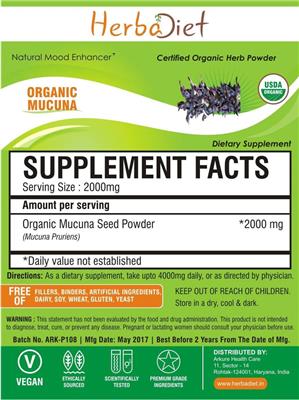
Supplement Facts
The label details for Organic Mucuna by Herbadiet, sourced from the NIH Dietary Supplement Label Database.
Supplement Facts
| Ingredient | Amount | % DV |
|---|---|---|
| Mucuna, Powder | 2000 mg | -- |
Tap any ingredient to jump to its full detail below.
These statements are the manufacturer’s wording, reproduced from the product label — the label is saying it, not HelloPharmacist. We don’t verify or endorse them.
Formulation
Natural mood enhancer
Free of fillers, binders, artificial ingredients, dairy, soy, wheat, gluten, yeast
Vegan
Ethically sourced Scientifically tested
Premium grade ingredients
USDA Organic
Formula
Certified organic herb powder
Seals/Symbols
USDA Organic
Vegan
FDA Statement of Identity
Dietary Supplement
Suggested/Recommended/Usage/Directions
Directions: As a dietary supplement, take up to 4000mg daily, or as directed by physician.
Precautions
Keep out of reach of children.
Pregnant or lactating women should consult your physician before use.
Storage
Store in a dry, cool & dark.
Best before 2 years from the date of Mfg.
FDA Disclaimer Statement
Warning: This statement has not been evaluated by the Food and Drug Administration. This product is not intended to diagnose, treat, cure, or prevent disease.
Is this label outdated? Report a formula or label change and our pharmacy team will review it.
Organic Mucuna by Herbadiet label
The label scan from the NIH Dietary Supplement Label Database. Tap to enlarge.
Label images are published by the NIH Dietary Supplement Label Database for the version of this product on file. Always read your actual product label.
View the full label (PDF)The Ingredients in Organic Mucuna by Herbadiet
This is the 1 active ingredient this product is made of. Select it to open its full monograph.
Serving size2000 mg Dosage formPowder Amounts shown are per serving.
Mucuna, Powder
Interacts with193 drugs
Cowhage (Mucuna pruriens) is a tropical legume best known as a natural source of L-dopa, the compound the body turns into dopamine. It is most studied...
Mucuna, Powder monograph & interactionsOrganic Mucuna by Herbadiet Drug Interactions
HelloPharmacist Interaction Report
Organic Mucuna by Herbadiet does interact with medications — notably through its levodopa content, which is an active compound that mimics dopamine in your brain.
The most serious interactions are with monoamine oxidase inhibitors (MAOIs) and methyldopa, where concomitant use carries a Major risk: MAOIs may trigger a hypertensive crisis (dangerously high blood pressure), and methyldopa may cause additive low blood pressure and increase levodopa levels in your central nervous system, risking serious adverse effects.
Read the full breakdown — every affected drug type, severity by severity
Additionally, this product contains levodopa itself — if you're already taking levodopa for Parkinson disease or another condition, combining them increases the risk of levodopa-related side effects. Taking it with antipsychotic drugs may reduce how well those antipsychotics work, since levodopa counteracts their mechanism.
Tricyclic antidepressants (TCAs) may reduce levodopa absorption and have been linked in case reports to high blood pressure and involuntary movements when used together. Guanethidine (a blood pressure medication) poses a risk of additive low blood pressure, and certain anesthetics — specifically cyclopropane or halogenated hydrocarbons — may cause heart rhythm problems.
Moderate concerns also exist with blood sugar medications: animal evidence suggests mucuna might lower blood sugar, raising the risk of hypoglycemia when combined with antidiabetes drugs. Altogether, these interactions span 193 individual medications.
Check your exact medications against the search tool below before starting this product, and talk with your doctor or pharmacist if you take any blood pressure drugs, antidepressants, antipsychotics, diabetes medications, or MAOIs.
Check your own medications below · Editorial policy · How we use AI
Want to check YOUR meds against Organic Mucuna?
Ask about interactions with your drugs in plain English — “Can I take it with lisinopril?” — and we find you the answer in seconds, ingredient by ingredient.
Go to the checkerIngredients driving the most interactions
Individual Drug Interactions
The ingredients in Organic Mucuna interact with 193 drugs. Click any drug to see the details.
1 of the 1 ingredient in Organic Mucuna interact with drugs. Each result below shows which ingredient is responsible. Mucuna, Powder
AmphetamineAdensys XR-ODT, Adzenys ER, Dyanavel XR, Mydayis
How Amphetamine interacts with Organic Mucuna — through 1 ingredient. Tap an ingredient for the detail:
Mucuna, PowderMonoamine Oxidase Inhibitors (maois) Major
Interaction Summary
Theoretically, concomitant use of cowhage and non-selective MAOIs might increase the risk of hypertensive crisis.
Read the full Mucuna, Powder + Amphetamine interactionBenserazide, LevodopaMadopar, Prolopa
How Benserazide, Levodopa interacts with Organic Mucuna — through 1 ingredient. Tap an ingredient for the detail:
Mucuna, PowderLevodopa Major
Interaction Summary
Concomitant use can increase the risk of levodopa-related adverse effects.
Read the full Mucuna, Powder + Benserazide, Levodopa interactionCarbidopa, LevodopaDhivy, Rytary, Sinemet, Sinemet CR
How Carbidopa, Levodopa interacts with Organic Mucuna — through 1 ingredient. Tap an ingredient for the detail:
Mucuna, PowderLevodopa Major
Interaction Summary
Concomitant use can increase the risk of levodopa-related adverse effects.
Read the full Mucuna, Powder + Carbidopa, Levodopa interactionCarbidopa, Levodopa, EntacaponeStalevo
How Carbidopa, Levodopa, Entacapone interacts with Organic Mucuna — through 1 ingredient. Tap an ingredient for the detail:
Mucuna, PowderLevodopa Major
Interaction Summary
Concomitant use can increase the risk of levodopa-related adverse effects.
Read the full Mucuna, Powder + Carbidopa, Levodopa, Entacapone interactionChlorothiazide, MethyldopaAldochlor, Aldoclor 150, Aldoclor 250
How Chlorothiazide, Methyldopa interacts with Organic Mucuna — through 1 ingredient. Tap an ingredient for the detail:
Mucuna, PowderMethyldopa (aldomet) Major
Interaction Summary
Theoretically, concomitant use of cowhage and methyldopa might increase the risk of hypotension.
Read the full Mucuna, Powder + Chlorothiazide, Methyldopa interactionHydrochlorothiazide, MethyldopaAldoril 15, Aldoril 25, Aldoril D30, Methazide
How Hydrochlorothiazide, Methyldopa interacts with Organic Mucuna — through 1 ingredient. Tap an ingredient for the detail:
Mucuna, PowderMethyldopa (aldomet) Major
Interaction Summary
Theoretically, concomitant use of cowhage and methyldopa might increase the risk of hypotension.
Read the full Mucuna, Powder + Hydrochlorothiazide, Methyldopa interactionIsocarboxazidMarplan
How Isocarboxazid interacts with Organic Mucuna — through 1 ingredient. Tap an ingredient for the detail:
Mucuna, PowderMonoamine Oxidase Inhibitors (maois) Major
Interaction Summary
Theoretically, concomitant use of cowhage and non-selective MAOIs might increase the risk of hypertensive crisis.
Read the full Mucuna, Powder + Isocarboxazid interactionLevodopaInbrija, Larodopa
How Levodopa interacts with Organic Mucuna — through 1 ingredient. Tap an ingredient for the detail:
Mucuna, PowderLevodopa Major
Interaction Summary
Concomitant use can increase the risk of levodopa-related adverse effects.
Read the full Mucuna, Powder + Levodopa interactionLevodopa, CarbidopaDuodopa
How Levodopa, Carbidopa interacts with Organic Mucuna — through 1 ingredient. Tap an ingredient for the detail:
Mucuna, PowderLevodopa Major
Interaction Summary
Concomitant use can increase the risk of levodopa-related adverse effects.
Read the full Mucuna, Powder + Levodopa, Carbidopa interactionMethyldopaAldomet, Methyldopa
How Methyldopa interacts with Organic Mucuna — through 1 ingredient. Tap an ingredient for the detail:
Mucuna, PowderMethyldopa (aldomet) Major
Interaction Summary
Theoretically, concomitant use of cowhage and methyldopa might increase the risk of hypotension.
Read the full Mucuna, Powder + Methyldopa interactionMoclobemideManerix, Moclobemide
How Moclobemide interacts with Organic Mucuna — through 1 ingredient. Tap an ingredient for the detail:
Mucuna, PowderMonoamine Oxidase Inhibitors (maois) Major
Interaction Summary
Theoretically, concomitant use of cowhage and non-selective MAOIs might increase the risk of hypertensive crisis.
Read the full Mucuna, Powder + Moclobemide interactionOzanimod HydrochlorideZeposia
How Ozanimod Hydrochloride interacts with Organic Mucuna — through 1 ingredient. Tap an ingredient for the detail:
Mucuna, PowderMonoamine Oxidase Inhibitors (maois) Major
Interaction Summary
Theoretically, concomitant use of cowhage and non-selective MAOIs might increase the risk of hypertensive crisis.
Read the full Mucuna, Powder + Ozanimod Hydrochloride interactionPhenelzine SulfateNardil
How Phenelzine Sulfate interacts with Organic Mucuna — through 1 ingredient. Tap an ingredient for the detail:
Mucuna, PowderMonoamine Oxidase Inhibitors (maois) Major
Interaction Summary
Theoretically, concomitant use of cowhage and non-selective MAOIs might increase the risk of hypertensive crisis.
Read the full Mucuna, Powder + Phenelzine Sulfate interactionRasagilineAzilect
How Rasagiline interacts with Organic Mucuna — through 1 ingredient. Tap an ingredient for the detail:
Mucuna, PowderMonoamine Oxidase Inhibitors (maois) Major
Interaction Summary
Theoretically, concomitant use of cowhage and non-selective MAOIs might increase the risk of hypertensive crisis.
Read the full Mucuna, Powder + Rasagiline interactionSafinamide MesylateXadago
How Safinamide Mesylate interacts with Organic Mucuna — through 1 ingredient. Tap an ingredient for the detail:
Mucuna, PowderMonoamine Oxidase Inhibitors (maois) Major
Interaction Summary
Theoretically, concomitant use of cowhage and non-selective MAOIs might increase the risk of hypertensive crisis.
Read the full Mucuna, Powder + Safinamide Mesylate interactionSelegilineCarbex, Eldepryl, Emsam, Zelapar
How Selegiline interacts with Organic Mucuna — through 1 ingredient. Tap an ingredient for the detail:
Mucuna, PowderMonoamine Oxidase Inhibitors (maois) Major
Interaction Summary
Theoretically, concomitant use of cowhage and non-selective MAOIs might increase the risk of hypertensive crisis.
Read the full Mucuna, Powder + Selegiline interactionTranylcypromineParnate
How Tranylcypromine interacts with Organic Mucuna — through 1 ingredient. Tap an ingredient for the detail:
Mucuna, PowderMonoamine Oxidase Inhibitors (maois) Major
Interaction Summary
Theoretically, concomitant use of cowhage and non-selective MAOIs might increase the risk of hypertensive crisis.
Read the full Mucuna, Powder + Tranylcypromine interactionAcarboseGlucobay, Prandase, Precose
How Acarbose interacts with Organic Mucuna — through 1 ingredient. Tap an ingredient for the detail:
Mucuna, PowderAntidiabetes Drugs Moderate
Interaction Summary
Theoretically, concomitant use of cowhage and antidiabetes drugs might increase the risk of hypoglycemia.
Read the full Mucuna, Powder + Acarbose interactionAcepromazineAtravet
How Acepromazine interacts with Organic Mucuna — through 1 ingredient. Tap an ingredient for the detail:
Mucuna, PowderAntipsychotic Drugs Moderate
Interaction Summary
Theoretically, use of cowhage might decrease the clinical effects of antipsychotic drugs.
Read the full Mucuna, Powder + Acepromazine interactionAcetohexamideDymelor
How Acetohexamide interacts with Organic Mucuna — through 1 ingredient. Tap an ingredient for the detail:
Mucuna, PowderAntidiabetes Drugs Moderate
Interaction Summary
Theoretically, concomitant use of cowhage and antidiabetes drugs might increase the risk of hypoglycemia.
Read the full Mucuna, Powder + Acetohexamide interactionAcetophenazineTindal
How Acetophenazine interacts with Organic Mucuna — through 1 ingredient. Tap an ingredient for the detail:
Mucuna, PowderAntipsychotic Drugs Moderate
Interaction Summary
Theoretically, use of cowhage might decrease the clinical effects of antipsychotic drugs.
Read the full Mucuna, Powder + Acetophenazine interactionAlbiglutideTanzeum
How Albiglutide interacts with Organic Mucuna — through 1 ingredient. Tap an ingredient for the detail:
Mucuna, PowderAntidiabetes Drugs Moderate
Interaction Summary
Theoretically, concomitant use of cowhage and antidiabetes drugs might increase the risk of hypoglycemia.
Read the full Mucuna, Powder + Albiglutide interactionAlfentanilAlfenta
How Alfentanil interacts with Organic Mucuna — through 1 ingredient. Tap an ingredient for the detail:
Mucuna, PowderAnesthesia Moderate
Interaction Summary
Theoretically, concomitant use of cowhage and anesthesia might increase the risk of arrhythmias.
Read the full Mucuna, Powder + Alfentanil interactionAlogliptinNesina
How Alogliptin interacts with Organic Mucuna — through 1 ingredient. Tap an ingredient for the detail:
Mucuna, PowderAntidiabetes Drugs Moderate
Interaction Summary
Theoretically, concomitant use of cowhage and antidiabetes drugs might increase the risk of hypoglycemia.
Read the full Mucuna, Powder + Alogliptin interactionAlogliptin, MetforminKazano
How Alogliptin, Metformin interacts with Organic Mucuna — through 1 ingredient. Tap an ingredient for the detail:
Mucuna, PowderAntidiabetes Drugs Moderate
Interaction Summary
Theoretically, concomitant use of cowhage and antidiabetes drugs might increase the risk of hypoglycemia.
Read the full Mucuna, Powder + Alogliptin, Metformin interactionAlogliptin, PioglitazoneOseni
How Alogliptin, Pioglitazone interacts with Organic Mucuna — through 1 ingredient. Tap an ingredient for the detail:
Mucuna, PowderAntidiabetes Drugs Moderate
Interaction Summary
Theoretically, concomitant use of cowhage and antidiabetes drugs might increase the risk of hypoglycemia.
Read the full Mucuna, Powder + Alogliptin, Pioglitazone interactionAmitriptylineElavil
How Amitriptyline interacts with Organic Mucuna — through 1 ingredient. Tap an ingredient for the detail:
Mucuna, PowderTricyclic Antidepressants (tcas) Moderate
Interaction Summary
Theoretically, use of TCAs might reduce the levels and clinical effects of cowhage.
Read the full Mucuna, Powder + Amitriptyline interactionAmitriptyline, ChlordiazepoxideLimbitrol DS
How Amitriptyline, Chlordiazepoxide interacts with Organic Mucuna — through 1 ingredient. Tap an ingredient for the detail:
Mucuna, PowderTricyclic Antidepressants (tcas) Moderate
Interaction Summary
Theoretically, use of TCAs might reduce the levels and clinical effects of cowhage.
Read the full Mucuna, Powder + Amitriptyline, Chlordiazepoxide interactionAmitriptyline, PerphenazineEtrafon, Etrafon-A, Etrafon-Forte, Triavil
How Amitriptyline, Perphenazine interacts with Organic Mucuna — through 1 ingredient. Tap an ingredient for the detail:
Mucuna, PowderAntipsychotic Drugs, Tricyclic Antidepressants (tcas) Moderate
Interaction Summary
Theoretically, use of cowhage might decrease the clinical effects of antipsychotic drugs.
Read the full Mucuna, Powder + Amitriptyline, Perphenazine interactionAmoxapineAsendin
How Amoxapine interacts with Organic Mucuna — through 1 ingredient. Tap an ingredient for the detail:
Mucuna, PowderTricyclic Antidepressants (tcas) Moderate
Interaction Summary
Theoretically, use of TCAs might reduce the levels and clinical effects of cowhage.
Read the full Mucuna, Powder + Amoxapine interactionEach ingredient & the kinds of drugs it affects
For each ingredient in Organic Mucuna with known interactions, here are the types of medications it can affect. Open any type for the detail — or search your exact drug in the checker above.
Mucuna, Powder
Levodopa
Concomitant use can increase the risk of levodopa-related adverse effects.
Cowhage contains levodopa. Some cowhage products have been standardized to contain 75-400 mg of levodopa per dose.
Methyldopa (Aldomet)
Theoretically, concomitant use of cowhage and methyldopa might increase the risk of hypotension.
Cowhage contains levodopa. Use of levodopa with methyldopa might cause additive hypotension. In addition, methyldopa may inhibit peripheral decarboxylation of levodopa and increase levodopa levels in the central nervous system; avoid using.
Monoamine Oxidase Inhibitors (Maois)
Theoretically, concomitant use of cowhage and non-selective MAOIs might increase the risk of hypertensive crisis.
Cowhage contains levodopa. Use of levodopa with non-selective MAOIs might cause hypertensive crisis. However, this interaction has not been reported with MAO-B selective inhibitors such as selegiline.
Anesthesia
Theoretically, concomitant use of cowhage and anesthesia might increase the risk of arrhythmias.
Cowhage contains levodopa. Use of levodopa with cyclopropane or halogenated hydrocarbon anesthesia has led to arrhythmias. Other anesthetics have not been implicated. Use other anesthetics in patients taking cowhage or tell patients to stop taking cowhage at least 2 weeks before surgery.
Antidiabetes Drugs
Theoretically, concomitant use of cowhage and antidiabetes drugs might increase the risk of hypoglycemia.
Animal research shows that cowhage might have hypoglycemic effects.
Antipsychotic Drugs
Theoretically, use of cowhage might decrease the clinical effects of antipsychotic drugs.
Cowhage contains levodopa. Use of levodopa might counteract the antidopaminergic effects of antipsychotic medications.
Guanethidine (Ismelin)
Theoretically, concomitant use of cowhage and guanethidine might increase the risk of hypotension.
Cowhage contains levodopa. Use of levodopa with guanethidine might cause additive hypotension; avoid using.
Tricyclic Antidepressants (Tcas)
Theoretically, use of TCAs might reduce the levels and clinical effects of cowhage.
Cowhage contains levodopa. Use of TCAs might reduce the absorption of levodopa. Some case reports describe patients that developed hypertension and dyskinesia when taking both levodopa and TCAs.
Brand information
Manufacturer and brand details for Organic Mucuna, from the product label.
Herbadiet
See all Herbadiet products- Name
- Arkure Health Care
- Street Address
- 11, Sector - 14
- City
- Rohtak
- State
- Haryana
- ZipCode
- 124001
- Web Address
- www.herbadiet.in
Organic Mucuna by Herbadiet: Common Questions
Does Organic Mucuna by Herbadiet interact with any medications?
How can one product interact with so many drugs?
Where does this information come from?
What is mucuna (cowhage) and why is it in this product?
Can I take this if I'm on blood pressure or heart medications?
What side effects might I experience?
Is this safe during pregnancy or breastfeeding?
Can I take this with my antidepressant?
What if I take diabetes medication?
Written and reviewed by the HelloPharmacist editorial staff. Our editorial policy
Not sure if Organic Mucuna is safe with your meds?
Our pharmacists answer your medication & supplement questions — free.
Label information is sourced from the NIH Dietary Supplement Label Database and reflects the product version on file; always read your actual product label. This page is for education only and is not a substitute for professional medical advice. Confirm with your pharmacist or doctor before combining supplements and medications.
The Full Monographs Behind Organic Mucuna’s Ingredients
Every ingredient we hold a full HelloPharmacist monograph for — uses, evidence, safety, and the complete interaction list.
Sources & How We Checked
Organic Mucuna's label data comes from the NIH Dietary Supplement Label Database; the ingredient interaction data is from the Natural Medicines database, reviewed by our pharmacists.
- NIH Dietary Supplement Label Database (DSLD) — The official product label on file for this supplement.
- Natural Medicines (Therapeutic Research Center) — Evidence-graded clinical reference behind the ingredient interaction data.
Content is written and reviewed by licensed HelloPharmacist pharmacists. See our data sources and editorial standards for how this information is built and checked.
The 12 references behind this product’s interaction data
Every citation that drives the interaction findings for this product’s ingredients, from the evidence-graded Natural Medicines (TRC Healthcare) database. Open an ingredient to browse its citations — links open the study on PubMed or the publisher’s site.
Cowhage 12 references
- McEvoy GK, ed. AHFS Drug Information. Bethesda, MD: American Society of Health-System Pharmacists, 1998.
- Gruenwald J, Brendler T, Jaenicke C. PDR for Herbal Medicines. 1st ed. Montvale, NJ: Medical Economics Company, Inc., 1998.
- Anon. Epidemiological notes and reports: Mucuna pruriens-associated pruritus--New Jersey. MMWR Morb Mortal Wkly Rep 1985;34:732-3.
- HP-200 in Parkinson's Disease study group. An alternative medicine treatment for Parkinson's disease: Results of a multicenter clinical trial. J Alt Comp Med 1995;1:249-55. DOI
- Infante ME, Perez AM, Simao MR, et al. Outbreak of acute toxic psychosis attributed to Mucuna pruriens. Lancet 1990;336:1129. PubMed
- Vaidya AB, Rajagopalan TG, Mankodi NA, et al. Treatment of Parkinson's disease with the cowhage plant-Mucuna pruriens Bak. Neurol India 1978;26:171-6.
- Vadivel V, Janardhanan K. Nutritional and anti-nutritional composition of velvet bean: an under-utilized food legume in south India. Int J Food Sci Nutr 2000;51:279-87. PubMed
- Akhtar MS, Qureshi AQ, Iqbal J. Antidiabetic evaluation of Mucuna pruriens, Linn seeds. J Pak Med Assoc 1990;40:147-50.
- Prakash, D., Niranjan, A., and Tewari, S. K. Some nutritional properties of the seeds of three Mucuna species. Int.J.Food Sci.Nutr. 2001;52(1):79-82.
- Vadivel, V. and Janardhanan, K. Nutritional and antinutritional characteristics of seven South Indian wild legumes. Plant Foods Hum.Nutr 2005;60(2):69-75. PubMed
- Creapure (Creatine Monohydrate). Toxicological Datasheet. Degussa BioActives. Available at: https://www.fda.gov/ohrms/DOCKETS/.../95s-0316-rpt0154-54-Ref-50-vol112.pdf.
- Pulikkalpura H, Kurup R, Mathew PJ, Baby S. Levodopa in Mucuna pruriens and its degradation. Sci Rep 2015;5:11078. PubMed
Parts of this content are provided by the Therapeutic Research Center, LLC.
DISCLAIMER: Currently this does not check for drug-drug interactions. This is not an all-inclusive comprehensive list of potential interactions and is for informational purposes only. Not all interactions are known or well-reported in the scientific literature, and new interactions are continually being reported. Input is needed from a qualified healthcare provider including a pharmacist before starting any therapy. Application of clinical judgment is necessary.
© 2021 Therapeutic Research Center, LLC