
Peak ATP 400 mg Ingredients & Drug Interactions
by SuperSmart
What is this page for?
First and foremost: checking Peak ATP 400 mg against your medications. The heart of this page is the interaction checker and the full interaction report — how this product’s ingredients may interact with prescription and over-the-counter medicines you may be taking.
Around that, we add a pharmacist’s high-level view of the product as a whole — what’s inside, the evidence for its stated use, how transparent the label is, and what safety data exists — so you can see the full picture in one place. It’s educational information from our licensed clinical databases and the clinical staff at HelloPharmacist — not medical advice — and we don’t sell or endorse products. Our editorial policy
Peak ATP 400 mg is a dietary supplement by SuperSmart with 1 active ingredient. Its ingredients are commonly taken for energy and cellular function support, athletic performance and muscle energy, circulation support.Based on those ingredients, 47 medications have a known interaction with it, the most serious rated major. The ingredients most likely to interact are Peak ATP. Use the checker below to test your specific medication, or read the full HelloPharmacist Interaction Report.
Check Your Meds Against Peak ATP 400 mg by SuperSmart
Ask about any prescription or over-the-counter medication and we check it for interactions with Peak ATP 400 mg by SuperSmart — and tell you which ingredient is responsible.
AI summaries are generated from our interaction database for education only — always confirm with your pharmacist. How we use AI
Ask the Pharmacist
A licensed pharmacist will answer your question by email — free, usually within 24 hours.
Got it — thank you!
A licensed pharmacist will answer within 24 hours. Keep an eye on your email (worth checking spam, just in case).
HelloPharmacist Scorecard of Peak ATP 400 mg by SuperSmart
Our pharmacy team’s full take, with four database checks built into the cards below — a summary of what is known, not a grade of the product itself.
What’s inside
Full disclosure
This product contains one active ingredient: Peak ATP, which is adenosine. Adenosine is a naturally occurring compound involved in energy production and cell signaling in the body.
The capsule also contains acacia gum as an inactive ingredient.
Does it work?
Not established
In prescription form (given by IV), adenosine is effective for treating paroxysmal supraventricular tachycardia (a type of rapid heart rhythm) and for helping diagnose cardiovascular disease during stress testing. However, the evidence for this oral supplement form is limited.
The safety and effectiveness data we hold come from the injectable prescription version, which is a powerful medication given only by medical professionals — what works intravenously may not translate the same way to an oral supplement.
How safe is it?
Well-documented data
Here's the candid part: the supplement form of adenosine hasn't been thoroughly studied for safety. The safety notes in our data advise caution because evidence for oral supplement use is limited.
The intravenous prescription form can cause chest pain, dizziness, shortness of breath (dyspnea), flushing, headache, low blood pressure (hypotension), nausea, and in rare cases serious heart rhythm problems — but those are from IV doses given in a controlled medical setting. With oral or intramuscular use, no adverse effects have been formally reported, though a full safety evaluation hasn't been done either.
Regarding pregnancy and breastfeeding: there isn't enough safety information on file for either, so you'd want to talk with your doctor or pharmacist before use.
Meds to double-check
Major interaction found
Before taking this product, double-check with your pharmacist if you're on dipyridamole (Persantine) — a major interaction — or carbamazepine (Tegretol) for seizures. Also ask about methylxanthines: caffeine supplements, theophylline, or aminophylline, which can block this product's effects.
Altogether, these interactions span 47 individual medications.
The bottom line
Scorecard at a glanceFully disclosed formula with no established evidence rating for its marketed use. Major medication interactions have been identified, and safety information is well characterized.
Peak ATP is an oral form of a compound that's well-established in IV cardiac medicine, but the supplement evidence is thin. If you take dipyridamole, carbamazepine, or methylxanthines (caffeine, theophylline, aminophylline), this isn't for you without a conversation with your pharmacist.
Pregnant or breastfeeding? Check with your doctor first.
Educational only — not medical advice; always confirm with your pharmacist. Our editorial policy · How we use AI
Assessment coverage: 1 of 1 active ingredient matched to our full ingredient reviews (monographs). Based on the product label dated Jul 24, 2025.
This Scorecard evaluates available label information, ingredient evidence, and known medication-safety considerations. It does not independently verify product identity, purity, potency, contamination, or manufacturing quality. How these ratings are computed
General information
Key facts about Peak ATP 400 mg, straight from the product label.
| Brand | SuperSmart |
|---|---|
| Barcode (UPC) | 5453003824091 |
| Net contents | 120 Drcaps Hypromellose Capsule(s) |
| Market status | On market |
| Date entered into DSLD | Jul 24, 2025 |
| DSLD ID | 332479 |
| Product type | Non-nutrient/non-botanical |
| Supplement form | Capsule |
| Dietary claims / uses | All Other, Structure/Function |
| Intended target group(s) | Adult (18 - 50 Years) |
Everything in this section is reproduced from the manufacturer’s own product label — it’s the label speaking, not HelloPharmacist. We show it so you can see exactly what the maker states; we don’t verify or endorse those statements.
Supplement Facts
The label details for Peak ATP 400 mg by SuperSmart, sourced from the NIH Dietary Supplement Label Database.
Tap any ingredient to jump to its full detail below.
These statements are the manufacturer’s wording, reproduced from the product label — the label is saying it, not HelloPharmacist. We don’t verify or endorse them.
Formula
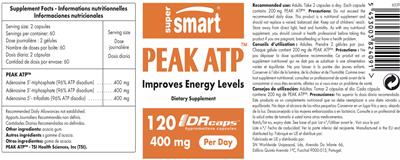
PEAK ATP - TSI Health Sciences, Inc (TSI).
PEAK ATP 400 mg per day
Each capsule contains 200 mg PEAK ATP.
Formulation
Improves energy levels
FDA Statement of Identity
Dietary Supplement
Suggested/Recommended/Usage/Directions
Recommended use: Adults. Take 2 capsules a day.
Precautions
Precautions: Do not exceed the recommended daily dose. This product is a nutritional supplement and should not replace a varied, balanced diet.
Keep out of childrens' reach.
As with any nutritional supplement, you should consult a health professional before taking this product if you are pregnant, breastfeeding or have a health problem.
Storage
Store away from direct light, heat and humidity.
Is this label outdated? Report a formula or label change and our pharmacy team will review it.
Peak ATP 400 mg by SuperSmart label
The label scan from the NIH Dietary Supplement Label Database. Tap to enlarge.
Label images are published by the NIH Dietary Supplement Label Database for the version of this product on file. Always read your actual product label.
View the full label (PDF)The Ingredients in Peak ATP 400 mg by SuperSmart
This is the 1 active ingredient this product is made of. Select it to open its full monograph.
Serving size2 Capsule(s) Dosage formCapsule Servings per container60 Amounts shown are per serving.
Peak ATP
Interacts with47 drugs
Adenosine is a natural building block your body uses for energy and cell signaling, and a prescription injectable version is used by doctors to treat...
Peak ATP monograph & interactionsOther (inactive) ingredients: Acacia Gum. These complete the product’s ingredient list but are not active constituents.
Peak ATP 400 mg by SuperSmart Drug Interactions
HelloPharmacist Interaction Report
Peak ATP 400 mg by SuperSmart contains adenosine, which interacts with several medications.
The most serious concern is dipyridamole (Persantine), a blood vessel dilator used in cardiac testing — adenosine can amplify both its therapeutic and toxic effects, potentially causing dizziness, slow heart rate (bradycardia), and fainting. If you take dipyridamole, it needs to be stopped several days before any adenosine-based cardiac stress test.
Read the full breakdown — every affected drug type, severity by severity
Carbamazepine (Tegretol), an anti-seizure medication, poses a moderate risk: both it and adenosine can cause heart block on their own, and using them together might add that risk. Additionally, caffeine, aminophylline, and theophylline (methylxanthines used for breathing problems and other conditions) are competitive antagonists of adenosine — they block its effects — so they should be avoided for 24 hours before taking this product.
Additionally, check your exact medications with our search tool on this page to see if any of your prescriptions fall into these categories.
Check your own medications below · Editorial policy · How we use AI
Want to check YOUR meds against Peak ATP 400 mg?
Ask about interactions with your drugs in plain English — “Can I take it with lisinopril?” — and we find you the answer in seconds, ingredient by ingredient.
Go to the checkerIngredients driving the most interactions
Individual Drug Interactions
The ingredients in Peak ATP 400 mg interact with 47 drugs. Click any drug to see the details.
1 of the 1 ingredient in Peak ATP 400 mg interact with drugs. Each result below shows which ingredient is responsible. Peak ATP
Aspirin, DipyridamoleAggrenox, Asasantin Retard
How Aspirin, Dipyridamole interacts with Peak ATP 400 mg — through 1 ingredient. Tap an ingredient for the detail:
Peak AtpDipyridamole (persantine) Major
Interaction Summary
Dipyridamole can increase the therapeutic and toxic effects of adenosine.
Read the full Peak Atp + Aspirin, Dipyridamole interactionDipyridamoleDipyridamole, Persantin, Persantin Injection, Persantin Retard, Persantine
How Dipyridamole interacts with Peak ATP 400 mg — through 1 ingredient. Tap an ingredient for the detail:
Peak AtpDipyridamole (persantine) Major
Interaction Summary
Dipyridamole can increase the therapeutic and toxic effects of adenosine.
Read the full Peak Atp + Dipyridamole interactionCarbamazepineCarbatrol, Carnexiv, Equetro, Tegretol, Tegretol XR
How Carbamazepine interacts with Peak ATP 400 mg — through 1 ingredient. Tap an ingredient for the detail:
Peak AtpCarbamazepine (tegretol) Moderate
Interaction Summary
Carbamazepine might increase the risk of heart block when used concomitantly with adenosine.
Read the full Peak Atp + Carbamazepine interactionAcetaminophen, Aspirin, CaffeineExcedrin, Excedrin Extra Strength, Excedrin Migraine
How Acetaminophen, Aspirin, Caffeine interacts with Peak ATP 400 mg — through 1 ingredient. Tap an ingredient for the detail:
Peak AtpMethylxanthines Minor
Interaction Summary
Methylxanthines are competitive antagonists of adenosine and can block its pharmacologic effects.
Read the full Peak Atp + Acetaminophen, Aspirin, Caffeine interactionAcetaminophen, Butalbital, CaffeineEsgic, Esgic Plus, Fiogesic, Fioricet, Repan, Tecnal +1 more
How Acetaminophen, Butalbital, Caffeine interacts with Peak ATP 400 mg — through 1 ingredient. Tap an ingredient for the detail:
Peak AtpMethylxanthines Minor
Interaction Summary
Methylxanthines are competitive antagonists of adenosine and can block its pharmacologic effects.
Read the full Peak Atp + Acetaminophen, Butalbital, Caffeine interactionAcetaminophen, Butalbital, Caffeine, CodeineEsgic with Codeine, Fioricet w/ Codeine
How Acetaminophen, Butalbital, Caffeine, Codeine interacts with Peak ATP 400 mg — through 1 ingredient. Tap an ingredient for the detail:
Peak AtpMethylxanthines Minor
Interaction Summary
Methylxanthines are competitive antagonists of adenosine and can block its pharmacologic effects.
Read the full Peak Atp + Acetaminophen, Butalbital, Caffeine, Codeine interactionAcetaminophen, Caffeine, Chlorpheniramine, Hydrocodone, PhenylephrineHycomine Compound
How Acetaminophen, Caffeine, Chlorpheniramine, Hydrocodone, Phenylephrine interacts with Peak ATP 400 mg — through 1 ingredient. Tap an ingredient for the detail:
Peak AtpMethylxanthines Minor
Interaction Summary
Methylxanthines are competitive antagonists of adenosine and can block its pharmacologic effects.
Read the full Peak Atp + Acetaminophen, Caffeine, Chlorpheniramine, Hydrocodone, Phenylephrine interactionAcetaminophen, Caffeine, CodeineGesic C15, Gesic C30, Gesic C8, Lenoltec 1, Lenoltec 2, Lenoltec 3 +1 more
How Acetaminophen, Caffeine, Codeine interacts with Peak ATP 400 mg — through 1 ingredient. Tap an ingredient for the detail:
Peak AtpMethylxanthines Minor
Interaction Summary
Methylxanthines are competitive antagonists of adenosine and can block its pharmacologic effects.
Read the full Peak Atp + Acetaminophen, Caffeine, Codeine interactionAcetaminophen, Caffeine, Codeine, SalicylamideCodalan No.1, Codalan No.2, Codalan No.3
How Acetaminophen, Caffeine, Codeine, Salicylamide interacts with Peak ATP 400 mg — through 1 ingredient. Tap an ingredient for the detail:
Peak AtpMethylxanthines Minor
Interaction Summary
Methylxanthines are competitive antagonists of adenosine and can block its pharmacologic effects.
Read the full Peak Atp + Acetaminophen, Caffeine, Codeine, Salicylamide interactionAcetaminophen, Caffeine, DihydrocodeineDHC Plus, Panlor DC, Panlor SS
How Acetaminophen, Caffeine, Dihydrocodeine interacts with Peak ATP 400 mg — through 1 ingredient. Tap an ingredient for the detail:
Peak AtpMethylxanthines Minor
Interaction Summary
Methylxanthines are competitive antagonists of adenosine and can block its pharmacologic effects.
Read the full Peak Atp + Acetaminophen, Caffeine, Dihydrocodeine interactionAcetaminophen, Caffeine, IsomethepteneMigralam
How Acetaminophen, Caffeine, Isometheptene interacts with Peak ATP 400 mg — through 1 ingredient. Tap an ingredient for the detail:
Peak AtpMethylxanthines Minor
Interaction Summary
Methylxanthines are competitive antagonists of adenosine and can block its pharmacologic effects.
Read the full Peak Atp + Acetaminophen, Caffeine, Isometheptene interactionAcetaminophen, Caffeine, PyrilamineMidol Max Strength Menstrual
How Acetaminophen, Caffeine, Pyrilamine interacts with Peak ATP 400 mg — through 1 ingredient. Tap an ingredient for the detail:
Peak AtpMethylxanthines Minor
Interaction Summary
Methylxanthines are competitive antagonists of adenosine and can block its pharmacologic effects.
Read the full Peak Atp + Acetaminophen, Caffeine, Pyrilamine interactionAminophyllineAminophylline
How Aminophylline interacts with Peak ATP 400 mg — through 1 ingredient. Tap an ingredient for the detail:
Peak AtpMethylxanthines Minor
Interaction Summary
Methylxanthines are competitive antagonists of adenosine and can block its pharmacologic effects.
Read the full Peak Atp + Aminophylline interactionAminophylline, Amobarbital, EphedrineAmesec
How Aminophylline, Amobarbital, Ephedrine interacts with Peak ATP 400 mg — through 1 ingredient. Tap an ingredient for the detail:
Peak AtpMethylxanthines Minor
Interaction Summary
Methylxanthines are competitive antagonists of adenosine and can block its pharmacologic effects.
Read the full Peak Atp + Aminophylline, Amobarbital, Ephedrine interactionAspirin, Butalbital, CaffeineFiorinal
How Aspirin, Butalbital, Caffeine interacts with Peak ATP 400 mg — through 1 ingredient. Tap an ingredient for the detail:
Peak AtpMethylxanthines Minor
Interaction Summary
Methylxanthines are competitive antagonists of adenosine and can block its pharmacologic effects.
Read the full Peak Atp + Aspirin, Butalbital, Caffeine interactionAspirin, Butalbital, Caffeine, Codeine PhosphateFiorinal w/ Codeine
How Aspirin, Butalbital, Caffeine, Codeine Phosphate interacts with Peak ATP 400 mg — through 1 ingredient. Tap an ingredient for the detail:
Peak AtpMethylxanthines Minor
Interaction Summary
Methylxanthines are competitive antagonists of adenosine and can block its pharmacologic effects.
Read the full Peak Atp + Aspirin, Butalbital, Caffeine, Codeine Phosphate interactionAspirin, Butalbital, Caffeine, PhenacetinMarnal
How Aspirin, Butalbital, Caffeine, Phenacetin interacts with Peak ATP 400 mg — through 1 ingredient. Tap an ingredient for the detail:
Peak AtpMethylxanthines Minor
Interaction Summary
Methylxanthines are competitive antagonists of adenosine and can block its pharmacologic effects.
Read the full Peak Atp + Aspirin, Butalbital, Caffeine, Phenacetin interactionAspirin, CaffeineAnacin
How Aspirin, Caffeine interacts with Peak ATP 400 mg — through 1 ingredient. Tap an ingredient for the detail:
Peak AtpMethylxanthines Minor
Interaction Summary
Methylxanthines are competitive antagonists of adenosine and can block its pharmacologic effects.
Read the full Peak Atp + Aspirin, Caffeine interactionAspirin, Caffeine, Codeine PhosphateAnacin w/ Codeine
How Aspirin, Caffeine, Codeine Phosphate interacts with Peak ATP 400 mg — through 1 ingredient. Tap an ingredient for the detail:
Peak AtpMethylxanthines Minor
Interaction Summary
Methylxanthines are competitive antagonists of adenosine and can block its pharmacologic effects.
Read the full Peak Atp + Aspirin, Caffeine, Codeine Phosphate interactionAspirin, Caffeine, Dihydrocodeine BitartrateSynalgos DC
How Aspirin, Caffeine, Dihydrocodeine Bitartrate interacts with Peak ATP 400 mg — through 1 ingredient. Tap an ingredient for the detail:
Peak AtpMethylxanthines Minor
Interaction Summary
Methylxanthines are competitive antagonists of adenosine and can block its pharmacologic effects.
Read the full Peak Atp + Aspirin, Caffeine, Dihydrocodeine Bitartrate interactionAspirin, Caffeine, Dover's PwdAcedoval, Dovacet
How Aspirin, Caffeine, Dover's Pwd interacts with Peak ATP 400 mg — through 1 ingredient. Tap an ingredient for the detail:
Peak AtpMethylxanthines Minor
Interaction Summary
Methylxanthines are competitive antagonists of adenosine and can block its pharmacologic effects.
Read the full Peak Atp + Aspirin, Caffeine, Dover's Pwd interactionAspirin, Caffeine, HydrocodoneDamason-P
How Aspirin, Caffeine, Hydrocodone interacts with Peak ATP 400 mg — through 1 ingredient. Tap an ingredient for the detail:
Peak AtpMethylxanthines Minor
Interaction Summary
Methylxanthines are competitive antagonists of adenosine and can block its pharmacologic effects.
Read the full Peak Atp + Aspirin, Caffeine, Hydrocodone interactionAspirin, Caffeine, Isobutylallylbarbituric Acid, PhenacetinLanorinal
How Aspirin, Caffeine, Isobutylallylbarbituric Acid, Phenacetin interacts with Peak ATP 400 mg — through 1 ingredient. Tap an ingredient for the detail:
Peak AtpMethylxanthines Minor
Interaction Summary
Methylxanthines are competitive antagonists of adenosine and can block its pharmacologic effects.
Read the full Peak Atp + Aspirin, Caffeine, Isobutylallylbarbituric Acid, Phenacetin interactionAspirin, Caffeine, OrphenadrineInvagesic, Invagesic Forte, Norgesic, Norgesic Forte, Orphengesic, Orphengesic Forte
How Aspirin, Caffeine, Orphenadrine interacts with Peak ATP 400 mg — through 1 ingredient. Tap an ingredient for the detail:
Peak AtpMethylxanthines Minor
Interaction Summary
Methylxanthines are competitive antagonists of adenosine and can block its pharmacologic effects.
Read the full Peak Atp + Aspirin, Caffeine, Orphenadrine interactionAspirin, Caffeine, Phenacetin, PropoxypheneMargesic Comp. 65
How Aspirin, Caffeine, Phenacetin, Propoxyphene interacts with Peak ATP 400 mg — through 1 ingredient. Tap an ingredient for the detail:
Peak AtpMethylxanthines Minor
Interaction Summary
Methylxanthines are competitive antagonists of adenosine and can block its pharmacologic effects.
Read the full Peak Atp + Aspirin, Caffeine, Phenacetin, Propoxyphene interactionBelladonna, Caffeine, Ergotamine, PentobarbitalMicomp PB
How Belladonna, Caffeine, Ergotamine, Pentobarbital interacts with Peak ATP 400 mg — through 1 ingredient. Tap an ingredient for the detail:
Peak AtpMethylxanthines Minor
Interaction Summary
Methylxanthines are competitive antagonists of adenosine and can block its pharmacologic effects.
Read the full Peak Atp + Belladonna, Caffeine, Ergotamine, Pentobarbital interactionBellafoline, Caffeine, Ergotamine Tartrate, PentobarbitalCafergot PB
How Bellafoline, Caffeine, Ergotamine Tartrate, Pentobarbital interacts with Peak ATP 400 mg — through 1 ingredient. Tap an ingredient for the detail:
Peak AtpMethylxanthines Minor
Interaction Summary
Methylxanthines are competitive antagonists of adenosine and can block its pharmacologic effects.
Read the full Peak Atp + Bellafoline, Caffeine, Ergotamine Tartrate, Pentobarbital interactionCaffeine (otc Drug)Molie, Overtime, Vivarin
How Caffeine (otc Drug) interacts with Peak ATP 400 mg — through 1 ingredient. Tap an ingredient for the detail:
Peak AtpMethylxanthines Minor
Interaction Summary
Methylxanthines are competitive antagonists of adenosine and can block its pharmacologic effects.
Read the full Peak Atp + Caffeine (otc Drug) interactionCaffeine (prescription Drug)Caffeine, Dextrophin
How Caffeine (prescription Drug) interacts with Peak ATP 400 mg — through 1 ingredient. Tap an ingredient for the detail:
Peak AtpMethylxanthines Minor
Interaction Summary
Methylxanthines are competitive antagonists of adenosine and can block its pharmacologic effects.
Read the full Peak Atp + Caffeine (prescription Drug) interactionCaffeine , Sodium BenzoateCaffeine and Sodium Benzoate
How Caffeine , Sodium Benzoate interacts with Peak ATP 400 mg — through 1 ingredient. Tap an ingredient for the detail:
Peak AtpMethylxanthines Minor
Interaction Summary
Methylxanthines are competitive antagonists of adenosine and can block its pharmacologic effects.
Read the full Peak Atp + Caffeine , Sodium Benzoate interactionEach ingredient & the kinds of drugs it affects
For each ingredient in Peak ATP 400 mg with known interactions, here are the types of medications it can affect. Open any type for the detail — or search your exact drug in the checker above.
Peak ATP
Dipyridamole (Persantine)
Dipyridamole can increase the therapeutic and toxic effects of adenosine.
Dipyridamole decreases the metabolism of adenosine. Intravenous infusion of adenosine in patients who are taking dipyridamole can cause dizziness, bradycardia, and syncope. Dipyridamole should be discontinued for several days prior to a cardiac stress test using adenosine.
Carbamazepine (Tegretol)
Carbamazepine might increase the risk of heart block when used concomitantly with adenosine.
Carbamazepine and adenosine can both cause heart block. Giving them concurrently might produce an additive effect.
Methylxanthines
Methylxanthines are competitive antagonists of adenosine and can block its pharmacologic effects.
The methylxanthines, aminophylline, caffeine, and theophylline, can block the effects of adenosine by acting as competitive antagonists at adenosine cell surface receptors. It is recommended that methylxanthines be avoided for 24 hours prior to cardiac stress tests.
Brand information
Manufacturer and brand details for Peak ATP 400 mg, from the product label.
SuperSmart
See all SuperSmart products- Name
- SN Worldwide Unipessoal, Lda
- Street Address
- Avenida Do Infante 66, Edificio Quinta Avenida 1 C
- City
- Funchal
- ZipCode
- 9000-015
Peak ATP 400 mg by SuperSmart: Common Questions
Does Peak ATP 400 mg by SuperSmart interact with any medications?
How can one product interact with so many drugs?
Where does this information come from?
What exactly is Peak ATP?
Does it actually work for athletic performance or energy?
Can I take this if I'm pregnant or breastfeeding?
What side effects should I watch for?
I drink a lot of coffee. Is that a problem?
Written and reviewed by the HelloPharmacist editorial staff. Our editorial policy
Not sure if Peak ATP 400 mg is safe with your meds?
Our pharmacists answer your medication & supplement questions — free.
Label information is sourced from the NIH Dietary Supplement Label Database and reflects the product version on file; always read your actual product label. This page is for education only and is not a substitute for professional medical advice. Confirm with your pharmacist or doctor before combining supplements and medications.
The Full Monographs Behind Peak ATP 400 mg’s Ingredients
Every ingredient we hold a full HelloPharmacist monograph for — uses, evidence, safety, and the complete interaction list.
Sources & How We Checked
Peak ATP 400 mg's label data comes from the NIH Dietary Supplement Label Database; the ingredient interaction data is from the Natural Medicines database, reviewed by our pharmacists.
- NIH Dietary Supplement Label Database (DSLD) — The official product label on file for this supplement.
- Natural Medicines (Therapeutic Research Center) — Evidence-graded clinical reference behind the ingredient interaction data.
Content is written and reviewed by licensed HelloPharmacist pharmacists. See our data sources and editorial standards for how this information is built and checked.
The 10 references behind this product’s interaction data
Every citation that drives the interaction findings for this product’s ingredients, from the evidence-graded Natural Medicines (TRC Healthcare) database. Open an ingredient to browse its citations — links open the study on PubMed or the publisher’s site.
Adenosine 10 references
- McEvoy GK, ed. AHFS Drug Information. Bethesda, MD: American Society of Health-System Pharmacists, 1998.
- Agteresch HJ, Dagnelie PC, van den Berg JW, Wilson JH. Adenosine triphosphate: established and potential clinical applications. Drugs 1999;58:211-32.. PubMed
- Agteresch HJ, Dagnelie PC, van der Gaast A, et al. Randomized clinical trial of adenosine 5'-triphosphate in patients with advanced non-small-cell lung cancer. J Natl Cancer Inst 2000;92:321-8.. PubMed
- Haskell CM, Wong M, Williams A, Lee LY. Phase I trial of extracellular adenosine 5'-triphosphate in patients with advanced cancer. Med Pediatr Oncol 1996;27:165-73.. DOI
- Haskell CM, Mendoza E, Pisters KM, et al. Phase II study of intravenous adenosine 5'-triphosphate in patients with previously untreated stage IIIB and stage IV non-small cell lung cancer. Invest New Drugs 1998;16:81-5.. PubMed
- Eisenach JC, Curry R, Hood DD. Dose response of intrathecal adenosine in experimental pain and allodynia. Anesthesiology 2002;97:938-42.. PubMed
- Agteresch HJ, Dagnelie PC, Rietveld T, et al. Pharmacokinetics of intravenous ATP in cancer patients. Eur J Clin Pharmacol 2000;56:49-55.. PubMed
- Underwood DA. Which medications should be held before a pharmacologic or exercise stress test? Cleve Clin J Med 2002;69:449-50. PubMed
- Litmann L, Anderson JD, Monroe MH. Adenosine and Aggrenox: A hazardous combination. Ann Intern Med 2002;137:E-76. PubMed
- Faghihi G, Iraji F, Rajaee Harandi M, et al. Comparison of the efficacy of topical minoxidil 5% and adenosine 0.75% solutions on male androgenic alopecia and measuring patient satisfaction rate. Acta Dermatovenerol Croat 2013;21(3):155-9.
Parts of this content are provided by the Therapeutic Research Center, LLC.
DISCLAIMER: Currently this does not check for drug-drug interactions. This is not an all-inclusive comprehensive list of potential interactions and is for informational purposes only. Not all interactions are known or well-reported in the scientific literature, and new interactions are continually being reported. Input is needed from a qualified healthcare provider including a pharmacist before starting any therapy. Application of clinical judgment is necessary.
© 2021 Therapeutic Research Center, LLC