
Phytoceramide Complex 700 mg Ingredients & Drug Interactions
by NusaPure
What is this page for?
First and foremost: checking Phytoceramide Complex 700 mg against your medications. The heart of this page is the interaction checker and the full interaction report — how this product’s ingredients may interact with prescription and over-the-counter medicines you may be taking.
Around that, we add a pharmacist’s high-level view of the product as a whole — what’s inside, the evidence for its stated use, how transparent the label is, and what safety data exists — so you can see the full picture in one place. It’s educational information from our licensed clinical databases and the clinical staff at HelloPharmacist — not medical advice — and we don’t sell or endorse products. Our editorial policy
Phytoceramide Complex 700 mg is a dietary supplement by NusaPure with 5 active ingredients. Its ingredients are commonly taken for general nutrition and fiber intake, heart and cholesterol health, blood sugar and weight management.Based on those ingredients, 480 medications have a known interaction with it, the most serious rated major. The ingredients most likely to interact are Apple, Wheat Germ powder, Avena sativa. Use the checker below to test your specific medication, or read the full HelloPharmacist Interaction Report.
Check Your Meds Against Phytoceramide Complex 700 mg by NusaPure
Ask about any prescription or over-the-counter medication and we check it for interactions with Phytoceramide Complex 700 mg by NusaPure — and tell you which ingredient is responsible.
AI summaries are generated from our interaction database for education only — always confirm with your pharmacist. How we use AI
Ask the Pharmacist
A licensed pharmacist will answer your question by email — free, usually within 24 hours.
Got it — thank you!
A licensed pharmacist will answer within 24 hours. Keep an eye on your email (worth checking spam, just in case).
HelloPharmacist Scorecard of Phytoceramide Complex 700 mg by NusaPure
Our pharmacy team’s full take, with four database checks built into the cards below — a summary of what is known, not a grade of the product itself.
What’s inside
Low disclosure
This formula contains 5 active ingredients: apple, fiber, sweet potato powder, oats (Avena sativa), and wheat germ powder, plus inactive ingredients (cellulose, silica, magnesium stearate, and rice flour) that act as binders and fillers. The product centers on phytoceramides—plant-based compounds—though the breakdown of how much of each ingredient you're getting per capsule isn't listed in the facts we hold.
Does it work?
Strong evidence
The oats in this product are likely effective for managing cholesterol (dyslipidemia) and heart disease risk (coronary heart disease). For apple, the evidence on Alzheimer's disease, cancer, dental plaque, diabetes, and diarrhea is insufficient to rate it either way.
For wheat germ and the other ingredients, we don't have established effectiveness ratings in our data.
How safe is it?
Well-documented data
Apple and oats as foods are generally well tolerated when eaten in normal amounts. The most common side effects are bloating and flatulence from both ingredients.
Apples rarely cause allergic reactions, and apple seeds in large amounts contain cyanide and can be dangerous—though normal food consumption poses no practical risk. Wheat germ powder is generally well tolerated but comes with caution: safety isn't fully established, and there's a contamination risk with raw products, so talk with your doctor before using it.
For pregnancy and breastfeeding, apples and oats eaten as foods are considered safe, though concentrated supplements haven't been well studied. We don't have enough data on wheat germ powder's safety in pregnancy or breastfeeding—check with your doctor or pharmacist if you're pregnant or nursing.
Meds to double-check
Major interaction found
Before taking this product, double-check with your doctor or pharmacist if you take OATP substrates (a Major interaction with apple), blood pressure drugs, blood sugar medications, insulin, heart drugs like atenolol or aliskiren, the allergy medicine fexofenadine, lithium, or drugs processed through liver enzyme CYP1A2.
The bottom line
Scorecard at a glanceFormula with limited ingredient disclosure with strong clinical evidence behind its ingredients' uses. Major medication interactions have been identified, and safety information is well characterized.
This product may help with cholesterol and heart health thanks to its oat content, but it carries several moderate interactions with blood pressure drugs, blood sugar medications, insulin, and some heart and allergy medicines. If you take any medications—especially for diabetes, heart disease, blood pressure, or allergies—check your exact drugs against the tool on this page and discuss this product with your doctor or pharmacist before starting.
Educational only — not medical advice; always confirm with your pharmacist. Our editorial policy · How we use AI
Assessment coverage: 3 of 5 active ingredients matched to our full ingredient reviews (monographs). Based on the product label dated Apr 22, 2021.
This Scorecard evaluates available label information, ingredient evidence, and known medication-safety considerations. It does not independently verify product identity, purity, potency, contamination, or manufacturing quality. How these ratings are computed
General information
Key facts about Phytoceramide Complex 700 mg, straight from the product label.
| Brand | NusaPure |
|---|---|
| Barcode (UPC) | X001KKUSM5 |
| Net contents | 200 Veg Cap(s) |
| Market status | On market |
| Date entered into DSLD | Apr 22, 2021 |
| DSLD ID | 246814 |
| Product type | Other Combinations |
| Supplement form | Capsule |
| Dietary claims / uses | All Other, Structure/Function |
| Intended target group(s) | Adult (18 - 50 Years), Dairy Free, Sugar Free |
Everything in this section is reproduced from the manufacturer’s own product label — it’s the label speaking, not HelloPharmacist. We show it so you can see exactly what the maker states; we don’t verify or endorse those statements.
Supplement Facts
The label details for Phytoceramide Complex 700 mg by NusaPure, sourced from the NIH Dietary Supplement Label Database.
Supplement Facts
| Ingredient | Amount | % DV |
|---|---|---|
| Apple | 0 NP | -- |
| Fiber | 0 NP | -- |
| Sweet Potato powder | 0 NP | -- |
| Avena sativa | 0 NP | -- |
| Wheat Germ powder | 0 NP | -- |
| Phytoceramides Complex | 700 mg | -- |
Other ingredients: Cellulose, Silica, Magnesium Stearate, Rice Flour
Tap any ingredient to jump to its full detail below.
These statements are the manufacturer’s wording, reproduced from the product label — the label is saying it, not HelloPharmacist. We don’t verify or endorse them.
Suggested/Recommended/Usage/Directions
Directions: For adults, take two (2) capsules daily, preferably with meals.
Precautions
Please, discuss the supplement and medications you take with your health care providers.
Warning: For adults only.
Consult physician if pregnant, nursing, taking medication. or have a medical condition.
Keep out of reach of children. Not intended for use by persons under the age of 18.
Do not eat freshness packet. Keep in bottle.
Allergen Information: Contains no artificial coloring, artificial flavors, yeast, corn, milk or milk derivatives, lactose, salt, sodium, soy, sugar, egg, fish, shellfish or tree nut ingredients. Produced in a GMP facility that processes other ingredients containing these allergens.
Storage
Store in a cool, dry place after opening.
General Statements
Please recycle.
FDA Disclaimer Statement
These statements have not been evaluated by the Food and Drug Administration. This product is not intended to diagnose, treat, cure or prevent any disease.
Seals/Symbols
Premium Quality Assembled in USA GMO Free Made with non-GMO Ingredients
Manufactured in a cGMP Inspected Facility
Formulation
GMO Free Made with non-GMO Ingredients
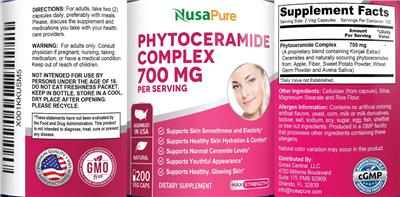
Assembled in USA Natural Supports skin smoothness and elasticity Supports healthy skin hydration & comfort Supports normal ceramide levels Supports youthful appearance Supports healthy, glowing skin Max Strength
Allergen Information: Contains no artificial coloring, artificial flavors, yeast, corn, milk or milk derivatives, lactose, salt, sodium, soy, sugar, egg, fish, shellfish or tree nut ingredients.
Natural color variation may occur in this product.
Formula
Phytoceramide complex 700 mg per serving
FDA Statement of Identity
Dietary Supplement
Is this label outdated? Report a formula or label change and our pharmacy team will review it.
Phytoceramide Complex 700 mg by NusaPure label
The label scan from the NIH Dietary Supplement Label Database. Tap to enlarge.
Label images are published by the NIH Dietary Supplement Label Database for the version of this product on file. Always read your actual product label.
View the full label (PDF)The Ingredients in Phytoceramide Complex 700 mg by NusaPure
These are the 5 active ingredients this product is made of. Select any to open its full monograph.
Serving size2 Veg Capsule(s) Dosage formCapsule Servings per container100 Amounts shown are per serving.
Most supplement products combine several ingredients, and a medication can interact with the product through any one of them. Each ingredient below shows whether it has known drug interactions.
Phytoceramides Complex
- › Apple
- › Fiber
- › Sweet Potato powder
- › Avena sativa
- › Wheat Germ powder
Other (inactive) ingredients: Cellulose, Silica, Magnesium Stearate, Rice Flour. These complete the product’s ingredient list but are not active constituents.
Phytoceramide Complex 700 mg by NusaPure Drug Interactions
HelloPharmacist Interaction Report
NusaPure Phytoceramide Complex 700 mg contains apple, oats (Avena sativa), and wheat germ powder—three ingredients with documented interactions.
The most serious is apple's Major-severity effect on OATP substrates (organic anion-transporting polypeptide substrates), a group of medications whose absorption apple significantly reduces, potentially lowering their blood levels and effectiveness.
Read the full breakdown — every affected drug type, severity by severity
Apple also interacts moderately with blood pressure drugs (antihypertensive medications), blood sugar drugs (antidiabetes medications), the heart drug atenolol, the antihistamine fexofenadine, the blood pressure drug aliskiren, and lithium. Research shows apple juice can cut atenolol levels by 58–82%, fexofenadine absorption by up to 78%, and aliskiren by 63%.
Oats interact moderately with blood sugar drugs and insulin, potentially increasing the risk of low blood sugar (hypoglycemia). Wheat germ powder also interacts moderately with blood sugar drugs and with drugs processed through the liver enzyme CYP1A2, potentially reducing their effectiveness.
We could not check fiber or sweet potato powder for interactions. Altogether, these interactions span 480 individual medications.
Use the search tool on this page to verify your exact medications before starting this product, and talk it over with your doctor or pharmacist.
Check your own medications below · Editorial policy · How we use AI
Want to check YOUR meds against Phytoceramide Complex 700 mg?
Ask about interactions with your drugs in plain English — “Can I take it with lisinopril?” — and we find you the answer in seconds, ingredient by ingredient.
Go to the checkerIngredients driving the most interactions
Individual Drug Interactions
The ingredients in Phytoceramide Complex 700 mg interact with 480 drugs. Click any drug to see the details.
3 of the 5 ingredients in Phytoceramide Complex 700 mg interact with drugs. Each result below shows which ingredient is responsible. Apple Wheat Germ powder Avena sativa
AtorvastatinAtorvaliq
How Atorvastatin interacts with Phytoceramide Complex 700 mg — through 1 ingredient. Tap an ingredient for the detail:
AppleOrganic Anion-transporting Polypeptide Substrates (oatp) Major
Interaction Summary
Concomitant consumption of apple juice can significantly decrease oral absorption and blood levels of OATP substrates.
Read the full Apple + Atorvastatin interactionAtorvastatin CalciumLipitor
How Atorvastatin Calcium interacts with Phytoceramide Complex 700 mg — through 1 ingredient. Tap an ingredient for the detail:
AppleOrganic Anion-transporting Polypeptide Substrates (oatp) Major
Interaction Summary
Concomitant consumption of apple juice can significantly decrease oral absorption and blood levels of OATP substrates.
Read the full Apple + Atorvastatin Calcium interactionBosentanTracleer
How Bosentan interacts with Phytoceramide Complex 700 mg — through 1 ingredient. Tap an ingredient for the detail:
AppleAntihypertensive Drugs, Organic Anion-transporting Polypeptide Substrates (oatp) Major
Interaction Summary
Consuming apple juice with antihypertensive drugs might interfere with blood pressure control.
Read the full Apple + Bosentan interactionBrincidofovirTembexa
How Brincidofovir interacts with Phytoceramide Complex 700 mg — through 1 ingredient. Tap an ingredient for the detail:
AppleOrganic Anion-transporting Polypeptide Substrates (oatp) Major
Interaction Summary
Concomitant consumption of apple juice can significantly decrease oral absorption and blood levels of OATP substrates.
Read the full Apple + Brincidofovir interactionCeliprololCelicard
How Celiprolol interacts with Phytoceramide Complex 700 mg — through 1 ingredient. Tap an ingredient for the detail:
AppleAntihypertensive Drugs, Organic Anion-transporting Polypeptide Substrates (oatp) Major
Interaction Summary
Consuming apple juice with antihypertensive drugs might interfere with blood pressure control.
Read the full Apple + Celiprolol interactionCerivastatin SodiumBaycol
How Cerivastatin Sodium interacts with Phytoceramide Complex 700 mg — through 1 ingredient. Tap an ingredient for the detail:
AppleOrganic Anion-transporting Polypeptide Substrates (oatp) Major
Interaction Summary
Concomitant consumption of apple juice can significantly decrease oral absorption and blood levels of OATP substrates.
Read the full Apple + Cerivastatin Sodium interactionCinoxacinCinobac
How Cinoxacin interacts with Phytoceramide Complex 700 mg — through 1 ingredient. Tap an ingredient for the detail:
AppleOrganic Anion-transporting Polypeptide Substrates (oatp) Major
Interaction Summary
Concomitant consumption of apple juice can significantly decrease oral absorption and blood levels of OATP substrates.
Read the full Apple + Cinoxacin interactionCiprofloxacinCiloxan, Cipro, Cipro IV, Cipro XR, Ciprobay, Otiprio
How Ciprofloxacin interacts with Phytoceramide Complex 700 mg — through 1 ingredient. Tap an ingredient for the detail:
AppleOrganic Anion-transporting Polypeptide Substrates (oatp) Major
Interaction Summary
Concomitant consumption of apple juice can significantly decrease oral absorption and blood levels of OATP substrates.
Read the full Apple + Ciprofloxacin interactionCiprofloxacin, HydrocortisoneCipro HC Otic
How Ciprofloxacin, Hydrocortisone interacts with Phytoceramide Complex 700 mg — through 1 ingredient. Tap an ingredient for the detail:
AppleOrganic Anion-transporting Polypeptide Substrates (oatp) Major
Interaction Summary
Concomitant consumption of apple juice can significantly decrease oral absorption and blood levels of OATP substrates.
Read the full Apple + Ciprofloxacin, Hydrocortisone interactionClinafloxacinClinafloxacin
How Clinafloxacin interacts with Phytoceramide Complex 700 mg — through 1 ingredient. Tap an ingredient for the detail:
AppleOrganic Anion-transporting Polypeptide Substrates (oatp) Major
Interaction Summary
Concomitant consumption of apple juice can significantly decrease oral absorption and blood levels of OATP substrates.
Read the full Apple + Clinafloxacin interactionEnoxacinPenetrex
How Enoxacin interacts with Phytoceramide Complex 700 mg — through 1 ingredient. Tap an ingredient for the detail:
AppleOrganic Anion-transporting Polypeptide Substrates (oatp) Major
Interaction Summary
Concomitant consumption of apple juice can significantly decrease oral absorption and blood levels of OATP substrates.
Read the full Apple + Enoxacin interactionEtoposideEtopophos, VePesid, VP16
How Etoposide interacts with Phytoceramide Complex 700 mg — through 1 ingredient. Tap an ingredient for the detail:
AppleOrganic Anion-transporting Polypeptide Substrates (oatp) Major
Interaction Summary
Concomitant consumption of apple juice can significantly decrease oral absorption and blood levels of OATP substrates.
Read the full Apple + Etoposide interactionEzetimibe, AtorvastatinLiptruzet
How Ezetimibe, Atorvastatin interacts with Phytoceramide Complex 700 mg — through 1 ingredient. Tap an ingredient for the detail:
AppleOrganic Anion-transporting Polypeptide Substrates (oatp) Major
Interaction Summary
Concomitant consumption of apple juice can significantly decrease oral absorption and blood levels of OATP substrates.
Read the full Apple + Ezetimibe, Atorvastatin interactionFexofenadineAllegra
How Fexofenadine interacts with Phytoceramide Complex 700 mg — through 1 ingredient. Tap an ingredient for the detail:
AppleOrganic Anion-transporting Polypeptide Substrates (oatp), Fexofenadine (allegra) Major
Interaction Summary
Concomitant consumption of apple juice can significantly decrease oral absorption and blood levels of OATP substrates.
Read the full Apple + Fexofenadine interactionFexofenadine, PseudoephedrineAllegra D
How Fexofenadine, Pseudoephedrine interacts with Phytoceramide Complex 700 mg — through 1 ingredient. Tap an ingredient for the detail:
AppleOrganic Anion-transporting Polypeptide Substrates (oatp), Fexofenadine (allegra) Major
Interaction Summary
Concomitant consumption of apple juice can significantly decrease oral absorption and blood levels of OATP substrates.
Read the full Apple + Fexofenadine, Pseudoephedrine interactionFluvastatinLescol, Lescol XL
How Fluvastatin interacts with Phytoceramide Complex 700 mg — through 1 ingredient. Tap an ingredient for the detail:
AppleOrganic Anion-transporting Polypeptide Substrates (oatp) Major
Interaction Summary
Concomitant consumption of apple juice can significantly decrease oral absorption and blood levels of OATP substrates.
Read the full Apple + Fluvastatin interactionGatifloxacinTequin, Tequin Injection
How Gatifloxacin interacts with Phytoceramide Complex 700 mg — through 1 ingredient. Tap an ingredient for the detail:
AppleOrganic Anion-transporting Polypeptide Substrates (oatp) Major
Interaction Summary
Concomitant consumption of apple juice can significantly decrease oral absorption and blood levels of OATP substrates.
Read the full Apple + Gatifloxacin interactionGemifloxacinFactive
How Gemifloxacin interacts with Phytoceramide Complex 700 mg — through 1 ingredient. Tap an ingredient for the detail:
AppleOrganic Anion-transporting Polypeptide Substrates (oatp) Major
Interaction Summary
Concomitant consumption of apple juice can significantly decrease oral absorption and blood levels of OATP substrates.
Read the full Apple + Gemifloxacin interactionGlyburideAlbert Glyburide, Diabeta, Glycron, Glynase, Glynase PresTab, Micronase +1 more
How Glyburide interacts with Phytoceramide Complex 700 mg — through 3 ingredients. Tap an ingredient for the detail:
AppleOrganic Anion-transporting Polypeptide Substrates (oatp), Antidiabetes Drugs Major
Interaction Summary
Concomitant consumption of apple juice can significantly decrease oral absorption and blood levels of OATP substrates.
Read the full Apple + Glyburide interactionAvena SativaAntidiabetes Drugs Moderate
Interaction Summary
Theoretically, oats may have additive effects with antidiabetic agents and might increase the risk of hypoglycemia.
Read the full Avena Sativa + Glyburide interactionWheat Germ PowderAntidiabetes Drugs Moderate
Interaction Summary
Theoretically, taking wheatgrass with antidiabetes drugs might lower blood glucose levels and increase the risk of hypoglycemia.
Read the full Wheat Germ Powder + Glyburide interactionGlyburide, MetforminGlucovance
How Glyburide, Metformin interacts with Phytoceramide Complex 700 mg — through 3 ingredients. Tap an ingredient for the detail:
AppleAntidiabetes Drugs, Organic Anion-transporting Polypeptide Substrates (oatp) Major
Interaction Summary
Theoretically, consuming apple juice with antidiabetes drugs might interfere with blood glucose control.
Read the full Apple + Glyburide, Metformin interactionAvena SativaAntidiabetes Drugs Moderate
Interaction Summary
Theoretically, oats may have additive effects with antidiabetic agents and might increase the risk of hypoglycemia.
Read the full Avena Sativa + Glyburide, Metformin interactionWheat Germ PowderAntidiabetes Drugs Moderate
Interaction Summary
Theoretically, taking wheatgrass with antidiabetes drugs might lower blood glucose levels and increase the risk of hypoglycemia.
Read the full Wheat Germ Powder + Glyburide, Metformin interactionGrepafloxacinRaxar
How Grepafloxacin interacts with Phytoceramide Complex 700 mg — through 2 ingredients. Tap an ingredient for the detail:
AppleOrganic Anion-transporting Polypeptide Substrates (oatp) Major
Interaction Summary
Concomitant consumption of apple juice can significantly decrease oral absorption and blood levels of OATP substrates.
Read the full Apple + Grepafloxacin interactionWheat Germ PowderCytochrome P450 1a2 (cyp1a2) Substrates Moderate
Interaction Summary
Theoretically, wheatgrass might decrease the levels and clinical effects of CYP1A2 substrates.
Read the full Wheat Germ Powder + Grepafloxacin interactionIrinotecanCamptosar, Onivyde
How Irinotecan interacts with Phytoceramide Complex 700 mg — through 1 ingredient. Tap an ingredient for the detail:
AppleOrganic Anion-transporting Polypeptide Substrates (oatp) Major
Interaction Summary
Concomitant consumption of apple juice can significantly decrease oral absorption and blood levels of OATP substrates.
Read the full Apple + Irinotecan interactionIrinotecan Hydrochloride
How Irinotecan Hydrochloride interacts with Phytoceramide Complex 700 mg — through 1 ingredient. Tap an ingredient for the detail:
AppleOrganic Anion-transporting Polypeptide Substrates (oatp) Major
Interaction Summary
Concomitant consumption of apple juice can significantly decrease oral absorption and blood levels of OATP substrates.
Read the full Apple + Irinotecan Hydrochloride interactionIsoniazid, Pyrazinamide, RifampinRifater
How Isoniazid, Pyrazinamide, Rifampin interacts with Phytoceramide Complex 700 mg — through 1 ingredient. Tap an ingredient for the detail:
AppleOrganic Anion-transporting Polypeptide Substrates (oatp) Major
Interaction Summary
Concomitant consumption of apple juice can significantly decrease oral absorption and blood levels of OATP substrates.
Read the full Apple + Isoniazid, Pyrazinamide, Rifampin interactionIsoniazid, RifampinRifamate
How Isoniazid, Rifampin interacts with Phytoceramide Complex 700 mg — through 1 ingredient. Tap an ingredient for the detail:
AppleOrganic Anion-transporting Polypeptide Substrates (oatp) Major
Interaction Summary
Concomitant consumption of apple juice can significantly decrease oral absorption and blood levels of OATP substrates.
Read the full Apple + Isoniazid, Rifampin interactionLevofloxacinLeva-pak, Levaquin, Levaquin Injection
How Levofloxacin interacts with Phytoceramide Complex 700 mg — through 1 ingredient. Tap an ingredient for the detail:
AppleOrganic Anion-transporting Polypeptide Substrates (oatp) Major
Interaction Summary
Concomitant consumption of apple juice can significantly decrease oral absorption and blood levels of OATP substrates.
Read the full Apple + Levofloxacin interactionLevofloxacin (ophthalmic)Levofloxacin
How Levofloxacin (ophthalmic) interacts with Phytoceramide Complex 700 mg — through 1 ingredient. Tap an ingredient for the detail:
AppleOrganic Anion-transporting Polypeptide Substrates (oatp) Major
Interaction Summary
Concomitant consumption of apple juice can significantly decrease oral absorption and blood levels of OATP substrates.
Read the full Apple + Levofloxacin (ophthalmic) interactionLomefloxacinMaxaquin
How Lomefloxacin interacts with Phytoceramide Complex 700 mg — through 1 ingredient. Tap an ingredient for the detail:
AppleOrganic Anion-transporting Polypeptide Substrates (oatp) Major
Interaction Summary
Concomitant consumption of apple juice can significantly decrease oral absorption and blood levels of OATP substrates.
Read the full Apple + Lomefloxacin interactionLovastatinAltocor, Mevacor
How Lovastatin interacts with Phytoceramide Complex 700 mg — through 1 ingredient. Tap an ingredient for the detail:
AppleOrganic Anion-transporting Polypeptide Substrates (oatp) Major
Interaction Summary
Concomitant consumption of apple juice can significantly decrease oral absorption and blood levels of OATP substrates.
Read the full Apple + Lovastatin interactionMethotrexateOtrexup, Rasuvo, Reditrex, Rheumatrex
How Methotrexate interacts with Phytoceramide Complex 700 mg — through 1 ingredient. Tap an ingredient for the detail:
AppleOrganic Anion-transporting Polypeptide Substrates (oatp) Major
Interaction Summary
Concomitant consumption of apple juice can significantly decrease oral absorption and blood levels of OATP substrates.
Read the full Apple + Methotrexate interactionEach ingredient & the kinds of drugs it affects
For each ingredient in Phytoceramide Complex 700 mg with known interactions, here are the types of medications they can affect. Open any type for the detail — or search your exact drug in the checker above.
Apple
Organic Anion-Transporting Polypeptide Substrates (Oatp)
Concomitant consumption of apple juice can significantly decrease oral absorption and blood levels of OATP substrates.
Research shows that consuming apple juice inhibits OATP, which reduces bioavailability of oral drugs that are substrates of OATP. Fexofenadine, atenolol, and aliskiren are substrates of OATP. Clinical research shows that coadministration of apple juice decreases bioavailability of fexofenadine by up to 78%, aliskiren by 63%, and atenolol by up to 82%. These effects appear to increase with larger quantities of apple juice. It is thought that apple juice might affect OATP for only a short time. Therefore, separating drug administration and consumption of apple juice by at least 4 hours might avoid this interaction.
Aliskiren (Tekturna, Rasilez)
Concomitant consumption of apple juice can significantly decrease oral absorption and blood levels of aliskiren.
Pharmacokinetic research shows that coadministration of apple juice 200 mL along with aliskiren 150 mg decreases the bioavailability of aliskiren by 63%. Apple juice seems to inhibit organic anion transporting polypeptide (OATP), which is involved in drug uptake in the gut, liver, and kidney. It is thought that apple juice might affect OATP for only a short time. Therefore, separating drug administration and consumption of apple juice by at least 4 hours might avoid this interaction.
Antidiabetes Drugs
Theoretically, consuming apple juice with antidiabetes drugs might interfere with blood glucose control.
Clinical research suggests that consuming apples or drinking apple juice can raise blood glucose levels, with the effects of drinking apple juice being more significant than consuming apples.
Antihypertensive Drugs
Consuming apple juice with antihypertensive drugs might interfere with blood pressure control.
Some clinical evidence suggests that consuming apple and cherry juice can increase blood pressure in elderly patients.
Atenolol (Tenormin)
Concomitant consumption of apple juice can significantly decrease oral absorption and blood levels of atenolol.
Pharmacokinetic research shows that coadministration of apple juice 600-1200 mL decreases levels of atenolol by 58% to 82% in a dose-dependent manner. Apple juice seems to inhibit organic anion transporting polypeptide (OATP), which is involved in drug uptake in the gut, liver, and kidney. It is thought that apple juice might affect OATP for only a short time. Therefore, separating drug administration and consumption of apple juice by at least 4 hours might avoid this interaction.
Fexofenadine (Allegra)
Concomitant consumption of apple juice can significantly decrease oral absorption and blood levels of fexofenadine.
Pharmacokinetic research shows that coadministration of apple juice 400-1200 mL along with fexofenadine 60-120 mg decreases bioavailability of fexofenadine by up to 78%. Coadministration with smaller quantities of apple juice (150 mL or less) does not appear to affect the bioavailability of fexofenadine. Apple juice seems to inhibit organic anion transporting polypeptide (OATP), which is involved in drug uptake in the gut, liver, and kidney. It is thought that apple juice might affect OATP for only a short time. Therefore, separating drug administration and consumption of apple juice by at least 4 hours might avoid this interaction.
Lithium
There is some concern that concomitant consumption of apple juice might decrease oral absorption and blood levels of lithium.
In one case report, a patient had an undetectable serum lithium level when lithium citrate was administered with apple juice. When lithium was administered with an alternative beverage, the lithium level became detectable and the patient demonstrated clinical improvement.
Wheat Germ powder
Antidiabetes Drugs
Theoretically, taking wheatgrass with antidiabetes drugs might lower blood glucose levels and increase the risk of hypoglycemia.
Animal research shows that taking wheatgrass stimulates the release of insulin from beta-cells and lowers blood glucose.
Cytochrome P450 1A2 (Cyp1A2) Substrates
Theoretically, wheatgrass might decrease the levels and clinical effects of CYP1A2 substrates.
In vitro research shows that wheatgrass induces CYP1A2 enzymes.
Avena sativa
Antidiabetes Drugs
Theoretically, oats may have additive effects with antidiabetic agents and might increase the risk of hypoglycemia.
Consuming oats can decrease blood glucose in patients with diabetes. In those who require insulin, taking oats 100 grams daily for 2 days reduces the insulin dose required to achieve metabolic control.
Insulin
Concomitant use of oats and insulin might increase the risk of hypoglycemia.
In patients with insulin-dependent type 2 diabetes, taking oats 100 grams daily for 2 days reduces the insulin dose required to achieve metabolic control.
Brand information
Manufacturer and brand details for Phytoceramide Complex 700 mg, from the product label.
NusaPure
See all NusaPure products- Name
- Gmax Central LLC
- Street Address
- 4700 Millenia Boulevard, Suite 175 PMB 92909
- City
- Orlando
- State
- FL
- ZipCode
- 32839
Phytoceramide Complex 700 mg by NusaPure: Common Questions
Does Phytoceramide Complex 700 mg by NusaPure interact with any medications?
How can one product interact with so many drugs?
Where does this information come from?
Can I take this if I'm pregnant or breastfeeding?
What's actually in here that might work?
What side effects might I get?
Why is apple marked as a Major interaction?
Should I worry about the apple seeds?
Written and reviewed by the HelloPharmacist editorial staff. Our editorial policy
Not sure if Phytoceramide Complex 700 mg is safe with your meds?
Our pharmacists answer your medication & supplement questions — free.
Label information is sourced from the NIH Dietary Supplement Label Database and reflects the product version on file; always read your actual product label. This page is for education only and is not a substitute for professional medical advice. Confirm with your pharmacist or doctor before combining supplements and medications.
The Full Monographs Behind Phytoceramide Complex 700 mg’s Ingredients
Every ingredient we hold a full HelloPharmacist monograph for — uses, evidence, safety, and the complete interaction list.
Apple
Interacts with 300 drugsApples are a nutritious whole food that provides fiber, vitamins, and antioxidant plant compounds, and eating them regularly fits well into a healthy diet. While research suggests apples may...
Read the full Apple monograph → Herb & supplement monographOats
Interacts with 86 drugsOats are a well-studied whole grain whose soluble fiber (beta-glucan) can help lower cholesterol and support heart health when eaten regularly. As a food, oats are safe for most people, and...
Read the full Oats monograph → Herb & supplement monographWheatgrass
Interacts with 272 drugsWheatgrass is the young grass of the wheat plant, taken as a juice or powder, and is mainly used as a concentrated source of vitamins and plant nutrients. Solid scientific evidence for most...
Read the full Wheatgrass monograph →Sources & How We Checked
Phytoceramide Complex 700 mg's label data comes from the NIH Dietary Supplement Label Database; the ingredient interaction data is from the Natural Medicines database, reviewed by our pharmacists.
- NIH Dietary Supplement Label Database (DSLD) — The official product label on file for this supplement.
- Natural Medicines (Therapeutic Research Center) — Evidence-graded clinical reference behind the ingredient interaction data.
Content is written and reviewed by licensed HelloPharmacist pharmacists. See our data sources and editorial standards for how this information is built and checked.
The 34 references behind this product’s interaction data
Every citation that drives the interaction findings for this product’s ingredients, from the evidence-graded Natural Medicines (TRC Healthcare) database. Open an ingredient to browse its citations — links open the study on PubMed or the publisher’s site.
Apple 16 references
- The Review of Natural Products by Facts and Comparisons. St. Louis, MO: Wolters Kluwer Co., 1999.
- Bailey DG, Dresser GK, Munoz C, et al. Reduction of fexofenadine bioavailability by fruit juices. Clin Pharmacol Ther 2001;69:P21.
- Rodriguez J, Crespo JF, Lopez-Rubio A, et al. Clinical cross-reactivity among foods of the Rosaceae family. J Allergy Clin Immunol 2000;106:183-189. PubMed
- Greenblatt DJ. Analysis of drug interactions involving fruit beverages and organic anion-transporting polypeptides. J Clin Pharmacol 2009;49:1403-7. PubMed
- Bailey DG. Fruit juice inhibition of uptake transport: a new type of food-drug interaction. Br J Clin Pharmacol 2010;70:645-55. PubMed
- Kamath AV, Yao M, Zhang Y, Chong S. Effect of fruit juices on the oral bioavailability of fexofenadine in rats. J Pharm Sci 2005;94:233-9. PubMed
- Tapaninen T, Neuvonen PJ, Niemi M. Orange and apple juice greatly reduce the plasma concentrations of the OATP2B1 substrate aliskiren. Br J Clin Pharmacol 2011;71:718-26. PubMed
- Jeon H, Jang IJ, Lee S, et al. Apple juice greatly reduces systemic exposure to atenolol. Br J Clin Pharmacol 2012 May 11. doi: 10.1111/j.1365-2125.2012.04324.x. [Epub ahead of print]. PubMed
- Visvanathan, R., Chen, R., Horowitz, M., and Chapman, I. Blood pressure responses in healthy older people to 50 g carbohydrate drinks with differing glycaemic effects. Br J Nutr 2004;92(2):335-340. PubMed
- Asp, N. G., Agardh, C. D., Ahren, B., Dencker, I., Johansson, C. G., Lundquist, I., Nyman, M., Sartor, G., and Schersten, B. Dietary fibre in type II diabetes. Acta Med Scand Suppl 1981;656:47-50. PubMed
- Akamine Y, Miura M, Komori H, et al. Effects of one-time apple juice ingestion on the pharmacokinetics of fexofenadine enantiomers. Eur J Clin Pharmacol. 2014 Sep;70(9):1087-95. PubMed
- Luo J, Imai H, Ohyama T, et al. The Pharmacokinetic Exposure to Fexofenadine is Volume-Dependently Reduced in Healthy Subjects Following Oral Administration With Apple Juice. Clin Transl Sci. 2016 Aug;9(4):201-6. PubMed
- Tsiougkos N, Vovolis V. Repeated anaphylactic episodes to orange and apple. Eur Ann Allergy Clin Immunol. 2013 May;45(3):113-5.
- Rubido S, García-Caballero L, Abeleira MT, Limeres J, García M, Diz P. Effect of chewing an apple on dental plaque removal and on salivary bacterial viability. PLoS One. 2018;13(7):e0199812. PubMed
- Krishnasamy S, Lomer MCE, Marciani L, et al. Processing apples to puree or juice speeds gastric emptying and reduces postprandial intestinal volumes and satiety in healthy adults. J Nutr 2020;150(11):2890-9. PubMed
- Awan S, Abelleira A, Khehra L, Hieber R. Undetectable serum lithium concentrations after coadministration of liquid lithium citrate and apple juice: A case report. Ment Health Clin. 2021;11(1):27-30. PubMed
Oats 13 references
- Cooper SG, Tracey EJ. Small-bowel obstruction caused by oat-bran bezoar. N Engl J Med 1989;320:1148-9. DOI
- Pick ME, Hawrysh ZJ, Gee MI, et al. Oat bran concentrate bread products improve long-term control of diabetes: a pilot study. J Am Diet Assoc 1996;96:1254-61. PubMed
- Braaten JT, Scott FW, Wood PJ, et al. High beta-glucan oat bran and oat gum reduce postprandial blood glucose and insulin in subjects with and without type 2 diabetes. Diabet Med 1994;11:312-8.
- Rosario PG, Gerst PH, Prakash K, Albu E. Dentureless distention: oat bran bezoars cause obstruction. J Am Geriatr Soc 1990;38:608. PubMed
- Food and Drug Administration. Food labeling: health claims: oats and coronary heart disease. Fed Regist 1996;61:296-313.
- Foulke J. FDA Allows Whole Oat Foods To Make Health Claim on Reducing the Risk of Heart Disease. FDA Talk Paper. 1997. Available at: http://www.fda.gov/bbs/topics/ANSWERS/ANS00782.html.
- Chandalia M, Garg A, Lutjohann D, et al. Beneficial effects of high dietary fiber intake in patients with type 2 diabetes mellitus. N Engl J Med 2000;342:1392-8. PubMed
- Lembo A, Camilleri M. Chronic constipation. N Engl J Med 2003;349:1360-8. . PubMed
- De Paz Arranz S, Perez Montero A, Remon LZ, Molero MI. Allergic contact urticaria to oatmeal. Allergy 2002;57:1215. . PubMed
- Delgado G, Kleber ME, Krämer BK, et al. Dietary intervention with oatmeal in patients with uncontrolled type 2 diabetes mellitus - A crossover study. Exp Clin Endocrinol Diabetes. 2019;127(9):623-629. PubMed
- Sobhan M, Hojati M, Vafaie SY, Ahmadimoghaddam D, Mohammadi Y, Mehrpooya M. The efficacy of colloidal oatmeal cream 1% as add-on therapy in the management of chronic irritant hand eczema: A double-blind study. Clin Cosmet Investig Dermatol. 2020;13:241-25
- Hou Q, Li Y, Li L, Cheng G, Sun X, Li S, Tian H. The metabolic effects of oats intake in patients with type 2 diabetes: A systematic review and meta-analysis. Nutrients. 2015;7(12):10369-87. PubMed
- González-Afonso M, Cañas JA, Sastre B, et al. A Case of Anaphylaxis After Ingestion of Oats: Research Into New Allergens. J Investig Allergol Clin Immunol 2022;32(6):506-508. PubMed
Wheatgrass 5 references
- Ben-Arye E, Golden E, Wengrower D, et al. Wheat grass juice in the treatment of active distal ulcerative colitis a randomized double-blind placebo-controlled trial. Scand J Gastroenterol 2002;4:444-9.. PubMed
- Mohan Y, Jesuthankaraj GN1, Ramasamy Thangavelu N. Antidiabetic and antioxidant properties of Triticum aestivum in streptozotocin-induced diabetic rats. Adv Pharmacol Sci 2013;2013:716073.
- Shakya G, Randhi PK, Pajaniradje S, Mohankumar K, Rajagopalan R. Hypoglycaemic role of wheatgrass and its effect on carbohydrate metabolic enzymes in type II diabetic rats. Toxicol Ind Health 2016;32(6):1026-32. PubMed
- Food and Drug Administration. Food Allergen Labeling and Consumer Protection Act of 2004 (FALCPA); Public Law 108-282, Title II. Accessed on May 19, 2021. Available at: https://www.fda.gov/food/food-allergensgluten-free-guidance-documents-regulatory-infor
- Haron MH, Dale O, Martin K, et al. Evaluation of the Herb-Drug Interaction Potential of Commonly Used Botanicals on the US Market with Regard to PXR- and AhR-Mediated Influences on CYP3A4 and CYP1A2. J Diet Suppl 2022. PubMed
Parts of this content are provided by the Therapeutic Research Center, LLC.
DISCLAIMER: Currently this does not check for drug-drug interactions. This is not an all-inclusive comprehensive list of potential interactions and is for informational purposes only. Not all interactions are known or well-reported in the scientific literature, and new interactions are continually being reported. Input is needed from a qualified healthcare provider including a pharmacist before starting any therapy. Application of clinical judgment is necessary.
© 2021 Therapeutic Research Center, LLC