
Sleep Worx Ingredients & Drug Interactions
by SuperiorLabs
What is this page for?
First and foremost: checking Sleep Worx against your medications. The heart of this page is the interaction checker and the full interaction report — how this product’s ingredients may interact with prescription and over-the-counter medicines you may be taking.
Around that, we add a pharmacist’s high-level view of the product as a whole — what’s inside, the evidence for its stated use, how transparent the label is, and what safety data exists — so you can see the full picture in one place. It’s educational information from our licensed clinical databases and the clinical staff at HelloPharmacist — not medical advice — and we don’t sell or endorse products. Our editorial policy
Sleep Worx is a dietary supplement by SuperiorLabs with 5 active ingredients. Its ingredients are commonly taken for anxiety and stress, sleep and relaxation, digestive upset.Based on those ingredients, 1,203 medications have a known interaction with it, the most serious rated major. The ingredients most likely to interact are Kava, Chamomile, Valerian. Use the checker below to test your specific medication, or read the full HelloPharmacist Interaction Report.
Check Your Meds Against Sleep Worx by SuperiorLabs
Ask about any prescription or over-the-counter medication and we check it for interactions with Sleep Worx by SuperiorLabs — and tell you which ingredient is responsible.
AI summaries are generated from our interaction database for education only — always confirm with your pharmacist. How we use AI
Ask the Pharmacist
A licensed pharmacist will answer your question by email — free, usually within 24 hours.
Got it — thank you!
A licensed pharmacist will answer within 24 hours. Keep an eye on your email (worth checking spam, just in case).
HelloPharmacist Scorecard of Sleep Worx by SuperiorLabs
Our pharmacy team’s full take, with four database checks built into the cards below — a summary of what is known, not a grade of the product itself.
What’s inside
Full disclosure
Sleep Worx contains five active herbal ingredients. Chamomile (German chamomile), kava, valerian, passionflower, and lemon balm are all traditionally used to promote relaxation and sleep.
The product also contains two inactive ingredients—rice concentrate and plant cellulose—which serve as fillers and capsule material. Each ingredient contributes its own set of compounds: chamomile provides flavonoids and volatile oils; kava delivers kavalactones; valerian contains valerenic acid and other compounds; passionflower offers flavonoids including apigenin; and lemon balm brings its own volatile oil profile.
These work through different mechanisms in the body to encourage rest.
Does it work?
Moderate evidence
The evidence for Sleep Worx's ingredients is mixed. Valerian and passionflower each have a rating of Possibly Effective for insomnia.
Lemon balm is rated Possibly Effective for stress and depression. Kava, however, is rated Possibly Ineffective for generalized anxiety disorder.
Chamomile's evidence for anxiety, hay fever, and attention issues is Insufficient Reliable Evidence—meaning the data we hold doesn't yet establish whether it works for those uses. Because this is a multi-ingredient product with varying strength of evidence across its components, the overall effectiveness for sleep depends on which ingredient might benefit you most, and that conversation is best had with your doctor or pharmacist.
How safe is it?
Well-documented data
The herbal ingredients in Sleep Worx are generally well tolerated short-term, but some carry important caveats. Chamomile can trigger allergic reactions in people sensitive to ragweed and related plants, and may cause nausea or burning in the mouth when used as a rinse.
Kava has been linked to rare but serious liver injury in over 100 cases worldwide, particularly with excessive or prolonged use, and may cause drowsiness, tremor, and memory problems. Valerian is generally well tolerated but can cause dizziness, drowsiness, headache, and vivid dreams; stopping it abruptly after extended use may bring on withdrawal symptoms like anxiety and insomnia.
Passionflower can cause dizziness, confusion, and sedation, and there is one case report of severe nausea, vomiting, and heart rhythm abnormalities at high doses. Lemon balm is generally well tolerated but long-term safety is not well studied.
During pregnancy, chamomile and lemon balm are best avoided unless your doctor approves, valerian should be avoided, passionflower is possibly unsafe, and kava is not considered safe. While breastfeeding, chamomile, valerian, and passionflower have limited safety data and should be discussed with your doctor or pharmacist; kava is not recommended.
Meds to double-check
Major interaction found
Before taking Sleep Worx, double-check your medications with your doctor or pharmacist, especially if you take CNS depressants like sleeping pills, sedatives, or pain medication (Major risk from kava). Also flag blood thinners like warfarin, oral contraceptives, estrogen or thyroid hormone therapy, or any drugs metabolized by the liver enzymes CYP2D6, CYP2C9, CYP2C19, CYP2E1, or CYP3A4 (all Moderate risk).
Additionally, tell your provider if you take any hepatotoxic drugs or if you have liver concerns, since kava carries a rare but documented risk of liver injury.
The bottom line
Scorecard at a glanceFully disclosed formula with some supporting evidence for its stated purpose. Major medication interactions have been identified, and safety information is well characterized.
Sleep Worx may be worth considering if you're looking for herbal support for sleep or stress and you're not taking CNS depressants, blood thinners, oral contraceptives, thyroid medication, or drugs metabolized through major liver pathways. If you take any regular medications, are pregnant, breastfeeding, or have liver concerns, talk with your doctor or pharmacist before starting—the ingredient list here has real interactions and a few rare but serious safety signals that warrant a personalized conversation.
Educational only — not medical advice; always confirm with your pharmacist. Our editorial policy · How we use AI
Assessment coverage: 5 of 5 active ingredients matched to our full ingredient reviews (monographs). Based on the product label dated Jun 24, 2020.
This Scorecard evaluates available label information, ingredient evidence, and known medication-safety considerations. It does not independently verify product identity, purity, potency, contamination, or manufacturing quality. How these ratings are computed
General information
Key facts about Sleep Worx, straight from the product label.
| Brand | SuperiorLabs |
|---|---|
| Barcode (UPC) | 850569006445 |
| Net contents | 60 Capsule(s) |
| Market status | On market |
| Date entered into DSLD | Jun 24, 2020 |
| DSLD ID | 228094 |
| Product type | Botanical |
| Supplement form | Capsule |
| Dietary claims / uses | All Other, Structure/Function |
| Intended target group(s) | Adult (18 - 50 Years) |
Everything in this section is reproduced from the manufacturer’s own product label — it’s the label speaking, not HelloPharmacist. We show it so you can see exactly what the maker states; we don’t verify or endorse those statements.
Supplement Facts
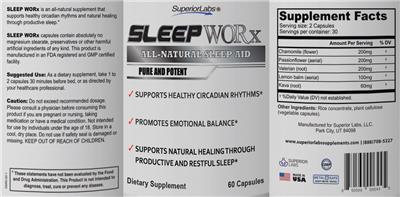
The label details for Sleep Worx by SuperiorLabs, sourced from the NIH Dietary Supplement Label Database.
Supplement Facts
| Ingredient | Amount | % DV |
|---|---|---|
| Chamomile | 200 mg | -- |
| Kava | 60 mg | -- |
| Valerian | 200 mg | -- |
| Passionflower | 200 mg | -- |
| Lemon Balm | 100 mg | -- |
Other ingredients: Rice concentrate, Plant Cellulose
Tap any ingredient to jump to its full detail below.
These statements are the manufacturer’s wording, reproduced from the product label — the label is saying it, not HelloPharmacist. We don’t verify or endorse them.
Formulation
Sleep Worx is an all-natural supplement that supports healthy circadian rhythms and natural healing through productive sleep.
Sleep Worx capsules contain absolutely no magnesium stearate, preservatives or other harmful artificial ingredients of any kind.
This product is manufactured in and FDA registered and GMP certified facility.
All-Natural Sleep Aid Pure and Potent
Supports healthy circadian rhythms Promotes emotional balance Supports natural healing through productive and restful sleep
Suggested/Recommended/Usage/Directions
Suggested Use: As a dietary supplement, take 1 to 2 capsules 30 minutes before bed, or as directed by your healthcare professional.
Precautions
Caution: Do not exceed recommended dosage.
Please consult a physician before consuming this product if you are pregnant or nursing, taking medication or have a medical condition.
Not intended for use by individuals under the age of 18.
Do not use if safety seal is damaged or missing.
Keep out of reach of children.
Storage
Store in a cool, dry place.
FDA Disclaimer Statement
These statements have not been evaluated by the Food and Drug Administration. This product is not intended to diagnose, treat, cure or prevent any disease.
FDA Statement of Identity
Dietary Supplement
Seals/Symbols
Certified GMP Facility Made in USA Metal Safe Heavy Metal Tested
Is this label outdated? Report a formula or label change and our pharmacy team will review it.
Sleep Worx by SuperiorLabs label
The label scan from the NIH Dietary Supplement Label Database. Tap to enlarge.
Label images are published by the NIH Dietary Supplement Label Database for the version of this product on file. Always read your actual product label.
View the full label (PDF)The Ingredients in Sleep Worx by SuperiorLabs
These are the 5 active ingredients this product is made of. Select any to open its full monograph.
Serving size1 Capsule(s) Dosage formCapsule Servings per container30 Amounts shown are per serving.
Most supplement products combine several ingredients, and a medication can interact with the product through any one of them. Each ingredient below shows whether it has known drug interactions.
Chamomile
Interacts with960 drugs
German chamomile is a widely used herbal remedy taken mainly as a tea for calming, sleep, and digestive complaints. Early research suggests possible b...
Chamomile monograph & interactionsKava
Interacts with1,166 drugs
Kava is a Pacific Island plant traditionally used to promote relaxation and ease anxiety, and some studies suggest it may help mild anxiety. However,...
Kava monograph & interactionsValerian
Interacts with902 drugs
Valerian is an herb whose root is widely used as a natural sleep aid and for calming nerves. The evidence is mixed and often weak, so it may help some...
Valerian monograph & interactionsPassionflower
Interacts with836 drugs
Passion flower is a traditional calming herb that many people use for anxiety and sleep. Early studies hint it may help with mild anxiety and restless...
Passionflower monograph & interactionsLemon Balm
Interacts with264 drugs
Lemon balm is a gentle, lemon-scented mint-family herb traditionally used to ease stress, support sleep, and calm digestion, and topically for cold so...
Lemon Balm monograph & interactionsOther (inactive) ingredients: Rice concentrate, Plant Cellulose. These complete the product’s ingredient list but are not active constituents.
Sleep Worx by SuperiorLabs Drug Interactions
HelloPharmacist Interaction Report
Sleep Worx by SuperiorLabs has documented interactions with medications through several of its five active ingredients: chamomile, kava, valerian, passionflower, and lemon balm.
The most serious interaction is between kava and CNS depressants (drugs that slow the brain and nervous system)—kava can add to their sedative effects and increase drowsiness and impaired motor reflexes, a Major-severity concern.
Read the full breakdown — every affected drug type, severity by severity
Chamomile interacts with CNS depressants, blood thinners like warfarin, oral contraceptives, estrogens, and drugs metabolized by three liver enzymes (CYP2D6, CYP2C9, CYP3A4). All of these are Moderate severity.
The warfarin interaction is notable: chamomile has been linked in one case to serious bleeding. Valerian and passionflower also carry Moderate-severity additive sedation with CNS depressants.
Lemon balm can theoretically add to CNS depressant effects and may interfere with thyroid hormone replacement (both Moderate).
Kava also interacts with several drug types: it may increase levels of drugs metabolized by liver enzymes CYP2C19, CYP2C9, and CYP2E1 (Moderate); can raise the risk of liver damage when used with hepatotoxic drugs (Moderate); and there are case reports of adverse effects with haloperidol and ropinirole (Moderate). Valerian carries Minor-severity interactions with drugs metabolized by CYP2D6 and CYP3A4, and passionflower carries Minor interactions with OATP substrates and CYP3A4 drugs.
Additionally, chamomile may also interact with drugs whose metabolism is affected through CYP2D6, CYP2C9, and CYP3A4. Altogether, these interactions span 1,204 individual medications.
Before starting Sleep Worx, use the medication checker on this page with your current prescriptions, and talk with your doctor or pharmacist about whether this product is appropriate for you.
Check your own medications below · Editorial policy · How we use AI
Want to check YOUR meds against Sleep Worx?
Ask about interactions with your drugs in plain English — “Can I take it with lisinopril?” — and we find you the answer in seconds, ingredient by ingredient.
Go to the checkerIngredients driving the most interactions
Individual Drug Interactions
The ingredients in Sleep Worx interact with 1,203 drugs. Click any drug to see the details.
5 of the 5 ingredients in Sleep Worx interact with drugs. Each result below shows which ingredient is responsible. Kava Chamomile Valerian Passionflower Lemon Balm
Belladonna Alkaloids, Ergotamine Tartrate, PhenobarbitalBel Tabs, Bellamine-S, Bellaphen-S, Duragal S, Phenarbal S, Spastrin
How Belladonna Alkaloids, Ergotamine Tartrate, Phenobarbital interacts with Sleep Worx — through 5 ingredients. Tap an ingredient for the detail:
KavaCns Depressants, Cytochrome P450 3a4 (cyp3a4) Substrates Major
Interaction Summary
Combining kava with CNS depressants can have additive sedative effects.
Read the full Kava + Belladonna Alkaloids, Ergotamine Tartrate, Phenobarbital interactionPassionflowerCytochrome P450 3a4 (cyp3a4) Substrates, Cns Depressants Moderate
Interaction Summary
Theoretically, passion flower might decrease the effects of CYP3A4 substrates.
Read the full Passionflower + Belladonna Alkaloids, Ergotamine Tartrate, Phenobarbital interactionChamomileCns Depressants, Cytochrome P450 3a4 (cyp3a4) Substrates Moderate
Interaction Summary
Theoretically, German chamomile might have additive effects when used with CNS depressants.
Read the full Chamomile + Belladonna Alkaloids, Ergotamine Tartrate, Phenobarbital interactionValerianCytochrome P450 3a4 (cyp3a4) Substrates, Cns Depressants Moderate
Interaction Summary
Valerian does not seem to have a clinically relevant effect on levels of drugs metabolized by CYP3A4.
Read the full Valerian + Belladonna Alkaloids, Ergotamine Tartrate, Phenobarbital interactionLemon BalmCns Depressants Moderate
Interaction Summary
Theoretically, concomitant use of lemon balm might have additive effects with CNS depressant drugs.
Read the full Lemon Balm + Belladonna Alkaloids, Ergotamine Tartrate, Phenobarbital interactionBelladonna Alkaloids, PhenobarbitalBarbidonna, Donnatal
How Belladonna Alkaloids, Phenobarbital interacts with Sleep Worx — through 5 ingredients. Tap an ingredient for the detail:
KavaCns Depressants Major
Interaction Summary
Combining kava with CNS depressants can have additive sedative effects.
Read the full Kava + Belladonna Alkaloids, Phenobarbital interactionChamomileCns Depressants Moderate
Interaction Summary
Theoretically, German chamomile might have additive effects when used with CNS depressants.
Read the full Chamomile + Belladonna Alkaloids, Phenobarbital interactionPassionflowerCns Depressants Moderate
Interaction Summary
Concomitant use of passion flower with sedative drugs might cause additive effects and side effects.
Read the full Passionflower + Belladonna Alkaloids, Phenobarbital interactionLemon BalmCns Depressants Moderate
Interaction Summary
Theoretically, concomitant use of lemon balm might have additive effects with CNS depressant drugs.
Read the full Lemon Balm + Belladonna Alkaloids, Phenobarbital interactionValerianCns Depressants Moderate
Interaction Summary
Valerian can have additive sedative effects when used concomitantly with CNS depressant drugs.
Read the full Valerian + Belladonna Alkaloids, Phenobarbital interactionBelladonna Extract, PhenobarbitalBelap
How Belladonna Extract, Phenobarbital interacts with Sleep Worx — through 5 ingredients. Tap an ingredient for the detail:
KavaCns Depressants Major
Interaction Summary
Combining kava with CNS depressants can have additive sedative effects.
Read the full Kava + Belladonna Extract, Phenobarbital interactionValerianCns Depressants Moderate
Interaction Summary
Valerian can have additive sedative effects when used concomitantly with CNS depressant drugs.
Read the full Valerian + Belladonna Extract, Phenobarbital interactionLemon BalmCns Depressants Moderate
Interaction Summary
Theoretically, concomitant use of lemon balm might have additive effects with CNS depressant drugs.
Read the full Lemon Balm + Belladonna Extract, Phenobarbital interactionChamomileCns Depressants Moderate
Interaction Summary
Theoretically, German chamomile might have additive effects when used with CNS depressants.
Read the full Chamomile + Belladonna Extract, Phenobarbital interactionPassionflowerCns Depressants Moderate
Interaction Summary
Concomitant use of passion flower with sedative drugs might cause additive effects and side effects.
Read the full Passionflower + Belladonna Extract, Phenobarbital interactionBelladonna, Caffeine, Ergotamine, PentobarbitalMicomp PB
How Belladonna, Caffeine, Ergotamine, Pentobarbital interacts with Sleep Worx — through 5 ingredients. Tap an ingredient for the detail:
KavaCytochrome P450 1a2 (cyp1a2) Substrates, Cns Depressants +1 Major
Interaction Summary
It is unclear if kava inhibits CYP1A2; research is conflicting.
Read the full Kava + Belladonna, Caffeine, Ergotamine, Pentobarbital interactionPassionflowerCytochrome P450 3a4 (cyp3a4) Substrates, Cns Depressants Moderate
Interaction Summary
Theoretically, passion flower might decrease the effects of CYP3A4 substrates.
Read the full Passionflower + Belladonna, Caffeine, Ergotamine, Pentobarbital interactionLemon BalmCns Depressants Moderate
Interaction Summary
Theoretically, concomitant use of lemon balm might have additive effects with CNS depressant drugs.
Read the full Lemon Balm + Belladonna, Caffeine, Ergotamine, Pentobarbital interactionValerianCytochrome P450 3a4 (cyp3a4) Substrates, Cns Depressants Moderate
Interaction Summary
Valerian does not seem to have a clinically relevant effect on levels of drugs metabolized by CYP3A4.
Read the full Valerian + Belladonna, Caffeine, Ergotamine, Pentobarbital interactionChamomileCytochrome P450 3a4 (cyp3a4) Substrates, Cytochrome P450 1a2 (cyp1a2) Substrates +1 Moderate
Interaction Summary
Theoretically, German chamomile might inhibit CYP3A4 and increase levels of drugs metabolized by these enzymes.
Read the full Chamomile + Belladonna, Caffeine, Ergotamine, Pentobarbital interactionBelladonna, Ergotamine Tartrate, Phenobarbital
How Belladonna, Ergotamine Tartrate, Phenobarbital interacts with Sleep Worx — through 5 ingredients. Tap an ingredient for the detail:
KavaCytochrome P450 3a4 (cyp3a4) Substrates, Cns Depressants Major
Interaction Summary
It is unclear if kava inhibits CYP3AA; research is conflicting.
Read the full Kava + Belladonna, Ergotamine Tartrate, Phenobarbital interactionChamomileCns Depressants, Cytochrome P450 3a4 (cyp3a4) Substrates Moderate
Interaction Summary
Theoretically, German chamomile might have additive effects when used with CNS depressants.
Read the full Chamomile + Belladonna, Ergotamine Tartrate, Phenobarbital interactionPassionflowerCns Depressants, Cytochrome P450 3a4 (cyp3a4) Substrates Moderate
Interaction Summary
Concomitant use of passion flower with sedative drugs might cause additive effects and side effects.
Read the full Passionflower + Belladonna, Ergotamine Tartrate, Phenobarbital interactionLemon BalmCns Depressants Moderate
Interaction Summary
Theoretically, concomitant use of lemon balm might have additive effects with CNS depressant drugs.
Read the full Lemon Balm + Belladonna, Ergotamine Tartrate, Phenobarbital interactionValerianCns Depressants, Cytochrome P450 3a4 (cyp3a4) Substrates Moderate
Interaction Summary
Valerian can have additive sedative effects when used concomitantly with CNS depressant drugs.
Read the full Valerian + Belladonna, Ergotamine Tartrate, Phenobarbital interactionBelladonna, Ergotamine, PhenobarbitalBellergal-S
How Belladonna, Ergotamine, Phenobarbital interacts with Sleep Worx — through 5 ingredients. Tap an ingredient for the detail:
KavaCytochrome P450 3a4 (cyp3a4) Substrates, Cns Depressants Major
Interaction Summary
It is unclear if kava inhibits CYP3AA; research is conflicting.
Read the full Kava + Belladonna, Ergotamine, Phenobarbital interactionChamomileCytochrome P450 3a4 (cyp3a4) Substrates, Cns Depressants Moderate
Interaction Summary
Theoretically, German chamomile might inhibit CYP3A4 and increase levels of drugs metabolized by these enzymes.
Read the full Chamomile + Belladonna, Ergotamine, Phenobarbital interactionValerianCytochrome P450 3a4 (cyp3a4) Substrates, Cns Depressants Moderate
Interaction Summary
Valerian does not seem to have a clinically relevant effect on levels of drugs metabolized by CYP3A4.
Read the full Valerian + Belladonna, Ergotamine, Phenobarbital interactionPassionflowerCns Depressants, Cytochrome P450 3a4 (cyp3a4) Substrates Moderate
Interaction Summary
Concomitant use of passion flower with sedative drugs might cause additive effects and side effects.
Read the full Passionflower + Belladonna, Ergotamine, Phenobarbital interactionLemon BalmCns Depressants Moderate
Interaction Summary
Theoretically, concomitant use of lemon balm might have additive effects with CNS depressant drugs.
Read the full Lemon Balm + Belladonna, Ergotamine, Phenobarbital interactionBelladonna, OpiumB & O Supprettes
How Belladonna, Opium interacts with Sleep Worx — through 5 ingredients. Tap an ingredient for the detail:
KavaCns Depressants Major
Interaction Summary
Combining kava with CNS depressants can have additive sedative effects.
Read the full Kava + Belladonna, Opium interactionPassionflowerCns Depressants Moderate
Interaction Summary
Concomitant use of passion flower with sedative drugs might cause additive effects and side effects.
Read the full Passionflower + Belladonna, Opium interactionLemon BalmCns Depressants Moderate
Interaction Summary
Theoretically, concomitant use of lemon balm might have additive effects with CNS depressant drugs.
Read the full Lemon Balm + Belladonna, Opium interactionValerianCns Depressants Moderate
Interaction Summary
Valerian can have additive sedative effects when used concomitantly with CNS depressant drugs.
Read the full Valerian + Belladonna, Opium interactionChamomileCns Depressants Moderate
Interaction Summary
Theoretically, German chamomile might have additive effects when used with CNS depressants.
Read the full Chamomile + Belladonna, Opium interactionBelladonna, PhenobarbitalBellophen, Susano
How Belladonna, Phenobarbital interacts with Sleep Worx — through 5 ingredients. Tap an ingredient for the detail:
KavaCns Depressants Major
Interaction Summary
Combining kava with CNS depressants can have additive sedative effects.
Read the full Kava + Belladonna, Phenobarbital interactionChamomileCns Depressants Moderate
Interaction Summary
Theoretically, German chamomile might have additive effects when used with CNS depressants.
Read the full Chamomile + Belladonna, Phenobarbital interactionPassionflowerCns Depressants Moderate
Interaction Summary
Concomitant use of passion flower with sedative drugs might cause additive effects and side effects.
Read the full Passionflower + Belladonna, Phenobarbital interactionValerianCns Depressants Moderate
Interaction Summary
Valerian can have additive sedative effects when used concomitantly with CNS depressant drugs.
Read the full Valerian + Belladonna, Phenobarbital interactionLemon BalmCns Depressants Moderate
Interaction Summary
Theoretically, concomitant use of lemon balm might have additive effects with CNS depressant drugs.
Read the full Lemon Balm + Belladonna, Phenobarbital interactionBellafoline, Caffeine, Ergotamine Tartrate, PentobarbitalCafergot PB
How Bellafoline, Caffeine, Ergotamine Tartrate, Pentobarbital interacts with Sleep Worx — through 5 ingredients. Tap an ingredient for the detail:
KavaCytochrome P450 3a4 (cyp3a4) Substrates, Cns Depressants +1 Major
Interaction Summary
It is unclear if kava inhibits CYP3AA; research is conflicting.
Read the full Kava + Bellafoline, Caffeine, Ergotamine Tartrate, Pentobarbital interactionLemon BalmCns Depressants Moderate
Interaction Summary
Theoretically, concomitant use of lemon balm might have additive effects with CNS depressant drugs.
Read the full Lemon Balm + Bellafoline, Caffeine, Ergotamine Tartrate, Pentobarbital interactionValerianCytochrome P450 3a4 (cyp3a4) Substrates, Cns Depressants Moderate
Interaction Summary
Valerian does not seem to have a clinically relevant effect on levels of drugs metabolized by CYP3A4.
Read the full Valerian + Bellafoline, Caffeine, Ergotamine Tartrate, Pentobarbital interactionPassionflowerCns Depressants, Cytochrome P450 3a4 (cyp3a4) Substrates Moderate
Interaction Summary
Concomitant use of passion flower with sedative drugs might cause additive effects and side effects.
Read the full Passionflower + Bellafoline, Caffeine, Ergotamine Tartrate, Pentobarbital interactionChamomileCns Depressants, Cytochrome P450 3a4 (cyp3a4) Substrates +1 Moderate
Interaction Summary
Theoretically, German chamomile might have additive effects when used with CNS depressants.
Read the full Chamomile + Bellafoline, Caffeine, Ergotamine Tartrate, Pentobarbital interactionBellafoline, PhenobarbitalBelladenal, Belladenal-S
How Bellafoline, Phenobarbital interacts with Sleep Worx — through 5 ingredients. Tap an ingredient for the detail:
KavaCns Depressants Major
Interaction Summary
Combining kava with CNS depressants can have additive sedative effects.
Read the full Kava + Bellafoline, Phenobarbital interactionChamomileCns Depressants Moderate
Interaction Summary
Theoretically, German chamomile might have additive effects when used with CNS depressants.
Read the full Chamomile + Bellafoline, Phenobarbital interactionPassionflowerCns Depressants Moderate
Interaction Summary
Concomitant use of passion flower with sedative drugs might cause additive effects and side effects.
Read the full Passionflower + Bellafoline, Phenobarbital interactionLemon BalmCns Depressants Moderate
Interaction Summary
Theoretically, concomitant use of lemon balm might have additive effects with CNS depressant drugs.
Read the full Lemon Balm + Bellafoline, Phenobarbital interactionValerianCns Depressants Moderate
Interaction Summary
Valerian can have additive sedative effects when used concomitantly with CNS depressant drugs.
Read the full Valerian + Bellafoline, Phenobarbital interactionBenactyzine, MeprobamateDeprol
How Benactyzine, Meprobamate interacts with Sleep Worx — through 5 ingredients. Tap an ingredient for the detail:
KavaCns Depressants Major
Interaction Summary
Combining kava with CNS depressants can have additive sedative effects.
Read the full Kava + Benactyzine, Meprobamate interactionPassionflowerCns Depressants Moderate
Interaction Summary
Concomitant use of passion flower with sedative drugs might cause additive effects and side effects.
Read the full Passionflower + Benactyzine, Meprobamate interactionChamomileCns Depressants Moderate
Interaction Summary
Theoretically, German chamomile might have additive effects when used with CNS depressants.
Read the full Chamomile + Benactyzine, Meprobamate interactionValerianGlucuronidated Drugs, Cns Depressants Moderate
Interaction Summary
Valerian might weakly inhibit glucuronidation and increase concentrations of drugs metabolized by UGT1A1 and UGT2B7.
Read the full Valerian + Benactyzine, Meprobamate interactionLemon BalmCns Depressants Moderate
Interaction Summary
Theoretically, concomitant use of lemon balm might have additive effects with CNS depressant drugs.
Read the full Lemon Balm + Benactyzine, Meprobamate interactionBenzhydrocodone, AcetaminophenApadaz
How Benzhydrocodone, Acetaminophen interacts with Sleep Worx — through 5 ingredients. Tap an ingredient for the detail:
KavaCytochrome P450 1a2 (cyp1a2) Substrates, Cns Depressants +4 Major
Interaction Summary
It is unclear if kava inhibits CYP1A2; research is conflicting.
Read the full Kava + Benzhydrocodone, Acetaminophen interactionPassionflowerCytochrome P450 3a4 (cyp3a4) Substrates, Cns Depressants Moderate
Interaction Summary
Theoretically, passion flower might decrease the effects of CYP3A4 substrates.
Read the full Passionflower + Benzhydrocodone, Acetaminophen interactionChamomileCytochrome P450 1a2 (cyp1a2) Substrates, Cytochrome P450 3a4 (cyp3a4) Substrates +2 Moderate
Interaction Summary
Theoretically, German chamomile might inhibit CYP1A2 and increase levels of drugs metabolized by these enzymes.
Read the full Chamomile + Benzhydrocodone, Acetaminophen interactionLemon BalmCns Depressants Moderate
Interaction Summary
Theoretically, concomitant use of lemon balm might have additive effects with CNS depressant drugs.
Read the full Lemon Balm + Benzhydrocodone, Acetaminophen interactionValerianCytochrome P450 3a4 (cyp3a4) Substrates, Cns Depressants +2 Moderate
Interaction Summary
Valerian does not seem to have a clinically relevant effect on levels of drugs metabolized by CYP3A4.
Read the full Valerian + Benzhydrocodone, Acetaminophen interactionBrexanoloneZulresso
How Brexanolone interacts with Sleep Worx — through 5 ingredients. Tap an ingredient for the detail:
KavaCns Depressants Major
Interaction Summary
Combining kava with CNS depressants can have additive sedative effects.
Read the full Kava + Brexanolone interactionChamomileCns Depressants Moderate
Interaction Summary
Theoretically, German chamomile might have additive effects when used with CNS depressants.
Read the full Chamomile + Brexanolone interactionPassionflowerCns Depressants Moderate
Interaction Summary
Concomitant use of passion flower with sedative drugs might cause additive effects and side effects.
Read the full Passionflower + Brexanolone interactionValerianCns Depressants Moderate
Interaction Summary
Valerian can have additive sedative effects when used concomitantly with CNS depressant drugs.
Read the full Valerian + Brexanolone interactionLemon BalmCns Depressants Moderate
Interaction Summary
Theoretically, concomitant use of lemon balm might have additive effects with CNS depressant drugs.
Read the full Lemon Balm + Brexanolone interactionBromazepamLectopam
How Bromazepam interacts with Sleep Worx — through 5 ingredients. Tap an ingredient for the detail:
KavaCns Depressants Major
Interaction Summary
Combining kava with CNS depressants can have additive sedative effects.
Read the full Kava + Bromazepam interactionChamomileCns Depressants Moderate
Interaction Summary
Theoretically, German chamomile might have additive effects when used with CNS depressants.
Read the full Chamomile + Bromazepam interactionValerianCns Depressants Moderate
Interaction Summary
Valerian can have additive sedative effects when used concomitantly with CNS depressant drugs.
Read the full Valerian + Bromazepam interactionLemon BalmCns Depressants Moderate
Interaction Summary
Theoretically, concomitant use of lemon balm might have additive effects with CNS depressant drugs.
Read the full Lemon Balm + Bromazepam interactionPassionflowerCns Depressants Moderate
Interaction Summary
Concomitant use of passion flower with sedative drugs might cause additive effects and side effects.
Read the full Passionflower + Bromazepam interactionBuprenorphineBrixadi, Butrans, Sublocade, Subutex
How Buprenorphine interacts with Sleep Worx — through 5 ingredients. Tap an ingredient for the detail:
KavaCytochrome P450 3a4 (cyp3a4) Substrates, Cns Depressants Major
Interaction Summary
It is unclear if kava inhibits CYP3AA; research is conflicting.
Read the full Kava + Buprenorphine interactionChamomileCns Depressants, Cytochrome P450 3a4 (cyp3a4) Substrates Moderate
Interaction Summary
Theoretically, German chamomile might have additive effects when used with CNS depressants.
Read the full Chamomile + Buprenorphine interactionPassionflowerCns Depressants, Cytochrome P450 3a4 (cyp3a4) Substrates Moderate
Interaction Summary
Concomitant use of passion flower with sedative drugs might cause additive effects and side effects.
Read the full Passionflower + Buprenorphine interactionValerianCns Depressants, Cytochrome P450 3a4 (cyp3a4) Substrates Moderate
Interaction Summary
Valerian can have additive sedative effects when used concomitantly with CNS depressant drugs.
Read the full Valerian + Buprenorphine interactionLemon BalmCns Depressants Moderate
Interaction Summary
Theoretically, concomitant use of lemon balm might have additive effects with CNS depressant drugs.
Read the full Lemon Balm + Buprenorphine interactionBuprenorphine HydrochlorideBelbuca, Probuphine
How Buprenorphine Hydrochloride interacts with Sleep Worx — through 5 ingredients. Tap an ingredient for the detail:
KavaCytochrome P450 3a4 (cyp3a4) Substrates, Cns Depressants Major
Interaction Summary
It is unclear if kava inhibits CYP3AA; research is conflicting.
Read the full Kava + Buprenorphine Hydrochloride interactionLemon BalmCns Depressants Moderate
Interaction Summary
Theoretically, concomitant use of lemon balm might have additive effects with CNS depressant drugs.
Read the full Lemon Balm + Buprenorphine Hydrochloride interactionValerianCns Depressants, Cytochrome P450 3a4 (cyp3a4) Substrates Moderate
Interaction Summary
Valerian can have additive sedative effects when used concomitantly with CNS depressant drugs.
Read the full Valerian + Buprenorphine Hydrochloride interactionChamomileCns Depressants, Cytochrome P450 3a4 (cyp3a4) Substrates Moderate
Interaction Summary
Theoretically, German chamomile might have additive effects when used with CNS depressants.
Read the full Chamomile + Buprenorphine Hydrochloride interactionPassionflowerCns Depressants, Cytochrome P450 3a4 (cyp3a4) Substrates Moderate
Interaction Summary
Concomitant use of passion flower with sedative drugs might cause additive effects and side effects.
Read the full Passionflower + Buprenorphine Hydrochloride interactionBuprenorphine Hydrochloride, Naloxone HydrochlorideBunavail
How Buprenorphine Hydrochloride, Naloxone Hydrochloride interacts with Sleep Worx — through 5 ingredients. Tap an ingredient for the detail:
KavaCns Depressants, Cytochrome P450 3a4 (cyp3a4) Substrates Major
Interaction Summary
Combining kava with CNS depressants can have additive sedative effects.
Read the full Kava + Buprenorphine Hydrochloride, Naloxone Hydrochloride interactionPassionflowerCytochrome P450 3a4 (cyp3a4) Substrates, Cns Depressants Moderate
Interaction Summary
Theoretically, passion flower might decrease the effects of CYP3A4 substrates.
Read the full Passionflower + Buprenorphine Hydrochloride, Naloxone Hydrochloride interactionChamomileCytochrome P450 3a4 (cyp3a4) Substrates, Cns Depressants Moderate
Interaction Summary
Theoretically, German chamomile might inhibit CYP3A4 and increase levels of drugs metabolized by these enzymes.
Read the full Chamomile + Buprenorphine Hydrochloride, Naloxone Hydrochloride interactionValerianCns Depressants, Cytochrome P450 3a4 (cyp3a4) Substrates Moderate
Interaction Summary
Valerian can have additive sedative effects when used concomitantly with CNS depressant drugs.
Read the full Valerian + Buprenorphine Hydrochloride, Naloxone Hydrochloride interactionLemon BalmCns Depressants Moderate
Interaction Summary
Theoretically, concomitant use of lemon balm might have additive effects with CNS depressant drugs.
Read the full Lemon Balm + Buprenorphine Hydrochloride, Naloxone Hydrochloride interactionBuprenorphine, NaloxoneCassipa, Zubsolv
How Buprenorphine, Naloxone interacts with Sleep Worx — through 5 ingredients. Tap an ingredient for the detail:
KavaCytochrome P450 3a4 (cyp3a4) Substrates, Cns Depressants Major
Interaction Summary
It is unclear if kava inhibits CYP3AA; research is conflicting.
Read the full Kava + Buprenorphine, Naloxone interactionChamomileCns Depressants, Cytochrome P450 3a4 (cyp3a4) Substrates Moderate
Interaction Summary
Theoretically, German chamomile might have additive effects when used with CNS depressants.
Read the full Chamomile + Buprenorphine, Naloxone interactionPassionflowerCns Depressants, Cytochrome P450 3a4 (cyp3a4) Substrates Moderate
Interaction Summary
Concomitant use of passion flower with sedative drugs might cause additive effects and side effects.
Read the full Passionflower + Buprenorphine, Naloxone interactionValerianCytochrome P450 3a4 (cyp3a4) Substrates, Cns Depressants Moderate
Interaction Summary
Valerian does not seem to have a clinically relevant effect on levels of drugs metabolized by CYP3A4.
Read the full Valerian + Buprenorphine, Naloxone interactionLemon BalmCns Depressants Moderate
Interaction Summary
Theoretically, concomitant use of lemon balm might have additive effects with CNS depressant drugs.
Read the full Lemon Balm + Buprenorphine, Naloxone interactionBuprenorphine/naloxoneSuboxone
How Buprenorphine/naloxone interacts with Sleep Worx — through 5 ingredients. Tap an ingredient for the detail:
KavaCytochrome P450 3a4 (cyp3a4) Substrates, Cns Depressants Major
Interaction Summary
It is unclear if kava inhibits CYP3AA; research is conflicting.
Read the full Kava + Buprenorphine/naloxone interactionLemon BalmCns Depressants Moderate
Interaction Summary
Theoretically, concomitant use of lemon balm might have additive effects with CNS depressant drugs.
Read the full Lemon Balm + Buprenorphine/naloxone interactionValerianCytochrome P450 3a4 (cyp3a4) Substrates, Cns Depressants Moderate
Interaction Summary
Valerian does not seem to have a clinically relevant effect on levels of drugs metabolized by CYP3A4.
Read the full Valerian + Buprenorphine/naloxone interactionChamomileCytochrome P450 3a4 (cyp3a4) Substrates, Cns Depressants Moderate
Interaction Summary
Theoretically, German chamomile might inhibit CYP3A4 and increase levels of drugs metabolized by these enzymes.
Read the full Chamomile + Buprenorphine/naloxone interactionPassionflowerCns Depressants, Cytochrome P450 3a4 (cyp3a4) Substrates Moderate
Interaction Summary
Concomitant use of passion flower with sedative drugs might cause additive effects and side effects.
Read the full Passionflower + Buprenorphine/naloxone interactionButabarbital SodiumButisol Sodium, Sarisol #2
How Butabarbital Sodium interacts with Sleep Worx — through 5 ingredients. Tap an ingredient for the detail:
KavaCns Depressants Major
Interaction Summary
Combining kava with CNS depressants can have additive sedative effects.
Read the full Kava + Butabarbital Sodium interactionLemon BalmCns Depressants Moderate
Interaction Summary
Theoretically, concomitant use of lemon balm might have additive effects with CNS depressant drugs.
Read the full Lemon Balm + Butabarbital Sodium interactionValerianCns Depressants Moderate
Interaction Summary
Valerian can have additive sedative effects when used concomitantly with CNS depressant drugs.
Read the full Valerian + Butabarbital Sodium interactionPassionflowerCns Depressants Moderate
Interaction Summary
Concomitant use of passion flower with sedative drugs might cause additive effects and side effects.
Read the full Passionflower + Butabarbital Sodium interactionChamomileCns Depressants Moderate
Interaction Summary
Theoretically, German chamomile might have additive effects when used with CNS depressants.
Read the full Chamomile + Butabarbital Sodium interactionButabarbital, Phenobarbital, SecobarbitalS.B.P.
How Butabarbital, Phenobarbital, Secobarbital interacts with Sleep Worx — through 5 ingredients. Tap an ingredient for the detail:
KavaCns Depressants Major
Interaction Summary
Combining kava with CNS depressants can have additive sedative effects.
Read the full Kava + Butabarbital, Phenobarbital, Secobarbital interactionChamomileCns Depressants Moderate
Interaction Summary
Theoretically, German chamomile might have additive effects when used with CNS depressants.
Read the full Chamomile + Butabarbital, Phenobarbital, Secobarbital interactionPassionflowerCns Depressants Moderate
Interaction Summary
Concomitant use of passion flower with sedative drugs might cause additive effects and side effects.
Read the full Passionflower + Butabarbital, Phenobarbital, Secobarbital interactionLemon BalmCns Depressants Moderate
Interaction Summary
Theoretically, concomitant use of lemon balm might have additive effects with CNS depressant drugs.
Read the full Lemon Balm + Butabarbital, Phenobarbital, Secobarbital interactionValerianCns Depressants Moderate
Interaction Summary
Valerian can have additive sedative effects when used concomitantly with CNS depressant drugs.
Read the full Valerian + Butabarbital, Phenobarbital, Secobarbital interactionButalbital, Phenobarbital, SecobarbitalTribarb
How Butalbital, Phenobarbital, Secobarbital interacts with Sleep Worx — through 5 ingredients. Tap an ingredient for the detail:
KavaCns Depressants Major
Interaction Summary
Combining kava with CNS depressants can have additive sedative effects.
Read the full Kava + Butalbital, Phenobarbital, Secobarbital interactionValerianCns Depressants Moderate
Interaction Summary
Valerian can have additive sedative effects when used concomitantly with CNS depressant drugs.
Read the full Valerian + Butalbital, Phenobarbital, Secobarbital interactionLemon BalmCns Depressants Moderate
Interaction Summary
Theoretically, concomitant use of lemon balm might have additive effects with CNS depressant drugs.
Read the full Lemon Balm + Butalbital, Phenobarbital, Secobarbital interactionChamomileCns Depressants Moderate
Interaction Summary
Theoretically, German chamomile might have additive effects when used with CNS depressants.
Read the full Chamomile + Butalbital, Phenobarbital, Secobarbital interactionPassionflowerCns Depressants Moderate
Interaction Summary
Concomitant use of passion flower with sedative drugs might cause additive effects and side effects.
Read the full Passionflower + Butalbital, Phenobarbital, Secobarbital interactionButorphanolStadol
How Butorphanol interacts with Sleep Worx — through 5 ingredients. Tap an ingredient for the detail:
KavaCns Depressants Major
Interaction Summary
Combining kava with CNS depressants can have additive sedative effects.
Read the full Kava + Butorphanol interactionPassionflowerCns Depressants Moderate
Interaction Summary
Concomitant use of passion flower with sedative drugs might cause additive effects and side effects.
Read the full Passionflower + Butorphanol interactionLemon BalmCns Depressants Moderate
Interaction Summary
Theoretically, concomitant use of lemon balm might have additive effects with CNS depressant drugs.
Read the full Lemon Balm + Butorphanol interactionValerianCns Depressants Moderate
Interaction Summary
Valerian can have additive sedative effects when used concomitantly with CNS depressant drugs.
Read the full Valerian + Butorphanol interactionChamomileCns Depressants Moderate
Interaction Summary
Theoretically, German chamomile might have additive effects when used with CNS depressants.
Read the full Chamomile + Butorphanol interactionCaffeine, Diphenhydramine, Ergotamine (prescription Drug)Ergodryl
How Caffeine, Diphenhydramine, Ergotamine (prescription Drug) interacts with Sleep Worx — through 5 ingredients. Tap an ingredient for the detail:
KavaCytochrome P450 1a2 (cyp1a2) Substrates, Cns Depressants +1 Major
Interaction Summary
It is unclear if kava inhibits CYP1A2; research is conflicting.
Read the full Kava + Caffeine, Diphenhydramine, Ergotamine (prescription Drug) interactionValerianCytochrome P450 3a4 (cyp3a4) Substrates, Cns Depressants Moderate
Interaction Summary
Valerian does not seem to have a clinically relevant effect on levels of drugs metabolized by CYP3A4.
Read the full Valerian + Caffeine, Diphenhydramine, Ergotamine (prescription Drug) interactionPassionflowerCns Depressants, Cytochrome P450 3a4 (cyp3a4) Substrates Moderate
Interaction Summary
Concomitant use of passion flower with sedative drugs might cause additive effects and side effects.
Read the full Passionflower + Caffeine, Diphenhydramine, Ergotamine (prescription Drug) interactionLemon BalmCns Depressants Moderate
Interaction Summary
Theoretically, concomitant use of lemon balm might have additive effects with CNS depressant drugs.
Read the full Lemon Balm + Caffeine, Diphenhydramine, Ergotamine (prescription Drug) interactionChamomileCns Depressants, Cytochrome P450 1a2 (cyp1a2) Substrates +1 Moderate
Interaction Summary
Theoretically, German chamomile might have additive effects when used with CNS depressants.
Read the full Chamomile + Caffeine, Diphenhydramine, Ergotamine (prescription Drug) interactionCamphor, Hyoscyamine, Passif, Phenobarbital, Scopolamine, ValerianNevrotose #3
How Camphor, Hyoscyamine, Passif, Phenobarbital, Scopolamine, Valerian interacts with Sleep Worx — through 5 ingredients. Tap an ingredient for the detail:
KavaCns Depressants Major
Interaction Summary
Combining kava with CNS depressants can have additive sedative effects.
Read the full Kava + Camphor, Hyoscyamine, Passif, Phenobarbital, Scopolamine, Valerian interactionChamomileCns Depressants Moderate
Interaction Summary
Theoretically, German chamomile might have additive effects when used with CNS depressants.
Read the full Chamomile + Camphor, Hyoscyamine, Passif, Phenobarbital, Scopolamine, Valerian interactionPassionflowerCns Depressants Moderate
Interaction Summary
Concomitant use of passion flower with sedative drugs might cause additive effects and side effects.
Read the full Passionflower + Camphor, Hyoscyamine, Passif, Phenobarbital, Scopolamine, Valerian interactionLemon BalmCns Depressants Moderate
Interaction Summary
Theoretically, concomitant use of lemon balm might have additive effects with CNS depressant drugs.
Read the full Lemon Balm + Camphor, Hyoscyamine, Passif, Phenobarbital, Scopolamine, Valerian interactionValerianCns Depressants Moderate
Interaction Summary
Valerian can have additive sedative effects when used concomitantly with CNS depressant drugs.
Read the full Valerian + Camphor, Hyoscyamine, Passif, Phenobarbital, Scopolamine, Valerian interactionCannabidiol (prescription Drug)Epidiolex
How Cannabidiol (prescription Drug) interacts with Sleep Worx — through 5 ingredients. Tap an ingredient for the detail:
KavaHepatotoxic Drugs, Cytochrome P450 3a4 (cyp3a4) Substrates +2 Major
Interaction Summary
Theoretically, using kava with hepatotoxic drugs might increase the risk of liver damage.
Read the full Kava + Cannabidiol (prescription Drug) interactionLemon BalmCns Depressants Moderate
Interaction Summary
Theoretically, concomitant use of lemon balm might have additive effects with CNS depressant drugs.
Read the full Lemon Balm + Cannabidiol (prescription Drug) interactionValerianCytochrome P450 3a4 (cyp3a4) Substrates, Cns Depressants Moderate
Interaction Summary
Valerian does not seem to have a clinically relevant effect on levels of drugs metabolized by CYP3A4.
Read the full Valerian + Cannabidiol (prescription Drug) interactionChamomileCytochrome P450 3a4 (cyp3a4) Substrates, Cns Depressants Moderate
Interaction Summary
Theoretically, German chamomile might inhibit CYP3A4 and increase levels of drugs metabolized by these enzymes.
Read the full Chamomile + Cannabidiol (prescription Drug) interactionPassionflowerCns Depressants, Cytochrome P450 3a4 (cyp3a4) Substrates Moderate
Interaction Summary
Concomitant use of passion flower with sedative drugs might cause additive effects and side effects.
Read the full Passionflower + Cannabidiol (prescription Drug) interactionCarbamazepineCarbatrol, Carnexiv, Equetro, Tegretol, Tegretol XR
How Carbamazepine interacts with Sleep Worx — through 5 ingredients. Tap an ingredient for the detail:
KavaCytochrome P450 3a4 (cyp3a4) Substrates, Hepatotoxic Drugs +1 Major
Interaction Summary
It is unclear if kava inhibits CYP3AA; research is conflicting.
Read the full Kava + Carbamazepine interactionValerianCns Depressants, Cytochrome P450 3a4 (cyp3a4) Substrates Moderate
Interaction Summary
Valerian can have additive sedative effects when used concomitantly with CNS depressant drugs.
Read the full Valerian + Carbamazepine interactionPassionflowerCns Depressants, Cytochrome P450 3a4 (cyp3a4) Substrates Moderate
Interaction Summary
Concomitant use of passion flower with sedative drugs might cause additive effects and side effects.
Read the full Passionflower + Carbamazepine interactionLemon BalmCns Depressants Moderate
Interaction Summary
Theoretically, concomitant use of lemon balm might have additive effects with CNS depressant drugs.
Read the full Lemon Balm + Carbamazepine interactionChamomileCns Depressants, Cytochrome P450 3a4 (cyp3a4) Substrates Moderate
Interaction Summary
Theoretically, German chamomile might have additive effects when used with CNS depressants.
Read the full Chamomile + Carbamazepine interactionCelecoxib, TramadolSeglentis
How Celecoxib, Tramadol interacts with Sleep Worx — through 5 ingredients. Tap an ingredient for the detail:
KavaCytochrome P450 2c9 (cyp2c9) Substrates, Cytochrome P450 3a4 (cyp3a4) Substrates +2 Major
Interaction Summary
Theoretically, kava might increase levels of CYP2C9 substrates.
Read the full Kava + Celecoxib, Tramadol interactionValerianCns Depressants, Cytochrome P450 3a4 (cyp3a4) Substrates +1 Moderate
Interaction Summary
Valerian can have additive sedative effects when used concomitantly with CNS depressant drugs.
Read the full Valerian + Celecoxib, Tramadol interactionLemon BalmCns Depressants Moderate
Interaction Summary
Theoretically, concomitant use of lemon balm might have additive effects with CNS depressant drugs.
Read the full Lemon Balm + Celecoxib, Tramadol interactionPassionflowerCns Depressants, Cytochrome P450 3a4 (cyp3a4) Substrates Moderate
Interaction Summary
Concomitant use of passion flower with sedative drugs might cause additive effects and side effects.
Read the full Passionflower + Celecoxib, Tramadol interactionChamomileCytochrome P450 3a4 (cyp3a4) Substrates, Cytochrome P450 2c9 (cyp2c9) Substrates +2 Moderate
Interaction Summary
Theoretically, German chamomile might inhibit CYP3A4 and increase levels of drugs metabolized by these enzymes.
Read the full Chamomile + Celecoxib, Tramadol interactionCenobamateXcopri
How Cenobamate interacts with Sleep Worx — through 5 ingredients. Tap an ingredient for the detail:
KavaCns Depressants Major
Interaction Summary
Combining kava with CNS depressants can have additive sedative effects.
Read the full Kava + Cenobamate interactionPassionflowerCns Depressants Moderate
Interaction Summary
Concomitant use of passion flower with sedative drugs might cause additive effects and side effects.
Read the full Passionflower + Cenobamate interactionChamomileCns Depressants Moderate
Interaction Summary
Theoretically, German chamomile might have additive effects when used with CNS depressants.
Read the full Chamomile + Cenobamate interactionValerianCns Depressants Moderate
Interaction Summary
Valerian can have additive sedative effects when used concomitantly with CNS depressant drugs.
Read the full Valerian + Cenobamate interactionLemon BalmCns Depressants Moderate
Interaction Summary
Theoretically, concomitant use of lemon balm might have additive effects with CNS depressant drugs.
Read the full Lemon Balm + Cenobamate interactionCetirizineCetirizine, Quzyttir, Zyrtec
How Cetirizine interacts with Sleep Worx — through 5 ingredients. Tap an ingredient for the detail:
KavaCns Depressants Major
Interaction Summary
Combining kava with CNS depressants can have additive sedative effects.
Read the full Kava + Cetirizine interactionPassionflowerCns Depressants Moderate
Interaction Summary
Concomitant use of passion flower with sedative drugs might cause additive effects and side effects.
Read the full Passionflower + Cetirizine interactionChamomileCns Depressants Moderate
Interaction Summary
Theoretically, German chamomile might have additive effects when used with CNS depressants.
Read the full Chamomile + Cetirizine interactionLemon BalmCns Depressants Moderate
Interaction Summary
Theoretically, concomitant use of lemon balm might have additive effects with CNS depressant drugs.
Read the full Lemon Balm + Cetirizine interactionValerianCns Depressants Moderate
Interaction Summary
Valerian can have additive sedative effects when used concomitantly with CNS depressant drugs.
Read the full Valerian + Cetirizine interactionEach ingredient & the kinds of drugs it affects
For each ingredient in Sleep Worx with known interactions, here are the types of medications they can affect. Open any type for the detail — or search your exact drug in the checker above.
Kava
Cns Depressants
Combining kava with CNS depressants can have additive sedative effects.
Kava has CNS depressant effects. Concomitant use of kava with other CNS depressants can increase the risk of drowsiness and motor reflex depression. Clinical practice guidelines from a joint taskforce of the World Federation of Societies of Biological Psychiatry (WFSBP) and the Canadian Network for Mood and Anxiety Treatments (CANMAT) recommend that CNS depressants, including alcohol and benzodiazepines, not be used with kava.
Alcohol (Ethanol)
Combining kava with alcohol may increase the risk of sedation and/or hepatotoxicity.
Kava has CNS depressant effects. Concomitant use of kava with other CNS depressants can increase the risk of drowsiness and motor reflex depression. Additionally, kava has been associated with over 100 cases of hepatotoxicity. There is some concern that kava can adversely affect the liver, especially when used in combination with hepatotoxic drugs. Clinical practice guidelines from a joint taskforce of the World Federation of Societies of Biological Psychiatry (WFSBP) and the Canadian Network for Mood and Anxiety Treatments (CANMAT) recommend that alcohol not be used with kava.
Cytochrome P450 2C19 (Cyp2C19) Substrates
Theoretically, kava might increase levels of CYP2C19 substrates.
In vitro research shows that kava significantly inhibits CYP2C19 enzymes. This effect has not yet been reported in humans.
Cytochrome P450 2C9 (Cyp2C9) Substrates
Theoretically, kava might increase levels of CYP2C9 substrates.
In vitro research shows that kava significantly inhibits CYP2C9 enzymes. This effect has not yet been reported in humans.
Cytochrome P450 2E1 (Cyp2E1) Substrates
Kava might increase levels of CYP2E1 substrates.
In a clinical study in healthy volunteers, taking kava 1000 mg twice daily (containing a daily dose of 138 mg kavalactones) for 28 days inhibited the metabolism of CYP2E1 substrates.
Haloperidol (Haldol)
Combining kava and haloperidol might increase the risk of cardiovascular adverse effects and hypoxia.
Atrial flutter and hypoxia has been reported for a patient who received intramuscular injections of haloperidol and lorazepam after using kava orally. The side effects were attributed to kava-induced inhibition of CYP2D6, but might also have been related to additive adverse effects with the concomitant use of haloperidol, lorazepam, and kava.
Hepatotoxic Drugs
Theoretically, using kava with hepatotoxic drugs might increase the risk of liver damage.
Kava has been linked with over 100 cases of hepatotoxicity. Most cases occur with excessive and prolonged use. There is some concern that kava can adversely affect the liver, especially when used in combination with hepatotoxic drugs.
P-Glycoprotein Substrates
It is unclear if kava inhibits P-glycoprotein (P-gp); research is conflicting.
In vitro research shows that kava can inhibit P-gp efflux. However, a clinical study in healthy volunteers shows that taking kava standardized to provide 225 mg kavalactones daily for 14 days does not affect the pharmacokinetics of digoxin, a P-gp substrate. It is possible that the use of other P-gp substrates or higher doses of kava might still inhibit P-gp.
Ropinirole (Requip)
Taking kava with ropinirole might increase the risk for dopaminergic toxicity.
A case of visual hallucinations and paranoid delusions has been reported for a patient who used kava in combination with ropinirole. The adverse effects were attributed to kava-induced inhibition of CYP1A2, which may have reduced the metabolism of ropinirole, resulting in excessive dopaminergic stimulation.
Cytochrome P450 1A2 (Cyp1A2) Substrates
It is unclear if kava inhibits CYP1A2; research is conflicting.
Although in vitro research and a case report suggest that kava inhibits CYP1A2, more robust clinical evidence shows that kava has no effect on CYP1A2. In a clinical study in healthy volunteers, taking kava 1000 mg twice daily (containing a daily dose of 138 mg kavalactones) for 28 days had no effect on CYP1A2 activity.
Cytochrome P450 2D6 (Cyp2D6) Substrates
It is unclear if kava inhibits CYP1A2; research is conflicting.
In vitro research shows that kava extract significantly inhibits CYP2D6. However, clinical research shows that kava does not affect the metabolism of CYP2D6 substrates in humans.
Cytochrome P450 3A4 (Cyp3A4) Substrates
It is unclear if kava inhibits CYP3AA; research is conflicting.
Although in vitro research suggests that kava inhibits CYP3A4, more robust clinical evidence shows that kava has no effect on CYP3A4. In a clinical study in healthy volunteers, taking kava 1000 mg twice daily (containing a daily dose of 138 mg kavalactones) for 28 days had no effect on CYP3A4 activity.
Chamomile
Cns Depressants
Theoretically, German chamomile might have additive effects when used with CNS depressants.
German chamomile has mild sedative effects. Theoretically, concomitant use with drugs with sedative properties can cause additive effects and side effects.
Contraceptive Drugs
Theoretically, large amounts of German chamomile might reduce the effectiveness of oral contraceptives.
In vitro, German chamomile has demonstrated antiestrogenic activity. Theoretically, concomitant use of large amounts of German chamomile might interfere with contraceptive drugs through competition for estrogen receptors.
Cytochrome P450 2C9 (Cyp2C9) Substrates
Theoretically, German chamomile might inhibit CYP2C9 and increase levels of drugs metabolized by these enzymes.
In vitro evidence shows that German chamomile might inhibit CYP2C9. So far, this interaction has not been reported in humans. However, there might be an increase in the levels of drugs metabolized by CYP2C9 in patients taking German chamomile.
Cytochrome P450 2D6 (Cyp2D6) Substrates
Theoretically, German chamomile might inhibit CYP2D6 and increase levels of drugs metabolized by these enzymes.
In vitro evidence shows that German chamomile might inhibit CYP2D6. So far, this interaction has not been reported in humans. However, there might be an increase in the levels of drugs metabolized by CYP2D6 in patients taking German chamomile.
Cytochrome P450 3A4 (Cyp3A4) Substrates
Theoretically, German chamomile might inhibit CYP3A4 and increase levels of drugs metabolized by these enzymes.
In vitro evidence shows that German chamomile might inhibit CYP3A4. So far, this interaction has not been reported in humans. However, there might be an increase in the levels of drugs metabolized by CYP3A4 in patients taking German chamomile.
Estrogens
Theoretically, large amounts of German chamomile might reduce the effectiveness of estrogens.
In vitro, German chamomile has demonstrated antiestrogenic activity. Theoretically, large amounts of German chamomile might interfere with hormone replacement therapy through competition for estrogen receptors.
Tamoxifen (Nolvadex)
Theoretically, large amounts of German chamomile might interfere with the activity of tamoxifen.
In vitro, German chamomile has demonstrated antiestrogenic activity.
Warfarin (Coumadin)
German chamomile might increase the effects of warfarin and increase the risk of bleeding.
In one case, a 70-year-old female taking warfarin developed retroperitoneal hematoma and bilateral recti muscle bleeding along with an INR of 7.9 following ingestion of German chamomile tea 4-5 cups daily and use of a topical chamomile-based lotion applied 4-5 times daily.
Cytochrome P450 1A2 (Cyp1A2) Substrates
Theoretically, German chamomile might inhibit CYP1A2 and increase levels of drugs metabolized by these enzymes.
In vitro and animal research shows that German chamomile might inhibit CYP1A2. So far, this interaction has not been reported in humans. However, there might be an increase in the levels of drugs metabolized by CYP1A2 in patients taking German chamomile.
Valerian
Alcohol (Ethanol)
Valerian can have additive sedative effects when used concomitantly with alcohol.
Valerian has sedative effects. Theoretically, valerian might have an additive sedative effect when combined with alcohol. Excessive sedation has been reported in an alcohol-abusing individual who took valerian and Gingko biloba. However, the potential interaction between valerian and alcohol has been disputed in other research. Limited evidence suggests that a combination of valerian 160 mg and lemon balm 80 mg (Euvegal) does not cause further deterioration in reaction ability and reaction rate when taken with alcohol as compared to the effects of alcohol alone.
Alprazolam (Xanax)
Valerian can have additive sedative effects when used with alprazolam. Also, valerian in high doses might modestly increase alprazolam levels, though this is not likely to be clinically significant.
Valerian has sedative effects. Theoretically, valerian might cause additive sedation when combined with alprazolam. Also, a small pharmacokinetic study shows that taking valerian extract 1000 mg daily (providing 11 mg valerenic acid) might increase alprazolam levels by about 19%. This might be due to valerian's mild inhibition of cytochrome P450 3A4 (CYP3A4). Despite being statistically significant, this increase is not likely to be clinically significant.
Cns Depressants
Valerian can have additive sedative effects when used concomitantly with CNS depressant drugs.
Theoretically, concomitant use of valerian and drugs with sedative and anesthetic properties may cause additive therapeutic and adverse effects.
Glucuronidated Drugs
Valerian might weakly inhibit glucuronidation and increase concentrations of drugs metabolized by UGT1A1 and UGT2B7.
In vitro research shows that methanolic valerian extract and valerenic acid might competitively inhibit UDP-glucuronosyltransferase (UGT) 1A1 (UGT1A1) and UGT2B7.
Cytochrome P450 2D6 (Cyp2D6) Substrates
Valerian does not seem to have a clinically relevant effect on levels of drugs metabolized by CYP2D6.
Although some in vitro evidence suggests that valerian affects CYP2D6, clinical pharmacokinetic (PK) studies show that valerian is unlikely to affect the CYP2D6 enzyme. In one PK study, taking valerian 1000 mg (providing about 11 mg valerenic acid) nightly for 14 days did not affect the metabolism of dextromethorphan, a CYP2D6 substrate. In another PK study, taking valerian 125 mg three times daily for 28 days did not affect metabolism of debrisoquine, an accepted CYP2D6 probe-substrate.
Cytochrome P450 3A4 (Cyp3A4) Substrates
Valerian does not seem to have a clinically relevant effect on levels of drugs metabolized by CYP3A4.
Although some in vitro evidence suggests that valerian extract might inhibit or induce CYP3A4, clinical pharmacokinetic (PK) studies show that valerian does not have a clinically significant effect on the CYP3A4 enzyme. In one PK study, taking valerian 125 mg three times daily for 28 days did not affect metabolism of midazolam, an accepted CYP3A4 probe-substrate. In another PK study, taking valerian 1000 mg (providing about 11 mg valerenic acid) nightly for 14 days modestly increases levels of alprazolam, a CYP3A4 substrate, suggesting mild inhibition of CYP3A4. However, this mild inhibition is unlikely to be clinically relevant.
Passionflower
Cns Depressants
Concomitant use of passion flower with sedative drugs might cause additive effects and side effects.
Research in animals and humans shows that passion flower has sedative effects which can be additive when used with sedative medications like lorazepam.
Cytochrome P450 3A4 (Cyp3A4) Substrates
Theoretically, passion flower might decrease the effects of CYP3A4 substrates.
In vitro research suggests that passion flower can induce CYP3A4 enzymes, albeit to a much lower degree than rifampin, a known CYP3A4 inducer.
Organic Anion-Transporting Polypeptide Substrates (Oatp)
Theoretically, passion flower might reduce the bioavailability of OATP2B1 and OATP1A2 substrates.
In vitro research shows that the passion flower constituents apigenin and vitexin inhibit OATP2B1 and OATP1A2. This inhibition may be dose-dependent. One specific high-flavonoid passion flower extract (Valverde) seems to inhibit OATP2B1 and OATP1A2, while another extract with a lower flavonoid concentration (Arkocaps) shows less potent inhibition. OATPs are responsible for the uptake of drugs and other compounds into the body; however, the specific activities of OATP2B1 and OATP1A2 are not well characterized.
Lemon Balm
Cns Depressants
Theoretically, concomitant use of lemon balm might have additive effects with CNS depressant drugs.
Lemon balm seems to have CNS depressant activity in animals and in humans.
Thyroid Hormone
Theoretically, lemon balm might interfere with thyroid hormone replacement therapy.
In vitro, constituents of lemon balm extract bind to thyroid stimulating hormone (TSH), preventing TSH receptor-binding and leading to the inhibition of TSH-stimulated adenylate cyclase activity. In animals, lemon balm extract has been shown to decrease levels of circulating TSH and inhibit thyroid secretion.
Brand information
Manufacturer and brand details for Sleep Worx, from the product label.
SuperiorLabs
See all SuperiorLabs products- Name
- Superior Labs, LLC.
- City
- Park City
- State
- UT
- ZipCode
- 84098
- Phone Number
- (888) 708-5227
- Web Address
- www.superiorlabssupplements.com
Sleep Worx by SuperiorLabs: Common Questions
Does Sleep Worx by SuperiorLabs interact with any medications?
How can one product interact with so many drugs?
Where does this information come from?
Can I take Sleep Worx while pregnant?
Will Sleep Worx make me drowsy during the day?
Can I drink alcohol while taking Sleep Worx?
Is kava safe in this product?
Does Sleep Worx actually help with insomnia?
What should I do if I stop taking Sleep Worx after using it for a while?
Written and reviewed by the HelloPharmacist editorial staff. Our editorial policy
Not sure if Sleep Worx is safe with your meds?
Our pharmacists answer your medication & supplement questions — free.
Label information is sourced from the NIH Dietary Supplement Label Database and reflects the product version on file; always read your actual product label. This page is for education only and is not a substitute for professional medical advice. Confirm with your pharmacist or doctor before combining supplements and medications.
The Full Monographs Behind Sleep Worx’s Ingredients
Every ingredient we hold a full HelloPharmacist monograph for — uses, evidence, safety, and the complete interaction list.
German Chamomile
Interacts with 960 drugsGerman chamomile is a widely used herbal remedy taken mainly as a tea for calming, sleep, and digestive complaints. Early research suggests possible benefits for mild anxiety and some skin o...
Read the full German Chamomile monograph → Herb & supplement monographKava
Interacts with 1,166 drugsKava is a Pacific Island plant traditionally used to promote relaxation and ease anxiety, and some studies suggest it may help mild anxiety. However, kava has been linked to rare but serious...
Read the full Kava monograph → Herb & supplement monographValerian
Interacts with 902 drugsValerian is an herb whose root is widely used as a natural sleep aid and for calming nerves. The evidence is mixed and often weak, so it may help some people sleep but does not work reliably...
Read the full Valerian monograph → Herb & supplement monographPassion Flower
Interacts with 836 drugsPassion flower is a traditional calming herb that many people use for anxiety and sleep. Early studies hint it may help with mild anxiety and restlessness, but the evidence is limited and mo...
Read the full Passion Flower monograph → Herb & supplement monographLemon Balm
Interacts with 264 drugsLemon balm is a gentle, lemon-scented mint-family herb traditionally used to ease stress, support sleep, and calm digestion, and topically for cold sores. Early studies are promising but gen...
Read the full Lemon Balm monograph →Sources & How We Checked
Sleep Worx's label data comes from the NIH Dietary Supplement Label Database; the ingredient interaction data is from the Natural Medicines database, reviewed by our pharmacists.
- NIH Dietary Supplement Label Database (DSLD) — The official product label on file for this supplement.
- Natural Medicines (Therapeutic Research Center) — Evidence-graded clinical reference behind the ingredient interaction data.
Content is written and reviewed by licensed HelloPharmacist pharmacists. See our data sources and editorial standards for how this information is built and checked.
The 154 references behind this product’s interaction data
Every citation that drives the interaction findings for this product’s ingredients, from the evidence-graded Natural Medicines (TRC Healthcare) database. Open an ingredient to browse its citations — links open the study on PubMed or the publisher’s site.
German Chamomile 15 references
- Subiza J, Subiza JL, Hinojosa M, et al. Anaphylactic reaction after the ingestion of chamomile tea; a study of cross-reactivity with other composite pollens. J Allergy Clin Immunol 1989;84:353-8. PubMed
- Budzinski JW, Foster BC, Vandenhoek S, Arnason JT. An in vitro evaluation of human cytochrome P450 3A4 inhibition by selected commercial herbal extracts and tinctures. Phytomedicine 2000;7:273-82. PubMed
- Viola H, Wasowski C, Levi de Stein M, et al. Apigenin, a component of Matricaria recutita flowers, is a central benzodiazepine receptors-ligand with anxiolytic effects. Planta Med 1995;61:213-6.
- van Ketel WG. Allergy to Matricaria chamomilla. Contact Dermatitis 1982;8:143. PubMed
- van Ketel WG. Allergy to Matricaria chamomilla. Contact Dermatitis 1987;16:50-1. PubMed
- Hormann HP, Korting HC. Evidence for the efficacy and safety of topical herbal drugs in dermatology: part I: anti-inflammatory agents. Phytomedicine 1994;1:161-71. PubMed
- Avallone R, Zanoli P, Puia G, et al. Pharmacological profile of apigenin, a flavonoid isolated from Matricaria chamomilla. Biochem Pharmacol 2000;59:1387-94. PubMed
- Kassi E, Papoutsi Z, Fokialakis N, et al. Greek plant extracts exhibit selective estrogen receptor modulator (SERM)-like properties. J Agric Food Chem 2004;52:6956-61. PubMed
- Maliakal PP, Wanwimolruk S. Effect of herbal teas on hepatic drug metabolizing enzymes in rats. J Pharm Pharmacol 2001;53:1323-9. PubMed
- Segal R, Pilote L. Warfarin interaction with Matricaria chamomilla. CMAJ 2006;174:1281-2. PubMed
- Loggia RD, Traversa U, Scarcia V, et al. Depressive effects of Chamomilla recutita (L.) Rausch, tubular flowers, on central nervous system in mice. Pharmacol Res Commun 1982;14(2):153-162. PubMed
- Ganzera M, Schneider P, Stuppner H. Inhibitory effects of the essential oil of chamomile (Matricaria recutita L.) and its major constituents on human cytochrome P450 enzymes. Life Sci 2006;78(8):856-861. PubMed
- Benito P, Rodríguez-Perez R, García F, Juste S, Moneo I, Caballero ML. Occupational allergic rhinoconjunctivitis induced by Matricaria chamomilla with tolerance of chamomile tea. J Investig Allergol Clin Immunol. 2014;24(5):369-70. No abstract available.
- Braga FT, Santos AC, Bueno PC, et al. Use of Chamomilla recutita in the prevention and treatment of oral mucositis in patients undergoing hematopoietic stem cell transplantation: a randomized, controlled, phase II clinical trial. Cancer Nurs 2015;38(4):32 PubMed
- Sarris J, Ravindran A, Yatham LN, et al. Clinician guidelines for the treatment of psychiatric disorders with nutraceuticals and phytoceuticals: The World Federation of Societies of Biological Psychiatry (WFSBP) and Canadian Network for Mood and Anxiety T
Kava 71 references
- Brinker F. Herb Contraindications and Drug Interactions. 2nd ed. Sandy, OR: Eclectic Medical Publications, 1998.
- Strahl S, Ehret V, Dahm HH, Maier KP. [Necrotizing hepatitis after taking herbal medication]. Dtsch Med Wochenschr 1998;123:1410-4.
- Spillane PK, et al. Neurological manifestations of kava intoxication. Med J Aust 1997;167:172-3. PubMed
- Swensen JN. Man convicted of driving under the influence of kava. Salt Lake City, UT: Deseret News, 1996.
- Pittler MH, Ernst E. Efficacy of kava extract for treating anxiety: systematic review and meta-analysis. J Clin Psychopharmacol 2000;20:84-9. PubMed
- Volz HP, Kieser M. Kava-kava extract WS 1490 versus placebo in anxiety disorders--a randomized placebo-controlled 25-week outpatient trial. Pharmacopsychiatry 1997;30:1-5. PubMed
- Heinze HJ, Munthe TF, Steitz J, Matzke M. Pharmacopsychological effects of oxazepam and kava-extract in a visual search paradigm assessed with event-related potentials. Pharmacopsychiatry 1994;27:224-30. PubMed
- Munte TF, Heinze HJ, Matzke M, Steitz J. Effects of oxazepam and an extract of kava roots (Piper methysticum) on event-related potentials in a word recognition task. Neuropsychobiology 1993;27:46-53.
- Wheatley D. Stress-induced insomnia treated with kava and valerian: singly and in combination. Hum Psychopharmacol 2001;16:353-6. PubMed
- Schelosky L, Raffaup C, Jendroska K, Poewe W. Kava and dopamine antagonism. J Neurol Neurosurg Psychiatry 1995;58:639-40. PubMed
- Norton SA, Ruze P. Kava dermopathy. J Am Acad Dermatol 1994;31:89-97.
- Pizzorno JE, Murray MT, eds. Textbook of Natural Medicine. 2nd ed. Edinburgh:Churchill Livingstone, 1999.
- Mathews JD, Riley MD, Fejo L, et al. Effects of heavy usage of kava on physical health: Summary of a pilot survey in an aboriginal community. Med J Aust 1988;148:548-55.
- Escher M, Desmeules J, Giostra E, Mentha G. Hepatitis associated with Kava, a herbal remedy for anxiety. BMJ 2001;322:139.
- Russmann S, Lauterburg BH, Helbling A. Kava hepatotoxicity [letter]. Ann Intern Med 2001;135:68-9.
- Liver Toxicity With Kava. Pharmacist's Letter/Prescriber's Letter. January 2001.
- Consultation letter MLX 286: Proposals to prohibit the herbal ingredient Kava-Kava (Piper methysticum) in unlicensed medicines. Medicines Control Agency, United Kingdom, July 19, 2002.
- Meseguer E, Taboada R, Sanchez V, et al. Life-threatening parkinsonism induced by kava-kava. Mov Disord 2002;17:195-6. PubMed
- Ruze P. Kava-induced dermopathy: a niacin deficiency? Lancet 1990;335:1442-5. PubMed
- Singh YN. Kava: an overview. J Ethnopharmacol 1992;37:13-45.
- Bilia AR, Gallori S, Vincieri FF. Kava-kava and anxiety: growing knowledge about the efficacy and safety. Life Sci 2002;70:2581-97. PubMed
- Wooltorton E. Herbal kava: reports of liver toxicity. CMAJ 2002;166:777.
- Mathews JM, Etheridge AS, Black SR. Inhibition of human cytochrome P450 activities by kava extract and kavalactones. Drug Metab Dispos 2002;30:1153-7. PubMed
- Logan JL, Ahmed J. Critical hypokalemic renal tubular acidosis due to Sjogren's syndrome: association with the purported immune stimulant echinacea. Clin Rheumatol 2003;22:158-9.
- Teschke R, Gaus W, Loew D. Kava extracts: safety and risks including rare hepatotoxicity. Phytomedicine 2003;10:440-6. PubMed
- Schmidt P, Boehncke WH. Delayed-type hypersensitivity reaction to kava-kava extract. Contact Dermatitis 2000;42:363-4.
- Schulze J, Raasch W, Siegers CP. Toxicity of kava pyrones, drug safety and precautions--a case study. Phytomedicine 2003;10:68-73.. PubMed
- Pittler MH, Ernst E. Kava extract for treating anxiety. Cochrane Database Syst Rev 2003;(1):CD003383.
- Cairney S, Maruff P, Clough AR, et al. Saccade and cognitive impairment associated with kava intoxication. Hum Psychopharmacol 2003;18:525-33. PubMed
- Moulds RF, Malani J. Kava: herbal panacea or liver poison? Med J Aust 2003;178:451-3. PubMed
- Gow PJ, Connelly NJ, Hill RL, et al. Fatal fulminant hepatic failure induced by a natural therapy containing kava. Med J Aust 2003;178:442-3. PubMed
- Unger M, Frank A. Simultaneous determination of the inhibitory potency of herbal extracts on the activity of six major cytochrome P450 enzymes using liquid chromatography/mass spectrometry and automated online extraction. Rapid Commun Mass Spectrom 2004;1 PubMed
- Gurley BJ, Gardner SF, Hubbard MA, et al. In vivo effects of goldenseal, kava kava, black cohosh, and valerian on human cytochrome P450 1A2, 2D6, 2E1, and 3A4/5 phenotypes. Clin Pharmacol Ther 2005;77:415-26. PubMed
- Weiss J, Sauer A, Frank A, Unger M. Extracts and kavalactones of Piper methysticum G. Forst (kava-kava) inhibit P-glycoprotein in vitro. Drug Metab Dispos 2005;33:1580-3. PubMed
- Gurley BJ, Swain A, Barone GW, et al. Effect of goldenseal (Hydrastis canadensis) and kava kava (Piper methysticum) supplementation on digoxin pharmacokinetics in humans. Drug Metab Dispos 2007;35:240-5. PubMed
- Gurley BJ, Swain A, Hubbard MA, et al. Clinical assessement of CYP2D6-mediated herb-drug interactions in humans: Effects of milk-thistle, black cohosh, goldenseal, kava kava, St. John's wort, and Echinacea. Mol Nutr Food Res 2008;52:755-63.
- Li XZ, Ramzan I. Role of ethanol in kava hepatotoxicity. Phytother Res 2010;24:475-80. PubMed
- Bodkin R, Schneider S, Rekkerth D, et al. Rhabdomyolysis associated with kava ingestion. Am J Emerg Med 2012;30:635.el-3. PubMed
- Donadio V, Bonsi P, Zele I, et al. Myoglobinuria after ingestion of extracts of guarana, Ginkgo biloba and kava. Ginkgo biloba and kava. Neurol Sci 2000;21:124. PubMed
- Sarris J, Kavanagh DJ, Byrne G, et al. The Kava Anxiety Depression Spectrum Study (KADSS): a randomized, placebo-controlled crossover trial using an aqueous extract of Piper methysticum. Psychopharmacology 2009;205:399-407. PubMed
- Hannam S, Murray M, Romani L, Tuicakau M, J Whitfeld M. Kava dermopathy in Fiji: an acquired ichthyosis? Int J Dermatol 2014;53(12):1490-4. PubMed
- Huynh JC, Asgari MM, Moore MM. Sebotropic eruption associated with use of oral kava kava supplement. Clin Exp Dermatol 2014;39(7):816-8. PubMed
- Teschke R, Sarris J, Schweitzer I. Kava hepatotoxicity in traditional and modern use: the presumed Pacific kava paradox hypothesis revisited. Br J Clin Pharmacol 2012;73(2):170-4. PubMed
- Scherer, J. Kava-kava extract in anxiety disorders: an outpatient observational study. Adv.Ther. 1998;15(4):261-269.
- Humberston, C. L., Akhtar, J., and Krenzelok, E. P. Acute hepatitis induced by kava kava. J Toxicol.Clin Toxicol. 2003;41(2):109-113. PubMed
- Schmidt, M. Are kavalactones the hepatotoxic principle of kava extracts? The pitfalls of the glutathione theory. J Altern Complement Med 2003;9(2):183-187. PubMed
- Stickel, F., Baumuller, H. M., Seitz, K., Vasilakis, D., Seitz, G., Seitz, H. K., and Schuppan, D. Hepatitis induced by Kava (Piper methysticum rhizoma). J Hepatol. 2003;39(1):62-67. PubMed
- Grace, R. Kava-induced urticaria. J Am Acad Dermatol 2005;53(5):906. PubMed
- Christl, S. U., Seifert, A., and Seeler, D. Toxic hepatitis after consumption of traditional kava preparation. J.Travel.Med. 2009;16(1):55-56. PubMed
- Teschke, R., Genthner, A., and Wolff, A. Kava hepatotoxicity: comparison of aqueous, ethanolic, acetonic kava extracts and kava-herbs mixtures. J.Ethnopharmacol. 6-25-2009;123(3):378-384. PubMed
- Jappe, U., Franke, I., Reinhold, D., and Gollnick, H. P. Sebotropic drug reaction resulting from kava-kava extract therapy: a new entity? J Am Acad Dermatol. 1998;38(1):104-106. PubMed
- Gessner B and Cnota P. Extract of the kava-kava rhizome in comparison with diazepam and placebo. Z Phytother 1994;15(1):30-37.
- Johnson D, Frauendorf A, Stecker K, and et al. Neurophysiological active profile and tolerance of kava extract WS 1490, A pilot study with randomized evaluation. TW Neurolgie Psychiatrie 1991;5(6):349-354.
- Keller F and Klohs M. A review of the chemistry and pharmacology of the constituents of Piper methysticum. Lloydia 1963;26:1-15.
- Siegers CP, Honold E, Krall B, and et al. Results of the drug monitoring L 1090 with Laitan capsules. Arztl Forsch 1992;39:7-11.
- Chanwai, L. G. Kava toxicity. Emergency Medicine 2002;12:142-145.
- Leung, N. Acute urinary retention secondary to kava ingestion. Emerg Med Australas 2004;16(1):94. PubMed
- Teschke R. Kava hepatotoxicity: pathogenetic aspects and prospective considerations. Liver Int 2010;30(9):1270-9. PubMed
- Toohey TP, Lu BY, Wada C. Toxic effects of psychotropics related to possible p450 enzyme inhibition by kava:report of 2 cases. Prim Care Companion CNS Disord 2013;15(5). PubMed
- Ostermayer D. News: Kava, Popular as Alcohol Alternative, May Cause Toxicity. Emerg Med News. 2016;38(1B).
- Kuchta K, Schmidt M, Nahrstedt A. German Kava Ban Lifted by Court: The Alleged Hepatotoxicity of Kava (Piper methysticum) as a Case of Ill-Defined Herbal Drug Identity, Lacking Quality Control, and Misguided Regulatory Politics. Planta Med. 2015;81(18):16 PubMed
- Schmidt M. German Court Ruling Reverses Kava Ban; German Regulatory Authority Appeals Decision. HerbalEGram. 2014;11(7).
- Wainiqolo I, Kool B, Nosa V, Ameratunga S. Is driving under the influence of kava associated with motor vehicle crashes? A systematic review of the epidemiological literature. Aust N Z J Public Health 2015;39(5):495-9. PubMed
- Wainiqolo I, Kafoa B, Kool B, et al. Driving following kava use and road traffic injuries: a population-based case-control study in Fiji (TRIP 14). PLoS One 2016;11(3):e0149719. PubMed
- Asher GN, Corbett AH, Hawke RL. Common Herbal Dietary Supplement-Drug Interactions. Am Fam Physician. 2017;96(2):101-107.
- Sarris J, Byrne GJ, Bousman CA, et al. Kava for generalised anxiety disorder: A 16-week double-blind, randomised, placebo-controlled study. Aust N Z J Psychiatry. 2020 Mar;54(3):288-297. PubMed
- Aporosa AS, Atkins M, Brunton R. Kava drinking in traditional settings: towards understanding effects on cognitive function. Hum Psychopharmacol. 2020;35(2):e2725. PubMed
- Sarris J, Ravindran A, Yatham LN, et al. Clinician guidelines for the treatment of psychiatric disorders with nutraceuticals and phytoceuticals: The World Federation of Societies of Biological Psychiatry (WFSBP) and Canadian Network for Mood and Anxiety T
- Aporosa S', Ballard H, Pandey R, McCarthy MJ. The impact of traditional kava (Piper methysticum) use on cognition: Implications for driver fitness. J Ethnopharmacol 2022;291:115080. PubMed
- Savage K, Sarris J, Hughes M, et al. Neuroimaging insights: Kava's (Piper methysticum) effect on dorsal anterior cingulate cortex GABA in generalized anxiety disorder. Nutrients 2023;15(21):4586. PubMed
- du Plessis Nisbet J, Xie D, Thompson R, Wark K, Lamrock E, Scurry J. Kava-induced dermatitis: A detailed histopathological analysis. Australas J Dermatol 2024. PubMed
Valerian 37 references
- Willey LB, Mady SP, Cobaugh DJ, Wax PM. Valerian overdose: a case report. Vet Hum Toxicol 1995;37:364-5.
- Kuhlmann J, Berger W, Podzuweit H, Schmidt U. The influence of valerian treatment on "reaction time, alertness and concentration" in volunteers. Pharmacopsychiatry 1999;32:235-41. PubMed
- Klepser TB, Klepser ME. Unsafe and potentially safe herbal therapies. Am J Health Syst Pharm 1999;56:125-38. PubMed
- Houghton PJ. The scientific basis for the reputed activity of Valerian. J Pharm Pharmacol 1999;51:505-12. PubMed
- Garges HP, Varia I, Doraiswamy PM. Cardiac complications and delirium associated with Valerian root withdrawal. [Letter to the Editor]. JAMA 1998;280:1566-7. PubMed
- Budzinski JW, Foster BC, Vandenhoek S, Arnason JT. An in vitro evaluation of human cytochrome P450 3A4 inhibition by selected commercial herbal extracts and tinctures. Phytomedicine 2000;7:273-82. PubMed
- MacGregor FB, Abernethy VE, Dahabra S, et al. Hepatotoxicity of herbal remedies. BMJ 1989;299:1156-7. PubMed
- Leathwood PD, Chauffard F. Aqueous extract of valerian reduces latency to fall asleep in man. Planta Med 1985;2:144-8. PubMed
- Hadley S, Petry JJ. Valerian. Am Fam Physician 2003;67:1755-8..
- Glass JR, Sproule BA, Herrmann N, et al. Acute pharmacological effects of temazepam, diphenhydramine, and valerian in healthy elderly subjects. J Clin Psychopharmacol 2003;23:260-8. PubMed
- Lefebvre T, Foster BC, Drouin CE, et al. In vitro activity of commercial valerian root extracts against human cytochrome P450 3A4. J Pharm Pharmaceut Sci 2004;7:265-73.
- Yuan CS, Mehendale S, Xiao Y, et al. The gamma-aminobutyric acidergic effects of valerian and valerenic acid on rat brainstem neuronal activity. Anesth Analg 2004;98:353-8. PubMed
- Donovan JL, DeVane CL, Chavin KD, et al. Multiple night-time doses of valerian (Valeriana officinalis) had minimal effects on CYP3A4 activity and no effect on CYP2D6 activity in healthy volunteers. Drug Metab Dispos 2004;32:1333-6. PubMed
- Gurley BJ, Gardner SF, Hubbard MA, et al. In vivo effects of goldenseal, kava kava, black cohosh, and valerian on human cytochrome P450 1A2, 2D6, 2E1, and 3A4/5 phenotypes. Clin Pharmacol Ther 2005;77:415-26. PubMed
- Gutierrez S, Ang-Lee MK, Walker DJ, Zacny JP. Assessing subjective and psychomotor effects of the herbal medication valerian in healthy volunteers. Pharmacol Biochem Behav 2004;78:57-64. PubMed
- Jacobs BP, Bent S, Tice JA, et al. An internet-based randomized, placebo-controlled trial of kava and valerian for anxiety and insomnia. Medicine (Baltimore) 2005;84:197-207. PubMed
- National Toxicology Program, US Department of Health and Human Services. Chemical Information Review Document for Valerian (Valeriana officinalis L.) [CAS No. 8057-49-6] and Oils [CAS No. 8008-88-6]. Supporting Nomination for Toxicological Evaluation by t
- Fernández-San-Martín MI, Masa-Font R, Palacios-Soler L, et al. Effectiveness of Valerian on insomnia: a meta-analysis of randomized placebo-controlled trials. Sleep Med. 2010 Jun;11:505-11. PubMed
- Coxeter PD, Schluter PJ, Eastwood HL, et al. Valerian does not appear to reduce symptoms for patients with chronic insomnia in general practice using a series of randomised n-of-1 trials. Complement Ther Med. 2003 Dec;11:215-22. PubMed
- Diaper A, Hindmarch I. A double-blind, placebo-controlled investigation of the effects of two doses of a valerian preparation on the sleep, cognitive and psychomotor function of sleep-disturbed older adults. Phytother Res. 2004 Oct;18:831-6. PubMed
- Cuellar NG, Ratcliffe SJ. Does valerian improve sleepiness and symptom severity in people with restless legs syndrome? Altern Ther Health Med 2009;15:22-8.
- Chen D, Klesmer J, Giovanniello A, et al. Mental status changes in an alcohol abuser taking valerian and gingko biloba. Am J Addict. 2002 Winter;11:75-7. PubMed
- Albrecht M, Berger W, Laux P, Schmidt U, et al. Psychopharmaka und Verkehrssicherheit. Der Einfluß von Euvegal® - Dragees forte auf die Fahrtüchtigkeit und Kombinationswirkungen mit Alkohol Z Allg Med 1995;71:1215-25.
- Carrasco MC, Vallejo JR, Pardo-de-Santayana M, et al. Interactions of Valeriana officinalis L. and Passiflora incarnata L. in a patient treated with lorazepam. Phytother Res. 2009 Dec;23:1795-6.
- Hellum BH, Nilsen OG. The in vitro inhibitory potential of trade herbal products on human CYP2D6-mediated metabolism and the influence of ethanol. Basic Clin Pharmacol Toxicol. 2007 Nov;101:350-8.
- Hellum BH, Hu Z, Nilsen OG. The induction of CYP1A2, CYP2D6 and CYP3A4 by six trade herbal products in cultured primary human hepatocytes. Basic Clin Pharmacol Toxicol. 2007 Jan;100:23-30. PubMed
- Alkharfy, K. M. and Frye, R. F. Effect of valerian, valerian/hops extracts, and valerenic acid on glucuronidation in vitro. Xenobiotica 2007;37(2):113-123.
- Vassiliadis, T., Anagnostis, P., Patsiaoura, K., Giouleme, O., Katsinelos, P., Mpoumponaris, A., and Eugenidis, N. Valeriana hepatotoxicity. Sleep Med 2009;10(8):935. PubMed
- Muller, Z., Sarkany, A., Altorjay, A., Szilagyi, A., Tura, T., and Ozsvar, Z. [Liver failure a la Eastern Europe]. Orv.Hetil. 3-22-2009;150(12):555-557. PubMed
- National Toxicology Program, US Department of Health and Human Services. Chemical Information Review Document for Valerian (Valeriana officinalis L.) [CAS No. 8057-49-6] and Oils [CAS No. 8008-88-6]. 2009;
- Wells SR. International intravenous administration of a crude valerian root extract. NACCT 1995;33:542.
- Aydinoglu U, Özcan H, Yücel A, Yücel N, Mutlu M. Valerian induced hypomania: a case report. Bull Clin Psychopharma 2012;22(Suppl. 1):S63.
- Mirabi P, Mojab F. The effects of valerian root on hot flashes in menopausal women. Iran J Pharm Res 2013;12(1):217-22.
- Thomas K, Canedo J, Perry PJ, et al. Effects of valerian on subjective sedation, field sobriety testing and driving simulator performance. Accid Anal Prev. 2016 Jul;92:240-4. PubMed
- Kia YH, Alexander S, Dowling D, Standish R. A case of steroid-responsive valerian-associated hepatitis. Intern Med J. 2016 Jan;46(1):118-9. PubMed
- Burke H, Jiang S, Chatham P, Stern TA. Delirium After Withdrawal From Valerian Root: A Case Report. Psychosomatics. 2020;61(6):787-790. PubMed
- Hajizadeh I, Jamshidi M, Kazemi M, Kargar H, Sadeghi T. Comparison the effect of valerian and gabapentin on RLS and sleep quality in hemodialysis patients: A randomized clinical trial. Ther Apher Dial 2023.
Passion Flower 19 references
- Newall CA, Anderson LA, Philpson JD. Herbal Medicine: A Guide for Healthcare Professionals. London, UK: The Pharmaceutical Press, 1996.
- The Review of Natural Products by Facts and Comparisons. St. Louis, MO: Wolters Kluwer Co., 1999.
- Fisher AA, Purcell P, Le Couteur DG. Toxicity of Passiflora incarnata L. J Toxicol Clin Toxicol 2000;38:63-6.
- Akhondzadeh S, Naghavi HR, Shayeganpour A, et al. Passionflower in the treatment of generalized anxiety: a pilot double-blind randomized controlled trial with oxazepam. J Clin Pharm Ther 2001;26:363-7. PubMed
- Farnsworth N, Bingel A, Cordell G, et al. Potential value of plants as sources of new antifertility agents I. J Pharm Sci 1975;64:535-98. DOI
- Mori A, Hasegawa K, Murasaki M, et al. Clinical evaluation of Passiflamin (passiflora extract) on neurosis - multicenter double blind study in comparison with mexazolam. Rinsho Hyoka (Clinical Evaluation) 1993;21:383-440.
- Miyasaka LS, Atallah AN, Soares BG. Passiflora for anxiety disorder. Cochrane Database Syst Rev 2007;(1):CD004518. DOI
- Speroni E., Minghetti A. Neuropharmacological activity of extracts from Passiflora incarnata. Planta Med. 1988;54:488-91.
- Capasso A., Sorrentino L. Pharmacological studies on the sedative and hypnotic effect of Kava kava and Passiflora extracts combination. Phytomedicine. 2005;12:39-45. PubMed
- Carrasco MC, Vallejo JR, Pardo-de-Santayana M, et al. Interactions of Valeriana officinalis L. and Passiflora incarnata L. in a patient treated with lorazepam. Phytother Res. 2009 Dec;23:1795-6.
- Smith, G. W., Chalmers, T. M., and Nuki, G. Vasculitis associated with herbal preparation containing Passiflora extract. Br J Rheumatol. 1993;32(1):87-88.
- Soulimani, R., Younos, C., Jarmouni, S., Bousta, D., Misslin, R., and Mortier, F. Behavioural effects of Passiflora incarnata L. and its indole alkaloid and flavonoid derivatives and maltol in the mouse. J Ethnopharmacol. 1997;57(1):11-20. PubMed
- Nojoumi M, Ghaeli P, Salimi S, Sharifi A, Raisi F. Effects of Passion Flower Extract, as an Add-On Treatment to Sertraline, on Reaction Time in Patients ?with Generalized Anxiety Disorder: A Double-Blind Placebo-Controlled Study. Iran J Psychiatry. 2016;1
- Rokhtabnak F, Ghodraty MR, Kholdebarin A, et al. Comparing the Effect of Preoperative Administration of Melatonin and Passiflora incarnata on Postoperative Cognitive Disorders in Adult Patients Undergoing Elective Surgery. Anesth Pain Med. 2016;7(1):e4123 PubMed
- Dantas LP, de Oliveira-Ribeiro A, de Almeida-Souza LM, Groppo FC. Effects of passiflora incarnata and midazolam for control of anxiety in patients undergoing dental extraction. Med Oral Patol Oral Cir Bucal. 2017;22(1):e95-e101. PubMed
- Ozturk Z, Kalayci CC. Pregnancy outcomes in psychiatric patients treated with passiflora incarnata. Complement Ther Med. 2018 Feb;36:30-32. PubMed
- da Cunha RS, Amorim KS, Gercina AC, et al. Herbal medicines as anxiolytics prior to third molar surgical extraction. A randomized controlled clinical trial. Clin Oral Investig. 2020. PubMed
- Schäfer AM, Gilgen PM, Spirgi C, et al. Constituents of Passiflora incarnata, but Not of Valeriana officinalis, Interact with the Organic Anion Transporting Polypeptides (OATP)2B1 and OATP1A2. Planta Med. 2021. PubMed
- Mazzari ALDA, Lacerda MG, Milton FA, et al. In vitro effects of European and Latin-American medicinal plants in CYP3A4 gene expression, glutathione levels, and P-glycoprotein activity. Front Pharmacol 2022;13:826395. PubMed
Lemon Balm 12 references
- Wolbling RH, Leonhardt K. Local therapy of herpes simplex with dried extract from Melissa officinalis. Phytomedicine 1994;1:25-31.
- Akhondzadeh S, Noroozian M, Mohammadi M, et al. Melissa officinalis extract in the treatment of patients with mild to moderate Alzheimer's disease: a double blind, randomised, placebo controlled trial. J Neurol Neurosurg Psychiatry 2003;74:863-6. PubMed
- Kennedy DO, Scholey AB, Tildesley NT, et al. Modulation of mood and cognitive performance following acute administration of Melissa officinalis (lemon balm). Pharmacol Biochem Behav 2002;72:953-64. PubMed
- Albrecht M, Berger W, Laux P, Schmidt U, et al. Psychopharmaka und Verkehrssicherheit. Der Einfluß von Euvegal® - Dragees forte auf die Fahrtüchtigkeit und Kombinationswirkungen mit Alkohol Z Allg Med 1995;71:1215-25.
- Herberg, KW. Nebenwirkungen pflanzlicher Beruhigungsmittel/ Leistung und Befinden nach Einnahme einer Baldrian-Hopfen-Kombination. Z.Allg Med 1996;72:234-240.
- Soulimani R, Fleurentin J, Mortier F, et al. Neurotropic action of the hydroalcoholic extract of Melissa officinalis in the mouse. Planta Med. 1991 Apr;57:105-9.
- Sourgens H, Winterhoff H, Gumbinger HG, et al. Antihormonal effects of plant extracts. TSH- and prolactin-suppressing properties of Lithospermum officinale and other plants. Planta Med. 1982 Jun;45:78-86. DOI
- Auf'mkolk M, Ingbar JC, Amir SM, et al. Inhibition by certain plant extracts of the binding and adenylate cyclase stimulatory effect of bovine thyrotropin in human thyroid membranes. Endocrinology. 1984 Aug;115:527-34. PubMed
- Santini F, Vitti P, Ceccarini G, et al. In vitro assay of thyroid disruptors affecting TSH-stimulated adenylate cyclase activity. J Endocrinol Invest. 2003 Oct;26:950-5. PubMed
- Alijaniha F, et al. Heart palpitation relief with Melissa officinalis leaf extract: double blind, randomized, placebo controlled trial of efficacy and safety. J Ethnopharmacol. 2015;164:378-384. doi: 10.1016/j.jep.2015.02.007. Epub 2015 Feb 11. PubMed
- Araj-Khodaei M, Noorbala AA, Yarani R, et al. A double-blind, randomized pilot study for comparison of Melissa officinalis L. and Lavandula angustifolia Mill. with Fluoxetine for the treatment of depression. BMC Complement Med Ther. 2020;20(1):207. PubMed
- Kucuk U, Pham M, Raza Raja MH, Saad Shaukat MH, Clark R. Transient complete atrioventricular block associated with herbal supplement use. S D Med 2023;76(7):311-313.
Parts of this content are provided by the Therapeutic Research Center, LLC.
DISCLAIMER: Currently this does not check for drug-drug interactions. This is not an all-inclusive comprehensive list of potential interactions and is for informational purposes only. Not all interactions are known or well-reported in the scientific literature, and new interactions are continually being reported. Input is needed from a qualified healthcare provider including a pharmacist before starting any therapy. Application of clinical judgment is necessary.
© 2021 Therapeutic Research Center, LLC