
T1 To T6 Circ Ingredients & Drug Interactions
by Chiro-Zyme
What is this page for?
First and foremost: checking T1 To T6 Circ against your medications. The heart of this page is the interaction checker and the full interaction report — how this product’s ingredients may interact with prescription and over-the-counter medicines you may be taking.
Around that, we add a pharmacist’s high-level view of the product as a whole — what’s inside, the evidence for its stated use, how transparent the label is, and what safety data exists — so you can see the full picture in one place. It’s educational information from our licensed clinical databases and the clinical staff at HelloPharmacist — not medical advice — and we don’t sell or endorse products. Our editorial policy
T1 To T6 Circ is a dietary supplement by Chiro-Zyme with 11 active ingredients. Its ingredients are commonly taken for digestion and bloating, muscle soreness and exercise recovery, inflammation and swelling.Based on those ingredients, 620 medications have a known interaction with it, the most serious rated major. The ingredients most likely to interact are Rosemary, Motherwort (whole plant) extract, Hawthorn. Use the checker below to test your specific medication, or read the full HelloPharmacist Interaction Report.
Check Your Meds Against T1 To T6 Circ by Chiro-Zyme
Ask about any prescription or over-the-counter medication and we check it for interactions with T1 To T6 Circ by Chiro-Zyme — and tell you which ingredient is responsible.
AI summaries are generated from our interaction database for education only — always confirm with your pharmacist. How we use AI
Ask the Pharmacist
A licensed pharmacist will answer your question by email — free, usually within 24 hours.
Got it — thank you!
A licensed pharmacist will answer within 24 hours. Keep an eye on your email (worth checking spam, just in case).
HelloPharmacist Scorecard of T1 To T6 Circ by Chiro-Zyme
Our pharmacy team’s full take, with four database checks built into the cards below — a summary of what is known, not a grade of the product itself.
What’s inside
Low disclosure
Chiro-Zyme T1 To T6 Circ is a 11-ingredient enzyme blend designed to support digestion. The product contains several digestive enzymes—protease, lipase, and others such as amylase, cellulase, glucoamylase, alpha-galactosidase, and hemicellulase—along with a proprietary plant enzyme blend.
It also includes three herbal ingredients: hawthorn (for heart and circulation), rosemary, and motherwort extract. The inactive ingredients are a vegetable capsule and phytase.
These inactive items are fillers and capsule materials that don't contribute to the product's digestive action.
Does it work?
Couldn't assess
The evidence on these ingredients is limited. Protease, lipase, and the other digestive enzymes in this formula lack established effectiveness ratings in the data we hold.
Rosemary is rated possibly effective for memory, though the other ingredients—hawthorn, motherwort, and the remaining enzymes—either have insufficient evidence or no ratings documented. If you're considering this product for a specific health goal, talk it over with your doctor or pharmacist about whether the research supports its use for your situation.
How safe is it?
Well-documented data
Protease and lipase are generally well tolerated in healthy adults but may cause digestive upset in some people. Rare allergic reactions to protease have been reported, particularly in people with occupational exposure to enzyme products.
Hawthorn and rosemary are generally well tolerated when used appropriately, though hawthorn rarely may cause heart palpitations or other cardiac symptoms. Motherwort is tolerated short-term in healthy adults but carries limited human safety data; common side effects are diarrhea and stomach irritation, and doses over 3 grams may trigger uterine bleeding.
For pregnancy: protease and motherwort should be avoided (safety data advise against their use), hawthorn should be avoided (not enough information), and rosemary in medicinal doses should be avoided (food amounts are likely fine). For breastfeeding: protease, lipase, hawthorn, and motherwort all lack enough safety data—check with your healthcare provider before use.
Rosemary in food amounts is likely fine, but medicinal doses aren't recommended.
Meds to double-check
Major interaction found
Check before taking if you use nitrates or phosphodiesterase-5 inhibitors (Major severity); blood thinners or antiplatelet drugs including aspirin (Moderate); beta-blockers, calcium channel blockers, or digoxin (Moderate); diabetes medications (Moderate); sedating medications like sleep aids or anti-anxiety drugs (Moderate); or drugs metabolized by liver enzyme CYP1A2, such as certain antidepressants or theophylline (Minor).
The bottom line
Scorecard at a glanceFormula with limited ingredient disclosure with no assessable stated purpose. Major medication interactions have been identified, and safety information is well characterized.
This product may appeal to people looking for digestive enzyme support, but it contains herbal ingredients with significant medication interactions—especially if you take heart, blood pressure, or blood thinner drugs. Hawthorn and rosemary carry the most concerns, and motherwort may amplify sedation.
If you're pregnant, breastfeeding, or take any prescription medications, talk with your doctor or pharmacist before starting it.
Educational only — not medical advice; always confirm with your pharmacist. Our editorial policy · How we use AI
Assessment coverage: 5 of 11 active ingredients matched to our full ingredient reviews (monographs). Based on the product label dated Apr 25, 2018.
This Scorecard evaluates available label information, ingredient evidence, and known medication-safety considerations. It does not independently verify product identity, purity, potency, contamination, or manufacturing quality. How these ratings are computed
General information
Key facts about T1 To T6 Circ, straight from the product label.
| Brand | Chiro-Zyme |
|---|---|
| Barcode (UPC) | 697706001617 |
| Net contents | 180 Capsule(s) |
| Market status | On market |
| Date entered into DSLD | Apr 25, 2018 |
| DSLD ID | 176410 |
| Product type | Other Combinations |
| Supplement form | Capsule |
| Dietary claims / uses | All Other, Structure/Function |
| Intended target group(s) | Adult (18 - 50 Years) |
Everything in this section is reproduced from the manufacturer’s own product label — it’s the label speaking, not HelloPharmacist. We show it so you can see exactly what the maker states; we don’t verify or endorse those statements.
Supplement Facts
The label details for T1 To T6 Circ by Chiro-Zyme, sourced from the NIH Dietary Supplement Label Database.
Supplement Facts
| Ingredient | Amount | % DV |
|---|---|---|
| Amylase | 0 NP | -- |
| Protease | 0 NP | -- |
| Lipase | 0 NP | -- |
| Cellulase | 0 NP | -- |
| Glucoamylase | 0 NP | -- |
| Alpha-Galactosidase | 0 NP | -- |
| Hemicellulase | 0 NP | -- |
| Proprietary Plant Enzyme Blend | 86 mg | -- |
| Hawthorn | 266 mg | -- |
| Rosemary | 54 mg | -- |
| Motherwort (whole plant) extract | 40 mg | -- |
| Stoneroot | 160 mg | -- |
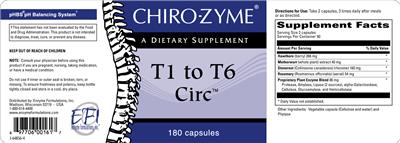
Other ingredients: Vegetable Capsule, Phytase
Tap any ingredient to jump to its full detail below.
These statements are the manufacturer’s wording, reproduced from the product label — the label is saying it, not HelloPharmacist. We don’t verify or endorse them.
Brand IP Statement(s)
pHBS ph balancing system
EFI Enzyme Formulations, Inc.
FDA Disclaimer Statement
This statement has not been evaluated by the Food and Drug Administration. This product is not intended to diagnose, treat, cure, or prevent any disease.
Precautions
Keep out of reach of children
Note: Consult your physician before using this product if you are pregnant, nursing, taking medication, or have a medical condition.
Do not use if inner or outer seal is broken, torn, or missing.
Storage
To ensure freshness and potency, keep bottle tightly closed and store in a cool, dry place.
General
J-64856-4
FDA Statement of Identity
A Dietary Supplement
Suggested/Recommended/Usage/Directions
Directions for use: Take 2 capsules, 3 times daily after meals or as directed.
Is this label outdated? Report a formula or label change and our pharmacy team will review it.
T1 To T6 Circ by Chiro-Zyme label
The label scan from the NIH Dietary Supplement Label Database. Tap to enlarge.
Label images are published by the NIH Dietary Supplement Label Database for the version of this product on file. Always read your actual product label.
View the full label (PDF)The Ingredients in T1 To T6 Circ by Chiro-Zyme
These are the 11 active ingredients this product is made of. Select any to open its full monograph.
Serving size2 Capsule(s) Dosage formCapsule Servings per container90 Amounts shown are per serving.
Most supplement products combine several ingredients, and a medication can interact with the product through any one of them. Each ingredient below shows whether it has known drug interactions.
Proprietary Plant Enzyme Blend
Hawthorn
Interacts with191 drugs
Hawthorn is a plant traditionally used for heart-related complaints, and some studies suggest it may modestly help symptoms of mild heart failure when...
Hawthorn monograph & interactionsRosemary
Interacts with372 drugs
Rosemary is a fragrant Mediterranean herb that is safe and flavorful in normal food amounts. Some early research suggests possible benefits for memory...
Rosemary monograph & interactionsMotherwort (whole plant) extract
Interacts with248 drugs
Motherwort is a traditional herb in the mint family long used for anxiety, heart palpitations, and women's reproductive complaints, but solid human ev...
Motherwort (whole plant) extract monograph & interactionsStoneroot
Other (inactive) ingredients: Vegetable Capsule, Phytase. These complete the product’s ingredient list but are not active constituents.
T1 To T6 Circ by Chiro-Zyme Drug Interactions
HelloPharmacist Interaction Report
Chiro-Zyme T1 To T6 Circ contains three ingredients with documented medication interactions: hawthorn, rosemary, and motherwort.
The most serious interactions come from hawthorn's Major-severity concern with nitrates and phosphodiesterase-5 inhibitors (drugs like sildenafil for erectile dysfunction), which could cause a dangerous drop in blood pressure through additive blood vessel dilation.
Read the full breakdown — every affected drug type, severity by severity
Hawthorn also interacts moderately with blood thinners and antiplatelet drugs (including aspirin), beta-blockers, calcium channel blockers, and digoxin, a heart medication. Rosemary carries Moderate-severity interactions with blood thinners, diabetes drugs, aspirin, and related salicylate-containing medications, plus a Minor interaction with certain liver-processed drugs.
Motherwort has a Moderate interaction with sedating medications, which could increase drowsiness.
We could not check amylase, cellulase, glucoamylase, alpha-galactosidase, hemicellulase, or stoneroot for interactions. Altogether, these interactions span 620 individual medications.
Before starting this product, search your exact medications in the tool on this page or check with your doctor or pharmacist — especially if you take heart, blood pressure, blood thinner, diabetes, or sleep medications.
Check your own medications below · Editorial policy · How we use AI
Want to check YOUR meds against T1 To T6 Circ?
Ask about interactions with your drugs in plain English — “Can I take it with lisinopril?” — and we find you the answer in seconds, ingredient by ingredient.
Go to the checkerIngredients driving the most interactions
Individual Drug Interactions
The ingredients in T1 To T6 Circ interact with 620 drugs. Click any drug to see the details.
3 of the 11 ingredients in T1 To T6 Circ interact with drugs. Each result below shows which ingredient is responsible. Rosemary Motherwort (whole plant) extract Hawthorn
AvanafilStendra
How Avanafil interacts with T1 To T6 Circ — through 1 ingredient. Tap an ingredient for the detail:
HawthornPhosphodiesterase-5 Inhibitors Major
Interaction Summary
Theoretically, concomitant use might result in additive vasodilation and hypotension.
Read the full Hawthorn + Avanafil interactionFinasteride, TadalafilEntadfi
How Finasteride, Tadalafil interacts with T1 To T6 Circ — through 1 ingredient. Tap an ingredient for the detail:
HawthornPhosphodiesterase-5 Inhibitors Major
Interaction Summary
Theoretically, concomitant use might result in additive vasodilation and hypotension.
Read the full Hawthorn + Finasteride, Tadalafil interactionGlyceryl TrinitrateNitronal
How Glyceryl Trinitrate interacts with T1 To T6 Circ — through 1 ingredient. Tap an ingredient for the detail:
HawthornNitrates Major
Interaction Summary
Theoretically, concomitant use might cause additive coronary vasodilatory effects.
Read the full Hawthorn + Glyceryl Trinitrate interactionIsosorbide DinitrateAngitak, Cedocard Retard, Isoket, Isoket Retard, Isordil
How Isosorbide Dinitrate interacts with T1 To T6 Circ — through 1 ingredient. Tap an ingredient for the detail:
HawthornNitrates Major
Interaction Summary
Theoretically, concomitant use might cause additive coronary vasodilatory effects.
Read the full Hawthorn + Isosorbide Dinitrate interactionIsosorbide Dinitrate, HydralazineBiDil
How Isosorbide Dinitrate, Hydralazine interacts with T1 To T6 Circ — through 1 ingredient. Tap an ingredient for the detail:
HawthornNitrates Major
Interaction Summary
Theoretically, concomitant use might cause additive coronary vasodilatory effects.
Read the full Hawthorn + Isosorbide Dinitrate, Hydralazine interactionIsosorbide MononitrateAngeze, Angeze SR, Chemydur 60XL, Dynamin, Elantan, Elantan LA +13 more
How Isosorbide Mononitrate interacts with T1 To T6 Circ — through 1 ingredient. Tap an ingredient for the detail:
HawthornNitrates Major
Interaction Summary
Theoretically, concomitant use might cause additive coronary vasodilatory effects.
Read the full Hawthorn + Isosorbide Mononitrate interactionMacitentan, TadalafilOpsynvi
How Macitentan, Tadalafil interacts with T1 To T6 Circ — through 1 ingredient. Tap an ingredient for the detail:
HawthornPhosphodiesterase-5 Inhibitors Major
Interaction Summary
Theoretically, concomitant use might result in additive vasodilation and hypotension.
Read the full Hawthorn + Macitentan, Tadalafil interactionNicorandilAprior, Dancor, Ikorel, Sigmart, Zynicor
How Nicorandil interacts with T1 To T6 Circ — through 1 ingredient. Tap an ingredient for the detail:
HawthornNitrates Major
Interaction Summary
Theoretically, concomitant use might cause additive coronary vasodilatory effects.
Read the full Hawthorn + Nicorandil interactionNitroglycerinGonitro, Nitro Time, Nitro-Bid, Nitrocine Timecaps, Nitrogard, Nitrogard SR +7 more
How Nitroglycerin interacts with T1 To T6 Circ — through 1 ingredient. Tap an ingredient for the detail:
HawthornNitrates Major
Interaction Summary
Theoretically, concomitant use might cause additive coronary vasodilatory effects.
Read the full Hawthorn + Nitroglycerin interactionPentaerythritol TetranitratePeritrate, Peritrate SA
How Pentaerythritol Tetranitrate interacts with T1 To T6 Circ — through 1 ingredient. Tap an ingredient for the detail:
HawthornNitrates Major
Interaction Summary
Theoretically, concomitant use might cause additive coronary vasodilatory effects.
Read the full Hawthorn + Pentaerythritol Tetranitrate interactionSildenafilRevatio
How Sildenafil interacts with T1 To T6 Circ — through 1 ingredient. Tap an ingredient for the detail:
HawthornPhosphodiesterase-5 Inhibitors Major
Interaction Summary
Theoretically, concomitant use might result in additive vasodilation and hypotension.
Read the full Hawthorn + Sildenafil interactionSildenafil CitrateViagra
How Sildenafil Citrate interacts with T1 To T6 Circ — through 1 ingredient. Tap an ingredient for the detail:
HawthornPhosphodiesterase-5 Inhibitors Major
Interaction Summary
Theoretically, concomitant use might result in additive vasodilation and hypotension.
Read the full Hawthorn + Sildenafil Citrate interactionTadalafilCialis, Tadliq
How Tadalafil interacts with T1 To T6 Circ — through 1 ingredient. Tap an ingredient for the detail:
HawthornPhosphodiesterase-5 Inhibitors Major
Interaction Summary
Theoretically, concomitant use might result in additive vasodilation and hypotension.
Read the full Hawthorn + Tadalafil interactionVardenafilLevitra, Staxyn
How Vardenafil interacts with T1 To T6 Circ — through 1 ingredient. Tap an ingredient for the detail:
HawthornPhosphodiesterase-5 Inhibitors Major
Interaction Summary
Theoretically, concomitant use might result in additive vasodilation and hypotension.
Read the full Hawthorn + Vardenafil interactionAbciximabReoPro
How Abciximab interacts with T1 To T6 Circ — through 2 ingredients. Tap an ingredient for the detail:
HawthornAnticoagulant/antiplatelet Drugs Moderate
Interaction Summary
Theoretically, hawthorn may increase the risk of bleeding if used with anticoagulant or antiplatelet drugs.
Read the full Hawthorn + Abciximab interactionRosemaryAnticoagulant/antiplatelet Drugs Moderate
Interaction Summary
Theoretically, rosemary may increase the risk of bleeding if used with anticoagulant or antiplatelet drugs.
Read the full Rosemary + Abciximab interactionAbrocitinibCibinqo
How Abrocitinib interacts with T1 To T6 Circ — through 2 ingredients. Tap an ingredient for the detail:
RosemaryAnticoagulant/antiplatelet Drugs Moderate
Interaction Summary
Theoretically, rosemary may increase the risk of bleeding if used with anticoagulant or antiplatelet drugs.
Read the full Rosemary + Abrocitinib interactionHawthornAnticoagulant/antiplatelet Drugs Moderate
Interaction Summary
Theoretically, hawthorn may increase the risk of bleeding if used with anticoagulant or antiplatelet drugs.
Read the full Hawthorn + Abrocitinib interactionAcarboseGlucobay, Prandase, Precose
How Acarbose interacts with T1 To T6 Circ — through 1 ingredient. Tap an ingredient for the detail:
RosemaryAntidiabetes Drugs Moderate
Interaction Summary
Theoretically, taking rosemary with antidiabetes drugs might increase the risk of hypoglycemia.
Read the full Rosemary + Acarbose interactionAcebutololRhotral, Sectral
How Acebutolol interacts with T1 To T6 Circ — through 1 ingredient. Tap an ingredient for the detail:
HawthornBeta-blockers Moderate
Interaction Summary
Theoretically, concomitant use might cause additive effects on blood pressure and heart rate.
Read the full Hawthorn + Acebutolol interactionAcenocoumarolSintrom
How Acenocoumarol interacts with T1 To T6 Circ — through 2 ingredients. Tap an ingredient for the detail:
HawthornAnticoagulant/antiplatelet Drugs Moderate
Interaction Summary
Theoretically, hawthorn may increase the risk of bleeding if used with anticoagulant or antiplatelet drugs.
Read the full Hawthorn + Acenocoumarol interactionRosemaryAnticoagulant/antiplatelet Drugs Moderate
Interaction Summary
Theoretically, rosemary may increase the risk of bleeding if used with anticoagulant or antiplatelet drugs.
Read the full Rosemary + Acenocoumarol interactionAcepromazineAtravet
How Acepromazine interacts with T1 To T6 Circ — through 1 ingredient. Tap an ingredient for the detail:
Motherwort (whole Plant) ExtractCns Depressants Moderate
Interaction Summary
Theoretically, taking motherwort concomitantly with other CNS depressants may increase the risk of sedation.
Read the full Motherwort (whole Plant) Extract + Acepromazine interactionAcetaminophen, AspirinGemnisyn
How Acetaminophen, Aspirin interacts with T1 To T6 Circ — through 2 ingredients. Tap an ingredient for the detail:
RosemaryCytochrome P450 1a2 (cyp1a2) Substrates, Anticoagulant/antiplatelet Drugs +1 Moderate
Interaction Summary
Theoretically, rosemary might decrease the levels and clinical effects of CYP1A2 substrates.
Read the full Rosemary + Acetaminophen, Aspirin interactionHawthornAnticoagulant/antiplatelet Drugs Moderate
Interaction Summary
Theoretically, hawthorn may increase the risk of bleeding if used with anticoagulant or antiplatelet drugs.
Read the full Hawthorn + Acetaminophen, Aspirin interactionAcetaminophen, Aspirin, CaffeineExcedrin, Excedrin Extra Strength, Excedrin Migraine
How Acetaminophen, Aspirin, Caffeine interacts with T1 To T6 Circ — through 2 ingredients. Tap an ingredient for the detail:
RosemaryAspirin, Cytochrome P450 1a2 (cyp1a2) Substrates +1 Moderate
Interaction Summary
Theoretically, rosemary might have additive effects with salicylate-containing drugs such as aspirin.
Read the full Rosemary + Acetaminophen, Aspirin, Caffeine interactionHawthornAnticoagulant/antiplatelet Drugs Moderate
Interaction Summary
Theoretically, hawthorn may increase the risk of bleeding if used with anticoagulant or antiplatelet drugs.
Read the full Hawthorn + Acetaminophen, Aspirin, Caffeine interactionAcetaminophen, Butalbital, Caffeine, CodeineEsgic with Codeine, Fioricet w/ Codeine
How Acetaminophen, Butalbital, Caffeine, Codeine interacts with T1 To T6 Circ — through 2 ingredients. Tap an ingredient for the detail:
Motherwort (whole Plant) ExtractCns Depressants Moderate
Interaction Summary
Theoretically, taking motherwort concomitantly with other CNS depressants may increase the risk of sedation.
Read the full Motherwort (whole Plant) Extract + Acetaminophen, Butalbital, Caffeine, Codeine interactionRosemaryCytochrome P450 1a2 (cyp1a2) Substrates Minor
Interaction Summary
Theoretically, rosemary might decrease the levels and clinical effects of CYP1A2 substrates.
Read the full Rosemary + Acetaminophen, Butalbital, Caffeine, Codeine interactionAcetaminophen, Butalbital, CodeineBancap w/ Codeine
How Acetaminophen, Butalbital, Codeine interacts with T1 To T6 Circ — through 2 ingredients. Tap an ingredient for the detail:
Motherwort (whole Plant) ExtractCns Depressants Moderate
Interaction Summary
Theoretically, taking motherwort concomitantly with other CNS depressants may increase the risk of sedation.
Read the full Motherwort (whole Plant) Extract + Acetaminophen, Butalbital, Codeine interactionRosemaryCytochrome P450 1a2 (cyp1a2) Substrates Minor
Interaction Summary
Theoretically, rosemary might decrease the levels and clinical effects of CYP1A2 substrates.
Read the full Rosemary + Acetaminophen, Butalbital, Codeine interactionAcetaminophen, Butalbital, Codeine PhosphatePhrenilin #3
How Acetaminophen, Butalbital, Codeine Phosphate interacts with T1 To T6 Circ — through 2 ingredients. Tap an ingredient for the detail:
Motherwort (whole Plant) ExtractCns Depressants Moderate
Interaction Summary
Theoretically, taking motherwort concomitantly with other CNS depressants may increase the risk of sedation.
Read the full Motherwort (whole Plant) Extract + Acetaminophen, Butalbital, Codeine Phosphate interactionRosemaryCytochrome P450 1a2 (cyp1a2) Substrates Minor
Interaction Summary
Theoretically, rosemary might decrease the levels and clinical effects of CYP1A2 substrates.
Read the full Rosemary + Acetaminophen, Butalbital, Codeine Phosphate interactionAcetaminophen, Caffeine, Chlorpheniramine, Hydrocodone, PhenylephrineHycomine Compound
How Acetaminophen, Caffeine, Chlorpheniramine, Hydrocodone, Phenylephrine interacts with T1 To T6 Circ — through 2 ingredients. Tap an ingredient for the detail:
Motherwort (whole Plant) ExtractCns Depressants Moderate
Interaction Summary
Theoretically, taking motherwort concomitantly with other CNS depressants may increase the risk of sedation.
Read the full Motherwort (whole Plant) Extract + Acetaminophen, Caffeine, Chlorpheniramine, Hydrocodone, Phenylephrine interactionRosemaryCytochrome P450 1a2 (cyp1a2) Substrates Minor
Interaction Summary
Theoretically, rosemary might decrease the levels and clinical effects of CYP1A2 substrates.
Read the full Rosemary + Acetaminophen, Caffeine, Chlorpheniramine, Hydrocodone, Phenylephrine interactionAcetaminophen, Caffeine, CodeineGesic C15, Gesic C30, Gesic C8, Lenoltec 1, Lenoltec 2, Lenoltec 3 +1 more
How Acetaminophen, Caffeine, Codeine interacts with T1 To T6 Circ — through 2 ingredients. Tap an ingredient for the detail:
Motherwort (whole Plant) ExtractCns Depressants Moderate
Interaction Summary
Theoretically, taking motherwort concomitantly with other CNS depressants may increase the risk of sedation.
Read the full Motherwort (whole Plant) Extract + Acetaminophen, Caffeine, Codeine interactionRosemaryCytochrome P450 1a2 (cyp1a2) Substrates Minor
Interaction Summary
Theoretically, rosemary might decrease the levels and clinical effects of CYP1A2 substrates.
Read the full Rosemary + Acetaminophen, Caffeine, Codeine interactionAcetaminophen, Caffeine, Codeine, SalicylamideCodalan No.1, Codalan No.2, Codalan No.3
How Acetaminophen, Caffeine, Codeine, Salicylamide interacts with T1 To T6 Circ — through 2 ingredients. Tap an ingredient for the detail:
Motherwort (whole Plant) ExtractCns Depressants Moderate
Interaction Summary
Theoretically, taking motherwort concomitantly with other CNS depressants may increase the risk of sedation.
Read the full Motherwort (whole Plant) Extract + Acetaminophen, Caffeine, Codeine, Salicylamide interactionRosemaryCytochrome P450 1a2 (cyp1a2) Substrates Minor
Interaction Summary
Theoretically, rosemary might decrease the levels and clinical effects of CYP1A2 substrates.
Read the full Rosemary + Acetaminophen, Caffeine, Codeine, Salicylamide interactionAcetaminophen, Caffeine, DihydrocodeineDHC Plus, Panlor DC, Panlor SS
How Acetaminophen, Caffeine, Dihydrocodeine interacts with T1 To T6 Circ — through 2 ingredients. Tap an ingredient for the detail:
Motherwort (whole Plant) ExtractCns Depressants Moderate
Interaction Summary
Theoretically, taking motherwort concomitantly with other CNS depressants may increase the risk of sedation.
Read the full Motherwort (whole Plant) Extract + Acetaminophen, Caffeine, Dihydrocodeine interactionRosemaryCytochrome P450 1a2 (cyp1a2) Substrates Minor
Interaction Summary
Theoretically, rosemary might decrease the levels and clinical effects of CYP1A2 substrates.
Read the full Rosemary + Acetaminophen, Caffeine, Dihydrocodeine interactionAcetaminophen, Chlorpheniramine, Codeine, PhenylephrineColrex
How Acetaminophen, Chlorpheniramine, Codeine, Phenylephrine interacts with T1 To T6 Circ — through 2 ingredients. Tap an ingredient for the detail:
Motherwort (whole Plant) ExtractCns Depressants Moderate
Interaction Summary
Theoretically, taking motherwort concomitantly with other CNS depressants may increase the risk of sedation.
Read the full Motherwort (whole Plant) Extract + Acetaminophen, Chlorpheniramine, Codeine, Phenylephrine interactionRosemaryCytochrome P450 1a2 (cyp1a2) Substrates Minor
Interaction Summary
Theoretically, rosemary might decrease the levels and clinical effects of CYP1A2 substrates.
Read the full Rosemary + Acetaminophen, Chlorpheniramine, Codeine, Phenylephrine interactionEach ingredient & the kinds of drugs it affects
For each ingredient in T1 To T6 Circ with known interactions, here are the types of medications they can affect. Open any type for the detail — or search your exact drug in the checker above.
Rosemary
Anticoagulant/Antiplatelet Drugs
Theoretically, rosemary may increase the risk of bleeding if used with anticoagulant or antiplatelet drugs.
In vitro and animal research suggests that rosemary inhibits platelet aggregation.
Antidiabetes Drugs
Theoretically, taking rosemary with antidiabetes drugs might increase the risk of hypoglycemia.
Animal research shows that rosemary extract can decrease blood glucose levels in diabetic models. However, research in humans is conflicting. Although rosemary powder decreased blood glucose levels in healthy adults, no change in blood glucose levels was seen in adults with type 2 diabetes, most of whom were taking antidiabetes drugs.
Aspirin
Theoretically, rosemary might have additive effects with salicylate-containing drugs such as aspirin.
Rosemary is reported to contain salicylates.
Choline Magnesium Trisalicylate (Trilisate)
Theoretically, rosemary might have additive effects with salicylate-containing drugs such as choline magnesium trisalicylate.
Rosemary is reported to contain salicylate.
Salsalate (Disalcid)
Theoretically, rosemary might have additive effects with salicylate-containing drugs such as salsalate.
Rosemary is reported to contain salicylate.
Cytochrome P450 1A2 (Cyp1A2) Substrates
Theoretically, rosemary might decrease the levels and clinical effects of CYP1A2 substrates.
In vitro research shows that rosemary induces CYP1A2 enzymes. This effect has not been reported in humans.
Motherwort (whole plant) extract
Cns Depressants
Theoretically, taking motherwort concomitantly with other CNS depressants may increase the risk of sedation.
Motherwort has been reported to cause CNS depression and sedation.
Hawthorn
Nitrates
Theoretically, concomitant use might cause additive coronary vasodilatory effects.
Some evidence shows that hawthorn might lower blood pressure due to vasodilatory effects.
Phosphodiesterase-5 Inhibitors
Theoretically, concomitant use might result in additive vasodilation and hypotension.
Hawthorn might inhibit PDE-5 and cause vasodilation.
Anticoagulant/Antiplatelet Drugs
Theoretically, hawthorn may increase the risk of bleeding if used with anticoagulant or antiplatelet drugs.
In vitro and animal research shows that hawthorn can inhibit platelet aggregation. However, its effect in humans is unclear. One observational study shows that patients taking hawthorn shortly before undergoing coronary artery bypass graft (CABG) surgery or valve replacement surgery have a 10% incidence of postoperative bleeding, compared with 1% in those who never consumed hawthorn extract. However, clinical research shows that taking a specific preparation of dried hawthorn leaves and flowers (Crataesor, Soria Natural Lab) 800 mg three times daily for 15 days does not affect platelet aggregation or levels of thromboxane B2, the metabolite of thromboxane A2, in healthy humans.
Beta-Blockers
Theoretically, concomitant use might cause additive effects on blood pressure and heart rate.
Some evidence shows that hawthorn might lower blood pressure and heart rate.
Calcium Channel Blockers
Theoretically, concomitant use might cause additive coronary vasodilation and hypotensive effects.
Some evidence shows that hawthorn might lower blood pressure due to vasodilatory effects.
Digoxin (Lanoxin)
Theoretically, hawthorn might potentiate the effects and adverse effects of digoxin.
Hawthorn appears to improve cardiac output; however, hawthorn does not appear to affect digoxin pharmacokinetics. Case reports suggest that at least one species of hawthorn root extract (Crataegus mexicana) may produce adverse effects similar to digoxin and can cross-react with digoxin assays, leading to falsely elevated plasma digoxin levels.
Brand information
Manufacturer and brand details for T1 To T6 Circ, from the product label.
Chiro-Zyme
See all Chiro-Zyme products- Name
- Enzyme Formulations, Inc.
- City
- Madison
- State
- Wisconsin
- ZipCode
- 53719
- Phone Number
- 1-800-614-4400
- Web Address
- www.enzymeformulations.com
T1 To T6 Circ by Chiro-Zyme: Common Questions
Does T1 To T6 Circ by Chiro-Zyme interact with any medications?
How can one product interact with so many drugs?
Where does this information come from?
Can I take this if I'm on blood pressure medication?
Is this safe during pregnancy?
What does rosemary in this product do?
Could this make me drowsy?
Does this contain fillers?
What if I'm on a blood thinner like warfarin?
Written and reviewed by the HelloPharmacist editorial staff. Our editorial policy
Not sure if T1 To T6 Circ is safe with your meds?
Our pharmacists answer your medication & supplement questions — free.
Label information is sourced from the NIH Dietary Supplement Label Database and reflects the product version on file; always read your actual product label. This page is for education only and is not a substitute for professional medical advice. Confirm with your pharmacist or doctor before combining supplements and medications.
The Full Monographs Behind T1 To T6 Circ’s Ingredients
Every ingredient we hold a full HelloPharmacist monograph for — uses, evidence, safety, and the complete interaction list.
Proteolytic Enzymes (proteases)
Proteolytic enzymes are proteins that help break down other proteins, and common examples include bromelain (from pineapple), papain (from papaya), trypsin, chymotrypsin, and pancreatin. Peo...
Read the full Proteolytic Enzymes (proteases) monograph → Herb & supplement monographLipase
Lipase is a digestive enzyme that helps your body break down dietary fats. It is well established as part of prescription pancreatic enzyme therapy for people who cannot make enough of their...
Read the full Lipase monograph → Herb & supplement monographHawthorn
Interacts with 191 drugsHawthorn is a plant traditionally used for heart-related complaints, and some studies suggest it may modestly help symptoms of mild heart failure when added to standard care. However, the ev...
Read the full Hawthorn monograph → Herb & supplement monographRosemary
Interacts with 372 drugsRosemary is a fragrant Mediterranean herb that is safe and flavorful in normal food amounts. Some early research suggests possible benefits for memory, mood, and hair growth, but the evidenc...
Read the full Rosemary monograph → Herb & supplement monographMotherwort
Interacts with 248 drugsMotherwort is a traditional herb in the mint family long used for anxiety, heart palpitations, and women's reproductive complaints, but solid human evidence is very limited. It should be avo...
Read the full Motherwort monograph →Sources & How We Checked
T1 To T6 Circ's label data comes from the NIH Dietary Supplement Label Database; the ingredient interaction data is from the Natural Medicines database, reviewed by our pharmacists.
- NIH Dietary Supplement Label Database (DSLD) — The official product label on file for this supplement.
- Natural Medicines (Therapeutic Research Center) — Evidence-graded clinical reference behind the ingredient interaction data.
Content is written and reviewed by licensed HelloPharmacist pharmacists. See our data sources and editorial standards for how this information is built and checked.
The 55 references behind this product’s interaction data
Every citation that drives the interaction findings for this product’s ingredients, from the evidence-graded Natural Medicines (TRC Healthcare) database. Open an ingredient to browse its citations — links open the study on PubMed or the publisher’s site.
Proteolytic Enzymes (proteases) 3 references
- Weeks JA, Harper RA, Simon RA, Burdick JD. Assessment of sensitization risk of a laundry pre-spotter containing protease. Cutan Ocul Toxicol. 2011;30(4):272-9. PubMed
- Marquès LI, Lara S, Abós T, Bartolomé B. Occupational rhinitis due to pepsin. J Investig Allergol Clin Immunol. 2006;16(2):136-7. DOI
- Cartier A, Malo JL, Pineau L, Dolovich J. Occupational asthma due to pepsin. J Allergy Clin Immunol. 1984;73(5 Pt 1):574-7. PubMed
See these in context on the Proteolytic Enzymes (proteases) monograph →
Lipase 1 reference
- Casper C, Hascoet JM, Ertl T, et al. Recombinant bile salt-stimulated lipase in preterm infant feeding: A randomized phase 3 study. PLoS One. 2016;11(5):e0156071. PubMed
Hawthorn 25 references
- Tauchert M. Efficacy and safety of crataegus extract WS 1442 in comparison with placebo in patients with chronic stable New York Heart Association class-III heart failure. Am Heart J 2002;143:910-5. PubMed
- Pittler MH, Schmidt K, Ernst E. Hawthorn extract for treating chronic heart failure: meta-analysis of randomized trials. Am J Med 2003;114:665-74.. PubMed
- Chang Q, Zuo Z, Harrison F, Chow MS. Hawthorn. J Clin Pharmacol 2002;42:605-12.
- Holubarsch CJ, Colucci WS, Meinertz T, et al. The efficacy and safety of Crataegus extract WS 1442 in patients with heart failure: the SPICE trial. Eur J Heart Fail 2008;10:1255-63. PubMed
- Pittler MH, Guo R, and Ernst E. Hawthorn extract for treating chronic heart failure. Cochrane.Database.Syst Rev 2008:CD005312. PubMed
- Zick SM, Vautaw BM, Gillespie B, Aaronson KD. Hawthorn Extract Randomized Blinded Chronic Heart Failure (HERB CHF) trial. Eur J Heart Fail. 2009;11:990-99. PubMed
- Werner NS, Duschek S, and Schandry R. D-camphor-crataegus berry extract combination increases blood pressure and cognitive functioning in the elderly - a randomized, placebo controlled double blind study. Phytomedicine. 2009;16:1077-82. PubMed
- Dalli E, Colomer E, Tormos MC, et al. Crataegus laevigata decreases neutrophil elastase and has hypolipidemic effect: a randomized, double-blind, placebo-controlled trial. Phytomedicine. 6-15-2011;18:769-75. PubMed
- Maek-a-nantawat W, Phonrat B, Dhitavat J, et al. Safety and efficacy of CKBM-A01, a Chinese herbal medicine, among asymptomatic HIV patients. Southeast Asian J Trop.Med Public Health 2009;40:494-501.
- Asher GN, Viera AJ, Weaver MA, et al. Effect of hawthorn standardized extract on flow mediated dilation in prehypertensive and mildly hypertensive adults: a randomized, controlled cross-over trial. BMC.Complement Altern.Med 2012;12:26. PubMed
- Walker AF, Marakis G, Simpson E, et al. Hypotensive effects of hawthorn for patients with diabetes taking prescription drugs: a randomised controlled trial. Br J Gen.Pract 2006;56:437-43.
- Daniele C, Mazzanti G, Pittler MH, et al. Adverse-event profile of Crataegus spp.: a systematic review. Drug Saf 2006;29:523-35. PubMed
- Tankanow R, Tamer HR, Streetman DS, et al. Interaction study between digoxin and a preparation of hawthorn (Crataegus oxyacantha). J.Clin.Pharmacol. 2003;43:637-42. DOI
- Tauchert, M., Gildor, A., and Lipinski, J. [High-dose Crataegus extract WS 1442 in the treatment of NYHA stage II heart failure]. Herz 1999;24(6):465-474.
- Horoz, M., Gok, E., Genctoy, G., Ozcan, T., Olmaz, R., Akca, M., Kiykim, A., and Gurses, I. Crataegus orientalis associated multiorgan hypersensitivity reaction and acute renal failure. Intern.Med 2008;47(23):2039-2042. PubMed
- Dalli, E., Valles, J., Cosin-Sales, J., Santos, M. T., Moscardo, A., Milara, J., and Sotillo, J. F. Effects of hawthorn (Crataegus laevigata) on platelet aggregation in healthy volunteers. Thromb.Res 2011;128(4):398-400. PubMed
- Rogov VD. [Toxiderma due to the fruits of the hawthorn]. Vestn Dermatol Venerol 1984;7(7):46-47.
- Loew D, Albrecht M, and Podzuweit H. Efficacy and tolerability of a Hawthorn preparation in patients with heart failure Stage I and II according to NYHA - a surveillance study. Phytomedicine 1996;3(Suppl 1):92.
- Rababa'h AM, Altarabsheh SE, Haddad O, Deo SV, Obeidat Y, Al-Azzam S. Hawthorn Herb Increases the Risk of Bleeding after Cardiac Surgery: An Evidence-Based Approach. Heart Surg Forum 2016;19(4):E175-9. PubMed
- Shatoor AS, Soliman H, Al-Hashem F, Gamal BE, Othman A, El-Menshaw N. Effect of hawthorn (Crataegus aronia syn. Azarolus (L)) on platelet function in albino wistar rats. Thromb Res 2012;130(1):75-80. PubMed
- Vibes J, Lasserre B, Gleye J, Declume C. Inhibition of thromboxane A2 biosynthesis in vitro by the main components of Crataegus oxyacantha (hawthorn) flower heads. Prostaglandins Leukot Essent Fatty Acids 1994;50(4):173-5. PubMed
- Rogers KL, Grice ID, Griffiths LR. Inhibition of platelet aggregation and 5-HT release by extracts of Australian plants used traditionally as headache treatments. Eur J Pharm Sci 2000;9(4):355-63. PubMed
- Zhou CC, Huang XX, Gao PY, et al. Two new compounds from Crataegus pinnatifida and their antithrombotic activities. J Asian Nat Prod Res 2014;16(2):169-74.
- Palmer KG, Lebin JA, Cronin MT, Mazor SS, Burns RA. Crataegus mexicana (Tejocote) Exposure Associated with Cardiotoxicity and a Falsely Elevated Digoxin Level. J Med Toxicol. 2019;15(4):295-298. PubMed
- Espinosa J, Bassett R, Lucerna A, Finn D. Hawthorne root (Crataegus mexicana) toxicity. Am J Emerg Med. 2024;78:242.e5-242.e6. PubMed
Rosemary 20 references
- Newall CA, Anderson LA, Philpson JD. Herbal Medicine: A Guide for Healthcare Professionals. London, UK: The Pharmaceutical Press, 1996.
- Foster S, Tyler VE. Tyler's Honest Herbal: A Sensible Guide to the Use of Herbs and Related Remedies. 3rd ed., Binghamton, NY: Haworth Herbal Press, 1993.
- The Review of Natural Products by Facts and Comparisons. St. Louis, MO: Wolters Kluwer Co., 1999.
- McGuffin M, Hobbs C, Upton R, Goldberg A, eds. American Herbal Products Association's Botanical Safety Handbook. Boca Raton, FL: CRC Press, LLC 1997.
- Gruenwald J, Brendler T, Jaenicke C. PDR for Herbal Medicines. 1st ed. Montvale, NJ: Medical Economics Company, Inc., 1998.
- Cartier LC, Lehrer A, Malo JL. Occupational asthma caused by aromatic herbs. Allergy 1996;51:647-9. DOI
- Burkhard PR, Burkhardt K, Haenggeli CA, Landis T. Plant-induced seizures: reappearance of an old problem. J Neurol 1999;246:667-70. PubMed
- Swain AR, Dutton SP, Truswell AS. Salicylates in foods. J Am Diet.Assoc 1985;85(8):950-60. DOI
- Zhu BT, Loder DP, Cai MX, et al. Dietary administration of an extract from rosemary leaves enhances the liver microsomal metabolism of endogenous estrogens and decreases their uterotropic action in CD-1 mice. Carcinogenesis 1998;19(10):1821-7. PubMed
- Debersac P, Heydel JM, Amiot MJ, et al. Induction of cytochrome P450 and/or detoxication enzymes by various extracts of rosemary: description of specific patterns. Food Chem Toxicol 2001;39(9):907-18. PubMed
- Debersac P, Vernevaut MF, Amiot MJ, et al. Effects of a water-soluble extract of rosemary and its purified component rosmarinic acid on xenobiotic-metabolizing enzymes in rat liver. Food Chem Toxicol 2001;39(2):109-17. PubMed
- Lee JJ, Jin YR, Lee JH, et al. Antiplatelet activity of carnosic acid, a phenolic diterpene from Rosmarinus officinalis. Planta Med 2007;73(2):121-7.
- Yamamoto J, Yamada K, Naemura A, et al. Testing various herbs for antithrombotic effect. Nutrition 2005;21(5):580-7. PubMed
- Naemura A, Ura M, Yamashita T, et al. Long-term intake of rosemary and common thyme herbs inhibits experimental thrombosis without prolongation of bleeding time. Thromb Res 2008;122(4):517-22. PubMed
- Lee JJ, Jin YR, Lim Y, et al. Antiplatelet activity of carnosol is mediated by the inhibition of TXA2 receptor and cytosolic calcium mobilization. Vascul Pharmacol 2006;45:148-53. PubMed
- Bakirel, T., Bakirel, U., Keles, O. U., Ulgen, S. G., and Yardibi, H. In vivo assessment of antidiabetic and antioxidant activities of rosemary (Rosmarinus officinalis) in alloxan-diabetic rabbits. J Ethnopharmacol 2-28-2008;116(1):64-73. PubMed
- Erenmemisoglu, A., Saraymen, R., and Ustun, S. Effect of a Rosmarinus officinalis leave extract on plasma glucose levels in normoglycaemic and diabetic mice. Pharmazie 1997;52(8):645-646.
- Valones MAA, Silva ICG, Gueiros LAM, Leão JC, Caldas AF Jr, Carvalho AAT. Clinical assessment of rosemary-based toothpaste (Rosmarinus officinalis Linn.): A randomized controlled double-blind study. Braz Dent J. 2019;30(2):146-151. PubMed
- Quirarte-Báez SM, Zamora-Perez AL, Reyes-Estrada CA, et al. A shortened treatment with rosemary tea (rosmarinus officinalis) instead of glucose in patients with diabetes mellitus type 2 (TSD). J Popul Ther Clin Pharmacol. 2019;26(4):e18-e28.
- Al Jamal A. Effect of rosemary (Rosmarinus officinalis) on lipid profiles and blood glucose in human diabetic patients (type-2). African J. Biochem. Res. 2014;8(8):147-50. DOI
Motherwort 6 references
- Newall CA, Anderson LA, Philpson JD. Herbal Medicine: A Guide for Healthcare Professionals. London, UK: The Pharmaceutical Press, 1996.
- McGuffin M, Hobbs C, Upton R, Goldberg A, eds. American Herbal Products Association's Botanical Safety Handbook. Boca Raton, FL: CRC Press, LLC 1997.
- Brinker F. Herb Contraindications and Drug Interactions. 2nd ed. Sandy, OR: Eclectic Medical Publications, 1998.
- Wojtyniak K, Szymanski M, Matlawska I. Leonurus cardiaca L. (motherwort): a review of its phytochemistry and pharmacology. Phytother Res 2013;27(8):1115-20.
- Xia WT, Zhou H, Wang Y, et al. Motherwort injection in preventing post-abortion hemorrhage after induced abortion: A multi-center, prospective, randomized controlled trial. Explore (NY). 2019. pii: S1550-8307(19)30447-1. PubMed
- Cao Shan DOSOGC, Zhang W, Zhao Z, et al. Post-marketing safety surveillance and reevaluation of Motherwort injection: A clinical study of 10 094 cases. J Tradit Chin Med. 2018 Aug;38(4):625-635. DOI
Parts of this content are provided by the Therapeutic Research Center, LLC.
DISCLAIMER: Currently this does not check for drug-drug interactions. This is not an all-inclusive comprehensive list of potential interactions and is for informational purposes only. Not all interactions are known or well-reported in the scientific literature, and new interactions are continually being reported. Input is needed from a qualified healthcare provider including a pharmacist before starting any therapy. Application of clinical judgment is necessary.
© 2021 Therapeutic Research Center, LLC