
Wheat Grass Ingredients & Drug Interactions
by TerraVita
What is this page for?
First and foremost: checking Wheat Grass against your medications. The heart of this page is the interaction checker and the full interaction report — how this product’s ingredients may interact with prescription and over-the-counter medicines you may be taking.
Around that, we add a pharmacist’s high-level view of the product as a whole — what’s inside, the evidence for its stated use, how transparent the label is, and what safety data exists — so you can see the full picture in one place. It’s educational information from our licensed clinical databases and the clinical staff at HelloPharmacist — not medical advice — and we don’t sell or endorse products. Our editorial policy
Wheat Grass is a dietary supplement by TerraVita with 1 active ingredient. Its ingredients are commonly taken for general nutrition support, digestive health, antioxidant support.Based on those ingredients, 272 medications have a known interaction with it, the most serious rated moderate. The ingredients most likely to interact are Wheat Grass Glycerite Liquid Extract. Use the checker below to test your specific medication, or read the full HelloPharmacist Interaction Report.
Check Your Meds Against Wheat Grass by TerraVita
Ask about any prescription or over-the-counter medication and we check it for interactions with Wheat Grass by TerraVita — and tell you which ingredient is responsible.
AI summaries are generated from our interaction database for education only — always confirm with your pharmacist. How we use AI
Ask the Pharmacist
A licensed pharmacist will answer your question by email — free, usually within 24 hours.
Got it — thank you!
A licensed pharmacist will answer within 24 hours. Keep an eye on your email (worth checking spam, just in case).
HelloPharmacist Scorecard of Wheat Grass by TerraVita
Our pharmacy team’s full take, with four database checks built into the cards below — a summary of what is known, not a grade of the product itself.
What’s inside
Full disclosure
This product contains one active ingredient: wheat grass glycerite liquid extract. The only other ingredient listed is glycerin, which is a sweetener and preservative used to keep the product liquid.
Does it work?
Couldn't assess
The evidence we hold doesn't establish how well wheat grass works for the conditions listed—bronchitis, benign prostatic hyperplasia, beta-thalassemia, cancer, and the common cold all carry a rating of insufficient reliable evidence. That means we don't have enough solid data to say whether it's effective for any of these uses.
How safe is it?
Well-documented data
Wheat grass is generally well tolerated when taken by mouth, but the facts raise caution flags. Raw products may carry contamination risk, and quality concerns exist.
Wheat itself is a major food allergen in the United States, so if you're sensitive to wheat, this product poses an allergy risk. The most common side effects reported are allergic reactions, loss of appetite (anorexia), constipation, and nausea.
Safety hasn't been formally established, so your doctor should clear it first.
Meds to double-check
Moderate interaction found
If you take any diabetes medication (insulin, metformin, sulfonylureas, or others), check with your pharmacist before adding this product—wheatgrass may lower your blood sugar too far. Also double-check any prescription medications metabolized by CYP1A2 enzymes with your pharmacist, as this product may reduce how well they work.
The bottom line
Scorecard at a glanceFully disclosed formula with no assessable stated purpose. Moderate medication interactions have been identified, and safety information is well characterized.
Wheat grass might appeal to you if you're interested in a traditional herbal remedy, but the evidence for it doesn't yet support its use for any specific condition. If you take diabetes medication or any prescription drug, check it against the interaction tool first—there are a lot of potential concerns.
Talk to your doctor or pharmacist before starting, especially if you have a wheat allergy or are pregnant or breastfeeding.
Educational only — not medical advice; always confirm with your pharmacist. Our editorial policy · How we use AI
Assessment coverage: 1 of 1 active ingredient matched to our full ingredient reviews (monographs). Based on the product label dated Dec 13, 2022.
This Scorecard evaluates available label information, ingredient evidence, and known medication-safety considerations. It does not independently verify product identity, purity, potency, contamination, or manufacturing quality. How these ratings are computed
General information
Key facts about Wheat Grass, straight from the product label.
Everything in this section is reproduced from the manufacturer’s own product label — it’s the label speaking, not HelloPharmacist. We show it so you can see exactly what the maker states; we don’t verify or endorse those statements.
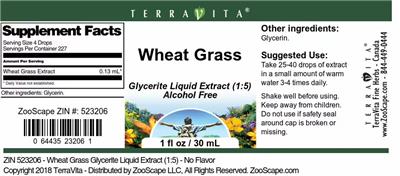
Supplement Facts
The label details for Wheat Grass by TerraVita, sourced from the NIH Dietary Supplement Label Database.
Supplement Facts
| Ingredient | Amount | % DV |
|---|---|---|
| Wheat Grass Glycerite Liquid Extract | 0.13 mL | -- |
Other ingredients: Glycerin
Tap any ingredient to jump to its full detail below.
These statements are the manufacturer’s wording, reproduced from the product label — the label is saying it, not HelloPharmacist. We don’t verify or endorse them.
Brand IP Statement(s)
Copyright 2018 TerraVita - Distributed by ZooScape LLC, All Rights Reserved.
Formula
Glycerite liquid extract (1:5)
Formulation
Alcohol free
No flavor
Suggested/Recommended/Usage/Directions
Suggested Use: Take 25-40 drops of extract in a small amount of warm water 3-4 times daily. Shake well before using.
Precautions
Keep away from children.
Do not use if safety seal around cap is broken or missing.
Is this label outdated? Report a formula or label change and our pharmacy team will review it.
Wheat Grass by TerraVita label
The label scan from the NIH Dietary Supplement Label Database. Tap to enlarge.
Label images are published by the NIH Dietary Supplement Label Database for the version of this product on file. Always read your actual product label.
View the full label (PDF)The Ingredients in Wheat Grass by TerraVita
This is the 1 active ingredient this product is made of. Select it to open its full monograph.
Serving size25 Drop(s) Dosage formLiquid Servings per container227 Amounts shown are per serving.
Wheat Grass Glycerite Liquid Extract
Interacts with272 drugs
Wheatgrass is the young grass of the wheat plant, taken as a juice or powder, and is mainly used as a concentrated source of vitamins and plant nutrie...
Wheat Grass Glycerite Liquid Extract monograph & interactionsOther (inactive) ingredients: Glycerin. These complete the product’s ingredient list but are not active constituents.
Wheat Grass by TerraVita Drug Interactions
HelloPharmacist Interaction Report
TerraVita Wheat Grass Liquid has documented interactions with antidiabetes drugs and a large group of medications broken down by how your liver processes them.
The most serious concern is with antidiabetes drugs (blood sugar medications): wheatgrass may stimulate insulin release and lower blood glucose, raising the risk of low blood sugar (hypoglycemia) if you're already taking a medication for diabetes.
Read the full breakdown — every affected drug type, severity by severity
It also interacts with a broad category called CYP1A2 substrates—these are drugs your liver breaks down using a specific enzyme. Wheatgrass appears to speed up that enzyme, which can lower the levels and reduce the effectiveness of those medications.
Altogether, these interactions span 272 individual medications. If you take diabetes medication or any prescription drug metabolized through this pathway (your pharmacist can tell you), check your exact medications with the tool on this page before starting this product.
Check your own medications below · Editorial policy · How we use AI
Want to check YOUR meds against Wheat Grass?
Ask about interactions with your drugs in plain English — “Can I take it with lisinopril?” — and we find you the answer in seconds, ingredient by ingredient.
Go to the checkerIngredients driving the most interactions
Individual Drug Interactions
The ingredients in Wheat Grass interact with 272 drugs. Click any drug to see the details.
1 of the 1 ingredient in Wheat Grass interact with drugs. Each result below shows which ingredient is responsible. Wheat Grass Glycerite Liquid Extract
BendamustineBelrapzo, Treanda, Vivimusta
How Bendamustine interacts with Wheat Grass — through 1 ingredient. Tap an ingredient for the detail:
Wheat Grass Glycerite Liquid ExtractCytochrome P450 1a2 (cyp1a2) Substrates Moderate
Interaction Summary
Theoretically, wheatgrass might decrease the levels and clinical effects of CYP1A2 substrates.
Read the full Wheat Grass Glycerite Liquid Extract + Bendamustine interactionBendamustine HydrochlorideBendeka
How Bendamustine Hydrochloride interacts with Wheat Grass — through 1 ingredient. Tap an ingredient for the detail:
Wheat Grass Glycerite Liquid ExtractCytochrome P450 1a2 (cyp1a2) Substrates Moderate
Interaction Summary
Theoretically, wheatgrass might decrease the levels and clinical effects of CYP1A2 substrates.
Read the full Wheat Grass Glycerite Liquid Extract + Bendamustine Hydrochloride interactionBenzhydrocodone, AcetaminophenApadaz
How Benzhydrocodone, Acetaminophen interacts with Wheat Grass — through 1 ingredient. Tap an ingredient for the detail:
Wheat Grass Glycerite Liquid ExtractCytochrome P450 1a2 (cyp1a2) Substrates Moderate
Interaction Summary
Theoretically, wheatgrass might decrease the levels and clinical effects of CYP1A2 substrates.
Read the full Wheat Grass Glycerite Liquid Extract + Benzhydrocodone, Acetaminophen interactionCaffeine (otc Drug)Molie, Overtime, Vivarin
How Caffeine (otc Drug) interacts with Wheat Grass — through 1 ingredient. Tap an ingredient for the detail:
Wheat Grass Glycerite Liquid ExtractCytochrome P450 1a2 (cyp1a2) Substrates Moderate
Interaction Summary
Theoretically, wheatgrass might decrease the levels and clinical effects of CYP1A2 substrates.
Read the full Wheat Grass Glycerite Liquid Extract + Caffeine (otc Drug) interactionCaffeine (prescription Drug)Caffeine, Dextrophin
How Caffeine (prescription Drug) interacts with Wheat Grass — through 1 ingredient. Tap an ingredient for the detail:
Wheat Grass Glycerite Liquid ExtractCytochrome P450 1a2 (cyp1a2) Substrates Moderate
Interaction Summary
Theoretically, wheatgrass might decrease the levels and clinical effects of CYP1A2 substrates.
Read the full Wheat Grass Glycerite Liquid Extract + Caffeine (prescription Drug) interactionCaffeine , Sodium BenzoateCaffeine and Sodium Benzoate
How Caffeine , Sodium Benzoate interacts with Wheat Grass — through 1 ingredient. Tap an ingredient for the detail:
Wheat Grass Glycerite Liquid ExtractCytochrome P450 1a2 (cyp1a2) Substrates Moderate
Interaction Summary
Theoretically, wheatgrass might decrease the levels and clinical effects of CYP1A2 substrates.
Read the full Wheat Grass Glycerite Liquid Extract + Caffeine , Sodium Benzoate interactionCaffeine, Diphenhydramine, Ergotamine (prescription Drug)Ergodryl
How Caffeine, Diphenhydramine, Ergotamine (prescription Drug) interacts with Wheat Grass — through 1 ingredient. Tap an ingredient for the detail:
Wheat Grass Glycerite Liquid ExtractCytochrome P450 1a2 (cyp1a2) Substrates Moderate
Interaction Summary
Theoretically, wheatgrass might decrease the levels and clinical effects of CYP1A2 substrates.
Read the full Wheat Grass Glycerite Liquid Extract + Caffeine, Diphenhydramine, Ergotamine (prescription Drug) interactionCaffeine, Ergotamine (prescription Drug)Migergot
How Caffeine, Ergotamine (prescription Drug) interacts with Wheat Grass — through 1 ingredient. Tap an ingredient for the detail:
Wheat Grass Glycerite Liquid ExtractCytochrome P450 1a2 (cyp1a2) Substrates Moderate
Interaction Summary
Theoretically, wheatgrass might decrease the levels and clinical effects of CYP1A2 substrates.
Read the full Wheat Grass Glycerite Liquid Extract + Caffeine, Ergotamine (prescription Drug) interactionCaffeine, Ergotamine Tartrate (prescription Drug)Cafergot, Wigraine
How Caffeine, Ergotamine Tartrate (prescription Drug) interacts with Wheat Grass — through 1 ingredient. Tap an ingredient for the detail:
Wheat Grass Glycerite Liquid ExtractCytochrome P450 1a2 (cyp1a2) Substrates Moderate
Interaction Summary
Theoretically, wheatgrass might decrease the levels and clinical effects of CYP1A2 substrates.
Read the full Wheat Grass Glycerite Liquid Extract + Caffeine, Ergotamine Tartrate (prescription Drug) interactionCaffeine, Potassium Salicylate, SalicylamideTrim-Elim
How Caffeine, Potassium Salicylate, Salicylamide interacts with Wheat Grass — through 1 ingredient. Tap an ingredient for the detail:
Wheat Grass Glycerite Liquid ExtractCytochrome P450 1a2 (cyp1a2) Substrates Moderate
Interaction Summary
Theoretically, wheatgrass might decrease the levels and clinical effects of CYP1A2 substrates.
Read the full Wheat Grass Glycerite Liquid Extract + Caffeine, Potassium Salicylate, Salicylamide interactionCanagliflozinInvokana
How Canagliflozin interacts with Wheat Grass — through 1 ingredient. Tap an ingredient for the detail:
Wheat Grass Glycerite Liquid ExtractAntidiabetes Drugs Moderate
Interaction Summary
Theoretically, taking wheatgrass with antidiabetes drugs might lower blood glucose levels and increase the risk of hypoglycemia.
Read the full Wheat Grass Glycerite Liquid Extract + Canagliflozin interactionCanagliflozin, MetforminInvokamet
How Canagliflozin, Metformin interacts with Wheat Grass — through 1 ingredient. Tap an ingredient for the detail:
Wheat Grass Glycerite Liquid ExtractAntidiabetes Drugs Moderate
Interaction Summary
Theoretically, taking wheatgrass with antidiabetes drugs might lower blood glucose levels and increase the risk of hypoglycemia.
Read the full Wheat Grass Glycerite Liquid Extract + Canagliflozin, Metformin interactionCanagliflozin, Metformin HydrochlorideInvokamet XR
How Canagliflozin, Metformin Hydrochloride interacts with Wheat Grass — through 1 ingredient. Tap an ingredient for the detail:
Wheat Grass Glycerite Liquid ExtractAntidiabetes Drugs Moderate
Interaction Summary
Theoretically, taking wheatgrass with antidiabetes drugs might lower blood glucose levels and increase the risk of hypoglycemia.
Read the full Wheat Grass Glycerite Liquid Extract + Canagliflozin, Metformin Hydrochloride interactionChlordiazepoxideLibrium
How Chlordiazepoxide interacts with Wheat Grass — through 1 ingredient. Tap an ingredient for the detail:
Wheat Grass Glycerite Liquid ExtractCytochrome P450 1a2 (cyp1a2) Substrates Moderate
Interaction Summary
Theoretically, wheatgrass might decrease the levels and clinical effects of CYP1A2 substrates.
Read the full Wheat Grass Glycerite Liquid Extract + Chlordiazepoxide interactionChlordiazepoxide, Clidinium BromideLibrax
How Chlordiazepoxide, Clidinium Bromide interacts with Wheat Grass — through 1 ingredient. Tap an ingredient for the detail:
Wheat Grass Glycerite Liquid ExtractCytochrome P450 1a2 (cyp1a2) Substrates Moderate
Interaction Summary
Theoretically, wheatgrass might decrease the levels and clinical effects of CYP1A2 substrates.
Read the full Wheat Grass Glycerite Liquid Extract + Chlordiazepoxide, Clidinium Bromide interactionChlorpropamideChlorpropam, Diabinese
How Chlorpropamide interacts with Wheat Grass — through 1 ingredient. Tap an ingredient for the detail:
Wheat Grass Glycerite Liquid ExtractAntidiabetes Drugs Moderate
Interaction Summary
Theoretically, taking wheatgrass with antidiabetes drugs might lower blood glucose levels and increase the risk of hypoglycemia.
Read the full Wheat Grass Glycerite Liquid Extract + Chlorpropamide interactionClomipramineAnafranil, Anafranil SR
How Clomipramine interacts with Wheat Grass — through 1 ingredient. Tap an ingredient for the detail:
Wheat Grass Glycerite Liquid ExtractCytochrome P450 1a2 (cyp1a2) Substrates Moderate
Interaction Summary
Theoretically, wheatgrass might decrease the levels and clinical effects of CYP1A2 substrates.
Read the full Wheat Grass Glycerite Liquid Extract + Clomipramine interactionClopidogrelPlavix
How Clopidogrel interacts with Wheat Grass — through 1 ingredient. Tap an ingredient for the detail:
Wheat Grass Glycerite Liquid ExtractCytochrome P450 1a2 (cyp1a2) Substrates Moderate
Interaction Summary
Theoretically, wheatgrass might decrease the levels and clinical effects of CYP1A2 substrates.
Read the full Wheat Grass Glycerite Liquid Extract + Clopidogrel interactionClozapineClozaril, Versacloz
How Clozapine interacts with Wheat Grass — through 1 ingredient. Tap an ingredient for the detail:
Wheat Grass Glycerite Liquid ExtractCytochrome P450 1a2 (cyp1a2) Substrates Moderate
Interaction Summary
Theoretically, wheatgrass might decrease the levels and clinical effects of CYP1A2 substrates.
Read the full Wheat Grass Glycerite Liquid Extract + Clozapine interactionCodeine, ParacetamolCo-codamol
How Codeine, Paracetamol interacts with Wheat Grass — through 1 ingredient. Tap an ingredient for the detail:
Wheat Grass Glycerite Liquid ExtractCytochrome P450 1a2 (cyp1a2) Substrates Moderate
Interaction Summary
Theoretically, wheatgrass might decrease the levels and clinical effects of CYP1A2 substrates.
Read the full Wheat Grass Glycerite Liquid Extract + Codeine, Paracetamol interactionCyclobenzaprineCyclobenzaprine, Cycloprine, Flexeril
How Cyclobenzaprine interacts with Wheat Grass — through 1 ingredient. Tap an ingredient for the detail:
Wheat Grass Glycerite Liquid ExtractCytochrome P450 1a2 (cyp1a2) Substrates Moderate
Interaction Summary
Theoretically, wheatgrass might decrease the levels and clinical effects of CYP1A2 substrates.
Read the full Wheat Grass Glycerite Liquid Extract + Cyclobenzaprine interactionCyproterone Acetate, Ethinyl EstradiolDiane-35, Dianette
How Cyproterone Acetate, Ethinyl Estradiol interacts with Wheat Grass — through 1 ingredient. Tap an ingredient for the detail:
Wheat Grass Glycerite Liquid ExtractCytochrome P450 1a2 (cyp1a2) Substrates Moderate
Interaction Summary
Theoretically, wheatgrass might decrease the levels and clinical effects of CYP1A2 substrates.
Read the full Wheat Grass Glycerite Liquid Extract + Cyproterone Acetate, Ethinyl Estradiol interactionDapagliflozinFarxiga
How Dapagliflozin interacts with Wheat Grass — through 1 ingredient. Tap an ingredient for the detail:
Wheat Grass Glycerite Liquid ExtractAntidiabetes Drugs Moderate
Interaction Summary
Theoretically, taking wheatgrass with antidiabetes drugs might lower blood glucose levels and increase the risk of hypoglycemia.
Read the full Wheat Grass Glycerite Liquid Extract + Dapagliflozin interactionDapagliflozin Propanediol, MetforminXigduo XR
How Dapagliflozin Propanediol, Metformin interacts with Wheat Grass — through 1 ingredient. Tap an ingredient for the detail:
Wheat Grass Glycerite Liquid ExtractAntidiabetes Drugs Moderate
Interaction Summary
Theoretically, taking wheatgrass with antidiabetes drugs might lower blood glucose levels and increase the risk of hypoglycemia.
Read the full Wheat Grass Glycerite Liquid Extract + Dapagliflozin Propanediol, Metformin interactionDapagliflozin Propanediol, Saxagliptin HydrochlorideQtern
How Dapagliflozin Propanediol, Saxagliptin Hydrochloride interacts with Wheat Grass — through 1 ingredient. Tap an ingredient for the detail:
Wheat Grass Glycerite Liquid ExtractAntidiabetes Drugs Moderate
Interaction Summary
Theoretically, taking wheatgrass with antidiabetes drugs might lower blood glucose levels and increase the risk of hypoglycemia.
Read the full Wheat Grass Glycerite Liquid Extract + Dapagliflozin Propanediol, Saxagliptin Hydrochloride interactionDapagliflozin, Metformin Hydrochloride, Saxagliptin HydrochlorideQternmet XR
How Dapagliflozin, Metformin Hydrochloride, Saxagliptin Hydrochloride interacts with Wheat Grass — through 1 ingredient. Tap an ingredient for the detail:
Wheat Grass Glycerite Liquid ExtractAntidiabetes Drugs Moderate
Interaction Summary
Theoretically, taking wheatgrass with antidiabetes drugs might lower blood glucose levels and increase the risk of hypoglycemia.
Read the full Wheat Grass Glycerite Liquid Extract + Dapagliflozin, Metformin Hydrochloride, Saxagliptin Hydrochloride interactionDasiglucagon HydrochlorideZegalogue
How Dasiglucagon Hydrochloride interacts with Wheat Grass — through 1 ingredient. Tap an ingredient for the detail:
Wheat Grass Glycerite Liquid ExtractAntidiabetes Drugs Moderate
Interaction Summary
Theoretically, taking wheatgrass with antidiabetes drugs might lower blood glucose levels and increase the risk of hypoglycemia.
Read the full Wheat Grass Glycerite Liquid Extract + Dasiglucagon Hydrochloride interactionDesipramineDesipramine, Norpramin, Pertofrane
How Desipramine interacts with Wheat Grass — through 1 ingredient. Tap an ingredient for the detail:
Wheat Grass Glycerite Liquid ExtractCytochrome P450 1a2 (cyp1a2) Substrates Moderate
Interaction Summary
Theoretically, wheatgrass might decrease the levels and clinical effects of CYP1A2 substrates.
Read the full Wheat Grass Glycerite Liquid Extract + Desipramine interactionDesogestrel, Ethinyl EstradiolDesogen, Marvelon, Marvelon 21, Marvelon 28, Mircette, Ortho-Cept +2 more
How Desogestrel, Ethinyl Estradiol interacts with Wheat Grass — through 1 ingredient. Tap an ingredient for the detail:
Wheat Grass Glycerite Liquid ExtractCytochrome P450 1a2 (cyp1a2) Substrates Moderate
Interaction Summary
Theoretically, wheatgrass might decrease the levels and clinical effects of CYP1A2 substrates.
Read the full Wheat Grass Glycerite Liquid Extract + Desogestrel, Ethinyl Estradiol interactionDiazepamDiastat AcuDial, Valium, Valium injection, Valtoco
How Diazepam interacts with Wheat Grass — through 1 ingredient. Tap an ingredient for the detail:
Wheat Grass Glycerite Liquid ExtractCytochrome P450 1a2 (cyp1a2) Substrates Moderate
Interaction Summary
Theoretically, wheatgrass might decrease the levels and clinical effects of CYP1A2 substrates.
Read the full Wheat Grass Glycerite Liquid Extract + Diazepam interactionEach ingredient & the kinds of drugs it affects
For each ingredient in Wheat Grass with known interactions, here are the types of medications it can affect. Open any type for the detail — or search your exact drug in the checker above.
Wheat Grass Glycerite Liquid Extract
Antidiabetes Drugs
Theoretically, taking wheatgrass with antidiabetes drugs might lower blood glucose levels and increase the risk of hypoglycemia.
Animal research shows that taking wheatgrass stimulates the release of insulin from beta-cells and lowers blood glucose.
Cytochrome P450 1A2 (Cyp1A2) Substrates
Theoretically, wheatgrass might decrease the levels and clinical effects of CYP1A2 substrates.
In vitro research shows that wheatgrass induces CYP1A2 enzymes.
Brand information
Manufacturer and brand details for Wheat Grass, from the product label.
TerraVita
See all TerraVita products- Name
- ZooScape LLC
- Phone Number
- 844-449-0444
- Web Address
- www.ZooScape.com
Wheat Grass by TerraVita: Common Questions
Does Wheat Grass by TerraVita interact with any medications?
How can one product interact with so many drugs?
Where does this information come from?
Can I take this if I'm allergic to wheat?
What are the most common side effects?
Is it safe to take while pregnant or breastfeeding?
Does it actually work for colds or cancer?
Why is contamination a concern?
Written and reviewed by the HelloPharmacist editorial staff. Our editorial policy
Not sure if Wheat Grass is safe with your meds?
Our pharmacists answer your medication & supplement questions — free.
Label information is sourced from the NIH Dietary Supplement Label Database and reflects the product version on file; always read your actual product label. This page is for education only and is not a substitute for professional medical advice. Confirm with your pharmacist or doctor before combining supplements and medications.
The Full Monographs Behind Wheat Grass’s Ingredients
Every ingredient we hold a full HelloPharmacist monograph for — uses, evidence, safety, and the complete interaction list.
Sources & How We Checked
Wheat Grass's label data comes from the NIH Dietary Supplement Label Database; the ingredient interaction data is from the Natural Medicines database, reviewed by our pharmacists.
- NIH Dietary Supplement Label Database (DSLD) — The official product label on file for this supplement.
- Natural Medicines (Therapeutic Research Center) — Evidence-graded clinical reference behind the ingredient interaction data.
Content is written and reviewed by licensed HelloPharmacist pharmacists. See our data sources and editorial standards for how this information is built and checked.
The 5 references behind this product’s interaction data
Every citation that drives the interaction findings for this product’s ingredients, from the evidence-graded Natural Medicines (TRC Healthcare) database. Open an ingredient to browse its citations — links open the study on PubMed or the publisher’s site.
Wheatgrass 5 references
- Ben-Arye E, Golden E, Wengrower D, et al. Wheat grass juice in the treatment of active distal ulcerative colitis a randomized double-blind placebo-controlled trial. Scand J Gastroenterol 2002;4:444-9.. PubMed
- Mohan Y, Jesuthankaraj GN1, Ramasamy Thangavelu N. Antidiabetic and antioxidant properties of Triticum aestivum in streptozotocin-induced diabetic rats. Adv Pharmacol Sci 2013;2013:716073.
- Shakya G, Randhi PK, Pajaniradje S, Mohankumar K, Rajagopalan R. Hypoglycaemic role of wheatgrass and its effect on carbohydrate metabolic enzymes in type II diabetic rats. Toxicol Ind Health 2016;32(6):1026-32. PubMed
- Food and Drug Administration. Food Allergen Labeling and Consumer Protection Act of 2004 (FALCPA); Public Law 108-282, Title II. Accessed on May 19, 2021. Available at: https://www.fda.gov/food/food-allergensgluten-free-guidance-documents-regulatory-infor
- Haron MH, Dale O, Martin K, et al. Evaluation of the Herb-Drug Interaction Potential of Commonly Used Botanicals on the US Market with Regard to PXR- and AhR-Mediated Influences on CYP3A4 and CYP1A2. J Diet Suppl 2022. PubMed
Parts of this content are provided by the Therapeutic Research Center, LLC.
DISCLAIMER: Currently this does not check for drug-drug interactions. This is not an all-inclusive comprehensive list of potential interactions and is for informational purposes only. Not all interactions are known or well-reported in the scientific literature, and new interactions are continually being reported. Input is needed from a qualified healthcare provider including a pharmacist before starting any therapy. Application of clinical judgment is necessary.
© 2021 Therapeutic Research Center, LLC