
Willow Aid Ingredients & Drug Interactions
What is this page for?
First and foremost: checking Willow Aid against your medications. The heart of this page is the interaction checker and the full interaction report — how this product’s ingredients may interact with prescription and over-the-counter medicines you may be taking.
Around that, we add a pharmacist’s high-level view of the product as a whole — what’s inside, the evidence for its stated use, how transparent the label is, and what safety data exists — so you can see the full picture in one place. It’s educational information from our licensed clinical databases and the clinical staff at HelloPharmacist — not medical advice — and we don’t sell or endorse products. Our editorial policy
Willow Aid is a dietary supplement by Planetary Herbals with 8 active ingredients. Its ingredients are commonly taken for constipation, diarrhea, high cholesterol.Based on those ingredients, 2,233 medications have a known interaction with it, the most serious rated major. The ingredients most likely to interact are Dietary Fiber, Corydalis yanhusuo, Boswellia serrata extract. Use the checker below to test your specific medication, or read the full HelloPharmacist Interaction Report.
Check Your Meds Against Willow Aid by Planetary Herbals
Ask about any prescription or over-the-counter medication and we check it for interactions with Willow Aid by Planetary Herbals — and tell you which ingredient is responsible.
AI summaries are generated from our interaction database for education only — always confirm with your pharmacist. How we use AI
Ask the Pharmacist
A licensed pharmacist will answer your question by email — free, usually within 24 hours.
Got it — thank you!
A licensed pharmacist will answer within 24 hours. Keep an eye on your email (worth checking spam, just in case).
HelloPharmacist Scorecard of Willow Aid by Planetary Herbals
Our pharmacy team’s full take, with four database checks built into the cards below — a summary of what is known, not a grade of the product itself.
What’s inside
Low disclosure
Willow Aid contains 7 active ingredients. The most prominent is calcium, a mineral essential for bone health and many body processes.
The product also includes valerian (a traditional relaxation herb), dong quai (used in herbal medicine for women's health), guggul extract (from tree resin, traditionally used in Ayurvedic practice), Boswellia serrata extract (from tree gum resin), Corydalis yanhusuo (a plant used in traditional Chinese medicine), and willow bark extract (which contains salicin, a compound similar to aspirin). These are blended with inactive ingredients—dibasic calcium phosphate, stearic acid, silica, modified cellulose gum, and magnesium stearate—that serve as binders and fillers to form the tablet.
Does it work?
Moderate evidence
Calcium in this product is effective for treating kidney failure, indigestion (dyspepsia), low blood calcium (hypocalcemia), high potassium (hyperkalemia), and is likely effective for osteoporosis. Willow bark is possibly effective for back pain.
For the other ingredients—valerian, dong quai, guggul, Boswellia serrata, and Corydalis yanhusuo—the evidence we hold either shows insufficient reliable data to rate their effectiveness for their traditional uses (such as valerian for insomnia, guggul for weight or cholesterol, or Boswellia for joint pain) or suggests they may be ineffective for certain claims. Talk to your pharmacist about what you're hoping this product will do for you; they can tell you whether the evidence supports it.
How safe is it?
Well-documented data
Calcium is generally well tolerated at recommended doses, though high doses can cause problems. Common side effects are belching, constipation, diarrhea, and stomach upset.
There's a rare concern about kidney stones and calciphylaxis (a serious calcium deposit condition) with very high oral doses. Some research suggests that calcium intake above 1,500–2,000 mg daily may be linked to an increased risk of advanced prostate cancer and possibly heart disease, though these findings remain debated.
During pregnancy, adequate calcium is important; stay within recommended amounts unless your doctor advises otherwise. Calcium needs can be met while breastfeeding with recommended amounts.
Valerian is generally well tolerated short-term but long-term safety isn't well studied. Common side effects include dizziness, drowsiness, mental slowness, headache, and vivid dreams.
If you take it for weeks and then stop abruptly, you may experience withdrawal symptoms like anxiety, irritability, or insomnia—taper slowly. Avoid valerian during pregnancy; it should also be avoided while breastfeeding.
Willow bark acts like aspirin and is generally tolerated short-term in healthy adults, but common side effects are diarrhea, heartburn, and stomach upset. Avoid it during pregnancy because of its aspirin-like effects, especially later in pregnancy; avoid while breastfeeding.
Dong quai is generally well tolerated but may increase bleeding and cause skin sensitivity to sunlight; avoid it during pregnancy because it may stimulate the uterus, and avoid while breastfeeding. Guggul may cause digestive upset and skin reactions; avoid during pregnancy and while breastfeeding.
Boswellia serrata is generally well tolerated short-term; common side effects are abdominal pain, diarrhea, headache, and nausea. Avoid during pregnancy; safety is unknown while breastfeeding.
Corydalis yanhusuo has a long history of traditional use but human safety data are limited; avoid during pregnancy and while breastfeeding.
Meds to double-check
Major interaction found
Check with your pharmacist before taking Willow Aid if you use blood thinners or anticoagulants (Major risk with warfarin, Moderate risk with others), HIV or integrase inhibitor drugs like dolutegravir or elvitegravir (Major risk), intravenous ceftriaxone (Major risk), or aspirin and aspirin-like drugs. Also flag CNS depressants and sedatives, heart medications, thyroid hormone, antidiabetes drugs, metformin, or anything your liver metabolizes—especially if you take multiple medications.
No interactions are documented for the proprietary blend component amounts since they aren't separately listed.
The bottom line
Scorecard at a glanceFormula with limited ingredient disclosure with some supporting evidence for its stated purpose. Major medication interactions have been identified, and safety information is well characterized.
Willow Aid is best suited for people looking for calcium to support bone health combined with herbal ingredients traditionally used for relaxation and joint support. If you take any blood thinners, HIV medications, thyroid hormone, heart drugs, sleep aids, or diabetes medications, check your medications against this product before starting—the interactions are real.
Pregnant or breastfeeding women should talk with their doctor or pharmacist first, as several ingredients aren't recommended during these times. Your pharmacist can help you figure out whether this product makes sense for you and your medications.
Educational only — not medical advice; always confirm with your pharmacist. Our editorial policy · How we use AI
Assessment coverage: 8 of 8 active ingredients matched to our full ingredient reviews (monographs). Based on the product label dated Nov 20, 2017.
This Scorecard evaluates available label information, ingredient evidence, and known medication-safety considerations. It does not independently verify product identity, purity, potency, contamination, or manufacturing quality. How these ratings are computed
General information
Key facts about Willow Aid, straight from the product label.
| Brand | Planetary Herbals |
|---|---|
| Barcode (UPC) | 021078103998 |
| Net contents | 30 Tablet(s) |
| Market status | On market |
| Date entered into DSLD | Nov 20, 2017 |
| DSLD ID | 80719 |
| Product type | Botanical With Nutrients |
| Supplement form | Tablet Or Pill |
| Dietary claims / uses | All Other, Structure/Function |
| Intended target group(s) | Adult (18 - 50 Years) |
Everything in this section is reproduced from the manufacturer’s own product label — it’s the label speaking, not HelloPharmacist. We show it so you can see exactly what the maker states; we don’t verify or endorse those statements.
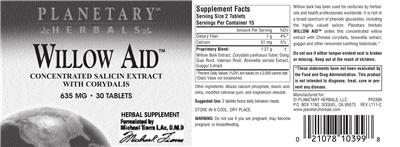
Supplement Facts
The label details for Willow Aid by Planetary Herbals, sourced from the NIH Dietary Supplement Label Database.
Supplement Facts
| Ingredient | Amount | % DV |
|---|---|---|
| Dietary Fiber | 1 Gram(s) | 4% |
| Calcium | 51 mg | 5% |
| Proprietary Blend | 1.27 Gram(s) | -- |
| Valerian | 0 NP | -- |
| Dong Quai | 0 NP | -- |
| Guggul extract | 0 NP | -- |
| Boswellia serrata extract | 0 NP | -- |
| Corydalis yanhusuo | 0 NP | -- |
| Willow bark extract | 0 NP | -- |
Other ingredients: Dibasic Calcium Phosphate, Stearic Acid, Silica, modified Cellulose Gum, Magnesium Stearate
Tap any ingredient to jump to its full detail below.
These statements are the manufacturer’s wording, reproduced from the product label — the label is saying it, not HelloPharmacist. We don’t verify or endorse them.
Formula
Concentrated Salicin Extract with Corydalis
It is rich in a broad spectrum of phenolic glycosides, including the highly valued salicin. Planetary Herbals Willow Aid unites this concentrated willow extract with Chinese corydalis, boswellia extract, guggul and other renowned soothing botanicals.
General Statements
635 mg
Formulated by Michael Tierra L.Ac, O.M.D
Willow bark has been used for centuries by herbalists and health professionals worldwide.
FDA Statement of Identity
Herbal Supplement
Suggested/Recommended/Usage/Directions
Suggested Use: 2 tablets twice daily between meals.
Storage
Store in a cool, dry place.
Precautions
Warning: Do not use if you are pregnant, may become pregnant, or breastfeeding.
Do not use if either tamper-evident seal is broken or missing.
Keep out of the reach of children.
FDA Disclaimer Statement
These statements have not been evaluated by the Food and Drug Administration. This product is not intended to diagnose, treat, cure or prevent any disease.
Brand IP Statement(s)
Planetary Herbals, LLC
General
PF0399 REV L111-C
Is this label outdated? Report a formula or label change and our pharmacy team will review it.
Willow Aid by Planetary Herbals label
The label scan from the NIH Dietary Supplement Label Database. Tap to enlarge.
Label images are published by the NIH Dietary Supplement Label Database for the version of this product on file. Always read your actual product label.
View the full label (PDF)The Ingredients in Willow Aid by Planetary Herbals
These are the 8 active ingredients this product is made of. Select any to open its full monograph.
Serving size2 Tablet(s) Dosage formTablet Or Pill Servings per container15 Amounts shown are per serving.
Most supplement products combine several ingredients, and a medication can interact with the product through any one of them. Each ingredient below shows whether it has known drug interactions.
Dietary Fiber
Interacts with2,025 drugs
Black psyllium is a soluble-fiber supplement made from the seeds of a Plantago plant, used mostly to ease constipation and support digestive health. I...
Dietary Fiber monograph & interactionsCalcium
Interacts with168 drugs
Calcium is an essential mineral your body needs for strong bones, nerve signaling, and muscle function, and supplements can help fill gaps when diet f...
Calcium monograph & interactionsProprietary Blend
Other (inactive) ingredients: Dibasic Calcium Phosphate, Stearic Acid, Silica, Modified Cellulose Gum, Magnesium Stearate. These complete the product’s ingredient list but are not active constituents.
Willow Aid by Planetary Herbals Drug Interactions
HelloPharmacist Interaction Report
Willow Aid by Planetary Herbals contains several active ingredients with documented interactions to medications.
The most serious concern is calcium, which has Major-severity interactions with three HIV and integrase inhibitor drugs: dolutegravir (Tivicay), elvitegravir (Vitekta), and ceftriaxone (Rocephin). Calcium can reduce blood levels of dolutegravir by nearly 40% and elvitegravir through a process called chelation, making these medications less effective; it can also cause dangerous precipitation if mixed intravenously with ceftriaxone.
You'll need to separate doses by 2 to 6 hours depending on the drug.
Read the full breakdown — every affected drug type, severity by severity
Calcium also has Moderate-severity interactions with raltegravir (another HIV drug), levothyroxine (thyroid hormone), the heart medications sotalol and diltiazem, and calcipotriene (a psoriasis treatment). Dong quai carries a Major-severity interaction with warfarin (a blood thinner), increasing bleeding risk.
Several ingredients—valerian, dong quai, guggul, Boswellia serrata, Corydalis yanhusuo, and willow bark—have Moderate-severity interactions with blood thinners and antiplatelet drugs; with CNS depressants like sedatives; and with various drugs metabolized by your liver, including heart medications, antidiabetes drugs, and metformin. Valerian and alcohol together can cause extra drowsiness, and willow bark acts like aspirin, so it shouldn't be combined with aspirin or similar salicylate drugs.
Additionally, boswellia may theoretically interfere with immune-suppressing medications. Altogether, these interactions span 1,384 individual medications.
We could not check Proprietary Blend for interactions because its specific component amounts are not listed separately.
Before you start Willow Aid, run your medications through the checker on this page—especially if you take blood thinners, anticoagulants like warfarin or direct-acting antivirals for HIV, heart drugs, thyroid hormone, sleep aids, or anything metabolized by your liver.
Check your own medications below · Editorial policy · How we use AI
Want to check YOUR meds against Willow Aid?
Ask about interactions with your drugs in plain English — “Can I take it with lisinopril?” — and we find you the answer in seconds, ingredient by ingredient.
Go to the checkerIngredients driving the most interactions
Individual Drug Interactions
The ingredients in Willow Aid interact with 2,233 drugs. Click any drug to see the details.
8 of the 8 ingredients in Willow Aid interact with drugs. Each result below shows which ingredient is responsible. Dietary Fiber Corydalis yanhusuo Boswellia serrata extract Valerian Guggul extract Calcium Dong Quai Willow bark extract
Aluminum Hydroxide, Magnesium Hydroxide, Simethicone (otc Drug)Mylanta
How Aluminum Hydroxide, Magnesium Hydroxide, Simethicone (otc Drug) interacts with Willow Aid — through 2 ingredients. Tap an ingredient for the detail:
CalciumAluminum Moderate
Interaction Summary
Calcium citrate might increase aluminum absorption and toxicity.
Read the full Calcium + Aluminum Hydroxide, Magnesium Hydroxide, Simethicone (otc Drug) interactionDietary FiberOral Drugs Minor
Interaction Summary
Theoretically, psyllium might increase, decrease, or have no effect on the absorption of oral drugs.
Read the full Dietary Fiber + Aluminum Hydroxide, Magnesium Hydroxide, Simethicone (otc Drug) interactionAluminum, CalciumDomeboro
How Aluminum, Calcium interacts with Willow Aid — through 2 ingredients. Tap an ingredient for the detail:
CalciumAluminum Moderate
Interaction Summary
Calcium citrate might increase aluminum absorption and toxicity.
Read the full Calcium + Aluminum, Calcium interactionDietary FiberOral Drugs Minor
Interaction Summary
Theoretically, psyllium might increase, decrease, or have no effect on the absorption of oral drugs.
Read the full Dietary Fiber + Aluminum, Calcium interactionAluminum, Magnesium (otc Drug)Almagel
How Aluminum, Magnesium (otc Drug) interacts with Willow Aid — through 2 ingredients. Tap an ingredient for the detail:
CalciumAluminum Moderate
Interaction Summary
Calcium citrate might increase aluminum absorption and toxicity.
Read the full Calcium + Aluminum, Magnesium (otc Drug) interactionDietary FiberOral Drugs Minor
Interaction Summary
Theoretically, psyllium might increase, decrease, or have no effect on the absorption of oral drugs.
Read the full Dietary Fiber + Aluminum, Magnesium (otc Drug) interactionAluminum, Magnesium Hydroxide (otc Drug)Wingel
How Aluminum, Magnesium Hydroxide (otc Drug) interacts with Willow Aid — through 2 ingredients. Tap an ingredient for the detail:
CalciumAluminum Moderate
Interaction Summary
Calcium citrate might increase aluminum absorption and toxicity.
Read the full Calcium + Aluminum, Magnesium Hydroxide (otc Drug) interactionDietary FiberOral Drugs Minor
Interaction Summary
Theoretically, psyllium might increase, decrease, or have no effect on the absorption of oral drugs.
Read the full Dietary Fiber + Aluminum, Magnesium Hydroxide (otc Drug) interactionAmbrisentanLetairis, Volibris
How Ambrisentan interacts with Willow Aid — through 5 ingredients. Tap an ingredient for the detail:
Boswellia Serrata ExtractCytochrome P450 3a4 (cyp3a4) Substrates Moderate
Interaction Summary
Theoretically, Boswellia serrata might increase or decrease the levels and clinical effects of CYP3A4 substrates.
Read the full Boswellia Serrata Extract + Ambrisentan interactionGuggul ExtractCytochrome P450 3a4 (cyp3a4) Substrates Moderate
Interaction Summary
Theoretically, guggul might reduce the effects of CYP3A4 substrates.
Read the full Guggul Extract + Ambrisentan interactionCorydalis YanhusuoAntihypertensive Drugs, Cytochrome P450 3a4 (cyp3a4) Substrates Moderate
Interaction Summary
Theoretically, Corydalis yanhusuo might have additive effects with antihypertensive drugs.
Read the full Corydalis Yanhusuo + Ambrisentan interactionValerianCytochrome P450 3a4 (cyp3a4) Substrates Minor
Interaction Summary
Valerian does not seem to have a clinically relevant effect on levels of drugs metabolized by CYP3A4.
Read the full Valerian + Ambrisentan interactionDietary FiberOral Drugs Minor
Interaction Summary
Theoretically, psyllium might increase, decrease, or have no effect on the absorption of oral drugs.
Read the full Dietary Fiber + Ambrisentan interactionAmilorideAmilamont, Midamor
How Amiloride interacts with Willow Aid — through 2 ingredients. Tap an ingredient for the detail:
Corydalis YanhusuoAntihypertensive Drugs Moderate
Interaction Summary
Theoretically, Corydalis yanhusuo might have additive effects with antihypertensive drugs.
Read the full Corydalis Yanhusuo + Amiloride interactionDietary FiberOral Drugs Minor
Interaction Summary
Theoretically, psyllium might increase, decrease, or have no effect on the absorption of oral drugs.
Read the full Dietary Fiber + Amiloride interactionAmiloride, HydrochlorothiazideAmil-Co, Amilzide, Moduret 25, Moduretic
How Amiloride, Hydrochlorothiazide interacts with Willow Aid — through 3 ingredients. Tap an ingredient for the detail:
Corydalis YanhusuoAntihypertensive Drugs Moderate
Interaction Summary
Theoretically, Corydalis yanhusuo might have additive effects with antihypertensive drugs.
Read the full Corydalis Yanhusuo + Amiloride, Hydrochlorothiazide interactionCalciumThiazide Diuretics Moderate
Interaction Summary
Taking calcium along with thiazides might increase the risk of hypercalcemia and renal failure.
Read the full Calcium + Amiloride, Hydrochlorothiazide interactionDietary FiberOral Drugs Minor
Interaction Summary
Theoretically, psyllium might increase, decrease, or have no effect on the absorption of oral drugs.
Read the full Dietary Fiber + Amiloride, Hydrochlorothiazide interactionAminoglutethimideCytadren
How Aminoglutethimide interacts with Willow Aid — through 3 ingredients. Tap an ingredient for the detail:
Corydalis YanhusuoCns Depressants Moderate
Interaction Summary
Theoretically, Corydalis yanhusuo might increase the sedative effects of CNS depressants.
Read the full Corydalis Yanhusuo + Aminoglutethimide interactionValerianCns Depressants Moderate
Interaction Summary
Valerian can have additive sedative effects when used concomitantly with CNS depressant drugs.
Read the full Valerian + Aminoglutethimide interactionDietary FiberOral Drugs Minor
Interaction Summary
Theoretically, psyllium might increase, decrease, or have no effect on the absorption of oral drugs.
Read the full Dietary Fiber + Aminoglutethimide interactionAminophylline, Amobarbital, EphedrineAmesec
How Aminophylline, Amobarbital, Ephedrine interacts with Willow Aid — through 3 ingredients. Tap an ingredient for the detail:
ValerianCns Depressants Moderate
Interaction Summary
Valerian can have additive sedative effects when used concomitantly with CNS depressant drugs.
Read the full Valerian + Aminophylline, Amobarbital, Ephedrine interactionCorydalis YanhusuoCns Depressants Moderate
Interaction Summary
Theoretically, Corydalis yanhusuo might increase the sedative effects of CNS depressants.
Read the full Corydalis Yanhusuo + Aminophylline, Amobarbital, Ephedrine interactionDietary FiberOral Drugs Minor
Interaction Summary
Theoretically, psyllium might increase, decrease, or have no effect on the absorption of oral drugs.
Read the full Dietary Fiber + Aminophylline, Amobarbital, Ephedrine interactionAmiodaroneCordarone, Pacerone
How Amiodarone interacts with Willow Aid — through 5 ingredients. Tap an ingredient for the detail:
Boswellia Serrata ExtractCytochrome P450 3a4 (cyp3a4) Substrates Moderate
Interaction Summary
Theoretically, Boswellia serrata might increase or decrease the levels and clinical effects of CYP3A4 substrates.
Read the full Boswellia Serrata Extract + Amiodarone interactionGuggul ExtractCytochrome P450 3a4 (cyp3a4) Substrates Moderate
Interaction Summary
Theoretically, guggul might reduce the effects of CYP3A4 substrates.
Read the full Guggul Extract + Amiodarone interactionCorydalis YanhusuoCytochrome P450 3a4 (cyp3a4) Substrates Moderate
Interaction Summary
Theoretically, Corydalis yanhusuo might increase serum levels of drugs metabolized by CYP3A4.
Read the full Corydalis Yanhusuo + Amiodarone interactionDietary FiberOral Drugs Minor
Interaction Summary
Theoretically, psyllium might increase, decrease, or have no effect on the absorption of oral drugs.
Read the full Dietary Fiber + Amiodarone interactionValerianCytochrome P450 3a4 (cyp3a4) Substrates Minor
Interaction Summary
Valerian does not seem to have a clinically relevant effect on levels of drugs metabolized by CYP3A4.
Read the full Valerian + Amiodarone interactionAmitriptylineElavil
How Amitriptyline interacts with Willow Aid — through 5 ingredients. Tap an ingredient for the detail:
Corydalis YanhusuoCytochrome P450 3a4 (cyp3a4) Substrates, Cytochrome P450 2d6 (cyp2d6) Substrates +2 Moderate
Interaction Summary
Theoretically, Corydalis yanhusuo might increase serum levels of drugs metabolized by CYP3A4.
Read the full Corydalis Yanhusuo + Amitriptyline interactionValerianCytochrome P450 3a4 (cyp3a4) Substrates, Cytochrome P450 2d6 (cyp2d6) Substrates +1 Moderate
Interaction Summary
Valerian does not seem to have a clinically relevant effect on levels of drugs metabolized by CYP3A4.
Read the full Valerian + Amitriptyline interactionBoswellia Serrata ExtractCytochrome P450 2c9 (cyp2c9) Substrates, Cytochrome P450 3a4 (cyp3a4) Substrates +3 Moderate
Interaction Summary
Theoretically, Boswellia serrata might increase the levels of CYP2C9 substrates.
Read the full Boswellia Serrata Extract + Amitriptyline interactionGuggul ExtractCytochrome P450 3a4 (cyp3a4) Substrates Moderate
Interaction Summary
Theoretically, guggul might reduce the effects of CYP3A4 substrates.
Read the full Guggul Extract + Amitriptyline interactionDietary FiberOral Drugs Minor
Interaction Summary
Theoretically, psyllium might increase, decrease, or have no effect on the absorption of oral drugs.
Read the full Dietary Fiber + Amitriptyline interactionAmitriptyline, ChlordiazepoxideLimbitrol DS
How Amitriptyline, Chlordiazepoxide interacts with Willow Aid — through 5 ingredients. Tap an ingredient for the detail:
ValerianCns Depressants, Cytochrome P450 2d6 (cyp2d6) Substrates +1 Moderate
Interaction Summary
Valerian can have additive sedative effects when used concomitantly with CNS depressant drugs.
Read the full Valerian + Amitriptyline, Chlordiazepoxide interactionGuggul ExtractCytochrome P450 3a4 (cyp3a4) Substrates Moderate
Interaction Summary
Theoretically, guggul might reduce the effects of CYP3A4 substrates.
Read the full Guggul Extract + Amitriptyline, Chlordiazepoxide interactionCorydalis YanhusuoCns Depressants, Cytochrome P450 3a4 (cyp3a4) Substrates +2 Moderate
Interaction Summary
Theoretically, Corydalis yanhusuo might increase the sedative effects of CNS depressants.
Read the full Corydalis Yanhusuo + Amitriptyline, Chlordiazepoxide interactionBoswellia Serrata ExtractCytochrome P450 1a2 (cyp1a2) Substrates, Cytochrome P450 2c9 (cyp2c9) Substrates +3 Moderate
Interaction Summary
Theoretically, Boswellia serrata might increase the levels of CYP1A2 substrates.
Read the full Boswellia Serrata Extract + Amitriptyline, Chlordiazepoxide interactionDietary FiberOral Drugs Minor
Interaction Summary
Theoretically, psyllium might increase, decrease, or have no effect on the absorption of oral drugs.
Read the full Dietary Fiber + Amitriptyline, Chlordiazepoxide interactionAmitriptyline, PerphenazineEtrafon, Etrafon-A, Etrafon-Forte, Triavil
How Amitriptyline, Perphenazine interacts with Willow Aid — through 5 ingredients. Tap an ingredient for the detail:
Boswellia Serrata ExtractCytochrome P450 2d6 (cyp2d6) Substrates, Cytochrome P450 2c19 (cyp2c19) Substrates +3 Moderate
Interaction Summary
Theoretically, Boswellia serrata might increase the levels of CYP2D6 substrates.
Read the full Boswellia Serrata Extract + Amitriptyline, Perphenazine interactionValerianCytochrome P450 3a4 (cyp3a4) Substrates, Cytochrome P450 2d6 (cyp2d6) Substrates +1 Moderate
Interaction Summary
Valerian does not seem to have a clinically relevant effect on levels of drugs metabolized by CYP3A4.
Read the full Valerian + Amitriptyline, Perphenazine interactionGuggul ExtractCytochrome P450 3a4 (cyp3a4) Substrates Moderate
Interaction Summary
Theoretically, guggul might reduce the effects of CYP3A4 substrates.
Read the full Guggul Extract + Amitriptyline, Perphenazine interactionCorydalis YanhusuoCytochrome P450 2d6 (cyp2d6) Substrates, Cns Depressants +2 Moderate
Interaction Summary
Theoretically, Corydalis yanhusuo might increase serum levels of drugs metabolized by CYP2D6.
Read the full Corydalis Yanhusuo + Amitriptyline, Perphenazine interactionDietary FiberOral Drugs Minor
Interaction Summary
Theoretically, psyllium might increase, decrease, or have no effect on the absorption of oral drugs.
Read the full Dietary Fiber + Amitriptyline, Perphenazine interactionAmlodipineNorliqva
How Amlodipine interacts with Willow Aid — through 6 ingredients. Tap an ingredient for the detail:
Corydalis YanhusuoAntihypertensive Drugs, Cytochrome P450 3a4 (cyp3a4) Substrates Moderate
Interaction Summary
Theoretically, Corydalis yanhusuo might have additive effects with antihypertensive drugs.
Read the full Corydalis Yanhusuo + Amlodipine interactionBoswellia Serrata ExtractCytochrome P450 3a4 (cyp3a4) Substrates Moderate
Interaction Summary
Theoretically, Boswellia serrata might increase or decrease the levels and clinical effects of CYP3A4 substrates.
Read the full Boswellia Serrata Extract + Amlodipine interactionGuggul ExtractCytochrome P450 3a4 (cyp3a4) Substrates Moderate
Interaction Summary
Theoretically, guggul might reduce the effects of CYP3A4 substrates.
Read the full Guggul Extract + Amlodipine interactionDietary FiberOral Drugs Minor
Interaction Summary
Theoretically, psyllium might increase, decrease, or have no effect on the absorption of oral drugs.
Read the full Dietary Fiber + Amlodipine interactionValerianCytochrome P450 3a4 (cyp3a4) Substrates Minor
Interaction Summary
Valerian does not seem to have a clinically relevant effect on levels of drugs metabolized by CYP3A4.
Read the full Valerian + Amlodipine interactionCalciumCalcium Channel Blockers Minor
Interaction Summary
Intravenous calcium may decrease the effects of calcium channel blockers; oral calcium is unlikely to have this effect.
Read the full Calcium + Amlodipine interactionAmlodipine BenzoateKaterzia
How Amlodipine Benzoate interacts with Willow Aid — through 6 ingredients. Tap an ingredient for the detail:
Guggul ExtractCytochrome P450 3a4 (cyp3a4) Substrates Moderate
Interaction Summary
Theoretically, guggul might reduce the effects of CYP3A4 substrates.
Read the full Guggul Extract + Amlodipine Benzoate interactionBoswellia Serrata ExtractCytochrome P450 3a4 (cyp3a4) Substrates Moderate
Interaction Summary
Theoretically, Boswellia serrata might increase or decrease the levels and clinical effects of CYP3A4 substrates.
Read the full Boswellia Serrata Extract + Amlodipine Benzoate interactionCorydalis YanhusuoAntihypertensive Drugs, Cytochrome P450 3a4 (cyp3a4) Substrates Moderate
Interaction Summary
Theoretically, Corydalis yanhusuo might have additive effects with antihypertensive drugs.
Read the full Corydalis Yanhusuo + Amlodipine Benzoate interactionCalciumCalcium Channel Blockers Minor
Interaction Summary
Intravenous calcium may decrease the effects of calcium channel blockers; oral calcium is unlikely to have this effect.
Read the full Calcium + Amlodipine Benzoate interactionDietary FiberOral Drugs Minor
Interaction Summary
Theoretically, psyllium might increase, decrease, or have no effect on the absorption of oral drugs.
Read the full Dietary Fiber + Amlodipine Benzoate interactionValerianCytochrome P450 3a4 (cyp3a4) Substrates Minor
Interaction Summary
Valerian does not seem to have a clinically relevant effect on levels of drugs metabolized by CYP3A4.
Read the full Valerian + Amlodipine Benzoate interactionAmlodipine BesilateIstin
How Amlodipine Besilate interacts with Willow Aid — through 6 ingredients. Tap an ingredient for the detail:
Boswellia Serrata ExtractCytochrome P450 3a4 (cyp3a4) Substrates Moderate
Interaction Summary
Theoretically, Boswellia serrata might increase or decrease the levels and clinical effects of CYP3A4 substrates.
Read the full Boswellia Serrata Extract + Amlodipine Besilate interactionGuggul ExtractCytochrome P450 3a4 (cyp3a4) Substrates Moderate
Interaction Summary
Theoretically, guggul might reduce the effects of CYP3A4 substrates.
Read the full Guggul Extract + Amlodipine Besilate interactionCorydalis YanhusuoAntihypertensive Drugs, Cytochrome P450 3a4 (cyp3a4) Substrates Moderate
Interaction Summary
Theoretically, Corydalis yanhusuo might have additive effects with antihypertensive drugs.
Read the full Corydalis Yanhusuo + Amlodipine Besilate interactionValerianCytochrome P450 3a4 (cyp3a4) Substrates Minor
Interaction Summary
Valerian does not seem to have a clinically relevant effect on levels of drugs metabolized by CYP3A4.
Read the full Valerian + Amlodipine Besilate interactionDietary FiberOral Drugs Minor
Interaction Summary
Theoretically, psyllium might increase, decrease, or have no effect on the absorption of oral drugs.
Read the full Dietary Fiber + Amlodipine Besilate interactionCalciumCalcium Channel Blockers Minor
Interaction Summary
Intravenous calcium may decrease the effects of calcium channel blockers; oral calcium is unlikely to have this effect.
Read the full Calcium + Amlodipine Besilate interactionAmlodipine BesylateNorvasc
How Amlodipine Besylate interacts with Willow Aid — through 6 ingredients. Tap an ingredient for the detail:
Corydalis YanhusuoCytochrome P450 3a4 (cyp3a4) Substrates, Antihypertensive Drugs Moderate
Interaction Summary
Theoretically, Corydalis yanhusuo might increase serum levels of drugs metabolized by CYP3A4.
Read the full Corydalis Yanhusuo + Amlodipine Besylate interactionBoswellia Serrata ExtractCytochrome P450 3a4 (cyp3a4) Substrates Moderate
Interaction Summary
Theoretically, Boswellia serrata might increase or decrease the levels and clinical effects of CYP3A4 substrates.
Read the full Boswellia Serrata Extract + Amlodipine Besylate interactionGuggul ExtractCytochrome P450 3a4 (cyp3a4) Substrates Moderate
Interaction Summary
Theoretically, guggul might reduce the effects of CYP3A4 substrates.
Read the full Guggul Extract + Amlodipine Besylate interactionValerianCytochrome P450 3a4 (cyp3a4) Substrates Minor
Interaction Summary
Valerian does not seem to have a clinically relevant effect on levels of drugs metabolized by CYP3A4.
Read the full Valerian + Amlodipine Besylate interactionDietary FiberOral Drugs Minor
Interaction Summary
Theoretically, psyllium might increase, decrease, or have no effect on the absorption of oral drugs.
Read the full Dietary Fiber + Amlodipine Besylate interactionCalciumCalcium Channel Blockers Minor
Interaction Summary
Intravenous calcium may decrease the effects of calcium channel blockers; oral calcium is unlikely to have this effect.
Read the full Calcium + Amlodipine Besylate interactionAmlodipine Besylate, BenazeprilLotrel
How Amlodipine Besylate, Benazepril interacts with Willow Aid — through 6 ingredients. Tap an ingredient for the detail:
Guggul ExtractCytochrome P450 3a4 (cyp3a4) Substrates Moderate
Interaction Summary
Theoretically, guggul might reduce the effects of CYP3A4 substrates.
Read the full Guggul Extract + Amlodipine Besylate, Benazepril interactionCorydalis YanhusuoAntihypertensive Drugs, Cytochrome P450 3a4 (cyp3a4) Substrates Moderate
Interaction Summary
Theoretically, Corydalis yanhusuo might have additive effects with antihypertensive drugs.
Read the full Corydalis Yanhusuo + Amlodipine Besylate, Benazepril interactionBoswellia Serrata ExtractCytochrome P450 3a4 (cyp3a4) Substrates Moderate
Interaction Summary
Theoretically, Boswellia serrata might increase or decrease the levels and clinical effects of CYP3A4 substrates.
Read the full Boswellia Serrata Extract + Amlodipine Besylate, Benazepril interactionCalciumCalcium Channel Blockers Minor
Interaction Summary
Intravenous calcium may decrease the effects of calcium channel blockers; oral calcium is unlikely to have this effect.
Read the full Calcium + Amlodipine Besylate, Benazepril interactionValerianCytochrome P450 3a4 (cyp3a4) Substrates Minor
Interaction Summary
Valerian does not seem to have a clinically relevant effect on levels of drugs metabolized by CYP3A4.
Read the full Valerian + Amlodipine Besylate, Benazepril interactionDietary FiberOral Drugs Minor
Interaction Summary
Theoretically, psyllium might increase, decrease, or have no effect on the absorption of oral drugs.
Read the full Dietary Fiber + Amlodipine Besylate, Benazepril interactionAmlodipine, CelecoxibConsensi
How Amlodipine, Celecoxib interacts with Willow Aid — through 6 ingredients. Tap an ingredient for the detail:
Boswellia Serrata ExtractCytochrome P450 2c9 (cyp2c9) Substrates, Cytochrome P450 3a4 (cyp3a4) Substrates Moderate
Interaction Summary
Theoretically, Boswellia serrata might increase the levels of CYP2C9 substrates.
Read the full Boswellia Serrata Extract + Amlodipine, Celecoxib interactionGuggul ExtractCytochrome P450 3a4 (cyp3a4) Substrates Moderate
Interaction Summary
Theoretically, guggul might reduce the effects of CYP3A4 substrates.
Read the full Guggul Extract + Amlodipine, Celecoxib interactionCorydalis YanhusuoCytochrome P450 2c9 (cyp2c9) Substrates, Antihypertensive Drugs +1 Moderate
Interaction Summary
Theoretically, Corydalis yanhusuo might increase serum levels of drugs metabolized by CYP2C9.
Read the full Corydalis Yanhusuo + Amlodipine, Celecoxib interactionValerianCytochrome P450 3a4 (cyp3a4) Substrates Minor
Interaction Summary
Valerian does not seem to have a clinically relevant effect on levels of drugs metabolized by CYP3A4.
Read the full Valerian + Amlodipine, Celecoxib interactionDietary FiberOral Drugs Minor
Interaction Summary
Theoretically, psyllium might increase, decrease, or have no effect on the absorption of oral drugs.
Read the full Dietary Fiber + Amlodipine, Celecoxib interactionCalciumCalcium Channel Blockers Minor
Interaction Summary
Intravenous calcium may decrease the effects of calcium channel blockers; oral calcium is unlikely to have this effect.
Read the full Calcium + Amlodipine, Celecoxib interactionAmmonium ChlorideAmmonium Chloride
How Ammonium Chloride interacts with Willow Aid — through 2 ingredients. Tap an ingredient for the detail:
Corydalis YanhusuoAntihypertensive Drugs Moderate
Interaction Summary
Theoretically, Corydalis yanhusuo might have additive effects with antihypertensive drugs.
Read the full Corydalis Yanhusuo + Ammonium Chloride interactionDietary FiberOral Drugs Minor
Interaction Summary
Theoretically, psyllium might increase, decrease, or have no effect on the absorption of oral drugs.
Read the full Dietary Fiber + Ammonium Chloride interactionAmobarbitalAmytal
How Amobarbital interacts with Willow Aid — through 3 ingredients. Tap an ingredient for the detail:
Corydalis YanhusuoCns Depressants Moderate
Interaction Summary
Theoretically, Corydalis yanhusuo might increase the sedative effects of CNS depressants.
Read the full Corydalis Yanhusuo + Amobarbital interactionValerianCns Depressants Moderate
Interaction Summary
Valerian can have additive sedative effects when used concomitantly with CNS depressant drugs.
Read the full Valerian + Amobarbital interactionDietary FiberOral Drugs Minor
Interaction Summary
Theoretically, psyllium might increase, decrease, or have no effect on the absorption of oral drugs.
Read the full Dietary Fiber + Amobarbital interactionAmobarbital, Ephedrine SulfateEphedrine & Amytal
How Amobarbital, Ephedrine Sulfate interacts with Willow Aid — through 2 ingredients. Tap an ingredient for the detail:
ValerianCns Depressants Moderate
Interaction Summary
Valerian can have additive sedative effects when used concomitantly with CNS depressant drugs.
Read the full Valerian + Amobarbital, Ephedrine Sulfate interactionCorydalis YanhusuoCns Depressants Moderate
Interaction Summary
Theoretically, Corydalis yanhusuo might increase the sedative effects of CNS depressants.
Read the full Corydalis Yanhusuo + Amobarbital, Ephedrine Sulfate interactionAmobarbital, SecobarbitalTuinal
How Amobarbital, Secobarbital interacts with Willow Aid — through 3 ingredients. Tap an ingredient for the detail:
Corydalis YanhusuoCns Depressants Moderate
Interaction Summary
Theoretically, Corydalis yanhusuo might increase the sedative effects of CNS depressants.
Read the full Corydalis Yanhusuo + Amobarbital, Secobarbital interactionValerianCns Depressants Moderate
Interaction Summary
Valerian can have additive sedative effects when used concomitantly with CNS depressant drugs.
Read the full Valerian + Amobarbital, Secobarbital interactionDietary FiberOral Drugs Minor
Interaction Summary
Theoretically, psyllium might increase, decrease, or have no effect on the absorption of oral drugs.
Read the full Dietary Fiber + Amobarbital, Secobarbital interactionAmoxicillin, Omeprazole Magnesium, RifabutinTalicia
How Amoxicillin, Omeprazole Magnesium, Rifabutin interacts with Willow Aid — through 5 ingredients. Tap an ingredient for the detail:
Boswellia Serrata ExtractCytochrome P450 2c9 (cyp2c9) Substrates, Cytochrome P450 2c19 (cyp2c19) Substrates +1 Moderate
Interaction Summary
Theoretically, Boswellia serrata might increase the levels of CYP2C9 substrates.
Read the full Boswellia Serrata Extract + Amoxicillin, Omeprazole Magnesium, Rifabutin interactionCorydalis YanhusuoCytochrome P450 3a4 (cyp3a4) Substrates, Cytochrome P450 2c9 (cyp2c9) Substrates Moderate
Interaction Summary
Theoretically, Corydalis yanhusuo might increase serum levels of drugs metabolized by CYP3A4.
Read the full Corydalis Yanhusuo + Amoxicillin, Omeprazole Magnesium, Rifabutin interactionGuggul ExtractCytochrome P450 3a4 (cyp3a4) Substrates Moderate
Interaction Summary
Theoretically, guggul might reduce the effects of CYP3A4 substrates.
Read the full Guggul Extract + Amoxicillin, Omeprazole Magnesium, Rifabutin interactionDietary FiberOral Drugs Minor
Interaction Summary
Theoretically, psyllium might increase, decrease, or have no effect on the absorption of oral drugs.
Read the full Dietary Fiber + Amoxicillin, Omeprazole Magnesium, Rifabutin interactionValerianCytochrome P450 3a4 (cyp3a4) Substrates Minor
Interaction Summary
Valerian does not seem to have a clinically relevant effect on levels of drugs metabolized by CYP3A4.
Read the full Valerian + Amoxicillin, Omeprazole Magnesium, Rifabutin interactionAmphetamineAdensys XR-ODT, Adzenys ER, Dyanavel XR, Mydayis
How Amphetamine interacts with Willow Aid — through 4 ingredients. Tap an ingredient for the detail:
Corydalis YanhusuoCytochrome P450 2d6 (cyp2d6) Substrates Moderate
Interaction Summary
Theoretically, Corydalis yanhusuo might increase serum levels of drugs metabolized by CYP2D6.
Read the full Corydalis Yanhusuo + Amphetamine interactionBoswellia Serrata ExtractCytochrome P450 2d6 (cyp2d6) Substrates Moderate
Interaction Summary
Theoretically, Boswellia serrata might increase the levels of CYP2D6 substrates.
Read the full Boswellia Serrata Extract + Amphetamine interactionDietary FiberOral Drugs Minor
Interaction Summary
Theoretically, psyllium might increase, decrease, or have no effect on the absorption of oral drugs.
Read the full Dietary Fiber + Amphetamine interactionValerianCytochrome P450 2d6 (cyp2d6) Substrates Minor
Interaction Summary
Valerian does not seem to have a clinically relevant effect on levels of drugs metabolized by CYP2D6.
Read the full Valerian + Amphetamine interactionAmphetamine Aspartate, Amphetamine Sulfate, Dextroamphetamine Saccharate, Dextroamphetamine SulfateAdderall, Adderall XR
How Amphetamine Aspartate, Amphetamine Sulfate, Dextroamphetamine Saccharate, Dextroamphetamine Sulfate interacts with Willow Aid — through 4 ingredients. Tap an ingredient for the detail:
Corydalis YanhusuoCytochrome P450 2d6 (cyp2d6) Substrates Moderate
Interaction Summary
Theoretically, Corydalis yanhusuo might increase serum levels of drugs metabolized by CYP2D6.
Read the full Corydalis Yanhusuo + Amphetamine Aspartate, Amphetamine Sulfate, Dextroamphetamine Saccharate, Dextroamphetamine Sulfate interactionBoswellia Serrata ExtractCytochrome P450 2d6 (cyp2d6) Substrates Moderate
Interaction Summary
Theoretically, Boswellia serrata might increase the levels of CYP2D6 substrates.
Read the full Boswellia Serrata Extract + Amphetamine Aspartate, Amphetamine Sulfate, Dextroamphetamine Saccharate, Dextroamphetamine Sulfate interactionValerianCytochrome P450 2d6 (cyp2d6) Substrates Minor
Interaction Summary
Valerian does not seem to have a clinically relevant effect on levels of drugs metabolized by CYP2D6.
Read the full Valerian + Amphetamine Aspartate, Amphetamine Sulfate, Dextroamphetamine Saccharate, Dextroamphetamine Sulfate interactionDietary FiberOral Drugs Minor
Interaction Summary
Theoretically, psyllium might increase, decrease, or have no effect on the absorption of oral drugs.
Read the full Dietary Fiber + Amphetamine Aspartate, Amphetamine Sulfate, Dextroamphetamine Saccharate, Dextroamphetamine Sulfate interactionAmphetamine SulfateBenzedrine, Evekeo ODT
How Amphetamine Sulfate interacts with Willow Aid — through 4 ingredients. Tap an ingredient for the detail:
Boswellia Serrata ExtractCytochrome P450 2d6 (cyp2d6) Substrates Moderate
Interaction Summary
Theoretically, Boswellia serrata might increase the levels of CYP2D6 substrates.
Read the full Boswellia Serrata Extract + Amphetamine Sulfate interactionCorydalis YanhusuoCytochrome P450 2d6 (cyp2d6) Substrates Moderate
Interaction Summary
Theoretically, Corydalis yanhusuo might increase serum levels of drugs metabolized by CYP2D6.
Read the full Corydalis Yanhusuo + Amphetamine Sulfate interactionDietary FiberOral Drugs Minor
Interaction Summary
Theoretically, psyllium might increase, decrease, or have no effect on the absorption of oral drugs.
Read the full Dietary Fiber + Amphetamine Sulfate interactionValerianCytochrome P450 2d6 (cyp2d6) Substrates Minor
Interaction Summary
Valerian does not seem to have a clinically relevant effect on levels of drugs metabolized by CYP2D6.
Read the full Valerian + Amphetamine Sulfate interactionAmphotericin, TetracyclineMysteclin-F
How Amphotericin, Tetracycline interacts with Willow Aid — through 2 ingredients. Tap an ingredient for the detail:
CalciumTetracycline Antibiotics Moderate
Interaction Summary
Calcium seems to reduce the absorption of tetracycline antibiotics.
Read the full Calcium + Amphotericin, Tetracycline interactionDietary FiberOral Drugs Minor
Interaction Summary
Theoretically, psyllium might increase, decrease, or have no effect on the absorption of oral drugs.
Read the full Dietary Fiber + Amphotericin, Tetracycline interactionAmprenavirAgenerase
How Amprenavir interacts with Willow Aid — through 5 ingredients. Tap an ingredient for the detail:
Boswellia Serrata ExtractCytochrome P450 3a4 (cyp3a4) Substrates Moderate
Interaction Summary
Theoretically, Boswellia serrata might increase or decrease the levels and clinical effects of CYP3A4 substrates.
Read the full Boswellia Serrata Extract + Amprenavir interactionGuggul ExtractCytochrome P450 3a4 (cyp3a4) Substrates Moderate
Interaction Summary
Theoretically, guggul might reduce the effects of CYP3A4 substrates.
Read the full Guggul Extract + Amprenavir interactionCorydalis YanhusuoCytochrome P450 3a4 (cyp3a4) Substrates Moderate
Interaction Summary
Theoretically, Corydalis yanhusuo might increase serum levels of drugs metabolized by CYP3A4.
Read the full Corydalis Yanhusuo + Amprenavir interactionDietary FiberOral Drugs Minor
Interaction Summary
Theoretically, psyllium might increase, decrease, or have no effect on the absorption of oral drugs.
Read the full Dietary Fiber + Amprenavir interactionValerianCytochrome P450 3a4 (cyp3a4) Substrates Minor
Interaction Summary
Valerian does not seem to have a clinically relevant effect on levels of drugs metabolized by CYP3A4.
Read the full Valerian + Amprenavir interactionAnacaulase-bcdbNexoBrid
How Anacaulase-bcdb interacts with Willow Aid — through 4 ingredients. Tap an ingredient for the detail:
Dong QuaiAnticoagulant/antiplatelet Drugs Moderate
Interaction Summary
Theoretically, dong quai may increase the risk of bleeding when used with anticoagulant or antiplatelet drugs; however, research is conflicting.
Read the full Dong Quai + Anacaulase-bcdb interactionWillow Bark ExtractAnticoagulant/antiplatelet Drugs Moderate
Interaction Summary
Theoretically, willow bark might increase the risk of bleeding when taken with anticoagulant/antiplatelet drugs.
Read the full Willow Bark Extract + Anacaulase-bcdb interactionGuggul ExtractAnticoagulant/antiplatelet Drugs Moderate
Interaction Summary
Theoretically, guggul might increase the risk of bleeding when taken with anticoagulant/antiplatelet drugs.
Read the full Guggul Extract + Anacaulase-bcdb interactionCorydalis YanhusuoAnticoagulant/antiplatelet Drugs Moderate
Interaction Summary
Theoretically, Corydalis yanhusuo might increase the risk of bleeding when used with anticoagulant or antiplatelet drugs.
Read the full Corydalis Yanhusuo + Anacaulase-bcdb interactionEach ingredient & the kinds of drugs it affects
For each ingredient in Willow Aid with known interactions, here are the types of medications they can affect. Open any type for the detail — or search your exact drug in the checker above.
Dietary Fiber
Carbamazepine (Tegretol)
Theoretically, black psyllium might reduce the effects of carbamazepine and increase the risk for convulsions.
Theoretically, black psyllium might reduce carbamazepine absorption. A preliminary study using blond psyllium reported decreased carbamazepine bioavailability due to binding of the drug to psyllium, as well as reduction of available fluid in the gut for dissolution of the drug. This interaction may also occur with black psyllium.
Lithium
Theoretically, taking black psyllium at the same time as lithium might reduce lithium absorption.
The fiber in black psyllium might reduce lithium absorption and plasma levels. Some case reports describe a reduction in plasma lithium levels with concomitant administration of blond psyllium. This was reversed when psyllium was stopped. This interaction may also occur with black psyllium.
Metformin (Glucophage)
Theoretically, black psyllium might increase the therapeutic and adverse effects of metformin.
Animal research shows that concurrent consumption of blond psyllium with metformin slows and increases the absorption of metformin. This interaction may also occur with black psyllium. To avoid changes in absorption, take psyllium 30-60 minutes after metformin.
Olanzapine (Zyprexa)
Theoretically, taking black psyllium at the same time as olanzapine might reduce olanzapine absorption.
The fiber in black psyllium might decrease the absorption of olanzapine. A single case report describes a reduction in the effectiveness of olanzapine when it was concomitantly administered with an unspecified type of psyllium 3 grams orally twice daily. This effect was reversed when psyllium was stopped.
Digoxin (Lanoxin)
Theoretically, taking black psyllium at the same time as digoxin might reduce digoxin absorption and decrease digoxin levels.
Psyllium might bind digoxin in the gut. However, some clinical evidence suggests that psyllium does not impact digoxin absorption.
Ethinyl Estradiol
Theoretically, taking black psyllium at the same time as ethinyl estradiol might alter levels of estradiol.
Concurrent use of blond psyllium with ethinyl estradiol results in a slight increase in the extent of ethinyl estradiol absorption and a slower rate of absorption. This is unlikely to be clinically significant.
Oral Drugs
Theoretically, psyllium might increase, decrease, or have no effect on the absorption of oral drugs.
Psyllium seems to have variable effects on drug absorption. To avoid changes in absorption, take psyllium 30-60 minutes after oral medications. Animal research shows that blond psyllium delays and increases the absorption of metformin and ethinyl estradiol. Case reports and animal research suggest that blond psyllium might reduce absorption of lithium, digoxin, olanzapine, and carbamazepine. Finally, some pharmacokinetic studies show that psyllium does not affect the absorption of levothyroxine or warfarin. Although many of these studies evaluated blond psyllium, the fiber content in black psyllium may have similar effects.
Corydalis yanhusuo
Anticoagulant/Antiplatelet Drugs
Theoretically, Corydalis yanhusuo might increase the risk of bleeding when used with anticoagulant or antiplatelet drugs.
Corydalis yanhusuo contains berberine. In vitro and in vivo research suggest that berberine can inhibit platelet aggregation. Theoretically, Corydalis yanhusuo might also inhibit platelet aggregation.
Antidiabetes Drugs
Theoretically, Corydalis yanhusuo may increase the risk of hypoglycemia when taken with antidiabetes drugs.
Corydalis yanhusuo contains berberine. Clinical research shows that berberine may lower blood glucose levels. Theoretically, Corydalis yanhusuo might also lower blood glucose levels.
Antihypertensive Drugs
Theoretically, Corydalis yanhusuo might have additive effects with antihypertensive drugs.
Corydalis yanhusuo contains berberine. Animal research suggests that berberine can have hypotensive effects. Also, a clinical study suggests that taking berberine in combination with amlodipine can lower systolic and diastolic blood pressure when compared with amlodipine alone. Theoretically, Corydalis yanhusuo might also reduce blood pressure.
Cns Depressants
Theoretically, Corydalis yanhusuo might increase the sedative effects of CNS depressants.
Corydalis yanhusuo contains berberine. Animal research suggests that berberine may have sedative effects. Theoretically, Corydalis yanhusuo might also have CNS depressants effects.
Cyclosporine (Neoral, Sandimmune)
Theoretically, Corydalis yanhusuo might increase blood levels of cyclosporine.
Corydalis yanhusuo contains berberine. Preliminary clinical research shows that berberine can reduce metabolism of cyclosporine and increase serum levels, likely through inhibition of cytochrome P450 3A4 (CYP3A4), which metabolizes cyclosporine. Theoretically, Corydalis yanhusuo might also reduce the metabolism of cyclosporine.
Cytochrome P450 2C9 (Cyp2C9) Substrates
Theoretically, Corydalis yanhusuo might increase serum levels of drugs metabolized by CYP2C9.
Corydalis yanhusuo contains berberine. Preliminary clinical research shows that berberine can inhibit CYP2C9. Theoretically, Corydalis yanhusuo might also inhibit CYP2C9.
Cytochrome P450 2D6 (Cyp2D6) Substrates
Theoretically, Corydalis yanhusuo might increase serum levels of drugs metabolized by CYP2D6.
Corydalis yanhusuo contains berberine. In vitro research and preliminary clinical evidence show that berberine can inhibit CYP2D6. Theoretically, Corydalis yanhusuo might also inhibit CYP2D6.
Cytochrome P450 3A4 (Cyp3A4) Substrates
Theoretically, Corydalis yanhusuo might increase serum levels of drugs metabolized by CYP3A4.
Corydalis yanhusuo contains berberine. In vitro research and preliminary clinical research show that berberine moderately inhibits CYP3A4. Theoretically, Corydalis yanhusuo might also inhibit CYP3A4.
Dextromethorphan (Robitussin Dm, Others)
Theoretically, Corydalis yanhusuo may increase serum levels of dextromethorphan.
Corydalis yanhusuo contains berberine. Preliminary clinical research shows that berberine can inhibit cytochrome P450 2D6 (CYP2D6) activity and reduce the metabolism of dextromethorphan. Theoretically, Corydalis yanhusuo may also inhibit the metabolism of dextromethorphan.
Losartan (Cozaar)
Theoretically, Corydalis yanhusuo might reduce the therapeutic effects of losartan by decreasing its conversion to its active form.
Corydalis yanhusuo contains berberine. Preliminary clinical research suggests that berberine can inhibit cytochrome P450 2C9 (CYP2C9) activity and reduce metabolism of losartan. Theoretically, Corydalis yanhusuo might also inhibit the metabolism of losartan.
Metformin (Glucophage)
Theoretically, Corydalis yanhusuo might increase the therapeutic and adverse effects of metformin.
Corydalis yanhusuo contains berberine. In vitro and animal studies show that berberine can increase the systemic exposure and half-life of metformin, potentially increasing metformin's effects and side effects. This interaction seems to be most apparent when berberine is administered 2 hours prior to metformin. Taking berberine and metformin at the same time does not appear to increase systemic exposure to metformin. It is unclear if Corydalis yanhusuo might have this same effect.
Midazolam (Versed)
Theoretically, Corydalis yanhusuo might reduce metabolism of midazolam, which might increase the risk of severe adverse effects.
Corydalis yanhusuo contains berberine. Preliminary clinical research shows that berberine can inhibit cytochrome P450 3A4 (CYP3A4) activity and reduce metabolism of midazolam. Theoretically, Corydalis yanhusuo might also inhibit the metabolism of midazolam.
Pentobarbital (Nembutal)
Theoretically, Corydalis yanhusuo might increase the sedative effect of pentobarbital.
Corydalis yanhusuo contains berberine. Animal research shows that berberine can prolong pentobarbital-induced sleeping time. Theoretically, Corydalis yanhusuo might increase the sedative effects of pentobarbital.
Tacrolimus (Prograf)
Theoretically, Corydalis yanhusuo might increase blood levels of tacrolimus.
Corydalis yanhusuo contains berberine. In a 16-year-old patient with idiopathic nephrotic syndrome who was being treated with tacrolimus 6.5 mg twice daily, intake of berberine 200 mg three times daily increased the blood concentration of tacrolimus from 8 to 22 ng/mL. Following a reduction of the tacrolimus dose to 3 mg daily, blood levels of tacrolimus decreased to 12 ng/mL. It is unclear if Corydalis yanhusuo might have this same effect.
Boswellia serrata extract
Cytochrome P450 1A2 (Cyp1A2) Substrates
Theoretically, Boswellia serrata might increase the levels of CYP1A2 substrates.
In vitro research shows that Boswellia serrata gum resin inhibits CYP1A2 enzymes.
Cytochrome P450 2C19 (Cyp2C19) Substrates
Theoretically, Boswellia serrata might increase the levels of CYP2C19 substrates.
In vitro research shows that Boswellia serrata gum resin inhibits CYP2C19 enzymes.
Cytochrome P450 2C9 (Cyp2C9) Substrates
Theoretically, Boswellia serrata might increase the levels of CYP2C9 substrates.
In vitro research shows that Boswellia serrata gum resin inhibits CYP2C9 enzymes.
Cytochrome P450 2D6 (Cyp2D6) Substrates
Theoretically, Boswellia serrata might increase the levels of CYP2D6 substrates.
In vitro research shows that Boswellia serrata gum resin inhibits CYP2D6 enzymes.
Cytochrome P450 3A4 (Cyp3A4) Substrates
Theoretically, Boswellia serrata might increase or decrease the levels and clinical effects of CYP3A4 substrates.
In vitro research shows that Boswellia serrata gum resin inhibits CYP3A4 enzymes. Other in vitro research shows that Boswellia serrata extract inhibits CYP3A4 enzymes at most concentrations, although it may modestly induce enzyme activity at low concentrations.
Immunosuppressants
Theoretically, Boswellia serrata might alter the effects of immunosuppressive drugs.
Some in vitro research suggests that Boswellia serrata extracts might inhibit mediators of autoimmune disorders such as leukotrienes and reduce production of antibodies and cell-mediated immunity. However, other in vitro research suggests that, when coupled with calcium ions, boswellic acids containing the keto group have immunostimulant properties within specific cell signaling pathways.
Valerian
Alcohol (Ethanol)
Valerian can have additive sedative effects when used concomitantly with alcohol.
Valerian has sedative effects. Theoretically, valerian might have an additive sedative effect when combined with alcohol. Excessive sedation has been reported in an alcohol-abusing individual who took valerian and Gingko biloba. However, the potential interaction between valerian and alcohol has been disputed in other research. Limited evidence suggests that a combination of valerian 160 mg and lemon balm 80 mg (Euvegal) does not cause further deterioration in reaction ability and reaction rate when taken with alcohol as compared to the effects of alcohol alone.
Alprazolam (Xanax)
Valerian can have additive sedative effects when used with alprazolam. Also, valerian in high doses might modestly increase alprazolam levels, though this is not likely to be clinically significant.
Valerian has sedative effects. Theoretically, valerian might cause additive sedation when combined with alprazolam. Also, a small pharmacokinetic study shows that taking valerian extract 1000 mg daily (providing 11 mg valerenic acid) might increase alprazolam levels by about 19%. This might be due to valerian's mild inhibition of cytochrome P450 3A4 (CYP3A4). Despite being statistically significant, this increase is not likely to be clinically significant.
Cns Depressants
Valerian can have additive sedative effects when used concomitantly with CNS depressant drugs.
Theoretically, concomitant use of valerian and drugs with sedative and anesthetic properties may cause additive therapeutic and adverse effects.
Glucuronidated Drugs
Valerian might weakly inhibit glucuronidation and increase concentrations of drugs metabolized by UGT1A1 and UGT2B7.
In vitro research shows that methanolic valerian extract and valerenic acid might competitively inhibit UDP-glucuronosyltransferase (UGT) 1A1 (UGT1A1) and UGT2B7.
Cytochrome P450 2D6 (Cyp2D6) Substrates
Valerian does not seem to have a clinically relevant effect on levels of drugs metabolized by CYP2D6.
Although some in vitro evidence suggests that valerian affects CYP2D6, clinical pharmacokinetic (PK) studies show that valerian is unlikely to affect the CYP2D6 enzyme. In one PK study, taking valerian 1000 mg (providing about 11 mg valerenic acid) nightly for 14 days did not affect the metabolism of dextromethorphan, a CYP2D6 substrate. In another PK study, taking valerian 125 mg three times daily for 28 days did not affect metabolism of debrisoquine, an accepted CYP2D6 probe-substrate.
Cytochrome P450 3A4 (Cyp3A4) Substrates
Valerian does not seem to have a clinically relevant effect on levels of drugs metabolized by CYP3A4.
Although some in vitro evidence suggests that valerian extract might inhibit or induce CYP3A4, clinical pharmacokinetic (PK) studies show that valerian does not have a clinically significant effect on the CYP3A4 enzyme. In one PK study, taking valerian 125 mg three times daily for 28 days did not affect metabolism of midazolam, an accepted CYP3A4 probe-substrate. In another PK study, taking valerian 1000 mg (providing about 11 mg valerenic acid) nightly for 14 days modestly increases levels of alprazolam, a CYP3A4 substrate, suggesting mild inhibition of CYP3A4. However, this mild inhibition is unlikely to be clinically relevant.
Guggul extract
Anticoagulant/Antiplatelet Drugs
Theoretically, guggul might increase the risk of bleeding when taken with anticoagulant/antiplatelet drugs.
In vitro research and preliminary clinical studies suggest that guggul might have antiplatelet and anticoagulant effects.
Contraceptive Drugs
Theoretically, guggul might increase the risk of adverse effects when taken with contraceptive drugs.
In vitro research shows that guggul has estrogen-alpha receptor agonist activity.
Cytochrome P450 3A4 (Cyp3A4) Substrates
Theoretically, guggul might reduce the effects of CYP3A4 substrates.
In vitro research shows that guggul constituents known as guggulsterones can induce CYP3A4.
Diltiazem (Cardizem, Others)
Guggul might reduce the effects of diltiazem.
A small pharmacokinetic study shows that concomitant use of guggul with diltiazem reduces the bioavailability of diltiazem.
Estrogens
Theoretically, guggul might increase the risk of adverse effects when taken with estrogens.
In vitro research shows that guggul constituents known as guggulsterones have estrogen-alpha receptor agonist activity.
Propranolol (Inderal)
Guggul might reduce the effects of propranolol.
A small pharmacokinetic study shows that concomitant use of guggul with propranolol reduces the bioavailability of propranolol.
Rosuvastatin (Crestor)
Theoretically, guggul might increase the effects and adverse effects of rosuvastatin.
Animal research shows that guggul increases the bioavailability and hypolipidemic effects of rosuvastatin. The mechanism of this interaction is unclear.
Tamoxifen (Nolvadex)
Theoretically, guggul might interfere with tamoxifen therapy.
In vitro research shows that guggul has estrogen-alpha receptor agonist activity.
Thyroid Hormone
Theoretically, guggul might increase the risk for adverse effects when taken with thyroid hormone therapy.
Animal research suggests that guggul has thyroid-stimulating effects.
Calcium
Ceftriaxone (Rocephin)
Co-administration of intravenous calcium and ceftriaxone can result in precipitation of a ceftriaxone-calcium salt in the lungs and kidneys.
Avoid administering intravenous calcium in any form, such as parenteral nutrition or Lactated Ringers, within 48 hours of intravenous ceftriaxone. Case reports in neonates show that administering intravenous ceftriaxone and calcium can result in precipitation of a ceftriaxone-calcium salt in the lungs and kidneys. In several cases, neonates have died as a result of this interaction. So far there are no reports in adults; however, there is still concern that this interaction might occur in adults.
Dolutegravir (Tivicay)
Calcium seems to reduce levels of dolutegravir.
Advise patients to take dolutegravir either 2 hours before or 6 hours after taking calcium supplements. Pharmacokinetic research suggests that taking calcium carbonate 1200 mg concomitantly with dolutegravir 50 mg reduces plasma levels of dolutegravir by almost 40%. Calcium appears to decrease levels of dolutegravir through chelation.
Elvitegravir (Vitekta)
Calcium seems to reduce levels of elvitegravir.
Advise patients to take elvitegravir either 2 hours before or 2 hours after taking calcium supplements. Pharmacokinetic research suggests that taking calcium along with elvitegravir can reduce blood levels of elvitegravir through chelation.
Aluminum
Calcium citrate might increase aluminum absorption and toxicity. Other types of calcium do not increase aluminum absorption.
Calcium citrate can increase the absorption of aluminum when taken with aluminum hydroxide. The increase in aluminum levels may become toxic, particularly in individuals with kidney disease. However, the effect of calcium citrate on aluminum absorption is due to the citrate anion rather than calcium cation. Calcium acetate does not appear to increase aluminum absorption.
Bictegravir/Emtricitabine/Tenofovir Alafenamide (Biktarvy)
Calcium might decrease levels of bictegravir/emtricitabine/tenofovir alafenamide by reducing its absorption when taken in a fasting state.
Advise patients that bictegravir/emtricitabine/tenofovir alafenamide and calcium can be taken together if taken with food. However, if taken on an empty stomach, bictegravir/emtricitabine/tenofovir alafenamide should not be taken with, or 2 hours after, calcium containing products.
Bisphosphonates
Calcium reduces the absorption of bisphosphonates.
Advise patients to take bisphosphonates at least 30 minutes before calcium, but preferably at a different time of day. Calcium supplements decrease absorption of bisphosphonates.
Calcipotriene (Dovonex)
Taking calcipotriene with calcium might increase the risk for hypercalcemia.
Calcipotriene is a vitamin D analog used topically for psoriasis. It can be absorbed in sufficient amounts to cause systemic effects, including hypercalcemia. Theoretically, combining calcipotriene with calcium supplements might increase the risk of hypercalcemia.
Digoxin (Lanoxin)
Using intravenous calcium with digoxin might increase the risk of fatal cardiac arrhythmias.
Hypercalcemia increases the risk of fatal cardiac arrhythmias with digoxin. However, one retrospective analysis of clinical data suggests that intravenous calcium does not increase the risk of dysrhythmias or mortality in patients receiving digoxin.
Diltiazem (Cardizem, Others)
Theoretically, calcium may reduce the therapeutic effects of diltiazem.
Hypercalcemia can reduce the effectiveness of verapamil in atrial fibrillation. Theoretically, calcium might increase this risk of hypercalcemia and reduce the effectiveness of diltiazem.
Levothyroxine (Synthroid, Others)
Calcium seems to reduce the absorption and effectiveness of levothyroxine.
Advise patients to take levothyroxine and calcium supplements at least 4 hours apart. Calcium reduces levothyroxine absorption, probably by forming insoluble complexes. Calcium carbonate supplements reduce effectiveness of levothyroxine in patients with hypothyroidism.
Lithium
Theoretically, concomitant use of calcium and lithium may increase this risk of hypercalcemia.
Clinical research suggests that long-term use of lithium may cause hypercalcemia in 10% to 60% of patients. Theoretically, concomitant use of lithium and calcium supplements may further increase this risk.
Quinolone Antibiotics
Calcium seems to reduce the absorption of quinolone antibiotics.
Advise patients to take oral quinolones at least 2 hours before or 4-6 hours after calcium supplements or calcium-fortified foods. Taking calcium at the same time as oral quinolones can reduce quinolone absorption. Calcium binds to quinolones in the gut.
Raltegravir (Isentress)
Calcium may reduce levels of raltegravir.
Pharmacokinetic research shows that taking a single dose of calcium carbonate 3000 mg along with raltegravir 400 mg twice daily modestly decreases the mean area under the curve of raltegravir, but the decrease does not necessitate a dose adjustment of raltegravir. However, a case of elevated HIV-1 RNA levels and documented resistance to raltegravir has been reported for a patient taking calcium carbonate 1 gram three times daily plus vitamin D3 (cholecalciferol) 400 IU three times daily in combination with raltegravir 400 mg twice daily for 11 months. It is thought that calcium reduced raltegravir levels by chelation, leading to treatment failure.
Sotalol (Betapace)
Calcium seems to reduce the absorption of sotalol.
Advise patients to separate doses by at least 2 hours before or 4-6 hours after calcium. Calcium appears to reduce the absorption of sotalol, probably by forming insoluble complexes.
Tetracycline Antibiotics
Calcium seems to reduce the absorption of tetracycline antibiotics.
Advise patients to take oral tetracyclines at least 2 hours before, or 4-6 hours after calcium supplements. Taking calcium at the same time as oral tetracyclines can reduce tetracycline absorption. Calcium binds to tetracyclines in the gut.
Thiazide Diuretics
Taking calcium along with thiazides might increase the risk of hypercalcemia and renal failure.
Thiazides reduce calcium excretion by the kidneys. Using thiazides along with moderately large amounts of calcium carbonate increases the risk of milk-alkali syndrome (hypercalcemia, metabolic alkalosis, renal failure). Patients may need to have their serum calcium levels and/or parathyroid function monitored regularly.
Verapamil (Calan, Others)
Theoretically, calcium may reduce the therapeutic effects of verapamil.
Hypercalcemia can reduce the effectiveness of verapamil in atrial fibrillation. Theoretically, use of calcium supplements may increase this risk of hypercalcemia and reduce the effectiveness of verapamil.
Calcium Channel Blockers
Intravenous calcium may decrease the effects of calcium channel blockers; oral calcium is unlikely to have this effect.
Intravenous calcium is used to decrease the effects of calcium channel blockers in the management of overdose. Intravenous calcium gluconate has been used before intravenous verapamil (Isoptin) to prevent or reduce the hypotensive effects without affecting the antiarrhythmic effects. But there is no evidence that dietary or supplemental calcium when taken orally interacts with calcium channel blockers.
Dong Quai
Warfarin (Coumadin)
Dong quai may increase the risk of bleeding when used with warfarin.
Case reports suggest that concomitant use of dong quai with warfarin can increase the anticoagulant effects of warfarin and increase the risk of bleeding. In one case, after 4 weeks of taking dong quai 565 mg once or twice daily, the international normalized ratio (INR) increased to 4.9. The INR normalized 4 weeks after discontinuation of dong quai.
Anticoagulant/Antiplatelet Drugs
Theoretically, dong quai may increase the risk of bleeding when used with anticoagulant or antiplatelet drugs; however, research is conflicting.
Animal studies suggest that dong quai has antithrombin activity and inhibits platelet aggregation due to its coumarin components. Additionally, some case reports in humans suggest that dong quai can increase the anticoagulant effects of warfarin. However, clinical research in healthy adults shows that taking 1 gram of dong quai root daily for 3 weeks does not significantly inhibit platelet aggregation or cause bleeding. Until more is known, use dong quai with caution in patients taking antiplatelet/anticoagulant drugs.
Estrogens
Theoretically, dong quai may reduce the effects of estrogens.
Dong quai has estrogenic effects. Theoretically, concomitant use of large amounts of dong quai might interfere with hormone replacement therapy due to competition for estrogen receptors.
Willow bark extract
Acetazolamide
Theoretically, willow bark might result in additive adverse effects associated with acetazolamide.
Willow bark contains salicin, a plant salicylate. Human case reports suggests that a combination of acetazolamide and salicylate increases unbound plasma levels of acetazolamide, as well as adverse effects related to acetazolamide.
Anticoagulant/Antiplatelet Drugs
Theoretically, willow bark might increase the risk of bleeding when taken with anticoagulant/antiplatelet drugs.
Willow bark has antiplatelet effects, but less so than aspirin.
Aspirin
Theoretically, willow bark might increase the effects and adverse effects of aspirin.
Willow bark contains salicin, a plant salicylate. It might have an additive effect when taken with other salicylate-containing drugs such as aspirin.
Choline Magnesium Trisalicylate (Trilisate)
Theoretically, willow bark might increase the effects and adverse effects of choline magnesium trisalicylate.
Willow bark contains salicin, a plant salicylate. It might have an additive effect when taken with other salicylate-containing drugs such as choline magnesium trisalicylate.
Salsalate (Disalcid)
Theoretically, willow bark might increase the effects and adverse effects of salsalate.
Willow bark contains salicin, a plant salicylate. It might have an additive effect when taken with other salicylate-containing drugs such as salsalate.
Brand information
Manufacturer and brand details for Willow Aid, from the product label.
Planetary Herbals
See all Planetary Herbals products- Name
- Planetary Herbals, LLC
- Street Address
- P.O. Box 1760
- City
- Soquel
- State
- CA
- ZipCode
- 95073
- Web Address
- www.planetaryherbals.com
Willow Aid by Planetary Herbals: Common Questions
Does Willow Aid by Planetary Herbals interact with any medications?
How can one product interact with so many drugs?
Where does this information come from?
Is Willow Aid safe to take with my blood thinner?
Does the calcium in this product interact with my other supplements or medications?
Can I take Willow Aid if I'm pregnant?
What's the willow bark in this product used for?
Will valerian in this product make me drowsy?
Does this product actually help with osteoporosis or bone health?
Written and reviewed by the HelloPharmacist editorial staff. Our editorial policy
Not sure if Willow Aid is safe with your meds?
Our pharmacists answer your medication & supplement questions — free.
Label information is sourced from the NIH Dietary Supplement Label Database and reflects the product version on file; always read your actual product label. This page is for education only and is not a substitute for professional medical advice. Confirm with your pharmacist or doctor before combining supplements and medications.
The Full Monographs Behind Willow Aid’s Ingredients
Every ingredient we hold a full HelloPharmacist monograph for — uses, evidence, safety, and the complete interaction list.
Black Psyllium
Interacts with 2,025 drugsBlack psyllium is a soluble-fiber supplement made from the seeds of a Plantago plant, used mostly to ease constipation and support digestive health. It is best known and most studied for rel...
Read the full Black Psyllium monograph → Herb & supplement monographCalcium
Interacts with 168 drugsCalcium is an essential mineral your body needs for strong bones, nerve signaling, and muscle function, and supplements can help fill gaps when diet falls short. Most people do best getting...
Read the full Calcium monograph → Herb & supplement monographValerian
Interacts with 902 drugsValerian is an herb whose root is widely used as a natural sleep aid and for calming nerves. The evidence is mixed and often weak, so it may help some people sleep but does not work reliably...
Read the full Valerian monograph → Herb & supplement monographDong Quai
Interacts with 163 drugsDong Quai is a traditional Chinese herb often called "female ginseng" and is mostly used for menstrual and menopausal complaints. High-quality scientific evidence that it works for these use...
Read the full Dong Quai monograph → Herb & supplement monographGuggul
Interacts with 757 drugsGuggul is a gum resin from the Commiphora wightii tree, long used in Ayurvedic medicine for cholesterol, joint, and skin problems. Modern studies are mixed and often low-quality, and it can...
Read the full Guggul monograph → Herb & supplement monographBoswellia Serrata
Interacts with 952 drugsBoswellia serrata is a tree resin used in traditional medicine, mainly for joint pain and inflammation. Some studies suggest it may help with osteoarthritis symptoms, but the overall evidenc...
Read the full Boswellia Serrata monograph → Herb & supplement monographCorydalis Yanhusuo
Interacts with 1,160 drugsCorydalis yanhusuo is a traditional Chinese herb used mainly for pain. Some early laboratory and animal research suggests its compounds may affect pain and the nervous system, but high-quali...
Read the full Corydalis Yanhusuo monograph → Herb & supplement monographWillow Bark
Interacts with 127 drugsWillow bark is a traditional plant remedy that contains salicin, a compound related to aspirin, and is most often used for pain and inflammation. Some evidence suggests it may modestly help...
Read the full Willow Bark monograph →Sources & How We Checked
Willow Aid's label data comes from the NIH Dietary Supplement Label Database; the ingredient interaction data is from the Natural Medicines database, reviewed by our pharmacists.
- NIH Dietary Supplement Label Database (DSLD) — The official product label on file for this supplement.
- Natural Medicines (Therapeutic Research Center) — Evidence-graded clinical reference behind the ingredient interaction data.
Content is written and reviewed by licensed HelloPharmacist pharmacists. See our data sources and editorial standards for how this information is built and checked.
The 206 references behind this product’s interaction data
Every citation that drives the interaction findings for this product’s ingredients, from the evidence-graded Natural Medicines (TRC Healthcare) database. Open an ingredient to browse its citations — links open the study on PubMed or the publisher’s site.
Black Psyllium 18 references
- McGuffin M, Hobbs C, Upton R, Goldberg A, eds. American Herbal Products Association's Botanical Safety Handbook. Boca Raton, FL: CRC Press, LLC 1997.
- Gruenwald J, Brendler T, Jaenicke C. PDR for Herbal Medicines. 1st ed. Montvale, NJ: Medical Economics Company, Inc., 1998.
- Covington TR, et al. Handbook of Nonprescription Drugs. 11th ed. Washington, DC: American Pharmaceutical Association, 1996.
- Etman M. Effect of a bulk forming laxative on the bioavailablility of carbamazepine in man. Drug Dev Ind Pharm 1995;21:1901-6.
- Perlman BB. Interaction between lithium salts and ispaghula husk. Lancet 1990;335:416.
- Vaswani SK, Hamilton RG, Valentine MD, Adkinson NF. Psyllium laxative-induced anaphylaxis, asthma, and rhinitis. Allergy 1996;51:266-8. PubMed
- Lantner RR, Espiritu BR, Zumerchik P, Tobin MC. Anaphylaxis following ingestion of a psyllium-containing cereal. JAMA 1990;264:2534-6. DOI
- Kaplan MJ. Anaphylactic reaction to "Heartwise." N Engl J Med 1990;323:1072-3. DOI
- Nordstrom M, Melander A, Robertsson E, Steen B. Influence of wheat bran and of a bulk-forming ispaghula cathartic on the bioavailability of digoxin in geriatric in-patients. Drug Nutr Interact 1987;5:67-9..
- Robinson DS, Benjamin DM, McCormack JJ. Interaction of warfarin and nonsystemic gastrointestinal drugs. Clin Pharmacol Ther 1971;12:491-5. PubMed
- Garcia JJ, Fernandez N, Diez MJ, et al. Influence of two dietary fibers in the oral bioavailability and other pharmacokinetic parameters of ethinyloestradiol. Contraception 2000;62:253-7. PubMed
- Fernandez N, Lopez C, Díez R, et al. Drug interactions with the dietary fiber Plantago ovata husk. Expert Opin Drug Metab Toxicol 2012;8(11):1377-86.
- Semen plantaginis in: WHO Monographs on Selected Medicinal Plants, volume 1. World Health Organization, Geneva, 1999. Available at http://apps.who.int/medicinedocs/en/d/Js2200e/. Accessed November 26, 1026.
- Code of Federal Regulations, Title 21 (21CFR 101.17). Food labeling warning, notice, and safe handling statements. Available at www.ecfr.gov/cgi-bin/text-idx?SID=20f647d3b74161501f46564b915b4048&mc=true&node=se21.2.101_117&rgn=div8. Accessed December 3, 2
- Code of Federal Regulations, Title 21 (21CFR 201.319). Specific labeling requirements - water-soluble gums, hydrophilic gums, and hydrophilic mucilloids. Available at www.accessdata.fda.gov/scripts/cdrh/cfdocs/cfcfr/CFRSearch.cfm?fr=201.319. Accessed Dece
- Diez R, Garcia JJ, Diez MJ, Sierra M, Sahagun AM, Fernandez N. Influence of Plantago ovata husk (dietary fiber) on the bioavailability and other pharmacokinetic parameters of metformin in diabetic rabbits. BMC Complement Altern Med. 2017 Jun 7;17(1):298. PubMed
- Chiu AC, Sherman SI. Effects of pharmacological fiber supplements on levothyroxine absorption. Thyroid. 1998;8(8):667-71. PubMed
- Merrick C, Madden CA, Capurso NA. A Case of Blunted Orally Disintegrating Olanzapine Effect Due to Coadministered Psyllium. J Clin Psychiatry 2021;82(2):20cr13633. PubMed
Calcium 62 references
- Shils M, Olson A, Shike M. Modern Nutrition in Health and Disease. 8th ed. Philadelphia, PA: Lea and Febiger, 1994.
- Hernandez-Avila M, Gonzalez-Cossio T, Hernandez-Avila JE, et al. Dietary calcium supplements to lower blood lead levels in lactating women: a randomized placebo-controlled trial. Epidemiology 2003;14:206-12.. PubMed
- Thys-Jacobs S, Ceccarelli S, Bierman A, et al. Calcium supplementation in premenstrual syndrome: a randomized crossover trial. J Gen Intern Med 1989;4:183-9. PubMed
- Maton PN, Burton ME. Antacids revisited: a review of their clinical pharmacology and recommended therapeutic use. Drugs 1999;57:855-70.
- Clemens JD, Feinstein AR. Calcium carbonate and constipation: a historical review of medical mythopoeia. Gastroenterology 1977;72:957-61. DOI
- Saunders D, Sillery J, Chapman R. Effect of calcium carbonate and aluminum hydroxide on human intestinal function. Dig Dis Sci 1988;33:409-13. PubMed
- Friedman PA, Bushinsky DA. Diuretic effects on calcium metabolism. Semin Nephrol 1999;19:551-6.
- Koo WK, Walters JC, Esterlitz J, et al. Maternal calcium supplementation and fetal bone mineralization. Obstet Gynecol 1999;94:577-82. DOI
- Raman L, Rajalakshmi K, Krishnamachari KAVR, et al. Effect of calcium supplementation to undernourished mothers during pregnancy on the bone density of the neonates. Am J Clin Nutr 1978; 31:466-9. DOI
- Murry JJ, Healy MD. Drug-mineral interactions: a new responsibility for the hospital dietician. J Am Diet Assoc 1991;91:66-73.
- Chan JM, Giovannucci E, Andersson SO, et al. Dairy products, calcium, phosphorous, vitamin D, and risk of prostate cancer. Cancer Causes Control 1998;9:559-66.
- Butner LE, Fulco PP, Feldman G, et al. Calcium carbonate-induced hypothyroidism. Ann Intern Med 2000:132:595. PubMed
- Schneyer CR. Calcium carbonate and reduction of levothyroxine efficacy. JAMA 1998;279:750. PubMed
- Moser LR, Smythe MA, Tisdale JE. The use of calcium salts in the prevention and management of verapamil-induced hypotension. Ann Pharmacother 2000;34:622-9. PubMed
- Singh N, Singh PN, Hershman JM. Effect of calcium carbonate on the absorption of levothyroxine. JAMA 2000;283:2822-5. PubMed
- Kahela P, Anttila M, Tikkanen R, Sundquist H. Effect of food, food constituents and fluid volume on the bioavailability of sotalol. Acta Pharmacol Toxicol (Copenh) 1979;44:7-12.. PubMed
- Pletz MW, Petzold P, Allen A, et al. Effect of calcium carbonate on bioavailability of orally administered gemifloxacin. Antimicrob Agents Chemother 2003;47:2158-60.. PubMed
- Bar-Or D, Yoel G. Calcium and calciferol antagonize effect of verapamil in atrial fibrillation. Br Med J 1981;282:1585-6.
- Decktor DL, Robinson M, Maton PN, et al. Effects of aluminum/magnesium hydroxide and calcium carbonate on esophageal and gastric pH in subjects with heartburn. Am J Ther 1995;2:546-52. PubMed
- Simoneau G. Absence of rebound effect with calcium carbonate. Eur J Drug Metab Pharmacokinet 1996;21:351-7. PubMed
- Peters ML, Leonard M, Licata AA. Role of alendronate and risedronate in preventing and treating osteoporosis. Cleve Clin J Med 2001;68:945-51. PubMed
- Bourke JF, Mumford R, Whittaker P, et al. The effects of topical calcipotriol on systemic calcium homeostasis in patients with chronic plaque psoriasis. J Am Acad Dermatol 1997;37:929-34.
- Gueguen L, Pointillart A. The bioavailability of dietary calcium. J Am Coll Nutr 2000;19:119s-136s. PubMed
- Vella A, Gerber TC, Hayes DL, Reeder GS. Digoxin, hypercalcaemia, and cardiac conduction. Postgrad Med J 1999;75:554-6. PubMed
- Bania TC, Blaufeux B, Hughes S, et al. Calcium and digoxin vs. calcium alone for severe verapamil toxicity. Acad Emerg Med 2000;7:1089-96. PubMed
- Tseng M, Breslow RA, Graubard BI, Ziegler RG. Dairy, calcium, and vitamin D intakes and prostate cancer risk in the National Health and Nutrition Examination Epidemiologic Follow-up Study cohort. Am J Clin Nutr 2005;81:1147-54. PubMed
- Weingarten MA, Zalmanovici A, Yaphe J. Dietary calcium supplementation for preventing colorectal cancer and adenomatous polyps. Cochrane Database Syst Rev 2004;(1):CD003548. PubMed
- Tavani A, Bertuccio P, Bosetti C, et al. Dietary intake of calcium, vitamin D, phosphorus and the risk of prostate cancer. Eur Urol 2005;48:27-33. PubMed
- Giovannucci E, Liu Y, Stampfer MJ, Willett WC. A prospective study of calcium intake and incident and fatal prostate cancer. Cancer Epidemiol Biomarkers Prev 2006;15:203-10. PubMed
- Rocephin (ceftriaxone) and calcium interaction. Pharmacist's Letter / Prescriber's Letter 2007;23(10):231005.
- Bolland MJ, Barber PA, Doughty RN, et al. Vascular events in healthy older women receiving calcium supplementation: randomised control trial. BMJ 2008;336:262-6.
- Bolland MJ, Avenell A, Baron JA, et al. Effect of calcium supplements on risk of myocardial infarction and cardiovascular events: meta-analysis. BMJ 2010;341:c3691. PubMed
- Calcium supplementation and vascular events. Pharmacist's Letter / Prescriber's Letter 2008;24(3):240306.
- Dietary reference intakes for calcium and vitamin D. Institute of Medicine, November 30, 2010. Available at: http://www.iom.edu/~/media/Files/Report%20Files/2010/Dietary-Reference-Intakes-for-Calcium-and-Vitamin-D/Vitamin%20D%20and%20Calcium%202010%20Repo
- Coburn JW, Mischel MG, Goodman WG, et al. Calcium citrate markedly enhances aluminum absorption from aluminum hydroxide. Am J Kidney Dis. 1991;17(6):708-11. PubMed
- Bradley JS, Wassel RT, Lee L, et al. Intravenous ceftriaxone and calcium in the neonate: assessing the risk for cardiopulmonary adverse events. Pediatrics. 2009;123(4):e609-13. PubMed
- Kays MB, Overholser BR, Mueller BA, et al. Effects of sevelamer hydrochloride and calcium acetate on the oral bioavailability of ciprofloxacin. Am J Kidney Dis. 2003;42(6):1253-9. PubMed
- Neuhofel, A. L., Wilton, J. H., Victory, J. M., Hejmanowsk, L. G., and Amsden, G. W. Lack of bioequivalence of ciprofloxacin when administered with calcium-fortified orange juice: a new twist on an old interaction. J Clin Pharmacol. 2002;42(4):461-466. DOI
- Dickinson, H. O., Nicolson, D. J., Cook, J. V., Campbell, F., Beyer, F. R., Ford, G. A., and Mason, J. Calcium supplementation for the management of primary hypertension in adults. Cochrane.Database.Syst.Rev. 2006;(2):CD004639. PubMed
- Jones, B. J. and Twomey, P. J. Requesting patterns for serum calcium concentration in patients on long-term lithium therapy. Int J Clin Pract. 2009;63(1):170-172. PubMed
- Levine, M., Nikkanen, H., and Pallin, D. J. The effects of intravenous calcium in patients with digoxin toxicity. J Emerg.Med. 2011;40(1):41-46. PubMed
- Castelo-Branco, C., Ciria-Recasens, M., Cancelo-Hidalgo, M. J., Palacios, S., Haya-Palazuelos, J., Carbonell-Abello, J., Blanch-Rubio, J., Martinez-Zapata, M. J., Manasanch, J., and Perez-Edo, L. Efficacy of ossein-hydroxyapatite complex compared with ca
- Li K, Kaaks R, Linseisen J, Rohrmann S. Associations of dietary calcium intake and calcium supplementation with myocardial infarction and stroke risk and overall cardiovascular mortality in the Heidelberg cohort of the European Prospective Investigation i
- Chung M, Tang AM, Fu Z. Calcium Intake and Cardiovascular Disease Risk: An Updated Systematic Review and Meta-analysis. Ann Intern Med. 2016 Oct 25. PubMed
- Nolan CR, Califano JR, Butzin CA. Influence of calcium acetate or calcium citrate on intestinal aluminum absorption. Kidney Int. 1990;38(5):937-41. PubMed
- Lewis JR, Radavelli-Bagatini S, Rejnmark L, et al. The effects of calcium supplementation on verified coronary heart disease hospitalization and death in postmenopausal women: a collaborative meta-analysis of randomized controlled trials. J Bone Miner Res PubMed
- Jalloh MA, Gregory PJ, Hein D, et al. Dietary supplement interactions with antiretrovirals: a systematic review. Int J STD AIDS. 2017 Jan;28(1):4-15. PubMed
- Lappe J, Watson P, Travers-Gustafson D, Recker R, Garland C, Gorham E, Baggerly K, McDonnell SL. Effect of Vitamin D and Calcium Supplementation on Cancer Incidence in Older Women: A Randomized Clinical Trial. JAMA. 2017 Mar 28;317(12):1234-1243. PubMed
- Grove ML, Cook D. Calcium and heart attacks. Doesn't apply to most calcium prescriptions. BMJ. 2010;341:c5003. PubMed
- Insentress [package insert]. Whitehouse Station, NJ: Merck Sharp & Dohme Corp.; 2014.
- Roberts JL, Kiser JJ, Hindman JT, Meditz AL. Virologic failure with a raltegravir-containing antiretroviral regimen and concomitant calcium administration. Pharmacotherapy 2011;31(10):298e-302e. DOI
- Vitekta [package insert]. Foster City, CA: Gilead Sciences, Inc.; 2014.
- Storan ER, O'Gorman SM, Murphy A, Laing M. Case Report of Calciphylaxis Secondary to Calcium and Vitamin D<sub>3</sub> Supplementation. J Cutan Med Surg. 2017;21(2):162-163. DOI
- Jenkins DJA, Spence JD, Giovannucci EL, et al. Supplemental vitamins and minerals for CVD prevention and treatment. J Am Coll Cardiol 2018;71(22):2570-84. PubMed
- Borkenhagen JF, Connor EL, Stafstrom CE. Neonatal hypocalcemic seizures due to excessive maternal calcium ingestion. Pediatr Neurol 2013;48(6):469-71. PubMed
- WHO recommendations on antenatal care for a positive pregnancy experience. Geneva: World Health Organization; 2016 (http://www.who.int/reproductivehealth/publications/maternal_perinatal_health/ anc-positive-pregnancy-experience/en/).
- Aune D, Navarro Rosenblatt DA, Chan DS, et al. Dairy products, calcium, and prostate cancer risk: a systematic review and meta-analysis of cohort studies. Am J Clin Nutr. 2015;101(1):87-117. PubMed
- Lan T, Park Y, Colditz GA, et al. Adolescent dairy product and calcium intake in relation to later prostate cancer risk and mortality in the NIH-AARP Diet and Health Study. Cancer Causes Control. 2020;31(10):891-904. PubMed
- Zhang Y, Li Y, Liu J, et al. Association of Vitamin D or Calcium Supplementation with Cardiovascular Outcomes and Mortality: A Meta-Analysis with Trial Sequential Analysis. J Nutr Health Aging 2021;25(2):263-270. PubMed
- Myung SK, Kim HB, Lee YJ, Choi YJ, Oh SW. Calcium Supplements and Risk of Cardiovascular Disease: A Meta-Analysis of Clinical Trials. Nutrients 2021;13(2):368. PubMed
- Hetaimish B. Neonatal Calcinosis Cutis After Treatment of Hypocalcemia with Calcium Gluconate: A Report of 2 Cases. Am J Case Rep 2024;25:e943397. PubMed
- US Food and Drug Administration (FDA). Biktarvy Prescribing Information. October 2024. Available at: https://www.accessdata.fda.gov/drugsatfda_docs/label/2024/210251Orig1s020lbl.pdf. Accessed July 16, 2025.
Valerian 37 references
- Willey LB, Mady SP, Cobaugh DJ, Wax PM. Valerian overdose: a case report. Vet Hum Toxicol 1995;37:364-5.
- Kuhlmann J, Berger W, Podzuweit H, Schmidt U. The influence of valerian treatment on "reaction time, alertness and concentration" in volunteers. Pharmacopsychiatry 1999;32:235-41. PubMed
- Klepser TB, Klepser ME. Unsafe and potentially safe herbal therapies. Am J Health Syst Pharm 1999;56:125-38. PubMed
- Houghton PJ. The scientific basis for the reputed activity of Valerian. J Pharm Pharmacol 1999;51:505-12. PubMed
- Garges HP, Varia I, Doraiswamy PM. Cardiac complications and delirium associated with Valerian root withdrawal. [Letter to the Editor]. JAMA 1998;280:1566-7. PubMed
- Budzinski JW, Foster BC, Vandenhoek S, Arnason JT. An in vitro evaluation of human cytochrome P450 3A4 inhibition by selected commercial herbal extracts and tinctures. Phytomedicine 2000;7:273-82. PubMed
- MacGregor FB, Abernethy VE, Dahabra S, et al. Hepatotoxicity of herbal remedies. BMJ 1989;299:1156-7. PubMed
- Leathwood PD, Chauffard F. Aqueous extract of valerian reduces latency to fall asleep in man. Planta Med 1985;2:144-8. PubMed
- Hadley S, Petry JJ. Valerian. Am Fam Physician 2003;67:1755-8..
- Glass JR, Sproule BA, Herrmann N, et al. Acute pharmacological effects of temazepam, diphenhydramine, and valerian in healthy elderly subjects. J Clin Psychopharmacol 2003;23:260-8. PubMed
- Lefebvre T, Foster BC, Drouin CE, et al. In vitro activity of commercial valerian root extracts against human cytochrome P450 3A4. J Pharm Pharmaceut Sci 2004;7:265-73.
- Yuan CS, Mehendale S, Xiao Y, et al. The gamma-aminobutyric acidergic effects of valerian and valerenic acid on rat brainstem neuronal activity. Anesth Analg 2004;98:353-8. PubMed
- Donovan JL, DeVane CL, Chavin KD, et al. Multiple night-time doses of valerian (Valeriana officinalis) had minimal effects on CYP3A4 activity and no effect on CYP2D6 activity in healthy volunteers. Drug Metab Dispos 2004;32:1333-6. PubMed
- Gurley BJ, Gardner SF, Hubbard MA, et al. In vivo effects of goldenseal, kava kava, black cohosh, and valerian on human cytochrome P450 1A2, 2D6, 2E1, and 3A4/5 phenotypes. Clin Pharmacol Ther 2005;77:415-26. PubMed
- Gutierrez S, Ang-Lee MK, Walker DJ, Zacny JP. Assessing subjective and psychomotor effects of the herbal medication valerian in healthy volunteers. Pharmacol Biochem Behav 2004;78:57-64. PubMed
- Jacobs BP, Bent S, Tice JA, et al. An internet-based randomized, placebo-controlled trial of kava and valerian for anxiety and insomnia. Medicine (Baltimore) 2005;84:197-207. PubMed
- National Toxicology Program, US Department of Health and Human Services. Chemical Information Review Document for Valerian (Valeriana officinalis L.) [CAS No. 8057-49-6] and Oils [CAS No. 8008-88-6]. Supporting Nomination for Toxicological Evaluation by t
- Fernández-San-Martín MI, Masa-Font R, Palacios-Soler L, et al. Effectiveness of Valerian on insomnia: a meta-analysis of randomized placebo-controlled trials. Sleep Med. 2010 Jun;11:505-11. PubMed
- Coxeter PD, Schluter PJ, Eastwood HL, et al. Valerian does not appear to reduce symptoms for patients with chronic insomnia in general practice using a series of randomised n-of-1 trials. Complement Ther Med. 2003 Dec;11:215-22. PubMed
- Diaper A, Hindmarch I. A double-blind, placebo-controlled investigation of the effects of two doses of a valerian preparation on the sleep, cognitive and psychomotor function of sleep-disturbed older adults. Phytother Res. 2004 Oct;18:831-6. PubMed
- Cuellar NG, Ratcliffe SJ. Does valerian improve sleepiness and symptom severity in people with restless legs syndrome? Altern Ther Health Med 2009;15:22-8.
- Chen D, Klesmer J, Giovanniello A, et al. Mental status changes in an alcohol abuser taking valerian and gingko biloba. Am J Addict. 2002 Winter;11:75-7. PubMed
- Albrecht M, Berger W, Laux P, Schmidt U, et al. Psychopharmaka und Verkehrssicherheit. Der Einfluß von Euvegal® - Dragees forte auf die Fahrtüchtigkeit und Kombinationswirkungen mit Alkohol Z Allg Med 1995;71:1215-25.
- Carrasco MC, Vallejo JR, Pardo-de-Santayana M, et al. Interactions of Valeriana officinalis L. and Passiflora incarnata L. in a patient treated with lorazepam. Phytother Res. 2009 Dec;23:1795-6.
- Hellum BH, Nilsen OG. The in vitro inhibitory potential of trade herbal products on human CYP2D6-mediated metabolism and the influence of ethanol. Basic Clin Pharmacol Toxicol. 2007 Nov;101:350-8.
- Hellum BH, Hu Z, Nilsen OG. The induction of CYP1A2, CYP2D6 and CYP3A4 by six trade herbal products in cultured primary human hepatocytes. Basic Clin Pharmacol Toxicol. 2007 Jan;100:23-30. PubMed
- Alkharfy, K. M. and Frye, R. F. Effect of valerian, valerian/hops extracts, and valerenic acid on glucuronidation in vitro. Xenobiotica 2007;37(2):113-123.
- Vassiliadis, T., Anagnostis, P., Patsiaoura, K., Giouleme, O., Katsinelos, P., Mpoumponaris, A., and Eugenidis, N. Valeriana hepatotoxicity. Sleep Med 2009;10(8):935. PubMed
- Muller, Z., Sarkany, A., Altorjay, A., Szilagyi, A., Tura, T., and Ozsvar, Z. [Liver failure a la Eastern Europe]. Orv.Hetil. 3-22-2009;150(12):555-557. PubMed
- National Toxicology Program, US Department of Health and Human Services. Chemical Information Review Document for Valerian (Valeriana officinalis L.) [CAS No. 8057-49-6] and Oils [CAS No. 8008-88-6]. 2009;
- Wells SR. International intravenous administration of a crude valerian root extract. NACCT 1995;33:542.
- Aydinoglu U, Özcan H, Yücel A, Yücel N, Mutlu M. Valerian induced hypomania: a case report. Bull Clin Psychopharma 2012;22(Suppl. 1):S63.
- Mirabi P, Mojab F. The effects of valerian root on hot flashes in menopausal women. Iran J Pharm Res 2013;12(1):217-22.
- Thomas K, Canedo J, Perry PJ, et al. Effects of valerian on subjective sedation, field sobriety testing and driving simulator performance. Accid Anal Prev. 2016 Jul;92:240-4. PubMed
- Kia YH, Alexander S, Dowling D, Standish R. A case of steroid-responsive valerian-associated hepatitis. Intern Med J. 2016 Jan;46(1):118-9. PubMed
- Burke H, Jiang S, Chatham P, Stern TA. Delirium After Withdrawal From Valerian Root: A Case Report. Psychosomatics. 2020;61(6):787-790. PubMed
- Hajizadeh I, Jamshidi M, Kazemi M, Kargar H, Sadeghi T. Comparison the effect of valerian and gabapentin on RLS and sleep quality in hemodialysis patients: A randomized clinical trial. Ther Apher Dial 2023.
Dong Quai 19 references
- Hirata JD, Swiersz LM, Zell B, et al. Does dong quai have estrogenic effects in postmenopausal women? A double-blind, placebo-controlled trial. Fertil Steril 1997;68:981-6. PubMed
- Page RL II, Lawrence JD. Potentiation of warfarin by dong quai. Pharmacotherapy 1999;19:870-6. PubMed
- Heck AM, DeWitt BA, Lukes AL. Potential interactions between alternative therapies and warfarin. Am J Health Syst Pharm 2000;57:1221-7. DOI
- Eagon PK, Elm MS, Hunter DS, et al. Medicinal herbs: modulation of estrogen action. Era of Hope Mtg, Dept Defense; Breast Cancer Res Prog, Atlanta, GA 2000;Jun 8-11.
- Dr. Duke's Phytochemical and Ethnobotanical Databases. Available at: http://www.ars-grin.gov/duke/.
- Amato P, Christophe S, Mellon PL. Estrogenic activity of herbs commonly used as remedies for menopausal symptoms. Menopause 2002;9:145-50. PubMed
- Shi M, Chang L, He G. [Stimulating action of Carthamus tinctorius L., Angelica sinensis (Oliv.) Diels and Leonurus sibiricus L. on the uterus]. Zhongguo Zhong Yao Za Zhi 1995;20:173-5, 192.
- Hoult JR, Paya M. Pharmacological and biochemical actions of simple coumarins: natural products with therapeutic potential. Gen Pharmacol 1996;27:713-22.. PubMed
- Cheong JL, Bucknall R. Retinal vein thrombosis associated with a herbal phytoestrogen preparation in a susceptible patient. Postgrad Med J 2005;81:266-7.. PubMed
- Chang CJ, Chiu JH, Tseng LM, et al. Modulation of HER2 expression by ferulic acid on human breast cancer MCF7 cells. Eur J Clin Invest 2006;36:588-96. PubMed
- Chuang CH, Doyle P, Wang JD, et al. Herbal medicines used during the first trimester and major congenital malformations: an analysis of data from a pregnancy cohort study. Drug Saf 2006;29:537-48. PubMed
- Lau CBS, Ho TCY, Chan TWL, Kim SCF. Use of dong quai (Angelica sinensis) to treat peri- and postmenopausal symptoms in women with breast cancer: is it appropriate? Menopause 2005;12:734-40.
- Ellis GR, Stephens MR. Untitled (photograph and a brief case report). BMJ 1999;319:650.
- Nambiar, S., Schwartz, R. H., and Constantino, A. Hypertension in mother and baby linked to ingestion of Chinese herbal medicine. West J Med 1999;171(3):152.
- Lee, S. K., Cho, H. K., Cho, S. H., Kim, S. S., Nahm, D. H., and Park, H. S. Occupational asthma and rhinitis caused by multiple herbal agents in a pharmacist. Ann.Allergy Asthma Immunol. 2001;86(4):469-474. PubMed
- Xu, J. and Li, G. [Observation on short-term effects of Angelica injection on chronic obstructive pulmonary disease patients with pulmonary hypertension]. Zhongguo Zhong Xi Yi Jie He Za Zhi 2000;20(3):187-189.
- Scott, G. N. and Elmer, G. W. Update on natural product--drug interactions. Am J Health Syst.Pharm 2-15-2002;59(4):339-347. PubMed
- Circosta, C., Pasquale, R. D., Palumbo, D. R., Samperi, S., and Occhiuto, F. Estrogenic activity of standardized extract of Angelica sinensis. Phytother.Res. 2006;20(8):665-669.
- Fung FY, Wong WH, Ang SK, et al. A randomized, double-blind, placebo- controlled study on the anti-haemostatic effects of Curcuma longa, Angelica sinensis and Panax ginseng. Phytomedicine. 2017;32:88-96. PubMed
Guggul 21 references
- McGuffin M, Hobbs C, Upton R, Goldberg A, eds. American Herbal Products Association's Botanical Safety Handbook. Boca Raton, FL: CRC Press, LLC 1997.
- Dalvi SS, Nayak VK, Pohujani SM, et al. Effect of gugulipid on bioavailability of diltiazem and propranolol. J Assoc Phys India 1994;42:454-5.
- Singh RB, Niaz MA, Ghosh S. Hypolipidemic and antioxidant effects of Commiphora mukul as an adjunct to dietary therapy in patients with hypercholesterolemia. Cardiovasc Drugs Ther 1994;8:659-64. PubMed
- Tripathi YB, Tripathi P, Malhotra OP, Tripathi SN. Thyroid stimulatory action of (Z)-guggulsterone: mechanism of action. Planta Med 1988;54:271-7.
- Agarwal RC, Singh SP, Saran RK, et al. Clinical trial of gugulipid – a new hypolipidemic agent of plant origin in primary hyperlipidemia. Ind J Med Res 1986;84:626-34.
- Malhotra SC, Ahuja MM, Sundaram KR. Long term clinical studies on the hypolipidaemic effect of Commiphora mukul (Guggulu) and clofibrate. Indian J Med Res 1977;65:390-5.
- Mester L, Mester M, Nityanand S. Inhibition of platelet aggregation by "guggulu" steroids. Planta Med 1979;37:367-9. PubMed
- Szapary PO, Wolfe ML, Bloedon LT, et al. Guggulipid for treatment of hypercholesterolemia: a randomized controlled trial. JAMA 2003;290:765-72.
- Brobst DE, Ding X, Creech KL, et al. Guggulsterone activates multiple nuclear receptors and induces CYP3A gene expression through the pregnane X receptor. J Pharmacol Exp Ther 2004;310:528-35. PubMed
- Bianchi A, Cantu P, Firenzuoli F, et al. Rhabdomyolysis caused by Commiphora mukul, a natural lipid-lowering agent. Ann Pharmacother 2004;38:1222-5.
- Gelfand JM, Crawford GH, Brod BA, Szazpary PO. Adverse cutaneous reactions to guggulipid. J Am Acad Dermatol 2005;52:533-4 PubMed
- Nohr, L. A., Rasmussen, L. B., and Straand, J. Resin from the mukul myrrh tree, guggul, can it be used for treating hypercholesterolemia? A randomized, controlled study. Complement Ther.Med. 2009;17(1):16-22. PubMed
- Gelfand, J. M., Crawford, G. H., Brod, B. A., and Szazpary, P. O. Adverse cutaneous reactions to guggulipid. J.Am.Acad.Dermatol. 2005;52(3 Pt 1):533-534. PubMed
- Kolonte, A., Guillot, B., and Raison-Peyron, N. Allergic contact dermatitis to guggul extract contained in an anticellulite gel-cream. Contact Dermatitis 2006;54(4):226-227. PubMed
- Salavert, M., Amarger, S., Le Bouedec, M. C., Roger, H., Souteyrand, P., and D'incan, M. Allergic contact dermatitis to guggul in a slimming cream. Contact Dermatitis 2007;56(5):286-287. PubMed
- Malhotra SC, Ahuja MM. Comparative hypolipidaemic effectiveness of gum guggulu (Commiphora mukul) fraction 'A', ethyl-P-chlorophenoxyisobutyrate and Ciba-13437-Su. Indian J Med Res 1971;59:1621-1632.
- Gaur SP, Garg RK, Kar AM, et al. Gugulipid, a new hypolipidaemic agent, in patients of acute ischaemic stroke: effect on clinical outcome, platelet function and serum lipids. Asia Pacif J Pharm 1997;12:65-69.
- Baldwa VS, Sharma RC, Ranka PC, et al. Effect of Commiphora mukul (guggul) on fibrinolytic activity and platelet aggregation in coronary artery disease. Rajas Med J 1980;19:84-86.
- Donato F, Raffetti E, Toninelli G, Festa A, Scarcella C, Castellano M; TRIGU Project Working Group. Guggulu and Triphala for the Treatment of Hypercholesterolaemia: A Placebo-Controlled, Double-Blind, Randomised Trial. Complement Med Res 2021;28(3):216-22 PubMed
- Mehdi Z, Fatemeh P, Roja R, et al. Efficacy and safety of Hemoheal cream in patients with hemorrhoids: a randomized double-blind placebo controlled clinical trial. J Tradit Chin Med 2021;41(2):301-307.
- Asad M, Asdaq SMB, Mohzari Y, et al. Pharmacokinetic and pharmacodynamic interaction of Rosuvastatin calcium with guggulipid extract in rats. Saudi J Biol Sci 2021;28(6):3490-3496. PubMed
Boswellia Serrata 16 references
- Gupta I, Gupta V, Parihar A, et al. Effects of Boswellia serrata gum resin in patients with bronchial asthma: results of a double-blind, placebo-controlled, 6-week clinical study. Eur J Med Res 1998;3:511-4.
- Electronic Code of Federal Regulations. Title 21. Part 182 -- Substances Generally Recognized As Safe. Available at: https://www.accessdata.fda.gov/scripts/cdrh/cfdocs/cfcfr/CFRSearch.cfm?CFRPart=182
- Kimmatkar N, Thawani V, Hingorani L, et al. Efficacy and tolerability of Boswellia serrata extract in treatment of osteoarthritis of knee--a randomized double blind placebo controlled trial. Phytomedicine 2003;10:3-7. PubMed
- Liu JJ, Nilsson A, Oredsson S, et al. Boswellic acids trigger apoptosis via a pathway dependent on caspase-8 activation but independent on Fas/Fas ligand interaction in colon cancer HT-29 cells. Carcinogenesis 2002;23:2087-93. PubMed
- Wildfeuer A, Neu IS, Safayhi H, et al. Effects of boswellic acids extracted from a herbal medicine on the biosynthesis of leukotrienes and the course of experimental autoimmune encephalomyelitis. Arzneimittelforschung 1998;48:668-74.
- Gupta I, Parihar A, Malhotra P, et al. Effects of gum resin of Boswellia serrata in patients with chronic colitis. Planta Med 2001;67:391-5. PubMed
- Sengupta K, Alluri KV, Satish AR, et al. A double blind, randomized, placebo controlled study of the efficacy and safety of 5-Loxin. Arthritis Res Ther 2008;10:R85.
- Sengupta K, Krishnaraju AV, Vishal AA, et al. Comparative efficacy and tolerability of 5-Loxin and Aflapin against osteoarthritis of the knee: a double blind, randomized, placebo controlled clinical study. Int J Med Sci 2010;7:366-77.
- Ernst E. Frankincense: systematic review. BMJ 2008;337:a2813. PubMed
- Kirste S, Treier M, Wehrle SJ, et al. Boswellia serratea extract acts on cerebral edema in patients irradiated for brain tumors: a prospective, randomized, placebo-controlled, double-blind pilot trial. Cancer 2011;117:3788-95.
- Frank A, Unger M. Analysis of frankincense from various Boswellia species with inhibitory activity on human drug metabolising cytochrome P450 enzymes using liquid chromatography mass spectrometry after automated on-line extraction. J Chromatogr A 2006;111 PubMed
- Altmann A, Poeckel D, Fischer L, et al. Coupling of boswellic acid-incuded Ca2+ mobilisation and MAPK activation to lipid metabolism and peroxide formation in human leucocytes. Br J Pharmacol 2004;141:223-32.
- El Fortia, M., Badi, H., Elalem, Kh, Kadiki, O., and Topov, Y. Olibanum bezoar: complication of a traditional popular medicine. East Mediterr.Health J 2006;12(6):927-929.
- Meshkat S, Mahmoodi Baram S, Rajaei S, et al. Boswellia serrata extract shows cognitive benefits in a double-blind, randomized, placebo-controlled pilot clinical trial in individuals who suffered traumatic brain injury. Brain Inj 2022;36(4):553-559. PubMed
- Haron MH, Dale O, Martin K, et al. Evaluation of the Herb-Drug Interaction Potential of Commonly Used Botanicals on the US Market with Regard to PXR- and AhR-Mediated Influences on CYP3A4 and CYP1A2. J Diet Suppl 2022. PubMed
- Valente IVB, Garcia D, Abbott A, et al. The anti-proliferative effects of a frankincense extract in a window of opportunity phase ia clinical trial for patients with breast cancer. Breast Cancer Res Treat 2024;204(3):521-530. PubMed
Corydalis Yanhusuo 21 references
- McGuffin M, Hobbs C, Upton R, Goldberg A, eds. American Herbal Products Association's Botanical Safety Handbook. Boca Raton, FL: CRC Press, LLC 1997.
- Chan E. Displacement of bilirubin from albumin by berberine. Biol Neonate 1993;63:201-8. PubMed
- Janbaz KH, Gilani AH. Studies on preventive and curative effects of berberine on chemical-induced hepatotoxicity in rodents. Fitoterapia 2000;71:25-33.. PubMed
- Wu X, Li Q, Xin H, Yu A, Zhong M. Effects of berberine on the blood concentration of cyclosporin A in renal transplanted recipients: clinical and pharmacokinetic study. Eur J Clin Pharmacol 2005;61:567-72. PubMed
- Zhang Y, Li X, Zou D, et al. Treatment of type 2 diabetes and dyslipidemia with the natural plant alkaloid berberine. J Clin Endocrinol Metab 2008;93:2559-65. PubMed
- Budzinski JW, Foster BC, Vandenhoek S, Arnason JT. An in vitro evaluation of human cytochrome P450 3A4 inhibition by selected commercial herbal extracts and tinctures. Phytomedicine 2000;7:273-82. PubMed
- Chatterjee P, Franklin MR. Human cytochrome p450 inhibition and metabolic-intermediate complex formation by goldenseal extract and its methylenedioxyphenyl components. Drug Metab Dispos 2003;31:1391-7. PubMed
- Shanbhag, S. M., Kulkarni, H. J., and Gaitonde, B. B. Pharmacological actions of berberine on the central nervous system. Jpn.J Pharmacol 1970;20(4):482-487. PubMed
- Wu, J. F. and Liu, T. P. [Effects of berberine on platelet aggregation and plasma levels of TXB2 and 6-keto-PGF1 alpha in rats with reversible middle cerebral artery occlusion]. Yao Xue.Xue.Bao. 1995;30(2):98-102.
- Peng, W. H., Hsieh, M. T., and Wu, C. R. Effect of long-term administration of berberine on scopolamine-induced amnesia in rats. Jpn J Pharmacol 1997;74(3):261-266. DOI
- Sabir M and Bhide NK. Study of some pharmacological actions of berberine. Ind J Physiol & Pharmac 1971;15(3):111-132.
- Tripathi YB and Shukla SD. Berberis artistata inhibits PAF induced aggregation of rabbit platelets. Phytotherapy Research 1996;10:628-630.
- Yin, J., Xing, H., and Ye, J. Efficacy of berberine in patients with type 2 diabetes mellitus. Metabolism 2008;57(5):712-717. PubMed
- Zhang, H., Wei, J., Xue, R., Wu, J. D., Zhao, W., Wang, Z. Z., Wang, S. K., Zhou, Z. X., Song, D. Q., Wang, Y. M., Pan, H. N., Kong, W. J., and Jiang, J. D. Berberine lowers blood glucose in type 2 diabetes mellitus patients through increasing insulin re
- Guo, Y., Chen, Y., Tan, Z. R., Klaassen, C. D., and Zhou, H. H. Repeated administration of berberine inhibits cytochromes P450 in humans. Eur J Clin Pharmacol 2012;68(2):213-217. PubMed
- Wei, W., Zhao, H., Wang, A., Sui, M., Liang, K., Deng, H., Ma, Y., Zhang, Y., Zhang, H., and Guan, Y. A clinical study on the short-term effect of berberine in comparison to metformin on the metabolic characteristics of women with polycystic ovary syndro
- Hermann, R. and von, Richter O. Clinical evidence of herbal drugs as perpetrators of pharmacokinetic drug interactions. Planta Med 2012;78(13):1458-1477. PubMed
- Chun YT, Yip TT, Lau KL, and et al. A biochemical study on the hypotensive effect of berberine in rats. Gen Pharmac 1979;10:177-182. PubMed
- Hou Q, Han W, Fu X. Pharmacokinetic interaction between tacrolimus and berberine in a child with idiopathic nephrotic syndrome. Eur J Clin Pharmacol 2013;69(10):1861-2. PubMed
- Lan J, Zhao Y, Dong F, et al. Meta-analysis of the effect and safety of berberine in the treatment of type 2 diabetes mellitus, hyperlipemia and hypertension. J Ethnopharmacol. 2015;161:69-81. PubMed
- Lyu Y, Zhang Y, Yang M, et al. Pharmacokinetic interactions between metformin and berberine in rats: Role of oral administration sequences and microbiota. Life Sci. 2019;235:116818. PubMed
Willow Bark 12 references
- Chrubasik S, Eisenberg E, Balan E, et al. Treatment of low back pain exacerbations with willow bark extract: a randomized double-blind study. Am J Med 2000;109:9-14. PubMed
- Schmid B, Ludtke R, Selbmann HK, et al. Efficacy and tolerability of a standardized willow bark extract in patients with osteoarthritis: randomized placebo-controlled, double blind clinical trial. Phytother Res 2001;15:344-50. PubMed
- Biegert C, Wagner I, Ludtke R, et al. Efficacy and safety of willow bark extract in the treatment of osteoarthritis and rheumatoid arthritis: results of 2 randomized double-blind controlled trials. J Rheumatol 2004;31:2121-30.
- Unsworth J, d'Assis-Fonseca A, Beswick DT, Blake DR. Serum salicylate levels in a breast fed infant. Ann Rheum Dis 1987;46:638-9. PubMed
- Clark JH, Wilson WG. A 16-day-old breast-fed infant with metabolic acidosis caused by salicylate. Clin Pediatr (Phila) 1981;20:53-4. PubMed
- Chrubasik S, Kunzel O, Model A, et al. Treatment of low back pain with a herbal or synthetic anti-rheumatic: a randomized controlled study. Willow bark extract for low back pain. Rheumatology (Oxford) 2001;40:1388-93. PubMed
- Schmid B, Kotter I, Heide L. Pharmacokinetics of salicin after oral administration of a standardised willow bark extract. Eur J Clin Pharmacol. 2001;57:387-91. PubMed
- Krivoy N, Pavlotzky E, Chrubasik S, et al. Effect of salicis cortex extract on human platelet aggregation. Planta Med 2001;67:209-12. PubMed
- Mills SY, Jacoby RK, Chacksfield M, Willoughby M. Effect of a proprietary herbal medicine on the relief of chronic arthritic pain: a double-blind study. Br J Rheumatol 1996;35:874-8. PubMed
- Chrubasik, S., Kunzel, O., Black, A., Conradt, C., and Kerschbaumer, F. Potential economic impact of using a proprietary willow bark extract in outpatient treatment of low back pain: an open non-randomized study. Phytomedicine 2001;8(4):241-251. PubMed
- <p>Moro PA, Flacco V, Cassetti F, Clementi V, Colombo ML, Chiesa GM, Menniti-Ippolito F, Raschetti R, Santuccio C. Hypovolemic shock due to severe gastrointestinal bleeding in a child taking an herbal syrup. Ann Ist Super Sanita. 2011;47(3):278-83.</p>
- Sweeney, K. R., Chapron, D. J., Brandt, J. L., Gomolin, I. H., Feig, P. U., and Kramer, P. A. Toxic interaction between acetazolamide and salicylate: case reports and a pharmacokinetic explanation. Clin Pharmacol Ther 1986;40(5):518-524.
Parts of this content are provided by the Therapeutic Research Center, LLC.
DISCLAIMER: Currently this does not check for drug-drug interactions. This is not an all-inclusive comprehensive list of potential interactions and is for informational purposes only. Not all interactions are known or well-reported in the scientific literature, and new interactions are continually being reported. Input is needed from a qualified healthcare provider including a pharmacist before starting any therapy. Application of clinical judgment is necessary.
© 2021 Therapeutic Research Center, LLC