
Beet Root 1000 mg by Double Wood Supplements Ingredients, Side Effects and Drug Interactions
Dietary Supplement Capsule Botanical
UPC 8 59793 00759 4 Match it to the barcode on your bottle

Medically reviewed by Dr. Brian Staiger, PharmD, BCPS
Also reviewed by the HelloPharmacist Editorial Team
Updated Details about this page
- Label on file from the NIH Dietary Supplement Label Database, dated Jun 20, 2024.
- The interaction, evidence and safety records come from the Natural Medicines database, which we license, read against this label by our own system; the pharmacy team’s sections are written from those records.
- Dr. Brian Staiger, PharmD, BCPS, is a clinical pharmacist and pharmacotherapy specialist.
- Editorial policy Our sources
AI is used only to summarize verified clinical information, never the open internet. Our AI policy
Summary: The HelloPharmacist Team’s Take
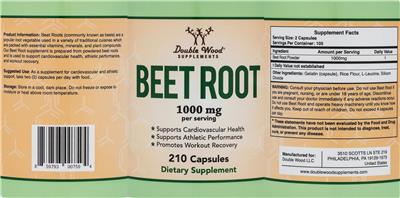
- Form
- Capsule
- Serving Size
- 2 Capsules
- Servings
- 105 per container
- Container Holds
- 210 Capsules
What’s in it, whether it interacts with your drugs, its side effects, whether it works, and what our pharmacists would want you to know before you start it.
- What is Beet Root 1000 mg?A single-ingredient supplement from Double Wood Supplements, in capsule form.
- Active Ingredients Beet, Powder 1000 mg One active ingredient. We check it for drug interactions and side effects. The full Supplement Facts
- Drug Interactions 863 drugs have a documented interaction with this supplement; the most serious is rated moderate. Of those, 552 are single drugs and 311 are combination products (two or more drugs in one), each listed under its own name. Ask your pharmacist first if you take a drug in any of these categories:
- Moderate · 645 drugs
- Minor · 186 drugs
- Minor · 172 drugs
- Possible Side EffectsPink urineSometimes red stools after eating beets +1 moreReported for its one active ingredient, Beet. Not studied in this exact product.
- Well documented Why
Does Beet Root 1000 mg work?
What It Is Marketed For
Cardiovascular and athletic performance support
From the claims on the product’s label.
The Closest Use the Research Grades
Some studies support it, but the evidence isn’t conclusive.
Beet has research behind other uses too:
- Exercise-induced muscle soreness
These grades are for the ingredient, not this exact product, and never a promise it will work for you.
What the research says- Full Why
- AllergensNone of its ingredient names point to a major food allergen, and the label text we have carries no allergen statement
- Barcode (UPC)8 59793 00759 4Match it to the barcode on your bottle to be sure this is your product. Not your product? Search for it here
Who Might Consider It
- People looking for cardiovascular and athletic performance support, which is what it is marketed for. The closest use the research grades is athletic performance, rated Possibly Effective.
- People who want it for exercise-induced muscle soreness: the other use with research behind it. See the grade
- This product may suit adults looking into beet powder for athletic performance or muscle soreness, where the evidence is rated Possibly Effective.
Who Should Be Careful
- People on blood pressure medicines, people with low blood pressure, anyone with a history of kidney stones, and anyone taking medications cleared by CYP3A4 or CYP1A2 should be careful.
- Talk it over with your own doctor or pharmacist before you start.
More Before You Take It Show all three answersHide Its Beet, Powder Amount vs. Other Supplements Pregnancy and Breastfeeding The Label’s Directions
-
How does its Beet, Powder amount compare with other supplements?
- Beet, Powder1000 mgMore than most of the 208 recent Beet products in our database that state an amount; 0.08 mg is the most common.
A label’s amount is what the product holds, not a recommended dose.
See the Beet, Powder comparison -
Pregnant or breastfeeding?
- Pregnancy
- ! Beet as a food is fine, but concentrated supplements lack safety data, so use caution.
- Breastfeeding
- There is insufficient reliable information available about the safety of beets used medicinally during pregnancy and breast-feeding.
-
How does the label say to take it?
“Suggested Use: As a supplement for cardiovascular and athletic support, take two (2) capsules per day with food.”
The maker’s words. Your pharmacist or doctor may advise differently.
Everything the label says
From the label dated Jun 20, 2024: its one active ingredient was checked against our records. A summary of what is known, not a grade or a test of the product. How these ratings are computed
Ask Anything About This Supplement
Name a drug you take, or ask about side effects, ingredients or pregnancy.
AI answers come from this label and our own records, never the open internet. AI can make mistakes, so always check with your doctor or pharmacist. How we use AI
Ask the Pharmacist
A licensed pharmacist will answer your question by email — free, usually within 24 hours.
Got it — thank you!
A licensed pharmacist will answer within 24 hours. Keep an eye on your email (worth checking spam, just in case).
What’s Inside Beet Root 1000 mg by Double Wood Supplements
One Active Ingredient: Beet, Powder
Everything this page says about drug interactions and side effects comes from what is known about Beet, Powder.
Why this rating?
The label gives the exact amount of its one active ingredient, so you know how much you get in each serving. This rates what the label tells you, not the quality of the product.
Supplement Facts
| Amount Per Serving | % Daily Value | |
|---|---|---|
| Beet, Powder | 1000 mg | † |
Other ingredients: Gelatin, Rice Flour, L-Leucine, Silicon Dioxide
† Daily Value not established.
Daily Values for adults and children 4 or more years of age.
As the label prints it, from the NIH Dietary Supplement Label Database.
Each Ingredient and Its Drug Interactions
Tap one for more about it and its full guide.
-
Beet, Powder 1000 mg Beet powder is the only active ingredient in this capsule. Interacts with 863 drugs
Beet, especially beetroot juice, is a nitrate-rich food that may modestly lower blood pressure and slightly improve exercise performance in some people.
- It is generally safe as a food, but supplement effects are modest and not a substitute for prescribed treatment, so talk with your pharmacist or doctor before relying on it.
The full Beet guide: uses, dosage and safety Every Beet drug interaction
How Much Beet Is in It, Compared With Other Supplements
Each bar is an amount that other recent supplements list for the same ingredient. The taller the bar, the more of them state it.
-
1,000 mg in a serving of this product
More than most products
- Most common amount
- 0.08 mg (about 27 in 100 products)
- Most products state
- 0.08 mg to 1,000 mg
- Compared with
- 208 recent products
Other Ingredients (Inactive)
The capsule or tablet itself, fillers, coatings and flavors. Not part of the drug interaction check; the allergen check below reads them.
- Gelatin
- Rice Flour
- L-Leucine
- Silicon Dioxide
Allergens in Beet Root 1000 mg
None of its ingredient names point to a major food allergen, and the label text we have carries no allergen statement.
Named on this label
- Gelatin (animal-derived)In the ingredients: Gelatin
Not named in the ingredients
- Milk
- Egg
- Fish
- Shellfish
- Tree nuts
- Peanuts
- Wheat or other gluten grains
- Soy
- Sesame
From the label text and ingredient names on file; we do not test products. With a serious allergy, check your bottle and ask the maker or your pharmacist.
What the Label Says
The maker’s own words, from the label. We do not verify or endorse them.
- Storage
-
“Storage: Store in a cool, dark place. Do not freeze or expose to moisture or heat above room temperature.”
- Formulation
-
“Supports cardiovascular health Supports athletic performance Promotes workout recovery”
“Product Information: Beet Roots (commonly known as beets) are a popular root vegetable used in a variety of traditional cuisines which are packed with essential vitamins, minerals, and plant compounds. Our Beet Root supplement is prepared from powdered beet roots and is used to support cardiovascular health, athletic performance, and workout recovery.”
“Beet Root 1000 mg per serving”
- FDA Statement of Identity
-
“Dietary Supplement”
The Beet Root 1000 mg Label on File
The label scan on file at the NIH Dietary Supplement Label Database, dated June 2024. Always read the label on the bottle you have.
Product Facts
- Brand
- Double Wood Supplements
- Barcode (UPC)
- 859793007594
- Net contents
- 210 Capsules
- Market status
- On market
- Date entered into DSLD
- Jun 20, 2024
- DSLD ID
- 315590
- Product type
- Botanical
- Supplement form
- Capsule
- Dietary claims / uses
- Nutrient, All Other, Structure/Function
- Intended target group(s)
- Adult (18 - 50 Years), Women (not pregnant or lactating)
Is this label outdated? Report a formula or label change and our pharmacy team will review it.
Beet Root 1000 mg by Double Wood Supplements Side Effects
Why this rating?
We look for three kinds of safety information on each ingredient: side effects reported in studies, a pregnancy and breastfeeding rating, and a safety write-up from our pharmacy team. All three are on file for Beet.
So this rates how much is known, not whether Beet Root 1000 mg is right for you.
Reported with Beet, its active ingredient
- Most often
- Pink urine and sometimes red stools after eating beets
- !Rare but serious
- Hypocalcemia See details
HelloPharmacist Team Summary of Side Effects
Beet powder is generally well tolerated, and the effect you are most likely to notice is red or pink coloring of your urine and stools, which is not harmful.
- Rarely, large amounts have been linked to low blood calcium and kidney damage, and one case report described black stools in a man taking blood thinners, so call your doctor promptly if you notice black stools.
- If you have a history of kidney stones or low blood pressure, or you take blood thinners or other medications, talk with your own doctor or pharmacist before starting this product.
Side Effects Reported With Beet
Beet Root 1000 mg Warnings: Who Should Be Careful
These warnings are for Beet, its one active ingredient. If any of these apply to you, talk to your doctor or pharmacist before you start it.
-
Blood Pressure
- People with low blood pressure should be aware that beets may lower it further.
-
Kidney Disease or Kidney Stones
- People with a history of kidney stones may want to be careful, because beets contain oxalates, which can contribute to certain types of stones.
-
Other Cautions
- Concentrated beet supplements, however, lack adequate safety data, so our data advises caution.
-
What the Label Warns
- “Warning: Consult your physician before use.”
- “Do not use Beet Root if you are pregnant, nursing, or are under 18 years of age.”
- “Do not use Beet Root if you are pregnant, nursing, or are under 18 years of age.”
- “Discontinue use and consult your doctor immediately if any adverse reactions occur. Do not use Beet Root and operate heavy machinery until you know how it affects you.”
- “Keep out of reach of children.”
- “Do not exceed 4 capsules per day.”
The maker’s wording, from the product label.
-
Pregnant or Breastfeeding
The rating for pregnancy and for breastfeeding, and what it covers.
Pregnancy
-
Beet as a food is fine, but concentrated supplements lack safety data, so use caution.
Breastfeeding
-
There is insufficient reliable information available about the safety of beets used medicinally during pregnancy and breast-feeding.
Ratings and the words beside them are from the Natural Medicines database, which we license. Where it has no rating, the rating and note are our pharmacy team’s.
The full record, with its sources, in the Beet guide -
Rare but Serious Side Effects
-
!
Beet
In short-term medicinal use, beet seems well tolerated, but rare serious effects include low blood calcium (hypocalcemia) and kidney damage when taken in large amounts.
Orally: Hypocalcemia and kidney damage when ingested in large amounts.
When to get help: a serious allergic reaction, with trouble breathing or swelling of the face, lips or throat, needs emergency care: call 911. For any other side effect that worries you, call your doctor or pharmacist.
These reports describe each ingredient, not studies of this exact product. Not medical advice: a side effect you notice after starting a supplement is worth a word with your pharmacist or doctor.
Beet Root 1000 mg by Double Wood Supplements Drug Interactions
This supplement has one active ingredient, Beet, Powder, and we checked it against every drug in our records.
A moderate interaction on record
2 of 3, on a scale from Minor or none to Major.Why this rating?
We rate this by the most serious interaction on record, not by how many there are. For Beet, the most serious is rated moderate, which means it calls for caution, and sometimes monitoring or a change in timing or dose.
864 drugs are on the full list. What matters is whether one you take is on it, so check yours with the interaction checker on this page.
Its one active ingredient has drug interactions on record: Beet.
Beet
- Interacts with
- 863 drugs
- Most serious
- Moderate
- The most serious is a Moderate interaction with medications broken down by the liver enzyme CYP3A4 (CYP3A4 substrates).
- Lab research suggests beet's main pigment, betanin, can slow this enzyme in a dose-dependent way, similar to the strong inhibitor ketoconazole, which could raise levels of those drugs.
- Beet's nitrates can widen blood vessels and may lower blood pressure, so antihypertensive drugs (blood pressure medicines) carry a Minor interaction.
- A study using concentrated beetroot juice found no significant effect on blood pressure or heart rate across age groups.
Show two more points
- Beet is also linked, in theory, to lower levels and effects of drugs cleared by the liver enzyme CYP1A2 (CYP1A2 substrates), a Minor interaction based on lab research showing beet can switch that enzyme on.
- Use the search tool on this page to check your exact medications.
The kinds of drugs it affects most
- 645 drugs
- 186 drugs
- 172 drugs
Every Beet drug interaction, 3 records The Beet records cite 11 references, listed in the Beet guide.
Summarized by the HelloPharmacist pharmacy team from the interaction records below. How it is written How we use AI
The Breakdown by Severity
Each drug counted once, at its most serious rating. Tap a tile to list those drugs.
Find Your Drug
Type a drug or brand name to see whether it is on the list.
- Only drugs with a documented interaction are listed, the most serious first.
- A drug with no known interaction is not listed, but searching its name tells you so.
- Open a drug to see which ingredient is responsible. Of those, 552 are single drugs and 311 are combination products (two or more drugs in one), each listed under its own name.
-
ApixabanEliquis Moderate
The ingredient responsible:
-
Beet, Powder Moderate Apixaban is in the Cytochrome P450 3A4 (CYP3A4) Substrates category.
Theoretically, beet might increase the levels of CYP3A4 substrates.
The full Beet, Powder + Apixaban interaction
-
-
WarfarinWarfarin Moderate
The ingredient responsible:
-
Beet, Powder Moderate Warfarin is in these Cytochrome P450 3A4 (CYP3A4) Substrates, Cytochrome P450 1A2 (CYP1A2) Substrates categories.
Theoretically, beet might increase the levels of CYP3A4 substrates.
The full Beet, Powder + Warfarin interaction
-
-
AmlodipineNorliqva Moderate
The ingredient responsible:
-
Beet, Powder Moderate Amlodipine is in these Antihypertensive Drugs, Cytochrome P450 3A4 (CYP3A4) Substrates categories.
Beet and beetroot contain nitrates, which can cause vasodilation, potentially leading to lower blood pressure.
The full Beet, Powder + Amlodipine interaction
-
-
SertralineZoloft Moderate
The ingredient responsible:
-
Beet, Powder Moderate Sertraline is in the Cytochrome P450 3A4 (CYP3A4) Substrates category.
Theoretically, beet might increase the levels of CYP3A4 substrates.
The full Beet, Powder + Sertraline interaction
-
-
ClopidogrelPlavix Moderate
The ingredient responsible:
-
Beet, Powder Moderate Clopidogrel is in these Cytochrome P450 1A2 (CYP1A2) Substrates, Cytochrome P450 3A4 (CYP3A4) Substrates categories.
Theoretically, beet might decrease the levels and clinical effects of CYP1A2 substrates.
The full Beet, Powder + Clopidogrel interaction
-
-
EscitalopramLexapro Moderate
The ingredient responsible:
-
Beet, Powder Moderate Escitalopram is in the Cytochrome P450 3A4 (CYP3A4) Substrates category.
Theoretically, beet might increase the levels of CYP3A4 substrates.
The full Beet, Powder + Escitalopram interaction
-
-
Losartan PotassiumCozaar Moderate
The ingredient responsible:
-
Beet, Powder Moderate Losartan Potassium is in these Cytochrome P450 3A4 (CYP3A4) Substrates, Antihypertensive Drugs categories.
Theoretically, beet might increase the levels of CYP3A4 substrates.
The full Beet, Powder + Losartan Potassium interaction
-
-
AtorvastatinAtorvaliq Moderate
The ingredient responsible:
-
Beet, Powder Moderate Atorvastatin is in the Cytochrome P450 3A4 (CYP3A4) Substrates category.
Theoretically, beet might increase the levels of CYP3A4 substrates.
The full Beet, Powder + Atorvastatin interaction
-
-
RivaroxabanXarelto Moderate
The ingredient responsible:
-
Beet, Powder Moderate Rivaroxaban is in the Cytochrome P450 3A4 (CYP3A4) Substrates category.
Theoretically, beet might increase the levels of CYP3A4 substrates.
The full Beet, Powder + Rivaroxaban interaction
-
-
Warfarin SodiumCoumadin, Panwarfin, Sofarin Moderate
The ingredient responsible:
-
Beet, Powder Moderate Warfarin Sodium is in these Cytochrome P450 3A4 (CYP3A4) Substrates, Cytochrome P450 1A2 (CYP1A2) Substrates categories.
Theoretically, beet might increase the levels of CYP3A4 substrates.
The full Beet, Powder + Warfarin Sodium interaction
-
-
TadalafilCialis, Tadliq Moderate
The ingredient responsible:
-
Beet, Powder Moderate Tadalafil is in the Cytochrome P450 3A4 (CYP3A4) Substrates category.
Theoretically, beet might increase the levels of CYP3A4 substrates.
The full Beet, Powder + Tadalafil interaction
-
-
TestosteroneAndrogel, Andropatch, Delatestryl, Intrinsa, Natesto and 4 more Moderate
The ingredient responsible:
-
Beet, Powder Moderate Testosterone is in the Cytochrome P450 3A4 (CYP3A4) Substrates category.
Theoretically, beet might increase the levels of CYP3A4 substrates.
The full Beet, Powder + Testosterone interaction
-
-
PrednisoneCortan, Deltasone, Meticorten, Orasone, Prednicen-M and 3 more Moderate
The ingredient responsible:
-
Beet, Powder Moderate Prednisone is in the Cytochrome P450 3A4 (CYP3A4) Substrates category.
Theoretically, beet might increase the levels of CYP3A4 substrates.
The full Beet, Powder + Prednisone interaction
-
-
AbemaciclibVerzenio Moderate
The ingredient responsible:
-
Beet, Powder Moderate Abemaciclib is in the Cytochrome P450 3A4 (CYP3A4) Substrates category.
Theoretically, beet might increase the levels of CYP3A4 substrates.
The full Beet, Powder + Abemaciclib interaction
-
-
LetrozoleFemara Moderate
The ingredient responsible:
-
Beet, Powder Moderate Letrozole is in the Cytochrome P450 3A4 (CYP3A4) Substrates category.
Theoretically, beet might increase the levels of CYP3A4 substrates.
The full Beet, Powder + Letrozole interaction
-
-
ClonazepamCeberclon, Klonopin, Rivotril Moderate
The ingredient responsible:
-
Beet, Powder Moderate Clonazepam is in the Cytochrome P450 3A4 (CYP3A4) Substrates category.
Theoretically, beet might increase the levels of CYP3A4 substrates.
The full Beet, Powder + Clonazepam interaction
-
-
AmitriptylineElavil Moderate
The ingredient responsible:
-
Beet, Powder Moderate Amitriptyline is in these Cytochrome P450 3A4 (CYP3A4) Substrates, Cytochrome P450 1A2 (CYP1A2) Substrates categories.
Theoretically, beet might increase the levels of CYP3A4 substrates.
The full Beet, Powder + Amitriptyline interaction
-
-
CitalopramCelexa Moderate
The ingredient responsible:
-
Beet, Powder Moderate Citalopram is in the Cytochrome P450 3A4 (CYP3A4) Substrates category.
Theoretically, beet might increase the levels of CYP3A4 substrates.
The full Beet, Powder + Citalopram interaction
-
-
BuspironeBuSpar Moderate
The ingredient responsible:
-
Beet, Powder Moderate Buspirone is in the Cytochrome P450 3A4 (CYP3A4) Substrates category.
Theoretically, beet might increase the levels of CYP3A4 substrates.
The full Beet, Powder + Buspirone interaction
-
-
OmeprazoleLosec, Prilosec, Zegerid Moderate
The ingredient responsible:
-
Beet, Powder Moderate Omeprazole is in the Cytochrome P450 3A4 (CYP3A4) Substrates category.
Theoretically, beet might increase the levels of CYP3A4 substrates.
The full Beet, Powder + Omeprazole interaction
-
-
QuetiapineDopaquel, Seroquel Moderate
The ingredient responsible:
-
Beet, Powder Moderate Quetiapine is in the Cytochrome P450 3A4 (CYP3A4) Substrates category.
Theoretically, beet might increase the levels of CYP3A4 substrates.
The full Beet, Powder + Quetiapine interaction
-
-
Amlodipine BesylateNorvasc Moderate
The ingredient responsible:
-
Beet, Powder Moderate Amlodipine Besylate is in these Antihypertensive Drugs, Cytochrome P450 3A4 (CYP3A4) Substrates categories.
Beet and beetroot contain nitrates, which can cause vasodilation, potentially leading to lower blood pressure.
The full Beet, Powder + Amlodipine Besylate interaction
-
-
EstrogenEstrogen Moderate
The ingredient responsible:
-
Beet, Powder Moderate Estrogen is in these Cytochrome P450 3A4 (CYP3A4) Substrates, Cytochrome P450 1A2 (CYP1A2) Substrates categories.
Theoretically, beet might increase the levels of CYP3A4 substrates.
The full Beet, Powder + Estrogen interaction
-
-
DiazepamDiastat AcuDial, Valium, Valium injection, Valtoco Moderate
The ingredient responsible:
-
Beet, Powder Moderate Diazepam is in these Cytochrome P450 3A4 (CYP3A4) Substrates, Cytochrome P450 1A2 (CYP1A2) Substrates categories.
Theoretically, beet might increase the levels of CYP3A4 substrates.
The full Beet, Powder + Diazepam interaction
-
-
Atorvastatin CalciumLipitor Moderate
The ingredient responsible:
-
Beet, Powder Moderate Atorvastatin Calcium is in the Cytochrome P450 3A4 (CYP3A4) Substrates category.
Theoretically, beet might increase the levels of CYP3A4 substrates.
The full Beet, Powder + Atorvastatin Calcium interaction
-
-
FinasteridePropecia, Proscar Moderate
The ingredient responsible:
-
Beet, Powder Moderate Finasteride is in the Cytochrome P450 3A4 (CYP3A4) Substrates category.
Theoretically, beet might increase the levels of CYP3A4 substrates.
The full Beet, Powder + Finasteride interaction
-
-
Tamoxifen CitrateNolvadex, Soltamox Moderate
The ingredient responsible:
-
Beet, Powder Moderate Tamoxifen Citrate is in the Cytochrome P450 3A4 (CYP3A4) Substrates category.
Theoretically, beet might increase the levels of CYP3A4 substrates.
The full Beet, Powder + Tamoxifen Citrate interaction
-
-
DexamethasoneDecadron, Dexone, Dextenza, Dexycu, Hemady and 2 more Moderate
The ingredient responsible:
-
Beet, Powder Moderate Dexamethasone is in the Cytochrome P450 3A4 (CYP3A4) Substrates category.
Theoretically, beet might increase the levels of CYP3A4 substrates.
The full Beet, Powder + Dexamethasone interaction
-
-
PantoprazolePantoloc, Protonix, Protonix IV Moderate
The ingredient responsible:
-
Beet, Powder Moderate Pantoprazole is in the Cytochrome P450 3A4 (CYP3A4) Substrates category.
Theoretically, beet might increase the levels of CYP3A4 substrates.
The full Beet, Powder + Pantoprazole interaction
-
-
AlprazolamNiravam, Xanax Moderate
The ingredient responsible:
-
Beet, Powder Moderate Alprazolam is in the Cytochrome P450 3A4 (CYP3A4) Substrates category.
Theoretically, beet might increase the levels of CYP3A4 substrates.
The full Beet, Powder + Alprazolam interaction
-
Does It Work? Beet Root 1000 mg by Double Wood Supplements
What the research says so far. A grade is the research so far, never an endorsement.
What It Is Marketed For
Cardiovascular and athletic performance support
From the claims on the product’s label.
Closest match for what it is marketed for
Beet for athletic performance
Some studies support it, but the evidence isn’t conclusive.
Our pharmacy team’s notes on this supplement
- Athletic performance and exercise-induced muscle soreness are rated Possibly Effective for beet.
- For chronic obstructive pulmonary disease (COPD), beet is rated Possibly Ineffective.
- Dyslipidemia and cognitive function have insufficient reliable evidence to rate.
- These ratings reflect the evidence we have, not a guarantee of results for you.
What the Research Says About Beet
Its uses graded effective, likely effective or possibly effective:
Research suggests a benefit for
- Athletic performance (the use on its label) and exercise-induced muscle soreness
The grades are the Natural Medicines database’s, which we license; tap a grade for what it means. They are about each ingredient, not this exact product.
About Double Wood Supplements
Manufacturer and brand details for Beet Root 1000 mg, from the product label.
Double Wood Supplements has 135 products in our supplement database, 133 of them on the market, with labels on file since 2020. Our database is built from the NIH’s Dietary Supplement Label Database and our pharmacy team’s own additions, so it covers the labels filed there, not every product the brand sells.
- Name
- Double Wood LLC
- Street Address
- 3510 Scotts Ln Ste 219
- City
- Philadelphia
- State
- PA
- ZipCode
- 19129-15173
- Web Address
- www.doublewoodsupplements.com
Beet Root 1000 mg by Double Wood Supplements: Common Questions
Does Beet Root 1000 mg by Double Wood Supplements interact with any drugs?
What are the side effects of Beet Root 1000 mg by Double Wood Supplements?
Who should be careful taking Beet Root 1000 mg by Double Wood Supplements?
How can Beet Root 1000 mg by Double Wood Supplements interact with so many drugs?
Where does the information about Beet Root 1000 mg by Double Wood Supplements come from?
Does beet powder work for muscle soreness?
Is beet powder okay during pregnancy?
Why are my stools or urine red or pink?
Can beet powder lower blood pressure?
Can beet cause black stools?
Written and reviewed by the HelloPharmacist Editorial Team. Our editorial policy
Still Have a Question About Beet Root 1000 mg?
Our pharmacists answer drug and supplement questions, free, by email.
Label information is sourced from the NIH Dietary Supplement Label Database and reflects the product version on file; always read your actual product label. This page is for education only and is not a substitute for professional medical advice. Confirm with your pharmacist or doctor before combining supplements and drugs.
Who Reviews This Page
The pharmacist behind it, and how it is checked.
Dr. Brian Staiger, PharmD, BCPS
Clinical pharmacist and founder of HelloPharmacist
A licensed pharmacist for more than 13 years, he built the system behind this page: it reads the label on file, matches each active ingredient to its record in the Natural Medicines database, checks those records against every drug we cover, and our pharmacy team writes the take and the interaction summary from those records.
- 13+ Years in PharmacyRetail and clinical pharmacy, medication safety and healthcare administration.
- Board Certified (BCPS)A pharmacotherapy specialist, certified by the Board of Pharmacy Specialties.
- Herbalist TrainingCertificates in medical ethnobotany, for the herbs and supplements people take.
Where This Page Comes From
Beet Root 1000 mg’s label data comes from the NIH Dietary Supplement Label Database; the ingredient interaction data is from the Natural Medicines database, reviewed by our pharmacists.
- NIH Dietary Supplement Label Database (DSLD)
- The official product label on file for this supplement.
- Natural Medicines (Therapeutic Research Center)
- The evidence-graded clinical reference behind the ingredient interaction, evidence and safety records, which we license.
- HelloPharmacist Editorial Team
- Content is reviewed by the HelloPharmacist Editorial Team, the pharmacists on our staff and those we contract. See our data sources and editorial standards for how this information is built and checked.
- The Pharmacy Team’s Take and Summaries
- Generated from HelloPharmacist’s pharmacist-curated databases and editorial rules. Clinical methodology reviewed by Dr. Brian Staiger, PharmD, BCPS. Last generated Oct 31, 2026. How we use AI
- The ratings in the Quick Summary
- They summarize available label information, ingredient evidence and known drug-safety records: a summary of what is known, not a grade of the product itself. They do not verify product identity, purity, potency, contamination or manufacturing quality. How these ratings are computed
The References Behind the Interaction Records
Every citation the ingredients’ records rest on is listed in that ingredient’s guide, in context: Beet, 11 references .
Parts of this content are provided by the Therapeutic Research Center, LLC.
DISCLAIMER: Currently this does not check for drug-drug interactions. This is not an all-inclusive comprehensive list of potential interactions and is for informational purposes only. Not all interactions are known or well-reported in the scientific literature, and new interactions are continually being reported. Input is needed from a qualified healthcare provider including a pharmacist before starting any therapy. Application of clinical judgment is necessary.
© 2021 Therapeutic Research Center, LLC
Keep Exploring
- Supplement interaction checkerCheck any supplement or product against your drugs
- Drug–drug interactionsCheck two or more of your drugs against each other
- Browse drugs A to ZEvery drug we have checked against herbs and supplements
- NDC and pricing lookupFind a drug’s NDCs, packaging and costs
- Ask a pharmacistA free, personal answer from our licensed team