
CS-W by Pure Herbs Ingredients, Side Effects and Drug Interactions
Dietary Supplement Liquid Botanical

Medically reviewed by Dr. Brian Staiger, PharmD, BCPS
Also reviewed by the HelloPharmacist Editorial Team
Updated Details about this page
- Label on file from the NIH Dietary Supplement Label Database, dated Jan 23, 2023.
- The interaction, evidence and safety records come from the Natural Medicines database, which we license, read against this label by our own system; the pharmacy team’s sections are written from those records.
- Dr. Brian Staiger, PharmD, BCPS, is a clinical pharmacist and pharmacotherapy specialist.
- Editorial policy Our sources
AI is used only to summarize verified clinical information, never the open internet. Our AI policy
Summary: The HelloPharmacist Team’s Take
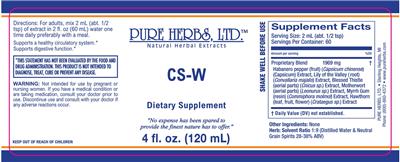
- Form
- Liquid
- Serving Size
- 2 mL
- Servings
- 60 per container
- Container Holds
- 4 Fluid Ounces; 120 mL
What’s in it, whether it interacts with your drugs, its side effects, whether it works, and what our pharmacists would want you to know before you start it.
- What is CS-W?A supplement from Pure Herbs with six active ingredients, in liquid form.
- Active Ingredients Habanero Pepper Fruit ExtractLily of the Valley Root ExtractBlessed Thistle Aerial Parts ExtractMotherwort Aerial Parts ExtractMyrrh Gum Resin ExtractHawthorn Flower, Fruit, Leaf Extract Six active ingredients. Each one can interact with drugs or cause side effects on its own, so we check every one. The full Supplement Facts
- Drug Interactions 692 drugs have a documented interaction with this supplement; the most serious is rated major. Of those, 427 are single drugs and 265 are combination products (two or more drugs in one), each listed under its own name. Ask your pharmacist first if you take a drug in any of these categories, the most serious of the 23 on record:
- Major · 23 drugs
- Major · 7 drugs
- PHOSPHODIESTERASE-5 InhibitorsMajor · 7 drugs
- QuinineMajor · 2 drugs
- Possible Side EffectsDiarrhea 2 ingredientsStomach upset 2 ingredientsBurningDizzinessStingingNausea +6 moreReported for four of its six active ingredients. Not studied in this exact product.
- Well documented Why
Does CS-W work?
What It Is Marketed For
Circulatory and digestive system support
From the claims on the product’s label.
The Closest Use the Research Grades
Blessed Thistle
There isn’t enough good research to say either way.
Capsicum has stronger research for other uses:
- Postherpetic neuralgia
These grades are for the ingredient, not this exact product, and never a promise it will work for you.
What the research says- Low Why
- AllergensNone of its ingredient names point to a major food allergen, and the label text we have carries no allergen statement
Who Might Consider It
- People looking for circulatory and digestive system support, which is what it is marketed for. For dyspepsia, the closest use the research grades, there is not enough good research to say either way.
- People who want it for postherpetic neuralgia: the other use with research behind it. See the grade
- It is not a product to start casually.
Who Should Be Careful
- CS-W may be of interest to adults who have already talked through its ingredients with their own doctor.
- People taking heart medicines, blood thinners, diabetes drugs, lithium, or any other prescription medication should be especially careful.
- Anyone who is pregnant or breastfeeding should talk it over with their own doctor or pharmacist before starting.
- Keep it away from children and pets, since lily of the valley is considered especially dangerous for them.
More Before You Take It Show both answersHide Pregnancy and Breastfeeding The Label’s Directions
-
Pregnant or breastfeeding?
- Pregnancy and Breastfeeding Lily-of-the-valley
- ! When used orally for self-medication.
- Pregnancy Blessed Thistle
- ! When used orally; avoid using.
- Breastfeeding Blessed Thistle
- Insufficient reliable information available; avoid using.
- Pregnancy Motherwort
- ! When used orally or by injection.
- Breastfeeding Motherwort
- Insufficient reliable information available; avoid using.
-
How does the label say to take it?
“Directions: For adults, mix 2 mL (abt. 1/2 tsp) of extract in 2 fl. oz (60 mL) water one time daily preferably with a meal.”
The maker’s words. Your pharmacist or doctor may advise differently.
Everything the label says
From the label dated Jan 23, 2023: all six of its active ingredients were checked against our records. A summary of what is known, not a grade or a test of the product. How these ratings are computed
Ask Anything About This Supplement
Name a drug you take, or ask about side effects, ingredients or pregnancy.
AI answers come from this label and our own records, never the open internet. AI can make mistakes, so always check with your doctor or pharmacist. How we use AI
Ask the Pharmacist
A licensed pharmacist will answer your question by email — free, usually within 24 hours.
Got it — thank you!
A licensed pharmacist will answer within 24 hours. Keep an eye on your email (worth checking spam, just in case).
What’s Inside CS-W by Pure Herbs
Six Active Ingredients, Each Checked on Its Own
A supplement is often several ingredients in one bottle, and each one can interact with drugs or cause side effects on its own. We check every one of them against our records.
- Habanero Pepper Fruit ExtractDrug interactions on record, most serious: Moderate
- Lily of the Valley Root ExtractDrug interactions on record, most serious: Major
- Blessed Thistle Aerial Parts ExtractNo drug interactions on record
- Motherwort Aerial Parts ExtractDrug interactions on record, most serious: Moderate
- Myrrh Gum Resin ExtractDrug interactions on record, most serious: Moderate
- Hawthorn Flower, Fruit, Leaf ExtractDrug interactions on record, most serious: Major
The label gives an exact amount for 0 of its 6 active ingredients. Six are inside one proprietary blend, “Proprietary Blend”, and the label gives one total for it, not how much of each ingredient is in it.
- 0 state an exact amount
- 6 have no amount of their own
- Proprietary Blend 1,969 mg in total · 6 ingredients, no amount for each
This rates what the label tells you, not the quality of the product.
Supplement Facts
| Amount Per Serving | % Daily Value | |
|---|---|---|
| Proprietary Blend | 1969 mg | † |
| Habanero Pepper Fruit Extract | † | |
| Lily of the Valley Root Extract | † | |
| Blessed Thistle Aerial Parts Extract | † | |
| Motherwort Aerial Parts Extract | † | |
| Myrrh Gum Resin Extract | † | |
| Hawthorn Flower, Fruit, Leaf Extract | † | |
Other ingredients: None
† Daily Value not established.
Daily Values for adults and children 4 or more years of age.
As the label prints it, from the NIH Dietary Supplement Label Database.
Each Ingredient and Its Drug Interactions
Tap one for more about it and its full guide. A drug can interact with this supplement through any one of them.
CS-W's active ingredients are habanero pepper fruit extract (capsicum), blessed thistle aerial parts extract, lily of the valley root extract, motherwort aerial parts extract, hawthorn flower, fruit, and leaf extract, and myrrh gum resin extract.
- Capsicum is the component with the most research in this product, and it has been studied for nerve pain, headaches, and nausea after surgery.
- The other herbs have mostly traditional uses for heart, digestive, uterine, and milk-supply concerns, and the human evidence for most of those uses is limited.
-
Proprietary Blend 1969 mg The product also includes a proprietary blend, which our data lists as a container with its components listed individually. Six ingredients inside it, each checked on its own
- Habanero Pepper Fruit Extract 239 drugs
- Lily of the Valley Root Extract 157 drugs
- Blessed Thistle Aerial Parts Extract 36 drugs
- Motherwort Aerial Parts Extract 248 drugs
- Myrrh Gum Resin Extract 88 drugs
- Hawthorn Flower, Fruit, Leaf Extract 191 drugs
Other Ingredients (Inactive)
The capsule or tablet itself, fillers, coatings and flavors. Not part of the drug interaction check; the allergen check below reads them.
- None
Allergens in CS-W
None of its ingredient names point to a major food allergen, and the label text we have carries no allergen statement.
Not named in the ingredients
- Milk
- Egg
- Fish
- Shellfish
- Tree nuts
- Peanuts
- Wheat or other gluten grains
- Soy
- Sesame
From the label text and ingredient names on file; we do not test products. With a serious allergy, check your bottle and ask the maker or your pharmacist.
What the Label Says
The maker’s own words, from the label. We do not verify or endorse them.
- Directions
-
“Shake well before use”
- Formulation
-
“Supports a healthy circulatory system. Supports digestive function.”
- Brand IP Statement(s)
-
“Pure Herbs, Ltd. Natural Herbal Extracts”
- FDA Statement of Identity
-
“Dietary Supplement”
- General statements
-
“"No expense has been spared to provide the finest nature has to offer."”
The CS-W Label on File
The label scan on file at the NIH Dietary Supplement Label Database, dated January 2023. Always read the label on the bottle you have.
Product Facts
- Brand
- Pure Herbs
- Net contents
- 4 Fluid Ounces; 120 mL
- Market status
- On market
- Date entered into DSLD
- Jan 23, 2023
- DSLD ID
- 281226
- Product type
- Botanical
- Supplement form
- Liquid
- Dietary claims / uses
- All Other, Structure/Function
- Intended target group(s)
- Adult (18 - 50 Years), Women (not pregnant or lactating)
Is this label outdated? Report a formula or label change and our pharmacy team will review it.
CS-W by Pure Herbs Side Effects
Why this rating?
We look for three kinds of safety information on each ingredient: side effects reported in studies, a pregnancy and breastfeeding rating, and a safety write-up from our pharmacy team. All three are on file for each of the six ingredients we could check.
So this rates how much is known, not whether CS-W is right for you.
Reported with six of its ingredients
- Most often
- Diarrhea, stomach upset, burning, dizziness, stinging and nausea
- !Rare but serious
- Reported with Capsicum, Lily-of-the-valley, Blessed Thistle, Myrrh and Hawthorn See details
HelloPharmacist Team Summary of Side Effects
For you, CS-W is most likely to bring stomach upset, diarrhea, and dizziness, the three side effects reported most often across its ingredients.
- Dizziness is reported from hawthorn, so see how it affects you before you drive.
- Burning, stinging, itching, and redness are reported mainly with the capsicum component, so wash your hands well after use and keep it out of your eyes.
- The rare but serious concern is from lily of the valley: a slow, fast, or irregular heartbeat or dangerously low blood pressure, so call your doctor right away if these occur.
- If you have a heart condition, take blood thinners or diabetes medication, or are pregnant or breastfeeding, talk with your own doctor or pharmacist before starting.
Side Effects, Ingredient by Ingredient
A supplement’s side effects come from its ingredients. Here is what is reported with each one.
Capsicum
Most reported
- Burning
- Stinging
- Itching
- Redness at the application site
Motherwort
Most reported
- Stomach upset
- Diarrhea
- Increased menstrual flow
Myrrh
Most reported
- Stomach upset
- Diarrhea
- Skin irritation
Hawthorn
Most reported
- Dizziness
- Nausea
- Digestive upset
- Headache
Lily-of-the-valley and Blessed Thistle have side-effect reports on file, but no list of the most common ones. Read them in each guide: Lily-of-the-valley, Blessed Thistle.
CS-W Warnings: Who Should Be Careful
CS-W has six active ingredients, and each can carry warnings of its own. We checked all six, and each warning below names the ingredient it comes from. If any of these apply to you, talk to your doctor or pharmacist before you start it.
- Capsicum3 warnings below
- Lily-of-the-valley3 warnings below
- Blessed Thistle3 warnings below
- Motherwort3 warnings below
- Myrrh3 warnings below
- Hawthorn1 warning below
-
Bleeding Problems or Surgery
- MotherwortAlso use caution if you are scheduled for surgery, as herbs that affect the heart or blood may interfere with that.
- Motherwort above 3 grams can cause uterine bleeding, myrrh at 2 to 4 grams may cause diarrhea, and blessed thistle above 5 grams per cup of tea can cause stomach irritation and vomiting.
-
Diabetes or Low Blood Sugar
- MyrrhPeople with diabetes should be cautious, as some reports suggest myrrh may affect blood sugar.
-
Blood Pressure
- MotherwortBecause it may affect heart rhythm and blood pressure, people with heart conditions, low blood pressure, or a slow heart rate should be especially careful and talk to a doctor first.
- HawthornEven so, anyone with a heart condition, high blood pressure, or an irregular heartbeat should only use it under the care of a doctor or pharmacist.
-
Kidney Disease or Kidney Stones
- MyrrhThose with heart problems, kidney issues, or a history of allergic skin reactions should also use care.
-
Heart Conditions
- Lily-of-the-valleyPeople with heart disease are at particular risk.
-
Stomach or Bowel Problems
- CapsicumPeople with sensitive stomachs, acid reflux, ulcers, or irritable bowel symptoms may find that oral capsicum worsens their symptoms.
- Blessed ThistleThose with stomach or intestinal problems, such as ulcers, gastritis, or inflammatory bowel disease, should be careful because bitter herbs can increase stomach acid.
-
Allergies
- Blessed ThistlePeople who are allergic to ragweed, marigolds, daisies, chrysanthemums, or other plants in the Asteraceae family may also react to blessed thistle.
-
Children
- Lily-of-the-valleyIt is especially dangerous for children, who may be attracted to the bright red berries, and for pets.
-
If You Take Other Drugs
- MotherwortAlways check with a pharmacist or doctor before starting motherwort, especially if you take prescription medicines or have a chronic health condition.
- MyrrhAs always, check with your pharmacist or doctor before starting myrrh, especially if you take regular medications or have a chronic condition.
-
Other Cautions
- CapsicumAvoid getting it in your eyes, nose, mouth, or on broken or irritated skin, and wash your hands well after use.
- CapsicumUse caution if you have these conditions.
- Lily-of-the-valleyBecause of its toxicity, this plant should not be used for self-treatment under any circumstances.
- Blessed ThistleStill, human safety data are limited, so caution is wise.
-
What the Label Warns
- “Warning: Not intended for use by pregnant or nursing women. If you have a medical condition or are taking medication, consult your doctor prior to use.”
- “Discontinue use and consult with your doctor if any adverse reactions occur.”
- “Keep out of reach of children”
The maker’s wording, from the product label.
-
Pregnant or Breastfeeding
Each ingredient’s rating for pregnancy and for breastfeeding, and what it covers.
Pregnancy and Breastfeeding The record rates both the same
-
When used orally for self-medication.
Avoid using.
Pregnancy
-
When used orally; avoid using.
Breastfeeding
-
Insufficient reliable information available; avoid using.
Show 4 more ingredients
Pregnancy
-
When used orally or by injection.
Alkaloids present in motherwort have uterine stimulant effects.
Breastfeeding
-
Insufficient reliable information available; avoid using.
Pregnancy
-
When used orally.
Myrrh stimulates uterine tone and blood flow and may have an abortifacient effect.
There is insufficient reliable information available about the safety of the topical use of myrrh during pregnancy.
Breastfeeding
-
Insufficient reliable information available; avoid using.
Pregnancy
-
When used orally and appropriately, short-term.
Capsicum 5 mg daily has been used for up to 28 days during the latter half of the second trimester and the third trimester.
1 more rating for Capsicum used another way
This supplement is taken by mouth. This rating is for Capsicum given another way.
-
When used topically and appropriately.
Breastfeeding
-
When used orally.
Dermatitis can sometimes occur in infants when foods heavily spiced with capsicum peppers are ingested during lactation.
Also, observational research suggests that intake of raw capsicum peppers during pregnancy is associated with an increased risk of sensitization to inhalant allergens in children by the age of 2 years.
1 more rating for Capsicum used another way
This supplement is taken by mouth. This rating is for Capsicum given another way.
-
When used topically and appropriately.
Pregnancy and Breastfeeding The record rates both the same
-
Insufficient reliable information available; avoid using.
Our pharmacy team’s notes
- CapsicumCapsicum carries Likely Safe and Possibly Safe pregnancy ratings and a Likely Safe lactation rating.
- Lily-of-the-valleyLily of the valley is also rated Likely Unsafe in lactation.
- On pregnancy and breastfeeding, blessed thistle, lily of the valley, motherwort, and myrrh are rated Likely Unsafe in pregnancy, so they are best avoided.
Ratings and the words beside them are from the Natural Medicines database, which we license.
-
Rare but Serious Side Effects
-
!
Capsicum
Rarely, severe irritation, allergic reactions, or breathing problems from inhaling the powder can occur.
Orally: Cases of myocardial infarction and hypertensive crisis have been reported.
-
!
Lily-of-the-valley
More serious effects involve the heart, including a slow, fast, or irregular heartbeat and dangerously low blood pressure.
Lily of the valley is the biggest concern: all parts are poisonous, our pharmacists advise avoiding it, and rare cardiac arrhythmias have been reported.
Orally, lily-of-the-valley can cause cardiac arrhythmias.
-
!
Blessed Thistle
Some people may have allergic reactions, especially if they are sensitive to related plants; these can include skin rash or itching.
-
!
Myrrh
Some people may have an allergic reaction such as rash or itching.
-
!
Hawthorn
If you have new or worsening symptoms such as chest pain, severe shortness of breath, swelling in your legs, fainting, or a very fast or irregular heartbeat, seek medical care right away rather than trying to treat yourself with hawthorn.
Hawthorn has rare reports of severe allergic reactions affecting the kidneys.
Orally: Multiorgan hypersensitivity reactions resulting in acute renal failure have been reported rarely.
When to get help: a serious allergic reaction, with trouble breathing or swelling of the face, lips or throat, needs emergency care: call 911. For any other side effect that worries you, call your doctor or pharmacist.
These reports describe each ingredient, not studies of this exact product. Not medical advice: a side effect you notice after starting a supplement is worth a word with your pharmacist or doctor.
CS-W by Pure Herbs Drug Interactions
We checked all six active ingredients in this supplement against every drug in our records. A drug can interact with it through any one of them.
A major interaction on record
3 of 3, on a scale from Minor or none to Major.Why this rating?
We rate this by the most serious interaction on record, not by how many there are. For Blessed Thistle, Motherwort, Lily-of-the-valley, Hawthorn and Myrrh, the most serious is rated major, which means the combination is best avoided, or used only under close supervision. Some involve kinds of drugs where a small change can matter, such as blood thinners, diabetes drugs and heart-rhythm drugs.
692 drugs are on the full list. What matters is whether one you take is on it, so check yours with the interaction checker on this page.
All six of its active ingredients have drug interactions on record: Capsicum, Lily-of-the-valley, Blessed Thistle, Motherwort, Myrrh and Hawthorn.
- Interacts with
- 157 drugs
- Most serious
- Major
- The most serious interaction is lily of the valley with digoxin (Lanoxin), a heart medication.
- The Moderate-rated types are diuretics (water pills), lithium, stimulant laxatives, and macrolide and tetracycline antibiotics, mostly through lily of the valley.
- Interacts with
- 191 drugs
- Most serious
- Major
- Hawthorn's Major-rated interactions are with nitrates and PDE-5 inhibitors (erectile dysfunction drugs), since the added blood pressure lowering could lead to dangerously low blood pressure.
- Interacts with
- 248 drugs
- Most serious
- Moderate
- Most of its records involve CNS Depressants.
Show three more ingredients
- Interacts with
- 239 drugs
- Most serious
- Moderate
- Most of its records involve Anticoagulant/Antiplatelet Drugs, Antidiabetes Drugs and Aspirin.
- Interacts with
- 88 drugs
- Most serious
- Moderate
- Most of its records involve Antidiabetes Drugs and Warfarin (Coumadin).
- Interacts with
- 36 drugs
- Most serious
- Minor
- Most of its records involve Antacids, Proton Pump Inhibitors (PPIs) and H2-BLOCKERS.
From the HelloPharmacist Team
Here is how the interactions add up across the whole label.
- CS-W by Pure Herbs does interact with a number of medications, through its habanero pepper, blessed thistle, lily of the valley, motherwort, hawthorn, and myrrh content.
- Together they can cause cardiac glycoside toxicity (poisoning from heart-active compounds), and the severity is rated Major.
- Lily of the valley also has Major-rated interactions with corticosteroids and quinine, both of which can raise the risk of cardiac glycoside toxicity.
Summarized by the HelloPharmacist pharmacy team from the interaction records below. How it is written How we use AI
Why CS-W Interacts, Ingredient by Ingredient
A product interacts through its ingredients. Each card: how many drugs, the most serious rating, and the kinds of drugs it affects most (tap a kind for what it means).
The ingredients driving the most interactions
-
Motherwort Aerial Parts Extract 248 drugs
Most serious: Moderate1 interaction record on file
The kinds of drugs it affects most
- 248 drugs
Every Motherwort drug interaction, 1 record The Motherwort records cite 6 references, listed in the Motherwort guide.
-
Habanero Pepper Fruit Extract 239 drugs
Most serious: Moderate6 interaction records on file
The kinds of drugs it affects most
- 122 drugs
- 86 drugs
- 35 drugs
- 23 drugs
Every Capsicum drug interaction, 6 records The Capsicum records cite 89 references, listed in the Capsicum guide.
-
Hawthorn Flower, Fruit, Leaf Extract 191 drugs
Most serious: Major6 interaction records on file
The kinds of drugs it affects most
- 122 drugs
- 32 drugs
- 22 drugs
- 7 drugs
Every Hawthorn drug interaction, 6 records The Hawthorn records cite 25 references, listed in the Hawthorn guide.
-
Lily of the Valley Root Extract 157 drugs
Most serious: Major8 interaction records on file
The kinds of drugs it affects most
- 75 drugs
- 23 drugs
- 21 drugs
- 20 drugs
Every Lily-of-the-valley drug interaction, 8 records The Lily-of-the-valley records cite 7 references, listed in the Lily-of-the-valley guide.
-
Myrrh Gum Resin Extract 88 drugs
Most serious: Moderate2 interaction records on file
The kinds of drugs it affects most
- 86 drugs
- 2 drugs
Every Myrrh drug interaction, 2 records The Myrrh records cite 8 references, listed in the Myrrh guide.
-
Blessed Thistle Aerial Parts Extract 36 drugs
Most serious: Minor3 interaction records on file
The kinds of drugs it affects most
- 16 drugs
- 14 drugs
- 6 drugs
Every Blessed Thistle drug interaction, 3 records The Blessed Thistle records cite 2 references, listed in the Blessed Thistle guide.
The Breakdown by Severity
Each drug counted once, at its most serious rating. Tap a tile to list those drugs.
Find Your Drug
Type a drug or brand name to see whether it is on the list.
- Only drugs with a documented interaction are listed, the most serious first.
- A drug with no known interaction is not listed, but searching its name tells you so.
- Open a drug to see which ingredient is responsible. Of those, 427 are single drugs and 265 are combination products (two or more drugs in one), each listed under its own name.
-
TadalafilCialis, Tadliq Major
The ingredient responsible:
-
Hawthorn Flower, Fruit, Leaf Extract Major Tadalafil is in the PHOSPHODIESTERASE-5 Inhibitors category.
Theoretically, concomitant use might result in additive vasodilation and hypotension.
The full Hawthorn Flower, Fruit, Leaf Extract + Tadalafil interaction
-
-
PrednisoneCortan, Deltasone, Meticorten, Orasone, Prednicen-M and 3 more Major
The ingredient responsible:
-
Lily Of The Valley Root Extract Major Prednisone is in the Corticosteroids category.
Theoretically, using lily-of-the-valley with prolonged corticosteroid therapy can cause cardiac glycoside toxicity.
The full Lily Of The Valley Root Extract + Prednisone interaction
-
-
DexamethasoneDecadron, Dexone, Dextenza, Dexycu, Hemady and 2 more Major
The ingredient responsible:
-
Lily Of The Valley Root Extract Major Dexamethasone is in the Corticosteroids category.
Theoretically, using lily-of-the-valley with prolonged corticosteroid therapy can cause cardiac glycoside toxicity.
The full Lily Of The Valley Root Extract + Dexamethasone interaction
-
-
PrednisoloneCortalone, Delta Cortef, Pred Forte, Prednisolone, Solupred and 1 more Major
The ingredient responsible:
-
Lily Of The Valley Root Extract Major Prednisolone is in the Corticosteroids category.
Theoretically, using lily-of-the-valley with prolonged corticosteroid therapy can cause cardiac glycoside toxicity.
The full Lily Of The Valley Root Extract + Prednisolone interaction
-
-
Sildenafil CitrateViagra Major
The ingredient responsible:
-
Hawthorn Flower, Fruit, Leaf Extract Major Sildenafil Citrate is in the PHOSPHODIESTERASE-5 Inhibitors category.
Theoretically, concomitant use might result in additive vasodilation and hypotension.
The full Hawthorn Flower, Fruit, Leaf Extract + Sildenafil Citrate interaction
-
-
DigoxinDigitek, Lanoxicaps, Lanoxin Major
The 2 ingredients responsible:
-
Lily Of The Valley Root Extract Major
Using lily-of-the-valley with digoxin can cause cardiac glycoside toxicity.
The full Lily Of The Valley Root Extract + Digoxin interaction -
Hawthorn Flower, Fruit, Leaf Extract Moderate
Theoretically, hawthorn might potentiate the effects and adverse effects of digoxin.
The full Hawthorn Flower, Fruit, Leaf Extract + Digoxin interaction
-
-
SildenafilRevatio Major
The ingredient responsible:
-
Hawthorn Flower, Fruit, Leaf Extract Major Sildenafil is in the PHOSPHODIESTERASE-5 Inhibitors category.
Theoretically, concomitant use might result in additive vasodilation and hypotension.
The full Hawthorn Flower, Fruit, Leaf Extract + Sildenafil interaction
-
-
HydrocortisoneAlkindi Sprinkle, Alphaderm, Calmurid HC, Carmol HC cream, Cortef and 9 more Major
The ingredient responsible:
-
Lily Of The Valley Root Extract Major Hydrocortisone is in the Corticosteroids category.
Theoretically, using lily-of-the-valley with prolonged corticosteroid therapy can cause cardiac glycoside toxicity.
The full Lily Of The Valley Root Extract + Hydrocortisone interaction
-
-
AvanafilStendra Major
The ingredient responsible:
-
Hawthorn Flower, Fruit, Leaf Extract Major Avanafil is in the PHOSPHODIESTERASE-5 Inhibitors category.
Theoretically, concomitant use might result in additive vasodilation and hypotension.
The full Hawthorn Flower, Fruit, Leaf Extract + Avanafil interaction
-
-
MethylprednisoloneMedrol, Medrol Dosepak Major
The ingredient responsible:
-
Lily Of The Valley Root Extract Major Methylprednisolone is in the Corticosteroids category.
Theoretically, using lily-of-the-valley with prolonged corticosteroid therapy can cause cardiac glycoside toxicity.
The full Lily Of The Valley Root Extract + Methylprednisolone interaction
-
-
NitroglycerinGonitro, Nitro Time, Nitro-Bid, Nitrocine Timecaps, Nitrogard and 8 more Major
The ingredient responsible:
-
Hawthorn Flower, Fruit, Leaf Extract Major Nitroglycerin is in the Nitrates category.
Theoretically, concomitant use might cause additive coronary vasodilatory effects.
The full Hawthorn Flower, Fruit, Leaf Extract + Nitroglycerin interaction
-
-
BudesonideEntocort EC, Eohilia, Pulmicort, Tarpeyo, Uceris Major
The ingredient responsible:
-
Lily Of The Valley Root Extract Major Budesonide is in the Corticosteroids category.
Theoretically, using lily-of-the-valley with prolonged corticosteroid therapy can cause cardiac glycoside toxicity.
The full Lily Of The Valley Root Extract + Budesonide interaction
-
-
Isosorbide DinitrateAngitak, Cedocard Retard, Isoket, Isoket Retard, Isordil Major
The ingredient responsible:
-
Hawthorn Flower, Fruit, Leaf Extract Major Isosorbide Dinitrate is in the Nitrates category.
Theoretically, concomitant use might cause additive coronary vasodilatory effects.
The full Hawthorn Flower, Fruit, Leaf Extract + Isosorbide Dinitrate interaction
-
-
Glyceryl TrinitrateNitronal Major
The ingredient responsible:
-
Hawthorn Flower, Fruit, Leaf Extract Major Glyceryl Trinitrate is in the Nitrates category.
Theoretically, concomitant use might cause additive coronary vasodilatory effects.
The full Hawthorn Flower, Fruit, Leaf Extract + Glyceryl Trinitrate interaction
-
-
QuinineQualaquin Major
The ingredient responsible:
-
Lily Of The Valley Root Extract Major
Theoretically, using lily-of-the-valley with quinine can increase the risk of cardiac glycoside toxicity.
The full Lily Of The Valley Root Extract + Quinine interaction
-
-
Beclomethasone DipropionateQNASL, Qvar Major
The ingredient responsible:
-
Lily Of The Valley Root Extract Major Beclomethasone Dipropionate is in the Corticosteroids category.
Theoretically, using lily-of-the-valley with prolonged corticosteroid therapy can cause cardiac glycoside toxicity.
The full Lily Of The Valley Root Extract + Beclomethasone Dipropionate interaction
-
-
BeclomethasoneBeclovent, Vanceril Major
The ingredient responsible:
-
Lily Of The Valley Root Extract Major Beclomethasone is in the Corticosteroids category.
Theoretically, using lily-of-the-valley with prolonged corticosteroid therapy can cause cardiac glycoside toxicity.
The full Lily Of The Valley Root Extract + Beclomethasone interaction
-
-
Quinine SulfateQuinamm, Quinine Sulfate Major
The ingredient responsible:
-
Lily Of The Valley Root Extract Major
Theoretically, using lily-of-the-valley with quinine can increase the risk of cardiac glycoside toxicity.
The full Lily Of The Valley Root Extract + Quinine Sulfate interaction
-
-
Cortisone AcetateCortisone Tablets, Cortone Major
The ingredient responsible:
-
Lily Of The Valley Root Extract Major Cortisone Acetate is in the Corticosteroids category.
Theoretically, using lily-of-the-valley with prolonged corticosteroid therapy can cause cardiac glycoside toxicity.
The full Lily Of The Valley Root Extract + Cortisone Acetate interaction
-
-
BetamethasoneCelestone, Diprolene AF, Diprosone Major
The ingredient responsible:
-
Lily Of The Valley Root Extract Major Betamethasone is in the Corticosteroids category.
Theoretically, using lily-of-the-valley with prolonged corticosteroid therapy can cause cardiac glycoside toxicity.
The full Lily Of The Valley Root Extract + Betamethasone interaction
-
-
FluticasoneFlixotide, Flonase, Flovent, Seretide, Veramyst Major
The ingredient responsible:
-
Lily Of The Valley Root Extract Major Fluticasone is in the Corticosteroids category.
Theoretically, using lily-of-the-valley with prolonged corticosteroid therapy can cause cardiac glycoside toxicity.
The full Lily Of The Valley Root Extract + Fluticasone interaction
-
-
VardenafilLevitra, Staxyn Major
The ingredient responsible:
-
Hawthorn Flower, Fruit, Leaf Extract Major Vardenafil is in the PHOSPHODIESTERASE-5 Inhibitors category.
Theoretically, concomitant use might result in additive vasodilation and hypotension.
The full Hawthorn Flower, Fruit, Leaf Extract + Vardenafil interaction
-
-
NicorandilAprior, Dancor, Ikorel, Sigmart, Zynicor Major
The ingredient responsible:
-
Hawthorn Flower, Fruit, Leaf Extract Major Nicorandil is in the Nitrates category.
Theoretically, concomitant use might cause additive coronary vasodilatory effects.
The full Hawthorn Flower, Fruit, Leaf Extract + Nicorandil interaction
-
-
Isosorbide MononitrateAngeze, Angeze SR, Chemydur 60XL, Dynamin, Elantan and 14 more Major
The ingredient responsible:
-
Hawthorn Flower, Fruit, Leaf Extract Major Isosorbide Mononitrate is in the Nitrates category.
Theoretically, concomitant use might cause additive coronary vasodilatory effects.
The full Hawthorn Flower, Fruit, Leaf Extract + Isosorbide Mononitrate interaction
-
-
ClobetasolClobex, Temovate Major
The ingredient responsible:
-
Lily Of The Valley Root Extract Major Clobetasol is in the Corticosteroids category.
Theoretically, using lily-of-the-valley with prolonged corticosteroid therapy can cause cardiac glycoside toxicity.
The full Lily Of The Valley Root Extract + Clobetasol interaction
-
-
TriamcinoloneAdcortyl in Orabase, Adcortyl Intra-articular / Intradermal, Aristocort, Kenacort, Kenalog Intra-articular / Intramuscular and 1 more Major
The ingredient responsible:
-
Lily Of The Valley Root Extract Major Triamcinolone is in the Corticosteroids category.
Theoretically, using lily-of-the-valley with prolonged corticosteroid therapy can cause cardiac glycoside toxicity.
The full Lily Of The Valley Root Extract + Triamcinolone interaction
-
-
Triamcinolone AcetonideXipere, Zilretta Major
The ingredient responsible:
-
Lily Of The Valley Root Extract Major Triamcinolone Acetonide is in the Corticosteroids category.
Theoretically, using lily-of-the-valley with prolonged corticosteroid therapy can cause cardiac glycoside toxicity.
The full Lily Of The Valley Root Extract + Triamcinolone Acetonide interaction
-
-
Betamethasone DipropionateSernivo Major
The ingredient responsible:
-
Lily Of The Valley Root Extract Major Betamethasone Dipropionate is in the Corticosteroids category.
Theoretically, using lily-of-the-valley with prolonged corticosteroid therapy can cause cardiac glycoside toxicity.
The full Lily Of The Valley Root Extract + Betamethasone Dipropionate interaction
-
-
Beclometasone DipropionateBecotide Major
The ingredient responsible:
-
Lily Of The Valley Root Extract Major Beclometasone Dipropionate is in the Corticosteroids category.
Theoretically, using lily-of-the-valley with prolonged corticosteroid therapy can cause cardiac glycoside toxicity.
The full Lily Of The Valley Root Extract + Beclometasone Dipropionate interaction
-
-
Betamethasone ValerateLuxiq Major
The ingredient responsible:
-
Lily Of The Valley Root Extract Major Betamethasone Valerate is in the Corticosteroids category.
Theoretically, using lily-of-the-valley with prolonged corticosteroid therapy can cause cardiac glycoside toxicity.
The full Lily Of The Valley Root Extract + Betamethasone Valerate interaction
-
Does It Work? CS-W by Pure Herbs
How it rates in the research so far, then each ingredient on its own. A grade is the research so far, never an endorsement.
What It Is Marketed For
Circulatory and digestive system support
From the claims on the product’s label.
Closest match for what it is marketed for
Blessed Thistle for dyspepsia
There isn’t enough good research to say either way.
Our pharmacy team’s notes on this supplement
- Blessed thistle (dyspepsia), lily of the valley (arrhythmia and heart failure), hawthorn (angina, anxiety, and heart conditions), and motherwort's other uses are rated Insufficient Reliable Evidence To Rate, so the evidence for those uses isn't established.
The Evidence, Ingredient by Ingredient
Each card holds our notes on one ingredient, then its uses graded effective, likely effective or possibly effective.
Capsicum
From our Capsicum guide
- The strongest evidence for capsicum is for topical capsaicin used for pain.
Research suggests a benefit for
- Postherpetic neuralgia
Not counted here: seven graded uses are for Capsicum injected or put on the skin (back pain, cluster headache, diabetic neuropathy and others), not for a product like this one.
Every graded use, in the Capsicum guideLily-of-the-valley
From our Lily-of-the-valley guide
- Historically, lily-of-the-valley was used to treat heart failure, irregular heartbeats, and fluid buildup (edema).
- In some parts of Europe, plant extracts were once used by herbalists as a heart tonic.
No use is graded effective, likely effective or possibly effective for it yet.
Every graded use, in the Lily-of-the-valley guideBlessed Thistle
From our Blessed Thistle guide
- Blessed thistle is most commonly used to ease mild digestive problems, such as poor appetite, bloating, and indigestion.
- Like other bitter herbs, it is thought to encourage the release of saliva and digestive juices.
No use is graded effective, likely effective or possibly effective for it yet.
Every graded use, in the Blessed Thistle guideMotherwort
From our Motherwort guide
- Despite its long history of use, there is not much high-quality human research on motherwort.
- Most of what we know comes from traditional use, laboratory studies, and animal experiments rather than well-designed clinical trials.
Not counted here: one graded use is for Motherwort injected or put on the skin (bleeding), not for a product like this one.
Every graded use, in the Motherwort guideMyrrh
Our pharmacy team’s notes on Myrrh
- Myrrh is rated Likely Ineffective for schistosomiasis, a parasitic infection.
No use is graded effective, likely effective or possibly effective for it yet.
Every graded use, in the Myrrh guideHawthorn
From our Hawthorn guide
- The most studied use of hawthorn is for mild heart failure.
- Some clinical trials suggest that, when added to standard medicines, hawthorn extract may help with symptoms such as fatigue and shortness of breath.
No use is graded effective, likely effective or possibly effective for it yet.
Every graded use, in the Hawthorn guideThe grades are the Natural Medicines database’s, which we license; tap a grade for what it means. They are about each ingredient, not this exact product.
About Pure Herbs
Manufacturer and brand details for CS-W, from the product label.
Pure Herbs has 634 products in our supplement database, all of them on the market, with labels on file since 2017. Our database is built from the NIH’s Dietary Supplement Label Database and our pharmacy team’s own additions, so it covers the labels filed there, not every product the brand sells.
- Name
- Pure Herbs, Ltd.
- City
- Sterling Heights
- State
- MI
- Phone Number
- (800) 860-4372
- Web Address
- www.pureherbs.com
CS-W by Pure Herbs: Common Questions
Does CS-W by Pure Herbs interact with any drugs?
What are the side effects of CS-W by Pure Herbs?
Who should be careful taking CS-W by Pure Herbs?
Can CS-W by Pure Herbs affect the kidneys?
How can CS-W by Pure Herbs interact with so many drugs?
Where does the information about CS-W by Pure Herbs come from?
Can I use CS-W by Pure Herbs while pregnant?
Does capsicum help with nerve pain?
Does myrrh affect blood sugar?
Does motherwort work for anxiety?
Written and reviewed by the HelloPharmacist Editorial Team. Our editorial policy
Still Have a Question About CS-W?
Our pharmacists answer drug and supplement questions, free, by email.
Label information is sourced from the NIH Dietary Supplement Label Database and reflects the product version on file; always read your actual product label. This page is for education only and is not a substitute for professional medical advice. Confirm with your pharmacist or doctor before combining supplements and drugs.
Who Reviews This Page
The pharmacist behind it, and how it is checked.
Dr. Brian Staiger, PharmD, BCPS
Clinical pharmacist and founder of HelloPharmacist
A licensed pharmacist for more than 13 years, he built the system behind this page: it reads the label on file, matches each active ingredient to its record in the Natural Medicines database, checks those records against every drug we cover, and our pharmacy team writes the take and the interaction summary from those records.
- 13+ Years in PharmacyRetail and clinical pharmacy, medication safety and healthcare administration.
- Board Certified (BCPS)A pharmacotherapy specialist, certified by the Board of Pharmacy Specialties.
- Herbalist TrainingCertificates in medical ethnobotany, for the herbs and supplements people take.
Where This Page Comes From
CS-W’s label data comes from the NIH Dietary Supplement Label Database; the ingredient interaction data is from the Natural Medicines database, reviewed by our pharmacists.
- NIH Dietary Supplement Label Database (DSLD)
- The official product label on file for this supplement.
- Natural Medicines (Therapeutic Research Center)
- The evidence-graded clinical reference behind the ingredient interaction, evidence and safety records, which we license.
- HelloPharmacist Editorial Team
- Content is reviewed by the HelloPharmacist Editorial Team, the pharmacists on our staff and those we contract. See our data sources and editorial standards for how this information is built and checked.
- The Pharmacy Team’s Take and Summaries
- Generated from HelloPharmacist’s pharmacist-curated databases and editorial rules. Clinical methodology reviewed by Dr. Brian Staiger, PharmD, BCPS. Last generated Oct 30, 2026. How we use AI
- The ratings in the Quick Summary
- They summarize available label information, ingredient evidence and known drug-safety records: a summary of what is known, not a grade of the product itself. They do not verify product identity, purity, potency, contamination or manufacturing quality. How these ratings are computed
The References Behind the Interaction Records
Every citation the ingredients’ records rest on is listed in that ingredient’s guide, in context: Capsicum, 89 references; Lily-of-the-valley, 7 references; Blessed Thistle, 2 references; Motherwort, 6 references; Myrrh, 8 references; Hawthorn, 25 references .
Parts of this content are provided by the Therapeutic Research Center, LLC.
DISCLAIMER: Currently this does not check for drug-drug interactions. This is not an all-inclusive comprehensive list of potential interactions and is for informational purposes only. Not all interactions are known or well-reported in the scientific literature, and new interactions are continually being reported. Input is needed from a qualified healthcare provider including a pharmacist before starting any therapy. Application of clinical judgment is necessary.
© 2021 Therapeutic Research Center, LLC
Keep Exploring
- Supplement interaction checkerCheck any supplement or product against your drugs
- Drug–drug interactionsCheck two or more of your drugs against each other
- Browse drugs A to ZEvery drug we have checked against herbs and supplements
- NDC and pricing lookupFind a drug’s NDCs, packaging and costs
- Ask a pharmacistA free, personal answer from our licensed team