
Devil’s Claw Ingredients & Drug Interactions
What is this page for?
First and foremost: checking Devil’s Claw against your medications. The heart of this page is the interaction checker and the full interaction report — how this product’s ingredients may interact with prescription and over-the-counter medicines you may be taking.
Around that, we add a pharmacist’s high-level view of the product as a whole — what’s inside, the evidence for its stated use, how transparent the label is, and what safety data exists — so you can see the full picture in one place. It’s educational information from our licensed clinical databases and the clinical staff at HelloPharmacist — not medical advice — and we don’t sell or endorse products. Our editorial policy
Devil’s Claw is a dietary supplement by Earthborn Elements with 1 active ingredient. Its ingredients are commonly taken for osteoarthritis pain, lower back pain, joint pain and stiffness.Based on those ingredients, 804 medications have a known interaction with it, the most serious rated moderate. The ingredients most likely to interact are Devil's Claw extract. Use the checker below to test your specific medication, or read the full HelloPharmacist Interaction Report.
Check Your Meds Against Devil’s Claw by Earthborn Elements
Ask about any prescription or over-the-counter medication and we check it for interactions with Devil’s Claw by Earthborn Elements — and tell you which ingredient is responsible.
AI summaries are generated from our interaction database for education only — always confirm with your pharmacist. How we use AI
Ask the Pharmacist
A licensed pharmacist will answer your question by email — free, usually within 24 hours.
Got it — thank you!
A licensed pharmacist will answer within 24 hours. Keep an eye on your email (worth checking spam, just in case).
HelloPharmacist Scorecard of Devil’s Claw by Earthborn Elements
Our pharmacy team’s full take, with four database checks built into the cards below — a summary of what is known, not a grade of the product itself.
What’s inside
Full disclosure
This product contains one active ingredient: devil's claw extract. Devil's claw is a plant traditionally used for joint and back discomfort.
The capsule itself is made with gelatin as an inactive ingredient.
Does it work?
Moderate evidence
Devil's claw is possibly effective for back pain and osteoarthritis based on the evidence we hold. For atherosclerosis (hardening of arteries), there isn't enough reliable evidence to rate how well it works.
How safe is it?
Well-documented data
Devil's claw is generally well tolerated for short-term use in healthy adults, though digestive upset does happen. Most commonly, people report allergic skin reactions, diarrhea, or dyspepsia (indigestion).
Gastrointestinal side effects show up in about 9 to 18 percent of people taking it, especially at higher doses. Rarely, gastrointestinal bleeding has been reported.
A small number of people have also reported headache, dizziness, tinnitus (ringing in the ears), or changes in appetite and taste. Devil's claw should be avoided during pregnancy because it may affect the uterus and safety hasn't been established.
It should also be avoided while breastfeeding due to insufficient safety information.
Meds to double-check
Moderate interaction found
Blood thinners like warfarin are the top concern — devil's claw may increase their effect. Also check with us before taking it if you use any medications processed by your liver (CYP2C19, CYP2C9, or CYP3A4), drugs that depend on P-glycoprotein to work, or acid-reducing medications (H2-blockers or PPIs).
Your pharmacist can look up whether your specific drugs are affected.
The bottom line
Scorecard at a glanceFully disclosed formula with some supporting evidence behind its ingredients' uses. Moderate medication interactions have been identified, and safety information is well characterized.
Devil's claw may help with back pain and osteoarthritis, but it's not right if you take blood thinners, certain liver-metabolized medications, or acid-reducing drugs — those need to be checked first. If you have a history of digestive trouble or gastrointestinal bleeding, talk with us before starting.
Pregnant or breastfeeding? Skip this one.
Educational only — not medical advice; always confirm with your pharmacist. Our editorial policy · How we use AI
Assessment coverage: 1 of 1 active ingredient matched to our full ingredient reviews (monographs). Based on the product label dated Oct 24, 2024.
This Scorecard evaluates available label information, ingredient evidence, and known medication-safety considerations. It does not independently verify product identity, purity, potency, contamination, or manufacturing quality. How these ratings are computed
General information
Key facts about Devil’s Claw, straight from the product label.
| Brand | Earthborn Elements |
|---|---|
| Net contents | 200 Capsule(s) |
| Market status | On market |
| Date entered into DSLD | Oct 24, 2024 |
| DSLD ID | 319532 |
| Product type | Botanical |
| Supplement form | Capsule |
| Dietary claims / uses | All Other |
| Intended target group(s) | Adult (18 - 50 Years) |
Everything in this section is reproduced from the manufacturer’s own product label — it’s the label speaking, not HelloPharmacist. We show it so you can see exactly what the maker states; we don’t verify or endorse those statements.
Supplement Facts
The label details for Devil’s Claw by Earthborn Elements, sourced from the NIH Dietary Supplement Label Database.
Tap any ingredient to jump to its full detail below.
These statements are the manufacturer’s wording, reproduced from the product label — the label is saying it, not HelloPharmacist. We don’t verify or endorse them.
Suggested/Recommended/Usage/Directions
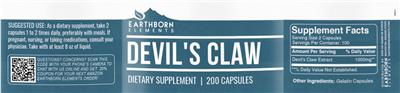
Suggested Use: As a dietary supplement, take 2 capsules 1 to 2 times daily, preferably with meals. Take with at least 8 oz of liquid.
Precautions
If pregnant, nursing, or taking medications, consult your physician.
General Statements
Questions? Concerns? Scan this code with your phone's camera to chat with us online and get 20% coupon for your next amazon earthborn elements order!
FDA Statement of Identity
Dietary Supplement
Is this label outdated? Report a formula or label change and our pharmacy team will review it.
Devil’s Claw by Earthborn Elements label
The label scan from the NIH Dietary Supplement Label Database. Tap to enlarge.
Label images are published by the NIH Dietary Supplement Label Database for the version of this product on file. Always read your actual product label.
View the full label (PDF)The Ingredients in Devil’s Claw by Earthborn Elements
This is the 1 active ingredient this product is made of. Select it to open its full monograph.
Serving size2 Capsule(s) Dosage formCapsule Servings per container100 Amounts shown are per serving.
Devil's Claw extract
Interacts with804 drugs
Devil's claw is a southern African plant used mainly for arthritis and back pain, and some studies suggest it may help ease these types of discomfort....
Devil's Claw extract monograph & interactionsOther (inactive) ingredients: Gelatin. These complete the product’s ingredient list but are not active constituents.
Devil’s Claw by Earthborn Elements Drug Interactions
HelloPharmacist Interaction Report
Devil's Claw by Earthborn Elements has documented interactions with medications.
The most serious concern is with blood thinners (anticoagulants) like warfarin — devil's claw may increase their effects, raising the risk of over-bleeding. In one case report, a patient on warfarin who also took devil's claw developed purpura (abnormal bruising), suggesting over-anticoagulation, though other factors may have contributed.
Read the full breakdown — every affected drug type, severity by severity
Devil's claw also affects how your body metabolizes several drug types. It may theoretically slow the breakdown of drugs processed by liver enzymes (CYP2C19, CYP2C9, and CYP3A4 substrates), potentially raising their levels — though this hasn't been observed in people, only in lab studies.
It may also affect P-glycoprotein substrates, which transport drugs out of cells.
Additionally, devil's claw increases stomach acid, which may reduce how well acid-reducing medications work — both H2-blockers and PPIs (proton pump inhibitors) could be affected.
Altogether, these interactions span 791 individual medications. Please check your exact medications with the tool on this page before starting devil's claw.
Check your own medications below · Editorial policy · How we use AI
Want to check YOUR meds against Devil’s Claw?
Ask about interactions with your drugs in plain English — “Can I take it with lisinopril?” — and we find you the answer in seconds, ingredient by ingredient.
Go to the checkerIngredients driving the most interactions
Individual Drug Interactions
The ingredients in Devil’s Claw interact with 804 drugs. Click any drug to see the details.
1 of the 1 ingredient in Devil’s Claw interact with drugs. Each result below shows which ingredient is responsible. Devil's Claw extract
Acetaminophen, Dextromethorphan, Guaifenesin, PhenylephrineConar-A
How Acetaminophen, Dextromethorphan, Guaifenesin, Phenylephrine interacts with Devil’s Claw — through 1 ingredient. Tap an ingredient for the detail:
Devil's Claw ExtractCytochrome P450 3a4 (cyp3a4) Substrates Moderate
Interaction Summary
Theoretically, devil's claw might increase levels of drugs metabolized by CYP3A4.
Read the full Devil's Claw Extract + Acetaminophen, Dextromethorphan, Guaifenesin, Phenylephrine interactionAcetaminophen, Dextromethorphan, Guaifenesin, PhenylpropanolamineAnatuss
How Acetaminophen, Dextromethorphan, Guaifenesin, Phenylpropanolamine interacts with Devil’s Claw — through 1 ingredient. Tap an ingredient for the detail:
Devil's Claw ExtractCytochrome P450 3a4 (cyp3a4) Substrates Moderate
Interaction Summary
Theoretically, devil's claw might increase levels of drugs metabolized by CYP3A4.
Read the full Devil's Claw Extract + Acetaminophen, Dextromethorphan, Guaifenesin, Phenylpropanolamine interactionAcetaminophen, Dextromethorphan, Guaifenesin, PseudoephedrineRobitussin Cold, Severe Cold, Suphedrine Cold/Cough
How Acetaminophen, Dextromethorphan, Guaifenesin, Pseudoephedrine interacts with Devil’s Claw — through 1 ingredient. Tap an ingredient for the detail:
Devil's Claw ExtractCytochrome P450 3a4 (cyp3a4) Substrates Moderate
Interaction Summary
Theoretically, devil's claw might increase levels of drugs metabolized by CYP3A4.
Read the full Devil's Claw Extract + Acetaminophen, Dextromethorphan, Guaifenesin, Pseudoephedrine interactionAcetaminophen, Dextromethorphan, Phenylpropanolamine, PyrilamineTheracaps
How Acetaminophen, Dextromethorphan, Phenylpropanolamine, Pyrilamine interacts with Devil’s Claw — through 1 ingredient. Tap an ingredient for the detail:
Devil's Claw ExtractCytochrome P450 3a4 (cyp3a4) Substrates Moderate
Interaction Summary
Theoretically, devil's claw might increase levels of drugs metabolized by CYP3A4.
Read the full Devil's Claw Extract + Acetaminophen, Dextromethorphan, Phenylpropanolamine, Pyrilamine interactionAcetaminophen, Dextromethorphan, PseudoephedrineAlka-Seltzer PLUS Flu Liquid Gels, Non Aspirin Cold Caps, Tylenol Cold, Tylenol Flu Daytime Ex Strength, Tylenol Flu Ex Strength
How Acetaminophen, Dextromethorphan, Pseudoephedrine interacts with Devil’s Claw — through 1 ingredient. Tap an ingredient for the detail:
Devil's Claw ExtractCytochrome P450 3a4 (cyp3a4) Substrates Moderate
Interaction Summary
Theoretically, devil's claw might increase levels of drugs metabolized by CYP3A4.
Read the full Devil's Claw Extract + Acetaminophen, Dextromethorphan, Pseudoephedrine interactionAcetaminophen, HydrocodoneAnexsia, Anodynos DHC, Azdone, Co-Gesic, Doucet, Lorcet +9 more
How Acetaminophen, Hydrocodone interacts with Devil’s Claw — through 1 ingredient. Tap an ingredient for the detail:
Devil's Claw ExtractCytochrome P450 3a4 (cyp3a4) Substrates Moderate
Interaction Summary
Theoretically, devil's claw might increase levels of drugs metabolized by CYP3A4.
Read the full Devil's Claw Extract + Acetaminophen, Hydrocodone interactionAcetaminophen, IbuprofenCombogesic
How Acetaminophen, Ibuprofen interacts with Devil’s Claw — through 1 ingredient. Tap an ingredient for the detail:
Devil's Claw ExtractCytochrome P450 2c9 (cyp2c9) Substrates Moderate
Interaction Summary
Theoretically, devil's claw might increase levels of drugs metabolized by CYP2C9.
Read the full Devil's Claw Extract + Acetaminophen, Ibuprofen interactionAcetaminophen, Phenylephrine, ChlorpheniramineSuper Cold Tabs
How Acetaminophen, Phenylephrine, Chlorpheniramine interacts with Devil’s Claw — through 1 ingredient. Tap an ingredient for the detail:
Devil's Claw ExtractCytochrome P450 3a4 (cyp3a4) Substrates Moderate
Interaction Summary
Theoretically, devil's claw might increase levels of drugs metabolized by CYP3A4.
Read the full Devil's Claw Extract + Acetaminophen, Phenylephrine, Chlorpheniramine interactionAdagrasibKrazati
How Adagrasib interacts with Devil’s Claw — through 1 ingredient. Tap an ingredient for the detail:
Devil's Claw ExtractCytochrome P450 3a4 (cyp3a4) Substrates Moderate
Interaction Summary
Theoretically, devil's claw might increase levels of drugs metabolized by CYP3A4.
Read the full Devil's Claw Extract + Adagrasib interactionAerosphere Budesonide, Formoterol Fumarate, GlycopyrrolateBreztri
How Aerosphere Budesonide, Formoterol Fumarate, Glycopyrrolate interacts with Devil’s Claw — through 1 ingredient. Tap an ingredient for the detail:
Devil's Claw ExtractCytochrome P450 2c19 (cyp2c19) Substrates, Cytochrome P450 2c9 (cyp2c9) Substrates Moderate
Interaction Summary
Theoretically, devil's claw might increase levels of drugs metabolized by CYP2C19.
Read the full Devil's Claw Extract + Aerosphere Budesonide, Formoterol Fumarate, Glycopyrrolate interactionAgomelatineValdoxan
How Agomelatine interacts with Devil’s Claw — through 1 ingredient. Tap an ingredient for the detail:
Devil's Claw ExtractCytochrome P450 2c19 (cyp2c19) Substrates, Cytochrome P450 2c9 (cyp2c9) Substrates Moderate
Interaction Summary
Theoretically, devil's claw might increase levels of drugs metabolized by CYP2C19.
Read the full Devil's Claw Extract + Agomelatine interactionAlfentanilAlfenta
How Alfentanil interacts with Devil’s Claw — through 1 ingredient. Tap an ingredient for the detail:
Devil's Claw ExtractCytochrome P450 3a4 (cyp3a4) Substrates Moderate
Interaction Summary
Theoretically, devil's claw might increase levels of drugs metabolized by CYP3A4.
Read the full Devil's Claw Extract + Alfentanil interactionAlfuzosinUroxatral
How Alfuzosin interacts with Devil’s Claw — through 1 ingredient. Tap an ingredient for the detail:
Devil's Claw ExtractCytochrome P450 3a4 (cyp3a4) Substrates Moderate
Interaction Summary
Theoretically, devil's claw might increase levels of drugs metabolized by CYP3A4.
Read the full Devil's Claw Extract + Alfuzosin interactionAliskirenTekturna
How Aliskiren interacts with Devil’s Claw — through 1 ingredient. Tap an ingredient for the detail:
Devil's Claw ExtractCytochrome P450 3a4 (cyp3a4) Substrates Moderate
Interaction Summary
Theoretically, devil's claw might increase levels of drugs metabolized by CYP3A4.
Read the full Devil's Claw Extract + Aliskiren interactionAlmotriptanAlmogran, Axert
How Almotriptan interacts with Devil’s Claw — through 1 ingredient. Tap an ingredient for the detail:
Devil's Claw ExtractCytochrome P450 3a4 (cyp3a4) Substrates Moderate
Interaction Summary
Theoretically, devil's claw might increase levels of drugs metabolized by CYP3A4.
Read the full Devil's Claw Extract + Almotriptan interactionAlogliptinNesina
How Alogliptin interacts with Devil’s Claw — through 1 ingredient. Tap an ingredient for the detail:
Devil's Claw ExtractCytochrome P450 3a4 (cyp3a4) Substrates Moderate
Interaction Summary
Theoretically, devil's claw might increase levels of drugs metabolized by CYP3A4.
Read the full Devil's Claw Extract + Alogliptin interactionAlogliptin, PioglitazoneOseni
How Alogliptin, Pioglitazone interacts with Devil’s Claw — through 1 ingredient. Tap an ingredient for the detail:
Devil's Claw ExtractCytochrome P450 3a4 (cyp3a4) Substrates Moderate
Interaction Summary
Theoretically, devil's claw might increase levels of drugs metabolized by CYP3A4.
Read the full Devil's Claw Extract + Alogliptin, Pioglitazone interactionAlpelisibPiqray
How Alpelisib interacts with Devil’s Claw — through 1 ingredient. Tap an ingredient for the detail:
Devil's Claw ExtractCytochrome P450 3a4 (cyp3a4) Substrates Moderate
Interaction Summary
Theoretically, devil's claw might increase levels of drugs metabolized by CYP3A4.
Read the full Devil's Claw Extract + Alpelisib interactionAlprazolamNiravam, Xanax
How Alprazolam interacts with Devil’s Claw — through 1 ingredient. Tap an ingredient for the detail:
Devil's Claw ExtractCytochrome P450 3a4 (cyp3a4) Substrates Moderate
Interaction Summary
Theoretically, devil's claw might increase levels of drugs metabolized by CYP3A4.
Read the full Devil's Claw Extract + Alprazolam interactionAmbrisentanLetairis, Volibris
How Ambrisentan interacts with Devil’s Claw — through 1 ingredient. Tap an ingredient for the detail:
Devil's Claw ExtractP-glycoprotein Substrates, Cytochrome P450 3a4 (cyp3a4) Substrates Moderate
Interaction Summary
Theoretically, devil's claw might increase levels of P-glycoprotein substrates.
Read the full Devil's Claw Extract + Ambrisentan interactionAmiodaroneCordarone, Pacerone
How Amiodarone interacts with Devil’s Claw — through 1 ingredient. Tap an ingredient for the detail:
Devil's Claw ExtractCytochrome P450 3a4 (cyp3a4) Substrates Moderate
Interaction Summary
Theoretically, devil's claw might increase levels of drugs metabolized by CYP3A4.
Read the full Devil's Claw Extract + Amiodarone interactionAmitriptylineElavil
How Amitriptyline interacts with Devil’s Claw — through 1 ingredient. Tap an ingredient for the detail:
Devil's Claw ExtractCytochrome P450 2c19 (cyp2c19) Substrates, Cytochrome P450 2c9 (cyp2c9) Substrates +1 Moderate
Interaction Summary
Theoretically, devil's claw might increase levels of drugs metabolized by CYP2C19.
Read the full Devil's Claw Extract + Amitriptyline interactionAmitriptyline, ChlordiazepoxideLimbitrol DS
How Amitriptyline, Chlordiazepoxide interacts with Devil’s Claw — through 1 ingredient. Tap an ingredient for the detail:
Devil's Claw ExtractCytochrome P450 3a4 (cyp3a4) Substrates, Cytochrome P450 2c19 (cyp2c19) Substrates +1 Moderate
Interaction Summary
Theoretically, devil's claw might increase levels of drugs metabolized by CYP3A4.
Read the full Devil's Claw Extract + Amitriptyline, Chlordiazepoxide interactionAmitriptyline, PerphenazineEtrafon, Etrafon-A, Etrafon-Forte, Triavil
How Amitriptyline, Perphenazine interacts with Devil’s Claw — through 1 ingredient. Tap an ingredient for the detail:
Devil's Claw ExtractCytochrome P450 2c19 (cyp2c19) Substrates, Cytochrome P450 2c9 (cyp2c9) Substrates +1 Moderate
Interaction Summary
Theoretically, devil's claw might increase levels of drugs metabolized by CYP2C19.
Read the full Devil's Claw Extract + Amitriptyline, Perphenazine interactionAmlodipineNorliqva
How Amlodipine interacts with Devil’s Claw — through 1 ingredient. Tap an ingredient for the detail:
Devil's Claw ExtractCytochrome P450 3a4 (cyp3a4) Substrates Moderate
Interaction Summary
Theoretically, devil's claw might increase levels of drugs metabolized by CYP3A4.
Read the full Devil's Claw Extract + Amlodipine interactionAmlodipine BenzoateKaterzia
How Amlodipine Benzoate interacts with Devil’s Claw — through 1 ingredient. Tap an ingredient for the detail:
Devil's Claw ExtractCytochrome P450 3a4 (cyp3a4) Substrates Moderate
Interaction Summary
Theoretically, devil's claw might increase levels of drugs metabolized by CYP3A4.
Read the full Devil's Claw Extract + Amlodipine Benzoate interactionAmlodipine BesilateIstin
How Amlodipine Besilate interacts with Devil’s Claw — through 1 ingredient. Tap an ingredient for the detail:
Devil's Claw ExtractCytochrome P450 3a4 (cyp3a4) Substrates Moderate
Interaction Summary
Theoretically, devil's claw might increase levels of drugs metabolized by CYP3A4.
Read the full Devil's Claw Extract + Amlodipine Besilate interactionAmlodipine BesylateNorvasc
How Amlodipine Besylate interacts with Devil’s Claw — through 1 ingredient. Tap an ingredient for the detail:
Devil's Claw ExtractCytochrome P450 3a4 (cyp3a4) Substrates Moderate
Interaction Summary
Theoretically, devil's claw might increase levels of drugs metabolized by CYP3A4.
Read the full Devil's Claw Extract + Amlodipine Besylate interactionAmlodipine Besylate, BenazeprilLotrel
How Amlodipine Besylate, Benazepril interacts with Devil’s Claw — through 1 ingredient. Tap an ingredient for the detail:
Devil's Claw ExtractCytochrome P450 3a4 (cyp3a4) Substrates Moderate
Interaction Summary
Theoretically, devil's claw might increase levels of drugs metabolized by CYP3A4.
Read the full Devil's Claw Extract + Amlodipine Besylate, Benazepril interactionAmlodipine, CelecoxibConsensi
How Amlodipine, Celecoxib interacts with Devil’s Claw — through 1 ingredient. Tap an ingredient for the detail:
Devil's Claw ExtractCytochrome P450 2c9 (cyp2c9) Substrates, Cytochrome P450 3a4 (cyp3a4) Substrates Moderate
Interaction Summary
Theoretically, devil's claw might increase levels of drugs metabolized by CYP2C9.
Read the full Devil's Claw Extract + Amlodipine, Celecoxib interactionEach ingredient & the kinds of drugs it affects
For each ingredient in Devil’s Claw with known interactions, here are the types of medications it can affect. Open any type for the detail — or search your exact drug in the checker above.
Devil's Claw extract
Cytochrome P450 2C19 (Cyp2C19) Substrates
Theoretically, devil's claw might increase levels of drugs metabolized by CYP2C19.
In vitro research shows that devil's claw might inhibit CYP2C19, although this has not been reported in humans.
Cytochrome P450 2C9 (Cyp2C9) Substrates
Theoretically, devil's claw might increase levels of drugs metabolized by CYP2C9.
In vitro research shows that devil's claw might inhibit CYP2C9, although this has not been reported in humans.
Cytochrome P450 3A4 (Cyp3A4) Substrates
Theoretically, devil's claw might increase levels of drugs metabolized by CYP3A4.
In vitro research shows that devil's claw might inhibit CYP3A4, although this has not been reported in humans.
Warfarin (Coumadin)
Theoretically, Devil's claw might increase the activity of warfarin.
In one case report, purpura occurred in a patient taking warfarin and devil's claw concurrently. This might indicate over-anticoagulation. It is unclear if this was due to Devil's claw or other contributing factors.
H2-Blockers
Theoretically, devil's claw might decrease the effectiveness of H2-blockers.
Devil's claw has been reported to increase stomach acid, which might interfere with the effects of H2-blockers.
P-Glycoprotein Substrates
Theoretically, devil's claw might increase levels of P-glycoprotein substrates.
In vitro research shows that devil's claw inhibits P-glycoprotein, which transports many drugs out of cells. This might increase intracellular levels of P-glycoprotein substrates, although it is unclear if this effect would be clinically important.
Proton Pump Inhibitors (Ppis)
Theoretically, devil's claw might decrease the effectiveness of PPIs.
Devil's claw has been reported to increase stomach acid, which might interfere with the effects of PPIs.
Brand information
Manufacturer and brand details for Devil’s Claw, from the product label.
Earthborn Elements
See all Earthborn Elements products- Name
- Earthborn Elements
- Street Address
- 9450 SW Gemini Dr #49936
- City
- Beaverton
- State
- Oregon
- ZipCode
- 97008
- Web Address
- Earthbornelements.com
Devil’s Claw by Earthborn Elements: Common Questions
Does Devil’s Claw by Earthborn Elements interact with any medications?
How can one product interact with so many drugs?
Where does this information come from?
Is devil's claw safe to take long-term?
Can I take this if I'm pregnant or breastfeeding?
What's the most common side effect?
Does devil's claw actually work for back pain?
Why can't I take this with my acid reflux medication?
Written and reviewed by the HelloPharmacist editorial staff. Our editorial policy
Not sure if Devil’s Claw is safe with your meds?
Our pharmacists answer your medication & supplement questions — free.
Label information is sourced from the NIH Dietary Supplement Label Database and reflects the product version on file; always read your actual product label. This page is for education only and is not a substitute for professional medical advice. Confirm with your pharmacist or doctor before combining supplements and medications.
The Full Monographs Behind Devil’s Claw’s Ingredients
Every ingredient we hold a full HelloPharmacist monograph for — uses, evidence, safety, and the complete interaction list.
Sources & How We Checked
Devil’s Claw's label data comes from the NIH Dietary Supplement Label Database; the ingredient interaction data is from the Natural Medicines database, reviewed by our pharmacists.
- NIH Dietary Supplement Label Database (DSLD) — The official product label on file for this supplement.
- Natural Medicines (Therapeutic Research Center) — Evidence-graded clinical reference behind the ingredient interaction data.
Content is written and reviewed by licensed HelloPharmacist pharmacists. See our data sources and editorial standards for how this information is built and checked.
The 18 references behind this product’s interaction data
Every citation that drives the interaction findings for this product’s ingredients, from the evidence-graded Natural Medicines (TRC Healthcare) database. Open an ingredient to browse its citations — links open the study on PubMed or the publisher’s site.
Devil's Claw 18 references
- Brinker F. Herb Contraindications and Drug Interactions. 2nd ed. Sandy, OR: Eclectic Medical Publications, 1998.
- Shaw D, Leon C, Kolev S, Murray V. Traditional remedies and food supplements: a 5-year toxicological study (1991-1995). Drug Saf 1997;17:342-56.
- Chantre P, Cappelaere A, Leblan D, et al. Efficacy and tolerance or Harpagophytum procumbens versus diacerhein in treatment of osteoarthritis. Phytomedicine 2000;7:177-83.
- Chrubasik S, Thanner J, Kunzel O, et al. Comparison of outcome measures during treatment with the proprietary Harpagophytum extract doloteffin in patients with pain in the lower back, knee or hip. Phytomedicine 2002;9:181-94. PubMed
- Circosta C, Occhiuto F, Ragusa S, et al. A drug used in traditional medicine: Harpagophytum procumbens DC. II. Cardiovascular activity. J Ethnopharmacol 1984;11:259-74. PubMed
- Grahame R, Robinson BV. Devils's claw (Harpagophytum procumbens): pharmacological and clinical studies. Ann Rheum Dis 1981;40:632. PubMed
- Unger M, Frank A. Simultaneous determination of the inhibitory potency of herbal extracts on the activity of six major cytochrome P450 enzymes using liquid chromatography/mass spectrometry and automated online extraction. Rapid Commun Mass Spectrom 2004;1 PubMed
- Wegener T, Lupke NP. Treatment of patients with arthrosis of hip or knee with an aqueous extract of devil's claw (Harpagophytum procumbens DC). Phytother Res 2003;17:1165-72.
- Chrubasik S, Kunzel O, Thanner J, et al. A 1-year follow-up after a pilot study with Doloteffin for low back pain. Phytomedicine 2005;12:1-9. PubMed
- Romiti N, Tramonti G, Corti A, Chieli E. Effects of Devil's Claw (Harpagophytum procumbens) on the multidrug transporter ABCB1/P-glycoprotein. Phytomedicine 2009;16:1095-100. PubMed
- Chrubasik, S., Junck, H., Breitschwerdt, H., Conradt, C., and Zappe, H. Effectiveness of Harpagophytum extract WS 1531 in the treatment of exacerbation of low back pain: a randomized, placebo-controlled, double- blind study. Eur.J Anaesthesiol. 1999;16(2 DOI
- Laudahn, D. and Walper, A. Efficacy and tolerance of Harpagophytum extract LI 174 in patients with chronic non-radicular back pain. Phytother.Res. 2001;15(7):621-624.
- Belaiche P. Etude clinique de 630 cas d'artrose traites par le nebulisat aqueux d'Harpagophytum procumbens (Radix). Phytotherapy 1982;1:22-28.
- Chrubasik S, Model A, Black A, and et al. A randomized double-blind pilot study comparing Doloteffin® and Vioxx® in the treatment of low back pain. Rheumatology 2003;42:141-148.
- Cuspidi C, Sala C, Tadic M, et al. Systemic hypertension induced by Harpagophytum procumbens (devil's claw): a case report. J Clin Hypertens (Greenwich) 2015;17(11):908-10.
- Mahomed IM, Ojewole JAO. Oxytocin-like effect of Harpagophytum procumbens [Pedaliacae] secondary root aqueous extract on rat isolated uterus. Afr J Trad CAM 2006;3(1):82-89.
- Carvalho RR, Donadel CD, Cortez AF, Valviesse VR, Vianna PF, Correa BB. J Bras Nefrol. 2017 Mar;39(1):79-81.
- Anon. Devil's claw root: ulcers and gastrointestinal bleeding. Prescrire Int 2013;22(144):296.
Parts of this content are provided by the Therapeutic Research Center, LLC.
DISCLAIMER: Currently this does not check for drug-drug interactions. This is not an all-inclusive comprehensive list of potential interactions and is for informational purposes only. Not all interactions are known or well-reported in the scientific literature, and new interactions are continually being reported. Input is needed from a qualified healthcare provider including a pharmacist before starting any therapy. Application of clinical judgment is necessary.
© 2021 Therapeutic Research Center, LLC