
Hormify Ingredients, Side Effects and Drug Interactions
by Hormify Dietary Supplement Capsule Botanical With Nutrients

Medically reviewed by Dr. Brian Staiger, PharmD, BCPS
Also reviewed by the HelloPharmacist Editorial Team
Updated Details about this page
- Label on file from the NIH Dietary Supplement Label Database, dated Jul 25, 2024.
- The interaction, evidence and safety records come from the Natural Medicines database, which we license, read against this label by our own system; the pharmacy team’s sections are written from those records.
- Dr. Brian Staiger, PharmD, BCPS, is a clinical pharmacist and pharmacotherapy specialist.
- Editorial policy Our sources
AI is used only to summarize verified clinical information, never the open internet. Our AI policy
Summary: The HelloPharmacist Team’s Take
- Form
- Capsule
- Serving Size
- 2 Capsules
- Servings
- 30 per container
- Container Holds
- 60 Capsules
What’s in it, whether it interacts with your drugs, its side effects, whether it works, and what our pharmacists would want you to know before you start it.
- What is Hormify?A supplement from Hormify with 23 active ingredients, in capsule form.
- Active Ingredients 6 vitamins, 1 mineral, 15 plant ingredients such as Bioperine, Epimedium and Tribulus terrestris and 1 amino acid: Vitamin A 50 mcgVitamin B1 1.25 mgVitamin B3 1 mg NEVitamin B6 3.8 mgVitamin B12 54 mcgVitamin B5 2.5 mgZinc 26 mgL-Arginine 100 mgBioperine 1000 mcgEpimediumTribulus terrestrisCatuaba, Powder 23 active ingredients. Each one can interact with drugs or cause side effects on its own, so we check every one. And 11 more, in the Supplement Facts
- Drug Interactions 1,766 drugs have a documented interaction with this supplement; the most serious is rated major. Of those, 1,262 are single drugs and 504 are combination products (two or more drugs in one), each listed under its own name. Based on the 21 of its 23 ingredients we could check. Ask your pharmacist first if you take a drug in any of these categories, the most serious of the 96 on record:
- Major · 9 drugs
- RetinoidsMajor · 9 drugs
- Major · 5 drugs
- Methyldopa (Aldomet)Major · 3 drugs
- Possible Side EffectsStomach upset 13 ingredientsNausea 10 ingredientsHeadache 8 ingredientsDiarrhea 5 ingredientsGas 4 ingredientsBloating 3 ingredients +41 moreCombined from 19 of its 23 active ingredients. Not studied in this exact product.
- Well documented Why
Does Hormify work?
Moderate This product doesn't appear to be marketed for a specific use, so we graded its ingredients' overall clinical evidence instead.It is not marketed for one specific use, so this is what its ingredients have been studied for, strongest research first:
- Vitamin A deficiency Vitamin A
- Vitamin B6 deficiency Vitamin B6
- Vitamin B12
- Pellagra Niacin
- Hyperhomocysteinemia Vitamin B6
- Vitamin A
These grades are for each ingredient, not this exact product, and never a promise it will work for you.
And 12 more graded uses, in what the research says- Low Why
- AllergensNone of its ingredient names point to a major food allergen, and the label text we have carries no allergen statement
Who Might Consider It
- People who want it for vitamin A deficiency, vitamin B6 deficiency, vitamin B12 deficiency, pellagra or another graded use: the uses with research behind them. See each grade
- Hormify may appeal to adults looking for a multi-ingredient vitamin and botanical formula, though many of its ingredients have limited evidence.
Who Should Be Careful
- If you take blood thinners, blood pressure or diabetes medicines, MAOIs, levodopa, warfarin, or thyroid hormone, or if you are pregnant, breastfeeding, or have liver or kidney conditions, be especially careful.
- Please talk it over with your own doctor or pharmacist before starting.
More Before You Take It Show the answerHide Pregnancy and Breastfeeding
-
Pregnant or breastfeeding?
- Pregnancy Zinc
- ! When used orally in doses exceeding the UL.
- Breastfeeding Zinc
- ! When used orally in doses exceeding the UL.
- Pregnancy Black Pepper
- ! When used orally in large amounts.
- Breastfeeding Black Pepper
- When used orally in amounts commonly found in foods.
- Pregnancy Cowhage
- ! Not enough safety data and its dopamine effects make it best avoided during pregnancy.
- Breastfeeding Cowhage
- Insufficient reliable information available; avoid using.
From the label dated Jul 25, 2024: 21 of its 23 active ingredients were checked against our records; the other two are not in them yet. A summary of what is known, not a grade or a test of the product. How these ratings are computed
Ask Anything About This Supplement
Name a drug you take, or ask about side effects, ingredients or pregnancy.
AI answers come from this label and our own records, never the open internet. AI can make mistakes, so always check with your doctor or pharmacist. How we use AI
Ask the Pharmacist
A licensed pharmacist will answer your question by email — free, as soon as they can.
Got it — thank you!
A licensed pharmacist will answer as soon as they can. Keep an eye on your email (worth checking spam, just in case).
What’s Inside Hormify
23 Active Ingredients, Each Checked on Its Own
A supplement is often several ingredients in one bottle, and each one can interact with drugs or cause side effects on its own. We check every one of them against our records.
- Vitamin ADrug interactions on record, most serious: Major
- Vitamin B1Not in our interaction records yet
- Vitamin B3Drug interactions on record, most serious: Moderate
- Vitamin B6Drug interactions on record, most serious: Moderate
- Vitamin B12No drug interactions on record
- Vitamin B5Not in our interaction records yet
- ZincDrug interactions on record, most serious: Moderate
- L-ArginineDrug interactions on record, most serious: Moderate
And 15 more, each with its own card below.
The label gives an exact amount for 9 of its 23 active ingredients. The other 14 are inside one proprietary blend, “Proprietary Blend”, and the label gives one total for it, not how much of each ingredient is in it.
- 9 state an exact amount
- 14 have no amount of their own
- Proprietary Blend 802 mg in total · 14 ingredients, no amount for each
This rates what the label tells you, not the quality of the product.
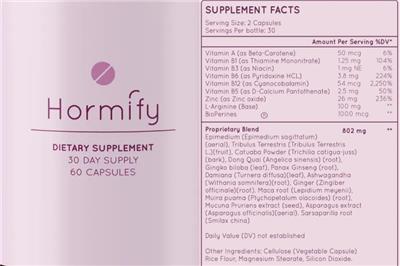
Supplement Facts
| Amount Per Serving | % Daily Value | |
|---|---|---|
| Vitamin A | 50 mcg | 6% |
| Vitamin B1 | 1.25 mg | 104% |
| Vitamin B3 | 1 mg NE | 6% |
| Vitamin B6 | 3.8 mg | 224% |
| Vitamin B12 | 54 mcg | 2250% |
| Vitamin B5 | 2.5 mg | 50% |
| Zinc | 26 mg | 236% |
| L-Arginine | 100 mg | † |
| Bioperine | 1000 mcg | † |
| Proprietary Blend | 802 mg | † |
| Epimedium | † | |
| Tribulus terrestris | † | |
| Catuaba, Powder | † | |
| Dong Quai | † | |
| Gingko biloba | † | |
| Panax ginseng | † | |
| Damiana | † | |
| Ashwagandha | † | |
| Ginger | † | |
| Maca | † | |
| Muira Puama | † | |
| Mucuna Pruriens Seed Extract | † | |
| Asparagus Aerial Extract | † | |
| Sarsaparilla | † | |
Other ingredients: Cellulose, Rice Flour, Magnesium Stearate, Silicon Dioxide
† Daily Value not established.
Daily Values for adults and children 4 or more years of age.
As the label prints it, from the NIH Dietary Supplement Label Database.
Each Ingredient and Its Drug Interactions
Tap one for more about it and its full guide. A drug can interact with this supplement through any one of them.
Hormify lists 23 ingredients, including vitamins B1, B3 (as niacin), B5, B6, B12, and A, zinc, and L-arginine, along with botanicals such as Panax ginseng, ashwagandha, ginkgo, ginger, maca, cowhage, dong quai, and black pepper extract (Bioperine).
- The vitamins and minerals are mainly used for deficiencies, while most of the botanicals are used for broader or less established purposes.
-
Vitamin A 50 mcg Interacts with 389 drugs
Form on the label: Beta-Carotene
Vitamin A is an essential nutrient important for vision, skin, immune function, and growth.
- Most people get enough from a balanced diet, and supplements are mainly useful for correcting a true deficiency.
- Because vitamin A is fat-soluble and can build up to harmful levels, more is not better, and high doses are especially risky in pregnancy.
The full Vitamin A guide: uses, dosage and safety Every Vitamin A drug interaction
-
Vitamin B1 1.25 mg We know this ingredient, but hold no drug interaction record for it yet, so it was not checked
Form on the label: Thiamine Mononitrate
-
Vitamin B3 1 mg NE Interacts with 729 drugs
Form on the label: Niacin
Niacin (vitamin B3) is an essential nutrient your body needs for energy and metabolism, and deficiency is uncommon in most developed countries.
- Prescription-strength niacin has been used to adjust cholesterol levels, but high doses can cause flushing and other side effects and should only be taken under medical supervision.
- Always talk with a pharmacist or doctor before using high-dose niacin supplements.
The full Niacin guide: uses, dosage and safety Every Niacin drug interaction
-
Vitamin B6 3.8 mg Interacts with 210 drugs
Form on the label: Pyridoxine Hydrochloride
Vitamin B6 (pyridoxine) is an essential water-soluble vitamin that your body needs for metabolism, brain function, and making red blood cells.
- It is best known for helping with pregnancy-related nausea and may help some people with PMS, but taking very high doses for long periods can cause nerve damage.
- Get most of your B6 from food, and check with a pharmacist or doctor before taking high-dose supplements.
The full Vitamin B6 guide: uses, dosage and safety Every Vitamin B6 drug interaction
-
Vitamin B12 54 mcg Interacts with 20 drugs
Form on the label: Cyanocobalamin
Vitamin B12 (cobalamin) is an essential nutrient your body needs to make red blood cells, keep nerves healthy, and support DNA.
- Supplements are very helpful for people who are deficient — such as vegans, older adults, and those with absorption problems — but taking extra B12 when you are not deficient is unlikely to boost energy or health.
- Talk to your pharmacist or doctor if you think you may be low.
The full Vitamin B12 guide: uses, dosage and safety Every Vitamin B12 drug interaction
-
Vitamin B5 2.5 mg We know this ingredient, but hold no drug interaction record for it yet, so it was not checked
Form on the label: D-Calcium Pantothenate
-
Zinc 26 mg Interacts with 67 drugs
Form on the label: Zinc Oxide
Zinc is an essential mineral that your body needs for immune function, wound healing, taste, and smell.
- Most people get enough from food, but supplements can help correct or prevent a deficiency.
- Taking too much zinc for too long can cause harm, so check with a pharmacist or doctor before using high-dose supplements.
The full Zinc guide: uses, dosage and safety Every Zinc drug interaction
-
L-Arginine 100 mg Interacts with 403 drugs
L-arginine is an amino acid that the body uses to make nitric oxide, a substance that helps blood vessels relax and widen.
- It is popularly used for blood pressure, erectile dysfunction, and exercise, but the evidence is mixed and stronger for some uses than others.
- It is generally well tolerated in healthy adults, but talk with a pharmacist or doctor before using it, especially if you have heart problems or take other medicines.
The full L-Arginine guide: uses, dosage and safety Every L-Arginine drug interaction
-
Bioperine 1000 mcg Interacts with 1,020 drugs
Black pepper is a common kitchen spice that is generally safe in the amounts used in food.
- Its extract, piperine, is mostly added to supplements to help the body absorb other ingredients (like curcumin from turmeric).
- Strong human evidence for black pepper treating specific health conditions is limited, so use supplement-strength products with care and check with your pharmacist.
The full Black Pepper guide: uses, dosage and safety Every Black Pepper drug interaction
-
Proprietary Blend 802 mg 14 ingredients inside it, each checked on its own
- Epimedium 965 drugs
- Tribulus terrestris 869 drugs
- Catuaba, Powder
- Dong Quai 163 drugs
- Gingko biloba 1,267 drugs
- Panax ginseng 1,132 drugs
- Damiana 86 drugs
- Ashwagandha 1,373 drugs
- Ginger 1,008 drugs
- Maca
- Muira Puama
- Mucuna Pruriens Seed Extract 193 drugs
- Asparagus Aerial Extract 76 drugs
- Sarsaparilla 2 drugs
Other Ingredients (Inactive)
The capsule or tablet itself, fillers, coatings and flavors. Not part of the drug interaction check; the allergen check below reads them.
- Cellulose
- Rice Flour
- Magnesium Stearate
- Silicon Dioxide
Allergens in Hormify
None of its ingredient names point to a major food allergen, and the label text we have carries no allergen statement.
Not named in the ingredients
- Milk
- Egg
- Fish
- Shellfish
- Tree nuts
- Peanuts
- Wheat or other gluten grains
- Soy
- Sesame
From the label text and ingredient names on file; we do not test products. With a serious allergy, check your bottle and ask the maker or your pharmacist.
What the Label Says
The maker’s own words, from the label. We do not verify or endorse them.
- FDA Statement of Identity
-
“Dietary Supplement”
- General statements
-
“30 Day Supply”
The Hormify Label on File
The label scan on file at the NIH Dietary Supplement Label Database, dated July 2024. Always read the label on the bottle you have.
Is this label outdated? Report a formula or label change and our pharmacy team will review it.
Hormify Side Effects
Why this rating?
We look for three kinds of safety information on each ingredient: side effects reported in studies, a pregnancy and breastfeeding rating, and a safety write-up from our pharmacy team. Of the 21 ingredients we could check, 19 have side-effect reports, all 21 have a pregnancy rating and all 21 have a safety write-up.
So this rates how much is known, not whether Hormify is right for you.
Reported with 21 of its ingredients
- Most often
- Stomach upset, nausea, headache, diarrhea, gas and bloating
- !Rare but serious
- Liver problems, possible changes in thyroid function and myopathy See details
HelloPharmacist Team Summary: Hormify Side Effects
Hormify is generally well tolerated, but the effects you are most likely to notice are digestive, such as upset stomach, nausea, bloating, gas, and heartburn, which have been reported with L-arginine, ginger, and zinc.
- You may also notice headache or drowsiness, and drowsiness has been reported with ashwagandha, so see how it affects you before driving.
- Rare but serious effects include liver problems (ashwagandha, niacin) and increased bleeding (ginkgo), and if either happens, call your doctor.
- If you are pregnant or breastfeeding, or you take blood thinners or blood pressure medicines, talk with your own doctor or pharmacist before starting.
Side Effects, Ingredient by Ingredient
A supplement’s side effects come from its ingredients. Here is what is reported with each one.
Niacin
Most reported
- Red
- Tingling
Vitamin B6
Most reported
- Abdominal pain
- Allergic reactions
- Headache
- Heartburn
- Loss of appetite
- Nausea
- Somnolence
- Vomiting
From the Natural Medicines database, which we license.
Every reported effect, in the Vitamin B6 guideZinc
Most reported
- Nausea
- Stomach upset
- Vomiting
- Metallic taste
L-Arginine
Most reported
- Stomach upset
- Bloating
- Nausea
- Diarrhea
Black Pepper
Most reported
- Burning aftertaste
- Dyspepsia
- Reduced taste perception
From the Natural Medicines database, which we license.
Every reported effect, in the Black Pepper guideHorny Goat Weed
Most reported
- Stomach upset
- Dry mouth
- Dizziness
- Nosebleed
Tribulus
Most reported
- Stomach upset
- Cramping
- Nausea
- Diarrhea
Catuaba
Most reported
- Stomach upset
- Nausea
- Headache
- Restlessness
Dong Quai
Most reported
- Burping
- Flatulence
From the Natural Medicines database, which we license.
Every reported effect, in the Dong Quai guideGinkgo
Most reported
- Headache
- Upset stomach or nausea
- Dizziness
- Constipation or diarrhea
Panax Ginseng
Most reported
- Headache
- Nervousness, restlessness, or feeling jittery
- Upset stomach, nausea, or diarrhea
- Changes in blood pressure
Damiana
Most reported
- Upset stomach
- Nausea
- Headache
Ashwagandha
Most reported
- Upset stomach, nausea, or diarrhea
- Drowsiness or sleepiness
- Headache
Ginger
Most reported
- Heartburn
- Stomach discomfort
- Gas
- Burping
Maca
Most reported
- Stomach upset
- Bloating
- Gas
- Changes in mood or sleep
Muira Puama
Most reported
- Stomach upset
- Headache
- Trouble sleeping
Cowhage
Most reported
- Nausea
- Vomiting
- Stomach upset
- Headache
Asparagus
Most reported
- Gas
- Bloating
- Stomach upset
Sarsaparilla
Most reported
- Stomach upset
- Digestive discomfort
Vitamin A and Vitamin B12 have side-effect reports, but no list of the most common ones. Read them in each guide: Vitamin A, Vitamin B12.
Hormify Warnings: Who Should Be Careful
Hormify has 23 active ingredients, and each can carry warnings of its own. We checked the 21 in our ingredient guides, and each warning below names the ingredient it comes from. Vitamin B1 and Vitamin B5 are not in our guides yet, so ask your pharmacist about them. If any of these apply to you, talk to your doctor or pharmacist before you start it.
- Vitamin A2 warnings below
- Niacin2 warnings below
- Vitamin B62 warnings below
- Vitamin B121 warning below
- Zinc2 warnings below
- L-Arginine3 warnings below
- Black Pepper2 warnings below
- Horny Goat Weed1 warning below
- Tribulus1 warning below
- Catuaba1 warning below
- Dong Quai3 warnings below
- Ginkgo2 warnings below
- Panax Ginseng1 warning below
- DamianaNo warnings in its guide
- Ashwagandha2 warnings below
- Ginger2 warnings below
- Maca3 warnings below
- Muira Puama2 warnings below
- Cowhage3 warnings below
- Asparagus3 warnings below
- Sarsaparilla2 warnings below
- Vitamin B1Not in our guides yet
- Vitamin B5Not in our guides yet
-
Bleeding Problems or Surgery
- Vitamin B12Older adults, people with stomach or bowel conditions, those who have had weight-loss or stomach surgery, and people on long-term acid-reducing medicines may absorb B12 poorly and should ask about testing.
- Horny Goat WeedPeople with heart conditions, low blood pressure, hormone-sensitive conditions, or bleeding problems should be especially cautious and check with a healthcare provider first.
- Dong QuaiDong Quai may increase the risk of bleeding, so people with bleeding disorders, those scheduled for surgery, or anyone taking blood thinners should be especially careful and talk to a doctor first.
- Dong QuaiIt may stimulate the uterus and affect bleeding, which could be harmful.
Show 2 more
- AshwagandhaPeople with autoimmune conditions or those scheduled for surgery should also check with their doctor first.
- GingerUse extra caution if you have a bleeding disorder or are scheduled for surgery, since ginger may slightly affect blood clotting.
-
Diabetes or Low Blood Sugar
- NiacinPeople with liver disease, stomach ulcers, gout, diabetes, low blood pressure, or a history of heart problems should be especially careful and talk to a healthcare provider first.
- TribulusPeople with hormone-sensitive conditions, prostate problems, diabetes, or kidney or liver disease should be cautious and talk to a healthcare provider first, since Tribulus may affect hormones and other body systems.
-
Blood Pressure
- L-ArginineBecause L-arginine can widen blood vessels and lower blood pressure, use caution if you already have low blood pressure.
- Muira PuamaPeople with heart conditions, high blood pressure, or other chronic illnesses should be cautious and check with a healthcare provider first.
- CowhageThis means it can affect blood pressure, mood, and the nervous system.
-
Liver Disease
- Vitamin APeople with liver disease, those who drink alcohol heavily, and people taking other vitamin A-related medicines should be especially careful and talk with a clinician first.
-
Kidney Disease or Kidney Stones
- Vitamin B6People with kidney problems or other chronic conditions should talk to a clinician before using supplements.
- AsparagusBecause asparagus may have a mild diuretic effect, people with kidney problems or those on fluid-restricted diets should be cautious with large medicinal amounts and check with their doctor.
- AsparagusPeople prone to kidney stones may also want to be careful, since asparagus contains compounds called purines.
- SarsaparillaPeople with kidney problems should be cautious, since the saponins may irritate the kidneys in large amounts.
-
Gallbladder Problems
- GingerPeople with gallstones should also check with a doctor, because ginger can increase the flow of bile.
-
Heart Conditions
- L-ArgininePeople with heart disease, especially those who have recently had a heart attack, should avoid using it unless a doctor recommends it, since some research suggested possible harm in that group.
- CowhagePeople with Parkinson's disease, psychiatric conditions, heart problems, or those already taking dopamine-related medicines should only use it under medical supervision.
-
Stomach or Bowel Problems
- ZincPeople with digestive disorders, those who drink heavily, and people on restrictive diets are more likely to be low in zinc and may need supplements.
- Black PepperPeople with stomach ulcers, acid reflux, or gut sensitivity may find that pepper worsens irritation.
-
Thyroid Conditions
- AshwagandhaUse caution if you have a thyroid condition, since ashwagandha may affect thyroid hormone levels.
- MacaPeople with hormone-sensitive conditions (such as certain breast, uterine, or prostate concerns) and those with thyroid problems should be cautious, because maca contains compounds called goitrogens that could affect the thyroid, especially in large amounts.
-
Hormone-Sensitive Conditions
- Dong QuaiAnyone with a hormone-sensitive condition should also check with their doctor before use.
-
Seizure Disorders
- GinkgoPeople with a history of seizures should be careful, as some reports suggest ginkgo could lower the seizure threshold, especially if a product is contaminated with ginkgo seeds.
-
Allergies
- AsparagusSome people are allergic to it and should avoid it.
-
Children
- CatuabaChildren should not use it.
- GinkgoNever eat raw or roasted ginkgo seeds (nuts), which can be toxic, especially in children.
- Panax GinsengGinseng is generally not recommended for children unless directed by a doctor.
- Muira PuamaChildren should also avoid it because it has not been studied in this group.
-
If You Take Other Drugs
- NiacinAlways check with a pharmacist or doctor before starting high-dose niacin, especially if you take other medicines or have a chronic health condition.
- Black PepperBecause piperine can increase absorption of medications and other supplements, anyone taking prescription drugs should talk to a pharmacist before using a piperine supplement.
- MacaAlways check with your pharmacist or doctor before starting maca, especially if you have a health condition or take medications.
- CowhageAlways talk with your pharmacist or doctor before starting cowhage, especially if you take any prescription medicines or have a chronic health condition.
- SarsaparillaIf you have any chronic health condition or take regular medications, check with your pharmacist or doctor before starting.
-
Other Cautions
- Vitamin AWhen in doubt, choose food sources and your prenatal vitamin, and check with a pharmacist or doctor.
- Vitamin B6Avoid high doses.
- ZincAnyone considering high-dose or long-term zinc should talk to a pharmacist or doctor first.
- L-ArgininePeople with herpes (cold sores or genital herpes) sometimes worry that arginine may trigger outbreaks; this is not well proven but worth discussing with your provider.
-
Pregnant or Breastfeeding
Each ingredient’s rating for pregnancy and for breastfeeding, and what it covers.
Pregnancy
-
When used orally and appropriately.
Zinc is safe in amounts that do not exceed the tolerable upper intake level (UL) of 34 mg daily during pregnancy in those 14-18 years of age and 40 mg daily in those 19-50 years of age.
-
When used orally in doses exceeding the UL.
Breastfeeding
-
When used orally and appropriately.
Zinc is safe in amounts that do not exceed the tolerable upper intake level (UL) of 34 mg daily during lactation in those 14-18 years of age, and 40 mg daily for those 19-50 years of age.
-
When used orally in doses exceeding the UL.
Higher doses can cause zinc-induced copper deficiency in nursing infants.
Pregnancy
-
When used orally in amounts commonly found in foods.
-
When used orally in large amounts.
Black pepper might have abortifacient effects; contraindicated.
There is insufficient reliable information available about the safety of topical pepper when used during pregnancy.
Breastfeeding
-
When used orally in amounts commonly found in foods.
There is insufficient reliable information available about the safety of black pepper when used in medicinal amounts during breast-feeding.
Show 19 more ingredients
Pregnancy
-
Not enough safety data and its dopamine effects make it best avoided during pregnancy.
Breastfeeding
-
Insufficient reliable information available; avoid using.
Pregnancy and Breastfeeding The record rates both the same
-
When used orally or intramuscularly and appropriately.
Vitamin A, as pre-formed vitamin A (retinol or retinyl ester), is safe during pregnancy and lactation when used in doses less than 10,000 IU (3000 mcg) per day in adults 19 years of age and older and 2800 mcg daily in those 14-18 years of age.
4 more points on this rating
- Vitamin A is available in two different forms: pre-formed vitamin A (retinol or retinyl ester) and provitamin A (carotenoids).
- The safety concerns associated with high vitamin A intake occur with pre-formed vitamin A only.
- Some supplements contain vitamin A in both pre-formed and provitamin A forms.
- For these supplements, the amount of pre-formed vitamin A should be used as the reference amount to determine safety.
-
When used orally or intramuscularly in excessive doses.
Daily intake of greater than 10,000 IU (3000 mcg) can cause fetal malformations.
4 more points on this rating
- Excessive dietary intake of vitamin A has also been associated with teratogenicity.
- The first trimester of pregnancy seems to be the critical period for susceptibility to vitamin A-associated birth defects such as craniofacial abnormalities and abnormalities of the central nervous system.
- Pregnant patients should monitor their intake of pre-formed vitamin A (retinol or retinyl ester).
- This form of vitamin A is found in several foods including animal products, particularly fish and animal liver, some fortified breakfast cereals, and dietary supplements.
Pregnancy
-
When used orally and appropriately.
A special sustained-release product providing vitamin B6 (pyridoxine) 75 mg daily is FDA-approved for use in pregnancy.
3 more points on this rating
- Vitamin B6 (pyridoxine) is also considered a first-line treatment for nausea and vomiting in pregnancy by the American College of Obstetrics and Gynecology.
- However, it should not be used long-term or without medical supervision and close monitoring.
- The tolerable upper intake level (UL) refers to vitamin B6 in the form of pyridoxine and is 80 mg daily for those aged 14-18 years and 100 mg daily for 19 years and older.
-
When used orally in excessive doses.
There is some concern that high-dose maternal vitamin B6 (pyridoxine) can cause neonatal seizures.
Breastfeeding
-
When used orally in doses not exceeding the tolerable upper intake level (UL) of vitamin B6 in the form of pyridoxine 80 mg daily for those aged 14-18 years and 100 mg daily for those 19 years and older.
The recommended dietary allowance (RDA) in lactating women is 2 mg daily.
There is insufficient reliable information available about the safety of vitamin B6 when used in higher doses in breast-feeding women.
Pregnancy
-
When used orally.
Horny goat weed might have androgenic activity.
Theoretically, it might harm a developing fetus; avoid using.
Breastfeeding
-
Insufficient reliable information available; avoid using.
Pregnancy
-
When used orally.
Animal research suggests that tribulus might adversely affect fetal development; avoid using.
Breastfeeding
-
Insufficient reliable information available; avoid using.
Pregnancy
-
When used orally.
Dong quai has uterine stimulant and relaxant effects; theoretically, it could adversely affect pregnancy.
Observational research has found that intake of An-Tai-Yin, an herbal combination product containing dong quai and parsley, during the first trimester is associated with an increased risk of congenital malformations of the musculoskeletal system, connective tissue, and eyes.
Breastfeeding
-
Insufficient reliable information available; avoid use.
Pregnancy
-
When used orally.
There is concern that ginkgo might have labor-inducing and hormonal effects.
2 more points on this rating
- There is also concern that the antiplatelet effects of ginkgo could prolong bleeding time if taken around the time of labor and delivery.
- Theoretically, ginkgo might adversely affect pregnancy outcome; avoid using during pregnancy.
Breastfeeding
-
Insufficient reliable information available; avoid using.
Pregnancy
-
When used orally.
Ginsenoside Rb1, an active constituent of Panax ginseng, has teratogenic effects in animal models; avoid using.
Breastfeeding
-
Insufficient reliable information available; avoid using.
Pregnancy
-
When used in amounts commonly found in foods.
-
When used in larger amounts for medicinal purposes.
Asparagus extracts may have contraceptive effects; avoid using.
Breastfeeding
-
When used in amounts commonly found in foods.
There is insufficient reliable information available about the safety of asparagus when used in medicinal amounts during lactation.
Pregnancy
-
When used orally and appropriately, short-term.
L-arginine 12 grams daily for 2 days has been used with apparent safety in pregnancy during the third trimester.
L-arginine 3 grams daily has been taken safely during the second and/or third trimesters.
1 more rating for L-Arginine used another way
This supplement is taken by mouth. This rating is for L-Arginine given another way.
-
When used intravenously and appropriately, short-term.
Intravenous L-arginine 20-30 grams daily has been used safely in pregnancy for up to 5 days.
Breastfeeding
-
Insufficient reliable information available; avoid using.
Pregnancy and Breastfeeding The record rates both the same
-
Insufficient reliable information available; avoid using.
Pregnancy and Breastfeeding The record rates both the same
-
Insufficient reliable information available; avoid using.
Pregnancy
-
There is insufficient reliable information available about the safety of oral ashwagandha when used during pregnancy.
Historically, ashwagandha has been linked to abortifacient effects; however, there are no reliable case reports of harm in pregnancy.
2 more points on this rating
- Although one clinical study in pregnant females in their second trimester reported no adverse events with use of ashwagandha 300 mg twice daily for 12 weeks, abortifacient activity, developmental outcomes, and fetal toxicity were not assessed.
- Until more is known about the safety of ashwagandha, avoid using during pregnancy.
Breastfeeding
-
Insufficient reliable information available; avoid using.
Pregnancy and Breastfeeding The record rates both the same
-
Insufficient reliable information available; avoid using.
Pregnancy and Breastfeeding The record rates both the same
-
Insufficient reliable information available; avoid using.
Pregnancy and Breastfeeding The record rates both the same
-
Insufficient reliable information available; avoid using.
Pregnancy and Breastfeeding The record rates both the same
-
When used orally in amounts that do not exceed the tolerable upper intake level (UL).
The UL of niacin during pregnancy and lactation is 30 mg daily for 14-18 years of age and 35 mg daily for 19 years and older.
There is insufficient reliable information available about the safety of larger oral doses of niacin during pregnancy or lactation; avoid using.
Pregnancy
-
When used orally in amounts that do not exceed the recommended dietary allowance (RDA).
The RDA for vitamin B12 during pregnancy is 2.6 mcg daily.
There is insufficient reliable information available about the safety of larger amounts of vitamin B12 during pregnancy.
Breastfeeding
-
When used orally in amounts that do not exceed the recommended dietary allowance (RDA).
The RDA of vitamin B12 during lactation is 2.8 mcg daily.
There is insufficient reliable information available about the safety of larger amounts of vitamin B12 while breastfeeding.
Pregnancy
-
When consumed in the amounts typically found in foods.
Ginger is considered a first-line nonpharmacological treatment option for nausea in pregnancy by the American College of Obstetrics and Gynecology (ACOG).
However, it should not be used long-term or without medical supervision and close monitoring.
-
When used for medicinal purposes.
Despite some early reports of adverse effects and one observational study suggesting that taking dried ginger and other herbal supplements during the first 20 weeks of pregnancy marginally increased the chance of stillbirth, most research shows that ginger is unlikely to cause harm to the baby.
3 more points on this rating
- The risk for major malformations in infants of parents who took ginger when pregnant does not appear to be higher than the baseline rate of 1% to 3%.
- Also, other research suggests that ginger intake during various trimesters does not significantly affect the risk of spontaneous abortion, congenital malformations, stillbirth, perinatal death, preterm birth, low birth weight, or low Apgar scores.
- Ginger use has been associated with an increase in non-severe vaginal bleeding, including spotting, after week 17 of pregnancy.
Breastfeeding
-
When consumed in the amounts typically found in foods.
There is insufficient reliable information available about the safety of ginger when used for medicinal purposes; avoid amounts greater than those found in foods.
Our pharmacy team’s notes
- Vitamin B12Vitamin B12 is rated likely safe in pregnancy and lactation.
- For pregnancy, ginkgo and dong quai are rated possibly unsafe, so they are best avoided.
Ratings and the words beside them are from the Natural Medicines database, which we license. Where it has no rating, the rating and note are our pharmacy team’s.
-
Rare but Serious Side Effects
-
!
Vitamin A
Very high single doses can cause more sudden symptoms like severe headache, blurred vision, and vomiting.
Orally: In very high doses, vitamin A can cause pseudotumor cerebri, pain, liver toxicity, coma, and even death.
-
!
Niacin
Higher doses can sometimes cause more serious problems, such as liver injury, increased blood sugar, gout flares, and changes in vision.
Orally: Hepatotoxicity, myopathy, thrombocytopenia, and vision changes.
-
!
Vitamin B6
Orally or by injection: Sensory neuropathy (high doses).
Orally: Liver cirrhosis, hepatocellular carcinoma (high doses of pyridoxal-5'-phosphate).
-
!
Vitamin B12
Serious allergic reactions are rare but possible; signs include rash, swelling, or trouble breathing, which need emergency care.
-
!
Zinc
Very high single doses can cause more serious stomach symptoms.
Orally: There have been cases of acute renal tubular necrosis, interstitial nephritis, neurological complications, severe vomiting, and sideroblastic anemia after zinc overdose.
-
!
L-Arginine
Allergic reactions are possible but uncommon.
-
!
Black Pepper
Orally: Allergic reaction in sensitive individuals.
-
!
Horny Goat Weed
Rare but more serious effects have been linked to large doses or long-term use, including rapid or irregular heartbeat, mood changes, or breathing problems.
Orally: Respiratory arrest.
-
!
Tribulus
More serious problems are rare but have been reported, including cases of liver injury and kidney issues with certain Tribulus-containing products.
Orally: Cases of liver and kidney injury, seizures, and chronic painful erection with impaired sexual function have been reported. Pneumothorax and bronchial polyp after consuming the spine-covered tribulus fruit have been reported.
-
!
Catuaba
Allergic reactions are always possible with plant products.
-
!
Dong Quai
Allergic reactions are possible, especially in people allergic to other plants in the carrot/celery family.
-
!
Ginkgo
More serious but rare concerns include increased bleeding or bruising.
Orally: Arrhythmia, bleeding, Stevens-Johnson syndrome.
-
!
Panax Ginseng
Rarely, more serious reactions such as allergic reactions can occur.
Orally: Anaphylaxis, arrhythmia, ischemia, Stevens-Johnson syndrome.
-
!
Damiana
There have been rare reports of more serious reactions, including seizures, with very large doses.
-
!
Ashwagandha
Rare but serious effects include liver problems and possible changes in thyroid function.
Orally: Some case reports raise concerns about acute hepatitis, acute liver failure, hepatic encephalopathy, the need for liver transplantation, and death due to liver failure with ashwagandha treatment.
-
!
Ginger
Rarely, some people may have an allergic reaction.
-
!
Maca
Serious side effects have not been commonly reported, but high-quality long-term safety data are limited.
-
!
Muira Puama
Muira puama has been used traditionally for a long time, and short-term use of typical supplement amounts has not been linked to serious problems in the limited reports available.
-
!
Cowhage
Higher doses may cause more serious effects such as abnormal movements, confusion, fast or irregular heartbeat, or agitation.
-
!
Asparagus
Allergic reactions can occur in sensitive people and may include itching, hives, or in rare cases more serious symptoms.
-
!
Sarsaparilla
As with any plant product, allergic reactions are possible.
-
!
Our pharmacy team on Hormify
Vitamin B6, zinc, niacin, and vitamin A are generally well tolerated at recommended amounts, but our pharmacists warn that high doses can cause harm, including nerve damage with vitamin B6, toxicity with vitamin A, and flushing and liver problems with niacin.
Ginkgo may increase bleeding risk, and ashwagandha has case reports of serious liver problems.
When to get help: a serious allergic reaction, with trouble breathing or swelling of the face, lips or throat, needs emergency care: call 911. For any other side effect that worries you, call your doctor or pharmacist.
These reports describe each ingredient, not studies of this exact product. Not medical advice: a side effect you notice after starting a supplement is worth a word with your pharmacist or doctor.
Hormify Drug Interactions
We checked all 23 active ingredients in this supplement against every drug in our records. A drug can interact with it through any one of them. Vitamin B1 and Vitamin B5 are not in our interaction records yet.
A major interaction on record
3 of 3, on a scale from Minor or none to Major.Why this rating?
We rate this by the most serious interaction on record, not by how many there are. For Tribulus, Asparagus, Ginkgo, Sarsaparilla and Horny Goat Weed, the most serious is rated major, which means the combination is best avoided, or used only under close supervision. Some involve kinds of drugs where a small change can matter, such as blood thinners, seizure drugs and transplant drugs.
1,767 drugs are on the full list. What matters is whether one you take is on it, so check yours with the interaction checker on this page.
18 of its 23 active ingredients have drug interactions on record. The ones below matter most.
- Interacts with
- 20 drugs
- Most serious
- Minor
- Metformin is the Minor-rated type linked to vitamin B12.
- Interacts with
- 193 drugs
- Most serious
- Major
- The most serious rating is Major: cowhage can increase the risk of hypertensive crisis, a dangerous spike in blood pressure, when combined with monoamine oxidase inhibitors (MAOIs).
- Interacts with
- 1,373 drugs
- Most serious
- Moderate
- Most of its records involve Cytochrome P450 3A4 (CYP3A4) Substrates, Hepatotoxic Drugs and CNS Depressants.
Show three more ingredients
- Interacts with
- 1,267 drugs
- Most serious
- Major
- Most of its records involve Cytochrome P450 3A4 (CYP3A4) Substrates, Seizure Threshold Lowering Drugs and P-glycoprotein Substrates.
- Interacts with
- 1,132 drugs
- Most serious
- Moderate
- Most of its records involve Cytochrome P450 3A4 (CYP3A4) Substrates, Cytochrome P450 2D6 (CYP2D6) Substrates and Stimulant Drugs.
- Interacts with
- 1,020 drugs
- Most serious
- Moderate
- Most of its records involve Cytochrome P450 3A4 (CYP3A4) Substrates, P-glycoprotein Substrates and Cytochrome P450 2D6 (CYP2D6) Substrates.
And twelve more ingredients with records, each in the cards below.
From the HelloPharmacist Team
Here is how the interactions add up across the whole label.
- Hormify, a 23-ingredient capsule, can interact with a broad range of medications through its vitamin B6, B12, A, and B3, zinc, L-arginine, Panax ginseng, ashwagandha, black pepper (Bioperine), ginkgo, ginger, cowhage (mucuna), dong quai, damiana, tribulus, asparagus, epimedium, and sarsaparilla content.
- Other Major-rated categories are retinoid drugs (vitamin A can build to excess levels), talinolol (ginkgo can raise its blood levels), methyldopa (cowhage can add to blood pressure lowering), levodopa (cowhage can increase levodopa side effects), and warfarin (dong quai can increase bleeding risk).
- Moderate-rated categories include blood pressure medicines, diabetes medicines, blood thinners and antiplatelet drugs, ACE inhibitors, ARBs, insulin, sildenafil, statins, benzodiazepines, thyroid hormone, lithium, digoxin, and several antibiotics.
Summarized by the HelloPharmacist pharmacy team from the interaction records below. How it is written How we use AI
Why Hormify Interacts, Ingredient by Ingredient
A product interacts through its ingredients. Each card: how many drugs, the most serious rating, and the kinds of drugs it affects most (tap a kind for what it means).
The ingredients driving the most interactions
-
Ashwagandha 1,373 drugs
Most serious: Moderate10 interaction records on file
The kinds of drugs it affects most
- 645 drugs
- 372 drugs
- 248 drugs
- 186 drugs
Every Ashwagandha drug interaction, 10 records The Ashwagandha records cite 32 references, listed in the Ashwagandha guide.
-
Gingko biloba 1,267 drugs
Most serious: Major23 interaction records on file
The kinds of drugs it affects most
- 645 drugs
- 418 drugs
- 202 drugs
- 186 drugs
Every Ginkgo drug interaction, 23 records The Ginkgo records cite 97 references, listed in the Ginkgo guide.
-
Panax ginseng 1,132 drugs
Most serious: Moderate20 interaction records on file
The kinds of drugs it affects most
- 645 drugs
- 193 drugs
- 172 drugs
- 161 drugs
Every Panax Ginseng drug interaction, 20 records The Panax Ginseng records cite 65 references, listed in the Panax Ginseng guide.
-
Bioperine 1,020 drugs
Most serious: Moderate17 interaction records on file
The kinds of drugs it affects most
- 645 drugs
- 202 drugs
- 193 drugs
- 186 drugs
Every Black Pepper drug interaction, 17 records The Black Pepper records cite 29 references, listed in the Black Pepper guide.
-
Ginger 1,008 drugs
Most serious: Moderate14 interaction records on file
The kinds of drugs it affects most
- 645 drugs
- 202 drugs
- 186 drugs
- 122 drugs
Every Ginger drug interaction, 14 records The Ginger records cite 65 references, listed in the Ginger guide.
-
Epimedium 965 drugs
Most serious: Moderate6 interaction records on file
The kinds of drugs it affects most
- 645 drugs
- 186 drugs
- 172 drugs
- 122 drugs
Every Horny Goat Weed drug interaction, 6 records The Horny Goat Weed records cite 11 references, listed in the Horny Goat Weed guide.
-
Tribulus terrestris 869 drugs
Most serious: Moderate5 interaction records on file
The kinds of drugs it affects most
- 645 drugs
- 172 drugs
- 86 drugs
- Atorvastatin (Lipitor) 3 drugs
Every Tribulus drug interaction, 5 records The Tribulus records cite 13 references, listed in the Tribulus guide.
-
Vitamin B3 729 drugs
Most serious: Moderate15 interaction records on file
The kinds of drugs it affects most
- 372 drugs
- 172 drugs
- 122 drugs
- 86 drugs
Every Niacin drug interaction, 15 records The Niacin records cite 66 references, listed in the Niacin guide.
-
L-Arginine 403 drugs
Most serious: Moderate9 interaction records on file
The kinds of drugs it affects most
- 172 drugs
- 122 drugs
- 86 drugs
- 23 drugs
Every L-Arginine drug interaction, 9 records The L-Arginine records cite 66 references, listed in the L-Arginine guide.
-
Vitamin A 389 drugs
Most serious: Major4 interaction records on file
The kinds of drugs it affects most
- 372 drugs
- 20 drugs
- Retinoids 9 drugs
- 2 drugs
Every Vitamin A drug interaction, 4 records The Vitamin A records cite 31 references, listed in the Vitamin A guide.
-
Vitamin B6 210 drugs
Most serious: Moderate5 interaction records on file
The kinds of drugs it affects most
- 172 drugs
- Phenobarbital (Luminal) 28 drugs
- Phenytoin (Dilantin) 5 drugs
- 5 drugs
Every Vitamin B6 drug interaction, 5 records The Vitamin B6 records cite 33 references, listed in the Vitamin B6 guide.
-
Mucuna Pruriens Seed Extract 193 drugs
Most serious: Major8 interaction records on file
The kinds of drugs it affects most
- 86 drugs
- 45 drugs
- Anesthesia 31 drugs
- 13 drugs
Every Cowhage drug interaction, 8 records The Cowhage records cite 12 references, listed in the Cowhage guide.
-
Dong Quai 163 drugs
Most serious: Major3 interaction records on file
The kinds of drugs it affects most
- 122 drugs
- 41 drugs
- 2 drugs
Every Dong Quai drug interaction, 3 records The Dong Quai records cite 19 references, listed in the Dong Quai guide.
-
Damiana 86 drugs
Most serious: Moderate1 interaction record on file
The kinds of drugs it affects most
- 86 drugs
Every Damiana drug interaction, 1 record The Damiana records cite 2 references, listed in the Damiana guide.
-
Asparagus Aerial Extract 76 drugs
Most serious: Moderate2 interaction records on file
The kinds of drugs it affects most
- 75 drugs
- 1 drug
Every Asparagus drug interaction, 2 records The Asparagus records cite 14 references, listed in the Asparagus guide.
-
Zinc 67 drugs
Most serious: Moderate10 interaction records on file
The kinds of drugs it affects most
- 21 drugs
- 20 drugs
- Bictegravir/Emtricitabine/Tenofovir Alafenamide (Biktarvy) 13 drugs
- Ritonavir (Norvir) 7 drugs
Every Zinc drug interaction, 10 records The Zinc records cite 88 references, listed in the Zinc guide.
-
Vitamin B12 20 drugs
Most serious: Minor1 interaction record on file
The kinds of drugs it affects most
- 20 drugs
Every Vitamin B12 drug interaction, 1 record The Vitamin B12 records cite 34 references, listed in the Vitamin B12 guide.
-
Sarsaparilla 2 drugs
Most serious: Moderate2 interaction records on file
The kinds of drugs it affects most
- 1 drug
- 1 drug
Every Sarsaparilla drug interaction, 2 records The Sarsaparilla records cite 3 references, listed in the Sarsaparilla guide.
The Breakdown by Severity
Each drug counted once, at its most serious rating. Tap a tile to list those drugs.
Find Your Drug
Type a drug or brand name to see whether it is on the list.
- Only drugs with a documented interaction are listed, the most serious first.
- A drug with no known interaction is not listed, but searching its name tells you so.
- Open a drug to see which ingredient is responsible. Of those, 1,262 are single drugs and 504 are combination products (two or more drugs in one), each listed under its own name.
-
Amoxicillin and Clavulanate PotassiumAugmentin, Augmentin '125/31 SF', Augmentin '250/62 SF', Augmentin XR, Augmentin-Duo 400/57 and 1 more Moderate
The 5 ingredients responsible:
-
Vitamin A Moderate Amoxicillin and Clavulanate Potassium is in the Hepatotoxic Drugs category.
Theoretically, taking high doses of vitamin A in combination with other potentially hepatotoxic drugs might increase the risk of liver disease.
The full Vitamin A + Amoxicillin and Clavulanate Potassium interaction -
Gingko Biloba Moderate Amoxicillin and Clavulanate Potassium is in the Seizure Threshold Lowering Drugs category.
Theoretically, taking ginkgo with drugs that lower the seizure threshold might increase the risk for convulsions.
The full Gingko Biloba + Amoxicillin and Clavulanate Potassium interaction -
Vitamin B3 Moderate Amoxicillin and Clavulanate Potassium is in the Hepatotoxic Drugs category.
Theoretically, concomitant use of niacin and hepatotoxic drugs might increase the risk of hepatotoxicity.
The full Vitamin B3 + Amoxicillin and Clavulanate Potassium interaction -
Ashwagandha Moderate Amoxicillin and Clavulanate Potassium is in the Hepatotoxic Drugs category.
Theoretically, taking ashwagandha with hepatotoxic drugs might increase the risk of liver damage.
The full Ashwagandha + Amoxicillin and Clavulanate Potassium interaction -
Bioperine Minor
Theoretically, black pepper might increase the effects and side effects of amoxicillin.
The full Bioperine + Amoxicillin and Clavulanate Potassium interaction
-
-
Hydrochlorothiazide and Losartan PotassiumHyzaar Moderate
The 11 ingredients responsible:
-
Epimedium Moderate Hydrochlorothiazide and Losartan Potassium is in these Antihypertensive Drugs, Cytochrome P450 3A4 (CYP3A4) Substrates categories.
Theoretically, horny goat weed might increase the risk of hypotension.
The full Epimedium + Hydrochlorothiazide and Losartan Potassium interaction -
Gingko Biloba Moderate Hydrochlorothiazide and Losartan Potassium is in the Cytochrome P450 3A4 (CYP3A4) Substrates category.
Theoretically, ginkgo might decrease levels of drugs metabolized by CYP3A4.
The full Gingko Biloba + Hydrochlorothiazide and Losartan Potassium interaction -
Ashwagandha Moderate Hydrochlorothiazide and Losartan Potassium is in these Antihypertensive Drugs, Cytochrome P450 3A4 (CYP3A4) Substrates categories.
Theoretically, taking ashwagandha with antihypertensive drugs might increase the risk of hypotension.
The full Ashwagandha + Hydrochlorothiazide and Losartan Potassium interaction -
Vitamin B6 Moderate Hydrochlorothiazide and Losartan Potassium is in the Antihypertensive Drugs category.
Theoretically, vitamin B6 may have additive effects when used with antihypertensive drugs.
The full Vitamin B6 + Hydrochlorothiazide and Losartan Potassium interaction -
Ginger Moderate It contains losartan, the drug this record is about. Hydrochlorothiazide and Losartan Potassium is in the Cytochrome P450 3A4 (CYP3A4) Substrates category.
Ginger might increase or decrease the levels of CYP3A4 substrates.
The full Ginger + Hydrochlorothiazide and Losartan Potassium interaction -
L-Arginine Moderate Hydrochlorothiazide and Losartan Potassium is in these Angiotensin Receptor Blockers (ARBs), Antihypertensive Drugs categories.
Theoretically, concomitant use of L-arginine and ARBs may increase the risk of hypotension and hyperkalemia.
The full L-Arginine + Hydrochlorothiazide and Losartan Potassium interaction -
Vitamin B3 Moderate Hydrochlorothiazide and Losartan Potassium is in the Antihypertensive Drugs category.
Theoretically, niacin may increase the risk of hypotension when used with antihypertensive drugs.
The full Vitamin B3 + Hydrochlorothiazide and Losartan Potassium interaction -
Bioperine Moderate Hydrochlorothiazide and Losartan Potassium is in the Cytochrome P450 3A4 (CYP3A4) Substrates category.
Theoretically, black pepper might increase levels of drugs metabolized by CYP3A4.
The full Bioperine + Hydrochlorothiazide and Losartan Potassium interaction
And through 3 more ingredients, each with its own page:
- Tribulus Terrestris Moderate
- Asparagus Aerial Extract Moderate
- Panax Ginseng Moderate
-
-
Aspirin, Calcium Carbonate, Magnesium Carbonate, and Magnesium OxideBufferin Moderate
The 8 ingredients responsible:
-
Bioperine Moderate Aspirin, Calcium Carbonate, Magnesium Carbonate, and Magnesium Oxide is in the Anticoagulant/Antiplatelet Drugs category.
Theoretically, black pepper might increase the risk of bleeding when taken with antiplatelet or anticoagulant drugs.
The full Bioperine + Aspirin, Calcium Carbonate, Magnesium Carbonate, and Magnesium Oxide interaction -
L-Arginine Moderate Aspirin, Calcium Carbonate, Magnesium Carbonate, and Magnesium Oxide is in the Anticoagulant/Antiplatelet Drugs category.
Theoretically, concomitant use of L-arginine with anticoagulant and antiplatelet drugs might have additive effects and increase the risk of bleeding.
The full L-Arginine + Aspirin, Calcium Carbonate, Magnesium Carbonate, and Magnesium Oxide interaction -
Vitamin B3 Moderate It contains aspirin, the drug this record is about. Aspirin, Calcium Carbonate, Magnesium Carbonate, and Magnesium Oxide is in the Anticoagulant/Antiplatelet Drugs category.
Large doses of aspirin might alter the clearance of niacin.
The full Vitamin B3 + Aspirin, Calcium Carbonate, Magnesium Carbonate, and Magnesium Oxide interaction -
Dong Quai Moderate Aspirin, Calcium Carbonate, Magnesium Carbonate, and Magnesium Oxide is in the Anticoagulant/Antiplatelet Drugs category.
Theoretically, dong quai may increase the risk of bleeding when used with anticoagulant or antiplatelet drugs; however, research is conflicting.
The full Dong Quai + Aspirin, Calcium Carbonate, Magnesium Carbonate, and Magnesium Oxide interaction -
Panax Ginseng Moderate Aspirin, Calcium Carbonate, Magnesium Carbonate, and Magnesium Oxide is in the Anticoagulant/Antiplatelet Drugs category.
Although Panax ginseng has shown antiplatelet effects in the laboratory, it is unlikely to increase the risk of bleeding if used with anticoagulant or antiplatelet drugs.
The full Panax Ginseng + Aspirin, Calcium Carbonate, Magnesium Carbonate, and Magnesium Oxide interaction -
Ginger Moderate Aspirin, Calcium Carbonate, Magnesium Carbonate, and Magnesium Oxide is in the Anticoagulant/Antiplatelet Drugs category.
Ginger may have antiplatelet effects and may increase the risk of bleeding if used with anticoagulant or antiplatelet drugs.
The full Ginger + Aspirin, Calcium Carbonate, Magnesium Carbonate, and Magnesium Oxide interaction -
Gingko Biloba Moderate Aspirin, Calcium Carbonate, Magnesium Carbonate, and Magnesium Oxide is in the Anticoagulant/Antiplatelet Drugs category.
Ginkgo has been shown to increase the risk of bleeding in some people when taken with warfarin.
The full Gingko Biloba + Aspirin, Calcium Carbonate, Magnesium Carbonate, and Magnesium Oxide interaction -
Epimedium Moderate Aspirin, Calcium Carbonate, Magnesium Carbonate, and Magnesium Oxide is in the Anticoagulant/Antiplatelet Drugs category.
Theoretically, horny goat weed might increase the risk of bleeding.
The full Epimedium + Aspirin, Calcium Carbonate, Magnesium Carbonate, and Magnesium Oxide interaction
-
-
Ibuprofen and AcetaminophenAdvil Dual Action Moderate
The 10 ingredients responsible:
-
Gingko Biloba Moderate Ibuprofen and Acetaminophen is in these Anticoagulant/Antiplatelet Drugs, Cytochrome P450 1A2 (CYP1A2) Substrates, Cytochrome P450 2C9 (CYP2C9) Substrates categories.
Ginkgo has been shown to increase the risk of bleeding in some people when taken with warfarin.
The full Gingko Biloba + Ibuprofen and Acetaminophen interaction -
Epimedium Moderate Ibuprofen and Acetaminophen is in these Anticoagulant/Antiplatelet Drugs, Cytochrome P450 1A2 (CYP1A2) Substrates categories.
Theoretically, horny goat weed might increase the risk of bleeding.
The full Epimedium + Ibuprofen and Acetaminophen interaction -
Ginger Moderate Ibuprofen and Acetaminophen is in these Cytochrome P450 2C9 (CYP2C9) Substrates, Anticoagulant/Antiplatelet Drugs, Cytochrome P450 1A2 (CYP1A2) Substrates categories.
Theoretically, ginger might increase the levels of CYP2C9 substrates.
The full Ginger + Ibuprofen and Acetaminophen interaction -
L-Arginine Moderate Ibuprofen and Acetaminophen is in the Anticoagulant/Antiplatelet Drugs category.
Theoretically, concomitant use of L-arginine with anticoagulant and antiplatelet drugs might have additive effects and increase the risk of bleeding.
The full L-Arginine + Ibuprofen and Acetaminophen interaction -
Bioperine Moderate Ibuprofen and Acetaminophen is in these Anticoagulant/Antiplatelet Drugs, Cytochrome P450 1A2 (CYP1A2) Substrates categories.
Theoretically, black pepper might increase the risk of bleeding when taken with antiplatelet or anticoagulant drugs.
The full Bioperine + Ibuprofen and Acetaminophen interaction -
Vitamin B3 Moderate Ibuprofen and Acetaminophen is in these Anticoagulant/Antiplatelet Drugs, Hepatotoxic Drugs categories.
Theoretically, niacin may have additive effects when used with anticoagulant or antiplatelet drugs.
The full Vitamin B3 + Ibuprofen and Acetaminophen interaction -
Dong Quai Moderate Ibuprofen and Acetaminophen is in the Anticoagulant/Antiplatelet Drugs category.
Theoretically, dong quai may increase the risk of bleeding when used with anticoagulant or antiplatelet drugs; however, research is conflicting.
The full Dong Quai + Ibuprofen and Acetaminophen interaction -
Panax Ginseng Moderate Ibuprofen and Acetaminophen is in the Anticoagulant/Antiplatelet Drugs category.
Although Panax ginseng has shown antiplatelet effects in the laboratory, it is unlikely to increase the risk of bleeding if used with anticoagulant or antiplatelet drugs.
The full Panax Ginseng + Ibuprofen and Acetaminophen interaction
And through 2 more ingredients, each with its own page:
- Vitamin A Moderate
- Ashwagandha Moderate
-
-
Acetaminophen and IbuprofenCombogesic Moderate
The 10 ingredients responsible:
-
Ashwagandha Moderate Acetaminophen and Ibuprofen is in these Hepatotoxic Drugs, Cytochrome P450 1A2 (CYP1A2) Substrates categories.
Theoretically, taking ashwagandha with hepatotoxic drugs might increase the risk of liver damage.
The full Ashwagandha + Acetaminophen and Ibuprofen interaction -
Gingko Biloba Moderate It contains ibuprofen, the drug this record is about. Acetaminophen and Ibuprofen is in these Cytochrome P450 1A2 (CYP1A2) Substrates, Cytochrome P450 2C9 (CYP2C9) Substrates, Anticoagulant/Antiplatelet Drugs categories.
Theoretically, ginkgo might increase levels of drugs metabolized by CYP1A2.
The full Gingko Biloba + Acetaminophen and Ibuprofen interaction -
Ginger Moderate Acetaminophen and Ibuprofen is in these Anticoagulant/Antiplatelet Drugs, Cytochrome P450 1A2 (CYP1A2) Substrates, Cytochrome P450 2C9 (CYP2C9) Substrates categories.
Ginger may have antiplatelet effects and may increase the risk of bleeding if used with anticoagulant or antiplatelet drugs.
The full Ginger + Acetaminophen and Ibuprofen interaction -
Panax Ginseng Moderate Acetaminophen and Ibuprofen is in the Anticoagulant/Antiplatelet Drugs category.
Although Panax ginseng has shown antiplatelet effects in the laboratory, it is unlikely to increase the risk of bleeding if used with anticoagulant or antiplatelet drugs.
The full Panax Ginseng + Acetaminophen and Ibuprofen interaction -
Vitamin A Moderate Acetaminophen and Ibuprofen is in the Hepatotoxic Drugs category.
Theoretically, taking high doses of vitamin A in combination with other potentially hepatotoxic drugs might increase the risk of liver disease.
The full Vitamin A + Acetaminophen and Ibuprofen interaction -
Epimedium Moderate Acetaminophen and Ibuprofen is in these Anticoagulant/Antiplatelet Drugs, Cytochrome P450 1A2 (CYP1A2) Substrates categories.
Theoretically, horny goat weed might increase the risk of bleeding.
The full Epimedium + Acetaminophen and Ibuprofen interaction -
Dong Quai Moderate Acetaminophen and Ibuprofen is in the Anticoagulant/Antiplatelet Drugs category.
Theoretically, dong quai may increase the risk of bleeding when used with anticoagulant or antiplatelet drugs; however, research is conflicting.
The full Dong Quai + Acetaminophen and Ibuprofen interaction -
Vitamin B3 Moderate Acetaminophen and Ibuprofen is in these Hepatotoxic Drugs, Anticoagulant/Antiplatelet Drugs categories.
Theoretically, concomitant use of niacin and hepatotoxic drugs might increase the risk of hepatotoxicity.
The full Vitamin B3 + Acetaminophen and Ibuprofen interaction
And through 2 more ingredients, each with its own page:
- Bioperine Moderate
- L-Arginine Moderate
-
-
Aluminum Hydroxide, Aspirin, and Magnesium HydroxideAscriptin Moderate
The 8 ingredients responsible:
-
Epimedium Moderate Aluminum Hydroxide, Aspirin, and Magnesium Hydroxide is in the Anticoagulant/Antiplatelet Drugs category.
Theoretically, horny goat weed might increase the risk of bleeding.
The full Epimedium + Aluminum Hydroxide, Aspirin, and Magnesium Hydroxide interaction -
Gingko Biloba Moderate Aluminum Hydroxide, Aspirin, and Magnesium Hydroxide is in the Anticoagulant/Antiplatelet Drugs category.
Ginkgo has been shown to increase the risk of bleeding in some people when taken with warfarin.
The full Gingko Biloba + Aluminum Hydroxide, Aspirin, and Magnesium Hydroxide interaction -
Ginger Moderate Aluminum Hydroxide, Aspirin, and Magnesium Hydroxide is in the Anticoagulant/Antiplatelet Drugs category.
Ginger may have antiplatelet effects and may increase the risk of bleeding if used with anticoagulant or antiplatelet drugs.
The full Ginger + Aluminum Hydroxide, Aspirin, and Magnesium Hydroxide interaction -
Bioperine Moderate Aluminum Hydroxide, Aspirin, and Magnesium Hydroxide is in the Anticoagulant/Antiplatelet Drugs category.
Theoretically, black pepper might increase the risk of bleeding when taken with antiplatelet or anticoagulant drugs.
The full Bioperine + Aluminum Hydroxide, Aspirin, and Magnesium Hydroxide interaction -
L-Arginine Moderate Aluminum Hydroxide, Aspirin, and Magnesium Hydroxide is in the Anticoagulant/Antiplatelet Drugs category.
Theoretically, concomitant use of L-arginine with anticoagulant and antiplatelet drugs might have additive effects and increase the risk of bleeding.
The full L-Arginine + Aluminum Hydroxide, Aspirin, and Magnesium Hydroxide interaction -
Panax Ginseng Moderate Aluminum Hydroxide, Aspirin, and Magnesium Hydroxide is in the Anticoagulant/Antiplatelet Drugs category.
Although Panax ginseng has shown antiplatelet effects in the laboratory, it is unlikely to increase the risk of bleeding if used with anticoagulant or antiplatelet drugs.
The full Panax Ginseng + Aluminum Hydroxide, Aspirin, and Magnesium Hydroxide interaction -
Vitamin B3 Moderate Aluminum Hydroxide, Aspirin, and Magnesium Hydroxide is in these Anticoagulant/Antiplatelet Drugs, Aspirin categories.
Theoretically, niacin may have additive effects when used with anticoagulant or antiplatelet drugs.
The full Vitamin B3 + Aluminum Hydroxide, Aspirin, and Magnesium Hydroxide interaction -
Dong Quai Moderate Aluminum Hydroxide, Aspirin, and Magnesium Hydroxide is in the Anticoagulant/Antiplatelet Drugs category.
Theoretically, dong quai may increase the risk of bleeding when used with anticoagulant or antiplatelet drugs; however, research is conflicting.
The full Dong Quai + Aluminum Hydroxide, Aspirin, and Magnesium Hydroxide interaction
-
-
Acetaminophen and AspirinGemnisyn Moderate
The 10 ingredients responsible:
-
Vitamin A Moderate Acetaminophen and Aspirin is in the Hepatotoxic Drugs category.
Theoretically, taking high doses of vitamin A in combination with other potentially hepatotoxic drugs might increase the risk of liver disease.
The full Vitamin A + Acetaminophen and Aspirin interaction -
Ginger Moderate Acetaminophen and Aspirin is in these Cytochrome P450 1A2 (CYP1A2) Substrates, Anticoagulant/Antiplatelet Drugs categories.
Theoretically, ginger might increase the levels of CYP1A2 substrates.
The full Ginger + Acetaminophen and Aspirin interaction -
Ashwagandha Moderate Acetaminophen and Aspirin is in these Cytochrome P450 1A2 (CYP1A2) Substrates, Hepatotoxic Drugs categories.
Theoretically, ashwagandha might decrease the levels and clinical effects of CYP1A2 substrates.
The full Ashwagandha + Acetaminophen and Aspirin interaction -
Epimedium Moderate Acetaminophen and Aspirin is in these Cytochrome P450 1A2 (CYP1A2) Substrates, Anticoagulant/Antiplatelet Drugs categories.
Theoretically, horny goat weed might increase the effects and side effects of CYP1A2 substrates.
The full Epimedium + Acetaminophen and Aspirin interaction -
Gingko Biloba Moderate Acetaminophen and Aspirin is in these Anticoagulant/Antiplatelet Drugs, Cytochrome P450 1A2 (CYP1A2) Substrates categories.
Ginkgo has been shown to increase the risk of bleeding in some people when taken with warfarin.
The full Gingko Biloba + Acetaminophen and Aspirin interaction -
Panax Ginseng Moderate Acetaminophen and Aspirin is in the Anticoagulant/Antiplatelet Drugs category.
Although Panax ginseng has shown antiplatelet effects in the laboratory, it is unlikely to increase the risk of bleeding if used with anticoagulant or antiplatelet drugs.
The full Panax Ginseng + Acetaminophen and Aspirin interaction -
Bioperine Moderate Acetaminophen and Aspirin is in these Cytochrome P450 1A2 (CYP1A2) Substrates, Anticoagulant/Antiplatelet Drugs categories.
Theoretically, black pepper might decrease levels and clinical effects of drugs metabolized by CYP1A2.
The full Bioperine + Acetaminophen and Aspirin interaction -
L-Arginine Moderate Acetaminophen and Aspirin is in the Anticoagulant/Antiplatelet Drugs category.
Theoretically, concomitant use of L-arginine with anticoagulant and antiplatelet drugs might have additive effects and increase the risk of bleeding.
The full L-Arginine + Acetaminophen and Aspirin interaction
And through 2 more ingredients, each with its own page:
- Vitamin B3 Moderate
- Dong Quai Moderate
-
-
Hydrochlorothiazide and LisinoprilPrinzide, Zestoretic Moderate
The 7 ingredients responsible:
-
L-Arginine Moderate Hydrochlorothiazide and Lisinopril is in these Antihypertensive Drugs, ACE Inhibitors (ACEIs) categories.
Theoretically, concomitant use of L-arginine and antihypertensive drugs may increase the risk of hypotension.
The full L-Arginine + Hydrochlorothiazide and Lisinopril interaction -
Vitamin B3 Moderate Hydrochlorothiazide and Lisinopril is in the Antihypertensive Drugs category.
Theoretically, niacin may increase the risk of hypotension when used with antihypertensive drugs.
The full Vitamin B3 + Hydrochlorothiazide and Lisinopril interaction -
Vitamin B6 Moderate Hydrochlorothiazide and Lisinopril is in the Antihypertensive Drugs category.
Theoretically, vitamin B6 may have additive effects when used with antihypertensive drugs.
The full Vitamin B6 + Hydrochlorothiazide and Lisinopril interaction -
Ashwagandha Moderate Hydrochlorothiazide and Lisinopril is in the Antihypertensive Drugs category.
Theoretically, taking ashwagandha with antihypertensive drugs might increase the risk of hypotension.
The full Ashwagandha + Hydrochlorothiazide and Lisinopril interaction -
Asparagus Aerial Extract Moderate Hydrochlorothiazide and Lisinopril is in the Diuretic Drugs category.
Theoretically, asparagus root might increase diuresis and electrolyte loss when used with diuretic drugs.
The full Asparagus Aerial Extract + Hydrochlorothiazide and Lisinopril interaction -
Tribulus Terrestris Moderate Hydrochlorothiazide and Lisinopril is in the Antihypertensive Drugs category.
Theoretically, taking tribulus with antihypertensive drugs might increase the risk of hypotension.
The full Tribulus Terrestris + Hydrochlorothiazide and Lisinopril interaction -
Epimedium Moderate Hydrochlorothiazide and Lisinopril is in the Antihypertensive Drugs category.
Theoretically, horny goat weed might increase the risk of hypotension.
The full Epimedium + Hydrochlorothiazide and Lisinopril interaction
-
-
Acetaminophen, Caffeine, and CodeineGesic C15, Gesic C30, Gesic C8, Lenoltec 1, Lenoltec 2 and 2 more Moderate
The 9 ingredients responsible:
-
Tribulus Terrestris Moderate Acetaminophen, Caffeine, and Codeine is in the Cytochrome P450 3A4 (CYP3A4) Substrates category.
Theoretically, tribulus can increase levels of drugs metabolized by CYP3A4.
The full Tribulus Terrestris + Acetaminophen, Caffeine, and Codeine interaction -
Gingko Biloba Moderate Acetaminophen, Caffeine, and Codeine is in these Cytochrome P450 1A2 (CYP1A2) Substrates, Seizure Threshold Lowering Drugs, Cytochrome P450 3A4 (CYP3A4) Substrates categories.
Theoretically, ginkgo might increase levels of drugs metabolized by CYP1A2.
The full Gingko Biloba + Acetaminophen, Caffeine, and Codeine interaction -
Ashwagandha Moderate Acetaminophen, Caffeine, and Codeine is in these CNS Depressants, Cytochrome P450 3A4 (CYP3A4) Substrates, Hepatotoxic Drugs and 1 more categories.
Theoretically, taking ashwagandha might increase the sedative effects of CNS depressants.
The full Ashwagandha + Acetaminophen, Caffeine, and Codeine interaction -
Vitamin B3 Moderate Acetaminophen, Caffeine, and Codeine is in the Hepatotoxic Drugs category.
Theoretically, concomitant use of niacin and hepatotoxic drugs might increase the risk of hepatotoxicity.
The full Vitamin B3 + Acetaminophen, Caffeine, and Codeine interaction -
Panax Ginseng Moderate Acetaminophen, Caffeine, and Codeine is in these Caffeine, Stimulant Drugs, Cytochrome P450 2D6 (CYP2D6) Substrates and 1 more categories.
Theoretically, taking Panax ginseng with caffeine might increase the risk of adverse stimulant effects.
The full Panax Ginseng + Acetaminophen, Caffeine, and Codeine interaction -
Bioperine Moderate Acetaminophen, Caffeine, and Codeine is in these Cytochrome P450 3A4 (CYP3A4) Substrates, Cytochrome P450 2D6 (CYP2D6) Substrates, Cytochrome P450 1A2 (CYP1A2) Substrates categories.
Theoretically, black pepper might increase levels of drugs metabolized by CYP3A4.
The full Bioperine + Acetaminophen, Caffeine, and Codeine interaction -
Epimedium Moderate Acetaminophen, Caffeine, and Codeine is in these Cytochrome P450 3A4 (CYP3A4) Substrates, Cytochrome P450 1A2 (CYP1A2) Substrates categories.
Theoretically, horny goat weed might increase the effects and side effects of CYP3A4 substrates.
The full Epimedium + Acetaminophen, Caffeine, and Codeine interaction -
Vitamin A Moderate Acetaminophen, Caffeine, and Codeine is in the Hepatotoxic Drugs category.
Theoretically, taking high doses of vitamin A in combination with other potentially hepatotoxic drugs might increase the risk of liver disease.
The full Vitamin A + Acetaminophen, Caffeine, and Codeine interaction
And through 1 more ingredient, each with its own page:
- Ginger Moderate
-
-
Acetaminophen, Chlorpheniramine, Dextromethorphan, and PseudoephedrineChildren's Tylenol Cold Plus Cough, Tylenol Cold Ex Strength Moderate
The 9 ingredients responsible:
-
Bioperine Moderate Acetaminophen, Chlorpheniramine, Dextromethorphan, and Pseudoephedrine is in these Cytochrome P450 1A2 (CYP1A2) Substrates, Cytochrome P450 3A4 (CYP3A4) Substrates, Cytochrome P450 2D6 (CYP2D6) Substrates categories.
Theoretically, black pepper might decrease levels and clinical effects of drugs metabolized by CYP1A2.
The full Bioperine + Acetaminophen, Chlorpheniramine, Dextromethorphan, and Pseudoephedrine interaction -
Tribulus Terrestris Moderate Acetaminophen, Chlorpheniramine, Dextromethorphan, and Pseudoephedrine is in the Cytochrome P450 3A4 (CYP3A4) Substrates category.
Theoretically, tribulus can increase levels of drugs metabolized by CYP3A4.
The full Tribulus Terrestris + Acetaminophen, Chlorpheniramine, Dextromethorphan, and Pseudoephedrine interaction -
Gingko Biloba Moderate Acetaminophen, Chlorpheniramine, Dextromethorphan, and Pseudoephedrine is in these Seizure Threshold Lowering Drugs, Cytochrome P450 1A2 (CYP1A2) Substrates, Cytochrome P450 3A4 (CYP3A4) Substrates categories.
Theoretically, taking ginkgo with drugs that lower the seizure threshold might increase the risk for convulsions.
The full Gingko Biloba + Acetaminophen, Chlorpheniramine, Dextromethorphan, and Pseudoephedrine interaction -
Panax Ginseng Moderate Acetaminophen, Chlorpheniramine, Dextromethorphan, and Pseudoephedrine is in these Stimulant Drugs, Cytochrome P450 3A4 (CYP3A4) Substrates, Cytochrome P450 2D6 (CYP2D6) Substrates categories.
Theoretically, taking Panax ginseng with stimulant drugs might increase the risk of adverse stimulant effects.
The full Panax Ginseng + Acetaminophen, Chlorpheniramine, Dextromethorphan, and Pseudoephedrine interaction -
Ginger Moderate Acetaminophen, Chlorpheniramine, Dextromethorphan, and Pseudoephedrine is in these Cytochrome P450 3A4 (CYP3A4) Substrates, Cytochrome P450 1A2 (CYP1A2) Substrates categories.
Ginger might increase or decrease the levels of CYP3A4 substrates.
The full Ginger + Acetaminophen, Chlorpheniramine, Dextromethorphan, and Pseudoephedrine interaction -
Vitamin A Moderate Acetaminophen, Chlorpheniramine, Dextromethorphan, and Pseudoephedrine is in the Hepatotoxic Drugs category.
Theoretically, taking high doses of vitamin A in combination with other potentially hepatotoxic drugs might increase the risk of liver disease.
The full Vitamin A + Acetaminophen, Chlorpheniramine, Dextromethorphan, and Pseudoephedrine interaction -
Vitamin B3 Moderate Acetaminophen, Chlorpheniramine, Dextromethorphan, and Pseudoephedrine is in the Hepatotoxic Drugs category.
Theoretically, concomitant use of niacin and hepatotoxic drugs might increase the risk of hepatotoxicity.
The full Vitamin B3 + Acetaminophen, Chlorpheniramine, Dextromethorphan, and Pseudoephedrine interaction -
Epimedium Moderate Acetaminophen, Chlorpheniramine, Dextromethorphan, and Pseudoephedrine is in these Cytochrome P450 3A4 (CYP3A4) Substrates, Cytochrome P450 1A2 (CYP1A2) Substrates categories.
Theoretically, horny goat weed might increase the effects and side effects of CYP3A4 substrates.
The full Epimedium + Acetaminophen, Chlorpheniramine, Dextromethorphan, and Pseudoephedrine interaction
And through 1 more ingredient, each with its own page:
- Ashwagandha Moderate
-
-
Aspirin, Citric Acid, and Sodium BicarbonateAlka-Seltzer Pain Reliever and Antacid Moderate
The 8 ingredients responsible:
-
Bioperine Moderate Aspirin, Citric Acid, and Sodium Bicarbonate is in the Anticoagulant/Antiplatelet Drugs category.
Theoretically, black pepper might increase the risk of bleeding when taken with antiplatelet or anticoagulant drugs.
The full Bioperine + Aspirin, Citric Acid, and Sodium Bicarbonate interaction -
L-Arginine Moderate Aspirin, Citric Acid, and Sodium Bicarbonate is in the Anticoagulant/Antiplatelet Drugs category.
Theoretically, concomitant use of L-arginine with anticoagulant and antiplatelet drugs might have additive effects and increase the risk of bleeding.
The full L-Arginine + Aspirin, Citric Acid, and Sodium Bicarbonate interaction -
Ginger Moderate Aspirin, Citric Acid, and Sodium Bicarbonate is in the Anticoagulant/Antiplatelet Drugs category.
Ginger may have antiplatelet effects and may increase the risk of bleeding if used with anticoagulant or antiplatelet drugs.
The full Ginger + Aspirin, Citric Acid, and Sodium Bicarbonate interaction -
Epimedium Moderate Aspirin, Citric Acid, and Sodium Bicarbonate is in the Anticoagulant/Antiplatelet Drugs category.
Theoretically, horny goat weed might increase the risk of bleeding.
The full Epimedium + Aspirin, Citric Acid, and Sodium Bicarbonate interaction -
Dong Quai Moderate Aspirin, Citric Acid, and Sodium Bicarbonate is in the Anticoagulant/Antiplatelet Drugs category.
Theoretically, dong quai may increase the risk of bleeding when used with anticoagulant or antiplatelet drugs; however, research is conflicting.
The full Dong Quai + Aspirin, Citric Acid, and Sodium Bicarbonate interaction -
Vitamin B3 Moderate It contains aspirin, the drug this record is about. Aspirin, Citric Acid, and Sodium Bicarbonate is in the Anticoagulant/Antiplatelet Drugs category.
Large doses of aspirin might alter the clearance of niacin.
The full Vitamin B3 + Aspirin, Citric Acid, and Sodium Bicarbonate interaction -
Panax Ginseng Moderate Aspirin, Citric Acid, and Sodium Bicarbonate is in the Anticoagulant/Antiplatelet Drugs category.
Although Panax ginseng has shown antiplatelet effects in the laboratory, it is unlikely to increase the risk of bleeding if used with anticoagulant or antiplatelet drugs.
The full Panax Ginseng + Aspirin, Citric Acid, and Sodium Bicarbonate interaction -
Gingko Biloba Moderate Aspirin, Citric Acid, and Sodium Bicarbonate is in the Anticoagulant/Antiplatelet Drugs category.
Ginkgo has been shown to increase the risk of bleeding in some people when taken with warfarin.
The full Gingko Biloba + Aspirin, Citric Acid, and Sodium Bicarbonate interaction
-
-
Aspirin, Caffeine, Phenacetin, and PropoxypheneMargesic Comp. 65 Moderate
The 11 ingredients responsible:
-
Panax Ginseng Moderate Aspirin, Caffeine, Phenacetin, and Propoxyphene is in these Cytochrome P450 3A4 (CYP3A4) Substrates, Cytochrome P450 2D6 (CYP2D6) Substrates, Anticoagulant/Antiplatelet Drugs and 2 more categories.
Theoretically, Panax ginseng might increase or decrease levels of drugs metabolized by CYP3A4.
The full Panax Ginseng + Aspirin, Caffeine, Phenacetin, and Propoxyphene interaction -
Vitamin B3 Moderate It contains aspirin, the drug this record is about. Aspirin, Caffeine, Phenacetin, and Propoxyphene is in these Anticoagulant/Antiplatelet Drugs, Hepatotoxic Drugs categories.
Large doses of aspirin might alter the clearance of niacin.
The full Vitamin B3 + Aspirin, Caffeine, Phenacetin, and Propoxyphene interaction -
Dong Quai Moderate Aspirin, Caffeine, Phenacetin, and Propoxyphene is in the Anticoagulant/Antiplatelet Drugs category.
Theoretically, dong quai may increase the risk of bleeding when used with anticoagulant or antiplatelet drugs; however, research is conflicting.
The full Dong Quai + Aspirin, Caffeine, Phenacetin, and Propoxyphene interaction -
Ashwagandha Moderate Aspirin, Caffeine, Phenacetin, and Propoxyphene is in these CNS Depressants, Cytochrome P450 1A2 (CYP1A2) Substrates, Cytochrome P450 3A4 (CYP3A4) Substrates and 1 more categories.
Theoretically, taking ashwagandha might increase the sedative effects of CNS depressants.
The full Ashwagandha + Aspirin, Caffeine, Phenacetin, and Propoxyphene interaction -
L-Arginine Moderate Aspirin, Caffeine, Phenacetin, and Propoxyphene is in the Anticoagulant/Antiplatelet Drugs category.
Theoretically, concomitant use of L-arginine with anticoagulant and antiplatelet drugs might have additive effects and increase the risk of bleeding.
The full L-Arginine + Aspirin, Caffeine, Phenacetin, and Propoxyphene interaction -
Bioperine Moderate Aspirin, Caffeine, Phenacetin, and Propoxyphene is in these Anticoagulant/Antiplatelet Drugs, Cytochrome P450 1A2 (CYP1A2) Substrates, Cytochrome P450 3A4 (CYP3A4) Substrates and 1 more categories.
Theoretically, black pepper might increase the risk of bleeding when taken with antiplatelet or anticoagulant drugs.
The full Bioperine + Aspirin, Caffeine, Phenacetin, and Propoxyphene interaction -
Ginger Moderate Aspirin, Caffeine, Phenacetin, and Propoxyphene is in these Cytochrome P450 1A2 (CYP1A2) Substrates, Anticoagulant/Antiplatelet Drugs, Cytochrome P450 3A4 (CYP3A4) Substrates categories.
Theoretically, ginger might increase the levels of CYP1A2 substrates.
The full Ginger + Aspirin, Caffeine, Phenacetin, and Propoxyphene interaction -
Vitamin A Moderate Aspirin, Caffeine, Phenacetin, and Propoxyphene is in the Hepatotoxic Drugs category.
Theoretically, taking high doses of vitamin A in combination with other potentially hepatotoxic drugs might increase the risk of liver disease.
The full Vitamin A + Aspirin, Caffeine, Phenacetin, and Propoxyphene interaction
And through 3 more ingredients, each with its own page:
- Epimedium Moderate
- Gingko Biloba Moderate
- Tribulus Terrestris Moderate
-
-
Aspirin and OmeprazoleYosprala Moderate
The 10 ingredients responsible:
-
Epimedium Moderate Aspirin and Omeprazole is in these Cytochrome P450 3A4 (CYP3A4) Substrates, Anticoagulant/Antiplatelet Drugs categories.
Theoretically, horny goat weed might increase the effects and side effects of CYP3A4 substrates.
The full Epimedium + Aspirin and Omeprazole interaction -
Gingko Biloba Moderate It contains omeprazole, the drug this record is about. Aspirin and Omeprazole is in these Cytochrome P450 2C19 (CYP2C19) Substrates, Cytochrome P450 3A4 (CYP3A4) Substrates, Anticoagulant/Antiplatelet Drugs and 1 more categories.
Theoretically, ginkgo might decrease levels of drugs metabolized by CYP2C19.
The full Gingko Biloba + Aspirin and Omeprazole interaction -
Tribulus Terrestris Moderate Aspirin and Omeprazole is in the Cytochrome P450 3A4 (CYP3A4) Substrates category.
Theoretically, tribulus can increase levels of drugs metabolized by CYP3A4.
The full Tribulus Terrestris + Aspirin and Omeprazole interaction -
Ginger Moderate Aspirin and Omeprazole is in these Cytochrome P450 2C9 (CYP2C9) Substrates, Anticoagulant/Antiplatelet Drugs, Cytochrome P450 3A4 (CYP3A4) Substrates categories.
Theoretically, ginger might increase the levels of CYP2C9 substrates.
The full Ginger + Aspirin and Omeprazole interaction -
Bioperine Moderate Aspirin and Omeprazole is in these Anticoagulant/Antiplatelet Drugs, Cytochrome P450 3A4 (CYP3A4) Substrates categories.
Theoretically, black pepper might increase the risk of bleeding when taken with antiplatelet or anticoagulant drugs.
The full Bioperine + Aspirin and Omeprazole interaction -
L-Arginine Moderate Aspirin and Omeprazole is in the Anticoagulant/Antiplatelet Drugs category.
Theoretically, concomitant use of L-arginine with anticoagulant and antiplatelet drugs might have additive effects and increase the risk of bleeding.
The full L-Arginine + Aspirin and Omeprazole interaction -
Vitamin B3 Moderate Aspirin and Omeprazole is in the Anticoagulant/Antiplatelet Drugs category.
Theoretically, niacin may have additive effects when used with anticoagulant or antiplatelet drugs.
The full Vitamin B3 + Aspirin and Omeprazole interaction -
Dong Quai Moderate Aspirin and Omeprazole is in the Anticoagulant/Antiplatelet Drugs category.
Theoretically, dong quai may increase the risk of bleeding when used with anticoagulant or antiplatelet drugs; however, research is conflicting.
The full Dong Quai + Aspirin and Omeprazole interaction
And through 2 more ingredients, each with its own page:
- Panax Ginseng Moderate
- Ashwagandha Minor
-
-
Telmisartan and AmlodipineTwynsta Moderate
The 10 ingredients responsible:
-
Epimedium Moderate Telmisartan and Amlodipine is in these Antihypertensive Drugs, Cytochrome P450 3A4 (CYP3A4) Substrates categories.
Theoretically, horny goat weed might increase the risk of hypotension.
The full Epimedium + Telmisartan and Amlodipine interaction -
Gingko Biloba Moderate Telmisartan and Amlodipine is in the Cytochrome P450 3A4 (CYP3A4) Substrates category.
Theoretically, ginkgo might decrease levels of drugs metabolized by CYP3A4.
The full Gingko Biloba + Telmisartan and Amlodipine interaction -
L-Arginine Moderate Telmisartan and Amlodipine is in these Antihypertensive Drugs, Angiotensin Receptor Blockers (ARBs) categories.
Theoretically, concomitant use of L-arginine and antihypertensive drugs may increase the risk of hypotension.
The full L-Arginine + Telmisartan and Amlodipine interaction -
Bioperine Moderate Telmisartan and Amlodipine is in the Cytochrome P450 3A4 (CYP3A4) Substrates category.
Theoretically, black pepper might increase levels of drugs metabolized by CYP3A4.
The full Bioperine + Telmisartan and Amlodipine interaction -
Vitamin B3 Moderate Telmisartan and Amlodipine is in the Antihypertensive Drugs category.
Theoretically, niacin may increase the risk of hypotension when used with antihypertensive drugs.
The full Vitamin B3 + Telmisartan and Amlodipine interaction -
Panax Ginseng Moderate Telmisartan and Amlodipine is in the Cytochrome P450 3A4 (CYP3A4) Substrates category.
Theoretically, Panax ginseng might increase or decrease levels of drugs metabolized by CYP3A4.
The full Panax Ginseng + Telmisartan and Amlodipine interaction -
Ashwagandha Moderate Telmisartan and Amlodipine is in these Cytochrome P450 3A4 (CYP3A4) Substrates, Antihypertensive Drugs categories.
Theoretically, ashwagandha might decrease the levels and clinical effects of CYP3A4 substrates.
The full Ashwagandha + Telmisartan and Amlodipine interaction -
Ginger Moderate Telmisartan and Amlodipine is in these Cytochrome P450 3A4 (CYP3A4) Substrates, Calcium Channel Blockers categories.
Ginger might increase or decrease the levels of CYP3A4 substrates.
The full Ginger + Telmisartan and Amlodipine interaction
And through 2 more ingredients, each with its own page:
- Tribulus Terrestris Moderate
- Vitamin B6 Moderate
-
-
Dapagliflozin, Metformin Hydrochloride, and Saxagliptin HydrochlorideQternmet XR Moderate
The 12 ingredients responsible:
-
L-Arginine Moderate Dapagliflozin, Metformin Hydrochloride, and Saxagliptin Hydrochloride is in the Antidiabetes Drugs category.
Theoretically, concomitant use of L-arginine might have additive effects with antidiabetes drugs.
The full L-Arginine + Dapagliflozin, Metformin Hydrochloride, and Saxagliptin Hydrochloride interaction -
Bioperine Moderate Dapagliflozin, Metformin Hydrochloride, and Saxagliptin Hydrochloride is in these Cytochrome P450 3A4 (CYP3A4) Substrates, Antidiabetes Drugs categories.
Theoretically, black pepper might increase levels of drugs metabolized by CYP3A4.
The full Bioperine + Dapagliflozin, Metformin Hydrochloride, and Saxagliptin Hydrochloride interaction -
Damiana Moderate Dapagliflozin, Metformin Hydrochloride, and Saxagliptin Hydrochloride is in the Antidiabetes Drugs category.
Theoretically, taking damiana with antidiabetes drugs might increase the risk of hypoglycemia.
The full Damiana + Dapagliflozin, Metformin Hydrochloride, and Saxagliptin Hydrochloride interaction -
Epimedium Moderate Dapagliflozin, Metformin Hydrochloride, and Saxagliptin Hydrochloride is in the Cytochrome P450 3A4 (CYP3A4) Substrates category.
Theoretically, horny goat weed might increase the effects and side effects of CYP3A4 substrates.
The full Epimedium + Dapagliflozin, Metformin Hydrochloride, and Saxagliptin Hydrochloride interaction -
Mucuna Pruriens Seed Extract Moderate Dapagliflozin, Metformin Hydrochloride, and Saxagliptin Hydrochloride is in the Antidiabetes Drugs category.
Theoretically, concomitant use of cowhage and antidiabetes drugs might increase the risk of hypoglycemia.
The full Mucuna Pruriens Seed Extract + Dapagliflozin, Metformin Hydrochloride, and Saxagliptin Hydrochloride interaction -
Panax Ginseng Moderate Dapagliflozin, Metformin Hydrochloride, and Saxagliptin Hydrochloride is in these Cytochrome P450 3A4 (CYP3A4) Substrates, Antidiabetes Drugs categories.
Theoretically, Panax ginseng might increase or decrease levels of drugs metabolized by CYP3A4.
The full Panax Ginseng + Dapagliflozin, Metformin Hydrochloride, and Saxagliptin Hydrochloride interaction -
Ashwagandha Moderate Dapagliflozin, Metformin Hydrochloride, and Saxagliptin Hydrochloride is in these Antidiabetes Drugs, Cytochrome P450 3A4 (CYP3A4) Substrates categories.
Theoretically, taking ashwagandha with antidiabetes drugs might increase the risk of hypoglycemia.
The full Ashwagandha + Dapagliflozin, Metformin Hydrochloride, and Saxagliptin Hydrochloride interaction -
Tribulus Terrestris Moderate Dapagliflozin, Metformin Hydrochloride, and Saxagliptin Hydrochloride is in these Antidiabetes Drugs, Cytochrome P450 3A4 (CYP3A4) Substrates categories.
Taking tribulus with antidiabetes drugs might increase the risk of hypoglycemia.
The full Tribulus Terrestris + Dapagliflozin, Metformin Hydrochloride, and Saxagliptin Hydrochloride interaction
And through 4 more ingredients, each with its own page:
- Ginger Moderate
- Vitamin B3 Moderate
- Gingko Biloba Moderate
- Vitamin B12 Minor
-
-
Sacubitril and ValsartanEntresto Moderate
The 9 ingredients responsible:
-
Asparagus Aerial Extract Moderate Sacubitril and Valsartan is in the Diuretic Drugs category.
Theoretically, asparagus root might increase diuresis and electrolyte loss when used with diuretic drugs.
The full Asparagus Aerial Extract + Sacubitril and Valsartan interaction -
Tribulus Terrestris Moderate Sacubitril and Valsartan is in the Antihypertensive Drugs category.
Theoretically, taking tribulus with antihypertensive drugs might increase the risk of hypotension.
The full Tribulus Terrestris + Sacubitril and Valsartan interaction -
Vitamin B6 Moderate Sacubitril and Valsartan is in the Antihypertensive Drugs category.
Theoretically, vitamin B6 may have additive effects when used with antihypertensive drugs.
The full Vitamin B6 + Sacubitril and Valsartan interaction -
Vitamin B3 Moderate Sacubitril and Valsartan is in the Antihypertensive Drugs category.
Theoretically, niacin may increase the risk of hypotension when used with antihypertensive drugs.
The full Vitamin B3 + Sacubitril and Valsartan interaction -
Ashwagandha Moderate Sacubitril and Valsartan is in the Antihypertensive Drugs category.
Theoretically, taking ashwagandha with antihypertensive drugs might increase the risk of hypotension.
The full Ashwagandha + Sacubitril and Valsartan interaction -
Gingko Biloba Moderate Sacubitril and Valsartan is in the Cytochrome P450 2C9 (CYP2C9) Substrates category.
Theoretically, ginkgo might increase levels of drugs metabolized by CYP2C9.
The full Gingko Biloba + Sacubitril and Valsartan interaction -
Epimedium Moderate Sacubitril and Valsartan is in the Antihypertensive Drugs category.
Theoretically, horny goat weed might increase the risk of hypotension.
The full Epimedium + Sacubitril and Valsartan interaction -
L-Arginine Moderate Sacubitril and Valsartan is in these Angiotensin Receptor Blockers (ARBs), Antihypertensive Drugs, Potassium-sparing Diuretics categories.
Theoretically, concomitant use of L-arginine and ARBs may increase the risk of hypotension and hyperkalemia.
The full L-Arginine + Sacubitril and Valsartan interaction
And through 1 more ingredient, each with its own page:
- Ginger Minor
-
-
Acetaminophen, Butalbital, and CaffeineEsgic, Esgic Plus, Fiogesic, Fioricet, Repan and 2 more Moderate
The 9 ingredients responsible:
-
Ashwagandha Moderate Acetaminophen, Butalbital, and Caffeine is in these Cytochrome P450 1A2 (CYP1A2) Substrates, Hepatotoxic Drugs, Cytochrome P450 3A4 (CYP3A4) Substrates categories.
Theoretically, ashwagandha might decrease the levels and clinical effects of CYP1A2 substrates.
The full Ashwagandha + Acetaminophen, Butalbital, and Caffeine interaction -
Vitamin A Moderate Acetaminophen, Butalbital, and Caffeine is in the Hepatotoxic Drugs category.
Theoretically, taking high doses of vitamin A in combination with other potentially hepatotoxic drugs might increase the risk of liver disease.
The full Vitamin A + Acetaminophen, Butalbital, and Caffeine interaction -
Ginger Moderate Acetaminophen, Butalbital, and Caffeine is in these Cytochrome P450 1A2 (CYP1A2) Substrates, Cytochrome P450 3A4 (CYP3A4) Substrates categories.
Theoretically, ginger might increase the levels of CYP1A2 substrates.
The full Ginger + Acetaminophen, Butalbital, and Caffeine interaction -
Gingko Biloba Moderate Acetaminophen, Butalbital, and Caffeine is in these Cytochrome P450 1A2 (CYP1A2) Substrates, Cytochrome P450 3A4 (CYP3A4) Substrates categories.
Theoretically, ginkgo might increase levels of drugs metabolized by CYP1A2.
The full Gingko Biloba + Acetaminophen, Butalbital, and Caffeine interaction -
Tribulus Terrestris Moderate Acetaminophen, Butalbital, and Caffeine is in the Cytochrome P450 3A4 (CYP3A4) Substrates category.
Theoretically, tribulus can increase levels of drugs metabolized by CYP3A4.
The full Tribulus Terrestris + Acetaminophen, Butalbital, and Caffeine interaction -
Epimedium Moderate Acetaminophen, Butalbital, and Caffeine is in these Cytochrome P450 1A2 (CYP1A2) Substrates, Cytochrome P450 3A4 (CYP3A4) Substrates categories.
Theoretically, horny goat weed might increase the effects and side effects of CYP1A2 substrates.
The full Epimedium + Acetaminophen, Butalbital, and Caffeine interaction -
Panax Ginseng Moderate Acetaminophen, Butalbital, and Caffeine is in these Stimulant Drugs, Caffeine, Cytochrome P450 3A4 (CYP3A4) Substrates categories.
Theoretically, taking Panax ginseng with stimulant drugs might increase the risk of adverse stimulant effects.
The full Panax Ginseng + Acetaminophen, Butalbital, and Caffeine interaction -
Bioperine Moderate Acetaminophen, Butalbital, and Caffeine is in these Cytochrome P450 1A2 (CYP1A2) Substrates, Cytochrome P450 3A4 (CYP3A4) Substrates categories.
Theoretically, black pepper might decrease levels and clinical effects of drugs metabolized by CYP1A2.
The full Bioperine + Acetaminophen, Butalbital, and Caffeine interaction
And through 1 more ingredient, each with its own page:
- Vitamin B3 Moderate
-
-
Acetaminophen, Caffeine, Chlorpheniramine, Hydrocodone, and PhenylephrineHycomine Compound Moderate
The 9 ingredients responsible:
-
Panax Ginseng Moderate Acetaminophen, Caffeine, Chlorpheniramine, Hydrocodone, and Phenylephrine is in these Cytochrome P450 2D6 (CYP2D6) Substrates, Stimulant Drugs, Cytochrome P450 3A4 (CYP3A4) Substrates and 1 more categories.
Theoretically, Panax ginseng might increase levels of drugs metabolized by CYP2D6.
The full Panax Ginseng + Acetaminophen, Caffeine, Chlorpheniramine, Hydrocodone, and Phenylephrine interaction -
Ashwagandha Moderate Acetaminophen, Caffeine, Chlorpheniramine, Hydrocodone, and Phenylephrine is in these Cytochrome P450 1A2 (CYP1A2) Substrates, Hepatotoxic Drugs, Cytochrome P450 3A4 (CYP3A4) Substrates and 1 more categories.
Theoretically, ashwagandha might decrease the levels and clinical effects of CYP1A2 substrates.
The full Ashwagandha + Acetaminophen, Caffeine, Chlorpheniramine, Hydrocodone, and Phenylephrine interaction -
Bioperine Moderate Acetaminophen, Caffeine, Chlorpheniramine, Hydrocodone, and Phenylephrine is in these Cytochrome P450 2D6 (CYP2D6) Substrates, Cytochrome P450 3A4 (CYP3A4) Substrates, Cytochrome P450 1A2 (CYP1A2) Substrates categories.
Theoretically, black pepper might increase levels of drugs metabolized by CYP2D6.
The full Bioperine + Acetaminophen, Caffeine, Chlorpheniramine, Hydrocodone, and Phenylephrine interaction -
Epimedium Moderate Acetaminophen, Caffeine, Chlorpheniramine, Hydrocodone, and Phenylephrine is in these Cytochrome P450 3A4 (CYP3A4) Substrates, Cytochrome P450 1A2 (CYP1A2) Substrates categories.
Theoretically, horny goat weed might increase the effects and side effects of CYP3A4 substrates.
The full Epimedium + Acetaminophen, Caffeine, Chlorpheniramine, Hydrocodone, and Phenylephrine interaction -
Vitamin B3 Moderate Acetaminophen, Caffeine, Chlorpheniramine, Hydrocodone, and Phenylephrine is in the Hepatotoxic Drugs category.
Theoretically, concomitant use of niacin and hepatotoxic drugs might increase the risk of hepatotoxicity.
The full Vitamin B3 + Acetaminophen, Caffeine, Chlorpheniramine, Hydrocodone, and Phenylephrine interaction -
Gingko Biloba Moderate Acetaminophen, Caffeine, Chlorpheniramine, Hydrocodone, and Phenylephrine is in these Cytochrome P450 3A4 (CYP3A4) Substrates, Seizure Threshold Lowering Drugs, Cytochrome P450 1A2 (CYP1A2) Substrates categories.
Theoretically, ginkgo might decrease levels of drugs metabolized by CYP3A4.
The full Gingko Biloba + Acetaminophen, Caffeine, Chlorpheniramine, Hydrocodone, and Phenylephrine interaction -
Ginger Moderate Acetaminophen, Caffeine, Chlorpheniramine, Hydrocodone, and Phenylephrine is in these Cytochrome P450 3A4 (CYP3A4) Substrates, Cytochrome P450 1A2 (CYP1A2) Substrates categories.
Ginger might increase or decrease the levels of CYP3A4 substrates.
The full Ginger + Acetaminophen, Caffeine, Chlorpheniramine, Hydrocodone, and Phenylephrine interaction -
Vitamin A Moderate Acetaminophen, Caffeine, Chlorpheniramine, Hydrocodone, and Phenylephrine is in the Hepatotoxic Drugs category.
Theoretically, taking high doses of vitamin A in combination with other potentially hepatotoxic drugs might increase the risk of liver disease.
The full Vitamin A + Acetaminophen, Caffeine, Chlorpheniramine, Hydrocodone, and Phenylephrine interaction
And through 1 more ingredient, each with its own page:
- Tribulus Terrestris Moderate
-
-
Acetaminophen and CodeineTylenol No.3, Tylenol w/ Codeine Moderate
The 8 ingredients responsible:
-
Ashwagandha Moderate Acetaminophen and Codeine is in these CNS Depressants, Cytochrome P450 1A2 (CYP1A2) Substrates, Hepatotoxic Drugs categories.
Theoretically, taking ashwagandha might increase the sedative effects of CNS depressants.
The full Ashwagandha + Acetaminophen and Codeine interaction -
Vitamin B3 Moderate Acetaminophen and Codeine is in the Hepatotoxic Drugs category.
Theoretically, concomitant use of niacin and hepatotoxic drugs might increase the risk of hepatotoxicity.
The full Vitamin B3 + Acetaminophen and Codeine interaction -
Panax Ginseng Moderate Acetaminophen and Codeine is in the Cytochrome P450 2D6 (CYP2D6) Substrates category.
Theoretically, Panax ginseng might increase levels of drugs metabolized by CYP2D6.
The full Panax Ginseng + Acetaminophen and Codeine interaction -
Vitamin A Moderate Acetaminophen and Codeine is in the Hepatotoxic Drugs category.
Theoretically, taking high doses of vitamin A in combination with other potentially hepatotoxic drugs might increase the risk of liver disease.
The full Vitamin A + Acetaminophen and Codeine interaction -
Epimedium Moderate Acetaminophen and Codeine is in the Cytochrome P450 1A2 (CYP1A2) Substrates category.
Theoretically, horny goat weed might increase the effects and side effects of CYP1A2 substrates.
The full Epimedium + Acetaminophen and Codeine interaction -
Bioperine Moderate Acetaminophen and Codeine is in these Cytochrome P450 1A2 (CYP1A2) Substrates, Cytochrome P450 2D6 (CYP2D6) Substrates categories.
Theoretically, black pepper might decrease levels and clinical effects of drugs metabolized by CYP1A2.
The full Bioperine + Acetaminophen and Codeine interaction -
Gingko Biloba Moderate Acetaminophen and Codeine is in these Seizure Threshold Lowering Drugs, Cytochrome P450 1A2 (CYP1A2) Substrates categories.
Theoretically, taking ginkgo with drugs that lower the seizure threshold might increase the risk for convulsions.
The full Gingko Biloba + Acetaminophen and Codeine interaction -
Ginger Minor Acetaminophen and Codeine is in the Cytochrome P450 1A2 (CYP1A2) Substrates category.
Theoretically, ginger might increase the levels of CYP1A2 substrates.
The full Ginger + Acetaminophen and Codeine interaction
-
-
Progestin and Oral ContraceptiveSlynd Moderate
The 7 ingredients responsible:
-
Tribulus Terrestris Moderate Progestin and Oral Contraceptive is in the Cytochrome P450 3A4 (CYP3A4) Substrates category.
Theoretically, tribulus can increase levels of drugs metabolized by CYP3A4.
The full Tribulus Terrestris + Progestin and Oral Contraceptive interaction -
Gingko Biloba Moderate Progestin and Oral Contraceptive is in the Cytochrome P450 3A4 (CYP3A4) Substrates category.
Theoretically, ginkgo might decrease levels of drugs metabolized by CYP3A4.
The full Gingko Biloba + Progestin and Oral Contraceptive interaction -
Ginger Moderate Progestin and Oral Contraceptive is in the Cytochrome P450 3A4 (CYP3A4) Substrates category.
Ginger might increase or decrease the levels of CYP3A4 substrates.
The full Ginger + Progestin and Oral Contraceptive interaction -
Epimedium Moderate Progestin and Oral Contraceptive is in the Cytochrome P450 3A4 (CYP3A4) Substrates category.
Theoretically, horny goat weed might increase the effects and side effects of CYP3A4 substrates.
The full Epimedium + Progestin and Oral Contraceptive interaction -
Panax Ginseng Moderate Progestin and Oral Contraceptive is in the Cytochrome P450 3A4 (CYP3A4) Substrates category.
Theoretically, Panax ginseng might increase or decrease levels of drugs metabolized by CYP3A4.
The full Panax Ginseng + Progestin and Oral Contraceptive interaction -
Bioperine Moderate Progestin and Oral Contraceptive is in the Cytochrome P450 3A4 (CYP3A4) Substrates category.
Theoretically, black pepper might increase levels of drugs metabolized by CYP3A4.
The full Bioperine + Progestin and Oral Contraceptive interaction -
Ashwagandha Minor Progestin and Oral Contraceptive is in the Cytochrome P450 3A4 (CYP3A4) Substrates category.
Theoretically, ashwagandha might decrease the levels and clinical effects of CYP3A4 substrates.
The full Ashwagandha + Progestin and Oral Contraceptive interaction
-
-
Acetaminophen, Dextromethorphan, Doxylamine, and PseudoephedrineVicks NyQuil Moderate
The 9 ingredients responsible:
-
Vitamin B3 Moderate Acetaminophen, Dextromethorphan, Doxylamine, and Pseudoephedrine is in the Hepatotoxic Drugs category.
Theoretically, concomitant use of niacin and hepatotoxic drugs might increase the risk of hepatotoxicity.
The full Vitamin B3 + Acetaminophen, Dextromethorphan, Doxylamine, and Pseudoephedrine interaction -
Ginger Moderate Acetaminophen, Dextromethorphan, Doxylamine, and Pseudoephedrine is in these Cytochrome P450 1A2 (CYP1A2) Substrates, Cytochrome P450 3A4 (CYP3A4) Substrates categories.
Theoretically, ginger might increase the levels of CYP1A2 substrates.
The full Ginger + Acetaminophen, Dextromethorphan, Doxylamine, and Pseudoephedrine interaction -
Vitamin A Moderate Acetaminophen, Dextromethorphan, Doxylamine, and Pseudoephedrine is in the Hepatotoxic Drugs category.
Theoretically, taking high doses of vitamin A in combination with other potentially hepatotoxic drugs might increase the risk of liver disease.
The full Vitamin A + Acetaminophen, Dextromethorphan, Doxylamine, and Pseudoephedrine interaction -
Epimedium Moderate Acetaminophen, Dextromethorphan, Doxylamine, and Pseudoephedrine is in these Cytochrome P450 1A2 (CYP1A2) Substrates, Cytochrome P450 3A4 (CYP3A4) Substrates categories.
Theoretically, horny goat weed might increase the effects and side effects of CYP1A2 substrates.
The full Epimedium + Acetaminophen, Dextromethorphan, Doxylamine, and Pseudoephedrine interaction -
Bioperine Moderate Acetaminophen, Dextromethorphan, Doxylamine, and Pseudoephedrine is in these Cytochrome P450 2D6 (CYP2D6) Substrates, Cytochrome P450 1A2 (CYP1A2) Substrates, Cytochrome P450 3A4 (CYP3A4) Substrates categories.
Theoretically, black pepper might increase levels of drugs metabolized by CYP2D6.
The full Bioperine + Acetaminophen, Dextromethorphan, Doxylamine, and Pseudoephedrine interaction -
Gingko Biloba Moderate Acetaminophen, Dextromethorphan, Doxylamine, and Pseudoephedrine is in these Seizure Threshold Lowering Drugs, Cytochrome P450 3A4 (CYP3A4) Substrates, Cytochrome P450 1A2 (CYP1A2) Substrates categories.
Theoretically, taking ginkgo with drugs that lower the seizure threshold might increase the risk for convulsions.
The full Gingko Biloba + Acetaminophen, Dextromethorphan, Doxylamine, and Pseudoephedrine interaction -
Tribulus Terrestris Moderate Acetaminophen, Dextromethorphan, Doxylamine, and Pseudoephedrine is in the Cytochrome P450 3A4 (CYP3A4) Substrates category.
Theoretically, tribulus can increase levels of drugs metabolized by CYP3A4.
The full Tribulus Terrestris + Acetaminophen, Dextromethorphan, Doxylamine, and Pseudoephedrine interaction -
Ashwagandha Moderate Acetaminophen, Dextromethorphan, Doxylamine, and Pseudoephedrine is in these Cytochrome P450 1A2 (CYP1A2) Substrates, Serotonergic Drugs, Cytochrome P450 3A4 (CYP3A4) Substrates and 1 more categories.
Theoretically, ashwagandha might decrease the levels and clinical effects of CYP1A2 substrates.
The full Ashwagandha + Acetaminophen, Dextromethorphan, Doxylamine, and Pseudoephedrine interaction
And through 1 more ingredient, each with its own page:
- Panax Ginseng Moderate
-
-
Acetaminophen, Dextromethorphan, Guaifenesin, and PseudoephedrineRobitussin Cold, Severe Cold, Suphedrine Cold/Cough Moderate
The 9 ingredients responsible:
-
Ashwagandha Moderate Acetaminophen, Dextromethorphan, Guaifenesin, and Pseudoephedrine is in these Cytochrome P450 1A2 (CYP1A2) Substrates, Hepatotoxic Drugs, Cytochrome P450 3A4 (CYP3A4) Substrates and 1 more categories.
Theoretically, ashwagandha might decrease the levels and clinical effects of CYP1A2 substrates.
The full Ashwagandha + Acetaminophen, Dextromethorphan, Guaifenesin, and Pseudoephedrine interaction -
Panax Ginseng Moderate Acetaminophen, Dextromethorphan, Guaifenesin, and Pseudoephedrine is in these Stimulant Drugs, Cytochrome P450 2D6 (CYP2D6) Substrates, Cytochrome P450 3A4 (CYP3A4) Substrates categories.
Theoretically, taking Panax ginseng with stimulant drugs might increase the risk of adverse stimulant effects.
The full Panax Ginseng + Acetaminophen, Dextromethorphan, Guaifenesin, and Pseudoephedrine interaction -
Vitamin B3 Moderate Acetaminophen, Dextromethorphan, Guaifenesin, and Pseudoephedrine is in the Hepatotoxic Drugs category.
Theoretically, concomitant use of niacin and hepatotoxic drugs might increase the risk of hepatotoxicity.
The full Vitamin B3 + Acetaminophen, Dextromethorphan, Guaifenesin, and Pseudoephedrine interaction -
Gingko Biloba Moderate Acetaminophen, Dextromethorphan, Guaifenesin, and Pseudoephedrine is in these Cytochrome P450 3A4 (CYP3A4) Substrates, Cytochrome P450 1A2 (CYP1A2) Substrates categories.
Theoretically, ginkgo might decrease levels of drugs metabolized by CYP3A4.
The full Gingko Biloba + Acetaminophen, Dextromethorphan, Guaifenesin, and Pseudoephedrine interaction -
Bioperine Moderate Acetaminophen, Dextromethorphan, Guaifenesin, and Pseudoephedrine is in these Cytochrome P450 1A2 (CYP1A2) Substrates, Cytochrome P450 3A4 (CYP3A4) Substrates, Cytochrome P450 2D6 (CYP2D6) Substrates categories.
Theoretically, black pepper might decrease levels and clinical effects of drugs metabolized by CYP1A2.
The full Bioperine + Acetaminophen, Dextromethorphan, Guaifenesin, and Pseudoephedrine interaction -
Epimedium Moderate Acetaminophen, Dextromethorphan, Guaifenesin, and Pseudoephedrine is in these Cytochrome P450 3A4 (CYP3A4) Substrates, Cytochrome P450 1A2 (CYP1A2) Substrates categories.
Theoretically, horny goat weed might increase the effects and side effects of CYP3A4 substrates.
The full Epimedium + Acetaminophen, Dextromethorphan, Guaifenesin, and Pseudoephedrine interaction -
Vitamin A Moderate Acetaminophen, Dextromethorphan, Guaifenesin, and Pseudoephedrine is in the Hepatotoxic Drugs category.
Theoretically, taking high doses of vitamin A in combination with other potentially hepatotoxic drugs might increase the risk of liver disease.
The full Vitamin A + Acetaminophen, Dextromethorphan, Guaifenesin, and Pseudoephedrine interaction -
Ginger Moderate Acetaminophen, Dextromethorphan, Guaifenesin, and Pseudoephedrine is in these Cytochrome P450 3A4 (CYP3A4) Substrates, Cytochrome P450 1A2 (CYP1A2) Substrates categories.
Ginger might increase or decrease the levels of CYP3A4 substrates.
The full Ginger + Acetaminophen, Dextromethorphan, Guaifenesin, and Pseudoephedrine interaction
And through 1 more ingredient, each with its own page:
- Tribulus Terrestris Moderate
-
-
Aspirin, Caffeine, and Dihydrocodeine BitartrateSynalgos DC Moderate
The 10 ingredients responsible:
-
Gingko Biloba Moderate Aspirin, Caffeine, and Dihydrocodeine Bitartrate is in these Cytochrome P450 3A4 (CYP3A4) Substrates, Anticoagulant/Antiplatelet Drugs, Seizure Threshold Lowering Drugs and 1 more categories.
Theoretically, ginkgo might decrease levels of drugs metabolized by CYP3A4.
The full Gingko Biloba + Aspirin, Caffeine, and Dihydrocodeine Bitartrate interaction -
Epimedium Moderate Aspirin, Caffeine, and Dihydrocodeine Bitartrate is in these Cytochrome P450 1A2 (CYP1A2) Substrates, Anticoagulant/Antiplatelet Drugs, Cytochrome P450 3A4 (CYP3A4) Substrates categories.
Theoretically, horny goat weed might increase the effects and side effects of CYP1A2 substrates.
The full Epimedium + Aspirin, Caffeine, and Dihydrocodeine Bitartrate interaction -
Tribulus Terrestris Moderate Aspirin, Caffeine, and Dihydrocodeine Bitartrate is in the Cytochrome P450 3A4 (CYP3A4) Substrates category.
Theoretically, tribulus can increase levels of drugs metabolized by CYP3A4.
The full Tribulus Terrestris + Aspirin, Caffeine, and Dihydrocodeine Bitartrate interaction -
Panax Ginseng Moderate Aspirin, Caffeine, and Dihydrocodeine Bitartrate is in these Anticoagulant/Antiplatelet Drugs, Caffeine, Stimulant Drugs and 2 more categories.
Although Panax ginseng has shown antiplatelet effects in the laboratory, it is unlikely to increase the risk of bleeding if used with anticoagulant or antiplatelet drugs.
The full Panax Ginseng + Aspirin, Caffeine, and Dihydrocodeine Bitartrate interaction -
Bioperine Moderate Aspirin, Caffeine, and Dihydrocodeine Bitartrate is in these Cytochrome P450 3A4 (CYP3A4) Substrates, Cytochrome P450 2D6 (CYP2D6) Substrates, Cytochrome P450 1A2 (CYP1A2) Substrates and 1 more categories.
Theoretically, black pepper might increase levels of drugs metabolized by CYP3A4.
The full Bioperine + Aspirin, Caffeine, and Dihydrocodeine Bitartrate interaction -
L-Arginine Moderate Aspirin, Caffeine, and Dihydrocodeine Bitartrate is in the Anticoagulant/Antiplatelet Drugs category.
Theoretically, concomitant use of L-arginine with anticoagulant and antiplatelet drugs might have additive effects and increase the risk of bleeding.
The full L-Arginine + Aspirin, Caffeine, and Dihydrocodeine Bitartrate interaction -
Ashwagandha Moderate Aspirin, Caffeine, and Dihydrocodeine Bitartrate is in these Cytochrome P450 3A4 (CYP3A4) Substrates, Cytochrome P450 1A2 (CYP1A2) Substrates, CNS Depressants categories.
Theoretically, ashwagandha might decrease the levels and clinical effects of CYP3A4 substrates.
The full Ashwagandha + Aspirin, Caffeine, and Dihydrocodeine Bitartrate interaction -
Ginger Moderate Aspirin, Caffeine, and Dihydrocodeine Bitartrate is in these Anticoagulant/Antiplatelet Drugs, Cytochrome P450 1A2 (CYP1A2) Substrates, Cytochrome P450 3A4 (CYP3A4) Substrates categories.
Ginger may have antiplatelet effects and may increase the risk of bleeding if used with anticoagulant or antiplatelet drugs.
The full Ginger + Aspirin, Caffeine, and Dihydrocodeine Bitartrate interaction
And through 2 more ingredients, each with its own page:
- Vitamin B3 Moderate
- Dong Quai Moderate
-
-
Aspirin, Caffeine, Isobutylallylbarbituric Acid, and PhenacetinLanorinal Moderate
The 10 ingredients responsible:
-
Vitamin B3 Moderate It contains aspirin, the drug this record is about. Aspirin, Caffeine, Isobutylallylbarbituric Acid, and Phenacetin is in the Anticoagulant/Antiplatelet Drugs category.
Large doses of aspirin might alter the clearance of niacin.
The full Vitamin B3 + Aspirin, Caffeine, Isobutylallylbarbituric Acid, and Phenacetin interaction -
Dong Quai Moderate Aspirin, Caffeine, Isobutylallylbarbituric Acid, and Phenacetin is in the Anticoagulant/Antiplatelet Drugs category.
Theoretically, dong quai may increase the risk of bleeding when used with anticoagulant or antiplatelet drugs; however, research is conflicting.
The full Dong Quai + Aspirin, Caffeine, Isobutylallylbarbituric Acid, and Phenacetin interaction -
Ginger Moderate Aspirin, Caffeine, Isobutylallylbarbituric Acid, and Phenacetin is in these Cytochrome P450 3A4 (CYP3A4) Substrates, Cytochrome P450 1A2 (CYP1A2) Substrates, Anticoagulant/Antiplatelet Drugs categories.
Ginger might increase or decrease the levels of CYP3A4 substrates.
The full Ginger + Aspirin, Caffeine, Isobutylallylbarbituric Acid, and Phenacetin interaction -
Gingko Biloba Moderate Aspirin, Caffeine, Isobutylallylbarbituric Acid, and Phenacetin is in these Anticoagulant/Antiplatelet Drugs, Cytochrome P450 3A4 (CYP3A4) Substrates, Cytochrome P450 1A2 (CYP1A2) Substrates categories.
Ginkgo has been shown to increase the risk of bleeding in some people when taken with warfarin.
The full Gingko Biloba + Aspirin, Caffeine, Isobutylallylbarbituric Acid, and Phenacetin interaction -
Epimedium Moderate Aspirin, Caffeine, Isobutylallylbarbituric Acid, and Phenacetin is in these Cytochrome P450 3A4 (CYP3A4) Substrates, Cytochrome P450 1A2 (CYP1A2) Substrates, Anticoagulant/Antiplatelet Drugs categories.
Theoretically, horny goat weed might increase the effects and side effects of CYP3A4 substrates.
The full Epimedium + Aspirin, Caffeine, Isobutylallylbarbituric Acid, and Phenacetin interaction -
Panax Ginseng Moderate Aspirin, Caffeine, Isobutylallylbarbituric Acid, and Phenacetin is in these Caffeine, Stimulant Drugs, Anticoagulant/Antiplatelet Drugs and 1 more categories.
Theoretically, taking Panax ginseng with caffeine might increase the risk of adverse stimulant effects.
The full Panax Ginseng + Aspirin, Caffeine, Isobutylallylbarbituric Acid, and Phenacetin interaction -
Tribulus Terrestris Moderate Aspirin, Caffeine, Isobutylallylbarbituric Acid, and Phenacetin is in the Cytochrome P450 3A4 (CYP3A4) Substrates category.
Theoretically, tribulus can increase levels of drugs metabolized by CYP3A4.
The full Tribulus Terrestris + Aspirin, Caffeine, Isobutylallylbarbituric Acid, and Phenacetin interaction -
Bioperine Moderate Aspirin, Caffeine, Isobutylallylbarbituric Acid, and Phenacetin is in these Cytochrome P450 1A2 (CYP1A2) Substrates, Cytochrome P450 3A4 (CYP3A4) Substrates, Anticoagulant/Antiplatelet Drugs categories.
Theoretically, black pepper might decrease levels and clinical effects of drugs metabolized by CYP1A2.
The full Bioperine + Aspirin, Caffeine, Isobutylallylbarbituric Acid, and Phenacetin interaction
And through 2 more ingredients, each with its own page:
- L-Arginine Moderate
- Ashwagandha Minor
-
-
Codeine and ParacetamolCo-codamol Moderate
The 8 ingredients responsible:
-
Bioperine Moderate Codeine and Paracetamol is in these Cytochrome P450 2D6 (CYP2D6) Substrates, Cytochrome P450 1A2 (CYP1A2) Substrates categories.
Theoretically, black pepper might increase levels of drugs metabolized by CYP2D6.
The full Bioperine + Codeine and Paracetamol interaction -
Epimedium Moderate Codeine and Paracetamol is in the Cytochrome P450 1A2 (CYP1A2) Substrates category.
Theoretically, horny goat weed might increase the effects and side effects of CYP1A2 substrates.
The full Epimedium + Codeine and Paracetamol interaction -
Ashwagandha Moderate Codeine and Paracetamol is in these CNS Depressants, Hepatotoxic Drugs, Cytochrome P450 1A2 (CYP1A2) Substrates categories.
Theoretically, taking ashwagandha might increase the sedative effects of CNS depressants.
The full Ashwagandha + Codeine and Paracetamol interaction -
Vitamin B3 Moderate Codeine and Paracetamol is in the Hepatotoxic Drugs category.
Theoretically, concomitant use of niacin and hepatotoxic drugs might increase the risk of hepatotoxicity.
The full Vitamin B3 + Codeine and Paracetamol interaction -
Gingko Biloba Moderate Codeine and Paracetamol is in these Cytochrome P450 1A2 (CYP1A2) Substrates, Seizure Threshold Lowering Drugs categories.
Theoretically, ginkgo might increase levels of drugs metabolized by CYP1A2.
The full Gingko Biloba + Codeine and Paracetamol interaction -
Panax Ginseng Moderate Codeine and Paracetamol is in the Cytochrome P450 2D6 (CYP2D6) Substrates category.
Theoretically, Panax ginseng might increase levels of drugs metabolized by CYP2D6.
The full Panax Ginseng + Codeine and Paracetamol interaction -
Vitamin A Moderate Codeine and Paracetamol is in the Hepatotoxic Drugs category.
Theoretically, taking high doses of vitamin A in combination with other potentially hepatotoxic drugs might increase the risk of liver disease.
The full Vitamin A + Codeine and Paracetamol interaction -
Ginger Minor Codeine and Paracetamol is in the Cytochrome P450 1A2 (CYP1A2) Substrates category.
Theoretically, ginger might increase the levels of CYP1A2 substrates.
The full Ginger + Codeine and Paracetamol interaction
-
-
Aspirin, Caffeine, and HydrocodoneDamason-P Moderate
The 10 ingredients responsible:
-
Ashwagandha Moderate Aspirin, Caffeine, and Hydrocodone is in these Cytochrome P450 1A2 (CYP1A2) Substrates, Cytochrome P450 3A4 (CYP3A4) Substrates, CNS Depressants categories.
Theoretically, ashwagandha might decrease the levels and clinical effects of CYP1A2 substrates.
The full Ashwagandha + Aspirin, Caffeine, and Hydrocodone interaction -
Gingko Biloba Moderate Aspirin, Caffeine, and Hydrocodone is in these Cytochrome P450 3A4 (CYP3A4) Substrates, Anticoagulant/Antiplatelet Drugs, Cytochrome P450 1A2 (CYP1A2) Substrates and 1 more categories.
Theoretically, ginkgo might decrease levels of drugs metabolized by CYP3A4.
The full Gingko Biloba + Aspirin, Caffeine, and Hydrocodone interaction -
Epimedium Moderate Aspirin, Caffeine, and Hydrocodone is in these Cytochrome P450 3A4 (CYP3A4) Substrates, Cytochrome P450 1A2 (CYP1A2) Substrates, Anticoagulant/Antiplatelet Drugs categories.
Theoretically, horny goat weed might increase the effects and side effects of CYP3A4 substrates.
The full Epimedium + Aspirin, Caffeine, and Hydrocodone interaction -
Bioperine Moderate Aspirin, Caffeine, and Hydrocodone is in these Cytochrome P450 2D6 (CYP2D6) Substrates, Cytochrome P450 3A4 (CYP3A4) Substrates, Anticoagulant/Antiplatelet Drugs and 1 more categories.
Theoretically, black pepper might increase levels of drugs metabolized by CYP2D6.
The full Bioperine + Aspirin, Caffeine, and Hydrocodone interaction -
Ginger Moderate Aspirin, Caffeine, and Hydrocodone is in these Anticoagulant/Antiplatelet Drugs, Cytochrome P450 1A2 (CYP1A2) Substrates, Cytochrome P450 3A4 (CYP3A4) Substrates categories.
Ginger may have antiplatelet effects and may increase the risk of bleeding if used with anticoagulant or antiplatelet drugs.
The full Ginger + Aspirin, Caffeine, and Hydrocodone interaction -
Tribulus Terrestris Moderate Aspirin, Caffeine, and Hydrocodone is in the Cytochrome P450 3A4 (CYP3A4) Substrates category.
Theoretically, tribulus can increase levels of drugs metabolized by CYP3A4.
The full Tribulus Terrestris + Aspirin, Caffeine, and Hydrocodone interaction -
L-Arginine Moderate Aspirin, Caffeine, and Hydrocodone is in the Anticoagulant/Antiplatelet Drugs category.
Theoretically, concomitant use of L-arginine with anticoagulant and antiplatelet drugs might have additive effects and increase the risk of bleeding.
The full L-Arginine + Aspirin, Caffeine, and Hydrocodone interaction -
Panax Ginseng Moderate Aspirin, Caffeine, and Hydrocodone is in these Stimulant Drugs, Caffeine, Cytochrome P450 3A4 (CYP3A4) Substrates and 2 more categories.
Theoretically, taking Panax ginseng with stimulant drugs might increase the risk of adverse stimulant effects.
The full Panax Ginseng + Aspirin, Caffeine, and Hydrocodone interaction
And through 2 more ingredients, each with its own page:
- Dong Quai Moderate
- Vitamin B3 Moderate
-
-
Perindopril Arginine and AmlodipinePrestalia Moderate
The 10 ingredients responsible:
-
Panax Ginseng Moderate Perindopril Arginine and Amlodipine is in the Cytochrome P450 3A4 (CYP3A4) Substrates category.
Theoretically, Panax ginseng might increase or decrease levels of drugs metabolized by CYP3A4.
The full Panax Ginseng + Perindopril Arginine and Amlodipine interaction -
Tribulus Terrestris Moderate Perindopril Arginine and Amlodipine is in these Cytochrome P450 3A4 (CYP3A4) Substrates, Antihypertensive Drugs categories.
Theoretically, tribulus can increase levels of drugs metabolized by CYP3A4.
The full Tribulus Terrestris + Perindopril Arginine and Amlodipine interaction -
Vitamin B6 Moderate Perindopril Arginine and Amlodipine is in the Antihypertensive Drugs category.
Theoretically, vitamin B6 may have additive effects when used with antihypertensive drugs.
The full Vitamin B6 + Perindopril Arginine and Amlodipine interaction -
Vitamin B3 Moderate Perindopril Arginine and Amlodipine is in the Antihypertensive Drugs category.
Theoretically, niacin may increase the risk of hypotension when used with antihypertensive drugs.
The full Vitamin B3 + Perindopril Arginine and Amlodipine interaction -
Ashwagandha Moderate Perindopril Arginine and Amlodipine is in these Antihypertensive Drugs, Cytochrome P450 3A4 (CYP3A4) Substrates categories.
Theoretically, taking ashwagandha with antihypertensive drugs might increase the risk of hypotension.
The full Ashwagandha + Perindopril Arginine and Amlodipine interaction -
L-Arginine Moderate Perindopril Arginine and Amlodipine is in these Antihypertensive Drugs, ACE Inhibitors (ACEIs) categories.
Theoretically, concomitant use of L-arginine and antihypertensive drugs may increase the risk of hypotension.
The full L-Arginine + Perindopril Arginine and Amlodipine interaction -
Bioperine Moderate Perindopril Arginine and Amlodipine is in the Cytochrome P450 3A4 (CYP3A4) Substrates category.
Theoretically, black pepper might increase levels of drugs metabolized by CYP3A4.
The full Bioperine + Perindopril Arginine and Amlodipine interaction -
Gingko Biloba Moderate Perindopril Arginine and Amlodipine is in the Cytochrome P450 3A4 (CYP3A4) Substrates category.
Theoretically, ginkgo might decrease levels of drugs metabolized by CYP3A4.
The full Gingko Biloba + Perindopril Arginine and Amlodipine interaction
And through 2 more ingredients, each with its own page:
-
-
Ethinyl Estradiol, Norethindrone, and Ferrous FumarateEstrostep Fe, Femcon FE, Junel Fe 1.5/30, Loestrin Fe, Loestrin Fe 1.5/30 and 4 more Moderate
The 10 ingredients responsible:
-
Dong Quai Moderate Ethinyl Estradiol, Norethindrone, and Ferrous Fumarate is in the Estrogens category.
Theoretically, dong quai may reduce the effects of estrogens.
The full Dong Quai + Ethinyl Estradiol, Norethindrone, and Ferrous Fumarate interaction -
Vitamin B3 Moderate Ethinyl Estradiol, Norethindrone, and Ferrous Fumarate is in the Hepatotoxic Drugs category.
Theoretically, concomitant use of niacin and hepatotoxic drugs might increase the risk of hepatotoxicity.
The full Vitamin B3 + Ethinyl Estradiol, Norethindrone, and Ferrous Fumarate interaction -
Bioperine Moderate Ethinyl Estradiol, Norethindrone, and Ferrous Fumarate is in these Cytochrome P450 1A2 (CYP1A2) Substrates, Cytochrome P450 3A4 (CYP3A4) Substrates, P-glycoprotein Substrates categories.
Theoretically, black pepper might decrease levels and clinical effects of drugs metabolized by CYP1A2.
The full Bioperine + Ethinyl Estradiol, Norethindrone, and Ferrous Fumarate interaction -
Ginger Moderate Ethinyl Estradiol, Norethindrone, and Ferrous Fumarate is in these Cytochrome P450 1A2 (CYP1A2) Substrates, P-glycoprotein Substrates, Cytochrome P450 3A4 (CYP3A4) Substrates categories.
Theoretically, ginger might increase the levels of CYP1A2 substrates.
The full Ginger + Ethinyl Estradiol, Norethindrone, and Ferrous Fumarate interaction -
Vitamin A Moderate Ethinyl Estradiol, Norethindrone, and Ferrous Fumarate is in the Hepatotoxic Drugs category.
Theoretically, taking high doses of vitamin A in combination with other potentially hepatotoxic drugs might increase the risk of liver disease.
The full Vitamin A + Ethinyl Estradiol, Norethindrone, and Ferrous Fumarate interaction -
Ashwagandha Moderate Ethinyl Estradiol, Norethindrone, and Ferrous Fumarate is in these Cytochrome P450 1A2 (CYP1A2) Substrates, Cytochrome P450 3A4 (CYP3A4) Substrates, Hepatotoxic Drugs categories.
Theoretically, ashwagandha might decrease the levels and clinical effects of CYP1A2 substrates.
The full Ashwagandha + Ethinyl Estradiol, Norethindrone, and Ferrous Fumarate interaction -
Epimedium Moderate Ethinyl Estradiol, Norethindrone, and Ferrous Fumarate is in these Estrogens, Cytochrome P450 3A4 (CYP3A4) Substrates, Cytochrome P450 1A2 (CYP1A2) Substrates categories.
Theoretically, concomitant use of horny goat weed with estrogens might increase their therapeutic and adverse effects.
The full Epimedium + Ethinyl Estradiol, Norethindrone, and Ferrous Fumarate interaction -
Gingko Biloba Moderate Ethinyl Estradiol, Norethindrone, and Ferrous Fumarate is in these Cytochrome P450 3A4 (CYP3A4) Substrates, P-glycoprotein Substrates, Cytochrome P450 1A2 (CYP1A2) Substrates categories.
Theoretically, ginkgo might decrease levels of drugs metabolized by CYP3A4.
The full Gingko Biloba + Ethinyl Estradiol, Norethindrone, and Ferrous Fumarate interaction
And through 2 more ingredients, each with its own page:
- Panax Ginseng Moderate
- Tribulus Terrestris Moderate
-
-
Drospirenone and Ethinyl EstradiolAngeliq, Gianvi, Yasmin Moderate
The 11 ingredients responsible:
-
Ashwagandha Moderate Drospirenone and Ethinyl Estradiol is in these Hepatotoxic Drugs, Cytochrome P450 1A2 (CYP1A2) Substrates, Cytochrome P450 3A4 (CYP3A4) Substrates categories.
Theoretically, taking ashwagandha with hepatotoxic drugs might increase the risk of liver damage.
The full Ashwagandha + Drospirenone and Ethinyl Estradiol interaction -
Dong Quai Moderate Drospirenone and Ethinyl Estradiol is in the Estrogens category.
Theoretically, dong quai may reduce the effects of estrogens.
The full Dong Quai + Drospirenone and Ethinyl Estradiol interaction -
Vitamin B3 Moderate Drospirenone and Ethinyl Estradiol is in the Hepatotoxic Drugs category.
Theoretically, concomitant use of niacin and hepatotoxic drugs might increase the risk of hepatotoxicity.
The full Vitamin B3 + Drospirenone and Ethinyl Estradiol interaction -
Bioperine Moderate Drospirenone and Ethinyl Estradiol is in these Cytochrome P450 1A2 (CYP1A2) Substrates, Cytochrome P450 3A4 (CYP3A4) Substrates, P-glycoprotein Substrates categories.
Theoretically, black pepper might decrease levels and clinical effects of drugs metabolized by CYP1A2.
The full Bioperine + Drospirenone and Ethinyl Estradiol interaction -
L-Arginine Moderate Drospirenone and Ethinyl Estradiol is in the Potassium-sparing Diuretics category.
Theoretically concomitant use of potassium-sparing diuretics with L-arginine may increases the risk of hyperkalemia.
The full L-Arginine + Drospirenone and Ethinyl Estradiol interaction -
Ginger Moderate Drospirenone and Ethinyl Estradiol is in these P-glycoprotein Substrates, Cytochrome P450 3A4 (CYP3A4) Substrates, Cytochrome P450 1A2 (CYP1A2) Substrates categories.
Ginger might increase the absorption and blood levels of P-glycoprotein (P-gp) substrates.
The full Ginger + Drospirenone and Ethinyl Estradiol interaction -
Vitamin A Moderate Drospirenone and Ethinyl Estradiol is in the Hepatotoxic Drugs category.
Theoretically, taking high doses of vitamin A in combination with other potentially hepatotoxic drugs might increase the risk of liver disease.
The full Vitamin A + Drospirenone and Ethinyl Estradiol interaction -
Panax Ginseng Moderate Drospirenone and Ethinyl Estradiol is in these Estrogens, Cytochrome P450 3A4 (CYP3A4) Substrates categories.
Theoretically, concomitant use of large amounts of Panax ginseng might interfere with hormone replacement therapy.
The full Panax Ginseng + Drospirenone and Ethinyl Estradiol interaction
And through 3 more ingredients, each with its own page:
- Gingko Biloba Moderate
- Tribulus Terrestris Moderate
- Epimedium Moderate
-
-
Empagliflozin, Linagliptin, and Metformin HydrochlorideTrijardy XR Moderate
The 11 ingredients responsible:
-
Tribulus Terrestris Moderate Empagliflozin, Linagliptin, and Metformin Hydrochloride is in the Antidiabetes Drugs category.
Taking tribulus with antidiabetes drugs might increase the risk of hypoglycemia.
The full Tribulus Terrestris + Empagliflozin, Linagliptin, and Metformin Hydrochloride interaction -
Ginger Moderate Empagliflozin, Linagliptin, and Metformin Hydrochloride is in these Antidiabetes Drugs, P-glycoprotein Substrates categories.
Theoretically, taking ginger with antidiabetes drugs might increase the risk of hypoglycemia.
The full Ginger + Empagliflozin, Linagliptin, and Metformin Hydrochloride interaction -
Panax Ginseng Moderate Empagliflozin, Linagliptin, and Metformin Hydrochloride is in the Antidiabetes Drugs category.
Theoretically, taking Panax ginseng with antidiabetes drugs might increase the risk of hypoglycemia.
The full Panax Ginseng + Empagliflozin, Linagliptin, and Metformin Hydrochloride interaction -
Mucuna Pruriens Seed Extract Moderate Empagliflozin, Linagliptin, and Metformin Hydrochloride is in the Antidiabetes Drugs category.
Theoretically, concomitant use of cowhage and antidiabetes drugs might increase the risk of hypoglycemia.
The full Mucuna Pruriens Seed Extract + Empagliflozin, Linagliptin, and Metformin Hydrochloride interaction -
Vitamin B3 Moderate Empagliflozin, Linagliptin, and Metformin Hydrochloride is in the Antidiabetes Drugs category.
Niacin can increase blood glucose levels and may diminish the effects of antidiabetes drugs.
The full Vitamin B3 + Empagliflozin, Linagliptin, and Metformin Hydrochloride interaction -
Gingko Biloba Moderate Empagliflozin, Linagliptin, and Metformin Hydrochloride is in these Antidiabetes Drugs, P-glycoprotein Substrates categories.
Theoretically, taking ginkgo with antidiabetes drugs might alter the response to antidiabetes drugs.
The full Gingko Biloba + Empagliflozin, Linagliptin, and Metformin Hydrochloride interaction -
Damiana Moderate Empagliflozin, Linagliptin, and Metformin Hydrochloride is in the Antidiabetes Drugs category.
Theoretically, taking damiana with antidiabetes drugs might increase the risk of hypoglycemia.
The full Damiana + Empagliflozin, Linagliptin, and Metformin Hydrochloride interaction -
Bioperine Moderate Empagliflozin, Linagliptin, and Metformin Hydrochloride is in these P-glycoprotein Substrates, Antidiabetes Drugs categories.
Theoretically, black pepper might increase levels of P-glycoprotein substrates.
The full Bioperine + Empagliflozin, Linagliptin, and Metformin Hydrochloride interaction
And through 3 more ingredients, each with its own page:
- Ashwagandha Moderate
- L-Arginine Moderate
- Vitamin B12 Minor
-
Does It Work? Hormify
How it rates in the research so far, then each ingredient on its own. A grade is the research so far, never an endorsement.
This product doesn't appear to be marketed for a specific use, so we graded its ingredients' overall clinical evidence instead.
Why this rating?
It is not marketed for one specific use, so we looked at what its ingredients have been studied for instead.
The strongest: Vitamin B6 is graded “Likely Effective” for hyperhomocysteinemia. That means good studies support it.
We did not count sideroblastic anemia: it is treated by a doctor or in a hospital. Nor imerslund-Grasbeck disease, pyridoxine-dependent epilepsy and cyanide poisoning: the research there is for the ingredient used a different way than this product, such as by injection.
Our pharmacy team’s notes on this supplement
- Ratings vary a lot from one ingredient to another.
- Vitamin A is rated effective for vitamin A deficiency, zinc for zinc deficiency, and niacin is rated likely effective for pellagra.
- Bioperine, maca, and several other botanicals have insufficient reliable evidence to rate.
The Evidence, Ingredient by Ingredient
Each card holds our notes on one ingredient, then its uses graded effective, likely effective or possibly effective.
Vitamin A
From our Vitamin A guide
- The strongest, best-supported use of vitamin A is correcting or preventing a deficiency.
- In people who are truly low in vitamin A, supplementing clearly helps prevent problems like night blindness and supports normal growth and immune function.
Research suggests a benefit for
- Vitamin A deficiency
- Ulcerative colitis, postpartum complications, oral leukoplakia, retinitis pigmentosa, measles and night vision
Not counted here: three graded uses are for Vitamin A injected or put on the skin (aging skin, bronchopulmonary dysplasia and wrinkled skin), not for a product like this one.
Every graded use, in the Vitamin A guideNiacin
From our Niacin guide
- Preventing and treating deficiency: Niacin clearly works to prevent and treat its deficiency disease, called pellagra.
- This is its most well-established use.
Research suggests a benefit for
- Pellagra
- Metabolic syndrome
Not counted here: one graded use is for a condition treated by a doctor or in a hospital (HIV/AIDS-related dyslipidemia).
Every graded use, in the Niacin guideVitamin B6
From our Vitamin B6 guide
- Morning sickness (nausea and vomiting in pregnancy): This is one of the better-supported uses.
- Vitamin B6 is commonly recommended by doctors, sometimes combined with the medication doxylamine, to help reduce nausea.
Research suggests a benefit for
- Vitamin B6 deficiency
- Hyperhomocysteinemia
- Premenstrual syndrome (PMS), kidney stones (nephrolithiasis), pregnancy-induced nausea and vomiting and antipsychotic-induced hyperprolactinemia
Not counted here: one graded use is for Vitamin B6 injected or put on the skin (pyridoxine-dependent epilepsy), not for a product like this one. One more is for a condition treated by a doctor or in a hospital (sideroblastic anemia).
Every graded use, in the Vitamin B6 guideVitamin B12
From our Vitamin B12 guide
- The strongest and clearest use of B12 is to treat and prevent B12 deficiency.
- When a person is truly low, replacing B12 can correct anemia, reverse certain nerve symptoms (like tingling or numbness), and improve fatigue caused by the deficiency.
Research suggests a benefit for
- Vitamin B12 deficiency
- Canker sores and hyperhomocysteinemia
Not counted here: three graded uses are for Vitamin B12 injected or put on the skin (imerslund-Grasbeck disease, cyanide poisoning and postherpetic neuralgia), not for a product like this one.
Every graded use, in the Vitamin B12 guideZinc
From our Zinc guide
- The strongest reason to take zinc is to treat or prevent a zinc deficiency.
- Deficiency is well documented and clearly responds to zinc, so this use is supported by good evidence.
Research suggests a benefit for
- Zinc deficiency
- Diabetes, coronavirus disease 2019 (COVID-19), acne, peptic ulcers, age-related macular degeneration (AMD), child growth and halitosis
Not counted here: three graded uses are for Zinc injected or put on the skin (gingivitis, herpes labialis (cold sores) and pressure ulcers), not for a product like this one. Eight more are for conditions treated by a doctor or in a hospital (acrodermatitis enteropathica, leishmania lesions, leprosy and others).
And 2 more graded uses, in the Zinc guideL-Arginine
From our L-Arginine guide
- People take L-arginine for many reasons, but the strength of the evidence varies a lot depending on the use.
Research suggests a benefit for
- Erectile dysfunction (ED), peripheral arterial disease (PAD) and necrotizing enterocolitis (NEC)
Not counted here: two graded uses are for L-Arginine injected or put on the skin (pre-eclampsia and pregnancy-induced hypertension), not for a product like this one. One more is for a condition treated by a doctor or in a hospital (angina).
Every graded use, in the L-Arginine guideBlack Pepper
From our Black Pepper guide
- People use black pepper and piperine for digestion, inflammation, coughs and congestion, and as an antioxidant.
- Much of the support for these uses comes from traditional practice plus laboratory and animal studies rather than large, high-quality human trials.
No use is graded effective, likely effective or possibly effective for it yet.
Every graded use, in the Black Pepper guideHorny Goat Weed
From our Horny Goat Weed guide
- Horny goat weed is most famous as a natural remedy for low sex drive and erectile dysfunction.
- It is also used traditionally for fatigue, bone strength, joint pain, and symptoms around menopause.
No use is graded effective, likely effective or possibly effective for it yet.
Every graded use, in the Horny Goat Weed guideTribulus
From our Tribulus guide
- Tribulus is most often promoted for libido, sexual function, and testosterone.
- Some small studies suggest it may modestly improve sexual desire or satisfaction in certain people, but results are mixed and many studies are small or low quality.
No use is graded effective, likely effective or possibly effective for it yet.
Every graded use, in the Tribulus guideCatuaba
From our Catuaba guide
- Catuaba is mostly used for sexual concerns such as low libido and erectile difficulties, as well as for energy, stamina, and mood.
- These uses come from traditional practice, not from strong scientific proof.
No use is graded effective, likely effective or possibly effective for it yet.
Every graded use, in the Catuaba guideDong Quai
From our Dong Quai guide
- People most commonly use Dong Quai for menopause symptoms (like hot flashes), menstrual cramps, irregular periods, and PMS.
- It is also used as a general tonic for women's health and to support blood flow.
No use is graded effective, likely effective or possibly effective for it yet.
Every graded use, in the Dong Quai guideGinkgo
From our Ginkgo guide
- Ginkgo is widely marketed for memory and brain function, but the research is mixed.
Research suggests a benefit for
- Anxiety, schizophrenia, premenstrual syndrome (PMS), vertigo and tardive dyskinesia
Not counted here: one graded use is for Ginkgo injected or put on the skin (hearing loss), not for a product like this one. Two more are for conditions treated by a doctor or in a hospital (dementia and stroke).
Every graded use, in the Ginkgo guidePanax Ginseng
From our Panax Ginseng guide
- Panax ginseng has been studied for many conditions, but for most uses the evidence is limited, mixed, or preliminary.
- Many studies are small, short, or of low quality, and ginseng products vary a lot in their ingredients, which makes it hard to draw firm conclusions.
Research suggests a benefit for
- Influenza, cognitive function, multiple sclerosis-related fatigue, erectile dysfunction (ED) and sexual arousal
Damiana
From our Damiana guide
- Damiana is popular, but the science behind it is thin.
- Most claims come from traditional use, laboratory studies, and a small number of animal experiments rather than large, well-designed human trials.
No use is graded effective, likely effective or possibly effective for it yet.
Every graded use, in the Damiana guideAshwagandha
Our pharmacy team’s notes on Ashwagandha
- Ashwagandha is rated possibly effective for insomnia, stress, and generalized anxiety disorder.
Research suggests a benefit for
- Insomnia, stress and generalized anxiety disorder (GAD)
Ginger
Our pharmacy team’s notes on Ginger
- Ginger is rated possibly effective for pregnancy-related nausea but possibly ineffective for chemotherapy-related nausea.
Research suggests a benefit for
- Osteoarthritis, dysmenorrhea and pregnancy-induced nausea and vomiting
Maca
From our Maca guide
- Maca is marketed for many purposes, but the scientific evidence is generally limited, and many studies are small or of low quality.
No use is graded effective, likely effective or possibly effective for it yet.
Every graded use, in the Maca guideMuira Puama
From our Muira Puama guide
- Muira puama is most often promoted for low sex drive, erectile problems, and sexual performance in both men and women.
- It is also used as a tonic for tiredness and stress.
No use is graded effective, likely effective or possibly effective for it yet.
Every graded use, in the Muira Puama guideCowhage
From our Cowhage guide
- People use cowhage for several reasons, but the strength of the evidence varies a lot.
No use is graded effective, likely effective or possibly effective for it yet.
Every graded use, in the Cowhage guideAsparagus
From our Asparagus guide
- Asparagus is used both as a healthy food and as a traditional remedy.
- People most often take it for mild fluid retention (as a natural diuretic), urinary tract health, and digestive support from its fiber content.
No use is graded effective, likely effective or possibly effective for it yet.
Every graded use, in the Asparagus guideSarsaparilla
From our Sarsaparilla guide
- Sarsaparilla has been used for many years for skin problems such as psoriasis, eczema, and other rashes, as well as for joint pain, arthritis, and as a general health tonic.
- Some people also take it hoping to boost athletic performance or testosterone.
No use is graded effective, likely effective or possibly effective for it yet.
Every graded use, in the Sarsaparilla guideThe grades are the Natural Medicines database’s, which we license; tap a grade for what it means. They are about each ingredient, not this exact product.
About Hormify
Manufacturer and brand details for Hormify, from the product label.
Hormify has one product in our supplement database, with labels on file since 2024. Our database is built from the NIH’s Dietary Supplement Label Database and our pharmacy team’s own additions, so it covers the labels filed there, not every product the brand sells.
- Name
- Hormify
Hormify: Common Questions
Does Hormify interact with any drugs?
What are the side effects of Hormify?
Who should be careful taking Hormify?
Can Hormify affect the liver?
Can Hormify affect the kidneys?
How can Hormify interact with so many drugs?
Where does the information about Hormify come from?
What is ashwagandha in Hormify used for?
Does Hormify work?
Can I take Hormify during pregnancy?
Why might zinc upset my stomach?
Written and reviewed by the HelloPharmacist Editorial Team. Our editorial policy
Still Have a Question About Hormify?
Our pharmacists answer drug and supplement questions, free, by email.
Label information is sourced from the NIH Dietary Supplement Label Database and reflects the product version on file; always read your actual product label. This page is for education only and is not a substitute for professional medical advice. Confirm with your pharmacist or doctor before combining supplements and drugs.
Who Reviews This Page
The pharmacist behind it, and how it is checked.
Dr. Brian Staiger, PharmD, BCPS
Clinical pharmacist and founder of HelloPharmacist
A licensed pharmacist for more than 13 years, he built the system behind this page: it reads the label on file, matches each active ingredient to its record in the Natural Medicines database, checks those records against every drug we cover, and our pharmacy team writes the take and the interaction summary from those records.
- 13+ Years in PharmacyRetail and clinical pharmacy, medication safety and healthcare administration.
- Board Certified (BCPS)A pharmacotherapy specialist, certified by the Board of Pharmacy Specialties.
- Herbalist TrainingCertificates in medical ethnobotany, for the herbs and supplements people take.
Where This Page Comes From
Hormify’s label data comes from the NIH Dietary Supplement Label Database; the ingredient interaction data is from the Natural Medicines database, reviewed by our pharmacists.
- NIH Dietary Supplement Label Database (DSLD)
- The official product label on file for this supplement.
- Natural Medicines (Therapeutic Research Center)
- The evidence-graded clinical reference behind the ingredient interaction, evidence and safety records, which we license.
- HelloPharmacist Editorial Team
- Content is reviewed by the HelloPharmacist Editorial Team, the pharmacists on our staff and those we contract. See our data sources and editorial standards for how this information is built and checked.
- The Pharmacy Team’s Take and Summaries
- Generated from HelloPharmacist’s pharmacist-curated databases and editorial rules. Clinical methodology reviewed by Dr. Brian Staiger, PharmD, BCPS. Last generated Oct 30, 2026. How we use AI
- The ratings in the Quick Summary
- They summarize available label information, ingredient evidence and known drug-safety records: a summary of what is known, not a grade of the product itself. They do not verify product identity, purity, potency, contamination or manufacturing quality. How these ratings are computed
The References Behind the Interaction Records
Every citation the ingredients’ records rest on is listed in that ingredient’s guide, in context: Vitamin A, 31 references; Niacin, 66 references; Vitamin B6, 33 references; Vitamin B12, 34 references; Zinc, 88 references; L-Arginine, 66 references; Black Pepper, 29 references; Horny Goat Weed, 11 references; Tribulus, 13 references; Dong Quai, 19 references; Ginkgo, 97 references; Panax Ginseng, 65 references; Damiana, 2 references; Ashwagandha, 32 references; Ginger, 65 references; Maca, 1 reference; Muira Puama, 1 reference; Cowhage, 12 references; Asparagus, 14 references; Sarsaparilla, 3 references .
Parts of this content are provided by the Therapeutic Research Center, LLC.
DISCLAIMER: Currently this does not check for drug-drug interactions. This is not an all-inclusive comprehensive list of potential interactions and is for informational purposes only. Not all interactions are known or well-reported in the scientific literature, and new interactions are continually being reported. Input is needed from a qualified healthcare provider including a pharmacist before starting any therapy. Application of clinical judgment is necessary.
© 2021 Therapeutic Research Center, LLC
Keep Exploring
- Supplement interaction checkerCheck any supplement or product against your drugs
- Drug–drug interactionsCheck two or more of your drugs against each other
- Browse drugs A to ZEvery drug we have checked against herbs and supplements
- NDC and pricing lookupFind a drug’s NDCs, packaging and costs
- Ask a pharmacistA free, personal answer from our licensed team