
Joint Health Ingredients & Drug Interactions
What is this page for?
First and foremost: checking Joint Health against your medications. The heart of this page is the interaction checker and the full interaction report — how this product’s ingredients may interact with prescription and over-the-counter medicines you may be taking.
Around that, we add a pharmacist’s high-level view of the product as a whole — what’s inside, the evidence for its stated use, how transparent the label is, and what safety data exists — so you can see the full picture in one place. It’s educational information from our licensed clinical databases and the clinical staff at HelloPharmacist — not medical advice — and we don’t sell or endorse products. Our editorial policy
Joint Health is a dietary supplement by Nature's Sunshine with 14 active ingredients. Its ingredients are commonly taken for stress and anxiety, sleep problems, fatigue and low energy.Based on those ingredients, 1,540 medications have a known interaction with it, the most serious rated moderate. The ingredients most likely to interact are Ashwagandha, Ajowan, Indian Frankincense. Use the checker below to test your specific medication, or read the full HelloPharmacist Interaction Report.
Check Your Meds Against Joint Health by Nature's Sunshine
Ask about any prescription or over-the-counter medication and we check it for interactions with Joint Health by Nature's Sunshine — and tell you which ingredient is responsible.
AI summaries are generated from our interaction database for education only — always confirm with your pharmacist. How we use AI
Ask the Pharmacist
A licensed pharmacist will answer your question by email — free, usually within 24 hours.
Got it — thank you!
A licensed pharmacist will answer within 24 hours. Keep an eye on your email (worth checking spam, just in case).
HelloPharmacist Scorecard of Joint Health by Nature's Sunshine
Our pharmacy team’s full take, with four database checks built into the cards below — a summary of what is known, not a grade of the product itself.
What’s inside
Low disclosure
Joint Health contains 14 ingredients in a proprietary blend. The active ingredients we can identify are ashwagandha, guggul gum extract, Indian Tinospora, ajowan (Bishop's weed), celery, tribulus, and fenugreek seed extract.
The product also contains several plant extracts — Chinese Smilax, Indian Frankincense, Skunkvine leaf, Chinese Chaste Tree leaf, Boerhavia, Holarrhena, and Cyperus — whose roles we cannot detail from the data on file. Inactive ingredients include gelatin, water, and magnesium stearate.
Does it work?
Moderate evidence
Evidence for the active ingredients in this blend is mixed and limited. Ashwagandha is possibly effective for insomnia, anxiety, stress, and generalized anxiety disorder.
Tinospora cordifolia is possibly effective for diabetes. Tribulus is possibly effective for sexual dysfunction but possibly ineffective for athletic performance.
Fenugreek is possibly effective for sexual dysfunction, sexual arousal, dysmenorrhea, and diabetes. Guggul and celery show little or no confirmed benefit for their traditional uses — guggul is possibly ineffective for obesity, and celery's effectiveness for the conditions it's studied for is not established in our data.
For most other uses claimed in traditional medicine, evidence is insufficient to rate.
How safe is it?
Well-documented data
Ashwagandha is generally well tolerated short-term in healthy adults, though long-term safety data are limited. Diarrhea, nausea, and vomiting are uncommon at typical doses; rare cases of liver damage, hepatitis, and liver failure have been reported.
Avoid ashwagandha in pregnancy — it is traditionally thought to risk miscarriage — and while breastfeeding due to insufficient safety data. Guggul may cause digestive upset and skin reactions (rash, itching, swelling); avoid it in pregnancy because it may stimulate the uterus, and avoid while breastfeeding.
Tinospora cordifolia is generally well tolerated but has been linked to liver injury in rare cases; avoid in pregnancy and while breastfeeding. Ajowan contains light-sensitizing compounds and can be toxic; avoid in pregnancy and while breastfeeding.
Celery is generally safe as food but can trigger allergic reactions (oral allergy syndrome, anaphylaxis in sensitive people); avoid medicinal amounts in pregnancy. Tribulus is often well tolerated short-term but quality and long-term safety data are limited; rare cases of liver and kidney injury and seizures have been reported; avoid in pregnancy and while breastfeeding.
Fenugreek is generally well tolerated in food amounts, though supplement doses can cause abdominal pain, bloating, diarrhea, and nausea; avoid medicinal use in pregnancy, but it is possibly safe while breastfeeding.
Meds to double-check
Moderate interaction found
Check these medication types before using this product: blood pressure drugs, blood thinners (anticoagulants), diabetes medications, thyroid hormones, sedatives and anti-anxiety drugs (including benzodiazepines), drugs that work through liver enzyme systems (CYP2D6, CYP2C19, CYP1A2, CYP2C9, CYP3A4), immune-suppressing drugs, and sun-sensitizing drugs. Use the medication checker on this page with your exact prescriptions.
The bottom line
Scorecard at a glanceFormula with limited ingredient disclosure with some supporting evidence for its stated purpose. Moderate medication interactions have been identified, and safety information is well characterized.
This blend combines traditional joint-support herbs with documented interactions across a large number of medications. If you take any blood pressure drugs, blood thinners, diabetes medications, thyroid hormones, sedatives, anti-anxiety drugs, or any drug metabolized by the liver, you should check your specific medications before starting.
Talk to your pharmacist before adding this product to your routine.
Educational only — not medical advice; always confirm with your pharmacist. Our editorial policy · How we use AI
Assessment coverage: 9 of 14 active ingredients matched to our full ingredient reviews (monographs). Based on the product label dated Aug 22, 2024.
This Scorecard evaluates available label information, ingredient evidence, and known medication-safety considerations. It does not independently verify product identity, purity, potency, contamination, or manufacturing quality. How these ratings are computed
General information
Key facts about Joint Health, straight from the product label.
| Brand | Nature's Sunshine |
|---|---|
| Barcode (UPC) | 099904012967 |
| Net contents | 100 Capsule(s) |
| Market status | On market |
| Date entered into DSLD | Aug 22, 2024 |
| DSLD ID | 313091 |
| Product type | Botanical |
| Supplement form | Capsule |
| Dietary claims / uses | All Other, Structure/Function |
| Intended target group(s) | Adult (18 - 50 Years) |
Everything in this section is reproduced from the manufacturer’s own product label — it’s the label speaking, not HelloPharmacist. We show it so you can see exactly what the maker states; we don’t verify or endorse those statements.
Supplement Facts
The label details for Joint Health by Nature's Sunshine, sourced from the NIH Dietary Supplement Label Database.
Supplement Facts
| Ingredient | Amount | % DV |
|---|---|---|
| Proprietary Blend | 820 mg | -- |
| Ashwagandha | 0 NP | -- |
| Guggul gum extract | 0 NP | -- |
| Chinese Smilax | 0 NP | -- |
| Indian Frankincense | 0 NP | -- |
| Skunkvine leaf extract | 0 NP | -- |
| Chinese Chaste Tree leaf extract | 0 NP | -- |
| Indian Tinospora | 0 NP | -- |
| Ajowan | 0 NP | -- |
| Celery | 0 NP | -- |
| Tribulus | 0 NP | -- |
| Fenugreek Seed Extract | 0 NP | -- |
| Boerhavia | 0 NP | -- |
| Holarrhena | 0 NP | -- |
| Cyperus | 0 NP | -- |
Other ingredients: Gelatin, Water, Magnesium Stearate
Tap any ingredient to jump to its full detail below.
These statements are the manufacturer’s wording, reproduced from the product label — the label is saying it, not HelloPharmacist. We don’t verify or endorse them.
General Statements
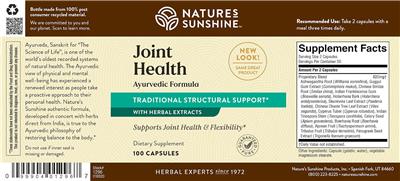
Bottle made from 100% post consumer recycled material. We are committed to you and our planet. Scan to learn more. Ayurveda, Sanskrit for "The Science of Life", is one of the oldest recorded systems of natural health. The ayurvedic view of of physical and mental well-being has experienced a renewed interest as people take a proactive approach to their personal health.
New look! Same great product
Herbal experts since 1972
Formulation
Nature's Sunshine authentic formula, developed in concert with herbs direct from India, is true to the Ayurvedic philosophy of restoring balance to the body.
Ayurvedic formula Traditional structural support Supports joint health & flexibility
Precautions
Do not use if inner seal is missing or damaged.
FDA Disclaimer Statement
These statements have not been evaluated by the Food and Drug Administration. This product is not intended to diagnose, treat, cure, or prevent any disease.
Formula
Joint health with herbal extracts
FDA Statement of Identity
Dietary Supplement
Seals/Symbols
Guaranteed pure
Suggested/Recommended/Usage/Directions
Recommended use: Take 2 capsules with a meal three times daily.
Is this label outdated? Report a formula or label change and our pharmacy team will review it.
Joint Health by Nature's Sunshine label
The label scan from the NIH Dietary Supplement Label Database. Tap to enlarge.
Label images are published by the NIH Dietary Supplement Label Database for the version of this product on file. Always read your actual product label.
View the full label (PDF)The Ingredients in Joint Health by Nature's Sunshine
These are the 14 active ingredients this product is made of. Select any to open its full monograph.
Serving size2 Capsule(s) Dosage formCapsule Servings per container50 Amounts shown are per serving.
Most supplement products combine several ingredients, and a medication can interact with the product through any one of them. Each ingredient below shows whether it has known drug interactions.
Proprietary Blend
- › Ashwagandha
- › Guggul gum extract
- › Chinese Smilax
- › Indian Frankincense
- › Skunkvine leaf extract
- › Chinese Chaste Tree leaf extract
- › Indian Tinospora
- › Ajowan
- › Celery
- › Tribulus
- › Fenugreek Seed Extract
- › Boerhavia
- › Holarrhena
- › Cyperus
Other (inactive) ingredients: Gelatin, Water, Magnesium Stearate. These complete the product’s ingredient list but are not active constituents.
Joint Health by Nature's Sunshine Drug Interactions
HelloPharmacist Interaction Report
Nature's Sunshine Joint Health contains 14 ingredients, several of which interact with medications.
Ashwagandha, one of the active components, has Moderate-severity interactions with CNS depressants (sedatives, anti-anxiety drugs, and benzodiazepines) — it may increase their sedative effects. It also raises Moderate concerns with blood pressure drugs, diabetes medications, thyroid hormones, immune-suppressing drugs, and drugs processed through a liver enzyme called CYP1A2.
Read the full breakdown — every affected drug type, severity by severity
Guggul gum extract interacts Moderately with heart and blood pressure medications (propranolol, diltiazem), blood thinners, birth control, estrogen therapy, and thyroid hormones. Indian Tinospora has Moderate interactions with several drug-metabolizing liver enzymes (CYP2D6, CYP2C19, CYP1A2, CYP2C9), plus diabetes and immune-suppressing medications.
Ajowan (Bishop's weed) interacts Moderately with blood thinners and certain enzymes, and can cause photosensitivity with sun-sensitizing drugs. Celery interacts Moderately with blood thinners, lithium, thyroid hormone, the antidepressant venlafaxine, and blood pressure drugs.
Tribulus and fenugreek seed extract each have Moderate interactions with blood pressure and diabetes drugs. Fenugreek also affects the blood thinner warfarin, the asthma drug theophylline, and other medications.
We could not check Chinese Smilax, Indian Frankincense, Skunkvine, Chinese Chaste Tree, Boerhavia, Holarrhena, or Cyperus — no data is on file for these. Altogether, these interactions span 1,515 individual medications.
Before you start this product, please check your exact prescriptions below.
Check your own medications below · Editorial policy · How we use AI
Want to check YOUR meds against Joint Health?
Ask about interactions with your drugs in plain English — “Can I take it with lisinopril?” — and we find you the answer in seconds, ingredient by ingredient.
Go to the checkerIngredients driving the most interactions
Individual Drug Interactions
The ingredients in Joint Health interact with 1,540 drugs. Click any drug to see the details.
9 of the 14 ingredients in Joint Health interact with drugs. Each result below shows which ingredient is responsible. Ashwagandha Ajowan Indian Frankincense Guggul gum extract Celery Indian Tinospora Fenugreek Seed Extract Tribulus Cyperus
6-mercaptopurinePurinethol
How 6-mercaptopurine interacts with Joint Health — through 3 ingredients. Tap an ingredient for the detail:
Indian TinosporaImmunosuppressants Moderate
Interaction Summary
Theoretically, Tinospora cordifolia might reduce the effectiveness of immunosuppressants.
Read the full Indian Tinospora + 6-mercaptopurine interactionAshwagandhaHepatotoxic Drugs, Immunosuppressants Moderate
Interaction Summary
Theoretically, taking ashwagandha with hepatotoxic drugs might increase the risk of liver damage.
Read the full Ashwagandha + 6-mercaptopurine interactionIndian FrankincenseImmunosuppressants Moderate
Interaction Summary
Theoretically, Boswellia serrata might alter the effects of immunosuppressive drugs.
Read the full Indian Frankincense + 6-mercaptopurine interactionAdo-trastuzumab EmtansineKadcyla
How Ado-trastuzumab Emtansine interacts with Joint Health — through 4 ingredients. Tap an ingredient for the detail:
AjowanCytochrome P450 3a4 (cyp3a4) Substrates Moderate
Interaction Summary
Bergapten, a constituent of bishop's weed, has been shown to inhibit cytochrome P450 3A4 (CYP3A4) in vitro.
Read the full Ajowan + Ado-trastuzumab Emtansine interactionGuggul Gum ExtractCytochrome P450 3a4 (cyp3a4) Substrates Moderate
Interaction Summary
Theoretically, guggul might reduce the effects of CYP3A4 substrates.
Read the full Guggul Gum Extract + Ado-trastuzumab Emtansine interactionIndian FrankincenseCytochrome P450 3a4 (cyp3a4) Substrates Moderate
Interaction Summary
Theoretically, Boswellia serrata might increase or decrease the levels and clinical effects of CYP3A4 substrates.
Read the full Indian Frankincense + Ado-trastuzumab Emtansine interactionAshwagandhaCytochrome P450 3a4 (cyp3a4) Substrates Minor
Interaction Summary
Theoretically, ashwagandha might decrease the levels and clinical effects of CYP3A4 substrates.
Read the full Ashwagandha + Ado-trastuzumab Emtansine interactionAbacavir Sulfate, Dolutegravir, LamivudineTriumeq
How Abacavir Sulfate, Dolutegravir, Lamivudine interacts with Joint Health — through 1 ingredient. Tap an ingredient for the detail:
AshwagandhaHepatotoxic Drugs Moderate
Interaction Summary
Theoretically, taking ashwagandha with hepatotoxic drugs might increase the risk of liver damage.
Read the full Ashwagandha + Abacavir Sulfate, Dolutegravir, Lamivudine interactionAbacavir, LamivudineEpzicom
How Abacavir, Lamivudine interacts with Joint Health — through 1 ingredient. Tap an ingredient for the detail:
AshwagandhaHepatotoxic Drugs Moderate
Interaction Summary
Theoretically, taking ashwagandha with hepatotoxic drugs might increase the risk of liver damage.
Read the full Ashwagandha + Abacavir, Lamivudine interactionAbciximabReoPro
How Abciximab interacts with Joint Health — through 4 ingredients. Tap an ingredient for the detail:
AjowanAnticoagulant/antiplatelet Drugs Moderate
Interaction Summary
Bergapten, a constituent of bishop's weed, has antiplatelet activity.
Read the full Ajowan + Abciximab interactionCeleryAnticoagulant/antiplatelet Drugs Moderate
Interaction Summary
Theoretically, celery root might increase the risk of bleeding when taken with anticoagulant/antiplatelet drugs.
Read the full Celery + Abciximab interactionFenugreek Seed ExtractAnticoagulant/antiplatelet Drugs Moderate
Interaction Summary
Theoretically, fenugreek might have additive effects when used with anticoagulant or antiplatelet drugs.
Read the full Fenugreek Seed Extract + Abciximab interactionGuggul Gum ExtractAnticoagulant/antiplatelet Drugs Moderate
Interaction Summary
Theoretically, guggul might increase the risk of bleeding when taken with anticoagulant/antiplatelet drugs.
Read the full Guggul Gum Extract + Abciximab interactionAbemaciclibVerzenio
How Abemaciclib interacts with Joint Health — through 4 ingredients. Tap an ingredient for the detail:
Guggul Gum ExtractCytochrome P450 3a4 (cyp3a4) Substrates Moderate
Interaction Summary
Theoretically, guggul might reduce the effects of CYP3A4 substrates.
Read the full Guggul Gum Extract + Abemaciclib interactionIndian FrankincenseCytochrome P450 3a4 (cyp3a4) Substrates Moderate
Interaction Summary
Theoretically, Boswellia serrata might increase or decrease the levels and clinical effects of CYP3A4 substrates.
Read the full Indian Frankincense + Abemaciclib interactionAjowanCytochrome P450 3a4 (cyp3a4) Substrates Moderate
Interaction Summary
Bergapten, a constituent of bishop's weed, has been shown to inhibit cytochrome P450 3A4 (CYP3A4) in vitro.
Read the full Ajowan + Abemaciclib interactionAshwagandhaCytochrome P450 3a4 (cyp3a4) Substrates Minor
Interaction Summary
Theoretically, ashwagandha might decrease the levels and clinical effects of CYP3A4 substrates.
Read the full Ashwagandha + Abemaciclib interactionAbiraterone
How Abiraterone interacts with Joint Health — through 4 ingredients. Tap an ingredient for the detail:
AshwagandhaCytochrome P450 3a4 (cyp3a4) Substrates, Hepatotoxic Drugs Moderate
Interaction Summary
Theoretically, ashwagandha might decrease the levels and clinical effects of CYP3A4 substrates.
Read the full Ashwagandha + Abiraterone interactionAjowanCytochrome P450 3a4 (cyp3a4) Substrates Moderate
Interaction Summary
Bergapten, a constituent of bishop's weed, has been shown to inhibit cytochrome P450 3A4 (CYP3A4) in vitro.
Read the full Ajowan + Abiraterone interactionIndian FrankincenseCytochrome P450 3a4 (cyp3a4) Substrates Moderate
Interaction Summary
Theoretically, Boswellia serrata might increase or decrease the levels and clinical effects of CYP3A4 substrates.
Read the full Indian Frankincense + Abiraterone interactionGuggul Gum ExtractCytochrome P450 3a4 (cyp3a4) Substrates Moderate
Interaction Summary
Theoretically, guggul might reduce the effects of CYP3A4 substrates.
Read the full Guggul Gum Extract + Abiraterone interactionAbiraterone AcetateYonsa, Zytiga
How Abiraterone Acetate interacts with Joint Health — through 4 ingredients. Tap an ingredient for the detail:
Guggul Gum ExtractCytochrome P450 3a4 (cyp3a4) Substrates Moderate
Interaction Summary
Theoretically, guggul might reduce the effects of CYP3A4 substrates.
Read the full Guggul Gum Extract + Abiraterone Acetate interactionIndian FrankincenseCytochrome P450 3a4 (cyp3a4) Substrates Moderate
Interaction Summary
Theoretically, Boswellia serrata might increase or decrease the levels and clinical effects of CYP3A4 substrates.
Read the full Indian Frankincense + Abiraterone Acetate interactionAjowanCytochrome P450 3a4 (cyp3a4) Substrates Moderate
Interaction Summary
Bergapten, a constituent of bishop's weed, has been shown to inhibit cytochrome P450 3A4 (CYP3A4) in vitro.
Read the full Ajowan + Abiraterone Acetate interactionAshwagandhaHepatotoxic Drugs, Cytochrome P450 3a4 (cyp3a4) Substrates Moderate
Interaction Summary
Theoretically, taking ashwagandha with hepatotoxic drugs might increase the risk of liver damage.
Read the full Ashwagandha + Abiraterone Acetate interactionAbrocitinibCibinqo
How Abrocitinib interacts with Joint Health — through 7 ingredients. Tap an ingredient for the detail:
Indian TinosporaImmunosuppressants, Cytochrome P450 2c19 (cyp2c19) Substrates +1 Moderate
Interaction Summary
Theoretically, Tinospora cordifolia might reduce the effectiveness of immunosuppressants.
Read the full Indian Tinospora + Abrocitinib interactionAjowanAnticoagulant/antiplatelet Drugs Moderate
Interaction Summary
Bergapten, a constituent of bishop's weed, has antiplatelet activity.
Read the full Ajowan + Abrocitinib interactionIndian FrankincenseImmunosuppressants, Cytochrome P450 2c9 (cyp2c9) Substrates +1 Moderate
Interaction Summary
Theoretically, Boswellia serrata might alter the effects of immunosuppressive drugs.
Read the full Indian Frankincense + Abrocitinib interactionGuggul Gum ExtractAnticoagulant/antiplatelet Drugs Moderate
Interaction Summary
Theoretically, guggul might increase the risk of bleeding when taken with anticoagulant/antiplatelet drugs.
Read the full Guggul Gum Extract + Abrocitinib interactionFenugreek Seed ExtractAnticoagulant/antiplatelet Drugs Moderate
Interaction Summary
Theoretically, fenugreek might have additive effects when used with anticoagulant or antiplatelet drugs.
Read the full Fenugreek Seed Extract + Abrocitinib interactionCeleryAnticoagulant/antiplatelet Drugs Moderate
Interaction Summary
Theoretically, celery root might increase the risk of bleeding when taken with anticoagulant/antiplatelet drugs.
Read the full Celery + Abrocitinib interactionAshwagandhaImmunosuppressants Moderate
Interaction Summary
Theoretically, taking ashwagandha might decrease the effects of immunosuppressants.
Read the full Ashwagandha + Abrocitinib interactionAcalabrutinibCalquence
How Acalabrutinib interacts with Joint Health — through 4 ingredients. Tap an ingredient for the detail:
AjowanCytochrome P450 3a4 (cyp3a4) Substrates Moderate
Interaction Summary
Bergapten, a constituent of bishop's weed, has been shown to inhibit cytochrome P450 3A4 (CYP3A4) in vitro.
Read the full Ajowan + Acalabrutinib interactionIndian FrankincenseCytochrome P450 3a4 (cyp3a4) Substrates Moderate
Interaction Summary
Theoretically, Boswellia serrata might increase or decrease the levels and clinical effects of CYP3A4 substrates.
Read the full Indian Frankincense + Acalabrutinib interactionGuggul Gum ExtractCytochrome P450 3a4 (cyp3a4) Substrates Moderate
Interaction Summary
Theoretically, guggul might reduce the effects of CYP3A4 substrates.
Read the full Guggul Gum Extract + Acalabrutinib interactionAshwagandhaCytochrome P450 3a4 (cyp3a4) Substrates Minor
Interaction Summary
Theoretically, ashwagandha might decrease the levels and clinical effects of CYP3A4 substrates.
Read the full Ashwagandha + Acalabrutinib interactionAcarboseGlucobay, Prandase, Precose
How Acarbose interacts with Joint Health — through 4 ingredients. Tap an ingredient for the detail:
Fenugreek Seed ExtractAntidiabetes Drugs Moderate
Interaction Summary
Theoretically, fenugreek seed might have additive hypoglycemic effects when used with antidiabetes drugs.
Read the full Fenugreek Seed Extract + Acarbose interactionIndian TinosporaAntidiabetes Drugs Moderate
Interaction Summary
Theoretically, Tinospora cordifolia might increase the risk of hypoglycemia when taken with antidiabetes drugs.
Read the full Indian Tinospora + Acarbose interactionTribulusAntidiabetes Drugs Moderate
Interaction Summary
Taking tribulus with antidiabetes drugs might increase the risk of hypoglycemia.
Read the full Tribulus + Acarbose interactionAshwagandhaAntidiabetes Drugs, Hepatotoxic Drugs Moderate
Interaction Summary
Theoretically, taking ashwagandha with antidiabetes drugs might increase the risk of hypoglycemia.
Read the full Ashwagandha + Acarbose interactionAcebutololRhotral, Sectral
How Acebutolol interacts with Joint Health — through 4 ingredients. Tap an ingredient for the detail:
AshwagandhaHepatotoxic Drugs, Antihypertensive Drugs Moderate
Interaction Summary
Theoretically, taking ashwagandha with hepatotoxic drugs might increase the risk of liver damage.
Read the full Ashwagandha + Acebutolol interactionCeleryAntihypertensive Drugs Moderate
Interaction Summary
Theoretically, celery seed extract might have additive effects with antihypertensive drugs.
Read the full Celery + Acebutolol interactionTribulusAntihypertensive Drugs Moderate
Interaction Summary
Theoretically, taking tribulus with antihypertensive drugs might increase the risk of hypotension.
Read the full Tribulus + Acebutolol interactionFenugreek Seed ExtractAntihypertensive Drugs Minor
Interaction Summary
Fenugreek may also have an additive effect on blood pressure-lowering medications.
Read the full Fenugreek Seed Extract + Acebutolol interactionAcenocoumarolSintrom
How Acenocoumarol interacts with Joint Health — through 4 ingredients. Tap an ingredient for the detail:
Fenugreek Seed ExtractAnticoagulant/antiplatelet Drugs Moderate
Interaction Summary
Theoretically, fenugreek might have additive effects when used with anticoagulant or antiplatelet drugs.
Read the full Fenugreek Seed Extract + Acenocoumarol interactionGuggul Gum ExtractAnticoagulant/antiplatelet Drugs Moderate
Interaction Summary
Theoretically, guggul might increase the risk of bleeding when taken with anticoagulant/antiplatelet drugs.
Read the full Guggul Gum Extract + Acenocoumarol interactionCeleryAnticoagulant/antiplatelet Drugs Moderate
Interaction Summary
Theoretically, celery root might increase the risk of bleeding when taken with anticoagulant/antiplatelet drugs.
Read the full Celery + Acenocoumarol interactionAjowanAnticoagulant/antiplatelet Drugs Moderate
Interaction Summary
Bergapten, a constituent of bishop's weed, has antiplatelet activity.
Read the full Ajowan + Acenocoumarol interactionAcepromazineAtravet
How Acepromazine interacts with Joint Health — through 4 ingredients. Tap an ingredient for the detail:
AjowanPhotosensitizing Drugs Moderate
Interaction Summary
Bishop's weed constituents seem to cause photosensitivity.
Read the full Ajowan + Acepromazine interactionCyperusCns Depressants Moderate
Interaction Summary
Animal research suggests that taking adrue in combination with sodium thiopental or diazepam increases total sleep time up to four-fold compared to the effects of the drugs alone.
Read the full Cyperus + Acepromazine interactionAshwagandhaCns Depressants Moderate
Interaction Summary
Theoretically, taking ashwagandha might increase the sedative effects of CNS depressants.
Read the full Ashwagandha + Acepromazine interactionCeleryPhotosensitizing Drugs Minor
Interaction Summary
Theoretically, celery might increase the risk of photosensitivity reactions when taken with photosensitizing drugs.
Read the full Celery + Acepromazine interactionAcetaminophenChildren's Tylenol, Children's Tylenol Meltaways, Tylenol, Tylenol Ex Strength
How Acetaminophen interacts with Joint Health — through 4 ingredients. Tap an ingredient for the detail:
AshwagandhaHepatotoxic Drugs, Cytochrome P450 1a2 (cyp1a2) Substrates Moderate
Interaction Summary
Theoretically, taking ashwagandha with hepatotoxic drugs might increase the risk of liver damage.
Read the full Ashwagandha + Acetaminophen interactionCeleryAcetaminophen (tylenol, Others), Cytochrome P450 1a2 (cyp1a2) Substrates Moderate
Interaction Summary
Theoretically, celery juice might increase the effects and side effects of acetaminophen.
Read the full Celery + Acetaminophen interactionIndian TinosporaCytochrome P450 1a2 (cyp1a2) Substrates Moderate
Interaction Summary
Theoretically, Tinospora cordifolia might increase levels of drugs metabolized by CYP1A2.
Read the full Indian Tinospora + Acetaminophen interactionIndian FrankincenseCytochrome P450 1a2 (cyp1a2) Substrates Moderate
Interaction Summary
Theoretically, Boswellia serrata might increase the levels of CYP1A2 substrates.
Read the full Indian Frankincense + Acetaminophen interactionAcetaminophen, AspirinGemnisyn
How Acetaminophen, Aspirin interacts with Joint Health — through 7 ingredients. Tap an ingredient for the detail:
Indian FrankincenseCytochrome P450 1a2 (cyp1a2) Substrates Moderate
Interaction Summary
Theoretically, Boswellia serrata might increase the levels of CYP1A2 substrates.
Read the full Indian Frankincense + Acetaminophen, Aspirin interactionCeleryCytochrome P450 1a2 (cyp1a2) Substrates, Acetaminophen (tylenol, Others) +1 Moderate
Interaction Summary
Theoretically, celery might increase levels of drugs metabolized by CYP1A2.
Read the full Celery + Acetaminophen, Aspirin interactionFenugreek Seed ExtractAnticoagulant/antiplatelet Drugs Moderate
Interaction Summary
Theoretically, fenugreek might have additive effects when used with anticoagulant or antiplatelet drugs.
Read the full Fenugreek Seed Extract + Acetaminophen, Aspirin interactionGuggul Gum ExtractAnticoagulant/antiplatelet Drugs Moderate
Interaction Summary
Theoretically, guggul might increase the risk of bleeding when taken with anticoagulant/antiplatelet drugs.
Read the full Guggul Gum Extract + Acetaminophen, Aspirin interactionAjowanAnticoagulant/antiplatelet Drugs Moderate
Interaction Summary
Bergapten, a constituent of bishop's weed, has antiplatelet activity.
Read the full Ajowan + Acetaminophen, Aspirin interactionAshwagandhaCytochrome P450 1a2 (cyp1a2) Substrates, Hepatotoxic Drugs Moderate
Interaction Summary
Theoretically, ashwagandha might decrease the levels and clinical effects of CYP1A2 substrates.
Read the full Ashwagandha + Acetaminophen, Aspirin interactionIndian TinosporaCytochrome P450 1a2 (cyp1a2) Substrates Moderate
Interaction Summary
Theoretically, Tinospora cordifolia might increase levels of drugs metabolized by CYP1A2.
Read the full Indian Tinospora + Acetaminophen, Aspirin interactionAcetaminophen, Aspirin, CaffeineExcedrin, Excedrin Extra Strength, Excedrin Migraine
How Acetaminophen, Aspirin, Caffeine interacts with Joint Health — through 7 ingredients. Tap an ingredient for the detail:
Indian TinosporaCytochrome P450 1a2 (cyp1a2) Substrates Moderate
Interaction Summary
Theoretically, Tinospora cordifolia might increase levels of drugs metabolized by CYP1A2.
Read the full Indian Tinospora + Acetaminophen, Aspirin, Caffeine interactionAshwagandhaCytochrome P450 3a4 (cyp3a4) Substrates, Cytochrome P450 1a2 (cyp1a2) Substrates +1 Moderate
Interaction Summary
Theoretically, ashwagandha might decrease the levels and clinical effects of CYP3A4 substrates.
Read the full Ashwagandha + Acetaminophen, Aspirin, Caffeine interactionAjowanAnticoagulant/antiplatelet Drugs, Cytochrome P450 3a4 (cyp3a4) Substrates Moderate
Interaction Summary
Bergapten, a constituent of bishop's weed, has antiplatelet activity.
Read the full Ajowan + Acetaminophen, Aspirin, Caffeine interactionGuggul Gum ExtractCytochrome P450 3a4 (cyp3a4) Substrates, Anticoagulant/antiplatelet Drugs Moderate
Interaction Summary
Theoretically, guggul might reduce the effects of CYP3A4 substrates.
Read the full Guggul Gum Extract + Acetaminophen, Aspirin, Caffeine interactionIndian FrankincenseCytochrome P450 1a2 (cyp1a2) Substrates, Cytochrome P450 3a4 (cyp3a4) Substrates Moderate
Interaction Summary
Theoretically, Boswellia serrata might increase the levels of CYP1A2 substrates.
Read the full Indian Frankincense + Acetaminophen, Aspirin, Caffeine interactionFenugreek Seed ExtractAnticoagulant/antiplatelet Drugs Moderate
Interaction Summary
Theoretically, fenugreek might have additive effects when used with anticoagulant or antiplatelet drugs.
Read the full Fenugreek Seed Extract + Acetaminophen, Aspirin, Caffeine interactionCeleryCytochrome P450 1a2 (cyp1a2) Substrates, Anticoagulant/antiplatelet Drugs +1 Moderate
Interaction Summary
Theoretically, celery might increase levels of drugs metabolized by CYP1A2.
Read the full Celery + Acetaminophen, Aspirin, Caffeine interactionAcetaminophen, Brompheniramine, PhenylpropanolamineDimetapp Cold and Flu
How Acetaminophen, Brompheniramine, Phenylpropanolamine interacts with Joint Health — through 5 ingredients. Tap an ingredient for the detail:
AshwagandhaCytochrome P450 1a2 (cyp1a2) Substrates, Hepatotoxic Drugs Moderate
Interaction Summary
Theoretically, ashwagandha might decrease the levels and clinical effects of CYP1A2 substrates.
Read the full Ashwagandha + Acetaminophen, Brompheniramine, Phenylpropanolamine interactionCeleryAcetaminophen (tylenol, Others), Cytochrome P450 1a2 (cyp1a2) Substrates +1 Moderate
Interaction Summary
Theoretically, celery juice might increase the effects and side effects of acetaminophen.
Read the full Celery + Acetaminophen, Brompheniramine, Phenylpropanolamine interactionIndian FrankincenseCytochrome P450 1a2 (cyp1a2) Substrates Moderate
Interaction Summary
Theoretically, Boswellia serrata might increase the levels of CYP1A2 substrates.
Read the full Indian Frankincense + Acetaminophen, Brompheniramine, Phenylpropanolamine interactionIndian TinosporaCytochrome P450 1a2 (cyp1a2) Substrates Moderate
Interaction Summary
Theoretically, Tinospora cordifolia might increase levels of drugs metabolized by CYP1A2.
Read the full Indian Tinospora + Acetaminophen, Brompheniramine, Phenylpropanolamine interactionAjowanPhotosensitizing Drugs Moderate
Interaction Summary
Bishop's weed constituents seem to cause photosensitivity.
Read the full Ajowan + Acetaminophen, Brompheniramine, Phenylpropanolamine interactionAcetaminophen, ButalbitalAxocet, Bancap, Bucet, Butex Forte, Esgic CF, Orbivan CF +5 more
How Acetaminophen, Butalbital interacts with Joint Health — through 5 ingredients. Tap an ingredient for the detail:
CeleryCytochrome P450 1a2 (cyp1a2) Substrates, Acetaminophen (tylenol, Others) Moderate
Interaction Summary
Theoretically, celery might increase levels of drugs metabolized by CYP1A2.
Read the full Celery + Acetaminophen, Butalbital interactionIndian TinosporaCytochrome P450 1a2 (cyp1a2) Substrates Moderate
Interaction Summary
Theoretically, Tinospora cordifolia might increase levels of drugs metabolized by CYP1A2.
Read the full Indian Tinospora + Acetaminophen, Butalbital interactionAshwagandhaHepatotoxic Drugs, Cytochrome P450 1a2 (cyp1a2) Substrates Moderate
Interaction Summary
Theoretically, taking ashwagandha with hepatotoxic drugs might increase the risk of liver damage.
Read the full Ashwagandha + Acetaminophen, Butalbital interactionIndian FrankincenseCytochrome P450 1a2 (cyp1a2) Substrates Moderate
Interaction Summary
Theoretically, Boswellia serrata might increase the levels of CYP1A2 substrates.
Read the full Indian Frankincense + Acetaminophen, Butalbital interactionCyperusBarbiturates Moderate
Interaction Summary
Animal research suggests that taking adrue in combination with sodium thiopental increases total sleep time three-fold compared to the effects of sodium thiopental alone.
Read the full Cyperus + Acetaminophen, Butalbital interactionAcetaminophen, Butalbital, CaffeineEsgic, Esgic Plus, Fiogesic, Fioricet, Repan, Tecnal +1 more
How Acetaminophen, Butalbital, Caffeine interacts with Joint Health — through 7 ingredients. Tap an ingredient for the detail:
CyperusBarbiturates Moderate
Interaction Summary
Animal research suggests that taking adrue in combination with sodium thiopental increases total sleep time three-fold compared to the effects of sodium thiopental alone.
Read the full Cyperus + Acetaminophen, Butalbital, Caffeine interactionIndian FrankincenseCytochrome P450 1a2 (cyp1a2) Substrates, Cytochrome P450 3a4 (cyp3a4) Substrates Moderate
Interaction Summary
Theoretically, Boswellia serrata might increase the levels of CYP1A2 substrates.
Read the full Indian Frankincense + Acetaminophen, Butalbital, Caffeine interactionCeleryAcetaminophen (tylenol, Others), Cytochrome P450 1a2 (cyp1a2) Substrates Moderate
Interaction Summary
Theoretically, celery juice might increase the effects and side effects of acetaminophen.
Read the full Celery + Acetaminophen, Butalbital, Caffeine interactionAshwagandhaCytochrome P450 1a2 (cyp1a2) Substrates, Hepatotoxic Drugs +1 Moderate
Interaction Summary
Theoretically, ashwagandha might decrease the levels and clinical effects of CYP1A2 substrates.
Read the full Ashwagandha + Acetaminophen, Butalbital, Caffeine interactionIndian TinosporaCytochrome P450 1a2 (cyp1a2) Substrates Moderate
Interaction Summary
Theoretically, Tinospora cordifolia might increase levels of drugs metabolized by CYP1A2.
Read the full Indian Tinospora + Acetaminophen, Butalbital, Caffeine interactionGuggul Gum ExtractCytochrome P450 3a4 (cyp3a4) Substrates Moderate
Interaction Summary
Theoretically, guggul might reduce the effects of CYP3A4 substrates.
Read the full Guggul Gum Extract + Acetaminophen, Butalbital, Caffeine interactionAjowanCytochrome P450 3a4 (cyp3a4) Substrates Moderate
Interaction Summary
Bergapten, a constituent of bishop's weed, has been shown to inhibit cytochrome P450 3A4 (CYP3A4) in vitro.
Read the full Ajowan + Acetaminophen, Butalbital, Caffeine interactionAcetaminophen, Butalbital, Caffeine, CodeineEsgic with Codeine, Fioricet w/ Codeine
How Acetaminophen, Butalbital, Caffeine, Codeine interacts with Joint Health — through 7 ingredients. Tap an ingredient for the detail:
AjowanCytochrome P450 3a4 (cyp3a4) Substrates Moderate
Interaction Summary
Bergapten, a constituent of bishop's weed, has been shown to inhibit cytochrome P450 3A4 (CYP3A4) in vitro.
Read the full Ajowan + Acetaminophen, Butalbital, Caffeine, Codeine interactionGuggul Gum ExtractCytochrome P450 3a4 (cyp3a4) Substrates Moderate
Interaction Summary
Theoretically, guggul might reduce the effects of CYP3A4 substrates.
Read the full Guggul Gum Extract + Acetaminophen, Butalbital, Caffeine, Codeine interactionCeleryCytochrome P450 1a2 (cyp1a2) Substrates, Acetaminophen (tylenol, Others) Moderate
Interaction Summary
Theoretically, celery might increase levels of drugs metabolized by CYP1A2.
Read the full Celery + Acetaminophen, Butalbital, Caffeine, Codeine interactionIndian FrankincenseCytochrome P450 3a4 (cyp3a4) Substrates, Cytochrome P450 1a2 (cyp1a2) Substrates +1 Moderate
Interaction Summary
Theoretically, Boswellia serrata might increase or decrease the levels and clinical effects of CYP3A4 substrates.
Read the full Indian Frankincense + Acetaminophen, Butalbital, Caffeine, Codeine interactionCyperusCns Depressants, Barbiturates Moderate
Interaction Summary
Animal research suggests that taking adrue in combination with sodium thiopental or diazepam increases total sleep time up to four-fold compared to the effects of the drugs alone.
Read the full Cyperus + Acetaminophen, Butalbital, Caffeine, Codeine interactionAshwagandhaCytochrome P450 1a2 (cyp1a2) Substrates, Hepatotoxic Drugs +2 Moderate
Interaction Summary
Theoretically, ashwagandha might decrease the levels and clinical effects of CYP1A2 substrates.
Read the full Ashwagandha + Acetaminophen, Butalbital, Caffeine, Codeine interactionIndian TinosporaCytochrome P450 1a2 (cyp1a2) Substrates, Cytochrome P450 2d6 (cyp2d6) Substrates Moderate
Interaction Summary
Theoretically, Tinospora cordifolia might increase levels of drugs metabolized by CYP1A2.
Read the full Indian Tinospora + Acetaminophen, Butalbital, Caffeine, Codeine interactionAcetaminophen, Butalbital, CodeineBancap w/ Codeine
How Acetaminophen, Butalbital, Codeine interacts with Joint Health — through 5 ingredients. Tap an ingredient for the detail:
Indian TinosporaCytochrome P450 2d6 (cyp2d6) Substrates, Cytochrome P450 1a2 (cyp1a2) Substrates Moderate
Interaction Summary
Theoretically, Tinospora cordifolia might increase levels of drugs metabolized by CYP2D6.
Read the full Indian Tinospora + Acetaminophen, Butalbital, Codeine interactionIndian FrankincenseCytochrome P450 2d6 (cyp2d6) Substrates, Cytochrome P450 1a2 (cyp1a2) Substrates Moderate
Interaction Summary
Theoretically, Boswellia serrata might increase the levels of CYP2D6 substrates.
Read the full Indian Frankincense + Acetaminophen, Butalbital, Codeine interactionCyperusCns Depressants Moderate
Interaction Summary
Animal research suggests that taking adrue in combination with sodium thiopental or diazepam increases total sleep time up to four-fold compared to the effects of the drugs alone.
Read the full Cyperus + Acetaminophen, Butalbital, Codeine interactionCeleryCytochrome P450 1a2 (cyp1a2) Substrates, Acetaminophen (tylenol, Others) Moderate
Interaction Summary
Theoretically, celery might increase levels of drugs metabolized by CYP1A2.
Read the full Celery + Acetaminophen, Butalbital, Codeine interactionAshwagandhaCytochrome P450 1a2 (cyp1a2) Substrates, Hepatotoxic Drugs +1 Moderate
Interaction Summary
Theoretically, ashwagandha might decrease the levels and clinical effects of CYP1A2 substrates.
Read the full Ashwagandha + Acetaminophen, Butalbital, Codeine interactionAcetaminophen, Butalbital, Codeine PhosphatePhrenilin #3
How Acetaminophen, Butalbital, Codeine Phosphate interacts with Joint Health — through 5 ingredients. Tap an ingredient for the detail:
CeleryAcetaminophen (tylenol, Others), Cytochrome P450 1a2 (cyp1a2) Substrates Moderate
Interaction Summary
Theoretically, celery juice might increase the effects and side effects of acetaminophen.
Read the full Celery + Acetaminophen, Butalbital, Codeine Phosphate interactionAshwagandhaHepatotoxic Drugs, Cns Depressants +1 Moderate
Interaction Summary
Theoretically, taking ashwagandha with hepatotoxic drugs might increase the risk of liver damage.
Read the full Ashwagandha + Acetaminophen, Butalbital, Codeine Phosphate interactionIndian FrankincenseCytochrome P450 1a2 (cyp1a2) Substrates, Cytochrome P450 2d6 (cyp2d6) Substrates Moderate
Interaction Summary
Theoretically, Boswellia serrata might increase the levels of CYP1A2 substrates.
Read the full Indian Frankincense + Acetaminophen, Butalbital, Codeine Phosphate interactionCyperusCns Depressants Moderate
Interaction Summary
Animal research suggests that taking adrue in combination with sodium thiopental or diazepam increases total sleep time up to four-fold compared to the effects of the drugs alone.
Read the full Cyperus + Acetaminophen, Butalbital, Codeine Phosphate interactionIndian TinosporaCytochrome P450 1a2 (cyp1a2) Substrates, Cytochrome P450 2d6 (cyp2d6) Substrates Moderate
Interaction Summary
Theoretically, Tinospora cordifolia might increase levels of drugs metabolized by CYP1A2.
Read the full Indian Tinospora + Acetaminophen, Butalbital, Codeine Phosphate interactionAcetaminophen, Caffeine, Chlorpheniramine, Hydrocodone, PhenylephrineHycomine Compound
How Acetaminophen, Caffeine, Chlorpheniramine, Hydrocodone, Phenylephrine interacts with Joint Health — through 7 ingredients. Tap an ingredient for the detail:
CeleryCytochrome P450 1a2 (cyp1a2) Substrates, Photosensitizing Drugs +1 Moderate
Interaction Summary
Theoretically, celery might increase levels of drugs metabolized by CYP1A2.
Read the full Celery + Acetaminophen, Caffeine, Chlorpheniramine, Hydrocodone, Phenylephrine interactionIndian FrankincenseCytochrome P450 2d6 (cyp2d6) Substrates, Cytochrome P450 1a2 (cyp1a2) Substrates +1 Moderate
Interaction Summary
Theoretically, Boswellia serrata might increase the levels of CYP2D6 substrates.
Read the full Indian Frankincense + Acetaminophen, Caffeine, Chlorpheniramine, Hydrocodone, Phenylephrine interactionCyperusCns Depressants Moderate
Interaction Summary
Animal research suggests that taking adrue in combination with sodium thiopental or diazepam increases total sleep time up to four-fold compared to the effects of the drugs alone.
Read the full Cyperus + Acetaminophen, Caffeine, Chlorpheniramine, Hydrocodone, Phenylephrine interactionGuggul Gum ExtractCytochrome P450 3a4 (cyp3a4) Substrates Moderate
Interaction Summary
Theoretically, guggul might reduce the effects of CYP3A4 substrates.
Read the full Guggul Gum Extract + Acetaminophen, Caffeine, Chlorpheniramine, Hydrocodone, Phenylephrine interactionAjowanPhotosensitizing Drugs, Cytochrome P450 3a4 (cyp3a4) Substrates Moderate
Interaction Summary
Bishop's weed constituents seem to cause photosensitivity.
Read the full Ajowan + Acetaminophen, Caffeine, Chlorpheniramine, Hydrocodone, Phenylephrine interactionAshwagandhaHepatotoxic Drugs, Cns Depressants +2 Moderate
Interaction Summary
Theoretically, taking ashwagandha with hepatotoxic drugs might increase the risk of liver damage.
Read the full Ashwagandha + Acetaminophen, Caffeine, Chlorpheniramine, Hydrocodone, Phenylephrine interactionIndian TinosporaCytochrome P450 2d6 (cyp2d6) Substrates, Cytochrome P450 1a2 (cyp1a2) Substrates Moderate
Interaction Summary
Theoretically, Tinospora cordifolia might increase levels of drugs metabolized by CYP2D6.
Read the full Indian Tinospora + Acetaminophen, Caffeine, Chlorpheniramine, Hydrocodone, Phenylephrine interactionAcetaminophen, Caffeine, CodeineGesic C15, Gesic C30, Gesic C8, Lenoltec 1, Lenoltec 2, Lenoltec 3 +1 more
How Acetaminophen, Caffeine, Codeine interacts with Joint Health — through 7 ingredients. Tap an ingredient for the detail:
AshwagandhaCytochrome P450 3a4 (cyp3a4) Substrates, Cytochrome P450 1a2 (cyp1a2) Substrates +2 Moderate
Interaction Summary
Theoretically, ashwagandha might decrease the levels and clinical effects of CYP3A4 substrates.
Read the full Ashwagandha + Acetaminophen, Caffeine, Codeine interactionIndian TinosporaCytochrome P450 1a2 (cyp1a2) Substrates, Cytochrome P450 2d6 (cyp2d6) Substrates Moderate
Interaction Summary
Theoretically, Tinospora cordifolia might increase levels of drugs metabolized by CYP1A2.
Read the full Indian Tinospora + Acetaminophen, Caffeine, Codeine interactionAjowanCytochrome P450 3a4 (cyp3a4) Substrates Moderate
Interaction Summary
Bergapten, a constituent of bishop's weed, has been shown to inhibit cytochrome P450 3A4 (CYP3A4) in vitro.
Read the full Ajowan + Acetaminophen, Caffeine, Codeine interactionGuggul Gum ExtractCytochrome P450 3a4 (cyp3a4) Substrates Moderate
Interaction Summary
Theoretically, guggul might reduce the effects of CYP3A4 substrates.
Read the full Guggul Gum Extract + Acetaminophen, Caffeine, Codeine interactionCeleryCytochrome P450 1a2 (cyp1a2) Substrates, Acetaminophen (tylenol, Others) Moderate
Interaction Summary
Theoretically, celery might increase levels of drugs metabolized by CYP1A2.
Read the full Celery + Acetaminophen, Caffeine, Codeine interactionCyperusCns Depressants Moderate
Interaction Summary
Animal research suggests that taking adrue in combination with sodium thiopental or diazepam increases total sleep time up to four-fold compared to the effects of the drugs alone.
Read the full Cyperus + Acetaminophen, Caffeine, Codeine interactionIndian FrankincenseCytochrome P450 1a2 (cyp1a2) Substrates, Cytochrome P450 2d6 (cyp2d6) Substrates +1 Moderate
Interaction Summary
Theoretically, Boswellia serrata might increase the levels of CYP1A2 substrates.
Read the full Indian Frankincense + Acetaminophen, Caffeine, Codeine interactionAcetaminophen, Caffeine, Codeine, SalicylamideCodalan No.1, Codalan No.2, Codalan No.3
How Acetaminophen, Caffeine, Codeine, Salicylamide interacts with Joint Health — through 7 ingredients. Tap an ingredient for the detail:
CeleryAcetaminophen (tylenol, Others), Cytochrome P450 1a2 (cyp1a2) Substrates Moderate
Interaction Summary
Theoretically, celery juice might increase the effects and side effects of acetaminophen.
Read the full Celery + Acetaminophen, Caffeine, Codeine, Salicylamide interactionAshwagandhaCns Depressants, Hepatotoxic Drugs +2 Moderate
Interaction Summary
Theoretically, taking ashwagandha might increase the sedative effects of CNS depressants.
Read the full Ashwagandha + Acetaminophen, Caffeine, Codeine, Salicylamide interactionIndian TinosporaCytochrome P450 2d6 (cyp2d6) Substrates, Cytochrome P450 1a2 (cyp1a2) Substrates Moderate
Interaction Summary
Theoretically, Tinospora cordifolia might increase levels of drugs metabolized by CYP2D6.
Read the full Indian Tinospora + Acetaminophen, Caffeine, Codeine, Salicylamide interactionGuggul Gum ExtractCytochrome P450 3a4 (cyp3a4) Substrates Moderate
Interaction Summary
Theoretically, guggul might reduce the effects of CYP3A4 substrates.
Read the full Guggul Gum Extract + Acetaminophen, Caffeine, Codeine, Salicylamide interactionAjowanCytochrome P450 3a4 (cyp3a4) Substrates Moderate
Interaction Summary
Bergapten, a constituent of bishop's weed, has been shown to inhibit cytochrome P450 3A4 (CYP3A4) in vitro.
Read the full Ajowan + Acetaminophen, Caffeine, Codeine, Salicylamide interactionIndian FrankincenseCytochrome P450 3a4 (cyp3a4) Substrates, Cytochrome P450 2d6 (cyp2d6) Substrates +1 Moderate
Interaction Summary
Theoretically, Boswellia serrata might increase or decrease the levels and clinical effects of CYP3A4 substrates.
Read the full Indian Frankincense + Acetaminophen, Caffeine, Codeine, Salicylamide interactionCyperusCns Depressants Moderate
Interaction Summary
Animal research suggests that taking adrue in combination with sodium thiopental or diazepam increases total sleep time up to four-fold compared to the effects of the drugs alone.
Read the full Cyperus + Acetaminophen, Caffeine, Codeine, Salicylamide interactionAcetaminophen, Caffeine, DihydrocodeineDHC Plus, Panlor DC, Panlor SS
How Acetaminophen, Caffeine, Dihydrocodeine interacts with Joint Health — through 7 ingredients. Tap an ingredient for the detail:
Indian FrankincenseCytochrome P450 3a4 (cyp3a4) Substrates, Cytochrome P450 1a2 (cyp1a2) Substrates +1 Moderate
Interaction Summary
Theoretically, Boswellia serrata might increase or decrease the levels and clinical effects of CYP3A4 substrates.
Read the full Indian Frankincense + Acetaminophen, Caffeine, Dihydrocodeine interactionCyperusCns Depressants Moderate
Interaction Summary
Animal research suggests that taking adrue in combination with sodium thiopental or diazepam increases total sleep time up to four-fold compared to the effects of the drugs alone.
Read the full Cyperus + Acetaminophen, Caffeine, Dihydrocodeine interactionAshwagandhaCytochrome P450 3a4 (cyp3a4) Substrates, Cytochrome P450 1a2 (cyp1a2) Substrates +2 Moderate
Interaction Summary
Theoretically, ashwagandha might decrease the levels and clinical effects of CYP3A4 substrates.
Read the full Ashwagandha + Acetaminophen, Caffeine, Dihydrocodeine interactionIndian TinosporaCytochrome P450 1a2 (cyp1a2) Substrates, Cytochrome P450 2d6 (cyp2d6) Substrates Moderate
Interaction Summary
Theoretically, Tinospora cordifolia might increase levels of drugs metabolized by CYP1A2.
Read the full Indian Tinospora + Acetaminophen, Caffeine, Dihydrocodeine interactionCeleryAcetaminophen (tylenol, Others), Cytochrome P450 1a2 (cyp1a2) Substrates Moderate
Interaction Summary
Theoretically, celery juice might increase the effects and side effects of acetaminophen.
Read the full Celery + Acetaminophen, Caffeine, Dihydrocodeine interactionAjowanCytochrome P450 3a4 (cyp3a4) Substrates Moderate
Interaction Summary
Bergapten, a constituent of bishop's weed, has been shown to inhibit cytochrome P450 3A4 (CYP3A4) in vitro.
Read the full Ajowan + Acetaminophen, Caffeine, Dihydrocodeine interactionGuggul Gum ExtractCytochrome P450 3a4 (cyp3a4) Substrates Moderate
Interaction Summary
Theoretically, guggul might reduce the effects of CYP3A4 substrates.
Read the full Guggul Gum Extract + Acetaminophen, Caffeine, Dihydrocodeine interactionAcetaminophen, Caffeine, IsomethepteneMigralam
How Acetaminophen, Caffeine, Isometheptene interacts with Joint Health — through 6 ingredients. Tap an ingredient for the detail:
Guggul Gum ExtractCytochrome P450 3a4 (cyp3a4) Substrates Moderate
Interaction Summary
Theoretically, guggul might reduce the effects of CYP3A4 substrates.
Read the full Guggul Gum Extract + Acetaminophen, Caffeine, Isometheptene interactionAjowanCytochrome P450 3a4 (cyp3a4) Substrates Moderate
Interaction Summary
Bergapten, a constituent of bishop's weed, has been shown to inhibit cytochrome P450 3A4 (CYP3A4) in vitro.
Read the full Ajowan + Acetaminophen, Caffeine, Isometheptene interactionCeleryAcetaminophen (tylenol, Others), Cytochrome P450 1a2 (cyp1a2) Substrates Moderate
Interaction Summary
Theoretically, celery juice might increase the effects and side effects of acetaminophen.
Read the full Celery + Acetaminophen, Caffeine, Isometheptene interactionAshwagandhaCytochrome P450 1a2 (cyp1a2) Substrates, Hepatotoxic Drugs +1 Moderate
Interaction Summary
Theoretically, ashwagandha might decrease the levels and clinical effects of CYP1A2 substrates.
Read the full Ashwagandha + Acetaminophen, Caffeine, Isometheptene interactionIndian FrankincenseCytochrome P450 3a4 (cyp3a4) Substrates, Cytochrome P450 1a2 (cyp1a2) Substrates Moderate
Interaction Summary
Theoretically, Boswellia serrata might increase or decrease the levels and clinical effects of CYP3A4 substrates.
Read the full Indian Frankincense + Acetaminophen, Caffeine, Isometheptene interactionIndian TinosporaCytochrome P450 1a2 (cyp1a2) Substrates Moderate
Interaction Summary
Theoretically, Tinospora cordifolia might increase levels of drugs metabolized by CYP1A2.
Read the full Indian Tinospora + Acetaminophen, Caffeine, Isometheptene interactionAcetaminophen, Caffeine, PyrilamineMidol Max Strength Menstrual
How Acetaminophen, Caffeine, Pyrilamine interacts with Joint Health — through 6 ingredients. Tap an ingredient for the detail:
CeleryCytochrome P450 1a2 (cyp1a2) Substrates, Acetaminophen (tylenol, Others) Moderate
Interaction Summary
Theoretically, celery might increase levels of drugs metabolized by CYP1A2.
Read the full Celery + Acetaminophen, Caffeine, Pyrilamine interactionIndian FrankincenseCytochrome P450 1a2 (cyp1a2) Substrates, Cytochrome P450 3a4 (cyp3a4) Substrates Moderate
Interaction Summary
Theoretically, Boswellia serrata might increase the levels of CYP1A2 substrates.
Read the full Indian Frankincense + Acetaminophen, Caffeine, Pyrilamine interactionAjowanCytochrome P450 3a4 (cyp3a4) Substrates Moderate
Interaction Summary
Bergapten, a constituent of bishop's weed, has been shown to inhibit cytochrome P450 3A4 (CYP3A4) in vitro.
Read the full Ajowan + Acetaminophen, Caffeine, Pyrilamine interactionGuggul Gum ExtractCytochrome P450 3a4 (cyp3a4) Substrates Moderate
Interaction Summary
Theoretically, guggul might reduce the effects of CYP3A4 substrates.
Read the full Guggul Gum Extract + Acetaminophen, Caffeine, Pyrilamine interactionAshwagandhaCytochrome P450 1a2 (cyp1a2) Substrates, Hepatotoxic Drugs +1 Moderate
Interaction Summary
Theoretically, ashwagandha might decrease the levels and clinical effects of CYP1A2 substrates.
Read the full Ashwagandha + Acetaminophen, Caffeine, Pyrilamine interactionIndian TinosporaCytochrome P450 1a2 (cyp1a2) Substrates Moderate
Interaction Summary
Theoretically, Tinospora cordifolia might increase levels of drugs metabolized by CYP1A2.
Read the full Indian Tinospora + Acetaminophen, Caffeine, Pyrilamine interactionAcetaminophen, Chlorpheniramine Maleate, Dextromethorphan HbrVicks Formula 44M Cough, Cold & Flu Relief
How Acetaminophen, Chlorpheniramine Maleate, Dextromethorphan Hbr interacts with Joint Health — through 6 ingredients. Tap an ingredient for the detail:
Indian TinosporaCytochrome P450 1a2 (cyp1a2) Substrates, Cytochrome P450 2d6 (cyp2d6) Substrates Moderate
Interaction Summary
Theoretically, Tinospora cordifolia might increase levels of drugs metabolized by CYP1A2.
Read the full Indian Tinospora + Acetaminophen, Chlorpheniramine Maleate, Dextromethorphan Hbr interactionAshwagandhaCytochrome P450 3a4 (cyp3a4) Substrates, Serotonergic Drugs +2 Moderate
Interaction Summary
Theoretically, ashwagandha might decrease the levels and clinical effects of CYP3A4 substrates.
Read the full Ashwagandha + Acetaminophen, Chlorpheniramine Maleate, Dextromethorphan Hbr interactionAjowanCytochrome P450 3a4 (cyp3a4) Substrates, Photosensitizing Drugs Moderate
Interaction Summary
Bergapten, a constituent of bishop's weed, has been shown to inhibit cytochrome P450 3A4 (CYP3A4) in vitro.
Read the full Ajowan + Acetaminophen, Chlorpheniramine Maleate, Dextromethorphan Hbr interactionCeleryPhotosensitizing Drugs, Acetaminophen (tylenol, Others) +1 Moderate
Interaction Summary
Theoretically, celery might increase the risk of photosensitivity reactions when taken with photosensitizing drugs.
Read the full Celery + Acetaminophen, Chlorpheniramine Maleate, Dextromethorphan Hbr interactionGuggul Gum ExtractCytochrome P450 3a4 (cyp3a4) Substrates Moderate
Interaction Summary
Theoretically, guggul might reduce the effects of CYP3A4 substrates.
Read the full Guggul Gum Extract + Acetaminophen, Chlorpheniramine Maleate, Dextromethorphan Hbr interactionIndian FrankincenseCytochrome P450 1a2 (cyp1a2) Substrates, Cytochrome P450 2d6 (cyp2d6) Substrates +1 Moderate
Interaction Summary
Theoretically, Boswellia serrata might increase the levels of CYP1A2 substrates.
Read the full Indian Frankincense + Acetaminophen, Chlorpheniramine Maleate, Dextromethorphan Hbr interactionEach ingredient & the kinds of drugs it affects
For each ingredient in Joint Health with known interactions, here are the types of medications they can affect. Open any type for the detail — or search your exact drug in the checker above.
Ashwagandha
Antidiabetes Drugs
Theoretically, taking ashwagandha with antidiabetes drugs might increase the risk of hypoglycemia.
There is preliminary clinical evidence suggesting that ashwagandha might lower blood glucose levels. Theoretically, ashwagandha might have additive effects when used with antidiabetes drugs and increase the risk of hypoglycemia.
Antihypertensive Drugs
Theoretically, taking ashwagandha with antihypertensive drugs might increase the risk of hypotension.
Animal research suggests that ashwagandha might lower systolic and diastolic blood pressure. Theoretically, ashwagandha might have additive effects when used with antihypertensive drugs and increase the risk of hypotension.
Benzodiazepines
Theoretically, taking ashwagandha might increase the sedative effects of benzodiazepines.
There is preliminary evidence that ashwagandha might have an additive effect with diazepam (Valium) and clonazepam (Klonopin). This may also occur with other benzodiazepines.
Cns Depressants
Theoretically, taking ashwagandha might increase the sedative effects of CNS depressants.
Ashwagandha seems to have sedative effects. Theoretically, this may potentiate the effects of barbiturates, other sedatives, and anxiolytics.
Hepatotoxic Drugs
Theoretically, taking ashwagandha with hepatotoxic drugs might increase the risk of liver damage.
Ashwagandha has been linked to cases of acute hepatitis, liver failure, hepatic encephalopathy, autoimmune hepatitis, the need for liver transplantation, and death due to liver failure.
Immunosuppressants
Theoretically, taking ashwagandha might decrease the effects of immunosuppressants.
Ashwagandha has demonstrated immunostimulant effects in humans. Animal research has shown that ashwagandha can attenuate the immunosuppression caused by cyclophosphamide.
Thyroid Hormone
Ashwagandha might increase the effects and adverse effects of thyroid hormone.
Concomitant use of ashwagandha with thyroid hormones may cause additive therapeutic and adverse effects. Preliminary clinical research and animal studies suggest that ashwagandha boosts thyroid hormone synthesis and secretion. In one clinical study, ashwagandha increased triiodothyronine (T3) and thyroxine (T4) levels by 41.5% and 19.6%, respectively, and reduced serum TSH levels by 17.4% from baseline in adults with subclinical hypothyroidism.
Cytochrome P450 1A2 (Cyp1A2) Substrates
Theoretically, ashwagandha might decrease the levels and clinical effects of CYP1A2 substrates.
In vitro research shows that ashwagandha extract induces CYP1A2 enzymes.
Cytochrome P450 3A4 (Cyp3A4) Substrates
Theoretically, ashwagandha might decrease the levels and clinical effects of CYP3A4 substrates.
In vitro research shows that ashwagandha extract induces CYP3A4 enzymes.
Serotonergic Drugs
Some animal studies have reported that ashwagandha can enhance serotonergic transmission by altering certain serotonin (5-HT) receptors. However, there is no evidence to suggest that ashwagandha increases the risk of serotonin-related effects, and there have been no published case reports of serotonin syndrome when combined with other serotonergic drugs. Nevertheless, due to the lack of extensive studies on the matter and the fact that ashwagandha appears to affect serotonergic pathways, it would be prudent to exercise caution when combining it with drugs that affect serotonin. [References: - Effects of Withania somnifera (Ashwaga ndha) on Stress and the Stress-Related Neuropsychiatric Disorders Anxiety, Depression, and Insomnia. Curr Neuropharmacol. 2021 Sep 14; 19: 1468–1495. - A Prospective, Randomized Double-Blind, Placebo-Controlled Study of Safety and Efficacy of a High-Concentration Full-Spectrum Extract of Ashwagandha Root in Reducing Stress and Anxiety in Adults. https://www.ncbi.nlm.nih.gov/pmc/articles/PMC3573577/]
Ajowan
Anticoagulant/Antiplatelet Drugs
Bergapten, a constituent of bishop's weed, has antiplatelet activity. Theoretically, bishop's weed might have additive effects with anticoagulant or antiplatelet drugs and possibly increase the risk of bleeding.
Some anticoagulant or antiplatelet drugs include aspirin, clopidogrel (Plavix), dalteparin (Fragmin), enoxaparin (Lovenox), heparin, ticlopidine (Ticlid), warfarin (Coumadin), and others.
Cytochrome P450 3A4 (Cyp3A4) Substrates
Bergapten, a constituent of bishop's weed, has been shown to inhibit cytochrome P450 3A4 (CYP3A4) in vitro. Theoretically, bishop's weed might inhibit elimination and increase blood levels of drugs metabolized by CYP3A4.
Some drugs metabolized by CYP3A4 include alprazolam (Xanax), amitriptyline (Elavil), amiodarone (Cordarone), buspirone (Buspar), cerivastatin (Baycol), citalopram (Celexa), felodipine (Plendil), fexofenadine (Allegra), itraconazole (Sporanox), ketoconazole (Nizoral), lansoprazole (Prevacid), losartan (Cozaar), lovastatin (Mevacor), ondansetron (Zofran), prednisone (Deltasone, Orasone), sertraline (Zoloft), sibutramine (Meridia), sildenafil (Viagra), simvastatin (Zocor), verapamil (Calan, Covera-HS, Isoptin), and many others.
Photosensitizing Drugs
Bishop's weed constituents seem to cause photosensitivity. Theoretically, concomitant use of bishop's weed with photosensitizing drugs might result in increased photosensitivity.
Some drugs that cause photosensitivity include amitriptyline (Elavil), quinolones (Ciprofloxacin, others), sulfa drugs (Septra, Bactrim, others), and tetracycline.
Indian Frankincense
Cytochrome P450 1A2 (Cyp1A2) Substrates
Theoretically, Boswellia serrata might increase the levels of CYP1A2 substrates.
In vitro research shows that Boswellia serrata gum resin inhibits CYP1A2 enzymes.
Cytochrome P450 2C19 (Cyp2C19) Substrates
Theoretically, Boswellia serrata might increase the levels of CYP2C19 substrates.
In vitro research shows that Boswellia serrata gum resin inhibits CYP2C19 enzymes.
Cytochrome P450 2C9 (Cyp2C9) Substrates
Theoretically, Boswellia serrata might increase the levels of CYP2C9 substrates.
In vitro research shows that Boswellia serrata gum resin inhibits CYP2C9 enzymes.
Cytochrome P450 2D6 (Cyp2D6) Substrates
Theoretically, Boswellia serrata might increase the levels of CYP2D6 substrates.
In vitro research shows that Boswellia serrata gum resin inhibits CYP2D6 enzymes.
Cytochrome P450 3A4 (Cyp3A4) Substrates
Theoretically, Boswellia serrata might increase or decrease the levels and clinical effects of CYP3A4 substrates.
In vitro research shows that Boswellia serrata gum resin inhibits CYP3A4 enzymes. Other in vitro research shows that Boswellia serrata extract inhibits CYP3A4 enzymes at most concentrations, although it may modestly induce enzyme activity at low concentrations.
Immunosuppressants
Theoretically, Boswellia serrata might alter the effects of immunosuppressive drugs.
Some in vitro research suggests that Boswellia serrata extracts might inhibit mediators of autoimmune disorders such as leukotrienes and reduce production of antibodies and cell-mediated immunity. However, other in vitro research suggests that, when coupled with calcium ions, boswellic acids containing the keto group have immunostimulant properties within specific cell signaling pathways.
Guggul gum extract
Anticoagulant/Antiplatelet Drugs
Theoretically, guggul might increase the risk of bleeding when taken with anticoagulant/antiplatelet drugs.
In vitro research and preliminary clinical studies suggest that guggul might have antiplatelet and anticoagulant effects.
Contraceptive Drugs
Theoretically, guggul might increase the risk of adverse effects when taken with contraceptive drugs.
In vitro research shows that guggul has estrogen-alpha receptor agonist activity.
Cytochrome P450 3A4 (Cyp3A4) Substrates
Theoretically, guggul might reduce the effects of CYP3A4 substrates.
In vitro research shows that guggul constituents known as guggulsterones can induce CYP3A4.
Diltiazem (Cardizem, Others)
Guggul might reduce the effects of diltiazem.
A small pharmacokinetic study shows that concomitant use of guggul with diltiazem reduces the bioavailability of diltiazem.
Estrogens
Theoretically, guggul might increase the risk of adverse effects when taken with estrogens.
In vitro research shows that guggul constituents known as guggulsterones have estrogen-alpha receptor agonist activity.
Propranolol (Inderal)
Guggul might reduce the effects of propranolol.
A small pharmacokinetic study shows that concomitant use of guggul with propranolol reduces the bioavailability of propranolol.
Rosuvastatin (Crestor)
Theoretically, guggul might increase the effects and adverse effects of rosuvastatin.
Animal research shows that guggul increases the bioavailability and hypolipidemic effects of rosuvastatin. The mechanism of this interaction is unclear.
Tamoxifen (Nolvadex)
Theoretically, guggul might interfere with tamoxifen therapy.
In vitro research shows that guggul has estrogen-alpha receptor agonist activity.
Thyroid Hormone
Theoretically, guggul might increase the risk for adverse effects when taken with thyroid hormone therapy.
Animal research suggests that guggul has thyroid-stimulating effects.
Celery
Anticoagulant/Antiplatelet Drugs
Theoretically, celery root might increase the risk of bleeding when taken with anticoagulant/antiplatelet drugs.
Celery root contains the constituents falcarinol and falcarindiol. Laboratory research suggests that these constituents can inhibit platelet aggregation. This effect has not been reported in humans.
Antihypertensive Drugs
Theoretically, celery seed extract might have additive effects with antihypertensive drugs.
Clinical research suggests that taking celery seed extract may reduce daytime systolic blood pressure by about 12 mmHg compared to less than 1 mmHg with placebo.
Cytochrome P450 1A2 (Cyp1A2) Substrates
Theoretically, celery might increase levels of drugs metabolized by CYP1A2.
In vitro and animal research suggests that constituents of celery can inhibit CYP1A2. This effect has not been reported in humans.
Levothyroxine (Synthroid, Others)
Theoretically, celery seed might decrease the effects of levothyroxine.
Several cases of hypothyroidism with low T4 levels have been reported in people who were previously stabilized on levothyroxine and then started taking celery seed tablets. They presented with symptoms such as lethargy, bloating, and dry skin, and recovered when celery seed was stopped. However, celery stem and leaf has been associated with case reports of hyperthyroidism in patients with no pre-existing thyroid disorders.
Lithium
Theoretically, celery might reduce excretion and increase levels of lithium due to potential diuretic effects.
Celery is thought to have diuretic properties. However, this effect has not been confirmed in humans.
Venlafaxine (Effexor)
Theoretically, celery root extract might increase blood levels of venlafaxine.
There is one case report of a patient who experienced medication-induced bipolar disorder after beginning to take celery root extract 1000 mg daily along with venlafaxine 75 mg and St. John's wort 600 mg daily. Symptoms included confusion, speech abnormalities, manic affect, and visual hallucinations. The plasma level of venlafaxine was 476.8 ng/mL (normal range 195-400 ng/mL). It is theorized that celery root increased venlafaxine levels by inhibiting cytochrome P450 2D6.
Acetaminophen (Tylenol, Others)
Theoretically, celery juice might increase the effects and side effects of acetaminophen.
Animal research suggests that concomitant use of celery juice plus acetaminophen prolongs the effects of acetaminophen. This effect has been attributed to a decrease in hepatic cytochrome P450 activity. However, other animal research shows that pretreatment with celery root extract protects against acetaminophen-induced acute liver failure. These effects have not been reported in humans.
Photosensitizing Drugs
Theoretically, celery might increase the risk of photosensitivity reactions when taken with photosensitizing drugs.
Laboratory research shows that celery contains photosensitizing agents such as phenols and psoralens.
Indian Tinospora
Antidiabetes Drugs
Theoretically, Tinospora cordifolia might increase the risk of hypoglycemia when taken with antidiabetes drugs.
Clinical research in adults with type 2 diabetes shows that Tinospora cordifolia can reduce fasting blood glucose and glycated hemoglobin. Additionally, animal research shows that Tinospora cordifolia has hypoglycemic effects.
Cytochrome P450 1A2 (Cyp1A2) Substrates
Theoretically, Tinospora cordifolia might increase levels of drugs metabolized by CYP1A2.
In vitro research shows that Tinospora cordifolia extract inhibits CYP1A2 at high concentrations. However, this interaction has not been reported in humans.
Cytochrome P450 2C19 (Cyp2C19) Substrates
Theoretically, Tinospora cordifolia might increase levels of drugs metabolized by CYP2C19.
In vitro research shows that Tinospora cordifolia extract inhibits CYP2C19 at high concentrations. However, this interaction has not been reported in humans.
Cytochrome P450 2C9 (Cyp2C9) Substrates
Theoretically, Tinospora cordifolia might increase levels of drugs metabolized by CYP2C9.
In vitro research shows that Tinospora cordifolia extract inhibits CYP2C9. Animal research shows that Tinospora cordifolia extract 400 mg/kg twice daily for 14 days reduces the clearance and increases plasma levels of glyburide, a CYP2C9 substrate. However, this interaction has not been reported in humans.
Cytochrome P450 2D6 (Cyp2D6) Substrates
Theoretically, Tinospora cordifolia might increase levels of drugs metabolized by CYP2D6.
In vitro research shows that Tinospora cordifolia extract inhibits CYP2D6 at high concentrations. However, this interaction has not been reported in humans.
Immunosuppressants
Theoretically, Tinospora cordifolia might reduce the effectiveness of immunosuppressants.
In vitro and animal research shows that Tinospora cordifolia has immunostimulant effects.
Fenugreek Seed Extract
Anticoagulant/Antiplatelet Drugs
Theoretically, fenugreek might have additive effects when used with anticoagulant or antiplatelet drugs.
Some of the constituents in fenugreek have antiplatelet effects in animal and in vitro research. However, common fenugreek products might not contain sufficient concentrations of these constituents for clinical effects. A clinical study in patients with coronary artery disease or diabetes shows that taking fenugreek seed powder 2.5 grams twice daily for 3 months does not affect platelet aggregation, fibrinolytic activity, or fibrinogen levels .
Antidiabetes Drugs
Theoretically, fenugreek seed might have additive hypoglycemic effects when used with antidiabetes drugs.
Clinical research shows that fenugreek seed can reduce fasting blood glucose and 2-hour postprandial glucose levels in adults with type 2 diabetes.
Clopidogrel (Plavix)
Theoretically, fenugreek seed might alter the clinical effects of clopidogrel by inhibiting its conversion to the active form.
Animal research shows that fenugreek seed 200 mg/kg daily for 14 days increases the maximum serum concentration of clopidogrel by 21%. It is unclear how this affects the pharmacokinetics of the active metabolite of clopidogrel; however, this study found that concomitant use of fenugreek seed and clopidogrel prolonged bleeding time by an additional 11%.
Metoprolol (Toprol)
Theoretically, fenugreek seed might have additive hypotensive effects when used with metoprolol.
Animal research shows that fenugreek seed 300 mg/kg daily for 2 weeks decreases systolic and diastolic blood pressure by 9% and 11%, respectively, when administered alone, and by 15% and 22%, respectively, when given with metoprolol 10 mg/kg.
Phenytoin (Dilantin)
Theoretically, fenugreek might decrease plasma levels of phenytoin.
Animal research shows that taking fenugreek seeds for 1 week decreases maximum concentrations and the area under the curve of a single dose of phenytoin by 44% and 72%, respectively. This seems to be related to increased clearance. So far, this interaction has not been reported in humans.
Sildenafil (Viagra)
Theoretically, concurrent use of sildenafil and fenugreek might reduce levels and therapeutic effects of sildenafil.
Animal research shows that taking fenugreek seeds for 1 week reduces maximum concentrations and the area under the curve of a single dose of sildenafil by 27% and 48%, respectively. So far, this interaction has not been reported in humans.
Theophylline
Theoretically, fenugreek may reduce the levels and clinical effects of theophylline.
Animal research shows that fenugreek 50 grams daily for 7 days reduces the maximum serum concentration (Cmax) of theophylline by 28% and the area under the plasma drug concentration-time curve (AUC) by 22%.
Warfarin (Coumadin)
Theoretically, fenugreek might have additive effects with warfarin and increase the international normalized ratio (INR).
Some fenugreek constituents have antiplatelet effects, although these might not be present in concentrations that are clinically significant. In one case report, a patient taking warfarin experienced an increased INR when starting to take fenugreek in combination with boldo.
Antihypertensive Drugs
Fenugreek may also have an additive effect on blood pressure-lowering medications. Studies on animals have shown that fenugreek seed can decrease both systolic and diastolic blood pressure by up to 22% when combined with metoprolol. Therefore, it is essential to monitor your blood pressure regularly if you are taking fenugreek and metoprolol together or any other antihypertensive drugs.
Tribulus
Antidiabetes Drugs
Taking tribulus with antidiabetes drugs might increase the risk of hypoglycemia.
Clinical research shows that Tribulus can lower blood glucose levels in adults with type 2 diabetes who are taking antidiabetes medications.
Antihypertensive Drugs
Theoretically, taking tribulus with antihypertensive drugs might increase the risk of hypotension.
Animal research shows that tribulus can lower blood pressure by inhibiting angiotensin-converting enzyme (ACE). Tribulus has also demonstrated hypotensive effects in pre-hypertensive adults.
Lithium
Theoretically, tribulus might increase the levels and clinical effects of lithium.
Tribulus is thought to have diuretic properties. Due to these potential diuretic effects, tribulus might reduce excretion and increase levels of lithium. The dose of lithium might need to be decreased.
Cyperus
Barbiturates
Animal research suggests that taking adrue in combination with sodium thiopental increases total sleep time three-fold compared to the effects of sodium thiopental alone. Theoretically, concomitant use of adrue and barbiturates might increase the risk of drowsiness and motor reflex depression. Some barbiturates include amobarbital (Amytal), butabarbital (Butisol), mephobarbital (Mebaral), pentobarbital (Nembutal), phenobarbital (Luminal), secobarbital (Seconal), and others.
Benzodiazepines
Animal research suggests that taking adrue in combination with diazepam increases total sleep time four-fold compared to the effects of diazepam alone. Theoretically, concomitant use adrue and benzodiazepines might increase the risk of drowsiness and motor reflex depression. Some benzodiazepines include clonazepam (Klonopin), diazepam (Valium), lorazepam (Ativan), and others.
Cns Depressants
Animal research suggests that taking adrue in combination with sodium thiopental or diazepam increases total sleep time up to four-fold compared to the effects of the drugs alone. Theoretically, concomitant use of adrue with CNS depressants might cause additive sedation. Some CNS depressants include benzodiazepines, such as diazepam (Valium), alprazolam (Xanax), triazolam (Halcion), and estazolam (ProSom); barbiturates, such as mephobarbital (Mebaral), phenobarbital (Luminal Sodium), and pentobarbital sodium (Nembutal); zolpidem (Ambien); and others.
Brand information
Manufacturer and brand details for Joint Health, from the product label.
Nature's Sunshine
See all Nature's Sunshine products- Name
- Nature's Sunshine Products, Inc
- City
- Spanish Fork
- State
- Utah
- ZipCode
- 84660
- Phone Number
- 1-800-223-8225
- Web Address
- www.naturessunshine.com
Joint Health by Nature's Sunshine: Common Questions
Does Joint Health by Nature's Sunshine interact with any medications?
How can one product interact with so many drugs?
Where does this information come from?
Can I take this while pregnant or breastfeeding?
What are the most common side effects?
Does this product actually help with joint health?
Why are there so many drug interactions listed?
Is ashwagandha safe to take long-term?
What should I do if I'm on blood thinners?
Written and reviewed by the HelloPharmacist editorial staff. Our editorial policy
Not sure if Joint Health is safe with your meds?
Our pharmacists answer your medication & supplement questions — free.
Label information is sourced from the NIH Dietary Supplement Label Database and reflects the product version on file; always read your actual product label. This page is for education only and is not a substitute for professional medical advice. Confirm with your pharmacist or doctor before combining supplements and medications.
The Full Monographs Behind Joint Health’s Ingredients
Every ingredient we hold a full HelloPharmacist monograph for — uses, evidence, safety, and the complete interaction list.
Ashwagandha
Interacts with 1,372 drugsAshwagandha is an Ayurvedic herb most often taken to help with stress, anxiety, and sleep, and some small studies suggest it may help, though the evidence is still limited. It is generally w...
Read the full Ashwagandha monograph → Herb & supplement monographGuggul
Interacts with 757 drugsGuggul is a gum resin from the Commiphora wightii tree, long used in Ayurvedic medicine for cholesterol, joint, and skin problems. Modern studies are mixed and often low-quality, and it can...
Read the full Guggul monograph → Herb & supplement monographBoswellia Serrata
Interacts with 952 drugsBoswellia serrata is a tree resin used in traditional medicine, mainly for joint pain and inflammation. Some studies suggest it may help with osteoarthritis symptoms, but the overall evidenc...
Read the full Boswellia Serrata monograph → Herb & supplement monographTinospora Cordifolia
Interacts with 612 drugsTinospora cordifolia, known as Guduchi or Giloy in Ayurvedic medicine, is a climbing plant traditionally used to support immunity and treat fevers. Early laboratory and small human studies s...
Read the full Tinospora Cordifolia monograph → Herb & supplement monographBishop's Weed
Interacts with 954 drugsBishop's Weed (Ammi majus) is a flowering plant whose seeds contain natural light-sensitizing compounds called psoralens, which have been studied mainly for skin conditions like vitiligo and...
Read the full Bishop's Weed monograph → Herb & supplement monographCelery
Interacts with 651 drugsCelery is a common vegetable that is also taken as a seed extract or oil supplement, mainly for blood pressure, fluid retention, and joint discomfort. Human evidence for these supplement use...
Read the full Celery monograph → Herb & supplement monographTribulus
Interacts with 259 drugsTribulus is a plant supplement most often marketed to boost libido, testosterone, and athletic performance, but the human evidence behind these claims is weak and inconsistent. It is general...
Read the full Tribulus monograph → Herb & supplement monographFenugreek
Interacts with 389 drugsFenugreek is a common kitchen spice that is also taken as a supplement, mainly for blood sugar, cholesterol, and to support breast milk production. Some early research is encouraging for blo...
Read the full Fenugreek monograph → Herb & supplement monographAdrue
Interacts with 256 drugsAdrue (Cyperus articulatus) is a sedge whose rhizome has long been used in traditional medicine for nausea and other stomach complaints, and as a mild calming agent. Solid human studies are...
Read the full Adrue monograph →Sources & How We Checked
Joint Health's label data comes from the NIH Dietary Supplement Label Database; the ingredient interaction data is from the Natural Medicines database, reviewed by our pharmacists.
- NIH Dietary Supplement Label Database (DSLD) — The official product label on file for this supplement.
- Natural Medicines (Therapeutic Research Center) — Evidence-graded clinical reference behind the ingredient interaction data.
Content is written and reviewed by licensed HelloPharmacist pharmacists. See our data sources and editorial standards for how this information is built and checked.
The 182 references behind this product’s interaction data
Every citation that drives the interaction findings for this product’s ingredients, from the evidence-graded Natural Medicines (TRC Healthcare) database. Open an ingredient to browse its citations — links open the study on PubMed or the publisher’s site.
Ashwagandha 32 references
- McGuffin M, Hobbs C, Upton R, Goldberg A, eds. American Herbal Products Association's Botanical Safety Handbook. Boca Raton, FL: CRC Press, LLC 1997.
- Upton R, ed. Ashwagandha Root (Withania somnifera): Analytical, quality control, and therapuetic monograph. Santa Cruz, CA: American Herbal Pharmacopoeia 2000:1-25.
- Davis L, Kuttan G. Effect of Withania somnifera on cyclophosphamide-induced urotoxicity. Cancer Lett 2000;148:9-17. PubMed
- Davis L, Kuttan G. Suppressive effect of cyclophosphamide-induced toxicity by Withania somnifera extract in mice. J Ethnopharmacol 1998;62:209-14. PubMed
- Mishra LC, Singh BB, Dagenais S. Scientific basis for the therapeutic use of Withania somnifera (ashwagandha): a review. Altern Med Rev 2000;5:334-46. DOI
- Andallu B, Radhika B. Hypoglycemic, diuretic and hypocholesterolemic effect of winter cherry (Withania somnifera, Dunal) root. Indian J Exp Biol 2000;38:607-9.
- Kulkarni RR, Patki PS, Jog VP, et al. Treatment of osteoarthritis with a herbomineral formulation: a double-blind, placebo-controlled, cross-over study. J Ethnopharmacol 1991;33:91-5. PubMed
- Ahumada F, Aspee F, Wikman G, Hancke J. Withania somnifera exract. Its effects on arterial blood pressure in anaesthetized dogs. Phytother Res 1991;5:111-14.
- Panda S, Kar A. Withania somnifera and Bauhinia purpurea in the regulation of circulating thyroid hormone concentrations in female mice. J Ethnopharmacol 1999;67:233-39. PubMed
- Panda S, Kar A. Changes in thyroid hormone concentrations after administration of ashwagandha root extract to adult male mice. J Pharm Pharmacol 1998;50:1065-68. PubMed
- Sehgal, V. N., Verma, P., and Bhattacharya, S. N. Fixed-drug eruption caused by ashwagandha (Withania somnifera): a widely used Ayurvedic drug. Skinmed. 2012;10(1):48-49.
- Agnihotri AP, Sontakke SD, Thawani VR, Saoji A, Goswami VS. Effects of Withania somnifera in patients of schizophrenia: a randomized, double blind, placebo controlled pilot trial study. Indian J Pharmacol. 2013;45(4):417-8. PubMed
- Biswal BM, Sulaiman SA, Ismail HC, Zakaria H, Musa KI. Effect of Withania somnifera (Ashwagandha) on the development of chemotherapy-induced fatigue and quality of life in breast cancer patients. Integr Cancer Ther. 2013;12(4):312-22.
- Sharma AK, Basu I, Singh S. Efficacy and safety of Ashwagandha root extract in subclinical hypothyroid patients: a double-blind, randomized placebo-controlled trial. J Altern Complement Med. 2018 Mar;24(3):243-248. PubMed
- Durg S, Bavage S, Shivaram SB. Withania somnifera (Indian ginseng) in diabetes mellitus: A systematic review and meta-analysis of scientific evidence from experimental research to clinical application. Phytother Res. 2020;34(5):1041-1059.
- Björnsson HK, Björnsson ES, Avula B, et al. Ashwagandha-induced liver injury: A case series from Iceland and the US Drug-Induced Liver Injury Network. Liver Int. 2020;40(4):825-829. PubMed
- Tharakan A, Shukla H, Benny IR, Tharakan M, George L, Koshy S. Immunomodulatory Effect of Withania somnifera (Ashwagandha) Extract-A Randomized, Double-Blind, Placebo Controlled Trial with an Open Label Extension on Healthy Participants. J Clin Med 2021;1 PubMed
- Ireland PJ, Hardy T, Burt AD, Donnelly MC. Drug-induced hepatocellular injury due to herbal supplement ashwagandha. J R Coll Physicians Edinb. 2021;51(4):363-365. PubMed
- Kamal HI, Patel K, Brdak A, Heffernan J, Ahmad N. Ashwagandha as a unique cause of thyrotoxicosis presenting with supraventricular tachycardia. Cureus. 2022 Mar 25;14(3):e23494. PubMed
- Suryawanshi G, Abdallah M, Thomson M, Desai N, Chauhan A, Lim N. Ashwagandha-Associated Acute Liver Failure Requiring Liver Transplantation. Am J Ther 2023;30(1):e80-e83. PubMed
- Pusec CM, Wolsky R, Llerena C, Sura P. A Case of Supplement-Induced Hepatitis. Cureus 2022;14(10):e30433. PubMed
- Ajgaonkar A, Jain M, Debnath K. Efficacy and Safety of Ashwagandha (Withania somnifera) Root Extract for Improvement of Sexual Health in Healthy Women: A Prospective, Randomized, Placebo-Controlled Study. Cureus 2022;14(10):e30787. PubMed
- Haron MH, Dale O, Martin K, et al. Evaluation of the Herb-Drug Interaction Potential of Commonly Used Botanicals on the US Market with Regard to PXR- and AhR-Mediated Influences on CYP3A4 and CYP1A2. J Diet Suppl 2022. PubMed
- Lubarska M, Halasinski P, Hryhorowicz S, et al. Liver Dangers of Herbal Products: A Case Report of Ashwagandha-Induced Liver Injury. Int J Environ Res Public Health 2023;20(5):3921. PubMed
- Tóth M, Benedek AE, Longerich T, Seitz HK. Ashwagandha-induced acute liver injury: A case report. Clin Case Rep 2023;11(3):e7078.
- Bokan G, Glamocanin T, Mavija Z, et al. Herb-Induced Liver Injury by Ayurvedic Ashwagandha as Assessed for Causality by the Updated RUCAM: An Emerging Cause. Pharmaceuticals (Basel) 2023;16(8):1129. PubMed
- Patel PA, Sanborn E, Then R, Williams DM. Recurrent Reversible Cerebral Vasoconstriction Syndrome: A Report of Two Cases. Cureus 2023;15(8):e42992. PubMed
- Majeed M, Nagabhushanam K, Murali A, Vishwanathan DT, Mamidala RV, Mundkur L. A Standardized Withania somniferra (Linn.) Root Extract with Piperine Alleviates the Symptoms of Anxiety and Depression by Increasing Serotonin Levels: A Double-Blind, Randomize
- Philips CA, Valsan A, Theruvath AH, et al. Ashwagandha-induced liver injury-A case series from India and literature review. Hepatol Commun 2023;7(10):e0270. PubMed
- Hayashi M, Hamada H, Azuma SI, Hayashi K. Painless Thyroiditis by Withania somnifera (Ashwagandha). Cureus 2024;16(3):e55352. PubMed
- Vazirani S, Kothari A, Fujimoto J, Gomez M. Supplements Are Not a Synonym for Safe: Suspected Liver Injury From Ashwagandha. Fed Pract 2023;40(9):315-319. PubMed
- Patel M, Newell R, Hillier M, Ramalingam R. Herbal remedies as a potential cause of hypoadrenalism. Br J Hosp Med (Lond) 2024;85(6):1-4. PubMed
Guggul 21 references
- McGuffin M, Hobbs C, Upton R, Goldberg A, eds. American Herbal Products Association's Botanical Safety Handbook. Boca Raton, FL: CRC Press, LLC 1997.
- Dalvi SS, Nayak VK, Pohujani SM, et al. Effect of gugulipid on bioavailability of diltiazem and propranolol. J Assoc Phys India 1994;42:454-5.
- Singh RB, Niaz MA, Ghosh S. Hypolipidemic and antioxidant effects of Commiphora mukul as an adjunct to dietary therapy in patients with hypercholesterolemia. Cardiovasc Drugs Ther 1994;8:659-64. PubMed
- Tripathi YB, Tripathi P, Malhotra OP, Tripathi SN. Thyroid stimulatory action of (Z)-guggulsterone: mechanism of action. Planta Med 1988;54:271-7.
- Agarwal RC, Singh SP, Saran RK, et al. Clinical trial of gugulipid – a new hypolipidemic agent of plant origin in primary hyperlipidemia. Ind J Med Res 1986;84:626-34.
- Malhotra SC, Ahuja MM, Sundaram KR. Long term clinical studies on the hypolipidaemic effect of Commiphora mukul (Guggulu) and clofibrate. Indian J Med Res 1977;65:390-5.
- Mester L, Mester M, Nityanand S. Inhibition of platelet aggregation by "guggulu" steroids. Planta Med 1979;37:367-9. PubMed
- Szapary PO, Wolfe ML, Bloedon LT, et al. Guggulipid for treatment of hypercholesterolemia: a randomized controlled trial. JAMA 2003;290:765-72.
- Brobst DE, Ding X, Creech KL, et al. Guggulsterone activates multiple nuclear receptors and induces CYP3A gene expression through the pregnane X receptor. J Pharmacol Exp Ther 2004;310:528-35. PubMed
- Bianchi A, Cantu P, Firenzuoli F, et al. Rhabdomyolysis caused by Commiphora mukul, a natural lipid-lowering agent. Ann Pharmacother 2004;38:1222-5.
- Gelfand JM, Crawford GH, Brod BA, Szazpary PO. Adverse cutaneous reactions to guggulipid. J Am Acad Dermatol 2005;52:533-4 PubMed
- Nohr, L. A., Rasmussen, L. B., and Straand, J. Resin from the mukul myrrh tree, guggul, can it be used for treating hypercholesterolemia? A randomized, controlled study. Complement Ther.Med. 2009;17(1):16-22. PubMed
- Gelfand, J. M., Crawford, G. H., Brod, B. A., and Szazpary, P. O. Adverse cutaneous reactions to guggulipid. J.Am.Acad.Dermatol. 2005;52(3 Pt 1):533-534. PubMed
- Kolonte, A., Guillot, B., and Raison-Peyron, N. Allergic contact dermatitis to guggul extract contained in an anticellulite gel-cream. Contact Dermatitis 2006;54(4):226-227. PubMed
- Salavert, M., Amarger, S., Le Bouedec, M. C., Roger, H., Souteyrand, P., and D'incan, M. Allergic contact dermatitis to guggul in a slimming cream. Contact Dermatitis 2007;56(5):286-287. PubMed
- Malhotra SC, Ahuja MM. Comparative hypolipidaemic effectiveness of gum guggulu (Commiphora mukul) fraction 'A', ethyl-P-chlorophenoxyisobutyrate and Ciba-13437-Su. Indian J Med Res 1971;59:1621-1632.
- Gaur SP, Garg RK, Kar AM, et al. Gugulipid, a new hypolipidaemic agent, in patients of acute ischaemic stroke: effect on clinical outcome, platelet function and serum lipids. Asia Pacif J Pharm 1997;12:65-69.
- Baldwa VS, Sharma RC, Ranka PC, et al. Effect of Commiphora mukul (guggul) on fibrinolytic activity and platelet aggregation in coronary artery disease. Rajas Med J 1980;19:84-86.
- Donato F, Raffetti E, Toninelli G, Festa A, Scarcella C, Castellano M; TRIGU Project Working Group. Guggulu and Triphala for the Treatment of Hypercholesterolaemia: A Placebo-Controlled, Double-Blind, Randomised Trial. Complement Med Res 2021;28(3):216-22 PubMed
- Mehdi Z, Fatemeh P, Roja R, et al. Efficacy and safety of Hemoheal cream in patients with hemorrhoids: a randomized double-blind placebo controlled clinical trial. J Tradit Chin Med 2021;41(2):301-307.
- Asad M, Asdaq SMB, Mohzari Y, et al. Pharmacokinetic and pharmacodynamic interaction of Rosuvastatin calcium with guggulipid extract in rats. Saudi J Biol Sci 2021;28(6):3490-3496. PubMed
Boswellia Serrata 16 references
- Gupta I, Gupta V, Parihar A, et al. Effects of Boswellia serrata gum resin in patients with bronchial asthma: results of a double-blind, placebo-controlled, 6-week clinical study. Eur J Med Res 1998;3:511-4.
- Electronic Code of Federal Regulations. Title 21. Part 182 -- Substances Generally Recognized As Safe. Available at: https://www.accessdata.fda.gov/scripts/cdrh/cfdocs/cfcfr/CFRSearch.cfm?CFRPart=182
- Kimmatkar N, Thawani V, Hingorani L, et al. Efficacy and tolerability of Boswellia serrata extract in treatment of osteoarthritis of knee--a randomized double blind placebo controlled trial. Phytomedicine 2003;10:3-7. PubMed
- Liu JJ, Nilsson A, Oredsson S, et al. Boswellic acids trigger apoptosis via a pathway dependent on caspase-8 activation but independent on Fas/Fas ligand interaction in colon cancer HT-29 cells. Carcinogenesis 2002;23:2087-93. PubMed
- Wildfeuer A, Neu IS, Safayhi H, et al. Effects of boswellic acids extracted from a herbal medicine on the biosynthesis of leukotrienes and the course of experimental autoimmune encephalomyelitis. Arzneimittelforschung 1998;48:668-74.
- Gupta I, Parihar A, Malhotra P, et al. Effects of gum resin of Boswellia serrata in patients with chronic colitis. Planta Med 2001;67:391-5. PubMed
- Sengupta K, Alluri KV, Satish AR, et al. A double blind, randomized, placebo controlled study of the efficacy and safety of 5-Loxin. Arthritis Res Ther 2008;10:R85.
- Sengupta K, Krishnaraju AV, Vishal AA, et al. Comparative efficacy and tolerability of 5-Loxin and Aflapin against osteoarthritis of the knee: a double blind, randomized, placebo controlled clinical study. Int J Med Sci 2010;7:366-77.
- Ernst E. Frankincense: systematic review. BMJ 2008;337:a2813. PubMed
- Kirste S, Treier M, Wehrle SJ, et al. Boswellia serratea extract acts on cerebral edema in patients irradiated for brain tumors: a prospective, randomized, placebo-controlled, double-blind pilot trial. Cancer 2011;117:3788-95.
- Frank A, Unger M. Analysis of frankincense from various Boswellia species with inhibitory activity on human drug metabolising cytochrome P450 enzymes using liquid chromatography mass spectrometry after automated on-line extraction. J Chromatogr A 2006;111 PubMed
- Altmann A, Poeckel D, Fischer L, et al. Coupling of boswellic acid-incuded Ca2+ mobilisation and MAPK activation to lipid metabolism and peroxide formation in human leucocytes. Br J Pharmacol 2004;141:223-32.
- El Fortia, M., Badi, H., Elalem, Kh, Kadiki, O., and Topov, Y. Olibanum bezoar: complication of a traditional popular medicine. East Mediterr.Health J 2006;12(6):927-929.
- Meshkat S, Mahmoodi Baram S, Rajaei S, et al. Boswellia serrata extract shows cognitive benefits in a double-blind, randomized, placebo-controlled pilot clinical trial in individuals who suffered traumatic brain injury. Brain Inj 2022;36(4):553-559. PubMed
- Haron MH, Dale O, Martin K, et al. Evaluation of the Herb-Drug Interaction Potential of Commonly Used Botanicals on the US Market with Regard to PXR- and AhR-Mediated Influences on CYP3A4 and CYP1A2. J Diet Suppl 2022. PubMed
- Valente IVB, Garcia D, Abbott A, et al. The anti-proliferative effects of a frankincense extract in a window of opportunity phase ia clinical trial for patients with breast cancer. Breast Cancer Res Treat 2024;204(3):521-530. PubMed
Tinospora Cordifolia 16 references
- Stanely Mainzen Prince P, Menon VP. Hypoglycaemic and hypolipidaemic action of alcohol extract of Tinospora cordifolia roots in chemical induced diabetes in rats. Phytother Res 2003;17:410-3.
- Grover JK, Vats V, Rathi SS. Anti-hyperglycemic effect of Eugenia jambolana and Tinospora cordifolia in experimental diabetes and their effects on key metabolic enzymes involved in carbohydrate metabolism. J Ethnopharmacol 2000;73:461-70. PubMed
- Manjrekar PN, Jolly CI, Narayanan S. Comparative studies of the immunomodulatory activity of Tinospora cordifolia and Tinospora sinensis. Fitoterapia 2000;71:254-7. PubMed
- Prince PS, Menon VP. Antioxidant activity of Tinospora cordifolia roots in experimental diabetes. J Ethnopharmacol 1999;65:277-81. PubMed
- Stanely Mainzen Prince P, Menon VP, Gunasekaran G. Hypolipidaemic action of Tinospora cordifolia roots in alloxan diabetic rats. J Ethnopharmacol 1999;64:53-7. PubMed
- Badar VA, Thawani VR, Wakode PT, et al. Efficacy of Tinospora cordifolia in allergic rhinitis. J Ethnopharmacol 2005;96:445-9. PubMed
- Kapil A, Sharma S. Immunopotentiating compounds from Tinospora cordifolia. J Ethnopharmacol 1997;58:89-95. PubMed
- Nair PK, Rodriguez S, Ramachandran R, et al. Immune stimulating properties of a novel polysaccharide from the medicinal plant Tinospora cordifolia. Int Immunopharmacol 2004;4:1645-59. PubMed
- Castillo AL, Osi MO, Ramos JD, De Francia JL, Dujunco MU, Quilala PF. Efficacy and safety of Tinospora cordifolia lotion in Sarcoptes scabiei var hominis-infected pediatric patients: A single blind, randomized controlled trial. J Pharmacol Pharmacother. 2 PubMed
- Sahu R, Ahmed T, Sangana R, Punde R, Subudhi BB. Effect of Tinospora cordifolia aqua-alcoholic extract on pharmacokinetic of glibenclamide in rat: an herb-drug interaction study. J Pharm Biomed Anal. 2018;151:310-6. doi: 10.1016/j.jpba.2018.01.010. PubMed
- Patial V, Katoch S, Chhimwal J, Singh PP, Suresh PS, Padwad Y. Tinospora cordifolia activates PPAR? pathway and mitigates glomerular and tubular cell injury in diabetic kidney disease. Phytomedicine 2021;91:153663. PubMed
- Kulkarni AV, Hanchanale P, Prakash V, et al. Tinospora Cordifolia (Giloy)-Induced Liver Injury During the COVID-19 Pandemic-Multicenter Nationwide Study From India. Hepatol Commun 2022;6(6):1289-1300. PubMed
- Nagral A, Adhyaru K, Rudra OS, Gharat A, Bhandare S. Herbal Immune Booster-Induced Liver Injury in the COVID-19 Pandemic - A Case Series. J Clin Exp Hepatol. 2021;11(6):732-738. PubMed
- Chattopadhyay K, Wang H, Kaur J, et al. Effectiveness and Safety of Ayurvedic Medicines in Type 2 Diabetes Mellitus Management: A Systematic Review and Meta-Analysis. Front Pharmacol. 2022;13:821810. Published 2022 Jun 8. PubMed
- Nnamani I, Tolu-Akinnawo O, Dufera RR, Akintunde A, Maliakkal B. Tinospora cordifolia (Guduchi/Giloy)-Induced Liver Injury: A Case Review. Cureus 2023;15(5):e39793. PubMed
- May K, Jeitler M, Murthy V, Stapelfeldt E, Kessler CS. A Case Report of Acute Hepatitis Involving the Medicinal Herb Tinospora cordifolia Along with Other Variables. J Integr Complement Med 2023;29(5):327-333.
See these in context on the Tinospora Cordifolia monograph →
Bishop's Weed 8 references
- Brinker F. Herb Contraindications and Drug Interactions. 2nd ed. Sandy, OR: Eclectic Medical Publications, 1998.
- Kiistala R, Makinen-Kiljunen S, Heikkinen K, et al. Occupational allergic rhinitis and contact urticaria caused by bishop's weed (Ammi majus). Allergy 1999;54:635-9.
- Ossenkoppele PM, van der Sluis WG, van Vloten WA. [Phototoxic dermatitis following the use of Ammi majus fruit for vitiligo]. Ned Tijdschr Geneeskd 1991;135:478-80.
- Malhotra S, Bailey DG, Paine MF, Watkins PB. Seville orange juice-felodipine interaction: comparison with dilute grapefruit juice and involvement of furocoumarins. Clin Pharmacol Ther 2001;69:14-23. PubMed
- Chevallier A. Encyclopedia of Herbal Medicine. 2nd ed. New York, NY: DK Publ, Inc., 2000.
- Dr. Duke's Phytochemical and Ethnobotanical Databases. Available at: http://www.ars-grin.gov/duke/.
- Dollahite, J. W., Younger, R. L., and Hoffman, G. O. Photosensitization in cattle and sheep caused by feeding Ammi majus (greater Ammi; Bishop's-Weed). Am J Vet.Res 1978;39(1):193-197. DOI
- Kavli, G. and Volden, G. Phytophotodermatitis. Photodermatol. 1984;1(2):65-75.
Celery 48 references
- Newall CA, Anderson LA, Philpson JD. Herbal Medicine: A Guide for Healthcare Professionals. London, UK: The Pharmaceutical Press, 1996.
- The Review of Natural Products by Facts and Comparisons. St. Louis, MO: Wolters Kluwer Co., 1999.
- Brinker F. Herb Contraindications and Drug Interactions. 2nd ed. Sandy, OR: Eclectic Medical Publications, 1998.
- Heck AM, DeWitt BA, Lukes AL. Potential interactions between alternative therapies and warfarin. Am J Health Syst Pharm 2000;57:1221-7. DOI
- Gral N, Beani JC, Bonnot D, et al. [Plasma levels of psoralens after celery ingestion]. Ann Dermatol Venereol 1993;120:599-603.
- Moses, G. Thyroxine interacts with celery seed tablets? Australian Prescriber 2001;24:6-7. DOI
- Ciganda C, and Laborde A. Herbal infusions used for induced abortion. J Toxicol.Clin Toxicol. 2003;41:235-239. PubMed
- Jakovljevic, V., Raskovic, A., Popovic, M., and Sabo, J. The effect of celery and parsley juices on pharmacodynamic activity of drugs involving cytochrome P450 in their metabolism. Eur.J Drug Metab Pharmacokinet. 2002;27(3):153-156. PubMed
- Wang, L., Sterling, B., and Don, P. Berloque dermatitis induced by "Florida water". Cutis 2002;70(1):29-30.
- Weber, I. C., Davis, C. P., and Greeson, D. M. Phytophotodermatitis: the other "lime" disease. J Emerg.Med 1999;17(2):235-237. PubMed
- Rueff, F., Eberlein-Konig, B., and Przybilla, B. Oral hyposensitization with celery juice. Allergy 2001;56(1):82-83. PubMed
- Lombaert, G. A., Siemens, K. H., Pellaers, P., Mankotia, M., and Ng, W. Furanocoumarins in celery and parsnips: method and multiyear Canadian survey. J AOAC Int 2001;84(4):1135-1143. DOI
- Ballmer-Weber, B. K., Hoffmann, A., Wuthrich, B., Luttkopf, D., Pompei, C., Wangorsch, A., Kastner, M., and Vieths, S. Influence of food processing on the allergenicity of celery: DBPCFC with celery spice and cooked celery in patients with celery allergy PubMed
- Hoerler, S. and Ukiwe, J. Laryngeal edema from celery allergic reaction. Am.J.Emerg.Med. 1992;10(6):613. PubMed
- DeLeo, V. A. Photocontact dermatitis. Dermatol Ther 2004;17(4):279-288. PubMed
- Groot, B. J., Belinfante-van Gelder, M. E., and Jans, H. W. [An epidemic of dermatitis caused by blanched celery]. Ned.Tijdschr.Geneeskd. 6-20-1992;136(25):1210-1213.
- Erdmann, S. M., Sachs, B., Schmidt, A., Merk, H. F., Scheiner, O., Moll-Slodowy, S., Sauer, I., Kwiecien, R., Maderegger, B., and Hoffmann-Sommergruber, K. In vitro analysis of birch-pollen-associated food allergy by use of recombinant allergens in the b
- Jeanmougin, M., Varroud-Vial, C., and Dubertret, L. [Phototoxic side-effect following celery ingestion during puvatherapy]. Ann.Dermatol Venereol 2005;132(6-7 Pt 1):566-567.
- Christensen, L. P. and Brandt, K. Bioactive polyacetylenes in food plants of the Apiaceae family: occurrence, bioactivity and analysis. J Pharm.Biomed.Anal. 6-7-2006;41(3):683-693. PubMed
- Gorgus, E., Lohr, C., Raquet, N., Guth, S., and Schrenk, D. Limettin and furocoumarins in beverages containing citrus juices or extracts. Food Chem.Toxicol. 2010;48(1):93-98. PubMed
- Maso, M. J., Ruszkowski, A. M., Bauerle, J., DeLeo, V. A., and Gasparro, F. P. Celery phytophotodermatitis in a chef. Arch.Dermatol. 1991;127(6):912-913. DOI
- Ljunggren, B. Severe phototoxic burn following celery ingestion. Arch.Dermatol. 1990;126(10):1334-1336. DOI
- Held, J. L. Phytophotodermatitis. Am Fam.Physician 1989;39(4):143-146.
- Silverstein, S. R., Frommer, D. A., Dobozin, B., and Rosen, P. Celery-dependent exercise-induced anaphylaxis. J.Emerg.Med. 1986;4(3):195-199. PubMed
- Rose, M. H. and Altman, L. C. Anaphylaxis after ingestion of raw celery. Ann.Allergy 1985;54(2):166.
- Forsbeck, M. and Ros, A. M. Anaphylactoid reaction to celery. Contact Dermatitis 1979;5(3):191. PubMed
- DeChamp, C., Michel, J., Deviller, P., and Perrin, L. F. [Anaphylactic shock to celery and sensitization to ragweed and mugwort. Crossed or concomitant allergy?]. Presse Med. 3-31-1984;13(14):871-874.
- Johansson, S. G., Dannaeus, A., and Lilja, G. The relevance of anti-food antibodies for the diagnosis of food allergy. Ann.Allergy 1984;53(6 Pt 2):665-672.
- Beier, R. C., Ivie, G. W., Oertli, E. H., and Holt, D. L. HPLC analysis of linear furocoumarins (psoralens) in healthy celery (Apium graveolens). Food Chem.Toxicol. 1983;21(2):163-165. PubMed
- Kidd, J. M., III, Cohen, S. H., Sosman, A. J., and Fink, J. N. Food-dependent exercise-induced anaphylaxis. J Allergy Clin Immunol 1983;71(4):407-411. PubMed
- Moneret-Vautrin, D. A. and Kanny, G. [Food-induced anaphylaxis. A new French multicenter survey]. Ann.Gastroenterol Hepatol (Paris) 1995;31(4):256-263.
- Bonnin, J. P., Grezard, P., Colin, L., and Perrot, H. [A very significant case of allergy to celery]. Allerg.Immunol.(Paris) 1995;27(6):209.
- Bonnin, J. P., Grezard, P., Colin, L., and Perrot, H. [A very significant case of allergy to celery cross-reacting with ragweed]. Allerg.Immunol.(Paris) 1995;27(3):91-93.
- Moneret-Vautrin, D. A. and Kanny, G. [Food-induced anaphylaxis. A new French multicenter study]. Bull.Acad.Natl.Med 1995;179(1):161-184.
- Puig, L. and de Moragas, J. M. Enhancement of PUVA phototoxic effects following celery ingestion: cool broth also can burn. Arch.Dermatol. 1994;130(6):809-810. DOI
- Egan, C. L. and Sterling, G. Phytophotodermatitis: a visit to Margaritaville. Cutis 1993;51(1):41-42.
- Boffa, M. J., Gilmour, E., and Ead, R. D. Celery soup causing severe phototoxicity during PUVA therapy. Br.J.Dermatol. 1996;135(2):334.
- Wuthrich, B., Borga, A., and Yman, L. Oral allergy syndrome to a jackfruit (Artocarpus integrifolia). Allergy 1997;52(4):428-431.
- Peterson, S., Lampe, J. W., Bammler, T. K., Gross-Steinmeyer, K., and Eaton, D. L. Apiaceous vegetable constituents inhibit human cytochrome P-450 1A2 (hCYP1A2) activity and hCYP1A2-mediated mutagenicity of aflatoxin B1. Food Chem.Toxicol. 2006;44(9):147 PubMed
- Baek CH, Bae YJ, Cho YS, Moon HB, Kim TB. Food-dependent exercise-induced anaphylaxis in the celery-mugwort-birch-spice syndrome. Allergy. 2010;65(6):792-3. PubMed
- Khalid Z, Osuagwu FC, Shah B, Roy N, Dillon JE, Bradley R. Celery root extract as an inducer of mania induction in a patient on venlafaxine and St John's Wort. Postgrad Med. 2016;128(7):682-3. PubMed
- Palgan K, Götz-Zbikowska M, Tykwinska M, Napiórkowska K, Bartuzi Z. Celery-cause of severe anaphylactic shock. Postepy Hig Med Dosw (Online). 2012;66:132-4.
- Maljaei MB, Moosavian SP, Mirmosayyeb O, Rouhani MH, Namjoo I, Bahreini A. Effect of celery extract on thyroid function; is herbal therapy safe in obesity? Int J Prev Med 2019;10:55. doi: 10.4103/ijpvm.IJPVM_209_17. PubMed
- Rouhi-Boroujeni H, Hosseini M, Gharipour M, Rouhi-Boroujeni H. Is herbal therapy safe in obesity? A case of Apium graveolens (Celery) induced hyperthyroidism. ARYA Atheroscler 2016;12(5):248-9.
- Emad AM, Ali SF, Abdel-Rahman EA, et al. Anti-inflammatory and antioxidant effects of Apium graveolens L. extracts mitigate against fatal acetaminophen-induced acute liver toxicity. J Food Biochem 2020:e13399. Online ahead of print.
- Shayani Rad M, Moohebati M, Mohajeri SA. Effect of celery (Apium graveolens) seed extract on hypertension: A randomized, triple-blind, placebo-controlled, cross-over, clinical trial. Phytother Res 2022.
- Azimi M, Zahedi MJ, Raeiszadeh M, Iraji A, Cramer H, Pasalar M. Efficacy and Safety of a Persian Medicine Formula on Functional Dyspepsia Symptoms: A Randomized Double-Blind Active-Control Clinical Trial. Complement Med Res 2023;30(3):238-247. PubMed
- Ukleja-Sokolowska N, Lis K, Graczyk M, Bartuzi M, Bartuzi Z. The use of inhibition assay in Api g 7 suspected allergy in a female patient with anaphylaxis: A case report. Int J Immunopathol Pharmacol 2024;38:3946320231223004. PubMed
Tribulus 10 references
- Sharifi AM, Darabi R, Akbarloo N. Study of antihypertensive mechanism of Tribulus terrestris in 2K1C hypertensive rats: role of tissue ACE activity. Life Sci 2003;73:2963-71. PubMed
- Walker D, Bird A, Flora T, O'Sullivan B. Some effects of feeding Tribulus terrestris, Ipomoea lonchophylla and the seed of Abelmoschus ficulneus on fetal development and the outcome of pregnancy in sheep. Reprod Fertil Dev 1992;4:135-44. PubMed
- Al-Ali M, Wahbi S, Twaij H, Al-Badr A. Tribulus terrestris: preliminary study of its diuretic and contractile effects and comparison with Zea mays. J Ethnopharmacol 2003;85:257-60. PubMed
- Tabakova, P., Dimitrov, M., Ognyanov, K., and et al. Clinical study of Tribestan in females with endocrine sterility. Documentation for Registration (unpublished) 1999.
- Akhtari E, Raisi F, Keshavarz M, et al. Tribulus terrestris for treatment of sexual dysfunction in women: randomized double-blind placebo-controlled study. Daru 2014;22:40. PubMed
- Ryan M, Lazar I, Nadasdy GM, et al. Acute kidney injury and hyperbilirubinemia in a young male after ingestion of Tribulus terrestris. Clin Nephrol 2015;83(3):177-83. PubMed
- Postigo S, Lima SM, Yamada SS, et al. Assessment of the effects of Tribulus terrestris on sexual function of menopausal women. Rev Bras Ginecol Obstet 2016;38(3):140-6. PubMed
- Talasaz AH, Abbasi MR, Abkhiz S, Dashti-Khavidaki S. Tribulus terrestris-induced severe nephrotoxicity in a young healthy male. Nephrol Dial Tranplant 2010;25(11):3792-3. PubMed
- Samani NB, Jokar A, Soveid M, Heydari M, Mosavat SH. Efficacy of the hydroalcoholic extract of Tribulus terrestris on the serum glucose and lipid profile of women with diabetes mellitus: a double-blind randomized placebo-controlled clinical trial. J Evid
- Siddiqui MA, Itrat M, Mobeen A, Khan MI. Efficacy of khar-i-khasak (Tribulus terrestris Linn.) in prehypertension: a randomized, double-blind, placebo-controlled trial. J Complement Integr Med. 2021.
Fenugreek 30 references
- Madar Z, Thorne R. Dietary fiber. Prog Food Nutr Sci 1987;11:153-74.
- Sharma RD, Raghuram TC, Rao NS. Effect of fenugreek seeds on blood glucose and serum lipids in type I diabetes. Eur J Clin Nutr 1990;44:301-6.
- Patil SP, Niphadkar PV, Bapat MM. Allergy to fenugreek (Trigonella foenum graecum). Ann Allergy Asthma Immunol 1997;78:297-300. PubMed
- Lambert J, Cormier J. Potential interaction between warfarin and boldo-fenugreek. Pharmacotherapy 2001;21:509-12. PubMed
- Bordia A, Verma SK, Srivastava KC. Effect of ginger (Zingiber officinale Rosc.) and fenugreek (Trigonella foenumgraecum L.) on blood lipids, blood sugar and platelet aggregation in patients with coronary artery disease. Prostaglandins Leukot Essent Fatty PubMed
- Yalcin SS, Tekinalp G, Ozalp I. Peculiar odor of traditional food and maple syrup urine disease. Pediatr Int 1999;41:108-9. PubMed
- Sewell AC, Mosandl A, Bohles H. False diagnosis of maple syrup urine disease owing to ingestion of herbal tea. N Engl J Med 1999;341:769.. PubMed
- Abdo MS, al-Kafawi AA. Experimental studies on the effect of Trigonella foenum-graecum (abstract). Planta Med 1969;17:14-8.
- Gupta A, Gupta R, Lal B. Effect of Trigonella foenum-graecum (fenugreek) seeds on glycaemic control and insulin resistance in type 2 diabetes mellitus: a double blind placebo controlled study. J Assoc Physicians India 2001;49:1057-61.
- Gabay MP. Galactogogues: medications that induce lactation. J Hum Lact 2002;18:274-9. PubMed
- Chevassus H, Gaillard JB, Farret A, et al. A fenugreek seed extract selectively reduces spontaneous fat intake in overweight subjects. Eur J Clin Pharmacol 2010;66(5):449-55. PubMed
- Turkyilmaz C, Onal E, Hirfanoglu IM, et al. The effect of galactagogue herbal tea on breast milk production and short-term catch-up of birth weight in the first week of life. J Altern Complement Med 2011;17(2):139-42. PubMed
- Swafford S, Berens P. Effect of fenugreek on breast milk volume. Abstract presented at: 5th International Meeting of the Academy of Breastfeeding Medicine; September 11-13,2000, Tucson, Arizona.
- Abdel-Barry, J. A., Abdel-Hassan, I. A., Jawad, A. M., and al Hakiem, M. H. Hypoglycaemic effect of aqueous extract of the leaves of Trigonella foenum-graecum in healthy volunteers. East Mediterr.Health J 2000;6(1):83-88. DOI
- Parvizpur, A., Ahmadiani, A., and Kamalinejad, M. Probable role of spinal purinoceptors in the analgesic effect of Trigonella foenum (TFG) leaves extract. J Ethnopharmacol 3-8-2006;104(1-2):108-112. PubMed
- Mora, A., Herrrera, A., Lopez, C., Dahbi, G., Mamani, R., Pita, J. M., Alonso, M. P., Llovo, J., Bernardez, M. I., Blanco, J. E., Blanco, M., and Blanco, J. Characteristics of the Shiga-toxin-producing enteroaggregative Escherichia coli O104:H4 German ou
- Blanco, J. [Stx2a-producing enteroaggregative Escherichia coli O104:H4-ST678. Microbiological diagnostic already, for this and other STEC/VTEC serotypes!]. Enferm.Infecc.Microbiol.Clin. 2012;30(2):84-89.
- Beutin, L. and Martin, A. Outbreak of Shiga toxin-producing Escherichia coli (STEC) O104:H4 infection in Germany causes a paradigm shift with regard to human pathogenicity of STEC strains. J Food Prot. 2012;75(2):408-418. PubMed
- King LA, Nogareda F, Weill FX, Mariani-Kurkdjian P, Loukiadis E, Gault G, Jourdan-DaSilva N, Bingen E, Macé M, Thevenot D, Ong N, Castor C, Noël H, Van Cauteren D, Charron M, Vaillant V, Aldabe B, Goulet V, Delmas G, Couturier E, Le Strat Y, Combe C, Delm
- Reeder C, Legrand A, O'Connor-Von SK. The Effect of Fenugreek on Milk Production and Prolactin Levels in Mothers of Preterm Infants. Clinical Lactation 2013;4(4):159-165. DOI
- Al-Jenoobi FI, Ahad A, Mahrous GM, Al-Mohizea AM, AlKharfy KM, Al-Suwayeh SA. Effects of fenugreek, garden cress, and black seed on theophylline pharmacokinetics in beagle dogs. Pharm Biol 2015;53(2):296-300. PubMed
- Rao A, Steels E, Inder WJ, Abraham S, Vitetta L. Testofen, a specialised Trigonella foenum-graecum seed extract reduces age-related symptoms of androgen decrease, increases testosterone levels and improves sexual function in healthy aging males in a doubl
- Steels E, Rao A, Vitetta L. Physiological aspects of male libido enhanced by standardized Trigonella foenum-graecum extract and mineral formulation. Phytother Res. 2011 Sep;25(9):1294-300.
- Gong J, Fang K, Dong H, Wang D, Hu M, Lu F. Effect of fenugreek on hyperglycaemia and hyperlipidemia in diabetes and prediabetes: A meta-analysis. J Ethnopharmacol. 2016 Dec 24;194:260-268. PubMed
- Ouzir M, El Bairi K, Amzazi S. Toxicological properties of fenugreek (Trigonella foenum graecum). Food Chem Toxicol. 2016 Oct;96:145-54. PubMed
- Khodamoradi K, Khosropanah MH, Ayati Z, et al. The Effects of Fenugreek on Cardiometabolic Risk Factors in Adults: A Systematic Review and Meta-analysis. Complement Ther Med. 2020;52:102416. PubMed
- Alkharfy K, Jan B, Alotaibi K, et al. Clopidogrel-herb Interactions: A Pharmacokinetic and Pharmacodynamic Assessment in a Rat Model. Curr Drug Metab 2021;22(12):969-977. PubMed
- Bin Jardan YA, Ahad A, Raish M, Alam MA, Al-Mohizea AM, Al-Jenoobi FI. Effects of garden cress, fenugreek and black seed on the pharmacodynamics of metoprolol: an herb-drug interaction study in rats with hypertension. Pharm Biol 2021;59(1):1088-1097. PubMed
- Al-Mohizea AM, Ahad A, El-Maghraby GM, et al. Effects of Nigella sativa, Lepidium sativum and Trigonella foenum-graecum on sildenafil disposition in beagle dogs. Eur J Drug Metab Pharmacokinet. 2015;40(2):219-24. PubMed
- Alkharfy KM, Al-Jenoobi FI, Al-Mohizea AM, et al. Effects of Lepidium sativum, Nigella sativa and Trigonella foenum-graceum on phenytoin pharmacokinetics in beagle dogs. Phytother Res. 2013;27(12):1800-4.
Adrue 1 reference
- Rakotonirina, V. S., Bum, E. N., Rakotonirina, A., and Bopelet, M. Sedative properties of the decoction of the rhizome of Cyperus articulatus. Fitoterapia 2001;72(1):22-29. PubMed
Parts of this content are provided by the Therapeutic Research Center, LLC.
DISCLAIMER: Currently this does not check for drug-drug interactions. This is not an all-inclusive comprehensive list of potential interactions and is for informational purposes only. Not all interactions are known or well-reported in the scientific literature, and new interactions are continually being reported. Input is needed from a qualified healthcare provider including a pharmacist before starting any therapy. Application of clinical judgment is necessary.
© 2021 Therapeutic Research Center, LLC