
KELA E Ingredients & Drug Interactions
by Life Zone
What is this page for?
First and foremost: checking KELA E against your medications. The heart of this page is the interaction checker and the full interaction report — how this product’s ingredients may interact with prescription and over-the-counter medicines you may be taking.
Around that, we add a pharmacist’s high-level view of the product as a whole — what’s inside, the evidence for its stated use, how transparent the label is, and what safety data exists — so you can see the full picture in one place. It’s educational information from our licensed clinical databases and the clinical staff at HelloPharmacist — not medical advice — and we don’t sell or endorse products. Our editorial policy
KELA E is a dietary supplement by Life Zone with 2 active ingredients. Its ingredients are commonly taken for bone health support, antioxidant and enzyme support, filling dietary gaps.Based on those ingredients, 89 medications have a known interaction with it, the most serious rated moderate. The ingredients most likely to interact are Manganese, Iodine. Use the checker below to test your specific medication, or read the full HelloPharmacist Interaction Report.
Check Your Meds Against KELA E by Life Zone
Ask about any prescription or over-the-counter medication and we check it for interactions with KELA E by Life Zone — and tell you which ingredient is responsible.
AI summaries are generated from our interaction database for education only — always confirm with your pharmacist. How we use AI
Ask the Pharmacist
A licensed pharmacist will answer your question by email — free, usually within 24 hours.
Got it — thank you!
A licensed pharmacist will answer within 24 hours. Keep an eye on your email (worth checking spam, just in case).
HelloPharmacist Scorecard of KELA E by Life Zone
Our pharmacy team’s full take, with four database checks built into the cards below — a summary of what is known, not a grade of the product itself.
What’s inside
Full disclosure
KELA E is a 2-ingredient supplement containing manganese and iodine. Both are essential minerals your body needs, but this product delivers them as concentrated supplements rather than food sources.
The inactive ingredients are gelatin (the capsule), maltodextrin, stearic acid, and magnesium stearate (used as a lubricant in manufacturing).
Does it work?
Strong evidence
Manganese is effective for treating manganese deficiency. For other uses—hay fever, osteoporosis, COPD, weight management, and osteoarthritis—the evidence isn't strong enough to rate it reliably.
Iodine is likely effective for radiation exposure and iodine deficiency, and possibly effective for mouth sores and gum disease. Beyond those uses, the evidence we hold doesn't establish effectiveness.
How safe is it?
Well-documented data
Both ingredients are generally well tolerated at normal dietary levels. However, high-dose manganese supplements carry real risks.
Taking large amounts can cause neurotoxicity—a serious condition that can lead to Parkinson-like symptoms, and in rare severe cases, irreversible neurological damage and liver injury requiring emergency treatment. One documented case involved someone taking 100 mg daily for 2–4 years.
For iodine, excess amounts can cause thyroid problems like goiter, hypothyroidism (low thyroid), or hyperthyroidism (overactive thyroid). Rare allergic reactions including anaphylaxis have been reported.
The safety data advises caution in pregnancy—adequate iodine matters for the baby, but high doses should be avoided. For breastfeeding, some iodine is needed, but excess passes into milk, so follow medical guidance.
For manganese, amounts in foods and prenatal vitamins are fine, but avoid high-dose supplements unless your doctor recommends it.
Meds to double-check
Moderate interaction found
Check with your doctor or pharmacist before taking KELA E if you're on any of these: antipsychotic medications (like haloperidol), quinolone antibiotics (like ciprofloxacin), tetracycline antibiotics (like doxycycline), lithium, antithyroid drugs, or amiodarone. These are Moderate severity interactions that could reduce drug effectiveness or increase side effects.
The bottom line
Scorecard at a glanceFully disclosed formula with clinical evidence supporting its stated purpose. Moderate medication interactions have been identified, and safety information is well characterized.
KELA E is useful if you have a documented manganese or iodine deficiency and your doctor has okayed supplementing. If you take antipsychotics, antibiotics, lithium, antithyroid drugs, or amiodarone, this product isn't safe to combine without checking with your pharmacist or doctor first.
Because high-dose manganese carries serious neurological risks, make sure your doctor knows you're taking this and approves the dose.
Educational only — not medical advice; always confirm with your pharmacist. Our editorial policy · How we use AI
Assessment coverage: 2 of 2 active ingredients matched to our full ingredient reviews (monographs). Based on the product label dated Dec 23, 2011.
This Scorecard evaluates available label information, ingredient evidence, and known medication-safety considerations. It does not independently verify product identity, purity, potency, contamination, or manufacturing quality. How these ratings are computed
General information
Key facts about KELA E, straight from the product label.
Everything in this section is reproduced from the manufacturer’s own product label — it’s the label speaking, not HelloPharmacist. We show it so you can see exactly what the maker states; we don’t verify or endorse those statements.
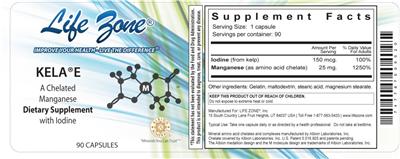
Supplement Facts
The label details for KELA E by Life Zone, sourced from the NIH Dietary Supplement Label Database.
Supplement Facts
| Ingredient | Amount | % DV |
|---|---|---|
| Manganese | 25 mg | 1250% |
| Iodine | 150 mcg | 100% |
Other ingredients: Gelatin, Maltodextrin, Stearic Acid, Magnesium Stearate
Tap any ingredient to jump to its full detail below.
These statements are the manufacturer’s wording, reproduced from the product label — the label is saying it, not HelloPharmacist. We don’t verify or endorse them.
FDA Statement of Identity
A Chelated Manganese Dietary Supplement with Iodine
Suggested/Recommended/Usage/Directions
Typical Use: Take one capsule daily or as directed by a health professional. Do not take at bedtime.
Precautions
KEEP THIS PRODUCT OUT OF REACH OF CHILDREN.
FDA Disclaimer Statement
*This statement has not been evaluated by the Food and Drug Administration. This product is not intended to diagnose, treat, cure, or prevent any disease.
Storage
Do not expose to extreme heat or cold.
General Statements
IMPROVE YOUR HEALTH* - LIVE THE DIFFERENCE(R)
Mineral amino acid chelates and complexes manufactured by Albion Laboratories, Inc. Chelate covered by Albion Laboratories, Inc. U.S. Patent 5,516,925 and patents pending. The Albion medallion design and the M molecule design are trademarks of Albion Laboratories, Inc.
Seals/Symbols
ALBION MINERALS(R) "Minerals You Can Trust"(TM)
M(TM)
Is this label outdated? Report a formula or label change and our pharmacy team will review it.
KELA E by Life Zone label
The label scan from the NIH Dietary Supplement Label Database. Tap to enlarge.
Label images are published by the NIH Dietary Supplement Label Database for the version of this product on file. Always read your actual product label.
View the full label (PDF)The Ingredients in KELA E by Life Zone
These are the 2 active ingredients this product is made of. Select any to open its full monograph.
Serving size1 Capsule(s) Dosage formCapsule Servings per container90 Amounts shown are per serving.
Most supplement products combine several ingredients, and a medication can interact with the product through any one of them. Each ingredient below shows whether it has known drug interactions.
Manganese
Interacts with83 drugs
Manganese is an essential trace mineral your body needs in small amounts for bone formation, metabolism, and antioxidant defense, and most people get...
Manganese monograph & interactionsIodine
Interacts with7 drugs
Iodine is an essential mineral your body needs to make thyroid hormones, and most people get enough from iodized salt, dairy, and seafood. Supplements...
Iodine monograph & interactionsOther (inactive) ingredients: Gelatin, Maltodextrin, Stearic Acid, Magnesium Stearate. These complete the product’s ingredient list but are not active constituents.
KELA E by Life Zone Drug Interactions
HelloPharmacist Interaction Report
Life Zone KELA E contains manganese and iodine, both of which have documented interactions with medications.
The most serious concern is manganese with antipsychotic drugs—there's a theoretical risk that manganese could increase toxicity risk, and a case report describes hallucinations and behavioral changes in a patient taking haloperidol (an antipsychotic) alongside manganese. Altogether, these interactions span 89 individual medications.
Read the full breakdown — every affected drug type, severity by severity
Manganese may also reduce how your body absorbs two classes of antibiotics: quinolones (like ciprofloxacin) and tetracyclines (like doxycycline). This happens because manganese is a mineral that can bind to these drugs in your gut and prevent them from being absorbed properly, potentially making the antibiotics less effective.
Iodine has separate interactions to watch. It can combine with lithium to worsen thyroid suppression, and it may interfere with antithyroid drugs by altering how well they work.
If you take amiodarone (a heart medication that's very high in iodine), adding this product could push your iodine levels too high and damage thyroid function.
Before you start KELA E, run your exact medications through the search tool below—especially if you take any antipsychotics, antibiotics, lithium, antithyroid drugs, or amiodarone.
Check your own medications below · Editorial policy · How we use AI
Want to check YOUR meds against KELA E?
Ask about interactions with your drugs in plain English — “Can I take it with lisinopril?” — and we find you the answer in seconds, ingredient by ingredient.
Go to the checkerIngredients driving the most interactions
Individual Drug Interactions
The ingredients in KELA E interact with 89 drugs. Click any drug to see the details.
2 of the 2 ingredients in KELA E interact with drugs. Each result below shows which ingredient is responsible. Manganese Iodine
AcepromazineAtravet
How Acepromazine interacts with KELA E — through 1 ingredient. Tap an ingredient for the detail:
ManganeseAntipsychotic Drugs Moderate
Interaction Summary
Theoretically, the risk for manganese toxicity might increase when taken with antipsychotic drugs.
Read the full Manganese + Acepromazine interactionAcetophenazineTindal
How Acetophenazine interacts with KELA E — through 1 ingredient. Tap an ingredient for the detail:
ManganeseAntipsychotic Drugs Moderate
Interaction Summary
Theoretically, the risk for manganese toxicity might increase when taken with antipsychotic drugs.
Read the full Manganese + Acetophenazine interactionAmiodaroneCordarone, Pacerone
How Amiodarone interacts with KELA E — through 1 ingredient. Tap an ingredient for the detail:
IodineAmiodarone (cordarone) Moderate
Interaction Summary
Combining iodine with amiodarone might cause excessively high iodine levels.
Read the full Iodine + Amiodarone interactionAmitriptyline, PerphenazineEtrafon, Etrafon-A, Etrafon-Forte, Triavil
How Amitriptyline, Perphenazine interacts with KELA E — through 1 ingredient. Tap an ingredient for the detail:
ManganeseAntipsychotic Drugs Moderate
Interaction Summary
Theoretically, the risk for manganese toxicity might increase when taken with antipsychotic drugs.
Read the full Manganese + Amitriptyline, Perphenazine interactionAmphotericin, TetracyclineMysteclin-F
How Amphotericin, Tetracycline interacts with KELA E — through 1 ingredient. Tap an ingredient for the detail:
ManganeseTetracycline Antibiotics Moderate
Interaction Summary
Theoretically, manganese might reduce the absorption of tetracycline antibiotics.
Read the full Manganese + Amphotericin, Tetracycline interactionAripiprazoleAbilify, Abilify Maintena, Abilify Mycite
How Aripiprazole interacts with KELA E — through 1 ingredient. Tap an ingredient for the detail:
ManganeseAntipsychotic Drugs Moderate
Interaction Summary
Theoretically, the risk for manganese toxicity might increase when taken with antipsychotic drugs.
Read the full Manganese + Aripiprazole interactionAripiprazole LauroxilAristada, Aristada Initio Kit
How Aripiprazole Lauroxil interacts with KELA E — through 1 ingredient. Tap an ingredient for the detail:
ManganeseAntipsychotic Drugs Moderate
Interaction Summary
Theoretically, the risk for manganese toxicity might increase when taken with antipsychotic drugs.
Read the full Manganese + Aripiprazole Lauroxil interactionAsenapineSaphris, Secuado
How Asenapine interacts with KELA E — through 1 ingredient. Tap an ingredient for the detail:
ManganeseAntipsychotic Drugs Moderate
Interaction Summary
Theoretically, the risk for manganese toxicity might increase when taken with antipsychotic drugs.
Read the full Manganese + Asenapine interactionBismuth Subsalicylate, Metronidazole, TetracyclineHelidac
How Bismuth Subsalicylate, Metronidazole, Tetracycline interacts with KELA E — through 1 ingredient. Tap an ingredient for the detail:
ManganeseTetracycline Antibiotics Moderate
Interaction Summary
Theoretically, manganese might reduce the absorption of tetracycline antibiotics.
Read the full Manganese + Bismuth Subsalicylate, Metronidazole, Tetracycline interactionBrexpiprazoleRexulti
How Brexpiprazole interacts with KELA E — through 1 ingredient. Tap an ingredient for the detail:
ManganeseAntipsychotic Drugs Moderate
Interaction Summary
Theoretically, the risk for manganese toxicity might increase when taken with antipsychotic drugs.
Read the full Manganese + Brexpiprazole interactionButaperazineRepoise
How Butaperazine interacts with KELA E — through 1 ingredient. Tap an ingredient for the detail:
ManganeseAntipsychotic Drugs Moderate
Interaction Summary
Theoretically, the risk for manganese toxicity might increase when taken with antipsychotic drugs.
Read the full Manganese + Butaperazine interactionCarbimazoleNeo-Mercazole
How Carbimazole interacts with KELA E — through 1 ingredient. Tap an ingredient for the detail:
IodineAntithyroid Drugs Moderate
Interaction Summary
Iodine might alter the effects of antithyroid drugs.
Read the full Iodine + Carbimazole interactionCariprazine HydrochlorideVraylar
How Cariprazine Hydrochloride interacts with KELA E — through 1 ingredient. Tap an ingredient for the detail:
ManganeseAntipsychotic Drugs Moderate
Interaction Summary
Theoretically, the risk for manganese toxicity might increase when taken with antipsychotic drugs.
Read the full Manganese + Cariprazine Hydrochloride interactionCarphenazineProketazin
How Carphenazine interacts with KELA E — through 1 ingredient. Tap an ingredient for the detail:
ManganeseAntipsychotic Drugs Moderate
Interaction Summary
Theoretically, the risk for manganese toxicity might increase when taken with antipsychotic drugs.
Read the full Manganese + Carphenazine interactionChlorpromazineThorazine, Thorazine Spansules
How Chlorpromazine interacts with KELA E — through 1 ingredient. Tap an ingredient for the detail:
ManganeseAntipsychotic Drugs Moderate
Interaction Summary
Theoretically, the risk for manganese toxicity might increase when taken with antipsychotic drugs.
Read the full Manganese + Chlorpromazine interactionChlorprothixeneTaractan
How Chlorprothixene interacts with KELA E — through 1 ingredient. Tap an ingredient for the detail:
ManganeseAntipsychotic Drugs Moderate
Interaction Summary
Theoretically, the risk for manganese toxicity might increase when taken with antipsychotic drugs.
Read the full Manganese + Chlorprothixene interactionChlortetracyclineAureomycin
How Chlortetracycline interacts with KELA E — through 1 ingredient. Tap an ingredient for the detail:
ManganeseTetracycline Antibiotics Moderate
Interaction Summary
Theoretically, manganese might reduce the absorption of tetracycline antibiotics.
Read the full Manganese + Chlortetracycline interactionCinoxacinCinobac
How Cinoxacin interacts with KELA E — through 1 ingredient. Tap an ingredient for the detail:
ManganeseQuinolone Antibiotics Moderate
Interaction Summary
Theoretically, manganese might reduce the absorption of quinolone antibiotics.
Read the full Manganese + Cinoxacin interactionCiprofloxacinCiloxan, Cipro, Cipro IV, Cipro XR, Ciprobay, Otiprio
How Ciprofloxacin interacts with KELA E — through 1 ingredient. Tap an ingredient for the detail:
ManganeseQuinolone Antibiotics Moderate
Interaction Summary
Theoretically, manganese might reduce the absorption of quinolone antibiotics.
Read the full Manganese + Ciprofloxacin interactionClinafloxacinClinafloxacin
How Clinafloxacin interacts with KELA E — through 1 ingredient. Tap an ingredient for the detail:
ManganeseQuinolone Antibiotics Moderate
Interaction Summary
Theoretically, manganese might reduce the absorption of quinolone antibiotics.
Read the full Manganese + Clinafloxacin interactionClozapineClozaril, Versacloz
How Clozapine interacts with KELA E — through 1 ingredient. Tap an ingredient for the detail:
ManganeseAntipsychotic Drugs Moderate
Interaction Summary
Theoretically, the risk for manganese toxicity might increase when taken with antipsychotic drugs.
Read the full Manganese + Clozapine interactionCyamemazineTercian
How Cyamemazine interacts with KELA E — through 1 ingredient. Tap an ingredient for the detail:
ManganeseAntipsychotic Drugs Moderate
Interaction Summary
Theoretically, the risk for manganese toxicity might increase when taken with antipsychotic drugs.
Read the full Manganese + Cyamemazine interactionDemeclocyclineDeclomycin
How Demeclocycline interacts with KELA E — through 1 ingredient. Tap an ingredient for the detail:
ManganeseTetracycline Antibiotics Moderate
Interaction Summary
Theoretically, manganese might reduce the absorption of tetracycline antibiotics.
Read the full Manganese + Demeclocycline interactionDoripenemDoribax
How Doripenem interacts with KELA E — through 1 ingredient. Tap an ingredient for the detail:
ManganeseTetracycline Antibiotics, Quinolone Antibiotics Moderate
Interaction Summary
Theoretically, manganese might reduce the absorption of tetracycline antibiotics.
Read the full Manganese + Doripenem interactionDoxycyclineDoryx, Doxy, Doxy-D, Doxycin, Doxycycline Injection, Doxylin +6 more
How Doxycycline interacts with KELA E — through 1 ingredient. Tap an ingredient for the detail:
ManganeseTetracycline Antibiotics Moderate
Interaction Summary
Theoretically, manganese might reduce the absorption of tetracycline antibiotics.
Read the full Manganese + Doxycycline interactionDoxycycline HyclateActiclate, Acticlate Cap, Lymepak
How Doxycycline Hyclate interacts with KELA E — through 1 ingredient. Tap an ingredient for the detail:
ManganeseTetracycline Antibiotics Moderate
Interaction Summary
Theoretically, manganese might reduce the absorption of tetracycline antibiotics.
Read the full Manganese + Doxycycline Hyclate interactionDoxycycline MonohydrateErfacea
How Doxycycline Monohydrate interacts with KELA E — through 1 ingredient. Tap an ingredient for the detail:
ManganeseTetracycline Antibiotics Moderate
Interaction Summary
Theoretically, manganese might reduce the absorption of tetracycline antibiotics.
Read the full Manganese + Doxycycline Monohydrate interactionDoxycylineDoxychel
How Doxycyline interacts with KELA E — through 1 ingredient. Tap an ingredient for the detail:
ManganeseTetracycline Antibiotics Moderate
Interaction Summary
Theoretically, manganese might reduce the absorption of tetracycline antibiotics.
Read the full Manganese + Doxycyline interactionEnoxacinPenetrex
How Enoxacin interacts with KELA E — through 1 ingredient. Tap an ingredient for the detail:
ManganeseQuinolone Antibiotics Moderate
Interaction Summary
Theoretically, manganese might reduce the absorption of quinolone antibiotics.
Read the full Manganese + Enoxacin interactionEravacyclineXerava
How Eravacycline interacts with KELA E — through 1 ingredient. Tap an ingredient for the detail:
ManganeseTetracycline Antibiotics Moderate
Interaction Summary
Theoretically, manganese might reduce the absorption of tetracycline antibiotics.
Read the full Manganese + Eravacycline interactionEach ingredient & the kinds of drugs it affects
For each ingredient in KELA E with known interactions, here are the types of medications they can affect. Open any type for the detail — or search your exact drug in the checker above.
Manganese
Antipsychotic Drugs
Theoretically, the risk for manganese toxicity might increase when taken with antipsychotic drugs.
Hallucinations and behavioral changes have been reported in a patient with liver disease who was taking haloperidol and manganese. Researchers speculate that taking manganese along with haloperidol, phenothiazine-derivatives, or other antipsychotic medications might increase the risk of manganese toxicity in some patients.
Quinolone Antibiotics
Theoretically, manganese might reduce the absorption of quinolone antibiotics.
Manganese is a multivalent cation. Interactions resulting in reduced quinolone absorption have been reported between quinolones and other multivalent cations, such as calcium and iron.
Tetracycline Antibiotics
Theoretically, manganese might reduce the absorption of tetracycline antibiotics.
Manganese is a multivalent cation. Interactions resulting in reduced tetracycline absorption have been reported between tetracyclines and other multivalent cations, such as calcium and iron.
Iodine
Amiodarone (Cordarone)
Combining iodine with amiodarone might cause excessively high iodine levels.
Amiodarone contains 37.3% iodine and can increase iodine levels. Concomitant use with iodine might increase the risk of having excessive iodine levels and adversely affecting thyroid function. Monitor thyroid function.
Antithyroid Drugs
Iodine might alter the effects of antithyroid drugs.
Iodine in high doses has been reported to cause both hyperthyroidism and hypothyroidism, depending on the individual's past medical history. Taking iodine while using antithyroid drugs could alter the effects of the antithyroid drugs.
Lithium
Combining iodine with lithium might have additive hypothyroid effects.
Lithium can inhibit thyroid function. Several case reports suggest that concomitant use of lithium and potassium iodide can reduce thyroid function in otherwise healthy adults. Monitor thyroid function.
Brand information
Manufacturer and brand details for KELA E, from the product label.
KELA E by Life Zone: Common Questions
Does KELA E by Life Zone interact with any medications?
How can one product interact with so many drugs?
Where does this information come from?
Is KELA E safe to take if I'm pregnant or breastfeeding?
Can high doses of manganese hurt me?
What are the side effects of iodine in this product?
Will KELA E help with hay fever or arthritis?
How does manganese interact with my antibiotics?
Why is this product risky if I take lithium?
Written and reviewed by the HelloPharmacist editorial staff. Our editorial policy
Not sure if KELA E is safe with your meds?
Our pharmacists answer your medication & supplement questions — free.
Label information is sourced from the NIH Dietary Supplement Label Database and reflects the product version on file; always read your actual product label. This page is for education only and is not a substitute for professional medical advice. Confirm with your pharmacist or doctor before combining supplements and medications.
The Full Monographs Behind KELA E’s Ingredients
Every ingredient we hold a full HelloPharmacist monograph for — uses, evidence, safety, and the complete interaction list.
Manganese
Interacts with 83 drugsManganese is an essential trace mineral your body needs in small amounts for bone formation, metabolism, and antioxidant defense, and most people get enough from a normal diet. Supplements m...
Read the full Manganese monograph → Herb & supplement monographIodine
Interacts with 7 drugsIodine is an essential mineral your body needs to make thyroid hormones, and most people get enough from iodized salt, dairy, and seafood. Supplements help when you are truly deficient, but...
Read the full Iodine monograph →Sources & How We Checked
KELA E's label data comes from the NIH Dietary Supplement Label Database; the ingredient interaction data is from the Natural Medicines database, reviewed by our pharmacists.
- NIH Dietary Supplement Label Database (DSLD) — The official product label on file for this supplement.
- Natural Medicines (Therapeutic Research Center) — Evidence-graded clinical reference behind the ingredient interaction data.
Content is written and reviewed by licensed HelloPharmacist pharmacists. See our data sources and editorial standards for how this information is built and checked.
The 47 references behind this product’s interaction data
Every citation that drives the interaction findings for this product’s ingredients, from the evidence-graded Natural Medicines (TRC Healthcare) database. Open an ingredient to browse its citations — links open the study on PubMed or the publisher’s site.
Manganese 21 references
- Hansten PD, Horn JR. Hansten and Horn's Drug Interactions Analysis and Management. Vancouver, CAN:Appl Therapeut, 1999.
- Barrington WW, Angle CR, Willcockson NK, et al. Autonomic function in manganese alloy workers. Environ Res 1998;78:50-8. PubMed
- Hauser RA, Zesiewicz TA, Martinez C, et al. Blood manganese correlates with brain magnetic resonance imaging changes in patients with liver disease. Can J Neurol Sci 1996;23:95-8. PubMed
- Food and Nutrition Board, Institute of Medicine. Dietary Reference Intakes for Vitamin A, Vitamin K, Arsenic, Boron, Chromium, Copper, Iodine, Iron, Manganese, Molybdenum, Nickel, Silicon, Vanadium, and Zinc. Washington, DC: National Academy Press, 2002.
- Lee JW. Manganese intoxication. Arch Neurol 2000;57:597-9.. PubMed
- Powers KM, Smith-Weller T, Franklin GM, et al. Parkinson's disease risks associated with dietary iron, manganese, and other nutrient intakes. Neurology 2003;60:1761-6.. PubMed
- McMillan, D. E. A brief history of the neurobehavioral toxicity of manganese: some unanswered questions. Neurotoxicology 1999;20(2-3):499-507.
- Gerber, G. B., Leonard, A., and Hantson, P. Carcinogenicity, mutagenicity and teratogenicity of manganese compounds. Crit Rev Oncol Hematol. 2002;42(1):25-34. PubMed
- Jiang, Y. and Zheng, W. Cardiovascular toxicities upon manganese exposure. Cardiovasc.Toxicol 2005;5(4):345-354. PubMed
- Mehta, R. and Reilly, J. J. Manganese levels in a jaundiced long-term total parenteral nutrition patient: potentiation of haloperidol toxicity? Case report and literature review. JPEN J Parenter.Enteral Nutr 1990;14(4):428-430. PubMed
- Nemery, B. Metal toxicity and the respiratory tract. Eur Respir.J 1990;3(2):202-219. DOI
- Vanek VW, Borum P, Buchman A, et al. A.S.P.E.N. position paper: recommendations for changes in commercially available parenteral multivitamin and multi-trace element products. Nutr Clin Pract. 2012;27:440-491.doi: 10.1177/0884533612446706 PubMed
- Schuh MJ. Possible Parkinson's disease induced by chronic manganese supplement ingestion. Consult Pharm. 2016;31(12):698-703. doi: 10.4140/TCP.n.2016.698. PubMed
- Baker B, Ali A, Isenring L. Recommendations for manganese supplementation to adult patients receiving long-term home parenteral nutrition: an analysis of the supporting evidence. Nutr Clin Pract 2016;31(2):180-5. doi: 10.1177/0884533615591600. PubMed
- Ho CSH, Ho RCM, Quek AML. Chronic manganese toxicity associated with voltage-gated potassium channel complex antibodies in a relapsing neuropsychiatric disorder. Int J Environ Res Public Health 2018;15(4). pii: E783. doi: 10.3390/ijerph15040783. PubMed
- Yamamoto M, Sakurai K, Eguchi A, et al.; Japan Environment and Children's Study Group: Association between blood manganese level during pregnancy and birth size: the Japan environment and children's study (JECS). Environ Res 2019;172:117-26. PubMed
- Li D, Ge X, Liu Z, et al. Association between long-term occupational manganese exposure and bone quality among retired workers. Environ Sci Pollut Res Int 2020;27(1):482-9. PubMed
- Martin KV, Sucharew H, Dietrich KN, et al. Co-exposure to manganese and lead and pediatric neurocognition in East Liverpool, Ohio. Environ Res 2021;202:111644. PubMed
- Racette BA, Nelson G, Dlamini WW, et al. Depression and anxiety in a manganese-exposed community. Neurotoxicology 2021;85:222-33. PubMed
- Ruiz-Azcona L, Fernández-Olmo I, Expósito A, et al. Impact of environmental airborne manganese exposure on cognitive and motor functions in adults: a systematic review and meta-analysis. Int J Environ Res Public Health 2021;18(8):4075. PubMed
- Uyar E, Gurkas E, Aksu AU, et al. Can therapeutic plasma exchange be life-saving in life-threatening manganese intoxication?. Transfus Apher Sci 2022;61(4):103417. PubMed
Iodine 26 references
- McEvoy GK, ed. AHFS Drug Information. Bethesda, MD: American Society of Health-System Pharmacists, 1998.
- Goodman GA, Rall TW, Nies AS, Taylor P. The Pharmacological Basis of Therapeutics, 9th ed.
- Ghent WR, Eskin BA, Low DA, Hill LP. Iodine replacement in fibrocystic disease of the breast. Can J Surg 1993;36:453-60.
- Potassium iodide for nuclear exposure. Pharmacist's Letter/Prescriber's Letter 2001;17(12):171214.
- Food and Nutrition Board, Institute of Medicine. Dietary Reference Intakes for Vitamin A, Vitamin K, Arsenic, Boron, Chromium, Copper, Iodine, Iron, Manganese, Molybdenum, Nickel, Silicon, Vanadium, and Zinc. Washington, DC: National Academy Press, 2002.
- Cabezas C, Bustamante B, Holgado W, Begue RE. Treatment of cutaneous sporotrichosis with one daily dose of potassium iodide. Pediatr Infect Dis J 1996;15:352-4. PubMed
- Sterling JB, Heymann WR. Potassium iodide in dermatology: a 19th century drug for the 21st century-uses, pharmacology, adverse effects, and contraindications. J Am Acad Dermatol 2000;43:691-7. PubMed
- Yarrington CD, Pearce EN. Dietary iodine in pregnancy and postpartum. Clin Obstet Gynecol 2011;54:459-70. PubMed
- Goel, S., Mandhani, A., Srivastava, A., Kapoor, R., Gogoi, S., Kumar, A., and Bhandari, M. Is povidone iodine an alternative to silver nitrate for renal pelvic instillation sclerotherapy in chyluria? BJU.Int 2004;94(7):1082-1085. PubMed
- Teng, W., Shan, Z., Teng, X., Guan, H., Li, Y., Teng, D., Jin, Y., Yu, X., Fan, C., Chong, W., Yang, F., Dai, H., Yu, Y., Li, J., Chen, Y., Zhao, D., Shi, X., Hu, F., Mao, J., Gu, X., Yang, R., Tong, Y., Wang, W., Gao, T., and Li, C. Effect of iodine int
- Crawford, B. A., Cowell, C. T., Emder, P. J., Learoyd, D. L., Chua, E. L., Sinn, J., and Jack, M. M. Iodine toxicity from soy milk and seaweed ingestion is associated with serious thyroid dysfunction. Med J Aust. 10-4-2010;193(7):413-415. PubMed
- Ohkuma, M. Molluscum contagiosum treated with iodine solution and salicylic acid plaster. Int J Dermatol. 1990;29(6):443-445. PubMed
- Connelly KJ, Boston BA, Pearce EN, Sesser D, Snyder D, Braverman LE, Pino S, LaFranchi SH. Congenital hypothyroidism caused by excess prenatal maternal iodine ingestion. J Pediatr. 2012 Oct;161(4):760-2. PubMed
- Kasahara T, Narumi S, Okasora K, Takaya R, Tamai H, Hasegawa T. Delayed onset congenital hypothyroidism in a patient with DUOX2 mutations and maternal iodine excess. Am J Med Genet A. 2013 Jan;161A(1):214-7.
- Murcia M, Rebagliato M, Iñiguez C, Lopez-Espinosa MJ, Estarlich M, Plaza B, Barona-Vilar C, Espada M, Vioque J, Ballester F. Effect of iodine supplementation during pregnancy on infant neurodevelopment at 1 year of age. Am J Epidemiol. 2011 Apr 1;173(7):8 PubMed
- Sang Z, Wang PP, Yao Z, Shen J, Halfyard B, Tan L, Zhao N, Wu Y, Gao S, Tan J, Liu J, Chen Z, Zhang W. Exploration of the safe upper level of iodine intake in euthyroid Chinese adults: a randomized double-blind trial. Am J Clin Nutr. 2012 Feb;95(2):367-73 PubMed
- Speeckaert MM, Speeckaert R, Wierckx K, Delanghe JR, Kaufman JM. Value and pitfalls in iodine fortification and supplementation in the 21st century. Br J Nutr. 2011 Oct;106(7):964-73. PubMed
- Yun SE, Kang Y, Bae EJ, Hwang K, Jang HN, Cho HS, Chang SH, Park DJ. Iodine-induced thyrotoxic hypokalemic paralysis after ingestion of Salicornia herbace. Ren Fail. 2014 Apr;36(3):461-3.
- Iodine Hypersensitivity. Pharmacist's Letter/Prescriber's Letter 2011; 27(5):270504.
- Hammel JA, Selby JC. Pustular eruption in a patient with cancer treated with complementary and alternative medicine. JAMA Dermatology 2017 October; E1. doi: 10.1001/jamadermatol.2017.3749. [Epub ahead of print] PubMed
- Gil GS, Smith BW, Guerra JR, Williams WT. Acute Delirium in a Hypothyroid Patient Precipitated by Iodine Supplements Use. Am J Ther. 2018;25(6):e717-e718. PubMed
- Hamby T, Kunnel N, Dallas JS, Wilson DP. Maternal iodine excess: an uncommon cause of acquired neonatal hypothyroidism. J Pediatr Endocrinol Metab. 2018;31(9):1061-1064. PubMed
- Censi S, Watutantrige-Fernando S, Groccia G, et al. The Effects of Iodine Supplementation in Pregnancy on Iodine Status, Thyroglobulin Levels and Thyroid Function Parameters: Results from a Randomized Controlled Clinical Trial in a Mild-to-Moderate Iodine
- Rovner MS, Wolf BJ, Rubin M, et al. Instillation of 5% Povidone-Iodine Ophthalmic Drops Decreases the Respiratory Rate in Children Undergoing Strabismus Surgery: A Randomized Controlled Trial. J Pediatr Ophthalmol Strabismus. 2019;56(6):378-382. PubMed
- Guenezan J, Garcia M, Strasters D, et al. Povidone Iodine Mouthwash, Gargle, and Nasal Spray to Reduce Nasopharyngeal Viral Load in Patients With COVID-19: A Randomized Clinical Trial. JAMA Otolaryngol Head Neck Surg. 2021;147(4):400-401. PubMed
- Li F, Wan S, Zhang L, et al. A Meta-Analysis of the Effect of Iodine Excess on the Intellectual Development of Children in Areas with High Iodine Levels in their Drinking Water. Biol Trace Elem Res 2022;200(4):1580-1590. PubMed
Parts of this content are provided by the Therapeutic Research Center, LLC.
DISCLAIMER: Currently this does not check for drug-drug interactions. This is not an all-inclusive comprehensive list of potential interactions and is for informational purposes only. Not all interactions are known or well-reported in the scientific literature, and new interactions are continually being reported. Input is needed from a qualified healthcare provider including a pharmacist before starting any therapy. Application of clinical judgment is necessary.
© 2021 Therapeutic Research Center, LLC