
Stress Factors Ingredients & Drug Interactions
by Nutra BioGenesis
What is this page for?
First and foremost: checking Stress Factors against your medications. The heart of this page is the interaction checker and the full interaction report — how this product’s ingredients may interact with prescription and over-the-counter medicines you may be taking.
Around that, we add a pharmacist’s high-level view of the product as a whole — what’s inside, the evidence for its stated use, how transparent the label is, and what safety data exists — so you can see the full picture in one place. It’s educational information from our licensed clinical databases and the clinical staff at HelloPharmacist — not medical advice — and we don’t sell or endorse products. Our editorial policy
Stress Factors is a dietary supplement by Nutra BioGenesis with 8 active ingredients. Its ingredients are commonly taken for low mood or depression, anxiety and stress, sleep problems.Based on those ingredients, 1,275 medications have a known interaction with it, the most serious rated major. The ingredients most likely to interact are Hops, Passionflower Aerial Extract, L-Theanine. Use the checker below to test your specific medication, or read the full HelloPharmacist Interaction Report.
Check Your Meds Against Stress Factors by Nutra BioGenesis
Ask about any prescription or over-the-counter medication and we check it for interactions with Stress Factors by Nutra BioGenesis — and tell you which ingredient is responsible.
AI summaries are generated from our interaction database for education only — always confirm with your pharmacist. How we use AI
Ask the Pharmacist
A licensed pharmacist will answer your question by email — free, usually within 24 hours.
Got it — thank you!
A licensed pharmacist will answer within 24 hours. Keep an eye on your email (worth checking spam, just in case).
HelloPharmacist Scorecard of Stress Factors by Nutra BioGenesis
Our pharmacy team’s full take, with four database checks built into the cards below — a summary of what is known, not a grade of the product itself.
What’s inside
Full disclosure
Stress Factors contains eight active ingredients. The main ones are 5-HTP, a serotonin precursor; L-theanine, an amino acid from tea; GABA, a calming neurotransmitter; lithium orotate, a mineral form of lithium; and herbal extracts of hops and passionflower.
You'll also find vitamin B6 and inositol, a sugar-like compound. The product also includes inactive ingredients — cellulose and rice bran extract — which are fillers and binders.
Does it work?
Moderate evidence
The evidence for this product's ingredients is mixed. 5-HTP is possibly effective for depression, though the data on other uses like panic disorder or Alzheimer's disease is insufficient.
Vitamin B6 is effective for certain types of anemia and B6 deficiency, and possibly effective for pregnancy-related nausea. Inositol is possibly effective for polycystic ovary syndrome and metabolic syndrome but possibly ineffective for anxiety and depression.
L-theanine is possibly effective for cognitive function but the evidence for anxiety is insufficient. Passionflower is possibly effective for insomnia and pre-procedural anxiety.
GABA and hops lack sufficient evidence to rate their effectiveness for most conditions. Lithium orotate's effectiveness for any condition has not been established in the data we hold.
How safe is it?
Well-documented data
5-HTP is generally well tolerated short-term but can cause abdominal pain, diarrhea, drowsiness, fatigue, headache, nausea, and vomiting, especially at higher doses. Rare serious effects include aggression, hallucinations, and mania.
Avoid it during pregnancy and breastfeeding — there isn't enough safety information. Vitamin B6 is safe at normal doses from food and standard supplements, but high doses over time can damage nerves (sensory neuropathy).
Inositol is generally well tolerated with mostly mild digestive side effects like diarrhea, gas, and nausea; safety in pregnancy and breastfeeding hasn't been fully established. L-theanine may cause headaches and drowsiness; avoid during pregnancy and breastfeeding due to lack of safety data.
GABA is generally well tolerated short-term but can cause drowsiness, nausea, and muscle weakness; avoid during pregnancy and breastfeeding. Lithium orotate has a narrow safety margin — prescription lithium requires blood monitoring, and the supplement form is not well studied.
Lithium can harm a developing baby and passes into breast milk; avoid unless your doctor directs and monitors it. Hops can cause drowsiness and is not well studied long-term; avoid during pregnancy and breastfeeding.
Passionflower is well tolerated but can cause confusion, dizziness, and sedation; avoid during pregnancy due to possible uterine effects, and avoid while breastfeeding.
Meds to double-check
Major interaction found
Check with your pharmacist before taking this if you use serotonergic drugs like SSRIs or other antidepressants, diuretics, blood pressure medications, diabetes drugs, NSAIDs like ibuprofen, seizure medications, sedatives or sleep aids, antipsychotics, ACE inhibitors, calcium channel blockers, or skeletal muscle relaxants — this product carries multiple interactions across these categories, some Major in severity.
The bottom line
Scorecard at a glanceFully disclosed formula with some supporting evidence for its stated purpose. Major medication interactions have been identified, and safety information is well characterized.
Stress Factors is designed for people looking to manage everyday stress and anxiety, with ingredients like passionflower and L-theanine that have some evidence for these uses. However, because it contains lithium orotate, serotonergic 5-HTP, and several other sedating herbs, you need to talk with your pharmacist or doctor before taking it if you use any mood medications, blood pressure drugs, diabetes medications, diuretics, or sedatives — the interactions can be serious.
If you're pregnant or breastfeeding, skip this product without professional guidance.
Educational only — not medical advice; always confirm with your pharmacist. Our editorial policy · How we use AI
Assessment coverage: 8 of 8 active ingredients matched to our full ingredient reviews (monographs). Based on the product label dated Dec 21, 2024.
This Scorecard evaluates available label information, ingredient evidence, and known medication-safety considerations. It does not independently verify product identity, purity, potency, contamination, or manufacturing quality. How these ratings are computed
General information
Key facts about Stress Factors, straight from the product label.
| Brand | Nutra BioGenesis |
|---|---|
| Barcode (UPC) | 812806102686 |
| Net contents | 60 Capsule(s) |
| Market status | On market |
| Date entered into DSLD | Dec 21, 2024 |
| DSLD ID | 323013 |
| Product type | Other Combinations |
| Supplement form | Capsule |
| Dietary claims / uses | Nutrient, All Other, Structure/Function |
| Intended target group(s) | Vegan, Vegetarian, Adult (18 - 50 Years), Gluten Free, Dairy Free |
Everything in this section is reproduced from the manufacturer’s own product label — it’s the label speaking, not HelloPharmacist. We show it so you can see exactly what the maker states; we don’t verify or endorse those statements.
Supplement Facts
The label details for Stress Factors by Nutra BioGenesis, sourced from the NIH Dietary Supplement Label Database.
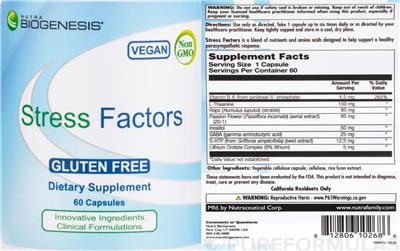
Supplement Facts
| Ingredient | Amount | % DV |
|---|---|---|
| 5-HTP | 12.5 mg | -- |
| Vitamin B6 | 4.5 mg | 265% |
| Inositol | 50 mg | -- |
| L-Theanine | 100 mg | -- |
| Gamma Aminobutyric Acid | 25 mg | -- |
| Lithium Orotate | 5 mg | -- |
| Hops | 85 mg | -- |
| Passionflower Aerial Extract | 85 mg | -- |
Other ingredients: Cellulose, Cellulose, Rice Bran Extract
Tap any ingredient to jump to its full detail below.
These statements are the manufacturer’s wording, reproduced from the product label — the label is saying it, not HelloPharmacist. We don’t verify or endorse them.
Formulation
Vegan
Non GMO Gluten free
FDA Statement of Identity
Dietary Supplement
General Statements
Innovative ingredients. Clinical formulations.
Pure formulas
Precautions
Warning: Do not use if safety seal is broken or missing.
Keep out of reach of children.
Keep your licensed healthcare practitioner informed when using this product, especially if pregnant or nursing.
California Residents Only Warning: Reproductive Harm - www.P65Warnings.ca.gov
Suggested/Recommended/Usage/Directions
Directions: Use only as directed. Take 1 capsule up to six times daily or as directed by your healthcare practitioner.
Storage
Keep tightly capped and store in a cool, dry place.
Formula
Stress Factors is a blend of nutrients and amino acids designed to help support a healthy parasympathetic response.
FDA Disclaimer Statement
These statements have not been evaluated by the FDA. This product is not intended to diagnose, treat, cure or prevent any disease.
Is this label outdated? Report a formula or label change and our pharmacy team will review it.
Stress Factors by Nutra BioGenesis label
The label scan from the NIH Dietary Supplement Label Database. Tap to enlarge.
Label images are published by the NIH Dietary Supplement Label Database for the version of this product on file. Always read your actual product label.
View the full label (PDF)The Ingredients in Stress Factors by Nutra BioGenesis
These are the 8 active ingredients this product is made of. Select any to open its full monograph.
Serving size1 Capsule(s) Dosage formCapsule Servings per container60 Amounts shown are per serving.
Most supplement products combine several ingredients, and a medication can interact with the product through any one of them. Each ingredient below shows whether it has known drug interactions.
5-HTP
Interacts with398 drugs
5-HTP is a compound your body uses to make serotonin, and people take it as a supplement hoping to improve mood, sleep, and headaches. Some early rese...
5-HTP monograph & interactionsVitamin B6
Interacts with210 drugs
Vitamin B6 (pyridoxine) is an essential water-soluble vitamin that your body needs for metabolism, brain function, and making red blood cells. It is b...
Vitamin B6 monograph & interactionsInositol
Interacts with86 drugs
Inositol is a sugar alcohol made naturally in the body and found in many foods, and it is sold as a supplement (often myo-inositol) mainly for PCOS, m...
Inositol monograph & interactionsL-Theanine
Interacts with565 drugs
Theanine (usually L-theanine) is an amino acid found naturally in tea leaves that many people take to feel calmer and less stressed without strong dro...
L-Theanine monograph & interactionsGamma Aminobutyric Acid
Interacts with419 drugs
GABA is a calming chemical messenger (neurotransmitter) that your body makes on its own, and it is sold as a supplement for stress, anxiety, and sleep...
Gamma Aminobutyric Acid monograph & interactionsLithium Orotate
Interacts with515 drugs
Lithium is a naturally occurring metal that, in prescription form (lithium carbonate or citrate), is an FDA-approved, well-proven treatment for bipola...
Lithium Orotate monograph & interactionsHops
Interacts with863 drugs
Hops are most often used for sleep and mild anxiety, frequently combined with valerian, but the human evidence is limited and not very strong. They ar...
Hops monograph & interactionsPassionflower Aerial Extract
Interacts with836 drugs
Passion flower is a traditional calming herb that many people use for anxiety and sleep. Early studies hint it may help with mild anxiety and restless...
Passionflower Aerial Extract monograph & interactionsOther (inactive) ingredients: Cellulose, Cellulose, Rice Bran Extract. These complete the product’s ingredient list but are not active constituents.
Stress Factors by Nutra BioGenesis Drug Interactions
HelloPharmacist Interaction Report
Stress Factors by Nutra BioGenesis contains several ingredients with documented interactions with medications, and the most serious ones involve lithium orotate.
This ingredient carries Major-severity interactions with serotonergic drugs (antidepressants, mood stabilizers) — there's a risk that lithium combined with these medications could mask serotonin syndrome while actually increasing its risk — and with diuretic drugs, which can raise lithium levels and cause toxicity. Lithium orotate also has Moderate interactions with NSAIDs, ACE inhibitors, calcium channel blockers, anticonvulsants, antipsychotics, and skeletal muscle relaxants.
Read the full breakdown — every affected drug type, severity by severity
5-HTP carries Moderate-severity interactions with CNS depressants (sedatives, sleep aids, pain medications) and serotonergic drugs; combining either with 5-HTP could intensify drowsiness or increase the risk of serotonin syndrome. Vitamin B6 at high doses interacts Moderately with blood pressure medications, the heart drug amiodarone, and seizure medications (phenobarbital and phenytoin).
Inositol may lower blood sugar and increase the risk of low blood glucose (hypoglycemia) when taken with diabetes medications.
L-theanine, GABA, hops, and passionflower all carry Moderate interactions with CNS depressants — adding any of them to sedating drugs could cause extra drowsiness. L-theanine and GABA may also lower blood pressure with antihypertensives.
Passionflower has Minor interactions with certain drug-metabolizing enzymes. Altogether, these interactions span 1,262 individual medications.
Check your exact prescriptions with the search tool on this page before starting.
Check your own medications below · Editorial policy · How we use AI
Want to check YOUR meds against Stress Factors?
Ask about interactions with your drugs in plain English — “Can I take it with lisinopril?” — and we find you the answer in seconds, ingredient by ingredient.
Go to the checkerIngredients driving the most interactions
Individual Drug Interactions
The ingredients in Stress Factors interact with 1,275 drugs. Click any drug to see the details.
8 of the 8 ingredients in Stress Factors interact with drugs. Each result below shows which ingredient is responsible. Hops Passionflower Aerial Extract L-Theanine Lithium Orotate Gamma Aminobutyric Acid 5-HTP Vitamin B6 Inositol
Acetaminophen, Caffeine, PyrilamineMidol Max Strength Menstrual
How Acetaminophen, Caffeine, Pyrilamine interacts with Stress Factors — through 3 ingredients. Tap an ingredient for the detail:
Lithium OrotateMethylxanthines, Diuretic Drugs Major
Interaction Summary
Theoretically, taking lithium supplements with methylxanthines might decrease lithium levels.
Read the full Lithium Orotate + Acetaminophen, Caffeine, Pyrilamine interactionHopsCytochrome P450 1a2 (cyp1a2) Substrates, Cytochrome P450 3a4 (cyp3a4) Substrates Minor
Interaction Summary
Hops extract does not seem to affect the metabolism of CYP1A2 substrates.
Read the full Hops + Acetaminophen, Caffeine, Pyrilamine interactionPassionflower Aerial ExtractCytochrome P450 3a4 (cyp3a4) Substrates Minor
Interaction Summary
Theoretically, passion flower might decrease the effects of CYP3A4 substrates.
Read the full Passionflower Aerial Extract + Acetaminophen, Caffeine, Pyrilamine interactionAcetaminophen, Chlorpheniramine Maleate, Dextromethorphan HbrVicks Formula 44M Cough, Cold & Flu Relief
How Acetaminophen, Chlorpheniramine Maleate, Dextromethorphan Hbr interacts with Stress Factors — through 5 ingredients. Tap an ingredient for the detail:
Lithium OrotateSerotonergic Drugs Major
Interaction Summary
Theoretically, taking lithium supplements with serotonergic drugs might both mask and increase the risk of serotonin syndrome.
Read the full Lithium Orotate + Acetaminophen, Chlorpheniramine Maleate, Dextromethorphan Hbr interaction5-htpSerotonergic Drugs Moderate
Interaction Summary
Combining serotonergic drugs with 5-HTP might cause additive serotonergic effects.
Read the full 5-htp + Acetaminophen, Chlorpheniramine Maleate, Dextromethorphan Hbr interactionHopsCytochrome P450 3a4 (cyp3a4) Substrates, Cytochrome P450 1a2 (cyp1a2) Substrates Minor
Interaction Summary
Theoretically, hops extract might alter metabolism of CYP3A4 substrates; however, this effect may not be clinically significant.
Read the full Hops + Acetaminophen, Chlorpheniramine Maleate, Dextromethorphan Hbr interactionPassionflower Aerial ExtractCytochrome P450 3a4 (cyp3a4) Substrates Minor
Interaction Summary
Theoretically, passion flower might decrease the effects of CYP3A4 substrates.
Read the full Passionflower Aerial Extract + Acetaminophen, Chlorpheniramine Maleate, Dextromethorphan Hbr interactionL-theanineSerotonergic Drugs Minor
Interaction Summary
Clinical studies regarding the effects of L-theanine on serotonin levels are conflicting.
Read the full L-theanine + Acetaminophen, Chlorpheniramine Maleate, Dextromethorphan Hbr interactionAcetaminophen, Chlorpheniramine, Codeine, PhenylephrineColrex
How Acetaminophen, Chlorpheniramine, Codeine, Phenylephrine interacts with Stress Factors — through 6 ingredients. Tap an ingredient for the detail:
Lithium OrotateSerotonergic Drugs Major
Interaction Summary
Theoretically, taking lithium supplements with serotonergic drugs might both mask and increase the risk of serotonin syndrome.
Read the full Lithium Orotate + Acetaminophen, Chlorpheniramine, Codeine, Phenylephrine interactionPassionflower Aerial ExtractCns Depressants, Cytochrome P450 3a4 (cyp3a4) Substrates Moderate
Interaction Summary
Concomitant use of passion flower with sedative drugs might cause additive effects and side effects.
Read the full Passionflower Aerial Extract + Acetaminophen, Chlorpheniramine, Codeine, Phenylephrine interaction5-htpSerotonergic Drugs, Cns Depressants Moderate
Interaction Summary
Combining serotonergic drugs with 5-HTP might cause additive serotonergic effects.
Read the full 5-htp + Acetaminophen, Chlorpheniramine, Codeine, Phenylephrine interactionHopsCytochrome P450 1a2 (cyp1a2) Substrates, Cytochrome P450 3a4 (cyp3a4) Substrates +1 Moderate
Interaction Summary
Hops extract does not seem to affect the metabolism of CYP1A2 substrates.
Read the full Hops + Acetaminophen, Chlorpheniramine, Codeine, Phenylephrine interactionL-theanineSerotonergic Drugs, Cns Depressants Minor
Interaction Summary
Clinical studies regarding the effects of L-theanine on serotonin levels are conflicting.
Read the full L-theanine + Acetaminophen, Chlorpheniramine, Codeine, Phenylephrine interactionGamma Aminobutyric AcidCns Depressants Minor
Interaction Summary
Theoretically, GABA might have additive sedative effects when used in conjunction with CNS depressants.
Read the full Gamma Aminobutyric Acid + Acetaminophen, Chlorpheniramine, Codeine, Phenylephrine interactionAcetaminophen, Chlorpheniramine, DextromethorphanCoricidin II Extra Strength Cold and Flu
How Acetaminophen, Chlorpheniramine, Dextromethorphan interacts with Stress Factors — through 5 ingredients. Tap an ingredient for the detail:
Lithium OrotateSerotonergic Drugs Major
Interaction Summary
Theoretically, taking lithium supplements with serotonergic drugs might both mask and increase the risk of serotonin syndrome.
Read the full Lithium Orotate + Acetaminophen, Chlorpheniramine, Dextromethorphan interaction5-htpSerotonergic Drugs Moderate
Interaction Summary
Combining serotonergic drugs with 5-HTP might cause additive serotonergic effects.
Read the full 5-htp + Acetaminophen, Chlorpheniramine, Dextromethorphan interactionHopsCytochrome P450 1a2 (cyp1a2) Substrates, Cytochrome P450 3a4 (cyp3a4) Substrates Minor
Interaction Summary
Hops extract does not seem to affect the metabolism of CYP1A2 substrates.
Read the full Hops + Acetaminophen, Chlorpheniramine, Dextromethorphan interactionL-theanineSerotonergic Drugs Minor
Interaction Summary
Clinical studies regarding the effects of L-theanine on serotonin levels are conflicting.
Read the full L-theanine + Acetaminophen, Chlorpheniramine, Dextromethorphan interactionPassionflower Aerial ExtractCytochrome P450 3a4 (cyp3a4) Substrates Minor
Interaction Summary
Theoretically, passion flower might decrease the effects of CYP3A4 substrates.
Read the full Passionflower Aerial Extract + Acetaminophen, Chlorpheniramine, Dextromethorphan interactionAcetaminophen, Chlorpheniramine, Dextromethorphan HydrobromideCoricidin HBP Maximum Strength Flu
How Acetaminophen, Chlorpheniramine, Dextromethorphan Hydrobromide interacts with Stress Factors — through 5 ingredients. Tap an ingredient for the detail:
Lithium OrotateSerotonergic Drugs Major
Interaction Summary
Theoretically, taking lithium supplements with serotonergic drugs might both mask and increase the risk of serotonin syndrome.
Read the full Lithium Orotate + Acetaminophen, Chlorpheniramine, Dextromethorphan Hydrobromide interaction5-htpSerotonergic Drugs Moderate
Interaction Summary
Combining serotonergic drugs with 5-HTP might cause additive serotonergic effects.
Read the full 5-htp + Acetaminophen, Chlorpheniramine, Dextromethorphan Hydrobromide interactionPassionflower Aerial ExtractCytochrome P450 3a4 (cyp3a4) Substrates Minor
Interaction Summary
Theoretically, passion flower might decrease the effects of CYP3A4 substrates.
Read the full Passionflower Aerial Extract + Acetaminophen, Chlorpheniramine, Dextromethorphan Hydrobromide interactionHopsCytochrome P450 3a4 (cyp3a4) Substrates, Cytochrome P450 1a2 (cyp1a2) Substrates Minor
Interaction Summary
Theoretically, hops extract might alter metabolism of CYP3A4 substrates; however, this effect may not be clinically significant.
Read the full Hops + Acetaminophen, Chlorpheniramine, Dextromethorphan Hydrobromide interactionL-theanineSerotonergic Drugs Minor
Interaction Summary
Clinical studies regarding the effects of L-theanine on serotonin levels are conflicting.
Read the full L-theanine + Acetaminophen, Chlorpheniramine, Dextromethorphan Hydrobromide interactionAcetaminophen, Chlorpheniramine, Dextromethorphan, PhenylpropanolamineMulti Symptom Cold Relief
How Acetaminophen, Chlorpheniramine, Dextromethorphan, Phenylpropanolamine interacts with Stress Factors — through 5 ingredients. Tap an ingredient for the detail:
Lithium OrotateSerotonergic Drugs Major
Interaction Summary
Theoretically, taking lithium supplements with serotonergic drugs might both mask and increase the risk of serotonin syndrome.
Read the full Lithium Orotate + Acetaminophen, Chlorpheniramine, Dextromethorphan, Phenylpropanolamine interaction5-htpSerotonergic Drugs Moderate
Interaction Summary
Combining serotonergic drugs with 5-HTP might cause additive serotonergic effects.
Read the full 5-htp + Acetaminophen, Chlorpheniramine, Dextromethorphan, Phenylpropanolamine interactionL-theanineSerotonergic Drugs Minor
Interaction Summary
Clinical studies regarding the effects of L-theanine on serotonin levels are conflicting.
Read the full L-theanine + Acetaminophen, Chlorpheniramine, Dextromethorphan, Phenylpropanolamine interactionPassionflower Aerial ExtractCytochrome P450 3a4 (cyp3a4) Substrates Minor
Interaction Summary
Theoretically, passion flower might decrease the effects of CYP3A4 substrates.
Read the full Passionflower Aerial Extract + Acetaminophen, Chlorpheniramine, Dextromethorphan, Phenylpropanolamine interactionHopsCytochrome P450 1a2 (cyp1a2) Substrates, Cytochrome P450 3a4 (cyp3a4) Substrates Minor
Interaction Summary
Hops extract does not seem to affect the metabolism of CYP1A2 substrates.
Read the full Hops + Acetaminophen, Chlorpheniramine, Dextromethorphan, Phenylpropanolamine interactionAcetaminophen, Chlorpheniramine, Dextromethorphan, PseudoephedrineChildren's Tylenol Cold Plus Cough, Tylenol Cold Ex Strength
How Acetaminophen, Chlorpheniramine, Dextromethorphan, Pseudoephedrine interacts with Stress Factors — through 5 ingredients. Tap an ingredient for the detail:
Lithium OrotateSerotonergic Drugs Major
Interaction Summary
Theoretically, taking lithium supplements with serotonergic drugs might both mask and increase the risk of serotonin syndrome.
Read the full Lithium Orotate + Acetaminophen, Chlorpheniramine, Dextromethorphan, Pseudoephedrine interaction5-htpSerotonergic Drugs Moderate
Interaction Summary
Combining serotonergic drugs with 5-HTP might cause additive serotonergic effects.
Read the full 5-htp + Acetaminophen, Chlorpheniramine, Dextromethorphan, Pseudoephedrine interactionHopsCytochrome P450 3a4 (cyp3a4) Substrates, Cytochrome P450 1a2 (cyp1a2) Substrates Minor
Interaction Summary
Theoretically, hops extract might alter metabolism of CYP3A4 substrates; however, this effect may not be clinically significant.
Read the full Hops + Acetaminophen, Chlorpheniramine, Dextromethorphan, Pseudoephedrine interactionL-theanineSerotonergic Drugs Minor
Interaction Summary
Clinical studies regarding the effects of L-theanine on serotonin levels are conflicting.
Read the full L-theanine + Acetaminophen, Chlorpheniramine, Dextromethorphan, Pseudoephedrine interactionPassionflower Aerial ExtractCytochrome P450 3a4 (cyp3a4) Substrates Minor
Interaction Summary
Theoretically, passion flower might decrease the effects of CYP3A4 substrates.
Read the full Passionflower Aerial Extract + Acetaminophen, Chlorpheniramine, Dextromethorphan, Pseudoephedrine interactionAcetaminophen, Chlorpheniramine, Guaifenesin, Phenylephrine, SalicylamideRhinogesic GG
How Acetaminophen, Chlorpheniramine, Guaifenesin, Phenylephrine, Salicylamide interacts with Stress Factors — through 5 ingredients. Tap an ingredient for the detail:
Lithium OrotateSerotonergic Drugs Major
Interaction Summary
Theoretically, taking lithium supplements with serotonergic drugs might both mask and increase the risk of serotonin syndrome.
Read the full Lithium Orotate + Acetaminophen, Chlorpheniramine, Guaifenesin, Phenylephrine, Salicylamide interaction5-htpSerotonergic Drugs Moderate
Interaction Summary
Combining serotonergic drugs with 5-HTP might cause additive serotonergic effects.
Read the full 5-htp + Acetaminophen, Chlorpheniramine, Guaifenesin, Phenylephrine, Salicylamide interactionHopsCytochrome P450 3a4 (cyp3a4) Substrates, Cytochrome P450 1a2 (cyp1a2) Substrates Minor
Interaction Summary
Theoretically, hops extract might alter metabolism of CYP3A4 substrates; however, this effect may not be clinically significant.
Read the full Hops + Acetaminophen, Chlorpheniramine, Guaifenesin, Phenylephrine, Salicylamide interactionPassionflower Aerial ExtractCytochrome P450 3a4 (cyp3a4) Substrates Minor
Interaction Summary
Theoretically, passion flower might decrease the effects of CYP3A4 substrates.
Read the full Passionflower Aerial Extract + Acetaminophen, Chlorpheniramine, Guaifenesin, Phenylephrine, Salicylamide interactionL-theanineSerotonergic Drugs Minor
Interaction Summary
Clinical studies regarding the effects of L-theanine on serotonin levels are conflicting.
Read the full L-theanine + Acetaminophen, Chlorpheniramine, Guaifenesin, Phenylephrine, Salicylamide interactionAcetaminophen, Chlorpheniramine, PhenylephrineAlka-Seltzer PLUS, Histex SR, Protid
How Acetaminophen, Chlorpheniramine, Phenylephrine interacts with Stress Factors — through 5 ingredients. Tap an ingredient for the detail:
Lithium OrotateSerotonergic Drugs Major
Interaction Summary
Theoretically, taking lithium supplements with serotonergic drugs might both mask and increase the risk of serotonin syndrome.
Read the full Lithium Orotate + Acetaminophen, Chlorpheniramine, Phenylephrine interaction5-htpSerotonergic Drugs Moderate
Interaction Summary
Combining serotonergic drugs with 5-HTP might cause additive serotonergic effects.
Read the full 5-htp + Acetaminophen, Chlorpheniramine, Phenylephrine interactionL-theanineSerotonergic Drugs Minor
Interaction Summary
Clinical studies regarding the effects of L-theanine on serotonin levels are conflicting.
Read the full L-theanine + Acetaminophen, Chlorpheniramine, Phenylephrine interactionPassionflower Aerial ExtractCytochrome P450 3a4 (cyp3a4) Substrates Minor
Interaction Summary
Theoretically, passion flower might decrease the effects of CYP3A4 substrates.
Read the full Passionflower Aerial Extract + Acetaminophen, Chlorpheniramine, Phenylephrine interactionHopsCytochrome P450 1a2 (cyp1a2) Substrates, Cytochrome P450 3a4 (cyp3a4) Substrates Minor
Interaction Summary
Hops extract does not seem to affect the metabolism of CYP1A2 substrates.
Read the full Hops + Acetaminophen, Chlorpheniramine, Phenylephrine interactionAcetaminophen, Chlorpheniramine, Phenylephrine, SalicylamideRhinogesic, Rhinogesic JR
How Acetaminophen, Chlorpheniramine, Phenylephrine, Salicylamide interacts with Stress Factors — through 5 ingredients. Tap an ingredient for the detail:
Lithium OrotateSerotonergic Drugs Major
Interaction Summary
Theoretically, taking lithium supplements with serotonergic drugs might both mask and increase the risk of serotonin syndrome.
Read the full Lithium Orotate + Acetaminophen, Chlorpheniramine, Phenylephrine, Salicylamide interaction5-htpSerotonergic Drugs Moderate
Interaction Summary
Combining serotonergic drugs with 5-HTP might cause additive serotonergic effects.
Read the full 5-htp + Acetaminophen, Chlorpheniramine, Phenylephrine, Salicylamide interactionHopsCytochrome P450 1a2 (cyp1a2) Substrates, Cytochrome P450 3a4 (cyp3a4) Substrates Minor
Interaction Summary
Hops extract does not seem to affect the metabolism of CYP1A2 substrates.
Read the full Hops + Acetaminophen, Chlorpheniramine, Phenylephrine, Salicylamide interactionL-theanineSerotonergic Drugs Minor
Interaction Summary
Clinical studies regarding the effects of L-theanine on serotonin levels are conflicting.
Read the full L-theanine + Acetaminophen, Chlorpheniramine, Phenylephrine, Salicylamide interactionPassionflower Aerial ExtractCytochrome P450 3a4 (cyp3a4) Substrates Minor
Interaction Summary
Theoretically, passion flower might decrease the effects of CYP3A4 substrates.
Read the full Passionflower Aerial Extract + Acetaminophen, Chlorpheniramine, Phenylephrine, Salicylamide interactionAcetaminophen, Chlorpheniramine, PhenylpropanolamineAlumadrine, Conex, Sinadrin Max Strength, Sinulin
How Acetaminophen, Chlorpheniramine, Phenylpropanolamine interacts with Stress Factors — through 5 ingredients. Tap an ingredient for the detail:
Lithium OrotateSerotonergic Drugs Major
Interaction Summary
Theoretically, taking lithium supplements with serotonergic drugs might both mask and increase the risk of serotonin syndrome.
Read the full Lithium Orotate + Acetaminophen, Chlorpheniramine, Phenylpropanolamine interaction5-htpSerotonergic Drugs Moderate
Interaction Summary
Combining serotonergic drugs with 5-HTP might cause additive serotonergic effects.
Read the full 5-htp + Acetaminophen, Chlorpheniramine, Phenylpropanolamine interactionPassionflower Aerial ExtractCytochrome P450 3a4 (cyp3a4) Substrates Minor
Interaction Summary
Theoretically, passion flower might decrease the effects of CYP3A4 substrates.
Read the full Passionflower Aerial Extract + Acetaminophen, Chlorpheniramine, Phenylpropanolamine interactionHopsCytochrome P450 1a2 (cyp1a2) Substrates, Cytochrome P450 3a4 (cyp3a4) Substrates Minor
Interaction Summary
Hops extract does not seem to affect the metabolism of CYP1A2 substrates.
Read the full Hops + Acetaminophen, Chlorpheniramine, Phenylpropanolamine interactionL-theanineSerotonergic Drugs Minor
Interaction Summary
Clinical studies regarding the effects of L-theanine on serotonin levels are conflicting.
Read the full L-theanine + Acetaminophen, Chlorpheniramine, Phenylpropanolamine interactionAcetaminophen, Chlorpheniramine, Phenylpropanolamine, OpiumHista-Derfule
How Acetaminophen, Chlorpheniramine, Phenylpropanolamine, Opium interacts with Stress Factors — through 6 ingredients. Tap an ingredient for the detail:
Lithium OrotateSerotonergic Drugs Major
Interaction Summary
Theoretically, taking lithium supplements with serotonergic drugs might both mask and increase the risk of serotonin syndrome.
Read the full Lithium Orotate + Acetaminophen, Chlorpheniramine, Phenylpropanolamine, Opium interactionPassionflower Aerial ExtractCytochrome P450 3a4 (cyp3a4) Substrates, Cns Depressants Moderate
Interaction Summary
Theoretically, passion flower might decrease the effects of CYP3A4 substrates.
Read the full Passionflower Aerial Extract + Acetaminophen, Chlorpheniramine, Phenylpropanolamine, Opium interactionHopsCytochrome P450 3a4 (cyp3a4) Substrates, Cytochrome P450 1a2 (cyp1a2) Substrates +1 Moderate
Interaction Summary
Theoretically, hops extract might alter metabolism of CYP3A4 substrates; however, this effect may not be clinically significant.
Read the full Hops + Acetaminophen, Chlorpheniramine, Phenylpropanolamine, Opium interaction5-htpSerotonergic Drugs, Cns Depressants Moderate
Interaction Summary
Combining serotonergic drugs with 5-HTP might cause additive serotonergic effects.
Read the full 5-htp + Acetaminophen, Chlorpheniramine, Phenylpropanolamine, Opium interactionL-theanineSerotonergic Drugs, Cns Depressants Minor
Interaction Summary
Clinical studies regarding the effects of L-theanine on serotonin levels are conflicting.
Read the full L-theanine + Acetaminophen, Chlorpheniramine, Phenylpropanolamine, Opium interactionGamma Aminobutyric AcidCns Depressants Minor
Interaction Summary
Theoretically, GABA might have additive sedative effects when used in conjunction with CNS depressants.
Read the full Gamma Aminobutyric Acid + Acetaminophen, Chlorpheniramine, Phenylpropanolamine, Opium interactionAcetaminophen, Chlorpheniramine, Phenylpropanolamine, PhenyltoloxamineNorel Plus
How Acetaminophen, Chlorpheniramine, Phenylpropanolamine, Phenyltoloxamine interacts with Stress Factors — through 5 ingredients. Tap an ingredient for the detail:
Lithium OrotateSerotonergic Drugs Major
Interaction Summary
Theoretically, taking lithium supplements with serotonergic drugs might both mask and increase the risk of serotonin syndrome.
Read the full Lithium Orotate + Acetaminophen, Chlorpheniramine, Phenylpropanolamine, Phenyltoloxamine interaction5-htpSerotonergic Drugs Moderate
Interaction Summary
Combining serotonergic drugs with 5-HTP might cause additive serotonergic effects.
Read the full 5-htp + Acetaminophen, Chlorpheniramine, Phenylpropanolamine, Phenyltoloxamine interactionHopsCytochrome P450 1a2 (cyp1a2) Substrates, Cytochrome P450 3a4 (cyp3a4) Substrates Minor
Interaction Summary
Hops extract does not seem to affect the metabolism of CYP1A2 substrates.
Read the full Hops + Acetaminophen, Chlorpheniramine, Phenylpropanolamine, Phenyltoloxamine interactionL-theanineSerotonergic Drugs Minor
Interaction Summary
Clinical studies regarding the effects of L-theanine on serotonin levels are conflicting.
Read the full L-theanine + Acetaminophen, Chlorpheniramine, Phenylpropanolamine, Phenyltoloxamine interactionPassionflower Aerial ExtractCytochrome P450 3a4 (cyp3a4) Substrates Minor
Interaction Summary
Theoretically, passion flower might decrease the effects of CYP3A4 substrates.
Read the full Passionflower Aerial Extract + Acetaminophen, Chlorpheniramine, Phenylpropanolamine, Phenyltoloxamine interactionAcetaminophen, Chlorpheniramine, PseudoephedrineAlka-Seltzer PLUS Liquid Gels, Children's Tylenol Cold, Codimal, Comtrex, Extra Strength Tylenol Allergy Sinus, Lorsin +3 more
How Acetaminophen, Chlorpheniramine, Pseudoephedrine interacts with Stress Factors — through 5 ingredients. Tap an ingredient for the detail:
Lithium OrotateSerotonergic Drugs Major
Interaction Summary
Theoretically, taking lithium supplements with serotonergic drugs might both mask and increase the risk of serotonin syndrome.
Read the full Lithium Orotate + Acetaminophen, Chlorpheniramine, Pseudoephedrine interaction5-htpSerotonergic Drugs Moderate
Interaction Summary
Combining serotonergic drugs with 5-HTP might cause additive serotonergic effects.
Read the full 5-htp + Acetaminophen, Chlorpheniramine, Pseudoephedrine interactionPassionflower Aerial ExtractCytochrome P450 3a4 (cyp3a4) Substrates Minor
Interaction Summary
Theoretically, passion flower might decrease the effects of CYP3A4 substrates.
Read the full Passionflower Aerial Extract + Acetaminophen, Chlorpheniramine, Pseudoephedrine interactionHopsCytochrome P450 1a2 (cyp1a2) Substrates, Cytochrome P450 3a4 (cyp3a4) Substrates Minor
Interaction Summary
Hops extract does not seem to affect the metabolism of CYP1A2 substrates.
Read the full Hops + Acetaminophen, Chlorpheniramine, Pseudoephedrine interactionL-theanineSerotonergic Drugs Minor
Interaction Summary
Clinical studies regarding the effects of L-theanine on serotonin levels are conflicting.
Read the full L-theanine + Acetaminophen, Chlorpheniramine, Pseudoephedrine interactionAcetaminophen, DextromethorphanTylenol Cough Ex Strength
How Acetaminophen, Dextromethorphan interacts with Stress Factors — through 5 ingredients. Tap an ingredient for the detail:
Lithium OrotateSerotonergic Drugs Major
Interaction Summary
Theoretically, taking lithium supplements with serotonergic drugs might both mask and increase the risk of serotonin syndrome.
Read the full Lithium Orotate + Acetaminophen, Dextromethorphan interaction5-htpSerotonergic Drugs Moderate
Interaction Summary
Combining serotonergic drugs with 5-HTP might cause additive serotonergic effects.
Read the full 5-htp + Acetaminophen, Dextromethorphan interactionHopsCytochrome P450 1a2 (cyp1a2) Substrates, Cytochrome P450 3a4 (cyp3a4) Substrates Minor
Interaction Summary
Hops extract does not seem to affect the metabolism of CYP1A2 substrates.
Read the full Hops + Acetaminophen, Dextromethorphan interactionL-theanineSerotonergic Drugs Minor
Interaction Summary
Clinical studies regarding the effects of L-theanine on serotonin levels are conflicting.
Read the full L-theanine + Acetaminophen, Dextromethorphan interactionPassionflower Aerial ExtractCytochrome P450 3a4 (cyp3a4) Substrates Minor
Interaction Summary
Theoretically, passion flower might decrease the effects of CYP3A4 substrates.
Read the full Passionflower Aerial Extract + Acetaminophen, Dextromethorphan interactionAcetaminophen, Dextromethorphan, Doxylamine, PseudoephedrineVicks NyQuil
How Acetaminophen, Dextromethorphan, Doxylamine, Pseudoephedrine interacts with Stress Factors — through 5 ingredients. Tap an ingredient for the detail:
Lithium OrotateSerotonergic Drugs Major
Interaction Summary
Theoretically, taking lithium supplements with serotonergic drugs might both mask and increase the risk of serotonin syndrome.
Read the full Lithium Orotate + Acetaminophen, Dextromethorphan, Doxylamine, Pseudoephedrine interaction5-htpSerotonergic Drugs Moderate
Interaction Summary
Combining serotonergic drugs with 5-HTP might cause additive serotonergic effects.
Read the full 5-htp + Acetaminophen, Dextromethorphan, Doxylamine, Pseudoephedrine interactionL-theanineSerotonergic Drugs Minor
Interaction Summary
Clinical studies regarding the effects of L-theanine on serotonin levels are conflicting.
Read the full L-theanine + Acetaminophen, Dextromethorphan, Doxylamine, Pseudoephedrine interactionHopsCytochrome P450 3a4 (cyp3a4) Substrates, Cytochrome P450 1a2 (cyp1a2) Substrates Minor
Interaction Summary
Theoretically, hops extract might alter metabolism of CYP3A4 substrates; however, this effect may not be clinically significant.
Read the full Hops + Acetaminophen, Dextromethorphan, Doxylamine, Pseudoephedrine interactionPassionflower Aerial ExtractCytochrome P450 3a4 (cyp3a4) Substrates Minor
Interaction Summary
Theoretically, passion flower might decrease the effects of CYP3A4 substrates.
Read the full Passionflower Aerial Extract + Acetaminophen, Dextromethorphan, Doxylamine, Pseudoephedrine interactionAcetaminophen, Dextromethorphan, Guaifenesin, PhenylephrineConar-A
How Acetaminophen, Dextromethorphan, Guaifenesin, Phenylephrine interacts with Stress Factors — through 5 ingredients. Tap an ingredient for the detail:
Lithium OrotateSerotonergic Drugs Major
Interaction Summary
Theoretically, taking lithium supplements with serotonergic drugs might both mask and increase the risk of serotonin syndrome.
Read the full Lithium Orotate + Acetaminophen, Dextromethorphan, Guaifenesin, Phenylephrine interaction5-htpSerotonergic Drugs Moderate
Interaction Summary
Combining serotonergic drugs with 5-HTP might cause additive serotonergic effects.
Read the full 5-htp + Acetaminophen, Dextromethorphan, Guaifenesin, Phenylephrine interactionHopsCytochrome P450 1a2 (cyp1a2) Substrates, Cytochrome P450 3a4 (cyp3a4) Substrates Minor
Interaction Summary
Hops extract does not seem to affect the metabolism of CYP1A2 substrates.
Read the full Hops + Acetaminophen, Dextromethorphan, Guaifenesin, Phenylephrine interactionL-theanineSerotonergic Drugs Minor
Interaction Summary
Clinical studies regarding the effects of L-theanine on serotonin levels are conflicting.
Read the full L-theanine + Acetaminophen, Dextromethorphan, Guaifenesin, Phenylephrine interactionPassionflower Aerial ExtractCytochrome P450 3a4 (cyp3a4) Substrates Minor
Interaction Summary
Theoretically, passion flower might decrease the effects of CYP3A4 substrates.
Read the full Passionflower Aerial Extract + Acetaminophen, Dextromethorphan, Guaifenesin, Phenylephrine interactionAcetaminophen, Dextromethorphan, Guaifenesin, PhenylpropanolamineAnatuss
How Acetaminophen, Dextromethorphan, Guaifenesin, Phenylpropanolamine interacts with Stress Factors — through 5 ingredients. Tap an ingredient for the detail:
Lithium OrotateSerotonergic Drugs Major
Interaction Summary
Theoretically, taking lithium supplements with serotonergic drugs might both mask and increase the risk of serotonin syndrome.
Read the full Lithium Orotate + Acetaminophen, Dextromethorphan, Guaifenesin, Phenylpropanolamine interaction5-htpSerotonergic Drugs Moderate
Interaction Summary
Combining serotonergic drugs with 5-HTP might cause additive serotonergic effects.
Read the full 5-htp + Acetaminophen, Dextromethorphan, Guaifenesin, Phenylpropanolamine interactionPassionflower Aerial ExtractCytochrome P450 3a4 (cyp3a4) Substrates Minor
Interaction Summary
Theoretically, passion flower might decrease the effects of CYP3A4 substrates.
Read the full Passionflower Aerial Extract + Acetaminophen, Dextromethorphan, Guaifenesin, Phenylpropanolamine interactionHopsCytochrome P450 1a2 (cyp1a2) Substrates, Cytochrome P450 3a4 (cyp3a4) Substrates Minor
Interaction Summary
Hops extract does not seem to affect the metabolism of CYP1A2 substrates.
Read the full Hops + Acetaminophen, Dextromethorphan, Guaifenesin, Phenylpropanolamine interactionL-theanineSerotonergic Drugs Minor
Interaction Summary
Clinical studies regarding the effects of L-theanine on serotonin levels are conflicting.
Read the full L-theanine + Acetaminophen, Dextromethorphan, Guaifenesin, Phenylpropanolamine interactionAcetaminophen, Dextromethorphan, Guaifenesin, PseudoephedrineRobitussin Cold, Severe Cold, Suphedrine Cold/Cough
How Acetaminophen, Dextromethorphan, Guaifenesin, Pseudoephedrine interacts with Stress Factors — through 5 ingredients. Tap an ingredient for the detail:
Lithium OrotateSerotonergic Drugs Major
Interaction Summary
Theoretically, taking lithium supplements with serotonergic drugs might both mask and increase the risk of serotonin syndrome.
Read the full Lithium Orotate + Acetaminophen, Dextromethorphan, Guaifenesin, Pseudoephedrine interaction5-htpSerotonergic Drugs Moderate
Interaction Summary
Combining serotonergic drugs with 5-HTP might cause additive serotonergic effects.
Read the full 5-htp + Acetaminophen, Dextromethorphan, Guaifenesin, Pseudoephedrine interactionL-theanineSerotonergic Drugs Minor
Interaction Summary
Clinical studies regarding the effects of L-theanine on serotonin levels are conflicting.
Read the full L-theanine + Acetaminophen, Dextromethorphan, Guaifenesin, Pseudoephedrine interactionHopsCytochrome P450 3a4 (cyp3a4) Substrates, Cytochrome P450 1a2 (cyp1a2) Substrates Minor
Interaction Summary
Theoretically, hops extract might alter metabolism of CYP3A4 substrates; however, this effect may not be clinically significant.
Read the full Hops + Acetaminophen, Dextromethorphan, Guaifenesin, Pseudoephedrine interactionPassionflower Aerial ExtractCytochrome P450 3a4 (cyp3a4) Substrates Minor
Interaction Summary
Theoretically, passion flower might decrease the effects of CYP3A4 substrates.
Read the full Passionflower Aerial Extract + Acetaminophen, Dextromethorphan, Guaifenesin, Pseudoephedrine interactionAcetaminophen, Dextromethorphan, Phenylpropanolamine, PyrilamineTheracaps
How Acetaminophen, Dextromethorphan, Phenylpropanolamine, Pyrilamine interacts with Stress Factors — through 5 ingredients. Tap an ingredient for the detail:
Lithium OrotateSerotonergic Drugs Major
Interaction Summary
Theoretically, taking lithium supplements with serotonergic drugs might both mask and increase the risk of serotonin syndrome.
Read the full Lithium Orotate + Acetaminophen, Dextromethorphan, Phenylpropanolamine, Pyrilamine interaction5-htpSerotonergic Drugs Moderate
Interaction Summary
Combining serotonergic drugs with 5-HTP might cause additive serotonergic effects.
Read the full 5-htp + Acetaminophen, Dextromethorphan, Phenylpropanolamine, Pyrilamine interactionHopsCytochrome P450 1a2 (cyp1a2) Substrates, Cytochrome P450 3a4 (cyp3a4) Substrates Minor
Interaction Summary
Hops extract does not seem to affect the metabolism of CYP1A2 substrates.
Read the full Hops + Acetaminophen, Dextromethorphan, Phenylpropanolamine, Pyrilamine interactionL-theanineSerotonergic Drugs Minor
Interaction Summary
Clinical studies regarding the effects of L-theanine on serotonin levels are conflicting.
Read the full L-theanine + Acetaminophen, Dextromethorphan, Phenylpropanolamine, Pyrilamine interactionPassionflower Aerial ExtractCytochrome P450 3a4 (cyp3a4) Substrates Minor
Interaction Summary
Theoretically, passion flower might decrease the effects of CYP3A4 substrates.
Read the full Passionflower Aerial Extract + Acetaminophen, Dextromethorphan, Phenylpropanolamine, Pyrilamine interactionAcetaminophen, Dextromethorphan, PseudoephedrineAlka-Seltzer PLUS Flu Liquid Gels, Non Aspirin Cold Caps, Tylenol Cold, Tylenol Flu Daytime Ex Strength, Tylenol Flu Ex Strength
How Acetaminophen, Dextromethorphan, Pseudoephedrine interacts with Stress Factors — through 5 ingredients. Tap an ingredient for the detail:
Lithium OrotateSerotonergic Drugs Major
Interaction Summary
Theoretically, taking lithium supplements with serotonergic drugs might both mask and increase the risk of serotonin syndrome.
Read the full Lithium Orotate + Acetaminophen, Dextromethorphan, Pseudoephedrine interaction5-htpSerotonergic Drugs Moderate
Interaction Summary
Combining serotonergic drugs with 5-HTP might cause additive serotonergic effects.
Read the full 5-htp + Acetaminophen, Dextromethorphan, Pseudoephedrine interactionPassionflower Aerial ExtractCytochrome P450 3a4 (cyp3a4) Substrates Minor
Interaction Summary
Theoretically, passion flower might decrease the effects of CYP3A4 substrates.
Read the full Passionflower Aerial Extract + Acetaminophen, Dextromethorphan, Pseudoephedrine interactionHopsCytochrome P450 3a4 (cyp3a4) Substrates, Cytochrome P450 1a2 (cyp1a2) Substrates Minor
Interaction Summary
Theoretically, hops extract might alter metabolism of CYP3A4 substrates; however, this effect may not be clinically significant.
Read the full Hops + Acetaminophen, Dextromethorphan, Pseudoephedrine interactionL-theanineSerotonergic Drugs Minor
Interaction Summary
Clinical studies regarding the effects of L-theanine on serotonin levels are conflicting.
Read the full L-theanine + Acetaminophen, Dextromethorphan, Pseudoephedrine interactionAcetaminophen, MeperidineDemerol APAP
How Acetaminophen, Meperidine interacts with Stress Factors — through 6 ingredients. Tap an ingredient for the detail:
Lithium OrotateSerotonergic Drugs Major
Interaction Summary
Theoretically, taking lithium supplements with serotonergic drugs might both mask and increase the risk of serotonin syndrome.
Read the full Lithium Orotate + Acetaminophen, Meperidine interaction5-htpSerotonergic Drugs, Cns Depressants Moderate
Interaction Summary
Combining serotonergic drugs with 5-HTP might cause additive serotonergic effects.
Read the full 5-htp + Acetaminophen, Meperidine interactionHopsCytochrome P450 1a2 (cyp1a2) Substrates, Cns Depressants Moderate
Interaction Summary
Hops extract does not seem to affect the metabolism of CYP1A2 substrates.
Read the full Hops + Acetaminophen, Meperidine interactionPassionflower Aerial ExtractCns Depressants Moderate
Interaction Summary
Concomitant use of passion flower with sedative drugs might cause additive effects and side effects.
Read the full Passionflower Aerial Extract + Acetaminophen, Meperidine interactionGamma Aminobutyric AcidCns Depressants Minor
Interaction Summary
Theoretically, GABA might have additive sedative effects when used in conjunction with CNS depressants.
Read the full Gamma Aminobutyric Acid + Acetaminophen, Meperidine interactionL-theanineCns Depressants, Serotonergic Drugs Minor
Interaction Summary
Theoretically, theanine might have additive sedative effects when used in conjunction with CNS depressants.
Read the full L-theanine + Acetaminophen, Meperidine interactionAcetaminophen, Pamabrom, PyrilamineMidol Max Strength PMS, Pamprin, Pamprin ES
How Acetaminophen, Pamabrom, Pyrilamine interacts with Stress Factors — through 2 ingredients. Tap an ingredient for the detail:
Lithium OrotateDiuretic Drugs Major
Interaction Summary
Theoretically, taking lithium supplements with loop diuretics might increase lithium levels and adverse effects.
Read the full Lithium Orotate + Acetaminophen, Pamabrom, Pyrilamine interactionHopsCytochrome P450 1a2 (cyp1a2) Substrates Minor
Interaction Summary
Hops extract does not seem to affect the metabolism of CYP1A2 substrates.
Read the full Hops + Acetaminophen, Pamabrom, Pyrilamine interactionAcetaminophen, Phenylephrine, ChlorpheniramineSuper Cold Tabs
How Acetaminophen, Phenylephrine, Chlorpheniramine interacts with Stress Factors — through 5 ingredients. Tap an ingredient for the detail:
Lithium OrotateSerotonergic Drugs Major
Interaction Summary
Theoretically, taking lithium supplements with serotonergic drugs might both mask and increase the risk of serotonin syndrome.
Read the full Lithium Orotate + Acetaminophen, Phenylephrine, Chlorpheniramine interaction5-htpSerotonergic Drugs Moderate
Interaction Summary
Combining serotonergic drugs with 5-HTP might cause additive serotonergic effects.
Read the full 5-htp + Acetaminophen, Phenylephrine, Chlorpheniramine interactionPassionflower Aerial ExtractCytochrome P450 3a4 (cyp3a4) Substrates Minor
Interaction Summary
Theoretically, passion flower might decrease the effects of CYP3A4 substrates.
Read the full Passionflower Aerial Extract + Acetaminophen, Phenylephrine, Chlorpheniramine interactionHopsCytochrome P450 1a2 (cyp1a2) Substrates, Cytochrome P450 3a4 (cyp3a4) Substrates Minor
Interaction Summary
Hops extract does not seem to affect the metabolism of CYP1A2 substrates.
Read the full Hops + Acetaminophen, Phenylephrine, Chlorpheniramine interactionL-theanineSerotonergic Drugs Minor
Interaction Summary
Clinical studies regarding the effects of L-theanine on serotonin levels are conflicting.
Read the full L-theanine + Acetaminophen, Phenylephrine, Chlorpheniramine interactionAcetazolamideAk-Zol, Diamox
How Acetazolamide interacts with Stress Factors — through 7 ingredients. Tap an ingredient for the detail:
Lithium OrotateDiuretic Drugs, Anticonvulsants Major
Interaction Summary
Theoretically, taking lithium supplements with loop diuretics might increase lithium levels and adverse effects.
Read the full Lithium Orotate + Acetazolamide interaction5-htpCns Depressants Moderate
Interaction Summary
Theoretically, concomitant use of 5-HTP with medications that cause sedation might have additive effects.
Read the full 5-htp + Acetazolamide interactionGamma Aminobutyric AcidAntihypertensive Drugs, Cns Depressants Moderate
Interaction Summary
Theoretically, taking GABA with antihypertensive drugs might increase the risk of hypotension.
Read the full Gamma Aminobutyric Acid + Acetazolamide interactionHopsCns Depressants Moderate
Interaction Summary
Theoretically, concomitant use of hops with sedative drugs might cause additive sedation.
Read the full Hops + Acetazolamide interactionL-theanineCns Depressants, Antihypertensive Drugs Moderate
Interaction Summary
Theoretically, theanine might have additive sedative effects when used in conjunction with CNS depressants.
Read the full L-theanine + Acetazolamide interactionPassionflower Aerial ExtractCns Depressants Moderate
Interaction Summary
Concomitant use of passion flower with sedative drugs might cause additive effects and side effects.
Read the full Passionflower Aerial Extract + Acetazolamide interactionVitamin B6Antihypertensive Drugs Moderate
Interaction Summary
Theoretically, vitamin B6 may have additive effects when used with antihypertensive drugs.
Read the full Vitamin B6 + Acetazolamide interactionAlmotriptanAlmogran, Axert
How Almotriptan interacts with Stress Factors — through 5 ingredients. Tap an ingredient for the detail:
Lithium OrotateSerotonergic Drugs Major
Interaction Summary
Theoretically, taking lithium supplements with serotonergic drugs might both mask and increase the risk of serotonin syndrome.
Read the full Lithium Orotate + Almotriptan interaction5-htpSerotonergic Drugs Moderate
Interaction Summary
Combining serotonergic drugs with 5-HTP might cause additive serotonergic effects.
Read the full 5-htp + Almotriptan interactionHopsCytochrome P450 3a4 (cyp3a4) Substrates Minor
Interaction Summary
Theoretically, hops extract might alter metabolism of CYP3A4 substrates; however, this effect may not be clinically significant.
Read the full Hops + Almotriptan interactionPassionflower Aerial ExtractCytochrome P450 3a4 (cyp3a4) Substrates Minor
Interaction Summary
Theoretically, passion flower might decrease the effects of CYP3A4 substrates.
Read the full Passionflower Aerial Extract + Almotriptan interactionL-theanineSerotonergic Drugs Minor
Interaction Summary
Clinical studies regarding the effects of L-theanine on serotonin levels are conflicting.
Read the full L-theanine + Almotriptan interactionAlosetronLotronex
How Alosetron interacts with Stress Factors — through 3 ingredients. Tap an ingredient for the detail:
Lithium OrotateSerotonergic Drugs Major
Interaction Summary
Theoretically, taking lithium supplements with serotonergic drugs might both mask and increase the risk of serotonin syndrome.
Read the full Lithium Orotate + Alosetron interaction5-htpSerotonergic Drugs Moderate
Interaction Summary
Combining serotonergic drugs with 5-HTP might cause additive serotonergic effects.
Read the full 5-htp + Alosetron interactionL-theanineSerotonergic Drugs Minor
Interaction Summary
Clinical studies regarding the effects of L-theanine on serotonin levels are conflicting.
Read the full L-theanine + Alosetron interactionAmiloride, HydrochlorothiazideAmil-Co, Amilzide, Moduret 25, Moduretic
How Amiloride, Hydrochlorothiazide interacts with Stress Factors — through 4 ingredients. Tap an ingredient for the detail:
Lithium OrotateDiuretic Drugs Major
Interaction Summary
Theoretically, taking lithium supplements with loop diuretics might increase lithium levels and adverse effects.
Read the full Lithium Orotate + Amiloride, Hydrochlorothiazide interactionGamma Aminobutyric AcidAntihypertensive Drugs Moderate
Interaction Summary
Theoretically, taking GABA with antihypertensive drugs might increase the risk of hypotension.
Read the full Gamma Aminobutyric Acid + Amiloride, Hydrochlorothiazide interactionVitamin B6Antihypertensive Drugs Moderate
Interaction Summary
Theoretically, vitamin B6 may have additive effects when used with antihypertensive drugs.
Read the full Vitamin B6 + Amiloride, Hydrochlorothiazide interactionL-theanineAntihypertensive Drugs Moderate
Interaction Summary
Theanine might lower blood pressure, potentiating the effects of antihypertensive drugs.
Read the full L-theanine + Amiloride, Hydrochlorothiazide interactionAmitriptylineElavil
How Amitriptyline interacts with Stress Factors — through 6 ingredients. Tap an ingredient for the detail:
Lithium OrotateSerotonergic Drugs Major
Interaction Summary
Theoretically, taking lithium supplements with serotonergic drugs might both mask and increase the risk of serotonin syndrome.
Read the full Lithium Orotate + Amitriptyline interactionPassionflower Aerial ExtractCytochrome P450 3a4 (cyp3a4) Substrates, Cns Depressants Moderate
Interaction Summary
Theoretically, passion flower might decrease the effects of CYP3A4 substrates.
Read the full Passionflower Aerial Extract + Amitriptyline interactionHopsCytochrome P450 3a4 (cyp3a4) Substrates, Cytochrome P450 1a2 (cyp1a2) Substrates +1 Moderate
Interaction Summary
Theoretically, hops extract might alter metabolism of CYP3A4 substrates; however, this effect may not be clinically significant.
Read the full Hops + Amitriptyline interaction5-htpCns Depressants, Serotonergic Drugs Moderate
Interaction Summary
Theoretically, concomitant use of 5-HTP with medications that cause sedation might have additive effects.
Read the full 5-htp + Amitriptyline interactionGamma Aminobutyric AcidCns Depressants Minor
Interaction Summary
Theoretically, GABA might have additive sedative effects when used in conjunction with CNS depressants.
Read the full Gamma Aminobutyric Acid + Amitriptyline interactionL-theanineCns Depressants, Serotonergic Drugs Minor
Interaction Summary
Theoretically, theanine might have additive sedative effects when used in conjunction with CNS depressants.
Read the full L-theanine + Amitriptyline interactionAmitriptyline, ChlordiazepoxideLimbitrol DS
How Amitriptyline, Chlordiazepoxide interacts with Stress Factors — through 6 ingredients. Tap an ingredient for the detail:
Lithium OrotateSerotonergic Drugs Major
Interaction Summary
Theoretically, taking lithium supplements with serotonergic drugs might both mask and increase the risk of serotonin syndrome.
Read the full Lithium Orotate + Amitriptyline, Chlordiazepoxide interactionPassionflower Aerial ExtractCns Depressants, Cytochrome P450 3a4 (cyp3a4) Substrates Moderate
Interaction Summary
Concomitant use of passion flower with sedative drugs might cause additive effects and side effects.
Read the full Passionflower Aerial Extract + Amitriptyline, Chlordiazepoxide interactionHopsCns Depressants, Cytochrome P450 3a4 (cyp3a4) Substrates +1 Moderate
Interaction Summary
Theoretically, concomitant use of hops with sedative drugs might cause additive sedation.
Read the full Hops + Amitriptyline, Chlordiazepoxide interaction5-htpSerotonergic Drugs, Cns Depressants Moderate
Interaction Summary
Combining serotonergic drugs with 5-HTP might cause additive serotonergic effects.
Read the full 5-htp + Amitriptyline, Chlordiazepoxide interactionL-theanineSerotonergic Drugs, Cns Depressants Minor
Interaction Summary
Clinical studies regarding the effects of L-theanine on serotonin levels are conflicting.
Read the full L-theanine + Amitriptyline, Chlordiazepoxide interactionGamma Aminobutyric AcidCns Depressants Minor
Interaction Summary
Theoretically, GABA might have additive sedative effects when used in conjunction with CNS depressants.
Read the full Gamma Aminobutyric Acid + Amitriptyline, Chlordiazepoxide interactionEach ingredient & the kinds of drugs it affects
For each ingredient in Stress Factors with known interactions, here are the types of medications they can affect. Open any type for the detail — or search your exact drug in the checker above.
Hops
Cns Depressants
Theoretically, concomitant use of hops with sedative drugs might cause additive sedation.
Some animal research shows that hops has sedative effects.
Estrogens
Theoretically, concomitant use of large amounts of hops might interfere with hormone replacement therapy due to competition for estrogen receptors.
In vitro research suggests that certain hops constituents can competitively bind to estrogen receptors. However, most hops extracts contain very small amounts of these constituents.
Cytochrome P450 1A2 (Cyp1A2) Substrates
Hops extract does not seem to affect the metabolism of CYP1A2 substrates.
In vitro research suggests that flavonoid constituents of hops inhibit CYP1A2 enzyme activity. However, a pharmacokinetic study in healthy postmenopausal patients shows that taking a standardized extract of spent hops containing prenylated phenols, as 59.5 mg twice daily for 2 weeks, does not affect levels of caffeine, a CYP1A2 probe substrate.
Cytochrome P450 3A4 (Cyp3A4) Substrates
Theoretically, hops extract might alter metabolism of CYP3A4 substrates; however, this effect may not be clinically significant.
Animal research suggests that specific constituents of hops, called lupulones, can induce hepatic CYP3A4 enzyme activity. However, a pharmacokinetic study in healthy postmenopausal patients with normal metabolism shows that taking a standardized extract of spent hops containing prenylated phenols, as 59.5 mg twice daily for 2 weeks, decreases the concentration of alprazolam, a CYP3A4 probe substrate, by 7.6%. This reduction is unlikely to be clinically relevant.
Passionflower Aerial Extract
Cns Depressants
Concomitant use of passion flower with sedative drugs might cause additive effects and side effects.
Research in animals and humans shows that passion flower has sedative effects which can be additive when used with sedative medications like lorazepam.
Cytochrome P450 3A4 (Cyp3A4) Substrates
Theoretically, passion flower might decrease the effects of CYP3A4 substrates.
In vitro research suggests that passion flower can induce CYP3A4 enzymes, albeit to a much lower degree than rifampin, a known CYP3A4 inducer.
Organic Anion-Transporting Polypeptide Substrates (Oatp)
Theoretically, passion flower might reduce the bioavailability of OATP2B1 and OATP1A2 substrates.
In vitro research shows that the passion flower constituents apigenin and vitexin inhibit OATP2B1 and OATP1A2. This inhibition may be dose-dependent. One specific high-flavonoid passion flower extract (Valverde) seems to inhibit OATP2B1 and OATP1A2, while another extract with a lower flavonoid concentration (Arkocaps) shows less potent inhibition. OATPs are responsible for the uptake of drugs and other compounds into the body; however, the specific activities of OATP2B1 and OATP1A2 are not well characterized.
L-Theanine
Antihypertensive Drugs
Theanine might lower blood pressure, potentiating the effects of antihypertensive drugs.
Animal research shows that theanine can lower blood pressure in spontaneously hypertensive animals. Theoretically, concomitant use of theanine and antihypertensive drugs might potentiate the antihypertensive activity.
Cns Depressants
Theoretically, theanine might have additive sedative effects when used in conjunction with CNS depressants. However, it is unclear if this concern is clinically relevant.
Theoretically, theanine may compete with glutamate and/or increase plasma gamma-aminobutyric acid (GABA) levels, which could cause CNS depression. In one clinical study, some subjects taking oral theanine reported drowsiness.
Serotonergic Drugs
Clinical studies regarding the effects of L-theanine on serotonin levels are conflicting. Some studies suggest it can increase serotonin levels in the brain while others report that it may decrease them. Nevertheless, there have been no reports of l-theanine being a causative agent in serotonergic-related side effects or serotonin syndrome.
Lithium Orotate
Diuretic Drugs
Theoretically, taking lithium supplements with loop diuretics might increase lithium levels and adverse effects.
Thiazide diuretics and loop diuretics might reduce lithium excretion, particularly in sodium-restricted patients. If lithium is clinically indicated and other treatment options are unavailable or inadequate in patients using diuretics, lithium treatment can be initiated with extreme caution. Serum lithium should be measured frequently and the doses used should be the lowest dose ordinarily tolerated. It is unclear if this interaction would be clinically significant with the smaller doses found in lithium supplements.
Serotonergic Drugs
Theoretically, taking lithium supplements with serotonergic drugs might both mask and increase the risk of serotonin syndrome.
In a case report, a 67-year-old female with depression and bipolar disorder using lithium in combination with selective serotonin reuptake inhibitors (SSRIs) and other medications developed serotonin syndrome with symptoms of deep tendon hyperreflexia, muscle rigidity, tremor, and hyperthermia. However, agitation, one classical symptom of serotonin syndrome, was lacking. This was thought to be due to masking by lithium toxicity. Lithium can increase serotonin levels, thus, combining serotonergic drugs with lithium might increase the risk of serotonergic side effects including serotonin syndrome and cerebral vasoconstrictive disorders. It is unclear if this interaction would occur with the smaller doses found in lithium supplements.
Ace Inhibitors (Aceis)
Theoretically, taking lithium supplements with ACEIs might increase levels and adverse effects of lithium.
Concomitant administration of ACEIs with lithium may increase lithium concentrations. It is unclear if this interaction would be clinically significant with the smaller doses found in lithium supplements.
Anticonvulsants
Theoretically, taking lithium supplements with anticonvulsants might increase the risk of neurotoxicity.
Drugs such as carbamazepine and phenytoin seem to increase the risk of neurotoxicity. It is unclear if this interaction would occur with the smaller doses found in lithium supplements.
Antipsychotic Drugs
Theoretically, taking lithium supplements with antipsychotic drugs might increase the risk of encephalopathic syndrome.
Encephalopathic syndrome has been reported in multiple patients taking prescription lithium and antipsychotics concomitantly. Symptoms have included weakness and lethargy, fever, confusion, and extrapyramidal symptoms. In some patients, resulting brain damage was irreversible. Although there is no established causal relationship between these symptoms and the combination of lithium and antipsychotic medications, there is a theoretical relationship. It is unclear if this interaction would occur with the smaller doses found in lithium supplements.
Calcium Channel Blockers
Theoretically, taking lithium supplements with calcium channel blockers might reduce lithium levels and might also increase the risk of certain adverse effects.
Calcium channel blockers might reduce lithium concentrations. Monitor lithium levels with concurrent use. Calcium channel blockers might also increase the adverse neurological and gastrointestinal adverse effects of lithium. It is unclear if these interactions would occur with the smaller doses found in lithium supplements.
Methyldopa (Aldomet)
Theoretically, taking lithium supplements with methyldopa might increase the risk of lithium toxicity.
Concurrent use of methyldopa with lithium increases the risk of lithium toxicity. It is unclear if this interaction would be clinically significant with the smaller doses found in lithium supplements.
Methylxanthines
Theoretically, taking lithium supplements with methylxanthines might decrease lithium levels.
Xanthines such as aminophylline, caffeine, and theophylline (Theo-Dur, Theo-24, others) might increase the clearance of lithium. It is unclear if this interaction would be clinically significant with the smaller doses found in lithium supplements.
Nonsteroidal Anti-Inflammatory Drugs (Nsaids)
Theoretically, taking lithium supplements with NSAIDs might increase lithium levels and adverse effects.
NSAIDs can decrease the renal clearance of lithium and increase lithium levels. It is unclear if this interaction would be clinically significant with the smaller doses found in lithium supplements.
Phenothiazines
Theoretically, taking lithium supplements with phenothiazines might decrease the levels and clinical effects of phenothiazines.
Concomitant use of lithium with phenothiazines might reduce lithium concentrations. Lithium might also reduce phenothiazine concentrations, making the pharmacokinetic effect unpredictable. It is unclear if these interactions would occur with the smaller doses found in lithium supplements.
Skeletal Muscle Relaxants
Theoretically, taking lithium supplements with skeletal muscle relaxants might prolong neuromuscular blockade.
Lithium might prolong neuromuscular blockade. It is unclear if this interaction would occur with the smaller doses found in lithium supplements.
Gamma Aminobutyric Acid
Antihypertensive Drugs
Theoretically, taking GABA with antihypertensive drugs might increase the risk of hypotension.
Some clinical research shows that GABA can decrease blood pressure in patients with hypertension.
Cns Depressants
Theoretically, GABA might have additive sedative effects when used in conjunction with CNS depressants. However, it is unclear if this concern is clinically relevant.
Endogenous GABA has well-established relaxant effects and GABA(A) receptors have an established physiological role in sleep. However, the effects of GABA supplements are unclear, as it is unknown whether exogenous GABA crosses the blood-brain barrier. Although there have been limited reports of drowsiness or tiredness with GABA supplements, these effects have not been widely reported in clinical studies. Additionally, intravenous GABA 0.1-1 mg/kg has been shown to induce anxiety in a dose-dependent manner.
5-HTP
Carbidopa (Lodosyn)
Combining 5-HTP and carbidopa can increase the risk of serotonergic side effects.
Carbidopa is sometimes used with 5-HTP to minimize peripheral 5-HTP metabolism and boost the amount that reaches the brain. However, this combination might also increase the risk of some side effects including hypomania, restlessness, rapid speech, anxiety, insomnia, and aggressiveness. Combining carbidopa and 5-HTP might also increase the risk of scleroderma-like skin changes due to elevated serotonin levels.
Cns Depressants
Theoretically, concomitant use of 5-HTP with medications that cause sedation might have additive effects.
In clinical trials, 5-HTP has been associated with drowsiness and somnolence.
Serotonergic Drugs
Combining serotonergic drugs with 5-HTP might cause additive serotonergic effects.
5-HTP can increase serotonin levels and cause serotonergic effects. Theoretically, combining serotonergic drugs with 5-HTP might increase the risk of serotonergic side effects, including serotonin syndrome and cerebral vasoconstrictive disorders. However, serotonin syndrome with 5-HTP has not yet been reported in humans. Monitor patients for signs of serotonin syndrome and other serotonergic side effects if using 5-HTP with serotonergic drugs.
Vitamin B6
Amiodarone (Cordarone)
Theoretically, vitamin B6 might increase the photosensitivity caused by amiodarone.
Despite initial case reports suggesting that pyridoxine may have a protective effect against amiodarone-induced photosensitivity, preliminary clinical research suggests that pyridoxine may actually exacerbate this adverse effect.
Antihypertensive Drugs
Theoretically, vitamin B6 may have additive effects when used with antihypertensive drugs.
Research in hypertensive rats shows that vitamin B6 can decrease systolic blood pressure. Similarly, clinical research in patients with hypertension shows that taking high doses of vitamin B6 may reduce systolic and diastolic blood pressure, possibly by reducing plasma levels of epinephrine and norepinephrine.
Phenobarbital (Luminal)
High doses of vitamin B6 may reduce the levels and clinical effects of phenobarbital.
Preliminary clinical evidence suggests that vitamin B6 200 mg daily can reduce plasma levels of phenobarbital, possibly by increasing metabolism. It is not known whether lower doses have any effect. Advise people taking phenobarbital to avoid high doses of vitamin B6.
Phenytoin (Dilantin)
High doses of vitamin B6 may reduce the levels and clinical effects of phenytoin.
Preliminary clinical evidence suggests that vitamin B6 200 mg daily can reduce plasma levels of phenytoin, possibly by increasing metabolism. It is not known whether lower doses have any effect. Advise people taking phenytoin to avoid high doses of vitamin B6.
Levodopa
Vitamin B6 may increase the metabolism of levodopa when taken alone, but not when taken in conjunction with carbidopa.
Vitamin B6 (pyridoxine) enhances the metabolism of levodopa, reducing its clinical effects. However, this interaction does not occur when carbidopa is used concurrently with levodopa (Sinemet). Therefore, it is not likely to be a problem in most people.
Inositol
Antidiabetes Drugs
Theoretically, taking inositol with antidiabetes drugs might increase the risk of hypoglycemia.
Clinical research shows that inositol lowers blood glucose levels and glycated hemoglobin (HbA1c) levels in patients with diabetes.
Brand information
Manufacturer and brand details for Stress Factors, from the product label.
Nutra BioGenesis
- Name
- Nutraceutical Corp.
- Web Address
- www.nutrafamily.com
Stress Factors by Nutra BioGenesis: Common Questions
Does Stress Factors by Nutra BioGenesis interact with any medications?
How can one product interact with so many drugs?
Where does this information come from?
Does 5-HTP in this product help with depression?
Can I take Stress Factors if I'm pregnant?
Will this make me drowsy?
What's lithium orotate doing in a stress supplement?
Can I take this with my blood pressure medication?
Are there any fillers in this product?
Written and reviewed by the HelloPharmacist editorial staff. Our editorial policy
Not sure if Stress Factors is safe with your meds?
Our pharmacists answer your medication & supplement questions — free.
Label information is sourced from the NIH Dietary Supplement Label Database and reflects the product version on file; always read your actual product label. This page is for education only and is not a substitute for professional medical advice. Confirm with your pharmacist or doctor before combining supplements and medications.
The Full Monographs Behind Stress Factors’s Ingredients
Every ingredient we hold a full HelloPharmacist monograph for — uses, evidence, safety, and the complete interaction list.
5-htp
Interacts with 398 drugs5-HTP is a compound your body uses to make serotonin, and people take it as a supplement hoping to improve mood, sleep, and headaches. Some early research is promising, but the overall evide...
Read the full 5-htp monograph → Herb & supplement monographVitamin B6
Interacts with 210 drugsVitamin B6 (pyridoxine) is an essential water-soluble vitamin that your body needs for metabolism, brain function, and making red blood cells. It is best known for helping with pregnancy-rel...
Read the full Vitamin B6 monograph → Herb & supplement monographInositol
Interacts with 86 drugsInositol is a sugar alcohol made naturally in the body and found in many foods, and it is sold as a supplement (often myo-inositol) mainly for PCOS, mood, and metabolic concerns. The stronge...
Read the full Inositol monograph → Herb & supplement monographTheanine
Interacts with 565 drugsTheanine (usually L-theanine) is an amino acid found naturally in tea leaves that many people take to feel calmer and less stressed without strong drowsiness. Early research suggests it may...
Read the full Theanine monograph → Herb & supplement monographGamma-aminobutyric Acid (gaba)
Interacts with 419 drugsGABA is a calming chemical messenger (neurotransmitter) that your body makes on its own, and it is sold as a supplement for stress, anxiety, and sleep. The science behind oral GABA supplemen...
Read the full Gamma-aminobutyric Acid (gaba) monograph → Herb & supplement monographLithium
Interacts with 515 drugsLithium is a naturally occurring metal that, in prescription form (lithium carbonate or citrate), is an FDA-approved, well-proven treatment for bipolar disorder. Low-dose supplement forms li...
Read the full Lithium monograph → Herb & supplement monographHops
Interacts with 863 drugsHops are most often used for sleep and mild anxiety, frequently combined with valerian, but the human evidence is limited and not very strong. They are generally well tolerated when used sho...
Read the full Hops monograph → Herb & supplement monographPassion Flower
Interacts with 836 drugsPassion flower is a traditional calming herb that many people use for anxiety and sleep. Early studies hint it may help with mild anxiety and restlessness, but the evidence is limited and mo...
Read the full Passion Flower monograph →Sources & How We Checked
Stress Factors's label data comes from the NIH Dietary Supplement Label Database; the ingredient interaction data is from the Natural Medicines database, reviewed by our pharmacists.
- NIH Dietary Supplement Label Database (DSLD) — The official product label on file for this supplement.
- Natural Medicines (Therapeutic Research Center) — Evidence-graded clinical reference behind the ingredient interaction data.
Content is written and reviewed by licensed HelloPharmacist pharmacists. See our data sources and editorial standards for how this information is built and checked.
The 156 references behind this product’s interaction data
Every citation that drives the interaction findings for this product’s ingredients, from the evidence-graded Natural Medicines (TRC Healthcare) database. Open an ingredient to browse its citations — links open the study on PubMed or the publisher’s site.
5-htp 32 references
- Birdsall TC. 5-Hydroxytryptophan: A Clinically-Effective Serotonin Precursor. Altern Med Rev 1998;3:271-80.
- Michelson D, Page SW, Casey R, et al. An eosinophilia-myalgia syndrome related disorder associated with exposure to L-5-hydroxytryptophan. J Rheumatol 1994;21:2261-5.
- Cangiano C, Ceci F, Cancino A, et al. Eating behavior and adherence to dietary prescriptions in obese adult subjects treated with 5-hydroxytryptophan. Am J Clin Nutr 1992;56:863-7. PubMed
- U.S. Food and Drug Administration. Impurities confirmed in dietary supplement 5-hydroxy-L-tryptophan. FDA Talk Paper, August 31, 1998; T98-48.
- Sternberg EM, Van Woert MH, Young SN, et al. Development of a scleroderma-like illness during therapy with L-5-hydroxytryptophan and carbidopa. N Engl J Med 1980;303:782-7. PubMed
- Poldinger W, Calanchini B, Schwarz W. A functional-dimensional approach to depression: serotonin deficiency as a target syndrome in a comparison of 5-hydroxytryptophan and fluvoxamine. Psychopathology 1991;24:53-81.
- Ribeiro CA. L-5-Hydroxytryptophan in the prophylaxis of chronic tension-type headache: a double-blind, randomized, placebo-controlled study. Headache 2000;40:451-6.
- U. S. Food and Drug Administration, Center for Food Safety and Applied Nutrition, Office of Nutritional Products, Labeling, and Dietary Supplements. Information Paper on L-Tryptophan and 5-hydroxy-L-tryptophan, February 2001.
- Singhal AB, Caviness VS, Begleiter AF, et al. Cerebral vasoconstriction and stroke after use of serotonergic drugs. Neurology 2002;58:130-3. PubMed
- Johnson KL, Klarskov K, Benson LM, et al. Presence of peak X and related compounds: the reported contaminant in case related 5-hydroxy-L-tryptophan associated with eosinophilia-myalgia syndrome. J Rheumatol 1999;26:2714-7.
- Takahashi S, Kondo H, Kato N. Effect of l-5-hydroxytryptophan on brain monoamine metabolism and evaluation of its clinical effect in depressed patients. J Psychiatr Res 1975;12:177-87. PubMed
- Iovieno, N., Dalton, E. D., Fava, M., and Mischoulon, D. Second-tier natural antidepressants: review and critique. J Affect.Disord. 2011;130(3):343-357. PubMed
- den Boer JA, Westenberg HG. Behavioral, neuroendocrine, and biochemical effects of 5-hydroxytryptophan administration in panic disorder. Psychiatry Res 1990;31:267-78. PubMed
- Jangid P, Malik P, Singh P, Sharma M, Gulia AK. Comparative study of efficacy of l-5-hydroxytryptophan and fluoxetine in patients presenting with first depressive episode. Asian J Psychiatr 2013;6:29-34. PubMed
- Ceci F, Cangiano C, Cairella M, et al. The effects of oral 5-hydroxytryptophan administration on feeding behavior in obese adult female subjects. J Neural Transm 1989;76:109-17. PubMed
- Angst J, Woggon B, Schoepf J. The treatment of depression with L-5-hydroxytryptophan versus imipramine. Results of two open and one double-blind study. Arch Psychiatr Nervenkr 1977;224:175-86. DOI
- Titus F, Dávalos A, Alom J, Codina A. 5-Hydroxytryptophan versus methysergide in the prophylaxis of migraine. Randomized clinical trial. Eur Neurol 1986;25:327-9. PubMed
- De Benedittis G, Massei R. Serotonin precursors in chronic primary headache. A double-blind cross-over study with L-5-hydroxytryptophan vs. placebo. J Neurosurg Sci 1985;29:239-48.
- Van Woert, M. H., Rosenbaum, D., Howieson, J., and Bowers, M. B., Jr. Long-term therapy of myoclonus and other neurologic disorders with L-5- hydroxytryptophan and carbidopa. N Engl J Med 1-13-1977;296(2):70-75. PubMed
- Wyatt, R. J., Vaughan, T., Galanter, M., Kaplan, J., and Green, R. Behavioral changes of chronic schizophrenic patients given L-5- hydroxytryptophan. Science 9-22-1972;177(54):1124-1126. PubMed
- Chase, T. N., Ng, L. K., and Watanabe, A. M. Parkinson's disease. Modification by 5-hydroxytryptophan. Neurology 1972;22(5):479-484.
- van Hiele LJ. l-5-Hydroxytryptophan in depression: the first substitution therapy in psychiatry? The treatment of 99 out-patients with 'therapy-resistant' depressions. Neuropsychobiology 1980;6:230-40. PubMed
- Pranzatelli, M. R., Tate, E., Huang, Y., Haas, R. H., Bodensteiner, J., Ashwal, S., and Franz, D. Neuropharmacology of progressive myoclonus epilepsy: response to 5- hydroxy-L-tryptophan. Epilepsia 1995;36(8):783-791. PubMed
- Trouillas P, Serratrice G, Laplane D, et al. Levorotatory form of 5-hydroxytryptophan in Friedreich's ataxia. Results of a double-blind drug-placebo cooperative study. Arch Neurol 1995;52:456-60. PubMed
- Bastard, J., Truelle, J. L., and Emile, J. [Effectiveness of 5 hydroxy-tryptophan in Parkinson's disease]. Nouv Presse Med 9-11-1976;5(29):1836-1837.
- Auffret, M., Comte, H., and Bene, J. Eosinophilia-myalgia syndrome induced by L-5 hydroxytryptophane: about three cases. Fund Clin Pharmacol 2013;Suppl 1(120):poster P2-204.
- Wyatt, R. J., Vaughan, T., Kaplan, J., Galanter, M., and Green, R. 5-Hydroxytryptophan and chronic schizophrenia. In: Barchas J and Usdin E. Serotonin and Behavior. New York: Acedemic Press;1973.
- Das YT, Bagchi M, Bagchi D, Preuss HG. Safety of 5-hydroxy-L-tryptophan. Toxicol Lett 2004;150:111-22. PubMed
- Pardo JV. Mania following addition of hydroxytryptophan to monoamine oxidase inhibitor. Gen Hosp Psychiatry 2012;34(1):102.e13-4. PubMed
- Michelson D, Page SW, Casey R, et al. An eosinophilia-myaligia syndrome related disorder associated with exposure to l-5-hydroxytryptophan. J Rheumatol 1994;21(12):2261-5.
- Yousefzadeh F, Sahebolzamani E, Sadri A, et al. 5-Hydroxytryptophan as adjuvant therapy in treatment of moderate to severe obsessive-compulsive disorder: a double-blind randomized trial with placebo control. Int Clin Psychopharmacol. 2020;35(5):254-262. PubMed
- Maffei ME. 5-Hydroxytryptophan (5-HTP): Natural Occurrence, Analysis, Biosynthesis, Biotechnology, Physiology and Toxicology. Int J Mol Sci. 2020;22(1):181. PubMed
Vitamin B6 32 references
- Hansten PD, Horn JR. Drug Interactions Analysis and Management. Vancouver, WA: Applied Therapeutics Inc., 1997 and updates.
- Yates AA, Schlicker SA, Suitor CW. Dietary reference intakes: The new basis for recommendations for calcium and related nutrients, B vitamins, and choline. J Am Diet Assoc 1998;98:699-706. PubMed
- Geerling BJ, Dagnelie PC, Badart-Smook A, et al. Diet as a risk factor for the development of ulcerative colitis. Am J Gastroenterol 2000;95:1008-13. PubMed
- South M. Neonatal seizures after pyridoxine use -- reply. Lancet 1999;354:2083. PubMed
- Food and Nutrition Board, Institute of Medicine. Dietary Reference Intakes for Thiamin, Riboflavin, Niacin, Vitamin B6, Folate, Vitamin B12, Pantothenic Acid, Biotin, and Choline (2000). Washington, DC: National Academy Press, 2000. Available at: http://b
- Baxter P, Aicardi J. Neonatal seizures after pyridoxine use. Lancet 1999;354:2082-3. PubMed
- Bendich A, Cohen M. Vitamin B6 safety issues. Ann N Y Acad Sci 1990;585:321-30.
- Schaumburg H, Kaplan J, Windebank A. Sensory neuropathy from pyridoxine abuse. A new megavitamin syndrome. N Engl J Med 1983;309:445-8. PubMed
- Gordon N. Pyridoxine dependency: an update. Dev Med Child Neurol 1997;39:63-5. PubMed
- Lewis PJ. Pain in the hand and wrist. Pyridoxine supplements may help patients with carpal tunnel syndrome. BMJ 1995;310:1534. PubMed
- Kaufman G. Pyridoxine against amiodarone-induced photosensitivity (letter). Lancet 1984;1:51-2. PubMed
- Mulrow JP, Mulrow CD, McKenna WJ. Pyridoxine and amiodarone-induced photosensitivity. Ann Intern Med 1985;103:68-9. PubMed
- Kawada A, Kashima A, Shiraishi H, et al. Pyridoxine-induced photosensitivity and hypophosphatasia. Dermatology 2000;201:356-60.. PubMed
- Vasile A, Goldberg R, Kornberg B. Pyridoxine toxicity: report of a case. J Am Osteopath Assoc 1984;83:790-1. DOI
- Hansson O, Sillanpaa M. Pyridoxine and serum concentration of phenytoin and phenobarbitone. Lancet 1976;1:256. DOI
- Jansen T, Romiti R, Kreuter A, Altmeyer P. Rosacea fulminans triggered by high-dose vitamins B6 and B12. J Eur Acad Dermatol Venereol 2001;15:484-5..
- Chittumma P, Kaewkiattikun K, Wiriyasiriwach B. Comparison of the effectiveness of ginger and vitamin B6 for treatment of nausea and vomiting in early pregnancy: a randomized double-blind controlled trial. J Med Assoc Thai 2007;90:15-20.
- Hatzitolios, A., Iliadis, F., Katsiki, N., and Baltatzi, M. Is the anti-hypertensive effect of dietary supplements via aldehydes reduction evidence based? A systematic review. Clin Exp.Hypertens. 2008;30(7):628-639. PubMed
- Vasdev, S., Ford, C. A., Parai, S., Longerich, L., and Gadag, V. Dietary vitamin B6 supplementation attenuates hypertension in spontaneously hypertensive rats. Mol.Cell Biochem. 1999;200(1-2):155-162.
- de, Vogel S., Dindore, V., van, Engeland M., Goldbohm, R. A., van den Brandt, P. A., and Weijenberg, M. P. Dietary folate, methionine, riboflavin, and vitamin B-6 and risk of sporadic colorectal cancer. J Nutr 2008;138(12):2372-2378. PubMed
- Hagen, I., Nesheim, B. I., and Tuntland, T. No effect of vitamin B-6 against premenstrual tension. A controlled clinical study. Acta Obstet.Gynecol.Scand. 1985;64(8):667-670. PubMed
- Aybak, M., Sermet, A., Ayyildiz, M. O., and Karakilcik, A. Z. Effect of oral pyridoxine hydrochloride supplementation on arterial blood pressure in patients with essential hypertension. Arzneimittelforschung. 1995;45(12):1271-1273.
- Lal, K. J., Dakshinamurti, K., and Thliveris, J. The effect of vitamin B6 on the systolic blood pressure of rats in various animal models of hypertension. J Hypertens. 1996;14(3):355-363. PubMed
- Lauritzen CH, Reuter HD, Repges R, Bohnert K, and Schmidt U. Treatment of premenstrual tension syndrome with Vitex agnus castus. Controlled, double-blind study versus pyridoxine. Phytomed 1997;4(3):183-189. PubMed
- Fonseca VA, Lavery LA, Thethi TK, et al. Metanx in type 2 diabetes with peripheral neuropathy: A randomized trial. Am J Med 2013;126(2):141-9. PubMed
- Hankey GJ, Eikelboom JW, Yi Q, et al. Treatment with B vitamins and incidence of cancer in patients with previous stroke or transient ischemic attack: Results of a randomized placebo-controlled trial. Stroke 2012;43(6):1572-7. PubMed
- Hoyer-Kuhn H, Kohbrok S, Volland R, Franklin J, Hero B, Beck BB, Hoppe B. Vitamin B6 in primary hyperoxaluria I: first prospective trial after 40 years of practice. Clin J Am Soc Nephrol. 2014 Mar;9(3):468-77. PubMed
- Mahmoud A, Tabassum S, Al Enazi S, et al. Amelioration of levetiracetam-induced behavioral side effects by pyridoxine. A randomized double blind controlled study. Pediatr Neurol 2021;119:15-21. PubMed
- Gupta M, Gallante B, Bamberger JN, et al. Prospective randomized evaluation of idiopathic hyperoxaluria treatments. J Endourol 2021;35(12):1844-1851. PubMed
- Li H, Chen M, Liang S, et al. Excessive vitamin B6 during treatment is related to poor prognosis of patients with nasopharyngeal carcinoma: A U-shaped distribution suggests low dose supplement. Clin Nutr 2021;40(4):2293-2300. PubMed
- Tanigawa J, Nabatame S, Tominaga K, et al. High-dose pyridoxine treatment for inherited glycosylphosphatidylinositol deficiency. Brain Dev 2021;43(6):680-687. PubMed
- Committee on Practice Bulletins-Obstetrics. ACOG Practice Bulletin No. 189: Nausea And Vomiting Of Pregnancy. Obstet Gynecol. 2018;131(1):e15-e30. PubMed
Inositol 14 references
- Palatnik A, Frolov K, Fux M, Benjamin J. Double-blind, controlled, crossover trial of inositol versus fluvoxamine for the treatment of panic disorder. J Clin Psychopharmacol 2001;21:335-9.. PubMed
- Allan SJ, Kavanagh GM, Herd RM, Savin JA. The effect of inositol supplements on the psoriasis of patients taking lithium: a randomized, placebo-controlled trial. Br J Dermatol 2004;150:966-9. PubMed
- Machado-Vieira R, Viale CI, Kapczinski F. Mania associated with an energy drink: the possible role of caffeine, taurine, and inositol. Can J Psychiatry 2001;46:454-5. PubMed
- Kamenov Z, Kolarov G, Gateva A, Carlomagno G, Genazzani AD. Ovulation induction with myo-inositol alone and in combination with clomiphene citrate in polycystic ovarian syndrome patients with insulin resistance. Gynecol Endocrinol 2015;31(2):131-5. PubMed
- Matarrelli B, Vitacolonna E, D'Angelo M, et al. Effect of dietary myo-inositol supplementation in pregnancy on the incidence of maternal gestational diabetes mellitus and fetal outcomes: a randomized controlled trial. J Matern Fetal Neonatal Med 2013;26(1 PubMed
- Mukai T, Kishi T, Matsuda Y, Iwata N. A meta-analysis of inositol for depression and anxiety disorders. Hum Psychopharmacol 2014;29(1):55-63. PubMed
- Farren M, Daly N, McKeating A, Kinsley B, Turner MJ, Daly S. The Prevention of Gestational Diabetes Mellitus With Antenatal Oral Inositol Supplementation: A Randomized Controlled Trial. Diabetes Care. 2017;40(6):759-63. PubMed
- Zheng X, Liu Z, Zhang Y, et al. Relationship Between Myo-Inositol Supplementary and Gestational Diabetes Mellitus: A Meta-Analysis. Medicine (Baltimore). 2015;94(42):e1604. PubMed
- Crawford TJ, Crowther CA, Alsweiler J, Brown J. Antenatal dietary supplementation with myo-inositol in women during pregnancy for preventing gestational diabetes. Cochrane Database Syst Rev. 2015;(12):CD011507. PubMed
- Maurizi AR, Menduni M, Del Toro R, et al. A pilot study of D-chiro-inositol plus folic acid in overweight patients with type 1 diabetes. Acta Diabetol. 2017;54(4):361-65. PubMed
- Leppink EW, Redden SA, Grant JE. A double-blind, placebo-controlled study of inositol in trichotillomania. Int Clin Psychopharmacol. 2017;32(2):107-14. PubMed
- Lam S, Mandrekar SJ, Gesthalter Y. A Randomized Phase IIb Trial of myo-Inositol in Smokers with Bronchial Dysplasia. Cancer Prev Res (Phila). 2016;9(12):906-14.
- Wozniak J, Faraone SV, Chan J, et al. A randomized clinical trial of high eicosapentaenoic acid omega-3 fatty acids and inositol as monotherapy and in combination in the treatment of pediatric bipolar spectrum disorders: a pilot study. J Clin Psychiatry. PubMed
- Vitale SG, Corrado F, Caruso S, et al. Myo-inositol supplementation to prevent gestational diabetes in overweight non-obese women: bioelectrical impedance analysis, metabolic aspects, obstetric and neonatal outcomes - a randomized and open-label, placebo-
Theanine 6 references
- Yokogoshi H, Kobayashi M. Hypotensive effect of gamma-glutamylethylamide in spontaneously hypertensive rats. Life Sci 1998;62:1065-8.
- Haskell, C. F., Kennedy, D. O., Milne, A. L., Wesnes, K. A., and Scholey, A. B. The effects of L-theanine, caffeine and their combination on cognition and mood. Biol.Psychol. 2008;77(2):113-122. PubMed
- Yokogoshi, H., Kato, Y., Sagesaka, Y. M., Takihara-Matsuura, T., Kakuda, T., and Takeuchi, N. Reduction effect of theanine on blood pressure and brain 5-hydroxyindoles in spontaneously hypertensive rats. Biosci.Biotechnol.Biochem. 1995;59(4):615-618. PubMed
- Lyon MR, Kapoor MP, Juneja LR. The effects of L-theanine (Suntheanine®) on objective sleep quality in boys with attention deficit hyperactivity disorder (ADHD): a randomized, double-blind, placebo-controlled clinical trial. Altern Med Rev. 2011;16(4):348-
- Hidese S, Ota M, Wakabayashi C, et al. Effects of chronic l-theanine administration in patients with major depressive disorder: an open-label study. Acta Neuropsychiatr 2017;29(2):72-9.
- Tsuchiya T, Honda H, Oikawa M, et al. Oral administration of the amino acids cystine and theanine attenuates the adverse events of S-1 adjuvant chemotherapy in gastrointestinal cancer patients. Int J Clin Oncol 2016;21(6):1085-90. PubMed
Gamma-aminobutyric Acid (gaba) 12 references
- Cavagnini F, Invitti C, Pinto M, et al. Effect of acute and repeated administration of gamma aminobutyric acid (GABA) on growth hormone and prolactin secretion in man. Acta Endocrinol (Copenh) 1980;93:149-54.
- Nurnberger JI Jr, Berrettini WH, Simmons-Alling S, et al. Intravenous GABA administration is anxiogenic in man. Psychiatry Res 1986;19:113-7. PubMed
- Gershman RN, Vasilenko MA, Iliushina GG, et al. [Gammalon in the rehabilitation in infantile cerebral palsy]. Pediatr.Akus.Ginekol. 1977;(6):26-7.
- Loeb C, Benassi E, Bo, GP, et al. Preliminary evaluation of the effect of GABA and phosphatidylserine in epileptic patients. Epilepsy Res. 1987;1:209-12 . PubMed
- Inoue K, Shirai T, Ochiai H, et al. Blood-pressure-lowering effect of a novel fermented milk containing gamma-aminobutyric acid (GABA) in mild hypertensives. Eur J Clin Nutr 2003;57:490-95.
- ELLIOTT, K. A. and JASPER, H. H. Gammaaminobutyric acid. Physiol Rev. 1959;39(2):383-406.
- Winsky-Sommerer, R. Role of GABAA receptors in the physiology and pharmacology of sleep. Eur.J.Neurosci. 2009;29(9):1779-1794.
- Meldrum, B. S. GABAergic mechanisms in the pathogenesis and treatment of epilepsy. Br.J.Clin.Pharmacol. 1989;27 Suppl 1:3S-11S. PubMed
- Loeb, C., Marinari, U. M., Benassi, E., Besio, G., Cottalasso, D., Cupello, A., Maffini, M., Mainardi, P., Pronzato, M. A., and Scotto, P. A. Phosphatidylserine increases in vivo the synaptosomal uptake of exogenous GABA in rats. Exp.Neurol. 1988;99(2):4 PubMed
- Melis, G. B., Paoletti, A. M., Mais, V., and Fioretti, P. Interference of dopamine infusion on gamma-amino butyric acid (GABA)-stimulated prolactin increase. J.Endocrinol.Invest 1980;3(4):445-448.
- Boonstra E, de Kleijn R, Colzato LS, Alkemade A, Forstmann BU, Nieuwenhuis S. Neurotransmitters as food supplements: the effects of GABA on brain and behavior. Front Psychol. 2015 Oct 6;6:1520. doi: 10.3389/fpsyg.2015.01520. eCollection 2015. PubMed
- de Bie TH, Witkamp RF, Balvers MG, Jongsma MA. Effects of ?-aminobutyric acid supplementation on glucose control in adults with prediabetes: A double-blind, randomized, placebo-controlled trial. Am J Clin Nutr 2023;118(3):708-719. PubMed
See these in context on the Gamma-aminobutyric Acid (gaba) monograph →
Lithium 26 references
- Martindale W. Martindale the Extra Pharmacopoeia. Pharmaceutical Press, 1999.
- McEvoy GK, ed. AHFS Drug Information. Bethesda, MD: American Society of Health-System Pharmacists, 1998.
- Perlis RH, Sachs GS, Lafer B, et al. Effect of abrupt change from standard to low serum levels of lithium: a reanalysis of double-blind lithium maintenance data. Am J Psychiatry 2002;159:1155-9.. PubMed
- Pinelli JM, Symington AJ, Cunningham KA, Paes BA. Case report and review of the perinatal implications of maternal lithium use. Am J Obstet Gynecol 2002;187:245-9.. PubMed
- Sawagashira R, Sasagawa Y, Matsukura M, Takamaru Y. Case of myxedema coma induced by lithium carbonate in a patient with schizophrenia. Psychiatry Clin Neurosci. 2018;72(2):131. PubMed
- Foulser P, Abbasi Y, Mathilakath A, Nilforooshan R. Do not treat the numbers: lithium toxicity. BMJ Case Rep. 2017;2017. pii: bcr-2017-220079. PubMed
- https://www.accessdata.fda.gov/drugsatfda_docs/label/2011/017812s028,018421s027lbl.pdf. Accessed Nov. 21, 2018
- Fornaro M, Maritan E, Ferranti R, et al. Lithium Exposure During Pregnancy and the Postpartum Period: A Systematic Review and Meta-Analysis of Safety and Efficacy Outcomes. Am J Psychiatry. 2020;177(1):76-92. DOI
- Rauf A, Gul S, Nasir M, Arif U, Oyenuga M. A Rare Case of Lithium-induced Partial Nephrogenic Diabetes Insipidus. Cureus. 2020;12(4):e7877. PubMed
- Hanna RM, Hasnain H, Sangalang MD, et al. Three Patients with Lithium-Associated Hyperparathyroidism: Literature Review Regarding Medical and Surgical Management. Case Rep Nephrol Dial. 2019;9(2):108-118. PubMed
- Rana P, Alba Aponte P, Babar G. An Adolescent Female with Bipolar Disorder Presenting with Lithium-Induced Hyperthyroidism. Case Rep Endocrinol. 2020;2020:1283464. PubMed
- Nwabufor PC, Omoniyi ON, Oyibo SO. A Case of Lithium-Associated Hypocalciuric Hypercalcemia. Cureus. 2020;12(9):e10606. PubMed
- Landa E, Wagner S, Makkar A, Liu A, Jung D. An atypical presentation of serotonin syndrome. Cureus. 2021;13(2):e13377. PubMed
- Benjelloun R, Motaib I, Otheman Y. Lithium-associated hypercalcemia presenting with neuropsychiatric manifestations in a patient with bipolar disorder. Case Rep Psychiatry. 2020;2020:6630838. PubMed
- Nombora O, Samico A, Venâncio Â. Lithium-Induced Dysgeusia and Hyposmia: A Case Report and a Literature Review. Clin Neuropharmacol 2023;46(1):31-33. PubMed
- Zhang P, Gandhi H, Kassis N. Lithium-induced nephropathy; One medication with multiple side effects: a case report. BMC Nephrol 2022;23(1):309. PubMed
- Kawada T. Lithium use and the risk of chronic kidney disease. Basic Clin Pharmacol Toxicol 2023;132(4):295-296. PubMed
- Yang Q, Cheng X, Su Z, Sun L, Li M. Electroconvulsive therapy combined with lithium developed reversible pure anomic aphasia: a case report. BMC Psychiatry 2022;22(1):663. PubMed
- Itoh M, Fukuya Y, Endo C, et al. Lithium carbonate-induced Stevens-Johnson syndrome: the first case report. Int J Dermatol 2023;62(3):e165-e167. PubMed
- Ono R, Nishiguchi S, Kitagawa I. Lithium intoxication-associated mild encephalitis/encephalopathy with a reversible splenial lesion: A case report. Bipolar Disord 2022;24(5):551-552. PubMed
- Li JJ, Tan S, Kawashita T, Tagle CA, Farmand F. Central Diabetes Insipidus in the Background of Lithium Use: Consider Central Causes Despite Nephrogenic as the Most Common. Am J Case Rep 2023;24:e939034. PubMed
- Yamada Y, Fujiwara M, Tsujino S, et al. Late-Onset Neutropenia With Clozapine Associated With Lithium Carbonate-Related Hyperthyroidism: A Case Report. J Clin Psychopharmacol 2023;43(1):76-77. PubMed
- Bocchetta A, Ambrosiani L, Sanna F, et al. Renal function at follow-up in a cohort of patients who had shown reduced glomerular filtration rate during long-term treatment with lithium. J Nephrol 2023;36(4):1079-1081. PubMed
- Sarangi A, Javed S, Paul T, Amor W. Lithium-Induced Sinoatrial Node Dysfunction. Cureus 2021;13(7):e16778. PubMed
- Aydin D, Tural Hesapcioglu S, Ceylan MF. Oropharyngeal Dysphagia as a Clinical Presentation of Lithium Intoxication: A Case Report. J Am Acad Child Adolesc Psychiatry 2021;60(12):1443-1445. PubMed
- Sogawa R, Tobita S, Monji A, et al. Deep Vein Thrombosis after Lithium Toxicity: A Report of Two Cases and Literature Review. Case Rep Psychiatry 2021;2021:9934037. PubMed
Hops 15 references
- Newall CA, Anderson LA, Philpson JD. Herbal Medicine: A Guide for Healthcare Professionals. London, UK: The Pharmaceutical Press, 1996.
- McGuffin M, Hobbs C, Upton R, Goldberg A, eds. American Herbal Products Association's Botanical Safety Handbook. Boca Raton, FL: CRC Press, LLC 1997.
- Zava DT, Dollbaum CM, Blen M. Estrogen and progestin bioactivity of foods, herbs, and spices. Proc Soc Exp Biol Med 1998;217:369-78. PubMed
- Milligan SR, Kalita JC, Heyerick A, et al. Identification of a potent phytoestrogen in hops (Humulus lupulus L.) and beer. J Clin Endocrinol Metab 1999;84:2249-52.. PubMed
- Milligan SR, Kalita JC, Pocock V, et al. The endocrine activities of 8-prenylnaringenin and related hop (Humulus lupulus L.) flavonoids. J Clin Endocrinol Metab 2000;85:4912-5.. DOI
- Henderson MC, Miranda CL, Stevens JF, et al. In vitro inhibition of human P450 enzymes by prenylated flavonoids from hops, Humulus lupulus. Xenobiotica 2000;30:235-51.. PubMed
- Mannering, G. J., Shoeman, J. A., and Deloria, L. B. Identification of the antibiotic hops component, colupulone, as an inducer of hepatic cytochrome P-4503A in the mouse. Drug Metab Dispos 1992;20(2):142-147. DOI
- Skorska, C., Mackiewicz, B., Gora, A., Golec, M., and Dutkiewicz, J. Health effects of inhalation exposure to organic dust in hops farmers. Ann.Univ Mariae.Curie Sklodowska [Med] 2003;58(1):459-465.
- Schiller, H., Forster, A., Vonhoff, C., Hegger, M., Biller, A., and Winterhoff, H. Sedating effects of Humulus lupulus L. extracts. Phytomedicine. 2006;13(8):535-541. PubMed
- van Hunsel, F. P. and Kampschoer, P. [Postmenopausal bleeding and dietary supplements: a possible causal relationship with hop- and soy-containing preparations]. Ned.Tijdschr.Geneeskd. 2012;156(41):A5095.
- Fenselau, C. and Talalay, P. Is oestrogenic activity present in hops? Food Cosmet.Toxicol. 1973;11(4):597-602. PubMed
- Godnic-Cvar, J., Zuskin, E., Mustajbegovic, J., Schachter, E. N., Kanceljak, B., Macan, J., Ilic, Z., and Ebling, Z. Respiratory and immunological findings in brewery workers. Am J Ind Med 1999;35(1):68-75. DOI
- Lee KM, Jung JS, Song DK, and et al. Effects of Humulus lupulus extract on the central nervous system in mice. Planta Med 1993;59(Suppl):A691.
- Assessment report on Humulus lupulus L., flos. European Medicines Agency, 2014. Available at: https://www.ema.europa.eu/en/documents/herbal-report/final-assessment-report-humulus-lupulus-l-flos_en.pdf. Accessed September 29, 2021.
- van Breemen RB, Chen L, Tonsing-Carter A, et al. Pharmacokinetic Interactions of a Hop Dietary Supplement with Drug Metabolism in Perimenopausal and Postmenopausal Women. J Agric Food Chem. 2020;68(18):5212-5220. PubMed
Passion Flower 19 references
- Newall CA, Anderson LA, Philpson JD. Herbal Medicine: A Guide for Healthcare Professionals. London, UK: The Pharmaceutical Press, 1996.
- The Review of Natural Products by Facts and Comparisons. St. Louis, MO: Wolters Kluwer Co., 1999.
- Fisher AA, Purcell P, Le Couteur DG. Toxicity of Passiflora incarnata L. J Toxicol Clin Toxicol 2000;38:63-6.
- Akhondzadeh S, Naghavi HR, Shayeganpour A, et al. Passionflower in the treatment of generalized anxiety: a pilot double-blind randomized controlled trial with oxazepam. J Clin Pharm Ther 2001;26:363-7. PubMed
- Farnsworth N, Bingel A, Cordell G, et al. Potential value of plants as sources of new antifertility agents I. J Pharm Sci 1975;64:535-98. DOI
- Mori A, Hasegawa K, Murasaki M, et al. Clinical evaluation of Passiflamin (passiflora extract) on neurosis - multicenter double blind study in comparison with mexazolam. Rinsho Hyoka (Clinical Evaluation) 1993;21:383-440.
- Miyasaka LS, Atallah AN, Soares BG. Passiflora for anxiety disorder. Cochrane Database Syst Rev 2007;(1):CD004518. DOI
- Speroni E., Minghetti A. Neuropharmacological activity of extracts from Passiflora incarnata. Planta Med. 1988;54:488-91.
- Capasso A., Sorrentino L. Pharmacological studies on the sedative and hypnotic effect of Kava kava and Passiflora extracts combination. Phytomedicine. 2005;12:39-45. PubMed
- Carrasco MC, Vallejo JR, Pardo-de-Santayana M, et al. Interactions of Valeriana officinalis L. and Passiflora incarnata L. in a patient treated with lorazepam. Phytother Res. 2009 Dec;23:1795-6.
- Smith, G. W., Chalmers, T. M., and Nuki, G. Vasculitis associated with herbal preparation containing Passiflora extract. Br J Rheumatol. 1993;32(1):87-88.
- Soulimani, R., Younos, C., Jarmouni, S., Bousta, D., Misslin, R., and Mortier, F. Behavioural effects of Passiflora incarnata L. and its indole alkaloid and flavonoid derivatives and maltol in the mouse. J Ethnopharmacol. 1997;57(1):11-20. PubMed
- Nojoumi M, Ghaeli P, Salimi S, Sharifi A, Raisi F. Effects of Passion Flower Extract, as an Add-On Treatment to Sertraline, on Reaction Time in Patients ?with Generalized Anxiety Disorder: A Double-Blind Placebo-Controlled Study. Iran J Psychiatry. 2016;1
- Rokhtabnak F, Ghodraty MR, Kholdebarin A, et al. Comparing the Effect of Preoperative Administration of Melatonin and Passiflora incarnata on Postoperative Cognitive Disorders in Adult Patients Undergoing Elective Surgery. Anesth Pain Med. 2016;7(1):e4123 PubMed
- Dantas LP, de Oliveira-Ribeiro A, de Almeida-Souza LM, Groppo FC. Effects of passiflora incarnata and midazolam for control of anxiety in patients undergoing dental extraction. Med Oral Patol Oral Cir Bucal. 2017;22(1):e95-e101. PubMed
- Ozturk Z, Kalayci CC. Pregnancy outcomes in psychiatric patients treated with passiflora incarnata. Complement Ther Med. 2018 Feb;36:30-32. PubMed
- da Cunha RS, Amorim KS, Gercina AC, et al. Herbal medicines as anxiolytics prior to third molar surgical extraction. A randomized controlled clinical trial. Clin Oral Investig. 2020. PubMed
- Schäfer AM, Gilgen PM, Spirgi C, et al. Constituents of Passiflora incarnata, but Not of Valeriana officinalis, Interact with the Organic Anion Transporting Polypeptides (OATP)2B1 and OATP1A2. Planta Med. 2021. PubMed
- Mazzari ALDA, Lacerda MG, Milton FA, et al. In vitro effects of European and Latin-American medicinal plants in CYP3A4 gene expression, glutathione levels, and P-glycoprotein activity. Front Pharmacol 2022;13:826395. PubMed
Parts of this content are provided by the Therapeutic Research Center, LLC.
DISCLAIMER: Currently this does not check for drug-drug interactions. This is not an all-inclusive comprehensive list of potential interactions and is for informational purposes only. Not all interactions are known or well-reported in the scientific literature, and new interactions are continually being reported. Input is needed from a qualified healthcare provider including a pharmacist before starting any therapy. Application of clinical judgment is necessary.
© 2021 Therapeutic Research Center, LLC