
Taproot Deep Jing Ingredients & Drug Interactions
What is this page for?
First and foremost: checking Taproot Deep Jing against your medications. The heart of this page is the interaction checker and the full interaction report — how this product’s ingredients may interact with prescription and over-the-counter medicines you may be taking.
Around that, we add a pharmacist’s high-level view of the product as a whole — what’s inside, the evidence for its stated use, how transparent the label is, and what safety data exists — so you can see the full picture in one place. It’s educational information from our licensed clinical databases and the clinical staff at HelloPharmacist — not medical advice — and we don’t sell or endorse products. Our editorial policy
Taproot Deep Jing is a dietary supplement by Raw Forest Foods with 6 active ingredients. Its ingredients are commonly taken for fatigue and low energy, digestive support and poor appetite, immune support.Based on those ingredients, 1,107 medications have a known interaction with it, the most serious rated major. The ingredients most likely to interact are Goji Berry Fruit Extract, Bai-Zhu Atractylodes (Atractylodes macrocephala) root extract, Codonopsis pilosula Root Extract. Use the checker below to test your specific medication, or read the full HelloPharmacist Interaction Report.
Check Your Meds Against Taproot Deep Jing by Raw Forest Foods
Ask about any prescription or over-the-counter medication and we check it for interactions with Taproot Deep Jing by Raw Forest Foods — and tell you which ingredient is responsible.
AI summaries are generated from our interaction database for education only — always confirm with your pharmacist. How we use AI
Ask the Pharmacist
A licensed pharmacist will answer your question by email — free, usually within 24 hours.
Got it — thank you!
A licensed pharmacist will answer within 24 hours. Keep an eye on your email (worth checking spam, just in case).
HelloPharmacist Scorecard of Taproot Deep Jing by Raw Forest Foods
Our pharmacy team’s full take, with four database checks built into the cards below — a summary of what is known, not a grade of the product itself.
What’s inside
Full disclosure
Taproot Deep Jing contains six active ingredients. Four of them are plant root or fruit extracts: Codonopsis pilosula, Atractylodes macrocephala (Bai-Zhu Atractylodes), goji berry, and glossy privet fruit.
The product also includes cuscuta chinensis (dodder) seed extract and bu gu zhi fruit extract. There are no inactive fillers or other ingredients listed.
Does it work?
Not established
The evidence for this product's effectiveness is not established in the data we hold. For codonopsis, the ingredients we could check show insufficient reliable evidence to rate its use for asthma, cancer, respiratory tract infections, indigestion, or high cholesterol.
Similarly, cuscuta chinensis shows insufficient evidence for depression or eczema, atractylodes for poor appetite, cachexia (muscle wasting), lung cancer, common cold, or diarrhea, and goji berry for sunburn, heart disease, high blood pressure, obesity, or quality of life. Glossy privet has no effectiveness ratings in our data, and we hold no information on bu gu zhi fruit extract's effectiveness.
How safe is it?
Well-documented data
The ingredients in this product are generally well tolerated at traditional food-like amounts, but high-quality safety data are limited overall. Codonopsis can cause allergic reactions including anaphylaxis and urticaria (hives)—one case report describes an 18-year-old who developed anaphylaxis after ingesting 20 grams of codonopsis root.
At very large doses (30–60 grams), codonopsis may cause chest pain, irregular heartbeat, throat pain, or loss of voice. Cuscuta (dodder) at high doses may cause intestinal cramping and diarrhea.
Atractylodes most commonly causes allergic reactions, dry mouth, and nausea. Goji berry has rare case reports of autoimmune hepatitis and acute hepatitis, and several cases of allergic reactions including anaphylaxis and facial swelling have been reported.
Pregnancy safety data advise against codonopsis, cuscuta, atractylodes, and goji berry; no reliable data exist for glossy privet or bu gu zhi fruit extract in pregnancy, so talk with your doctor. All ingredients should be avoided while breastfeeding except goji berry, for which there is limited safety data and caution is advised.
Meds to double-check
Major interaction found
Before taking this product, double-check warfarin (Coumadin) and other blood thinners, antiplatelet drugs like clopidogrel, diabetes medications, blood pressure drugs, and any medications broken down by your liver's CYP2D6, CYP2C9, CYP2C19, or CYP3A4 enzymes. Goji berry in particular may raise levels of several drug classes.
If you take lithium, glossy privet may increase its levels. Abiraterone (Zytiga) users should be cautious, as codonopsis may reduce its effectiveness.
Use the medication checker on this page to verify your exact prescriptions.
The bottom line
Scorecard at a glanceFully disclosed formula with no established evidence rating for its marketed use. Major medication interactions have been identified, and safety information is well characterized.
This product interacts with a large number of medications, most notably blood thinners like warfarin. If you take any prescription medications—especially for heart, blood clotting, diabetes, blood pressure, or mood—you must check them against the tool on this page before starting Taproot Deep Jing.
Talk with your pharmacist or doctor about your full medication list.
Educational only — not medical advice; always confirm with your pharmacist. Our editorial policy · How we use AI
Assessment coverage: 5 of 6 active ingredients matched to our full ingredient reviews (monographs). Based on the product label dated Jun 20, 2024.
This Scorecard evaluates available label information, ingredient evidence, and known medication-safety considerations. It does not independently verify product identity, purity, potency, contamination, or manufacturing quality. How these ratings are computed
General information
Key facts about Taproot Deep Jing, straight from the product label.
| Brand | Raw Forest Foods |
|---|---|
| Barcode (UPC) | 850004627280 |
| Net contents | 2.47 Ounce(s); 70 Gram(s) |
| Market status | On market |
| Date entered into DSLD | Jun 20, 2024 |
| DSLD ID | 309828 |
| Product type | Botanical |
| Supplement form | Powder |
| Dietary claims / uses | All Other, Structure/Function |
| Intended target group(s) | Vegan, Vegetarian, Adult (18 - 50 Years), Gluten Free, Dairy Free |
Everything in this section is reproduced from the manufacturer’s own product label — it’s the label speaking, not HelloPharmacist. We show it so you can see exactly what the maker states; we don’t verify or endorse those statements.
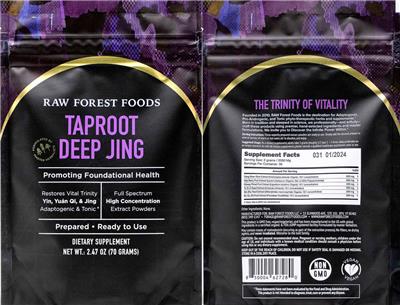
Supplement Facts
The label details for Taproot Deep Jing by Raw Forest Foods, sourced from the NIH Dietary Supplement Label Database.
Supplement Facts
| Ingredient | Amount | % DV |
|---|---|---|
| Codonopsis pilosula Root Extract | 500 mg | -- |
| Cuscuta chinensis Seed Extract | 200 mg | -- |
| Bai-Zhu Atractylodes (Atractylodes macrocephala) root extract | 200 mg | -- |
| Goji Berry Fruit Extract | 500 mg | -- |
| Glossy Privet Fruit Extract | 400 mg | -- |
| Bu Gu Zhi Fruit Extract | 200 mg | -- |
Tap any ingredient to jump to its full detail below.
These statements are the manufacturer’s wording, reproduced from the product label — the label is saying it, not HelloPharmacist. We don’t verify or endorse them.
General Statements
Formulated by Master Herbalists
The Trinity of Vitality Founded in 2010, RAW Forest Foods is the destination for Adaptogenic, Pro-Androgenic, and Tonic phyto-therapeutic herbs and supplements. Born in tradition and steeped in science, we professionally - and artfully craft these products using premier, hand-selected ingredients and master formulations. We invite you to Discover the Infinite Power Within.
Welcome to the Trail Family.
Formulation
Promoting Foundational Health Restores Vital Trinity Yin, Yuan Qi, & Jing Adaptogenic & Tonic Full Spectrum High concentration Extract powders Prepared - Ready to Use
This product is GMO Free, vegan/vegetarian, and has been manufactured in the US with global ingredients in a certified organic & FDA cGMP registered facility.
This product is GMO Free, vegan/vegetarian, and has been manufactured in the US with global ingredients in a certified organic & FDA cGMP registered facility.
Formulated by master herbalists.
No fillers, no drying agents and never irradiated.
Non GMO
FDA Statement of Identity
Dietary Supplement
Suggested/Recommended/Usage/Directions
Serving instructions: These expertly prepared extract powders are ready to use. Simply add the desired amount to several ounces of warm or hot water, stir to dissolve, and enjoy. Suggested Usage: As a dietary supplement, adults take 2 grams (roughly 1/2 tsp) 1-2 times daily, preferably on an empty stomach.
Precautions
As with all dietary supplements, please consult a qualified healthcare practitioner prior to use.
May contain traces of maltodextrin (occurring as part of the extraction process)
Caution: Do not exceed recommended dose.
Pregnant or nursing mother, children under the age of 18, and individuals with a known medical condition should consult a physician before using this or any dietary supplement
Pregnant or nursing mother, children under the age of 18, and individuals with a known medical condition should consult a physician before using this or any dietary supplement. Keep out of the reach of children.
Do not use if safety seal is damaged or missing.
Storage
Store in a cool, dry place.
Seals/Symbols
Vegan
FDA Disclaimer Statement
These statements have not been evaluated by the Food and Drug Administration. This product is not intended to diagnose, treat, cure or prevent any disease.
Is this label outdated? Report a formula or label change and our pharmacy team will review it.
Taproot Deep Jing by Raw Forest Foods label
The label scan from the NIH Dietary Supplement Label Database. Tap to enlarge.
Label images are published by the NIH Dietary Supplement Label Database for the version of this product on file. Always read your actual product label.
View the full label (PDF)The Ingredients in Taproot Deep Jing by Raw Forest Foods
These are the 6 active ingredients this product is made of. Select any to open its full monograph.
Serving size2 Gram(s) Dosage formPowder Servings per container35 Amounts shown are per serving.
Most supplement products combine several ingredients, and a medication can interact with the product through any one of them. Each ingredient below shows whether it has known drug interactions.
Codonopsis pilosula Root Extract
Interacts with211 drugs
Codonopsis (often called 'dang shen') is a root long used in Traditional Chinese Medicine as a gentle energy and digestive tonic, frequently as a mild...
Codonopsis pilosula Root Extract monograph & interactionsCuscuta chinensis Seed Extract
No knowninteractions
Dodder (Cuscuta) is a parasitic plant whose seeds are used in traditional Chinese and Middle Eastern medicine, mainly for sexual, kidney, and energy-r...
Cuscuta chinensis Seed Extract monograph & interactionsBai-Zhu Atractylodes (Atractylodes macrocephala) root extract
Interacts with803 drugs
Atractylodes is a root used for centuries in traditional Chinese, Japanese, and Thai medicine, mostly for digestive complaints and fatigue, often as p...
Bai-Zhu Atractylodes (Atractylodes macrocephala) root extract monograph & interactionsGoji Berry Fruit Extract
Interacts with1,002 drugs
Goji berries are a nutritious fruit rich in antioxidants, vitamins, and plant polysaccharides, and they are safe for most people as a food. While they...
Goji Berry Fruit Extract monograph & interactionsGlossy Privet Fruit Extract
Interacts with1 drug
Glossy Privet (Ligustrum lucidum) is a fruit long used in Traditional Chinese Medicine, often combined with other herbs as a liver and kidney 'tonic.'...
Glossy Privet Fruit Extract monograph & interactionsBu Gu Zhi Fruit Extract
Taproot Deep Jing by Raw Forest Foods Drug Interactions
HelloPharmacist Interaction Report
Taproot Deep Jing by Raw Forest Foods contains six ingredients, and the ones we could check interact with a significant number of medications.
The most serious interaction involves goji berry and warfarin (Coumadin), a blood thinner used for clot prevention. There are at least five case reports of people stable on warfarin who began drinking goji juice or concentrated goji tea and experienced increased bleeding risk.
Goji appears to slow how your liver breaks down warfarin, letting it build up in your system.
Read the full breakdown — every affected drug type, severity by severity
Three other ingredients also interact with anticoagulants and antiplatelets (blood thinners and antiplatelet drugs). Codonopsis and atractylodes may theoretically increase bleeding risk when combined with these medications, though human evidence is limited.
Additionally, goji berry interacts with several enzyme systems in your liver—specifically CYP2D6, CYP2C19, CYP2C9, and CYP3A4 substrates—which means it could raise the levels of many medications metabolized by these pathways. In one case, goji contributed to flecainide (Tambocor) toxicity.
Goji also theoretically increases the risk of low blood sugar (hypoglycemia) with diabetes medications, and may have additive effects with blood pressure medications.
Codonopsis may reduce the effectiveness of abiraterone (Zytiga), a prostate cancer drug, and increase the risk of low blood sugar with diabetes medications. Atractylodes might prolong the effects of hexobarbital, a barbiturate sedative, and theoretically affects CYP1A2 and CYP3A4 substrates.
Glossy privet may increase lithium levels by reducing how your kidneys excrete it. We could not check Bu Gu Zhi fruit extract—no interaction data are on file for it.
Altogether, these interactions span 1,093 individual medications. Use the search tool below to check your exact prescriptions before starting this product.
Check your own medications below · Editorial policy · How we use AI
Want to check YOUR meds against Taproot Deep Jing?
Ask about interactions with your drugs in plain English — “Can I take it with lisinopril?” — and we find you the answer in seconds, ingredient by ingredient.
Go to the checkerIngredients driving the most interactions
Individual Drug Interactions
The ingredients in Taproot Deep Jing interact with 1,107 drugs. Click any drug to see the details.
4 of the 6 ingredients in Taproot Deep Jing interact with drugs. Each result below shows which ingredient is responsible. Goji Berry Fruit Extract Bai-Zhu Atractylodes (Atractylodes macrocephala) root extract Codonopsis pilosula Root Extract Glossy Privet Fruit Extract
WarfarinWarfarin
How Warfarin interacts with Taproot Deep Jing — through 3 ingredients. Tap an ingredient for the detail:
Goji Berry Fruit ExtractWarfarin (coumadin), Cytochrome P450 2c19 (cyp2c19) Substrates +2 Major
Interaction Summary
Goji can increase the effects of warfarin and possibly increase the risk of bleeding.
Read the full Goji Berry Fruit Extract + Warfarin interactionBai-zhu Atractylodes (atractylodes Macrocephala) Root ExtractAnticoagulant/antiplatelet Drugs, Cytochrome P450 3a4 (cyp3a4) Substrates +1 Moderate
Interaction Summary
Theoretically, atractylodes might increase the risk of bleeding when used concomitantly with anticoagulant and antiplatelet drugs.
Read the full Bai-zhu Atractylodes (atractylodes Macrocephala) Root Extract + Warfarin interactionCodonopsis Pilosula Root ExtractAnticoagulant/antiplatelet Drugs Moderate
Interaction Summary
Theoretically, codonopsis liquor might increase the risk of bleeding when used with antiplatelet or anticoagulant drugs.
Read the full Codonopsis Pilosula Root Extract + Warfarin interactionWarfarin SodiumCoumadin, Panwarfin, Sofarin
How Warfarin Sodium interacts with Taproot Deep Jing — through 3 ingredients. Tap an ingredient for the detail:
Goji Berry Fruit ExtractCytochrome P450 2c19 (cyp2c19) Substrates, Cytochrome P450 2c9 (cyp2c9) Substrates +2 Major
Interaction Summary
Theoretically, goji berry might inhibit CYP2C19 and reduce metabolism of CYP2C19 substrates.
Read the full Goji Berry Fruit Extract + Warfarin Sodium interactionCodonopsis Pilosula Root ExtractAnticoagulant/antiplatelet Drugs Moderate
Interaction Summary
Theoretically, codonopsis liquor might increase the risk of bleeding when used with antiplatelet or anticoagulant drugs.
Read the full Codonopsis Pilosula Root Extract + Warfarin Sodium interactionBai-zhu Atractylodes (atractylodes Macrocephala) Root ExtractCytochrome P450 1a2 (cyp1a2) Substrates, Anticoagulant/antiplatelet Drugs +1 Moderate
Interaction Summary
Theoretically, atractylodes might decrease the levels of CYP1A2 substrates.
Read the full Bai-zhu Atractylodes (atractylodes Macrocephala) Root Extract + Warfarin Sodium interactionAdo-trastuzumab EmtansineKadcyla
How Ado-trastuzumab Emtansine interacts with Taproot Deep Jing — through 2 ingredients. Tap an ingredient for the detail:
Goji Berry Fruit ExtractCytochrome P450 3a4 (cyp3a4) Substrates Moderate
Interaction Summary
Theoretically, goji berry might inhibit CYP3A4 and reduce metabolism of CYP3A4 substrates.
Read the full Goji Berry Fruit Extract + Ado-trastuzumab Emtansine interactionBai-zhu Atractylodes (atractylodes Macrocephala) Root ExtractCytochrome P450 3a4 (cyp3a4) Substrates Minor
Interaction Summary
Theoretically, atractylodes might increase the levels of CYP3A4 substrates.
Read the full Bai-zhu Atractylodes (atractylodes Macrocephala) Root Extract + Ado-trastuzumab Emtansine interactionAbciximabReoPro
How Abciximab interacts with Taproot Deep Jing — through 2 ingredients. Tap an ingredient for the detail:
Bai-zhu Atractylodes (atractylodes Macrocephala) Root ExtractAnticoagulant/antiplatelet Drugs Moderate
Interaction Summary
Theoretically, atractylodes might increase the risk of bleeding when used concomitantly with anticoagulant and antiplatelet drugs.
Read the full Bai-zhu Atractylodes (atractylodes Macrocephala) Root Extract + Abciximab interactionCodonopsis Pilosula Root ExtractAnticoagulant/antiplatelet Drugs Moderate
Interaction Summary
Theoretically, codonopsis liquor might increase the risk of bleeding when used with antiplatelet or anticoagulant drugs.
Read the full Codonopsis Pilosula Root Extract + Abciximab interactionAbemaciclibVerzenio
How Abemaciclib interacts with Taproot Deep Jing — through 2 ingredients. Tap an ingredient for the detail:
Goji Berry Fruit ExtractCytochrome P450 3a4 (cyp3a4) Substrates Moderate
Interaction Summary
Theoretically, goji berry might inhibit CYP3A4 and reduce metabolism of CYP3A4 substrates.
Read the full Goji Berry Fruit Extract + Abemaciclib interactionBai-zhu Atractylodes (atractylodes Macrocephala) Root ExtractCytochrome P450 3a4 (cyp3a4) Substrates Minor
Interaction Summary
Theoretically, atractylodes might increase the levels of CYP3A4 substrates.
Read the full Bai-zhu Atractylodes (atractylodes Macrocephala) Root Extract + Abemaciclib interactionAbiraterone
How Abiraterone interacts with Taproot Deep Jing — through 3 ingredients. Tap an ingredient for the detail:
Codonopsis Pilosula Root ExtractAbiraterone (zytiga) Moderate
Interaction Summary
Theoretically, taking codonopsis root with abiraterone might reduce the levels and therapeutic effects of abiraterone.
Read the full Codonopsis Pilosula Root Extract + Abiraterone interactionGoji Berry Fruit ExtractCytochrome P450 3a4 (cyp3a4) Substrates Moderate
Interaction Summary
Theoretically, goji berry might inhibit CYP3A4 and reduce metabolism of CYP3A4 substrates.
Read the full Goji Berry Fruit Extract + Abiraterone interactionBai-zhu Atractylodes (atractylodes Macrocephala) Root ExtractCytochrome P450 3a4 (cyp3a4) Substrates Minor
Interaction Summary
Theoretically, atractylodes might increase the levels of CYP3A4 substrates.
Read the full Bai-zhu Atractylodes (atractylodes Macrocephala) Root Extract + Abiraterone interactionAbiraterone AcetateYonsa, Zytiga
How Abiraterone Acetate interacts with Taproot Deep Jing — through 3 ingredients. Tap an ingredient for the detail:
Goji Berry Fruit ExtractCytochrome P450 3a4 (cyp3a4) Substrates Moderate
Interaction Summary
Theoretically, goji berry might inhibit CYP3A4 and reduce metabolism of CYP3A4 substrates.
Read the full Goji Berry Fruit Extract + Abiraterone Acetate interactionCodonopsis Pilosula Root ExtractAbiraterone (zytiga) Moderate
Interaction Summary
Theoretically, taking codonopsis root with abiraterone might reduce the levels and therapeutic effects of abiraterone.
Read the full Codonopsis Pilosula Root Extract + Abiraterone Acetate interactionBai-zhu Atractylodes (atractylodes Macrocephala) Root ExtractCytochrome P450 3a4 (cyp3a4) Substrates Minor
Interaction Summary
Theoretically, atractylodes might increase the levels of CYP3A4 substrates.
Read the full Bai-zhu Atractylodes (atractylodes Macrocephala) Root Extract + Abiraterone Acetate interactionAbrocitinibCibinqo
How Abrocitinib interacts with Taproot Deep Jing — through 3 ingredients. Tap an ingredient for the detail:
Codonopsis Pilosula Root ExtractAnticoagulant/antiplatelet Drugs Moderate
Interaction Summary
Theoretically, codonopsis liquor might increase the risk of bleeding when used with antiplatelet or anticoagulant drugs.
Read the full Codonopsis Pilosula Root Extract + Abrocitinib interactionGoji Berry Fruit ExtractCytochrome P450 2c9 (cyp2c9) Substrates, Cytochrome P450 2c19 (cyp2c19) Substrates Moderate
Interaction Summary
Theoretically, goji berry might inhibit CYP2C9 and reduce metabolism of CYP2C9 substrates.
Read the full Goji Berry Fruit Extract + Abrocitinib interactionBai-zhu Atractylodes (atractylodes Macrocephala) Root ExtractAnticoagulant/antiplatelet Drugs Moderate
Interaction Summary
Theoretically, atractylodes might increase the risk of bleeding when used concomitantly with anticoagulant and antiplatelet drugs.
Read the full Bai-zhu Atractylodes (atractylodes Macrocephala) Root Extract + Abrocitinib interactionAcalabrutinibCalquence
How Acalabrutinib interacts with Taproot Deep Jing — through 2 ingredients. Tap an ingredient for the detail:
Goji Berry Fruit ExtractCytochrome P450 3a4 (cyp3a4) Substrates Moderate
Interaction Summary
Theoretically, goji berry might inhibit CYP3A4 and reduce metabolism of CYP3A4 substrates.
Read the full Goji Berry Fruit Extract + Acalabrutinib interactionBai-zhu Atractylodes (atractylodes Macrocephala) Root ExtractCytochrome P450 3a4 (cyp3a4) Substrates Minor
Interaction Summary
Theoretically, atractylodes might increase the levels of CYP3A4 substrates.
Read the full Bai-zhu Atractylodes (atractylodes Macrocephala) Root Extract + Acalabrutinib interactionAcarboseGlucobay, Prandase, Precose
How Acarbose interacts with Taproot Deep Jing — through 2 ingredients. Tap an ingredient for the detail:
Codonopsis Pilosula Root ExtractAntidiabetes Drugs Moderate
Interaction Summary
Theoretically, codonopsis might increase the risk of hypoglycemia when taken with antidiabetes drugs.
Read the full Codonopsis Pilosula Root Extract + Acarbose interactionGoji Berry Fruit ExtractAntidiabetes Drugs Minor
Interaction Summary
Theoretically, concomitant use of goji fruit polysaccharides or goji root bark with antidiabetes drugs might have additive effects.
Read the full Goji Berry Fruit Extract + Acarbose interactionAcebutololRhotral, Sectral
How Acebutolol interacts with Taproot Deep Jing — through 1 ingredient. Tap an ingredient for the detail:
Goji Berry Fruit ExtractAntihypertensive Drugs Moderate
Interaction Summary
Theoretically, concomitant use of goji root bark, but not goji fruit, with antihypertensive drugs might have additive effects.
Read the full Goji Berry Fruit Extract + Acebutolol interactionAcenocoumarolSintrom
How Acenocoumarol interacts with Taproot Deep Jing — through 2 ingredients. Tap an ingredient for the detail:
Codonopsis Pilosula Root ExtractAnticoagulant/antiplatelet Drugs Moderate
Interaction Summary
Theoretically, codonopsis liquor might increase the risk of bleeding when used with antiplatelet or anticoagulant drugs.
Read the full Codonopsis Pilosula Root Extract + Acenocoumarol interactionBai-zhu Atractylodes (atractylodes Macrocephala) Root ExtractAnticoagulant/antiplatelet Drugs Moderate
Interaction Summary
Theoretically, atractylodes might increase the risk of bleeding when used concomitantly with anticoagulant and antiplatelet drugs.
Read the full Bai-zhu Atractylodes (atractylodes Macrocephala) Root Extract + Acenocoumarol interactionAcetaminophen, AspirinGemnisyn
How Acetaminophen, Aspirin interacts with Taproot Deep Jing — through 2 ingredients. Tap an ingredient for the detail:
Bai-zhu Atractylodes (atractylodes Macrocephala) Root ExtractCytochrome P450 1a2 (cyp1a2) Substrates, Anticoagulant/antiplatelet Drugs Moderate
Interaction Summary
Theoretically, atractylodes might decrease the levels of CYP1A2 substrates.
Read the full Bai-zhu Atractylodes (atractylodes Macrocephala) Root Extract + Acetaminophen, Aspirin interactionCodonopsis Pilosula Root ExtractAnticoagulant/antiplatelet Drugs Moderate
Interaction Summary
Theoretically, codonopsis liquor might increase the risk of bleeding when used with antiplatelet or anticoagulant drugs.
Read the full Codonopsis Pilosula Root Extract + Acetaminophen, Aspirin interactionAcetaminophen, Aspirin, CaffeineExcedrin, Excedrin Extra Strength, Excedrin Migraine
How Acetaminophen, Aspirin, Caffeine interacts with Taproot Deep Jing — through 3 ingredients. Tap an ingredient for the detail:
Bai-zhu Atractylodes (atractylodes Macrocephala) Root ExtractAnticoagulant/antiplatelet Drugs, Cytochrome P450 1a2 (cyp1a2) Substrates +1 Moderate
Interaction Summary
Theoretically, atractylodes might increase the risk of bleeding when used concomitantly with anticoagulant and antiplatelet drugs.
Read the full Bai-zhu Atractylodes (atractylodes Macrocephala) Root Extract + Acetaminophen, Aspirin, Caffeine interactionGoji Berry Fruit ExtractCytochrome P450 3a4 (cyp3a4) Substrates Moderate
Interaction Summary
Theoretically, goji berry might inhibit CYP3A4 and reduce metabolism of CYP3A4 substrates.
Read the full Goji Berry Fruit Extract + Acetaminophen, Aspirin, Caffeine interactionCodonopsis Pilosula Root ExtractAnticoagulant/antiplatelet Drugs Moderate
Interaction Summary
Theoretically, codonopsis liquor might increase the risk of bleeding when used with antiplatelet or anticoagulant drugs.
Read the full Codonopsis Pilosula Root Extract + Acetaminophen, Aspirin, Caffeine interactionAcetaminophen, Butalbital, CaffeineEsgic, Esgic Plus, Fiogesic, Fioricet, Repan, Tecnal +1 more
How Acetaminophen, Butalbital, Caffeine interacts with Taproot Deep Jing — through 2 ingredients. Tap an ingredient for the detail:
Goji Berry Fruit ExtractCytochrome P450 3a4 (cyp3a4) Substrates Moderate
Interaction Summary
Theoretically, goji berry might inhibit CYP3A4 and reduce metabolism of CYP3A4 substrates.
Read the full Goji Berry Fruit Extract + Acetaminophen, Butalbital, Caffeine interactionBai-zhu Atractylodes (atractylodes Macrocephala) Root ExtractCytochrome P450 1a2 (cyp1a2) Substrates, Cytochrome P450 3a4 (cyp3a4) Substrates Minor
Interaction Summary
Theoretically, atractylodes might decrease the levels of CYP1A2 substrates.
Read the full Bai-zhu Atractylodes (atractylodes Macrocephala) Root Extract + Acetaminophen, Butalbital, Caffeine interactionAcetaminophen, Butalbital, Caffeine, CodeineEsgic with Codeine, Fioricet w/ Codeine
How Acetaminophen, Butalbital, Caffeine, Codeine interacts with Taproot Deep Jing — through 2 ingredients. Tap an ingredient for the detail:
Goji Berry Fruit ExtractCytochrome P450 2d6 (cyp2d6) Substrates, Cytochrome P450 3a4 (cyp3a4) Substrates Moderate
Interaction Summary
Theoretically, goji berry might inhibit CYP2D6 and reduce metabolism of CYP2D6 substrates.
Read the full Goji Berry Fruit Extract + Acetaminophen, Butalbital, Caffeine, Codeine interactionBai-zhu Atractylodes (atractylodes Macrocephala) Root ExtractCytochrome P450 3a4 (cyp3a4) Substrates, Cytochrome P450 1a2 (cyp1a2) Substrates Minor
Interaction Summary
Theoretically, atractylodes might increase the levels of CYP3A4 substrates.
Read the full Bai-zhu Atractylodes (atractylodes Macrocephala) Root Extract + Acetaminophen, Butalbital, Caffeine, Codeine interactionAcetaminophen, Butalbital, CodeineBancap w/ Codeine
How Acetaminophen, Butalbital, Codeine interacts with Taproot Deep Jing — through 2 ingredients. Tap an ingredient for the detail:
Goji Berry Fruit ExtractCytochrome P450 2d6 (cyp2d6) Substrates Moderate
Interaction Summary
Theoretically, goji berry might inhibit CYP2D6 and reduce metabolism of CYP2D6 substrates.
Read the full Goji Berry Fruit Extract + Acetaminophen, Butalbital, Codeine interactionBai-zhu Atractylodes (atractylodes Macrocephala) Root ExtractCytochrome P450 1a2 (cyp1a2) Substrates Minor
Interaction Summary
Theoretically, atractylodes might decrease the levels of CYP1A2 substrates.
Read the full Bai-zhu Atractylodes (atractylodes Macrocephala) Root Extract + Acetaminophen, Butalbital, Codeine interactionAcetaminophen, Butalbital, Codeine PhosphatePhrenilin #3
How Acetaminophen, Butalbital, Codeine Phosphate interacts with Taproot Deep Jing — through 2 ingredients. Tap an ingredient for the detail:
Goji Berry Fruit ExtractCytochrome P450 2d6 (cyp2d6) Substrates Moderate
Interaction Summary
Theoretically, goji berry might inhibit CYP2D6 and reduce metabolism of CYP2D6 substrates.
Read the full Goji Berry Fruit Extract + Acetaminophen, Butalbital, Codeine Phosphate interactionBai-zhu Atractylodes (atractylodes Macrocephala) Root ExtractCytochrome P450 1a2 (cyp1a2) Substrates Minor
Interaction Summary
Theoretically, atractylodes might decrease the levels of CYP1A2 substrates.
Read the full Bai-zhu Atractylodes (atractylodes Macrocephala) Root Extract + Acetaminophen, Butalbital, Codeine Phosphate interactionAcetaminophen, Caffeine, Chlorpheniramine, Hydrocodone, PhenylephrineHycomine Compound
How Acetaminophen, Caffeine, Chlorpheniramine, Hydrocodone, Phenylephrine interacts with Taproot Deep Jing — through 2 ingredients. Tap an ingredient for the detail:
Goji Berry Fruit ExtractCytochrome P450 3a4 (cyp3a4) Substrates, Cytochrome P450 2d6 (cyp2d6) Substrates Moderate
Interaction Summary
Theoretically, goji berry might inhibit CYP3A4 and reduce metabolism of CYP3A4 substrates.
Read the full Goji Berry Fruit Extract + Acetaminophen, Caffeine, Chlorpheniramine, Hydrocodone, Phenylephrine interactionBai-zhu Atractylodes (atractylodes Macrocephala) Root ExtractCytochrome P450 1a2 (cyp1a2) Substrates, Cytochrome P450 3a4 (cyp3a4) Substrates Minor
Interaction Summary
Theoretically, atractylodes might decrease the levels of CYP1A2 substrates.
Read the full Bai-zhu Atractylodes (atractylodes Macrocephala) Root Extract + Acetaminophen, Caffeine, Chlorpheniramine, Hydrocodone, Phenylephrine interactionAcetaminophen, Caffeine, CodeineGesic C15, Gesic C30, Gesic C8, Lenoltec 1, Lenoltec 2, Lenoltec 3 +1 more
How Acetaminophen, Caffeine, Codeine interacts with Taproot Deep Jing — through 2 ingredients. Tap an ingredient for the detail:
Goji Berry Fruit ExtractCytochrome P450 2d6 (cyp2d6) Substrates, Cytochrome P450 3a4 (cyp3a4) Substrates Moderate
Interaction Summary
Theoretically, goji berry might inhibit CYP2D6 and reduce metabolism of CYP2D6 substrates.
Read the full Goji Berry Fruit Extract + Acetaminophen, Caffeine, Codeine interactionBai-zhu Atractylodes (atractylodes Macrocephala) Root ExtractCytochrome P450 1a2 (cyp1a2) Substrates, Cytochrome P450 3a4 (cyp3a4) Substrates Minor
Interaction Summary
Theoretically, atractylodes might decrease the levels of CYP1A2 substrates.
Read the full Bai-zhu Atractylodes (atractylodes Macrocephala) Root Extract + Acetaminophen, Caffeine, Codeine interactionAcetaminophen, Caffeine, Codeine, SalicylamideCodalan No.1, Codalan No.2, Codalan No.3
How Acetaminophen, Caffeine, Codeine, Salicylamide interacts with Taproot Deep Jing — through 2 ingredients. Tap an ingredient for the detail:
Goji Berry Fruit ExtractCytochrome P450 3a4 (cyp3a4) Substrates, Cytochrome P450 2d6 (cyp2d6) Substrates Moderate
Interaction Summary
Theoretically, goji berry might inhibit CYP3A4 and reduce metabolism of CYP3A4 substrates.
Read the full Goji Berry Fruit Extract + Acetaminophen, Caffeine, Codeine, Salicylamide interactionBai-zhu Atractylodes (atractylodes Macrocephala) Root ExtractCytochrome P450 3a4 (cyp3a4) Substrates, Cytochrome P450 1a2 (cyp1a2) Substrates Minor
Interaction Summary
Theoretically, atractylodes might increase the levels of CYP3A4 substrates.
Read the full Bai-zhu Atractylodes (atractylodes Macrocephala) Root Extract + Acetaminophen, Caffeine, Codeine, Salicylamide interactionAcetaminophen, Caffeine, DihydrocodeineDHC Plus, Panlor DC, Panlor SS
How Acetaminophen, Caffeine, Dihydrocodeine interacts with Taproot Deep Jing — through 2 ingredients. Tap an ingredient for the detail:
Goji Berry Fruit ExtractCytochrome P450 3a4 (cyp3a4) Substrates, Cytochrome P450 2d6 (cyp2d6) Substrates Moderate
Interaction Summary
Theoretically, goji berry might inhibit CYP3A4 and reduce metabolism of CYP3A4 substrates.
Read the full Goji Berry Fruit Extract + Acetaminophen, Caffeine, Dihydrocodeine interactionBai-zhu Atractylodes (atractylodes Macrocephala) Root ExtractCytochrome P450 1a2 (cyp1a2) Substrates, Cytochrome P450 3a4 (cyp3a4) Substrates Minor
Interaction Summary
Theoretically, atractylodes might decrease the levels of CYP1A2 substrates.
Read the full Bai-zhu Atractylodes (atractylodes Macrocephala) Root Extract + Acetaminophen, Caffeine, Dihydrocodeine interactionAcetaminophen, Caffeine, IsomethepteneMigralam
How Acetaminophen, Caffeine, Isometheptene interacts with Taproot Deep Jing — through 2 ingredients. Tap an ingredient for the detail:
Goji Berry Fruit ExtractCytochrome P450 3a4 (cyp3a4) Substrates Moderate
Interaction Summary
Theoretically, goji berry might inhibit CYP3A4 and reduce metabolism of CYP3A4 substrates.
Read the full Goji Berry Fruit Extract + Acetaminophen, Caffeine, Isometheptene interactionBai-zhu Atractylodes (atractylodes Macrocephala) Root ExtractCytochrome P450 1a2 (cyp1a2) Substrates, Cytochrome P450 3a4 (cyp3a4) Substrates Minor
Interaction Summary
Theoretically, atractylodes might decrease the levels of CYP1A2 substrates.
Read the full Bai-zhu Atractylodes (atractylodes Macrocephala) Root Extract + Acetaminophen, Caffeine, Isometheptene interactionAcetaminophen, Caffeine, PyrilamineMidol Max Strength Menstrual
How Acetaminophen, Caffeine, Pyrilamine interacts with Taproot Deep Jing — through 2 ingredients. Tap an ingredient for the detail:
Goji Berry Fruit ExtractCytochrome P450 3a4 (cyp3a4) Substrates Moderate
Interaction Summary
Theoretically, goji berry might inhibit CYP3A4 and reduce metabolism of CYP3A4 substrates.
Read the full Goji Berry Fruit Extract + Acetaminophen, Caffeine, Pyrilamine interactionBai-zhu Atractylodes (atractylodes Macrocephala) Root ExtractCytochrome P450 3a4 (cyp3a4) Substrates, Cytochrome P450 1a2 (cyp1a2) Substrates Minor
Interaction Summary
Theoretically, atractylodes might increase the levels of CYP3A4 substrates.
Read the full Bai-zhu Atractylodes (atractylodes Macrocephala) Root Extract + Acetaminophen, Caffeine, Pyrilamine interactionAcetaminophen, Chlorpheniramine Maleate, Dextromethorphan HbrVicks Formula 44M Cough, Cold & Flu Relief
How Acetaminophen, Chlorpheniramine Maleate, Dextromethorphan Hbr interacts with Taproot Deep Jing — through 2 ingredients. Tap an ingredient for the detail:
Goji Berry Fruit ExtractCytochrome P450 3a4 (cyp3a4) Substrates, Cytochrome P450 2d6 (cyp2d6) Substrates Moderate
Interaction Summary
Theoretically, goji berry might inhibit CYP3A4 and reduce metabolism of CYP3A4 substrates.
Read the full Goji Berry Fruit Extract + Acetaminophen, Chlorpheniramine Maleate, Dextromethorphan Hbr interactionBai-zhu Atractylodes (atractylodes Macrocephala) Root ExtractCytochrome P450 1a2 (cyp1a2) Substrates, Cytochrome P450 3a4 (cyp3a4) Substrates Minor
Interaction Summary
Theoretically, atractylodes might decrease the levels of CYP1A2 substrates.
Read the full Bai-zhu Atractylodes (atractylodes Macrocephala) Root Extract + Acetaminophen, Chlorpheniramine Maleate, Dextromethorphan Hbr interactionAcetaminophen, Chlorpheniramine, Codeine, PhenylephrineColrex
How Acetaminophen, Chlorpheniramine, Codeine, Phenylephrine interacts with Taproot Deep Jing — through 2 ingredients. Tap an ingredient for the detail:
Goji Berry Fruit ExtractCytochrome P450 2d6 (cyp2d6) Substrates, Cytochrome P450 3a4 (cyp3a4) Substrates Moderate
Interaction Summary
Theoretically, goji berry might inhibit CYP2D6 and reduce metabolism of CYP2D6 substrates.
Read the full Goji Berry Fruit Extract + Acetaminophen, Chlorpheniramine, Codeine, Phenylephrine interactionBai-zhu Atractylodes (atractylodes Macrocephala) Root ExtractCytochrome P450 1a2 (cyp1a2) Substrates, Cytochrome P450 3a4 (cyp3a4) Substrates Minor
Interaction Summary
Theoretically, atractylodes might decrease the levels of CYP1A2 substrates.
Read the full Bai-zhu Atractylodes (atractylodes Macrocephala) Root Extract + Acetaminophen, Chlorpheniramine, Codeine, Phenylephrine interactionAcetaminophen, Chlorpheniramine, DextromethorphanCoricidin II Extra Strength Cold and Flu
How Acetaminophen, Chlorpheniramine, Dextromethorphan interacts with Taproot Deep Jing — through 2 ingredients. Tap an ingredient for the detail:
Goji Berry Fruit ExtractCytochrome P450 3a4 (cyp3a4) Substrates, Cytochrome P450 2d6 (cyp2d6) Substrates Moderate
Interaction Summary
Theoretically, goji berry might inhibit CYP3A4 and reduce metabolism of CYP3A4 substrates.
Read the full Goji Berry Fruit Extract + Acetaminophen, Chlorpheniramine, Dextromethorphan interactionBai-zhu Atractylodes (atractylodes Macrocephala) Root ExtractCytochrome P450 1a2 (cyp1a2) Substrates, Cytochrome P450 3a4 (cyp3a4) Substrates Minor
Interaction Summary
Theoretically, atractylodes might decrease the levels of CYP1A2 substrates.
Read the full Bai-zhu Atractylodes (atractylodes Macrocephala) Root Extract + Acetaminophen, Chlorpheniramine, Dextromethorphan interactionAcetaminophen, Chlorpheniramine, Dextromethorphan HydrobromideCoricidin HBP Maximum Strength Flu
How Acetaminophen, Chlorpheniramine, Dextromethorphan Hydrobromide interacts with Taproot Deep Jing — through 2 ingredients. Tap an ingredient for the detail:
Goji Berry Fruit ExtractCytochrome P450 3a4 (cyp3a4) Substrates, Cytochrome P450 2d6 (cyp2d6) Substrates Moderate
Interaction Summary
Theoretically, goji berry might inhibit CYP3A4 and reduce metabolism of CYP3A4 substrates.
Read the full Goji Berry Fruit Extract + Acetaminophen, Chlorpheniramine, Dextromethorphan Hydrobromide interactionBai-zhu Atractylodes (atractylodes Macrocephala) Root ExtractCytochrome P450 3a4 (cyp3a4) Substrates, Cytochrome P450 1a2 (cyp1a2) Substrates Minor
Interaction Summary
Theoretically, atractylodes might increase the levels of CYP3A4 substrates.
Read the full Bai-zhu Atractylodes (atractylodes Macrocephala) Root Extract + Acetaminophen, Chlorpheniramine, Dextromethorphan Hydrobromide interactionAcetaminophen, Chlorpheniramine, Dextromethorphan, PhenylpropanolamineMulti Symptom Cold Relief
How Acetaminophen, Chlorpheniramine, Dextromethorphan, Phenylpropanolamine interacts with Taproot Deep Jing — through 2 ingredients. Tap an ingredient for the detail:
Goji Berry Fruit ExtractCytochrome P450 3a4 (cyp3a4) Substrates, Cytochrome P450 2d6 (cyp2d6) Substrates Moderate
Interaction Summary
Theoretically, goji berry might inhibit CYP3A4 and reduce metabolism of CYP3A4 substrates.
Read the full Goji Berry Fruit Extract + Acetaminophen, Chlorpheniramine, Dextromethorphan, Phenylpropanolamine interactionBai-zhu Atractylodes (atractylodes Macrocephala) Root ExtractCytochrome P450 1a2 (cyp1a2) Substrates, Cytochrome P450 3a4 (cyp3a4) Substrates Minor
Interaction Summary
Theoretically, atractylodes might decrease the levels of CYP1A2 substrates.
Read the full Bai-zhu Atractylodes (atractylodes Macrocephala) Root Extract + Acetaminophen, Chlorpheniramine, Dextromethorphan, Phenylpropanolamine interactionAcetaminophen, Chlorpheniramine, Dextromethorphan, PseudoephedrineChildren's Tylenol Cold Plus Cough, Tylenol Cold Ex Strength
How Acetaminophen, Chlorpheniramine, Dextromethorphan, Pseudoephedrine interacts with Taproot Deep Jing — through 2 ingredients. Tap an ingredient for the detail:
Goji Berry Fruit ExtractCytochrome P450 3a4 (cyp3a4) Substrates, Cytochrome P450 2d6 (cyp2d6) Substrates Moderate
Interaction Summary
Theoretically, goji berry might inhibit CYP3A4 and reduce metabolism of CYP3A4 substrates.
Read the full Goji Berry Fruit Extract + Acetaminophen, Chlorpheniramine, Dextromethorphan, Pseudoephedrine interactionBai-zhu Atractylodes (atractylodes Macrocephala) Root ExtractCytochrome P450 3a4 (cyp3a4) Substrates, Cytochrome P450 1a2 (cyp1a2) Substrates Minor
Interaction Summary
Theoretically, atractylodes might increase the levels of CYP3A4 substrates.
Read the full Bai-zhu Atractylodes (atractylodes Macrocephala) Root Extract + Acetaminophen, Chlorpheniramine, Dextromethorphan, Pseudoephedrine interactionEach ingredient & the kinds of drugs it affects
For each ingredient in Taproot Deep Jing with known interactions, here are the types of medications they can affect. Open any type for the detail — or search your exact drug in the checker above.
Goji Berry Fruit Extract
Warfarin (Coumadin)
Goji can increase the effects of warfarin and possibly increase the risk of bleeding.
There are at least 5 case reports of increased international normalized ratio (INR) in patients stabilized on warfarin who began drinking goji juice, concentrated goji tea, or goji wine. Goji may inhibit the metabolism of warfarin by cytochrome P450 2C9 (CYP2C9).
Antihypertensive Drugs
Theoretically, concomitant use of goji root bark, but not goji fruit, with antihypertensive drugs might have additive effects.
Animal and in vitro research suggest that goji root bark has hypotensive effects. However, goji fruit juice does not appear to reduce systolic or diastolic blood pressure in humans.
Cytochrome P450 2C19 (Cyp2C19) Substrates
Theoretically, goji berry might inhibit CYP2C19 and reduce metabolism of CYP2C19 substrates.
In vitro research shows that goji berry tincture and juice inhibit CYP2C19 enzymes. Concomitant use with goji may decrease metabolism and increase levels of CYP2C19 substrates. However, this has not been reported in humans.
Cytochrome P450 2C9 (Cyp2C9) Substrates
Theoretically, goji berry might inhibit CYP2C9 and reduce metabolism of CYP2C9 substrates.
In vitro research shows that goji berry tincture and juice inhibit CYP2C9 enzymes. Additionally, multiple case reports suggest that goji berry concentrated tea and juice inhibit the metabolism of warfarin, a CYP2C9 substrate. Concomitant use with goji may decrease metabolism and increase levels of CYP2C9 substrates.
Cytochrome P450 2D6 (Cyp2D6) Substrates
Theoretically, goji berry might inhibit CYP2D6 and reduce metabolism of CYP2D6 substrates.
In vitro research shows that goji berry juice inhibits CYP2D6 enzymes. Concomitant use with goji may decrease metabolism and increase levels of CYP2D6 substrates. However, this has not been reported in humans.
Cytochrome P450 3A4 (Cyp3A4) Substrates
Theoretically, goji berry might inhibit CYP3A4 and reduce metabolism of CYP3A4 substrates.
In vitro research shows that goji berry juice inhibits CYP3A4 enzymes. Concomitant use with goji may decrease metabolism and increase levels of CYP3A4 substrates. However, this has not been reported in humans.
Flecainide (Tambocor)
Theoretically, goji berry might increase the levels and clinical effects of flecainide.
In one case report, a 75-year-old patient stable on flecainide and warfarin presented to the emergency room with fainting and pleomorphic arrhythmia caused by flecainide toxicity. Flecainide toxicity was attributed to drinking 1-2 glasses of concentrated goji tea daily for 2 weeks. Theoretically, goji may have inhibited the cytochrome P450 2D6 (CYP2D6) metabolism of flecainide.
Antidiabetes Drugs
Theoretically, concomitant use of goji fruit polysaccharides or goji root bark with antidiabetes drugs might have additive effects.
Animal and in vitro research show that goji root bark and fruit polysaccharides might have hypoglycemic effects. However, clinical research has only shown that taking goji fruit polysaccharides with or without antidiabetes drugs modestly reduces postprandial glucose when compared with control, with no reports of hypoglycemia.
Bai-Zhu Atractylodes (Atractylodes macrocephala) root extract
Anticoagulant/Antiplatelet Drugs
Theoretically, atractylodes might increase the risk of bleeding when used concomitantly with anticoagulant and antiplatelet drugs.
Laboratory research suggests that atractylenolides II and III, constituents of atractylodes, reduce platelet activation. So far, this has not been shown in humans.
Aromatase Inhibitors
Theoretically, atractylodes may have an additive effect when used with other aromatase inhibitors.
Laboratory research suggests that atractylodes and its constituents exhibit aromatase inhibitor effects.
Hexobarbital
Theoretically, taking atractylodes may prolong the therapeutic and adverse effects of hexobarbital.
In animals, atractylodes has been shown to prolong the effects of hexobarbital. These effects have not been shown in humans.
Cytochrome P450 1A2 (Cyp1A2) Substrates
Theoretically, atractylodes might decrease the levels of CYP1A2 substrates.
In animals, atractylodes administered at high doses has been shown to induce CYP1A2 activity. This effect has not been shown in humans.
Cytochrome P450 3A4 (Cyp3A4) Substrates
Theoretically, atractylodes might increase the levels of CYP3A4 substrates.
In animals, atractylodes administered at high doses has been shown to inhibit CYP3A1 activity, which is a homolog to the human CYP3A4 enzyme. This effect has not been shown in humans.
Codonopsis pilosula Root Extract
Abiraterone (Zytiga)
Theoretically, taking codonopsis root with abiraterone might reduce the levels and therapeutic effects of abiraterone.
Animal research in rats shows that intragastric administration of codonopsis root along with abiraterone every 2 days for 2 weeks seems to increase the clearance of abiraterone and reduce the overall exposure and time to maximum concentration. This interaction has not been reported in humans.
Anticoagulant/Antiplatelet Drugs
Theoretically, codonopsis liquor might increase the risk of bleeding when used with antiplatelet or anticoagulant drugs.
A small clinical study in adults with coronary heart disease shows that consuming Codonopsis pilosula liquor for 4 weeks inhibits platelet aggregation but does not affect tissue-type plasminogen activator (t-PA) or plasminogen activator inhibitor (PAI).
Antidiabetes Drugs
Theoretically, codonopsis might increase the risk of hypoglycemia when taken with antidiabetes drugs.
Laboratory and animal research suggest that codonopsis has antidiabetic effects.
Glossy Privet Fruit Extract
Lithium
Glossy privet is thought to have diuretic properties. Theoretically, due to these potential diuretic effects, glossy privet might reduce excretion and increase levels of lithium. The dose of lithium might need to be decreased.
Brand information
Manufacturer and brand details for Taproot Deep Jing, from the product label.
Raw Forest Foods
See all Raw Forest Foods products- Name
- RAW Forest Foods LLC
- Street Address
- 11 Elmwood Ave, STE 102
- City
- BTV
- State
- VT
- ZipCode
- 05402
- Phone Number
- (802) 349-1347
- Web Address
- www.rawforestfoods.com
Taproot Deep Jing by Raw Forest Foods: Common Questions
Does Taproot Deep Jing by Raw Forest Foods interact with any medications?
How can one product interact with so many drugs?
Where does this information come from?
Can I take this if I'm pregnant or breastfeeding?
What does codonopsis do?
Is goji berry really a problem with warfarin?
Can this cause an allergic reaction?
What are the side effects at normal doses?
Does this product have fillers or other inactive ingredients?
Written and reviewed by the HelloPharmacist editorial staff. Our editorial policy
Not sure if Taproot Deep Jing is safe with your meds?
Our pharmacists answer your medication & supplement questions — free.
Label information is sourced from the NIH Dietary Supplement Label Database and reflects the product version on file; always read your actual product label. This page is for education only and is not a substitute for professional medical advice. Confirm with your pharmacist or doctor before combining supplements and medications.
The Full Monographs Behind Taproot Deep Jing’s Ingredients
Every ingredient we hold a full HelloPharmacist monograph for — uses, evidence, safety, and the complete interaction list.
Codonopsis
Interacts with 211 drugsCodonopsis (often called 'dang shen') is a root long used in Traditional Chinese Medicine as a gentle energy and digestive tonic, frequently as a milder substitute for ginseng. Human researc...
Read the full Codonopsis monograph → Herb & supplement monographDodder
Dodder (Cuscuta) is a parasitic plant whose seeds are used in traditional Chinese and Middle Eastern medicine, mainly for sexual, kidney, and energy-related complaints. Human evidence for an...
Read the full Dodder monograph → Herb & supplement monographAtractylodes
Interacts with 803 drugsAtractylodes is a root used for centuries in traditional Chinese, Japanese, and Thai medicine, mostly for digestive complaints and fatigue, often as part of multi-herb formulas. Modern resea...
Read the full Atractylodes monograph → Herb & supplement monographGoji
Interacts with 1,002 drugsGoji berries are a nutritious fruit rich in antioxidants, vitamins, and plant polysaccharides, and they are safe for most people as a food. While they are popular for eye health, immune supp...
Read the full Goji monograph → Herb & supplement monographGlossy Privet
Interacts with 1 drugGlossy Privet (Ligustrum lucidum) is a fruit long used in Traditional Chinese Medicine, often combined with other herbs as a liver and kidney 'tonic.' Most of the research is from laboratory...
Read the full Glossy Privet monograph →Sources & How We Checked
Taproot Deep Jing's label data comes from the NIH Dietary Supplement Label Database; the ingredient interaction data is from the Natural Medicines database, reviewed by our pharmacists.
- NIH Dietary Supplement Label Database (DSLD) — The official product label on file for this supplement.
- Natural Medicines (Therapeutic Research Center) — Evidence-graded clinical reference behind the ingredient interaction data.
Content is written and reviewed by licensed HelloPharmacist pharmacists. See our data sources and editorial standards for how this information is built and checked.
The 30 references behind this product’s interaction data
Every citation that drives the interaction findings for this product’s ingredients, from the evidence-graded Natural Medicines (TRC Healthcare) database. Open an ingredient to browse its citations — links open the study on PubMed or the publisher’s site.
Codonopsis 5 references
- McGuffin M, Hobbs C, Upton R, Goldberg A, eds. American Herbal Products Association's Botanical Safety Handbook. Boca Raton, FL: CRC Press, LLC 1997.
- Xu, X., Wang, S. R., and Lin, Q. [Clinical and experimental study on codonopsis pilosula oral liquor in treating coronary heart disease with blood stasis]. Zhongguo Zhong.Xi.Yi.Jie.He.Za Zhi. 1995;15(7):398-400.
- Hur GY, Choi GS, Park HJ, Ye YM, Park HS. Anaphylactic shock induced by Codonopsis lanceolata, traditional Chinese medicine in a patient with allergic rhinitis. Allergy. 2008;63(10):1406-7.
- Zhang ZB, Ip SP, Cho WCS, et al. Herb-drug interactions between androgenic Chinese herbal medicines and androgen receptor antagonist on tumor growth: Studies on two xenograft prostate cancer animal models. Phytother Res. 2021.
- Jia W, Bi Q, Jiang S, et al. Hypoglycemic activity of Codonopsis pilosula (Franch.) Nannf. in vitro and in vivo and its chemical composition identification by UPLC-Triple-TOF-MS/MS. Food Funct 2022;13(5):2456-2464.
Dodder 3 references
- Gruenwald J, Brendler T, Jaenicke C. PDR for Herbal Medicines. 1st ed. Montvale, NJ: Medical Economics Company, Inc., 1998.
- Mehrbani M, Choopani R, Fekri A, Mehrabani M, Mosaddegh M, Mehrabani M. The efficacy of whey associated with dodder seed extract on moderate-to-severe atopic dermatitis in adults: A randomized, double-blind, placebo-controlled clinical trial. J Ethnopharm PubMed
- Firoozabadi A, Zarshenas MM, Salehi A, Jahanbin S, Mohagheghzadeh A. Effectiveness of Cuscuta planiflora Ten. and Nepeta menthoides Boiss. & Buhse in major depression: a triple-blind randomized controlled trial study. J Evid Based Complementary Altern Med
Atractylodes 6 references
- Liu Y, Jia Z, Dong L, et al. A randomized pilot study of atractylenolide I on gastric cancer cachexia patients. Evid Based Complement Alternat Med 2008;5:337-44. PubMed
- Chen Y, Yang W, Guo L, Wu X, Zhang T, Liu J, Zhang J. Atractylodes lactone compounds inhibit platelet activation. Platelets. 2017 Mar;28(2):194-202. PubMed
- Jiang H, Shi J, Li Y. Screening for compounds with aromatase inhibiting activities from Atractylodes macrocephala Koidz. Molecules. 2011 Apr 14;16(4):3146-51. PubMed
- Koonrungsesomboon N, Na-Bangchang K, Karbwang J. Therapeutic potential and pharmacological activities of Atractylodes lancea (Thunb.) DC. Asian Pac J Trop Med. 2014 Jun;7(6):421-8. PubMed
- Li L, Tang LY, Man GC, Yeung BH, Lau CB, Leung PC, Wang CC. Potential reproductive toxicity of Largehead Atractylodes Rhizome, the most commonly used Chinese medicine for threatened miscarriage. Hum Reprod. 2011 Dec;26(12):3280-8. PubMed
- Muhamad N, Plengsuriyakarn T, Na-Bangchang K. Atractylodes lancea for cholangiocarcinoma: Modulatory effects on CYP1A2 and CYP3A1 and pharmacokinetics in rats and biodistribution in mice. PLoS One 2022;17(11):e0277614. PubMed
Goji 14 references
- Huang KC. The Pharmacology of Chinese Herbs. 2nd ed. Boca Raton, FL: CRC Press, LLC 1999.
- Lam AY, Elmer GW, Mohutsky MA. Possible interaction between warfarin and Lycium Barbarum. Ann Pharmacother 2001;35:1199-201.
- Leung H, Hung A, Hui AC, Chan TY. Warfarin overdose due to the possible effects of Lycium barbarum L. Food Chem Toxicol 2008;46:1860-2. PubMed
- Amagase H, Nance DM. A randomized, double-blind, placebo-controlled, clinical study of the general effects of a standardized Lycium barbarum (goji) juice, GoChi. J Altern Complement Med 2008;14:403-12.
- Rivera, C. A., Ferro, C. L., Bursua, A. J., and Gerber, B. S. Probable interaction between Lycium barbarum (goji) and warfarin. Pharmacotherapy 2012;32(3):e50-e53.
- Monzon, Ballarin S., Lopez-Matas, M. A., Saenz, Abad D., Perez-Cinto, N., and Carnes, J. Anaphylaxis associated with the ingestion of Goji berries (Lycium barbarum). J.Investig.Allergol.Clin.Immunol. 2011;21(7):567-570.
- Franco, M., Monmany, J., Domingo, P., and Turbau, M. [Autoimmune hepatitis triggered by consumption of Goji berries]. Med.Clin.(Barc.) 9-22-2012;139(7):320-321.
- Jiménez-Encarnación E, Ríos G, Muñoz-Mirabal A, Vilá LM. Euforia-induced acute hepatitis in a patient with scleroderma. BMJ Case Rep 2012;2012. PubMed
- Larramendi CH, García-Abujeta JL, Vicario S, García-Endrino A, López-Matas MA, García-Sedeño MD, et al. Goji berries (Lycium barbarum): Risk of allergic reactions in individuals with food allergy. J Investig Allergol Clin Immunol. 2012;22(5):345-50.
- Cai H, Liu F, Zuo P, Huang G, Song Z, Wang T, et al. Practical application of antidiabetic efficacy of Lycium barbarum polysaccharide in patients with type 2 diabetes. Med Chem. 2015;11(4):383-90.
- Potterat O. Goji (Lycium barbarum and L. chinense): Phytochemistry, pharmacology and safety in the perspective of traditional uses and recent popularity. Planta Med 2010;76(1):7-19.
- Guzmán CE, Guzmán-Moreno CG, Assad-Morell JL, Edgar Francisco Carrizales-Sepúlveda EF. Flecainide toxicity associated with the use of goji berries: a case report. Eur Heart J Case Rep. 2021;5(6):ytab204. PubMed
- Liu R, Tam TW, Mao J, et al. In vitro activity of Lycium barbarum (Goji) against major human phase I metabolism enzymes. Complement Integr Med. 2016;13(3):257-265.
- Zhang J, Tian L, Xie B. Bleeding due to a probable interaction between warfarin and Gouqizi (Lycium Barbarum L.). Toxicol Rep. 2015;2:1209-1212. PubMed
Glossy Privet 2 references
- Pajaron MJ, Vila L, Prieto I, et al. Cross-reactivity of Olea europaea with other Oleaceae species in allergic rhinitis and bronchial asthma. Allergy 1997;52:829-35.
- Batanero E, Gonzalez De La Pena MA, Villalba M, et al. Isolation, cDNA cloning and expression of Lig v 1, the major allergen from privet pollen. Clin Exp Allergy 1996;26:1401-10. DOI
Parts of this content are provided by the Therapeutic Research Center, LLC.
DISCLAIMER: Currently this does not check for drug-drug interactions. This is not an all-inclusive comprehensive list of potential interactions and is for informational purposes only. Not all interactions are known or well-reported in the scientific literature, and new interactions are continually being reported. Input is needed from a qualified healthcare provider including a pharmacist before starting any therapy. Application of clinical judgment is necessary.
© 2021 Therapeutic Research Center, LLC