
Testo Shock 2.0 Ingredients & Drug Interactions
by Body Attack
What is this page for?
First and foremost: checking Testo Shock 2.0 against your medications. The heart of this page is the interaction checker and the full interaction report — how this product’s ingredients may interact with prescription and over-the-counter medicines you may be taking.
Around that, we add a pharmacist’s high-level view of the product as a whole — what’s inside, the evidence for its stated use, how transparent the label is, and what safety data exists — so you can see the full picture in one place. It’s educational information from our licensed clinical databases and the clinical staff at HelloPharmacist — not medical advice — and we don’t sell or endorse products. Our editorial policy
Testo Shock 2.0 is a dietary supplement by Body Attack with 12 active ingredients. Its ingredients are commonly taken for high cholesterol, vitamin b3 deficiency (pellagra), heart health support.Based on those ingredients, 1,477 medications have a known interaction with it, the most serious rated major. The ingredients most likely to interact are Siberian Ginseng extract, Citrus aurantium Extract, Niacin. Use the checker below to test your specific medication, or read the full HelloPharmacist Interaction Report.
Check Your Meds Against Testo Shock 2.0 by Body Attack
Ask about any prescription or over-the-counter medication and we check it for interactions with Testo Shock 2.0 by Body Attack — and tell you which ingredient is responsible.
AI summaries are generated from our interaction database for education only — always confirm with your pharmacist. How we use AI
Ask the Pharmacist
A licensed pharmacist will answer your question by email — free, usually within 24 hours.
Got it — thank you!
A licensed pharmacist will answer within 24 hours. Keep an eye on your email (worth checking spam, just in case).
HelloPharmacist Scorecard of Testo Shock 2.0 by Body Attack
Our pharmacy team’s full take, with four database checks built into the cards below — a summary of what is known, not a grade of the product itself.
What’s inside
Full disclosure
Testo Shock 2.0 contains 12 active ingredients. The main ones are zinc (as zinc citrate), niacin, and pantothenic acid — all B vitamins and minerals that support general health.
It also includes herbal extracts: Maca root, Siberian Ginseng (eleuthero), Fenugreek seed, Muira Puama, Tribulus terrestris, Green Oat extract, and Citrus aurantium (bitter orange). Wild Yam Root Extract and Kudzu Root Extract are included as well, plus saponins and isoflavones from plant sources, and diosgenin.
The product also contains inactive ingredients like capsule material (hydroxypropyl methylcellulose), magnesium stearate, and silicon dioxide.
Does it work?
Moderate evidence
The evidence for this product's active ingredients is mixed. Zinc is effective for zinc deficiency and likely effective for Wilson disease; it's possibly effective for acne, age-related macular degeneration, and diabetes.
Niacin is likely effective for pellagra and possibly effective for metabolic syndrome. Pantothenic acid is effective for pantothenic acid deficiency.
Green oat extract is likely effective for high cholesterol and heart disease. For the botanical ingredients—Maca root, Fenugreek, Muira Puama, and Siberian Ginseng—the evidence we hold shows insufficient reliable evidence or mixed results: some conditions like sexual dysfunction show insufficient evidence to rate, while others like genital herpes (Siberian Ginseng) and sexual dysfunction (Fenugreek) are possibly effective.
The product is marketed as a testosterone supporter, but effectiveness data for that specific purpose is not in the facts we hold.
How safe is it?
Well-documented data
Zinc is generally well tolerated below 40 mg daily (the tolerable upper limit for adults), though higher doses can cause nausea, diarrhea, metallic taste, and abdominal cramps. Very high long-term zinc use may raise the risk of copper deficiency.
Niacin at dietary levels is safe, but supplement doses commonly cause flushing (up to 70% of users), nausea, and gastrointestinal upset; high doses can harm the liver. Pantothenic acid is generally well tolerated; oral use may rarely cause diarrhea.
Siberian Ginseng may cause nervousness, anxiety, or increased blood pressure in some people, especially at higher doses. Fenugreek is usually well tolerated but can cause abdominal pain, bloating, diarrhea, and rarely allergic reactions.
Green oat extract is well tolerated; increased fiber can cause bloating and gas initially. Maca and Muira Puama have limited long-term safety data.
We hold no adverse-effect data for synephrine, saponins, isoflavones, or diosgenin.
Meds to double-check
Major interaction found
Before taking Testo Shock 2.0, check if you use quinolone or tetracycline antibiotics, cephalexin, or antiretroviral drugs for HIV (ritonavir, integrase inhibitors) — zinc can lower their levels. If you take diabetes drugs or insulin, blood thinners (warfarin, clopidogrel), blood pressure medications, statins, gout drugs, theophylline, phenytoin, or sildenafil, confirm with your pharmacist first.
Niacin and fenugreek both interact with several of these. Siberian Ginseng may affect how your liver metabolizes certain drugs.
No interactions are documented for the specific ingredient synephrine, but we hold no data for saponins, isoflavones, or diosgenin.
The bottom line
Scorecard at a glanceFully disclosed formula with some supporting evidence for its stated purpose. Major medication interactions have been identified, and safety information is well characterized.
This product is designed to support testosterone and sexual function through a blend of vitamins, minerals, and herbal extracts. If you take antibiotics, diabetes drugs, blood thinners, HIV medications, or heart medications, check your specific drug list with the interaction tool before starting — the interactions are real and can reduce how well your medication works.
Talk to your pharmacist or doctor, especially if you have high blood pressure, liver disease, diabetes, or are on multiple medications.
Educational only — not medical advice; always confirm with your pharmacist. Our editorial policy · How we use AI
Assessment coverage: 10 of 12 active ingredients matched to our full ingredient reviews (monographs). Based on the product label dated May 21, 2025.
This Scorecard evaluates available label information, ingredient evidence, and known medication-safety considerations. It does not independently verify product identity, purity, potency, contamination, or manufacturing quality. How these ratings are computed
General information
Key facts about Testo Shock 2.0, straight from the product label.
| Brand | Body Attack |
|---|---|
| Barcode (UPC) | 4250350547007 |
| Net contents | 90 Maxi Vegan Cap(s); 97 Gram(s) |
| Market status | On market |
| Date entered into DSLD | May 21, 2025 |
| DSLD ID | 329609 |
| Product type | Botanical With Nutrients |
| Supplement form | Capsule |
| Dietary claims / uses | Nutrient, All Other |
| Intended target group(s) | Adult (18 - 50 Years) |
Everything in this section is reproduced from the manufacturer’s own product label — it’s the label speaking, not HelloPharmacist. We show it so you can see exactly what the maker states; we don’t verify or endorse those statements.
Supplement Facts
The label details for Testo Shock 2.0 by Body Attack, sourced from the NIH Dietary Supplement Label Database.
Supplement Facts
| Ingredient | Amount | % DV |
|---|---|---|
| Zinc | 3.2 mg | 32% |
| Niacin | 54 mg | 337% |
| Pantothenic Acid | 3 mg | 50% |
| Zinc Citrate | 10 mg | -- |
| Maca Root Extract | 200 mg | -- |
| Siberian Ginseng extract | 20 mg | -- |
| Synephrine | 6.8 mg | -- |
| Saponins | 1376 mg | -- |
| Wild Yam Root Extract | 600 mg | -- |
| Isoflavones | 80 mg | -- |
| Kudzu Root Extract | 200 mg | -- |
| Fenugreek Seed Extract | 300 mg | -- |
| Muira Puama Extract | 200 mg | -- |
| Tribulus terrestris Extract | 1720 mg | -- |
| Green Oat extract | 160 mg | -- |
| Citrus aurantium Extract | 114 mg | -- |
| Diosgenin | 360 mg | -- |
Other ingredients: Tribulus terrestris Extract, Hydroxypropyl Methylcellulose, Wild Yam Root Extract, Kudzu Root Extract, Green Oat Extract, Citrus aurantium Extract, Magnesium Stearate, Silicon Dioxide, Nicotinamide, Siberian Ginseng Extract, Calcium D-Pantothenate
Tap any ingredient to jump to its full detail below.
These statements are the manufacturer’s wording, reproduced from the product label — the label is saying it, not HelloPharmacist. We don’t verify or endorse them.
Suggested/Recommended/Usage/Directions
Recommended dosage: Take 4 capsules daily, preferably 2 capsules first thing in the morning and 2 capsules before bedtime with plenty of liquid (200 mL).
Precautions
Do not exceed the recommended daily dosage.
Food supplements should not be used as a substitute for a varied and balanced diet and a healthy lifestyle.
Keep out of reach of small children.
Formula
Food supplement in capsule form with zinc, niacin, pantothenic acid and plant extracts.
Saponins 1376 mg + Fenugreek seed 300 mg Dosgenin 360 mg + Muira puama 200 mg Zinc citrate 10 mg + Pantothenic acid 3 mg per daily serving Zinc for a normal testosterone level Pantothenic acid contributes to normal synthesis and metabolism of steroid hormones
Maxicaps
FDA Statement of Identity
Food Supplement in capsule form with zinc, niacin, pantothenic acid and plant extracts.
Storage
If kept unopened in a cool, dry place, best before end of/Lot no.: see bottom. Once opened, use up quickly. Keep away from direct heat and light.
Formulation
All-in-one-matrix
Seals/Symbols
Made in Germany
General Statements
NRV = % of Nutrient Reference Values Content: =90 capsules [1080 mg each] = 22 servings
Is this label outdated? Report a formula or label change and our pharmacy team will review it.
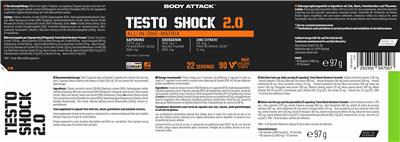
Testo Shock 2.0 by Body Attack label
The label scan from the NIH Dietary Supplement Label Database. Tap to enlarge.
Label images are published by the NIH Dietary Supplement Label Database for the version of this product on file. Always read your actual product label.
View the full label (PDF)The Ingredients in Testo Shock 2.0 by Body Attack
These are the 12 active ingredients this product is made of. Select any to open its full monograph.
Serving size2 Capsule(s) Dosage formCapsule Servings per container22 Amounts shown are per serving.
Most supplement products combine several ingredients, and a medication can interact with the product through any one of them. Each ingredient below shows whether it has known drug interactions.
Niacin
Interacts with727 drugs
Niacin (vitamin B3) is an essential nutrient your body needs for energy and metabolism, and deficiency is uncommon in most developed countries. Prescr...
Niacin monograph & interactionsPantothenic Acid
No knowninteractions
Pantothenic acid is vitamin B5, an essential nutrient your body uses to turn food into energy. True deficiency is very rare because it is found in nea...
Pantothenic Acid monograph & interactionsZinc Citrate
Interacts with67 drugs
Zinc is an essential mineral that your body needs for immune function, wound healing, taste, and smell. Most people get enough from food, but suppleme...
Zinc Citrate monograph & interactions- › Zinc
Maca Root Extract
No knowninteractions
Maca is a nutrient-rich Andean root often used for energy, libido, and menopause symptoms. Early studies suggest it may modestly help sexual desire an...
Maca Root Extract monograph & interactionsSiberian Ginseng extract
Interacts with1,140 drugs
Eleuthero is an herb traditionally used as an 'adaptogen' to fight fatigue, boost energy, and help the body handle stress. The scientific evidence beh...
Siberian Ginseng extract monograph & interactionsWild Yam Root Extract
Interacts with41 drugs
Wild yam is a root traditionally used for menopausal symptoms, cramps, and as a so-called 'natural' hormone supplement, but solid human evidence for t...
Wild Yam Root Extract monograph & interactions- › Diosgenin
Kudzu Root Extract
Interacts with584 drugs
Kudzu is a fast-growing vine whose root has long been used in traditional Chinese medicine and is now studied mostly for reducing alcohol intake. Earl...
Kudzu Root Extract monograph & interactionsFenugreek Seed Extract
Interacts with389 drugs
Fenugreek is a common kitchen spice that is also taken as a supplement, mainly for blood sugar, cholesterol, and to support breast milk production. So...
Fenugreek Seed Extract monograph & interactionsMuira Puama Extract
No knowninteractions
Muira puama is a Brazilian plant traditionally used as an aphrodisiac and general tonic, often nicknamed 'potency wood.' Human research is very limite...
Muira Puama Extract monograph & interactionsTribulus terrestris Extract
Interacts with259 drugs
Tribulus is a plant supplement most often marketed to boost libido, testosterone, and athletic performance, but the human evidence behind these claims...
Tribulus terrestris Extract monograph & interactions- › Saponins
Green Oat extract
Interacts with86 drugs
Oats are a well-studied whole grain whose soluble fiber (beta-glucan) can help lower cholesterol and support heart health when eaten regularly. As a f...
Green Oat extract monograph & interactionsCitrus aurantium Extract
Interacts with957 drugs
Bitter orange is a citrus fruit whose extracts contain synephrine, a mild stimulant often added to weight-loss and energy supplements. Evidence that i...
Citrus aurantium Extract monograph & interactionsOther (inactive) ingredients: Tribulus terrestris Extract, Hydroxypropyl Methylcellulose, Wild Yam Root Extract, Kudzu Root Extract, Green Oat Extract, Citrus aurantium Extract, Magnesium Stearate, Silicon Dioxide, Nicotinamide, Siberian Ginseng Extract, Calcium D-Pantothenate. These complete the product’s ingredient list but are not active constituents.
Testo Shock 2.0 by Body Attack Drug Interactions
HelloPharmacist Interaction Report
Testo Shock 2.0 by Body Attack contains several ingredients with documented drug interactions.
The most serious concern is zinc, which has Moderate interactions with multiple antibiotic classes and HIV medications. Zinc can bind to quinolone antibiotics (like ciprofloxacin), tetracyclines (like doxycycline), and cephalexin in your gut and prevent their absorption — reducing antibiotic levels by 27% to 40%.
Space these antibiotics at least 2 hours before or 4–6 hours after this product. Zinc also may reduce levels of ritonavir and integrase inhibitors used for HIV.
Read the full breakdown — every affected drug type, severity by severity
Niacin in this product has Moderate interactions with blood pressure medications, diabetes drugs, blood thinners (anticoagulants), statins (cholesterol drugs), and gout medications like allopurinol. High-dose niacin can raise blood sugar, lower blood pressure further, and affect how your liver processes other drugs.
Siberian Ginseng extract may increase levels of certain medications metabolized by your liver (CYP1A2, CYP2C9, CYP2D6 substrates), theoretically affect blood thinners, and interfere with immunosuppressants or diabetes drugs. One case report links it to elevated digoxin levels.
Fenugreek seed extract has Moderate interactions with blood thinners, diabetes drugs, theophylline, warfarin, the antiplatelet drug clopidogrel, metoprolol (a beta-blocker), phenytoin (an epilepsy drug), and sildenafil. Green oat extract may lower blood sugar and could increase the risk of low blood sugar (hypoglycemia) if you take insulin or diabetes medications.
We could not check synephrine, saponins, isoflavones, or diosgenin for interactions. Altogether, these interactions span 1,359 individual medications.
Check your exact medications with the tool on this page before starting.
Check your own medications below · Editorial policy · How we use AI
Want to check YOUR meds against Testo Shock 2.0?
Ask about interactions with your drugs in plain English — “Can I take it with lisinopril?” — and we find you the answer in seconds, ingredient by ingredient.
Go to the checkerIngredients driving the most interactions
Individual Drug Interactions
The ingredients in Testo Shock 2.0 interact with 1,477 drugs. Click any drug to see the details.
9 of the 12 ingredients in Testo Shock 2.0 interact with drugs. Each result below shows which ingredient is responsible. Siberian Ginseng extract Citrus aurantium Extract Niacin Kudzu Root Extract Fenugreek Seed Extract Tribulus terrestris Extract Green Oat extract Zinc Citrate Wild Yam Root Extract
AmphetamineAdensys XR-ODT, Adzenys ER, Dyanavel XR, Mydayis
How Amphetamine interacts with Testo Shock 2.0 — through 2 ingredients. Tap an ingredient for the detail:
Citrus Aurantium ExtractCytochrome P450 2d6 (cyp2d6) Substrates, Stimulant Drugs +1 Major
Interaction Summary
Theoretically, bitter orange might increase levels of drug metabolized by CYP2D6.
Read the full Citrus Aurantium Extract + Amphetamine interactionSiberian Ginseng ExtractCytochrome P450 2d6 (cyp2d6) Substrates Minor
Interaction Summary
Theoretically, eleuthero might increase levels of drugs metabolized by CYP2D6.
Read the full Siberian Ginseng Extract + Amphetamine interactionIsocarboxazidMarplan
How Isocarboxazid interacts with Testo Shock 2.0 — through 1 ingredient. Tap an ingredient for the detail:
Citrus Aurantium ExtractMonoamine Oxidase Inhibitors (maois) Major
Interaction Summary
Theoretically, taking MAOIs with synephrine-containing bitter orange preparations might increase the hypertensive effects of synephrine, potentially leading to hypertensive crisis.
Read the full Citrus Aurantium Extract + Isocarboxazid interactionMidazolamNayzilam, Seizalam, Versed
How Midazolam interacts with Testo Shock 2.0 — through 2 ingredients. Tap an ingredient for the detail:
Citrus Aurantium ExtractCytochrome P450 3a4 (cyp3a4) Substrates, Midazolam (versed) Major
Interaction Summary
Bitter orange might increase levels of drugs metabolized by CYP3A4.
Read the full Citrus Aurantium Extract + Midazolam interactionSiberian Ginseng ExtractCytochrome P450 3a4 (cyp3a4) Substrates Minor
Interaction Summary
Theoretically, eleuthero might increase levels of drugs metabolized by CYP3A4.
Read the full Siberian Ginseng Extract + Midazolam interactionMoclobemideManerix, Moclobemide
How Moclobemide interacts with Testo Shock 2.0 — through 1 ingredient. Tap an ingredient for the detail:
Citrus Aurantium ExtractMonoamine Oxidase Inhibitors (maois) Major
Interaction Summary
Theoretically, taking MAOIs with synephrine-containing bitter orange preparations might increase the hypertensive effects of synephrine, potentially leading to hypertensive crisis.
Read the full Citrus Aurantium Extract + Moclobemide interactionOzanimod HydrochlorideZeposia
How Ozanimod Hydrochloride interacts with Testo Shock 2.0 — through 4 ingredients. Tap an ingredient for the detail:
Citrus Aurantium ExtractQt Interval-prolonging Drugs, Monoamine Oxidase Inhibitors (maois) Major
Interaction Summary
Theoretically, bitter orange might have an additive effect when combined with drugs that prolong the QT interval, potentially increasing the risk of ventricular arrhythmias.
Read the full Citrus Aurantium Extract + Ozanimod Hydrochloride interactionKudzu Root ExtractHepatotoxic Drugs Moderate
Interaction Summary
Theoretically, concomitant use might have additive hepatotoxic effects.
Read the full Kudzu Root Extract + Ozanimod Hydrochloride interactionNiacinHepatotoxic Drugs Moderate
Interaction Summary
Theoretically, concomitant use of niacin and hepatotoxic drugs might increase the risk of hepatotoxicity.
Read the full Niacin + Ozanimod Hydrochloride interactionSiberian Ginseng ExtractImmunosuppressants Moderate
Interaction Summary
Theoretically, eleuthero might interfere with immunosuppressive drugs because of its immunostimulant activity.
Read the full Siberian Ginseng Extract + Ozanimod Hydrochloride interactionPhenelzine SulfateNardil
How Phenelzine Sulfate interacts with Testo Shock 2.0 — through 1 ingredient. Tap an ingredient for the detail:
Citrus Aurantium ExtractMonoamine Oxidase Inhibitors (maois) Major
Interaction Summary
Theoretically, taking MAOIs with synephrine-containing bitter orange preparations might increase the hypertensive effects of synephrine, potentially leading to hypertensive crisis.
Read the full Citrus Aurantium Extract + Phenelzine Sulfate interactionRasagilineAzilect
How Rasagiline interacts with Testo Shock 2.0 — through 2 ingredients. Tap an ingredient for the detail:
Citrus Aurantium ExtractMonoamine Oxidase Inhibitors (maois) Major
Interaction Summary
Theoretically, taking MAOIs with synephrine-containing bitter orange preparations might increase the hypertensive effects of synephrine, potentially leading to hypertensive crisis.
Read the full Citrus Aurantium Extract + Rasagiline interactionSiberian Ginseng ExtractCytochrome P450 1a2 (cyp1a2) Substrates Moderate
Interaction Summary
Theoretically, eleuthero might increase levels of drugs metabolized by CYP1A2.
Read the full Siberian Ginseng Extract + Rasagiline interactionSafinamide MesylateXadago
How Safinamide Mesylate interacts with Testo Shock 2.0 — through 1 ingredient. Tap an ingredient for the detail:
Citrus Aurantium ExtractMonoamine Oxidase Inhibitors (maois) Major
Interaction Summary
Theoretically, taking MAOIs with synephrine-containing bitter orange preparations might increase the hypertensive effects of synephrine, potentially leading to hypertensive crisis.
Read the full Citrus Aurantium Extract + Safinamide Mesylate interactionSelegilineCarbex, Eldepryl, Emsam, Zelapar
How Selegiline interacts with Testo Shock 2.0 — through 1 ingredient. Tap an ingredient for the detail:
Citrus Aurantium ExtractMonoamine Oxidase Inhibitors (maois) Major
Interaction Summary
Theoretically, taking MAOIs with synephrine-containing bitter orange preparations might increase the hypertensive effects of synephrine, potentially leading to hypertensive crisis.
Read the full Citrus Aurantium Extract + Selegiline interactionTranylcypromineParnate
How Tranylcypromine interacts with Testo Shock 2.0 — through 1 ingredient. Tap an ingredient for the detail:
Citrus Aurantium ExtractMonoamine Oxidase Inhibitors (maois) Major
Interaction Summary
Theoretically, taking MAOIs with synephrine-containing bitter orange preparations might increase the hypertensive effects of synephrine, potentially leading to hypertensive crisis.
Read the full Citrus Aurantium Extract + Tranylcypromine interaction6-mercaptopurinePurinethol
How 6-mercaptopurine interacts with Testo Shock 2.0 — through 3 ingredients. Tap an ingredient for the detail:
Siberian Ginseng ExtractImmunosuppressants Moderate
Interaction Summary
Theoretically, eleuthero might interfere with immunosuppressive drugs because of its immunostimulant activity.
Read the full Siberian Ginseng Extract + 6-mercaptopurine interactionKudzu Root ExtractHepatotoxic Drugs Moderate
Interaction Summary
Theoretically, concomitant use might have additive hepatotoxic effects.
Read the full Kudzu Root Extract + 6-mercaptopurine interactionNiacinHepatotoxic Drugs Moderate
Interaction Summary
Theoretically, concomitant use of niacin and hepatotoxic drugs might increase the risk of hepatotoxicity.
Read the full Niacin + 6-mercaptopurine interactionAdo-trastuzumab EmtansineKadcyla
How Ado-trastuzumab Emtansine interacts with Testo Shock 2.0 — through 2 ingredients. Tap an ingredient for the detail:
Citrus Aurantium ExtractCytochrome P450 3a4 (cyp3a4) Substrates Moderate
Interaction Summary
Bitter orange might increase levels of drugs metabolized by CYP3A4.
Read the full Citrus Aurantium Extract + Ado-trastuzumab Emtansine interactionSiberian Ginseng ExtractCytochrome P450 3a4 (cyp3a4) Substrates Minor
Interaction Summary
Theoretically, eleuthero might increase levels of drugs metabolized by CYP3A4.
Read the full Siberian Ginseng Extract + Ado-trastuzumab Emtansine interactionAbacavir Sulfate, Dolutegravir, LamivudineTriumeq
How Abacavir Sulfate, Dolutegravir, Lamivudine interacts with Testo Shock 2.0 — through 2 ingredients. Tap an ingredient for the detail:
NiacinHepatotoxic Drugs Moderate
Interaction Summary
Theoretically, concomitant use of niacin and hepatotoxic drugs might increase the risk of hepatotoxicity.
Read the full Niacin + Abacavir Sulfate, Dolutegravir, Lamivudine interactionKudzu Root ExtractHepatotoxic Drugs Moderate
Interaction Summary
Theoretically, concomitant use might have additive hepatotoxic effects.
Read the full Kudzu Root Extract + Abacavir Sulfate, Dolutegravir, Lamivudine interactionAbacavir, LamivudineEpzicom
How Abacavir, Lamivudine interacts with Testo Shock 2.0 — through 2 ingredients. Tap an ingredient for the detail:
Kudzu Root ExtractHepatotoxic Drugs Moderate
Interaction Summary
Theoretically, concomitant use might have additive hepatotoxic effects.
Read the full Kudzu Root Extract + Abacavir, Lamivudine interactionNiacinHepatotoxic Drugs Moderate
Interaction Summary
Theoretically, concomitant use of niacin and hepatotoxic drugs might increase the risk of hepatotoxicity.
Read the full Niacin + Abacavir, Lamivudine interactionAbciximabReoPro
How Abciximab interacts with Testo Shock 2.0 — through 4 ingredients. Tap an ingredient for the detail:
Siberian Ginseng ExtractAnticoagulant/antiplatelet Drugs Moderate
Interaction Summary
Theoretically, eleuthero may have antiplatelet effects and may increase the risk of bleeding if used with anticoagulant or antiplatelet drugs.
Read the full Siberian Ginseng Extract + Abciximab interactionNiacinAnticoagulant/antiplatelet Drugs Moderate
Interaction Summary
Theoretically, niacin may have additive effects when used with anticoagulant or antiplatelet drugs.
Read the full Niacin + Abciximab interactionKudzu Root ExtractAnticoagulant/antiplatelet Drugs Moderate
Interaction Summary
Theoretically, kudzu may increase the risk of bleeding if used with antiplatelet or anticoagulant drugs.
Read the full Kudzu Root Extract + Abciximab interactionFenugreek Seed ExtractAnticoagulant/antiplatelet Drugs Moderate
Interaction Summary
Theoretically, fenugreek might have additive effects when used with anticoagulant or antiplatelet drugs.
Read the full Fenugreek Seed Extract + Abciximab interactionAbemaciclibVerzenio
How Abemaciclib interacts with Testo Shock 2.0 — through 2 ingredients. Tap an ingredient for the detail:
Citrus Aurantium ExtractCytochrome P450 3a4 (cyp3a4) Substrates Moderate
Interaction Summary
Bitter orange might increase levels of drugs metabolized by CYP3A4.
Read the full Citrus Aurantium Extract + Abemaciclib interactionSiberian Ginseng ExtractCytochrome P450 3a4 (cyp3a4) Substrates Minor
Interaction Summary
Theoretically, eleuthero might increase levels of drugs metabolized by CYP3A4.
Read the full Siberian Ginseng Extract + Abemaciclib interactionAbiraterone
How Abiraterone interacts with Testo Shock 2.0 — through 4 ingredients. Tap an ingredient for the detail:
NiacinHepatotoxic Drugs Moderate
Interaction Summary
Theoretically, concomitant use of niacin and hepatotoxic drugs might increase the risk of hepatotoxicity.
Read the full Niacin + Abiraterone interactionKudzu Root ExtractHepatotoxic Drugs Moderate
Interaction Summary
Theoretically, concomitant use might have additive hepatotoxic effects.
Read the full Kudzu Root Extract + Abiraterone interactionCitrus Aurantium ExtractCytochrome P450 3a4 (cyp3a4) Substrates Moderate
Interaction Summary
Bitter orange might increase levels of drugs metabolized by CYP3A4.
Read the full Citrus Aurantium Extract + Abiraterone interactionSiberian Ginseng ExtractCytochrome P450 3a4 (cyp3a4) Substrates Minor
Interaction Summary
Theoretically, eleuthero might increase levels of drugs metabolized by CYP3A4.
Read the full Siberian Ginseng Extract + Abiraterone interactionAbiraterone AcetateYonsa, Zytiga
How Abiraterone Acetate interacts with Testo Shock 2.0 — through 4 ingredients. Tap an ingredient for the detail:
NiacinHepatotoxic Drugs Moderate
Interaction Summary
Theoretically, concomitant use of niacin and hepatotoxic drugs might increase the risk of hepatotoxicity.
Read the full Niacin + Abiraterone Acetate interactionCitrus Aurantium ExtractCytochrome P450 3a4 (cyp3a4) Substrates Moderate
Interaction Summary
Bitter orange might increase levels of drugs metabolized by CYP3A4.
Read the full Citrus Aurantium Extract + Abiraterone Acetate interactionKudzu Root ExtractHepatotoxic Drugs Moderate
Interaction Summary
Theoretically, concomitant use might have additive hepatotoxic effects.
Read the full Kudzu Root Extract + Abiraterone Acetate interactionSiberian Ginseng ExtractCytochrome P450 3a4 (cyp3a4) Substrates Minor
Interaction Summary
Theoretically, eleuthero might increase levels of drugs metabolized by CYP3A4.
Read the full Siberian Ginseng Extract + Abiraterone Acetate interactionAbrocitinibCibinqo
How Abrocitinib interacts with Testo Shock 2.0 — through 4 ingredients. Tap an ingredient for the detail:
Fenugreek Seed ExtractAnticoagulant/antiplatelet Drugs Moderate
Interaction Summary
Theoretically, fenugreek might have additive effects when used with anticoagulant or antiplatelet drugs.
Read the full Fenugreek Seed Extract + Abrocitinib interactionKudzu Root ExtractAnticoagulant/antiplatelet Drugs Moderate
Interaction Summary
Theoretically, kudzu may increase the risk of bleeding if used with antiplatelet or anticoagulant drugs.
Read the full Kudzu Root Extract + Abrocitinib interactionSiberian Ginseng ExtractAnticoagulant/antiplatelet Drugs, Cytochrome P450 2c9 (cyp2c9) Substrates +1 Moderate
Interaction Summary
Theoretically, eleuthero may have antiplatelet effects and may increase the risk of bleeding if used with anticoagulant or antiplatelet drugs.
Read the full Siberian Ginseng Extract + Abrocitinib interactionNiacinAnticoagulant/antiplatelet Drugs Moderate
Interaction Summary
Theoretically, niacin may have additive effects when used with anticoagulant or antiplatelet drugs.
Read the full Niacin + Abrocitinib interactionAcalabrutinibCalquence
How Acalabrutinib interacts with Testo Shock 2.0 — through 2 ingredients. Tap an ingredient for the detail:
Citrus Aurantium ExtractCytochrome P450 3a4 (cyp3a4) Substrates Moderate
Interaction Summary
Bitter orange might increase levels of drugs metabolized by CYP3A4.
Read the full Citrus Aurantium Extract + Acalabrutinib interactionSiberian Ginseng ExtractCytochrome P450 3a4 (cyp3a4) Substrates, P-glycoprotein Substrates Moderate
Interaction Summary
Theoretically, eleuthero might increase levels of drugs metabolized by CYP3A4.
Read the full Siberian Ginseng Extract + Acalabrutinib interactionAcarboseGlucobay, Prandase, Precose
How Acarbose interacts with Testo Shock 2.0 — through 7 ingredients. Tap an ingredient for the detail:
Siberian Ginseng ExtractAntidiabetes Drugs Moderate
Interaction Summary
Theoretically, eleuthero might have additive effects when used with antidiabetes drugs.
Read the full Siberian Ginseng Extract + Acarbose interactionCitrus Aurantium ExtractAntidiabetes Drugs Moderate
Interaction Summary
Theoretically, bitter orange might increase the risk of hypoglycemia when taken with antidiabetes drugs.
Read the full Citrus Aurantium Extract + Acarbose interactionKudzu Root ExtractAntidiabetes Drugs, Hepatotoxic Drugs Moderate
Interaction Summary
Theoretically, taking kudzu with antidiabetes drugs might increase the risk of hypoglycemia.
Read the full Kudzu Root Extract + Acarbose interactionGreen Oat ExtractAntidiabetes Drugs Moderate
Interaction Summary
Theoretically, oats may have additive effects with antidiabetic agents and might increase the risk of hypoglycemia.
Read the full Green Oat Extract + Acarbose interactionTribulus Terrestris ExtractAntidiabetes Drugs Moderate
Interaction Summary
Taking tribulus with antidiabetes drugs might increase the risk of hypoglycemia.
Read the full Tribulus Terrestris Extract + Acarbose interactionFenugreek Seed ExtractAntidiabetes Drugs Moderate
Interaction Summary
Theoretically, fenugreek seed might have additive hypoglycemic effects when used with antidiabetes drugs.
Read the full Fenugreek Seed Extract + Acarbose interactionNiacinHepatotoxic Drugs, Antidiabetes Drugs Moderate
Interaction Summary
Theoretically, concomitant use of niacin and hepatotoxic drugs might increase the risk of hepatotoxicity.
Read the full Niacin + Acarbose interactionAcebutololRhotral, Sectral
How Acebutolol interacts with Testo Shock 2.0 — through 4 ingredients. Tap an ingredient for the detail:
Kudzu Root ExtractHepatotoxic Drugs Moderate
Interaction Summary
Theoretically, concomitant use might have additive hepatotoxic effects.
Read the full Kudzu Root Extract + Acebutolol interactionTribulus Terrestris ExtractAntihypertensive Drugs Moderate
Interaction Summary
Theoretically, taking tribulus with antihypertensive drugs might increase the risk of hypotension.
Read the full Tribulus Terrestris Extract + Acebutolol interactionNiacinAntihypertensive Drugs, Hepatotoxic Drugs Moderate
Interaction Summary
Theoretically, niacin may increase the risk of hypotension when used with antihypertensive drugs.
Read the full Niacin + Acebutolol interactionFenugreek Seed ExtractAntihypertensive Drugs Minor
Interaction Summary
Fenugreek may also have an additive effect on blood pressure-lowering medications.
Read the full Fenugreek Seed Extract + Acebutolol interactionAcenocoumarolSintrom
How Acenocoumarol interacts with Testo Shock 2.0 — through 4 ingredients. Tap an ingredient for the detail:
Kudzu Root ExtractAnticoagulant/antiplatelet Drugs Moderate
Interaction Summary
Theoretically, kudzu may increase the risk of bleeding if used with antiplatelet or anticoagulant drugs.
Read the full Kudzu Root Extract + Acenocoumarol interactionFenugreek Seed ExtractAnticoagulant/antiplatelet Drugs Moderate
Interaction Summary
Theoretically, fenugreek might have additive effects when used with anticoagulant or antiplatelet drugs.
Read the full Fenugreek Seed Extract + Acenocoumarol interactionSiberian Ginseng ExtractAnticoagulant/antiplatelet Drugs Moderate
Interaction Summary
Theoretically, eleuthero may have antiplatelet effects and may increase the risk of bleeding if used with anticoagulant or antiplatelet drugs.
Read the full Siberian Ginseng Extract + Acenocoumarol interactionNiacinAnticoagulant/antiplatelet Drugs Moderate
Interaction Summary
Theoretically, niacin may have additive effects when used with anticoagulant or antiplatelet drugs.
Read the full Niacin + Acenocoumarol interactionAcetaminophenChildren's Tylenol, Children's Tylenol Meltaways, Tylenol, Tylenol Ex Strength
How Acetaminophen interacts with Testo Shock 2.0 — through 3 ingredients. Tap an ingredient for the detail:
NiacinHepatotoxic Drugs Moderate
Interaction Summary
Theoretically, concomitant use of niacin and hepatotoxic drugs might increase the risk of hepatotoxicity.
Read the full Niacin + Acetaminophen interactionKudzu Root ExtractHepatotoxic Drugs Moderate
Interaction Summary
Theoretically, concomitant use might have additive hepatotoxic effects.
Read the full Kudzu Root Extract + Acetaminophen interactionSiberian Ginseng ExtractCytochrome P450 1a2 (cyp1a2) Substrates Moderate
Interaction Summary
Theoretically, eleuthero might increase levels of drugs metabolized by CYP1A2.
Read the full Siberian Ginseng Extract + Acetaminophen interactionAcetaminophen, AspirinGemnisyn
How Acetaminophen, Aspirin interacts with Testo Shock 2.0 — through 4 ingredients. Tap an ingredient for the detail:
Siberian Ginseng ExtractCytochrome P450 1a2 (cyp1a2) Substrates, Anticoagulant/antiplatelet Drugs Moderate
Interaction Summary
Theoretically, eleuthero might increase levels of drugs metabolized by CYP1A2.
Read the full Siberian Ginseng Extract + Acetaminophen, Aspirin interactionNiacinAnticoagulant/antiplatelet Drugs, Aspirin +1 Moderate
Interaction Summary
Theoretically, niacin may have additive effects when used with anticoagulant or antiplatelet drugs.
Read the full Niacin + Acetaminophen, Aspirin interactionFenugreek Seed ExtractAnticoagulant/antiplatelet Drugs Moderate
Interaction Summary
Theoretically, fenugreek might have additive effects when used with anticoagulant or antiplatelet drugs.
Read the full Fenugreek Seed Extract + Acetaminophen, Aspirin interactionKudzu Root ExtractHepatotoxic Drugs, Anticoagulant/antiplatelet Drugs Moderate
Interaction Summary
Theoretically, concomitant use might have additive hepatotoxic effects.
Read the full Kudzu Root Extract + Acetaminophen, Aspirin interactionAcetaminophen, Aspirin, CaffeineExcedrin, Excedrin Extra Strength, Excedrin Migraine
How Acetaminophen, Aspirin, Caffeine interacts with Testo Shock 2.0 — through 5 ingredients. Tap an ingredient for the detail:
Kudzu Root ExtractAnticoagulant/antiplatelet Drugs, Caffeine +1 Moderate
Interaction Summary
Theoretically, kudzu may increase the risk of bleeding if used with antiplatelet or anticoagulant drugs.
Read the full Kudzu Root Extract + Acetaminophen, Aspirin, Caffeine interactionFenugreek Seed ExtractAnticoagulant/antiplatelet Drugs Moderate
Interaction Summary
Theoretically, fenugreek might have additive effects when used with anticoagulant or antiplatelet drugs.
Read the full Fenugreek Seed Extract + Acetaminophen, Aspirin, Caffeine interactionSiberian Ginseng ExtractAnticoagulant/antiplatelet Drugs, Cytochrome P450 3a4 (cyp3a4) Substrates +1 Moderate
Interaction Summary
Theoretically, eleuthero may have antiplatelet effects and may increase the risk of bleeding if used with anticoagulant or antiplatelet drugs.
Read the full Siberian Ginseng Extract + Acetaminophen, Aspirin, Caffeine interactionCitrus Aurantium ExtractStimulant Drugs, Caffeine +1 Moderate
Interaction Summary
Theoretically, bitter orange might increase the risk of hypertension and adverse cardiovascular effects when taken with stimulant drugs.
Read the full Citrus Aurantium Extract + Acetaminophen, Aspirin, Caffeine interactionNiacinHepatotoxic Drugs, Aspirin +1 Moderate
Interaction Summary
Theoretically, concomitant use of niacin and hepatotoxic drugs might increase the risk of hepatotoxicity.
Read the full Niacin + Acetaminophen, Aspirin, Caffeine interactionAcetaminophen, Brompheniramine, PhenylpropanolamineDimetapp Cold and Flu
How Acetaminophen, Brompheniramine, Phenylpropanolamine interacts with Testo Shock 2.0 — through 4 ingredients. Tap an ingredient for the detail:
NiacinHepatotoxic Drugs Moderate
Interaction Summary
Theoretically, concomitant use of niacin and hepatotoxic drugs might increase the risk of hepatotoxicity.
Read the full Niacin + Acetaminophen, Brompheniramine, Phenylpropanolamine interactionKudzu Root ExtractHepatotoxic Drugs Moderate
Interaction Summary
Theoretically, concomitant use might have additive hepatotoxic effects.
Read the full Kudzu Root Extract + Acetaminophen, Brompheniramine, Phenylpropanolamine interactionSiberian Ginseng ExtractCytochrome P450 1a2 (cyp1a2) Substrates Moderate
Interaction Summary
Theoretically, eleuthero might increase levels of drugs metabolized by CYP1A2.
Read the full Siberian Ginseng Extract + Acetaminophen, Brompheniramine, Phenylpropanolamine interactionCitrus Aurantium ExtractStimulant Drugs Moderate
Interaction Summary
Theoretically, bitter orange might increase the risk of hypertension and adverse cardiovascular effects when taken with stimulant drugs.
Read the full Citrus Aurantium Extract + Acetaminophen, Brompheniramine, Phenylpropanolamine interactionAcetaminophen, ButalbitalAxocet, Bancap, Bucet, Butex Forte, Esgic CF, Orbivan CF +5 more
How Acetaminophen, Butalbital interacts with Testo Shock 2.0 — through 3 ingredients. Tap an ingredient for the detail:
Siberian Ginseng ExtractCytochrome P450 1a2 (cyp1a2) Substrates Moderate
Interaction Summary
Theoretically, eleuthero might increase levels of drugs metabolized by CYP1A2.
Read the full Siberian Ginseng Extract + Acetaminophen, Butalbital interactionKudzu Root ExtractHepatotoxic Drugs Moderate
Interaction Summary
Theoretically, concomitant use might have additive hepatotoxic effects.
Read the full Kudzu Root Extract + Acetaminophen, Butalbital interactionNiacinHepatotoxic Drugs Moderate
Interaction Summary
Theoretically, concomitant use of niacin and hepatotoxic drugs might increase the risk of hepatotoxicity.
Read the full Niacin + Acetaminophen, Butalbital interactionAcetaminophen, Butalbital, CaffeineEsgic, Esgic Plus, Fiogesic, Fioricet, Repan, Tecnal +1 more
How Acetaminophen, Butalbital, Caffeine interacts with Testo Shock 2.0 — through 4 ingredients. Tap an ingredient for the detail:
Kudzu Root ExtractCaffeine, Hepatotoxic Drugs Moderate
Interaction Summary
Theoretically, taking kudzu with caffeine might increase levels of caffeine.
Read the full Kudzu Root Extract + Acetaminophen, Butalbital, Caffeine interactionNiacinHepatotoxic Drugs Moderate
Interaction Summary
Theoretically, concomitant use of niacin and hepatotoxic drugs might increase the risk of hepatotoxicity.
Read the full Niacin + Acetaminophen, Butalbital, Caffeine interactionCitrus Aurantium ExtractCytochrome P450 3a4 (cyp3a4) Substrates, Stimulant Drugs +1 Moderate
Interaction Summary
Bitter orange might increase levels of drugs metabolized by CYP3A4.
Read the full Citrus Aurantium Extract + Acetaminophen, Butalbital, Caffeine interactionSiberian Ginseng ExtractCytochrome P450 1a2 (cyp1a2) Substrates, Cytochrome P450 3a4 (cyp3a4) Substrates Moderate
Interaction Summary
Theoretically, eleuthero might increase levels of drugs metabolized by CYP1A2.
Read the full Siberian Ginseng Extract + Acetaminophen, Butalbital, Caffeine interactionAcetaminophen, Butalbital, Caffeine, CodeineEsgic with Codeine, Fioricet w/ Codeine
How Acetaminophen, Butalbital, Caffeine, Codeine interacts with Testo Shock 2.0 — through 4 ingredients. Tap an ingredient for the detail:
Citrus Aurantium ExtractStimulant Drugs, Caffeine +2 Moderate
Interaction Summary
Theoretically, bitter orange might increase the risk of hypertension and adverse cardiovascular effects when taken with stimulant drugs.
Read the full Citrus Aurantium Extract + Acetaminophen, Butalbital, Caffeine, Codeine interactionSiberian Ginseng ExtractCytochrome P450 2d6 (cyp2d6) Substrates, Cytochrome P450 1a2 (cyp1a2) Substrates +1 Moderate
Interaction Summary
Theoretically, eleuthero might increase levels of drugs metabolized by CYP2D6.
Read the full Siberian Ginseng Extract + Acetaminophen, Butalbital, Caffeine, Codeine interactionKudzu Root ExtractHepatotoxic Drugs, Caffeine Moderate
Interaction Summary
Theoretically, concomitant use might have additive hepatotoxic effects.
Read the full Kudzu Root Extract + Acetaminophen, Butalbital, Caffeine, Codeine interactionNiacinHepatotoxic Drugs Moderate
Interaction Summary
Theoretically, concomitant use of niacin and hepatotoxic drugs might increase the risk of hepatotoxicity.
Read the full Niacin + Acetaminophen, Butalbital, Caffeine, Codeine interactionEach ingredient & the kinds of drugs it affects
For each ingredient in Testo Shock 2.0 with known interactions, here are the types of medications they can affect. Open any type for the detail — or search your exact drug in the checker above.
Siberian Ginseng extract
Anticoagulant/Antiplatelet Drugs
Theoretically, eleuthero may have antiplatelet effects and may increase the risk of bleeding if used with anticoagulant or antiplatelet drugs.
In vitro and animal research shows that a constituent of eleuthero, dihydroxybenzoic acid, appears to inhibit platelet aggregation. Concomitant use with anticoagulant or antiplatelet drugs might increase the risk of bleeding. This effect has not been reported in humans.
Antidiabetes Drugs
Theoretically, eleuthero might have additive effects when used with antidiabetes drugs.
Animal research suggests that certain constituents of eleuthero have hypoglycemic activity in both healthy and diabetic animals. A small study in adults with type 2 diabetes also shows that taking eleuthero for 3 months can lower blood glucose levels. However, one very small study in healthy individuals shows that taking powdered eleuthero 3 grams, 40 minutes prior to a 75-gram oral glucose tolerance test, significantly increases postprandial blood glucose levels when compared with placebo. These contradictory findings might be due to patient-specific variability and variability in active ingredient ratios.
Cytochrome P450 1A2 (Cyp1A2) Substrates
Theoretically, eleuthero might increase levels of drugs metabolized by CYP1A2.
In vitro and animal research suggest that standardized extracts of eleuthero inhibit CYP1A2. This effect has not been reported in humans.
Cytochrome P450 2C9 (Cyp2C9) Substrates
Theoretically, eleuthero might increase levels of drugs metabolized by CYP2C9.
In vitro and animal research suggest that standardized extracts of eleuthero might inhibit CYP2C9. This effect has not been reported in humans.
Digoxin (Lanoxin)
Eleuthero might increase serum digoxin levels and increase the risk of side effects.
In one case report, a 74-year-old male who was stabilized on digoxin presented with an elevated serum digoxin level after starting an eleuthero supplement, without symptoms of toxicity. After stopping the supplement, serum digoxin levels returned to normal. It is not clear whether this was due to a pharmacokinetic interaction or to interference with the digoxin assay. Although the product was found to be free of digoxin and digitoxin, it was not tested for other contaminants.
Immunosuppressants
Theoretically, eleuthero might interfere with immunosuppressive drugs because of its immunostimulant activity.
Animal and in vitro research shows that eleuthero extracts have immunomodulatory effects, including increasing cellular and humoral activity.
P-Glycoprotein Substrates
Theoretically, eleuthero might increase levels of P-glycoprotein substrates.
In vitro research suggests that eleuthero can inhibit the multi-drug transporter protein, P-glycoprotein. However, it is too soon to tell if this is clinically important. This interaction has not been reported in humans.
Cytochrome P450 2D6 (Cyp2D6) Substrates
Theoretically, eleuthero might increase levels of drugs metabolized by CYP2D6.
In vitro and animal research suggest that standardized extracts of eleuthero might inhibit CYP2D6. However, research in healthy human volunteers has found that taking eleuthero 485 mg twice daily for 14 days does not inhibit CYP2D6 drug metabolism.
Cytochrome P450 3A4 (Cyp3A4) Substrates
Theoretically, eleuthero might increase levels of drugs metabolized by CYP3A4.
In vitro and animal research suggest that standardized extracts of eleuthero might inhibit CYP3A4. However, research in healthy human volunteers has found that taking eleuthero 485 mg twice daily for 14 days does not inhibit CYP3A4 drug metabolism.
Organic Anion-Transporting Polypeptide Substrates (Oatp)
Theoretically, eleuthero might decrease levels of drugs metabolized by OATP.
In vitro research suggests that eleuthero inhibits OATP2B1, which might reduce the bioavailability of oral drugs that are substrates of OATP2B1. Due to the weak inhibitory effect identified in this study, this interaction is not likely to be clinically significant.
Citrus aurantium Extract
Midazolam (Versed)
Bitter orange might increase blood levels of midazolam.
One small clinical study shows that bitter orange juice can increase midazolam levels, likely through inhibition of cytochrome P450 3A4 (CYP3A4). Theoretically, bitter orange might increase the risk of midazolam-related adverse effects.
Monoamine Oxidase Inhibitors (Maois)
Theoretically, taking MAOIs with synephrine-containing bitter orange preparations might increase the hypertensive effects of synephrine, potentially leading to hypertensive crisis.
Bitter orange contains tyramine, octopamine, and synephrine, which are MAO substrates.
Antidiabetes Drugs
Theoretically, bitter orange might increase the risk of hypoglycemia when taken with antidiabetes drugs.
Some clinical research shows that drinking a tea containing bitter orange and Indian snakeroot reduces fasting and postprandial glucose levels in patients with type 2 diabetes who are using antidiabetes drugs. However, it is unclear if these effects are due to bitter orange, Indian snakeroot, or the combination. An animal study also shows that p-synephrine in combination with gliclazide , a sulfonylurea, causes an additional 20% to 44% decrease in glucose levels when compared with gliclazide alone.
Caffeine
Bitter orange might increase blood pressure and heart rate when taken with caffeine.
Small clinical studies show that taking bitter orange in combination with caffeine can increase blood pressure and heart rate in otherwise healthy normotensive adults. Theoretically, this might increase the risk of serious cardiovascular adverse effects.
Colchicine
Bitter orange might affect colchicine levels.
Colchicine is a substrate of P-glycoprotein and cytochrome P450 3A4 (CYP3A4). Bitter orange has been reported to inhibit CYP3A4 and increase levels of CYP3A4 substrates. However, one small clinical study in healthy adults shows that drinking bitter orange juice 240 mL twice daily for 4 days and taking a single dose of colchicine 0.6 mg on the 4th day decreases colchicine peak serum levels by 24%, time to peak serum level by 1 hour, and overall exposure to colchicine by 20%. The clinical significance of this finding is unclear.
Cytochrome P450 3A4 (Cyp3A4) Substrates
Bitter orange might increase levels of drugs metabolized by CYP3A4.
Small clinical studies suggest that single or multiple doses of freshly squeezed bitter orange juice 200-240 mL can inhibit CYP3A4 metabolism of drugs, causing increased drug levels and potentially increasing the risk of adverse effects. However, the extent of the effect of bitter orange on CYP3A4-mediated drug interactions is unknown. Some evidence suggests that bitter orange selectively inhibits intestinal CYP3A4, but not hepatic CYP3A4. Its effect on P-glycoprotein, which strongly overlaps with CYP3A4 interactions, is unclear. One small clinical study shows that drinking 8 ounces of freshly squeezed bitter orange juice has no effect on cyclosporine, which seems to be more dependent on hepatic CYP3A4 and P-glycoprotein than intestinal CYP3A4.
Dextromethorphan (Robitussin Dm, Others)
Bitter orange might increase blood levels of dextromethorphan.
One small clinical study shows that bitter orange juice increases dextromethorphan levels, likely through cytochrome P450 3A4 (CYP3A4) inhibition. Theoretically, bitter orange might increase the risk for dextromethorphan-related adverse effects.
Felodipine (Plendil)
Bitter orange might increase blood levels of felodipine.
One small clinical study shows that bitter orange juice increases felodipine levels, likely through cytochrome P450 3A4 (CYP3A4) inhibition. Theoretically, bitter orange might increase the risk for felodipine-related adverse effects.
Indinavir (Crixivan)
Bitter orange might increase blood levels of indinavir.
One small clinical study shows that bitter orange juice slightly increases indinavir levels, but this effect is likely to be clinically insignificant. Bitter orange selectively inhibits intestinal cytochrome P450 3A4 (CYP3A4); however, the metabolism of indinavir seems to be more dependent on hepatic CYP3A4. The effect of bitter orange on other protease inhibitors has not been studied.
Qt Interval-Prolonging Drugs
Theoretically, bitter orange might have an additive effect when combined with drugs that prolong the QT interval, potentially increasing the risk of ventricular arrhythmias.
One case report suggests that taking bitter orange in combination with other stimulants such as caffeine might prolong the QT interval in some patients.
Sildenafil (Viagra)
Bitter orange juice might increase blood levels of sildenafil.
A small clinical study in healthy adult males shows that drinking freshly squeezed bitter orange juice 250 mL daily for 3 days and taking a single dose of sildenafil 50 mg on the 3rd day increases the peak plasma concentration of sildenafil by 18% and the overall exposure to sildenafil by 44%. Theoretically, this may be due to inhibition of cytochrome P450 3A4 by bitter orange.
Stimulant Drugs
Theoretically, bitter orange might increase the risk of hypertension and adverse cardiovascular effects when taken with stimulant drugs.
Bitter orange appears to have stimulant effects.
Cytochrome P450 2D6 (Cyp2D6) Substrates
Theoretically, bitter orange might increase levels of drug metabolized by CYP2D6.
In vitro research shows that octopamine, a constituent of bitter orange, weakly inhibits CYP2D6 enzymes. This effect has not been reported in humans.
Niacin
Alcohol (Ethanol)
Concomitant use of alcohol and niacin might increase the risk of flushing and hepatotoxicity.
Alcohol can exacerbate the flushing and pruritus associated with niacin. Large doses of niacin might also exacerbate liver dysfunction associated with chronic alcohol use. A case report describes delirium and lactic acidosis in a patient taking niacin 3 grams daily who ingested 1 liter of wine. Advise patients to avoid large amounts of alcohol while taking niacin.
Allopurinol (Zyloprim)
Theoretically, niacin might antagonize the therapeutic effects of uricosurics such as allopurinol.
Large doses of niacin can reduce urinary excretion of uric acid, potentially resulting in hyperuricemia. Doses of uricosurics such as allopurinol might need to be increased to maintain control of gout in patients who start taking niacin. People who have frequent attacks of gout despite uricosuric therapy should avoid niacin.
Anticoagulant/Antiplatelet Drugs
Theoretically, niacin may have additive effects when used with anticoagulant or antiplatelet drugs.
Several cases of clotting factor synthesis deficiency and coagulopathy have been reported in patients taking sustained-release niacin. Also, thrombocytopenia has been reported in patients treated with niacin or niacin plus lovastatin.
Antidiabetes Drugs
Niacin can increase blood glucose levels and may diminish the effects of antidiabetes drugs.
Niacin impairs glucose tolerance in a dose-dependent manner, probably by causing or aggravating insulin resistance and increasing hepatic production of glucose. In diabetes patients, niacin 4.5 grams daily for 5 weeks can increase plasma glucose by an average of 16% and glycated hemoglobin (HbA1c) by 21%. However, lower doses of 1.5 grams daily or less appear to have minimal effects on blood glucose. In some patients, glucose levels increase when niacin is started, but then return to baseline when a stable dose is reached. Up to 35% of patients with diabetes may need adjustments in hypoglycemic therapy when niacin is added.
Antihypertensive Drugs
Theoretically, niacin may increase the risk of hypotension when used with antihypertensive drugs.
The vasodilating effects of niacin can cause hypotension. Furthermore, some clinical evidence suggests that a one-hour infusion of niacin can reduce systolic, diastolic, and mean blood pressure in hypertensive patients. This effect is not observed in normotensive patients.
Bile Acid Sequestrants
Bile acid sequestrants can bind niacin and decrease absorption. Separate administration by 4-6 hours to avoid an interaction.
In vitro studies show that colestipol (Colestid) binds about 98% of available niacin and cholestyramine (Questran) binds 10% to 30%.
Gemfibrozil (Lopid)
Theoretically, concomitant use of niacin and gemfibrozil might increase the risk of myopathy in some patients.
A case of myopathy from concomitant use of niacin and gemfibrozil has been reported. Niacin alone has also been associated with cases of myopathy. Using gemfibrozil with niacin might further increase the risk of developing myopathy.
Hepatotoxic Drugs
Theoretically, concomitant use of niacin and hepatotoxic drugs might increase the risk of hepatotoxicity.
Niacin has been associated with cases of liver toxicity, especially when used in pharmacologic doses. Sustained-release niacin preparations appear to be associated with a higher risk of hepatotoxicity than immediate-release niacin.
Hmg-Coa Reductase Inhibitors ("Statins")
Theoretically, concomitant use of niacin and statins might increase the risk of myopathy and rhabdomyolysis in some patients.
Some case reports have raised concerns that niacin might increase the risk of myopathy and rhabdomyolysis when combined with statins. However, a significantly increased risk of myopathy has not been demonstrated in clinical trials, including those using an FDA-approved combination of lovastatin and niacin (Advicor).
Probenecid (Benemid)
Theoretically, niacin might antagonize the therapeutic effects of uricosurics such as probenecid.
Large doses of niacin reduce urinary excretion of uric acid, potentially causing hyperuricemia. Doses of uricosurics such as probenecid might need to be increased to maintain control of gout in patients who start taking niacin. People who have frequent attacks of gout despite uricosuric therapy should avoid niacin.
Sulfinpyrazone (Anturane)
Theoretically, niacin might antagonize the therapeutic effects of uricosurics such as sulfinpyrazone.
Large doses of niacin reduce urinary excretion of uric acid, potentially causing hyperuricemia. Doses of uricosurics such as sulfinpyrazone might need to be increased to maintain control of gout in patients who start taking niacin. People who have frequent attacks of gout despite uricosuric therapy should avoid niacin.
Thyroid Hormone
Theoretically, niacin might antagonize the therapeutic effects of thyroid hormones.
Clinical research and case reports suggests that taking niacin can reduce serum levels of thyroxine-binding globulin by up to 25% and moderately reduce levels of thyroxine (T4). Patients taking thyroid hormone for hypothyroidism might need dose adjustments when using niacin.
Transdermal Nicotine (Nicoderm)
Theoretically, concomitant use of niacin and transdermal nicotine might increase the risk of flushing and dizziness.
Niacin and nicotine can both cause flushing and dizziness.
Warfarin (Coumadin)
There is limited evidence that niacin may increase the anticoagulant effects of warfarin.
In a case report, a patient on warfarin developed an elevated international normalized ratio (INR) of 3.9 after taking niacin for two weeks. The patient's INR was previously stable, ranging between 2 and 3 in recent months, and no other medication changes were identified. The elevated INR returned to therapeutic range within 4 days following the discontinuation of niacin.
Aspirin
Large doses of aspirin might alter the clearance of niacin.
Aspirin is often used with niacin to reduce niacin-induced flushing. Doses of 80-975 mg aspirin have been used, but 325 mg appears to be optimal. Aspirin also seems to reduce the clearance of niacin by competing for glycine conjugation. Taking aspirin 1 gram seems to reduce niacin clearance by 45%. This is probably a dose-related effect and not clinically significant with the more common aspirin dose of 325 mg.
Kudzu Root Extract
Anticoagulant/Antiplatelet Drugs
Theoretically, kudzu may increase the risk of bleeding if used with antiplatelet or anticoagulant drugs.
Kudzu isoflavones are reported to have antiplatelet activity.
Caffeine
Theoretically, taking kudzu with caffeine might increase levels of caffeine.
In healthy males injected with the kudzu constituent puerarin, caffeine clearance and metabolism is inhibited. This effect has been attributed to inhibition of cytochrome P450 1A2 (CYP1A2) enzyme, which is involved in caffeine metabolism. It is unclear if taking kudzu orally would have this same effect.
Estrogens
Theoretically, kudzu might alter the effects of estrogen therapy.
Some research suggests that kudzu has estrogenic effects. This may enhance or inhibit the effects of estrogen therapy.
Hepatotoxic Drugs
Theoretically, concomitant use might have additive hepatotoxic effects.
There is some concern that kudzu can adversely affect the liver.
Methotrexate (Trexall, Others)
Theoretically, taking kudzu with methotrexate might increase the risk of methotrexate toxicity.
Preclinical research suggests that kudzu extract greatly reduces the elimination and increases the toxicity of methotrexate. Kudzu might inhibit organic anion transporters (OATs) that are responsible for hepatobiliary and renal excretion of anions, similar to the interaction between methotrexate and non-steroidal anti-inflammatory drugs (NSAIDs).
Tamoxifen (Nolvadex)
Theoretically, kudzu might interfere with tamoxifen activity.
Some research suggests that kudzu may have estrogenic effects.
Antidiabetes Drugs
Theoretically, taking kudzu with antidiabetes drugs might increase the risk of hypoglycemia.
Kudzu might lower blood glucose levels and have additive effects in patients treated with antidiabetic agents. The dose of diabetes medications might need to be adjusted.
Fenugreek Seed Extract
Anticoagulant/Antiplatelet Drugs
Theoretically, fenugreek might have additive effects when used with anticoagulant or antiplatelet drugs.
Some of the constituents in fenugreek have antiplatelet effects in animal and in vitro research. However, common fenugreek products might not contain sufficient concentrations of these constituents for clinical effects. A clinical study in patients with coronary artery disease or diabetes shows that taking fenugreek seed powder 2.5 grams twice daily for 3 months does not affect platelet aggregation, fibrinolytic activity, or fibrinogen levels .
Antidiabetes Drugs
Theoretically, fenugreek seed might have additive hypoglycemic effects when used with antidiabetes drugs.
Clinical research shows that fenugreek seed can reduce fasting blood glucose and 2-hour postprandial glucose levels in adults with type 2 diabetes.
Clopidogrel (Plavix)
Theoretically, fenugreek seed might alter the clinical effects of clopidogrel by inhibiting its conversion to the active form.
Animal research shows that fenugreek seed 200 mg/kg daily for 14 days increases the maximum serum concentration of clopidogrel by 21%. It is unclear how this affects the pharmacokinetics of the active metabolite of clopidogrel; however, this study found that concomitant use of fenugreek seed and clopidogrel prolonged bleeding time by an additional 11%.
Metoprolol (Toprol)
Theoretically, fenugreek seed might have additive hypotensive effects when used with metoprolol.
Animal research shows that fenugreek seed 300 mg/kg daily for 2 weeks decreases systolic and diastolic blood pressure by 9% and 11%, respectively, when administered alone, and by 15% and 22%, respectively, when given with metoprolol 10 mg/kg.
Phenytoin (Dilantin)
Theoretically, fenugreek might decrease plasma levels of phenytoin.
Animal research shows that taking fenugreek seeds for 1 week decreases maximum concentrations and the area under the curve of a single dose of phenytoin by 44% and 72%, respectively. This seems to be related to increased clearance. So far, this interaction has not been reported in humans.
Sildenafil (Viagra)
Theoretically, concurrent use of sildenafil and fenugreek might reduce levels and therapeutic effects of sildenafil.
Animal research shows that taking fenugreek seeds for 1 week reduces maximum concentrations and the area under the curve of a single dose of sildenafil by 27% and 48%, respectively. So far, this interaction has not been reported in humans.
Theophylline
Theoretically, fenugreek may reduce the levels and clinical effects of theophylline.
Animal research shows that fenugreek 50 grams daily for 7 days reduces the maximum serum concentration (Cmax) of theophylline by 28% and the area under the plasma drug concentration-time curve (AUC) by 22%.
Warfarin (Coumadin)
Theoretically, fenugreek might have additive effects with warfarin and increase the international normalized ratio (INR).
Some fenugreek constituents have antiplatelet effects, although these might not be present in concentrations that are clinically significant. In one case report, a patient taking warfarin experienced an increased INR when starting to take fenugreek in combination with boldo.
Antihypertensive Drugs
Fenugreek may also have an additive effect on blood pressure-lowering medications. Studies on animals have shown that fenugreek seed can decrease both systolic and diastolic blood pressure by up to 22% when combined with metoprolol. Therefore, it is essential to monitor your blood pressure regularly if you are taking fenugreek and metoprolol together or any other antihypertensive drugs.
Tribulus terrestris Extract
Antidiabetes Drugs
Taking tribulus with antidiabetes drugs might increase the risk of hypoglycemia.
Clinical research shows that Tribulus can lower blood glucose levels in adults with type 2 diabetes who are taking antidiabetes medications.
Antihypertensive Drugs
Theoretically, taking tribulus with antihypertensive drugs might increase the risk of hypotension.
Animal research shows that tribulus can lower blood pressure by inhibiting angiotensin-converting enzyme (ACE). Tribulus has also demonstrated hypotensive effects in pre-hypertensive adults.
Lithium
Theoretically, tribulus might increase the levels and clinical effects of lithium.
Tribulus is thought to have diuretic properties. Due to these potential diuretic effects, tribulus might reduce excretion and increase levels of lithium. The dose of lithium might need to be decreased.
Green Oat extract
Antidiabetes Drugs
Theoretically, oats may have additive effects with antidiabetic agents and might increase the risk of hypoglycemia.
Consuming oats can decrease blood glucose in patients with diabetes. In those who require insulin, taking oats 100 grams daily for 2 days reduces the insulin dose required to achieve metabolic control.
Insulin
Concomitant use of oats and insulin might increase the risk of hypoglycemia.
In patients with insulin-dependent type 2 diabetes, taking oats 100 grams daily for 2 days reduces the insulin dose required to achieve metabolic control.
Zinc Citrate
Bictegravir/Emtricitabine/Tenofovir Alafenamide (Biktarvy)
Theoretically, zinc might decrease levels of bictegravir/emtricitabine/tenofovir alafenamide by reducing its absorption.
Advise patients that bictegravir/emtricitabine/tenofovir alafenamide should be taken at least 2 hours before or 6 hours after zinc containing products.
Cephalexin (Keflex)
Zinc might decrease cephalexin levels by chelating with cephalexin in the gut and preventing its absorption.
A pharmacokinetic study shows that zinc sulfate 250 mg taken concomitantly with cephalexin 500 mg decreases peak levels of cephalexin by 31% and reduces the exposure to cephalexin by 27%. Also, taking zinc sulfate 3 hours before cephalexin decreases peak levels of cephalexin by 11% and reduces the exposure to cephalexin by 18%. By decreasing cephalexin levels, zinc might increase the risk of treatment failure. This effect does not occur when zinc is taken 3 hours after the cephalexin dose. To avoid an interaction, advise patients take zinc sulfate 3 hours after taking cephalexin.
Cisplatin (Platinol-Aq)
Theoretically, zinc might interfere with the therapeutic effects of cisplatin.
Animal research suggests that zinc stimulates tumor cell production of the protein metallothionein, which binds and inactivates cisplatin. It is not known whether zinc supplements or high dietary zinc intake can cause clinically significant interference with cisplatin therapy. Cisplatin might also increase zinc excretion.
Integrase Inhibitors
Theoretically, taking zinc along with integrase inhibitors might decrease the levels and clinical effects of these drugs.
Zinc is a divalent cation. Pharmacokinetic studies have shown that other divalent cations such as calcium and iron can decrease blood levels of the integrase inhibitor dolutegravir through chelation.
Penicillamine (Cuprimine, Depen)
Zinc might reduce the levels and clinical effects of penicillamine.
By forming an insoluble complex with penicillamine, zinc interferes with penicillamine absorption and activity. Zinc supplements reduce the efficacy of low-dose penicillamine (0.5-1 gram/day), but do not seem to affect higher doses (1-2.75 gram/day), provided dosing times are separated. Advise patients to take zinc and penicillamine at least 2 hours apart.
Quinolone Antibiotics
Zinc can decrease the levels and clinical effects of quinolones antibiotics.
Quinolones form complexes with zinc in the gastrointestinal tract, reducing absorption of both the quinolone and zinc if taken at the same time. Advise patients to take these drugs at least 2 hours before, or 4-6 hours after, zinc supplements.
Ritonavir (Norvir)
Zinc modestly reduces levels of ritonavir.
Clinical research shows that zinc might reduce serum ritonavir levels by chelating with ritonavir in the gut and preventing its absorption. In patients with HIV, ritonavir is taken with atazanavir to prevent the metabolism and increase the effects of atazanavir. A pharmacokinetic study shows that, in patients being treated with atazanavir/ritonavir, co-administration of zinc sulfate (Solvazinc tablets) 125 mg as a single dose or as multiple daily doses for 2 weeks reduces plasma levels of ritonavir by about 16%. However, atazanavir levels still remains high enough to prevent HIV virus replication. Therefore, the decrease in ritonavir levels is not likely to be clinically significant.
Tetracycline Antibiotics
Zinc might reduce levels of tetracycline antibiotics.
Tetracyclines form complexes with zinc in the gastrointestinal tract, which can reduce absorption of both the tetracycline and zinc when taken at the same time. Taking zinc sulfate 200 mg with tetracycline reduces absorption of the antibiotic by 30% to 40%. Demeclocycline and minocycline cause a similar interaction. However, doxycycline does not seem to interact significantly with zinc. Advise patients to take tetracyclines at least 2 hours before, or 4-6 hours after, zinc supplements to avoid any interactions.
Amiloride (Midamor)
Amiloride can modestly reduce zinc excretion and increase zinc levels.
Clinical research shows that amiloride can reduce urinary zinc excretion, especially at doses of 10 mg per day or more. This zinc-sparing effect can help to counteract zinc losses caused by thiazide diuretics, but it is unlikely to cause zinc toxicity at usual amiloride doses. The other potassium-sparing diuretics, spironolactone (Aldactone) and triamterene (Dyrenium), do not seem to have a zinc-sparing effect.
Atazanavir (Reyataz)
Zinc modestly reduces levels of atazanavir, although this effect does not seem to be clinically significant.
Clinical research shows that zinc might decrease serum atazanavir levels by chelating with atazanavir in the gut and preventing its absorption. Although a single dose of zinc sulfate (Solvazinc tablets) 125 mg orally does not affect atazanavir concentrations in patients being treated with atazanavir/ritonavir, co-administration of zinc sulfate 125 mg daily for 2 weeks reduces plasma levels of atazanavir by about 22% in these patients. However, despite this decrease, atazanavir levels still remain at high enough concentrations for the prevention of HIV virus replication.
Wild Yam Root Extract
Estrogens
Theoretically, wild yam might increase or decrease the effects of estrogen.
Wild yam root shows estrogenic and anti-estrogenic effects in vitro. Theoretically, wild yam might interfere with hormone therapy.
Brand information
Manufacturer and brand details for Testo Shock 2.0, from the product label.
Body Attack
See all Body Attack products- Name
- Body Attack GmbH & Co. KG
- Street Address
- Waldhofstrasse 19
- City
- Ellerbek
- ZipCode
- 25474
- Web Address
- www.body-attack.com
Testo Shock 2.0 by Body Attack: Common Questions
Does Testo Shock 2.0 by Body Attack interact with any medications?
How can one product interact with so many drugs?
Where does this information come from?
Is it safe to take this during pregnancy?
What is Maca Root in this product for?
Can this help with erectile dysfunction?
What are the most common side effects?
Is this product safe if I have diabetes?
Can I take this with my antidepressant or anxiety medication?
Written and reviewed by the HelloPharmacist editorial staff. Our editorial policy
Not sure if Testo Shock 2.0 is safe with your meds?
Our pharmacists answer your medication & supplement questions — free.
Label information is sourced from the NIH Dietary Supplement Label Database and reflects the product version on file; always read your actual product label. This page is for education only and is not a substitute for professional medical advice. Confirm with your pharmacist or doctor before combining supplements and medications.
The Full Monographs Behind Testo Shock 2.0’s Ingredients
Every ingredient we hold a full HelloPharmacist monograph for — uses, evidence, safety, and the complete interaction list.
Niacin
Interacts with 727 drugsNiacin (vitamin B3) is an essential nutrient your body needs for energy and metabolism, and deficiency is uncommon in most developed countries. Prescription-strength niacin has been used to...
Read the full Niacin monograph → Herb & supplement monographPantothenic Acid
Pantothenic acid is vitamin B5, an essential nutrient your body uses to turn food into energy. True deficiency is very rare because it is found in nearly all foods, and most people meet thei...
Read the full Pantothenic Acid monograph → Herb & supplement monographZinc
Interacts with 67 drugsZinc is an essential mineral that your body needs for immune function, wound healing, taste, and smell. Most people get enough from food, but supplements can help correct or prevent a defici...
Read the full Zinc monograph → Herb & supplement monographMaca
Maca is a nutrient-rich Andean root often used for energy, libido, and menopause symptoms. Early studies suggest it may modestly help sexual desire and some menopause symptoms, but the evide...
Read the full Maca monograph → Herb & supplement monographEleuthero
Interacts with 1,140 drugsEleuthero is an herb traditionally used as an 'adaptogen' to fight fatigue, boost energy, and help the body handle stress. The scientific evidence behind these uses is limited and mixed, so...
Read the full Eleuthero monograph → Herb & supplement monographWild Yam
Interacts with 41 drugsWild yam is a root traditionally used for menopausal symptoms, cramps, and as a so-called 'natural' hormone supplement, but solid human evidence for these uses is lacking. Despite popular cl...
Read the full Wild Yam monograph → Herb & supplement monographKudzu
Interacts with 584 drugsKudzu is a fast-growing vine whose root has long been used in traditional Chinese medicine and is now studied mostly for reducing alcohol intake. Early research is promising for cutting back...
Read the full Kudzu monograph → Herb & supplement monographFenugreek
Interacts with 389 drugsFenugreek is a common kitchen spice that is also taken as a supplement, mainly for blood sugar, cholesterol, and to support breast milk production. Some early research is encouraging for blo...
Read the full Fenugreek monograph → Herb & supplement monographMuira Puama
Muira puama is a Brazilian plant traditionally used as an aphrodisiac and general tonic, often nicknamed 'potency wood.' Human research is very limited, so its benefits are not well proven,...
Read the full Muira Puama monograph → Herb & supplement monographTribulus
Interacts with 259 drugsTribulus is a plant supplement most often marketed to boost libido, testosterone, and athletic performance, but the human evidence behind these claims is weak and inconsistent. It is general...
Read the full Tribulus monograph → Herb & supplement monographOats
Interacts with 86 drugsOats are a well-studied whole grain whose soluble fiber (beta-glucan) can help lower cholesterol and support heart health when eaten regularly. As a food, oats are safe for most people, and...
Read the full Oats monograph → Herb & supplement monographBitter Orange
Interacts with 957 drugsBitter orange is a citrus fruit whose extracts contain synephrine, a mild stimulant often added to weight-loss and energy supplements. Evidence that it works for weight loss or performance i...
Read the full Bitter Orange monograph →Sources & How We Checked
Testo Shock 2.0's label data comes from the NIH Dietary Supplement Label Database; the ingredient interaction data is from the Natural Medicines database, reviewed by our pharmacists.
- NIH Dietary Supplement Label Database (DSLD) — The official product label on file for this supplement.
- Natural Medicines (Therapeutic Research Center) — Evidence-graded clinical reference behind the ingredient interaction data.
Content is written and reviewed by licensed HelloPharmacist pharmacists. See our data sources and editorial standards for how this information is built and checked.
The 320 references behind this product’s interaction data
Every citation that drives the interaction findings for this product’s ingredients, from the evidence-graded Natural Medicines (TRC Healthcare) database. Open an ingredient to browse its citations — links open the study on PubMed or the publisher’s site.
Zinc 88 references
- Barceloux DG. Zinc. J Toxicol Clin Toxicol 1999;37:279-92.
- Eby GA, Davis DR, Halcomb WW. Reduction in duration of common colds by zinc gluconate lozenges in a double-blind study. Antimicrob Agents Chemother 1984;25:20-4. DOI
- Smith DS, Helzner EC, Nuttall CE Jr, et al. Failure of zinc gluconate in treatment of acute upper respiratory tract infections. Antimicrob Agents Chemother 1989;33:646-8. PubMed
- Blondeau JM. Expanded activity and utility of the new fluoroquinolones: a review. Clin Ther 1999;21:3-40. PubMed
- Reyes AJ, Olhaberry JV, Leary WP, et al. Urinary zinc excretion, diuretics, zinc deficiency and some side-effects of diuretics. S Afr Med J 1983;64:936-41.
- Kugelmas M. Preliminary observation: oral zinc sulfate replacement is effective in treating muscle cramps in cirrhotic patients. J Am Coll Nutr 2000;19:13-5. PubMed
- Hebel SK, ed. Drug Facts and Comparisons. 52nd ed. St. Louis: Facts and Comparisons, 1998.
- Chan S, Gerson B, Subramaniam S. The role of copper, molybdenum, selenium, and zinc in nutrition and health. Clin Lab Med 1998;18:673-85. DOI
- Brewer GJ, Yuzbasiyan-Gurkan V, Johnson V, et al. Treatment of Wilson's disease with zinc: XI. Interaction with other anticopper agents. J Am Coll Nutr 1993;12:26-30. PubMed
- Fosmire GJ. Zinc toxicity. Am J Clin Nutr 1990;51:225-7.
- Lomaestro BM, Bailie GR. Absorption interactions with fluoroquinolones. 1995 update. Drug Saf 1995;12:314-33. PubMed
- Hansten PD, Horn JR. Drug Interactions Analysis and Management. Vancouver, WA: Applied Therapeutics Inc., 1997 and updates.
- Seelig MS. Auto-immune complications of D-penicillamine - A possible result of zinc and magnesium depletion and of pyridoxine inactivation. J Am Coll Nutr 1982;1:207-14. PubMed
- Neuvonen PJ. Interactions with the absorption of tetracyclines. Drugs 1976;11:45-54.. PubMed
- Hirt M, Nobel S, Barron E. Zinc nasal gel for the treatment of common cold symptoms: A double-blind, placebo-controlled trial. Ear Nose Throat J 2000;79:778-82.. DOI
- Simkin PA. Oral zinc sulphate in rheumatoid arthritis. Lancet 1976;2:539-42. PubMed
- Wray D. A double-blind trial of systemic zinc sulfate in recurrent aphthous stomatitis. Oral Surg Oral Med Oral Pathol 1982;53:469-72. PubMed
- Douglas RM, Miles HB, Moore BW, et al. Failure of effervescent zinc acetate lozenges to alter the course of upper respiratory tract infections in Australian adults. Antimicrob Agents Chemother 1987;31:1263-5. PubMed
- Lagiou P, Wuu J, Trichopoulou A, et al. Diet and benign prostatic hyperplasia: a study in Greece. Urology 1999;54:284-90. PubMed
- Ewing CI, Gibbs AC, Ashcroft C, David TJ. Failure of oral zinc supplementation in atopic eczema. Eur J Clin Nutr 1991;45:507-10.
- Food and Nutrition Board, Institute of Medicine. Dietary Reference Intakes for Vitamin A, Vitamin K, Arsenic, Boron, Chromium, Copper, Iodine, Iron, Manganese, Molybdenum, Nickel, Silicon, Vanadium, and Zinc. Washington, DC: National Academy Press, 2002.
- Age-Related Eye Disease Study Research Group. A randomized, placebo-controlled, clinical trial of high-dose supplementation with vitamins C and E, beta carotene, and zinc for age-related macular degeneration and vision loss. AREDS report no. 8. Arch Oph
- Greenberg JE, Lynn M, Kirsner RS, et al. Mucocutaneous pigmented macule as a result of zinc deposition. J Cutan Pathol 2002;29:613-5. PubMed
- Godfrey HR, Godfrey NJ, Godfrey JC, Riley D. A randomized clinical trial on the treatment of oral herpes with topical zinc oxide/glycine. Altern Ther Health Med 2001;7:49-56.
- Turner RB. Ineffectiveness of intranasal zinc gluconate for prevention of experimental rhinovirus colds. Clin Infect Dis 2001;33:1865-70. PubMed
- Belongia EA, Berg R, Liu K. A randomized trial of zinc nasal spray for the treatment of upper respiratory illness in adults. Am J Med 2001;111:103-8. PubMed
- Mossad SB. Effect of zincum gluconicum nasal gel on the duration and symptom severity of the common cold in otherwise healthy adults. QJM 2003;96:35-43. DOI
- Leitzmann MF, Stampfer MJ, Wu K, et al. Zinc supplement use and risk of prostate cancer. J Natl Cancer Inst 2003;95:1004-7.. PubMed
- Jafek BW, Linschoten M, Murrow BW. Zicam Induced Anosmia. American Rhinologic Society 49th Annual Fall Scientific Meeting abstract. Orlando, Florida. September 20, 2003. http://app.american-rhinologic.org/programs/2003ARSFallProgram071503.pdf (Accessed 24
- Uebayashi H, Hatanaka T, Kanemura F, Tonosaki K. Acute anosmia in the mouse: behavioral discrimination among the four basic taste substances. Physiol Behav 2001;72:291-6.. PubMed
- Barrett S. Zicam Marketers Sued. United States District Court Western District of Michigan Southern Division, Filed October 14, 2003, Case No. 4:03CV0146.
- Bilici M, Yildirim F, Kandil S, et al. Double-blind, placebo-controlled study of zinc sulfate in the treatment of attention deficit hyperactivity disorder. Prog Neuropsychopharmacol Biol Psychiatry 2004;28:181-90.. PubMed
- Polk RE, Healy DP, Sahai J, et al. Effect of ferrous sulfate and multivitamins with zinc on absorption of ciprofloxacin in normal volunteers. Antimicrob Agents Chemother 1989;33:1841-4. PubMed
- Mery C, Delrieu F, Ghozlan R, et al. Controlled trial of D-penicillamine in rheumatoid arthritis. Dose effect and the role of zinc. Scand J Rheumatol 1976;5:241-7. PubMed
- Penttila O, Hurme H, Neuvonen PJ. Effect of zinc sulfate on the absorption of tetracycline and doxycycline in man. Eur J Clin Pharmacol 1975;9:131-4.
- Kondo Y, Yamagata K, Satoh M, et al. Optimal administration schedule of cisplatin for bladder tumor with minimal induction of metallothionein. J Urol 2003;170:2467-70. PubMed
- Doz F, Berens ME, Deschepper CF, et al. Experimental basis for increasing the therapeutic index of cis-diamminedicarboxylatocyclobutaneplatinum(II) in brain tumor therapy by a high-zinc diet. Cancer Chemother Pharmacol 1992;29:219-26.
- Wester PO. Urinary zinc excretion during treatment with different diuretics. Acta Med Scand 1980;208:209-12. PubMed
- Golik A, Modai D, Weissgarten J, et al. Hydrochlorothiazide-amiloride causes excessive urinary zinc excretion. Clin Pharmacol Ther 1987;42:42-4. PubMed
- Leary WP, Reyes AJ, Van der Byl K. Urinary magnesium and zinc excretion after two different single doses of amiloride in healthy adults. Curr Ther Res 1983;34:205-16.
- McBride K, Slotnick B, Margolis FL. Does intranasal application of zinc sulfate produce anosmia in the mouse? An olfactometric and anatomical study. Chem Senses 2003;28:659-70. PubMed
- Burd GD. Morphological study of the effects of intranasal zinc sulfate irrigation on the mouse olfactory epithelium and olfactory bulb. Microsc Res Tech 1993;24:195-213. PubMed
- Ducray A, Bondier JR, Michel G, et al. Recovery following peripheral destruction of olfactory neurons in young and adult mice. Eur J Neurosci 2002;15:1907-17. PubMed
- Mayer AD, Rosenblatt JS. Peripheral olfactory deafferentation of the primary olfactory system in rats using ZnSO4 nasal spray with special reference to maternal behavior. Physiol Behav 1993;53:587-92. PubMed
- DeCook CA, Hirsch AR. Anosmia due to inhalational zinc: a case report (abstract). Chem Senses 2000;25:659.
- Tisdall FF, Brown A, Defries RD. Persistent anosmia following zinc sulfate nasal spraying. JPed 1938;18:60-2. DOI
- Lawson KA, Wright ME, Subar A, et al. Multivitamin use and risk of prostate cancer in the National Institutes of Health-AARP Diet and Health Study. J Natl Cancer Inst 2007;99:754-64. PubMed
- Public Health Advisory. Loss of sense of smell with intranasal cold remedies containing zinc. U.S. Food and Drug Administration, June 16, 2009. Available at: http://www.fda.gov/Drugs/DrugSafety/PublicHealthAdvisories/ucm166059.htm (Accessed 16 June 2009)
- Dooren JC. FDA warns against use of Zicam. The Wall Street Journal, June 16, 2009. Available at: http://online.wsj.com/article/SB124516778692319231.html#mod=djemHL?mg=com-wsj (Accessed 16 June 2009).
- Alexander TH, Davidson TM. Intranasal zinc and anosmia: the zinc-induced anosmia syndrome. Laryngoscope 2006;116:217-20.
- Health Canada / GlaxoSmithKline Consumer Healthcare. Association of long-term, excessive use of zinc-containing Poli-Grip products with myeloneuropathy and blood dyscrasias. February 18, 2010. Available at: http://hc-sc.gc.ca/dhp-mps/alt_formats/pdf/medef
- GlaxoSmithKline Consumer Advisory. GlaxoSmithKline (GSK) warns about a potential health risk associated with long-term, excessive use of GSK's zinc-containing denture adhesives Super Polygrip Original, Ultra Fresh and Extra Care. February 18, 2010. Availa
- Science M, Johnstone J, Roth DE, et al. Zinc for the treatment of the common cold: a systematic review and meta-analysis of randomized controlled trials. CMAJ 2012;184:E551-61. PubMed
- Castilla-Higuero, L., Romero-Gomez, M., Suarez, E., and Castro, M. Acute hepatitis after starting zinc therapy in a patient with presymptomatic Wilson's disease. Hepatology 2000;32(4 Pt 1):877. PubMed
- Sharquie, K. E., Najim, R. A., Farjou, I. B., and Al Timimi, D. J. Oral zinc sulphate in the treatment of acute cutaneous leishmaniasis. Clin.Exp.Dermatol. 2001;26(1):21-26. PubMed
- Dreno, B., Moyse, D., Alirezai, M., Amblard, P., Auffret, N., Beylot, C., Bodokh, I., Chivot, M., Daniel, F., Humbert, P., Meynadier, J., and Poli, F. Multicenter randomized comparative double-blind controlled clinical trial of the safety and efficacy of
- Moore, R. Bleeding gastric erosion after oral zinc sulphate. Br.Med J 3-25-1978;1(6115):754. PubMed
- Jafek, B. W., Linschoten, M. R., and Murrow, B. W. Anosmia after intranasal zinc gluconate use. Am J Rhinol. 2004;18(3):137-141. DOI
- Simonart, T. and de, Maertelaer, V. Systemic treatments for cutaneous warts: a systematic review. J Dermatolog.Treat. 2012;23(1):72-77. PubMed
- Cochran, R. J., Tucker, S. B., and Flannigan, S. A. Topical zinc therapy for acne vulgaris. Int.J Dermatol. 1985;24(3):188-190. DOI
- Morgan, A. A. Bleeding gastric erosion after oral zinc sulphate. Br.Med.J. 5-13-1978;1(6122):1283-1284. PubMed
- Murphy, J. V. Intoxication following ingestion of elemental zinc. JAMA 6-22-1970;212(12):2119-2120.
- Lang, C. J., Rabas-Kolominsky, P., Engelhardt, A., Kobras, G., and Konig, H. J. Fatal deterioration of Wilson's disease after institution of oral zinc therapy. Arch Neurol. 1993;50(10):1007-1008. PubMed
- Fjellner, B. Drug-induced lupus erythematosus aggravated by oral zinc therapy. Acta Derm.Venereol. 1979;59(4):368-370. DOI
- Varas Lorenzo, M. J. Zinc acexamate and ranitidine in the short- and mid-term management of gastroduodenal ulcers. Curr Ther Res 21986;39:19-29.
- Bosch, F. and Jimenez, E. Post-marketing surveillance of zinc acexamate in peptic ulcer treatment. Clin Trials J 1990;27:301-312.
- DeCook, C. A. and Hirsch, A. R. Anosmia due to inhalational zinc: a case report (abstract). Chem Senses 2000;25:659.
- Crown LA, May JA. Zinc toxicity: denture adhesives, bone marrow failure and polyneuropathy. Tenn Med. 2012 Feb;105(2):39-40, 42.
- Dadamio J, Van Tournout M, Teughels W, Dekeyser C, Coucke W, Quirynen M. Efficacy of different mouthrinse formulations in reducing oral malodour: a randomized clinical trial. J Clin Periodontol. 2013 May;40(5):505-13. PubMed
- Moyle G, Else L, Jackson A, Back D, Yapa MH, Seymour N, Ringner-Nackter L, Karolia Z, Gazzard B, Boffito M. Coadministration of atazanavir-ritonavir and zinc sulfate: impact on hyperbilirubinemia and pharmacokinetics. Antimicrob Agents Chemother. 2013 Aug PubMed
- Zittel S, Ufer F, Gerloff C, Münchau A, Rosenkranz M. Severe myelopathy after denture cream use--is copper deficiency or excess zinc the cause? Clin Neurol Neurosurg. 2014 Jun;121:17-8. PubMed
- Jalloh MA, Gregory PJ, Hein D, et al. Dietary supplement interactions with antiretrovirals: a systematic review. Int J STD AIDS. 2017 Jan;28(1):4-15. PubMed
- Guidelines for the Use of Antiretroviral Agents in HIV-1-Infected Adults and Adolescents: Drug Interactions between Integrase Inhibitors and Other Drugs. AIDSinfo. July 14, 2016. Available at: https://aidsinfo.nih.gov/guidelines/html/1/adult-and-adolescen
- Ding Y, Jia YY, Li F, et al. The effect of staggered administration of zinc sulfate on the pharmacokinetics of oral cephalexin. Br J Clin Pharmacol. 2012 Mar;73(3):422-7. PubMed
- Fallah R, Sabbaghzadegan S, Karbasi SA, Binesh F. Efficacy of zinc sulfate supplement on febrile seizure recurrence prevention in children with normal serum zinc level: A randomised clinical trial. Nutrition. 2015;31(11-12):1358-61. PubMed
- Lazzerini M, Wanzira H. Oral zinc for treating diarrhoea in children. Cochrane Database Syst Rev. 2016;12:CD005436. PubMed
- Mahmoud AM, Al-Alem U, Dabbous F, et al. Zinc intake and risk of prostate cancer: Case-control study and meta-analysis. PLoS One. 2016;11(11):e0165956. PubMed
- Nagraj SK, George RP, Shetty N, Levenson D, Ferraiolo DM, Shrestha A. Interventions for managing taste disturbances. Cochrane Database Syst Rev. 2017 Dec 20;12(12):CD010470. PubMed
- Yee BE, Richards P, Sui JY, Marsch AF. Serum zinc levels and efficacy of zinc treatment in acne vulgaris: A systematic review and meta-analysis. Dermatol Ther. 2020:e14252. PubMed
- Janyajirawong R, Vilaichone RK, Sethasine S. Efficacy of zinc supplement in minimal hepatic encephalopathy: A prospective, randomized controlled study (Zinc-MHE Trial). Asian Pac J Cancer Prev 2021;22(9):2879-2887. PubMed
- Nakano M, Nakamura Y, Miyazaki A, Takahashi J. Zinc pharmacotherapy for elderly osteoporotic patients with zinc deficiency in a clinical setting. Nutrients 2021;13(6):1814. PubMed
- Tolino E, Skroza N, Mambrin A, et al. An open-label study comparing oral zinc to lymecycline in the treatment of acne vulgaris. J Clin Aesthet Dermatol 2021;14(5):56-58.
- Hunter J, Arentz S, Goldenberg J, et al. Zinc for the prevention or treatment of acute viral respiratory tract infections in adults: a rapid systematic review and meta-analysis of randomised controlled trials. BMJ Open. 2021;11(11):e047474. PubMed
- Yamazaki K, Kageyama H, Fujiyama T, Ito T, Urano S, Honda T. A case of systemic contact dermatitis due to zinc supplements. Int J Dermatol 2022. PubMed
- Magham K, Han J, Eilbert W, Bunney EB. Severe copper deficiency anemia caused by zinc supplement use. Am J Emerg Med 2023;72:222. PubMed
- Sivakumar RR, Chinnaiah Govindareddy D, Sahoo J, Bobby Z, Chinnakali P. Effect of daily zinc supplementation for 12 weeks on serum thyroid auto-antibody levels in children and adolescents with autoimmune thyroiditis - a randomized controlled trial. J Pedi PubMed
- AlDhasee O, AlMalki H, AlKharashi N, AlJeraisy N, Al Deeb M. Acute zinc sulfate overdose: clinical presentation and management. BMJ Case Rep 2025;18(1):e263899. PubMed
- US Food and Drug Administration (FDA). Biktarvy Prescribing Information. October 2024. Available at: https://www.accessdata.fda.gov/drugsatfda_docs/label/2024/210251Orig1s020lbl.pdf. Accessed July 16, 2025.
Niacin 66 references
- Garg R, Malinow MR, Pettinger M, et al. Niacin treatment increases plasma homocysteine levels. Am Heart J 1999;138:1082-7.
- Anon. Inositol hexaniacinate. Altern Med Rev 1998;3:222-3.
- Knodel LC, Talbert RL. Adverse effects of hypolipidaemic drugs. Med Toxicol 1987;2:10-32. PubMed
- Guyton JR, Blazing MA, Hagar J, et al. Extended-release niacin vs gemfibrozil for the treatment of low levels of high-density lipoprotein cholesterol. Niaspan-Gemfibrozil Study Group. Arch Intern Med 2000;160:1177-84. PubMed
- Gibbons LW, Gonzalez V, Gordon N, Grundy S. The prevalence of side effects with regular and sustained-release nicotinic acid. Am J Med 1995;99:378-85. PubMed
- Whelan AM, Price SO, Fowler SF, Hainer BL. The effect of aspirin on niacin-induced cutaneous reactions. J Fam Pract 1992;34:165-8.
- Jungnickel PW, Maloley PA, Vander Tuin EL, et al. Effect of two aspirin pretreatment regimens on niacin-induced cutaneous reactions. J Gen Intern Med 1997;12:591-6. PubMed
- Capuzzi DM, Guyton JR, Morgan JM, et al. Efficacy and safety of an extended-release niacin (Niaspan): a long-term study. Am J Cardiol 1998;82:74-81;disc. 85U-6U. PubMed
- Gray DR, Morgan T, Chretien SD, Kashyap ML. Efficacy and safety of controlled-release niacin in dyslipoproteinemic veterans. Ann Intern Med 1994;121:252-8. PubMed
- McKenney JM, Proctor JD, Harris S, Chinchili VM. A comparison of the efficacy and toxic effects of sustained- vs immediate-release niacin in hypercholesterolemic patients. JAMA 1994;271:672-7. DOI
- Knopp RH, Alagona P, Davidson M, et al. Equivalent efficacy of a time-release form of niacin (Niaspan) given once-a-night versus plain niacin in the management of hyperlipidemia. Metabolism 1998;47:1097-104. PubMed
- Knopp RH. Clinical profiles of plain versus sustained-release niacin (Niaspan) and the physiologic rationale for nighttime dosing. Am J Cardiol 1998;82:24U-28U;discussion 39U-41U. PubMed
- Garg A, Grundy SM. Nicotinic acid as therapy for dyslipidemia in non-insulin-dependent diabetes mellitus. JAMA 1990;264:723-6. DOI
- Leighton RF, Gordon NF, Small GS, et al. Dental and gingival pain as side effects of niacin therapy. Chest 1998;114:1472-4. PubMed
- American Society of Health-System Pharmacists. ASHP Therapeutic Position Statement on the safe use of niacin in the management of dyslipidemias. Am J Health Syst Pharm 1997;54:2815-9. DOI
- Vega GL, Grundy SM. Lipoprotein responses to treatment with lovastatin, gemfibrozil, and nicotinic acid in normolipidemic patients with hypoalphalipoproteinemia. Arch Intern Med 1994;154:73-82. DOI
- Guyton JR, Goldberg AC, Kreisberg RA, et al. Effectiveness of once-nightly dosing of extended-release niacin alone and in combination for hypercholesterolemia. Am J Cardiol 1998;82:737-43.
- Food and Nutrition Board, Institute of Medicine. Dietary Reference Intakes for Thiamin, Riboflavin, Niacin, Vitamin B6, Folate, Vitamin B12, Pantothenic Acid, Biotin, and Choline (2000). Washington, DC: National Academy Press, 2000. Available at: http://b
- Brown BG, Zhao XQ, Chait A, et al. Simvastatin and niacin, antioxidant vitamins, or the combination for the prevention of coronary disease. N Engl J Med 2001;345:1583-93. DOI
- Bays HE, Dujovne CA. Drug interactions of lipid-altering drugs. Drug Saf 1998;19:355-71. PubMed
- Rader JI, Calvert RJ, Hathcock JN. Hepatic toxicity of unmodified and time-release preparations of niacin. Am J Med 1992;92:77-81. PubMed
- Kahn SE, Beard JC, Schwartz MW, et al. Increased B-cell secretory capacity as mechanism for islet adaptation to nicotinic acid-induced insulin resistance. Diabetes 1989;38:562-8.
- Schwartz ML. Severe reversible hyperglycemia as a consequence of niacin therapy. Arch Int Med 1993;153:2050-2. DOI
- Raising HDL and Niacin Use. Pharmacist's Letter/Prescriber's Letter 2004;20(5):200504.
- McKenney J. New perspectives on the use of niacin in the treatment of lipid disorders. Arch Intern Med 2004;164:697-705. PubMed
- Reaven P, Witztum JL. Lovastatin, nicotinic acid and rhabdomyolysis (letter). Ann Int Med 1988;109:597-8. PubMed
- Ito MK. Advances in the understanding and management of dyslipidemia: using niacin-based therapies. Am J Health-Syst Pharm 2003;60(suppl 2):s15-21. PubMed
- Schwab RA, Bachhuber BH. Delirium and lactic acidosis caused by ethanol and niacin coingestion. Am J Emerg Med 1991;9:363-5. PubMed
- Product information: Niaspan. Kos Pharmaceuticals. Cranbury, NJ. 2005. Available at www.niaspan.com/professional/content/pdfs/productinfo.pdf. (Accessed 3 March 2006).
- Ding RW, Kolbe K, Merz B, et al. Pharmacokinetics of nicotinic acid-salicylic acid interaction. Clin Pharmacol Ther 1989;46:642-7. PubMed
- NIH News. NIH stops clinical trial on combination cholesterol treatment. May 26, 2011. http://www.nih.gov/news/health/may2011/nhlbi-26.htm. (Accessed 3 June 2011).
- Dearing BD, Lavie CJ, Lohmann TP, Genton E. Niacin-induced clotting factor synthesis deficiency with coagulopathy. Arch Intern Med. 1992;152(4):861-3. DOI
- O'Brien T, Silverberg JD, Nguyen TT. Nicotinic acid-induced toxicity associated with cytopenia and decreased levels of thyroxine-binding globulin. Mayo Clin Proc. 1992;67(5):465-8. PubMed
- Gadegbeku CA, Dhandayuthapani A, Shrayyef MZ, Egan BM. Hemodynamic effects of nicotinic acid infusion in normotensive and hypertensive subjects. Am J Hypertens. 2003;16(1):67-71. PubMed
- Garnett WR. Interactions with hydroxymethylglutaryl-coenzyme A reductase inhibitors. Am J Health Syst Pharm. 1995;52(15):1639-45. PubMed
- Litin SC, Anderson CF. Nicotinic acid-associated myopathy: a report of three cases. Am J Med. 1989;86(4):481-3. PubMed
- Dunn RT, Ford MA, Rindone JP, Kwiecinski FA. Low-Dose Aspirin and Ibuprofen Reduce the Cutaneous Reactions Following Niacin Administration. Am J Ther. 1995;2(7):478-480. PubMed
- Cashin-Hemphill L, Spencer CA, Nicoloff JT, et al. Alterations in serum thyroid hormonal indices with colestipol-niacin therapy. Ann Intern Med. 1987;107(3):324-9. PubMed
- Drinka PJ. Alterations in thyroid and hepatic function tests associated with preparations of sustained-release niacin. Mayo Clin Proc. 1992;67(12):1206. PubMed
- Shakir KM, Kroll S, Aprill BS, Drake AJ 3rd, Eisold JF. Nicotinic acid decreases serum thyroid hormone levels while maintaining a euthyroid state. Mayo Clin Proc. 1995;70(6):556-8. PubMed
- Etchason JA, Miller TD, Squires RW, et al. Niacin-induced hepatitis: a potential side effect with low-dose time-release niacin. Mayo Clin Proc. 1991;66(1):23-8. PubMed
- Henkin Y, Johnson KC, Segrest JP. Rechallenge with crystalline niacin after drug-induced hepatitis from sustained-release niacin. JAMA. 1990;264(2):241-3. DOI
- Henkin Y, Oberman A, Hurst DC, Segrest JP. Niacin revisited: clinical observations on an important but underutilized drug. Am J Med. 1991;91(3):239-46. PubMed
- Brown BG, Bardsley J, Poulin D, et al. Moderate dose, three-drug therapy with niacin, lovastatin, and colestipol to reduce low-density lipoprotein cholesterol <100 mg/dl in patients with hyperlipidemia and coronary artery disease. Am J Cardiol. 1997;80(2)
- Goldberg A, Alagona P Jr, Capuzzi DM, et al. Multiple-dose efficacy and safety of an extended-release form of niacin in the management of hyperlipidemia. Am J Cardiol. 2000;85(9):1100-5. PubMed
- Aronov DM, Keenan JM, Akhmedzhanov NM, et al. Clinical trial of wax-matrix sustained-release niacin in a Russian population with hypercholesterolemia. Arch Fam Med. 1996;5(10):567-75. PubMed
- Morgan JM, Capuzzi DM, Guyton JR, et al. Treatment Effect of Niaspan, a Controlled-release Niacin, in Patients With Hypercholesterolemia: A Placebo-controlled Trial. J Cardiovasc Pharmacol Ther. 1996;1(3):195-202. PubMed
- Andersson RG, Aberg G, Brattsand R, Ericsson E, Lundholm L. Studies on the mechanism of flush induced by nicotinic acid. Acta Pharmacol Toxicol (Copenh). 1977 Jul;41(1):1-10. PubMed
- Brown WV. Niacin for lipid disorders. Indications, effectiveness, and safety. Postgrad Med. 1995 Aug;98(2):185-9, 192-3. PubMed
- O'REILLY PO, CALLBECK MJ, HOFFER A. Sustained-release nicotinic acid (nicospan); effect on (1) cholesterol levels and (2) leukocytes. Can Med Assoc J. 1959;80(5):359-62.
- Gharavi AG, Diamond JA, Smith DA, Phillips RA. Niacin-induced myopathy. Am J Cardiol. 1994;74(8):841-2. PubMed
- Litin SC, Anderson CF. Nicotinic acid-associated myopathy: a report of three cases. Am J Med. 1989;86(4):481-3. PubMed
- Fraunfelder FW, Fraunfelder FT, Illingworth DR. Adverse ocular effects associated with niacin therapy. Br J Ophthalmol 1995;79:54-56. PubMed
- Ali EH, McJunkin B, Jubelirer S, Hood W. Niacin induced coagulopathy as a manifestation of occult liver injury. W V Med J. 2013 Jan-Feb;109(1):12-4
- Aramwit P, Srisawadwong R, Supasyndh O. Effectiveness and safety of extended-release nicotinic acid for reducing serum phosphorus in hemodialysis patients. J Nephrol. 2012 May-Jun;25(3):354-62. PubMed
- Bassan M. A case for immediate-release niacin. Heart Lung. 2012 Jan-Feb;41(1):95-8. PubMed
- Davidson MH, Rooney M, Pollock E, Drucker J, Choy Y. Effect of colesevelam and niacin on low-density lipoprotein cholesterol and glycemic control in subjects with dyslipidemia and impaired fasting glucose. J Clin Lipidol. 2013 Sep-Oct;7(5):423-32. PubMed
- Guyton JR, Fazio S, Adewale AJ, Jensen E, Tomassini JE, Shah A, Tershakovec AM. Effect of extended-release niacin on new-onset diabetes among hyperlipidemic patients treated with ezetimibe/simvastatin in a randomized controlled trial. Diabetes Care. 2012 PubMed
- Loebl T, Raskin S. A novel case report: acute manic psychotic episode after treatment with niacin. J Neuropsychiatry Clin Neurosci. 2013 Fall;25(4):E14. PubMed
- Teo KK, Goldstein LB, Chaitman BR, Grant S, Weintraub WS, Anderson DC, Sila CA, Cruz-Flores S, Padley RJ, Kostuk WJ, Boden WE; AIM-HIGH Investigators. Extended-release niacin therapy and risk of ischemic stroke in patients with cardiovascular disease: the
- Goldie C, Taylor AJ, Nguyen P, McCoy C, Zhao XQ, Preiss D. Niacin therapy and the risk of new-onset diabetes: a meta-analysis of randomized controlled trials. Heart. 2016 Feb;102(3):198-203.
- Schandelmaier S, Briel M, Saccilotto R, Olu KK, Arpagaus A, Hemkens LG, Nordmann AJ. Niacin for primary and secondary prevention of cardiovascular events. Cochrane Database Syst Rev. 2017 Jun 14;6:CD009744. PubMed
- Jenkins DJA, Spence JD, Giovannucci EL, et al. Supplemental vitamins and minerals for CVD prevention and treatment. J Am Coll Cardiol 2018;71(22):2570-84. PubMed
- Song S, Lee CJ, Oh J, Park S, Kang SM, Lee SH. Effect of Niacin on Carotid Atherosclerosis in Patients at Low-Density Lipoprotein-Cholesterol Goal but High Lipoprotein (a) Level: a 2-Year Follow-Up Study. J Lipid Atheroscler. 2019;8(1):58-66. PubMed
- Kimura H, Umemori Y, Yuki D. Anaphylactic shock-like symptoms due to niacin overdose: A case report. J Dermatol 2022;49(8):e287-e288. PubMed
- Nawaz N, Mistretta T, Karime C, Lewis J, Wolf E. Cholestatic Drug-Induced Liver Injury in a Patient Taking High-Dose Niacin for Hyperlipidemia. J Investig Med High Impact Case Rep 2024;12:23247096231224349. PubMed
Pantothenic Acid 11 references
- McEvoy GK, ed. AHFS Drug Information. Bethesda, MD: American Society of Health-System Pharmacists, 1998.
- Yates AA, Schlicker SA, Suitor CW. Dietary reference intakes: The new basis for recommendations for calcium and related nutrients, B vitamins, and choline. J Am Diet Assoc 1998;98:699-706. PubMed
- Debourdeau PM, Djezzar S, Estival JL, et al. Life-threatening eosinophilic pleuropericardial effusion related to vitamins B5 and H. Ann Pharmacother 2001;35:424-6. DOI
- Schmuth, M., Wimmer, M. A., Hofer, S., Sztankay, A., Weinlich, G., Linder, D. M., Elias, P. M., Fritsch, P. O., and Fritsch, E. Topical corticosteroid therapy for acute radiation dermatitis: a prospective, randomized, double-blind study. Br.J.Dermatol. 2 PubMed
- Schreck, U., Paulsen, F., Bamberg, M., and Budach, W. Intraindividual comparison of two different skin care conceptions in patients undergoing radiotherapy of the head-and-neck region. Creme or powder? Strahlenther.Onkol. 2002;178(6):321-329. PubMed
- Herbst, R. A., Uter, W., Pirker, C., Geier, J., and Frosch, P. J. Allergic and non-allergic periorbital dermatitis: patch test results of the Information Network of the Departments of Dermatology during a 5-year period. Contact Dermatitis 2004;51(1):13-1 PubMed
- Champault, G. and Patel, J. C. [Treatment of constipation with Bepanthene]. Med.Chir Dig. 1977;6(1):57-59.
- Scott LN, Fiume M, Bergfeld WF, et al. Safety Assessment of Panthenol, Pantothenic Acid, and Derivatives as Used in Cosmetics. Int J Toxicol 2022;41(3_suppl):77-128. PubMed
- Han J, Warshaw EM. Allergic Contact Dermatitis to Panthenol in "Hypoallergenic" Products. Dermatitis 2023;34(1):62-63. PubMed
- Blanchard G, Kerre S, Walker A, et al. Allergic contact dermatitis from pantolactone and dexpanthenol in wound healing creams. Contact Dermatitis 2022;87(5):468-471. PubMed
- Peltier E, Trapp S, de Salvo R, et al. A new dexpanthenol-containing liquid cleanser for atopic-prone skin: Results from two prospective clinical studies evaluating cutaneous tolerability, moisturization potential, and effects on barrier function. J Cosme PubMed
Maca 1 reference
- Valerio, L. G., Jr. and Gonzales, G. F. Toxicological aspects of the South American herbs cat's claw (Uncaria tomentosa) and Maca (Lepidium meyenii) : a critical synopsis. Toxicol.Rev 2005;24(1):11-35. PubMed
Eleuthero 24 references
- McGuffin M, Hobbs C, Upton R, Goldberg A, eds. American Herbal Products Association's Botanical Safety Handbook. Boca Raton, FL: CRC Press, LLC 1997.
- McRae S. Elevated serum digoxin levels in a patient taking digoxin and Siberian ginseng. CMAJ 1996;155:293-5.
- Awang DVC. Siberian ginseng toxicity may be case of mistaken identity (letter). CMAJ 1996;155:1237.
- Mills S, Bone K. Principles and Practice of Phytotherapy. London: Churchill Livingstone, 2000.
- Harkey MR, Henderson GL, Zhou L, et al. Effects of Siberian ginseng (Eleutherococcus senticosus) on c-DNA-expressed P450 drug metabolizing enzymes. Alt Ther 2001;7:S14.
- Hikino H, Takahashi M, Otake K, Konno C. Isolation and hypoglycemic activity of eleutherans A, B, C, D, E, F, and G: glycans of Eleutherococcus senticosus roots. J Nat Prod 1986;49:293-7. PubMed
- Yun-Choi HS, Kim JH, Lee JR. Potential inhibitors of platelet aggregation from plant sources, III. J Nat Prod 1987;50:1059-64. PubMed
- Donovan JL, DeVane CL, Chavin KD, et al. Siberian Ginseng (Eleutheroccus senticosus) Effects on CYP2D6 and CYP3A4 Activity in Normal Volunteers. Drug Metab Dispos 2003;31:519-22.. PubMed
- Hartz AJ, Bentler S, Noyes R et al. Randomized controlled trial of Siberian ginseng for chronic fatigue. Psychol Med 2004;34:51-61. PubMed
- Sievenpiper JL, Arnason JT, Leiter LA, Vuksan V. Decreasing, null and increasing effects of eight popular types of ginseng on acute postprandial glycemic indices in healthy humans: the role of ginsenosides. J Am Coll Nutr 2004;23:248-58. PubMed
- Dasgupta A, Wu S, Actor J, et al. Effect of Asian and Siberian ginseng on serum digoxin measurement by five digoxin immunoassays. Significant variation in digoxin-like immunoreactivity among commercial ginsengs. Am J Clin Pathol 2003;119:298-303. DOI
- Takahashi T, Kaku T, Sato T, et al. Effects of Acanthopanax senticosus HARMS extract on drug transport in human intestinal cell line Caco-2. J Nat Med. 2010;64(1):55-62. PubMed
- Fuchikami H, Satoh H, Tsujimoto M, Ohdo S, Ohtani H, Sawada Y. Effects of herbal extracts on the function of human organic anion-transporting polypeptide OATP-B. Drug Metab Dispos 2006;34:577-82. PubMed
- Friedman, J. A., Taylor, S. A., McDermott, W., and Alikhani, P. Multifocal and recurrent subarachnoid hemorrhage due to an herbal supplement containing natural coumarins. Neurocrit.Care 2007;7(1):76-80. PubMed
- Molokovskii, D. S., Davydov, V. V., and Tiulenev, V. V. [The action of adaptogenic plant preparations in experimental alloxan diabetes]. Probl.Endokrinol.(Mosk) 1989;35(6):82-87.
- Schmolz, M. W., Sacher, F., and Aicher, B. The synthesis of Rantes, G-CSF, IL-4, IL-5, IL-6, IL-12 and IL-13 in human whole-blood cultures is modulated by an extract from Eleutherococcus senticosus L. roots. Phytother.Res 2001;15(3):268-270.
- Huang, D. B., Ran, R. Z., and Yu, Z. F. [Effect of Acanthopanax senticosus injection on the activities of human tumor necrosis factor and natural killer cell in blood in the patients with lung cancer]. Zhongguo Zhong.Yao Za Zhi. 2005;30(8):621-624.
- Niu, H. S., Hsu, F. L., Liu, I. M., and Cheng, J. T. Increase of beta-endorphin secretion by syringin, an active principle of Eleutherococcus senticosus, to produce antihyperglycemic action in type 1-like diabetic rats. Horm.Metab Res 2007;39(12):894-898
- Watanabe, K., Kamata, K., Sato, J., and Takahashi, T. Fundamental studies on the inhibitory action of Acanthopanax senticosus Harms on glucose absorption. J Ethnopharmacol. 10-28-2010;132(1):193-199. PubMed
- Bazaz'ian, G. G., Liapina, L. A., Pastorova, V. E., and Zvereva, E. G. [Effect of Eleutherococcus on the functional status of the anticoagulation system in older animals]. Fiziol.Zh.SSSR Im I.M.Sechenova 1987;73(10):1390-1395.
- Kaloeva, Z. D. [Effect of the glycosides of Eleutherococcus senticosus on the hemodynamic indices of children with hypotensive states]. Farmakol.Toksikol. 1986;49(5):73.
- Martinez, B. and Staba, E. J. The physiological effects of Aralia, Panax and Eleutherococcus on exercised rats. Jpn J Pharmacol 1984;35(2):79-85. DOI
- Medon, P. J., Thompson, E. B., and Farnsworth, N. R. Hypoglycemic effect and toxicity of Eleutherococcus senticosus following acute and chronic administration in mice. Zhongguo Yao Li Xue.Bao. 1981;2(4):281-285.
- Freye E, GLeske J. Siberian ginseng results in beneficial effects on glucose metabolism in diabetes type 2 patients: a double blind placebo-controlled study in comparison to panax ginseng. Int J Clin Nutr. 2013;1(1):11-17.
Bitter Orange 47 references
- Penzak SR, Jann MW, Cold JA, et al. Seville (sour) orange juice: synephrine content and cardiovascular effects in normotensive adults. J Clin Pharmacol 2001;41:1059-63. PubMed
- Electronic Code of Federal Regulations. Title 21. Part 182 -- Substances Generally Recognized As Safe. Available at: https://www.accessdata.fda.gov/scripts/cdrh/cfdocs/cfcfr/CFRSearch.cfm?CFRPart=182
- Calapai G, Firenzuoli F, Saitta A, et al. Antiobesity and cardiovascular toxic effects of Citrus aurantium extracts in the rat: A preliminary report. Fitoterapia 1999;70:586-92. DOI
- Keogh AM, Baron DW. Sympathomimetic abuse and coronary artery spasm. Br Med J 1985;291:940.
- Malhotra S, Bailey DG, Paine MF, Watkins PB. Seville orange juice-felodipine interaction: comparison with dilute grapefruit juice and involvement of furocoumarins. Clin Pharmacol Ther 2001;69:14-23. PubMed
- Pellati F, Benvenuti S, Melegari M, Firenzuoli F. Determination of adrenergic agonists from extracts and herbal products of Citrus aurantium L. var. amara by LC. J Pharm Biomed Anal 2002;29:1113-9. . PubMed
- Colker CM, Kalman DS, Torina GC, et al. Effects of Citrus aurantium extract, caffeine, and St. John's wort on body fat loss, lipid levels, and mood states in overweight healthy adults. Curr Ther Res 1999;60:145-153. DOI
- Penzak SR, Acosta EP, Turner M, et al. Effect of Seville orange juice and grapefruit juice on indinavir pharmacokinetics. J Clin Pharmacol 2002;42:1165-70. PubMed
- Edwards DJ, Fitzsimmons ME, Schuetz EG, et al. 6',7'-Dihydroxybergamottin in grapefruit juice and Seville orange juice: effects on cyclosporine disposition, enterocyte CYP3A4, and P-glycoprotein. Clin Pharmacol Ther 1999;65:237-44. PubMed
- Di Marco MP, Edwards DJ, Wainer IW, Ducharme MP. The effect of grapefruit juice and seville orange juice on the pharmacokinetics of dextromethorphan: the role of gut CYP3A and P-glycoprotein. Life Sci 2002;71:1149-60. PubMed
- Visentin V, Morin N, Fontana E, et al. Dual action of octopamine on glucose transport into adipocytes: inhibition via beta3-adrenoceptor activation and stimulation via oxidation by amine oxidases. J Pharmacol Exp Ther 2001;299:96-104.
- Nykamp DL, Fackih MN, Compton AL. Possible association of acute lateral-wall myocardial infarction and bitter orange supplement. Ann Pharmacother 2004;38:812-6. PubMed
- Fugh-Berman A, Myers A. Citrus aurantium, an ingredient of dietary supplements marketed for weight loss: Current status of clinical and basic Research. Exp Biol Med 2004;229:698-704.
- Suzuki O, Matsumoto T, Oya M, Katsumata Y. Oxidation of synephrine by type A and type B monoamine oxidase. Experientia 1979;35:1283-4. PubMed
- Nasir JM, Durning SJ, Ferguson M, et al. Exercise-induced syncope associated with QT prolongation and ephedra-free Xenadrine. Mayo Clin Proc 2004;79:1059-62.. PubMed
- Firenzuoli F, Gori L, Galapai C. Adverse reaction to an adrenergic herbal extract (Citrus aurantium). Phytomedicine 2005;12:247-8. PubMed
- Bouchard NC, Howland MA, Greller HA, et al. Ischemic stroke associated with use of an ephedra-free dietary supplement containing synephrine. Mayo Clin Proc 2005;80:541-5. PubMed
- Haller CA, Benowitz NL, Jacob P 3rd. Hemodynamic effects of ephedra-free weight-loss supplements in humans. Am J Med 2005;118:998-1003.. PubMed
- Bui LT, Nguyen DT, Ambrose PJ. Blood pressure and heart rate effects following a single dose of bitter orange. Ann Pharmacother 2006;40:53-7. PubMed
- Min B, Cios D, Kluger J, White CM. Absence of QTc-interval-prolonging or hemodynamic effects of a single dose of bitter-orange extract in healthy subjects. Pharmacotherapy 2005;25:1719-24. PubMed
- Gange CA, Madias C, Felix-Getzik EM, et al. Variant angina associated with bitter orange in a dietary supplement. Mayo Clin Proc 2006;81:545-8. PubMed
- Jordan S, Murty M, Pilon K. Products containing bitter orange or synephrine: suspected cardiovascular adverse reactions. Canadian Adverse Reaction Newsletter 2004;14:3-4.
- Burke J, Seda G, Allen D, Knee TS. A case of severe exercise-induced rhabdomyolysis associated with a weight loss dietary supplement. Mil Med 2007;172:656-8. PubMed
- Gray, S. and Woolf, A. D. Citrus aurantium used for weight loss by an adolescent with anorexia nervosa. J Adolesc.Health 2005;37(5):414-415. PubMed
- Haller, C. A., Duan, M., Jacob, P., III, and Benowitz, N. Human pharmacology of a performance-enhancing dietary supplement under resting and exercise conditions. Br J Clin Pharmacol 2008;65(6):833-840. PubMed
- Thomas, J. E., Munir, J. A., McIntyre, P. Z., and Ferguson, M. A. STEMI in a 24-year-old man after use of a synephrine-containing dietary supplement: a case report and review of the literature. Tex.Heart Inst.J 2009;36(6):586-590.
- Campbell-Tofte, J. I., Molgaard, P., Josefsen, K., Abdallah, Z., Hansen, S. H., Cornett, C., Mu, H., Richter, E. A., Petersen, H. W., Norregaard, J. C., and Winther, K. Randomized and double-blinded pilot clinical study of the safety and anti-diabetic ef
- Seifert, J. G., Nelson, A., Devonish, J., Burke, E. R., and Stohs, S. J. Effect of acute administration of an herbal preparation on blood pressure and heart rate in humans. Int J Med Sci 2011;8(3):192-197. PubMed
- Stohs, S. J., Preuss, H. G., Keith, S. C., Keith, P. L., Miller, H., and Kaats, G. R. Effects of p-synephrine alone and in combination with selected bioflavonoids on resting metabolism, blood pressure, heart rate and self-reported mood changes. Int J Med
- Wason, S., DiGiacinto, J. L., and Davis, M. W. Effects of grapefruit and Seville orange juices on the pharmacokinetic properties of colchicine in healthy subjects. Clin Ther 2012;34(10):2161-2173. PubMed
- Kaats, G. R., Miller, H., Preuss, H. G., and Stohs, S. J. A 60day double-blind, placebo-controlled safety study involving Citrus aurantium (bitter orange) extract. Food Chem Toxicol. 2013;55:358-362.
- Calapai, G., Firenzuoli, F., Saitta, A., Squadrito, F. R., Arlotta, M., Costantino, G., and Inferrera, G. Antiobesity and cardiovascular toxic effects of Citrus aurantium extracts in the rat: a preliminary report. Fitoterapia 12-1-1999;70(6):586-592. DOI
- Colker, C., Kalman, D., and Torina, G. Effects of Citrus aurantium extract, caffeine, and St. John's Wort on body fat loss, lipid levels, and mood states in overweight healthy adults. Curr Ther Res 1999;60:145-153. DOI
- Shara M, Stohs SJ. Safety evaluation of Bitter orange extract (p-synephrine) in healthy volunteers. J.Amer.Coll.Nutr. 2011;30:358.
- Lynch B. Review of the safety of p-synephrine and caffeine. Intertek-Cantox Report, 2013;1-20.
- Smith TB, Staub BA, Natarajan GM, et al. Acute myocardial infarction associated with dietary supplements containing 1,3-dimethylamylamine and Citrus aurantium. Tex Heart Inst J 2014;41(1):70-2. PubMed
- Shara M, Stohs SJ, Mukattash TL. Cardiovascular safety of oral p-synephrine (bitter orange) in healthy subjects: a randomized placebo-controlled cross-over clinical trial. Phytother Res. 2016;30(5):842-7.
- Liu Y, Santillo MF. Cytochrome P450 2D6 and 3A4 enzyme inhibition by amine stimulants in dietary supplements. Drug Test Anal. 2016;8(3-4):307-10. PubMed
- Abdelkawy KS, Donia AM, Turner RB, Elbarbry F. Effects of Lemon and Seville Orange Juices on the Pharmacokinetic Properties of Sildenafil in Healthy Subjects. Drugs R D. 2016 Sep;16(3):271-278. PubMed
- Gutiérrez-Hellín J, Salinero JJ, Abían-Vicen J, Areces F, Lara B, Gallo C, et al. Acute consumption of p-synephrine does not enhance performance in sprint athletes.J. Appl Physiol Nutr Metab. 2016;41(1):63-9. doi: 10.1139/apnm-2015-0299.
- Jung YP, Earnest CP, Koozehchian M, et al. Effects of ingesting a pre-workout dietary supplement with and without synephrine for 8 weeks on training adaptations in resistance-trained males. J Int Soc Sports Nutr. 2017;3;14:1. doi: 10.1186/s12970-016-0158- PubMed
- Jung YP, Earnest CP, Koozehchian M, et al. Effects of acute ingestion of a pre-workout dietary supplement with and without synephrine on resting energy expenditure, cognitive function and exercise performance. J Int Soc Sports Nutr. 2017;14:3. doi: 10.118
- Vatsavai LK, Kilari EK. Interaction of p-synephrine on the pharmacodynamic and pharmacokinetics of gliclazide in animal models. J Ayurveda Integr Med 2017; S0975-9476(16)30487-9. doi: 10.1016/j.jaim.2017.04.010.
- Ratamess NA, Bush JA, Stohs SJ, et al. Acute cardiovascular effects of bitter orange extract (p-synephrine) consumed alone and in combination with caffeine in human subjects: A placebo-controlled, double-blind study. Phytother Res. 2018;32(1):94-102.
- Gutiérrez-Hellín J, Ruiz-Moreno C, Del Coso J. Acute p-synephrine ingestion increases whole-body fat oxidation during 1-h of cycling at Fatmax. Eur J Nutr. 2019 Nov 5. PubMed
- Karimzadeh Z, Azizzadeh Forouzi M, Tajadini H, Ahmadinejad M, Roy C, Dehghan M. Effects of lavender and Citrus aurantium on pain of conscious intensive care unit patients: a parallel randomized placebo-controlled trial. J Integr Med 2021:S2095-4964(21)000 PubMed
- Koncz D, Tóth B, Bahar MA, Roza O, Csupor D. The Safety and Efficacy of Citrus aurantium (Bitter Orange) Extracts and p-Synephrine: A Systematic Review and Meta-Analysis. Nutrients 2022;14(19):4019. PubMed
Wild Yam 7 references
- McGuffin M, Hobbs C, Upton R, Goldberg A, eds. American Herbal Products Association's Botanical Safety Handbook. Boca Raton, FL: CRC Press, LLC 1997.
- Eagon PK, Elm MS, Hunter DS, et al. Medicinal herbs: modulation of estrogen action. Era of Hope Mtg, Dept Defense; Breast Cancer Res Prog, Atlanta, GA 2000;Jun 8-11.
- Cheong JL, Bucknall R. Retinal vein thrombosis associated with a herbal phytoestrogen preparation in a susceptible patient. Postgrad Med J 2005;81:266-7.. PubMed
- Rosenberg Zand, R. S., Jenkins, D. J., and Diamandis, E. P. Effects of natural products and nutraceuticals on steroid hormone-regulated gene expression. Clin Chim.Acta 2001;312(1-2):213-219. PubMed
- Araghiniknam M, Chung S, Nelson-White T, and et al. Antioxidant activity of Dioscorea and dehydroepiandrosterone (DHEA) in older humans. Life Sciences 1996;59:L147-L157.
- Zeng M, Zhang L, Li M, et al. Estrogenic effects of the extracts from the Chinese Yam (Dioscorea opposite Thunb.) and its effective compounds in vitro and in vivo. Molecules. 2018 Jan 23;23(2). Pii: E11. PubMed
- Lu J, Wong RN, Zhang L, et al. Comparative analysis of proteins with stimulating activity on ovarian estradiol biosynthesis from four different Dioscorea species in vitro using both phenotypic and target-based approaches: implication for treating menopaus
Kudzu 21 references
- Woo J, Lau E, Ho SC, et al. Comparison of Pueraria lobata with hormone replacement therapy in treating the adverse health consequences of menopause. Menopause 2003;10:352-61. PubMed
- Akita H, Sowa J, Makiura M, et al. Maculopapular drug eruption due to the Japanese herbal medicine Kakkonto (kudzu or arrowroot decoction). Contact Dermatitis 2003;48:348-9. PubMed
- Luo ZR, Zheng B. [Effect of Puerarin on platelet activating factors CD63 and CD62P, plasminogen activator inhibitor and C-reactive protein in patients with unstable angia pectoris]. Zhongguo Zhong Xi Yi Jie He Za Zhi 2001;21:31-3 .
- Lee KT, Sohn IC, Kim DH, et al. Hypoglycemic and hypolipidemic effects of tectorigenin and kaikasaponin III in the streptozotocin-lnduced diabetic rat and their antioxidant activity in vitro. Arch Pharm Res 2000;23:461-6.
- Yu Z, Zhang G, Zhao H. [Effects of Puerariae isoflavone on blood viscosity, thrombosis and platelet function]. Zhong Yao Cai 1997;20:468-9.
- Hsu FL, Liu IM, Kuo DH, et al. Antihyperglycemic effect of puerarin in streptozotocin-induced diabetic rats. J Nat Prod 2003;66:788-92. PubMed
- Chiang HM, Fang SH, Wen KC, et al. Life-threatening interaction between the root extract of Pueraria lobata and methotrexate in rats. Toxicol Appl Pharmacol 2005;209:263-8.
- Zheng, J., Chen, B., Jiang, B., Zeng, L., Tang, Z. R., Fan, L., and Zhou, H. H. The effects of puerarin on CYP2D6 and CYP1A2 activities in vivo. Arch Pharm Res 2010;33(2):243-246. PubMed
- Hsu, H. H., Chang, C. K., Su, H. C., Liu, I. M., and Cheng, J. T. Stimulatory effect of puerarin on alpha1A-adrenoceptor to increase glucose uptake into cultured C2C12 cells of mice. Planta Med 2002;68(11):999-1003.
- Zheng, G., Zhang, X., Zheng, J., Meng, Q., and Zheng, D. [Estrogen-like effects of puerarin and total isoflavones from Pueraria lobata]. Zhong.Yao Cai. 2002;25(8):566-568.
- Qi, B. L. and Qi, B. M. [Effect of the purariae-isofiavones on estrogen level in normal and ovariectomized rats]. Zhongguo Zhong.Yao Za Zhi. 2002;27(11):850-852.
- Akita, H., Sowa, J., Makiura, M., Akamatsu, H., and Matsunaga, K. Maculopapular drug eruption due to the Japanese herbal medicine Kakkonto (kudzu or arrowroot decoction). Contact Dermatitis 2003;48(6):348-349. PubMed
- Manonai, J., Chittacharoen, A., Theppisai, U., and Theppisai, H. Effect of Pueraria mirifica on vaginal health. Menopause. 2007;14(5):919-924. PubMed
- Chandeying, V. and Sangthawan, M. Efficacy comparison of Pueraria mirifica (PM) against conjugated equine estrogen (CEE) with/without medroxyprogesterone acetate (MPA) in the treatment of climacteric symptoms in perimenopausal women: phase III study. J M
- Virojchaiwong, P., Suvithayasiri, V., and Itharat, A. Comparison of Pueraria mirifica 25 and 50 mg for menopausal symptoms. Arch.Gynecol.Obstet. 2011;284(2):411-419. PubMed
- Hou, Q., Ao, X., Li, G., and Zhang, Y. [Puerarin combined with avandia for diabetic nephropathy]. Zhong.Nan.Da.Xue Xue Bao Yi Xue Ban. 2012;37(1):73-77.
- Kim HJ, Kim H, Ahn JH, Suk JH. Liver injury induced by herbal extracts containing mistletoe and kudzu. J Altern Complement Med 2015;21(3):180-5. PubMed
- Santosh N, Mohan K, Royana S, Yamini TB. Hepatotoxicity of tubers of Indian Kudzu (Pueraria tuberosa) in rats. Food Chem Toxicol. 2010 Apr;48(4):1066-71. PubMed
- Teschke R, Zhang L, Long H, Schwarzenboeck A, Schmidt-Taenzer W, Genthner A, Wolff A, Frenzel C, Schulze J, Eickhoff A. Traditional Chinese Medicine and herbal hepatotoxicity: a tabular compilation of reported cases. Ann Hepatol. 2015 Jan-Feb;14(1):7-19. DOI
- Wang D, Qiu L, Wu X, Wei H, Xu F. Evaluation of kudzu root extract-induced hepatotoxicity. J Ethnopharmacol. 2015 Dec 24;176:321-6. PubMed
- Warinsiriruk P, Tantitham C, Cherdshewasart W, Shobeiri SA, Manonai J. Effects of Pueraria mirifica on vaginal artery vascularization in postmenopausal women with genitourinary syndrome of menopause. Maturitas 2022;160:4-10. PubMed
Fenugreek 30 references
- Madar Z, Thorne R. Dietary fiber. Prog Food Nutr Sci 1987;11:153-74.
- Sharma RD, Raghuram TC, Rao NS. Effect of fenugreek seeds on blood glucose and serum lipids in type I diabetes. Eur J Clin Nutr 1990;44:301-6.
- Patil SP, Niphadkar PV, Bapat MM. Allergy to fenugreek (Trigonella foenum graecum). Ann Allergy Asthma Immunol 1997;78:297-300. PubMed
- Lambert J, Cormier J. Potential interaction between warfarin and boldo-fenugreek. Pharmacotherapy 2001;21:509-12. PubMed
- Bordia A, Verma SK, Srivastava KC. Effect of ginger (Zingiber officinale Rosc.) and fenugreek (Trigonella foenumgraecum L.) on blood lipids, blood sugar and platelet aggregation in patients with coronary artery disease. Prostaglandins Leukot Essent Fatty PubMed
- Yalcin SS, Tekinalp G, Ozalp I. Peculiar odor of traditional food and maple syrup urine disease. Pediatr Int 1999;41:108-9. PubMed
- Sewell AC, Mosandl A, Bohles H. False diagnosis of maple syrup urine disease owing to ingestion of herbal tea. N Engl J Med 1999;341:769.. PubMed
- Abdo MS, al-Kafawi AA. Experimental studies on the effect of Trigonella foenum-graecum (abstract). Planta Med 1969;17:14-8.
- Gupta A, Gupta R, Lal B. Effect of Trigonella foenum-graecum (fenugreek) seeds on glycaemic control and insulin resistance in type 2 diabetes mellitus: a double blind placebo controlled study. J Assoc Physicians India 2001;49:1057-61.
- Gabay MP. Galactogogues: medications that induce lactation. J Hum Lact 2002;18:274-9. PubMed
- Chevassus H, Gaillard JB, Farret A, et al. A fenugreek seed extract selectively reduces spontaneous fat intake in overweight subjects. Eur J Clin Pharmacol 2010;66(5):449-55. PubMed
- Turkyilmaz C, Onal E, Hirfanoglu IM, et al. The effect of galactagogue herbal tea on breast milk production and short-term catch-up of birth weight in the first week of life. J Altern Complement Med 2011;17(2):139-42. PubMed
- Swafford S, Berens P. Effect of fenugreek on breast milk volume. Abstract presented at: 5th International Meeting of the Academy of Breastfeeding Medicine; September 11-13,2000, Tucson, Arizona.
- Abdel-Barry, J. A., Abdel-Hassan, I. A., Jawad, A. M., and al Hakiem, M. H. Hypoglycaemic effect of aqueous extract of the leaves of Trigonella foenum-graecum in healthy volunteers. East Mediterr.Health J 2000;6(1):83-88. DOI
- Parvizpur, A., Ahmadiani, A., and Kamalinejad, M. Probable role of spinal purinoceptors in the analgesic effect of Trigonella foenum (TFG) leaves extract. J Ethnopharmacol 3-8-2006;104(1-2):108-112. PubMed
- Mora, A., Herrrera, A., Lopez, C., Dahbi, G., Mamani, R., Pita, J. M., Alonso, M. P., Llovo, J., Bernardez, M. I., Blanco, J. E., Blanco, M., and Blanco, J. Characteristics of the Shiga-toxin-producing enteroaggregative Escherichia coli O104:H4 German ou
- Blanco, J. [Stx2a-producing enteroaggregative Escherichia coli O104:H4-ST678. Microbiological diagnostic already, for this and other STEC/VTEC serotypes!]. Enferm.Infecc.Microbiol.Clin. 2012;30(2):84-89.
- Beutin, L. and Martin, A. Outbreak of Shiga toxin-producing Escherichia coli (STEC) O104:H4 infection in Germany causes a paradigm shift with regard to human pathogenicity of STEC strains. J Food Prot. 2012;75(2):408-418. PubMed
- King LA, Nogareda F, Weill FX, Mariani-Kurkdjian P, Loukiadis E, Gault G, Jourdan-DaSilva N, Bingen E, Macé M, Thevenot D, Ong N, Castor C, Noël H, Van Cauteren D, Charron M, Vaillant V, Aldabe B, Goulet V, Delmas G, Couturier E, Le Strat Y, Combe C, Delm
- Reeder C, Legrand A, O'Connor-Von SK. The Effect of Fenugreek on Milk Production and Prolactin Levels in Mothers of Preterm Infants. Clinical Lactation 2013;4(4):159-165. DOI
- Al-Jenoobi FI, Ahad A, Mahrous GM, Al-Mohizea AM, AlKharfy KM, Al-Suwayeh SA. Effects of fenugreek, garden cress, and black seed on theophylline pharmacokinetics in beagle dogs. Pharm Biol 2015;53(2):296-300. PubMed
- Rao A, Steels E, Inder WJ, Abraham S, Vitetta L. Testofen, a specialised Trigonella foenum-graecum seed extract reduces age-related symptoms of androgen decrease, increases testosterone levels and improves sexual function in healthy aging males in a doubl
- Steels E, Rao A, Vitetta L. Physiological aspects of male libido enhanced by standardized Trigonella foenum-graecum extract and mineral formulation. Phytother Res. 2011 Sep;25(9):1294-300.
- Gong J, Fang K, Dong H, Wang D, Hu M, Lu F. Effect of fenugreek on hyperglycaemia and hyperlipidemia in diabetes and prediabetes: A meta-analysis. J Ethnopharmacol. 2016 Dec 24;194:260-268. PubMed
- Ouzir M, El Bairi K, Amzazi S. Toxicological properties of fenugreek (Trigonella foenum graecum). Food Chem Toxicol. 2016 Oct;96:145-54. PubMed
- Khodamoradi K, Khosropanah MH, Ayati Z, et al. The Effects of Fenugreek on Cardiometabolic Risk Factors in Adults: A Systematic Review and Meta-analysis. Complement Ther Med. 2020;52:102416. PubMed
- Alkharfy K, Jan B, Alotaibi K, et al. Clopidogrel-herb Interactions: A Pharmacokinetic and Pharmacodynamic Assessment in a Rat Model. Curr Drug Metab 2021;22(12):969-977. PubMed
- Bin Jardan YA, Ahad A, Raish M, Alam MA, Al-Mohizea AM, Al-Jenoobi FI. Effects of garden cress, fenugreek and black seed on the pharmacodynamics of metoprolol: an herb-drug interaction study in rats with hypertension. Pharm Biol 2021;59(1):1088-1097. PubMed
- Al-Mohizea AM, Ahad A, El-Maghraby GM, et al. Effects of Nigella sativa, Lepidium sativum and Trigonella foenum-graecum on sildenafil disposition in beagle dogs. Eur J Drug Metab Pharmacokinet. 2015;40(2):219-24. PubMed
- Alkharfy KM, Al-Jenoobi FI, Al-Mohizea AM, et al. Effects of Lepidium sativum, Nigella sativa and Trigonella foenum-graceum on phenytoin pharmacokinetics in beagle dogs. Phytother Res. 2013;27(12):1800-4.
Muira Puama 2 references
- Waynberg, J. and Brewer, S. Effects of Herbal vX on libido and sexual activity in premenopausal and postmenopausal women. Adv Ther 2000;17(5):255-262. PubMed
- Nguyen S, Rajfer J, Shaheen M. Safety and efficacy of daily Revactin in men with erectile dysfunction: a 3-month pilot study. Transl Androl Urol. 2018;7(2):266-73. PubMed
Tribulus 10 references
- Sharifi AM, Darabi R, Akbarloo N. Study of antihypertensive mechanism of Tribulus terrestris in 2K1C hypertensive rats: role of tissue ACE activity. Life Sci 2003;73:2963-71. PubMed
- Walker D, Bird A, Flora T, O'Sullivan B. Some effects of feeding Tribulus terrestris, Ipomoea lonchophylla and the seed of Abelmoschus ficulneus on fetal development and the outcome of pregnancy in sheep. Reprod Fertil Dev 1992;4:135-44. PubMed
- Al-Ali M, Wahbi S, Twaij H, Al-Badr A. Tribulus terrestris: preliminary study of its diuretic and contractile effects and comparison with Zea mays. J Ethnopharmacol 2003;85:257-60. PubMed
- Tabakova, P., Dimitrov, M., Ognyanov, K., and et al. Clinical study of Tribestan in females with endocrine sterility. Documentation for Registration (unpublished) 1999.
- Akhtari E, Raisi F, Keshavarz M, et al. Tribulus terrestris for treatment of sexual dysfunction in women: randomized double-blind placebo-controlled study. Daru 2014;22:40. PubMed
- Ryan M, Lazar I, Nadasdy GM, et al. Acute kidney injury and hyperbilirubinemia in a young male after ingestion of Tribulus terrestris. Clin Nephrol 2015;83(3):177-83. PubMed
- Postigo S, Lima SM, Yamada SS, et al. Assessment of the effects of Tribulus terrestris on sexual function of menopausal women. Rev Bras Ginecol Obstet 2016;38(3):140-6. PubMed
- Talasaz AH, Abbasi MR, Abkhiz S, Dashti-Khavidaki S. Tribulus terrestris-induced severe nephrotoxicity in a young healthy male. Nephrol Dial Tranplant 2010;25(11):3792-3. PubMed
- Samani NB, Jokar A, Soveid M, Heydari M, Mosavat SH. Efficacy of the hydroalcoholic extract of Tribulus terrestris on the serum glucose and lipid profile of women with diabetes mellitus: a double-blind randomized placebo-controlled clinical trial. J Evid
- Siddiqui MA, Itrat M, Mobeen A, Khan MI. Efficacy of khar-i-khasak (Tribulus terrestris Linn.) in prehypertension: a randomized, double-blind, placebo-controlled trial. J Complement Integr Med. 2021.
Oats 13 references
- Cooper SG, Tracey EJ. Small-bowel obstruction caused by oat-bran bezoar. N Engl J Med 1989;320:1148-9. DOI
- Pick ME, Hawrysh ZJ, Gee MI, et al. Oat bran concentrate bread products improve long-term control of diabetes: a pilot study. J Am Diet Assoc 1996;96:1254-61. PubMed
- Braaten JT, Scott FW, Wood PJ, et al. High beta-glucan oat bran and oat gum reduce postprandial blood glucose and insulin in subjects with and without type 2 diabetes. Diabet Med 1994;11:312-8.
- Rosario PG, Gerst PH, Prakash K, Albu E. Dentureless distention: oat bran bezoars cause obstruction. J Am Geriatr Soc 1990;38:608. PubMed
- Food and Drug Administration. Food labeling: health claims: oats and coronary heart disease. Fed Regist 1996;61:296-313.
- Foulke J. FDA Allows Whole Oat Foods To Make Health Claim on Reducing the Risk of Heart Disease. FDA Talk Paper. 1997. Available at: http://www.fda.gov/bbs/topics/ANSWERS/ANS00782.html.
- Chandalia M, Garg A, Lutjohann D, et al. Beneficial effects of high dietary fiber intake in patients with type 2 diabetes mellitus. N Engl J Med 2000;342:1392-8. PubMed
- Lembo A, Camilleri M. Chronic constipation. N Engl J Med 2003;349:1360-8. . PubMed
- De Paz Arranz S, Perez Montero A, Remon LZ, Molero MI. Allergic contact urticaria to oatmeal. Allergy 2002;57:1215. . PubMed
- Delgado G, Kleber ME, Krämer BK, et al. Dietary intervention with oatmeal in patients with uncontrolled type 2 diabetes mellitus - A crossover study. Exp Clin Endocrinol Diabetes. 2019;127(9):623-629. PubMed
- Sobhan M, Hojati M, Vafaie SY, Ahmadimoghaddam D, Mohammadi Y, Mehrpooya M. The efficacy of colloidal oatmeal cream 1% as add-on therapy in the management of chronic irritant hand eczema: A double-blind study. Clin Cosmet Investig Dermatol. 2020;13:241-25
- Hou Q, Li Y, Li L, Cheng G, Sun X, Li S, Tian H. The metabolic effects of oats intake in patients with type 2 diabetes: A systematic review and meta-analysis. Nutrients. 2015;7(12):10369-87. PubMed
- González-Afonso M, Cañas JA, Sastre B, et al. A Case of Anaphylaxis After Ingestion of Oats: Research Into New Allergens. J Investig Allergol Clin Immunol 2022;32(6):506-508. PubMed
Parts of this content are provided by the Therapeutic Research Center, LLC.
DISCLAIMER: Currently this does not check for drug-drug interactions. This is not an all-inclusive comprehensive list of potential interactions and is for informational purposes only. Not all interactions are known or well-reported in the scientific literature, and new interactions are continually being reported. Input is needed from a qualified healthcare provider including a pharmacist before starting any therapy. Application of clinical judgment is necessary.
© 2021 Therapeutic Research Center, LLC