
Thyroid Caps by Solaray Ingredients, Side Effects and Drug Interactions
Dietary Supplement Capsule Other Combinations
Thyroid Caps by Solaray is a dietary supplement with eight active ingredients: 6 minerals, 1 amino acid and 1 other. It is marketed for thyroid support.
UPC 0 76280 05210 7 Match it to the barcode on your bottle

Medically reviewed by Dr. Brian Staiger, PharmD, BCPS
Also reviewed by the HelloPharmacist Editorial Team
Updated Details about this page
- Label on file from the NIH Dietary Supplement Label Database, dated Aug 22, 2025.
- The interaction, evidence and safety records come from the Natural Medicines database, which we license, read against this label by our own system; the pharmacy team’s sections are written from those records.
- Dr. Brian Staiger, PharmD, BCPS, is a clinical pharmacist and pharmacotherapy specialist.
- Editorial policy Our sources
AI is used only to summarize verified clinical information, never the open internet. Our AI policy
Summary: The HelloPharmacist Team’s Take
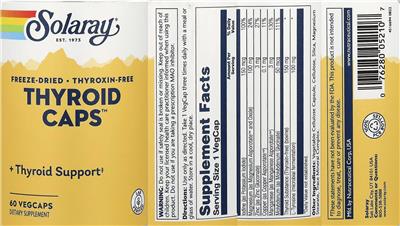
This summary is for Thyroid Caps by Solaray
- Form
- Capsule
- Serving Size
- 1 Veg Cap
- Servings
- 60 per container
- Container Holds
- 60 Veg Caps
- What is Thyroid Caps?A supplement from Solaray with eight active ingredients, in capsule form.
- Active Ingredients 6 minerals, 1 amino acid and 1 other: Iodine 150 mcgMagnesium 100 mgZinc 3 mgCopper 0.1 mgManganese 3 mgMolybdenum 50 mcgThyroid Substance 150 mgL-Tyrosine 100 mg Eight active ingredients. Each one can interact with drugs or cause side effects on its own, so we check every one. The full Supplement Facts
- Drug Interactions 401 drugs have a documented interaction with this supplement; the most serious is rated major. Of those, 266 are single drugs and 135 are combination products (two or more drugs in one), each listed under its own name. Based on the 7 of its 8 ingredients we could check. Ask your pharmacist first if you take a drug in any of these categories, the most serious of the 30 on record:
- Levodopa/
Carbidopa (Sinemet) Major · 6 drugs - Moderate · 45 drugs
- Skeletal Muscle RelaxantsModerate · 36 drugs
- Moderate · 23 drugs
- Levodopa/
- Possible Side EffectsNausea 4 ingredientsStomach upset 3 ingredientsDiarrhea 2 ingredientsHeadache 2 ingredientsMetallic taste 2 ingredientsStomach cramping +9 moreCombined from four of its eight active ingredients. Not studied in this exact product.
- Well documented Why
Does Thyroid Caps work?
What It Is Marketed For
Thyroid support
From the claims on the product’s label.
The Closest Use the Research Grades
Thyroid nodules Iodine
Some studies support it, but the evidence isn’t conclusive.
Its ingredients have stronger research for other uses:
- Magnesium
- Phenylketonuria (PKU) Tyrosine
- Magnesium
- Zinc
- Magnesium
- Iodine
These grades are for each ingredient, not this exact product, and never a promise it will work for you.
And 15 more graded uses, in what the research says- AllergensNone of its ingredient names point to a major food allergen, and the label text we have carries no allergen statement
- Barcode (UPC)0 76280 05210 7Match it to the barcode on your bottle to be sure this is your product. Not your product? Search for it here
Who Might Consider It
- People looking for thyroid support, which is what it is marketed for. The closest use the research grades is thyroid nodules, rated Possibly Effective.
- People who want it for constipation, phenylketonuria (PKU), dyspepsia, diabetes or another graded use: the other uses with research behind them. See each grade
- This product may be of interest to adults looking at a multi-mineral and amino acid formula, particularly if a deficiency has been identified.
Who Should Be Careful
- People with thyroid conditions, kidney problems, or Parkinson's disease, anyone on levodopa or thyroid medicines, and anyone who is pregnant or breastfeeding should be careful.
- Talk it over with your own doctor or pharmacist before you start.
More Before You Take It Show both answersHide Pregnancy and Breastfeeding The Label’s Directions
-
Pregnant or breastfeeding?
- Pregnancy Zinc
- ! When used orally in doses exceeding the UL.
- Breastfeeding Zinc
- ! When used orally in doses exceeding the UL.
- Pregnancy Manganese
- ! Amounts in foods and prenatal vitamins are appropriate, but avoid extra high-dose supplements unless advised.
- Breastfeeding Manganese
- ! When used orally in excessive doses.
- Pregnancy and Breastfeeding Iodine
- ! When used orally in doses exceeding the UL.
-
How does the label say to take it?
“Directions: Use only as directed. Take 1 VegCap three times daily with a meal or glass of water.”
The maker’s words. Your pharmacist or doctor may advise differently.
Everything the label says
From the label dated Aug 22, 2025: 7 of its 8 active ingredients were checked against our records; the other one is not in them yet. A summary of what is known, not a grade or a test of the product. How these ratings are computed
Ask Anything About This Supplement
Name a drug you take, or ask about side effects, ingredients or pregnancy.
There’s a lot of information about this supplement on this page! Ask anything in plain English for a quick answer drawn from it.
AI answers come from this label and our own records, never the open internet. AI can make mistakes, so always check with your doctor or pharmacist. How we use AI
Ask the Pharmacist
A licensed pharmacist will answer your question by email — free, as soon as they can.
Got it — thank you!
A licensed pharmacist will answer as soon as they can. Keep an eye on your email (worth checking spam, just in case).
What’s Inside Thyroid Caps by Solaray
Eight Active Ingredients
In the order the label lists them, each with its own card below.
Why this rating?
The label gives an exact amount for every one of its eight active ingredients, so you know how much of each you get in each serving. This rates what the label tells you, not the quality of the product.
Supplement Facts
| Amount Per Serving | % Daily Value | |
|---|---|---|
| Iodine | 150 mcg | 100% |
| Magnesium | 100 mg | 24% |
| Zinc | 3 mg | 27% |
| Copper | 0.1 mg | 11% |
| Manganese | 3 mg | 130% |
| Molybdenum | 50 mcg | 111% |
| Thyroid Substance | 150 mg | † |
| L-Tyrosine | 100 mg | † |
Other ingredients: Cellulose, Silica, Magnesium Stearate, Trace Mineral complex
† Daily Value not established.
Daily Values for adults and children 4 or more years of age.
As the label prints it, from the NIH Dietary Supplement Label Database.
Each Ingredient and Its Drug Interactions
Tap one for more about it and its full guide. A drug can interact with this supplement through any one of them.
The rest are minerals, and the ratings on this page tie most of them to correcting a deficiency.
-
Iodine 150 mcg Interacts with 23 drugs
Form on the label: Potassium Iodide
Iodine is an essential mineral your body needs to make thyroid hormones, and most people get enough from iodized salt, dairy, and seafood.
- Supplements help when you are truly deficient, but taking too much can harm the thyroid, so high-dose products should only be used under medical supervision.
The full Iodine guide: uses, dosage and safety Every Iodine drug interaction
-
Magnesium 100 mg Interacts with 298 drugs
Form on the label: Magnesium Asporotate, Magnesium Oxide
Magnesium is an essential mineral your body needs for muscles, nerves, blood pressure, and many other functions, and supplements are useful for preventing or correcting deficiency.
- Some other uses, like easing constipation or preventing migraines, have reasonable support, while uses for sleep and anxiety are less proven.
- It is generally safe for most healthy people at recommended amounts, but talk to your pharmacist or doctor before starting, especially if you have kidney problems.
The full Magnesium guide: uses, dosage and safety Every Magnesium drug interaction
-
Zinc 3 mg Interacts with 67 drugs
Form on the label: Zinc Gluconate
Zinc is an essential mineral that your body needs for immune function, wound healing, taste, and smell.
- Most people get enough from food, but supplements can help correct or prevent a deficiency.
- Taking too much zinc for too long can cause harm, so check with a pharmacist or doctor before using high-dose supplements.
The full Zinc guide: uses, dosage and safety Every Zinc drug interaction
-
Copper 0.1 mg Interacts with 31 drugs
Form on the label: Copper Asporotate
Copper is an essential trace mineral your body needs in small amounts for making red blood cells, supporting nerves and bones, and helping enzymes work.
- Most people get enough copper from food, and supplements are mainly useful for diagnosed deficiency.
- Too much copper can be harmful, so do not take high doses without medical advice.
The full Copper guide: uses, dosage and safety Every Copper drug interaction
-
Manganese 3 mg Interacts with 83 drugs
Form on the label: Manganese Asporotate
Manganese is an essential trace mineral your body needs in small amounts for bone formation, metabolism, and antioxidant defense, and most people get enough from a normal diet.
- Supplements may help if you have a genuine deficiency, but too much can be harmful—especially to the nervous system—so do not take high doses without guidance from a pharmacist or doctor.
The full Manganese guide: uses, dosage and safety Every Manganese drug interaction
-
Molybdenum 50 mcg No known drug interactions
Form on the label: Molybdenum Glycinate
Molybdenum is an essential trace mineral your body needs in tiny amounts to help certain enzymes work.
- Most people get enough from a normal diet, so supplements are rarely needed unless a doctor identifies a true deficiency.
- At normal dietary amounts it is considered safe, but high-dose supplements should be used cautiously and under professional guidance.
-
Thyroid Substance 150 mg We know this ingredient, but hold no drug interaction record for it yet, so it was not checked
-
L-Tyrosine 100 mg Tyrosine is an amino acid the body uses to make thyroid hormones. Interacts with 21 drugs
L-tyrosine is an amino acid your body uses to make brain chemicals like dopamine and norepinephrine.
- Some studies suggest it may help mental performance during short-term stress, sleep loss, or cold, but the evidence is mixed and it is not proven for everyday focus or mood.
- It is generally well tolerated in healthy adults, but check with your pharmacist or doctor before using it, especially during pregnancy or if you have a thyroid condition.
The full Tyrosine guide: uses, dosage and safety Every Tyrosine drug interaction
Other Ingredients (Inactive)
The capsule or tablet itself, fillers, coatings and flavors. Not part of the drug interaction check; the allergen check below reads them.
- Cellulose
- Silica
- Magnesium Stearate
- Trace Mineral complex
Allergens in Thyroid Caps
None of its ingredient names point to a major food allergen, and the label text we have carries no allergen statement.
Not named in the ingredients
- Milk
- Egg
- Fish
- Shellfish
- Tree nuts
- Peanuts
- Wheat or other gluten grains
- Soy
- Sesame
From the label text and ingredient names on file; we do not test products. With a serious allergy, check your bottle and ask the maker or your pharmacist.
What the Label Says
The maker’s own words, from the label. We do not verify or endorse them.
- Brand IP Statement(s)
-
“Solaray Est. 1973”
- Formulation
-
“Freeze-dried Thyroid support”
“Thyroxin-free”
- FDA Statement of Identity
-
“Dietary Supplement”
- Seals and symbols
-
“Lab Verified”
- Storage
-
“Store in a cool, dry place.”
- General statements
-
“100% PCR bottles”
The Thyroid Caps Label on File
The label scan on file at the NIH Dietary Supplement Label Database, dated August 2025. Always read the label on the bottle you have.
Product Facts
Is this label outdated? Report a formula or label change and our pharmacy team will review it.
HelloPharmacist Score Thyroid Caps by Solaray
Up to 10 points for research, amount, label and outside testing. Not a safety rating. How this one adds up
Not Scored Yet
Its main ingredient, Thyroid Substance, is not in our records.
It gets a score once we can check it. That says nothing about the product itself.
What’s inside itIts drug interactionsIts possible side effects
Thyroid Caps by Solaray Side Effects
Why this rating?
We look for three kinds of safety information on each ingredient: side effects reported in studies, a pregnancy and breastfeeding rating, and a safety write-up from our pharmacy team. All three are on file for each of the seven ingredients we could check.
So this rates how much is known, not whether Thyroid Caps is right for you.
Reported with six of its ingredients
- Most often
- Nausea, stomach upset, diarrhea, headache, metallic taste and stomach cramping
- !Rare but serious
- Hypersensitivity reactions such as anaphylaxis, angioedema and neurotoxicity See details
HelloPharmacist Team Summary: Thyroid Caps by Solaray Side Effects
You are likely to notice nausea, upset stomach, headache, or a metallic taste with Thyroid Caps, mostly from the zinc, iodine, and tyrosine.
- Tyrosine's reported side effects also include fatigue.
- The rare but serious concern is iodine's allergic reactions or thyroid problems at high intake, so call your doctor right away if you notice swelling, trouble breathing, or changes in your thyroid symptoms.
- If you have a thyroid condition, kidney problems, or take any of the medicines listed above, talk with your own doctor or pharmacist before starting.
- We have no side-effect information for the thyroid substance, so ask your pharmacist about it.
Side Effects, Ingredient by Ingredient
A supplement’s side effects come from its ingredients. Here is what is reported with each one.
Iodine
Most reported
- Metallic taste in the mouth
- Stomach upset, nausea, or diarrhea
- Burning in the mouth, throat, or stomach with strong liquid forms
- Headache
Magnesium
Most reported
- Diarrhea
- Nausea
- Stomach cramping
- Bloating
Zinc
Most reported
- Nausea
- Stomach upset
- Vomiting
- Metallic taste
Tyrosine
Most reported
- Nausea
- Upset stomach
- Headache
- Fatigue
Copper, Manganese and Molybdenum have side-effect reports, but no list of the most common ones. Read them in each guide: Copper, Manganese, Molybdenum.
Thyroid Caps Warnings: Who Should Be Careful
Thyroid Caps has eight active ingredients, and each can carry warnings of its own. We checked the seven in our ingredient guides, and each warning below names the ingredient it comes from. Thyroid Substance is not in our guides yet, so ask your pharmacist about it. If any of these apply to you, talk to your doctor or pharmacist before you start it.
- Iodine2 warnings below
- Magnesium3 warnings below
- Zinc2 warnings below
- Copper3 warnings below
- Manganese3 warnings below
- Molybdenum3 warnings below
- Tyrosine2 warnings below
- Thyroid SubstanceNot in our guides yet
-
Liver Disease
- CopperPeople with liver disease should also be cautious, since the liver handles copper.
- ManganesePeople who should be especially careful include those with liver disease (the liver helps clear manganese), people receiving long-term intravenous (IV) nutrition, and anyone with high environmental exposure, such as certain industrial or welding work.
-
Kidney Disease or Kidney Stones
- MagnesiumThe biggest safety concern is in people with kidney disease, because damaged kidneys cannot remove extra magnesium, which can build up to dangerous levels.
- MagnesiumIf you have kidney problems, do not take magnesium supplements unless your doctor tells you to.
- MolybdenumPeople with kidney problems should be especially cautious, since the kidneys help remove excess molybdenum from the body.
-
Heart Conditions
- MagnesiumPeople with heart conduction problems or certain bowel conditions should also be cautious.
-
Stomach or Bowel Problems
- ZincPeople with digestive disorders, those who drink heavily, and people on restrictive diets are more likely to be low in zinc and may need supplements.
-
Thyroid Conditions
- IodinePeople with existing thyroid conditions such as Hashimoto's disease, Graves' disease, thyroid nodules, or thyroid cancer should be especially careful and only take iodine under a doctor's guidance.
- IodineAlways talk to a pharmacist or doctor before starting an iodine supplement, especially if you take high doses or have a thyroid condition.
- TyrosineBe extra cautious if you have a thyroid condition (such as overactive thyroid or Graves' disease), because tyrosine is used to make thyroid hormones and could in theory affect thyroid levels.
-
Iron Deficiency or Anemia
- ManganeseChildren and people with iron deficiency may also absorb more manganese.
-
If You Take Other Drugs
- MolybdenumAlways talk with a pharmacist or doctor before starting a molybdenum supplement, especially if you have a health condition or take other medicines.
- TyrosinePeople with a history of migraines or those taking medications that affect brain chemicals should also check with a professional first.
-
Other Cautions
- ZincAnyone considering high-dose or long-term zinc should talk to a pharmacist or doctor first.
- CopperPeople with Wilson's disease, a genetic condition that causes copper to build up in the body, must avoid copper supplements and may need to limit copper in their diet.
- MolybdenumPeople with gout or high uric acid levels should also be careful, because very high intakes have been linked to increased uric acid in some reports.
-
What the Label Warns
- “Warning: Do not use if safety seal is broken or missing. Keep your licensed health care practitioner informed when using this product. Directions: Use only as directed.”
- “Keep out of reach of children.”
- “Do not use if you are taking a prescription MAO inhibitor.”
The maker’s wording, from the product label.
-
Pregnant or Breastfeeding
Each ingredient’s rating for pregnancy and for breastfeeding, and what it covers.
Pregnancy
-
When used orally and appropriately.
Zinc is safe in amounts that do not exceed the tolerable upper intake level (UL) of 34 mg daily during pregnancy in those 14-18 years of age and 40 mg daily in those 19-50 years of age.
-
When used orally in doses exceeding the UL.
Breastfeeding
-
When used orally and appropriately.
Zinc is safe in amounts that do not exceed the tolerable upper intake level (UL) of 34 mg daily during lactation in those 14-18 years of age, and 40 mg daily for those 19-50 years of age.
-
When used orally in doses exceeding the UL.
Higher doses can cause zinc-induced copper deficiency in nursing infants.
Pregnancy
-
Amounts in foods and prenatal vitamins are appropriate, but avoid extra high-dose supplements unless advised.
Breastfeeding
-
When used orally and appropriately.
Manganese is safe when used in doses below the tolerable upper intake level (UL) of 11 mg daily during pregnancy or lactation in those aged 19 or older.
However, those under 19 years of age should limit doses to less than 9 mg daily.
-
When used orally in excessive doses.
Doses over the UL are associated with a greater risk of toxicity.
Additionally, observational research shows that adults with higher blood manganese levels have greater odds of delivering low birth weight or small for gestational age (SGA) male, but not female, infants.
1 more rating for Manganese used another way
This supplement is taken by mouth. This rating is for Manganese given another way.
-
When inhaled at moderate doses, long-term.
Manganese salts can cross the placenta, and animal research suggests that large amounts of manganese may be teratogenic.
Show 5 more ingredients
Pregnancy and Breastfeeding The record rates both the same
-
When used orally and appropriately.
Iodine is safe in amounts that do not exceed the tolerable upper intake level (UL) of 1100 mcg daily in those 18 years and older or 900 mcg daily in those 14-18 years of age.
Iodine needs increase during pregnancy and lactation and adequate intakes should begin as soon as a patient is aware of the pregnancy, or earlier in areas of potential deficiency.
-
When used orally in doses exceeding the UL.
Higher intake can cause thyroid dysfunction.
2 more points on this rating
- Also, higher intakes during pregnancy cause increased iodine levels in breast milk and infant blood samples.
- Higher iodine intake during pregnancy has also been associated with an increased risk of congenital hypothyroidism and reduced mental and physical development in the offspring.
1 more rating for Iodine used another way
This supplement is taken by mouth. This rating is for Iodine given another way.
-
When used topically as a 2% solution.
Iodine is an FDA-approved prescription product.
Pregnancy and Breastfeeding The record rates both the same
-
When used orally and appropriately.
Magnesium is safe for those pregnant and breast-feeding when used in doses below the tolerable upper intake level (UL) of 350 mg daily.
-
When used orally in excessive doses.
Tell patients to avoid exceeding the tolerable upper intake level (UL) of 350 mg daily.
Taking magnesium orally in higher doses can cause diarrhea.
2 more ratings for Magnesium used another way
This supplement is taken by mouth. These ratings are for Magnesium given another way.
-
When prescription magnesium sulfate is given intramuscularly and intravenously prior to delivery for up to 5 days.
However, due to potential adverse effects associated with intravenous and intramuscular magnesium, use during pregnancy is limited to patients with specific conditions such as severe pre-eclampsia or eclampsia.
5 more points on this rating
- There is some evidence that intravenous magnesium can increase fetal mortality and adversely affect neurological and skeletal development.
- However, a more recent analysis of clinical research shows that increased risk of fetal mortality seems to occur only in the studies where antenatal magnesium is used for tocolysis and not for fetal neuroprotection or pre-eclampsia/eclampsia.
- Furthermore, antenatal magnesium does not seem to be associated with increased risk of necrotizing enterocolitis in preterm infants.
- There is also concern that magnesium increases the risk of maternal adverse events.
- A meta-analysis of clinical research shows that magnesium sulfate might increase the risk of maternal adverse events, especially in Hispanic mothers compared to other racial and ethnic groups.
-
When prescription magnesium sulfate is given intramuscularly and intravenously prior to delivery for longer than 5 days.
Maternal exposure to magnesium for longer than 5-7 days is associated with an increase in neonatal bone abnormalities such as osteopenia and fractures.
The U.S. Food and Drug Administration (FDA) recommends that magnesium injection not be given for longer than 5-7 days.
Pregnancy and Breastfeeding The record rates both the same
-
When used orally and appropriately.
Copper is safe in amounts that do not exceed the tolerable upper intake level (UL) of 8 mg daily for those 14-18 years of age or 10 mg daily for those 19 years and older.
-
When used orally in doses exceeding the UL.
Higher intake can cause liver damage.
Pregnancy
-
When used orally and appropriately.
Molybdenum crosses the placenta by passive diffusion and is exchanged freely between the mother and fetus.
However, molybdenum is safe when used in amounts that do not exceed the Tolerable Upper Intake Level (UL) of 1.7 mg/day for women 14 to 18 years, or 2 mg/day for women 19 years of age and older.
-
When used orally in high doses.
Molybdenum might not be safe during pregnancy when used in doses exceeding the UL of 1.7 mg/day for women 14 to 18 years, or 2 mg/day for women 19 and older.
Breastfeeding
-
When used orally and appropriately.
Molybdenum is safe when used in amounts that do not exceed the Tolerable Upper Intake Level (UL) of 2 mg/day for breast-feeding women 19 years of age or older, or 1.7 mg/day for breast-feeding women ages 14 to 18 years.
-
When used orally in high doses.
Molybdenum might not be safe when used in doses exceeding the UL of 2 mg/day for breast-feeding women 19 or older, or 1.7 mg/day for breast-feeding women ages 14 to 18 years.
Pregnancy and Breastfeeding The record rates both the same
-
There is insufficient reliable information available about the safety of tyrosine during pregnancy and lactation when used in medicinal amounts.
Some pharmacokinetic research shows that taking a single dose of tyrosine 2-10 grams orally can modestly increase levels of free tyrosine in breast milk.
2 more points on this rating
- However, total levels are not affected, and levels remain within the range found in infant formulas.
- Therefore, it is not clear if the increase in free tyrosine is a concern.
Our pharmacy team’s notes
- For those, the safety data advises against use in pregnancy unless your doctor directs it.
- Talk with your own doctor or pharmacist for personalized advice about pregnancy or breastfeeding.
- We have no pregnancy or safety information for the thyroid substance.
Ratings and the words beside them are from the Natural Medicines database, which we license. Where it has no rating, the rating and note are our pharmacy team’s.
-
Rare but Serious Side Effects
-
!
Iodine
More serious effects from too much iodine include thyroid problems (either overactive or underactive thyroid), thyroid swelling, and rarely allergic reactions.
Hypersensitivity reactions such as anaphylaxis and angioedema.
-
!
Magnesium
Rare but serious side effects happen mostly with very high doses or in people with poor kidney function.
With toxic doses, loss of reflexes and respiratory depression can occur. High doses in pregnancy can increase risk of neonatal mortality and neurological defects.
-
!
Zinc
Very high single doses can cause more serious stomach symptoms.
Orally: There have been cases of acute renal tubular necrosis, interstitial nephritis, neurological complications, severe vomiting, and sideroblastic anemia after zinc overdose.
-
!
Copper
Very large single doses can cause serious copper poisoning, which is a medical emergency.
-
!
Manganese
Very high or prolonged intake of manganese can cause a serious condition affecting the brain and nervous system called manganism, with symptoms that can resemble Parkinson's disease—such as tremor, muscle stiffness, slowed movement, balance problems, and mood or memory changes.
Neurotoxicity, including Parkinson-like extrapyramidal symptoms, when used in high doses.
-
!
Tyrosine
Serious side effects are uncommon at typical supplement doses.
When to get help: a serious allergic reaction, with trouble breathing or swelling of the face, lips or throat, needs emergency care: call 911. For any other side effect that worries you, call your doctor or pharmacist.
These reports describe each ingredient, not studies of this exact product. Not medical advice: a side effect you notice after starting a supplement is worth a word with your pharmacist or doctor.
Thyroid Caps by Solaray Drug Interactions
We checked all eight active ingredients in this supplement against every drug in our records. A drug can interact with it through any one of them. Thyroid Substance is not in our interaction records yet.
A major interaction on record
3 of 3, on a scale from Minor or none to Major.Why this rating?
We rate this by the most serious interaction on record, not by how many there are. For Iodine, Manganese, Copper, Zinc and Magnesium, the most serious is rated major, which means the combination is best avoided, or used only under close supervision. Some involve kinds of drugs where a small change can matter, such as blood thinners, diabetes drugs and heart-rhythm drugs.
401 drugs are on the full list. What matters is whether one you take is on it, so check yours with the interaction checker on this page.
From the HelloPharmacist Team
Stepping back from the single ingredients, here is the picture across the whole supplement.
- Thyroid Caps by Solaray does interact with some medications, through its tyrosine, zinc, iodine, magnesium, copper, and manganese content.
- The other interactions are rated Moderate, except one Minor.
- Tyrosine and iodine can both alter thyroid hormone medicines, and iodine also affects lithium, antithyroid drugs, and amiodarone.
Six of its eight active ingredients have drug interactions on record: Iodine, Magnesium, Zinc, Copper, Manganese and Tyrosine. We have no interaction records for Molybdenum and Thyroid Substance.
- Interacts with
- 298 drugs
- Most serious
- Major
- The most serious interaction is rated Major: magnesium can reduce how much levodopa/carbidopa (Sinemet, a Parkinson's medicine) your body absorbs.
- Magnesium can add to skeletal muscle relaxants, potassium-sparing diuretics, calcium channel blockers, antacids, sulfonylureas, and bisphosphonates.
- Interacts with
- 31 drugs
- Most serious
- Moderate
- Copper with contraceptive drugs carries a Minor rating.
- Interacts with
- 83 drugs
- Most serious
- Moderate
- Most of its records involve Antipsychotic Drugs, Quinolone Antibiotics and Tetracycline Antibiotics.
Show three more ingredients
- Interacts with
- 67 drugs
- Most serious
- Moderate
- Most of its records involve Quinolone Antibiotics, Tetracycline Antibiotics and Bictegravir/Emtricitabine/Tenofovir Alafenamide (Biktarvy).
- Interacts with
- 23 drugs
- Most serious
- Moderate
- Most of its records involve Thyroid Hormone, Antithyroid Drugs and Amiodarone (Cordarone).
- Interacts with
- 21 drugs
- Most serious
- Moderate
- Most of its records involve Thyroid Hormone and Levodopa.
Summarized by the HelloPharmacist pharmacy team from the interaction records below. How it is written How we use AI
Why Thyroid Caps Interacts, Ingredient by Ingredient
A product interacts through its ingredients. Each card: how many drugs, the most serious rating, and the kinds of drugs it affects most (tap a kind for what it means).
The ingredients driving the most interactions
-
Magnesium 298 drugs
Most serious: Major16 interaction records on file
The kinds of drugs it affects most
- 122 drugs
- Skeletal Muscle Relaxants 36 drugs
- 23 drugs
- 22 drugs
Every Magnesium drug interaction, 16 records The Magnesium records cite 84 references, listed in the Magnesium guide.
-
Manganese 83 drugs
Most serious: Moderate3 interaction records on file
The kinds of drugs it affects most
- 45 drugs
- 21 drugs
- 20 drugs
Every Manganese drug interaction, 3 records The Manganese records cite 21 references, listed in the Manganese guide.
-
Zinc 67 drugs
Most serious: Moderate10 interaction records on file
The kinds of drugs it affects most
- 21 drugs
- 20 drugs
- Bictegravir/Emtricitabine/Tenofovir Alafenamide (Biktarvy) 13 drugs
- Ritonavir (Norvir) 7 drugs
Every Zinc drug interaction, 10 records The Zinc records cite 88 references, listed in the Zinc guide.
-
Copper 31 drugs
Most serious: Moderate2 interaction records on file
The kinds of drugs it affects most
- 30 drugs
- Penicillamine (Cuprimine, Depen) 1 drug
Every Copper drug interaction, 2 records The Copper records cite 11 references, listed in the Copper guide.
-
Iodine 23 drugs
Most serious: Moderate4 interaction records on file
The kinds of drugs it affects most
- 16 drugs
- Antithyroid Drugs 5 drugs
- Amiodarone (Cordarone) 1 drug
- 1 drug
Every Iodine drug interaction, 4 records The Iodine records cite 29 references, listed in the Iodine guide.
-
L-Tyrosine 21 drugs
Most serious: Moderate2 interaction records on file
The kinds of drugs it affects most
- 16 drugs
- 5 drugs
Every Tyrosine drug interaction, 2 records The Tyrosine records cite 4 references, listed in the Tyrosine guide.
The Breakdown by Severity
Each drug counted once, at its most serious rating. Tap a tile to list those drugs.
Find Your Drug
Type a drug or brand name to see whether it is on the list.
- Only drugs with a documented interaction are listed, the most serious first.
- A drug with no known interaction is not listed, but searching its name tells you so.
- Open a drug to see which ingredient is responsible. Of those, 266 are single drugs and 135 are combination products (two or more drugs in one), each listed under its own name.
-
Calcium CarbonateAdcal, Adcal-D3, Calcichew, Os-Cal, Tums Moderate
The ingredient responsible:
-
Magnesium Moderate Calcium Carbonate is in the Antacids category.
Use of acid reducers may reduce the laxative effect of magnesium oxide.
The full Magnesium + Calcium Carbonate interaction
-
-
MethimazoleTapazole Moderate
The ingredient responsible:
-
Iodine Moderate Methimazole is in the Antithyroid Drugs category.
Iodine might alter the effects of antithyroid drugs.
The full Iodine + Methimazole interaction
-
-
AmiodaroneCordarone, Pacerone Moderate
The ingredient responsible:
-
Iodine Moderate
Combining iodine with amiodarone might cause excessively high iodine levels.
The full Iodine + Amiodarone interaction
-
-
Aripiprazole LauroxilAristada, Aristada Initio Kit Moderate
The ingredient responsible:
-
Manganese Moderate Aripiprazole Lauroxil is in the Antipsychotic Drugs category.
Theoretically, the risk for manganese toxicity might increase when taken with antipsychotic drugs.
The full Manganese + Aripiprazole Lauroxil interaction
-
-
CyclobenzaprineCyclobenzaprine, Cycloprine, Flexeril Moderate
The ingredient responsible:
-
Magnesium Moderate Cyclobenzaprine is in the Skeletal Muscle Relaxants category.
Parenteral magnesium alters the pharmacokinetics of skeletal muscle relaxants, increasing their effects and accelerating the onset of effect.
The full Magnesium + Cyclobenzaprine interaction
-
-
RapacuroniumRaplon Moderate
The ingredient responsible:
-
Magnesium Moderate Rapacuronium is in the Skeletal Muscle Relaxants category.
Parenteral magnesium alters the pharmacokinetics of skeletal muscle relaxants, increasing their effects and accelerating the onset of effect.
The full Magnesium + Rapacuronium interaction
-
-
AcetohexamideDymelor Moderate
The ingredient responsible:
-
Magnesium Moderate Acetohexamide is in the Sulfonylureas category.
Magnesium increases the systemic absorption of sulfonylureas, increasing their effects and side effects.
The full Magnesium + Acetohexamide interaction
-
-
AlendronateBinosto, Fosamax Moderate
The ingredient responsible:
-
Magnesium Moderate Alendronate is in the Bisphosphonates category.
Magnesium can decrease absorption of bisphosphonates.
The full Magnesium + Alendronate interaction
-
-
VerapamilCalan, Calan SR, Covera HS, Isoptin, Isoptin SR and 4 more Moderate
The ingredient responsible:
-
Magnesium Moderate Verapamil is in the Calcium Channel Blockers category.
Magnesium can have additive effects with calcium channel blockers, although evidence is conflicting.
The full Magnesium + Verapamil interaction
-
-
GlimepirideAmaryl Moderate
The ingredient responsible:
-
Magnesium Moderate Glimepiride is in the Sulfonylureas category.
Magnesium increases the systemic absorption of sulfonylureas, increasing their effects and side effects.
The full Magnesium + Glimepiride interaction
-
-
DoxycylineDoxychel Moderate
The 3 ingredients responsible:
-
Manganese Moderate Doxycyline is in the Tetracycline Antibiotics category.
Theoretically, manganese might reduce the absorption of tetracycline antibiotics.
The full Manganese + Doxycyline interaction -
Zinc Moderate Doxycyline is in the Tetracycline Antibiotics category.
Zinc might reduce levels of tetracycline antibiotics.
The full Zinc + Doxycyline interaction -
Magnesium Moderate Doxycyline is in the Tetracycline Antibiotics category.
Magnesium decreases absorption of tetracyclines.
The full Magnesium + Doxycyline interaction
-
-
GlyburideAlbert Glyburide, Diabeta, Glycron, Glynase, Glynase PresTab and 2 more Moderate
The ingredient responsible:
-
Magnesium Moderate Glyburide is in the Sulfonylureas category.
Magnesium increases the systemic absorption of sulfonylureas, increasing their effects and side effects.
The full Magnesium + Glyburide interaction
-
-
LevofloxacinLeva-pak, Levaquin, Levaquin Injection Moderate
The 3 ingredients responsible:
-
Magnesium Moderate Levofloxacin is in the Quinolone Antibiotics category.
Magnesium decreases absorption of quinolones.
The full Magnesium + Levofloxacin interaction -
Manganese Moderate Levofloxacin is in the Quinolone Antibiotics category.
Theoretically, manganese might reduce the absorption of quinolone antibiotics.
The full Manganese + Levofloxacin interaction -
Zinc Moderate Levofloxacin is in the Quinolone Antibiotics category.
Zinc can decrease the levels and clinical effects of quinolones antibiotics.
The full Zinc + Levofloxacin interaction
-
-
BaclofenFleqsuvy, Lioresal, Lyvispah, Ozobax Moderate
The ingredient responsible:
-
Magnesium Moderate Baclofen is in the Skeletal Muscle Relaxants category.
Parenteral magnesium alters the pharmacokinetics of skeletal muscle relaxants, increasing their effects and accelerating the onset of effect.
The full Magnesium + Baclofen interaction
-
-
MinocyclineAcnamino MR, Aknemin, Amzeeq, Arestin Miscrosperes, Dynacin and 7 more Moderate
The 3 ingredients responsible:
-
Magnesium Moderate Minocycline is in these Tetracycline Antibiotics, Anticoagulant/Antiplatelet Drugs categories.
Magnesium decreases absorption of tetracyclines.
The full Magnesium + Minocycline interaction -
Manganese Moderate Minocycline is in the Tetracycline Antibiotics category.
Theoretically, manganese might reduce the absorption of tetracycline antibiotics.
The full Manganese + Minocycline interaction -
Zinc Moderate Minocycline is in the Tetracycline Antibiotics category.
Zinc might reduce levels of tetracycline antibiotics.
The full Zinc + Minocycline interaction
-
-
Lercanidipine HydrochlorideZanidip Moderate
The ingredient responsible:
-
Magnesium Moderate Lercanidipine Hydrochloride is in the Calcium Channel Blockers category.
Magnesium can have additive effects with calcium channel blockers, although evidence is conflicting.
The full Magnesium + Lercanidipine Hydrochloride interaction
-
-
Amlodipine BesilateIstin Moderate
The ingredient responsible:
-
Magnesium Moderate Amlodipine Besilate is in the Calcium Channel Blockers category.
Magnesium can have additive effects with calcium channel blockers, although evidence is conflicting.
The full Magnesium + Amlodipine Besilate interaction
-
-
LiotrixEuthroid 1, Euthroid 1/2, Euthroid 3 Moderate
The 2 ingredients responsible:
-
L-Tyrosine Moderate Liotrix is in the Thyroid Hormone category.
Theoretically, tyrosine might have additive effects with thyroid hormone medications.
The full L-Tyrosine + Liotrix interaction -
Iodine Moderate Liotrix is in the Thyroid Hormone category.
Iodine might alter the effects of thyroid hormone.
The full Iodine + Liotrix interaction
-
-
RocuroniumZemuron Moderate
The ingredient responsible:
-
Magnesium Moderate Rocuronium is in the Skeletal Muscle Relaxants category.
Parenteral magnesium alters the pharmacokinetics of skeletal muscle relaxants, increasing their effects and accelerating the onset of effect.
The full Magnesium + Rocuronium interaction
-
-
HaloperidolHaldol Moderate
The ingredient responsible:
-
Manganese Moderate Haloperidol is in the Antipsychotic Drugs category.
Theoretically, the risk for manganese toxicity might increase when taken with antipsychotic drugs.
The full Manganese + Haloperidol interaction
-
-
Conjugated EstrogensCenestin, Enjuvia, Premarin, Premarin Vaginal Cream Moderate
The 2 ingredients responsible:
-
L-Tyrosine Moderate Conjugated Estrogens is in the Thyroid Hormone category.
Theoretically, tyrosine might have additive effects with thyroid hormone medications.
The full L-Tyrosine + Conjugated Estrogens interaction -
Iodine Moderate Conjugated Estrogens is in the Thyroid Hormone category.
Iodine might alter the effects of thyroid hormone.
The full Iodine + Conjugated Estrogens interaction
-
-
ChlorpropamideChlorpropam, Diabinese Moderate
The ingredient responsible:
-
Magnesium Moderate Chlorpropamide is in the Sulfonylureas category.
Magnesium increases the systemic absorption of sulfonylureas, increasing their effects and side effects.
The full Magnesium + Chlorpropamide interaction
-
-
ClozapineClozaril, Versacloz Moderate
The ingredient responsible:
-
Manganese Moderate Clozapine is in the Antipsychotic Drugs category.
Theoretically, the risk for manganese toxicity might increase when taken with antipsychotic drugs.
The full Manganese + Clozapine interaction
-
-
TizanidineOntralfy, Zanaflex Moderate
The ingredient responsible:
-
Magnesium Moderate Tizanidine is in the Skeletal Muscle Relaxants category.
Parenteral magnesium alters the pharmacokinetics of skeletal muscle relaxants, increasing their effects and accelerating the onset of effect.
The full Magnesium + Tizanidine interaction
-
-
OlanzapineZyprexa Moderate
The ingredient responsible:
-
Manganese Moderate Olanzapine is in the Antipsychotic Drugs category.
Theoretically, the risk for manganese toxicity might increase when taken with antipsychotic drugs.
The full Manganese + Olanzapine interaction
-
-
Human Chorionic Gonadotropin (hcg)Pregnyl Moderate
The 2 ingredients responsible:
-
L-Tyrosine Moderate Human Chorionic Gonadotropin (hcg) is in the Thyroid Hormone category.
Theoretically, tyrosine might have additive effects with thyroid hormone medications.
The full L-Tyrosine + Human Chorionic Gonadotropin (hcg) interaction -
Iodine Moderate Human Chorionic Gonadotropin (hcg) is in the Thyroid Hormone category.
Iodine might alter the effects of thyroid hormone.
The full Iodine + Human Chorionic Gonadotropin (hcg) interaction
-
-
AmilorideAmilamont, Midamor Moderate
The 2 ingredients responsible:
-
Magnesium Moderate Amiloride is in the Potassium-sparing Diuretics category.
Potassium-sparing diuretics decrease excretion of magnesium, possibly increasing magnesium levels.
The full Magnesium + Amiloride interaction -
Zinc Minor
Amiloride can modestly reduce zinc excretion and increase zinc levels.
The full Zinc + Amiloride interaction
-
-
PancuroniumPavulon Moderate
The ingredient responsible:
-
Magnesium Moderate Pancuronium is in the Skeletal Muscle Relaxants category.
Parenteral magnesium alters the pharmacokinetics of skeletal muscle relaxants, increasing their effects and accelerating the onset of effect.
The full Magnesium + Pancuronium interaction
-
-
Potassium Citrate (prescription Drug)Urocit K Moderate
The ingredient responsible:
-
Magnesium Moderate Potassium Citrate (prescription Drug) is in the Potassium-sparing Diuretics category.
Potassium-sparing diuretics decrease excretion of magnesium, possibly increasing magnesium levels.
The full Magnesium + Potassium Citrate (prescription Drug) interaction
-
-
CisplatinPlatinol-AQ Moderate
The ingredient responsible:
-
Zinc Moderate
Theoretically, zinc might interfere with the therapeutic effects of cisplatin.
The full Zinc + Cisplatin interaction
-
Does It Work? Thyroid Caps by Solaray
What the research says for what it is marketed for, then its ingredients’ other uses and each ingredient on its own. A grade is the research so far, never an endorsement.
What the Research Supports
First for what it is marketed for, then the other uses its ingredients are graded for, strongest research first.
Marketed for thyroid support
- Thyroid nodules Iodine
Other uses its ingredients are graded for
- Magnesium
- Magnesium
- Phenylketonuria (PKU) Tyrosine
- Magnesium and Zinc
- Magnesium
- Magnesium
- Magnesium
- Magnesium
- Tyrosine
- Tyrosine
- Zinc
- Zinc
- Zinc
- Zinc
- Child growth Zinc
- Halitosis Zinc
- Diaper rash Zinc
- Iodine
- Fibrocystic breast disease Iodine
HelloPharmacist Team Summary: Does Thyroid Caps by Solaray Work?
Ratings differ by ingredient and by condition.
- Zinc and manganese are rated effective for deficiency, iodine, molybdenum, and copper are rated likely effective for deficiency, and magnesium is rated effective for constipation, dyspepsia, and low magnesium.
- Tyrosine is rated effective for phenylketonuria (PKU).
- For tyrosine, cognitive function and memory are rated possibly effective, and athletic performance is rated possibly ineffective.
Show two more notes
- For copper, Alzheimer disease is rated possibly ineffective.
- Many other uses, including alcohol use disorder, dementia, and several cancers, have insufficient reliable evidence to rate, and we have no effectiveness information for the thyroid substance.
The Evidence, Ingredient by Ingredient
The detail behind the list above: our notes on each ingredient and its graded uses.
Magnesium
From our Magnesium guide
- The strongest reason to take magnesium is to prevent or correct a deficiency.
- People at higher risk include those with poorly controlled diabetes, long-term alcohol use, certain digestive diseases, or those taking medicines that lower magnesium.
Research suggests a benefit for
- Constipation and dyspepsia
- Diabetes, hypercholesterolemia, metabolic syndrome, osteoporosis and premenstrual syndrome (PMS)
Not counted here: five graded uses are for Magnesium injected or put on the skin (vasospastic angina, asthma, seizures and others), not for a product like this one. Six more are for conditions treated by a doctor or in a hospital (arrhythmia, cerebral palsy, colorectal cancer and others).
Every graded use, in the Magnesium guideTyrosine
From our Tyrosine guide
- People commonly take tyrosine for mental sharpness, focus, mood, and stress.
- The most promising research looks at situations where the brain is under physical or mental strain, such as sleep deprivation, cold exposure, or demanding multitasking.
Research suggests a benefit for
- Phenylketonuria (PKU)
- Cognitive function and memory
Zinc
From our Zinc guide
- The strongest reason to take zinc is to treat or prevent a zinc deficiency.
- Deficiency is well documented and clearly responds to zinc, so this use is supported by good evidence.
Research suggests a benefit for
- Zinc deficiency
- Diabetes, coronavirus disease 2019 (COVID-19), acne, peptic ulcers, age-related macular degeneration (AMD), child growth and halitosis
Not counted here: three graded uses are for Zinc injected or put on the skin (gingivitis, herpes labialis (cold sores) and pressure ulcers), not for a product like this one. Eight more are for conditions treated by a doctor or in a hospital (acrodermatitis enteropathica, leishmania lesions, leprosy and others).
And 2 more graded uses, in the Zinc guideManganese
From our Manganese guide
- Manganese is clearly necessary for health because it helps run several important enzymes in the body.
- Correcting a true manganese deficiency is the one situation where supplementing is genuinely useful—but real deficiency is rare in people eating a normal diet.
Research suggests a benefit for
- Manganese deficiency
Iodine
From our Iodine guide
- The strongest and best-proven use of iodine is to prevent and treat iodine deficiency.
- When people do not get enough iodine, supplements clearly help restore healthy thyroid function and support normal brain development in children.
Research suggests a benefit for
- Iodine deficiency
- Thyroid nodules (the use on its label), periodontitis and fibrocystic breast disease
Not counted here: four graded uses are for Iodine injected or put on the skin (venous leg ulcers, diabetic foot ulcers, conjunctivitis and others), not for a product like this one. Three more are for conditions treated by a doctor or in a hospital (postoperative infection, thyroid storm and radiation exposure).
Every graded use, in the Iodine guideCopper
From our Copper guide
- The clearest, best-supported use of copper supplements is to treat or prevent copper deficiency.
- Deficiency is rare but can occur in people with certain digestive conditions, those who have had weight-loss (bariatric) surgery, people fed only through an IV for long periods, or people taking very high doses of zinc, which can lower copper levels.
Research suggests a benefit for
- Copper deficiency
Molybdenum
From our Molybdenum guide
- The clearest and best-supported use of molybdenum is to treat or prevent molybdenum deficiency, which is uncommon and usually only seen in specific medical situations, such as long-term nutrition given through a vein (total parenteral nutrition) or certain rare genetic disorders.
Research suggests a benefit for
- Molybdenum deficiency
The grades are the Natural Medicines database’s, which we license; tap a grade for what it means. They are about each ingredient, not this exact product.
About Solaray
Manufacturer and brand details for Thyroid Caps, from the product label.
Solaray has 529 products in our supplement database, 524 of them on the market, with labels on file since 2012. Our database is built from the NIH’s Dietary Supplement Label Database and our pharmacy team’s own additions, so it covers the labels filed there, not every product the brand sells.
- Name
- Solaray
- City
- Salt Lake City
- State
- UT
- ZipCode
- 84101
- Phone Number
- 800-538-5888
- Web Address
- www.solaray.com
Thyroid Caps by Solaray: Common Questions
Does Thyroid Caps by Solaray interact with any drugs?
What are the side effects of Thyroid Caps by Solaray?
Who should be careful taking Thyroid Caps by Solaray?
Can Thyroid Caps by Solaray affect the liver?
How can Thyroid Caps by Solaray interact with so many drugs?
Where does the information about Thyroid Caps by Solaray come from?
Does tyrosine help with memory?
Is Thyroid Caps by Solaray safe during pregnancy?
Does iodine help with thyroid nodules?
Written and reviewed by the HelloPharmacist Editorial Team. Our editorial policy
Still Have a Question About Thyroid Caps?
Our pharmacists answer drug and supplement questions, free, by email.
Label information is sourced from the NIH Dietary Supplement Label Database and reflects the product version on file; always read your actual product label. This page is for education only and is not a substitute for professional medical advice. Confirm with your pharmacist or doctor before combining supplements and drugs.
Who Reviews This Page
The pharmacist behind it, and how it is checked.
Dr. Brian Staiger, PharmD, BCPS
Clinical pharmacist and founder of HelloPharmacist
A licensed pharmacist for more than 13 years, he built the system behind this page: it reads the label on file, matches each active ingredient to its record in the Natural Medicines database, checks those records against every drug we cover, and our pharmacy team writes the take and the interaction summary from those records.
- 13+ Years in PharmacyRetail and clinical pharmacy, medication safety and healthcare administration.
- Board Certified (BCPS)A pharmacotherapy specialist, certified by the Board of Pharmacy Specialties.
- Herbalist TrainingCertificates in medical ethnobotany, for the herbs and supplements people take.
Where This Page Comes From
Thyroid Caps’s label data comes from the NIH Dietary Supplement Label Database; the ingredient interaction data is from the Natural Medicines database, reviewed by our pharmacists.
- NIH Dietary Supplement Label Database (DSLD)
- The official product label on file for this supplement.
- Natural Medicines (Therapeutic Research Center)
- The evidence-graded clinical reference behind the ingredient interaction, evidence and safety records, which we license.
- HelloPharmacist Editorial Team
- Content is reviewed by the HelloPharmacist Editorial Team, the pharmacists on our staff and those we contract. See our data sources and editorial standards for how this information is built and checked.
- The Pharmacy Team’s Take and Summaries
- Generated from HelloPharmacist’s pharmacist-curated databases and editorial rules. Clinical methodology reviewed by Dr. Brian Staiger, PharmD, BCPS. Last generated Oct 30, 2026. How we use AI
- The ratings in the Quick Summary
- They summarize available label information, ingredient evidence and known drug-safety records: a summary of what is known, not a grade of the product itself. They do not verify product identity, purity, potency, contamination or manufacturing quality. How these ratings are computed
The References Behind the Interaction Records
Every citation the ingredients’ records rest on is listed in that ingredient’s guide, in context: Iodine, 29 references; Magnesium, 84 references; Zinc, 88 references; Copper, 11 references; Manganese, 21 references; Molybdenum, 8 references; Tyrosine, 4 references .
Parts of this content are provided by the Therapeutic Research Center, LLC.
DISCLAIMER: Currently this does not check for drug-drug interactions. This is not an all-inclusive comprehensive list of potential interactions and is for informational purposes only. Not all interactions are known or well-reported in the scientific literature, and new interactions are continually being reported. Input is needed from a qualified healthcare provider including a pharmacist before starting any therapy. Application of clinical judgment is necessary.
© 2021 Therapeutic Research Center, LLC
Keep Exploring
- Supplement interaction checkerCheck any supplement or product against your drugs
- Drug–drug interactionsCheck two or more of your drugs against each other
- Browse drugs A to ZEvery drug we have checked against herbs and supplements
- NDC and pricing lookupFind a drug’s NDCs, packaging and costs
- Ask a pharmacistA free, personal answer from our licensed team