
Triphalahills Ingredients & Drug Interactions
by Herbal Hills
What is this page for?
First and foremost: checking Triphalahills against your medications. The heart of this page is the interaction checker and the full interaction report — how this product’s ingredients may interact with prescription and over-the-counter medicines you may be taking.
Around that, we add a pharmacist’s high-level view of the product as a whole — what’s inside, the evidence for its stated use, how transparent the label is, and what safety data exists — so you can see the full picture in one place. It’s educational information from our licensed clinical databases and the clinical staff at HelloPharmacist — not medical advice — and we don’t sell or endorse products. Our editorial policy
Triphalahills is a dietary supplement by Herbal Hills with 3 active ingredients. Its ingredients are commonly taken for heart health and circulation, digestive problems (constipation, diarrhea), cholesterol support.Based on those ingredients, 933 medications have a known interaction with it, the most serious rated moderate. The ingredients most likely to interact are Terminalia belerica, Emblica officinalis. Use the checker below to test your specific medication, or read the full HelloPharmacist Interaction Report.
Check Your Meds Against Triphalahills by Herbal Hills
Ask about any prescription or over-the-counter medication and we check it for interactions with Triphalahills by Herbal Hills — and tell you which ingredient is responsible.
AI summaries are generated from our interaction database for education only — always confirm with your pharmacist. How we use AI
Ask the Pharmacist
A licensed pharmacist will answer your question by email — free, usually within 24 hours.
Got it — thank you!
A licensed pharmacist will answer within 24 hours. Keep an eye on your email (worth checking spam, just in case).
HelloPharmacist Scorecard of Triphalahills by Herbal Hills
Our pharmacy team’s full take, with four database checks built into the cards below — a summary of what is known, not a grade of the product itself.
What’s inside
Low disclosure
Triphalahills contains three active ingredients — Terminalia belerica, Emblica officinalis (Indian gooseberry), and a Triphala extract and powder blend — which together form a traditional Ayurvedic combination. The product also contains several inactive ingredients: xanthan gum, maize starch, silica, HPMC, and magnesium stearate (these are fillers and binders that help hold the tablet together).
Does it work?
Moderate evidence
The evidence for Triphalahills's ingredients is mixed. For Terminalia belerica, the data shows insufficient evidence to rate its effectiveness for obesity, high cholesterol, high blood pressure, or angina.
Emblica officinalis (Indian gooseberry) is possibly effective for acid reflux (GERD) and possibly effective for high cholesterol, but the evidence is insufficient to rate it for male-pattern hair loss or high cholesterol alone. The Triphala blend itself isn't rated separately in our data.
How safe is it?
Well-documented data
Terminalia belerica is generally well tolerated in short-term studies, though long-term safety and quality vary between products. It should be avoided during pregnancy and breastfeeding due to insufficient safety information.
Emblica officinalis is generally well tolerated as a food, but safety as a supplement is less studied and it should be avoided during pregnancy and breastfeeding. In clinical trials, a small number of people taking Emblica officinalis reported upset stomach, fatigue, or muscle pain.
We have no safety data on file for the fruit of Terminalia chebula.
Meds to double-check
Moderate interaction found
Before you start Triphalahills, check with your pharmacist if you take blood thinners or antiplatelet drugs (anticoagulants, aspirin, clopidogrel) — this product can increase your bleeding risk. Also double-check diabetes medications, chlorzoxazone (Parafon Forte, Paraflex), omeprazole (Prilosec), and any other regular prescriptions, since the ingredients can affect how your liver breaks down many common drugs and may change their blood levels.
The bottom line
Scorecard at a glanceFormula with limited ingredient disclosure with some supporting evidence behind its ingredients' uses. Moderate medication interactions have been identified, and safety information is well characterized.
Triphalahills may appeal to you if you're interested in traditional Ayurvedic support, but it's not one to start without checking your medications first — it affects a large number of drugs, especially blood thinners, diabetes medications, and several that rely on liver enzymes to be cleared. Talk to your pharmacist before adding it to your routine, particularly if you're on anticoagulants, aspirin, diabetes drugs, or any regular prescriptions.
Educational only — not medical advice; always confirm with your pharmacist. Our editorial policy · How we use AI
Assessment coverage: 2 of 3 active ingredients matched to our full ingredient reviews (monographs). Based on the product label dated Nov 21, 2012.
This Scorecard evaluates available label information, ingredient evidence, and known medication-safety considerations. It does not independently verify product identity, purity, potency, contamination, or manufacturing quality. How these ratings are computed
General information
Key facts about Triphalahills, straight from the product label.
| Brand | Herbal Hills |
|---|---|
| Barcode (UPC) | 8906008261042 |
| Net contents | 60 Tablet(s) |
| Market status | On market |
| Date entered into DSLD | Nov 21, 2012 |
| DSLD ID | 15611 |
| Product type | Botanical |
| Supplement form | Tablet Or Pill |
| Dietary claims / uses | All Other, Structure/Function |
| Intended target group(s) | Adult (18 - 50 Years) |
Everything in this section is reproduced from the manufacturer’s own product label — it’s the label speaking, not HelloPharmacist. We show it so you can see exactly what the maker states; we don’t verify or endorse those statements.
Supplement Facts
The label details for Triphalahills by Herbal Hills, sourced from the NIH Dietary Supplement Label Database.
Supplement Facts
| Ingredient | Amount | % DV |
|---|---|---|
| Terminalia belerica | 0 NP | -- |
| Emblica officinalis | 0 NP | -- |
| Triphala extract & Triphala powder Blend | 500 mg | -- |
| fruit of Terminalia chebula | 0 NP | -- |
Other ingredients: Xanthan Gum, Maize Starch, Silica, HPMC, Magnesium Stearate
Tap any ingredient to jump to its full detail below.
These statements are the manufacturer’s wording, reproduced from the product label — the label is saying it, not HelloPharmacist. We don’t verify or endorse them.
General Statements
MULTIEFFECTIVE HERB
Batch No. : Exp. Date: Neutral Code # MH/PD/AYU/002/10
Healthy Digestion
Pure – Natural – Effective Triphala literally means 3 fruits. It consists of Haritaki, Baheda & Amla. Triphala is considered to be a wonder herb that is comprehensively used by ayurvedic physicians to treat various disorders. Though it is widely used as a laxative, but there are certain secrets about triphala. It is not just a laxative but is considered to be a powerful body stimulant that helps promote health and assist in managing overall conditions of the body. It helps to detoxify and cleanse our body to rejuvenate all the body organs and thus may help in making it young and energetic. It helps maintain healthy blood circulation.
Contents based on standard Raw Material as per Ayurvedic Text
FDA Statement of Identity
HERBAL SUPPLEMENT
Dietary Supplement
Seals/Symbols
HERBALHILLS
GMP Good Manufacturing Practice
ISO 22000:2005 CERTIFIED COMPANY
EXTRACT STANDARDIZED EXTRACT
Storage
Store in a cool dry place away from direct sunlight.
Precautions
Keep out of reach of children.
Do not use if inner seal is broken or missing.
Caution : Pregnant or lactating women are advised to consume herbal products under the advice of the Healthcare Practitioner.
Formula
26% Tannins
Suggested/Recommended/Usage/Directions
Directions for use : As a dietary supplement take 1 tablet twice daily, preferably after meals or as recommended by a Healthcare Practitioner. For better results it should be taken with warm water
FDA Disclaimer Statement
These statements have not been evaluated by the Food & Drug Administration. This product is not intended to diagnose, treat, cure or prevent any disease.
Is this label outdated? Report a formula or label change and our pharmacy team will review it.
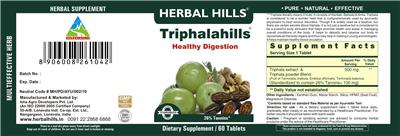
Triphalahills by Herbal Hills label
The label scan from the NIH Dietary Supplement Label Database. Tap to enlarge.
Label images are published by the NIH Dietary Supplement Label Database for the version of this product on file. Always read your actual product label.
View the full label (PDF)The Ingredients in Triphalahills by Herbal Hills
These are the 3 active ingredients this product is made of. Select any to open its full monograph.
Serving size1 Tablet(s) Dosage formTablet Or Pill Amounts shown are per serving.
Most supplement products combine several ingredients, and a medication can interact with the product through any one of them. Each ingredient below shows whether it has known drug interactions.
Triphala extract & Triphala powder Blend
- › Terminalia belerica
- › Emblica officinalis
- › Fruit of Terminalia chebula
Other (inactive) ingredients: Xanthan Gum, Maize Starch, Silica, HPMC, Magnesium Stearate. These complete the product’s ingredient list but are not active constituents.
Triphalahills by Herbal Hills Drug Interactions
HelloPharmacist Interaction Report
Triphalahills by Herbal Hills contains three active ingredients, two of which have documented interactions with medications.
The most serious concern is with blood thinners and antiplatelet drugs — both Terminalia belerica and Emblica officinalis can reduce platelet aggregation and increase bleeding time, which means they may raise your bleeding risk if you're on anticoagulants, aspirin, or clopidogrel (Plavix).
Read the full breakdown — every affected drug type, severity by severity
Both ingredients also interact with diabetes medications. Terminalia belerica and Emblica officinalis may lower blood sugar further, raising the risk of low blood sugar (hypoglycemia), so your diabetes medication doses might need adjustment.
Terminalia belerica additionally inhibits three liver enzymes that break down many common drugs — CYP2D6, CYP2C9, and CYP3A4 substrates — meaning levels of those medications could build up in your body and cause stronger effects. Two specific drugs are flagged: chlorzoxazone (a muscle relaxer) and omeprazole (a reflux medication) may reach higher blood levels with Terminalia belerica.
One ingredient, fruit of Terminalia chebula, we could not check for interactions. Altogether, these interactions span 922 individual medications.
Use the medication checker below to see if any of your prescriptions are affected.
Check your own medications below · Editorial policy · How we use AI
Want to check YOUR meds against Triphalahills?
Ask about interactions with your drugs in plain English — “Can I take it with lisinopril?” — and we find you the answer in seconds, ingredient by ingredient.
Go to the checkerIngredients driving the most interactions
Individual Drug Interactions
The ingredients in Triphalahills interact with 933 drugs. Click any drug to see the details.
2 of the 3 ingredients in Triphalahills interact with drugs. Each result below shows which ingredient is responsible. Terminalia belerica Emblica officinalis
AliskirenTekturna
How Aliskiren interacts with Triphalahills — through 1 ingredient. Tap an ingredient for the detail:
Terminalia BelericaCytochrome P450 3a4 (cyp3a4) Substrates Moderate
Interaction Summary
Theoretically, use of Terminalia arjuna may increase the levels and clinical effects of CYP3A4 substrates.
Read the full Terminalia Belerica + Aliskiren interactionAlmotriptanAlmogran, Axert
How Almotriptan interacts with Triphalahills — through 1 ingredient. Tap an ingredient for the detail:
Terminalia BelericaCytochrome P450 3a4 (cyp3a4) Substrates Moderate
Interaction Summary
Theoretically, use of Terminalia arjuna may increase the levels and clinical effects of CYP3A4 substrates.
Read the full Terminalia Belerica + Almotriptan interactionAlogliptinNesina
How Alogliptin interacts with Triphalahills — through 2 ingredients. Tap an ingredient for the detail:
Emblica OfficinalisAntidiabetes Drugs Moderate
Interaction Summary
Taking Indian gooseberry with antidiabetes drugs might increase the risk of hypoglycemia.
Read the full Emblica Officinalis + Alogliptin interactionTerminalia BelericaCytochrome P450 3a4 (cyp3a4) Substrates, Antidiabetes Drugs Moderate
Interaction Summary
Theoretically, use of Terminalia arjuna may increase the levels and clinical effects of CYP3A4 substrates.
Read the full Terminalia Belerica + Alogliptin interactionAlogliptin, MetforminKazano
How Alogliptin, Metformin interacts with Triphalahills — through 2 ingredients. Tap an ingredient for the detail:
Terminalia BelericaAntidiabetes Drugs Moderate
Interaction Summary
Theoretically, concomitant use of Terminalia bellirica or Terminalia chebula with antidiabetes drugs could affect blood sugar control and increase the risk of hypoglycemia.
Read the full Terminalia Belerica + Alogliptin, Metformin interactionEmblica OfficinalisAntidiabetes Drugs Moderate
Interaction Summary
Taking Indian gooseberry with antidiabetes drugs might increase the risk of hypoglycemia.
Read the full Emblica Officinalis + Alogliptin, Metformin interactionAlogliptin, PioglitazoneOseni
How Alogliptin, Pioglitazone interacts with Triphalahills — through 2 ingredients. Tap an ingredient for the detail:
Emblica OfficinalisAntidiabetes Drugs Moderate
Interaction Summary
Taking Indian gooseberry with antidiabetes drugs might increase the risk of hypoglycemia.
Read the full Emblica Officinalis + Alogliptin, Pioglitazone interactionTerminalia BelericaAntidiabetes Drugs, Cytochrome P450 3a4 (cyp3a4) Substrates Moderate
Interaction Summary
Theoretically, concomitant use of Terminalia bellirica or Terminalia chebula with antidiabetes drugs could affect blood sugar control and increase the risk of hypoglycemia.
Read the full Terminalia Belerica + Alogliptin, Pioglitazone interactionAlpelisibPiqray
How Alpelisib interacts with Triphalahills — through 1 ingredient. Tap an ingredient for the detail:
Terminalia BelericaCytochrome P450 3a4 (cyp3a4) Substrates Moderate
Interaction Summary
Theoretically, use of Terminalia arjuna may increase the levels and clinical effects of CYP3A4 substrates.
Read the full Terminalia Belerica + Alpelisib interactionAlprazolamNiravam, Xanax
How Alprazolam interacts with Triphalahills — through 1 ingredient. Tap an ingredient for the detail:
Terminalia BelericaCytochrome P450 3a4 (cyp3a4) Substrates Moderate
Interaction Summary
Theoretically, use of Terminalia arjuna may increase the levels and clinical effects of CYP3A4 substrates.
Read the full Terminalia Belerica + Alprazolam interactionAlteplase, TpaActilyse, Activase
How Alteplase, Tpa interacts with Triphalahills — through 2 ingredients. Tap an ingredient for the detail:
Emblica OfficinalisAnticoagulant/antiplatelet Drugs Moderate
Interaction Summary
Theoretically, Indian gooseberry may increase the risk of bleeding if used with anticoagulant or antiplatelet drugs; however, research is conflicting.
Read the full Emblica Officinalis + Alteplase, Tpa interactionTerminalia BelericaAnticoagulant/antiplatelet Drugs Moderate
Interaction Summary
Theoretically, concomitant use of Terminalia arjuna with anticoagulant or antiplatelet drugs may increase the risk of bleeding in some patients.
Read the full Terminalia Belerica + Alteplase, Tpa interactionAluminum Hydroxide, Aspirin, Codeine Phosphate, Magnesium HydroxideAscriptin Codeine #2
How Aluminum Hydroxide, Aspirin, Codeine Phosphate, Magnesium Hydroxide interacts with Triphalahills — through 2 ingredients. Tap an ingredient for the detail:
Terminalia BelericaAnticoagulant/antiplatelet Drugs, Cytochrome P450 2d6 (cyp2d6) Substrates Moderate
Interaction Summary
Theoretically, concomitant use of Terminalia arjuna with anticoagulant or antiplatelet drugs may increase the risk of bleeding in some patients.
Read the full Terminalia Belerica + Aluminum Hydroxide, Aspirin, Codeine Phosphate, Magnesium Hydroxide interactionEmblica OfficinalisAnticoagulant/antiplatelet Drugs, Aspirin Moderate
Interaction Summary
Theoretically, Indian gooseberry may increase the risk of bleeding if used with anticoagulant or antiplatelet drugs; however, research is conflicting.
Read the full Emblica Officinalis + Aluminum Hydroxide, Aspirin, Codeine Phosphate, Magnesium Hydroxide interactionAluminum Hydroxide, Aspirin, Magnesium HydroxideAscriptin
How Aluminum Hydroxide, Aspirin, Magnesium Hydroxide interacts with Triphalahills — through 2 ingredients. Tap an ingredient for the detail:
Emblica OfficinalisAspirin, Anticoagulant/antiplatelet Drugs Moderate
Interaction Summary
Theoretically, Indian gooseberry may increase the risk of bleeding if used with aspirin; however, research is conflicting.
Read the full Emblica Officinalis + Aluminum Hydroxide, Aspirin, Magnesium Hydroxide interactionTerminalia BelericaAnticoagulant/antiplatelet Drugs Moderate
Interaction Summary
Theoretically, concomitant use of Terminalia arjuna with anticoagulant or antiplatelet drugs may increase the risk of bleeding in some patients.
Read the full Terminalia Belerica + Aluminum Hydroxide, Aspirin, Magnesium Hydroxide interactionAmbrisentanLetairis, Volibris
How Ambrisentan interacts with Triphalahills — through 1 ingredient. Tap an ingredient for the detail:
Terminalia BelericaCytochrome P450 3a4 (cyp3a4) Substrates Moderate
Interaction Summary
Theoretically, use of Terminalia arjuna may increase the levels and clinical effects of CYP3A4 substrates.
Read the full Terminalia Belerica + Ambrisentan interactionAmiodaroneCordarone, Pacerone
How Amiodarone interacts with Triphalahills — through 1 ingredient. Tap an ingredient for the detail:
Terminalia BelericaCytochrome P450 3a4 (cyp3a4) Substrates Moderate
Interaction Summary
Theoretically, use of Terminalia arjuna may increase the levels and clinical effects of CYP3A4 substrates.
Read the full Terminalia Belerica + Amiodarone interactionAmitriptylineElavil
How Amitriptyline interacts with Triphalahills — through 1 ingredient. Tap an ingredient for the detail:
Terminalia BelericaCytochrome P450 2c9 (cyp2c9) Substrates, Cytochrome P450 3a4 (cyp3a4) Substrates +1 Moderate
Interaction Summary
Theoretically, use of Terminalia arjuna may increase the levels and clinical effects of CYP2C9 substrates.
Read the full Terminalia Belerica + Amitriptyline interactionAmitriptyline, ChlordiazepoxideLimbitrol DS
How Amitriptyline, Chlordiazepoxide interacts with Triphalahills — through 1 ingredient. Tap an ingredient for the detail:
Terminalia BelericaCytochrome P450 2d6 (cyp2d6) Substrates, Cytochrome P450 2c9 (cyp2c9) Substrates +1 Moderate
Interaction Summary
Theoretically, use of Terminalia arjuna may increase the levels and clinical effects of CYP2D6 substrates.
Read the full Terminalia Belerica + Amitriptyline, Chlordiazepoxide interactionAmitriptyline, PerphenazineEtrafon, Etrafon-A, Etrafon-Forte, Triavil
How Amitriptyline, Perphenazine interacts with Triphalahills — through 1 ingredient. Tap an ingredient for the detail:
Terminalia BelericaCytochrome P450 2c9 (cyp2c9) Substrates, Cytochrome P450 3a4 (cyp3a4) Substrates +1 Moderate
Interaction Summary
Theoretically, use of Terminalia arjuna may increase the levels and clinical effects of CYP2C9 substrates.
Read the full Terminalia Belerica + Amitriptyline, Perphenazine interactionAmlodipineNorliqva
How Amlodipine interacts with Triphalahills — through 1 ingredient. Tap an ingredient for the detail:
Terminalia BelericaCytochrome P450 3a4 (cyp3a4) Substrates Moderate
Interaction Summary
Theoretically, use of Terminalia arjuna may increase the levels and clinical effects of CYP3A4 substrates.
Read the full Terminalia Belerica + Amlodipine interactionAmlodipine BenzoateKaterzia
How Amlodipine Benzoate interacts with Triphalahills — through 1 ingredient. Tap an ingredient for the detail:
Terminalia BelericaCytochrome P450 3a4 (cyp3a4) Substrates Moderate
Interaction Summary
Theoretically, use of Terminalia arjuna may increase the levels and clinical effects of CYP3A4 substrates.
Read the full Terminalia Belerica + Amlodipine Benzoate interactionAmlodipine BesilateIstin
How Amlodipine Besilate interacts with Triphalahills — through 1 ingredient. Tap an ingredient for the detail:
Terminalia BelericaCytochrome P450 3a4 (cyp3a4) Substrates Moderate
Interaction Summary
Theoretically, use of Terminalia arjuna may increase the levels and clinical effects of CYP3A4 substrates.
Read the full Terminalia Belerica + Amlodipine Besilate interactionAmlodipine BesylateNorvasc
How Amlodipine Besylate interacts with Triphalahills — through 1 ingredient. Tap an ingredient for the detail:
Terminalia BelericaCytochrome P450 3a4 (cyp3a4) Substrates Moderate
Interaction Summary
Theoretically, use of Terminalia arjuna may increase the levels and clinical effects of CYP3A4 substrates.
Read the full Terminalia Belerica + Amlodipine Besylate interactionAmlodipine Besylate, BenazeprilLotrel
How Amlodipine Besylate, Benazepril interacts with Triphalahills — through 1 ingredient. Tap an ingredient for the detail:
Terminalia BelericaCytochrome P450 3a4 (cyp3a4) Substrates Moderate
Interaction Summary
Theoretically, use of Terminalia arjuna may increase the levels and clinical effects of CYP3A4 substrates.
Read the full Terminalia Belerica + Amlodipine Besylate, Benazepril interactionAmlodipine, CelecoxibConsensi
How Amlodipine, Celecoxib interacts with Triphalahills — through 1 ingredient. Tap an ingredient for the detail:
Terminalia BelericaCytochrome P450 2c9 (cyp2c9) Substrates, Cytochrome P450 3a4 (cyp3a4) Substrates Moderate
Interaction Summary
Theoretically, use of Terminalia arjuna may increase the levels and clinical effects of CYP2C9 substrates.
Read the full Terminalia Belerica + Amlodipine, Celecoxib interactionAmoxicillin, Omeprazole Magnesium, RifabutinTalicia
How Amoxicillin, Omeprazole Magnesium, Rifabutin interacts with Triphalahills — through 1 ingredient. Tap an ingredient for the detail:
Terminalia BelericaCytochrome P450 3a4 (cyp3a4) Substrates, Cytochrome P450 2c9 (cyp2c9) Substrates +1 Moderate
Interaction Summary
Theoretically, use of Terminalia arjuna may increase the levels and clinical effects of CYP3A4 substrates.
Read the full Terminalia Belerica + Amoxicillin, Omeprazole Magnesium, Rifabutin interactionAmphetamineAdensys XR-ODT, Adzenys ER, Dyanavel XR, Mydayis
How Amphetamine interacts with Triphalahills — through 1 ingredient. Tap an ingredient for the detail:
Terminalia BelericaCytochrome P450 2d6 (cyp2d6) Substrates Moderate
Interaction Summary
Theoretically, use of Terminalia arjuna may increase the levels and clinical effects of CYP2D6 substrates.
Read the full Terminalia Belerica + Amphetamine interactionAmphetamine Aspartate, Amphetamine Sulfate, Dextroamphetamine Saccharate, Dextroamphetamine SulfateAdderall, Adderall XR
How Amphetamine Aspartate, Amphetamine Sulfate, Dextroamphetamine Saccharate, Dextroamphetamine Sulfate interacts with Triphalahills — through 1 ingredient. Tap an ingredient for the detail:
Terminalia BelericaCytochrome P450 2d6 (cyp2d6) Substrates Moderate
Interaction Summary
Theoretically, use of Terminalia arjuna may increase the levels and clinical effects of CYP2D6 substrates.
Read the full Terminalia Belerica + Amphetamine Aspartate, Amphetamine Sulfate, Dextroamphetamine Saccharate, Dextroamphetamine Sulfate interactionAmphetamine SulfateBenzedrine, Evekeo ODT
How Amphetamine Sulfate interacts with Triphalahills — through 1 ingredient. Tap an ingredient for the detail:
Terminalia BelericaCytochrome P450 2d6 (cyp2d6) Substrates Moderate
Interaction Summary
Theoretically, use of Terminalia arjuna may increase the levels and clinical effects of CYP2D6 substrates.
Read the full Terminalia Belerica + Amphetamine Sulfate interactionAmprenavirAgenerase
How Amprenavir interacts with Triphalahills — through 1 ingredient. Tap an ingredient for the detail:
Terminalia BelericaCytochrome P450 3a4 (cyp3a4) Substrates Moderate
Interaction Summary
Theoretically, use of Terminalia arjuna may increase the levels and clinical effects of CYP3A4 substrates.
Read the full Terminalia Belerica + Amprenavir interactionAnacaulase-bcdbNexoBrid
How Anacaulase-bcdb interacts with Triphalahills — through 2 ingredients. Tap an ingredient for the detail:
Terminalia BelericaAnticoagulant/antiplatelet Drugs Moderate
Interaction Summary
Theoretically, concomitant use of Terminalia arjuna with anticoagulant or antiplatelet drugs may increase the risk of bleeding in some patients.
Read the full Terminalia Belerica + Anacaulase-bcdb interactionEmblica OfficinalisAnticoagulant/antiplatelet Drugs Moderate
Interaction Summary
Theoretically, Indian gooseberry may increase the risk of bleeding if used with anticoagulant or antiplatelet drugs; however, research is conflicting.
Read the full Emblica Officinalis + Anacaulase-bcdb interactionAnagrelideAgrylin
How Anagrelide interacts with Triphalahills — through 2 ingredients. Tap an ingredient for the detail:
Emblica OfficinalisAnticoagulant/antiplatelet Drugs Moderate
Interaction Summary
Theoretically, Indian gooseberry may increase the risk of bleeding if used with anticoagulant or antiplatelet drugs; however, research is conflicting.
Read the full Emblica Officinalis + Anagrelide interactionTerminalia BelericaAnticoagulant/antiplatelet Drugs Moderate
Interaction Summary
Theoretically, concomitant use of Terminalia arjuna with anticoagulant or antiplatelet drugs may increase the risk of bleeding in some patients.
Read the full Terminalia Belerica + Anagrelide interactionAnisindioneMiradon
How Anisindione interacts with Triphalahills — through 2 ingredients. Tap an ingredient for the detail:
Terminalia BelericaAnticoagulant/antiplatelet Drugs Moderate
Interaction Summary
Theoretically, concomitant use of Terminalia arjuna with anticoagulant or antiplatelet drugs may increase the risk of bleeding in some patients.
Read the full Terminalia Belerica + Anisindione interactionEmblica OfficinalisAnticoagulant/antiplatelet Drugs Moderate
Interaction Summary
Theoretically, Indian gooseberry may increase the risk of bleeding if used with anticoagulant or antiplatelet drugs; however, research is conflicting.
Read the full Emblica Officinalis + Anisindione interactionAntidiabetes, Dipeptidyl Peptidase-4 (dpp-iv) InhibitorGlyxambi
How Antidiabetes, Dipeptidyl Peptidase-4 (dpp-iv) Inhibitor interacts with Triphalahills — through 2 ingredients. Tap an ingredient for the detail:
Terminalia BelericaAntidiabetes Drugs Moderate
Interaction Summary
Theoretically, concomitant use of Terminalia bellirica or Terminalia chebula with antidiabetes drugs could affect blood sugar control and increase the risk of hypoglycemia.
Read the full Terminalia Belerica + Antidiabetes, Dipeptidyl Peptidase-4 (dpp-iv) Inhibitor interactionEmblica OfficinalisAntidiabetes Drugs Moderate
Interaction Summary
Taking Indian gooseberry with antidiabetes drugs might increase the risk of hypoglycemia.
Read the full Emblica Officinalis + Antidiabetes, Dipeptidyl Peptidase-4 (dpp-iv) Inhibitor interactionEach ingredient & the kinds of drugs it affects
For each ingredient in Triphalahills with known interactions, here are the types of medications they can affect. Open any type for the detail — or search your exact drug in the checker above.
Terminalia belerica
Anticoagulant/Antiplatelet Drugs
Theoretically, concomitant use of Terminalia arjuna with anticoagulant or antiplatelet drugs may increase the risk of bleeding in some patients.
In vitro, Terminalia arjuna bark extract inhibits platelet aggregation, decreases platelet activation, and shows antithrombotic properties.
Antidiabetes Drugs
Theoretically, concomitant use of Terminalia bellirica or Terminalia chebula with antidiabetes drugs could affect blood sugar control and increase the risk of hypoglycemia.
Animal and in vitro research shows that Terminalia bellirica and Terminalia chebula fruit and seed extract have hypoglycemic effects.
Chlorzoxazone (Parafon Forte, Paraflex)
Theoretically, use of Terminalia chebula may increase the risk of adverse effects from chlorzoxazone.
Animal research shows that enteral administration of Terminalia chebula for 15 days prior to administration of chlorzoxazone increases blood levels of chlorzoxazone and decreases chlorzoxazone clearance. It is speculated that Terminalia chebula reduces the metabolism of chlorzoxazone by inhibiting cytochrome P450 2E1.
Cytochrome P450 2C9 (Cyp2C9) Substrates
Theoretically, use of Terminalia arjuna may increase the levels and clinical effects of CYP2C9 substrates.
In vitro research shows that Terminalia arjuna extract inhibits CYP2C9 enzymes and reduces CYP2C9 substrate metabolism.
Cytochrome P450 2D6 (Cyp2D6) Substrates
Theoretically, use of Terminalia arjuna may increase the levels and clinical effects of CYP2D6 substrates.
In vitro research shows that Terminalia arjuna extract inhibits CYP2D6 enzymes and reduces CYP2D6 substrate metabolism.
Cytochrome P450 3A4 (Cyp3A4) Substrates
Theoretically, use of Terminalia arjuna may increase the levels and clinical effects of CYP3A4 substrates.
In vitro research shows that Terminalia arjuna extract inhibits CYP3A4 enzymes and reduces CYP3A4 substrate metabolism.
Omeprazole (Prilosec)
Theoretically, use of Terminalia chebula may increase the risk of adverse effects from omeprazole.
Animal research shows that enteral administration of Terminalia chebula for 15 days prior to administration of omeprazole increases blood levels of omeprazole and decreases omeprazole clearance. It is speculated that Terminalia chebula reduces the metabolism of omeprazole by inhibiting cytochrome P450 2C19.
Emblica officinalis
Anticoagulant/Antiplatelet Drugs
Theoretically, Indian gooseberry may increase the risk of bleeding if used with anticoagulant or antiplatelet drugs; however, research is conflicting.
Clinical research shows that taking Indian gooseberry 500 mg as a single dose or twice daily for 10 days reduces platelet aggregation by about 24% to 36%, increases bleeding time by about 3.8-5.9 seconds, and increases clotting time by about 9.8-12.7 seconds when compared to baseline. However, taking Indian gooseberry 500 mg along with clopidogrel 75 mg or ecosprin 75 mg, as a single dose or for 10 days, does not significantly reduce platelet aggregation or increase bleeding time or clotting time when compared with clopidogrel 75 mg or ecosprin 75 mg alone. Until more is known, use caution when taking Indian gooseberry in combination with anticoagulant/antiplatelet drugs.
Antidiabetes Drugs
Taking Indian gooseberry with antidiabetes drugs might increase the risk of hypoglycemia.
Clinical research shows that taking Indian gooseberry fruit or fruit extract alone or in conjunction with antidiabetes medications can lower blood glucose levels. Dose adjustments to diabetes medications might be necessary.
Aspirin
Theoretically, Indian gooseberry may increase the risk of bleeding if used with aspirin; however, research is conflicting.
Clinical research shows that taking Indian gooseberry 500 mg as a single dose or twice daily for 10 days reduces platelet aggregation by about 24% to 36%, increases bleeding time by about 3.8-5.9 seconds, and increases clotting time by about 9.8-12.7 seconds when compared to baseline. However, taking a single dose of Indian gooseberry 500 mg along with ecosprin 75 mg, or taking a combination of Indian gooseberry 500 mg twice daily plus ecosprin 75 mg once daily for 10 days, does not significantly reduce platelet aggregation or increase bleeding time or clotting time when compared with ecosprin 75 mg alone.
Clopidogrel (Plavix)
Theoretically, Indian gooseberry may increase the risk of bleeding if used with clopidogrel; however, research is conflicting.
Clinical research shows that taking Indian gooseberry 500 mg as a single dose or twice daily for 10 days reduces platelet aggregation by about 24% to 36%, increases bleeding time by about 3.8-5.9 seconds, and increases clotting time by about 9.8-12.7 seconds when compared to baseline. However, taking a single dose of Indian gooseberry 500 mg along with clopidogrel 75 mg, or taking a combination of Indian gooseberry 500 mg twice daily plus clopidogrel 75 mg once daily for 10 days, does not significantly reduce platelet aggregation or increase bleeding time or clotting time when compared with clopidogrel 75 mg alone.
Brand information
Manufacturer and brand details for Triphalahills, from the product label.
Herbal Hills
See all Herbal Hills products- Name
- Isha Agro Developers Pvt. Ltd. (An ISO 22000:2005 Certified Company)
- Street Address
- 55-A/B, Lonavala Indl. Co-op. Est. Ltd.
- City
- Nangargaon
- State
- Lonavala
- Phone Number
- 0091 22 2868 6868
- Web Address
- www.herbalhills.in
Triphalahills by Herbal Hills: Common Questions
Does Triphalahills by Herbal Hills interact with any medications?
How can one product interact with so many drugs?
Where does this information come from?
Can I take Triphalahills if I'm pregnant or breastfeeding?
What does Emblica officinalis actually do in this product?
Did anyone experience side effects in the studies?
Is this product safe to take long-term?
Does this product have fillers or other inactive ingredients?
Written and reviewed by the HelloPharmacist editorial staff. Our editorial policy
Not sure if Triphalahills is safe with your meds?
Our pharmacists answer your medication & supplement questions — free.
Label information is sourced from the NIH Dietary Supplement Label Database and reflects the product version on file; always read your actual product label. This page is for education only and is not a substitute for professional medical advice. Confirm with your pharmacist or doctor before combining supplements and medications.
The Full Monographs Behind Triphalahills’s Ingredients
Every ingredient we hold a full HelloPharmacist monograph for — uses, evidence, safety, and the complete interaction list.
Terminalia
Interacts with 933 drugsTerminalia is a group of traditional Ayurvedic tree species (most notably Terminalia arjuna) used for heart, digestive, and general wellness purposes. Some small studies suggest possible ben...
Read the full Terminalia monograph → Herb & supplement monographIndian Gooseberry
Interacts with 208 drugsIndian gooseberry (amla) is a vitamin C-rich fruit used in Ayurvedic medicine for many purposes, from antioxidant support to cholesterol and digestion. Early research is promising for some u...
Read the full Indian Gooseberry monograph →Sources & How We Checked
Triphalahills's label data comes from the NIH Dietary Supplement Label Database; the ingredient interaction data is from the Natural Medicines database, reviewed by our pharmacists.
- NIH Dietary Supplement Label Database (DSLD) — The official product label on file for this supplement.
- Natural Medicines (Therapeutic Research Center) — Evidence-graded clinical reference behind the ingredient interaction data.
Content is written and reviewed by licensed HelloPharmacist pharmacists. See our data sources and editorial standards for how this information is built and checked.
The 15 references behind this product’s interaction data
Every citation that drives the interaction findings for this product’s ingredients, from the evidence-graded Natural Medicines (TRC Healthcare) database. Open an ingredient to browse its citations — links open the study on PubMed or the publisher’s site.
Terminalia 9 references
- Sabu, M. C. and Kuttan, R. Anti-diabetic activity of medicinal plants and its relationship with their antioxidant property. J Ethnopharmacol. 2002;81(2):155-160. PubMed
- Rao, N. K. and Nammi, S. Antidiabetic and renoprotective effects of the chloroform extract of Terminalia chebula Retz. seeds in streptozotocin-induced diabetic rats. BMC.Complement Altern.Med 2006;6:17. PubMed
- Murali, Y. K., Anand, P., Tandon, V., Singh, R., Chandra, R., and Murthy, P. S. Long-term effects of Terminalia chebula Retz. on hyperglycemia and associated hyperlipidemia, tissue glycogen content and in vitro release of insulin in streptozotocin induced
- Senthilkumar, G. P. and Subramanian, S. Evaluation of antioxidant potential of Terminalia chebula fruits studies in streptozotocin-induced diabetic rats. Pharmaceutical Biology (Netherlands) 2007;45:511-518.
- Malik N, Dhawan V, Bahl A, Kaul D. Inihbitory effects of Terminalia arjuna on platelet activation in vitro in healthy subjects and patients with coronary artery disease. Platelets. 2009;20(3):183-1190.
- Varghese A, Savai J, Pandita N, Gaud RS. In vitro modulatory effects of Terminalia arjuna, arjunic acid, arjunetin, and arjungenin on CYP3A4, CYP2D6, and CYP2C9 enzyme activity in human liver microsomes. Toxicology Reports. 2015(2):806-16. PubMed
- Wu G, Dong Z, Dong J, et al. Effects of mongolian medicine Terminalia chebula Retz. on 6 CYP450 enzymes in rats. Int J Clin Exp Pathol 2020;13(12):3128-3138.
- Das A, Naveen J, Sreerama YN, Gnanesh Kumar BS, Baskaran V. Low-glycemic foods with wheat, barley and herbs (Terminalia chebula, Terminalia bellerica and Emblica officinalis) inhibit a-amylase, a-glucosidase and DPP-IV activity in high fat and low dose st
- Eltimamy M, Elshamarka M, Aboelsaad M, Sayed M, Moawad H. Effects of alcoholic extract of Terminalia Chebula dried fruit on blood biochemical profile in diabetic rats. J Diabetes Metab Disord 2022;21(1):159-170. PubMed
Indian Gooseberry 6 references
- Sabu, M. C. and Kuttan, R. Anti-diabetic activity of medicinal plants and its relationship with their antioxidant property. J Ethnopharmacol. 2002;81(2):155-160. PubMed
- Fatima N, Pingali U, Muralidhar N. Study of pharmacodynamic interaction of Phyllanthus emblica extract with clopidogrel and ecosprin in patients with type II diabetes mellitus. Phytomedicine. 2014;21(5):579-85. PubMed
- Shanmugarajan D, Girish C, Harivenkatesh N, Chanaveerappa B, Prasanna Lakshmi NC. Antihypertensive and pleiotropic effects of Phyllanthus emblica extract as an add-on therapy in patients with essential hypertension-A randomized double-blind placebo-contro
- Akhtar MS, Ramzan A, Ali A, Ahmad M. Effect of amla fruit (Emblica officinalis Gaertn.) on blood glucose and lipid profile of normal subjects and type 2 diabetic patients. Int J Food Sci Nutr. 2011;62(6):609-16.
- Usharani P, Fatima N, Muralidhar N. Effects of Phyllanthus emblica extract on endothelial dysfunction and biomarkers of oxidative stress in patients with type 2 diabetes mellitus: a randomized, double-blind, controlled study. Diabetes Metab Syndr Obes. 20 PubMed
- Majeed M, Mundkur L, Paulose S, Nagabhushanam K. Novel Emblica officinalis extract containing ß-glucogallin vs. metformin: a randomized, open-label, comparative efficacy study in newly diagnosed type 2 diabetes mellitus patients with dyslipidemia. Food Fu
Parts of this content are provided by the Therapeutic Research Center, LLC.
DISCLAIMER: Currently this does not check for drug-drug interactions. This is not an all-inclusive comprehensive list of potential interactions and is for informational purposes only. Not all interactions are known or well-reported in the scientific literature, and new interactions are continually being reported. Input is needed from a qualified healthcare provider including a pharmacist before starting any therapy. Application of clinical judgment is necessary.
© 2021 Therapeutic Research Center, LLC