
White Peony Root Ingredients & Drug Interactions
What is this page for?
First and foremost: checking White Peony Root against your medications. The heart of this page is the interaction checker and the full interaction report — how this product’s ingredients may interact with prescription and over-the-counter medicines you may be taking.
Around that, we add a pharmacist’s high-level view of the product as a whole — what’s inside, the evidence for its stated use, how transparent the label is, and what safety data exists — so you can see the full picture in one place. It’s educational information from our licensed clinical databases and the clinical staff at HelloPharmacist — not medical advice — and we don’t sell or endorse products. Our editorial policy
White Peony Root is a dietary supplement by Earthborn Elements with 1 active ingredient. Its ingredients are commonly taken for menstrual cramps and irregular periods, muscle cramps and spasms, anxiety and stress.Based on those ingredients, 811 medications have a known interaction with it, the most serious rated moderate. The ingredients most likely to interact are Paeonia lactiflora. Use the checker below to test your specific medication, or read the full HelloPharmacist Interaction Report.
Check Your Meds Against White Peony Root by Earthborn Elements
Ask about any prescription or over-the-counter medication and we check it for interactions with White Peony Root by Earthborn Elements — and tell you which ingredient is responsible.
AI summaries are generated from our interaction database for education only — always confirm with your pharmacist. How we use AI
Ask the Pharmacist
A licensed pharmacist will answer your question by email — free, usually within 24 hours.
Got it — thank you!
A licensed pharmacist will answer within 24 hours. Keep an eye on your email (worth checking spam, just in case).
HelloPharmacist Scorecard of White Peony Root by Earthborn Elements
Our pharmacy team’s full take, with four database checks built into the cards below — a summary of what is known, not a grade of the product itself.
What’s inside
Full disclosure
This product contains one active ingredient: white peony root (Paeonia lactiflora). Peony is used traditionally in herbal medicine and comes in a capsule with gelatin as the only other ingredient.
Does it work?
Couldn't assess
The evidence we hold doesn't establish that peony is effective for any of the conditions listed in our data—aging skin, anal fissures, atherosclerosis, chronic fatigue syndrome, cirrhosis, and migraine headache all show insufficient reliable evidence to rate. If you're considering peony for one of these uses, talk with your pharmacist or doctor about what the current research actually supports.
How safe is it?
Well-documented data
Peony is generally well tolerated for short-term use when taken by mouth, though high-quality safety data are limited. The most common side effects reported are gastrointestinal: abdominal bloating, loss of appetite, diarrhea, nausea, and general stomach discomfort.
In one study, diarrhea occurred in about 5% of people taking a peony extract at a high dose for 24 weeks. There's also one case report of bleeding (gum bleeding, nosebleeds, and bruising) in a patient on warfarin who switched to a different herbal product containing peony.
Do not use peony during pregnancy—there isn't enough safety data and some traditional uses raise concern. Similarly, avoid it while breastfeeding; there isn't reliable information to consider it safe.
Meds to double-check
Moderate interaction found
Check your medications against this product if you take blood thinners or antiplatelet drugs (like warfarin, aspirin, or clopidogrel); peony may increase bleeding risk. Also double-check if you're on the antipsychotic clozapine, the seizure medication phenytoin, oral contraceptives, or hormone replacement therapy—peony may interfere with how these work or increase their effects.
The bottom line
Scorecard at a glanceFully disclosed formula with no assessable stated purpose. Moderate medication interactions have been identified, and safety information is well characterized.
Peony is generally well tolerated for short-term use and causes mostly mild stomach side effects. However, it may interact with blood thinners, certain psychiatric and seizure medications, and hormone-based drugs.
If you take any prescription medication—especially blood thinners, antipsychotics, seizure medications, or hormonal contraceptives or replacement therapy—check with your pharmacist before adding this product. Don't use it during pregnancy or while breastfeeding.
Educational only — not medical advice; always confirm with your pharmacist. Our editorial policy · How we use AI
Assessment coverage: 1 of 1 active ingredient matched to our full ingredient reviews (monographs). Based on the product label dated Nov 22, 2024.
This Scorecard evaluates available label information, ingredient evidence, and known medication-safety considerations. It does not independently verify product identity, purity, potency, contamination, or manufacturing quality. How these ratings are computed
General information
Key facts about White Peony Root, straight from the product label.
| Brand | Earthborn Elements |
|---|---|
| Net contents | 200 Capsule(s) |
| Market status | On market |
| Date entered into DSLD | Nov 22, 2024 |
| DSLD ID | 319678 |
| Product type | Botanical |
| Supplement form | Capsule |
| Dietary claims / uses | All Other |
| Intended target group(s) | Adult (18 - 50 Years) |
Everything in this section is reproduced from the manufacturer’s own product label — it’s the label speaking, not HelloPharmacist. We show it so you can see exactly what the maker states; we don’t verify or endorse those statements.
Supplement Facts
The label details for White Peony Root by Earthborn Elements, sourced from the NIH Dietary Supplement Label Database.
Tap any ingredient to jump to its full detail below.
These statements are the manufacturer’s wording, reproduced from the product label — the label is saying it, not HelloPharmacist. We don’t verify or endorse them.
Suggested/Recommended/Usage/Directions
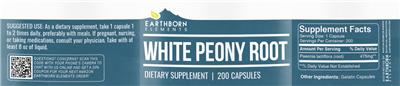
Suggested Use: As a dietary supplement, take 1 capsule 1 to 2 times daily, preferably with meals. Take with at least 8 oz of liquid.
Precautions
If pregnant, nursing, or taking medications, consult your physician.
General Statements
Questions? Concerns? Scan this code with your phone's camera to chat with us online and get 20% coupon for your next Amazon Earthborn Elements order!
FDA Statement of Identity
Dietary Supplement
Is this label outdated? Report a formula or label change and our pharmacy team will review it.
White Peony Root by Earthborn Elements label
The label scan from the NIH Dietary Supplement Label Database. Tap to enlarge.
Label images are published by the NIH Dietary Supplement Label Database for the version of this product on file. Always read your actual product label.
View the full label (PDF)The Ingredients in White Peony Root by Earthborn Elements
This is the 1 active ingredient this product is made of. Select it to open its full monograph.
Serving size1 Capsule(s) Dosage formCapsule Servings per container200 Amounts shown are per serving.
Paeonia lactiflora
Interacts with811 drugs
Peony root is a traditional Chinese medicine herb often used for menstrual problems, cramps, and inflammation, frequently as part of combination formu...
Paeonia lactiflora monograph & interactionsOther (inactive) ingredients: Gelatin. These complete the product’s ingredient list but are not active constituents.
White Peony Root by Earthborn Elements Drug Interactions
HelloPharmacist Interaction Report
White Peony Root by Earthborn Elements contains one active ingredient—Paeonia lactiflora—that has documented interactions with several medication types.
The most serious concern is with blood thinners (anticoagulants) and antiplatelet drugs: in vitro research suggests peony may have anticoagulant and antiplatelet effects, which theoretically could increase bleeding risk when combined with these medications. There's also one case report of bleeding complications in a patient on warfarin who switched to a different Chinese herbal product containing peony.
Read the full breakdown — every affected drug type, severity by severity
Peony may also affect how your liver metabolizes certain medications. It shows weak-to-moderate effects on two enzyme systems (CYP1A2 and CYP3A4), which could theoretically increase levels of drugs broken down by these pathways—including the antipsychotic clozapine.
Separately, peony has estrogenic activity in test-tube and animal studies, raising theoretical concerns with hormone replacement therapy and oral contraceptives, though human evidence is limited.
Additionally, animal research suggests peony might reduce blood levels of the seizure medication phenytoin, though preliminary human studies haven't confirmed this. Altogether, these interactions span 801 individual medications.
Before starting this product, use the medication checker on this page to look up your exact prescriptions.
Check your own medications below · Editorial policy · How we use AI
Want to check YOUR meds against White Peony Root?
Ask about interactions with your drugs in plain English — “Can I take it with lisinopril?” — and we find you the answer in seconds, ingredient by ingredient.
Go to the checkerIngredients driving the most interactions
Individual Drug Interactions
The ingredients in White Peony Root interact with 811 drugs. Click any drug to see the details.
1 of the 1 ingredient in White Peony Root interact with drugs. Each result below shows which ingredient is responsible. Paeonia lactiflora
Ado-trastuzumab EmtansineKadcyla
How Ado-trastuzumab Emtansine interacts with White Peony Root — through 1 ingredient. Tap an ingredient for the detail:
Paeonia LactifloraCytochrome P450 3a4 (cyp3a4) Substrates Moderate
Interaction Summary
Theoretically, use of peony may increase the levels and clinical effects of drugs metabolized by CYP3A4.
Read the full Paeonia Lactiflora + Ado-trastuzumab Emtansine interactionAbciximabReoPro
How Abciximab interacts with White Peony Root — through 1 ingredient. Tap an ingredient for the detail:
Paeonia LactifloraAnticoagulant/antiplatelet Drugs Moderate
Interaction Summary
Theoretically, combining peony with anticoagulant or antiplatelet drugs might increase the risk of bleeding.
Read the full Paeonia Lactiflora + Abciximab interactionAbemaciclibVerzenio
How Abemaciclib interacts with White Peony Root — through 1 ingredient. Tap an ingredient for the detail:
Paeonia LactifloraCytochrome P450 3a4 (cyp3a4) Substrates Moderate
Interaction Summary
Theoretically, use of peony may increase the levels and clinical effects of drugs metabolized by CYP3A4.
Read the full Paeonia Lactiflora + Abemaciclib interactionAbiraterone
How Abiraterone interacts with White Peony Root — through 1 ingredient. Tap an ingredient for the detail:
Paeonia LactifloraCytochrome P450 3a4 (cyp3a4) Substrates Moderate
Interaction Summary
Theoretically, use of peony may increase the levels and clinical effects of drugs metabolized by CYP3A4.
Read the full Paeonia Lactiflora + Abiraterone interactionAbiraterone AcetateYonsa, Zytiga
How Abiraterone Acetate interacts with White Peony Root — through 1 ingredient. Tap an ingredient for the detail:
Paeonia LactifloraCytochrome P450 3a4 (cyp3a4) Substrates Moderate
Interaction Summary
Theoretically, use of peony may increase the levels and clinical effects of drugs metabolized by CYP3A4.
Read the full Paeonia Lactiflora + Abiraterone Acetate interactionAbrocitinibCibinqo
How Abrocitinib interacts with White Peony Root — through 1 ingredient. Tap an ingredient for the detail:
Paeonia LactifloraAnticoagulant/antiplatelet Drugs Moderate
Interaction Summary
Theoretically, combining peony with anticoagulant or antiplatelet drugs might increase the risk of bleeding.
Read the full Paeonia Lactiflora + Abrocitinib interactionAcalabrutinibCalquence
How Acalabrutinib interacts with White Peony Root — through 1 ingredient. Tap an ingredient for the detail:
Paeonia LactifloraCytochrome P450 3a4 (cyp3a4) Substrates Moderate
Interaction Summary
Theoretically, use of peony may increase the levels and clinical effects of drugs metabolized by CYP3A4.
Read the full Paeonia Lactiflora + Acalabrutinib interactionAcenocoumarolSintrom
How Acenocoumarol interacts with White Peony Root — through 1 ingredient. Tap an ingredient for the detail:
Paeonia LactifloraAnticoagulant/antiplatelet Drugs Moderate
Interaction Summary
Theoretically, combining peony with anticoagulant or antiplatelet drugs might increase the risk of bleeding.
Read the full Paeonia Lactiflora + Acenocoumarol interactionAcetaminophenChildren's Tylenol, Children's Tylenol Meltaways, Tylenol, Tylenol Ex Strength
How Acetaminophen interacts with White Peony Root — through 1 ingredient. Tap an ingredient for the detail:
Paeonia LactifloraCytochrome P450 1a2 (cyp1a2) Substrates Moderate
Interaction Summary
Theoretically, use of peony may increase the levels and clinical effects of drugs metabolized by CYP1A2.
Read the full Paeonia Lactiflora + Acetaminophen interactionAcetaminophen, AspirinGemnisyn
How Acetaminophen, Aspirin interacts with White Peony Root — through 1 ingredient. Tap an ingredient for the detail:
Paeonia LactifloraCytochrome P450 1a2 (cyp1a2) Substrates, Anticoagulant/antiplatelet Drugs Moderate
Interaction Summary
Theoretically, use of peony may increase the levels and clinical effects of drugs metabolized by CYP1A2.
Read the full Paeonia Lactiflora + Acetaminophen, Aspirin interactionAcetaminophen, Aspirin, CaffeineExcedrin, Excedrin Extra Strength, Excedrin Migraine
How Acetaminophen, Aspirin, Caffeine interacts with White Peony Root — through 1 ingredient. Tap an ingredient for the detail:
Paeonia LactifloraCytochrome P450 1a2 (cyp1a2) Substrates, Cytochrome P450 3a4 (cyp3a4) Substrates +1 Moderate
Interaction Summary
Theoretically, use of peony may increase the levels and clinical effects of drugs metabolized by CYP1A2.
Read the full Paeonia Lactiflora + Acetaminophen, Aspirin, Caffeine interactionAcetaminophen, Brompheniramine, PhenylpropanolamineDimetapp Cold and Flu
How Acetaminophen, Brompheniramine, Phenylpropanolamine interacts with White Peony Root — through 1 ingredient. Tap an ingredient for the detail:
Paeonia LactifloraCytochrome P450 1a2 (cyp1a2) Substrates Moderate
Interaction Summary
Theoretically, use of peony may increase the levels and clinical effects of drugs metabolized by CYP1A2.
Read the full Paeonia Lactiflora + Acetaminophen, Brompheniramine, Phenylpropanolamine interactionAcetaminophen, ButalbitalAxocet, Bancap, Bucet, Butex Forte, Esgic CF, Orbivan CF +5 more
How Acetaminophen, Butalbital interacts with White Peony Root — through 1 ingredient. Tap an ingredient for the detail:
Paeonia LactifloraCytochrome P450 1a2 (cyp1a2) Substrates Moderate
Interaction Summary
Theoretically, use of peony may increase the levels and clinical effects of drugs metabolized by CYP1A2.
Read the full Paeonia Lactiflora + Acetaminophen, Butalbital interactionAcetaminophen, Butalbital, CaffeineEsgic, Esgic Plus, Fiogesic, Fioricet, Repan, Tecnal +1 more
How Acetaminophen, Butalbital, Caffeine interacts with White Peony Root — through 1 ingredient. Tap an ingredient for the detail:
Paeonia LactifloraCytochrome P450 1a2 (cyp1a2) Substrates, Cytochrome P450 3a4 (cyp3a4) Substrates Moderate
Interaction Summary
Theoretically, use of peony may increase the levels and clinical effects of drugs metabolized by CYP1A2.
Read the full Paeonia Lactiflora + Acetaminophen, Butalbital, Caffeine interactionAcetaminophen, Butalbital, Caffeine, CodeineEsgic with Codeine, Fioricet w/ Codeine
How Acetaminophen, Butalbital, Caffeine, Codeine interacts with White Peony Root — through 1 ingredient. Tap an ingredient for the detail:
Paeonia LactifloraCytochrome P450 3a4 (cyp3a4) Substrates, Cytochrome P450 1a2 (cyp1a2) Substrates Moderate
Interaction Summary
Theoretically, use of peony may increase the levels and clinical effects of drugs metabolized by CYP3A4.
Read the full Paeonia Lactiflora + Acetaminophen, Butalbital, Caffeine, Codeine interactionAcetaminophen, Butalbital, CodeineBancap w/ Codeine
How Acetaminophen, Butalbital, Codeine interacts with White Peony Root — through 1 ingredient. Tap an ingredient for the detail:
Paeonia LactifloraCytochrome P450 1a2 (cyp1a2) Substrates Moderate
Interaction Summary
Theoretically, use of peony may increase the levels and clinical effects of drugs metabolized by CYP1A2.
Read the full Paeonia Lactiflora + Acetaminophen, Butalbital, Codeine interactionAcetaminophen, Butalbital, Codeine PhosphatePhrenilin #3
How Acetaminophen, Butalbital, Codeine Phosphate interacts with White Peony Root — through 1 ingredient. Tap an ingredient for the detail:
Paeonia LactifloraCytochrome P450 1a2 (cyp1a2) Substrates Moderate
Interaction Summary
Theoretically, use of peony may increase the levels and clinical effects of drugs metabolized by CYP1A2.
Read the full Paeonia Lactiflora + Acetaminophen, Butalbital, Codeine Phosphate interactionAcetaminophen, Caffeine, Chlorpheniramine, Hydrocodone, PhenylephrineHycomine Compound
How Acetaminophen, Caffeine, Chlorpheniramine, Hydrocodone, Phenylephrine interacts with White Peony Root — through 1 ingredient. Tap an ingredient for the detail:
Paeonia LactifloraCytochrome P450 1a2 (cyp1a2) Substrates, Cytochrome P450 3a4 (cyp3a4) Substrates Moderate
Interaction Summary
Theoretically, use of peony may increase the levels and clinical effects of drugs metabolized by CYP1A2.
Read the full Paeonia Lactiflora + Acetaminophen, Caffeine, Chlorpheniramine, Hydrocodone, Phenylephrine interactionAcetaminophen, Caffeine, CodeineGesic C15, Gesic C30, Gesic C8, Lenoltec 1, Lenoltec 2, Lenoltec 3 +1 more
How Acetaminophen, Caffeine, Codeine interacts with White Peony Root — through 1 ingredient. Tap an ingredient for the detail:
Paeonia LactifloraCytochrome P450 3a4 (cyp3a4) Substrates, Cytochrome P450 1a2 (cyp1a2) Substrates Moderate
Interaction Summary
Theoretically, use of peony may increase the levels and clinical effects of drugs metabolized by CYP3A4.
Read the full Paeonia Lactiflora + Acetaminophen, Caffeine, Codeine interactionAcetaminophen, Caffeine, Codeine, SalicylamideCodalan No.1, Codalan No.2, Codalan No.3
How Acetaminophen, Caffeine, Codeine, Salicylamide interacts with White Peony Root — through 1 ingredient. Tap an ingredient for the detail:
Paeonia LactifloraCytochrome P450 1a2 (cyp1a2) Substrates, Cytochrome P450 3a4 (cyp3a4) Substrates Moderate
Interaction Summary
Theoretically, use of peony may increase the levels and clinical effects of drugs metabolized by CYP1A2.
Read the full Paeonia Lactiflora + Acetaminophen, Caffeine, Codeine, Salicylamide interactionAcetaminophen, Caffeine, DihydrocodeineDHC Plus, Panlor DC, Panlor SS
How Acetaminophen, Caffeine, Dihydrocodeine interacts with White Peony Root — through 1 ingredient. Tap an ingredient for the detail:
Paeonia LactifloraCytochrome P450 3a4 (cyp3a4) Substrates, Cytochrome P450 1a2 (cyp1a2) Substrates Moderate
Interaction Summary
Theoretically, use of peony may increase the levels and clinical effects of drugs metabolized by CYP3A4.
Read the full Paeonia Lactiflora + Acetaminophen, Caffeine, Dihydrocodeine interactionAcetaminophen, Caffeine, IsomethepteneMigralam
How Acetaminophen, Caffeine, Isometheptene interacts with White Peony Root — through 1 ingredient. Tap an ingredient for the detail:
Paeonia LactifloraCytochrome P450 1a2 (cyp1a2) Substrates, Cytochrome P450 3a4 (cyp3a4) Substrates Moderate
Interaction Summary
Theoretically, use of peony may increase the levels and clinical effects of drugs metabolized by CYP1A2.
Read the full Paeonia Lactiflora + Acetaminophen, Caffeine, Isometheptene interactionAcetaminophen, Caffeine, PyrilamineMidol Max Strength Menstrual
How Acetaminophen, Caffeine, Pyrilamine interacts with White Peony Root — through 1 ingredient. Tap an ingredient for the detail:
Paeonia LactifloraCytochrome P450 3a4 (cyp3a4) Substrates, Cytochrome P450 1a2 (cyp1a2) Substrates Moderate
Interaction Summary
Theoretically, use of peony may increase the levels and clinical effects of drugs metabolized by CYP3A4.
Read the full Paeonia Lactiflora + Acetaminophen, Caffeine, Pyrilamine interactionAcetaminophen, Chlorpheniramine Maleate, Dextromethorphan HbrVicks Formula 44M Cough, Cold & Flu Relief
How Acetaminophen, Chlorpheniramine Maleate, Dextromethorphan Hbr interacts with White Peony Root — through 1 ingredient. Tap an ingredient for the detail:
Paeonia LactifloraCytochrome P450 1a2 (cyp1a2) Substrates, Cytochrome P450 3a4 (cyp3a4) Substrates Moderate
Interaction Summary
Theoretically, use of peony may increase the levels and clinical effects of drugs metabolized by CYP1A2.
Read the full Paeonia Lactiflora + Acetaminophen, Chlorpheniramine Maleate, Dextromethorphan Hbr interactionAcetaminophen, Chlorpheniramine, Codeine, PhenylephrineColrex
How Acetaminophen, Chlorpheniramine, Codeine, Phenylephrine interacts with White Peony Root — through 1 ingredient. Tap an ingredient for the detail:
Paeonia LactifloraCytochrome P450 3a4 (cyp3a4) Substrates, Cytochrome P450 1a2 (cyp1a2) Substrates Moderate
Interaction Summary
Theoretically, use of peony may increase the levels and clinical effects of drugs metabolized by CYP3A4.
Read the full Paeonia Lactiflora + Acetaminophen, Chlorpheniramine, Codeine, Phenylephrine interactionAcetaminophen, Chlorpheniramine, DextromethorphanCoricidin II Extra Strength Cold and Flu
How Acetaminophen, Chlorpheniramine, Dextromethorphan interacts with White Peony Root — through 1 ingredient. Tap an ingredient for the detail:
Paeonia LactifloraCytochrome P450 1a2 (cyp1a2) Substrates, Cytochrome P450 3a4 (cyp3a4) Substrates Moderate
Interaction Summary
Theoretically, use of peony may increase the levels and clinical effects of drugs metabolized by CYP1A2.
Read the full Paeonia Lactiflora + Acetaminophen, Chlorpheniramine, Dextromethorphan interactionAcetaminophen, Chlorpheniramine, Dextromethorphan HydrobromideCoricidin HBP Maximum Strength Flu
How Acetaminophen, Chlorpheniramine, Dextromethorphan Hydrobromide interacts with White Peony Root — through 1 ingredient. Tap an ingredient for the detail:
Paeonia LactifloraCytochrome P450 3a4 (cyp3a4) Substrates, Cytochrome P450 1a2 (cyp1a2) Substrates Moderate
Interaction Summary
Theoretically, use of peony may increase the levels and clinical effects of drugs metabolized by CYP3A4.
Read the full Paeonia Lactiflora + Acetaminophen, Chlorpheniramine, Dextromethorphan Hydrobromide interactionAcetaminophen, Chlorpheniramine, Dextromethorphan, PhenylpropanolamineMulti Symptom Cold Relief
How Acetaminophen, Chlorpheniramine, Dextromethorphan, Phenylpropanolamine interacts with White Peony Root — through 1 ingredient. Tap an ingredient for the detail:
Paeonia LactifloraCytochrome P450 1a2 (cyp1a2) Substrates, Cytochrome P450 3a4 (cyp3a4) Substrates Moderate
Interaction Summary
Theoretically, use of peony may increase the levels and clinical effects of drugs metabolized by CYP1A2.
Read the full Paeonia Lactiflora + Acetaminophen, Chlorpheniramine, Dextromethorphan, Phenylpropanolamine interactionAcetaminophen, Chlorpheniramine, Dextromethorphan, PseudoephedrineChildren's Tylenol Cold Plus Cough, Tylenol Cold Ex Strength
How Acetaminophen, Chlorpheniramine, Dextromethorphan, Pseudoephedrine interacts with White Peony Root — through 1 ingredient. Tap an ingredient for the detail:
Paeonia LactifloraCytochrome P450 3a4 (cyp3a4) Substrates, Cytochrome P450 1a2 (cyp1a2) Substrates Moderate
Interaction Summary
Theoretically, use of peony may increase the levels and clinical effects of drugs metabolized by CYP3A4.
Read the full Paeonia Lactiflora + Acetaminophen, Chlorpheniramine, Dextromethorphan, Pseudoephedrine interactionAcetaminophen, Chlorpheniramine, Guaifenesin, Phenylephrine, SalicylamideRhinogesic GG
How Acetaminophen, Chlorpheniramine, Guaifenesin, Phenylephrine, Salicylamide interacts with White Peony Root — through 1 ingredient. Tap an ingredient for the detail:
Paeonia LactifloraCytochrome P450 1a2 (cyp1a2) Substrates, Cytochrome P450 3a4 (cyp3a4) Substrates Moderate
Interaction Summary
Theoretically, use of peony may increase the levels and clinical effects of drugs metabolized by CYP1A2.
Read the full Paeonia Lactiflora + Acetaminophen, Chlorpheniramine, Guaifenesin, Phenylephrine, Salicylamide interactionEach ingredient & the kinds of drugs it affects
For each ingredient in White Peony Root with known interactions, here are the types of medications it can affect. Open any type for the detail — or search your exact drug in the checker above.
Paeonia lactiflora
Anticoagulant/Antiplatelet Drugs
Theoretically, combining peony with anticoagulant or antiplatelet drugs might increase the risk of bleeding.
In vitro research suggests that peony might have antiplatelet, anticoagulant, and antithrombotic effects.
Clozapine (Clozaril)
Theoretically, peony might increase the levels and clinical effects of clozapine.
In vitro research shows that peony suppresses the metabolism of clozapine via weak-to-moderate inhibitory effects on cytochromes P450 (CYP) 1A2 and CYP3A4. This effect has not been reported in humans.
Contraceptive Drugs
Theoretically, peony might interfere with contraceptive drugs due to competition for estrogen receptors.
In vitro and animal research shows that peony extract has estrogenic activity. Concomitant use might also increase the risk for estrogen-related adverse effects.
Cytochrome P450 1A2 (Cyp1A2) Substrates
Theoretically, use of peony may increase the levels and clinical effects of drugs metabolized by CYP1A2.
In vitro research shows that peony suppresses the metabolism of clozapine via weak-to-moderate inhibitory effects on CYP1A2 and CYP3A4. This effect has not been reported in humans.
Cytochrome P450 3A4 (Cyp3A4) Substrates
Theoretically, use of peony may increase the levels and clinical effects of drugs metabolized by CYP3A4.
In vitro research shows that peony suppresses the metabolism of clozapine via weak-to-moderate inhibitory effects on CYP1A2 and CYP3A4. This effect has not been reported in humans.
Estrogens
Theoretically, concomitant use of large amounts of peony might interfere with hormone replacement therapy and/or increase the risk for estrogen-related adverse effects.
In vitro and animal research shows that peony extract has estrogenic activity. Theoretically, peony might compete for estrogen receptors and/or cause additive estrogenic effects.
Phenytoin (Dilantin)
Theoretically, peony might reduce the levels and clinical effects of phenytoin.
Animal research shows that taking peony root reduces levels of phenytoin. Some researchers suggest that peony root might affect cytochrome P450 (CYP) 2C9, which metabolizes phenytoin. However, preliminary research in humans shows that peony root does not alter levels of losartan (Cozaar), which is also metabolized by CYP2C9.
Brand information
Manufacturer and brand details for White Peony Root, from the product label.
Earthborn Elements
See all Earthborn Elements products- Name
- Earthborn Elements
- Street Address
- 9450 SW Gemini Dr #49936
- City
- Beaverton
- State
- Oregon
- ZipCode
- 97008
- Web Address
- Earthbornelements.com
White Peony Root by Earthborn Elements: Common Questions
Does White Peony Root by Earthborn Elements interact with any medications?
How can one product interact with so many drugs?
Where does this information come from?
What are the most common side effects?
Can I take this while pregnant or breastfeeding?
Does peony actually work for the conditions listed?
Why does this product show so many medication interactions?
Written and reviewed by the HelloPharmacist editorial staff. Our editorial policy
Not sure if White Peony Root is safe with your meds?
Our pharmacists answer your medication & supplement questions — free.
Label information is sourced from the NIH Dietary Supplement Label Database and reflects the product version on file; always read your actual product label. This page is for education only and is not a substitute for professional medical advice. Confirm with your pharmacist or doctor before combining supplements and medications.
The Full Monographs Behind White Peony Root’s Ingredients
Every ingredient we hold a full HelloPharmacist monograph for — uses, evidence, safety, and the complete interaction list.
Sources & How We Checked
White Peony Root's label data comes from the NIH Dietary Supplement Label Database; the ingredient interaction data is from the Natural Medicines database, reviewed by our pharmacists.
- NIH Dietary Supplement Label Database (DSLD) — The official product label on file for this supplement.
- Natural Medicines (Therapeutic Research Center) — Evidence-graded clinical reference behind the ingredient interaction data.
Content is written and reviewed by licensed HelloPharmacist pharmacists. See our data sources and editorial standards for how this information is built and checked.
The 15 references behind this product’s interaction data
Every citation that drives the interaction findings for this product’s ingredients, from the evidence-graded Natural Medicines (TRC Healthcare) database. Open an ingredient to browse its citations — links open the study on PubMed or the publisher’s site.
Peony 15 references
- Chen LC, Chou MH, Lin MF, Yang LL. Effects of Paeoniae Radix, a traditional Chinese medicine, on the pharmacokinetics of phenytoin. J Clin Pharm Ther 2001;26:271-8. PubMed
- Guo TL, Zhou XW. [Clinical observations on the treatment of the gestational hypertension syndrome with Angelica and Paeonia powder]. Zhong Xi Yi Jie He Za Zhi 1986;6:714-6, 707.
- Xie HJ, Yasar U, Sandberg M, Rane A. Paeoniae Radix, a traditional Chinese medicine, and CYP2C9 activity. J Clin Pharm Ther 2002;27:229-30. . PubMed
- Harada M, Suzuki M, Ozaki Y. Effect of Japanese Angelica root and peony root on uterine contraction in the rabbit in situ. J Pharmacobiodyn 1984;7:304-11. PubMed
- Anon. Monograph. Peony (Paeonia spp). Alt Med Rev 2001;6:495-9.
- Bruynzeel DP. Contact Dermatitis Due to Paeonia (Peony). Contact Dermatitis 1989; 20:152-3..
- Bian, X., Xu, Y., Zhu, L., Gao, P., Liu, X., Liu, S., Qian, M., Gai, M., Yang, J., and Wu, Y. Prevention of maternal-fetal blood group incompatibility with traditional Chinese herbal medicine. Chin Med J (Engl.) 1998;111(7):585-587.
- Wong, A. L. and Chan, T. Y. Interaction between warfarin and the herbal product quilinggao. Ann Pharmacother 2003;37(6):836-838.
- Cai Y, Yuan Q, Xu K, et al. Assessment of the therapeutic effect of total glycosides of peony for juvenile idiopathic arthritis: a systematic review and meta-analysis. Evid Based Complement Alternat Med 2016;2016:8292486.
- Koo YK, Kim JM, Koo JY, et al. Platelet anti-aggregatory and blood anti-coagulant effects of compounds isolated from Paeonia lactiflora and Paeonia suffruticosa. Pharmazie 2010;65(8):624-8.
- Wang W, Tian DD, Zheng B, et al. Peony-glycyrrhiza decoction, an herbal preparation, inhibits clozapine metabolism via cytochrome P450s, but not flavin-containing monooxygenase in in vitro models. Drug Metab Dispos 2015;43(7):1147-53. PubMed
- Zhou Y, Jin L, Kong F, et al. Clinical and immunological consequences of total glucosides of paeony treatment in Sjögren's syndrome: A randomized controlled pilot trial. Int Immunopharmacol. 2016 Oct;39:314-319. doi: 10.1016/j.intimp.2016.08.006. PubMed
- Zhu Q, Qi X, Wu Y, Wang K. Clinical study of total glucosides of paeony for the treatment of diabetic kidney disease in patients with diabetes mellitus. Int Urol Nephrol. 2016 Nov;48(11):1873-1880. doi: 10.1007/s11255-016-1345-5. PubMed
- Xu Y, Li X, Chen T, et al. Radix Paeoniae Alba increases serum estrogen level and up-regulates estrogen receptor expression in uterus and vagina of immature/ovariectomized mice. Phytother Res. 2019;33(1):117-29. [RETRACTED].
- Liu X, Li X, Li X, et al. The efficacy and safety of total glucosides of peony in the treatment of primary Sjögren's syndrome: a multi-center, randomized, double-blinded, placebo-controlled clinical trial. Clin Rheumatol. 2019;38(3):657-64. Erratum i
Parts of this content are provided by the Therapeutic Research Center, LLC.
DISCLAIMER: Currently this does not check for drug-drug interactions. This is not an all-inclusive comprehensive list of potential interactions and is for informational purposes only. Not all interactions are known or well-reported in the scientific literature, and new interactions are continually being reported. Input is needed from a qualified healthcare provider including a pharmacist before starting any therapy. Application of clinical judgment is necessary.
© 2021 Therapeutic Research Center, LLC