
Artichoke 500 mg Ingredients & Drug Interactions
What is this page for?
First and foremost: checking Artichoke 500 mg against your medications. The heart of this page is the interaction checker and the full interaction report — how this product’s ingredients may interact with prescription and over-the-counter medicines you may be taking.
Around that, we add a pharmacist’s high-level view of the product as a whole — what’s inside, the evidence for its stated use, how transparent the label is, and what safety data exists — so you can see the full picture in one place. It’s educational information from our licensed clinical databases and the clinical staff at HelloPharmacist — not medical advice — and we don’t sell or endorse products. Our editorial policy
Artichoke 500 mg is a dietary supplement by Jarrow Formulas with 1 active ingredient. Its ingredients are commonly taken for high cholesterol, indigestion and heartburn, constipation and bloating.Based on those ingredients, 364 medications have a known interaction with it, the most serious rated moderate. The ingredients most likely to interact are Artichoke Leaf Extract. Use the checker below to test your specific medication, or read the full HelloPharmacist Interaction Report.
Check Your Meds Against Artichoke 500 mg by Jarrow Formulas
Ask about any prescription or over-the-counter medication and we check it for interactions with Artichoke 500 mg by Jarrow Formulas — and tell you which ingredient is responsible.
AI summaries are generated from our interaction database for education only — always confirm with your pharmacist. How we use AI
Ask the Pharmacist
A licensed pharmacist will answer your question by email — free, usually within 24 hours.
Got it — thank you!
A licensed pharmacist will answer within 24 hours. Keep an eye on your email (worth checking spam, just in case).
HelloPharmacist Scorecard of Artichoke 500 mg by Jarrow Formulas
Four independent checks of what is known — a summary of the available information, not a grade of the product itself.
By FDA rules, dietary supplements can’t claim to treat, cure, or prevent disease — so labels speak in careful marketing language. We discern each product’s intended use from its name, label claims, and label statements, then grade the clinical evidence for that use. How these ratings are computed
None of the active ingredients could be matched to our evidence database, so intended use can't be graded.
Why this rating?
- None of the active ingredients could be matched to a HelloPharmacist monograph, so intended use can't be graded against our evidence data.
Every active ingredient lists its own amount on the label.
Why this rating?
- The label discloses an exact amount for 1 of its 1 active ingredient.
- “Artichoke Leaf Extract” is listed as a grouped ingredient — the label gives one combined amount (500 mg) without saying how much of each component you get.
None of the active ingredients could be matched to our interaction database.
Why this rating?
- We couldn't match any ingredient to a HelloPharmacist monograph, so there was nothing to check interactions against.
None of the active ingredients could be matched to our safety data.
Why this rating?
- We couldn't match any ingredient to a HelloPharmacist monograph, so there was no safety data to measure.
HelloPharmacist summaryFully disclosed formula with no assessable stated purpose. Medication interactions could not be assessed, and safety information could not be assessed.
Assessment coverage: 0 of 1 active ingredient matched to our full ingredient reviews (monographs). Based on the product label dated Jan 24, 2024.
This Scorecard evaluates available label information, ingredient evidence, and known medication-safety considerations. It does not independently verify product identity, purity, potency, contamination, or manufacturing quality. How these ratings are computed
General information
Key facts about Artichoke 500 mg, straight from the product label.
| Brand | Jarrow Formulas |
|---|---|
| Barcode (UPC) | 790011140627 |
| Net contents | 180 Veggie Capsule(s) |
| Market status | On market |
| Date entered into DSLD | Jan 24, 2024 |
| DSLD ID | 307554 |
| Product type | Botanical |
| Supplement form | Capsule |
| Dietary claims / uses | All Other, Structure/Function |
| Intended target group(s) | Vegan, Vegetarian, Adult (18 - 50 Years), No Allergies, Gluten Free, Dairy Free |
Everything in this section is reproduced from the manufacturer’s own product label — it’s the label speaking, not HelloPharmacist. We show it so you can see exactly what the maker states; we don’t verify or endorse those statements.
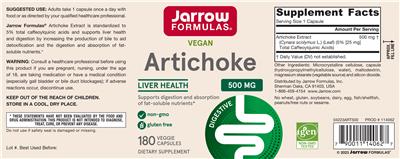
Supplement Facts
The label details for Artichoke 500 mg by Jarrow Formulas, sourced from the NIH Dietary Supplement Label Database.
Supplement Facts
| Ingredient | Amount | % DV |
|---|---|---|
| Total Caffeoylquinic Acids | 25 mg | -- |
| Artichoke Leaf Extract | 500 mg | -- |
Other ingredients: Microcrystalline Cellulose, Hydroxypropyl Methylcellulose, Water, Maltodextrin, Magnesium Stearate, Silicon Dioxide
Tap any ingredient to jump to its full detail below.
These statements are the manufacturer’s wording, reproduced from the product label — the label is saying it, not HelloPharmacist. We don’t verify or endorse them.
Suggested/Recommended/Usage/Directions
Suggested use: Adults take 1 capsule once a day with food or as directed by your qualified healthcare professional.
Formula
Jarrow Formulas Artichoke Extract is standardized to 5% total caffeoylquinic acids and supports liver health and digestion by increasing the production of bile to aid detoxification and the digestion and absorption of fat-soluble nutrients.
Precautions
Warning: Consult a healthcare professional before using this product if you are pregnant, nursing, under the age of 18, are taking medication or have a medical condition (especially gall bladder or bile duct blockages); if adverse reactions occur, discontinue use.
Warning: Consult a healthcare professional before using this product if you are pregnant, nursing, under the age of 18, are taking medication or have a medical condition (especially gall bladder or bile duct blockages); if adverse reactions occur, discontinue use. Keep out of the reach of children.
Do not use if safety seal is damaged or missing.
Storage
Store in a cool, dry place.
FDA Disclaimer Statement
These statements have not been evaluated by the Food and Drug Administration. This product is not intended to diagnose, treat, cure, or prevent any disease.
Formulation
Vegan
Liver health Supports digestion and absorption of fat-soluble nutrients Digestive
Non-GMO Gluten free
No wheat, gluten, soybeans, dairy, egg, fish/shellfish, peanuts/tree nuts or sesame.
FDA Statement of Identity
Dietary Supplement
Seals/Symbols
IGEN Non-GMO tested
Brand IP Statement(s)
Copyright 2023 Jarrow Formulas
Is this label outdated? Report a formula or label change and our pharmacy team will review it.
Artichoke 500 mg by Jarrow Formulas label
The label scan from the NIH Dietary Supplement Label Database. Tap to enlarge.
Label images are published by the NIH Dietary Supplement Label Database for the version of this product on file. Always read your actual product label.
View the full label (PDF)The Ingredients in Artichoke 500 mg by Jarrow Formulas
This is the 1 active ingredient this product is made of. Select it to open its full monograph.
Serving size1 Capsule(s) Dosage formCapsule Servings per container180 Amounts shown are per serving.
Artichoke Leaf Extract
Interacts with364 drugs
Artichoke leaf extract is a generally well-tolerated supplement that may have a mild cholesterol-lowering effect and is often used for indigestion, th...
Artichoke Leaf Extract monograph & interactions- › Total Caffeoylquinic Acids
Other (inactive) ingredients: Microcrystalline Cellulose, Hydroxypropyl Methylcellulose, Water, Maltodextrin, Magnesium Stearate, Silicon Dioxide. These complete the product’s ingredient list but are not active constituents.
Artichoke 500 mg by Jarrow Formulas Drug Interactions
Artichoke 500 mg contains a single active ingredient, and it has known interactions with 364 medications. Here’s the picture, then you can look up your own drug.
Want to check YOUR meds against Artichoke 500 mg?
Ask about interactions with your drugs in plain English — “Can I take it with lisinopril?” — and we find you the answer in seconds, ingredient by ingredient.
Go to the checkerIngredients driving the most interactions
Individual Drug Interactions
The ingredients in Artichoke 500 mg interact with 364 drugs. Click any drug to see the details.
1 of the 1 ingredient in Artichoke 500 mg interact with drugs. Each result below shows which ingredient is responsible. Artichoke Leaf Extract
AbrocitinibCibinqo
How Abrocitinib interacts with Artichoke 500 mg — through 1 ingredient. Tap an ingredient for the detail:
Artichoke Leaf ExtractCytochrome P450 2c19 (cyp2c19) Substrates Moderate
Interaction Summary
Theoretically, artichoke might increase serum levels of drugs metabolized by CYP2C19.
Read the full Artichoke Leaf Extract + Abrocitinib interactionAcarboseGlucobay, Prandase, Precose
How Acarbose interacts with Artichoke 500 mg — through 1 ingredient. Tap an ingredient for the detail:
Artichoke Leaf ExtractAntidiabetes Drugs Moderate
Interaction Summary
Theoretically, artichoke leaf extract may increase the risk of hypoglycemia when taken with antidiabetes drugs.
Read the full Artichoke Leaf Extract + Acarbose interactionAcebutololRhotral, Sectral
How Acebutolol interacts with Artichoke 500 mg — through 1 ingredient. Tap an ingredient for the detail:
Artichoke Leaf ExtractAntihypertensive Drugs Moderate
Interaction Summary
Theoretically, artichoke leaf extract may increase the risk of hypotension when taken with antihypertensive drugs.
Read the full Artichoke Leaf Extract + Acebutolol interactionAcetaminophen, OrphenadrineOrfenagesic
How Acetaminophen, Orphenadrine interacts with Artichoke 500 mg — through 1 ingredient. Tap an ingredient for the detail:
Artichoke Leaf ExtractCytochrome P450 2b6 (cyp2b6) Substrates Moderate
Interaction Summary
Theoretically, artichoke might increase serum levels of drugs metabolized by CYP2B6.
Read the full Artichoke Leaf Extract + Acetaminophen, Orphenadrine interactionAcetazolamideAk-Zol, Diamox
How Acetazolamide interacts with Artichoke 500 mg — through 1 ingredient. Tap an ingredient for the detail:
Artichoke Leaf ExtractAntihypertensive Drugs Moderate
Interaction Summary
Theoretically, artichoke leaf extract may increase the risk of hypotension when taken with antihypertensive drugs.
Read the full Artichoke Leaf Extract + Acetazolamide interactionAcetohexamideDymelor
How Acetohexamide interacts with Artichoke 500 mg — through 1 ingredient. Tap an ingredient for the detail:
Artichoke Leaf ExtractAntidiabetes Drugs Moderate
Interaction Summary
Theoretically, artichoke leaf extract may increase the risk of hypoglycemia when taken with antidiabetes drugs.
Read the full Artichoke Leaf Extract + Acetohexamide interactionAerosphere Budesonide, Formoterol Fumarate, GlycopyrrolateBreztri
How Aerosphere Budesonide, Formoterol Fumarate, Glycopyrrolate interacts with Artichoke 500 mg — through 1 ingredient. Tap an ingredient for the detail:
Artichoke Leaf ExtractCytochrome P450 2c19 (cyp2c19) Substrates Moderate
Interaction Summary
Theoretically, artichoke might increase serum levels of drugs metabolized by CYP2C19.
Read the full Artichoke Leaf Extract + Aerosphere Budesonide, Formoterol Fumarate, Glycopyrrolate interactionAgomelatineValdoxan
How Agomelatine interacts with Artichoke 500 mg — through 1 ingredient. Tap an ingredient for the detail:
Artichoke Leaf ExtractCytochrome P450 2c19 (cyp2c19) Substrates Moderate
Interaction Summary
Theoretically, artichoke might increase serum levels of drugs metabolized by CYP2C19.
Read the full Artichoke Leaf Extract + Agomelatine interactionAlbiglutideTanzeum
How Albiglutide interacts with Artichoke 500 mg — through 1 ingredient. Tap an ingredient for the detail:
Artichoke Leaf ExtractAntidiabetes Drugs Moderate
Interaction Summary
Theoretically, artichoke leaf extract may increase the risk of hypoglycemia when taken with antidiabetes drugs.
Read the full Artichoke Leaf Extract + Albiglutide interactionAliskirenTekturna
How Aliskiren interacts with Artichoke 500 mg — through 1 ingredient. Tap an ingredient for the detail:
Artichoke Leaf ExtractAntihypertensive Drugs Moderate
Interaction Summary
Theoretically, artichoke leaf extract may increase the risk of hypotension when taken with antihypertensive drugs.
Read the full Artichoke Leaf Extract + Aliskiren interactionAlogliptinNesina
How Alogliptin interacts with Artichoke 500 mg — through 1 ingredient. Tap an ingredient for the detail:
Artichoke Leaf ExtractAntidiabetes Drugs Moderate
Interaction Summary
Theoretically, artichoke leaf extract may increase the risk of hypoglycemia when taken with antidiabetes drugs.
Read the full Artichoke Leaf Extract + Alogliptin interactionAlogliptin, MetforminKazano
How Alogliptin, Metformin interacts with Artichoke 500 mg — through 1 ingredient. Tap an ingredient for the detail:
Artichoke Leaf ExtractAntidiabetes Drugs Moderate
Interaction Summary
Theoretically, artichoke leaf extract may increase the risk of hypoglycemia when taken with antidiabetes drugs.
Read the full Artichoke Leaf Extract + Alogliptin, Metformin interactionAlogliptin, PioglitazoneOseni
How Alogliptin, Pioglitazone interacts with Artichoke 500 mg — through 1 ingredient. Tap an ingredient for the detail:
Artichoke Leaf ExtractAntidiabetes Drugs Moderate
Interaction Summary
Theoretically, artichoke leaf extract may increase the risk of hypoglycemia when taken with antidiabetes drugs.
Read the full Artichoke Leaf Extract + Alogliptin, Pioglitazone interactionAmbrisentanLetairis, Volibris
How Ambrisentan interacts with Artichoke 500 mg — through 1 ingredient. Tap an ingredient for the detail:
Artichoke Leaf ExtractAntihypertensive Drugs Moderate
Interaction Summary
Theoretically, artichoke leaf extract may increase the risk of hypotension when taken with antihypertensive drugs.
Read the full Artichoke Leaf Extract + Ambrisentan interactionAmilorideAmilamont, Midamor
How Amiloride interacts with Artichoke 500 mg — through 1 ingredient. Tap an ingredient for the detail:
Artichoke Leaf ExtractAntihypertensive Drugs Moderate
Interaction Summary
Theoretically, artichoke leaf extract may increase the risk of hypotension when taken with antihypertensive drugs.
Read the full Artichoke Leaf Extract + Amiloride interactionAmiloride, HydrochlorothiazideAmil-Co, Amilzide, Moduret 25, Moduretic
How Amiloride, Hydrochlorothiazide interacts with Artichoke 500 mg — through 1 ingredient. Tap an ingredient for the detail:
Artichoke Leaf ExtractAntihypertensive Drugs Moderate
Interaction Summary
Theoretically, artichoke leaf extract may increase the risk of hypotension when taken with antihypertensive drugs.
Read the full Artichoke Leaf Extract + Amiloride, Hydrochlorothiazide interactionAmitriptylineElavil
How Amitriptyline interacts with Artichoke 500 mg — through 1 ingredient. Tap an ingredient for the detail:
Artichoke Leaf ExtractCytochrome P450 2c19 (cyp2c19) Substrates Moderate
Interaction Summary
Theoretically, artichoke might increase serum levels of drugs metabolized by CYP2C19.
Read the full Artichoke Leaf Extract + Amitriptyline interactionAmitriptyline, ChlordiazepoxideLimbitrol DS
How Amitriptyline, Chlordiazepoxide interacts with Artichoke 500 mg — through 1 ingredient. Tap an ingredient for the detail:
Artichoke Leaf ExtractCytochrome P450 2c19 (cyp2c19) Substrates Moderate
Interaction Summary
Theoretically, artichoke might increase serum levels of drugs metabolized by CYP2C19.
Read the full Artichoke Leaf Extract + Amitriptyline, Chlordiazepoxide interactionAmitriptyline, PerphenazineEtrafon, Etrafon-A, Etrafon-Forte, Triavil
How Amitriptyline, Perphenazine interacts with Artichoke 500 mg — through 1 ingredient. Tap an ingredient for the detail:
Artichoke Leaf ExtractCytochrome P450 2c19 (cyp2c19) Substrates Moderate
Interaction Summary
Theoretically, artichoke might increase serum levels of drugs metabolized by CYP2C19.
Read the full Artichoke Leaf Extract + Amitriptyline, Perphenazine interactionAmlodipineNorliqva
How Amlodipine interacts with Artichoke 500 mg — through 1 ingredient. Tap an ingredient for the detail:
Artichoke Leaf ExtractAntihypertensive Drugs Moderate
Interaction Summary
Theoretically, artichoke leaf extract may increase the risk of hypotension when taken with antihypertensive drugs.
Read the full Artichoke Leaf Extract + Amlodipine interactionAmlodipine BenzoateKaterzia
How Amlodipine Benzoate interacts with Artichoke 500 mg — through 1 ingredient. Tap an ingredient for the detail:
Artichoke Leaf ExtractAntihypertensive Drugs Moderate
Interaction Summary
Theoretically, artichoke leaf extract may increase the risk of hypotension when taken with antihypertensive drugs.
Read the full Artichoke Leaf Extract + Amlodipine Benzoate interactionAmlodipine BesilateIstin
How Amlodipine Besilate interacts with Artichoke 500 mg — through 1 ingredient. Tap an ingredient for the detail:
Artichoke Leaf ExtractAntihypertensive Drugs Moderate
Interaction Summary
Theoretically, artichoke leaf extract may increase the risk of hypotension when taken with antihypertensive drugs.
Read the full Artichoke Leaf Extract + Amlodipine Besilate interactionAmlodipine BesylateNorvasc
How Amlodipine Besylate interacts with Artichoke 500 mg — through 1 ingredient. Tap an ingredient for the detail:
Artichoke Leaf ExtractAntihypertensive Drugs Moderate
Interaction Summary
Theoretically, artichoke leaf extract may increase the risk of hypotension when taken with antihypertensive drugs.
Read the full Artichoke Leaf Extract + Amlodipine Besylate interactionAmlodipine Besylate, BenazeprilLotrel
How Amlodipine Besylate, Benazepril interacts with Artichoke 500 mg — through 1 ingredient. Tap an ingredient for the detail:
Artichoke Leaf ExtractAntihypertensive Drugs Moderate
Interaction Summary
Theoretically, artichoke leaf extract may increase the risk of hypotension when taken with antihypertensive drugs.
Read the full Artichoke Leaf Extract + Amlodipine Besylate, Benazepril interactionAmlodipine, CelecoxibConsensi
How Amlodipine, Celecoxib interacts with Artichoke 500 mg — through 1 ingredient. Tap an ingredient for the detail:
Artichoke Leaf ExtractAntihypertensive Drugs Moderate
Interaction Summary
Theoretically, artichoke leaf extract may increase the risk of hypotension when taken with antihypertensive drugs.
Read the full Artichoke Leaf Extract + Amlodipine, Celecoxib interactionAmmonium ChlorideAmmonium Chloride
How Ammonium Chloride interacts with Artichoke 500 mg — through 1 ingredient. Tap an ingredient for the detail:
Artichoke Leaf ExtractAntihypertensive Drugs Moderate
Interaction Summary
Theoretically, artichoke leaf extract may increase the risk of hypotension when taken with antihypertensive drugs.
Read the full Artichoke Leaf Extract + Ammonium Chloride interactionAmobarbital, SecobarbitalTuinal
How Amobarbital, Secobarbital interacts with Artichoke 500 mg — through 1 ingredient. Tap an ingredient for the detail:
Artichoke Leaf ExtractCytochrome P450 2b6 (cyp2b6) Substrates Moderate
Interaction Summary
Theoretically, artichoke might increase serum levels of drugs metabolized by CYP2B6.
Read the full Artichoke Leaf Extract + Amobarbital, Secobarbital interactionAmoxicillin, Omeprazole Magnesium, RifabutinTalicia
How Amoxicillin, Omeprazole Magnesium, Rifabutin interacts with Artichoke 500 mg — through 1 ingredient. Tap an ingredient for the detail:
Artichoke Leaf ExtractCytochrome P450 2c19 (cyp2c19) Substrates Moderate
Interaction Summary
Theoretically, artichoke might increase serum levels of drugs metabolized by CYP2C19.
Read the full Artichoke Leaf Extract + Amoxicillin, Omeprazole Magnesium, Rifabutin interactionAntidiabetes, Dipeptidyl Peptidase-4 (dpp-iv) InhibitorGlyxambi
How Antidiabetes, Dipeptidyl Peptidase-4 (dpp-iv) Inhibitor interacts with Artichoke 500 mg — through 1 ingredient. Tap an ingredient for the detail:
Artichoke Leaf ExtractAntidiabetes Drugs Moderate
Interaction Summary
Theoretically, artichoke leaf extract may increase the risk of hypoglycemia when taken with antidiabetes drugs.
Read the full Artichoke Leaf Extract + Antidiabetes, Dipeptidyl Peptidase-4 (dpp-iv) Inhibitor interactionAprobarbital, Butabarbital, PhenobarbitalTriple Barbital
How Aprobarbital, Butabarbital, Phenobarbital interacts with Artichoke 500 mg — through 1 ingredient. Tap an ingredient for the detail:
Artichoke Leaf ExtractCytochrome P450 2b6 (cyp2b6) Substrates Moderate
Interaction Summary
Theoretically, artichoke might increase serum levels of drugs metabolized by CYP2B6.
Read the full Artichoke Leaf Extract + Aprobarbital, Butabarbital, Phenobarbital interactionEach ingredient & the kinds of drugs it affects
For each ingredient in Artichoke 500 mg with known interactions, here are the types of medications it can affect. Open any type for the detail — or search your exact drug in the checker above.
Artichoke Leaf Extract
Antidiabetes Drugs
Theoretically, artichoke leaf extract may increase the risk of hypoglycemia when taken with antidiabetes drugs.
A meta-analysis of small clinical studies shows that taking artichoke leaf extract for 8-12 weeks can modestly reduce fasting plasma glucose when compared with placebo.
Antihypertensive Drugs
Theoretically, artichoke leaf extract may increase the risk of hypotension when taken with antihypertensive drugs.
A meta-analysis of small clinical studies in patients with hypertension shows that taking artichoke can reduce systolic blood pressure by around 3 mmHg and diastolic blood pressure by around 2 mmHg when compared with placebo.
Cytochrome P450 2B6 (Cyp2B6) Substrates
Theoretically, artichoke might increase serum levels of drugs metabolized by CYP2B6.
In vitro research shows that artichoke leaf extract inhibits CYP2B6 activity. However, this interaction has not been reported in humans.
Cytochrome P450 2C19 (Cyp2C19) Substrates
Theoretically, artichoke might increase serum levels of drugs metabolized by CYP2C19.
In vitro research shows that artichoke leaf extract inhibits CYP2C19 activity. However, this interaction has not been reported in humans.
Brand information
Manufacturer and brand details for Artichoke 500 mg, from the product label.
Jarrow Formulas
See all Jarrow Formulas products- Name
- Jarrow Formulas, Inc.
- City
- Sherman Oaks
- State
- CA
- ZipCode
- 91403
- Phone Number
- 1-866-459-4154
- Web Address
- www.Jarrow.com
Artichoke 500 mg by Jarrow Formulas: Common Questions
Does Artichoke 500 mg by Jarrow Formulas interact with any medications?
How can one product interact with so many drugs?
Where does this information come from?
Written and reviewed by the HelloPharmacist editorial staff. Our editorial policy
Not sure if Artichoke 500 mg is safe with your meds?
Our pharmacists answer your medication & supplement questions — free.
Label information is sourced from the NIH Dietary Supplement Label Database and reflects the product version on file; always read your actual product label. This page is for education only and is not a substitute for professional medical advice. Confirm with your pharmacist or doctor before combining supplements and medications.
The Full Monographs Behind Artichoke 500 mg’s Ingredients
Every ingredient we hold a full HelloPharmacist monograph for — uses, evidence, safety, and the complete interaction list.
Sources & How We Checked
Artichoke 500 mg's label data comes from the NIH Dietary Supplement Label Database; the ingredient interaction data is from the Natural Medicines database, reviewed by our pharmacists.
- NIH Dietary Supplement Label Database (DSLD) — The official product label on file for this supplement.
- Natural Medicines (Therapeutic Research Center) — Evidence-graded clinical reference behind the ingredient interaction data.
Content is written and reviewed by licensed HelloPharmacist pharmacists. See our data sources and editorial standards for how this information is built and checked.
The 16 references behind this product’s interaction data
Every citation that drives the interaction findings for this product’s ingredients, from the evidence-graded Natural Medicines (TRC Healthcare) database. Open an ingredient to browse its citations — links open the study on PubMed or the publisher’s site.
Artichoke 16 references
- Leung AY, Foster S. Encyclopedia of Common Natural Ingredients Used in Food, Drugs and Cosmetics. 2nd ed. New York, NY: John Wiley & Sons, 1996.
- Walker AF, Middleton RW, Petrowicz O. Artichoke leaf extract reduces symptoms of irritable bowel syndrome in a post-marketing surveillance study. Phytother Res 2001;15:58-61. PubMed
- Pittler MH, White AR, Stevinson C, Ernst E. Effectiveness of artichoke extract in preventing alcohol-induced hangovers: a randomized controlled trial. CMAJ 2003;169:1269-73.
- Romano, C., Ferrara, A., and Falagiani, P. A case of allergy to globe artichoke and other clinical cases of rare food allergy. J Investig.Allergol.Clin Immunol. 2000;10(2):102-104.
- Miralles, J. C., Garcia-Sells, J., Bartolome, B., and Negro, J. M. Occupational rhinitis and bronchial asthma due to artichoke (Cynara scolymus). Ann Allergy Asthma Immunol. 2003;91(1):92-95. PubMed
- Franck, P., Moneret-Vautrin, D. A., Morisset, M., Kanny, G., Megret-Gabeaux, M. L., and Olivier, J. L. Anaphylactic reaction to inulin: first identification of specific IgEs to an inulin protein compound. Int Arch Allergy Immunol 2005;136(2):155-158. PubMed
- Meding, B. Allergic contact dermatitis from artichoke, Cynara scolymus. Contact Dermatitis 1983;9(4):314.
- Quirce, S., Tabar, A. I., Olaguibel, J. M., and Cuevas, M. Occupational contact urticaria syndrome caused by globe artichoke (Cynara scolymus). J Allergy Clin Immunol. 1996;97(2):710-711. PubMed
- Held C. Von der 1. Deutsche-Ungarischen Phytopharmakon-Konferenz, Budapest, 20. November 1991. Z Klin Med 1992;47:92-93.
- Barrat E, Zaïr Y, Ogier N, et al. A combined natural supplement lowers LDL cholesterol in subjects with moderate untreated hypercholesterolemia: a randomized placebo-controlled trial. Int J Food Sci Nutr. 2013;64(7):882-9. PubMed
- Huber R, Müller M, Naumann J, Schenk T, Lüdtke R. Artichoke leave extract for chronic hepatitis C - a pilot study. Phytomedicine. 2009 Sep;16(9):801-4. PubMed
- Caputo F, Barranco R, Bonsignore A, Fraternali Orcioni G, Ventura F. A rare case of fatal bowel obstruction secondary to a colonic bezoar. Am J Forensic Med Pathol. 2018;39(1):38-40. PubMed
- Elsebai MF, Abass K, Hakkola J, Atawia AR, Farag MA. The wild Egyptian artichoke as a promising functional food for the treatment of hepatitis C virus as revealed via UPLC-MS and clinical trials. Food Funct. 2016;7(7):3006-16. PubMed
- Moradi M, Sohrabi G, Golbidi M, et al. Effects of artichoke on blood pressure: a systematic review and meta-analysis. Complement Ther Med 2021;57:102668. PubMed
- Jalili C, Moradi S, Babaei A, et al. Effects of Cynara scolymus L. on glycemic indices: a systematic review and meta-analysis of randomized clinical trials. Complement Ther Med 2020;52:102496. PubMed
- Gallo R, Oddenino G, Trave I, Gasparini G, Guadagno A, Parodi A. Contact sensitivity to sesquiterpene lactone mix and artichoke in a patient with severe recurrent dermatitis: A puzzling case. Contact Dermatitis 2023;88(2):156-158. PubMed
Parts of this content are provided by the Therapeutic Research Center, LLC.
DISCLAIMER: Currently this does not check for drug-drug interactions. This is not an all-inclusive comprehensive list of potential interactions and is for informational purposes only. Not all interactions are known or well-reported in the scientific literature, and new interactions are continually being reported. Input is needed from a qualified healthcare provider including a pharmacist before starting any therapy. Application of clinical judgment is necessary.
© 2021 Therapeutic Research Center, LLC