
PS100 100 mg by Jarrow Formulas Ingredients, Side Effects and Drug Interactions
Dietary Supplement Softgel Capsule Fat/fatty Acid
PS100 100 mg by Jarrow Formulas is a single-ingredient phosphatidylserine supplement. It is marketed for brain health support.
UPC 7 90011 16005 2 Match it to the barcode on your bottle

Medically reviewed by Dr. Brian Staiger, PharmD, BCPS
Also reviewed by the HelloPharmacist Editorial Team
Updated Details about this page
- Label on file from the NIH Dietary Supplement Label Database, dated Jan 23, 2025.
- The interaction, evidence and safety records come from the Natural Medicines database, which we license, read against this label by our own system; the pharmacy team’s sections are written from those records.
- Dr. Brian Staiger, PharmD, BCPS, is a clinical pharmacist and pharmacotherapy specialist.
- Editorial policy Our sources
AI is used only to summarize verified clinical information, never the open internet. Our AI policy
Summary: The HelloPharmacist Team’s Take
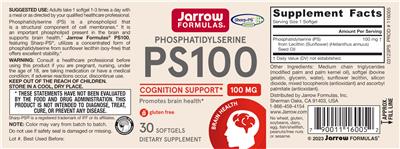
This summary is for PS100 100 mg by Jarrow Formulas
- Form
- Softgel Capsule
- Serving Size
- 1 Softgel
- Servings
- 30 per container
- Container Holds
- 30 Softgels
- What is PS100 100 mg?A single-ingredient supplement from Jarrow Formulas, in softgel form.
- Active Ingredients Phosphatidylserine 100 mg One active ingredient. We check it for drug interactions and side effects. The full Supplement Facts
- Drug Interactions 219 drugs have a documented interaction with this supplement; the most serious is rated moderate. Of those, 103 are single drugs and 116 are combination products (two or more drugs in one), each listed under its own name. Ask your pharmacist first if you take a drug in any of these categories:
- Moderate · 195 drugs
- Moderate · 25 drugs
- Possible Side EffectsUpset stomachTrouble sleeping From its one active ingredient, Phosphatidylserine. Not studied in this exact product.
- Well documented Why
Does PS100 100 mg work?
What It Is Marketed For
Brain health support
From the claims on the product’s label.
The Closest Use the Research Grades
Age-related cognitive decline
Some studies support it, but the evidence isn’t conclusive.
These grades are for the ingredient, not this exact product, and never a promise it will work for you.
What the research says- AllergensNone of its ingredient names is a major food allergen, but the label does not say what one of them is made from
- Barcode (UPC)7 90011 16005 2Match it to the barcode on your bottle to be sure this is your product. Not your product? Search for it here
Who Might Consider It
- People looking for brain health support, which is what it is marketed for. The closest use the research grades is age-related cognitive decline, rated Possibly Effective. See the grade
Who Should Be Careful
- Be more careful if you are pregnant or breastfeeding, have a bleeding disorder, are preparing for surgery, or take anticholinergic or cholinergic medications.
- Talk it over with your own doctor or pharmacist before starting.
More Before You Take It Show all three answersHide Its Phosphatidylserine Amount vs. Other Supplements Pregnancy and Breastfeeding The Label’s Directions
-
How does its Phosphatidylserine amount compare with other supplements?
- Phosphatidylserine100 mgThe most common amount among the 394 recent Phosphatidylserine products in our database that state an amount.
A label’s amount is what the product holds, not a recommended dose.
See the Phosphatidylserine comparison -
Pregnant or breastfeeding?
- Pregnancy and Breastfeeding
- Insufficient reliable information available; avoid using.
-
How does the label say to take it?
“Suggested use: Adults take 1 softgel 1-3 times a day with a meal or as directed by your qualified healthcare professional.”
The maker’s words. Your pharmacist or doctor may advise differently.
Everything the label says
From the label dated Jan 23, 2025: its one active ingredient was checked against our records. A summary of what is known, not a grade or a test of the product. How these ratings are computed
Ask Anything About This Supplement
Name a drug you take, or ask about side effects, ingredients or pregnancy.
There’s a lot of information about this supplement on this page! Ask anything in plain English for a quick answer drawn from it.
AI answers come from this label and our own records, never the open internet. AI can make mistakes, so always check with your doctor or pharmacist. How we use AI
Ask the Pharmacist
A licensed pharmacist will answer your question by email — free, as soon as they can.
Got it — thank you!
A licensed pharmacist will answer as soon as they can. Keep an eye on your email (worth checking spam, just in case).
What’s Inside PS100 100 mg by Jarrow Formulas
One Active Ingredient: Phosphatidylserine
Why this rating?
The label gives the exact amount of its one active ingredient, so you know how much you get in each serving. This rates what the label tells you, not the quality of the product.
Supplement Facts
| Amount Per Serving | % Daily Value | |
|---|---|---|
| Phosphatidylserine | 100 mg | † |
Other ingredients: Medium Chain Triglyceride, Bovine Gelatin, Glycerin, Water, Sunflower Lecithin, Silicon Dioxide, Mixed Tocopherols, Ascorbyl Palmitate
† Daily Value not established.
Daily Values for adults and children 4 or more years of age.
As the label prints it, from the NIH Dietary Supplement Label Database.
Each Ingredient and Its Drug Interactions
Tap one for more about it and its full guide.
-
Phosphatidylserine 100 mg Interacts with 219 drugs
Form on the label: Lecithin
Phosphatidylserine is a natural fat-like compound found in cell membranes, especially in the brain, and it is sold mainly to support memory and thinking.
- Some research suggests possible benefits for age-related memory problems, but the evidence is limited and far from conclusive.
- It is generally well tolerated, but check with your pharmacist or doctor before using it, especially during pregnancy or breastfeeding.
The full Phosphatidylserine guide: uses, dosage and safety Every Phosphatidylserine drug interaction
How Much Phosphatidylserine Is in It, Compared With Other Supplements
Each bar is an amount that other recent supplements list for the same ingredient. The taller the bar, the more of them state it.
-
100 mg in a serving of this product
The most common amount
- Most common amount
- 100 mg (about 46 in 100 products)
- Most products state
- 15 mg to 300 mg
- Compared with
- 394 recent products
Other Ingredients (Inactive)
The capsule or tablet itself, fillers, coatings and flavors. Not part of the drug interaction check; the allergen check below reads them.
- Medium Chain Triglyceride
- Bovine Gelatin
- Glycerin
- Water
- Sunflower Lecithin
- Silicon Dioxide
- Mixed Tocopherols
- Ascorbyl Palmitate
Allergens in PS100 100 mg
None of its ingredient names is a major food allergen, but the label does not say what one of them is made from.
Named on this label
- Gelatin (animal-derived)In the ingredients: Bovine Gelatin
Source not stated
- Phosphatidylserine (Lecithin)Often made from soy; this label does not say where it comes from.
Not named in the ingredients
- Milk
- Egg
- Fish
- Shellfish
- Tree nuts
- Peanuts
- Wheat or other gluten grains
- Sesame
- Made without, the label says“Gluten free”
- Made without, the label says“No wheat, gluten, soybeans, dairy, egg, fish/shellfish, or peanuts/tree nuts or sesame.”
From the label text and ingredient names on file; we do not test products. With a serious allergy, check your bottle and ask the maker or your pharmacist.
What the Label Says
The maker’s own words, from the label. We do not verify or endorse them.
- Storage
-
“Store in a cool, dry place.”
- Brand IP Statement(s)
-
“Sharp-PS is a registered trademark of IFF or its affiliates.”
“Copyright 2023 Jarrow Formulas”
- Formulation
-
“Note: Color may vary from batch to batch.”
“Cognition Support Promotes brain health”
2 more from the label
“Phosphatidylserine (PS) is a phospholipid that is a structural component of cell membranes. It is an important phospholipid present in the brain and supports brain health. Jarrow Formulas PS100 featuring Sharp-PS, utilize a concentrated form of phosphatidylserine from sunflower lecithin (soy-free) that offers excellent stability.”
“Phosphatidylserine Cogni-PS Phosphatidylserine Sharp-PS green”
- General statements
-
“Brain health”
- FDA Statement of Identity
-
“Dietary Supplement”
The PS100 100 mg Label on File
The label scan on file at the NIH Dietary Supplement Label Database, dated January 2025. Always read the label on the bottle you have.
Product Facts
- Brand
- Jarrow Formulas
- Barcode (UPC)
- 790011160052
- Net contents
- 30 Softgels
- Market status
- On market
- Date entered into DSLD
- Jan 23, 2025
- DSLD ID
- 321959
- Product type
- Fat/fatty Acid
- Supplement form
- Softgel Capsule
- Dietary claims / uses
- Nutrient, All Other, Structure/Function
- Intended target group(s)
- Adult (18 - 50 Years), No Allergies, Gluten Free, Dairy Free
Is this label outdated? Report a formula or label change and our pharmacy team will review it.
HelloPharmacist Score PS100 100 mg by Jarrow Formulas
Up to 10 points for research, amount, label and outside testing. Not a safety rating. How this one adds up
for age-related cognitive decline
It is marketed for brain health support. There is no graded research on that exact use, so we scored the closest one: some research suggests phosphatidylserine may help with age-related cognitive decline.
- Research3 of 5 points
- Amount2 of 2 points
- Label2 of 2 points
- Outside testing0 of 1 point
Moderate drug interactions. The score does not count drug interactions. Check them against any drugs you take. See them
There is too little research to score phosphatidylserine for athletic performance, depression, attention deficit-hyperactivity disorder (ADHD), cognitive function, exercise-induced muscle soreness, premenstrual syndrome (PMS), cognitive impairment and carpal tunnel syndrome.
How It Earns Its 7
Score: 7 out of 10. Preliminary for age-related cognitive decline.
Some research on phosphatidylserine for age-related cognitive decline.
Graded “Possibly Effective” in the Natural Medicines database, which we license. A related use, not the one it is marketed for, counts for at most 3 of 5 research points.
3 of 5 points
Amount
Its 100 mg is a normal amount: most of the 394 phosphatidylserine products in our database that state an amount hold 15 mg to 300 mg.
2 of 2 points
Label
It states the amount of its one active ingredient.
2 of 2 points
Outside testing
We found no mark from an outside testing program, such as USP Verified or NSF Certified, on the label we have on file.
0 of 1 point
Where It Sits on the Phosphatidylserine Shelf
The 130 phosphatidylserine products we have scored so far, lined up by their scores. The dark bottle is this one. Each bottle stands for up to 4 products. Tap a score to see the products on it.
17 phosphatidylserine products score 4 out of 10
- Phosphatidylserine 100 mg by Swanson
- Phosphatidyl Serine 100 mg by Carlson
- Sharp Thought by Country Life
- PS Caps 100 mg by Life Extension
- TruNeuro+ by PEScience
- Sunflower PS 100 mg by Healthy Origins
- Sunflower Phosphatidylserine 100 mg by Lake Avenue Nutrition
- PS Phosphatidylserine 100 mg by LifeLink
- Platinum Phosphatiidyl Seriine by MuscleTech Essential Series
- Phosphotidylserine PS Brain Treat (Soy Free) by Pure Herbs
- PhosphatidylSerine with SerinAid 100 mg by Doctor's Best
- Phosphatidylserine by Cardiovascular Research
And 5 more.
32 phosphatidylserine products score 8 out of 10
- Phosphatidylserine by Thorne
- Phosphatidylserine Powder 300 mg by BulkSupplements.com
- Phosphatidylserine Powder 300 mg by BulkSupplements.com
- Phosphatidylserine Powder 300 mg by BulkSupplements.com
- Phosphatidylserine Powder 300 mg by BulkSupplements.com
- Phosphatidylserine Powder 300 mg by BulkSupplements.com
- Phosphatidylserine Powder 300 mg by BulkSupplements.com
- Phosphatidyl Serine Capsules 60 mg by BulkSupplements.com
- PS-100 100 mg by Metabolic Maintenance
- Phosphatidylserine Powder 300 mg by BulkSupplements.com
- Phosphatidyl Serine SF by Klaire Labs
- Phosphatidylserine 150 mg by Vital Nutrients
And 20 more.
66 phosphatidylserine products score 7 out of 10
- PS100 100 mg by Jarrow Formulas this one
- Sharp Thought by Country Life
- Phosphatidylserine 100 mg by Nature's Way
- Peak PS by Peak Pure & Natural
- PS100 100 mg by Jarrow Formulas
- PS100 100 mg by Jarrow Formulas
- Phosphatidyl Serine 150 mg by Seeking Health
- PS100 100 mg by Jarrow Formulas
- Phosphatidylserine 150 mg by Healthy Directions
- PhosphatidylSerine by Wellness Resources
- Pure Phosphatidyl Serine by Intelligent Labs
- PS 100 300 mg by SuperSmart
And 54 more.
9 phosphatidylserine products score 6 out of 10
- Phosphatidylserine Complex by Country Life
- Neuro-PS Phosphatidylserine 100 mg by Puritan's Pride
- Neuro-PS Phosphatidylserine 100 mg by Puritan's Pride
- Phosphatidylserine Complex by Country Life
- Phosphatidylserine 100 mg by Nature's Way
- Neuro-PS Phosphatidylserine 300 mg by Puritan's Pride
- Neuro-PS Phosphatidylserine 200 mg by Vitamin World
- Neuro-PS 300 mg Triple Strength by Vitamin World
- Cognagen by Anabolic Laboratories
6 phosphatidylserine products score 3 out of 10
- Phosphatidylserine 1000 mg by NasaBe'Ahava
- Phosphatidylserine 500 mg by longlifenutri
- Phosphatidyl Serine 100 mg by Bluebonnet
- Vayacog by Vaya
- Phosphatidylserine Memory Ultimate by We Like Vitamins
- Phosphatidyl Serine 100 mg by Bluebonnet
This One Next to Most Phosphatidylserine Products
| What | This one | Most of the other 129 |
|---|---|---|
| What it is marketed for | No one use | Cognitive function (17 of 20) |
| How much phosphatidylserine | 100 mg a serving | 100 mg to 300 mg |
| Form | Lecithin | Many forms |
| The label | Every amount stated | Every amount stated on 126 of 129 |
| Outside testing seal | None on file | 1 of 129 have one |
| Score | 7, Preliminary | 7 |
PS100 100 mg by Jarrow Formulas Side Effects
Why this rating?
We look for three kinds of safety information on each ingredient: side effects reported in studies, a pregnancy and breastfeeding rating, and a safety write-up from our pharmacy team. All three are on file for Phosphatidylserine.
So this rates how much is known, not whether PS100 100 mg is right for you.
Reported with Phosphatidylserine, its active ingredient
- Most often
- Upset stomach and trouble sleeping
- !Rare but serious
- Reported with Phosphatidylserine See details
HelloPharmacist Team Summary: PS100 100 mg by Jarrow Formulas Side Effects
Phosphatidylserine is generally well tolerated, and you are most likely to notice upset stomach, trouble sleeping, or headache.
- Upset stomach and trouble sleeping are the two side effects reported most often for this ingredient.
- Serious side effects are not commonly reported, but if you notice an unusual or severe reaction, call your doctor right away.
- Anyone with a bleeding disorder, anyone preparing for surgery, and anyone who is pregnant or breastfeeding should talk with their own doctor or pharmacist before starting.
Side Effects Reported With Phosphatidylserine
PS100 100 mg Warnings: Who Should Be Careful
These warnings are for Phosphatidylserine, its one active ingredient. If any of these apply to you, talk to your doctor or pharmacist before you start it.
-
Bleeding Problems or Surgery
- Anyone with a bleeding disorder or who is preparing for surgery should talk with a healthcare provider before use.
-
Allergies
- People with soy allergy should check the source, since many products are made from soy; sunflower-based versions may be an alternative.
-
Children
- Always talk with a pharmacist or doctor before giving it to a child.
-
What the Label Warns
- “Warning: Consult a healthcare professional before using this product if you are pregnant, nursing, under the age of 18, are taking medication or have a medical condition; if adverse reaction occur, discontinue use.”
- “Warning: Consult a healthcare professional before using this product if you are pregnant, nursing, under the age of 18, are taking medication or have a medical condition; if adverse reaction occur, discontinue use. Keep out of the reach of children.”
- “Do not use if safety seal is damaged or missing.”
The maker’s wording, from the product label.
-
Pregnant or Breastfeeding
The rating for pregnancy and for breastfeeding, and what it covers.
Pregnancy and Breastfeeding The record rates both the same
-
Insufficient reliable information available; avoid using.
Our pharmacy team’s notes
- Our pharmacists advise avoiding phosphatidylserine during pregnancy, because there is not enough safety information.
- Breastfeeding safety is unknown, so avoidance is also recommended.
Ratings and the words beside them are from the Natural Medicines database, which we license.
The full record, with its sources, in the Phosphatidylserine guide -
Rare but Serious Side Effects
-
!
Phosphatidylserine
Serious side effects are not commonly reported, but because supplements are not tightly regulated, product quality can vary.
Serious side effects are not commonly reported.
When to get help: a serious allergic reaction, with trouble breathing or swelling of the face, lips or throat, needs emergency care: call 911. For any other side effect that worries you, call your doctor or pharmacist.
These reports describe each ingredient, not studies of this exact product. Not medical advice: a side effect you notice after starting a supplement is worth a word with your pharmacist or doctor.
PS100 100 mg by Jarrow Formulas Drug Interactions
This supplement has one active ingredient, Phosphatidylserine, and we checked it against every drug in our records.
A moderate interaction on record
2 of 3, on a scale from Minor or none to Major.Why this rating?
We rate this by the most serious interaction on record, not by how many there are. For Phosphatidylserine, the most serious is rated moderate, which means it calls for caution, and sometimes monitoring or a change in timing or dose.
219 drugs are on the full list. What matters is whether one you take is on it, so check yours with the interaction checker on this page.
Its one active ingredient has drug interactions on record: Phosphatidylserine.
Phosphatidylserine
- Interacts with
- 219 drugs
- Most serious
- Moderate
- The most serious one we list is with anticholinergic drugs (medicines that block acetylcholine, a chemical messenger in the brain), rated Moderate.
- Phosphatidylserine is thought to raise acetylcholine levels, which could theoretically reduce how well these drugs work.
- Cholinergic drugs (medicines that boost acetylcholine) are also rated Moderate.
- The concern here is theoretical additive effects, meaning the combined effect of both could be stronger than either alone.
Show two more points
- Phosphatidylserine is the only active ingredient in this product, and it is the only one we have interaction information for.
- To see whether a specific medication of yours is affected, use the search tool on this page, and talk with your own doctor or pharmacist before combining the two.
The kinds of drugs it affects most
- 195 drugs
- 25 drugs
Every Phosphatidylserine drug interaction, 2 records The Phosphatidylserine records cite 9 references, listed in the Phosphatidylserine guide.
Summarized by the HelloPharmacist pharmacy team from the interaction records below. How it is written How we use AI
The Breakdown by Severity
Each drug counted once, at its most serious rating. Tap a tile to list those drugs.
- 0 Major None found
- 219
- 0 Minor None found
Find Your Drug
Type a drug or brand name to see whether it is on the list.
- Only drugs with a documented interaction are listed, the most serious first.
- A drug with no known interaction is not listed, but searching its name tells you so.
- Open a drug to see which ingredient is responsible. Of those, 103 are single drugs and 116 are combination products (two or more drugs in one), each listed under its own name.
-
AmitriptylineElavil Moderate
The ingredient responsible:
-
Phosphatidylserine Moderate Amitriptyline is in the Anticholinergic Drugs category.
Theoretically, phosphatidylserine might decrease the effectiveness anticholinergic drugs.
The full Phosphatidylserine + Amitriptyline interaction
-
-
DiphenhydramineAllerdryl, Benadryl, Benadryl cream, Benadryl spray, Compoz and 10 more Moderate
The ingredient responsible:
-
Phosphatidylserine Moderate Diphenhydramine is in the Anticholinergic Drugs category.
Theoretically, phosphatidylserine might decrease the effectiveness anticholinergic drugs.
The full Phosphatidylserine + Diphenhydramine interaction
-
-
HydroxyzineAtarax, Ucerax, Vistaril Moderate
The ingredient responsible:
-
Phosphatidylserine Moderate Hydroxyzine is in the Anticholinergic Drugs category.
Theoretically, phosphatidylserine might decrease the effectiveness anticholinergic drugs.
The full Phosphatidylserine + Hydroxyzine interaction
-
-
NortriptylineAllegron, Aventyl, Nortriptyline, Pamelor Moderate
The ingredient responsible:
-
Phosphatidylserine Moderate Nortriptyline is in the Anticholinergic Drugs category.
Theoretically, phosphatidylserine might decrease the effectiveness anticholinergic drugs.
The full Phosphatidylserine + Nortriptyline interaction
-
-
CevimelineEvoxac Moderate
The ingredient responsible:
-
Phosphatidylserine Moderate Cevimeline is in the Cholinergic Drugs category.
Theoretically, phosphatidylserine might have additive effects with cholinergic drugs.
The full Phosphatidylserine + Cevimeline interaction
-
-
LoperamideImodium, Loperamide Moderate
The ingredient responsible:
-
Phosphatidylserine Moderate Loperamide is in the Anticholinergic Drugs category.
Theoretically, phosphatidylserine might decrease the effectiveness anticholinergic drugs.
The full Phosphatidylserine + Loperamide interaction
-
-
ChlorpheniramineChlor-Trimeton, Teldrin Moderate
The ingredient responsible:
-
Phosphatidylserine Moderate Chlorpheniramine is in the Anticholinergic Drugs category.
Theoretically, phosphatidylserine might decrease the effectiveness anticholinergic drugs.
The full Phosphatidylserine + Chlorpheniramine interaction
-
-
ClozapineClozaril, Versacloz Moderate
The ingredient responsible:
-
Phosphatidylserine Moderate Clozapine is in the Anticholinergic Drugs category.
Theoretically, phosphatidylserine might decrease the effectiveness anticholinergic drugs.
The full Phosphatidylserine + Clozapine interaction
-
-
GlutethimideDoriden Moderate
The ingredient responsible:
-
Phosphatidylserine Moderate Glutethimide is in the Anticholinergic Drugs category.
Theoretically, phosphatidylserine might decrease the effectiveness anticholinergic drugs.
The full Phosphatidylserine + Glutethimide interaction
-
-
ProtriptylineVivactil Moderate
The ingredient responsible:
-
Phosphatidylserine Moderate Protriptyline is in the Anticholinergic Drugs category.
Theoretically, phosphatidylserine might decrease the effectiveness anticholinergic drugs.
The full Phosphatidylserine + Protriptyline interaction
-
-
Hyoscine ButylbromideBuscopan, Buscopan IBS Relief Moderate
The ingredient responsible:
-
Phosphatidylserine Moderate Hyoscine Butylbromide is in the Anticholinergic Drugs category.
Theoretically, phosphatidylserine might decrease the effectiveness anticholinergic drugs.
The full Phosphatidylserine + Hyoscine Butylbromide interaction
-
-
Belladonna Alkaloids (prescription Drug)Bellafoline Moderate
The ingredient responsible:
-
Phosphatidylserine Moderate Belladonna Alkaloids (prescription Drug) is in the Anticholinergic Drugs category.
Theoretically, phosphatidylserine might decrease the effectiveness anticholinergic drugs.
The full Phosphatidylserine + Belladonna Alkaloids (prescription Drug) interaction
-
-
Donepezil (patch)Adlarity Moderate
The ingredient responsible:
-
Phosphatidylserine Moderate Donepezil (patch) is in the Cholinergic Drugs category.
Theoretically, phosphatidylserine might have additive effects with cholinergic drugs.
The full Phosphatidylserine + Donepezil (patch) interaction
-
-
DonepezilAricept Moderate
The ingredient responsible:
-
Phosphatidylserine Moderate Donepezil is in the Cholinergic Drugs category.
Theoretically, phosphatidylserine might have additive effects with cholinergic drugs.
The full Phosphatidylserine + Donepezil interaction
-
-
PimozideOrap Moderate
The ingredient responsible:
-
Phosphatidylserine Moderate Pimozide is in the Anticholinergic Drugs category.
Theoretically, phosphatidylserine might decrease the effectiveness anticholinergic drugs.
The full Phosphatidylserine + Pimozide interaction
-
-
Galantamine Extended ReleaseRazadyne ER Moderate
The ingredient responsible:
-
Phosphatidylserine Moderate Galantamine Extended Release is in the Cholinergic Drugs category.
Theoretically, phosphatidylserine might have additive effects with cholinergic drugs.
The full Phosphatidylserine + Galantamine Extended Release interaction
-
-
PromethazinePhenergan Moderate
The ingredient responsible:
-
Phosphatidylserine Moderate Promethazine is in the Anticholinergic Drugs category.
Theoretically, phosphatidylserine might decrease the effectiveness anticholinergic drugs.
The full Phosphatidylserine + Promethazine interaction
-
-
ThioridazineMellaril Moderate
The ingredient responsible:
-
Phosphatidylserine Moderate Thioridazine is in the Anticholinergic Drugs category.
Theoretically, phosphatidylserine might decrease the effectiveness anticholinergic drugs.
The full Phosphatidylserine + Thioridazine interaction
-
-
TrospiumRegurin, Sanctura, Trosec Moderate
The ingredient responsible:
-
Phosphatidylserine Moderate Trospium is in the Anticholinergic Drugs category.
Theoretically, phosphatidylserine might decrease the effectiveness anticholinergic drugs.
The full Phosphatidylserine + Trospium interaction
-
-
PromazineSparine Moderate
The ingredient responsible:
-
Phosphatidylserine Moderate Promazine is in the Anticholinergic Drugs category.
Theoretically, phosphatidylserine might decrease the effectiveness anticholinergic drugs.
The full Phosphatidylserine + Promazine interaction
-
-
AcetylcholineMiochol-E Moderate
The ingredient responsible:
-
Phosphatidylserine Moderate Acetylcholine is in the Cholinergic Drugs category.
Theoretically, phosphatidylserine might have additive effects with cholinergic drugs.
The full Phosphatidylserine + Acetylcholine interaction
-
-
ChlordiazepoxideLibrium Moderate
The ingredient responsible:
-
Phosphatidylserine Moderate Chlordiazepoxide is in the Anticholinergic Drugs category.
Theoretically, phosphatidylserine might decrease the effectiveness anticholinergic drugs.
The full Phosphatidylserine + Chlordiazepoxide interaction
-
-
ProcyclidineArpicolin, Kemadrin, Kemadrin Injection, Procyclid Moderate
The ingredient responsible:
-
Phosphatidylserine Moderate Procyclidine is in the Anticholinergic Drugs category.
Theoretically, phosphatidylserine might decrease the effectiveness anticholinergic drugs.
The full Phosphatidylserine + Procyclidine interaction
-
-
PhenobarbitalLuminal, Phenobarbital, Solfoton Moderate
The ingredient responsible:
-
Phosphatidylserine Moderate Phenobarbital is in the Anticholinergic Drugs category.
Theoretically, phosphatidylserine might decrease the effectiveness anticholinergic drugs.
The full Phosphatidylserine + Phenobarbital interaction
-
-
BiperidenAkineton, Akineton Injection Moderate
The ingredient responsible:
-
Phosphatidylserine Moderate Biperiden is in the Anticholinergic Drugs category.
Theoretically, phosphatidylserine might decrease the effectiveness anticholinergic drugs.
The full Phosphatidylserine + Biperiden interaction
-
-
CyproheptadinePeriactin Moderate
The ingredient responsible:
-
Phosphatidylserine Moderate Cyproheptadine is in the Anticholinergic Drugs category.
Theoretically, phosphatidylserine might decrease the effectiveness anticholinergic drugs.
The full Phosphatidylserine + Cyproheptadine interaction
-
-
Disopyramide PhosphateNorpace, Norpace CR Moderate
The ingredient responsible:
-
Phosphatidylserine Moderate Disopyramide Phosphate is in the Anticholinergic Drugs category.
Theoretically, phosphatidylserine might decrease the effectiveness anticholinergic drugs.
The full Phosphatidylserine + Disopyramide Phosphate interaction
-
-
OxybutyninAnturol, Ditropan, Ditropan XL, Gelnique, Oxybutynin and 1 more Moderate
The ingredient responsible:
-
Phosphatidylserine Moderate Oxybutynin is in the Anticholinergic Drugs category.
Theoretically, phosphatidylserine might decrease the effectiveness anticholinergic drugs.
The full Phosphatidylserine + Oxybutynin interaction
-
-
Doxylamine SuccinateUnisom Moderate
The ingredient responsible:
-
Phosphatidylserine Moderate Doxylamine Succinate is in the Anticholinergic Drugs category.
Theoretically, phosphatidylserine might decrease the effectiveness anticholinergic drugs.
The full Phosphatidylserine + Doxylamine Succinate interaction
-
-
DimenhydrinateDimenhydrin, DimeTabs, Dramamine, Vertab Moderate
The ingredient responsible:
-
Phosphatidylserine Moderate Dimenhydrinate is in the Anticholinergic Drugs category.
Theoretically, phosphatidylserine might decrease the effectiveness anticholinergic drugs.
The full Phosphatidylserine + Dimenhydrinate interaction
-
Does It Work? PS100 100 mg by Jarrow Formulas
What the research says so far. A grade is the research so far, never an endorsement.
HelloPharmacist Team Summary: Does PS100 100 mg by Jarrow Formulas Work?
For premenstrual syndrome (PMS), exercise-induced muscle soreness, and attention deficit-hyperactivity disorder (ADHD), the data we have is rated insufficient reliable evidence to rate, so we cannot say whether it helps for those uses.
- A Possibly Effective rating means the evidence is promising but not conclusive.
- It does not mean the product is proven to work for these conditions.
What the Research Says About Phosphatidylserine
Its uses graded effective, likely effective or possibly effective:
Research suggests a benefit for
- Age-related cognitive decline (the use on its label)
Not counted here: one graded use is for a condition treated by a doctor or in a hospital (Alzheimer disease).
Every graded use, in the Phosphatidylserine guideThe grades are the Natural Medicines database’s, which we license; tap a grade for what it means. They are about each ingredient, not this exact product.
About Jarrow Formulas
Manufacturer and brand details for PS100 100 mg, from the product label.
Jarrow Formulas has 296 products in our supplement database, 169 of them on the market, with labels on file since 2011. Our database is built from the NIH’s Dietary Supplement Label Database and our pharmacy team’s own additions, so it covers the labels filed there, not every product the brand sells.
- Name
- Jarrow Formulas, Inc.
- City
- Sherman Oaks
- State
- CA
- ZipCode
- 91403
- Phone Number
- 1-866-459-4154
- Web Address
- www.Jarrow.com
PS100 100 mg by Jarrow Formulas: Common Questions
Does PS100 100 mg by Jarrow Formulas interact with any drugs?
What are the side effects of PS100 100 mg by Jarrow Formulas?
Who should be careful taking PS100 100 mg by Jarrow Formulas?
Does PS100 100 mg by Jarrow Formulas contain any common allergens?
Is PS100 100 mg by Jarrow Formulas gluten free?
How can PS100 100 mg by Jarrow Formulas interact with so many drugs?
Where does the information about PS100 100 mg by Jarrow Formulas come from?
Is PS100 100 mg by Jarrow Formulas safe to take during pregnancy?
Can I take PS100 100 mg by Jarrow Formulas while breastfeeding?
Does phosphatidylserine work for memory?
Written and reviewed by the HelloPharmacist Editorial Team. Our editorial policy
Still Have a Question About PS100 100 mg?
Our pharmacists answer drug and supplement questions, free, by email.
Label information is sourced from the NIH Dietary Supplement Label Database and reflects the product version on file; always read your actual product label. This page is for education only and is not a substitute for professional medical advice. Confirm with your pharmacist or doctor before combining supplements and drugs.
Who Reviews This Page
The pharmacist behind it, and how it is checked.
Dr. Brian Staiger, PharmD, BCPS
Clinical pharmacist and founder of HelloPharmacist
A licensed pharmacist for more than 13 years, he built the system behind this page: it reads the label on file, matches each active ingredient to its record in the Natural Medicines database, checks those records against every drug we cover, and our pharmacy team writes the take and the interaction summary from those records.
- 13+ Years in PharmacyRetail and clinical pharmacy, medication safety and healthcare administration.
- Board Certified (BCPS)A pharmacotherapy specialist, certified by the Board of Pharmacy Specialties.
- Herbalist TrainingCertificates in medical ethnobotany, for the herbs and supplements people take.
Where This Page Comes From
PS100 100 mg’s label data comes from the NIH Dietary Supplement Label Database; the ingredient interaction data is from the Natural Medicines database, reviewed by our pharmacists.
- NIH Dietary Supplement Label Database (DSLD)
- The official product label on file for this supplement.
- Natural Medicines (Therapeutic Research Center)
- The evidence-graded clinical reference behind the ingredient interaction, evidence and safety records, which we license.
- HelloPharmacist Editorial Team
- Content is reviewed by the HelloPharmacist Editorial Team, the pharmacists on our staff and those we contract. See our data sources and editorial standards for how this information is built and checked.
- The Pharmacy Team’s Take and Summaries
- Generated from HelloPharmacist’s pharmacist-curated databases and editorial rules. Clinical methodology reviewed by Dr. Brian Staiger, PharmD, BCPS. Last generated Oct 31, 2026. How we use AI
- The ratings in the Quick Summary
- They summarize available label information, ingredient evidence and known drug-safety records: a summary of what is known, not a grade of the product itself. They do not verify product identity, purity, potency, contamination or manufacturing quality. How these ratings are computed
The References Behind the Interaction Records
Every citation the ingredients’ records rest on is listed in that ingredient’s guide, in context: Phosphatidylserine, 9 references .
Parts of this content are provided by the Therapeutic Research Center, LLC.
DISCLAIMER: Currently this does not check for drug-drug interactions. This is not an all-inclusive comprehensive list of potential interactions and is for informational purposes only. Not all interactions are known or well-reported in the scientific literature, and new interactions are continually being reported. Input is needed from a qualified healthcare provider including a pharmacist before starting any therapy. Application of clinical judgment is necessary.
© 2021 Therapeutic Research Center, LLC
Keep Exploring
- Supplement interaction checkerCheck any supplement or product against your drugs
- Drug–drug interactionsCheck two or more of your drugs against each other
- Browse drugs A to ZEvery drug we have checked against herbs and supplements
- NDC and pricing lookupFind a drug’s NDCs, packaging and costs
- Ask a pharmacistA free, personal answer from our licensed team