
Brain/Memory with Huperzine A Ingredients & Drug Interactions
by Vinco
What is this page for?
First and foremost: checking Brain/Memory with Huperzine A against your medications. The heart of this page is the interaction checker and the full interaction report — how this product’s ingredients may interact with prescription and over-the-counter medicines you may be taking.
Around that, we add a pharmacist’s high-level view of the product as a whole — what’s inside, the evidence for its stated use, how transparent the label is, and what safety data exists — so you can see the full picture in one place. It’s educational information from our licensed clinical databases and the clinical staff at HelloPharmacist — not medical advice — and we don’t sell or endorse products. Our editorial policy
Brain/Memory with Huperzine A is a dietary supplement by Vinco with 5 active ingredients. Its ingredients are commonly taken for memory and cognitive support, brain blood flow, stroke recovery.Based on those ingredients, 1,052 medications have a known interaction with it, the most serious rated moderate. The ingredients most likely to interact are Bacopa monnieri Extract, Huperzia serrata Extract, Vinpocetine. Use the checker below to test your specific medication, or read the full HelloPharmacist Interaction Report.
Check Your Meds Against Brain/Memory with Huperzine A by Vinco
Ask about any prescription or over-the-counter medication and we check it for interactions with Brain/Memory with Huperzine A by Vinco — and tell you which ingredient is responsible.
AI summaries are generated from our interaction database for education only — always confirm with your pharmacist. How we use AI
Ask the Pharmacist
A licensed pharmacist will answer your question by email — free, usually within 24 hours.
Got it — thank you!
A licensed pharmacist will answer within 24 hours. Keep an eye on your email (worth checking spam, just in case).
HelloPharmacist Scorecard of Brain/Memory with Huperzine A by Vinco
Our pharmacy team’s full take, with four database checks built into the cards below — a summary of what is known, not a grade of the product itself.
What’s inside
Full disclosure
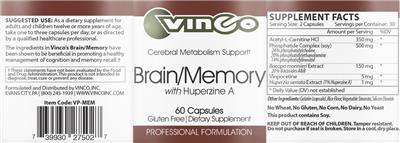
Vinco's Brain/Memory formula contains 5 active ingredients: Vinpocetine, N-Acetyl-L-Carnitine Hydrochloride, Phosphatidyl Complex, Huperzia serrata Extract, and Bacopa monnieri Extract. Vinpocetine is a compound derived from the periwinkle plant thought to improve blood flow to the brain.
N-Acetyl-L-Carnitine (often called ALCAR) is an amino acid form of carnitine involved in energy production in brain cells. Huperzia serrata extract and Bacopa monnieri are plant-based ingredients traditionally used in memory and cognitive support formulas.
The product also contains inactive ingredients — gelatin capsule, rice flour, vegetable stearate, and silicon dioxide — to hold and deliver the formula.
Does it work?
Moderate evidence
The evidence for this product's ingredients is mixed. Vinpocetine is rated possibly effective for dementia, but the data for tinnitus, motion sickness, stroke, and chronic fatigue syndrome is insufficient to rate.
N-Acetyl-L-Carnitine shows possibly effective evidence for age-related cognitive decline, Alzheimer disease, alcohol use disorder, diabetic neuropathy, and depression. Bacopa monnieri has insufficient reliable evidence for Alzheimer disease, sexual dysfunction, ADHD, back pain, cognitive function, and cognitive impairment in our data.
Overall, the strongest evidence exists for a couple of the ingredients in specific conditions, but much of the formula's claimed benefit rests on ingredients we simply don't have solid trial data for.
How safe is it?
Well-documented data
Vinpocetine is generally well tolerated short-term, though long-term safety isn't firmly established. Most common side effects include anxiety, dizziness, headache, flushing, stomach discomfort, and sleep issues.
Rare serious side effects (like arrhythmias and seizures) have been reported. The FDA has specifically warned that people who are or could become pregnant should not use vinpocetine, and it's best avoided while breastfeeding due to insufficient safety data.
N-Acetyl-L-Carnitine is also generally well tolerated short-term. Common side effects are agitation, dry mouth, headache, insomnia, and reduced appetite; a metabolite can cause a fishy odor in urine, breath, and sweat.
It's best avoided in pregnancy and while breastfeeding unless your doctor advises otherwise. Bacopa is generally well tolerated in studies, with common side effects including abdominal cramps, diarrhea, dry mouth, headache, nausea, drowsiness, and vivid dreams.
Gastrointestinal issues occurred in 12–30% of trial participants. Bacopa should be avoided during pregnancy and while breastfeeding due to insufficient safety information.
Meds to double-check
Moderate interaction found
Before taking this product, check with your pharmacist if you take blood thinners or antiplatelet drugs like warfarin or aspirin — Moderate risk of increased bleeding from both vinpocetine and the carnitine ingredient. If you take antidepressants or other serotonergic drugs, check first due to Moderate interaction potential from N-Acetyl-L-Carnitine.
Anyone on thyroid hormone replacement, liver-metabolized medications (especially those processed via CYP1A2, CYP2C19, CYP2C9, or CYP3A4), anticholinergic drugs, cholinergic drugs, or cevimeline should verify safety with a pharmacist. Use the medication checker on this page to search your specific drugs.
The bottom line
Scorecard at a glanceFully disclosed formula with some supporting evidence for its stated purpose. Moderate medication interactions have been identified, and safety information is well characterized.
This formula may be worth considering if you're interested in memory or cognitive support and have checked it with your exact medications — the ingredient list is substantial and the interaction potential is real. If you take blood thinners, antidepressants, thyroid medication, or anything processed through your liver, talk to your pharmacist before starting.
People who are or could become pregnant should not use this product. Your pharmacist can help you weigh whether the evidence for each ingredient matches your goals.
Educational only — not medical advice; always confirm with your pharmacist. Our editorial policy · How we use AI
Assessment coverage: 4 of 5 active ingredients matched to our full ingredient reviews (monographs). Based on the product label dated Aug 22, 2024.
This Scorecard evaluates available label information, ingredient evidence, and known medication-safety considerations. It does not independently verify product identity, purity, potency, contamination, or manufacturing quality. How these ratings are computed
General information
Key facts about Brain/Memory with Huperzine A, straight from the product label.
| Brand | Vinco |
|---|---|
| Barcode (UPC) | 739930275027 |
| Net contents | 60 Capsule(s) |
| Market status | On market |
| Date entered into DSLD | Aug 22, 2024 |
| DSLD ID | 317871 |
| Product type | Other Combinations |
| Supplement form | Capsule |
| Dietary claims / uses | All Other, Structure/Function |
| Intended target group(s) | Children 4 or More Years of Age, Adult (18 - 50 Years), Gluten Free, Dairy Free |
Everything in this section is reproduced from the manufacturer’s own product label — it’s the label speaking, not HelloPharmacist. We show it so you can see exactly what the maker states; we don’t verify or endorse those statements.
Supplement Facts
The label details for Brain/Memory with Huperzine A by Vinco, sourced from the NIH Dietary Supplement Label Database.
Supplement Facts
| Ingredient | Amount | % DV |
|---|---|---|
| Vinpocetine | 5 mg | -- |
| N-Acetyl-L-Carnitine Hydrochloride | 350 mg | -- |
| Phosphatide Complex | 500 mg | -- |
| Huperzia serrata Extract | 1 mg | -- |
| Bacopa monnieri Extract | 150 mg | -- |
Other ingredients: Gelatin, Rice Flour, Vegetable Stearate, Silicon Dioxide
Tap any ingredient to jump to its full detail below.
These statements are the manufacturer’s wording, reproduced from the product label — the label is saying it, not HelloPharmacist. We don’t verify or endorse them.
Suggested/Recommended/Usage/Directions
Suggested Use: As a dietary supplement for adults and children twelve or more years of age, take one or three capsules per day, or as directed by a qualified healthcare professional.
Formula
The ingredients in Vinco's Brain/Memory have been shown to be beneficial in promoting a healthy management of cognition and memory recall.
FDA Disclaimer Statement
These statements have not been evaluated by the Food and Drug Administration. This product is not intended to diagnose, treat, cure or prevent any disease.
Formulation
Cerebral Metabolism Support Professional Formulation
Gluten free
No wheat, no gluten, no corn, no dairy, no yeast
FDA Statement of Identity
Dietary Supplement
Precautions
This product contains soy.
Keep out of reach of children.
Tamper resistant. Do not purchase if seal is broken.
Storage
Store in a cool, dry place.
Is this label outdated? Report a formula or label change and our pharmacy team will review it.
Brain/Memory with Huperzine A by Vinco label
The label scan from the NIH Dietary Supplement Label Database. Tap to enlarge.
Label images are published by the NIH Dietary Supplement Label Database for the version of this product on file. Always read your actual product label.
View the full label (PDF)The Ingredients in Brain/Memory with Huperzine A by Vinco
These are the 5 active ingredients this product is made of. Select any to open its full monograph.
Serving size2 Capsule(s) Dosage formCapsule Servings per container30 Amounts shown are per serving.
Most supplement products combine several ingredients, and a medication can interact with the product through any one of them. Each ingredient below shows whether it has known drug interactions.
Vinpocetine
Interacts with208 drugs
Vinpocetine is a lab-made compound based on a chemical from the periwinkle plant, and it is marketed mainly for memory and brain health. The evidence...
Vinpocetine monograph & interactionsN-Acetyl-L-Carnitine Hydrochloride
Interacts with203 drugs
Acetyl-L-carnitine is a form of the amino acid carnitine that the body uses to help produce energy in cells. It is most studied for nerve pain and mem...
N-Acetyl-L-Carnitine Hydrochloride monograph & interactionsPhosphatide Complex
Huperzia serrata Extract
Interacts with219 drugs
Toothed Clubmoss is a moss-like plant best known as the natural source of huperzine A, a compound studied mainly for memory and Alzheimer's disease. S...
Huperzia serrata Extract monograph & interactionsBacopa monnieri Extract
Interacts with930 drugs
Bacopa is an Ayurvedic herb most often used for memory and thinking. Some small studies suggest it may modestly help memory when taken regularly for s...
Bacopa monnieri Extract monograph & interactionsOther (inactive) ingredients: Gelatin, Rice Flour, Vegetable Stearate, Silicon Dioxide. These complete the product’s ingredient list but are not active constituents.
Brain/Memory with Huperzine A by Vinco Drug Interactions
HelloPharmacist Interaction Report
Vinco's Brain/Memory with Huperzine A has documented interactions with a number of medication types across its active ingredients.
Vinpocetine is the source of the most serious concern: it may increase bleeding risk when combined with blood thinners (anticoagulants) and antiplatelet drugs — a Moderate severity interaction. This effect appears related to vinpocetine's ability to reduce how thick the blood is and decrease clotting-related cell behavior, though the specific risk with warfarin (Coumadin) is rated Minor.
Read the full breakdown — every affected drug type, severity by severity
N-Acetyl-L-Carnitine carries Moderate interactions with serotonergic drugs (antidepressants and related medications), potentially raising the risk of serotonin-related side effects including serotonin syndrome. It also theoretically increases the anticoagulant effects of warfarin and a similar drug called acenocoumarol (Sintrom), and may reduce how well thyroid hormone replacement works — all Moderate severity.
Bacopa monnieri extract has documented Moderate interactions with several medication classes processed through the liver's cytochrome P450 system (CYP1A2, CYP2C19, CYP2C9, and CYP3A4 substrates), which includes hundreds of common drugs. Bacopa also interacts Moderately with anticholinergic drugs (used for urinary or breathing issues), cholinergic drugs, cevimeline (Evoxac), and Minor interactions with thyroid hormone.
We could not check Phosphatidyl Complex or Huperzia serrata extract — no data on file for those. Altogether, these interactions span 1,041 individual medications.
Run your exact medications through the checker on this page before you start.
Check your own medications below · Editorial policy · How we use AI
Want to check YOUR meds against Brain/Memory with Huperzine A?
Ask about interactions with your drugs in plain English — “Can I take it with lisinopril?” — and we find you the answer in seconds, ingredient by ingredient.
Go to the checkerIngredients driving the most interactions
Individual Drug Interactions
The ingredients in Brain/Memory with Huperzine A interact with 1,052 drugs. Click any drug to see the details.
4 of the 5 ingredients in Brain/Memory with Huperzine A interact with drugs. Each result below shows which ingredient is responsible. Bacopa monnieri Extract Huperzia serrata Extract Vinpocetine N-Acetyl-L-Carnitine Hydrochloride
Ado-trastuzumab EmtansineKadcyla
How Ado-trastuzumab Emtansine interacts with Brain/Memory with Huperzine A — through 1 ingredient. Tap an ingredient for the detail:
Bacopa Monnieri ExtractCytochrome P450 3a4 (cyp3a4) Substrates Moderate
Interaction Summary
Theoretically, bacopa might increase the levels and adverse effects of CYP3A4 substrates.
Read the full Bacopa Monnieri Extract + Ado-trastuzumab Emtansine interactionAbciximabReoPro
How Abciximab interacts with Brain/Memory with Huperzine A — through 1 ingredient. Tap an ingredient for the detail:
VinpocetineAnticoagulant/antiplatelet Drugs Moderate
Interaction Summary
Vinpocetine might increase the risk of bleeding when taken with anticoagulant or antiplatelet drugs.
Read the full Vinpocetine + Abciximab interactionAbemaciclibVerzenio
How Abemaciclib interacts with Brain/Memory with Huperzine A — through 1 ingredient. Tap an ingredient for the detail:
Bacopa Monnieri ExtractCytochrome P450 3a4 (cyp3a4) Substrates Moderate
Interaction Summary
Theoretically, bacopa might increase the levels and adverse effects of CYP3A4 substrates.
Read the full Bacopa Monnieri Extract + Abemaciclib interactionAbiraterone
How Abiraterone interacts with Brain/Memory with Huperzine A — through 1 ingredient. Tap an ingredient for the detail:
Bacopa Monnieri ExtractCytochrome P450 3a4 (cyp3a4) Substrates Moderate
Interaction Summary
Theoretically, bacopa might increase the levels and adverse effects of CYP3A4 substrates.
Read the full Bacopa Monnieri Extract + Abiraterone interactionAbiraterone AcetateYonsa, Zytiga
How Abiraterone Acetate interacts with Brain/Memory with Huperzine A — through 1 ingredient. Tap an ingredient for the detail:
Bacopa Monnieri ExtractCytochrome P450 3a4 (cyp3a4) Substrates Moderate
Interaction Summary
Theoretically, bacopa might increase the levels and adverse effects of CYP3A4 substrates.
Read the full Bacopa Monnieri Extract + Abiraterone Acetate interactionAbrocitinibCibinqo
How Abrocitinib interacts with Brain/Memory with Huperzine A — through 2 ingredients. Tap an ingredient for the detail:
Bacopa Monnieri ExtractCytochrome P450 2c19 (cyp2c19) Substrates, Cytochrome P450 2c9 (cyp2c9) Substrates Moderate
Interaction Summary
Theoretically, bacopa might increase the levels and adverse effects of CYP2C19 substrates.
Read the full Bacopa Monnieri Extract + Abrocitinib interactionVinpocetineAnticoagulant/antiplatelet Drugs, Cytochrome P450 2c9 (cyp2c9) Substrates Moderate
Interaction Summary
Vinpocetine might increase the risk of bleeding when taken with anticoagulant or antiplatelet drugs.
Read the full Vinpocetine + Abrocitinib interactionAcalabrutinibCalquence
How Acalabrutinib interacts with Brain/Memory with Huperzine A — through 1 ingredient. Tap an ingredient for the detail:
Bacopa Monnieri ExtractCytochrome P450 3a4 (cyp3a4) Substrates Moderate
Interaction Summary
Theoretically, bacopa might increase the levels and adverse effects of CYP3A4 substrates.
Read the full Bacopa Monnieri Extract + Acalabrutinib interactionAcenocoumarolSintrom
How Acenocoumarol interacts with Brain/Memory with Huperzine A — through 2 ingredients. Tap an ingredient for the detail:
VinpocetineAnticoagulant/antiplatelet Drugs Moderate
Interaction Summary
Vinpocetine might increase the risk of bleeding when taken with anticoagulant or antiplatelet drugs.
Read the full Vinpocetine + Acenocoumarol interactionN-acetyl-l-carnitine HydrochlorideAcenocoumarol (sintrom) Moderate
Interaction Summary
Theoretically, acetyl-L-carnitine might increase the anticoagulant effects of acenocoumarol.
Read the full N-acetyl-l-carnitine Hydrochloride + Acenocoumarol interactionAcepromazineAtravet
How Acepromazine interacts with Brain/Memory with Huperzine A — through 2 ingredients. Tap an ingredient for the detail:
Huperzia Serrata ExtractAnticholinergic Drugs Moderate
Interaction Summary
In animal models, toothed clubmoss and huperzine A, an active constituent of toothed clubmoss, reversed cognitive deficits induced by scopolamine.
Read the full Huperzia Serrata Extract + Acepromazine interactionBacopa Monnieri ExtractAnticholinergic Drugs Moderate
Interaction Summary
Theoretically, concurrent use might decrease the effectiveness of both agents.
Read the full Bacopa Monnieri Extract + Acepromazine interactionAcetaminophenChildren's Tylenol, Children's Tylenol Meltaways, Tylenol, Tylenol Ex Strength
How Acetaminophen interacts with Brain/Memory with Huperzine A — through 1 ingredient. Tap an ingredient for the detail:
Bacopa Monnieri ExtractCytochrome P450 1a2 (cyp1a2) Substrates Moderate
Interaction Summary
Theoretically, bacopa might increase the levels and adverse effects of CYP1A2 substrates.
Read the full Bacopa Monnieri Extract + Acetaminophen interactionAcetaminophen, AspirinGemnisyn
How Acetaminophen, Aspirin interacts with Brain/Memory with Huperzine A — through 2 ingredients. Tap an ingredient for the detail:
Bacopa Monnieri ExtractCytochrome P450 1a2 (cyp1a2) Substrates Moderate
Interaction Summary
Theoretically, bacopa might increase the levels and adverse effects of CYP1A2 substrates.
Read the full Bacopa Monnieri Extract + Acetaminophen, Aspirin interactionVinpocetineAnticoagulant/antiplatelet Drugs Moderate
Interaction Summary
Vinpocetine might increase the risk of bleeding when taken with anticoagulant or antiplatelet drugs.
Read the full Vinpocetine + Acetaminophen, Aspirin interactionAcetaminophen, Aspirin, CaffeineExcedrin, Excedrin Extra Strength, Excedrin Migraine
How Acetaminophen, Aspirin, Caffeine interacts with Brain/Memory with Huperzine A — through 2 ingredients. Tap an ingredient for the detail:
VinpocetineAnticoagulant/antiplatelet Drugs Moderate
Interaction Summary
Vinpocetine might increase the risk of bleeding when taken with anticoagulant or antiplatelet drugs.
Read the full Vinpocetine + Acetaminophen, Aspirin, Caffeine interactionBacopa Monnieri ExtractCytochrome P450 1a2 (cyp1a2) Substrates, Cytochrome P450 3a4 (cyp3a4) Substrates Moderate
Interaction Summary
Theoretically, bacopa might increase the levels and adverse effects of CYP1A2 substrates.
Read the full Bacopa Monnieri Extract + Acetaminophen, Aspirin, Caffeine interactionAcetaminophen, Brompheniramine, PhenylpropanolamineDimetapp Cold and Flu
How Acetaminophen, Brompheniramine, Phenylpropanolamine interacts with Brain/Memory with Huperzine A — through 1 ingredient. Tap an ingredient for the detail:
Bacopa Monnieri ExtractCytochrome P450 1a2 (cyp1a2) Substrates Moderate
Interaction Summary
Theoretically, bacopa might increase the levels and adverse effects of CYP1A2 substrates.
Read the full Bacopa Monnieri Extract + Acetaminophen, Brompheniramine, Phenylpropanolamine interactionAcetaminophen, ButalbitalAxocet, Bancap, Bucet, Butex Forte, Esgic CF, Orbivan CF +5 more
How Acetaminophen, Butalbital interacts with Brain/Memory with Huperzine A — through 1 ingredient. Tap an ingredient for the detail:
Bacopa Monnieri ExtractCytochrome P450 1a2 (cyp1a2) Substrates Moderate
Interaction Summary
Theoretically, bacopa might increase the levels and adverse effects of CYP1A2 substrates.
Read the full Bacopa Monnieri Extract + Acetaminophen, Butalbital interactionAcetaminophen, Butalbital, CaffeineEsgic, Esgic Plus, Fiogesic, Fioricet, Repan, Tecnal +1 more
How Acetaminophen, Butalbital, Caffeine interacts with Brain/Memory with Huperzine A — through 1 ingredient. Tap an ingredient for the detail:
Bacopa Monnieri ExtractCytochrome P450 1a2 (cyp1a2) Substrates, Cytochrome P450 3a4 (cyp3a4) Substrates Moderate
Interaction Summary
Theoretically, bacopa might increase the levels and adverse effects of CYP1A2 substrates.
Read the full Bacopa Monnieri Extract + Acetaminophen, Butalbital, Caffeine interactionAcetaminophen, Butalbital, Caffeine, CodeineEsgic with Codeine, Fioricet w/ Codeine
How Acetaminophen, Butalbital, Caffeine, Codeine interacts with Brain/Memory with Huperzine A — through 1 ingredient. Tap an ingredient for the detail:
Bacopa Monnieri ExtractCytochrome P450 1a2 (cyp1a2) Substrates, Cytochrome P450 3a4 (cyp3a4) Substrates Moderate
Interaction Summary
Theoretically, bacopa might increase the levels and adverse effects of CYP1A2 substrates.
Read the full Bacopa Monnieri Extract + Acetaminophen, Butalbital, Caffeine, Codeine interactionAcetaminophen, Butalbital, CodeineBancap w/ Codeine
How Acetaminophen, Butalbital, Codeine interacts with Brain/Memory with Huperzine A — through 1 ingredient. Tap an ingredient for the detail:
Bacopa Monnieri ExtractCytochrome P450 1a2 (cyp1a2) Substrates Moderate
Interaction Summary
Theoretically, bacopa might increase the levels and adverse effects of CYP1A2 substrates.
Read the full Bacopa Monnieri Extract + Acetaminophen, Butalbital, Codeine interactionAcetaminophen, Butalbital, Codeine PhosphatePhrenilin #3
How Acetaminophen, Butalbital, Codeine Phosphate interacts with Brain/Memory with Huperzine A — through 1 ingredient. Tap an ingredient for the detail:
Bacopa Monnieri ExtractCytochrome P450 1a2 (cyp1a2) Substrates Moderate
Interaction Summary
Theoretically, bacopa might increase the levels and adverse effects of CYP1A2 substrates.
Read the full Bacopa Monnieri Extract + Acetaminophen, Butalbital, Codeine Phosphate interactionAcetaminophen, Caffeine, Chlorpheniramine, Hydrocodone, PhenylephrineHycomine Compound
How Acetaminophen, Caffeine, Chlorpheniramine, Hydrocodone, Phenylephrine interacts with Brain/Memory with Huperzine A — through 2 ingredients. Tap an ingredient for the detail:
Bacopa Monnieri ExtractCytochrome P450 1a2 (cyp1a2) Substrates, Cytochrome P450 3a4 (cyp3a4) Substrates +1 Moderate
Interaction Summary
Theoretically, bacopa might increase the levels and adverse effects of CYP1A2 substrates.
Read the full Bacopa Monnieri Extract + Acetaminophen, Caffeine, Chlorpheniramine, Hydrocodone, Phenylephrine interactionHuperzia Serrata ExtractAnticholinergic Drugs Moderate
Interaction Summary
In animal models, toothed clubmoss and huperzine A, an active constituent of toothed clubmoss, reversed cognitive deficits induced by scopolamine.
Read the full Huperzia Serrata Extract + Acetaminophen, Caffeine, Chlorpheniramine, Hydrocodone, Phenylephrine interactionAcetaminophen, Caffeine, CodeineGesic C15, Gesic C30, Gesic C8, Lenoltec 1, Lenoltec 2, Lenoltec 3 +1 more
How Acetaminophen, Caffeine, Codeine interacts with Brain/Memory with Huperzine A — through 1 ingredient. Tap an ingredient for the detail:
Bacopa Monnieri ExtractCytochrome P450 1a2 (cyp1a2) Substrates, Cytochrome P450 3a4 (cyp3a4) Substrates Moderate
Interaction Summary
Theoretically, bacopa might increase the levels and adverse effects of CYP1A2 substrates.
Read the full Bacopa Monnieri Extract + Acetaminophen, Caffeine, Codeine interactionAcetaminophen, Caffeine, Codeine, SalicylamideCodalan No.1, Codalan No.2, Codalan No.3
How Acetaminophen, Caffeine, Codeine, Salicylamide interacts with Brain/Memory with Huperzine A — through 1 ingredient. Tap an ingredient for the detail:
Bacopa Monnieri ExtractCytochrome P450 3a4 (cyp3a4) Substrates, Cytochrome P450 1a2 (cyp1a2) Substrates Moderate
Interaction Summary
Theoretically, bacopa might increase the levels and adverse effects of CYP3A4 substrates.
Read the full Bacopa Monnieri Extract + Acetaminophen, Caffeine, Codeine, Salicylamide interactionAcetaminophen, Caffeine, DihydrocodeineDHC Plus, Panlor DC, Panlor SS
How Acetaminophen, Caffeine, Dihydrocodeine interacts with Brain/Memory with Huperzine A — through 1 ingredient. Tap an ingredient for the detail:
Bacopa Monnieri ExtractCytochrome P450 1a2 (cyp1a2) Substrates, Cytochrome P450 3a4 (cyp3a4) Substrates Moderate
Interaction Summary
Theoretically, bacopa might increase the levels and adverse effects of CYP1A2 substrates.
Read the full Bacopa Monnieri Extract + Acetaminophen, Caffeine, Dihydrocodeine interactionAcetaminophen, Caffeine, IsomethepteneMigralam
How Acetaminophen, Caffeine, Isometheptene interacts with Brain/Memory with Huperzine A — through 1 ingredient. Tap an ingredient for the detail:
Bacopa Monnieri ExtractCytochrome P450 3a4 (cyp3a4) Substrates, Cytochrome P450 1a2 (cyp1a2) Substrates Moderate
Interaction Summary
Theoretically, bacopa might increase the levels and adverse effects of CYP3A4 substrates.
Read the full Bacopa Monnieri Extract + Acetaminophen, Caffeine, Isometheptene interactionAcetaminophen, Caffeine, PyrilamineMidol Max Strength Menstrual
How Acetaminophen, Caffeine, Pyrilamine interacts with Brain/Memory with Huperzine A — through 2 ingredients. Tap an ingredient for the detail:
Bacopa Monnieri ExtractCytochrome P450 1a2 (cyp1a2) Substrates, Cytochrome P450 3a4 (cyp3a4) Substrates +1 Moderate
Interaction Summary
Theoretically, bacopa might increase the levels and adverse effects of CYP1A2 substrates.
Read the full Bacopa Monnieri Extract + Acetaminophen, Caffeine, Pyrilamine interactionHuperzia Serrata ExtractAnticholinergic Drugs Moderate
Interaction Summary
In animal models, toothed clubmoss and huperzine A, an active constituent of toothed clubmoss, reversed cognitive deficits induced by scopolamine.
Read the full Huperzia Serrata Extract + Acetaminophen, Caffeine, Pyrilamine interactionAcetaminophen, Chlorpheniramine Maleate, Dextromethorphan HbrVicks Formula 44M Cough, Cold & Flu Relief
How Acetaminophen, Chlorpheniramine Maleate, Dextromethorphan Hbr interacts with Brain/Memory with Huperzine A — through 3 ingredients. Tap an ingredient for the detail:
Bacopa Monnieri ExtractAnticholinergic Drugs, Cytochrome P450 3a4 (cyp3a4) Substrates +1 Moderate
Interaction Summary
Theoretically, concurrent use might decrease the effectiveness of both agents.
Read the full Bacopa Monnieri Extract + Acetaminophen, Chlorpheniramine Maleate, Dextromethorphan Hbr interactionHuperzia Serrata ExtractAnticholinergic Drugs Moderate
Interaction Summary
In animal models, toothed clubmoss and huperzine A, an active constituent of toothed clubmoss, reversed cognitive deficits induced by scopolamine.
Read the full Huperzia Serrata Extract + Acetaminophen, Chlorpheniramine Maleate, Dextromethorphan Hbr interactionN-acetyl-l-carnitine HydrochlorideSerotonergic Drugs Moderate
Interaction Summary
Theoretically, acetyl-L-carnitine might increase the risk of serotonergic side effects, including serotonin syndrome and cerebral vasoconstrictive disorders, when taken with serotonergic drugs.
Read the full N-acetyl-l-carnitine Hydrochloride + Acetaminophen, Chlorpheniramine Maleate, Dextromethorphan Hbr interactionAcetaminophen, Chlorpheniramine, Codeine, PhenylephrineColrex
How Acetaminophen, Chlorpheniramine, Codeine, Phenylephrine interacts with Brain/Memory with Huperzine A — through 3 ingredients. Tap an ingredient for the detail:
Bacopa Monnieri ExtractAnticholinergic Drugs, Cytochrome P450 3a4 (cyp3a4) Substrates +1 Moderate
Interaction Summary
Theoretically, concurrent use might decrease the effectiveness of both agents.
Read the full Bacopa Monnieri Extract + Acetaminophen, Chlorpheniramine, Codeine, Phenylephrine interactionN-acetyl-l-carnitine HydrochlorideSerotonergic Drugs Moderate
Interaction Summary
Theoretically, acetyl-L-carnitine might increase the risk of serotonergic side effects, including serotonin syndrome and cerebral vasoconstrictive disorders, when taken with serotonergic drugs.
Read the full N-acetyl-l-carnitine Hydrochloride + Acetaminophen, Chlorpheniramine, Codeine, Phenylephrine interactionHuperzia Serrata ExtractAnticholinergic Drugs Moderate
Interaction Summary
In animal models, toothed clubmoss and huperzine A, an active constituent of toothed clubmoss, reversed cognitive deficits induced by scopolamine.
Read the full Huperzia Serrata Extract + Acetaminophen, Chlorpheniramine, Codeine, Phenylephrine interactionAcetaminophen, Chlorpheniramine, DextromethorphanCoricidin II Extra Strength Cold and Flu
How Acetaminophen, Chlorpheniramine, Dextromethorphan interacts with Brain/Memory with Huperzine A — through 3 ingredients. Tap an ingredient for the detail:
Bacopa Monnieri ExtractCytochrome P450 1a2 (cyp1a2) Substrates, Cytochrome P450 3a4 (cyp3a4) Substrates +1 Moderate
Interaction Summary
Theoretically, bacopa might increase the levels and adverse effects of CYP1A2 substrates.
Read the full Bacopa Monnieri Extract + Acetaminophen, Chlorpheniramine, Dextromethorphan interactionN-acetyl-l-carnitine HydrochlorideSerotonergic Drugs Moderate
Interaction Summary
Theoretically, acetyl-L-carnitine might increase the risk of serotonergic side effects, including serotonin syndrome and cerebral vasoconstrictive disorders, when taken with serotonergic drugs.
Read the full N-acetyl-l-carnitine Hydrochloride + Acetaminophen, Chlorpheniramine, Dextromethorphan interactionHuperzia Serrata ExtractAnticholinergic Drugs Moderate
Interaction Summary
In animal models, toothed clubmoss and huperzine A, an active constituent of toothed clubmoss, reversed cognitive deficits induced by scopolamine.
Read the full Huperzia Serrata Extract + Acetaminophen, Chlorpheniramine, Dextromethorphan interactionAcetaminophen, Chlorpheniramine, Dextromethorphan HydrobromideCoricidin HBP Maximum Strength Flu
How Acetaminophen, Chlorpheniramine, Dextromethorphan Hydrobromide interacts with Brain/Memory with Huperzine A — through 3 ingredients. Tap an ingredient for the detail:
Bacopa Monnieri ExtractAnticholinergic Drugs, Cytochrome P450 1a2 (cyp1a2) Substrates +1 Moderate
Interaction Summary
Theoretically, concurrent use might decrease the effectiveness of both agents.
Read the full Bacopa Monnieri Extract + Acetaminophen, Chlorpheniramine, Dextromethorphan Hydrobromide interactionN-acetyl-l-carnitine HydrochlorideSerotonergic Drugs Moderate
Interaction Summary
Theoretically, acetyl-L-carnitine might increase the risk of serotonergic side effects, including serotonin syndrome and cerebral vasoconstrictive disorders, when taken with serotonergic drugs.
Read the full N-acetyl-l-carnitine Hydrochloride + Acetaminophen, Chlorpheniramine, Dextromethorphan Hydrobromide interactionHuperzia Serrata ExtractAnticholinergic Drugs Moderate
Interaction Summary
In animal models, toothed clubmoss and huperzine A, an active constituent of toothed clubmoss, reversed cognitive deficits induced by scopolamine.
Read the full Huperzia Serrata Extract + Acetaminophen, Chlorpheniramine, Dextromethorphan Hydrobromide interactionAcetaminophen, Chlorpheniramine, Dextromethorphan, PhenylpropanolamineMulti Symptom Cold Relief
How Acetaminophen, Chlorpheniramine, Dextromethorphan, Phenylpropanolamine interacts with Brain/Memory with Huperzine A — through 3 ingredients. Tap an ingredient for the detail:
N-acetyl-l-carnitine HydrochlorideSerotonergic Drugs Moderate
Interaction Summary
Theoretically, acetyl-L-carnitine might increase the risk of serotonergic side effects, including serotonin syndrome and cerebral vasoconstrictive disorders, when taken with serotonergic drugs.
Read the full N-acetyl-l-carnitine Hydrochloride + Acetaminophen, Chlorpheniramine, Dextromethorphan, Phenylpropanolamine interactionBacopa Monnieri ExtractCytochrome P450 3a4 (cyp3a4) Substrates, Anticholinergic Drugs +1 Moderate
Interaction Summary
Theoretically, bacopa might increase the levels and adverse effects of CYP3A4 substrates.
Read the full Bacopa Monnieri Extract + Acetaminophen, Chlorpheniramine, Dextromethorphan, Phenylpropanolamine interactionHuperzia Serrata ExtractAnticholinergic Drugs Moderate
Interaction Summary
In animal models, toothed clubmoss and huperzine A, an active constituent of toothed clubmoss, reversed cognitive deficits induced by scopolamine.
Read the full Huperzia Serrata Extract + Acetaminophen, Chlorpheniramine, Dextromethorphan, Phenylpropanolamine interactionAcetaminophen, Chlorpheniramine, Dextromethorphan, PseudoephedrineChildren's Tylenol Cold Plus Cough, Tylenol Cold Ex Strength
How Acetaminophen, Chlorpheniramine, Dextromethorphan, Pseudoephedrine interacts with Brain/Memory with Huperzine A — through 3 ingredients. Tap an ingredient for the detail:
Bacopa Monnieri ExtractCytochrome P450 1a2 (cyp1a2) Substrates, Cytochrome P450 3a4 (cyp3a4) Substrates +1 Moderate
Interaction Summary
Theoretically, bacopa might increase the levels and adverse effects of CYP1A2 substrates.
Read the full Bacopa Monnieri Extract + Acetaminophen, Chlorpheniramine, Dextromethorphan, Pseudoephedrine interactionN-acetyl-l-carnitine HydrochlorideSerotonergic Drugs Moderate
Interaction Summary
Theoretically, acetyl-L-carnitine might increase the risk of serotonergic side effects, including serotonin syndrome and cerebral vasoconstrictive disorders, when taken with serotonergic drugs.
Read the full N-acetyl-l-carnitine Hydrochloride + Acetaminophen, Chlorpheniramine, Dextromethorphan, Pseudoephedrine interactionHuperzia Serrata ExtractAnticholinergic Drugs Moderate
Interaction Summary
In animal models, toothed clubmoss and huperzine A, an active constituent of toothed clubmoss, reversed cognitive deficits induced by scopolamine.
Read the full Huperzia Serrata Extract + Acetaminophen, Chlorpheniramine, Dextromethorphan, Pseudoephedrine interactionEach ingredient & the kinds of drugs it affects
For each ingredient in Brain/Memory with Huperzine A with known interactions, here are the types of medications they can affect. Open any type for the detail — or search your exact drug in the checker above.
Bacopa monnieri Extract
Anticholinergic Drugs
Theoretically, concurrent use might decrease the effectiveness of both agents.
Bacopa seems to inhibit acetylcholinesterase and might increase acetylcholine levels, which could counteract the effects of anticholinergic drugs. Similarly, anticholinergic drugs might counteract the cholinergic effects of bacopa.
Cevimeline (Evoxac)
Theoretically, bacopa might increase the effects and adverse effects of cevimeline.
In one case, a 58-year-old female taking cevimeline long-term for Sjogren syndrome experienced hyperhidrosis, malaise, nausea, and tachycardia shortly after taking a single dose of bacopa. Symptoms resolved after two days. Cevimeline is metabolized by cytochrome P450 (CYP) 2D6 and CYP3A4, and researchers theorize that bacopa may have inhibited these isoenzymes. However, it is unclear if bacopa causes clinically significant inhibition of either CYP2D6 or CYP3A4.
Cholinergic Drugs
Theoretically, concurrent use of bacopa with other cholinergic drugs might have additive effects.
Bacopa seems to inhibit acetylcholinesterase and might increase acetylcholine levels. Theoretically, this could result in additive cholinergic effects when used with cholinergic drugs.
Cytochrome P450 1A2 (Cyp1A2) Substrates
Theoretically, bacopa might increase the levels and adverse effects of CYP1A2 substrates.
Research on the effects of bacopa extracts on CYP1A2 enzymes is conflicting. Some in vitro evidence shows that bacopa extract can moderately and non-competitively inhibit CYP1A2, while other in vitro evidence suggests that any effect is unlikely to be clinically significant.
Cytochrome P450 2C19 (Cyp2C19) Substrates
Theoretically, bacopa might increase the levels and adverse effects of CYP2C19 substrates.
In vitro evidence suggests that bacopa extract can moderately and non-competitively inhibit CYP2C19 enzymes. It is not known whether this is clinically significant.
Cytochrome P450 2C9 (Cyp2C9) Substrates
Theoretically, bacopa might increase the levels and adverse effects of CYP2C9 substrates.
Research on the effect of bacopa extracts on CYP2C9 enzymes is conflicting. Some in vitro evidence suggests that bacopa extract can moderately and non-competitively inhibit CYP2C9, while other in vitro evidence suggests that any effect is unlikely to be clinically significant.
Cytochrome P450 3A4 (Cyp3A4) Substrates
Theoretically, bacopa might increase the levels and adverse effects of CYP3A4 substrates.
Research on the effects of bacopa extracts on CYP3A4 enzymes is conflicting. Some in vitro evidence suggests that bacopa extract can moderately and competitively inhibit CYP3A4, while other in vitro evidence suggests that any effect is unlikely to be clinically significant.
Thyroid Hormone
Theoretically, bacopa might have additive effects when used with thyroid hormone.
Animal research suggests that bacopa increases thyroxine (T4) levels in mice by about 40%.
Huperzia serrata Extract
Anticholinergic Drugs
In animal models, toothed clubmoss and huperzine A, an active constituent of toothed clubmoss, reversed cognitive deficits induced by scopolamine. Theoretically, concurrent use of anticholinergic drugs and toothed clubmoss might decrease the effectiveness of toothed clubmoss or the anticholinergic drug.
Some anticholinergic drugs include atropine, benztropine (Cogentin), biperiden (Akineton), procyclidine (Kemadrin), and trihexyphenidyl (Artane).
Cholinergic Drugs
Huperzine A, a constituent of toothed clubmoss, has demonstrated acetylcholinesterase inhibitory properties. Theoretically, concurrent use of toothed clubmoss with cholinergic drugs might have additive effects and increase the risk of cholinergic side effects.
Cholinergic drugs include bethanechol (Urecholine), donepezil (Aricept), echothiophate (Phospholine Iodide), edrophonium (Enlon, Reversol, Tensilon), neostigmine (Prostigmin), physostigmine (Antilirium), pyridostigmine (Mestinon, Regonol), succinylcholine (Anectine, Quelicin), and tacrine (Cognex).
Vinpocetine
Anticoagulant/Antiplatelet Drugs
Vinpocetine might increase the risk of bleeding when taken with anticoagulant or antiplatelet drugs.
Clinical research shows that vinpocetine decreases red blood cell aggregation, as well as plasma and whole blood viscosity. This effect has been seen with intravenous vinpocetine 1 mg/kg and oral vinpocetine 30 mg daily. Vinpocetine also seems to have antiplatelet effects.
Cytochrome P450 2C9 (Cyp2C9) Substrates
Theoretically, vinpocetine might increase levels of drugs metabolized by CYP2C9.
In vitro research shows that vinpocetine weakly inhibits CYP2C9. However, this effect has not been reported in humans.
Warfarin (Coumadin)
Vinpocetine might modestly increase the risk of bleeding when taken with warfarin.
Clinical research shows that the combination of warfarin and vinpocetine leads to slight increases in prothrombin time and the area under the concentration curve for warfarin. However, these increases were small, and researchers suggest that this interaction is not likely to be clinically significant in most patients.
N-Acetyl-L-Carnitine Hydrochloride
Acenocoumarol (Sintrom)
Theoretically, acetyl-L-carnitine might increase the anticoagulant effects of acenocoumarol.
L-carnitine, the parent compound of acetyl-L-carnitine, might enhance the anticoagulant effects of acenocoumarol, an oral anticoagulant that is similar to warfarin, but shorter-acting. There are at least two case reports of INR elevation when L-carnitine was taken with acenocoumarol. In one case, a 33-year-old male with a previously stable INR had an elevated INR of 4.65 after L-carnitine was started and continued for 10 weeks. INR normalized after discontinuation of the L-carnitine-containing product. It is unclear if such an interaction would also occur with acetyl-L-carnitine.
Serotonergic Drugs
Theoretically, acetyl-L-carnitine might increase the risk of serotonergic side effects, including serotonin syndrome and cerebral vasoconstrictive disorders, when taken with serotonergic drugs.
Animal research shows that acetyl-L-carnitine can increase levels of serotonin in the brain.
Thyroid Hormone
Theoretically, acetyl-L-carnitine might decrease the effectiveness of thyroid hormone replacement.
L-carnitine appears to act as a peripheral thyroid hormone antagonist by inhibiting entry of thyroid hormone into the nucleus of cells. Taking L-carnitine also seems to diminish some of the symptoms of hyperthyroidism. It is unclear if such an interaction would occur with acetyl-L-carnitine.
Warfarin (Coumadin)
Theoretically, acetyl-L-carnitine might increase the anticoagulant effects of warfarin.
L-carnitine, the parent compound of acetyl-L-carnitine, might increase the anticoagulant effects of acenocoumarol, a shorter-acting oral anticoagulant similar to warfarin. There is not enough information to know whether this interaction occurs with acetyl-L-carnitine and warfarin.
Brand information
Manufacturer and brand details for Brain/Memory with Huperzine A, from the product label.
Vinco
See all Vinco products- Name
- Vinco, Inc.
- City
- Evans City
- State
- PA
- Phone Number
- (800) 245-1939
- Web Address
- www.vincoinc.com
Brain/Memory with Huperzine A by Vinco: Common Questions
Does Brain/Memory with Huperzine A by Vinco interact with any medications?
How can one product interact with so many drugs?
Where does this information come from?
Can I take this if I'm pregnant or trying to get pregnant?
What are the most common side effects?
Does this really work for memory?
What is Huperzia serrata, and does it interact with medications?
Why does this product interact with so many medications?
Is it safe to take this with warfarin or other blood thinners?
Written and reviewed by the HelloPharmacist editorial staff. Our editorial policy
Not sure if Brain/Memory with Huperzine A is safe with your meds?
Our pharmacists answer your medication & supplement questions — free.
Label information is sourced from the NIH Dietary Supplement Label Database and reflects the product version on file; always read your actual product label. This page is for education only and is not a substitute for professional medical advice. Confirm with your pharmacist or doctor before combining supplements and medications.
The Full Monographs Behind Brain/Memory with Huperzine A’s Ingredients
Every ingredient we hold a full HelloPharmacist monograph for — uses, evidence, safety, and the complete interaction list.
Vinpocetine
Interacts with 208 drugsVinpocetine is a lab-made compound based on a chemical from the periwinkle plant, and it is marketed mainly for memory and brain health. The evidence behind these uses is limited and not str...
Read the full Vinpocetine monograph → Herb & supplement monographAcetyl-l-carnitine
Interacts with 203 drugsAcetyl-L-carnitine is a form of the amino acid carnitine that the body uses to help produce energy in cells. It is most studied for nerve pain and memory-related conditions, though the evide...
Read the full Acetyl-l-carnitine monograph → Herb & supplement monographToothed Clubmoss
Interacts with 219 drugsToothed Clubmoss is a moss-like plant best known as the natural source of huperzine A, a compound studied mainly for memory and Alzheimer's disease. Some early research is promising, but the...
Read the full Toothed Clubmoss monograph → Herb & supplement monographBacopa
Interacts with 930 drugsBacopa is an Ayurvedic herb most often used for memory and thinking. Some small studies suggest it may modestly help memory when taken regularly for several weeks, but the evidence is limite...
Read the full Bacopa monograph →Sources & How We Checked
Brain/Memory with Huperzine A's label data comes from the NIH Dietary Supplement Label Database; the ingredient interaction data is from the Natural Medicines database, reviewed by our pharmacists.
- NIH Dietary Supplement Label Database (DSLD) — The official product label on file for this supplement.
- Natural Medicines (Therapeutic Research Center) — Evidence-graded clinical reference behind the ingredient interaction data.
Content is written and reviewed by licensed HelloPharmacist pharmacists. See our data sources and editorial standards for how this information is built and checked.
The 64 references behind this product’s interaction data
Every citation that drives the interaction findings for this product’s ingredients, from the evidence-graded Natural Medicines (TRC Healthcare) database. Open an ingredient to browse its citations — links open the study on PubMed or the publisher’s site.
Vinpocetine 27 references
- Hindmarch I, Fuchs HH, Erzigkeit H. Efficacy and tolerance of vinpocetine in ambulant patients suffering from mild to moderate organic psychosyndromes. Int Clin Psychopharmacol 1991;6:31-43. PubMed
- Balestreri R, Fontana L, Astengo F. A double-blind placebo controlled evaluation of the safety and efficacy of vinpocetine in the treatment of patients with chronic vascular senile cerebral dysfunction. J Am Geriatr Soc 1987;35:425-30. PubMed
- Akopov SE, Gabrielian ES. Effects of aspirin, dipyridamole, nifedipine and cavinton which act on platelet aggregation induced by different aggregating agents alone and in combination. Eur J Clin Pharmacol 1992;42:257-9. PubMed
- Kidd PM. A review of nutrients and botanicals in the integrative management of cognitive dysfunction. Altern Med Rev 1999;4:144-61..
- Wollschlaeger B. Efficacy of vinpocetine in the management of cognitive impairment and memory loss. JANA 2001;4:25-30.
- Hitzenberger G, Sommer W, Grandt R. Influence of vinpocetine on warfarin-induced inhibition of coagulation. Int J Clin Pharmacol Ther Toxicol 1990;28:323-8..
- Dekoninck, W. J., Jocquet, P., Jacquy, J., and Henriet, M. Comparative study of the clinical effects of vincamine + glycerol versus glycerol + placebo in the acute phase of stroke. Arzneimittelforschung. 1978;28(9):1654-1657.
- Fischhof, P. K., Moslinger-Gehmayr, R., Herrmann, W. M., Friedmann, A., and Russmann, D. L. Therapeutic efficacy of vincamine in dementia. Neuropsychobiology 1996;34(1):29-35. PubMed
- Feher, G., Koltai, K., Kesmarky, G., Horvath, B., Toth, K., Komoly, S., and Szapary, L. Effect of parenteral or oral vinpocetine on the hemorheological parameters of patients with chronic cerebrovascular diseases. Phytomedicine. 2009;16(2-3):111-117. PubMed
- Kuzuya, F. Effects of vinpocetine on platelet aggregability and erythrocyte deformability. Ther Hung. 1985;33(1):22-34.
- Kovacs, L. Cavinton in the treatment of acute stroke. Ther Hung. 1985;33(1):50-57.
- Osawa, M. and Maruyama, S. Effects of TCV-3B (vinpocetine) on blood viscosity in ischemic cerebrovascular diseases. Ther.Hung. 1985;33(1):7-12.
- Ebi, O. Open-labeled phase III clinical trials with vinpocetine in Japan. Ther.Hung. 1985;33(1):41-49.
- Richichi, I., Valsecchi, O., Falcone, C., Sofi, A., and Zanini, L. [A case of "torsade de pointe" during vincamine therapy]. Minerva Cardioangiol. 1978;26(3):197-200.
- Dany, F., Merle, L., Goudoud, J. C., Liozon, F., Blanc, P., Bouvot, J. C., Nicot, G., and Dangoumau, J. [Cardiac toxicity of vincamine: a seven cases report of ventricular arrhythmias by parenteral administration of vincamine (author's transl)]. Therapie
- Fenzl, E., Apecechea, M., Schaltenbr, R., and Fridel, R. Long term study concerning tolerance and efficacy of vinpocetine in elderly patients suffering from a mild to moderate organic psychosyndrome. Senile dementia: early detection 1986;580-585.
- Peruzza, M. and DeJacobis, M. A double-blind placebo controlled evaluation of the efficacy and safety of vinpocetine in the treatment of patients with chronic vascular or degenerative senile cerebral dysfunction. ADV THER 1986;3(4):201-209.
- Manconi, E., Binaghi, F., and Pitzus, F. A double-blind clinical trial of vinpocetine in the treatment of cerebral insufficiency of vascular and degenerative origin. CURR THER RES, CLIN EXP 1986;40(4):702-709.
- Blaha, L., Erzigkeit, H. L., Adamczyk, L. A., Freytag, L. S., and Schaltenbrand, R. Clinical evidence of the effectiveness of vinpocetine in the treatment of organic psychosyndrome. Human Psychopharmacology: Clinical & Experimental 1989;4(2):103-111. DOI
- Shimizu, Y., Saitoh, K., Nakayama, M., Suto, K., Daikohara, R., and Nemoto, T. Agranulocytosis induced by vinpocetine. Medicine On-line 2011;
- Kong L, Song C, Ye L, et al. The Effect of Vinpocetine on Human Cytochrome P450 Isoenzymes by Using a Cocktail Method. Evid Based Complement Alternat Med. 2016;2016:5017135. PubMed
- Vinpocetine in Dietary Supplements. FDA Food/Dietary Supplements/Products & Ingredients. Available at: http://www.fda.gov/Food/DietarySupplements/ProductsIngredients/ucm518478.htm. Accessed 6 September 2016.
- Statement on warning for women of childbearing age about possible safety risks of dietary supplements containing vinpocetine. FDA Food/Dietary Supplements/Products & Ingredients. Available at: https://www.fda.gov/news-events/press-announcements/statement-
- Zhang W, Huang Y, Li Y, et al. Efficacy and safety of vinpocetine as part of treatment for acute cerebral infarction: A randomized, open-label, controlled, multicenter CAVIN (Chinese Assessment for Vinpocetine in Neurology) trial. Clin Drug Investig 2016; PubMed
- National Toxicology Program. NTP technical report on the prenatal development toxicity studies of vinpocetine (CAS No. 42971-09-5) in Sprague Dawley Rats and New Zealand White Rabbits (Gavage Studies). Research Triangle Park, NC: National Toxicology Progr
- Gutiérrez-Farfán I, Reyes-Legorreta C, Solís-Olguín M, Alatorre-Miguel E, Verduzco-Mendoza A, Durand-Rivera A. Evaluation of vinpocetine as a therapy in patients with sensorineural hearing loss: a phase II, open-label, single-center study. J Pharmacol Sci PubMed
- Hu X, Guo K, Li J, et al. Postoperative ecchymoma of eyelid after botulinum toxin injection for hemifacial spasm: a case report. Front Neurol 2023;14:1171303. PubMed
Acetyl-l-carnitine 22 references
- Thal LJ, Carta A, Clarke WR, et al. A 1-year multicenter placebo-controlled study of acetyl-L-carnitine in patients with Alzheimer's Disease. Neurology 1996;47:705-11. PubMed
- Sano M, Bell K, Cote L, et al. Double-blind parallel design pilot study of acetyl levocarnitine in patients with Alzheimer's Disease. Arch Neurol 1992;49:1137-41. PubMed
- Spagnoli A, Lucca U, Menasce G, et al. Long-term acetyl-L-carnitine treatment in Alzheimer's Disease. Neurology 1991;41:1726-32. PubMed
- Brooks JO 3rd, Yesavage JA, Carta A, Bravi D. Acetyl L-carnitine slows decline in younger patients with Alzheimer's disease: a reanalysis of a double-blind, placebo-controlled study using the trilinear approach. Int Psychoger 1998;10:193-203. PubMed
- Pettegrew JW, Klunk WE, Panchalingam K, et al. Clinical and neurochemical effects of acetyl-L-carnitine in Alzheimer's disease. Neurobiol Aging 1995;16:1-4. PubMed
- Rai G, Wright G, Scott L, et al. Double-blind, placebo controlled study of acetyl-l-carnitine in patients with Alzheimer's dementia. Curr Med Res Opin 1990;11:638-47. PubMed
- Benvenga S, Ruggeri RM, Russo A, et al. Usefulness of L-carnitine, a naturally occurring peripheral antagonist of thyroid hormone action, in iatrogenic hyperthyroidism: a randomized, double-blind, placebo-controlled clinical trial. J Clin Endocrinol Meta
- Montgomery SA, Thal LJ, Amrein R. Meta-analysis of double blind randomized controlled clinical trials of acetyl-L-carnitine versus placebo in the treatment of mild cognitive impairment and mild Alzheimer's disease. Int Clin Psychopharmacol 2003;18:61-71.. PubMed
- Martinez E, Domingo P, Roca-Cusachs A. Potentiation of acenocoumarol action by L-carnitine. J Intern Med 1993;233:94.
- Hudson S, Tabet N. Acetyl-L-carnitine for dementia. Cochrane Database Syst Rev 2003;2:CD003158.. PubMed
- Bachmann HU, Hoffmann A. Interaction of food supplement L-carnitine with oral anticoagulant acenocoumarol. Swiss Med Wkly 2004;134:385. PubMed
- De Grandis D, Minardi C. Acetyl-L-carnitine (levacecarnine) in the treatment of diabetic neuropathy. A long-term, randomised, double-blind, placebo-controlled study. Drugs R D 2002;3:223-31. PubMed
- 12761 Benvenga S, Amato A, Calvani M, Trimarchi F. Effects of carnitine on thyroid hormone action. Ann N Y Acad Sci 2004;1033:158-67. PubMed
- Sima AAF, Calvani M, Mehra M, et al. Acetyl-L-carnitine improves pain, nerve regeneration, and vibratory perception in patients with chronic diabetic neuropathy: An analysis of two randomized, placebo-controlled trials. Diabetes Care 2005;28:89-94.
- Youle, M. and Osio, M. A double-blind, parallel-group, placebo-controlled, multicentre study of acetyl L-carnitine in the symptomatic treatment of antiretroviral toxic neuropathy in patients with HIV-1 infection. HIV.Med. 2007;8(4):241-250.
- Brennan BP, Jensen JE, Hudson JI, Coit CE, Beaulieu A, Pope HG Jr, Renshaw PF, Cohen BM. A placebo-controlled trial of acetyl-L-carnitine and a-lipoic acid in the treatment of bipolar depression. J Clin Psychopharmacol. 2013 Oct;33(5):627-35.
- Ledinek AH, Sajko MC, Rot U. Evaluating the effects of amantadin, modafinil and acetyl-L-carnitine on fatigue in multiple sclerosis--result of a pilot randomized, blind study. Clin Neurol Neurosurg. 2013 Dec;115 Suppl 1:S86-9. PubMed
- Martinotti G, Andreoli S, Reina D, Di Nicola M, Ortolani I, Tedeschi D, Fanella F, Pozzi G, Iannoni E, D'Iddio S, Prof LJ. Acetyl-l-Carnitine in the treatment of anhedonia, melancholic and negative symptoms in alcohol dependent subjects. Prog Neuropsychop PubMed
- Baek SM, Zheng R, Seo EJ, Hwang DY, Kim BH. Pharmacokinetic comparisons of two acetyl-L-carnitine formulations in healthy Korean volunteers. Int J Clin Pharmacol Ther. 2015;53(11):980-6. PubMed
- Goodison G, Overeem K, de Monte V, Siskind D. Mania associated with self-prescribed acetyl-l-carnitine in a man with bipolar I disorder. Australas Psychiatry. 2017;25(1):13-4.
- Bruno A, Pandolfo G, Crucitti M, Lorusso S, Zoccali RA, Muscatello MR. Acetyl-L-Carnitine Augmentation of Clozapine in Partial-Responder Schizophrenia: A 12-Week, Open-Label Uncontrolled Preliminary Study. Clin Neuropharmacol. 2016;39(6):277-80. PubMed
- Veronese N, Stubbs B, Solmi M, Ajnakina O, Carvalho AF, Maggi S. Acetyl-L-Carnitine Supplementation and the Treatment of Depressive Symptoms: A Systematic Review and Meta-Analysis. Psychosom Med. 2018;80(2):154-9. PubMed
Toothed Clubmoss 3 references
- Budavari S, ed. The Merck Index. 12th ed. Whitehouse Station, NJ: Merck & Co., Inc., 1996.
- Zhang RW, Tang XC, Han YY, et al. [Drug evaluation of huperzine A in the treatment of senile memory disorders]. Chung Kuo Yao Li Hsueh Pao 1991;12:250-2.
- Ohba T, Yoshino Y, Ishisaka M, et al. Japanese Huperzia serrata extract and the constituent, huperzine A, ameliorate the scopolamine-induced cognitive impairment in mice. Biosci Biotechnol Biochem. 2015;79(11):1838-44.
Bacopa 12 references
- Stough C, Lloyd J, Clarke J, et al. The chronic effects of an extract of Bacopa monniera (Brahmi) on cognitive function in healthy human subjects. Psychopharmacology 2001;156:481-4..
- Yadav SK, Jain AK, Tripathi SN, Gupta JP. Irritable bowel syndrome: therapeutic evaluation of indigenous drugs. Indian J Med Res 1989;90:496-503..
- Morgan A, Stevens J. Does Bacopa monnieri improve memory performance in older persons? Results of a randomized, placebo-controlled, double-blind trial. J Altern Complement Med 2010;16:753-9.
- Kar, A., Panda, S., and Bharti, S. Relative efficacy of three medicinal plant extracts in the alteration of thyroid hormone concentrations in male mice. J Ethnopharmacol. 2002;81(2):281-285. PubMed
- Mukherjee, G. D. and Dey, C. D. Clinical trial on Brahmi. I. J.Exp.Med.Sci. 1966;10(1):5-11.
- Kar A, Pandit S, Mukherjee K, Bahadur S, Mukherjee PK. Safety assessment of selected medicinal food plants used in Ayurveda through CYP450 enzyme inhibition study. J Sci Food Agric 2017;97(1):333-40. doi: 10.1002/jsfa.7739. PubMed
- Kongkeaw C, Dilokthornsakul P, Thanarangsarit P, et al. Meta-analysis of randomized controlled trials on cognitive effects of Bacopa monnieri extract. J Ethnopharmacol 2014;151(1):528-35. PubMed
- Ramasamy S, Kiew LV, Chung LY. Inhibition of human cytochrome P450 enzymes by Bacopa monnieri standardized extract and constituents. Molecules 2014;19(2):2588-601. PubMed
- Prabhakar S, Vishnu VY, Modi M, et al. Efficacy of Bacopa monnieri (Brahmi) and donepezil in Alzheimer's disease and mild cognitive impairment: a randomized double-blind parallel phase 2b study. Ann Indian Acad Neurol 2020;23(6):767-73. PubMed
- Acquarulo B, Tandon P, Macica CM. Suspected cholinergic toxicity due to cevimeline hydrochloride and Bacopa monnieri interaction: a case report. J Med Case Rep 2022;16(1):253. PubMed
- Keegan AP, Stough C, Paris D, et al. Bacopa monnieri supplementation has no effect on serum brain-derived neurotrophic factor levels but beneficially modulates nuclear factor kappa B and cyclic AMP response element-binding protein levels in healthy elderl
- Yaworski AM, Blyumin M, Chang T, Mammen AL, Greene M. Necrotizing myopathy with elevated anti-HMGCR antibodies following exposure to the supplement Bacopa. Muscle Nerve 2023;67(2):E1-E3.
Parts of this content are provided by the Therapeutic Research Center, LLC.
DISCLAIMER: Currently this does not check for drug-drug interactions. This is not an all-inclusive comprehensive list of potential interactions and is for informational purposes only. Not all interactions are known or well-reported in the scientific literature, and new interactions are continually being reported. Input is needed from a qualified healthcare provider including a pharmacist before starting any therapy. Application of clinical judgment is necessary.
© 2021 Therapeutic Research Center, LLC