
Constilex by Approved Science Ingredients, Side Effects and Drug Interactions
Dietary Supplement Capsule Other Combinations

Medically reviewed by Dr. Brian Staiger, PharmD, BCPS
Also reviewed by the HelloPharmacist Editorial Team
Updated Details about this page
- Label on file from the NIH Dietary Supplement Label Database, dated Dec 21, 2024.
- The interaction, evidence and safety records come from the Natural Medicines database, which we license, read against this label by our own system; the pharmacy team’s sections are written from those records.
- Dr. Brian Staiger, PharmD, BCPS, is a clinical pharmacist and pharmacotherapy specialist.
- Editorial policy Our sources
AI is used only to summarize verified clinical information, never the open internet. Our AI policy
Summary: The HelloPharmacist Team’s Take
- Form
- Capsule
- Serving Size
- 1 Capsule
- Servings
- 30 per container
- Container Holds
- 60 Capsules
What’s in it, whether it interacts with your drugs, its side effects, whether it works, and what our pharmacists would want you to know before you start it.
- What is Constilex?A supplement from Approved Science with twelve active ingredients, in capsule form.
- Active Ingredients 8 plant ingredients such as Senna, Psyllium and Flaxseed, 1 probiotic and 3 sources of fiber: Senna 500 mgPsyllium 400 mgOat Bran 230 mgFlaxseed, Powder 200 mgPapaya 100 mgBlack Walnut 40 mgmangosteen 40 mgPrune, Powder 10 mgAloe Vera, Powder 10 mgLactobacillus acidophilus 10 mgApple Pectin 10 mgGlucomannan 10 mg Twelve active ingredients. Each one can interact with drugs or cause side effects on its own, so we check every one. The full Supplement Facts
- Drug Interactions 2,137 drugs have a documented interaction with this supplement; the most serious is rated major. Of those, 1,599 are single drugs and 538 are combination products (two or more drugs in one), each listed under its own name. Based on the 9 of its 12 ingredients we could check. Ask your pharmacist first if you take a drug in any of these categories, the most serious of the 15 on record:
- Major · 1 drug
- Moderate · 2,022 drugs
- Moderate · 182 drugs
- Moderate · 122 drugs
- Possible Side EffectsDiarrhea 5 ingredientsBloating 4 ingredientsGas 3 ingredientsNausea 2 ingredientsStomach cramps 2 ingredientsStomach upset 2 ingredients +13 moreCombined from seven of its twelve active ingredients. Not studied in this exact product.
- Well documented Why
Does Constilex work?
What It Is Marketed For
Constipation relief and bowel regularity
From the claims on the product’s label.
The Closest Use the Research Grades
Senna
Good studies support it.
Its ingredients have research behind other uses too:
- Mangosteen
- Plum
- Aloe
- Aloe
- Aloe
These grades are for each ingredient, not this exact product, and never a promise it will work for you.
And 2 more graded uses, in what the research says- Full Why
- AllergensIts ingredient list names tree nuts
Who Might Consider It
- People looking for constipation relief and bowel regularity, which is what it is marketed for. The closest use the research grades is constipation, rated Likely Effective.
- People who want it for periodontitis, constipation, diabetes, obesity or another graded use: the other uses with research behind them. See each grade
- People looking for a fiber-and-probiotic blend for constipation or bowel regularity may want to learn more about these ingredients.
Who Should Be Careful
- Anyone taking digoxin, warfarin, blood thinners, diuretics, diabetes medications, or other drugs listed above should be especially careful.
- People who are pregnant, breastfeeding, have kidney or bowel conditions, or have a tree nut allergy should also be careful.
- Talk it over with your own doctor or pharmacist before starting.
More Before You Take It Show both answersHide Pregnancy and Breastfeeding The Label’s Directions
-
Pregnant or breastfeeding?
- Pregnancy Papaya
- ! When the unripe fruit containing papaya latex is used orally; avoid using.
- Breastfeeding Papaya
- When the ripe fruit is consumed in amounts commonly found in foods.
- Pregnancy and Breastfeeding Black Walnut
- ! When the bark is used orally or topically; avoid using.
- Pregnancy Aloe
- ! When used orally.
- Breastfeeding Aloe
- ! When aloe preparations are used orally.
-
How does the label say to take it?
“Directions: As a dietary supplement, for first time use, take six capsules daily, (two in the morning, two in the afternoon and two in the evening). …”
The maker’s words. Your pharmacist or doctor may advise differently.
Everything the label says
From the label dated Dec 21, 2024: 9 of its 12 active ingredients were checked against our records; the other three are not in them yet. A summary of what is known, not a grade or a test of the product. How these ratings are computed
Ask Anything About This Supplement
Name a drug you take, or ask about side effects, ingredients or pregnancy.
AI answers come from this label and our own records, never the open internet. AI can make mistakes, so always check with your doctor or pharmacist. How we use AI
Ask the Pharmacist
A licensed pharmacist will answer your question by email — free, as soon as they can.
Got it — thank you!
A licensed pharmacist will answer as soon as they can. Keep an eye on your email (worth checking spam, just in case).
What’s Inside Constilex by Approved Science
Twelve Active Ingredients, Each Checked on Its Own
A supplement is often several ingredients in one bottle, and each one can interact with drugs or cause side effects on its own. We check every one of them against our records.
- SennaDrug interactions on record, most serious: Moderate
- PsylliumNot in our interaction records yet
- Oat BranNot in our interaction records yet
- Flaxseed, PowderNot in our interaction records yet
- PapayaDrug interactions on record, most serious: Moderate
- Black WalnutNo drug interactions on record
- mangosteenDrug interactions on record, most serious: Moderate
- Prune, PowderDrug interactions on record, most serious: Moderate
And 4 more, each with its own card below.
Why this rating?
The label gives an exact amount for every one of its twelve active ingredients, so you know how much of each you get in each serving. This rates what the label tells you, not the quality of the product.
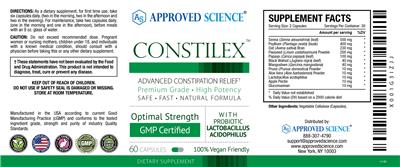
Supplement Facts
| Amount Per Serving | % Daily Value | |
|---|---|---|
| Senna | 500 mg | † |
| Psyllium | 400 mg | † |
| Oat Bran | 230 mg | † |
| Flaxseed, Powder | 200 mg | † |
| Papaya | 100 mg | † |
| Black Walnut | 40 mg | † |
| mangosteen | 40 mg | † |
| Prune, Powder | 10 mg | † |
| Aloe Vera, Powder | 10 mg | † |
| Lactobacillus acidophilus | 10 mg | † |
| Apple Pectin | 10 mg | † |
| Glucomannan | 10 mg | † |
Other ingredients: Cellulose
† Daily Value not established.
Daily Values for adults and children 4 or more years of age.
As the label prints it, from the NIH Dietary Supplement Label Database.
Each Ingredient and Its Drug Interactions
Tap one for more about it and its full guide. A drug can interact with this supplement through any one of them.
Constilex contains 12 active ingredients: Lactobacillus acidophilus (a probiotic bacteria), apple pectin, black walnut, oat bran, papaya, psyllium, aloe vera powder, senna, flaxseed powder, mangosteen, prune powder, and glucomannan.
- Pectin and glucomannan both form a gel when mixed with water, which is part of why they are discussed as fiber-type ingredients, and papaya contains papain, a digestive enzyme.
-
Senna 500 mg Interacts with 140 drugs
Form on the label: Senna alexandrina
Senna is a plant-based stimulant laxative that is widely used and generally effective for short-term relief of constipation.
- It is best used occasionally and for only a few days at a time, since long-term use can lead to dependence and other problems.
- Talk with a pharmacist or doctor before using it regularly or if you have ongoing constipation.
The full Senna guide: uses, dosage and safety Every Senna drug interaction
-
Psyllium 400 mg We know this ingredient, but hold no drug interaction record for it yet, so it was not checked
Form on the label: Plantago ovata
-
Oat Bran 230 mg We know this ingredient, but hold no drug interaction record for it yet, so it was not checked
-
Flaxseed, Powder 200 mg We know this ingredient, but hold no drug interaction record for it yet, so it was not checked
Form on the label: Linum usitatissimum, Powder
-
Papaya 100 mg Interacts with 92 drugs
Papaya is a tropical fruit that is nutritious and generally safe to eat as food, and it contains an enzyme called papain used as a digestive aid and meat tenderizer.
- Papaya leaf extract is being studied for raising platelet counts in dengue fever, but most other supplement uses have limited human evidence.
- Talk to your pharmacist or doctor before using concentrated papaya supplements, and avoid unripe (green) papaya and papaya seed products in pregnancy.
The full Papaya guide: uses, dosage and safety Every Papaya drug interaction
-
Black Walnut 40 mg No known drug interactions
Black walnut is a tree whose green hulls are traditionally used as a natural antiparasitic and digestive remedy, but solid human evidence for these uses is lacking.
- It contains a compound called juglone that may be irritating, so use it cautiously, avoid long-term use, and check with your pharmacist or doctor first.
-
Mangosteen 40 mg Interacts with 125 drugs
Mangosteen is a tropical fruit whose rind is rich in plant compounds called xanthones that act as antioxidants.
- While it is popular in juices and supplements for inflammation, immune support, and general wellness, strong human evidence for these benefits is limited.
- It is likely fine as a food, but talk with your pharmacist or doctor before using concentrated supplements.
The full Mangosteen guide: uses, dosage and safety Every Mangosteen drug interaction
-
Prune, Powder 10 mg Interacts with 122 drugs
Plums and their dried form (prunes) are common, nutritious foods that are best known for helping relieve constipation thanks to their fiber and sorbitol content.
- They are generally safe as food, but eating large amounts can cause gas, bloating, or loose stools.
- Talk to your pharmacist or doctor before using concentrated supplements, especially if you have a medical condition.
The full Plum guide: uses, dosage and safety Every Plum drug interaction
-
Aloe Vera, Powder 10 mg Interacts with 461 drugs
Form on the label: Aloe barbadensis, Powder
Aloe vera gel is widely used on the skin for minor burns and irritation, and some research suggests it may help.
- Aloe latex (the yellow part) is a strong laxative that can cause cramping and is not considered safe for regular use.
- Talk to your pharmacist or doctor before taking aloe by mouth, and avoid oral aloe during pregnancy.
The full Aloe guide: uses, dosage and safety Every Aloe drug interaction
-
Lactobacillus acidophilus 10 mg Interacts with 182 drugs
Lactobacillus acidophilus is a 'friendly' bacterium used as a probiotic to support gut and vaginal health.
- It is generally well tolerated in healthy people, and there is reasonable evidence it may help with certain types of diarrhea, but proof for many other uses is limited.
- People with weakened immune systems or serious illness should check with a doctor before using it.
The full Lactobacillus Acidophilus guide: uses, dosage and safety Every Lactobacillus Acidophilus drug interaction
-
Apple Pectin 10 mg Interacts with 23 drugs
Pectin is a natural soluble fiber found in fruits like apples and citrus, and it is widely used in foods and as a fiber supplement.
- It may modestly help with cholesterol, blood sugar, and digestive regularity, but evidence for many supplement claims is limited.
- It is generally well tolerated, though it can cause gas and bloating, especially when first starting.
The full Pectin guide: uses, dosage and safety Every Pectin drug interaction
-
Glucomannan 10 mg Interacts with 2,022 drugs
Glucomannan is a soluble fiber from the konjac root that swells into a gel in your stomach, which may help with mild weight loss, constipation, and modestly lowering cholesterol.
- It is generally well tolerated when taken with plenty of water, but it must be taken carefully because it can swell and cause choking or blockage if not swallowed properly.
- Talk with your pharmacist or doctor before starting it, especially if you have a health condition or take medicines.
The full Glucomannan guide: uses, dosage and safety Every Glucomannan drug interaction
Other Ingredients (Inactive)
The capsule or tablet itself, fillers, coatings and flavors. Not part of the drug interaction check; the allergen check below reads them.
- Cellulose
Allergens in Constilex
Its ingredient list names tree nuts.
Named on this label
- Tree nutsIn the ingredients: Black Walnut
Not named in the ingredients
- Milk
- Egg
- Fish
- Shellfish
- Peanuts
- Wheat or other gluten grains
- Soy
- Sesame
- Made without, the label says“100% vegan friendly”
From the label text and ingredient names on file; we do not test products. With a serious allergy, check your bottle and ask the maker or your pharmacist.
What the Label Says
The maker’s own words, from the label. We do not verify or endorse them.
- Directions
-
“Directions: As a dietary supplement, for first time use, take six capsules daily, (two in the morning, two in the afternoon and two in the evening). For maintenance, take two capsules daily, (one in the morning and one in the afternoon), before meals with an 8 oz. glass of water.”
- Storage
-
“Store at room temperature.”
- Formulation
-
“Manufactured in the USA according to current Good Manufacturing Practice (cGMP) and conforms to the tested ingredients grade, strength and purity of industry Quality Standards.”
“Vegan friendly”
3 more from the label
“Made with GMO free ingredients”
“Advanced constipation relief Premium grade High potency Safe Fast Natural formula Optimal strength GMP Certified”
“Constilex with probiotics Lactobacillus acidophilus”
- Seals and symbols
-
“Vegan friendly Made in USA No animal testing GMP Good Manufacturing Practice Quality Product”
- FDA Statement of Identity
-
“Dietary Supplement”
The Constilex Label on File
The label scan on file at the NIH Dietary Supplement Label Database, dated December 2024. Always read the label on the bottle you have.
Product Facts
- Brand
- Approved Science
- Barcode (UPC)
- X001G3IZJJ
- Net contents
- 60 Capsules
- Market status
- On market
- Date entered into DSLD
- Dec 21, 2024
- DSLD ID
- 319743
- Product type
- Other Combinations
- Supplement form
- Capsule
- Dietary claims / uses
- All Other, Structure/Function
- Intended target group(s)
- Vegan, Vegetarian, Adult (18 - 50 Years), Dairy Free
Is this label outdated? Report a formula or label change and our pharmacy team will review it.
Constilex by Approved Science Side Effects
Why this rating?
We look for three kinds of safety information on each ingredient: side effects reported in studies, a pregnancy and breastfeeding rating, and a safety write-up from our pharmacy team. All three are on file for each of the nine ingredients we could check.
So this rates how much is known, not whether Constilex is right for you.
Reported with nine of its ingredients
- Most often
- Diarrhea, bloating, gas, nausea, stomach cramps and stomach upset
- !Rare but serious
- Skin eruptions, severe allergic reactions and including anaphylaxis See details
HelloPharmacist Team Summary: Constilex by Approved Science Side Effects
Bloating, gas, and loose stools are the side effects most often reported for Constilex, and they come mainly from the fiber and laxative ingredients like pectin, glucomannan, prune, and senna.
- Most people tolerate these ingredients well, especially when taken in food amounts, and taking this product with plenty of fluid is a practical tip from the glucomannan guidance.
- The rare but serious concern is choking or blockage, which is linked to glucomannan taken dry or with too little water, and allergic reactions are uncommon but possible.
- If you notice trouble swallowing, chest pain, or a severe allergic reaction, call your doctor right away.
- Talk with your own doctor or pharmacist before starting if you are pregnant, breastfeeding, have bowel or kidney conditions, or take any of the medications named above.
Side Effects, Ingredient by Ingredient
A supplement’s side effects come from its ingredients. Here is what is reported with each one.
Senna
Most reported
- Stomach cramps
- Bloating
- Diarrhea
Papaya
Most reported
- Nausea
- Vomiting from papaya leaf extract
From the Natural Medicines database, which we license.
Every reported effect, in the Papaya guideBlack Walnut
Most reported
- Nausea
- Stomach upset
- Loose stools
Mangosteen
Most reported
- Stomach upset
- Diarrhea
- Constipation
Plum
Most reported
- Gas
- Bloating
- Stomach cramps
- Loose stools or diarrhea
Pectin
Most reported
- Gas
- Bloating
- Cramping
- Loose stools or diarrhea
Glucomannan
Most reported
- Bloating
- Gas
- Stomach discomfort
- Loose stools or diarrhea
Aloe and Lactobacillus Acidophilus have side-effect reports, but no list of the most common ones. Read them in each guide: Aloe, Lactobacillus Acidophilus.
Constilex Warnings: Who Should Be Careful
Constilex has twelve active ingredients, and each can carry warnings of its own. We checked the nine in our ingredient guides, and each warning below names the ingredient it comes from. Psyllium, Oat Bran and Flaxseed, Powder are not in our guides yet, so ask your pharmacist about them. If any of these apply to you, talk to your doctor or pharmacist before you start it.
- Senna3 warnings below
- Papaya2 warnings below
- Black Walnut3 warnings below
- Mangosteen2 warnings below
- Plum2 warnings below
- Aloe1 warning below
- Lactobacillus Acidophilus1 warning below
- Pectin2 warnings below
- Glucomannan3 warnings below
- PsylliumNot in our guides yet
- Oat BranNot in our guides yet
- Flaxseed, PowderNot in our guides yet
-
Bleeding Problems or Surgery
- PapayaAlways tell your pharmacist or doctor about any supplements you take, especially before surgery or if you have a medical condition.
- MangosteenPeople with kidney problems, bleeding disorders, or who are scheduled for surgery should be especially cautious and check with a healthcare provider first.
-
Diabetes or Low Blood Sugar
- AloePeople with kidney problems, bowel conditions, or diabetes should be especially careful and check with a doctor or pharmacist before taking aloe by mouth.
- GlucomannanThose with diabetes should monitor blood sugar, as glucomannan may affect glucose levels.
-
Kidney Disease or Kidney Stones
- SennaPeople with heart problems, kidney problems, or electrolyte imbalances should be especially careful.
- Black WalnutPeople with digestive conditions, kidney problems, or those taking multiple medications should talk to a pharmacist or doctor first.
- PlumThose with kidney problems should be aware that plums and prunes contain potassium and may also contain oxalate, so talk to your doctor if you have been told to limit these.
-
Stomach or Bowel Problems
- SennaDo not use senna if you have unexplained stomach pain, nausea, vomiting, signs of a bowel blockage, appendicitis, or inflammatory bowel conditions unless your doctor tells you to.
- PlumPeople with conditions that are sensitive to high-fiber or high-sorbitol foods—such as irritable bowel syndrome—may notice more digestive symptoms.
- PectinBecause pectin absorbs water and forms a gel, take it with plenty of fluid to lower the risk of it swelling and causing a blockage, particularly if you have trouble swallowing or have a narrowed digestive tract.
- PectinPeople with bowel conditions should talk to a doctor before using fiber supplements.
- GlucomannanPeople with swallowing problems, a narrowed esophagus, or a history of bowel obstruction should avoid it unless a doctor approves.
-
Allergies
- PapayaPeople who are allergic to papaya, papain, or latex (there can be cross-reactions with latex allergy) should avoid it.
- Black WalnutPeople with a tree nut allergy should be cautious or avoid black walnut, since it comes from a true tree nut.
-
Children
- SennaSenna should not be given to children unless directed by a healthcare provider.
- Lactobacillus AcidophilusFor most healthy adults and children, L. acidophilus is considered safe and is widely used in foods and supplements.
-
If You Take Other Drugs
- MangosteenAlways tell your pharmacist or doctor about any supplement you take, especially if you have a health condition or take medications.
- GlucomannanAlways check with your pharmacist or doctor before starting glucomannan, especially if you have a medical condition or take other medicines.
-
Other Cautions
- Black WalnutBecause of its tannin and juglone content, long-term or high-dose use is not recommended and has not been well studied for safety.
-
What the Label Warns
- “Caution: Do not exceed recommended dose. Do not use if safety seal is damaged or missing.”
- “Pregnant women or nursing mothers, children under 18, and individuals with a known medical condition, should consult with a physician before taking this or any other dietary supplement.”
- “Pregnant women or nursing mothers, children under 18, and individuals with a known medical condition, should consult with a physician before taking this or any other dietary supplement. Keep out of reach of children.”
The maker’s wording, from the product label.
-
Pregnant or Breastfeeding
Each ingredient’s rating for pregnancy and for breastfeeding, and what it covers.
Pregnancy
-
When the ripe fruit is consumed in amounts commonly found in foods.
-
When the unripe fruit containing papaya latex is used orally; avoid using.
There is some concern that crude papain, a constituent of papaya latex, is teratogenic and embryotoxic; however, this might be due to extraneous substances rather than papain.
2 more points on this rating
- Some evidence also suggests that high doses of papaya seed extract have abortifacient activity and can adversely affect fetal development.
- Theoretically, eating large amounts of papaya seeds may have similar effects.
Breastfeeding
-
When the ripe fruit is consumed in amounts commonly found in foods.
There is insufficient reliable information available about the safety of using papaya medicinally; avoid using.
Pregnancy and Breastfeeding The record rates both the same
-
When the fruit (nut) is consumed in amounts normally found in foods.
-
When the bark is used orally or topically; avoid using.
There is insufficient reliable information available about the safety of black walnut leaf or hull when used orally in medicinal amounts during pregnancy or lactation; avoid using.
Show 7 more ingredients
Pregnancy
-
When used orally.
Anthraquinones present in aloe latex and aloe whole leaf extracts have irritant, cathartic, and possible mutagenic effects.
There are also anecdotal reports and evidence from animal research that anthraquinones or aloe whole leaf extracts might induce abortion and stimulate menstruation; avoid using.
Breastfeeding
-
When aloe preparations are used orally.
Cathartic and mutagenic anthraquinones present in aloe latex and aloe whole leaf extracts might pass into milk; avoid using.
Pregnancy and Breastfeeding The record rates both the same
-
Insufficient reliable information available; avoid using.
Pregnancy and Breastfeeding The record rates both the same
-
Insufficient reliable information available; avoid using amounts greater than those found in food.
Pregnancy
-
When used orally and appropriately.
A combination of Lactobacillus acidophilus, Lacticaseibacillus casei, and Bifidobacterium bifidum has been used with apparent safety for 6 weeks, starting at 24-28 weeks' gestation.
Breastfeeding
-
There is insufficient reliable information available about the safety of Lactobacillus acidophilus during lactation.
However, there are currently no reasons to expect safety concerns when used appropriately.
Pregnancy and Breastfeeding The record rates both the same
-
Insufficient reliable information available; avoid using.
Pregnancy
-
When used orally and appropriately, short-term.
POSSIBLY UNSAFE...when used orally long-term or in high doses.
Long-term, frequent use, or use of high doses has been linked to serious side effects including laxative dependence and liver toxicity.
Breastfeeding
-
When used orally and appropriately, short term.
Although small amounts of constituents of senna cross into breast milk, senna has been taken while breast-feeding with apparent safety.
Senna does not cause changes in the frequency or consistency of infants' stools..
Pregnancy and Breastfeeding The record rates both the same
-
When used in amounts commonly found in foods.
Pectin has Generally Recognized as Safe (GRAS) status in the US.
-
When used orally in medicinal amounts.
Our pharmacy team’s notes
- AloeOral aloe latex carries the most serious warnings, including long-term harms and a rating that says to avoid taking aloe by mouth during pregnancy and while breastfeeding.
- Pregnancy and lactation data isn’t available for every ingredient.
- Oat bran, psyllium, and flaxseed powder have no pregnancy or lactation data for us.
- There is not enough information to say how this product affects pregnancy or breastfeeding, so talk with your doctor or pharmacist about personal advice.
Ratings and the words beside them are from the Natural Medicines database, which we license.
-
Rare but Serious Side Effects
-
!
Senna
With long-term use, more serious problems can occur, including dehydration, low potassium and other electrolyte imbalances, and dependence on laxatives.
Orally: Skin eruptions.
-
!
Papaya
Allergic reactions can occur, ranging from itching and rash to, rarely, more serious reactions.
Orally: Severe allergic reactions.
-
!
Black Walnut
People allergic to tree nuts could have an allergic reaction, which in rare cases can be serious.
Orally: The bark may increase the risk for tongue cancer or lip leukoplakia when used long-term.
Allergic reactions, including anaphylaxis.
-
!
Mangosteen
Some people may have an allergic reaction, with symptoms like rash, itching, or swelling.
-
!
Plum
Allergic reactions to plums are uncommon but possible, especially in people allergic to other stone fruits.
Orally: Allergic reactions. Consumption of dried plums or plum pits has been reported to cause bowel obstruction and esophageal perforation.
-
!
Aloe
Long-term use of oral aloe latex has been linked to more serious harms and is generally discouraged.
Orally: Aloe latex is associated with serious adverse effects when taken in high doses or long-term. Cases of acute hepatitis due to a hypersensitivity reaction to aloe leaf extract has been reported.
-
!
Lactobacillus Acidophilus
Serious side effects are rare.
-
!
Pectin
Allergic reactions are rare but possible, especially in people allergic to the fruit source.
Allergic reactions, including anaphylaxis, in sensitive individuals.
-
!
Glucomannan
The most serious concern is choking or blockage of the throat, esophagus, or intestines, which can happen if it is not taken with enough water.
Orally: Choking and esophageal or gastrointestinal obstruction, especially when taken as a dry powder or in tablet form.
When to get help: a serious allergic reaction, with trouble breathing or swelling of the face, lips or throat, needs emergency care: call 911. For any other side effect that worries you, call your doctor or pharmacist.
These reports describe each ingredient, not studies of this exact product. Not medical advice: a side effect you notice after starting a supplement is worth a word with your pharmacist or doctor.
Constilex by Approved Science Drug Interactions
We checked all twelve active ingredients in this supplement against every drug in our records. A drug can interact with it through any one of them. Psyllium, Oat Bran and Flaxseed, Powder are not in our interaction records yet.
A major interaction on record
3 of 3, on a scale from Minor or none to Major.Why this rating?
We rate this by the most serious interaction on record, not by how many there are. For Glucomannan, Papaya, Pectin, Aloe and Senna, the most serious is rated major, which means the combination is best avoided, or used only under close supervision. Some involve kinds of drugs where a small change can matter, such as blood thinners, diabetes drugs and heart-rhythm drugs.
2,138 drugs are on the full list. What matters is whether one you take is on it, so check yours with the interaction checker on this page.
Eight of its twelve active ingredients have drug interactions on record. The ones below matter most. We have no interaction records for Psyllium, Oat Bran, Flaxseed, Powder and Black Walnut.
- Interacts with
- 461 drugs
- Most serious
- Major
- The most serious interaction is rated Major: aloe can add to the risks of digoxin (Lanoxin), a heart medication, because overuse can cause potassium loss and raise the chance of digoxin toxicity.
- Interacts with
- 2,022 drugs
- Most serious
- Moderate
- Antibiotics may kill the live organisms in the probiotic, and glucomannan may reduce absorption of oral drugs.
- Interacts with
- 182 drugs
- Most serious
- Moderate
- Most of its records involve Antibiotic Drugs.
Show three more ingredients
- Interacts with
- 140 drugs
- Most serious
- Moderate
- Most of its records involve Diuretic Drugs, Estrogens and Stimulant Laxatives.
- Interacts with
- 125 drugs
- Most serious
- Moderate
- Most of its records involve Anticoagulant/Antiplatelet Drugs and Donepezil (Aricept).
- Interacts with
- 122 drugs
- Most serious
- Moderate
- Most of its records involve Anticoagulant/Antiplatelet Drugs.
And two more ingredients with records, each in the cards below.
From the HelloPharmacist Team
What matters most when you look at everything in the bottle at once.
- Constilex by Approved Science can interact with a number of medications, through its Lactobacillus acidophilus, apple pectin, papaya, aloe vera powder, senna, mangosteen, prune powder, and glucomannan content.
- Other interactions are rated Moderate.
- Warfarin, a blood thinner, may see increased effects from aloe, papaya, and senna, and anticoagulant and antiplatelet drugs may see added bleeding risk from aloe, mangosteen, and prune.
Summarized by the HelloPharmacist pharmacy team from the interaction records below. How it is written How we use AI
Why Constilex Interacts, Ingredient by Ingredient
A product interacts through its ingredients. Each card: how many drugs, the most serious rating, and the kinds of drugs it affects most (tap a kind for what it means).
The ingredients driving the most interactions
-
Glucomannan 2,022 drugs
Most serious: Moderate1 interaction record on file
The kinds of drugs it affects most
- 2,022 drugs
Every Glucomannan drug interaction, 1 record The Glucomannan records cite 15 references, listed in the Glucomannan guide.
-
Aloe Vera, Powder 461 drugs
Most serious: Major7 interaction records on file
The kinds of drugs it affects most
- 186 drugs
- 122 drugs
- 86 drugs
- 75 drugs
Every Aloe drug interaction, 7 records The Aloe records cite 41 references, listed in the Aloe guide.
-
Lactobacillus acidophilus 182 drugs
Most serious: Moderate1 interaction record on file
The kinds of drugs it affects most
- 182 drugs
Every Lactobacillus Acidophilus drug interaction, 1 record The Lactobacillus Acidophilus records cite 18 references, listed in the Lactobacillus Acidophilus guide.
-
Senna 140 drugs
Most serious: Moderate5 interaction records on file
The kinds of drugs it affects most
- 75 drugs
- 41 drugs
- 21 drugs
- 2 drugs
Every Senna drug interaction, 5 records The Senna records cite 42 references, listed in the Senna guide.
-
mangosteen 125 drugs
Most serious: Moderate2 interaction records on file
The kinds of drugs it affects most
- 122 drugs
- Donepezil (Aricept) 3 drugs
Every Mangosteen drug interaction, 2 records The Mangosteen records cite 6 references, listed in the Mangosteen guide.
-
Prune, Powder 122 drugs
Most serious: Moderate1 interaction record on file
The kinds of drugs it affects most
- 122 drugs
Every Plum drug interaction, 1 record The Plum records cite 10 references, listed in the Plum guide.
-
Papaya 92 drugs
Most serious: Moderate4 interaction records on file
The kinds of drugs it affects most
- 86 drugs
- 3 drugs
- 2 drugs
- Amiodarone (Cordarone) 1 drug
Every Papaya drug interaction, 4 records The Papaya records cite 14 references, listed in the Papaya guide.
-
Apple Pectin 23 drugs
Most serious: Moderate3 interaction records on file
The kinds of drugs it affects most
- 20 drugs
- Lovastatin (Mevacor) 2 drugs
- 1 drug
Every Pectin drug interaction, 3 records The Pectin records cite 11 references, listed in the Pectin guide.
The Breakdown by Severity
Each drug counted once, at its most serious rating. Tap a tile to list those drugs.
Find Your Drug
Type a drug or brand name to see whether it is on the list.
- Only drugs with a documented interaction are listed, the most serious first.
- A drug with no known interaction is not listed, but searching its name tells you so.
- Open a drug to see which ingredient is responsible. Of those, 1,599 are single drugs and 538 are combination products (two or more drugs in one), each listed under its own name.
-
AbemaciclibVerzenio Moderate
The ingredient responsible:
-
Glucomannan Moderate Abemaciclib is in the Oral Drugs category.
Theoretically, glucomannan may decrease absorption of drugs taken orally.
The full Glucomannan + Abemaciclib interaction
-
-
MethotrexateOtrexup, Rasuvo, Reditrex, Rheumatrex Moderate
The ingredient responsible:
-
Glucomannan Moderate Methotrexate is in the Oral Drugs category.
Theoretically, glucomannan may decrease absorption of drugs taken orally.
The full Glucomannan + Methotrexate interaction
-
-
PropranololAngilol, Bedranol SR, Beta Prograne, Half Beta Prograne, Half-Inderal LA and 7 more Moderate
The 2 ingredients responsible:
-
Glucomannan Moderate Propranolol is in the Oral Drugs category.
Theoretically, glucomannan may decrease absorption of drugs taken orally.
The full Glucomannan + Propranolol interaction -
Aloe Vera, Powder Minor Propranolol is in the Cytochrome P450 1A2 (CYP1A2) Substrates category.
Theoretically, aloe might decrease the levels and clinical effects of CYP1A2 substrates.
The full Aloe Vera, Powder + Propranolol interaction
-
-
PregabalinLyrica, Lyrica CR Moderate
The ingredient responsible:
-
Glucomannan Moderate Pregabalin is in the Oral Drugs category.
Theoretically, glucomannan may decrease absorption of drugs taken orally.
The full Glucomannan + Pregabalin interaction
-
-
LisinoprilPrinivil, Qbrelis, Zestril Moderate
The ingredient responsible:
-
Glucomannan Moderate Lisinopril is in the Oral Drugs category.
Theoretically, glucomannan may decrease absorption of drugs taken orally.
The full Glucomannan + Lisinopril interaction
-
-
AmitriptylineElavil Moderate
The 2 ingredients responsible:
-
Glucomannan Moderate Amitriptyline is in the Oral Drugs category.
Theoretically, glucomannan may decrease absorption of drugs taken orally.
The full Glucomannan + Amitriptyline interaction -
Aloe Vera, Powder Minor Amitriptyline is in the Cytochrome P450 1A2 (CYP1A2) Substrates category.
Theoretically, aloe might decrease the levels and clinical effects of CYP1A2 substrates.
The full Aloe Vera, Powder + Amitriptyline interaction
-
-
LamotrigineLamictal Moderate
The ingredient responsible:
-
Glucomannan Moderate Lamotrigine is in the Oral Drugs category.
Theoretically, glucomannan may decrease absorption of drugs taken orally.
The full Glucomannan + Lamotrigine interaction
-
-
BupropionAplenzin, Forfivo XL, Wellbutrin, Wellbutrin SR, Wellbutrin XL and 1 more Moderate
The ingredient responsible:
-
Glucomannan Moderate Bupropion is in the Oral Drugs category.
Theoretically, glucomannan may decrease absorption of drugs taken orally.
The full Glucomannan + Bupropion interaction
-
-
LetrozoleFemara Moderate
The ingredient responsible:
-
Glucomannan Moderate Letrozole is in the Oral Drugs category.
Theoretically, glucomannan may decrease absorption of drugs taken orally.
The full Glucomannan + Letrozole interaction
-
-
CitalopramCelexa Moderate
The ingredient responsible:
-
Glucomannan Moderate Citalopram is in the Oral Drugs category.
Theoretically, glucomannan may decrease absorption of drugs taken orally.
The full Glucomannan + Citalopram interaction
-
-
ClonazepamCeberclon, Klonopin, Rivotril Moderate
The ingredient responsible:
-
Glucomannan Moderate Clonazepam is in the Oral Drugs category.
Theoretically, glucomannan may decrease absorption of drugs taken orally.
The full Glucomannan + Clonazepam interaction
-
-
NaproxenAleve, Anaprox, Anaprox DS, Arthroxen, EC-Naprosyn and 8 more Moderate
The 4 ingredients responsible:
-
Aloe Vera, Powder Moderate Naproxen is in these Anticoagulant/Antiplatelet Drugs, Cytochrome P450 1A2 (CYP1A2) Substrates categories.
Theoretically, aloe gel might increase the risk of bleeding when taken with anticoagulant or antiplatelet drugs.
The full Aloe Vera, Powder + Naproxen interaction -
Glucomannan Moderate Naproxen is in the Oral Drugs category.
Theoretically, glucomannan may decrease absorption of drugs taken orally.
The full Glucomannan + Naproxen interaction -
Mangosteen Moderate Naproxen is in the Anticoagulant/Antiplatelet Drugs category.
Theoretically, concomitant use of mangosteen with anticoagulant or antiplatelet drugs may increase the risk of bleeding.
The full Mangosteen + Naproxen interaction -
Prune, Powder Moderate Naproxen is in the Anticoagulant/Antiplatelet Drugs category.
Theoretically, plum juice might have antiplatelet effects.
The full Prune, Powder + Naproxen interaction
-
-
DoxycyclineDoryx, Doxy, Doxy-D, Doxycin, Doxycycline Injection and 7 more Moderate
The 3 ingredients responsible:
-
Glucomannan Moderate Doxycycline is in the Oral Drugs category.
Theoretically, glucomannan may decrease absorption of drugs taken orally.
The full Glucomannan + Doxycycline interaction -
Apple Pectin Moderate Doxycycline is in the Tetracycline Antibiotics category.
Theoretically, pectin might reduce the absorption of tetracycline antibiotics, potentially decreasing their effectiveness.
The full Apple Pectin + Doxycycline interaction -
Lactobacillus Acidophilus Moderate Doxycycline is in the Antibiotic Drugs category.
Theoretically, taking Lactobacillus acidophilus with antibiotic drugs might decrease the effectiveness of L.
The full Lactobacillus Acidophilus + Doxycycline interaction
-
-
GabapentinGralise, Neurontin Moderate
The ingredient responsible:
-
Glucomannan Moderate Gabapentin is in the Oral Drugs category.
Theoretically, glucomannan may decrease absorption of drugs taken orally.
The full Glucomannan + Gabapentin interaction
-
-
OmeprazoleLosec, Prilosec, Zegerid Moderate
The ingredient responsible:
-
Glucomannan Moderate Omeprazole is in the Oral Drugs category.
Theoretically, glucomannan may decrease absorption of drugs taken orally.
The full Glucomannan + Omeprazole interaction
-
-
BuspironeBuSpar Moderate
The ingredient responsible:
-
Glucomannan Moderate Buspirone is in the Oral Drugs category.
Theoretically, glucomannan may decrease absorption of drugs taken orally.
The full Glucomannan + Buspirone interaction
-
-
QuetiapineDopaquel, Seroquel Moderate
The ingredient responsible:
-
Glucomannan Moderate Quetiapine is in the Oral Drugs category.
Theoretically, glucomannan may decrease absorption of drugs taken orally.
The full Glucomannan + Quetiapine interaction
-
-
Methylene BlueProvayblue, Urolene Blue Moderate
The ingredient responsible:
-
Glucomannan Moderate Methylene Blue is in the Oral Drugs category.
Theoretically, glucomannan may decrease absorption of drugs taken orally.
The full Glucomannan + Methylene Blue interaction
-
-
HydroxyureaDroxia, Hydrea, Siklos, Xromi Moderate
The ingredient responsible:
-
Glucomannan Moderate Hydroxyurea is in the Oral Drugs category.
Theoretically, glucomannan may decrease absorption of drugs taken orally.
The full Glucomannan + Hydroxyurea interaction
-
-
DocusateColace Moderate
The ingredient responsible:
-
Glucomannan Moderate Docusate is in the Oral Drugs category.
Theoretically, glucomannan may decrease absorption of drugs taken orally.
The full Glucomannan + Docusate interaction
-
-
Levothyroxine SodiumErmez, Thyquidity, Tirosint-Sol Moderate
The 2 ingredients responsible:
-
Papaya Moderate
Theoretically, consuming large quantities of papaya fruit can reduce the clinical effects of levothyroxine.
The full Papaya + Levothyroxine Sodium interaction -
Glucomannan Moderate Levothyroxine Sodium is in the Oral Drugs category.
Theoretically, glucomannan may decrease absorption of drugs taken orally.
The full Glucomannan + Levothyroxine Sodium interaction
-
-
MethamphetamineDesoxyn Moderate
The ingredient responsible:
-
Glucomannan Moderate Methamphetamine is in the Oral Drugs category.
Theoretically, glucomannan may decrease absorption of drugs taken orally.
The full Glucomannan + Methamphetamine interaction
-
-
DuloxetineCymbalta, Drizalma Sprinkle, Irenka Moderate
The ingredient responsible:
-
Glucomannan Moderate Duloxetine is in the Oral Drugs category.
Theoretically, glucomannan may decrease absorption of drugs taken orally.
The full Glucomannan + Duloxetine interaction
-
-
Amlodipine BesylateNorvasc Moderate
The ingredient responsible:
-
Glucomannan Moderate Amlodipine Besylate is in the Oral Drugs category.
Theoretically, glucomannan may decrease absorption of drugs taken orally.
The full Glucomannan + Amlodipine Besylate interaction
-
-
EstrogenEstrogen Moderate
The 3 ingredients responsible:
-
Senna Moderate Estrogen is in the Estrogens category.
Theoretically, taking senna may interfere with the absorption of exogenous estrogens.
The full Senna + Estrogen interaction -
Glucomannan Moderate Estrogen is in the Oral Drugs category.
Theoretically, glucomannan may decrease absorption of drugs taken orally.
The full Glucomannan + Estrogen interaction -
Aloe Vera, Powder Minor Estrogen is in the Cytochrome P450 1A2 (CYP1A2) Substrates category.
Theoretically, aloe might decrease the levels and clinical effects of CYP1A2 substrates.
The full Aloe Vera, Powder + Estrogen interaction
-
-
ValacyclovirValtrex Moderate
The ingredient responsible:
-
Glucomannan Moderate Valacyclovir is in the Oral Drugs category.
Theoretically, glucomannan may decrease absorption of drugs taken orally.
The full Glucomannan + Valacyclovir interaction
-
-
Thyroid HormoneEtwon Moderate
The ingredient responsible:
-
Glucomannan Moderate Thyroid Hormone is in the Oral Drugs category.
Theoretically, glucomannan may decrease absorption of drugs taken orally.
The full Glucomannan + Thyroid Hormone interaction
-
-
FinasteridePropecia, Proscar Moderate
The ingredient responsible:
-
Glucomannan Moderate Finasteride is in the Oral Drugs category.
Theoretically, glucomannan may decrease absorption of drugs taken orally.
The full Glucomannan + Finasteride interaction
-
-
AcyclovirAvaclyr, Sitavig, Zovirax, Zovirax Injection Moderate
The ingredient responsible:
-
Glucomannan Moderate Acyclovir is in the Oral Drugs category.
Theoretically, glucomannan may decrease absorption of drugs taken orally.
The full Glucomannan + Acyclovir interaction
-
-
CiprofloxacinCiloxan, Cipro, Cipro IV, Cipro XR, Ciprobay and 1 more Moderate
The 2 ingredients responsible:
-
Glucomannan Moderate Ciprofloxacin is in the Oral Drugs category.
Theoretically, glucomannan may decrease absorption of drugs taken orally.
The full Glucomannan + Ciprofloxacin interaction -
Lactobacillus Acidophilus Moderate Ciprofloxacin is in the Antibiotic Drugs category.
Theoretically, taking Lactobacillus acidophilus with antibiotic drugs might decrease the effectiveness of L.
The full Lactobacillus Acidophilus + Ciprofloxacin interaction
-
Does It Work? Constilex by Approved Science
How it rates in the research so far, then each ingredient on its own. A grade is the research so far, never an endorsement.
What It Is Marketed For
Constipation relief and bowel regularity
From the claims on the product’s label.
Closest match for what it is marketed for
Senna for constipation
Good studies support it.
Our pharmacy team’s notes on this supplement
- Several ingredients have ratings that point to some support.
- Senna is rated Likely Effective for constipation, and prune powder, glucomannan, and aloe are rated Possibly Effective for constipation.
- Glucomannan is also Possibly Effective for diabetes and hyperlipidemia, and apple pectin is Possibly Effective for hypercholesterolemia.
Show two more notes
- Other ratings are weaker.
- Black walnut, papaya, and several other conditions have Insufficient Reliable Evidence To Rate, meaning the evidence is not established.
The Evidence, Ingredient by Ingredient
Each card holds our notes on one ingredient, then its uses graded effective, likely effective or possibly effective.
Senna
From our Senna guide
- The main and best-supported use of senna is short-term relief of constipation.
- Health authorities and over-the-counter drug labels recognize senna as an effective stimulant laxative for occasional constipation, and it is one of the more well-studied herbal laxatives.
Research suggests a benefit for
- Constipation (the use on its label)
Not counted here: one graded use is for a condition treated by a doctor or in a hospital (bowel preparation).
Every graded use, in the Senna guidePapaya
From our Papaya guide
- Papaya is popular for many uses, but the strength of the scientific evidence varies a lot, and for most uses it is limited.
No use is graded effective, likely effective or possibly effective for it yet.
Every graded use, in the Papaya guideBlack Walnut
From our Black Walnut guide
- Black walnut is most commonly promoted for intestinal parasites and worms.
- This use is based mostly on tradition and on laboratory studies showing that compounds in the hull can affect certain microbes and parasites in a test tube.
No use is graded effective, likely effective or possibly effective for it yet.
Every graded use, in the Black Walnut guideMangosteen
From our Mangosteen guide
- People take mangosteen for many reasons, including inflammation, immune support, skin health, and general wellness.
- Much of the excitement comes from laboratory studies showing that mangosteen xanthones have antioxidant and anti-inflammatory effects in test tubes and animals.
Research suggests a benefit for
- Periodontitis
Plum
From our Plum guide
- The most studied use of plum is for relieving constipation.
- There is reasonably good evidence from human studies that eating dried plums (prunes) can help soften stool and increase the number of bowel movements.
Research suggests a benefit for
- Constipation
Aloe
From our Aloe guide
- Aloe is used for many conditions, but the strength of the evidence varies a lot depending on the use.
Research suggests a benefit for
- Diabetes, obesity, constipation, oral submucous fibrosis and traumatic oral ulcers
Not counted here: five graded uses are for Aloe injected or put on the skin (acne, burns, psoriasis and others), not for a product like this one.
Every graded use, in the Aloe guideLactobacillus Acidophilus
From our Lactobacillus Acidophilus guide
- The evidence for L. acidophilus varies depending on the condition, and results can also depend on the exact strain and dose used.
Research suggests a benefit for
- Irritable bowel syndrome (IBS), helicobacter pylori and antibiotic-associated diarrhea
Not counted here: one graded use is for Lactobacillus Acidophilus injected or put on the skin (bacterial vaginosis), not for a product like this one.
Every graded use, in the Lactobacillus Acidophilus guidePectin
From our Pectin guide
- Pectin is a soluble fiber, and like other soluble fibers it has some support for certain uses.
- There is moderate evidence that soluble fibers, including pectin, can help lower LDL ("bad") cholesterol modestly when taken regularly as part of the diet.
Research suggests a benefit for
- Hypercholesterolemia
Glucomannan
From our Glucomannan guide
- People take glucomannan for several reasons, but the strength of the evidence varies depending on the use.
Research suggests a benefit for
- Diabetes, hyperlipidemia and constipation
The grades are the Natural Medicines database’s, which we license; tap a grade for what it means. They are about each ingredient, not this exact product.
About Approved Science
Manufacturer and brand details for Constilex, from the product label.
Approved Science has 114 products in our supplement database, all of them on the market, with labels on file since 2024. Our database is built from the NIH’s Dietary Supplement Label Database and our pharmacy team’s own additions, so it covers the labels filed there, not every product the brand sells.
- Name
- Approved Science
- City
- New York
- State
- NY
- ZipCode
- 10003
- Phone Number
- 888-307-4790
- Web Address
- www.approvedscience.com
Constilex by Approved Science: Common Questions
Does Constilex by Approved Science interact with any drugs?
What are the side effects of Constilex by Approved Science?
Who should be careful taking Constilex by Approved Science?
Can Constilex by Approved Science affect the liver?
Can Constilex by Approved Science affect the kidneys?
Does Constilex by Approved Science contain any common allergens?
How can Constilex by Approved Science interact with so many drugs?
Where does the information about Constilex by Approved Science come from?
Is the probiotic in Constilex by Approved Science used for IBS?
Is Constilex by Approved Science safe during pregnancy?
Does senna work for constipation?
Does black walnut work for anything?
Written and reviewed by the HelloPharmacist Editorial Team. Our editorial policy
Still Have a Question About Constilex?
Our pharmacists answer drug and supplement questions, free, by email.
Label information is sourced from the NIH Dietary Supplement Label Database and reflects the product version on file; always read your actual product label. This page is for education only and is not a substitute for professional medical advice. Confirm with your pharmacist or doctor before combining supplements and drugs.
Who Reviews This Page
The pharmacist behind it, and how it is checked.
Dr. Brian Staiger, PharmD, BCPS
Clinical pharmacist and founder of HelloPharmacist
A licensed pharmacist for more than 13 years, he built the system behind this page: it reads the label on file, matches each active ingredient to its record in the Natural Medicines database, checks those records against every drug we cover, and our pharmacy team writes the take and the interaction summary from those records.
- 13+ Years in PharmacyRetail and clinical pharmacy, medication safety and healthcare administration.
- Board Certified (BCPS)A pharmacotherapy specialist, certified by the Board of Pharmacy Specialties.
- Herbalist TrainingCertificates in medical ethnobotany, for the herbs and supplements people take.
Where This Page Comes From
Constilex’s label data comes from the NIH Dietary Supplement Label Database; the ingredient interaction data is from the Natural Medicines database, reviewed by our pharmacists.
- NIH Dietary Supplement Label Database (DSLD)
- The official product label on file for this supplement.
- Natural Medicines (Therapeutic Research Center)
- The evidence-graded clinical reference behind the ingredient interaction, evidence and safety records, which we license.
- HelloPharmacist Editorial Team
- Content is reviewed by the HelloPharmacist Editorial Team, the pharmacists on our staff and those we contract. See our data sources and editorial standards for how this information is built and checked.
- The Pharmacy Team’s Take and Summaries
- Generated from HelloPharmacist’s pharmacist-curated databases and editorial rules. Clinical methodology reviewed by Dr. Brian Staiger, PharmD, BCPS. Last generated Oct 31, 2026. How we use AI
- The ratings in the Quick Summary
- They summarize available label information, ingredient evidence and known drug-safety records: a summary of what is known, not a grade of the product itself. They do not verify product identity, purity, potency, contamination or manufacturing quality. How these ratings are computed
The References Behind the Interaction Records
Every citation the ingredients’ records rest on is listed in that ingredient’s guide, in context: Senna, 42 references; Papaya, 14 references; Black Walnut, 3 references; Mangosteen, 6 references; Plum, 10 references; Aloe, 41 references; Lactobacillus Acidophilus, 18 references; Pectin, 11 references; Glucomannan, 15 references .
Parts of this content are provided by the Therapeutic Research Center, LLC.
DISCLAIMER: Currently this does not check for drug-drug interactions. This is not an all-inclusive comprehensive list of potential interactions and is for informational purposes only. Not all interactions are known or well-reported in the scientific literature, and new interactions are continually being reported. Input is needed from a qualified healthcare provider including a pharmacist before starting any therapy. Application of clinical judgment is necessary.
© 2021 Therapeutic Research Center, LLC
Keep Exploring
- Supplement interaction checkerCheck any supplement or product against your drugs
- Drug–drug interactionsCheck two or more of your drugs against each other
- Browse drugs A to ZEvery drug we have checked against herbs and supplements
- NDC and pricing lookupFind a drug’s NDCs, packaging and costs
- Ask a pharmacistA free, personal answer from our licensed team