
Digestive Grape Bitters Ingredients & Drug Interactions
What is this page for?
First and foremost: checking Digestive Grape Bitters against your medications. The heart of this page is the interaction checker and the full interaction report — how this product’s ingredients may interact with prescription and over-the-counter medicines you may be taking.
Around that, we add a pharmacist’s high-level view of the product as a whole — what’s inside, the evidence for its stated use, how transparent the label is, and what safety data exists — so you can see the full picture in one place. It’s educational information from our licensed clinical databases and the clinical staff at HelloPharmacist — not medical advice — and we don’t sell or endorse products. Our editorial policy
Digestive Grape Bitters is a dietary supplement by Planetary Herbals with 14 active ingredients. Its ingredients are commonly taken for psoriasis (topical), eczema and other skin conditions, digestive upset.Based on those ingredients, 1,464 medications have a known interaction with it, the most serious rated major. The ingredients most likely to interact are Oregon Grape, Ginger, Bai-zhu Atractylodes. Use the checker below to test your specific medication, or read the full HelloPharmacist Interaction Report.
Check Your Meds Against Digestive Grape Bitters by Planetary Herbals
Ask about any prescription or over-the-counter medication and we check it for interactions with Digestive Grape Bitters by Planetary Herbals — and tell you which ingredient is responsible.
AI summaries are generated from our interaction database for education only — always confirm with your pharmacist. How we use AI
Ask the Pharmacist
A licensed pharmacist will answer your question by email — free, usually within 24 hours.
Got it — thank you!
A licensed pharmacist will answer within 24 hours. Keep an eye on your email (worth checking spam, just in case).
HelloPharmacist Scorecard of Digestive Grape Bitters by Planetary Herbals
Our pharmacy team’s full take, with four database checks built into the cards below — a summary of what is known, not a grade of the product itself.
What’s inside
Low disclosure
This 15-ingredient herbal bitters blend combines traditional digestive and bitter-promoting herbs in liquid form. The active ingredients include Oregon grape root, coriander fruit, juniper berry, astragalus root, yerba santa leaf, anise seed, atractylodes rhizome (bai-zhu), cardamom seed, sweet orange fruit, angelica root, gentian root, ginger rhizome, dill seed, yarrow aerial parts, and galangal rhizome.
The product also contains inactive ingredients: purified water, grape juice concentrate, and grain alcohol as a preservative and extraction base.
Does it work?
Moderate evidence
The evidence supporting these ingredients for digestive complaints is limited. Oregon grape carries a 'Possibly Effective' rating only for psoriasis; for GERD and peptic ulcers the evidence is insufficient.
Most other ingredients — coriander, juniper, astragalus, yerba santa, anise, atractylodes, cardamom, orange, angelica, and gentian — lack sufficient reliable evidence for their uses in digestive health. Ginger shows stronger data: it's rated Possibly Effective for pregnancy-related nausea and dysmenorrhea (menstrual cramps), and Possibly Effective for osteoarthritis.
The product's overall digestive benefit rests mainly on traditional use rather than established clinical evidence.
How safe is it?
Well-documented data
Oregon grape carries the highest safety concerns: berberine-containing plants are traditionally avoided in pregnancy and should not be used, and berberine may pass into breast milk, so breastfeeding should be avoided. Juniper is traditionally avoided in pregnancy due to potential uterine effects and lacks breastfeeding safety data.
Yarrow is rated likely unsafe in pregnancy and should be avoided. Anise and dill are rated possibly unsafe in pregnancy.
Astragalus, atractylodes, angelica, and gentian lack sufficient safety data for pregnancy and should be avoided. Ginger is rated likely safe in pregnancy but warrants discussion with your doctor first, and is likely safe during breastfeeding.
Common side effects are generally mild: ginger may cause abdominal discomfort, heartburn, or diarrhea at higher doses; coriander and anise may rarely trigger allergic reactions including anaphylaxis in sensitive people; atractylodes may cause nausea or dry mouth; gentian can upset the stomach; and yarrow and juniper may cause skin irritation or dermatitis on contact. If you're pregnant or breastfeeding, talk with your doctor or pharmacist before using this product.
Meds to double-check
Major interaction found
Before taking this product, double-check with your doctor or pharmacist if you take: blood thinners or antiplatelet drugs (Oregon grape, ginger, atractylodes); diabetes medications (Oregon grape, coriander, juniper, anise, astragalus, dill, ginger); blood pressure medications (Oregon grape, coriander, gentian); lithium (astragalus, yerba santa, dill, yarrow); medications processed by your liver's CYP2D6, CYP2C9, or CYP3A4 enzymes (Oregon grape, ginger); or any drug absorbed through OATP transporters or affected by orange juice — especially pravastatin, fexofenadine, or ivermectin. These are Major or Moderate concerns; the orange content adds significant Major-level interactions.
The bottom line
Scorecard at a glanceFormula with limited ingredient disclosure with some supporting evidence behind its ingredients' uses. Major medication interactions have been identified, and safety information is well characterized.
This is a traditional herbal bitters formula with limited clinical evidence for digestive benefit. It's mainly for someone interested in historical digestive practices and willing to accept unproven benefits.
If you take any blood pressure, blood sugar, blood-thinning, or psychiatric medications, or lithium, you should clear it with your doctor or pharmacist first — the interactions are real and potentially significant. Avoid entirely if you're pregnant or breastfeeding.
Educational only — not medical advice; always confirm with your pharmacist. Our editorial policy · How we use AI
Assessment coverage: 15 of 15 active ingredients matched to our full ingredient reviews (monographs). Based on the product label dated Jul 25, 2017.
This Scorecard evaluates available label information, ingredient evidence, and known medication-safety considerations. It does not independently verify product identity, purity, potency, contamination, or manufacturing quality. How these ratings are computed
General information
Key facts about Digestive Grape Bitters, straight from the product label.
| Brand | Planetary Herbals |
|---|---|
| Barcode (UPC) | 021078101253 |
| Net contents | 4 fl. Oz.; 118.28 mL |
| Market status | On market |
| Date entered into DSLD | Jul 25, 2017 |
| DSLD ID | 75820 |
| Product type | Botanical |
| Supplement form | Liquid |
| Dietary claims / uses | All Other, Structure/Function |
| Intended target group(s) | Adult (18 - 50 Years) |
Everything in this section is reproduced from the manufacturer’s own product label — it’s the label speaking, not HelloPharmacist. We show it so you can see exactly what the maker states; we don’t verify or endorse those statements.
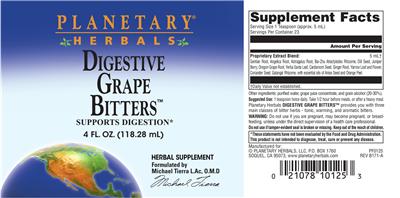
Supplement Facts
The label details for Digestive Grape Bitters by Planetary Herbals, sourced from the NIH Dietary Supplement Label Database.
Supplement Facts
| Ingredient | Amount | % DV |
|---|---|---|
| Oregon Grape | 0 NP | -- |
| Coriander | 0 NP | -- |
| Essential Oils | 0 NP | -- |
| Proprietary Extract Blend | 5 mL | -- |
| Juniper | 0 NP | -- |
| Astragalus | 0 NP | -- |
| Yerba Santa | 0 NP | -- |
| Anise | 0 NP | -- |
| Bai-zhu Atractylodes | 0 NP | -- |
| Cardamom | 0 NP | -- |
| Orange | 0 NP | -- |
| Angelica | 0 NP | -- |
| Gentian | 0 NP | -- |
| Ginger | 0 NP | -- |
| Dill | 0 NP | -- |
| Yarrow | 0 NP | -- |
| Galangal | 0 NP | -- |
Other ingredients: purified Water, Grape juice concentrate, Grain Alcohol
Tap any ingredient to jump to its full detail below.
These statements are the manufacturer’s wording, reproduced from the product label — the label is saying it, not HelloPharmacist. We don’t verify or endorse them.
General Statements
Supports digestion
Formulated by Michael Tierra L.Ac, O.M.D
FDA Statement of Identity
Herbal Supplement
Suggested/Recommended/Usage/Directions
Suggested Use: 1 teaspoon twice daily. Take 1/2 hour before meals, or after a heavy meal.
Brand IP Statement(s)
Planetary Herbals Digestive Grape Bitters provides you with three main classes of bitter herbs - tonic, warming, and aromatic bitters.
Precautions
Warning: Do not use if you are pregnant, may become pregnant, or breastfeeding, unless under the direct supervision of a health care professional.
Do not use if tamper-evident seal is broken or missing.
Keep out of the reach of children.
FDA Disclaimer Statement
These statements have not been evaluated by the Food and Drug Administration. This product is not intended to diagnose, treat, cure or prevent any disease.
General
PF0125 REV B171-A
Is this label outdated? Report a formula or label change and our pharmacy team will review it.
Digestive Grape Bitters by Planetary Herbals label
The label scan from the NIH Dietary Supplement Label Database. Tap to enlarge.
Label images are published by the NIH Dietary Supplement Label Database for the version of this product on file. Always read your actual product label.
View the full label (PDF)The Ingredients in Digestive Grape Bitters by Planetary Herbals
These are the 14 active ingredients this product is made of. Select any to open its full monograph.
Serving size1 tsp Dosage formLiquid Servings per container23 Amounts shown are per serving.
Most supplement products combine several ingredients, and a medication can interact with the product through any one of them. Each ingredient below shows whether it has known drug interactions.
Proprietary Extract Blend
- › Oregon Grape
- › Coriander
- › Essential Oils
- › Juniper
- › Astragalus
- › Yerba Santa
- › Bai-zhu Atractylodes
- › Cardamom
- › Angelica
- › Gentian
- › Ginger
- › Dill
- › Yarrow
- › Galangal
Other (inactive) ingredients: Purified Water, Grape juice concentrate, Grain Alcohol. These complete the product’s ingredient list but are not active constituents.
Digestive Grape Bitters by Planetary Herbals Drug Interactions
HelloPharmacist Interaction Report
Digestive Grape Bitters by Planetary Herbals contains several ingredients with documented interactions: Oregon grape, coriander, juniper, astragalus, yerba santa, anise, atractylodes, orange, angelica, gentian, ginger, dill, yarrow, and galangal.
The most serious interaction involves orange — consuming the product with certain medications metabolized through OATP (organic anion-transporting polypeptide) can significantly decrease drug absorption, and with pravastatin can dramatically increase absorption, requiring careful timing. These are rated Major severity.
Read the full breakdown — every affected drug type, severity by severity
Oregon grape's berberine content poses Moderate risks across several drug categories: it may increase sedation with CNS depressants, raise blood pressure-lowering effects with antihypertensive drugs, and increase levels of drugs metabolized by CYP2D6, CYP2C9, and CYP3A4 enzymes. Oregon grape also theoretically raises bleeding risk with blood thinners and low blood sugar risk with diabetes medications.
Anise and ginger share similar Moderate concerns with blood thinners, diabetes drugs, and several specific medications. Coriander and juniper may increase low blood sugar risk with diabetes medications and blood pressure drops with antihypertensive drugs, both Moderate.
Several ingredients carry Moderate interactions with lithium (astragalus, yerba santa, dill, and yarrow), potentially increasing lithium levels. Atractylodes may increase bleeding risk with blood thinners and affect certain metabolized drugs.
Angelica may alter levels of drugs processed by the CYP1A2 enzyme. Gentian theoretically compounds blood pressure-lowering effects.
Cardamom was checked and no interactions are documented in our data. Altogether, these interactions span 1,465 individual medications.
Run your exact prescriptions through the checker below before starting this product.
Check your own medications below · Editorial policy · How we use AI
Want to check YOUR meds against Digestive Grape Bitters?
Ask about interactions with your drugs in plain English — “Can I take it with lisinopril?” — and we find you the answer in seconds, ingredient by ingredient.
Go to the checkerIngredients driving the most interactions
Individual Drug Interactions
The ingredients in Digestive Grape Bitters interact with 1,464 drugs. Click any drug to see the details.
12 of the 14 ingredients in Digestive Grape Bitters interact with drugs. Each result below shows which ingredient is responsible. Oregon Grape Ginger Bai-zhu Atractylodes Coriander Astragalus Angelica Gentian Juniper Dill Galangal Yerba Santa Yarrow
AtorvastatinAtorvaliq
How Atorvastatin interacts with Digestive Grape Bitters — through 4 ingredients. Tap an ingredient for the detail:
OrangeOrganic Anion-transporting Polypeptide Substrates (oatp) Major
Interaction Summary
Consuming sweet orange juice can decrease oral absorption of OATP substrates.
Read the full Orange + Atorvastatin interactionOregon GrapeCytochrome P450 3a4 (cyp3a4) Substrates Moderate
Interaction Summary
Theoretically, Oregon grape might increase serum levels of drugs metabolized by CYP3A4.
Read the full Oregon Grape + Atorvastatin interactionGingerCytochrome P450 3a4 (cyp3a4) Substrates Moderate
Interaction Summary
Ginger might increase or decrease the levels of CYP3A4 substrates.
Read the full Ginger + Atorvastatin interactionBai-zhu AtractylodesCytochrome P450 3a4 (cyp3a4) Substrates Minor
Interaction Summary
Theoretically, atractylodes might increase the levels of CYP3A4 substrates.
Read the full Bai-zhu Atractylodes + Atorvastatin interactionAtorvastatin CalciumLipitor
How Atorvastatin Calcium interacts with Digestive Grape Bitters — through 4 ingredients. Tap an ingredient for the detail:
OrangeOrganic Anion-transporting Polypeptide Substrates (oatp) Major
Interaction Summary
Consuming sweet orange juice can decrease oral absorption of OATP substrates.
Read the full Orange + Atorvastatin Calcium interactionGingerCytochrome P450 3a4 (cyp3a4) Substrates Moderate
Interaction Summary
Ginger might increase or decrease the levels of CYP3A4 substrates.
Read the full Ginger + Atorvastatin Calcium interactionOregon GrapeCytochrome P450 3a4 (cyp3a4) Substrates Moderate
Interaction Summary
Theoretically, Oregon grape might increase serum levels of drugs metabolized by CYP3A4.
Read the full Oregon Grape + Atorvastatin Calcium interactionBai-zhu AtractylodesCytochrome P450 3a4 (cyp3a4) Substrates Minor
Interaction Summary
Theoretically, atractylodes might increase the levels of CYP3A4 substrates.
Read the full Bai-zhu Atractylodes + Atorvastatin Calcium interactionBosentanTracleer
How Bosentan interacts with Digestive Grape Bitters — through 6 ingredients. Tap an ingredient for the detail:
OrangeOrganic Anion-transporting Polypeptide Substrates (oatp) Major
Interaction Summary
Consuming sweet orange juice can decrease oral absorption of OATP substrates.
Read the full Orange + Bosentan interactionOregon GrapeCytochrome P450 2c9 (cyp2c9) Substrates, Cytochrome P450 3a4 (cyp3a4) Substrates +1 Moderate
Interaction Summary
Theoretically, Oregon grape might increase serum levels of drugs metabolized by CYP2C9.
Read the full Oregon Grape + Bosentan interactionCorianderAntihypertensive Drugs Moderate
Interaction Summary
Theoretically, coriander might increase the risk of hypotension when taken with antihypertensive drugs.
Read the full Coriander + Bosentan interactionGentianAntihypertensive Drugs Moderate
Interaction Summary
Theoretically, taking gentian with antihypertensive drugs might increase the risk of hypotension.
Read the full Gentian + Bosentan interactionGingerCytochrome P450 2c9 (cyp2c9) Substrates, Cytochrome P450 3a4 (cyp3a4) Substrates Moderate
Interaction Summary
Theoretically, ginger might increase the levels of CYP2C9 substrates.
Read the full Ginger + Bosentan interactionBai-zhu AtractylodesCytochrome P450 3a4 (cyp3a4) Substrates Minor
Interaction Summary
Theoretically, atractylodes might increase the levels of CYP3A4 substrates.
Read the full Bai-zhu Atractylodes + Bosentan interactionBrincidofovirTembexa
How Brincidofovir interacts with Digestive Grape Bitters — through 1 ingredient. Tap an ingredient for the detail:
OrangeOrganic Anion-transporting Polypeptide Substrates (oatp) Major
Interaction Summary
Consuming sweet orange juice can decrease oral absorption of OATP substrates.
Read the full Orange + Brincidofovir interactionCeliprololCelicard
How Celiprolol interacts with Digestive Grape Bitters — through 5 ingredients. Tap an ingredient for the detail:
OrangeP-glycoprotein Substrates, Organic Anion-transporting Polypeptide Substrates (oatp) +1 Major
Interaction Summary
Sweet orange juice seems to modulate P-glycoprotein (P-gp), which might affect the blood levels of P-gp substrates.
Read the full Orange + Celiprolol interactionOregon GrapeAntihypertensive Drugs, P-glycoprotein Substrates Moderate
Interaction Summary
Theoretically, Oregon grape might increase the risk of hypotension when taken with antihypertensive drugs.
Read the full Oregon Grape + Celiprolol interactionCorianderAntihypertensive Drugs Moderate
Interaction Summary
Theoretically, coriander might increase the risk of hypotension when taken with antihypertensive drugs.
Read the full Coriander + Celiprolol interactionGentianAntihypertensive Drugs Moderate
Interaction Summary
Theoretically, taking gentian with antihypertensive drugs might increase the risk of hypotension.
Read the full Gentian + Celiprolol interactionGingerP-glycoprotein Substrates Moderate
Interaction Summary
Ginger might increase the absorption and blood levels of P-glycoprotein (P-gp) substrates.
Read the full Ginger + Celiprolol interactionCerivastatin SodiumBaycol
How Cerivastatin Sodium interacts with Digestive Grape Bitters — through 1 ingredient. Tap an ingredient for the detail:
OrangeOrganic Anion-transporting Polypeptide Substrates (oatp) Major
Interaction Summary
Consuming sweet orange juice can decrease oral absorption of OATP substrates.
Read the full Orange + Cerivastatin Sodium interactionCinoxacinCinobac
How Cinoxacin interacts with Digestive Grape Bitters — through 2 ingredients. Tap an ingredient for the detail:
OrangeQuinolone Antibiotics, Organic Anion-transporting Polypeptide Substrates (oatp) Major
Interaction Summary
Calcium-fortified sweet orange juice might reduce quinolone absorption.
Read the full Orange + Cinoxacin interactionCorianderPhotosensitizing Drugs Moderate
Interaction Summary
Theoretically, coriander might increase the risk of photosensitivity when taken with photosensitizing drugs.
Read the full Coriander + Cinoxacin interactionCiprofloxacinCiloxan, Cipro, Cipro IV, Cipro XR, Ciprobay, Otiprio
How Ciprofloxacin interacts with Digestive Grape Bitters — through 2 ingredients. Tap an ingredient for the detail:
OrangeOrganic Anion-transporting Polypeptide Substrates (oatp), Quinolone Antibiotics Major
Interaction Summary
Consuming sweet orange juice can decrease oral absorption of OATP substrates.
Read the full Orange + Ciprofloxacin interactionCorianderPhotosensitizing Drugs Moderate
Interaction Summary
Theoretically, coriander might increase the risk of photosensitivity when taken with photosensitizing drugs.
Read the full Coriander + Ciprofloxacin interactionCiprofloxacin, HydrocortisoneCipro HC Otic
How Ciprofloxacin, Hydrocortisone interacts with Digestive Grape Bitters — through 1 ingredient. Tap an ingredient for the detail:
OrangeOrganic Anion-transporting Polypeptide Substrates (oatp) Major
Interaction Summary
Consuming sweet orange juice can decrease oral absorption of OATP substrates.
Read the full Orange + Ciprofloxacin, Hydrocortisone interactionClinafloxacinClinafloxacin
How Clinafloxacin interacts with Digestive Grape Bitters — through 1 ingredient. Tap an ingredient for the detail:
OrangeOrganic Anion-transporting Polypeptide Substrates (oatp), Quinolone Antibiotics Major
Interaction Summary
Consuming sweet orange juice can decrease oral absorption of OATP substrates.
Read the full Orange + Clinafloxacin interactionEnoxacinPenetrex
How Enoxacin interacts with Digestive Grape Bitters — through 2 ingredients. Tap an ingredient for the detail:
OrangeOrganic Anion-transporting Polypeptide Substrates (oatp), Quinolone Antibiotics Major
Interaction Summary
Consuming sweet orange juice can decrease oral absorption of OATP substrates.
Read the full Orange + Enoxacin interactionCorianderPhotosensitizing Drugs Moderate
Interaction Summary
Theoretically, coriander might increase the risk of photosensitivity when taken with photosensitizing drugs.
Read the full Coriander + Enoxacin interactionEtoposideEtopophos, VePesid, VP16
How Etoposide interacts with Digestive Grape Bitters — through 4 ingredients. Tap an ingredient for the detail:
OrangeOrganic Anion-transporting Polypeptide Substrates (oatp), P-glycoprotein Substrates Major
Interaction Summary
Consuming sweet orange juice can decrease oral absorption of OATP substrates.
Read the full Orange + Etoposide interactionOregon GrapeP-glycoprotein Substrates, Cytochrome P450 3a4 (cyp3a4) Substrates Moderate
Interaction Summary
Theoretically, Oregon grape might increase serum levels of drugs that are P-glycoprotein (P-gp) substrates.
Read the full Oregon Grape + Etoposide interactionGingerP-glycoprotein Substrates, Cytochrome P450 3a4 (cyp3a4) Substrates Moderate
Interaction Summary
Ginger might increase the absorption and blood levels of P-glycoprotein (P-gp) substrates.
Read the full Ginger + Etoposide interactionBai-zhu AtractylodesCytochrome P450 3a4 (cyp3a4) Substrates Minor
Interaction Summary
Theoretically, atractylodes might increase the levels of CYP3A4 substrates.
Read the full Bai-zhu Atractylodes + Etoposide interactionEzetimibe, AtorvastatinLiptruzet
How Ezetimibe, Atorvastatin interacts with Digestive Grape Bitters — through 4 ingredients. Tap an ingredient for the detail:
OrangeOrganic Anion-transporting Polypeptide Substrates (oatp) Major
Interaction Summary
Consuming sweet orange juice can decrease oral absorption of OATP substrates.
Read the full Orange + Ezetimibe, Atorvastatin interactionGingerCytochrome P450 3a4 (cyp3a4) Substrates Moderate
Interaction Summary
Ginger might increase or decrease the levels of CYP3A4 substrates.
Read the full Ginger + Ezetimibe, Atorvastatin interactionOregon GrapeCytochrome P450 3a4 (cyp3a4) Substrates Moderate
Interaction Summary
Theoretically, Oregon grape might increase serum levels of drugs metabolized by CYP3A4.
Read the full Oregon Grape + Ezetimibe, Atorvastatin interactionBai-zhu AtractylodesCytochrome P450 3a4 (cyp3a4) Substrates Minor
Interaction Summary
Theoretically, atractylodes might increase the levels of CYP3A4 substrates.
Read the full Bai-zhu Atractylodes + Ezetimibe, Atorvastatin interactionFexofenadineAllegra
How Fexofenadine interacts with Digestive Grape Bitters — through 4 ingredients. Tap an ingredient for the detail:
OrangeP-glycoprotein Substrates, Organic Anion-transporting Polypeptide Substrates (oatp) +1 Major
Interaction Summary
Sweet orange juice seems to modulate P-glycoprotein (P-gp), which might affect the blood levels of P-gp substrates.
Read the full Orange + Fexofenadine interactionGingerP-glycoprotein Substrates, Cytochrome P450 3a4 (cyp3a4) Substrates Moderate
Interaction Summary
Ginger might increase the absorption and blood levels of P-glycoprotein (P-gp) substrates.
Read the full Ginger + Fexofenadine interactionOregon GrapeCytochrome P450 3a4 (cyp3a4) Substrates, P-glycoprotein Substrates Moderate
Interaction Summary
Theoretically, Oregon grape might increase serum levels of drugs metabolized by CYP3A4.
Read the full Oregon Grape + Fexofenadine interactionBai-zhu AtractylodesCytochrome P450 3a4 (cyp3a4) Substrates Minor
Interaction Summary
Theoretically, atractylodes might increase the levels of CYP3A4 substrates.
Read the full Bai-zhu Atractylodes + Fexofenadine interactionFexofenadine, PseudoephedrineAllegra D
How Fexofenadine, Pseudoephedrine interacts with Digestive Grape Bitters — through 4 ingredients. Tap an ingredient for the detail:
OrangeFexofenadine (allegra), P-glycoprotein Substrates +1 Major
Interaction Summary
Consuming sweet orange juice with fexofenadine can decrease oral absorption of fexofenadine.
Read the full Orange + Fexofenadine, Pseudoephedrine interactionOregon GrapeP-glycoprotein Substrates, Cytochrome P450 3a4 (cyp3a4) Substrates Moderate
Interaction Summary
Theoretically, Oregon grape might increase serum levels of drugs that are P-glycoprotein (P-gp) substrates.
Read the full Oregon Grape + Fexofenadine, Pseudoephedrine interactionGingerP-glycoprotein Substrates, Cytochrome P450 3a4 (cyp3a4) Substrates Moderate
Interaction Summary
Ginger might increase the absorption and blood levels of P-glycoprotein (P-gp) substrates.
Read the full Ginger + Fexofenadine, Pseudoephedrine interactionBai-zhu AtractylodesCytochrome P450 3a4 (cyp3a4) Substrates Minor
Interaction Summary
Theoretically, atractylodes might increase the levels of CYP3A4 substrates.
Read the full Bai-zhu Atractylodes + Fexofenadine, Pseudoephedrine interactionFluvastatinLescol, Lescol XL
How Fluvastatin interacts with Digestive Grape Bitters — through 3 ingredients. Tap an ingredient for the detail:
OrangeOrganic Anion-transporting Polypeptide Substrates (oatp) Major
Interaction Summary
Consuming sweet orange juice can decrease oral absorption of OATP substrates.
Read the full Orange + Fluvastatin interactionOregon GrapeCytochrome P450 2c9 (cyp2c9) Substrates Moderate
Interaction Summary
Theoretically, Oregon grape might increase serum levels of drugs metabolized by CYP2C9.
Read the full Oregon Grape + Fluvastatin interactionGingerCytochrome P450 2c9 (cyp2c9) Substrates Minor
Interaction Summary
Theoretically, ginger might increase the levels of CYP2C9 substrates.
Read the full Ginger + Fluvastatin interactionGatifloxacinTequin, Tequin Injection
How Gatifloxacin interacts with Digestive Grape Bitters — through 2 ingredients. Tap an ingredient for the detail:
OrangeOrganic Anion-transporting Polypeptide Substrates (oatp), Quinolone Antibiotics Major
Interaction Summary
Consuming sweet orange juice can decrease oral absorption of OATP substrates.
Read the full Orange + Gatifloxacin interactionCorianderPhotosensitizing Drugs Moderate
Interaction Summary
Theoretically, coriander might increase the risk of photosensitivity when taken with photosensitizing drugs.
Read the full Coriander + Gatifloxacin interactionGemifloxacinFactive
How Gemifloxacin interacts with Digestive Grape Bitters — through 1 ingredient. Tap an ingredient for the detail:
OrangeQuinolone Antibiotics, Organic Anion-transporting Polypeptide Substrates (oatp) Major
Interaction Summary
Calcium-fortified sweet orange juice might reduce quinolone absorption.
Read the full Orange + Gemifloxacin interactionGlyburideAlbert Glyburide, Diabeta, Glycron, Glynase, Glynase PresTab, Micronase +1 more
How Glyburide interacts with Digestive Grape Bitters — through 8 ingredients. Tap an ingredient for the detail:
OrangeOrganic Anion-transporting Polypeptide Substrates (oatp) Major
Interaction Summary
Consuming sweet orange juice can decrease oral absorption of OATP substrates.
Read the full Orange + Glyburide interactionCorianderAntidiabetes Drugs, Photosensitizing Drugs Moderate
Interaction Summary
Theoretically, coriander might increase the risk of hypoglycemia when taken with antidiabetes drugs.
Read the full Coriander + Glyburide interactionDillAntidiabetes Drugs Moderate
Interaction Summary
Theoretically, dill extract might have additive effects with antidiabetes drugs and increase the risk of hypoglycemia.
Read the full Dill + Glyburide interactionAniseAntidiabetes Drugs Moderate
Interaction Summary
Theoretically, anise seed might increase the risk of hypoglycemia when taken with antidiabetes drugs.
Read the full Anise + Glyburide interactionOregon GrapeCytochrome P450 2c9 (cyp2c9) Substrates, Antidiabetes Drugs Moderate
Interaction Summary
Theoretically, Oregon grape might increase serum levels of drugs metabolized by CYP2C9.
Read the full Oregon Grape + Glyburide interactionGingerAntidiabetes Drugs, Cytochrome P450 2c9 (cyp2c9) Substrates Moderate
Interaction Summary
Theoretically, taking ginger with antidiabetes drugs might increase the risk of hypoglycemia.
Read the full Ginger + Glyburide interactionJuniperAntidiabetes Drugs Moderate
Interaction Summary
Theoretically, taking juniper berry with antidiabetes medications might cause additive hypoglycemia.
Read the full Juniper + Glyburide interactionAstragalusAntidiabetes Drugs Moderate
Interaction Summary
Theoretically, taking astragalus with antidiabetes drugs might increase the risk of hypoglycemia.
Read the full Astragalus + Glyburide interactionGlyburide, MetforminGlucovance
How Glyburide, Metformin interacts with Digestive Grape Bitters — through 8 ingredients. Tap an ingredient for the detail:
OrangeOrganic Anion-transporting Polypeptide Substrates (oatp) Major
Interaction Summary
Consuming sweet orange juice can decrease oral absorption of OATP substrates.
Read the full Orange + Glyburide, Metformin interactionAstragalusAntidiabetes Drugs Moderate
Interaction Summary
Theoretically, taking astragalus with antidiabetes drugs might increase the risk of hypoglycemia.
Read the full Astragalus + Glyburide, Metformin interactionOregon GrapeAntidiabetes Drugs, Cytochrome P450 2c9 (cyp2c9) Substrates Moderate
Interaction Summary
Theoretically, Oregon grape might increase the risk of hypoglycemia when taken with antidiabetes drugs.
Read the full Oregon Grape + Glyburide, Metformin interactionAniseAntidiabetes Drugs Moderate
Interaction Summary
Theoretically, anise seed might increase the risk of hypoglycemia when taken with antidiabetes drugs.
Read the full Anise + Glyburide, Metformin interactionCorianderPhotosensitizing Drugs, Antidiabetes Drugs Moderate
Interaction Summary
Theoretically, coriander might increase the risk of photosensitivity when taken with photosensitizing drugs.
Read the full Coriander + Glyburide, Metformin interactionDillAntidiabetes Drugs Moderate
Interaction Summary
Theoretically, dill extract might have additive effects with antidiabetes drugs and increase the risk of hypoglycemia.
Read the full Dill + Glyburide, Metformin interactionGingerCytochrome P450 2c9 (cyp2c9) Substrates, Antidiabetes Drugs Moderate
Interaction Summary
Theoretically, ginger might increase the levels of CYP2C9 substrates.
Read the full Ginger + Glyburide, Metformin interactionJuniperAntidiabetes Drugs Moderate
Interaction Summary
Theoretically, taking juniper berry with antidiabetes medications might cause additive hypoglycemia.
Read the full Juniper + Glyburide, Metformin interactionGrepafloxacinRaxar
How Grepafloxacin interacts with Digestive Grape Bitters — through 4 ingredients. Tap an ingredient for the detail:
OrangeOrganic Anion-transporting Polypeptide Substrates (oatp), Quinolone Antibiotics Major
Interaction Summary
Consuming sweet orange juice can decrease oral absorption of OATP substrates.
Read the full Orange + Grepafloxacin interactionAngelicaCytochrome P450 1a2 (cyp1a2) Substrates Moderate
Interaction Summary
In vitro research shows that ashitaba extract inhibits cytochrome P450 (CYP) 1A2.
Read the full Angelica + Grepafloxacin interactionBai-zhu AtractylodesCytochrome P450 1a2 (cyp1a2) Substrates Minor
Interaction Summary
Theoretically, atractylodes might decrease the levels of CYP1A2 substrates.
Read the full Bai-zhu Atractylodes + Grepafloxacin interactionGingerCytochrome P450 1a2 (cyp1a2) Substrates Minor
Interaction Summary
Theoretically, ginger might increase the levels of CYP1A2 substrates.
Read the full Ginger + Grepafloxacin interactionIrinotecanCamptosar, Onivyde
How Irinotecan interacts with Digestive Grape Bitters — through 4 ingredients. Tap an ingredient for the detail:
OrangeOrganic Anion-transporting Polypeptide Substrates (oatp) Major
Interaction Summary
Consuming sweet orange juice can decrease oral absorption of OATP substrates.
Read the full Orange + Irinotecan interactionOregon GrapeCytochrome P450 3a4 (cyp3a4) Substrates Moderate
Interaction Summary
Theoretically, Oregon grape might increase serum levels of drugs metabolized by CYP3A4.
Read the full Oregon Grape + Irinotecan interactionGingerCytochrome P450 3a4 (cyp3a4) Substrates Moderate
Interaction Summary
Ginger might increase or decrease the levels of CYP3A4 substrates.
Read the full Ginger + Irinotecan interactionBai-zhu AtractylodesCytochrome P450 3a4 (cyp3a4) Substrates Minor
Interaction Summary
Theoretically, atractylodes might increase the levels of CYP3A4 substrates.
Read the full Bai-zhu Atractylodes + Irinotecan interactionIrinotecan Hydrochloride
How Irinotecan Hydrochloride interacts with Digestive Grape Bitters — through 4 ingredients. Tap an ingredient for the detail:
OrangeOrganic Anion-transporting Polypeptide Substrates (oatp) Major
Interaction Summary
Consuming sweet orange juice can decrease oral absorption of OATP substrates.
Read the full Orange + Irinotecan Hydrochloride interactionGingerCytochrome P450 3a4 (cyp3a4) Substrates Moderate
Interaction Summary
Ginger might increase or decrease the levels of CYP3A4 substrates.
Read the full Ginger + Irinotecan Hydrochloride interactionOregon GrapeCytochrome P450 3a4 (cyp3a4) Substrates Moderate
Interaction Summary
Theoretically, Oregon grape might increase serum levels of drugs metabolized by CYP3A4.
Read the full Oregon Grape + Irinotecan Hydrochloride interactionBai-zhu AtractylodesCytochrome P450 3a4 (cyp3a4) Substrates Minor
Interaction Summary
Theoretically, atractylodes might increase the levels of CYP3A4 substrates.
Read the full Bai-zhu Atractylodes + Irinotecan Hydrochloride interactionIsoniazid, Pyrazinamide, RifampinRifater
How Isoniazid, Pyrazinamide, Rifampin interacts with Digestive Grape Bitters — through 2 ingredients. Tap an ingredient for the detail:
OrangeOrganic Anion-transporting Polypeptide Substrates (oatp) Major
Interaction Summary
Consuming sweet orange juice can decrease oral absorption of OATP substrates.
Read the full Orange + Isoniazid, Pyrazinamide, Rifampin interactionCorianderPhotosensitizing Drugs Moderate
Interaction Summary
Theoretically, coriander might increase the risk of photosensitivity when taken with photosensitizing drugs.
Read the full Coriander + Isoniazid, Pyrazinamide, Rifampin interactionIsoniazid, RifampinRifamate
How Isoniazid, Rifampin interacts with Digestive Grape Bitters — through 1 ingredient. Tap an ingredient for the detail:
OrangeOrganic Anion-transporting Polypeptide Substrates (oatp) Major
Interaction Summary
Consuming sweet orange juice can decrease oral absorption of OATP substrates.
Read the full Orange + Isoniazid, Rifampin interactionIvermectinMectizan, Sklice, Soolantra, Stromectol
How Ivermectin interacts with Digestive Grape Bitters — through 3 ingredients. Tap an ingredient for the detail:
OrangeP-glycoprotein Substrates, Ivermectin (stromectol, Others) Major
Interaction Summary
Sweet orange juice seems to modulate P-glycoprotein (P-gp), which might affect the blood levels of P-gp substrates.
Read the full Orange + Ivermectin interactionGingerP-glycoprotein Substrates Moderate
Interaction Summary
Ginger might increase the absorption and blood levels of P-glycoprotein (P-gp) substrates.
Read the full Ginger + Ivermectin interactionOregon GrapeP-glycoprotein Substrates Moderate
Interaction Summary
Theoretically, Oregon grape might increase serum levels of drugs that are P-glycoprotein (P-gp) substrates.
Read the full Oregon Grape + Ivermectin interactionLevofloxacinLeva-pak, Levaquin, Levaquin Injection
How Levofloxacin interacts with Digestive Grape Bitters — through 2 ingredients. Tap an ingredient for the detail:
OrangeQuinolone Antibiotics, Organic Anion-transporting Polypeptide Substrates (oatp) Major
Interaction Summary
Calcium-fortified sweet orange juice might reduce quinolone absorption.
Read the full Orange + Levofloxacin interactionCorianderPhotosensitizing Drugs Moderate
Interaction Summary
Theoretically, coriander might increase the risk of photosensitivity when taken with photosensitizing drugs.
Read the full Coriander + Levofloxacin interactionLevofloxacin (ophthalmic)Levofloxacin
How Levofloxacin (ophthalmic) interacts with Digestive Grape Bitters — through 1 ingredient. Tap an ingredient for the detail:
OrangeOrganic Anion-transporting Polypeptide Substrates (oatp), Quinolone Antibiotics Major
Interaction Summary
Consuming sweet orange juice can decrease oral absorption of OATP substrates.
Read the full Orange + Levofloxacin (ophthalmic) interactionLomefloxacinMaxaquin
How Lomefloxacin interacts with Digestive Grape Bitters — through 2 ingredients. Tap an ingredient for the detail:
OrangeOrganic Anion-transporting Polypeptide Substrates (oatp), Quinolone Antibiotics Major
Interaction Summary
Consuming sweet orange juice can decrease oral absorption of OATP substrates.
Read the full Orange + Lomefloxacin interactionCorianderPhotosensitizing Drugs Moderate
Interaction Summary
Theoretically, coriander might increase the risk of photosensitivity when taken with photosensitizing drugs.
Read the full Coriander + Lomefloxacin interactionLovastatinAltocor, Mevacor
How Lovastatin interacts with Digestive Grape Bitters — through 4 ingredients. Tap an ingredient for the detail:
OrangeOrganic Anion-transporting Polypeptide Substrates (oatp) Major
Interaction Summary
Consuming sweet orange juice can decrease oral absorption of OATP substrates.
Read the full Orange + Lovastatin interactionGingerCytochrome P450 3a4 (cyp3a4) Substrates Moderate
Interaction Summary
Ginger might increase or decrease the levels of CYP3A4 substrates.
Read the full Ginger + Lovastatin interactionOregon GrapeCytochrome P450 3a4 (cyp3a4) Substrates Moderate
Interaction Summary
Theoretically, Oregon grape might increase serum levels of drugs metabolized by CYP3A4.
Read the full Oregon Grape + Lovastatin interactionBai-zhu AtractylodesCytochrome P450 3a4 (cyp3a4) Substrates Minor
Interaction Summary
Theoretically, atractylodes might increase the levels of CYP3A4 substrates.
Read the full Bai-zhu Atractylodes + Lovastatin interactionEach ingredient & the kinds of drugs it affects
For each ingredient in Digestive Grape Bitters with known interactions, here are the types of medications they can affect. Open any type for the detail — or search your exact drug in the checker above.
Oregon Grape
Anticoagulant/Antiplatelet Drugs
Theoretically, Oregon grape might increase the risk of bleeding when taken with anticoagulant or antiplatelet drugs.
In vitro and in vivo research suggests that berberine, a constituent of Oregon grape, can inhibit platelet aggregation.
Antidiabetes Drugs
Theoretically, Oregon grape might increase the risk of hypoglycemia when taken with antidiabetes drugs.
Clinical research suggests that berberine, a constituent of Oregon grape, can lower blood glucose levels.
Antihypertensive Drugs
Theoretically, Oregon grape might increase the risk of hypotension when taken with antihypertensive drugs.
Animal research suggests that berberine, a constituent of Oregon grape, can have hypotensive effects. Also, an analysis of clinical evidence suggests that taking berberine in combination with amlodipine (Norvasc) can lower systolic and diastolic blood pressure when compared with taking amlodipine alone.
Cns Depressants
Theoretically, Oregon grape might increase the sedative effects of CNS depressants.
Animal research suggests that berberine, a constituent of Oregon grape, can have sedative effects.
Cyclosporine (Neoral, Sandimmune)
Theoretically, Oregon grape might increase the effects and adverse effects of cyclosporine.
Berberine, a constituent of Oregon grape, can reduce metabolism of cyclosporine and increase serum levels. It might inhibit cytochrome P450 3A4 (CYP3A4), which metabolizes cyclosporine.
Cytochrome P450 2C9 (Cyp2C9) Substrates
Theoretically, Oregon grape might increase serum levels of drugs metabolized by CYP2C9.
Preliminary clinical evidence suggests that berberine, a constituent of Oregon grape, can inhibit cytochrome P450 2C9 (CYP2C9).
Cytochrome P450 2D6 (Cyp2D6) Substrates
Theoretically, Oregon grape might increase serum levels of drugs metabolized by CYP2D6.
In vitro research and preliminary clinical evidence suggest that berberine, a constituent of Oregon grape, can inhibit cytochrome P450 2D6 (CYP2D6).
Cytochrome P450 3A4 (Cyp3A4) Substrates
Theoretically, Oregon grape might increase serum levels of drugs metabolized by CYP3A4.
In vitro research and preliminary clinical evidence suggest that berberine, a constituent of Oregon grape, moderately inhibits cytochrome P450 3A4 (CYP3A4).
P-Glycoprotein Substrates
Theoretically, Oregon grape might increase serum levels of drugs that are P-glycoprotein (P-gp) substrates.
In vitro research suggests that Oregon grape extracts inhibit P-gp efflux.
Ginger
Anticoagulant/Antiplatelet Drugs
Ginger may have antiplatelet effects and may increase the risk of bleeding if used with anticoagulant or antiplatelet drugs. However, research is conflicting.
Laboratory research suggests that ginger inhibits thromboxane synthetase and decreases platelet aggregation. However, this has not been demonstrated unequivocally in humans, with mixed results from clinical trials. Theoretically, excessive amounts of ginger might increase the risk of bleeding when used with anticoagulant/antiplatelet drugs.
Antidiabetes Drugs
Theoretically, taking ginger with antidiabetes drugs might increase the risk of hypoglycemia.
Animal and human research suggests that ginger might increase insulin levels and/or decrease blood glucose levels.
Cytochrome P450 3A4 (Cyp3A4) Substrates
Ginger might increase or decrease the levels of CYP3A4 substrates.
In vitro research and some case reports suggest that ginger inhibits CYP3A4 activity. Three case reports from the World Health Organization (WHO) adverse drug reaction database describe increased toxicity in patients taking ginger and cancer medications that are CYP3A4 substrates (imatinib, dabrafenib, and crizotinib). However, the causality of this interaction is unclear due to the presence of multiple interacting drugs and routes of administration.
Conversely, other in vitro research suggests that ginger induces CYP3A4 activity, leading to reduced levels of CYP3A4 substrates. However, this interaction has not been reported in humans.
Losartan (Cozaar)
Theoretically, ginger might increase levels of losartan and the risk of hypotension.
In animal research, ginger increased the levels and hypotensive effects of a single dose of losartan. It is not clear if ginger alters the concentration or effects of losartan when taken continuously. Additionally, this interaction has not been shown in humans.
Nifedipine (Procardia)
Ginger may have antiplatelet effects and increase the risk of bleeding if used with nifedipine.
Clinical research shows that combined treatment with ginger 1 gram plus nifedipine 10 mg significantly inhibits platelet aggregation when compared to nifedipine or ginger alone.
P-Glycoprotein Substrates
Ginger might increase the absorption and blood levels of P-glycoprotein (P-gp) substrates.
In vitro research and case reports suggest that ginger inhibits drug efflux by P-gp, potentially increasing absorption and serum levels of P-gp substrates. Two case reports from the World Health Organization (WHO) adverse drug reaction database describe increased toxicity in patients taking ginger and cancer medications that are P-gp substrates (trametinib, crizotinib). However, the causality of this interaction is unclear due to the presence of multiple interacting drugs and routes of administration.
Phenprocoumon (Marcoumar, Others)
Ginger might increase the risk of bleeding with phenprocoumon.
Phenprocoumon, a warfarin-related anticoagulant, might increase the international normalized ratio (INR) when taken with ginger. There is one case report of a 76-year-old woman with a stable INR on phenprocoumon that increased to greater than 10 when she began consuming dried ginger and ginger tea.
Warfarin (Coumadin)
Ginger might increase the risk of bleeding with warfarin.
Laboratory research suggests that ginger might inhibit thromboxane synthetase and decrease platelet aggregation. In one case report, ginger increased the INR when taken with phenprocoumon, which has similar pharmacological effects as warfarin. In another case report, ginger increased the INR when taken with a combination of warfarin, hydrochlorothiazide, and acetaminophen. A longitudinal analysis suggests that taking ginger increases the risk of bleeding in patients taking warfarin for at least 4 months. However, research in healthy people suggests that ginger has no effect on INR, or the pharmacokinetics or pharmacodynamics of warfarin. Until more is known, monitor INRs closely in patients taking large amounts of ginger.
Calcium Channel Blockers
Theoretically, taking ginger with calcium channel blockers might increase the risk of hypotension.
Some animal and in vitro research suggests that ginger has hypotensive and calcium channel-blocking effects. Another animal study shows that concomitant administration of ginger and the calcium channel blocker amlodipine leads to greater reductions in blood pressure when compared with amlodipine alone.
Cyclosporine (Neoral, Sandimmune)
Theoretically, when taken prior to cyclosporine, ginger might decrease cyclosporine levels.
In an animal model, ginger juice taken 2 hours prior to cyclosporine administration reduced the maximum concentration and area under the curve of cyclosporine by 51% and 40%, respectively. This effect was not observed when ginger juice and cyclosporine were administered at the same time.
Cytochrome P450 1A2 (Cyp1A2) Substrates
Theoretically, ginger might increase the levels of CYP1A2 substrates.
In vitro research shows that ginger inhibits CYP1A2 activity. However, this interaction has not been reported in humans.
Cytochrome P450 2B6 (Cyp2B6) Substrates
Theoretically, ginger might increase the levels of CYP2B6 substrates.
In vitro research shows that ginger inhibits CYP2B6 activity. However, this interaction has not been reported in humans.
Cytochrome P450 2C9 (Cyp2C9) Substrates
Theoretically, ginger might increase the levels of CYP2C9 substrates.
In vitro research shows that ginger inhibits CYP2C9 activity. However, this interaction has not been reported in humans.
Metronidazole (Flagyl)
Theoretically, ginger might increase levels of metronidazole.
In an animal model, ginger increased the absorption and plasma half-life of metronidazole. In addition, the elimination rate and clearance of metronidazole was significantly reduced.
Bai-zhu Atractylodes
Anticoagulant/Antiplatelet Drugs
Theoretically, atractylodes might increase the risk of bleeding when used concomitantly with anticoagulant and antiplatelet drugs.
Laboratory research suggests that atractylenolides II and III, constituents of atractylodes, reduce platelet activation. So far, this has not been shown in humans.
Aromatase Inhibitors
Theoretically, atractylodes may have an additive effect when used with other aromatase inhibitors.
Laboratory research suggests that atractylodes and its constituents exhibit aromatase inhibitor effects.
Hexobarbital
Theoretically, taking atractylodes may prolong the therapeutic and adverse effects of hexobarbital.
In animals, atractylodes has been shown to prolong the effects of hexobarbital. These effects have not been shown in humans.
Cytochrome P450 1A2 (Cyp1A2) Substrates
Theoretically, atractylodes might decrease the levels of CYP1A2 substrates.
In animals, atractylodes administered at high doses has been shown to induce CYP1A2 activity. This effect has not been shown in humans.
Cytochrome P450 3A4 (Cyp3A4) Substrates
Theoretically, atractylodes might increase the levels of CYP3A4 substrates.
In animals, atractylodes administered at high doses has been shown to inhibit CYP3A1 activity, which is a homolog to the human CYP3A4 enzyme. This effect has not been shown in humans.
Coriander
Antidiabetes Drugs
Theoretically, coriander might increase the risk of hypoglycemia when taken with antidiabetes drugs.
Evidence from animal research suggests that coriander fruit and coriander extract can reduce blood glucose levels. Monitor blood glucose levels closely. Dose adjustments might be necessary.
Antihypertensive Drugs
Theoretically, coriander might increase the risk of hypotension when taken with antihypertensive drugs.
Evidence from animal research suggests that coriander fruit can lower blood pressure.
Cns Depressants
Theoretically, coriander might cause additive sedative effects when taken with CNS depressants.
Evidence from animal research suggests that coriander fruit extract has sedative effects.
Photosensitizing Drugs
Theoretically, coriander might increase the risk of photosensitivity when taken with photosensitizing drugs.
Evidence from in vitro research suggests that coriandrin, a constituent of coriander, has photosensitizing effects.
Astragalus
Antidiabetes Drugs
Theoretically, taking astragalus with antidiabetes drugs might increase the risk of hypoglycemia.
Clinical research in humans shows that astragalus might have hypoglycemic effects. Theoretically, taking astragalus, especially in combination with other hypoglycemic agents, might increase the risk of hypoglycemia.
Cyclophosphamide
Theoretically, astragalus might interfere with cyclophosphamide therapy.
Evidence regarding the effect of astragalus on immunosuppression caused by cyclophosphamide is conflicting. Some animal research suggests that astragalus reverses cyclophosphamide-induced immunosuppression. However, other animal research shows no effect.
Immunosuppressants
Theoretically, astragalus might interfere with immunosuppressive therapy.
Astragalus seems to stimulate immune function. Theoretically, taking astragalus might decrease the effects of immunosuppressive therapy.
Lithium
Theoretically, astragalus might increase levels and adverse effects of lithium.
Animal research suggests that astragalus has diuretic properties. Theoretically, due to this diuretic effect, astragalus might reduce excretion and increase levels of lithium.
Angelica
Cytochrome P450 1A2 (Cyp1A2) Substrates
In vitro research shows that ashitaba extract inhibits cytochrome P450 (CYP) 1A2. Theoretically, concomitant use of ashitaba with CYP1A2 substrates might decrease the clearance of these substrates and increase the risk for adverse effects. However, this interaction has yet to be reported in humans. Until more is known, use with caution.
Gentian
Antihypertensive Drugs
Theoretically, taking gentian with antihypertensive drugs might increase the risk of hypotension.
In vitro research shows that gentian can cause vasodilation and lower blood pressure.
Juniper
Antidiabetes Drugs
Theoretically, taking juniper berry with antidiabetes medications might cause additive hypoglycemia.
Animal research shows that juniper berry can lower blood glucose.
Diuretic Drugs
Theoretically, juniper berry might increase the risk of adverse effects from diuretic drugs.
Juniper berry is thought to have mild diuretic effects.
Lithium
Theoretically, juniper berry might reduce lithium excretion and increase serum levels of lithium.
Juniper berry is thought to have mild diuretic effects.
Dill
Antidiabetes Drugs
Theoretically, dill extract might have additive effects with antidiabetes drugs and increase the risk of hypoglycemia. Animal research shows that dill extract can reduce blood sugar levels. Monitor blood glucose levels closely. Dose adjustments might be necessary.
Some antidiabetes drugs include glimepiride (Amaryl), glyburide (DiaBeta, Glynase PresTab, Micronase), insulin, pioglitazone (Actos), rosiglitazone (Avandia), and others.
Lithium
Dill is thought to have diuretic properties. Theoretically, due to these potential diuretic effects, dill might reduce excretion and increase levels of lithium. The dose of lithium might need to be decreased.
Galangal
Antacids
Theoretically, alpinia might decrease the effectiveness of antacids.
There are some reports suggesting that alpinia increases stomach acid.
H2-Blockers
Theoretically, alpinia might decrease the effectiveness of H2-blockers.
There are some reports suggesting that alpinia increases stomach acid.
Indomethacin (Tivorbex)
Theoretically, alpinia might reduce the levels and clinical effects of indomethacin.
In animals, giving an alpinia extract orally reduces systemic exposure to indomethacin, reduces its retention time in plasma, and accelerates its elimination in the bile and feces. This interaction has not been reported in humans.
Proton Pump Inhibitors (Ppis)
Theoretically, alpinia might decrease the effectiveness of PPIs.
There are some reports suggesting that alpinia increases stomach acid.
Yerba Santa
Lithium
Yerba santa is thought to have diuretic properties. Theoretically, due to these potential diuretic effects, yerba santa might reduce excretion and increase levels of lithium. The dose of lithium might need to be decreased.
Yarrow
Lithium
Theoretically, taking yarrow with lithium might increase the levels and adverse effects of lithium.
Animal research shows that yarrow has diuretic activity. Theoretically, due to these potential diuretic effects, yarrow might reduce excretion and increase levels of lithium. The dose of lithium might need to be decreased.
Brand information
Manufacturer and brand details for Digestive Grape Bitters, from the product label.
Planetary Herbals
See all Planetary Herbals products- Name
- Planetary Herbals, LLC
- Street Address
- P.O. Box 1760
- City
- Soquel
- State
- CA
- ZipCode
- 95073
- Web Address
- www.planetaryherbals.com
Digestive Grape Bitters by Planetary Herbals: Common Questions
Does Digestive Grape Bitters by Planetary Herbals interact with any medications?
How can one product interact with so many drugs?
Where does this information come from?
Is this product safe to take if I'm pregnant or breastfeeding?
What's in the 'proprietary extract blend' on the label?
Can this help with my acid reflux or ulcers?
Does this product contain any fillers or additives I should know about?
Will this cause an allergic reaction?
Why do I need to check my blood pressure or diabetes medications?
Written and reviewed by the HelloPharmacist editorial staff. Our editorial policy
Not sure if Digestive Grape Bitters is safe with your meds?
Our pharmacists answer your medication & supplement questions — free.
Label information is sourced from the NIH Dietary Supplement Label Database and reflects the product version on file; always read your actual product label. This page is for education only and is not a substitute for professional medical advice. Confirm with your pharmacist or doctor before combining supplements and medications.
The Full Monographs Behind Digestive Grape Bitters’s Ingredients
Every ingredient we hold a full HelloPharmacist monograph for — uses, evidence, safety, and the complete interaction list.
Oregon Grape
Interacts with 1,219 drugsOregon grape is a shrub whose root contains berberine and related compounds. The strongest (though still modest) evidence is for topical creams that may slightly ease psoriasis; evidence for...
Read the full Oregon Grape monograph → Herb & supplement monographCoriander
Interacts with 717 drugsCoriander (also called cilantro) is a common cooking herb and spice that has long been used in traditional medicine for digestive complaints. As a food it is generally safe for most people,...
Read the full Coriander monograph → Herb & supplement monographJuniper
Interacts with 162 drugsJuniper berry is a traditional herb best known for flavoring gin and for its folk use as a diuretic and digestive aid. Solid human evidence for its health benefits is limited, and it can irr...
Read the full Juniper monograph → Herb & supplement monographAstragalus
Interacts with 208 drugsAstragalus is a root used for centuries in traditional Chinese medicine, mainly to support the immune system and help the body cope with stress. While early studies are interesting, strong h...
Read the full Astragalus monograph → Herb & supplement monographYerba Santa
Interacts with 1 drugYerba Santa is an aromatic shrub from the western United States and Mexico that has long been used in folk medicine for coughs, congestion, and other respiratory complaints. Modern scientifi...
Read the full Yerba Santa monograph → Herb & supplement monographAtractylodes
Interacts with 803 drugsAtractylodes is a root used for centuries in traditional Chinese, Japanese, and Thai medicine, mostly for digestive complaints and fatigue, often as part of multi-herb formulas. Modern resea...
Read the full Atractylodes monograph → Herb & supplement monographCardamom
Cardamom is a popular cooking spice that has long been used in traditional medicine for digestion and fresh breath. As a food, it is generally safe for most people, but high-dose supplements...
Read the full Cardamom monograph → Herb & supplement monographAshitaba
Interacts with 186 drugsAshitaba is a leafy plant from Japan that is eaten as a vegetable and taken as a supplement for general health, antioxidant, and heart benefits. Most of the supporting research comes from la...
Read the full Ashitaba monograph → Herb & supplement monographGentian
Interacts with 172 drugsGentian is a very bitter root traditionally used to stimulate appetite and ease mild digestive complaints, often as part of "bitters" before meals. The evidence is mostly traditional and pre...
Read the full Gentian monograph → Herb & supplement monographGinger
Interacts with 1,008 drugsGinger is a widely used culinary spice with a long history in traditional medicine, and it has the strongest evidence for helping with nausea and vomiting, including from motion sickness, pr...
Read the full Ginger monograph → Herb & supplement monographDill
Interacts with 87 drugsDill is a common culinary herb that has long been used in traditional medicine for digestive complaints, but solid human evidence for any medicinal use is limited. It is generally considered...
Read the full Dill monograph → Herb & supplement monographYarrow
Interacts with 1 drugYarrow is a traditional herb long used for wounds, digestive complaints, and colds, but high-quality human studies are very limited, so its benefits are not well proven. It is generally used...
Read the full Yarrow monograph → Herb & supplement monographAlpinia
Interacts with 37 drugsAlpinia (lesser galangal) is a ginger-family root long used in Asian cooking and traditional medicine, mainly for digestive and inflammatory complaints. Most of its proposed health benefits...
Read the full Alpinia monograph →Sources & How We Checked
Digestive Grape Bitters's label data comes from the NIH Dietary Supplement Label Database; the ingredient interaction data is from the Natural Medicines database, reviewed by our pharmacists.
- NIH Dietary Supplement Label Database (DSLD) — The official product label on file for this supplement.
- Natural Medicines (Therapeutic Research Center) — Evidence-graded clinical reference behind the ingredient interaction data.
Content is written and reviewed by licensed HelloPharmacist pharmacists. See our data sources and editorial standards for how this information is built and checked.
The 180 references behind this product’s interaction data
Every citation that drives the interaction findings for this product’s ingredients, from the evidence-graded Natural Medicines (TRC Healthcare) database. Open an ingredient to browse its citations — links open the study on PubMed or the publisher’s site.
Oregon Grape 21 references
- Wiesenauer M, Lydtke R. Mahonia aquifolium in patients with Psoriasis vulgaris; an intraindividual study. Phytomedicine 1996;3:231-5.
- Chan E. Displacement of bilirubin from albumin by berberine. Biol Neonate 1993;63:201-8. PubMed
- Janbaz KH, Gilani AH. Studies on preventive and curative effects of berberine on chemical-induced hepatotoxicity in rodents. Fitoterapia 2000;71:25-33.. PubMed
- Wu X, Li Q, Xin H, Yu A, Zhong M. Effects of berberine on the blood concentration of cyclosporin A in renal transplanted recipients: clinical and pharmacokinetic study. Eur J Clin Pharmacol 2005;61:567-72. PubMed
- Gulliver WP, Donsky HJ. A report on three recent clinical trials using Mahonia aquifolium 10% topical cream and a review of the worldwide clinical experience with Mahonia aquifolium for the treatment of plaque psoriasis. Am J Ther 2005;12:398-406. PubMed
- Zhang Y, Li X, Zou D, et al. Treatment of type 2 diabetes and dyslipidemia with the natural plant alkaloid berberine. J Clin Endocrinol Metab 2008;93:2559-65. PubMed
- Budzinski JW, Foster BC, Vandenhoek S, Arnason JT. An in vitro evaluation of human cytochrome P450 3A4 inhibition by selected commercial herbal extracts and tinctures. Phytomedicine 2000;7:273-82. PubMed
- Chatterjee P, Franklin MR. Human cytochrome p450 inhibition and metabolic-intermediate complex formation by goldenseal extract and its methylenedioxyphenyl components. Drug Metab Dispos 2003;31:1391-7. PubMed
- Shanbhag, S. M., Kulkarni, H. J., and Gaitonde, B. B. Pharmacological actions of berberine on the central nervous system. Jpn.J Pharmacol 1970;20(4):482-487. PubMed
- Wu, J. F. and Liu, T. P. [Effects of berberine on platelet aggregation and plasma levels of TXB2 and 6-keto-PGF1 alpha in rats with reversible middle cerebral artery occlusion]. Yao Xue.Xue.Bao. 1995;30(2):98-102.
- Peng, W. H., Hsieh, M. T., and Wu, C. R. Effect of long-term administration of berberine on scopolamine-induced amnesia in rats. Jpn J Pharmacol 1997;74(3):261-266. DOI
- Sabir M and Bhide NK. Study of some pharmacological actions of berberine. Ind J Physiol & Pharmac 1971;15(3):111-132.
- Tripathi YB and Shukla SD. Berberis artistata inhibits PAF induced aggregation of rabbit platelets. Phytotherapy Research 1996;10:628-630.
- Yin, J., Xing, H., and Ye, J. Efficacy of berberine in patients with type 2 diabetes mellitus. Metabolism 2008;57(5):712-717. PubMed
- Zhang, H., Wei, J., Xue, R., Wu, J. D., Zhao, W., Wang, Z. Z., Wang, S. K., Zhou, Z. X., Song, D. Q., Wang, Y. M., Pan, H. N., Kong, W. J., and Jiang, J. D. Berberine lowers blood glucose in type 2 diabetes mellitus patients through increasing insulin re
- Guo, Y., Chen, Y., Tan, Z. R., Klaassen, C. D., and Zhou, H. H. Repeated administration of berberine inhibits cytochromes P450 in humans. Eur J Clin Pharmacol 2012;68(2):213-217. PubMed
- Wei, W., Zhao, H., Wang, A., Sui, M., Liang, K., Deng, H., Ma, Y., Zhang, Y., Zhang, H., and Guan, Y. A clinical study on the short-term effect of berberine in comparison to metformin on the metabolic characteristics of women with polycystic ovary syndro
- Hermann, R. and von, Richter O. Clinical evidence of herbal drugs as perpetrators of pharmacokinetic drug interactions. Planta Med 2012;78(13):1458-1477. PubMed
- Chun YT, Yip TT, Lau KL, and et al. A biochemical study on the hypotensive effect of berberine in rats. Gen Pharmac 1979;10:177-182. PubMed
- Lan J, Zhao Y, Dong F, et al. Meta-analysis of the effect and safety of berberine in the treatment of type 2 diabetes mellitus, hyperlipemia and hypertension. J Ethnopharmacol. 2015;161:69-81. PubMed
- Fan Y, Zhou Z, Zhang L. Effect of Oregon grape root extracts on P-glycoprotein mediated transport in in vitro cell lines. J Pharm Pharm Sci 2024;26:11927. PubMed
Coriander 12 references
- Brinker F. Herb Contraindications and Drug Interactions. 2nd ed. Sandy, OR: Eclectic Medical Publications, 1998.
- Swanston-Flatt SK, Day C, Bailey CJ, Flatt PR. Traditional plant treatments for diabetes. Studies in normal and streptozotocin diabetic mice. Diabetologia 1990;33:462-4. PubMed
- Gray, A. M. and Flatt, P. R. Insulin-releasing and insulin-like activity of the traditional anti-diabetic plant Coriandrum sativum (coriander). Br.J Nutr. 1999;81(3):203-209.
- Kanerva, L. and Soini, M. Occupational protein contact dermatitis from coriander. Contact Dermatitis 2001;45(6):354-355. PubMed
- Emamghoreishi, M., Khasaki, M., and Aazam, M. F. Coriandrum sativum: evaluation of its anxiolytic effect in the elevated plus-maze. J Ethnopharmacol. 1-15-2005;96(3):365-370. PubMed
- Ebo, D. G., Bridts, C. H., Mertens, M. H., and Stevens, W. J. Coriander anaphylaxis in a spice grinder with undetected occupational allergy. Acta Clin Belg. 2006;61(3):152-156. PubMed
- Eidi, M., Eidi, A., Saeidi, A., Molanaei, S., Sadeghipour, A., Bahar, M., and Bahar, K. Effect of coriander seed (Coriandrum sativum L.) ethanol extract on insulin release from pancreatic beta cells in streptozotocin-induced diabetic rats. Phytother.Res
- Jabeen, Q., Bashir, S., Lyoussi, B., and Gilani, A. H. Coriander fruit exhibits gut modulatory, blood pressure lowering and diuretic activities. J Ethnopharmacol. 2-25-2009;122(1):123-130. PubMed
- van Toorenenbergen, A. W. and Dieges, P. H. Immunoglobulin E antibodies against coriander and other spices. J Allergy Clin Immunol. 1985;76(3):477-481. PubMed
- Ashwood-Smith, M. J., Warrington, P. J., Jenkins, M., Ceska, O., and Romaniuk, P. J. Photobiological properties of a novel, naturally occurring furoisocoumarin, coriandrin. Photochem.Photobiol. 1989;50(6):745-751. PubMed
- Sastre, J., Olmo, M., Novalvos, A., Ibanez, D., and Lahoz, C. Occupational asthma due to different spices. Allergy 1996;51(2):117-120. PubMed
- Beikert FC, Anastasiadou Z, Fritzen B, Frank U, Augustin M. Topical treatment of tinea pedis using 6% coriander oil in unguentum leniens: a randomized, controlled, comparative pilot study. Dermatology. 2013;226(1):47-51. PubMed
Juniper 7 references
- Newall CA, Anderson LA, Philpson JD. Herbal Medicine: A Guide for Healthcare Professionals. London, UK: The Pharmaceutical Press, 1996.
- The Review of Natural Products by Facts and Comparisons. St. Louis, MO: Wolters Kluwer Co., 1999.
- Brinker F. Herb Contraindications and Drug Interactions. 2nd ed. Sandy, OR: Eclectic Medical Publications, 1998.
- Robbers JE, Tyler VE. Tyler's Herbs of Choice: The Therapeutic Use of Phytomedicinals. New York, NY: The Haworth Herbal Press, 1999.
- Sanchez de Medina F, Gamez MJ, Jimenez I, et al. Hypoglycemic activity of juniper "berries." Planta Med 1994;60:197-200. PubMed
- Swanston-Flatt SK, Day C, Bailey CJ, Flatt PR. Traditional plant treatments for diabetes. Studies in normal and streptozotocin diabetic mice. Diabetologia 1990;33:462-4. PubMed
- Tammaro A, Adebanjo GAR, Chello C, et al. Bullous dermatitis caused by common juniper. Contact Dermatitis. 2020. PubMed
Astragalus 13 references
- Upton R, ed. Astragalus Root: Analytical, quality control, and therapeutic monograph. Santa Cruz, CA: American Herbal Pharmacopoeia. 1999:1-25.
- Khoo KS, Ang PT. Extract of astragalus membranaceus and ligustrum lucidum does not prevent cyclophosphamide-induced myelosuppression. Singapore Med J 1995;36:387-90.
- Chu DT, Wong WL, Mavligit GM. Immunotherapy with Chinese medicinal herbs. II. Reversal of cyclophosphamide-induced immune suppression by administration of fractionated Astragalus membranaceus in vivo. J Clin Lab Immunol 1988;25:125-9.
- Sun Y, Hersh EM, Lee SL, et al. Preliminary observations on the effects of the Chinese medicinal herbs Astragalus membranaceus and Ligustrum lucidum on lymphocyte blastogenic responses. J Biol Response Mod 1983;2:227-37..
- Ma J, Peng A, Lin S. Mechanisms of the therapeutic effect of astragalus membranaceus on sodium and water retention in experimental heart failure. Chin Med J (Engl) 1998;111:17-23.
- Matkovic Z, Zivkovic V, Korica M, et al. Efficacy and safety of Astragalus membranaceus in the treatment of patients with seasonal allergic rhinitis. Phytother Res 2010;24:175-81.
- Zhang, J. G., Yang, N., He, H., Wei, G. H., Gao, D. S., Wang, X. L., Wang, X. Z., and Song, G. Y. [Effect of Astragalus injection on plasma levels of apoptosis-related factors in aged patients with chronic heart failure.]. Chin J Integr.Med 2005;11(3):18 PubMed
- Chen, H. W., Lin, I. H., Chen, Y. J., Chang, K. H., Wu, M. H., Su, W. H., Huang, G. C., and Lai, Y. L. A novel infusible botanically-derived drug, PG2, for cancer-related fatigue: a phase II double-blind, randomized placebo-controlled study. Clin Invest PubMed
- Tian H, Lu J, He H, et al.The effect of Astragalus as an adjuvant treatment in type 2 diabetes mellitus: A (preliminary) meta-analysis. J Ethnopharmacol. 2016;191:206-215. doi: 10.1016/j.jep.2016.05.062. PubMed
- Hong KF, Liu PY, Zhang W, Gui DK, Xu YH. The Efficacy and Safety of Astragalus as an Adjuvant Treatment for Type 2 Diabetes Mellitus: A Systematic Review and Meta-Analysis. J Integr Complement Med 2023. PubMed
- Chan KW, Kwong ASK, Tsui PN, et al. Add-on astragalus in type 2 diabetes and chronic kidney disease: A multi-center, assessor-blind, randomized controlled trial. Phytomedicine 2024;130:155457. PubMed
- Han X, Yu T, Chen X, Du Z, Yu M, Xiong J. Effect of Astragalus membranaceus on left ventricular remodeling in HFrEF: a systematic review and meta-analysis. Front Pharmacol 2024;15:1345797. PubMed
- Jing P, Hongzheng H, Zhenqi WU, Meijuan Z, Zuojing LI, Gang C. Long-term efficacy and safety of Huangqi ()-based Traditional Chinese Medicine in diabetic peripheral neuropathy: a Meta-analysis of randomized controlled trials. J Tradit Chin Med 2024;44(2):
Anise 12 references
- Electronic Code of Federal Regulations. Title 21. Part 182 -- Substances Generally Recognized As Safe. Available at: https://www.accessdata.fda.gov/scripts/cdrh/cfdocs/cfcfr/CFRSearch.cfm?CFRPart=182
- Kassi E, Papoutsi Z, Fokialakis N, et al. Greek plant extracts exhibit selective estrogen receptor modulator (SERM)-like properties. J Agric Food Chem 2004;52:6956-61. PubMed
- Mumcuoglu KY, Miller J, Zamir C, et al. The in vivo pediculicidal efficacy of a natural remedy. Isr Med Assoc J 2002;4:790-3.
- Garcia-Gonzalez JJ, Bartolome-Zavala B, Fernandez-Melendez S, et al. Occupational rhinoconjunctivitis and food allergy because of aniseed sensitization. Ann Allergy Asthma Immunol 2002;88:518-22. . PubMed
- Tabanca N, Khan SI, Bedir E, et al. Estrogenic activity of isolated compounds and essential oils of Pimpinella species from Turkey, evaluated using a recombinant yeast screen. Planta Med 2004;70:728-35.
- Gonzalez-Gutierrez, M. L., Sanchez-Fernandez, C., Esteban-Lopez, M. I., Sempere-Ortells, J. M., and Diaz-Alperi, P. Allergy to anis. Allergy 2000;55(2):195-196.
- Anliker, M. D., Borelli, S., and Wuthrich, B. Occupational protein contact dermatitis from spices in a butcher: a new presentation of the mugwort-spice syndrome. Contact Dermatitis 2002;46(2):72-74. PubMed
- Poon, T. S. and Freeman, S. Cheilitis caused by contact allergy to anethole in spearmint flavoured toothpaste. Australas.J Dermatol. 2006;47(4):300-301. PubMed
- Andersen, K. E. Contact allergy to toothpaste flavors. Contact Dermatitis 1978;4(4):195-198. PubMed
- Samojlik I, Mijatovic V, Petkovic S, et al. The influence of essential oil of aniseed (Pimpinella anisum, L.) on drug effects on the central nervous system. Fitoterapia 2012;83:1466-73. PubMed
- Samojlik I, Petkovic S, Stilinovic N, et al. Pharmacokinetic herb-drug interaction between essential oil of aniseed (Pimpinella anisum L., Apiaceae) and acetaminophen and caffeine: A potential risk for clinical practice. Phytother Res 2016;30:253-9.
- Rajeshwari U, Shobha I, Andallu B. Comparison of aniseeds and coriander seeds for antidiabetic, hypolipidemic and antioxidant activities. Spatula DD-Peer Reviewed Journal on Complementary Medicine and Drug Discovery 2011;1:9-16. DOI
Atractylodes 6 references
- Liu Y, Jia Z, Dong L, et al. A randomized pilot study of atractylenolide I on gastric cancer cachexia patients. Evid Based Complement Alternat Med 2008;5:337-44. PubMed
- Chen Y, Yang W, Guo L, Wu X, Zhang T, Liu J, Zhang J. Atractylodes lactone compounds inhibit platelet activation. Platelets. 2017 Mar;28(2):194-202. PubMed
- Jiang H, Shi J, Li Y. Screening for compounds with aromatase inhibiting activities from Atractylodes macrocephala Koidz. Molecules. 2011 Apr 14;16(4):3146-51. PubMed
- Koonrungsesomboon N, Na-Bangchang K, Karbwang J. Therapeutic potential and pharmacological activities of Atractylodes lancea (Thunb.) DC. Asian Pac J Trop Med. 2014 Jun;7(6):421-8. PubMed
- Li L, Tang LY, Man GC, Yeung BH, Lau CB, Leung PC, Wang CC. Potential reproductive toxicity of Largehead Atractylodes Rhizome, the most commonly used Chinese medicine for threatened miscarriage. Hum Reprod. 2011 Dec;26(12):3280-8. PubMed
- Muhamad N, Plengsuriyakarn T, Na-Bangchang K. Atractylodes lancea for cholangiocarcinoma: Modulatory effects on CYP1A2 and CYP3A1 and pharmacokinetics in rats and biodistribution in mice. PLoS One 2022;17(11):e0277614. PubMed
Cardamom 2 references
- Mobacken, H. and Fregert, S. Allergic contact dermatitis from cardamom. Contact Dermatitis 1975;1(3):175-176. PubMed
- Aghasi M, Koohdani F, Qorbani M, et al. Beneficial effects of green cardamom on serum SIRT1, glycemic indices and triglyceride levels in patients with type 2 diabetes mellitus: a randomized double-blind placebo controlled clinical trial. J Sci Food Agri PubMed
Sweet Orange 17 references
- Leung AY, Foster S. Encyclopedia of Common Natural Ingredients Used in Food, Drugs and Cosmetics. 2nd ed. New York, NY: John Wiley & Sons, 1996.
- FDA, CFSAN. FDA-approved potassium health claim notification for potassium containing foods. 2000. Available at: www.cfsan.fda.gov/~dms/hclm-k.html.
- Kurowska EM, Spence JD, Jordan J, et al. HDL-cholesterol-raising effect of orange juice in subjects with hypercholesterolemia. Am J Clin Nutr 2000;72:1095-100. PubMed
- Murry JJ, Healy MD. Drug-mineral interactions: a new responsibility for the hospital dietician. J Am Diet Assoc 1991;91:66-73.
- Bailey DG, Dresser GK, Munoz C, et al. Reduction of fexofenadine bioavailability by fruit juices. Clin Pharmacol Ther 2001;69:P21.
- Pletz MW, Petzold P, Allen A, et al. Effect of calcium carbonate on bioavailability of orally administered gemifloxacin. Antimicrob Agents Chemother 2003;47:2158-60.. PubMed
- Lilja JJ, Juntti-Patinen L, Neuvonen PJ. Orange juice substantially reduces the bioavailability of the beta-adrenergic-blocking agent celiprolol. Clin Pharmacol Ther 2004;75:184-90.
- Tian R, Koyabu N, Takanaga H, et al. Effects of grapefruit juice and orange juice on the intestinal efflux of P-glycoprotein substrates. Pharm Res 2002;19:802-9. PubMed
- Vanapalli SR, Chen Y, Ellingrod VL, et al. Orange juice decreases the oral bioavailability of ivermectin in health volunteers. Clin Pharmacol Ther 2003;73 (Abstract PDII-A-10):P94.
- Huang SM, Lesko LJ. Drug-drug, drug-dietary supplement, and drug-citrus fruit and other food interactions: what have we learned? J Clin Pharmacol 2004;44:559-69. PubMed
- Koitabashi Y, Kumai T, Matsumoto N, et al. Orange juice increased the bioavailability of pravastatin, 3-hydroxy-3-methylglutaryl CoA reductase inhibitor, in rats and healthy human subjects. Life Sci 2006;78:2852-9. PubMed
- Takanaga H, Ohnishi A, Yamada S, et al. Polymethoxylated flavones in orange juice are inhibitors of P-glycoprotein but not cytochrome P450 3A4. J Pharmacol Exp Ther 2000;293:230-6. DOI
- Greenblatt DJ. Analysis of drug interactions involving fruit beverages and organic anion-transporting polypeptides. J Clin Pharmacol 2009;49:1403-7. PubMed
- Bailey DG. Fruit juice inhibition of uptake transport: a new type of food-drug interaction. Br J Clin Pharmacol 2010;70:645-55. PubMed
- Kamath AV, Yao M, Zhang Y, Chong S. Effect of fruit juices on the oral bioavailability of fexofenadine in rats. J Pharm Sci 2005;94:233-9. PubMed
- Kays MB, Overholser BR, Mueller BA, et al. Effects of sevelamer hydrochloride and calcium acetate on the oral bioavailability of ciprofloxacin. Am J Kidney Dis. 2003;42(6):1253-9. PubMed
- Neuhofel, A. L., Wilton, J. H., Victory, J. M., Hejmanowsk, L. G., and Amsden, G. W. Lack of bioequivalence of ciprofloxacin when administered with calcium-fortified orange juice: a new twist on an old interaction. J Clin Pharmacol. 2002;42(4):461-466. DOI
Ashitaba 2 references
- Kwon D, Yoon S, Carter O, Bailey GS, Dashwood RH. Antioxidant and antigenotoxic activities of Angelica keiskei, Oenanthe javanica and Brassica oleracea in the Salmonella mutagenicity assay and in HCT116 human colon cancer cells. Biofactors. 2006;26(4):231
- Noh HM, Ahn EM, Yun JM, Cho BL, Paek YJ. Angelica keiskei Koidzumi extracts improve some markers of liver function in habitual alcohol drinkers: a randomized double-blind clinical trial. J Med Food. 2015;18(2):166-72.
Gentian 5 references
- Neubauer N, Marz RW. Placebo-controlled, randomized, double-blind, clincal trial with Sinupret sugar coated tablets on the basis of a therapy with antibiotics and decongestant nasal drops in acute sinusitis. Phytomedicine 1994;1:177-81.
- Marz RW, Ismail C, Popp MA. Action profile and efficacy of a herbal combination preparation for the treatment of sinusitis. Wien Med Wochenschr 1999;149:202-8.
- Uncini Manganelli RE, Chericoni S, Baragatti B. Ethnopharmacobotany in Tuscany: plants used as antihypertensives. Fitoterapia 2000;71:S95-100. PubMed
- Baragatti B, Calderone V, Testai L, et al. Vasodilator activity of crude methanolic extract of Gentiana kokiana Perr. et Song. (Gentianaceae). J Ethnopharmacol 2002;79:369-72. PubMed
- Sanatani M, Younus J, Stitt L, et al. Tolerability of the combination of ginger (Zingiber officinalis), gentian (Gentiana lutea) and turmeric (Curcuma longa) in patients with cancer-associated anorexia. J Complement Integr Med. 2015;12(1):57-60.
Ginger 64 references
- Fischer-Rasmussen W, Kjaer SK, Dahl C, Asping U. Ginger treatment of hyperemesis gravidarum. Eur J Obstet Gynecol Reprod Biol 1991;38:19-24. PubMed
- Jewell D, Young G. Interventions for nausea and vomiting in early pregnancy. Cochrane Database Syst Rev 2000;(2):CD000145. PubMed
- Vutyavanich T, Kraisarin T, Ruangsri R. Ginger for nausea and vomiting in pregnancy: randomized, double-masked, placebo-controlled trial. Obstet Gynecol 2001;97:577-82. DOI
- Backon J. Ginger in preventing nausea and vomiting of pregnancy; a caveat due to its thromboxane synthetase activity and effect on testosterone binding. Eur J Obstet Gynecol Reprod Biol 1991;42:163-4. PubMed
- Srivastava KC. Effect of onion and ginger consumption on platelet thromboxane production in humans. Prostaglandins Leukot Essent Fatty Acids 1989;35:183-5. PubMed
- Stewart JJ, Wood MJ, Wood CD, Mims ME. Effects of ginger on motion sickness susceptibility and gastric function. Pharmacology 1991;42:111-20. PubMed
- Smith C, Crowther C, Willson K, et al. A randomized controlled trial of ginger to treat nausea and vomiting in pregnancy. Obstet Gynecol 2004;103:639-45. PubMed
- Portnoi G, Chng LA, Karimi-Tabesh L, et al. Prospective comparative study of the safety and effectiveness of ginger for the treatment of nausea and vomiting in pregnancy. Am J Obstet Gynecol 2003;189:1374-7.. PubMed
- Wigler I, Grotto I, Caspi D, Yaron M. The effects of Zintona EC (a ginger extract) on symptomatic gonarthritis. Osteoarthritis Cartilage 2003;11:783-9. PubMed
- Ghayur MN, Gilani AH. Ginger lowers blood pressure through blockade of voltage-dependent calcium channels. J Cardiovasc Pharmacol 2005;45:74-80. PubMed
- Thomson M, Al-Qattan KK, Al-Sawan SM, et al. The use of ginger (Zingiber officinale Rosc.) as a potential anti-inflammatory and antithrombotic agent. Prostaglandins Leukot Essent Fatty Acids 2002;67:475-8. PubMed
- Kanerva L, Estlander T, Jolanki R. Occupational allergic contact dermatitis from spices. Contact Dermatitis 1996;35:157-62. PubMed
- Akhani SP, Vishwakarma SL, Goyal RK. Anti-diabetic activity of Zingiber officinale in streptozotocin-induced type I diabetic rats. J Pharm Pharmacol 2004;56:101-5.
- Kruth P, Brosi E, Fux R, et al. Ginger-associated overanticoagulation by phenprocoumon. Ann Pharmacother 2004;38:257-60. PubMed
- Jiang X, Williams KM, Liauw WS, et al. Effect of ginkgo and ginger on the pharmacokinetics and pharmacodynamics of warfarin in healthy subjects. Br J Clin Pharmacol 2005;59:425-32. PubMed
- Borrelli F, Capasso R, Aviello G, et al. Effectiveness and safety of ginger in the treatment of pregnancy-induced nausea and vomiting. Obstet Gynecol 2005;105:849-56. PubMed
- Smith C, Crowther C, Wilson K et al. A randomized controlled trial of ginger to treat nausea and vomiting in pregnancy. Obstet Gynecol 2004;103:639-45. PubMed
- Jiang X, Blair EY, McLachlan AJ. Investigation of the effects of herbal medicines on warfarin response in healthy subjects: a population pharmacokinetic-pharmacodynamic modeling approach. J Clin Pharmacol 2006;46:1370-8. PubMed
- Chittumma P, Kaewkiattikun K, Wiriyasiriwach B. Comparison of the effectiveness of ginger and vitamin B6 for treatment of nausea and vomiting in early pregnancy: a randomized double-blind controlled trial. J Med Assoc Thai 2007;90:15-20.
- Ozgoli G, Goli M, Moattar F. Comparison of effects of ginger, mefenamic acid, and ibuprofen on pain in women with primary dysmenorrhea. J Altern Complement Med 2009;15:129-32. PubMed
- Black CD, Herring MP, Hurley DJ, O'Connor PJ. Ginger (Zingiber officinale) reduces muscle pain caused by eccentric exercise. J Pain 2010;11:894-903. PubMed
- Heitmann K, Nordeng H, Holst L. Safety of ginger use in pregnancy: results from a large population-based cohort study. Eur J Clin Pharmacol 2012 Jun 17. PubMed
- Ryan JL, Heckler CE, Roscoe JA, et al. Ginger (Zingiber officinale) reduces acute chemotherapy-induced nausea: a URCC CCOP study of 576 patients. Support Care Cancer. 2012;20:1479-89. PubMed
- Backon J. Ginger as an antiemetic: possible side effects due to its thromboxane synthetase activity. Anaesthesia. 1991;46(8):705-6.. PubMed
- Abebe W. Herbal medication: potential for adverse interactions with analgesic drugs. J Clin Pharm Ther. 2002;27:391-401. PubMed
- Argento A, Tiraferri E, Marzaloni M. [Oral anticoagulants and medicinal plants. An emerging interaction]. Ann Ital Med Int. 2000;15:139-43.
- Young HY, Liao JC, Chang YS, et al. Synergistic effect of ginger and nifedipine on human platelet aggregation: a study in hypertensive patients and normal volunteers. Am J Chin Med. 2006;34:545-51. PubMed
- Greenway FL, Liu Z, Martin CK, et al. Safety and efficacy of NT, an herbal supplement, in treating human obesity. Int J Obes (Lond). 2006;30:1737-41. PubMed
- Shalansky S, Lynd L, Richardson K, et al. Risk of warfarin-related bleeding events and supratherapeutic international normalized ratios associated with complementary and alternative medicine: a longitudinal analysis. Pharmacotherapy. 2007;27:1237-47. PubMed
- Lesho EP, Saullo L, Udvari-Nagy S. A 76-year-old woman with erratic anticoagulation. Cleve Clin J Med. 2004;71:651-6. PubMed
- Okonta JM, Uboh M, Obonga WO. Herb-Drug Interaction: A Case Study of Effect of Ginger on the Pharmacokinetic of Metronidazole in Rabbit. Indian Journal of Pharmaceutical Sciences (India) 2008;70(230):232. PubMed
- Chiang HM, Chao PD, Hsiu SL, et al. Ginger significantly decreased the oral bioavailability of cyclosporine in rats. Am J Chin Med. 2006;34:845-55. PubMed
- Bhandari U, Kanojia R, Pillai KK. Effect of ethanolic extract of Zingiber officinale on dyslipidaemia in diabetic rats. J Ethnopharmacol. 2005;97:227-30. PubMed
- Ojewole JA. Analgesic, antiinflammatory and hypoglycaemic effects of ethanol extract of Zingiber officinale (Roscoe) rhizomes (Zingiberaceae) in mice and rats. Phytother Res. 2006;20:764-72.
- Al-Amin ZM, Thomson M, Al-Qattan KK, et al. Anti-diabetic and hypolipidaemic properties of ginger (Zingiber officinale) in streptozotocin-induced diabetic rats. Br J Nutr. 2006;96:660-6.
- Islam MS, Choi H. Comparative effects of dietary ginger (Zingiber officinale) and garlic (Allium sativum) investigated in a type 2 diabetes model of rats. J Med Food. 2008;11:152-9.
- Cady RK, Goldstein J, Nett R, et al. A double-blind placebo-controlled pilot study of sublingual feverfew and ginger (LipiGesic M) in the treatment of migraine. Headache 2011;51:1078-86.
- Futrell, J. M. and Rietschel, R. L. Spice allergy evaluated by results of patch tests. Cutis 1993;52(5):288-290.
- Sripramote, M. and Lekhyananda, N. A randomized comparison of ginger and vitamin B6 in the treatment of nausea and vomiting of pregnancy. J Med Assoc.Thai. 2003;86(9):846-853.
- Lohsiriwat, S., Rukkiat, M., Chaikomin, R., and Leelakusolvong, S. Effect of ginger on lower esophageal sphincter pressure. J.Med.Assoc.Thai. 2010;93(3):366-372.
- Liu, P. H. and Ho, H. L. Ginger and drug bezoar induced small bowel obstruction. J R.Coll.Surg.Edinb. 1983;28(6):397-398.
- Maghbooli M, Golipour F, Moghimi Esfandabadi A, Yousefi M. Comparison between the efficacy of ginger and sumatriptan in the ablative treatment of the common migraine. Phytother Res 2014;28(3):412-5. PubMed
- Mahluji S, Attari VE, Mobasseri M, Payahoo L, Ostadrahimi A, Golzari SE. Effects of ginger (Zingiber officinale) on plasma glucose level, HbA1c and insulin sensitivity in type 2 diabetic patients. Int J Food Sci Nutr 2013;64(6):682-6.
- Mozaffari-Khosravi H, Talaei B, Jalali BA, Najarzadeh A, Mozayan MR. The effect of ginger powder supplementation on insulin resistance and glycemic indices in patients with type 2 diabetes: a randomized, double-blind, placebo-controlled trial. Complement PubMed
- Paramdeep G. Efficacy and tolerability of ginger (Zingiber officinale) in patients of osteoarthritis of knee. Indian J Physiol Pharmacol 2013;57(2):177-83.
- Rahnama P, Montazeri A, Huseini HF, Kianbakht S, Naseri M. Effect of Zingiber officinale R. rhizomes (ginger) on pain relief in primary dysmenorrhea: a placebo randomized trial. BMC Complement Altern Med 2012;12:92. PubMed
- Viljoen E, Visser J, Koen N, Musekiwa A. A systematic review and meta-analysis of the effect and safety of ginger in the treatment of pregnancy-associated nausea and vomiting. Nutr J 2014;13:20. PubMed
- Bartels EM, Folmer VN, Bliddal H, et al. Efficacy and safety of ginger in osteoarthritis patients: a meta-analysis of randomized placebo-controlled trials. Osteoarthritis Cartilage. 2015;23(1):13-21. PubMed
- Choi JS, Han JY, Ahn HK, et al. Assessment of fetal and neonatal outcomes in the offspring of women who had been treated with dried ginger (Zingiberis rhizoma siccus) for a variety of illnesses during pregnancy. J Obstet Gynaecol. 2015;35(2):125-30.
- Marx W, McKavanagh D, McCarthy AL, Bird R, Ried K, Chan A, Isenring L. The effect of ginger (Zingiber officinale) on platelet aggregation: A systematic literature review. PLoS One. 2015;10(10):e0141119. PubMed
- Crichton M, Marshall S, Marx W, McCarthy AL, Isenring E. Efficacy of ginger (Zingiber officinale) in ameliorating chemotherapy-induced nausea and vomiting and chemotherapy-related outcomes: A systematic review update and meta-analysis. J Acad Nutr Diet. 2 PubMed
- Martins LB, Rodrigues AMDS, Monteze NM, et al. Double-blind placebo-controlled randomized clinical trial of ginger (Zingiber officinale Rosc.) in the prophylactic treatment of migraine. Cephalalgia. 2020;40(1):88-95.
- Martins LB, Rodrigues AMDS, Rodrigues DF, Dos Santos LC, Teixeira AL, Ferreira AVM. Double-blind placebo-controlled randomized clinical trial of ginger (Zingiber officinale Rosc.) addition in migraine acute treatment. Cephalalgia. 2019;39(1):68-76.
- Ahad A, Raish M, Bin Jardan YA, Alam MA, Al-Mohizea AM, Al-Jenoobi FI. Effect of Hibiscus sabdariffa and Zingiber officinale on the antihypertensive activity and pharmacokinetic of losartan in hypertensive rats. Xenobiotica. 2020:1-11.
- Okuhira H, Nakatani Y, Furukawa F, Kanazawa N. Anaphylaxis to ginger induced by herbal medicine. Allergol Int. 2020;69(1):159-160. PubMed
- Yamprasert R, Chanvimalueng W, Mukkasombut N, Itharat A. Ginger extract versus Loratadine in the treatment of allergic rhinitis: a randomized controlled trial. BMC Complement Med Ther. 2020;20(1):116. PubMed
- Ebrahimzadeh A, Ebrahimzadeh A, Mirghazanfari SM, Hazrati E, Hadi S, Milajerdi A. The effect of ginger supplementation on metabolic profiles in patients with type 2 diabetes mellitus: a systematic review and meta-analysis of randomized controlled trials. PubMed
- Alam MA, Bin Jardan YA, Alzenaidy B, et al. Effect of Hibiscus sabdariffa and Zingiber officinale on pharmacokinetics and pharmacodynamics of amlodipine. J Pharm Pharmacol 2021;73(9):1151-60.
- Akbarzadeh E, Heydari M, Atarzadeh F, Jaladat AM. Chronic dysuria following ginger (Zingiber officinale) use: a case report. Galen Med J 2018;7:e1086. DOI
- Haron MH, Dale O, Martin K, et al. Evaluation of the Herb-Drug Interaction Potential of Commonly Used Botanicals on the US Market with Regard to PXR- and AhR-Mediated Influences on CYP3A4 and CYP1A2. J Diet Suppl 2022. PubMed
- Rostamkhani H, Veisi P, Niknafs B, Jafarabadi MA, Ghoreishi Z. The effect of zingiber officinale on prooxidant-antioxidant balance and glycemic control in diabetic patients with ESRD undergoing hemodialysis: a double-blind randomized control trial. BMC Co PubMed
- Husain I, Dale OR, Idrisi M, et al. Evaluation of the Herb-Drug Interaction (HDI) Potential of Zingiber officinale and Its Major Phytoconstituents. J Agric Food Chem. 2023;71(19):7521-7534.
- Committee on Practice Bulletins-Obstetrics. ACOG Practice Bulletin No. 189: Nausea And Vomiting Of Pregnancy. Obstet Gynecol. 2018;131(1):e15-e30. PubMed
- Pochet S, Lechon AS, Lescrainier C, et al. Herb-anticancer drug interactions in real life based on VigiBase, the WHO global database. Sci Rep 2022;12(1):14178. PubMed
Dill 8 references
- Leung AY, Foster S. Encyclopedia of Common Natural Ingredients Used in Food, Drugs and Cosmetics. 2nd ed. New York, NY: John Wiley & Sons, 1996.
- Brinker F. Herb Contraindications and Drug Interactions. 2nd ed. Sandy, OR: Eclectic Medical Publications, 1998.
- Freeman, G. L. Allergy to fresh dill. Allergy 1999;54(5):531-532. PubMed
- Chiu, A. M. and Zacharisen, M. C. Anaphylaxis to dill. Ann Allergy Asthma Immunol. 2000;84(5):559-560.
- Monteseirin, J., Perez-Formoso, J. L., Sanchez-Hernandez, M. C., Hernandez, M., Camacho, M. J., Bonilla, I., Guardia, P., and Conde, J. Occupational contact dermatitis to dill. Allergy 2002;57(9):866-867. PubMed
- Monteseirin, J., Perez-Formoso, J. L., Hernandez, M., Sanchez-Hernandez, M. C., Camacho, M. J., Bonilla, I., Chaparro, A., and Conde, J. Contact urticaria from dill. Contact Dermatitis 2003;48(5):275. PubMed
- Panda, S. The effect of Anethum graveolens L. (dill) on corticosteroid induced diabetes mellitus: involvement of thyroid hormones. Phytother.Res 2008;22(12):1695-1697.
- Madani H, Mahmoodabady NA Vahdati A. Effects of hydroalchoholic [sic] extract of Anethum graveolens (DILL) on plasma glucose an [sic] lipid levels in diabetes induced rats. Iranian Journal of Diabetes & Lipid Disorders 2006;5(2):E13.
Yarrow 8 references
- McGuffin M, Hobbs C, Upton R, Goldberg A, eds. American Herbal Products Association's Botanical Safety Handbook. Boca Raton, FL: CRC Press, LLC 1997.
- Uter, W., Nohle, M., Randerath, B., and Schwanitz, H. J. Occupational contact urticaria and late-phase bronchial asthma caused by compositae pollen in a florist. Am J Contact Dermat. 2001;12(3):182-184. DOI
- Schempp, C. M., Schopf, E., and Simon, J. C. [Plant-induced toxic and allergic dermatitis (phytodermatitis)]. Hautarzt 2002;53(2):93-97.
- Jovanovic, M., Poljacki, M., Duran, V., Vujanovic, L., Sente, R., and Stojanovic, S. Contact allergy to Compositae plants in patients with atopic dermatitis. Med Pregl. 2004;57(5-6):209-218. PubMed
- Becker LC, Bergfeld WF, Belsito DV, et al. Safety assessment of Achillea millefolium as used in cosmetics. Int J Toxicol. 2016;35(3 suppl):5S-15S.
- Zakeri S, Esmaeilzadeh S, Gorji N, Memariani Z, Moeini R, Bijani A. The effect of Achillea millefolium L. on vulvovaginal candidiasis compared with clotrimazole: A randomized controlled trial. Complement Ther Med. 2020;52:102483. PubMed
- de Souza P, Crestani S, da Silva Rde C, et al. Involvement of bradykinin and prostaglandins in the diuretic effects of Achillea millefolium L. (Asteraceae). J Ethnopharmacol. 2013 Aug 26;149(1):157-61. PubMed
- Miranzadeh S, Adib-Hajbaghery M, Soleymanpoor L, Ehsani M. Effect of adding the herb Achillea millefolium on mouthwash on chemotherapy induced oral mucositis in cancer patients: A double-blind randomized controlled trial. Eur J Oncol Nurs. 2015;19(3):207- PubMed
Alpinia 3 references
- Brinker F. Herb Contraindications and Drug Interactions. 2nd ed. Sandy, OR: Eclectic Medical Publications, 1998.
- Kolangi F, Shafi H, Memariani Z, et al. Effect of Alpinia officinarum Hance rhizome extract on spermatogram factors in men with idiopathic infertility: a prospective double-blinded randomised clinical trial. Andrologia 2019;51(1):e13172.
- Zhang X, Xie Z, Chen X, et al. Herb-drug interaction in the protective effect of Alpinia officinarum against gastric injury induced by indomethacin based on pharmacokinetic, tissue distribution and excretion studies in rats. J Pharm Anal. 2021;11(2):200-9 PubMed
Parts of this content are provided by the Therapeutic Research Center, LLC.
DISCLAIMER: Currently this does not check for drug-drug interactions. This is not an all-inclusive comprehensive list of potential interactions and is for informational purposes only. Not all interactions are known or well-reported in the scientific literature, and new interactions are continually being reported. Input is needed from a qualified healthcare provider including a pharmacist before starting any therapy. Application of clinical judgment is necessary.
© 2021 Therapeutic Research Center, LLC