
Evening Primrose Oil Ingredients & Drug Interactions
by Barlean's
What is this page for?
First and foremost: checking Evening Primrose Oil against your medications. The heart of this page is the interaction checker and the full interaction report — how this product’s ingredients may interact with prescription and over-the-counter medicines you may be taking.
Around that, we add a pharmacist’s high-level view of the product as a whole — what’s inside, the evidence for its stated use, how transparent the label is, and what safety data exists — so you can see the full picture in one place. It’s educational information from our licensed clinical databases and the clinical staff at HelloPharmacist — not medical advice — and we don’t sell or endorse products. Our editorial policy
Evening Primrose Oil is a dietary supplement by Barlean's with 3 active ingredients. Its ingredients are commonly taken for heart health, healthy cooking fat, skin moisturizing.Based on those ingredients, 86 medications have a known interaction with it, the most serious rated moderate. The ingredients most likely to interact are Oleic Acid. Use the checker below to test your specific medication, or read the full HelloPharmacist Interaction Report.
Check Your Meds Against Evening Primrose Oil by Barlean's
Ask about any prescription or over-the-counter medication and we check it for interactions with Evening Primrose Oil by Barlean's — and tell you which ingredient is responsible.
AI summaries are generated from our interaction database for education only — always confirm with your pharmacist. How we use AI
Ask the Pharmacist
A licensed pharmacist will answer your question by email — free, usually within 24 hours.
Got it — thank you!
A licensed pharmacist will answer within 24 hours. Keep an eye on your email (worth checking spam, just in case).
HelloPharmacist Scorecard of Evening Primrose Oil by Barlean's
Our pharmacy team’s full take, with four database checks built into the cards below — a summary of what is known, not a grade of the product itself.
What’s inside
Full disclosure
Barlean's Evening Primrose Oil is a softgel containing five active ingredients: polyunsaturated fat, monounsaturated fat, gamma-linolenic acid, linoleic acid, and oleic acid. These are all fatty acids naturally present in evening primrose seed oil.
The product also contains organic evening primrose oil itself as an inactive ingredient and a softgel capsule shell.
Does it work?
Moderate evidence
The evidence we hold covers only oleic acid, one of the five actives. Oleic acid is rated possibly effective for high cholesterol (hypercholesterolemia) and coronary heart disease (CHD).
We don't have effectiveness ratings on file for the other four ingredients in this product, so we can't speak to what the full evening primrose oil formula may do beyond what oleic acid alone is shown to support.
How safe is it?
Some data gaps
Oleic acid from food sources — like olive oil — is generally recognized as safe in normal amounts. However, the safety data for concentrated oleic acid supplements during pregnancy and breastfeeding is limited.
If you're pregnant, nursing, or planning pregnancy, talk with your doctor or pharmacist about whether this product is right for you. We don't have adverse effects listed for oleic acid in our data.
Meds to double-check
Moderate interaction found
If you take antidiabetes drugs (blood sugar medications), this product deserves a conversation with your doctor or pharmacist — oleic acid may increase their effect. For the other four active ingredients in this product, we hold no interaction data, so we can't flag any drug types to watch for them.
The bottom line
Scorecard at a glanceFully disclosed formula with some supporting evidence behind its ingredients' uses. Moderate medication interactions have been identified, and some safety-information gaps remain.
If you're looking to support cholesterol levels or heart health, the oleic acid in this product has some research behind it. But if you take antidiabetes medication, check with your doctor or pharmacist first — oleic acid may strengthen how well those drugs work.
Anyone pregnant or nursing should discuss this supplement with their healthcare provider before starting.
Educational only — not medical advice; always confirm with your pharmacist. Our editorial policy · How we use AI
Assessment coverage: 1 of 5 active ingredients matched to our full ingredient reviews (monographs). Based on the product label dated Mar 24, 2020.
This Scorecard evaluates available label information, ingredient evidence, and known medication-safety considerations. It does not independently verify product identity, purity, potency, contamination, or manufacturing quality. How these ratings are computed
General information
Key facts about Evening Primrose Oil, straight from the product label.
| Brand | Barlean's |
|---|---|
| Barcode (UPC) | 705875100175 |
| Net contents | 60 Softgel(s) |
| Market status | On market |
| Date entered into DSLD | Mar 24, 2020 |
| DSLD ID | 215550 |
| Product type | Fat/fatty Acid |
| Supplement form | Softgel Capsule |
| Dietary claims / uses | Nutrient, All Other |
| Intended target group(s) | Adult (18 - 50 Years), Gluten Free |
Everything in this section is reproduced from the manufacturer’s own product label — it’s the label speaking, not HelloPharmacist. We show it so you can see exactly what the maker states; we don’t verify or endorse those statements.
Supplement Facts
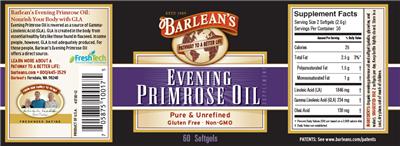
The label details for Evening Primrose Oil by Barlean's, sourced from the NIH Dietary Supplement Label Database.
Supplement Facts
| Ingredient | Amount | % DV |
|---|---|---|
| Calories | 25 Calorie(s) | -- |
| Total Fat | 2.5 Gram(s) | 3% |
| Polyunsaturated Fat | 1.5 Gram(s) | -- |
| Monounsaturated Fat | 1 Gram(s) | -- |
| Gamma-Linolenic Acid | 234 mg | -- |
| Linoleic Acid | 1846 mg | -- |
| Oleic Acid | 130 mg | -- |
Other ingredients: organic Evening Primrose Oil, Softgel
Tap any ingredient to jump to its full detail below.
These statements are the manufacturer’s wording, reproduced from the product label — the label is saying it, not HelloPharmacist. We don’t verify or endorse them.
Formula
Barlean's Evening Primrose Oil: Nourish Your Body with GLA Evening Primrose Oil is revered as a source of Gamma-Linolenic Acid (GLA). GLA is created in the body from essential healthy fats like those found in flaxseed. In some people, however, GLA is not adequately produced. For those people, Barlean's Evening Primrose Oil offers a direct source.
Pure & Unrefined
Formulation
FreshTech Patented Softgel Technology
Product of U.S.A.
Gluten Free Non-GMO
General Statements
Learn more about a Pathway to a Better Life:
From our family to yours Barbara Barlean David Barlean Bruce Barlean
ESTD 1989 Barlean's Pathway To A Better Life
FDA Statement of Identity
Evening Primrose Oil Supplement
Brand IP Statement(s)
Patents: See www.barleans.com/patents
Suggested/Recommended/Usage/Directions
Suggested Use: 2 Softgels per day.
Storage
Keep bottle tightly closed. Store in a cool, dry place, out of reach of children.
Precautions
Store in a cool, dry place, out of reach of children.
Is this label outdated? Report a formula or label change and our pharmacy team will review it.
Evening Primrose Oil by Barlean's label
The label scan from the NIH Dietary Supplement Label Database. Tap to enlarge.
Label images are published by the NIH Dietary Supplement Label Database for the version of this product on file. Always read your actual product label.
View the full label (PDF)The Ingredients in Evening Primrose Oil by Barlean's
These are the 3 active ingredients this product is made of. Select any to open its full monograph.
Serving size2 Softgel(s) Dosage formSoftgel Capsule Servings per container30 Amounts shown are per serving.
Most supplement products combine several ingredients, and a medication can interact with the product through any one of them. Each ingredient below shows whether it has known drug interactions.
Gamma-Linolenic Acid
Linoleic Acid
Oleic Acid
Interacts with86 drugs
Oleic acid is a heart-healthy monounsaturated fat found mainly in olive oil, canola oil, avocados, and nuts. As part of a Mediterranean-style diet, it...
Oleic Acid monograph & interactionsOther (inactive) ingredients: Organic Evening Primrose Oil, Softgel. These complete the product’s ingredient list but are not active constituents.
Evening Primrose Oil by Barlean's Drug Interactions
HelloPharmacist Interaction Report
Barlean's Evening Primrose Oil contains five active ingredients, and we could not check four of them — polyunsaturated fat, monounsaturated fat, gamma-linolenic acid, and linoleic acid — because we hold no interaction data for them.
However, oleic acid, one of the ingredients present, does have a documented interaction with antidiabetes drugs (blood sugar medications). Oleic acid may increase how well these drugs work, which could lower your blood sugar more than expected.
Read the full breakdown — every affected drug type, severity by severity
The interaction with antidiabetes drugs is rated Moderate severity. If you take any medication to manage diabetes — whether insulin, metformin, sulfonylureas, or another type — you'll want to check with your doctor or pharmacist before starting this product.
They can help you figure out if a dose adjustment or closer blood sugar monitoring might be needed.
For the four ingredients we couldn't check, we simply don't have monographs on file, so we can't speak to their interaction profile. That doesn't mean they interact with nothing — it means our data is incomplete for them.
Altogether, these interactions span 86 individual medications. Run your exact medications through the search tool on this page to see if any of yours are affected.
Check your own medications below · Editorial policy · How we use AI
Want to check YOUR meds against Evening Primrose Oil?
Ask about interactions with your drugs in plain English — “Can I take it with lisinopril?” — and we find you the answer in seconds, ingredient by ingredient.
Go to the checkerIngredients driving the most interactions
Individual Drug Interactions
The ingredients in Evening Primrose Oil interact with 86 drugs. Click any drug to see the details.
1 of the 3 ingredients in Evening Primrose Oil interact with drugs. Each result below shows which ingredient is responsible. Oleic Acid
AcarboseGlucobay, Prandase, Precose
How Acarbose interacts with Evening Primrose Oil — through 1 ingredient. Tap an ingredient for the detail:
Oleic AcidAntidiabetes Drugs Moderate
Interaction Summary
Theoretically, oleic acid might increase the effects of antidiabetes drugs.
Read the full Oleic Acid + Acarbose interactionAcetohexamideDymelor
How Acetohexamide interacts with Evening Primrose Oil — through 1 ingredient. Tap an ingredient for the detail:
Oleic AcidAntidiabetes Drugs Moderate
Interaction Summary
Theoretically, oleic acid might increase the effects of antidiabetes drugs.
Read the full Oleic Acid + Acetohexamide interactionAlbiglutideTanzeum
How Albiglutide interacts with Evening Primrose Oil — through 1 ingredient. Tap an ingredient for the detail:
Oleic AcidAntidiabetes Drugs Moderate
Interaction Summary
Theoretically, oleic acid might increase the effects of antidiabetes drugs.
Read the full Oleic Acid + Albiglutide interactionAlogliptinNesina
How Alogliptin interacts with Evening Primrose Oil — through 1 ingredient. Tap an ingredient for the detail:
Oleic AcidAntidiabetes Drugs Moderate
Interaction Summary
Theoretically, oleic acid might increase the effects of antidiabetes drugs.
Read the full Oleic Acid + Alogliptin interactionAlogliptin, MetforminKazano
How Alogliptin, Metformin interacts with Evening Primrose Oil — through 1 ingredient. Tap an ingredient for the detail:
Oleic AcidAntidiabetes Drugs Moderate
Interaction Summary
Theoretically, oleic acid might increase the effects of antidiabetes drugs.
Read the full Oleic Acid + Alogliptin, Metformin interactionAlogliptin, PioglitazoneOseni
How Alogliptin, Pioglitazone interacts with Evening Primrose Oil — through 1 ingredient. Tap an ingredient for the detail:
Oleic AcidAntidiabetes Drugs Moderate
Interaction Summary
Theoretically, oleic acid might increase the effects of antidiabetes drugs.
Read the full Oleic Acid + Alogliptin, Pioglitazone interactionAntidiabetes, Dipeptidyl Peptidase-4 (dpp-iv) InhibitorGlyxambi
How Antidiabetes, Dipeptidyl Peptidase-4 (dpp-iv) Inhibitor interacts with Evening Primrose Oil — through 1 ingredient. Tap an ingredient for the detail:
Oleic AcidAntidiabetes Drugs Moderate
Interaction Summary
Theoretically, oleic acid might increase the effects of antidiabetes drugs.
Read the full Oleic Acid + Antidiabetes, Dipeptidyl Peptidase-4 (dpp-iv) Inhibitor interactionCanagliflozinInvokana
How Canagliflozin interacts with Evening Primrose Oil — through 1 ingredient. Tap an ingredient for the detail:
Oleic AcidAntidiabetes Drugs Moderate
Interaction Summary
Theoretically, oleic acid might increase the effects of antidiabetes drugs.
Read the full Oleic Acid + Canagliflozin interactionCanagliflozin, MetforminInvokamet
How Canagliflozin, Metformin interacts with Evening Primrose Oil — through 1 ingredient. Tap an ingredient for the detail:
Oleic AcidAntidiabetes Drugs Moderate
Interaction Summary
Theoretically, oleic acid might increase the effects of antidiabetes drugs.
Read the full Oleic Acid + Canagliflozin, Metformin interactionCanagliflozin, Metformin HydrochlorideInvokamet XR
How Canagliflozin, Metformin Hydrochloride interacts with Evening Primrose Oil — through 1 ingredient. Tap an ingredient for the detail:
Oleic AcidAntidiabetes Drugs Moderate
Interaction Summary
Theoretically, oleic acid might increase the effects of antidiabetes drugs.
Read the full Oleic Acid + Canagliflozin, Metformin Hydrochloride interactionChlorpropamideChlorpropam, Diabinese
How Chlorpropamide interacts with Evening Primrose Oil — through 1 ingredient. Tap an ingredient for the detail:
Oleic AcidAntidiabetes Drugs Moderate
Interaction Summary
Theoretically, oleic acid might increase the effects of antidiabetes drugs.
Read the full Oleic Acid + Chlorpropamide interactionDapagliflozinFarxiga
How Dapagliflozin interacts with Evening Primrose Oil — through 1 ingredient. Tap an ingredient for the detail:
Oleic AcidAntidiabetes Drugs Moderate
Interaction Summary
Theoretically, oleic acid might increase the effects of antidiabetes drugs.
Read the full Oleic Acid + Dapagliflozin interactionDapagliflozin Propanediol, MetforminXigduo XR
How Dapagliflozin Propanediol, Metformin interacts with Evening Primrose Oil — through 1 ingredient. Tap an ingredient for the detail:
Oleic AcidAntidiabetes Drugs Moderate
Interaction Summary
Theoretically, oleic acid might increase the effects of antidiabetes drugs.
Read the full Oleic Acid + Dapagliflozin Propanediol, Metformin interactionDapagliflozin Propanediol, Saxagliptin HydrochlorideQtern
How Dapagliflozin Propanediol, Saxagliptin Hydrochloride interacts with Evening Primrose Oil — through 1 ingredient. Tap an ingredient for the detail:
Oleic AcidAntidiabetes Drugs Moderate
Interaction Summary
Theoretically, oleic acid might increase the effects of antidiabetes drugs.
Read the full Oleic Acid + Dapagliflozin Propanediol, Saxagliptin Hydrochloride interactionDapagliflozin, Metformin Hydrochloride, Saxagliptin HydrochlorideQternmet XR
How Dapagliflozin, Metformin Hydrochloride, Saxagliptin Hydrochloride interacts with Evening Primrose Oil — through 1 ingredient. Tap an ingredient for the detail:
Oleic AcidAntidiabetes Drugs Moderate
Interaction Summary
Theoretically, oleic acid might increase the effects of antidiabetes drugs.
Read the full Oleic Acid + Dapagliflozin, Metformin Hydrochloride, Saxagliptin Hydrochloride interactionDasiglucagon HydrochlorideZegalogue
How Dasiglucagon Hydrochloride interacts with Evening Primrose Oil — through 1 ingredient. Tap an ingredient for the detail:
Oleic AcidAntidiabetes Drugs Moderate
Interaction Summary
Theoretically, oleic acid might increase the effects of antidiabetes drugs.
Read the full Oleic Acid + Dasiglucagon Hydrochloride interactionDulaglutideTrulicity
How Dulaglutide interacts with Evening Primrose Oil — through 1 ingredient. Tap an ingredient for the detail:
Oleic AcidAntidiabetes Drugs Moderate
Interaction Summary
Theoretically, oleic acid might increase the effects of antidiabetes drugs.
Read the full Oleic Acid + Dulaglutide interactionEmpagliflozinJardiance
How Empagliflozin interacts with Evening Primrose Oil — through 1 ingredient. Tap an ingredient for the detail:
Oleic AcidAntidiabetes Drugs Moderate
Interaction Summary
Theoretically, oleic acid might increase the effects of antidiabetes drugs.
Read the full Oleic Acid + Empagliflozin interactionEmpagliflozin, Linagliptin, Metformin HydrochlorideTrijardy XR
How Empagliflozin, Linagliptin, Metformin Hydrochloride interacts with Evening Primrose Oil — through 1 ingredient. Tap an ingredient for the detail:
Oleic AcidAntidiabetes Drugs Moderate
Interaction Summary
Theoretically, oleic acid might increase the effects of antidiabetes drugs.
Read the full Oleic Acid + Empagliflozin, Linagliptin, Metformin Hydrochloride interactionEmpagliflozin, MetforminSynjardy
How Empagliflozin, Metformin interacts with Evening Primrose Oil — through 1 ingredient. Tap an ingredient for the detail:
Oleic AcidAntidiabetes Drugs Moderate
Interaction Summary
Theoretically, oleic acid might increase the effects of antidiabetes drugs.
Read the full Oleic Acid + Empagliflozin, Metformin interactionEmpagliflozin, Metformin HydrochlorideSynjardy XR
How Empagliflozin, Metformin Hydrochloride interacts with Evening Primrose Oil — through 1 ingredient. Tap an ingredient for the detail:
Oleic AcidAntidiabetes Drugs Moderate
Interaction Summary
Theoretically, oleic acid might increase the effects of antidiabetes drugs.
Read the full Oleic Acid + Empagliflozin, Metformin Hydrochloride interactionErtugliflozinSteglatro
How Ertugliflozin interacts with Evening Primrose Oil — through 1 ingredient. Tap an ingredient for the detail:
Oleic AcidAntidiabetes Drugs Moderate
Interaction Summary
Theoretically, oleic acid might increase the effects of antidiabetes drugs.
Read the full Oleic Acid + Ertugliflozin interactionErtugliflozin, Metformin HydrochlorideSegluromet
How Ertugliflozin, Metformin Hydrochloride interacts with Evening Primrose Oil — through 1 ingredient. Tap an ingredient for the detail:
Oleic AcidAntidiabetes Drugs Moderate
Interaction Summary
Theoretically, oleic acid might increase the effects of antidiabetes drugs.
Read the full Oleic Acid + Ertugliflozin, Metformin Hydrochloride interactionExenatideBydureon, Byetta
How Exenatide interacts with Evening Primrose Oil — through 1 ingredient. Tap an ingredient for the detail:
Oleic AcidAntidiabetes Drugs Moderate
Interaction Summary
Theoretically, oleic acid might increase the effects of antidiabetes drugs.
Read the full Oleic Acid + Exenatide interactionExenatide SyntheticBydureon BCISE
How Exenatide Synthetic interacts with Evening Primrose Oil — through 1 ingredient. Tap an ingredient for the detail:
Oleic AcidAntidiabetes Drugs Moderate
Interaction Summary
Theoretically, oleic acid might increase the effects of antidiabetes drugs.
Read the full Oleic Acid + Exenatide Synthetic interactionGliclazideDiamicron
How Gliclazide interacts with Evening Primrose Oil — through 1 ingredient. Tap an ingredient for the detail:
Oleic AcidAntidiabetes Drugs Moderate
Interaction Summary
Theoretically, oleic acid might increase the effects of antidiabetes drugs.
Read the full Oleic Acid + Gliclazide interactionGlimepirideAmaryl
How Glimepiride interacts with Evening Primrose Oil — through 1 ingredient. Tap an ingredient for the detail:
Oleic AcidAntidiabetes Drugs Moderate
Interaction Summary
Theoretically, oleic acid might increase the effects of antidiabetes drugs.
Read the full Oleic Acid + Glimepiride interactionGlipizideGlucotrol, Glucotrol XL
How Glipizide interacts with Evening Primrose Oil — through 1 ingredient. Tap an ingredient for the detail:
Oleic AcidAntidiabetes Drugs Moderate
Interaction Summary
Theoretically, oleic acid might increase the effects of antidiabetes drugs.
Read the full Oleic Acid + Glipizide interactionGlipizide, MetforminMetaglip
How Glipizide, Metformin interacts with Evening Primrose Oil — through 1 ingredient. Tap an ingredient for the detail:
Oleic AcidAntidiabetes Drugs Moderate
Interaction Summary
Theoretically, oleic acid might increase the effects of antidiabetes drugs.
Read the full Oleic Acid + Glipizide, Metformin interactionGlucagonBaqsimi, Glucagon
How Glucagon interacts with Evening Primrose Oil — through 1 ingredient. Tap an ingredient for the detail:
Oleic AcidAntidiabetes Drugs Moderate
Interaction Summary
Theoretically, oleic acid might increase the effects of antidiabetes drugs.
Read the full Oleic Acid + Glucagon interactionEach ingredient & the kinds of drugs it affects
For each ingredient in Evening Primrose Oil with known interactions, here are the types of medications it can affect. Open any type for the detail — or search your exact drug in the checker above.
Oleic Acid
Antidiabetes Drugs
Theoretically, oleic acid might increase the effects of antidiabetes drugs. Preliminary clinical research in patients with type 2 diabetes taking oral hypoglycemic drugs shows that eating a diet rich in oleic acid from olive oil decreases fasting blood glucose levels when compared to eating a diet rich in linoleic acid from sunflower oil. It is unknown if taking oleic acid supplements would have this effect or if this change is clinically significant. Until more is known, use caution. Dose adjustment may be necessary. Some antidiabetes drugs include glimepiride (Amaryl), glyburide (DiaBeta, Glynase PresTab, Micronase), insulin, metformin (Glucophage), pioglitazone (Actos), rosiglitazone (Avandia), and others.
Brand information
Manufacturer and brand details for Evening Primrose Oil, from the product label.
Barlean's
See all Barlean's products- Name
- Barlean's
- City
- Ferndale
- State
- WA
- ZipCode
- 98248
- Phone Number
- 800-445-3529
- Web Address
- barleans.com
Evening Primrose Oil by Barlean's: Common Questions
Does Evening Primrose Oil by Barlean's interact with any medications?
How can one product interact with so many drugs?
Where does this information come from?
Does evening primrose oil from Barlean's actually work?
Can I take this if I'm pregnant or breastfeeding?
What is oleic acid, and why is it in here?
Will this product lower my blood sugar if I take diabetes medication?
Are there any fillers or other ingredients I should know about?
Written and reviewed by the HelloPharmacist editorial staff. Our editorial policy
Not sure if Evening Primrose Oil is safe with your meds?
Our pharmacists answer your medication & supplement questions — free.
Label information is sourced from the NIH Dietary Supplement Label Database and reflects the product version on file; always read your actual product label. This page is for education only and is not a substitute for professional medical advice. Confirm with your pharmacist or doctor before combining supplements and medications.
The Full Monographs Behind Evening Primrose Oil’s Ingredients
Every ingredient we hold a full HelloPharmacist monograph for — uses, evidence, safety, and the complete interaction list.
Sources & How We Checked
Evening Primrose Oil's label data comes from the NIH Dietary Supplement Label Database; the ingredient interaction data is from the Natural Medicines database, reviewed by our pharmacists.
- NIH Dietary Supplement Label Database (DSLD) — The official product label on file for this supplement.
- Natural Medicines (Therapeutic Research Center) — Evidence-graded clinical reference behind the ingredient interaction data.
Content is written and reviewed by licensed HelloPharmacist pharmacists. See our data sources and editorial standards for how this information is built and checked.
The 19 references behind this product’s interaction data
Every citation that drives the interaction findings for this product’s ingredients, from the evidence-graded Natural Medicines (TRC Healthcare) database. Open an ingredient to browse its citations — links open the study on PubMed or the publisher’s site.
Oleic Acid 19 references
- Madigan C, Ryan M, Owens D, et al. Dietary unsaturated fatty acids in type 2 diabetes: higher levels of postprandial lipoprotein on a linoleic acid-rich sunflower oil diet compared with an oleic acid-rich olive oil diet. Diabetes Care 2000;23:1472-7. PubMed
- Gillingham, L. G., Gustafson, J. A., Han, S. Y., Jassal, D. S., and Jones, P. J. High-oleic rapeseed (canola) and flaxseed oils modulate serum lipids and inflammatory biomarkers in hypercholesterolaemic subjects. Br J Nutr 2011;105(3):417-427. PubMed
- Jones PJ, Senanayake VK, Pu S, Jenkins DJ, Connelly PW, Lamarche B, Couture P, Charest A, Baril-Gravel L, West SG, Liu X, Fleming JA, McCrea CE, Kris-Etherton PM. DHA-enriched high-oleic acid canola oil improves lipid profile and lowers predicted cardiova
- Cater, N. B., Heller, H. J., and Denke, M. A. Comparison of the effects of medium-chain triacylglycerols, palm oil, and high oleic acid sunflower oil on plasma triacylglycerol fatty acids and lipid and lipoprotein concentrations in humans. Am.J Clin.Nutr PubMed
- Mozaffarian D, Clarke R. Quantitative effects on cardiovascular risk factors and coronary heart disease risk of replacing partially hydrogenated vegetable oils with other fats and oils. Eur J Clin Nutr. 2009;63(Suppl 2):S22-33. PubMed
- Cao Y, Hou L, Wang W. Dietary total fat and fatty acids intake, serum fatty acids and risk of breast cancer: A meta-analysis of prospective cohort studies. Int J Cancer. 2016;138(8):1894-904. doi: 10.1002/ijc.29938. PubMed
- FDA completes review of qualified health claim petition for oleic acid and the risk of coronary heart disease. November 2018. Available at: www.fda.gov/Food/NewsEvents/ConstituentUpdates/ucm624758.htm. Accessed January 25, 2019.
- Liu X, Kris-Etherton PM, West SG, et al. Effects of canola and high-oleic-acid canola oils on abdominal fat mass in individuals with central obesity. Obesity. 2016;24(11):2261-2268. PubMed
- Bowen KJ, Kris-Etherton PM, West SG, et al. Diets enriched with conventional or high-oleic acid canola oils lower atherogenic lipids and lipoproteins compared to a diet with a western fatty acid profile in adults with central adiposity. J Nutr. 2019;149(3 PubMed
- Steffen BT, Duprez D, Szklo M, Guan W, Tsai MY. Circulating oleic acid levels are related to greater risks of cardiovascular events and all-cause mortality: The Multi-Ethnic Study of Atherosclerosis. J Clin Lipidol. 2018;12(6):1404-1412. PubMed
- Banim PJ, Luben R, Khaw KT, Hart AR. Dietary oleic acid is inversely associated with pancreatic cancer - Data from food diaries in a cohort study. Pancreatology. 2018;18(6):655-660. PubMed
- Morin SJ, Gaziano JM, Djoussé L. Relation between plasma phospholipid oleic acid and risk of heart failure. Eur J Nutr. 2018;57(8):2937-2942. PubMed
- Samieri C, Féart C, Proust-Lima C, et al. Olive oil consumption, plasma oleic acid, and stroke incidence: the Three-City Study. Neurology. 2011;77(5):418-25. PubMed
- Compher CW, Kinosian BP, Rubesin SE, Ratcliffe SJ, Metz DC. Energy absorption is reduced with oleic acid supplements in human short bowel syndrome. JPEN J Parenter Enteral Nutr. 2009;33(1):102-8. PubMed
- Ben Fradj MK, Ouanes Y, Hadj-Taieb S, et al. Decreased oleic acid and marine n?-?3 polyunsaturated fatty acids in Tunisian patients with urothelial bladder cancer. Nutr Cancer. 2018;70(7):1043-1050.
- de Silva PS, Luben R, Shrestha SS, Khaw KT, Hart AR. Dietary arachidonic and oleic acid intake in ulcerative colitis etiology: a prospective cohort study using 7-day food diaries. Eur J Gastroenterol Hepatol. 2014;26(1):11-8. PubMed
- Higashi K, Shige H, Ito T, et al. Effect of a low-fat diet enriched with oleic acid on postprandial lipemia in patients with type 2 diabetes mellitus. Lipids. 2001;36(1):1-6. PubMed
- Lin HC, van Citters GW, Heimer F, Bonorris G. Slowing of gastrointestinal transit by oleic acid: a preliminary report of a novel, nutrient-based treatment in humans. Dig Dis Sci. 2001;46(2):223-9. PubMed
- Li D, Tong Y, Li Y. Associations between dietary oleic acid and linoleic acid and depressive symptoms in perimenopausal women: The Study of Women's Health Across the Nation. Nutrition. 2020 Mar;71:110602. PubMed
Parts of this content are provided by the Therapeutic Research Center, LLC.
DISCLAIMER: Currently this does not check for drug-drug interactions. This is not an all-inclusive comprehensive list of potential interactions and is for informational purposes only. Not all interactions are known or well-reported in the scientific literature, and new interactions are continually being reported. Input is needed from a qualified healthcare provider including a pharmacist before starting any therapy. Application of clinical judgment is necessary.
© 2021 Therapeutic Research Center, LLC