
Extreme Instant EAA Watermelon Flavour by Body Attack Ingredients, Side Effects and Drug Interactions
Dietary Supplement Powder Other Combinations
UPC 4 250350 537312 Match it to the barcode on your bottle

Medically reviewed by Dr. Brian Staiger, PharmD, BCPS
Also reviewed by the HelloPharmacist Editorial Team
Updated Details about this page
- Label on file from the NIH Dietary Supplement Label Database, dated Sep 25, 2025.
- The interaction, evidence and safety records come from the Natural Medicines database, which we license, read against this label by our own system; the pharmacy team’s sections are written from those records.
- Dr. Brian Staiger, PharmD, BCPS, is a clinical pharmacist and pharmacotherapy specialist.
- Editorial policy Our sources
AI is used only to summarize verified clinical information, never the open internet. Our AI policy
Summary: The HelloPharmacist Team’s Take
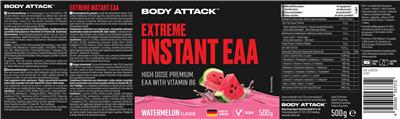
- Form
- Powder
- Serving Size
- 14 g
- Servings
- 35 per container
- Container Holds
- 500 g
What’s in it, whether it interacts with your drugs, its side effects, whether it works, and what our pharmacists would want you to know before you start it.
- What it isA supplement from Body Attack with 13 active ingredients, in powder form.
- Active Ingredients 1 vitamin, 8 amino acids, 1 fatty acid, 1 fat or oil and 2 others: Fat 0.1 gSaturated Fatty Acids 0.1 gSalt 0.01 gVitamin B6 0.5 mgL-Lysine 1.5 mgL-Phenylalanine 1.005 mgL-Threonine 900 mgL-Methionine 900 mgL-Tryptophan 240 mgL-Leucine 2458 mgL-Isoleucine 1229 mgL-Valine 1229 mg 13 active ingredients. Each one can interact with drugs or cause side effects on its own, so we check every one. And 1 more, in the Supplement Facts
- Drug Interactions 579 drugs have a documented interaction with this supplement; the most serious is rated major. Of those, 339 are single drugs and 240 are combination products (two or more drugs in one), each listed under its own name. Based on the 6 of its 13 ingredients we could check. Ask your pharmacist first if you take a drug in any of these categories, the most serious of the 11 on record:
- Major · 248 drugs
- Major · 5 drugs
- Nmda AntagonistsMajor · 3 drugs
- Moderate · 184 drugs
- Possible Side EffectsNausea 6 ingredientsDrowsiness 3 ingredientsHeadache 3 ingredientsHeartburn 2 ingredientsUpset stomach 2 ingredientsVomiting 2 ingredients +12 moreCombined from six of its 13 active ingredients. Not studied in this exact product.
- Well documented Why
Does Extreme Instant EAA Watermelon Flavour work?
Moderate This product doesn't appear to be marketed for a specific use, so we graded its ingredients' overall clinical evidence instead.It is not marketed for one specific use, so this is what its ingredients have been studied for, strongest research first:
- Vitamin B6 deficiency Vitamin B6
- Hyperhomocysteinemia Vitamin B6
- Neural tube birth defects Methionine
- Lysine
- Phenylalanine
- Vitamin B6
These grades are for each ingredient, not this exact product, and never a promise it will work for you.
And 3 more graded uses, in what the research says- Full Why
- AllergensNone of its ingredient names point to a major food allergen
- Barcode (UPC)4 250350 537312Match it to the barcode on your bottle to be sure this is your product. Not your product? Search for it here
Who Might Consider It
- People who want it for vitamin B6 deficiency, hyperhomocysteinemia, neural tube birth defects, herpes labialis (cold sores) or another graded use: the uses with research behind them. See each grade
- This product may suit people who are looking at an amino acid powder and have already checked their medications.
Who Should Be Careful
- Be extra careful if you take levodopa, CNS depressants, NMDA antagonists, MAOIs, serotonergic drugs, or blood pressure medicines, or if you are pregnant or have PKU.
- Talk it over with your own doctor or pharmacist before you start.
More Before You Take It Show both answersHide Pregnancy and Breastfeeding The Label’s Directions
-
Pregnant or breastfeeding?
- Pregnancy Phenylalanine
- ! When L-phenylalanine is consumed in amounts typically found in foods by pregnant patients with high serum phenylalanine concentrations, such as those with phenylketonuria (PKU).
- Breastfeeding Phenylalanine
- When L-phenylalanine is consumed in amounts typically found in foods by breast-feeding patients with normal phenylalanine metabolism.
- Pregnancy Vitamin B6
- ! When used orally in excessive doses.
- Breastfeeding Vitamin B6
- When used orally in doses not exceeding the tolerable upper intake level (UL) of vitamin B6 in the form of pyridoxine 80 mg daily for those aged 14-18 years and 100 mg daily for those 19 years and older.
- Pregnancy L-Tryptophan
- ! When used orally in medicinal amounts because it may cause respiratory depression in utero.
- Breastfeeding L-Tryptophan
- When used orally in amounts commonly found in foods.
-
How does the label say to take it?
“Recommended dosage: On training days, mix 14 g (1 scoop) in 350 mL cold water and consume before, during or after training once a day. On non-training days one serving in the morning. …”
The maker’s words. Your pharmacist or doctor may advise differently.
Everything the label says
From the label dated Sep 25, 2025: 6 of its 13 active ingredients were checked against our records; the other seven are not in them yet. A summary of what is known, not a grade or a test of the product. How these ratings are computed
Ask Anything About This Supplement
Name a drug you take, or ask about side effects, ingredients or pregnancy.
AI answers come from this label and our own records, never the open internet. AI can make mistakes, so always check with your doctor or pharmacist. How we use AI
Ask the Pharmacist
A licensed pharmacist will answer your question by email — free, usually within 24 hours.
Got it — thank you!
A licensed pharmacist will answer within 24 hours. Keep an eye on your email (worth checking spam, just in case).
What’s Inside Extreme Instant EAA Watermelon Flavour by Body Attack
13 Active Ingredients, Each Checked on Its Own
A supplement is often several ingredients in one bottle, and each one can interact with drugs or cause side effects on its own. We check every one of them against our records.
- FatNot in our interaction records yet
- Saturated Fatty AcidsNot in our interaction records yet
- SaltNot in our interaction records yet
- Vitamin B6Drug interactions on record, most serious: Moderate
- L-LysineNo drug interactions on record
- L-PhenylalanineDrug interactions on record, most serious: Major
- L-ThreonineDrug interactions on record, most serious: Major
- L-MethionineNo drug interactions on record
And 5 more, each with its own card below.
Why this rating?
The label gives an exact amount for every one of its 13 active ingredients, so you know how much of each you get in each serving. This rates what the label tells you, not the quality of the product.
Supplement Facts
| Amount Per Serving | % Daily Value | |
|---|---|---|
| Energy | 52 Kcals | † |
| Fat | 0.1 g | † |
| Saturated Fatty Acids | 0.1 g | † |
| Carbohydrate | 2 g | † |
| Sugar | 0.3 g | † |
| Protein | 9.5 g | † |
| Salt | 0.01 g | † |
| Vitamin B6 | 0.5 mg | 35% |
| L-Lysine | 1.5 mg | † |
| L-Phenylalanine | 1.005 mg | † |
| L-Threonine | 900 mg | † |
| L-Methionine | 900 mg | † |
| L-Tryptophan | 240 mg | † |
| L-Leucine | 2458 mg | † |
| L-Isoleucine | 1229 mg | † |
| L-Valine | 1229 mg | † |
| Total Essential Amino Acids | 9461 mg | † |
Other ingredients: L-Leucine, Citric Acid, L-Lysine Hydrochloride, Maltodextrin, L-Phenylalanine, L-Methionine, L-Threonine, Flavoring, L-Tryptophan, Acesulfame Potassium, Sucralose, Anthocyanin, Silicon Dioxide, Coconut, Palm, Lecithin
† Daily Value not established.
Daily Values for adults and children 4 or more years of age.
As the label prints it, from the NIH Dietary Supplement Label Database.
Each Ingredient and Its Drug Interactions
Tap one for more about it and its full guide. A drug can interact with this supplement through any one of them.
This powder lists 13 active ingredients, including vitamin B6 and a group of amino acids: L-methionine, L-phenylalanine, L-lysine, L-threonine, L-tryptophan, L-isoleucine, L-valine, and L-leucine.
- It also lists fat, saturated fatty acids, salt, and total essential amino acids as active ingredients.
-
Fat 0.1 g We know this ingredient, but hold no drug interaction record for it yet, so it was not checked
-
Saturated Fatty Acids 0.1 g We know this ingredient, but hold no drug interaction record for it yet, so it was not checked
-
Salt 0.01 g We know this ingredient, but hold no drug interaction record for it yet, so it was not checked
-
Vitamin B6 0.5 mg Interacts with 210 drugs
Vitamin B6 (pyridoxine) is an essential water-soluble vitamin that your body needs for metabolism, brain function, and making red blood cells.
- It is best known for helping with pregnancy-related nausea and may help some people with PMS, but taking very high doses for long periods can cause nerve damage.
- Get most of your B6 from food, and check with a pharmacist or doctor before taking high-dose supplements.
The full Vitamin B6 guide: uses, dosage and safety Every Vitamin B6 drug interaction
-
L-Lysine 1.5 mg Several amino acids also appear in the inactive list, including L-lysine hydrochloride. Interacts with 1 drug
Lysine is an essential amino acid your body cannot make on its own, so it must come from food or supplements.
- People most often take extra lysine to try to prevent or shorten cold sores, but the evidence is mixed and far from conclusive.
- For most healthy people who eat enough protein, supplements are likely unnecessary, but they are generally considered low-risk at typical doses.
The full Lysine guide: uses, dosage and safety Every Lysine drug interaction
-
L-Phenylalanine 1.005 mg Interacts with 16 drugs
Phenylalanine is an essential amino acid the body uses to make brain chemicals like dopamine and norepinephrine.
- Some people take it for mood, vitiligo, or pain, but the evidence is mostly limited or mixed.
- People with the genetic condition PKU must strictly avoid it.
The full Phenylalanine guide: uses, dosage and safety Every Phenylalanine drug interaction
-
L-Threonine 900 mg Interacts with 3 drugs
Threonine is an essential amino acid your body needs but cannot make, so you must get it from food or supplements.
- Most people get plenty from a normal diet, and high-quality evidence for taking it as a separate supplement is limited.
- If you are considering threonine supplements, talk with your pharmacist or doctor first.
The full Threonine guide: uses, dosage and safety Every Threonine drug interaction
-
L-Methionine 900 mg No known drug interactions
Methionine is an essential amino acid that your body needs for protein building and many basic chemical reactions.
- Most people get enough from a normal diet, and supplements are generally not needed unless directed by a healthcare provider.
- High doses can cause side effects, so talk to your pharmacist or doctor before using methionine supplements.
-
L-Tryptophan 240 mg Interacts with 394 drugs
L-tryptophan is an essential amino acid the body uses to make serotonin and melatonin, and people take it to support sleep and mood.
- The evidence for supplement use is limited and mixed, and there are real safety concerns, so talk to a pharmacist or doctor before trying it.
The full L-Tryptophan guide: uses, dosage and safety Every L-Tryptophan drug interaction
-
L-Leucine 2458 mg We know this ingredient, but hold no drug interaction record for it yet, so it was not checked
-
L-Isoleucine 1229 mg We know this ingredient, but hold no drug interaction record for it yet, so it was not checked
-
L-Valine 1229 mg We know this ingredient, but hold no drug interaction record for it yet, so it was not checked
-
Total Essential Amino Acids 9461 mg A blend: its ingredients are checked one by one where the label lists them
Other Ingredients (Inactive)
The capsule or tablet itself, fillers, coatings and flavors. Not part of the drug interaction check; the allergen check below reads them.
- L-Leucine
- Citric Acid
- L-Lysine Hydrochloride
- Maltodextrin
- L-Phenylalanine
- L-Methionine
- L-Threonine
- Flavoring
- L-Tryptophan
- Acesulfame Potassium
- Sucralose
- Anthocyanin
- Silicon Dioxide
- Coconut
- Palm
- Lecithin
Allergens in Extreme Instant EAA Watermelon Flavour
None of its ingredient names point to a major food allergen.
Not named in the ingredients
- Milk
- Egg
- Fish
- Shellfish
- Tree nuts
- Peanuts
- Wheat or other gluten grains
- Soy
- Sesame
- Made without, the label says“V Vegan”
- Made without, the label says“Sugar free · Lactose free”
From the label text and ingredient names on file; we do not test products. With a serious allergy, check your bottle and ask the maker or your pharmacist.
What the Label Says
The maker’s own words, from the label. We do not verify or endorse them.
- Directions
-
“Recommended dosage: On training days, mix 14 g (1 scoop) in 350 mL cold water and consume before, during or after training once a day. On non-training days one serving in the morning. Note: For a better solubility shake for 30 seconds in a shaker.”
- FDA Statement of Identity
-
“Food supplement with sweeteners.”
- Storage
-
“If kept unopened in a cool, dry place, best before end of/lot no.: see bottom. Once opened, consume quickly. Keep away from direct heat and light.”
- Seals and symbols
-
“Made in Germany”
- Formulation
-
“Sugar free Lactose free”
“Food supplement with sweeteners. Highly concentrated essential amino acids in powder form with vitamin B6. Flavour: Watermelon.”
“High dose premium EAA with vitamin B6”
- General statements
-
“%NRV % of Nutrient Reference Values”
The Extreme Instant EAA Watermelon Flavour Label on File
The label scan on file at the NIH Dietary Supplement Label Database, dated September 2025. Always read the label on the bottle you have.
Product Facts
- Brand
- Body Attack
- Barcode (UPC)
- 4250350537312
- Net contents
- 500 g
- Market status
- On market
- Date entered into DSLD
- Sep 25, 2025
- DSLD ID
- 334233
- Product type
- Other Combinations
- Supplement form
- Powder
- Dietary claims / uses
- Nutrient, All Other
- Intended target group(s)
- Vegan, Vegetarian, Adult (18 - 50 Years), Dairy Free, Sugar Free
Is this label outdated? Report a formula or label change and our pharmacy team will review it.
Extreme Instant EAA Watermelon Flavour by Body Attack Side Effects
Why this rating?
We look for three kinds of safety information on each ingredient: side effects reported in studies, a pregnancy and breastfeeding rating, and a safety write-up from our pharmacy team. All three are on file for each of the six ingredients we could check.
So this rates how much is known, not whether Extreme Instant EAA Watermelon Flavour is right for you.
Reported with six of its ingredients
- Most often
- Nausea, drowsiness, headache, heartburn, upset stomach and vomiting
- !Rare but serious
- Sensory neuropathy (high doses), liver cirrhosis and cerebral edema See details
HelloPharmacist Team Summary: Extreme Instant EAA Watermelon Flavour by Body Attack Side Effects
You may find this powder generally well tolerated, but the most likely side effects are nausea, stomach upset, and drowsiness, which have been reported with several of its amino acids.
- Drowsiness is worth noticing, so see how it affects you before driving.
- A rare but serious problem to know about is buildup of phenylalanine, which can cause brain damage, so call your doctor right away if you have unusual symptoms.
- Talk with your own doctor or pharmacist before starting if you have PKU, kidney or liver disease, or take medicines that affect serotonin or levodopa.
Side Effects, Ingredient by Ingredient
A supplement’s side effects come from its ingredients. Here is what is reported with each one.
Vitamin B6
Most reported
- Abdominal pain
- Allergic reactions
- Headache
- Heartburn
- Loss of appetite
- Nausea
- Somnolence
- Vomiting
From the Natural Medicines database, which we license.
Every reported effect, in the Vitamin B6 guideLysine
Most reported
- Stomach pain
- Nausea
- Diarrhea
Phenylalanine
Most reported
- Nausea
- Heartburn
- Headache
- Anxiety
Threonine
Most reported
- Nausea
- Upset stomach
- Headache
Methionine
Most reported
- Nausea
- Vomiting
- Drowsiness
- Irritability
L-Tryptophan
Most reported
- Drowsiness
- Nausea
- Stomach upset
- Dry mouth
Extreme Instant EAA Watermelon Flavour Warnings: Who Should Be Careful
Extreme Instant EAA Watermelon Flavour has 13 active ingredients, and each can carry warnings of its own. We checked the six in our ingredient guides, and each warning below names the ingredient it comes from. Fat, Saturated Fatty Acids and Salt and four more are not in our guides yet, so ask your pharmacist about them. If any of these apply to you, talk to your doctor or pharmacist before you start it.
- Vitamin B62 warnings below
- Lysine3 warnings below
- Phenylalanine3 warnings below
- Threonine2 warnings below
- Methionine3 warnings below
- L-Tryptophan2 warnings below
- FatNot in our guides yet
- Saturated Fatty AcidsNot in our guides yet
- SaltNot in our guides yet
- L-LeucineNot in our guides yet
- L-IsoleucineNot in our guides yet
- L-ValineNot in our guides yet
- Total Essential Amino AcidsNot in our guides yet
-
Blood Pressure
- PhenylalanineAnyone with high blood pressure should also use caution.
-
Liver Disease
- LysinePeople with kidney disease or liver disease should be cautious and talk to their doctor before using amino acid supplements, since these organs help process them.
- ThreoninePeople with kidney or liver disease should be cautious, because these organs process amino acids, and high amino acid loads may be harder for them to handle.
- MethionineThose with liver or kidney disease should also be careful and check with a doctor first.
- L-TryptophanPeople taking medicines that affect serotonin, those with liver or kidney problems, and anyone with a history of serotonin-related illness should be especially careful and check with a healthcare provider first.
-
Kidney Disease or Kidney Stones
- Vitamin B6People with kidney problems or other chronic conditions should talk to a clinician before using supplements.
-
Mental Health Conditions
- PhenylalaninePeople with certain mental health conditions, including schizophrenia or a history of mania, should be cautious because phenylalanine affects brain chemistry.
-
If You Take Other Drugs
- MethionineAlways talk with a pharmacist or doctor before starting methionine, especially if you take other medicines or have a health condition.
- L-TryptophanAlways talk to a pharmacist or doctor before starting it, especially if you take prescription medication.
-
Other Cautions
- Vitamin B6Avoid high doses.
- LysineTo be safe, avoid supplemental lysine unless your doctor recommends it.
- PhenylalaninePeople with phenylketonuria (PKU) must avoid phenylalanine.
- ThreonineIf you have any chronic health condition, check with your doctor or pharmacist before starting.
- MethioninePeople with certain inherited disorders that affect how the body handles amino acids (such as homocystinuria) should avoid methionine supplements.
-
What the Label Warns
- “Do not exceed the recommended daily dosage.”
- “Food supplements should not be used as a substitute for a varied and balanced diet and a healthy lifestyle.”
- “Keep out of reach of small children.”
The maker’s wording, from the product label.
-
Pregnant or Breastfeeding
Each ingredient’s rating for pregnancy and for breastfeeding, and what it covers.
Pregnancy
-
When L-phenylalanine is consumed in amounts typically found in foods by pregnant patients with normal phenylalanine metabolism.
-
When L-phenylalanine is consumed in amounts typically found in foods by pregnant patients with high serum phenylalanine concentrations, such as those with phenylketonuria (PKU).
Serum levels of phenylalanine greater than 360 micromol/L increase the risk of birth defects.
3 more points on this rating
- Experts recommend that patients with high phenylalanine serum concentrations follow a low phenylalanine diet for at least 20 weeks prior to conception to decrease the risk for birth defects.
- There is insufficient reliable information available about the safety of L-phenylalanine when taken by mouth in large doses during pregnancy; avoid using.
- There is insufficient reliable information available about the safety of oral D-phenylalanine during pregnancy; avoid using.
Breastfeeding
-
When L-phenylalanine is consumed in amounts typically found in foods by breast-feeding patients with normal phenylalanine metabolism.
There is insufficient reliable information available about the safety of L-phenylalanine when taken by mouth in medicinal amounts during lactation; avoid using.
There is insufficient reliable information available about the safety of oral D-phenylalanine during lactation; avoid using.
Pregnancy
-
When used orally and appropriately.
A special sustained-release product providing vitamin B6 (pyridoxine) 75 mg daily is FDA-approved for use in pregnancy.
3 more points on this rating
- Vitamin B6 (pyridoxine) is also considered a first-line treatment for nausea and vomiting in pregnancy by the American College of Obstetrics and Gynecology.
- However, it should not be used long-term or without medical supervision and close monitoring.
- The tolerable upper intake level (UL) refers to vitamin B6 in the form of pyridoxine and is 80 mg daily for those aged 14-18 years and 100 mg daily for 19 years and older.
-
When used orally in excessive doses.
There is some concern that high-dose maternal vitamin B6 (pyridoxine) can cause neonatal seizures.
Breastfeeding
-
When used orally in doses not exceeding the tolerable upper intake level (UL) of vitamin B6 in the form of pyridoxine 80 mg daily for those aged 14-18 years and 100 mg daily for those 19 years and older.
The recommended dietary allowance (RDA) in lactating women is 2 mg daily.
There is insufficient reliable information available about the safety of vitamin B6 when used in higher doses in breast-feeding women.
Show 4 more ingredients
Pregnancy
-
When used orally in amounts commonly found in foods.
-
When used orally in medicinal amounts because it may cause respiratory depression in utero.
Avoid using in amounts greater than those found in foods.
Breastfeeding
-
When used orally in amounts commonly found in foods.
There is insufficient reliable information available about the safety of larger medicinal amounts; avoid using.
Pregnancy and Breastfeeding The record rates both the same
-
Insufficient reliable information available; avoid using.
Pregnancy and Breastfeeding The record rates both the same
-
Insufficient reliable information available; avoid using.
Pregnancy and Breastfeeding The record rates both the same
-
When used orally in amounts commonly found in food.
There is insufficient reliable information available about the safety of methionine in medical doses during pregnancy and lactation; avoid using.
Our pharmacy team’s notes
- MethionineL-methionine is rated likely safe in pregnancy and lactation.
- The safety data advises against phenylalanine supplement doses in pregnancy.
Ratings and the words beside them are from the Natural Medicines database, which we license.
-
Rare but Serious Side Effects
-
!
Vitamin B6
Orally or by injection: Sensory neuropathy (high doses).
Orally: Liver cirrhosis, hepatocellular carcinoma (high doses of pyridoxal-5'-phosphate).
-
!
Phenylalanine
Buildup can cause serious harm, including brain damage.
For L-phenylalanine, buildup can cause serious harm, including brain damage, so people with phenylketonuria (PKU) must avoid it.
-
!
Threonine
Serious side effects are not well documented, but because high-dose, long-term use has not been carefully studied, unexpected effects are possible.
-
!
Methionine
Cerebral edema, hepatic encephalopathy. In infants, intravenous methionine has been linked to liver toxicity.
-
!
L-Tryptophan
More serious concerns include the possibility of too much serotonin activity, which can cause symptoms such as agitation, fast heartbeat, sweating, shivering, or confusion.
Orally: L-tryptophan has been associated with the neurological disorder eosinophilia-myalgia syndrome (EMS). However, almost all cases were traced to L-tryptophan produced by a single manufacturer in Japan and are likely related to contamination.
When to get help: a serious allergic reaction, with trouble breathing or swelling of the face, lips or throat, needs emergency care: call 911. For any other side effect that worries you, call your doctor or pharmacist.
These reports describe each ingredient, not studies of this exact product. Not medical advice: a side effect you notice after starting a supplement is worth a word with your pharmacist or doctor.
Extreme Instant EAA Watermelon Flavour by Body Attack Drug Interactions
We checked all 13 active ingredients in this supplement against every drug in our records. A drug can interact with it through any one of them. Seven of them are not in our interaction records yet.
A major interaction on record
3 of 3, on a scale from Minor or none to Major.Why this rating?
We rate this by the most serious interaction on record, not by how many there are. For Lysine, L-Tryptophan, Phenylalanine, Vitamin B6 and Threonine, the most serious is rated major, which means the combination is best avoided, or used only under close supervision. Some involve kinds of drugs where a small change can matter, such as Parkinson’s drugs.
579 drugs are on the full list. What matters is whether one you take is on it, so check yours with the interaction checker on this page.
Five of its 13 active ingredients have drug interactions on record: Vitamin B6, Lysine, Phenylalanine, Threonine and L-Tryptophan.
- Interacts with
- 16 drugs
- Most serious
- Major
- The most serious interaction is between L-phenylalanine and levodopa (a Parkinson's medication).
- Phenylalanine can reduce levodopa's effectiveness, which may worsen tremor, rigidity, and the sudden on-and-off swings seen in Parkinson's disease.
- Interacts with
- 394 drugs
- Most serious
- Major
- Most of its records involve CNS Depressants and Serotonergic Drugs.
- Interacts with
- 210 drugs
- Most serious
- Moderate
- Most of its records involve Antihypertensive Drugs, Phenobarbital (Luminal) and Phenytoin (Dilantin).
Show two more ingredients
From the HelloPharmacist Team
Stepping back from the single ingredients, here is the picture across the whole supplement.
- Body Attack Extreme Instant EAA Watermelon Flavour can interact with several types of medication, through its vitamin B6, L-phenylalanine, L-threonine, L-tryptophan, and L-lysine content.
- This interaction is rated Major.
- Other Major interactions are with CNS depressants (sedatives and sleep aids that slow the brain), where L-tryptophan may add to drowsiness, and NMDA antagonists, where L-threonine might reduce their effects.
Summarized by the HelloPharmacist pharmacy team from the interaction records below. How it is written How we use AI
Why Extreme Instant EAA Watermelon Flavour Interacts, Ingredient by Ingredient
A product interacts through its ingredients. Each card: how many drugs, the most serious rating, and the kinds of drugs it affects most (tap a kind for what it means).
The ingredients driving the most interactions
-
L-Tryptophan 394 drugs
Most serious: Major2 interaction records on file
The kinds of drugs it affects most
- 248 drugs
- 184 drugs
Every L-Tryptophan drug interaction, 2 records The L-Tryptophan records cite 18 references, listed in the L-Tryptophan guide.
-
Vitamin B6 210 drugs
Most serious: Moderate5 interaction records on file
The kinds of drugs it affects most
- 172 drugs
- Phenobarbital (Luminal) 28 drugs
- Phenytoin (Dilantin) 5 drugs
- 5 drugs
Every Vitamin B6 drug interaction, 5 records The Vitamin B6 records cite 33 references, listed in the Vitamin B6 guide.
-
L-Phenylalanine 16 drugs
Most serious: Major3 interaction records on file
The kinds of drugs it affects most
- 9 drugs
- 5 drugs
- Baclofen 2 drugs
Every Phenylalanine drug interaction, 3 records The Phenylalanine records cite 23 references, listed in the Phenylalanine guide.
-
L-Threonine 3 drugs
Most serious: Major1 interaction record on file
The kinds of drugs it affects most
- Nmda Antagonists 3 drugs
Every Threonine drug interaction, 1 record The Threonine records cite 4 references, listed in the Threonine guide.
-
L-Lysine 1 drug
Most serious: Minor1 interaction record on file
The kinds of drugs it affects most
- 5-HT4 Agonists 1 drug
Every Lysine drug interaction, 1 record The Lysine records cite 7 references, listed in the Lysine guide.
The Breakdown by Severity
Each drug counted once, at its most serious rating. Tap a tile to list those drugs.
Find Your Drug
Type a drug or brand name to see whether it is on the list.
- Only drugs with a documented interaction are listed, the most serious first.
- A drug with no known interaction is not listed, but searching its name tells you so.
- Open a drug to see which ingredient is responsible. Of those, 339 are single drugs and 240 are combination products (two or more drugs in one), each listed under its own name.
-
PregabalinLyrica, Lyrica CR Major
The ingredient responsible:
-
L-Tryptophan Major Pregabalin is in the CNS Depressants category.
Theoretically, concomitant use of L-tryptophan with CNS depressants might cause additive sedative effects.
The full L-Tryptophan + Pregabalin interaction
-
-
LamotrigineLamictal Major
The ingredient responsible:
-
L-Tryptophan Major Lamotrigine is in the CNS Depressants category.
Theoretically, concomitant use of L-tryptophan with CNS depressants might cause additive sedative effects.
The full L-Tryptophan + Lamotrigine interaction
-
-
AmitriptylineElavil Major
The ingredient responsible:
-
L-Tryptophan Major Amitriptyline is in these CNS Depressants, Serotonergic Drugs categories.
Theoretically, concomitant use of L-tryptophan with CNS depressants might cause additive sedative effects.
The full L-Tryptophan + Amitriptyline interaction
-
-
ClonazepamCeberclon, Klonopin, Rivotril Major
The ingredient responsible:
-
L-Tryptophan Major Clonazepam is in the CNS Depressants category.
Theoretically, concomitant use of L-tryptophan with CNS depressants might cause additive sedative effects.
The full L-Tryptophan + Clonazepam interaction
-
-
GabapentinGralise, Neurontin Major
The ingredient responsible:
-
L-Tryptophan Major Gabapentin is in the CNS Depressants category.
Theoretically, concomitant use of L-tryptophan with CNS depressants might cause additive sedative effects.
The full L-Tryptophan + Gabapentin interaction
-
-
DiazepamDiastat AcuDial, Valium, Valium injection, Valtoco Major
The ingredient responsible:
-
L-Tryptophan Major Diazepam is in the CNS Depressants category.
Theoretically, concomitant use of L-tryptophan with CNS depressants might cause additive sedative effects.
The full L-Tryptophan + Diazepam interaction
-
-
AlprazolamNiravam, Xanax Major
The ingredient responsible:
-
L-Tryptophan Major Alprazolam is in the CNS Depressants category.
Theoretically, concomitant use of L-tryptophan with CNS depressants might cause additive sedative effects.
The full L-Tryptophan + Alprazolam interaction
-
-
Lithium Carbonate (prescription Drug)Eskalith, Lithium Carbonate Major
The ingredient responsible:
-
L-Tryptophan Major Lithium Carbonate (prescription Drug) is in these Serotonergic Drugs, CNS Depressants categories.
Theoretically, combining L-tryptophan with serotonergic drugs might cause additive serotonergic effects.
The full L-Tryptophan + Lithium Carbonate (prescription Drug) interaction
-
-
LevetiracetamElepsia XR, Keppra, Spritam Major
The ingredient responsible:
-
L-Tryptophan Major Levetiracetam is in the CNS Depressants category.
Theoretically, concomitant use of L-tryptophan with CNS depressants might cause additive sedative effects.
The full L-Tryptophan + Levetiracetam interaction
-
-
LorazepamAtivan Major
The ingredient responsible:
-
L-Tryptophan Major Lorazepam is in the CNS Depressants category.
Theoretically, concomitant use of L-tryptophan with CNS depressants might cause additive sedative effects.
The full L-Tryptophan + Lorazepam interaction
-
-
DiphenhydramineAllerdryl, Benadryl, Benadryl cream, Benadryl spray, Compoz and 10 more Major
The ingredient responsible:
-
L-Tryptophan Major Diphenhydramine is in the CNS Depressants category.
Theoretically, concomitant use of L-tryptophan with CNS depressants might cause additive sedative effects.
The full L-Tryptophan + Diphenhydramine interaction
-
-
AcetazolamideAk-Zol, Diamox Major
The 2 ingredients responsible:
-
L-Tryptophan Major Acetazolamide is in the CNS Depressants category.
Theoretically, concomitant use of L-tryptophan with CNS depressants might cause additive sedative effects.
The full L-Tryptophan + Acetazolamide interaction -
Vitamin B6 Moderate Acetazolamide is in the Antihypertensive Drugs category.
Theoretically, vitamin B6 may have additive effects when used with antihypertensive drugs.
The full Vitamin B6 + Acetazolamide interaction
-
-
CetirizineCetirizine, Quzyttir, Zyrtec Major
The ingredient responsible:
-
L-Tryptophan Major Cetirizine is in the CNS Depressants category.
Theoretically, concomitant use of L-tryptophan with CNS depressants might cause additive sedative effects.
The full L-Tryptophan + Cetirizine interaction
-
-
CarbamazepineCarbatrol, Carnexiv, Equetro, Tegretol, Tegretol XR Major
The ingredient responsible:
-
L-Tryptophan Major Carbamazepine is in these CNS Depressants, Serotonergic Drugs categories.
Theoretically, concomitant use of L-tryptophan with CNS depressants might cause additive sedative effects.
The full L-Tryptophan + Carbamazepine interaction
-
-
AripiprazoleAbilify, Abilify Maintena, Abilify Mycite Major
The ingredient responsible:
-
L-Tryptophan Major Aripiprazole is in these Serotonergic Drugs, CNS Depressants categories.
Theoretically, combining L-tryptophan with serotonergic drugs might cause additive serotonergic effects.
The full L-Tryptophan + Aripiprazole interaction
-
-
LevodopaInbrija, Larodopa Major
The 2 ingredients responsible:
-
L-Phenylalanine Major
Phenylalanine, especially in high doses, can reduce the effectiveness of levodopa.
The full L-Phenylalanine + Levodopa interaction -
Vitamin B6 Minor
Vitamin B6 may increase the metabolism of levodopa when taken alone, but not when taken in conjunction with carbidopa.
The full Vitamin B6 + Levodopa interaction
-
-
Magnesium Sulfate (prescription Drug)Bilagog, Magnesium Sulfate Major
The ingredient responsible:
-
L-Tryptophan Major Magnesium Sulfate (prescription Drug) is in the CNS Depressants category.
Theoretically, concomitant use of L-tryptophan with CNS depressants might cause additive sedative effects.
The full L-Tryptophan + Magnesium Sulfate (prescription Drug) interaction
-
-
TopiramateEprontia, Qudexy XR, Topamax, Trokendi XR Major
The ingredient responsible:
-
L-Tryptophan Major Topiramate is in the CNS Depressants category.
Theoretically, concomitant use of L-tryptophan with CNS depressants might cause additive sedative effects.
The full L-Tryptophan + Topiramate interaction
-
-
Codeine PhosphateCodeine Major
The ingredient responsible:
-
L-Tryptophan Major Codeine Phosphate is in the CNS Depressants category.
Theoretically, concomitant use of L-tryptophan with CNS depressants might cause additive sedative effects.
The full L-Tryptophan + Codeine Phosphate interaction
-
-
MethadoneDolophine Major
The ingredient responsible:
-
L-Tryptophan Major Methadone is in these CNS Depressants, Serotonergic Drugs categories.
Theoretically, concomitant use of L-tryptophan with CNS depressants might cause additive sedative effects.
The full L-Tryptophan + Methadone interaction
-
-
Codeine SulfateCodeine Sulfate Major
The ingredient responsible:
-
L-Tryptophan Major Codeine Sulfate is in the CNS Depressants category.
Theoretically, concomitant use of L-tryptophan with CNS depressants might cause additive sedative effects.
The full L-Tryptophan + Codeine Sulfate interaction
-
-
OxycodoneOxecta, OxyContin, OxyIR, OxyNeo, Percolone and 1 more Major
The ingredient responsible:
-
L-Tryptophan Major Oxycodone is in the CNS Depressants category.
Theoretically, concomitant use of L-tryptophan with CNS depressants might cause additive sedative effects.
The full L-Tryptophan + Oxycodone interaction
-
-
HydrocodoneHydrocodone, Zohydro ER Major
The ingredient responsible:
-
L-Tryptophan Major Hydrocodone is in the CNS Depressants category.
Theoretically, concomitant use of L-tryptophan with CNS depressants might cause additive sedative effects.
The full L-Tryptophan + Hydrocodone interaction
-
-
ZopicloneApo-Zopiclone, Co Zopiclone, Dom-Zopiclone, Imovane, Mylan-Zopiclone and 2 more Major
The ingredient responsible:
-
L-Tryptophan Major Zopiclone is in the CNS Depressants category.
Theoretically, concomitant use of L-tryptophan with CNS depressants might cause additive sedative effects.
The full L-Tryptophan + Zopiclone interaction
-
-
Zolpidem TartrateAmbien Major
The ingredient responsible:
-
L-Tryptophan Major Zolpidem Tartrate is in the CNS Depressants category.
Theoretically, concomitant use of L-tryptophan with CNS depressants might cause additive sedative effects.
The full L-Tryptophan + Zolpidem Tartrate interaction
-
-
ZolpidemAmbien CR, Intermezzo, Sublinox Major
The ingredient responsible:
-
L-Tryptophan Major Zolpidem is in the CNS Depressants category.
Theoretically, concomitant use of L-tryptophan with CNS depressants might cause additive sedative effects.
The full L-Tryptophan + Zolpidem interaction
-
-
TramadolQdolo, Ultram, Zytram XL Major
The ingredient responsible:
-
L-Tryptophan Major Tramadol is in these CNS Depressants, Serotonergic Drugs categories.
Theoretically, concomitant use of L-tryptophan with CNS depressants might cause additive sedative effects.
The full L-Tryptophan + Tramadol interaction
-
-
Valproic AcidDepacon, Depakene, Valproate Major
The ingredient responsible:
-
L-Tryptophan Major Valproic Acid is in these CNS Depressants, Serotonergic Drugs categories.
Theoretically, concomitant use of L-tryptophan with CNS depressants might cause additive sedative effects.
The full L-Tryptophan + Valproic Acid interaction
-
-
Sodium ValproateEpilim Major
The ingredient responsible:
-
L-Tryptophan Major Sodium Valproate is in these CNS Depressants, Serotonergic Drugs categories.
Theoretically, concomitant use of L-tryptophan with CNS depressants might cause additive sedative effects.
The full L-Tryptophan + Sodium Valproate interaction
-
-
Hydrocodone BitartrateHysingla, Vantrela ER Major
The ingredient responsible:
-
L-Tryptophan Major Hydrocodone Bitartrate is in the CNS Depressants category.
Theoretically, concomitant use of L-tryptophan with CNS depressants might cause additive sedative effects.
The full L-Tryptophan + Hydrocodone Bitartrate interaction
-
Does It Work? Extreme Instant EAA Watermelon Flavour by Body Attack
How it rates in the research so far, then each ingredient on its own. A grade is the research so far, never an endorsement.
This product doesn't appear to be marketed for a specific use, so we graded its ingredients' overall clinical evidence instead.
Why this rating?
It is not marketed for one specific use, so we looked at what its ingredients have been studied for instead.
The strongest: Vitamin B6 is graded “Likely Effective” for hyperhomocysteinemia. That means good studies support it.
We did not count sideroblastic anemia: it is treated by a doctor or in a hospital. Nor pyridoxine-dependent epilepsy: the research there is for the ingredient used a different way than this product, such as by injection.
Our pharmacy team’s notes on this supplement
- Other ratings are weaker.
- For the remaining uses listed, there is insufficient reliable evidence to rate them, and for ingredients without a rating, the evidence isn't established.
The Evidence, Ingredient by Ingredient
Each card holds our notes on one ingredient, then its uses graded effective, likely effective or possibly effective.
Threonine
Our pharmacy team’s notes on Threonine
- L-threonine is possibly ineffective for ALS.
No use is graded effective, likely effective or possibly effective for it yet.
Every graded use, in the Threonine guideMethionine
Our pharmacy team’s notes on Methionine
- For L-methionine, it is possibly effective for neural tube birth defects.
Research suggests a benefit for
- Neural tube birth defects
L-Tryptophan
Our pharmacy team’s notes on L-Tryptophan
- L-tryptophan is possibly ineffective for depression.
No use is graded effective, likely effective or possibly effective for it yet.
Every graded use, in the L-Tryptophan guideLysine
Our pharmacy team’s notes on Lysine
- For L-lysine, it is possibly effective for cold sores (herpes labialis).
Research suggests a benefit for
- Herpes labialis (cold sores)
Phenylalanine
Our pharmacy team’s notes on Phenylalanine
- L-phenylalanine is possibly effective for vitiligo but possibly ineffective for ADHD.
Research suggests a benefit for
- Vitiligo
Vitamin B6
From our Vitamin B6 guide
- Morning sickness (nausea and vomiting in pregnancy): This is one of the better-supported uses.
- Vitamin B6 is commonly recommended by doctors, sometimes combined with the medication doxylamine, to help reduce nausea.
Research suggests a benefit for
- Vitamin B6 deficiency
- Hyperhomocysteinemia
- Premenstrual syndrome (PMS), kidney stones (nephrolithiasis), pregnancy-induced nausea and vomiting and antipsychotic-induced hyperprolactinemia
Not counted here: one graded use is for Vitamin B6 injected or put on the skin (pyridoxine-dependent epilepsy), not for a product like this one. One more is for a condition treated by a doctor or in a hospital (sideroblastic anemia).
Every graded use, in the Vitamin B6 guideThe grades are the Natural Medicines database’s, which we license; tap a grade for what it means. They are about each ingredient, not this exact product.
About Body Attack
Manufacturer and brand details for Extreme Instant EAA Watermelon Flavour, from the product label.
Body Attack has 32 products in our supplement database, all of them on the market, with labels on file since 2024. Our database is built from the NIH’s Dietary Supplement Label Database and our pharmacy team’s own additions, so it covers the labels filed there, not every product the brand sells.
- Name
- Body Attack Sports Nutrition GmbH & Co. KG
- Street Address
- Schnackenburgalle 217-223
- City
- Hamburg
- ZipCode
- 22525
- Web Address
- www.body-attack.com
Extreme Instant EAA Watermelon Flavour by Body Attack: Common Questions
Does Extreme Instant EAA Watermelon Flavour by Body Attack interact with any drugs?
What are the side effects of Extreme Instant EAA Watermelon Flavour by Body Attack?
Who should be careful taking Extreme Instant EAA Watermelon Flavour by Body Attack?
Can Extreme Instant EAA Watermelon Flavour by Body Attack affect the liver?
Can Extreme Instant EAA Watermelon Flavour by Body Attack affect the kidneys?
Does Extreme Instant EAA Watermelon Flavour by Body Attack contain any common allergens?
How can Extreme Instant EAA Watermelon Flavour by Body Attack interact with so many drugs?
Where does the information about Extreme Instant EAA Watermelon Flavour by Body Attack come from?
Can I take Extreme Instant EAA Watermelon Flavour by Body Attack while pregnant?
Will Extreme Instant EAA Watermelon Flavour by Body Attack help with depression?
Can lysine help with cold sores?
What is L-methionine used for?
Written and reviewed by the HelloPharmacist Editorial Team. Our editorial policy
Still Have a Question About Extreme Instant EAA Watermelon Flavour?
Our pharmacists answer drug and supplement questions, free, by email.
Label information is sourced from the NIH Dietary Supplement Label Database and reflects the product version on file; always read your actual product label. This page is for education only and is not a substitute for professional medical advice. Confirm with your pharmacist or doctor before combining supplements and drugs.
Who Reviews This Page
The pharmacist behind it, and how it is checked.
Dr. Brian Staiger, PharmD, BCPS
Clinical pharmacist and founder of HelloPharmacist
A licensed pharmacist for more than 13 years, he built the system behind this page: it reads the label on file, matches each active ingredient to its record in the Natural Medicines database, checks those records against every drug we cover, and our pharmacy team writes the take and the interaction summary from those records.
- 13+ Years in PharmacyRetail and clinical pharmacy, medication safety and healthcare administration.
- Board Certified (BCPS)A pharmacotherapy specialist, certified by the Board of Pharmacy Specialties.
- Herbalist TrainingCertificates in medical ethnobotany, for the herbs and supplements people take.
Where This Page Comes From
Extreme Instant EAA Watermelon Flavour’s label data comes from the NIH Dietary Supplement Label Database; the ingredient interaction data is from the Natural Medicines database, reviewed by our pharmacists.
- NIH Dietary Supplement Label Database (DSLD)
- The official product label on file for this supplement.
- Natural Medicines (Therapeutic Research Center)
- The evidence-graded clinical reference behind the ingredient interaction, evidence and safety records, which we license.
- HelloPharmacist Editorial Team
- Content is reviewed by the HelloPharmacist Editorial Team, the pharmacists on our staff and those we contract. See our data sources and editorial standards for how this information is built and checked.
- The Pharmacy Team’s Take and Summaries
- Generated from HelloPharmacist’s pharmacist-curated databases and editorial rules. Clinical methodology reviewed by Dr. Brian Staiger, PharmD, BCPS. Last generated Oct 31, 2026. How we use AI
- The ratings in the Quick Summary
- They summarize available label information, ingredient evidence and known drug-safety records: a summary of what is known, not a grade of the product itself. They do not verify product identity, purity, potency, contamination or manufacturing quality. How these ratings are computed
The References Behind the Interaction Records
Every citation the ingredients’ records rest on is listed in that ingredient’s guide, in context: Vitamin B6, 33 references; Lysine, 7 references; Phenylalanine, 23 references; Threonine, 4 references; Methionine, 12 references; L-Tryptophan, 18 references .
Parts of this content are provided by the Therapeutic Research Center, LLC.
DISCLAIMER: Currently this does not check for drug-drug interactions. This is not an all-inclusive comprehensive list of potential interactions and is for informational purposes only. Not all interactions are known or well-reported in the scientific literature, and new interactions are continually being reported. Input is needed from a qualified healthcare provider including a pharmacist before starting any therapy. Application of clinical judgment is necessary.
© 2021 Therapeutic Research Center, LLC
Keep Exploring
- Supplement interaction checkerCheck any supplement or product against your drugs
- Drug–drug interactionsCheck two or more of your drugs against each other
- Browse drugs A to ZEvery drug we have checked against herbs and supplements
- NDC and pricing lookupFind a drug’s NDCs, packaging and costs
- Ask a pharmacistA free, personal answer from our licensed team