
Florify Daily Probiotic Ingredients & Drug Interactions
What is this page for?
First and foremost: checking Florify Daily Probiotic against your medications. The heart of this page is the interaction checker and the full interaction report — how this product’s ingredients may interact with prescription and over-the-counter medicines you may be taking.
Around that, we add a pharmacist’s high-level view of the product as a whole — what’s inside, the evidence for its stated use, how transparent the label is, and what safety data exists — so you can see the full picture in one place. It’s educational information from our licensed clinical databases and the clinical staff at HelloPharmacist — not medical advice — and we don’t sell or endorse products. Our editorial policy
Florify Daily Probiotic is a dietary supplement by Vitality For Life with 8 active ingredients. Its ingredients are commonly taken for digestive health and balance, diarrhea (including antibiotic-related), vaginal yeast and bacterial infections.Based on those ingredients, 881 medications have a known interaction with it, the most serious rated moderate. The ingredients most likely to interact are Vitamin D, Lactobacillus acidophilus, Lactiplantibacillus plantarum. Use the checker below to test your specific medication, or read the full HelloPharmacist Interaction Report.
Check Your Meds Against Florify Daily Probiotic by Vitality For Life
Ask about any prescription or over-the-counter medication and we check it for interactions with Florify Daily Probiotic by Vitality For Life — and tell you which ingredient is responsible.
AI summaries are generated from our interaction database for education only — always confirm with your pharmacist. How we use AI
Ask the Pharmacist
A licensed pharmacist will answer your question by email — free, usually within 24 hours.
Got it — thank you!
A licensed pharmacist will answer within 24 hours. Keep an eye on your email (worth checking spam, just in case).
HelloPharmacist Scorecard of Florify Daily Probiotic by Vitality For Life
Our pharmacy team’s full take, with four database checks built into the cards below — a summary of what is known, not a grade of the product itself.
What’s inside
Low disclosure
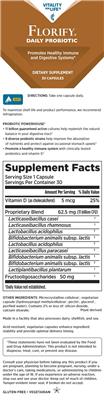
Florify Daily Probiotic contains 8 ingredients, including a proprietary blend of live probiotic bacteria and vitamin D. The active ingredients are five strains of beneficial bacteria (Lactobacillus acidophilus, Lactiplantibacillus plantarum, Lacticaseibacillus rhamnosus, Lacticaseibacillus casei, and Lacticaseibacillus paracasei), vitamin D to support bone and immune health, fructooligosaccharides (a type of carbohydrate that feeds beneficial bacteria), and Bifidobacterium animalis lactis.
The remaining ingredients are inactive—microcrystalline cellulose, hydroxypropyl methylcellulose, pectin, glycerol, purified water, silicon dioxide, and calcium stearate—used to form and stabilize the capsule.
Does it work?
Moderate evidence
The effectiveness data on file shows vitamin D is effective for treating vitamin D deficiency conditions like rickets, osteomalacia, renal bone disease, and hypoparathyroidism. For the probiotic strains, the evidence is more mixed.
Lactobacillus acidophilus, Lactiplantibacillus plantarum, Lacticaseibacillus rhamnosus, and Lacticaseibacillus paracasei are rated possibly effective for conditions like irritable bowel syndrome, antibiotic-associated diarrhea, eczema, and upper respiratory infections, though the evidence isn't conclusive. Lacticaseibacillus casei and fructooligosaccharides don't have reliable evidence in our data to rate their effectiveness for the conditions studied.
If you're taking this product for a specific health goal, talk with your pharmacist about what the current research actually supports.
How safe is it?
Well-documented data
Vitamin D is generally well tolerated at recommended doses, but very high doses over long periods can cause toxicity with symptoms like excessive blood calcium (hypercalcemia), weak bones, or reduced growth in children. The probiotic strains are generally well tolerated in healthy adults and children, though live microorganisms do carry a small theoretical risk of infection in people with very weakened immune systems or serious illness.
Uncommon side effects from the probiotics or fructooligosaccharides include mild gastrointestinal symptoms—bloating, gas, stomach discomfort, or loose stools. These typically resolve on their own.
Pregnancy and breastfeeding safety data for most of these ingredients isn't on file; if you're pregnant or nursing, check with your doctor or pharmacist before starting.
Meds to double-check
Moderate interaction found
Before taking Florify Daily Probiotic, double-check if you're on antibiotic drugs (Moderate severity)—these can kill the live probiotics and make them less effective, so you'll need to space them apart. If you take thiazide diuretics like hydrochlorothiazide, verapamil, diltiazem, digoxin, atorvastatin, or any psoriasis or aluminum-containing medication, those also interact with the vitamin D in this product at Moderate severity.
Mention this product to your pharmacist so they can review your full medication list.
The bottom line
Scorecard at a glanceFormula with limited ingredient disclosure with some supporting evidence for its stated purpose. Moderate medication interactions have been identified, and safety information is well characterized.
This product combines probiotics with vitamin D. It's worth considering if you're looking to support digestive or immune health and you don't take antibiotics or heart medications regularly.
If you take any prescription drugs—especially blood pressure or heart meds, antibiotics, or cholesterol drugs—check them against the interaction tool first. Talk to your pharmacist before starting, especially if you have a weakened immune system, are pregnant, or take multiple medications.
Educational only — not medical advice; always confirm with your pharmacist. Our editorial policy · How we use AI
Assessment coverage: 7 of 8 active ingredients matched to our full ingredient reviews (monographs). Based on the product label dated Jul 24, 2025.
This Scorecard evaluates available label information, ingredient evidence, and known medication-safety considerations. It does not independently verify product identity, purity, potency, contamination, or manufacturing quality. How these ratings are computed
General information
Key facts about Florify Daily Probiotic, straight from the product label.
| Brand | Vitality For Life |
|---|---|
| Net contents | 30 Capsule(s) |
| Market status | On market |
| Date entered into DSLD | Jul 24, 2025 |
| DSLD ID | 331651 |
| Product type | Other Combinations |
| Supplement form | Capsule |
| Dietary claims / uses | Nutrient, All Other, Structure/Function |
| Intended target group(s) | Vegetarian, Adult (18 - 50 Years), Kosher, Gluten Free |
Everything in this section is reproduced from the manufacturer’s own product label — it’s the label speaking, not HelloPharmacist. We show it so you can see exactly what the maker states; we don’t verify or endorse those statements.
Supplement Facts
The label details for Florify Daily Probiotic by Vitality For Life, sourced from the NIH Dietary Supplement Label Database.
Supplement Facts
| Ingredient | Amount | % DV |
|---|---|---|
| Proprietary Blend | 62.5 mg | -- |
| Vitamin D | 5 mcg | 25% |
| Lactobacillus acidophilus | 0 NP | -- |
| Fructooligosaccharides | 50 mg | -- |
| Bifidobacterium animalis lactis | 0 NP | -- |
| Lactiplantibacillus plantarum | 0 NP | -- |
| Lacticaseibacillus rhamnosus | 0 NP | -- |
| Lacticaseibacillus casei | 0 NP | -- |
| Lacticaseibacillus paracasei | 0 NP | -- |
Other ingredients: Microcrystalline Cellulose, Hydroxypropyl Methylcellulose, Pectin, Glycerol, Water, Purified, Silicon Dioxide, Calcium Stearate
Tap any ingredient to jump to its full detail below.
These statements are the manufacturer’s wording, reproduced from the product label — the label is saying it, not HelloPharmacist. We don’t verify or endorse them.
Formulation
Promotes healthy immune and digestive systems
Acid-resistant, vegetarian capsules enhance ingredient stability and provide optimal delivery timing.
Gluten-free
Vegetarian
FDA Statement of Identity
Dietary Supplement
Suggested/Recommended/Usage/Directions
AM Directions: Take one capsule daily.
Storage
To maximize shelf life and product performance, we recommend refrigeration.
Formula
Probiotic Powerhouse 11 billion guaranteed active cultures help replenish the natural balance in your digestive tract 9 diverse probiotic strains help improve the absorption of nutrients and protect against occasional stomach upsets Promote a healthy immune system with clinically tested probiotics and vitamin D
Star-K (Kosher)
Precautions
Made in a facility that also processes daily, shellfish, and soy.
Consult your physician before taking any this product if you are pregnant, planning to become pregnant, nursing, under a doctor's care, taking medications, or administering to children under the age of 18.
Consult your physician before taking any this product if you are pregnant, planning to become pregnant, nursing, under a doctor's care, taking medications, or administering to children under the age of 18. Keep out of reach of children.
If you experience an adverse reaction, stop use and see your doctor. Tamper-evident inner seal; if broken do not accept.
FDA Disclaimer Statement
These statements have not been evaluated by the Food and Drug Administration. This product is not intended to diagnose, treat, cure, or prevent any disease.
Seals/Symbols
Star-K (Kosher)
Is this label outdated? Report a formula or label change and our pharmacy team will review it.
Florify Daily Probiotic by Vitality For Life label
The label scan from the NIH Dietary Supplement Label Database. Tap to enlarge.
Label images are published by the NIH Dietary Supplement Label Database for the version of this product on file. Always read your actual product label.
View the full label (PDF)The Ingredients in Florify Daily Probiotic by Vitality For Life
These are the 8 active ingredients this product is made of. Select any to open its full monograph.
Serving size1 Capsule(s) Dosage formCapsule Servings per container30 Amounts shown are per serving.
Most supplement products combine several ingredients, and a medication can interact with the product through any one of them. Each ingredient below shows whether it has known drug interactions.
Proprietary Blend
- › Lactobacillus acidophilus
- › Bifidobacterium animalis lactis
- › Lactiplantibacillus plantarum
- › Lacticaseibacillus rhamnosus
- › Lacticaseibacillus casei
- › Lacticaseibacillus paracasei
Vitamin D
Interacts with717 drugs
Vitamin D is a fat-soluble vitamin that helps your body absorb calcium and is important for healthy bones, muscles, and immune function. Many people,...
Vitamin D monograph & interactionsFructooligosaccharides
No knowninteractions
Fructo-oligosaccharides (FOS) are a type of soluble fiber that acts as a prebiotic, meaning they feed the helpful bacteria in your gut. They are gener...
Fructooligosaccharides monograph & interactionsOther (inactive) ingredients: Microcrystalline Cellulose, Hydroxypropyl Methylcellulose, Pectin, Glycerol, Water, Purified, Silicon Dioxide, Calcium Stearate. These complete the product’s ingredient list but are not active constituents.
Florify Daily Probiotic by Vitality For Life Drug Interactions
HelloPharmacist Interaction Report
Florify Daily Probiotic by Vitality For Life contains several ingredients with documented interactions with medications.
The most serious concern involves vitamin D and thiazide diuretics (water pills), which carry a Moderate severity rating. Thiazide diuretics decrease how much calcium your body loses in urine, and when combined with vitamin D supplements—especially at high doses—this can lead to elevated blood calcium (hypercalcemia), which may cause symptoms like weakness, nausea, or kidney problems.
Read the full breakdown — every affected drug type, severity by severity
Vitamin D also interacts with heart rhythm medications (verapamil and diltiazem), the heart medication digoxin, the cholesterol drug atorvastatin, the psoriasis medication calcipotriene, and aluminum-containing products—all at Moderate severity. High-dose vitamin D can raise blood calcium and interfere with how these drugs work.
Additionally, vitamin D may affect how your liver processes certain other medications (CYP3A4 substrates), though this is rated Minor severity.
All five probiotic bacterial strains in this product—Lactobacillus acidophilus, Lactiplantibacillus plantarum, Lacticaseibacillus rhamnosus, Lacticaseibacillus casei, and Lacticaseibacillus paracasei—interact with antibiotic drugs at Moderate severity. Because these probiotics contain live organisms, antibiotics can kill them and reduce their effectiveness.
You'll want to separate when you take antibiotics and this probiotic by a few hours.
We could not check one ingredient, Bifidobacterium animalis lactis, for interactions. Altogether, these interactions span 869 individual medications.
Run your exact prescriptions through the medication checker on this page before you start.
Check your own medications below · Editorial policy · How we use AI
Want to check YOUR meds against Florify Daily Probiotic?
Ask about interactions with your drugs in plain English — “Can I take it with lisinopril?” — and we find you the answer in seconds, ingredient by ingredient.
Go to the checkerIngredients driving the most interactions
Individual Drug Interactions
The ingredients in Florify Daily Probiotic interact with 881 drugs. Click any drug to see the details.
6 of the 8 ingredients in Florify Daily Probiotic interact with drugs. Each result below shows which ingredient is responsible. Vitamin D Lactobacillus acidophilus Lactiplantibacillus plantarum Lacticaseibacillus rhamnosus Lacticaseibacillus casei Lacticaseibacillus paracasei
Alginic Acid, Aluminum HydroxideRafton
How Alginic Acid, Aluminum Hydroxide interacts with Florify Daily Probiotic — through 1 ingredient. Tap an ingredient for the detail:
Vitamin DAluminum Moderate
Interaction Summary
Vitamin D might increase aluminum absorption and toxicity, but this has only been reported in people with renal failure.
Read the full Vitamin D + Alginic Acid, Aluminum Hydroxide interactionAluminum Acetate, Benzethonium ChlorideBuro-Sol Otic Solution
How Aluminum Acetate, Benzethonium Chloride interacts with Florify Daily Probiotic — through 1 ingredient. Tap an ingredient for the detail:
Vitamin DAluminum Moderate
Interaction Summary
Vitamin D might increase aluminum absorption and toxicity, but this has only been reported in people with renal failure.
Read the full Vitamin D + Aluminum Acetate, Benzethonium Chloride interactionAluminum ChlorideAluminum Chloride, Anhydrol Forte, Driclor, Drysol
How Aluminum Chloride interacts with Florify Daily Probiotic — through 1 ingredient. Tap an ingredient for the detail:
Vitamin DAluminum Moderate
Interaction Summary
Vitamin D might increase aluminum absorption and toxicity, but this has only been reported in people with renal failure.
Read the full Vitamin D + Aluminum Chloride interactionAluminum HydroxideAlu-Cap, Amphojel, Gaviscon
How Aluminum Hydroxide interacts with Florify Daily Probiotic — through 1 ingredient. Tap an ingredient for the detail:
Vitamin DAluminum Moderate
Interaction Summary
Vitamin D might increase aluminum absorption and toxicity, but this has only been reported in people with renal failure.
Read the full Vitamin D + Aluminum Hydroxide interactionAluminum Hydroxide, Aspirin, Codeine Phosphate, Magnesium HydroxideAscriptin Codeine #2
How Aluminum Hydroxide, Aspirin, Codeine Phosphate, Magnesium Hydroxide interacts with Florify Daily Probiotic — through 1 ingredient. Tap an ingredient for the detail:
Vitamin DAluminum Moderate
Interaction Summary
Vitamin D might increase aluminum absorption and toxicity, but this has only been reported in people with renal failure.
Read the full Vitamin D + Aluminum Hydroxide, Aspirin, Codeine Phosphate, Magnesium Hydroxide interactionAluminum Hydroxide, Aspirin, Magnesium HydroxideAscriptin
How Aluminum Hydroxide, Aspirin, Magnesium Hydroxide interacts with Florify Daily Probiotic — through 1 ingredient. Tap an ingredient for the detail:
Vitamin DAluminum Moderate
Interaction Summary
Vitamin D might increase aluminum absorption and toxicity, but this has only been reported in people with renal failure.
Read the full Vitamin D + Aluminum Hydroxide, Aspirin, Magnesium Hydroxide interactionAluminum Hydroxide, Magnesium Hydroxide (otc Drug)Maalox, Mucogel
How Aluminum Hydroxide, Magnesium Hydroxide (otc Drug) interacts with Florify Daily Probiotic — through 1 ingredient. Tap an ingredient for the detail:
Vitamin DAluminum Moderate
Interaction Summary
Vitamin D might increase aluminum absorption and toxicity, but this has only been reported in people with renal failure.
Read the full Vitamin D + Aluminum Hydroxide, Magnesium Hydroxide (otc Drug) interactionAluminum Hydroxide, Magnesium Hydroxide, Simethicone (otc Drug)Mylanta
How Aluminum Hydroxide, Magnesium Hydroxide, Simethicone (otc Drug) interacts with Florify Daily Probiotic — through 1 ingredient. Tap an ingredient for the detail:
Vitamin DAluminum Moderate
Interaction Summary
Vitamin D might increase aluminum absorption and toxicity, but this has only been reported in people with renal failure.
Read the full Vitamin D + Aluminum Hydroxide, Magnesium Hydroxide, Simethicone (otc Drug) interactionAluminum, CalciumDomeboro
How Aluminum, Calcium interacts with Florify Daily Probiotic — through 1 ingredient. Tap an ingredient for the detail:
Vitamin DAluminum Moderate
Interaction Summary
Vitamin D might increase aluminum absorption and toxicity, but this has only been reported in people with renal failure.
Read the full Vitamin D + Aluminum, Calcium interactionAluminum, Magnesium (otc Drug)Almagel
How Aluminum, Magnesium (otc Drug) interacts with Florify Daily Probiotic — through 1 ingredient. Tap an ingredient for the detail:
Vitamin DAluminum Moderate
Interaction Summary
Vitamin D might increase aluminum absorption and toxicity, but this has only been reported in people with renal failure.
Read the full Vitamin D + Aluminum, Magnesium (otc Drug) interactionAluminum, Magnesium Hydroxide (otc Drug)Wingel
How Aluminum, Magnesium Hydroxide (otc Drug) interacts with Florify Daily Probiotic — through 1 ingredient. Tap an ingredient for the detail:
Vitamin DAluminum Moderate
Interaction Summary
Vitamin D might increase aluminum absorption and toxicity, but this has only been reported in people with renal failure.
Read the full Vitamin D + Aluminum, Magnesium Hydroxide (otc Drug) interactionAmikacinAmikin, Arikayce
How Amikacin interacts with Florify Daily Probiotic — through 5 ingredients. Tap an ingredient for the detail:
Lacticaseibacillus ParacaseiAntibiotic Drugs Moderate
Interaction Summary
Theoretically, taking Lacticaseibacillus paracasei with antibiotic drugs might decrease the effectiveness of L.
Read the full Lacticaseibacillus Paracasei + Amikacin interactionLactobacillus AcidophilusAntibiotic Drugs Moderate
Interaction Summary
Theoretically, taking Lactobacillus acidophilus with antibiotic drugs might decrease the effectiveness of L.
Read the full Lactobacillus Acidophilus + Amikacin interactionLacticaseibacillus CaseiAntibiotic Drugs Moderate
Interaction Summary
Theoretically, taking Lacticaseibacillus casei with antibiotic drugs might decrease the effectiveness of L.
Read the full Lacticaseibacillus Casei + Amikacin interactionLacticaseibacillus RhamnosusAntibiotic Drugs Moderate
Interaction Summary
Theoretically, taking Lacticaseibacillus rhamnosus with antibiotic drugs might decrease the effectiveness of L.
Read the full Lacticaseibacillus Rhamnosus + Amikacin interactionLactiplantibacillus PlantarumAntibiotic Drugs Moderate
Interaction Summary
Theoretically, taking Lactiplantibacillus plantarum with antibiotic drugs might decrease the effectiveness of L.
Read the full Lactiplantibacillus Plantarum + Amikacin interactionAmiloride, HydrochlorothiazideAmil-Co, Amilzide, Moduret 25, Moduretic
How Amiloride, Hydrochlorothiazide interacts with Florify Daily Probiotic — through 1 ingredient. Tap an ingredient for the detail:
Vitamin DThiazide Diuretics Moderate
Interaction Summary
Theoretically, taking thiazide diuretics and high-dose vitamin D can increase the risk of hypercalcemia.
Read the full Vitamin D + Amiloride, Hydrochlorothiazide interactionAmoxicillinAmix, Amoram, Amoxident, Amoxil Capsules, Amoxil Injection, Galenamox +3 more
How Amoxicillin interacts with Florify Daily Probiotic — through 5 ingredients. Tap an ingredient for the detail:
Lacticaseibacillus ParacaseiAntibiotic Drugs Moderate
Interaction Summary
Theoretically, taking Lacticaseibacillus paracasei with antibiotic drugs might decrease the effectiveness of L.
Read the full Lacticaseibacillus Paracasei + Amoxicillin interactionLacticaseibacillus CaseiAntibiotic Drugs Moderate
Interaction Summary
Theoretically, taking Lacticaseibacillus casei with antibiotic drugs might decrease the effectiveness of L.
Read the full Lacticaseibacillus Casei + Amoxicillin interactionLactiplantibacillus PlantarumAntibiotic Drugs Moderate
Interaction Summary
Theoretically, taking Lactiplantibacillus plantarum with antibiotic drugs might decrease the effectiveness of L.
Read the full Lactiplantibacillus Plantarum + Amoxicillin interactionLacticaseibacillus RhamnosusAntibiotic Drugs Moderate
Interaction Summary
Theoretically, taking Lacticaseibacillus rhamnosus with antibiotic drugs might decrease the effectiveness of L.
Read the full Lacticaseibacillus Rhamnosus + Amoxicillin interactionLactobacillus AcidophilusAntibiotic Drugs Moderate
Interaction Summary
Theoretically, taking Lactobacillus acidophilus with antibiotic drugs might decrease the effectiveness of L.
Read the full Lactobacillus Acidophilus + Amoxicillin interactionAmoxicillin VeterinaryBiomox
How Amoxicillin Veterinary interacts with Florify Daily Probiotic — through 5 ingredients. Tap an ingredient for the detail:
Lactobacillus AcidophilusAntibiotic Drugs Moderate
Interaction Summary
Theoretically, taking Lactobacillus acidophilus with antibiotic drugs might decrease the effectiveness of L.
Read the full Lactobacillus Acidophilus + Amoxicillin Veterinary interactionLacticaseibacillus RhamnosusAntibiotic Drugs Moderate
Interaction Summary
Theoretically, taking Lacticaseibacillus rhamnosus with antibiotic drugs might decrease the effectiveness of L.
Read the full Lacticaseibacillus Rhamnosus + Amoxicillin Veterinary interactionLacticaseibacillus ParacaseiAntibiotic Drugs Moderate
Interaction Summary
Theoretically, taking Lacticaseibacillus paracasei with antibiotic drugs might decrease the effectiveness of L.
Read the full Lacticaseibacillus Paracasei + Amoxicillin Veterinary interactionLacticaseibacillus CaseiAntibiotic Drugs Moderate
Interaction Summary
Theoretically, taking Lacticaseibacillus casei with antibiotic drugs might decrease the effectiveness of L.
Read the full Lacticaseibacillus Casei + Amoxicillin Veterinary interactionLactiplantibacillus PlantarumAntibiotic Drugs Moderate
Interaction Summary
Theoretically, taking Lactiplantibacillus plantarum with antibiotic drugs might decrease the effectiveness of L.
Read the full Lactiplantibacillus Plantarum + Amoxicillin Veterinary interactionAmoxicillin, Clavulanate PotassiumAugmentin, Augmentin '125/31 SF', Augmentin '250/62 SF', Augmentin XR, Augmentin-Duo 400/57, Clavulin
How Amoxicillin, Clavulanate Potassium interacts with Florify Daily Probiotic — through 5 ingredients. Tap an ingredient for the detail:
Lactiplantibacillus PlantarumAntibiotic Drugs Moderate
Interaction Summary
Theoretically, taking Lactiplantibacillus plantarum with antibiotic drugs might decrease the effectiveness of L.
Read the full Lactiplantibacillus Plantarum + Amoxicillin, Clavulanate Potassium interactionLacticaseibacillus ParacaseiAntibiotic Drugs Moderate
Interaction Summary
Theoretically, taking Lacticaseibacillus paracasei with antibiotic drugs might decrease the effectiveness of L.
Read the full Lacticaseibacillus Paracasei + Amoxicillin, Clavulanate Potassium interactionLacticaseibacillus CaseiAntibiotic Drugs Moderate
Interaction Summary
Theoretically, taking Lacticaseibacillus casei with antibiotic drugs might decrease the effectiveness of L.
Read the full Lacticaseibacillus Casei + Amoxicillin, Clavulanate Potassium interactionLactobacillus AcidophilusAntibiotic Drugs Moderate
Interaction Summary
Theoretically, taking Lactobacillus acidophilus with antibiotic drugs might decrease the effectiveness of L.
Read the full Lactobacillus Acidophilus + Amoxicillin, Clavulanate Potassium interactionLacticaseibacillus RhamnosusAntibiotic Drugs Moderate
Interaction Summary
Theoretically, taking Lacticaseibacillus rhamnosus with antibiotic drugs might decrease the effectiveness of L.
Read the full Lacticaseibacillus Rhamnosus + Amoxicillin, Clavulanate Potassium interactionAmoxicillin, Omeprazole Magnesium, RifabutinTalicia
How Amoxicillin, Omeprazole Magnesium, Rifabutin interacts with Florify Daily Probiotic — through 6 ingredients. Tap an ingredient for the detail:
Lacticaseibacillus CaseiAntibiotic Drugs Moderate
Interaction Summary
Theoretically, taking Lacticaseibacillus casei with antibiotic drugs might decrease the effectiveness of L.
Read the full Lacticaseibacillus Casei + Amoxicillin, Omeprazole Magnesium, Rifabutin interactionLactiplantibacillus PlantarumAntibiotic Drugs Moderate
Interaction Summary
Theoretically, taking Lactiplantibacillus plantarum with antibiotic drugs might decrease the effectiveness of L.
Read the full Lactiplantibacillus Plantarum + Amoxicillin, Omeprazole Magnesium, Rifabutin interactionLactobacillus AcidophilusAntibiotic Drugs Moderate
Interaction Summary
Theoretically, taking Lactobacillus acidophilus with antibiotic drugs might decrease the effectiveness of L.
Read the full Lactobacillus Acidophilus + Amoxicillin, Omeprazole Magnesium, Rifabutin interactionLacticaseibacillus RhamnosusAntibiotic Drugs Moderate
Interaction Summary
Theoretically, taking Lacticaseibacillus rhamnosus with antibiotic drugs might decrease the effectiveness of L.
Read the full Lacticaseibacillus Rhamnosus + Amoxicillin, Omeprazole Magnesium, Rifabutin interactionLacticaseibacillus ParacaseiAntibiotic Drugs Moderate
Interaction Summary
Theoretically, taking Lacticaseibacillus paracasei with antibiotic drugs might decrease the effectiveness of L.
Read the full Lacticaseibacillus Paracasei + Amoxicillin, Omeprazole Magnesium, Rifabutin interactionVitamin DCytochrome P450 3a4 (cyp3a4) Substrates Minor
Interaction Summary
Vitamin D might induce CYP3A4 enzymes and reduce the bioavailability of CYP3A4 substrates.
Read the full Vitamin D + Amoxicillin, Omeprazole Magnesium, Rifabutin interactionAmphotericin, TetracyclineMysteclin-F
How Amphotericin, Tetracycline interacts with Florify Daily Probiotic — through 5 ingredients. Tap an ingredient for the detail:
Lacticaseibacillus ParacaseiAntibiotic Drugs Moderate
Interaction Summary
Theoretically, taking Lacticaseibacillus paracasei with antibiotic drugs might decrease the effectiveness of L.
Read the full Lacticaseibacillus Paracasei + Amphotericin, Tetracycline interactionLacticaseibacillus CaseiAntibiotic Drugs Moderate
Interaction Summary
Theoretically, taking Lacticaseibacillus casei with antibiotic drugs might decrease the effectiveness of L.
Read the full Lacticaseibacillus Casei + Amphotericin, Tetracycline interactionLacticaseibacillus RhamnosusAntibiotic Drugs Moderate
Interaction Summary
Theoretically, taking Lacticaseibacillus rhamnosus with antibiotic drugs might decrease the effectiveness of L.
Read the full Lacticaseibacillus Rhamnosus + Amphotericin, Tetracycline interactionLactiplantibacillus PlantarumAntibiotic Drugs Moderate
Interaction Summary
Theoretically, taking Lactiplantibacillus plantarum with antibiotic drugs might decrease the effectiveness of L.
Read the full Lactiplantibacillus Plantarum + Amphotericin, Tetracycline interactionLactobacillus AcidophilusAntibiotic Drugs Moderate
Interaction Summary
Theoretically, taking Lactobacillus acidophilus with antibiotic drugs might decrease the effectiveness of L.
Read the full Lactobacillus Acidophilus + Amphotericin, Tetracycline interactionAmpicillinOmnipen, Omnipen-N, Penbritin, Principen, Rimacillin
How Ampicillin interacts with Florify Daily Probiotic — through 5 ingredients. Tap an ingredient for the detail:
Lactobacillus AcidophilusAntibiotic Drugs Moderate
Interaction Summary
Theoretically, taking Lactobacillus acidophilus with antibiotic drugs might decrease the effectiveness of L.
Read the full Lactobacillus Acidophilus + Ampicillin interactionLacticaseibacillus ParacaseiAntibiotic Drugs Moderate
Interaction Summary
Theoretically, taking Lacticaseibacillus paracasei with antibiotic drugs might decrease the effectiveness of L.
Read the full Lacticaseibacillus Paracasei + Ampicillin interactionLacticaseibacillus CaseiAntibiotic Drugs Moderate
Interaction Summary
Theoretically, taking Lacticaseibacillus casei with antibiotic drugs might decrease the effectiveness of L.
Read the full Lacticaseibacillus Casei + Ampicillin interactionLactiplantibacillus PlantarumAntibiotic Drugs Moderate
Interaction Summary
Theoretically, taking Lactiplantibacillus plantarum with antibiotic drugs might decrease the effectiveness of L.
Read the full Lactiplantibacillus Plantarum + Ampicillin interactionLacticaseibacillus RhamnosusAntibiotic Drugs Moderate
Interaction Summary
Theoretically, taking Lacticaseibacillus rhamnosus with antibiotic drugs might decrease the effectiveness of L.
Read the full Lacticaseibacillus Rhamnosus + Ampicillin interactionAmpicillin, SulbactamUnasyn
How Ampicillin, Sulbactam interacts with Florify Daily Probiotic — through 5 ingredients. Tap an ingredient for the detail:
Lacticaseibacillus CaseiAntibiotic Drugs Moderate
Interaction Summary
Theoretically, taking Lacticaseibacillus casei with antibiotic drugs might decrease the effectiveness of L.
Read the full Lacticaseibacillus Casei + Ampicillin, Sulbactam interactionLactobacillus AcidophilusAntibiotic Drugs Moderate
Interaction Summary
Theoretically, taking Lactobacillus acidophilus with antibiotic drugs might decrease the effectiveness of L.
Read the full Lactobacillus Acidophilus + Ampicillin, Sulbactam interactionLacticaseibacillus RhamnosusAntibiotic Drugs Moderate
Interaction Summary
Theoretically, taking Lacticaseibacillus rhamnosus with antibiotic drugs might decrease the effectiveness of L.
Read the full Lacticaseibacillus Rhamnosus + Ampicillin, Sulbactam interactionLactiplantibacillus PlantarumAntibiotic Drugs Moderate
Interaction Summary
Theoretically, taking Lactiplantibacillus plantarum with antibiotic drugs might decrease the effectiveness of L.
Read the full Lactiplantibacillus Plantarum + Ampicillin, Sulbactam interactionLacticaseibacillus ParacaseiAntibiotic Drugs Moderate
Interaction Summary
Theoretically, taking Lacticaseibacillus paracasei with antibiotic drugs might decrease the effectiveness of L.
Read the full Lacticaseibacillus Paracasei + Ampicillin, Sulbactam interactionAspirin, Aluminum Hydroxide, Codeine Phosphate, Magnesium HydroxideAscriptin Codeine #3
How Aspirin, Aluminum Hydroxide, Codeine Phosphate, Magnesium Hydroxide interacts with Florify Daily Probiotic — through 1 ingredient. Tap an ingredient for the detail:
Vitamin DAluminum Moderate
Interaction Summary
Vitamin D might increase aluminum absorption and toxicity, but this has only been reported in people with renal failure.
Read the full Vitamin D + Aspirin, Aluminum Hydroxide, Codeine Phosphate, Magnesium Hydroxide interactionAtenolol, ChlortalidoneAtenixCo, Tenoret 50, Totaretic
How Atenolol, Chlortalidone interacts with Florify Daily Probiotic — through 1 ingredient. Tap an ingredient for the detail:
Vitamin DThiazide Diuretics Moderate
Interaction Summary
Theoretically, taking thiazide diuretics and high-dose vitamin D can increase the risk of hypercalcemia.
Read the full Vitamin D + Atenolol, Chlortalidone interactionAtenolol, ChlorthalidoneTenoretic
How Atenolol, Chlorthalidone interacts with Florify Daily Probiotic — through 1 ingredient. Tap an ingredient for the detail:
Vitamin DThiazide Diuretics Moderate
Interaction Summary
Theoretically, taking thiazide diuretics and high-dose vitamin D can increase the risk of hypercalcemia.
Read the full Vitamin D + Atenolol, Chlorthalidone interactionAtorvastatinAtorvaliq
How Atorvastatin interacts with Florify Daily Probiotic — through 1 ingredient. Tap an ingredient for the detail:
Vitamin DCytochrome P450 3a4 (cyp3a4) Substrates, Atorvastatin (lipitor) Moderate
Interaction Summary
Vitamin D might induce CYP3A4 enzymes and reduce the bioavailability of CYP3A4 substrates.
Read the full Vitamin D + Atorvastatin interactionAtorvastatin CalciumLipitor
How Atorvastatin Calcium interacts with Florify Daily Probiotic — through 1 ingredient. Tap an ingredient for the detail:
Vitamin DAtorvastatin (lipitor), Cytochrome P450 3a4 (cyp3a4) Substrates Moderate
Interaction Summary
Vitamin D might reduce absorption of atorvastatin.
Read the full Vitamin D + Atorvastatin Calcium interactionAvibactam Sodium, CeftazidimeAvycaz
How Avibactam Sodium, Ceftazidime interacts with Florify Daily Probiotic — through 5 ingredients. Tap an ingredient for the detail:
Lactobacillus AcidophilusAntibiotic Drugs Moderate
Interaction Summary
Theoretically, taking Lactobacillus acidophilus with antibiotic drugs might decrease the effectiveness of L.
Read the full Lactobacillus Acidophilus + Avibactam Sodium, Ceftazidime interactionLacticaseibacillus CaseiAntibiotic Drugs Moderate
Interaction Summary
Theoretically, taking Lacticaseibacillus casei with antibiotic drugs might decrease the effectiveness of L.
Read the full Lacticaseibacillus Casei + Avibactam Sodium, Ceftazidime interactionLacticaseibacillus ParacaseiAntibiotic Drugs Moderate
Interaction Summary
Theoretically, taking Lacticaseibacillus paracasei with antibiotic drugs might decrease the effectiveness of L.
Read the full Lacticaseibacillus Paracasei + Avibactam Sodium, Ceftazidime interactionLactiplantibacillus PlantarumAntibiotic Drugs Moderate
Interaction Summary
Theoretically, taking Lactiplantibacillus plantarum with antibiotic drugs might decrease the effectiveness of L.
Read the full Lactiplantibacillus Plantarum + Avibactam Sodium, Ceftazidime interactionLacticaseibacillus RhamnosusAntibiotic Drugs Moderate
Interaction Summary
Theoretically, taking Lacticaseibacillus rhamnosus with antibiotic drugs might decrease the effectiveness of L.
Read the full Lacticaseibacillus Rhamnosus + Avibactam Sodium, Ceftazidime interactionAzilsartan, ChlorthalidoneEdarbyclor
How Azilsartan, Chlorthalidone interacts with Florify Daily Probiotic — through 1 ingredient. Tap an ingredient for the detail:
Vitamin DThiazide Diuretics Moderate
Interaction Summary
Theoretically, taking thiazide diuretics and high-dose vitamin D can increase the risk of hypercalcemia.
Read the full Vitamin D + Azilsartan, Chlorthalidone interactionAzithromycinAzasite, Zithromax, Zmax
How Azithromycin interacts with Florify Daily Probiotic — through 5 ingredients. Tap an ingredient for the detail:
Lacticaseibacillus RhamnosusAntibiotic Drugs Moderate
Interaction Summary
Theoretically, taking Lacticaseibacillus rhamnosus with antibiotic drugs might decrease the effectiveness of L.
Read the full Lacticaseibacillus Rhamnosus + Azithromycin interactionLacticaseibacillus CaseiAntibiotic Drugs Moderate
Interaction Summary
Theoretically, taking Lacticaseibacillus casei with antibiotic drugs might decrease the effectiveness of L.
Read the full Lacticaseibacillus Casei + Azithromycin interactionLactobacillus AcidophilusAntibiotic Drugs Moderate
Interaction Summary
Theoretically, taking Lactobacillus acidophilus with antibiotic drugs might decrease the effectiveness of L.
Read the full Lactobacillus Acidophilus + Azithromycin interactionLactiplantibacillus PlantarumAntibiotic Drugs Moderate
Interaction Summary
Theoretically, taking Lactiplantibacillus plantarum with antibiotic drugs might decrease the effectiveness of L.
Read the full Lactiplantibacillus Plantarum + Azithromycin interactionLacticaseibacillus ParacaseiAntibiotic Drugs Moderate
Interaction Summary
Theoretically, taking Lacticaseibacillus paracasei with antibiotic drugs might decrease the effectiveness of L.
Read the full Lacticaseibacillus Paracasei + Azithromycin interactionAztreonamAzactam
How Aztreonam interacts with Florify Daily Probiotic — through 5 ingredients. Tap an ingredient for the detail:
Lacticaseibacillus ParacaseiAntibiotic Drugs Moderate
Interaction Summary
Theoretically, taking Lacticaseibacillus paracasei with antibiotic drugs might decrease the effectiveness of L.
Read the full Lacticaseibacillus Paracasei + Aztreonam interactionLacticaseibacillus CaseiAntibiotic Drugs Moderate
Interaction Summary
Theoretically, taking Lacticaseibacillus casei with antibiotic drugs might decrease the effectiveness of L.
Read the full Lacticaseibacillus Casei + Aztreonam interactionLacticaseibacillus RhamnosusAntibiotic Drugs Moderate
Interaction Summary
Theoretically, taking Lacticaseibacillus rhamnosus with antibiotic drugs might decrease the effectiveness of L.
Read the full Lacticaseibacillus Rhamnosus + Aztreonam interactionLactiplantibacillus PlantarumAntibiotic Drugs Moderate
Interaction Summary
Theoretically, taking Lactiplantibacillus plantarum with antibiotic drugs might decrease the effectiveness of L.
Read the full Lactiplantibacillus Plantarum + Aztreonam interactionLactobacillus AcidophilusAntibiotic Drugs Moderate
Interaction Summary
Theoretically, taking Lactobacillus acidophilus with antibiotic drugs might decrease the effectiveness of L.
Read the full Lactobacillus Acidophilus + Aztreonam interactionBacampicillinPenglobe
How Bacampicillin interacts with Florify Daily Probiotic — through 5 ingredients. Tap an ingredient for the detail:
Lactobacillus AcidophilusAntibiotic Drugs Moderate
Interaction Summary
Theoretically, taking Lactobacillus acidophilus with antibiotic drugs might decrease the effectiveness of L.
Read the full Lactobacillus Acidophilus + Bacampicillin interactionLacticaseibacillus RhamnosusAntibiotic Drugs Moderate
Interaction Summary
Theoretically, taking Lacticaseibacillus rhamnosus with antibiotic drugs might decrease the effectiveness of L.
Read the full Lacticaseibacillus Rhamnosus + Bacampicillin interactionLacticaseibacillus ParacaseiAntibiotic Drugs Moderate
Interaction Summary
Theoretically, taking Lacticaseibacillus paracasei with antibiotic drugs might decrease the effectiveness of L.
Read the full Lacticaseibacillus Paracasei + Bacampicillin interactionLacticaseibacillus CaseiAntibiotic Drugs Moderate
Interaction Summary
Theoretically, taking Lacticaseibacillus casei with antibiotic drugs might decrease the effectiveness of L.
Read the full Lacticaseibacillus Casei + Bacampicillin interactionLactiplantibacillus PlantarumAntibiotic Drugs Moderate
Interaction Summary
Theoretically, taking Lactiplantibacillus plantarum with antibiotic drugs might decrease the effectiveness of L.
Read the full Lactiplantibacillus Plantarum + Bacampicillin interactionEach ingredient & the kinds of drugs it affects
For each ingredient in Florify Daily Probiotic with known interactions, here are the types of medications they can affect. Open any type for the detail — or search your exact drug in the checker above.
Vitamin D
Aluminum
Vitamin D might increase aluminum absorption and toxicity, but this has only been reported in people with renal failure.
The protein that transports calcium across the intestinal wall can also bind and transport aluminum. This protein is stimulated by vitamin D, which may therefore increase aluminum absorption. This mechanism may contribute to increased aluminum levels and toxicity in people with renal failure, when they take vitamin D and aluminum-containing phosphate binders chronically.
Atorvastatin (Lipitor)
Vitamin D might reduce absorption of atorvastatin.
A small, low-quality clinical study shows that taking vitamin D reduces levels of atorvastatin and its active metabolites by up to 55%. However, while atorvastatin levels decreased, total cholesterol, low-density lipoprotein (LDL) cholesterol, and high-density lipoprotein (HDL) cholesterol levels did not substantially change. Atorvastatin is metabolized in the gut by CYP3A4 enzymes, and researchers theorized that vitamin D might induce CYP3A4, causing reduced levels of atorvastatin. However, this proposed mechanism was not specifically studied.
Calcipotriene (Dovonex)
Taking calcipotriene with vitamin D increases the risk for hypercalcemia.
Calcipotriene is a vitamin D analog used topically for psoriasis. It can be absorbed in sufficient amounts to cause systemic effects, including hypercalcemia. Theoretically, combining calcipotriene with vitamin D supplements might increase the risk of hypercalcemia.
Digoxin (Lanoxin)
Theoretically, hypercalcemia induced by high-dose vitamin D can increase the risk of arrhythmia from digoxin.
High doses of vitamin D can cause hypercalcemia. Hypercalcemia increases the risk of fatal cardiac arrhythmias with digoxin. Avoid vitamin D doses above the tolerable upper intake level (4000 IU daily for adults) and monitor serum calcium levels in people taking vitamin D and digoxin concurrently.
Diltiazem (Cardizem, Others)
Theoretically, hypercalcemia induced by high-dose vitamin D can reduce the therapeutic effects of diltiazem for arrhythmia.
High doses of vitamin D can cause hypercalcemia. Hypercalcemia can reduce the effectiveness of verapamil in atrial fibrillation. Theoretically this could also occur with diltiazem. Avoid vitamin D doses above the tolerable upper intake level (4000 IU daily for adults) and monitor serum calcium levels in people taking vitamin D and diltiazem concurrently.
Thiazide Diuretics
Theoretically, taking thiazide diuretics and high-dose vitamin D can increase the risk of hypercalcemia.
Thiazide diuretics decrease urinary calcium excretion, which could lead to hypercalcemia if vitamin D supplements are taken concurrently. This has been reported in people being treated with vitamin D for hypoparathyroidism, and also in elderly people with normal parathyroid function who were taking a thiazide, vitamin D, and calcium-containing antacids daily.
Verapamil (Calan, Others)
Hypercalcemia induced by high-dose vitamin D can reduce the therapeutic effects of verapamil for arrhythmia.
Hypercalcemia due to high doses of vitamin D can reduce the effectiveness of verapamil in atrial fibrillation. Avoid vitamin D doses above the tolerable upper intake level (4000 IU daily for adults) and monitor serum calcium levels in people taking vitamin D and verapamil concurrently.
Cytochrome P450 3A4 (Cyp3A4) Substrates
Vitamin D might induce CYP3A4 enzymes and reduce the bioavailability of CYP3A4 substrates.
There is some concern that vitamin D might induce CYP3A4. In vitro research suggests that vitamin D induces CYP3A4 transcription. Additionally, observational research has found that increased UV light exposure and serum vitamin D levels are associated with decreased serum levels of CYP3A4 substrates such as tacrolimus and sirolimus, while no association between UV light exposure or vitamin D levels and levels of mycophenolic acid, a non-CYP3A4 substrate, was found. A small, low-quality clinical study shows that taking vitamin D reduces levels of the CYP3A4 substrate atorvastatin and its active metabolites by up to 55%; however, the clinical effects of atorvastatin were not reduced. While researchers theorized that vitamin D might induce CYP3A4, this proposed mechanism was not specifically studied.
Lactobacillus acidophilus
Antibiotic Drugs
Theoretically, taking Lactobacillus acidophilus with antibiotic drugs might decrease the effectiveness of L. acidophilus.
L. acidophilus preparations usually contain live and active organisms. Therefore, simultaneously taking antibiotics might kill a significant number of the organisms. Tell patients to separate administration of antibiotics and L. acidophilus preparations by at least two hours.
Lactiplantibacillus plantarum
Antibiotic Drugs
Theoretically, taking Lactiplantibacillus plantarum with antibiotic drugs might decrease the effectiveness of L. plantarum.
L. plantarum preparations usually contain live and active organisms. Therefore, simultaneously taking antibiotics might kill a significant number of the organisms. Tell patients to separate administration of antibiotics and L. plantarum preparations by at least two hours.
Lacticaseibacillus rhamnosus
Antibiotic Drugs
Theoretically, taking Lacticaseibacillus rhamnosus with antibiotic drugs might decrease the effectiveness of L. rhamnosus.
L. rhamnosus preparations usually contain live and active organisms. Therefore, simultaneously taking antibiotics might kill a significant number of the organisms. Tell patients to separate administration of antibiotics and L. rhamnosus preparations by at least two hours.
Lacticaseibacillus casei
Antibiotic Drugs
Theoretically, taking Lacticaseibacillus casei with antibiotic drugs might decrease the effectiveness of L. casei.
L. casei preparations usually contain live and active organisms. Therefore, simultaneously taking antibiotics might kill a significant number of the organisms. Tell patients to separate administration of antibiotics and L. casei preparations by at least two hours.
Lacticaseibacillus paracasei
Antibiotic Drugs
Theoretically, taking Lacticaseibacillus paracasei with antibiotic drugs might decrease the effectiveness of L. paracasei.
L. paracasei preparations usually contain live and active organisms. Therefore, simultaneously taking antibiotics might kill a significant number of the organisms. Tell patients to separate administration of antibiotics and L. paracasei preparations by at least two hours.
Brand information
Manufacturer and brand details for Florify Daily Probiotic, from the product label.
Florify Daily Probiotic by Vitality For Life: Common Questions
Does Florify Daily Probiotic by Vitality For Life interact with any medications?
How can one product interact with so many drugs?
Where does this information come from?
Will antibiotics stop this probiotic from working?
Can I take this if I'm pregnant?
What's the vitamin D in here for?
Will this cause bloating or gas?
Is this safe for someone with a weak immune system?
Does this actually work for IBS or diarrhea?
Written and reviewed by the HelloPharmacist editorial staff. Our editorial policy
Not sure if Florify Daily Probiotic is safe with your meds?
Our pharmacists answer your medication & supplement questions — free.
Label information is sourced from the NIH Dietary Supplement Label Database and reflects the product version on file; always read your actual product label. This page is for education only and is not a substitute for professional medical advice. Confirm with your pharmacist or doctor before combining supplements and medications.
The Full Monographs Behind Florify Daily Probiotic’s Ingredients
Every ingredient we hold a full HelloPharmacist monograph for — uses, evidence, safety, and the complete interaction list.
Lactobacillus Acidophilus
Interacts with 182 drugsLactobacillus acidophilus is a 'friendly' bacterium used as a probiotic to support gut and vaginal health. It is generally well tolerated in healthy people, and there is reasonable evidence...
Read the full Lactobacillus Acidophilus monograph → Herb & supplement monographLactiplantibacillus Plantarum
Interacts with 182 drugsLactiplantibacillus plantarum is a 'friendly' bacterium (probiotic) found in fermented foods and many supplements, studied mainly for digestive health. It is generally well tolerated in heal...
Read the full Lactiplantibacillus Plantarum monograph → Herb & supplement monographLacticaseibacillus Rhamnosus
Interacts with 182 drugsLacticaseibacillus rhamnosus (often labeled L. rhamnosus GG) is a well-studied probiotic bacterium used mainly for diarrhea and general gut health. It is considered safe for most healthy peo...
Read the full Lacticaseibacillus Rhamnosus monograph → Herb & supplement monographLacticaseibacillus Casei
Interacts with 182 drugsLacticaseibacillus casei (formerly Lactobacillus casei) is a 'friendly' probiotic bacterium found in fermented foods and many supplements. It is most studied for digestive issues like diarrh...
Read the full Lacticaseibacillus Casei monograph → Herb & supplement monographLacticaseibacillus Paracasei
Interacts with 182 drugsLacticaseibacillus paracasei (formerly Lactobacillus paracasei) is a probiotic bacterium found in fermented foods and supplements that is widely used to support gut and immune health. Some s...
Read the full Lacticaseibacillus Paracasei monograph → Herb & supplement monographVitamin D
Interacts with 717 drugsVitamin D is a fat-soluble vitamin that helps your body absorb calcium and is important for healthy bones, muscles, and immune function. Many people, especially those with low sun exposure,...
Read the full Vitamin D monograph → Herb & supplement monographFructo-oligosaccharides (fos)
Fructo-oligosaccharides (FOS) are a type of soluble fiber that acts as a prebiotic, meaning they feed the helpful bacteria in your gut. They are generally considered safe for most people in...
Read the full Fructo-oligosaccharides (fos) monograph →Sources & How We Checked
Florify Daily Probiotic's label data comes from the NIH Dietary Supplement Label Database; the ingredient interaction data is from the Natural Medicines database, reviewed by our pharmacists.
- NIH Dietary Supplement Label Database (DSLD) — The official product label on file for this supplement.
- Natural Medicines (Therapeutic Research Center) — Evidence-graded clinical reference behind the ingredient interaction data.
Content is written and reviewed by licensed HelloPharmacist pharmacists. See our data sources and editorial standards for how this information is built and checked.
The 118 references behind this product’s interaction data
Every citation that drives the interaction findings for this product’s ingredients, from the evidence-graded Natural Medicines (TRC Healthcare) database. Open an ingredient to browse its citations — links open the study on PubMed or the publisher’s site.
Vitamin D 25 references
- McEvoy GK, ed. AHFS Drug Information. Bethesda, MD: American Society of Health-System Pharmacists, 1998.
- Tatro DS, ed. Drug Interactions Facts. Facts and Comparisons Inc., St. Louis, MO. 1999.
- Koutkia P, Chen TC, Holick MF. Vitamin D intoxication associated with an over-the-counter supplement. N Engl J Med 2001;345:66-7. PubMed
- Bar-Or D, Yoel G. Calcium and calciferol antagonize effect of verapamil in atrial fibrillation. Br Med J 1981;282:1585-6.
- Demontis R, Leflon A, Fournier A, et al. 1 alpha(OH) vitamin D3 increases plasma aluminum in hemodialyzed patients taking AI(OH)3. Clin Nephrol 1986;26:146-9.
- Crowe M, Wollner L, Griffiths RA. Hypercalcemia following vitamin D and thiazide therapy in the elderly. Practitioner 1984;228:312-3.
- Parfitt AM. Thiazide-induced hypercalcemia in vitamin D-treated hypoparathyroidism. Ann Intern Med 1972;77:557-63. PubMed
- Thiazide diuretics and the risk of osteoporosis. Pharmacist's Letter/Prescriber's Letter 2003;19(11):191105.
- Moon J. The role of vitamin D in toxic metal absorption. J Am Coll Nutr 1994;13:559-64.
- Demontis R, Reissi D, Noel C, et al. Indirect clinical evidence that 1alphaOH vitamin D<SUB>3</SUB> increases the intestinal absorption of aluminum. Clin Nephrol 1989;31:123-7.
- Adler AJ, Berlyne GM. Duodenal aluminum absorption in the rat: effect of vitamin D. Am J Physiol 1985;249:G209-13. PubMed
- Schwartz JB. Effects of vitamin D supplementation in atorvastatin-treated patients: A new drug interaction with an unexpected consequence. Clin Pharmacol Ther 2009;85:198-203. PubMed
- Dietary reference intakes for calcium and vitamin D. Institute of Medicine, November 30, 2010. Available at: http://www.iom.edu/~/media/Files/Report%20Files/2010/Dietary-Reference-Intakes-for-Calcium-and-Vitamin-D/Vitamin%20D%20and%20Calcium%202010%20Repo
- Cox KA, Dunn MA. Aluminum toxicity alters the regulation of calbindin-D28k protein and mRNA expression in chick intestine. J Nutr 2001;131:2007-13. PubMed
- Escribano, J., Balaguer, A., Pagone, F., Feliu, A., and Roque, I. Figuls. Pharmacological interventions for preventing complications in idiopathic hypercalciuria. Cochrane.Database.Syst.Rev. 2009;(1):CD004754. PubMed
- Carlton, S., Clopton, D., and Cappuzzo, K. A. Vitamin D deficiency: appropriate replenishment therapies and the effects of vitamin D toxicity. Consult Pharm 2010;25(3):171-177. PubMed
- Wang, H., Xia, N., Yang, Y., and Peng, D. Q. Influence of vitamin D supplementation on plasma lipid profiles: a meta-analysis of randomized controlled trials. Lipids Health Dis. 2012;11:42. PubMed
- Turner AN, Carr Reese P, Fields KS, Anderson J, Ervin M, Davis JA, Fichorova RN, Roberts MW, Klebanoff MA, Jackson RD. A blinded, randomized controlled trial of high-dose vitamin D supplementation to reduce recurrence of bacterial vaginosis. Am J Obstet G PubMed
- Weiner M, Epstein FH. Signs and symptoms of electrolyte disorders. Yale J Biol Med. 1970;43(2):76-109.
- Lappe J, Watson P, Travers-Gustafson D, Recker R, Garland C, Gorham E, Baggerly K, McDonnell SL. Effect of Vitamin D and Calcium Supplementation on Cancer Incidence in Older Women: A Randomized Clinical Trial. JAMA. 2017 Mar 28;317(12):1234-1243. PubMed
- Roth DE, Leung M, Mesfin E, Qamar H, Watterworth J, Papp E. Vitamin D supplementation during pregnancy: state of the evidence from a systematic review of randomised trials. BMJ. 2017;359:j5237. PubMed
- Murai IH, Fernandes AL, Sales LP, et al. Effect of a single high dose of vitamin D3 on hospital length of stay in patients with moderate to severe COVID-19: A randomized clinical trial. JAMA. 2021.
- Wang Z, Schuetz EG, Xu Y, Thummel KE. Interplay between vitamin D and the drug metabolizing enzyme CYP3A4. J Steroid Biochem Mol Biol 2013;136:54-8. PubMed
- Doyle D, Browne U, Brickley A, Murphy D. Vitamin D-induced hypercalcaemia and acute kidney injury in sarcoidosis. BMJ Case Rep 2023;16(1):e250580. PubMed
- Williamson A, Martineau AR, Sheikh A, Jolliffe D, Griffiths CJ. Vitamin D for the management of asthma. Cochrane Database Syst Rev 2023;2(2):CD011511. PubMed
Lactobacillus Acidophilus 15 references
- Pierce A. The American Pharmaceutical Association Practical Guide to Natural Medicines. New York: The Stonesong Press, 1999:19.
- Begtrup LM, de Muckadell OB, Kjeldsen J, Christensen RD, Jarbøl DE. Long-term treatment with probiotics in primary care patients with irritable bowel syndrome--a randomised, double-blind, placebo controlled trial. Scand J Gastroenterol 2013;48(10):1127-35 PubMed
- Chatterjee S, Kar P, Das T, Ray S, Gangulyt S, Rajendiran C, Mitra M. Randomised placebo-controlled double blind multicentric trial on efficacy and safety of Lactobacillus acidophilus LA-5 and Bifidobacterium BB-12 for prevention of antibiotic-associated
- Shavakhi A, Tabesh E, Yaghoutkar A, Hashemi H, Tabesh F, Khodadoostan M,Minakari M, Shavakhi S, Gholamrezaei A. The effects of multistrain probiotic compound on bismuth-containing quadruple therapy for Helicobacter pylori infection: a randomized placebo-c
- Karamali M, Dadkhah F, Sadrkhanlou M, et al. Effects of probiotic supplementation on glycaemic control and lipid profiles in gestational diabetes: a randomized, double-blind, placebo-controlled trial. Diabetes Metab 2016;42(4):234-41. PubMed
- Badehnoosh B, Karamali M, Zarrati M, et al. The effects of probiotic supplementation on biomarkers of inflammation, oxidative stress and pregnancy outcomes in gestational diabetes. J Matern Fetal Neonatal Med. 2018 May;31(9):1128-1136.
- Kumar S, Kumar R, Rohilla L, Jacob N, Yadav J, Sachdeva N. A high potency multi-strain probiotic improves glycemic control in children with new-onset type 1 diabetes mellitus: A randomized, double-blind, and placebo-controlled pilot study. Pediatr Diabete
- Shahriari A, Karimi E, Shahriari M, Aslani N, Khooshideh M, Arab A. The effect of probiotic supplementation on the risk of gestational diabetes mellitus among high-risk pregnant women: A parallel double-blind, randomized, placebo-controlled clinical trial PubMed
- Xiao SD, Zhang DZ, Lu H, et al. Multicenter, randomized, controlled trial of heat-killed Lactobacillus acidophilus LB in patients with chronic diarrhea. Adv Ther. 2003;20(5):253-60.
- Rossi F, Amadoro C, Gasperi M, Colavita G. Lactobacilli infection case reports in the last three years and safety implications. Nutrients. 2022;14(6):1178. PubMed
- Ozer M, Goksu SY, Shahverdiani A, Mustafa M. Lactobacillus acidophilus-induced endocarditis and associated splenic abscess. Case Rep Infect Dis 2020;2020:1382709.
- Sadrin S, Sennoune S, Gout B, et al. A 2-strain mixture of Lactobacillus acidophilus in the treatment of irritable bowel syndrome: A placebo-controlled randomized clinical trial. Dig Liver Dis 2020;52(5):534-540. PubMed
- Stoffer JN, Slingsby TJ, Giuliari GP. Lactobacillus acidophilus endophthalmitis after intravitreal bevacizumab injection requiring intraocular lens explantation. Can J Ophthalmol 2022;57(1):e21-e22. PubMed
- Cukovic-Cavka S, Likic R, Francetic I, Rustemovic N, Opacic M, Vucelic B. Lactobacillus acidophilus as a cause of liver abscess in a NOD2/CARD15-positive patient with Crohn's disease. Digestion 2006;73(2-3):107-10.
- Hui J, Ren Y, Wang Y, Han Q. Lactobacillus acidophilus endophthalmitis postcataract operation: A case report with a literature review. Ocul Immunol Inflamm 2023.
See these in context on the Lactobacillus Acidophilus monograph →
Fructo-oligosaccharides (fos) 6 references
- Briet F, et al. Symptomatic response to varying levels of fructo-oligosaccharides consumed occasionally or regularly. Eur J Clin Nutr 1995;49:501-7.
- Bouhnik Y, Vahedi K, Achour L, et al. Short-chain fructo-oligosaccharide administration dose-dependently increases fecal bifidobacteria in healthy humans. J Nutr 1999;129:113-6. PubMed
- Cummings JH, Macfarlane GT, Englyst HN. Prebiotic digestion and fermentation. Am J Clin Nutr 2001;73:415S-420S. PubMed
- Souza DDS, Tahan S, Weber TK, Araujo-Filho HB, de Morais MB. Randomized, double-blind, placebo-controlled parallel clinical trial assessing the effect of fructooligosaccharides in infants with constipation. Nutrients. 2018;10(11). pii: E1602. PubMed
- Andermann TM, Fouladi F, Tamburini FB, et al. A Fructo-Oligosaccharide Prebiotic Is Well Tolerated in Adults Undergoing Allogeneic Hematopoietic Stem Cell Transplantation: A Phase I Dose-Escalation Trial. Transplant Cell Ther 2021;27(11):932. PubMed
- Dou Y, Yu X, Luo Y, Chen B, Ma D, Zhu J. Effect of Fructooligosaccharides Supplementation on the Gut Microbiota in Human: A Systematic Review and Meta-Analysis. Nutrients 2022;14(16):3298. PubMed
See these in context on the Fructo-oligosaccharides (fos) monograph →
Lactiplantibacillus Plantarum 12 references
- Pierce A. The American Pharmaceutical Association Practical Guide to Natural Medicines. New York: The Stonesong Press, 1999:19.
- Ducrotté P, Sawant P, Jayanthi V. Clinical trial: Lactobacillus plantarum 299v (DSM 9843) improves symptoms of irritable bowel syndrome. World J Gastroenterol 2012;18(30):4012-8.
- Krag A, Munkholm P, Israelsen H, von Ryberg B, Andersen KK, Bendtsen F. Profermin is efficacious in patients with active ulcerative colitis--a randomized controlled trial. Inflamm Bowel Dis. 2013;19(12):2584-92. PubMed
- Topcuoglu S, Gursoy T, Ovali F, Serce O, Karatekin G. A new risk factor for neonatal vancomycin-resistant Enterococcus colonisation: bacterial probiotics. J Matern Fetal Neonatal Med. 2015;28(12):1491-4. PubMed
- Kumar S, Kumar R, Rohilla L, Jacob N, Yadav J, Sachdeva N. A high potency multi-strain probiotic improves glycemic control in children with new-onset type 1 diabetes mellitus: A randomized, double-blind, and placebo-controlled pilot study. Pediatr Diabete
- Rossi F, Amadoro C, Gasperi M, Colavita G. Lactobacilli infection case reports in the last three years and safety implications. Nutrients. 2022;14(6):1178. PubMed
- Axling U, Önning G, Martinsson Niskanen T, Larsson N, Hansson SR, Hulthén L. The effect of Lactiplantibacillus plantarum 299v together with a low dose of iron on iron status in healthy pregnant women: A randomized clinical trial. Acta Obstet Gynecol Scand
- Matsuura H, Kiura Y, Ito T, et al. Lactobacillus bacteremia: a diagnostic clue of rectal cancer. QJM. 2021;114(2):122-123. PubMed
- Lazou Ahrén I, Berggren A, Teixeira C, Martinsson Niskanen T, Larsson N. Evaluation of the efficacy of Lactobacillus plantarum HEAL9 and Lactobacillus paracasei 8700:2 on aspects of common cold infections in children attending day care: a randomised, doub
- Busch R, Gruenwald J, Dudek S. Randomized, double blind and placebo controlled study using a combination of two probiotic lactobacilli to alleviate symptoms and frequency of common cold. Food Nutr Sci 2013;4(11A):13-2. DOI
- Bengtsson J, Adlerberth I, Östblom A, Saksena P, Öresland T, Börjesson L. Effect of probiotics (Lactobacillus plantarum 299 plus Bifidobacterium Cure21) in patients with poor ileal pouch function: a randomised controlled trial. Scand J Gastroenterol 2016;
- Canaviri-Paz P, Oscarsson E, Kjellström A, Olsson H, Jois C, Håkansson Å. Effects on Microbiota Composition after Consumption of Quinoa Beverage Fermented by a Novel Xylose-Metabolizing L. plantarum Strain. Nutrients 2021;13(10):3318. PubMed
See these in context on the Lactiplantibacillus Plantarum monograph →
Lacticaseibacillus Rhamnosus 34 references
- Pierce A. The American Pharmaceutical Association Practical Guide to Natural Medicines. New York: The Stonesong Press, 1999:19.
- Saxelin M, Chuang NH, Chassy B, et al. Lactobacilli and bacteremia in southern Finland 1989-1992. Clin Infect Dis 1996;22:564-6. PubMed
- Klein G, Zill E, Schindler R, et al. Peritonitis associated with vancomycin-resistant Lactobacillus rhamnosus in a continuous ambulatory peritoneal dialysis patient; organism identification, antibiotic therapy, and case report. J Clin Microbiol 1998;36:
- Kalima P, Masterton RG, Roddie PH, et al. Lactobacillus rhamnosus infection in a child following bone marrow transplant. J Infect 1996;32:165-7. PubMed
- Rautio M, Jousimies-Somer H, Kauma H, et al. Liver abscess due to Lactobacillus rhamnosus strain indistinguishable from L. rhamnosus strain GG. Clin Infect Dis 1999;28:1159-60.
- Rautava S, Kalliomaki M, Isolauri E. Probiotics during pregnancy and breast-feeding might confer immunomodulatory protection against atopic disease in the infant. J Allergy Clin Immunol 2002;109:119-21. PubMed
- Kalliomaki M, Salminen S, Arvilommi H et al. Probiotics in primary prevention of atopic disease: a randomised placebo-controlled trial. Lancet 2001;357:1076-1079. PubMed
- MacGregor G, Smith AJ, Thakker B, Kinsella J. Yoghurt biotherapy: contraindicated in immunosuppressed patients? Postgrad Med J 2002;78:366-7. PubMed
- Land MH, Rouster-Stevens K, Woods CR, et al. Lactobacillus sepsis associated with probiotic therapy. Pediatrics 2005;115:178-81.
- De Groote MA, Frank DN, Dowell E, et al. Lactobacillus rhamnosus GG bacteremia associated with probiotic use in a child with short gut syndrome. Pediatr Infect Dis J 2005;24:278-80. PubMed
- Beerepoot MA, ter Riet G, Nys S, van der Wal WM, de Borgie CA, de Reijke TM,Prins JM, Koeijers J, Verbon A, Stobberingh E, Geerlings SE. Lactobacilli vs antibiotics to prevent urinary tract infections: a randomized, double-blind, noninferiority trial in p DOI
- Rautava S, Kainonen E, Salminen S, Isolauri E. Maternal probiotic supplementation during pregnancy and breast-feeding reduces the risk of eczema in the infant. J Allergy Clin Immunol. 2012;130(6):1355-60. PubMed
- Vahabnezhad E, Mochon AB, Wozniak LJ, Ziring DA. Lactobacillus bacteremia associated with probiotic use in a pediatric patient with ulcerative colitis. J Clin Gastroenterol. 2013;47(5):437-9. PubMed
- Wickens KL, Barthow CA, Murphy R, et al. Early pregnancy probiotic supplementation with Lactobacillus rhamnosus HN001 may reduce the prevalence of gestational diabetes mellitus: a randomised controlled trial. Br J Nutr. 2017;117(6):804-813.
- Topcuoglu S, Gursoy T, Ovali F, Serce O, Karatekin G. A new risk factor for neonatal vancomycin-resistant Enterococcus colonisation: bacterial probiotics. J Matern Fetal Neonatal Med. 2015;28(12):1491-4. PubMed
- Wickens K, Barthow C, Mitchell EA, et al. Maternal supplementation alone with Lactobacillus rhamnosus HN001 during pregnancy and breastfeeding does not reduce infant eczema. Pediatr Allergy Immunol. 2018 May;29(3):296-302.
- Husain S, Allotey J, Drymoussi Z, et al. Effects of oral probiotic supplements on vaginal microbiota during pregnancy: a randomised, double-blind, placebo-controlled trial with microbiome analysis. BJOG. 2020;127(2):275-284. PubMed
- Sendil S, Shrimanker I, Mansoora Q, Goldman J, Nookala VK. Lactobacillus rhamnosus bacteremia in an immunocompromised renal transplant patient. Cureus. 2020;12(2):e6887. PubMed
- Pellonperä O, Vahlberg T, Mokkala K, et al. Weight gain and body composition during pregnancy: a randomised pilot trial with probiotics and/or fish oil. Br J Nutr. 2020 Nov 4:1-11. PubMed
- Farr A, Sustr V, Kiss H, et al. Oral probiotics to reduce vaginal group B streptococcal colonization in late pregnancy. Sci Rep. 2020;10(1):19745. PubMed
- Albarillo FS, Shah U, Joyce C, Slade D. Lactobacillus rhamnosus Infection: A single-center 4-year descriptive analysis. J Glob Infect Dis. 2020;12(3):119-123. PubMed
- Pasala S, Singer L, Arshad T, Roach K. Lactobacillus endocarditis in a healthy patient with probiotic use. IDCases. 2020;22:e00915. PubMed
- Antoun M, Hattab Y, Akhrass FA, Hamilton LD. Uncommon pathogen, Lactobacillus, causing infective endocarditis: Case report and review. Case Rep Infect Dis. 2020;2020:8833948. PubMed
- Pellonperä O, Mokkala K, Houttu N, et al. Efficacy of fish oil and/or probiotic intervention on the incidence of gestational diabetes mellitus in an at-risk group of overweight and obese women: A randomized, placebo-controlled, double-blind clinical trial PubMed
- Davidson SJ, Barrett HL, Price SA, Callaway LK, Dekker Nitert M. Probiotics for preventing gestational diabetes. Cochrane Database Syst Rev. 2021;4(4):CD009951. PubMed
- Kirjavainen PV, Salminen SJ, Isolauri E. Probiotic bacteria in the management of atopic disease: underscoring the importance of viability. J Pediatr Gastroenterol Nutr. 2003;36(2):223-7. DOI
- Rossi F, Amadoro C, Gasperi M, Colavita G. Lactobacilli infection case reports in the last three years and safety implications. Nutrients. 2022;14(6):1178. PubMed
- Yefet E, Colodner R, Strauss M, Gam Ze Letova Y, Nachum Z. A randomized controlled open label crossover trial to study vaginal colonization of orally administered Lactobacillus reuteri RC-14 and rhamnosus GR-1 in pregnant women at high risk for preterm la
- Dani C, Coviello C C, Corsini I I, Arena F, Antonelli A, Rossolini GM. Lactobacillus Sepsis and Probiotic Therapy in Newborns: Two New Cases and Literature Review. AJP Rep. 2016;6(1):e25-9. PubMed
- Rubin IMC, Stevnsborg L, Mollerup S, Petersen AM, Pinholt M. Bacteraemia caused by Lactobacillus rhamnosus given as a probiotic in a patient with a central venous catheter: a WGS case report. Infect Prev Pract 2022;4(1):100200. PubMed
- Karime C, Barrios MS, Wiest NE, Stancampiano F. Lactobacillus rhamnosus sepsis, endocarditis and septic emboli in a patient with ulcerative colitis taking probiotics. BMJ Case Rep 2022;15(6):e249020.
- Ishihara Y, Kanda J, Tanaka K, et al. Severe oral infection due to Lactobacillus rhamnosus during induction chemotherapy for acute myeloid leukemia. Int J Hematol 2014;100(6):607-10. PubMed
- Sadowska-Krawczenko I, Paprzycka M, Korbal P, et al. Lactobacillus rhamnosus GG suspected infection in a newborn with intrauterine growth restriction. Benef Microbes. 2014;5(4):397-402. PubMed
- Kunz AN, Noel JM, Fairchok MP. Two cases of Lactobacillus bacteremia during probiotic treatment of short gut syndrome. J Pediatr Gastroenterol Nutr. 2004;38(4):457-8.
See these in context on the Lacticaseibacillus Rhamnosus monograph →
Lacticaseibacillus Casei 10 references
- Pierce A. The American Pharmaceutical Association Practical Guide to Natural Medicines. New York: The Stonesong Press, 1999:19.
- Orkaby AR, Chen B, Iliaki EF, Sulis CA, Oates DJ. A curious case of Lactobacillus casei in a prosthetic joint: was it the yogurt? J Am Geriatr Soc. 2012;60(6):1177-8.
- Shavakhi A, Tabesh E, Yaghoutkar A, Hashemi H, Tabesh F, Khodadoostan M,Minakari M, Shavakhi S, Gholamrezaei A. The effects of multistrain probiotic compound on bismuth-containing quadruple therapy for Helicobacter pylori infection: a randomized placebo-c
- Karamali M, Dadkhah F, Sadrkhanlou M, et al. Effects of probiotic supplementation on glycaemic control and lipid profiles in gestational diabetes: a randomized, double-blind, placebo-controlled trial. Diabetes Metab 2016;42(4):234-41. PubMed
- Topcuoglu S, Gursoy T, Ovali F, Serce O, Karatekin G. A new risk factor for neonatal vancomycin-resistant Enterococcus colonisation: bacterial probiotics. J Matern Fetal Neonatal Med. 2015;28(12):1491-4. PubMed
- Badehnoosh B, Karamali M, Zarrati M, et al. The effects of probiotic supplementation on biomarkers of inflammation, oxidative stress and pregnancy outcomes in gestational diabetes. J Matern Fetal Neonatal Med. 2018 May;31(9):1128-1136.
- Rossi F, Amadoro C, Gasperi M, Colavita G. Lactobacilli infection case reports in the last three years and safety implications. Nutrients. 2022;14(6):1178. PubMed
- de Seynes C, Dutronc H, Cremer P, Dupon M. Lactobacillus casei prosthetic joint infection. Med Mal Infect 2018;48(6):422-423. PubMed
- Russo A, Angeletti S, Lorino G, et al. A case of Lactobacillus casei bacteraemia associated with aortic dissection: is there a link?. New Microbiol 2010;33(2):175-8.
- Rahman A, Alqaisi S, Nath J. A Case of Lactobacillus casei endocarditis associated with probiotic intake in an immunocompromised patient. Cureus. 2023;15(4):e38049. PubMed
See these in context on the Lacticaseibacillus Casei monograph →
Lacticaseibacillus Paracasei 16 references
- Pierce A. The American Pharmaceutical Association Practical Guide to Natural Medicines. New York: The Stonesong Press, 1999:19.
- Begtrup LM, de Muckadell OB, Kjeldsen J, Christensen RD, Jarbøl DE. Long-term treatment with probiotics in primary care patients with irritable bowel syndrome--a randomised, double-blind, placebo controlled trial. Scand J Gastroenterol 2013;48(10):1127-35 PubMed
- Franko B, Vaillant M, Recule C, Vautrin E, Brion JP, Pavese P. Lactobacillus paracasei endocarditis in a consumer of probiotics. Med Mal Infect 2013;43(4):171-3. PubMed
- Orkaby AR, Chen B, Iliaki EF, Sulis CA, Oates DJ. A curious case of Lactobacillus casei in a prosthetic joint: was it the yogurt? J Am Geriatr Soc. 2012;60(6):1177-8.
- Rautava S, Kainonen E, Salminen S, Isolauri E. Maternal probiotic supplementation during pregnancy and breast-feeding reduces the risk of eczema in the infant. J Allergy Clin Immunol. 2012;130(6):1355-60. PubMed
- Kato K, Funabashi N, Takaoka H, et al. Lactobacillus paracasei endocarditis in a consumer of probiotics with advanced and severe bicuspid aortic valve stenosis complicated with diffuse left ventricular mid-layer fibrosis. Int J Cardiol 2016;224:157-61. PubMed
- Lee C, Wongjarupong N, Narayan M, Melzer AC. Acute cholecystitis complicated with gallbladder perforation and peritonitis caused by vancomycin-resistant Lactobacillus paracasei. Cureus. 2020;12(3):e7476. PubMed
- Cai T, Gallelli L, Cione E, et al. The use of Lactobacillus casei DG® prevents symptomatic episodes and reduces the antibiotic use in patients affected by chronic bacterial prostatitis: results from a phase IV study. World J Urol. 2021. DOI
- Kumar S, Kumar R, Rohilla L, Jacob N, Yadav J, Sachdeva N. A high potency multi-strain probiotic improves glycemic control in children with new-onset type 1 diabetes mellitus: A randomized, double-blind, and placebo-controlled pilot study. Pediatr Diabete
- Rossi F, Amadoro C, Gasperi M, Colavita G. Lactobacilli infection case reports in the last three years and safety implications. Nutrients. 2022;14(6):1178. PubMed
- Campbell RE, Miller A, Afroze A. Native valve endocarditis secondary to Lactobacillus paracasei bacteremia. Consultant. 2020;60(9):27-8. DOI
- Harding-Theobald E, Maraj B. Spontaneous bacterial peritonitis due to Lactobacillus paracasei in cirrhosis. Case Rep Gastrointest Med 2018;2018:5714053.
- Tan C, Howard JL, Bondy L. Prosthetic joint infection after total hip arthroplasty caused by Lactobacillus paracasei. CMAJ 2020;192(44):E1357-E1360.
- Sathikulpakdee S, Kanokrungsee S, Vitheejongjaroen P, Kamanamool N, Udompataikul M, Taweechotipatr M. Efficacy of probiotic-derived lotion from Lactobacillus paracasei MSMC 39-1 in mild to moderate acne vulgaris, randomized controlled trial. J Cosmet Derm
- Miwa T, Tanaka H, Shiojiri T. Infected pancreatic necrosis and retroperitoneal abscess associated with Lactobacillus paracasei. BMJ Case Rep 2021;14(8):e243936.
- Thijssen AY, Clemens CH, Vankerckhoven V, Goossens H, Jonkers DM, Masclee AA. Efficacy of Lactobacillus casei Shirota for patients with irritable bowel syndrome. Eur J Gastroenterol Hepatol 2016;28(1):8-14. PubMed
See these in context on the Lacticaseibacillus Paracasei monograph →
Parts of this content are provided by the Therapeutic Research Center, LLC.
DISCLAIMER: Currently this does not check for drug-drug interactions. This is not an all-inclusive comprehensive list of potential interactions and is for informational purposes only. Not all interactions are known or well-reported in the scientific literature, and new interactions are continually being reported. Input is needed from a qualified healthcare provider including a pharmacist before starting any therapy. Application of clinical judgment is necessary.
© 2021 Therapeutic Research Center, LLC