
Kids Vision Support Mango by Swanson Ingredients, Side Effects and Drug Interactions
Dietary Supplement Gummy or Jelly Other Combinations
Kids Vision Support Mango by Swanson is a dietary supplement with three active ingredients: sodium, lutein and zeaxanthin. It is marketed for eye health, macular health and blue light protection.
UPC 0 87614 11882 6 Match it to the barcode on your bottle

Medically reviewed by Dr. Brian Staiger, PharmD, BCPS
Also reviewed by the HelloPharmacist Editorial Team
Updated Details about this page
- Label on file from the NIH Dietary Supplement Label Database, dated Mar 22, 2024.
- The interaction, evidence and safety records come from the Natural Medicines database, which we license, read against this label by our own system; the pharmacy team’s sections are written from those records.
- Dr. Brian Staiger, PharmD, BCPS, is a clinical pharmacist and pharmacotherapy specialist.
- Editorial policy Our sources
AI is used only to summarize verified clinical information, never the open internet. Our AI policy
Summary: The HelloPharmacist Team’s Take
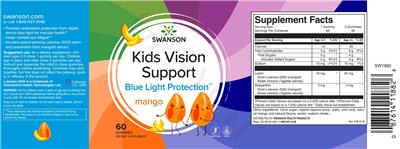
This summary is for Kids Vision Support Mango by Swanson
- Form
- Gummy or Jelly
- Serving Size
- 1 Gummy(ies)
- Servings
- 60 per container
- Container Holds
- 60 Gummy(ies)
- What is Kids Vision Support Mango?A supplement from Swanson with three active ingredients, in gummy form.
- Active Ingredients Sodium 10 mg, 15 mgLutein 10 mg, 20 mgZeaxanthin 2 mg, 4 mg Three active ingredients. Each one can interact with drugs or cause side effects on its own, so we check every one. The full Supplement Facts
- Drug Interactions 291 drugs have a documented interaction with this supplement; the most serious is rated moderate. Of those, 200 are single drugs and 91 are combination products (two or more drugs in one), each listed under its own name. Ask your pharmacist first if you take a drug in any of these categories, the most serious of the 8 on record:
- Moderate · 172 drugs
- Moderate · 86 drugs
- Moderate · 23 drugs
- Sodium-containing DrugsModerate · 7 drugs
- Well documented Why
Does Kids Vision Support Mango work?
What It Is Marketed For
- Eye health
- Macular health
- Blue light protection
From the claims on the product’s label.
The Closest Use the Research Grades
Lutein
Some studies support it, but the evidence isn’t conclusive.
Its ingredients have research behind other uses too:
- Lutein
- Zeaxanthin
These grades are for each ingredient, not this exact product, and never a promise it will work for you.
What the research says- AllergensNone of its ingredient names point to a major food allergen
- Barcode (UPC)0 87614 11882 6Match it to the barcode on your bottle to be sure this is your product. Not your product? Search for it here
Who Might Consider It
- People looking for eye health, macular health and blue light protection, which is what it is marketed for. The closest use the research grades is age-related macular degeneration (AMD), rated Possibly Effective.
- People who want it for cataracts or age-related macular degeneration (AMD): the other uses with research behind them. See each grade
- This supplement may appeal to someone interested in eye and macular health, since its lutein and zeaxanthin have research behind AMD.
Who Should Be Careful
- Anyone who is pregnant or breastfeeding, has high blood pressure, heart, kidney, or liver disease, is on a low-salt diet, or takes lithium, blood pressure medicines, or antidiabetes drugs should take extra care.
- Talk it over with your own doctor or pharmacist before starting.
More Before You Take It Show all three answersHide Its Ingredient Amounts vs. Other Supplements Pregnancy and Breastfeeding The Label’s Directions
-
How do its ingredient amounts compare with other supplements?
- Sodium10 mg, 15 mgLess than most of the 502 recent Sodium products in our database that state an amount; 5 mg is the most common.
- Lutein10 mg, 20 mgMore than most of the 522 recent Lutein products in our database that state an amount; 2 mg is the most common.
- Zeaxanthin2 mg, 4 mgThe most common amount among the 506 recent Zeaxanthin products in our database that state an amount.
A label’s amount is what the product holds, not a recommended dose.
See each comparison -
Pregnant or breastfeeding?
- Pregnancy and Breastfeeding Sodium
- ! When used orally in higher doses.
- Pregnancy and Breastfeeding Lutein
- When used orally and appropriately in amounts found in foods.
- Pregnancy and Breastfeeding Zeaxanthin
- When used orally and appropriately in amounts found in foods.
-
How does the label say to take it?
“Suggested use: As a dietary supplement, children ages 2-3 chew 1 gummy per day. Children age 4 years an older chew 2 gummies per day. Instruct and supervise the child to chew gummies thoroughly before swallowing.”
The maker’s words. Your pharmacist or doctor may advise differently.
Everything the label says
A Note From the HelloPharmacist Team
Research backs this product's main use only in part, since lutein and zeaxanthin are rated possibly effective for age-related macular degeneration, and lutein also for cataracts. Side effects are little known, with none reported, though sodium carries a rare but serious risk if taken in large amounts. Sodium may reduce how well blood pressure medicines work, and a sharp drop in sodium intake may push lithium, a mood medicine, to toxic levels.
From the label dated Mar 22, 2024: all three of its active ingredients were checked against our records. A summary of what is known, not a grade or a test of the product. How these ratings are computed
Ask Anything About This Supplement
Name a drug you take, or ask about side effects, ingredients or pregnancy.
There’s a lot of information about this supplement on this page! Ask anything in plain English for a quick answer drawn from it.
AI answers come from this label and our own records, never the open internet. AI can make mistakes, so always check with your doctor or pharmacist. How we use AI
Ask the Pharmacist
A licensed pharmacist will answer your question by email — free, as soon as they can.
Got it — thank you!
A licensed pharmacist will answer as soon as they can. Keep an eye on your email (worth checking spam, just in case).
What’s Inside Kids Vision Support Mango by Swanson
Three Active Ingredients
In the order the label lists them, each with its own card below.
Why this rating?
The label gives an exact amount for every one of its three active ingredients, so you know how much of each you get in each serving. This rates what the label tells you, not the quality of the product.
Supplement Facts
| Amount Per Serving | % Daily Value | |
|---|---|---|
| Calories | 15 Calories, 25 Calories | † |
| Total Carbohydrates | 3 g, 6 g | 2%, 2% |
| Total Sugars | 2 g, 4 g | † |
| Added Sugars | 2 g, 4 g | 8%, 8% |
| Sodium | 10 mg, 15 mg | 1%, 1% |
| Lutein | 10 mg, 20 mg | † |
| Zeaxanthin | 2 mg, 4 mg | † |
Other ingredients: Cane Sugar, Tapioca Syrup, Water, Citric Acid, Mango Flavor, Natural, Natural Flavors, Pectin, Sodium Citrate
† Daily Value not established.
Daily Values for adults and children 4 or more years of age.
As the label prints it, from the NIH Dietary Supplement Label Database.
Each Ingredient and Its Drug Interactions
Tap one for more about it and its full guide. A drug can interact with this supplement through any one of them.
Lutein and zeaxanthin are carotenoids, plant pigments the label markets for eye and macular health.
- These help make up the gummy and give it its taste and texture.
-
Sodium 10 mg, 15 mg Sodium is a mineral the body needs in small amounts, and it is also the ingredient that calls for the most caution in this product. Interacts with 205 drugs
Sodium is an essential mineral and electrolyte your body needs to balance fluids, support nerves, and help muscles work.
- Most people in modern diets get more than enough—often too much—from food, so supplements are rarely needed except for specific medical reasons like dehydration or low blood sodium.
- Talk to your doctor or pharmacist before deliberately adding sodium, especially if you have high blood pressure, heart, or kidney problems.
The full Sodium guide: uses, dosage and safety Every Sodium drug interaction
-
Lutein 10 mg, 20 mg No known drug interactions
Form on the label: Lutemax 2020
Lutein is a plant-based antioxidant pigment that concentrates in the eye, and the best evidence suggests it (often combined with zeaxanthin) may help slow progression of age-related macular degeneration in certain people.
- For most other eye and health claims, the evidence is limited or mixed.
- It is generally well tolerated, but talk to your pharmacist or doctor before starting it, especially during pregnancy or breastfeeding.
-
Zeaxanthin 2 mg, 4 mg Interacts with 86 drugs
Form on the label: Lutemax 2020
Zeaxanthin is a carotenoid pigment that, along with lutein, concentrates in the macula of the eye and may help support long-term eye health.
- The strongest evidence relates to slowing progression of advanced age-related macular degeneration when combined with other nutrients, while many other uses remain unproven.
- It is generally well tolerated, but talk to your pharmacist or doctor before starting any supplement.
The full Zeaxanthin guide: uses, dosage and safety Every Zeaxanthin drug interaction
How Much of Each Ingredient Is in It, Compared With Other Supplements
Each bar is an amount that other recent supplements list for the same ingredient. The taller the bar, the more of them state it.
-
10 mg in a serving of this product
Less than most products
- Most common amount
- 5 mg (about 12 in 100 products)
- Most products state
- 5 mg to 270 mg
- Compared with
- 502 recent products
-
10 mg in a serving of this product
More than most products
- Most common amount
- 2 mg (about 15 in 100 products)
- Most products state
- 0.25 mg to 20 mg
- Compared with
- 522 recent products
-
2 mg in a serving of this product
The most common amount
- Most common amount
- 2 mg (about 15 in 100 products)
- Most products state
- 0.16 mg to 4 mg
- Compared with
- 506 recent products
Other Ingredients (Inactive)
The capsule or tablet itself, fillers, coatings and flavors. Not part of the drug interaction check; the allergen check below reads them.
- Cane Sugar
- Tapioca Syrup
- Water
- Citric Acid
- Mango Flavor, Natural
- Natural Flavors
- Pectin
- Sodium Citrate
Allergens in Kids Vision Support Mango
None of its ingredient names point to a major food allergen.
Not named in the ingredients
- Milk
- Egg
- Fish
- Shellfish
- Tree nuts
- Peanuts
- Wheat or other gluten grains
- Soy
- Sesame
- Made without, the label says“Gluten free”
- Made without, the label says“Vegan”
From the label text and ingredient names on file; we do not test products. With a serious allergy, check your bottle and ask the maker or your pharmacist.
What the Label Says
The maker’s own words, from the label. We do not verify or endorse them.
- Formulation
-
“Provides antioxidant protection from digital device blue light for macular health Helps combat eye fatigue”
“Gummies may stick together, but this does not affect the potency, quality or efficacy of the product.”
2 more from the label
“Blue light protection”
“Includes award-winning Lutemax 2020 lutein and zeaxanthin from marigold extract”
- Brand IP Statement(s)
-
“Lutemax 2020 is a trademark of OmniActive Health Technologies Ltd. Lutemax 2020 Lutein and zeaxanthin”
- Storage
-
“Store in a cool, dry place.”
- FDA Statement of Identity
-
“Dietary Supplement”
- General statements
-
“Servings Per Container 60, 30”
The Kids Vision Support Mango Label on File
The label scan on file at the NIH Dietary Supplement Label Database, dated March 2024. Always read the label on the bottle you have.
Product Facts
- Brand
- Swanson
- Barcode (UPC)
- 087614118826
- Net contents
- 60 Gummy(ies)
- Market status
- On market
- Date entered into DSLD
- Mar 22, 2024
- DSLD ID
- 308635
- Product type
- Other Combinations
- Supplement form
- Gummy or Jelly
- Dietary claims / uses
- All Other, Structure/Function
- Intended target group(s)
- Children 4 or More Years of Age, Vegan, Vegetarian, Gluten Free, Dairy Free, Children more than 1 but less than 4
Is this label outdated? Report a formula or label change and our pharmacy team will review it.
HelloPharmacist Score Kids Vision Support Mango by Swanson
Up to 10 points for research, amount, label and outside testing. Not a safety rating. How this one adds up
No Score for This Product
It is made for children, and the research behind the score is in adults.
That is not a judgment of the product. It means our score cannot speak for it.
What’s inside itIts drug interactionsIts possible side effects
Kids Vision Support Mango by Swanson Side Effects
Why this rating?
We look for three kinds of safety information on each ingredient: side effects reported in studies, a pregnancy and breastfeeding rating, and a safety write-up from our pharmacy team. Of the three ingredients we could check, two have side-effect reports, all three have a pregnancy rating and all three have a safety write-up.
So this rates how much is known, not whether Kids Vision Support Mango is right for you.
Reported with Sodium, Lutein and Zeaxanthin
- !Rare but serious
- Worsened cardiovascular disease and high blood pressure See details
What Our Pharmacy Team Says
HelloPharmacist Team Summary: Kids Vision Support Mango by Swanson Side Effects
Its ingredients are generally well tolerated, and no side effects have been reported for them, though that does not rule out a reaction for you.
- The one to keep in mind is sodium, since too much of it, especially from a sudden large intake, can be serious and may worsen heart, blood pressure, or kidney problems.
- Lutein has not caused adverse effects at doses up to 20 mg daily, and zeaxanthin is usually well tolerated at typical amounts.
- If you notice a serious reaction, call your doctor right away.
Sodium has side-effect reports, but no list of the most common ones. Read them in the Sodium guide
Kids Vision Support Mango Warnings: Who Should Be Careful
HelloPharmacist Team Summary: Kids Vision Support Mango by Swanson Warnings
Pregnancy and breastfeeding call for care.
- Sodium's ratings include possibly unsafe, so it is best avoided, while lutein and zeaxanthin are rated likely safe, though not enough is known about concentrated supplements.
- Anyone with high blood pressure, heart failure, kidney disease, or liver disease, or anyone on a low-salt diet, should be especially careful with the added sodium.
- People who smoke should take care with high-dose carotenoid supplements like this one, and if you have an eye condition, this should not replace proper medical care.
- Talk it over with your own doctor or pharmacist before starting.
Kids Vision Support Mango has three active ingredients, and each can carry warnings of its own. We checked all three, and each warning below names the ingredient it comes from.
- Sodium3 warnings below
- Lutein1 warning below
- Zeaxanthin3 warnings below
-
Blood Pressure
- SodiumYou should be especially cautious with added sodium if you have high blood pressure, heart failure, kidney disease, or liver disease, or if your doctor has told you to follow a low-salt diet.
-
Other Cautions
- LuteinIf you have an eye condition, do not use lutein as a replacement for proper medical care.
- ZeaxanthinPeople who smoke or have smoked should be careful with high-dose carotenoid supplements in general, because some research with a different carotenoid (beta-carotene) raised concerns about lung cancer risk in smokers.
- ZeaxanthinIf you smoke, talk to your doctor or pharmacist before taking carotenoid supplements.
- ZeaxanthinTo be safe, it is best to use caution and check with your healthcare provider before taking a supplement.
-
What the Label Warns
- “Warning: Not for children under 2 years of age due to choking hazard. Consult your child's pediatrician before giving this or any product to your child. Keep out of reach of children.”
- “Do not exceed recommended dose. Do not use if seal is broken.”
The maker’s wording, from the product label.
-
Pregnant or Breastfeeding
Each ingredient’s rating for pregnancy and for breastfeeding, and what it covers.
Pregnancy and Breastfeeding The record rates both the same
-
When used orally and appropriately.
Sodium is safe in amounts that do not exceed the CDRR intake level of 2.3 grams daily.
-
When used orally in higher doses.
Higher intake can cause hypertension.
Also, both the highest and the lowest pre-pregnancy sodium quintile intakes are associated with an increased risk of hypertensive disorders of pregnancy, including gestational hypertension and pre-eclampsia, and the delivery of small for gestational age (SGA) infants when compared to the middle intake quintile.
Pregnancy and Breastfeeding The record rates both the same
-
When used orally and appropriately in amounts found in foods.
The high end of dietary lutein intake ranges from 6.9-11.7 mg/day.
Pregnancy and Breastfeeding The record rates both the same
-
When used orally and appropriately in amounts found in foods.
Zeaxanthin is found in breast milk and levels correlate with infant status.
2 more points on this rating
- Supplementation during pregnancy increases zeaxanthin levels in cord blood and infant skin.
- There is insufficient reliable information available about the safety of supplemental zeaxanthin.
Our pharmacy team’s notes
- SodiumIts pregnancy and breastfeeding ratings include possibly unsafe, so it is best avoided in those situations.
- LuteinLutein has not caused adverse effects at doses up to 20 mg daily, and it is rated likely safe in pregnancy and breastfeeding.
- ZeaxanthinZeaxanthin is also rated likely safe in pregnancy, but there is not enough data on concentrated supplements while breastfeeding.
Ratings and the words beside them are from the Natural Medicines database, which we license.
-
Rare but Serious Side Effects
-
!
Sodium
Rarely, a sudden large intake of salt—or a rapid change in blood sodium during treatment—can be very serious and even life-threatening.
Too much sodium is linked to high blood pressure and heart strain, and rarely, a sudden large intake can be very serious.
Orally: Worsened cardiovascular disease, hypertension, kidney disease.
-
!
Lutein
Serious side effects are rare.
-
!
Zeaxanthin
Zeaxanthin is usually well tolerated, and serious side effects are uncommon at typical supplement amounts.
When to get help: a serious allergic reaction, with trouble breathing or swelling of the face, lips or throat, needs emergency care: call 911. For any other side effect that worries you, call your doctor or pharmacist.
These reports describe each ingredient, not studies of this exact product. Not medical advice: a side effect you notice after starting a supplement is worth a word with your pharmacist or doctor.
Kids Vision Support Mango by Swanson Drug Interactions
We checked all three active ingredients in this supplement against every drug in our records. A drug can interact with it through any one of them.
A moderate interaction on record
2 of 3, on a scale from Minor or none to Major.Why this rating?
We rate this by the most serious interaction on record, not by how many there are. For Sodium and Zeaxanthin, the most serious is rated moderate, which means it calls for caution, and sometimes monitoring or a change in timing or dose. Some involve kinds of drugs where a small change can matter, such as diabetes drugs and lithium.
291 drugs are on the full list. What matters is whether one you take is on it, so check yours with the interaction checker on this page.
From the HelloPharmacist Team
Our pharmacy team’s read on the supplement as a whole.
- Swanson's Kids Vision Support Mango can interact with some medications, mainly through its sodium and zeaxanthin content.
- The other affected drug types are blood pressure medicines (antihypertensive drugs), where sodium may reduce effectiveness (Moderate); steroid medicines (corticosteroids), where sodium may raise the risk of too much sodium in the blood (Moderate); tolvaptan (Samsca), used for low blood sodium (Moderate); sodium phosphate bowel cleansers (Moderate); didanosine (Videx), an HIV medicine (Moderate); other sodium-containing drugs (Moderate); and antidiabetes drugs, where zeaxanthin may increase the risk of low blood sugar (hypoglycemia) (Moderate).
- Lutein has been checked, and no interactions were found for it.
Two of its three active ingredients have drug interactions on record: Sodium and Zeaxanthin. We have no interaction records for Lutein.
- Interacts with
- 205 drugs
- Most serious
- Moderate
- Sodium carries most of the interactions, and the most serious one is with lithium, a mood medicine, rated Moderate.
- High sodium intake can lower lithium levels, while cutting sodium sharply can raise them to toxic levels.
- Interacts with
- 86 drugs
- Most serious
- Moderate
- Most of its records involve Antidiabetes Drugs.
Summarized by the HelloPharmacist pharmacy team from the interaction records below. How it is written How we use AI
Why Kids Vision Support Mango Interacts, Ingredient by Ingredient
A product interacts through its ingredients. Each card: how many drugs, the most serious rating, and the kinds of drugs it affects most (tap a kind for what it means).
The ingredients driving the most interactions
-
Sodium 205 drugs
Most serious: Moderate7 interaction records on file
The kinds of drugs it affects most
- 172 drugs
- 23 drugs
- Sodium-containing Drugs 7 drugs
- Sodium Phosphates 2 drugs
Every Sodium drug interaction, 7 records The Sodium records cite 43 references, listed in the Sodium guide.
-
Zeaxanthin 86 drugs
Most serious: Moderate1 interaction record on file
The kinds of drugs it affects most
- 86 drugs
Every Zeaxanthin drug interaction, 1 record The Zeaxanthin records cite 5 references, listed in the Zeaxanthin guide.
The Breakdown by Severity
Each drug counted once, at its most serious rating. Tap a tile to list those drugs.
- 0 Major None found
- 291
- 0 Minor None found
Find Your Drug
Type a drug or brand name to see whether it is on the list.
- Only drugs with a documented interaction are listed, the most serious first.
- A drug with no known interaction is not listed, but searching its name tells you so.
- Open a drug to see which ingredient is responsible. Of those, 200 are single drugs and 91 are combination products (two or more drugs in one), each listed under its own name.
-
AmlodipineNorliqva Moderate
The ingredient responsible:
-
Sodium Moderate Amlodipine is in the Antihypertensive Drugs category.
Theoretically, a high intake of dietary sodium might reduce the effectiveness of antihypertensive drugs.
The full Sodium + Amlodipine interaction
-
-
Losartan PotassiumCozaar Moderate
The ingredient responsible:
-
Sodium Moderate Losartan Potassium is in the Antihypertensive Drugs category.
Theoretically, a high intake of dietary sodium might reduce the effectiveness of antihypertensive drugs.
The full Sodium + Losartan Potassium interaction
-
-
MetforminGlucophage, Metformin Moderate
The ingredient responsible:
-
Zeaxanthin Moderate Metformin is in the Antidiabetes Drugs category.
Theoretically, taking zeaxanthin with antidiabetes drugs might increase the risk of hypoglycemia.
The full Zeaxanthin + Metformin interaction
-
-
MetoprololLopressor, Toprol XL Moderate
The ingredient responsible:
-
Sodium Moderate Metoprolol is in the Antihypertensive Drugs category.
Theoretically, a high intake of dietary sodium might reduce the effectiveness of antihypertensive drugs.
The full Sodium + Metoprolol interaction
-
-
TirzepatideMounjaro, Zepbound Moderate
The ingredient responsible:
-
Zeaxanthin Moderate Tirzepatide is in the Antidiabetes Drugs category.
Theoretically, taking zeaxanthin with antidiabetes drugs might increase the risk of hypoglycemia.
The full Zeaxanthin + Tirzepatide interaction
-
-
SemaglutideOzempic, Rybelsus, Wegovy Moderate
The ingredient responsible:
-
Zeaxanthin Moderate Semaglutide is in the Antidiabetes Drugs category.
Theoretically, taking zeaxanthin with antidiabetes drugs might increase the risk of hypoglycemia.
The full Zeaxanthin + Semaglutide interaction
-
-
PrednisoneCortan, Deltasone, Meticorten, Orasone, Prednicen-M and 3 more Moderate
The ingredient responsible:
-
Sodium Moderate Prednisone is in the Corticosteroids category.
Concomitant use of mineralocorticoids and some glucocorticoids with sodium supplements might increase the risk of hypernatremia.
The full Sodium + Prednisone interaction
-
-
PropranololAngilol, Bedranol SR, Beta Prograne, Half Beta Prograne, Half-Inderal LA and 7 more Moderate
The ingredient responsible:
-
Sodium Moderate Propranolol is in the Antihypertensive Drugs category.
Theoretically, a high intake of dietary sodium might reduce the effectiveness of antihypertensive drugs.
The full Sodium + Propranolol interaction
-
-
LisinoprilPrinivil, Qbrelis, Zestril Moderate
The ingredient responsible:
-
Sodium Moderate Lisinopril is in the Antihypertensive Drugs category.
Theoretically, a high intake of dietary sodium might reduce the effectiveness of antihypertensive drugs.
The full Sodium + Lisinopril interaction
-
-
Amlodipine BesylateNorvasc Moderate
The ingredient responsible:
-
Sodium Moderate Amlodipine Besylate is in the Antihypertensive Drugs category.
Theoretically, a high intake of dietary sodium might reduce the effectiveness of antihypertensive drugs.
The full Sodium + Amlodipine Besylate interaction
-
-
BisoprololZebeta Moderate
The ingredient responsible:
-
Sodium Moderate Bisoprolol is in the Antihypertensive Drugs category.
Theoretically, a high intake of dietary sodium might reduce the effectiveness of antihypertensive drugs.
The full Sodium + Bisoprolol interaction
-
-
ValsartanDiovan, Prexxartan Moderate
The ingredient responsible:
-
Sodium Moderate Valsartan is in the Antihypertensive Drugs category.
Theoretically, a high intake of dietary sodium might reduce the effectiveness of antihypertensive drugs.
The full Sodium + Valsartan interaction
-
-
TelmisartanMicardis Moderate
The ingredient responsible:
-
Sodium Moderate Telmisartan is in the Antihypertensive Drugs category.
Theoretically, a high intake of dietary sodium might reduce the effectiveness of antihypertensive drugs.
The full Sodium + Telmisartan interaction
-
-
Metformin HydrochlorideRiomet ER Moderate
The ingredient responsible:
-
Zeaxanthin Moderate Metformin Hydrochloride is in the Antidiabetes Drugs category.
Theoretically, taking zeaxanthin with antidiabetes drugs might increase the risk of hypoglycemia.
The full Zeaxanthin + Metformin Hydrochloride interaction
-
-
SpironolactoneAldactone, Carospir, Spiroton Moderate
The ingredient responsible:
-
Sodium Moderate Spironolactone is in the Antihypertensive Drugs category.
Theoretically, a high intake of dietary sodium might reduce the effectiveness of antihypertensive drugs.
The full Sodium + Spironolactone interaction
-
-
GlucoseIV Glucose Moderate
The ingredient responsible:
-
Zeaxanthin Moderate Glucose is in the Antidiabetes Drugs category.
Theoretically, taking zeaxanthin with antidiabetes drugs might increase the risk of hypoglycemia.
The full Zeaxanthin + Glucose interaction
-
-
AcetazolamideAk-Zol, Diamox Moderate
The ingredient responsible:
-
Sodium Moderate Acetazolamide is in the Antihypertensive Drugs category.
Theoretically, a high intake of dietary sodium might reduce the effectiveness of antihypertensive drugs.
The full Sodium + Acetazolamide interaction
-
-
CarvedilolCoreg, Coreg CR Moderate
The ingredient responsible:
-
Sodium Moderate Carvedilol is in the Antihypertensive Drugs category.
Theoretically, a high intake of dietary sodium might reduce the effectiveness of antihypertensive drugs.
The full Sodium + Carvedilol interaction
-
-
Metformin XrGlucophage XR Moderate
The ingredient responsible:
-
Zeaxanthin Moderate Metformin Xr is in the Antidiabetes Drugs category.
Theoretically, taking zeaxanthin with antidiabetes drugs might increase the risk of hypoglycemia.
The full Zeaxanthin + Metformin Xr interaction
-
-
InsulinNovoRapid Insulin Moderate
The ingredient responsible:
-
Zeaxanthin Moderate Insulin is in the Antidiabetes Drugs category.
Theoretically, taking zeaxanthin with antidiabetes drugs might increase the risk of hypoglycemia.
The full Zeaxanthin + Insulin interaction
-
-
Propranolol HydrochlorideHemangeol Moderate
The ingredient responsible:
-
Sodium Moderate Propranolol Hydrochloride is in the Antihypertensive Drugs category.
Theoretically, a high intake of dietary sodium might reduce the effectiveness of antihypertensive drugs.
The full Sodium + Propranolol Hydrochloride interaction
-
-
Insulin (human)Afrezza, Novolin 70/30, Novolin L, Novolin N, Novolin R Moderate
The ingredient responsible:
-
Zeaxanthin Moderate Insulin (human) is in the Antidiabetes Drugs category.
Theoretically, taking zeaxanthin with antidiabetes drugs might increase the risk of hypoglycemia.
The full Zeaxanthin + Insulin (human) interaction
-
-
AtenololAtenix, Tenormin Moderate
The ingredient responsible:
-
Sodium Moderate Atenolol is in the Antihypertensive Drugs category.
Theoretically, a high intake of dietary sodium might reduce the effectiveness of antihypertensive drugs.
The full Sodium + Atenolol interaction
-
-
Lithium Carbonate (prescription Drug)Eskalith, Lithium Carbonate Moderate
The ingredient responsible:
-
Sodium Moderate
Altering dietary intake of sodium might alter the levels and clinical effects of lithium.
The full Sodium + Lithium Carbonate (prescription Drug) interaction
-
-
MinoxidilLoniten, Minoxidil, Rogaine Moderate
The ingredient responsible:
-
Sodium Moderate Minoxidil is in the Antihypertensive Drugs category.
Theoretically, a high intake of dietary sodium might reduce the effectiveness of antihypertensive drugs.
The full Sodium + Minoxidil interaction
-
-
Candesartan CilexetilAmias, Atacand Moderate
The ingredient responsible:
-
Sodium Moderate Candesartan Cilexetil is in the Antihypertensive Drugs category.
Theoretically, a high intake of dietary sodium might reduce the effectiveness of antihypertensive drugs.
The full Sodium + Candesartan Cilexetil interaction
-
-
DexamethasoneDecadron, Dexone, Dextenza, Dexycu, Hemady and 2 more Moderate
The ingredient responsible:
-
Sodium Moderate Dexamethasone is in the Corticosteroids category.
Concomitant use of mineralocorticoids and some glucocorticoids with sodium supplements might increase the risk of hypernatremia.
The full Sodium + Dexamethasone interaction
-
-
RamiprilAltace Moderate
The ingredient responsible:
-
Sodium Moderate Ramipril is in the Antihypertensive Drugs category.
Theoretically, a high intake of dietary sodium might reduce the effectiveness of antihypertensive drugs.
The full Sodium + Ramipril interaction
-
-
AlogliptinNesina Moderate
The ingredient responsible:
-
Zeaxanthin Moderate Alogliptin is in the Antidiabetes Drugs category.
Theoretically, taking zeaxanthin with antidiabetes drugs might increase the risk of hypoglycemia.
The full Zeaxanthin + Alogliptin interaction
-
-
GlipizideGlucotrol, Glucotrol XL Moderate
The ingredient responsible:
-
Zeaxanthin Moderate Glipizide is in the Antidiabetes Drugs category.
Theoretically, taking zeaxanthin with antidiabetes drugs might increase the risk of hypoglycemia.
The full Zeaxanthin + Glipizide interaction
-
Does It Work? Kids Vision Support Mango by Swanson
What the research says for what it is marketed for, then its ingredients’ other uses and each ingredient on its own. A grade is the research so far, never an endorsement.
What the Research Supports
First for what it is marketed for, then the other uses its ingredients are graded for, strongest research first.
Marketed for eye health, macular health and blue light protection
- Lutein and Zeaxanthin
- Lutein
HelloPharmacist Team Summary: Does Kids Vision Support Mango by Swanson Work?
It is marketed for eye health, macular health, and blue light protection.
- For macular health, the strongest research is for lutein and zeaxanthin in age-related macular degeneration (AMD), both rated possibly effective, and lutein is also rated possibly effective for cataracts.
- Most other eye uses are rated as having insufficient reliable evidence to rate, and none of its ingredients has been graded for blue light protection.
- Those grades apply to each ingredient on its own, not to this specific combination.
The Evidence, Ingredient by Ingredient
The detail behind the list above: our notes on each ingredient and its graded uses.
Sodium
From our Sodium guide
- Sodium is genuinely needed for normal body function, so the question is usually about how much, not whether it works.
Not counted here: one graded use is for Sodium injected or put on the skin (cystic fibrosis), not for a product like this one. One more is for a condition treated by a doctor or in a hospital (amphotericin B nephrotoxicity).
Every graded use, in the Sodium guideLutein
From our Lutein guide
- Lutein is most studied for eye health.
- The strongest evidence comes from large studies on age-related macular degeneration (AMD), where lutein and zeaxanthin were part of supplement formulas that may help slow progression in people who already have a certain stage of the disease.
Research suggests a benefit for
- Age-related macular degeneration (AMD) (the use on its label) and cataracts
Zeaxanthin
From our Zeaxanthin guide
- The best-studied use of zeaxanthin is for age-related macular degeneration (AMD).
- Large eye-health research projects have tested zeaxanthin together with lutein and other nutrients (like vitamins C and E, zinc, and copper).
Research suggests a benefit for
- Age-related macular degeneration (AMD)
The grades are the Natural Medicines database’s, which we license; tap a grade for what it means. They are about each ingredient, not this exact product.
About Swanson
Manufacturer and brand details for Kids Vision Support Mango, from the product label.
Swanson has 700 products in our supplement database, 699 of them on the market, with labels on file since 2012. Our database is built from the NIH’s Dietary Supplement Label Database and our pharmacy team’s own additions, so it covers the labels filed there, not every product the brand sells.
- Name
- Swanson Health Products
- City
- Fargo
- State
- ND
- ZipCode
- 58104
- Phone Number
- 1-800-437-4148
- Web Address
- swanson.com
Kids Vision Support Mango by Swanson: Common Questions
Does Kids Vision Support Mango by Swanson interact with any drugs?
What are the side effects of Kids Vision Support Mango by Swanson?
Who should be careful taking Kids Vision Support Mango by Swanson?
Does Kids Vision Support Mango by Swanson contain any common allergens?
Is Kids Vision Support Mango by Swanson gluten free?
How can Kids Vision Support Mango by Swanson interact with so many drugs?
Where does the information about Kids Vision Support Mango by Swanson come from?
Does lutein help with age-related macular degeneration?
Is Kids Vision Support Mango by Swanson a good choice during pregnancy?
Does Kids Vision Support Mango by Swanson protect against blue light?
Written and reviewed by the HelloPharmacist Editorial Team. Our editorial policy
Still Have a Question About Kids Vision Support Mango?
Our pharmacists answer drug and supplement questions, free, by email.
Label information is sourced from the NIH Dietary Supplement Label Database and reflects the product version on file; always read your actual product label. This page is for education only and is not a substitute for professional medical advice. Confirm with your pharmacist or doctor before combining supplements and drugs.
Who Reviews This Page
The pharmacist behind it, and how it is checked.
Dr. Brian Staiger, PharmD, BCPS
Clinical pharmacist and founder of HelloPharmacist
A licensed pharmacist for more than 13 years, he built the system behind this page: it reads the label on file, matches each active ingredient to its record in the Natural Medicines database, checks those records against every drug we cover, and our pharmacy team writes the take and the interaction summary from those records.
- 13+ Years in PharmacyRetail and clinical pharmacy, medication safety and healthcare administration.
- Board Certified (BCPS)A pharmacotherapy specialist, certified by the Board of Pharmacy Specialties.
- Herbalist TrainingCertificates in medical ethnobotany, for the herbs and supplements people take.
Where This Page Comes From
Kids Vision Support Mango’s label data comes from the NIH Dietary Supplement Label Database; the ingredient interaction data is from the Natural Medicines database, reviewed by our pharmacists.
- NIH Dietary Supplement Label Database (DSLD)
- The official product label on file for this supplement.
- Natural Medicines (Therapeutic Research Center)
- The evidence-graded clinical reference behind the ingredient interaction, evidence and safety records, which we license.
- HelloPharmacist Editorial Team
- Content is reviewed by the HelloPharmacist Editorial Team, the pharmacists on our staff and those we contract. See our data sources and editorial standards for how this information is built and checked.
- The Pharmacy Team’s Take and Summaries
- Generated from HelloPharmacist’s pharmacist-curated databases and editorial rules. Clinical methodology reviewed by Dr. Brian Staiger, PharmD, BCPS. Last generated Nov 26, 2026. How we use AI
- The ratings in the Quick Summary
- They summarize available label information, ingredient evidence and known drug-safety records: a summary of what is known, not a grade of the product itself. They do not verify product identity, purity, potency, contamination or manufacturing quality. How these ratings are computed
The References Behind the Interaction Records
Every citation the ingredients’ records rest on is listed in that ingredient’s guide, in context: Sodium, 43 references; Lutein, 2 references; Zeaxanthin, 5 references .
Parts of this content are provided by the Therapeutic Research Center, LLC.
DISCLAIMER: Currently this does not check for drug-drug interactions. This is not an all-inclusive comprehensive list of potential interactions and is for informational purposes only. Not all interactions are known or well-reported in the scientific literature, and new interactions are continually being reported. Input is needed from a qualified healthcare provider including a pharmacist before starting any therapy. Application of clinical judgment is necessary.
© 2021 Therapeutic Research Center, LLC
Keep Exploring
- Supplement interaction checkerCheck any supplement or product against your drugs
- Drug–drug interactionsCheck two or more of your drugs against each other
- Browse drugs A to ZEvery drug we have checked against herbs and supplements
- NDC and pricing lookupFind a drug’s NDCs, packaging and costs
- Ask a pharmacistA free, personal answer from our licensed team