
Post Workout by Dyna Storm Nutrition Ingredients, Side Effects and Drug Interactions
Dietary Supplement Capsule Other Combinations

Medically reviewed by Dr. Brian Staiger, PharmD, BCPS
Also reviewed by the HelloPharmacist Editorial Team
Updated Details about this page
- Label on file from the NIH Dietary Supplement Label Database, dated Dec 26, 2020.
- The interaction, evidence and safety records come from the Natural Medicines database, which we license, read against this label by our own system; the pharmacy team’s sections are written from those records.
- Dr. Brian Staiger, PharmD, BCPS, is a clinical pharmacist and pharmacotherapy specialist.
- Editorial policy Our sources
AI is used only to summarize verified clinical information, never the open internet. Our AI policy
Summary: The HelloPharmacist Team’s Take
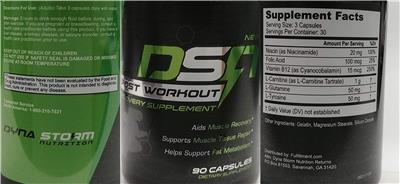
- Form
- Capsule
- Serving Size
- 3 Capsules
- Servings
- 30 per container
- Container Holds
- 90 Capsules
- Status
- No longer sold, per the NIH record
What’s in it, whether it interacts with your drugs, its side effects, whether it works, and what our pharmacists would want you to know before you start it.
- What is Post Workout?An L-Carnitine supplement from Dyna Storm Nutrition with five other active ingredients, in capsule form.
- Active Ingredients 3 vitamins, 2 amino acids and 1 other: Niacin 20 mgFolic Acid 100 mcgVitamin B12 15 mcgL-Carnitine 1 gL-Glutamine 50 mgL-Tyrosine 50 mg Six active ingredients. Each one can interact with drugs or cause side effects on its own, so we check every one. The full Supplement Facts
- Drug Interactions 800 drugs have a documented interaction with this supplement; the most serious is rated moderate. Of those, 505 are single drugs and 295 are combination products (two or more drugs in one), each listed under its own name. Ask your pharmacist first if you take a drug in any of these categories, the most serious of the 26 on record:
- Moderate · 372 drugs
- Moderate · 172 drugs
- Moderate · 122 drugs
- Moderate · 86 drugs
- Possible Side EffectsNausea 4 ingredientsStomach upset 4 ingredientsBloating 2 ingredientsGas 2 ingredientsRedTingling +15 moreCombined from five of its six active ingredients. Not studied in this exact product.
- Well documented Why
Does Post Workout work?
What It Is Marketed For
Post-workout muscle recovery
From the claims on the product’s label.
The Closest Use the Research Grades
Glutamine
The studies lean against a benefit.
Its ingredients have stronger research for other uses:
- L-carnitine deficiency L-Carnitine
- L-Carnitine
- Myocarditis L-Carnitine
- Phenylketonuria (PKU) Tyrosine
- Pellagra Niacin
- Critical illness (trauma) Glutamine
These grades are for each ingredient, not this exact product, and never a promise it will work for you.
And 5 more graded uses, in what the research says- Full Why
- AllergensNone of its ingredient names point to a major food allergen, and the label text we have carries no allergen statement
Who Might Consider It
- People looking for post-workout muscle recovery, which is what it is marketed for. For athletic performance, the closest use the research grades, the studies lean against a benefit.
- People who want L-Carnitine, its main ingredient, for L-carnitine deficiency, hyperlipidemia, myocarditis or another graded use: the uses with research behind it. See each grade
More Before You Take It Show both answersHide Pregnancy and Breastfeeding The Label’s Directions
-
Pregnant or breastfeeding?
- Pregnancy L-Carnitine
- Insufficient reliable information available; avoid using.
- Breastfeeding L-Carnitine
- When used orally.
- Pregnancy and Breastfeeding Tyrosine
- There is insufficient reliable information available about the safety of tyrosine during pregnancy and lactation when used in medicinal amounts.
- Pregnancy and Breastfeeding Niacin
- When used orally in amounts that do not exceed the tolerable upper intake level (UL).
-
How does the label say to take it?
“Directions for use: (Adults) Take 3 capsules daily with water.”
The maker’s words. Your pharmacist or doctor may advise differently.
Everything the label says
From the label dated Dec 26, 2020: all six of its active ingredients were checked against our records. A summary of what is known, not a grade or a test of the product. How these ratings are computed
Ask Anything About This Supplement
Name a drug you take, or ask about side effects, ingredients or pregnancy.
AI answers come from this label and our own records, never the open internet. AI can make mistakes, so always check with your doctor or pharmacist. How we use AI
Ask the Pharmacist
A licensed pharmacist will answer your question by email — free, as soon as they can.
Got it — thank you!
A licensed pharmacist will answer as soon as they can. Keep an eye on your email (worth checking spam, just in case).
What’s Inside Post Workout by Dyna Storm Nutrition
Six Active Ingredients, Each Checked on Its Own
A supplement is often several ingredients in one bottle, and each one can interact with drugs or cause side effects on its own. We check every one of them against our records.
- NiacinDrug interactions on record, most serious: Moderate
- Folic AcidDrug interactions on record, most serious: Moderate
- Vitamin B12No drug interactions on record
- L-CarnitineDrug interactions on record, most serious: Moderate
- L-GlutamineDrug interactions on record, most serious: Moderate
- L-TyrosineDrug interactions on record, most serious: Moderate
Why this rating?
The label gives an exact amount for every one of its six active ingredients, so you know how much of each you get in each serving. This rates what the label tells you, not the quality of the product.
Supplement Facts
| Amount Per Serving | % Daily Value | |
|---|---|---|
| Niacin | 20 mg | 100% |
| Folic Acid | 100 mcg | 25% |
| Vitamin B12 | 15 mcg | 250% |
| L-Carnitine | 1 g | † |
| L-Glutamine | 50 mg | † |
| L-Tyrosine | 50 mg | † |
Other ingredients: Gelatin, Magnesium Stearate, Silicon Dioxide
† Daily Value not established.
Daily Values for adults and children 4 or more years of age.
As the label prints it, from the NIH Dietary Supplement Label Database.
Each Ingredient and Its Drug Interactions
Tap one for more about it and its full guide. A drug can interact with this supplement through any one of them.
-
Niacin 20 mg Interacts with 729 drugs
Form on the label: Niacinamide
Niacin (vitamin B3) is an essential nutrient your body needs for energy and metabolism, and deficiency is uncommon in most developed countries.
- Prescription-strength niacin has been used to adjust cholesterol levels, but high doses can cause flushing and other side effects and should only be taken under medical supervision.
- Always talk with a pharmacist or doctor before using high-dose niacin supplements.
The full Niacin guide: uses, dosage and safety Every Niacin drug interaction
-
Folic Acid 100 mcg Interacts with 40 drugs
Folic acid is the man-made form of vitamin B9 and is one of the most well-studied supplements, especially for preventing serious birth defects when taken before and during early pregnancy.
- It is widely available, inexpensive, and generally safe at recommended doses, but you should still check with your pharmacist or doctor about the right amount for you.
The full Folic Acid guide: uses, dosage and safety Every Folic Acid drug interaction
-
Vitamin B12 15 mcg Interacts with 20 drugs
Form on the label: Cyanocobalamin
Vitamin B12 (cobalamin) is an essential nutrient your body needs to make red blood cells, keep nerves healthy, and support DNA.
- Supplements are very helpful for people who are deficient — such as vegans, older adults, and those with absorption problems — but taking extra B12 when you are not deficient is unlikely to boost energy or health.
- Talk to your pharmacist or doctor if you think you may be low.
The full Vitamin B12 guide: uses, dosage and safety Every Vitamin B12 drug interaction
-
L-Carnitine 1 g Interacts with 19 drugs
Form on the label: L-Carnitine Tartrate
L-carnitine is a compound your body makes naturally and also gets from foods like meat.
- It helps cells turn fat into energy, and supplements are most clearly useful for people with a true carnitine deficiency.
- For most other uses, like weight loss or boosting athletic performance, the evidence is mixed or limited, so talk with your pharmacist or doctor before trying it.
The full L-Carnitine guide: uses, dosage and safety Every L-Carnitine drug interaction
-
L-Glutamine 50 mg Interacts with 50 drugs
Glutamine is the most abundant amino acid in the body and is usually made in your muscles.
- A prescription form is FDA-approved to help reduce sickle cell disease complications, but for most popular uses such as muscle building, gut health, and immunity the evidence is limited or mixed.
- It is generally well tolerated in healthy people, but anyone with serious liver or kidney problems should check with a doctor first.
The full Glutamine guide: uses, dosage and safety Every Glutamine drug interaction
-
L-Tyrosine 50 mg Interacts with 21 drugs
L-tyrosine is an amino acid your body uses to make brain chemicals like dopamine and norepinephrine.
- Some studies suggest it may help mental performance during short-term stress, sleep loss, or cold, but the evidence is mixed and it is not proven for everyday focus or mood.
- It is generally well tolerated in healthy adults, but check with your pharmacist or doctor before using it, especially during pregnancy or if you have a thyroid condition.
The full Tyrosine guide: uses, dosage and safety Every Tyrosine drug interaction
Other Ingredients (Inactive)
The capsule or tablet itself, fillers, coatings and flavors. Not part of the drug interaction check; the allergen check below reads them.
- Gelatin
- Magnesium Stearate
- Silicon Dioxide
Allergens in Post Workout
None of its ingredient names point to a major food allergen, and the label text we have carries no allergen statement.
Named on this label
- Gelatin (animal-derived)In the ingredients: Gelatin
Not named in the ingredients
- Milk
- Egg
- Fish
- Shellfish
- Tree nuts
- Peanuts
- Wheat or other gluten grains
- Soy
- Sesame
From the label text and ingredient names on file; we do not test products. With a serious allergy, check your bottle and ask the maker or your pharmacist.
What the Label Says
The maker’s own words, from the label. We do not verify or endorse them.
- Storage
-
“Store at room temperature”
- General statements
-
“New”
- Formulation
-
“Recovery supplement Aids muscle recovery Supports muscle tissue repair Helps support fat metabolism”
- FDA Statement of Identity
-
“Dietary Supplement”
The Post Workout Label on File
The label scan on file at the NIH Dietary Supplement Label Database, dated December 2020. Always read the label on the bottle you have.
Product Facts
- Brand
- Dyna Storm Nutrition
- Net contents
- 90 Capsules
- Market status
- Off market
- Date entered into DSLD
- Dec 26, 2020
- DSLD ID
- 239605
- Product type
- Other Combinations
- Supplement form
- Capsule
- Dietary claims / uses
- All Other, Structure/Function
- Intended target group(s)
- Adult (18 - 50 Years)
Is this label outdated? Report a formula or label change and our pharmacy team will review it.
Post Workout by Dyna Storm Nutrition Side Effects
Why this rating?
We look for three kinds of safety information on each ingredient: side effects reported in studies, a pregnancy and breastfeeding rating, and a safety write-up from our pharmacy team. All three are on file for each of the six ingredients we could check.
So this rates how much is known, not whether Post Workout is right for you.
Reported with six of its ingredients
- Most often
- Nausea, stomach upset, bloating, gas, red and tingling
- !Rare but serious
- Liver injury, myopathy and low platelets See details
Side Effects, Ingredient by Ingredient
A supplement’s side effects come from its ingredients. Here is what is reported with each one.
Niacin
Most reported
- Red
- Tingling
Folic Acid
Most reported
- Stomach upset
- Nausea
- Bloating
- Gas
L-Carnitine
Most reported
- Nausea, stomach upset, or cramping
- Diarrhea
- A fishy body odor, especially at higher doses
- Heartburn or a fishy taste
Glutamine
Most reported
- Stomach upset
- Nausea
- Bloating
- Gas
Tyrosine
Most reported
- Nausea
- Upset stomach
- Headache
- Fatigue
Vitamin B12 has side-effect reports, but no list of the most common ones. Read them in the Vitamin B12 guide
Post Workout Warnings: Who Should Be Careful
Post Workout has six active ingredients, and each can carry warnings of its own. We checked all six, and each warning below names the ingredient it comes from. If any of these apply to you, talk to your doctor or pharmacist before you start it.
- Niacin2 warnings below
- Folic Acid2 warnings below
- Vitamin B121 warning below
- L-Carnitine3 warnings below
- Glutamine3 warnings below
- Tyrosine2 warnings below
-
Bleeding Problems or Surgery
- Vitamin B12Older adults, people with stomach or bowel conditions, those who have had weight-loss or stomach surgery, and people on long-term acid-reducing medicines may absorb B12 poorly and should ask about testing.
-
Diabetes or Low Blood Sugar
- NiacinPeople with liver disease, stomach ulcers, gout, diabetes, low blood pressure, or a history of heart problems should be especially careful and talk to a healthcare provider first.
-
Liver Disease
- GlutamineUse extra caution if you have kidney disease or liver disease, since these organs are involved in processing amino acids and the byproducts of protein.
-
Kidney Disease or Kidney Stones
- L-CarnitineUse extra caution if you have kidney disease, since the body handles L-carnitine differently and waste products may build up.
-
Thyroid Conditions
- TyrosineBe extra cautious if you have a thyroid condition (such as overactive thyroid or Graves' disease), because tyrosine is used to make thyroid hormones and could in theory affect thyroid levels.
-
Seizure Disorders
- L-CarnitinePeople with a history of seizures should also be careful, as some reports link L-carnitine to more frequent seizures.
- GlutaminePeople with a history of seizures or certain mental health conditions should also talk to a doctor first, because glutamine is related to glutamate, a chemical messenger in the brain.
-
Iron Deficiency or Anemia
- Folic AcidAnyone with a history of anemia should have the cause checked rather than just taking folic acid on their own.
-
If You Take Other Drugs
- NiacinAlways check with a pharmacist or doctor before starting high-dose niacin, especially if you take other medicines or have a chronic health condition.
- TyrosinePeople with a history of migraines or those taking medications that affect brain chemicals should also check with a professional first.
-
Other Cautions
- Folic AcidOne important caution: high doses of folic acid can mask a vitamin B12 deficiency.
- L-CarnitinePeople with a real deficiency are often treated under medical supervision.
- GlutaminePeople with these conditions should only take glutamine under the supervision of a healthcare provider.
-
What the Label Warns
- “Warnings: Ensure to drink enough fluid before, during, and after exercise.”
- “If you are pregnant or breastfeeding, consult a health care practitioner before using this product.”
- “If you have a liver disease, a kidney disease, or seizure disorder, consult a health care practitioner prior to use.”
- “Keep out of reach of children”
- “Do not use if safety seal is damaged or missing”
The maker’s wording, from the product label.
-
Pregnant or Breastfeeding
Each ingredient’s rating for pregnancy and for breastfeeding, and what it covers.
Pregnancy
-
Insufficient reliable information available; avoid using.
Breastfeeding
-
When used orally.
Supplemental doses of L-carnitine have been given to infants in breast milk and formula with no reported adverse effects.
The effects of large doses used while nursing are unknown, but L-carnitine is secreted in the breast milk.
Pregnancy and Breastfeeding The record rates both the same
-
There is insufficient reliable information available about the safety of tyrosine during pregnancy and lactation when used in medicinal amounts.
Some pharmacokinetic research shows that taking a single dose of tyrosine 2-10 grams orally can modestly increase levels of free tyrosine in breast milk.
2 more points on this rating
- However, total levels are not affected, and levels remain within the range found in infant formulas.
- Therefore, it is not clear if the increase in free tyrosine is a concern.
Show 4 more ingredients
Pregnancy and Breastfeeding The record rates both the same
-
When used orally in amounts that do not exceed the tolerable upper intake level (UL).
The UL of niacin during pregnancy and lactation is 30 mg daily for 14-18 years of age and 35 mg daily for 19 years and older.
There is insufficient reliable information available about the safety of larger oral doses of niacin during pregnancy or lactation; avoid using.
Pregnancy and Breastfeeding The record rates both the same
-
When used orally and appropriately.
Folic acid 300-400 mcg is commonly used during pregnancy for prevention of neural tube defects.
3 more points on this rating
- Miscarriage rates and negative impacts on fetal growth have not been shown to increase with peri-conception supplemental folic acid intakes of 4 mg per day.
- However, other research shows that taking more than 5 mg per day during pregnancy may reduce development of cognitive, emotional, and motor skills in infants.
- Also, the tolerable upper intake level (UL) of folic acid for pregnant or lactating women is 800 mcg daily for those 14-18 years of age and 1000 mcg daily for those 19 years and older.
-
When L-5-methyltetrahydrofolate (L-5-MTHF), the reduced form of folate, is used orally and appropriately, short-term.
L-5-MTHF has been used with apparent safety at a dose of 416 mcg daily for 16 weeks during lactation.
Compared to folic acid, this form seems to further increase the folate concentration of red blood cells, but not breast milk.
Pregnancy
-
When used orally in amounts that do not exceed the recommended dietary allowance (RDA).
The RDA for vitamin B12 during pregnancy is 2.6 mcg daily.
There is insufficient reliable information available about the safety of larger amounts of vitamin B12 during pregnancy.
Breastfeeding
-
When used orally in amounts that do not exceed the recommended dietary allowance (RDA).
The RDA of vitamin B12 during lactation is 2.8 mcg daily.
There is insufficient reliable information available about the safety of larger amounts of vitamin B12 while breastfeeding.
Pregnancy and Breastfeeding The record rates both the same
-
When consumed in amounts commonly found in foods.
There is insufficient reliable information available about the safety of glutamine when used in larger amounts as medicine during pregnancy or lactation.
Ratings and the words beside them are from the Natural Medicines database, which we license.
-
Rare but Serious Side Effects
-
!
Niacin
Higher doses can sometimes cause more serious problems, such as liver injury, increased blood sugar, gout flares, and changes in vision.
Orally: Hepatotoxicity, myopathy, thrombocytopenia, and vision changes.
-
!
Folic Acid
Allergic reactions are uncommon but possible.
Orally: Cancer (long-term use), cardiovascular complications, liver injury, seizures.
Allergic reactions such as bronchospasm and anaphylactic shock.
-
!
Vitamin B12
Serious allergic reactions are rare but possible; signs include rash, swelling, or trouble breathing, which need emergency care.
-
!
L-Carnitine
Seizures.
-
!
Glutamine
Serious reactions are uncommon.
-
!
Tyrosine
Serious side effects are uncommon at typical supplement doses.
When to get help: a serious allergic reaction, with trouble breathing or swelling of the face, lips or throat, needs emergency care: call 911. For any other side effect that worries you, call your doctor or pharmacist.
These reports describe each ingredient, not studies of this exact product. Not medical advice: a side effect you notice after starting a supplement is worth a word with your pharmacist or doctor.
Post Workout by Dyna Storm Nutrition Drug Interactions
We checked all six active ingredients in this supplement against every drug in our records. A drug can interact with it through any one of them.
A moderate interaction on record
2 of 3, on a scale from Minor or none to Major.Why this rating?
We rate this by the most serious interaction on record, not by how many there are. For Glutamine, Niacin, Vitamin B12, Folic Acid and L-Carnitine, the most serious is rated moderate, which means it calls for caution, and sometimes monitoring or a change in timing or dose. Some involve kinds of drugs where a small change can matter, such as blood thinners, seizure drugs and diabetes drugs.
801 drugs are on the full list. What matters is whether one you take is on it, so check yours with the interaction checker on this page.
All six of its active ingredients have drug interactions on record: Niacin, Folic Acid, Vitamin B12, L-Carnitine, Glutamine and Tyrosine.
- Interacts with
- 729 drugs
- Most serious
- Moderate
- Most of its records involve Hepatotoxic Drugs, Antihypertensive Drugs and Anticoagulant/Antiplatelet Drugs.
- Interacts with
- 50 drugs
- Most serious
- Moderate
- Most of its records involve Anticonvulsants.
- Interacts with
- 40 drugs
- Most serious
- Moderate
- Most of its records involve Phenobarbital (Luminal), Phenytoin (Dilantin) and 5-Fluorouracil.
Show three more ingredients
- Interacts with
- 21 drugs
- Most serious
- Moderate
- Most of its records involve Thyroid Hormone and Levodopa.
- Interacts with
- 20 drugs
- Most serious
- Minor
- Most of its records involve Metformin (Glucophage).
- Interacts with
- 19 drugs
- Most serious
- Moderate
- Most of its records involve Thyroid Hormone, Warfarin (Coumadin) and Acenocoumarol (Sintrom).
Why Post Workout Interacts, Ingredient by Ingredient
A product interacts through its ingredients. Each card: how many drugs, the most serious rating, and the kinds of drugs it affects most (tap a kind for what it means).
The ingredients driving the most interactions
-
Niacin 729 drugs
Most serious: Moderate15 interaction records on file
The kinds of drugs it affects most
- 372 drugs
- 172 drugs
- 122 drugs
- 86 drugs
Every Niacin drug interaction, 15 records The Niacin records cite 66 references, listed in the Niacin guide.
-
L-Glutamine 50 drugs
Most serious: Moderate1 interaction record on file
The kinds of drugs it affects most
- 50 drugs
Every Glutamine drug interaction, 1 record The Glutamine records cite 11 references, listed in the Glutamine guide.
-
Folic Acid 40 drugs
Most serious: Moderate7 interaction records on file
The kinds of drugs it affects most
- Phenobarbital (Luminal) 28 drugs
- Phenytoin (Dilantin) 5 drugs
- 5-Fluorouracil 2 drugs
- 2 drugs
Every Folic Acid drug interaction, 7 records The Folic Acid records cite 56 references, listed in the Folic Acid guide.
-
L-Tyrosine 21 drugs
Most serious: Moderate2 interaction records on file
The kinds of drugs it affects most
- 16 drugs
- 5 drugs
Every Tyrosine drug interaction, 2 records The Tyrosine records cite 4 references, listed in the Tyrosine guide.
-
Vitamin B12 20 drugs
Most serious: Minor1 interaction record on file
The kinds of drugs it affects most
- 20 drugs
Every Vitamin B12 drug interaction, 1 record The Vitamin B12 records cite 34 references, listed in the Vitamin B12 guide.
-
L-Carnitine 19 drugs
Most serious: Moderate3 interaction records on file
The kinds of drugs it affects most
- 16 drugs
- 2 drugs
- Acenocoumarol (Sintrom) 1 drug
Every L-Carnitine drug interaction, 3 records The L-Carnitine records cite 41 references, listed in the L-Carnitine guide.
The Breakdown by Severity
Each drug counted once, at its most serious rating. Tap a tile to list those drugs.
- 0 Major None found
- 800
- 0 Minor None found
Find Your Drug
Type a drug or brand name to see whether it is on the list.
- Only drugs with a documented interaction are listed, the most serious first.
- A drug with no known interaction is not listed, but searching its name tells you so.
- Open a drug to see which ingredient is responsible. Of those, 505 are single drugs and 295 are combination products (two or more drugs in one), each listed under its own name.
-
ApixabanEliquis Moderate
The ingredient responsible:
-
Niacin Moderate Apixaban is in the Anticoagulant/Antiplatelet Drugs category.
Theoretically, niacin may have additive effects when used with anticoagulant or antiplatelet drugs.
The full Niacin + Apixaban interaction
-
-
WarfarinWarfarin Moderate
The 2 ingredients responsible:
-
Niacin Moderate Warfarin is in the Anticoagulant/Antiplatelet Drugs category.
Theoretically, niacin may have additive effects when used with anticoagulant or antiplatelet drugs.
The full Niacin + Warfarin interaction -
L-Carnitine Moderate
Theoretically, L-carnitine might increase the anticoagulant effects of warfarin.
The full L-Carnitine + Warfarin interaction
-
-
LevothyroxineEltroxin, Estre, Euthyrox, Levo-T, Levolet and 6 more Moderate
The 3 ingredients responsible:
-
L-Tyrosine Moderate Levothyroxine is in the Thyroid Hormone category.
Theoretically, tyrosine might have additive effects with thyroid hormone medications.
The full L-Tyrosine + Levothyroxine interaction -
L-Carnitine Moderate Levothyroxine is in the Thyroid Hormone category.
Theoretically, L-carnitine might decrease the effectiveness of thyroid hormone replacement.
The full L-Carnitine + Levothyroxine interaction -
Niacin Moderate Levothyroxine is in the Thyroid Hormone category.
Theoretically, niacin might antagonize the therapeutic effects of thyroid hormones.
The full Niacin + Levothyroxine interaction
-
-
AmlodipineNorliqva Moderate
The ingredient responsible:
-
Niacin Moderate Amlodipine is in the Antihypertensive Drugs category.
Theoretically, niacin may increase the risk of hypotension when used with antihypertensive drugs.
The full Niacin + Amlodipine interaction
-
-
ClopidogrelPlavix Moderate
The ingredient responsible:
-
Niacin Moderate Clopidogrel is in the Anticoagulant/Antiplatelet Drugs category.
Theoretically, niacin may have additive effects when used with anticoagulant or antiplatelet drugs.
The full Niacin + Clopidogrel interaction
-
-
RosuvastatinCrestor, Ezallor Moderate
The ingredient responsible:
-
Niacin Moderate Rosuvastatin is in these HMG-CoA REDUCTASE INHIBITORS ("Statins"), Hepatotoxic Drugs categories.
Theoretically, concomitant use of niacin and statins might increase the risk of myopathy and rhabdomyolysis in some patients.
The full Niacin + Rosuvastatin interaction
-
-
Losartan PotassiumCozaar Moderate
The ingredient responsible:
-
Niacin Moderate Losartan Potassium is in the Antihypertensive Drugs category.
Theoretically, niacin may increase the risk of hypotension when used with antihypertensive drugs.
The full Niacin + Losartan Potassium interaction
-
-
AspirinAngettes 75, ASA, Asaphen, Aspirin, Caprin and 9 more Moderate
The ingredient responsible:
-
Niacin Moderate Aspirin is in the Anticoagulant/Antiplatelet Drugs category.
Theoretically, niacin may have additive effects when used with anticoagulant or antiplatelet drugs.
The full Niacin + Aspirin interaction
-
-
AtorvastatinAtorvaliq Moderate
The ingredient responsible:
-
Niacin Moderate Atorvastatin is in these HMG-CoA REDUCTASE INHIBITORS ("Statins"), Hepatotoxic Drugs categories.
Theoretically, concomitant use of niacin and statins might increase the risk of myopathy and rhabdomyolysis in some patients.
The full Niacin + Atorvastatin interaction
-
-
RivaroxabanXarelto Moderate
The ingredient responsible:
-
Niacin Moderate Rivaroxaban is in the Anticoagulant/Antiplatelet Drugs category.
Theoretically, niacin may have additive effects when used with anticoagulant or antiplatelet drugs.
The full Niacin + Rivaroxaban interaction
-
-
Warfarin SodiumCoumadin, Panwarfin, Sofarin Moderate
The 2 ingredients responsible:
-
L-Carnitine Moderate
Theoretically, L-carnitine might increase the anticoagulant effects of warfarin.
The full L-Carnitine + Warfarin Sodium interaction -
Niacin Moderate Warfarin Sodium is in the Anticoagulant/Antiplatelet Drugs category.
Theoretically, niacin may have additive effects when used with anticoagulant or antiplatelet drugs.
The full Niacin + Warfarin Sodium interaction
-
-
MetforminGlucophage, Metformin Moderate
The 2 ingredients responsible:
-
Niacin Moderate Metformin is in the Antidiabetes Drugs category.
Niacin can increase blood glucose levels and may diminish the effects of antidiabetes drugs.
The full Niacin + Metformin interaction -
Vitamin B12 Minor
Metformin, a common medication used to manage type 2 diabetes, has been associated with lower vitamin B12 levels in some individuals.
The full Vitamin B12 + Metformin interaction
-
-
MetoprololLopressor, Toprol XL Moderate
The ingredient responsible:
-
Niacin Moderate Metoprolol is in the Antihypertensive Drugs category.
Theoretically, niacin may increase the risk of hypotension when used with antihypertensive drugs.
The full Niacin + Metoprolol interaction
-
-
TirzepatideMounjaro, Zepbound Moderate
The ingredient responsible:
-
Niacin Moderate Tirzepatide is in the Antidiabetes Drugs category.
Niacin can increase blood glucose levels and may diminish the effects of antidiabetes drugs.
The full Niacin + Tirzepatide interaction
-
-
IbuprofenAdvil, Arthrofen, Brufen, Brufen Retard, Calodor and 15 more Moderate
The ingredient responsible:
-
Niacin Moderate Ibuprofen is in the Anticoagulant/Antiplatelet Drugs category.
Theoretically, niacin may have additive effects when used with anticoagulant or antiplatelet drugs.
The full Niacin + Ibuprofen interaction
-
-
SemaglutideOzempic, Rybelsus, Wegovy Moderate
The ingredient responsible:
-
Niacin Moderate Semaglutide is in the Antidiabetes Drugs category.
Niacin can increase blood glucose levels and may diminish the effects of antidiabetes drugs.
The full Niacin + Semaglutide interaction
-
-
TestosteroneAndrogel, Andropatch, Delatestryl, Intrinsa, Natesto and 4 more Moderate
The ingredient responsible:
-
Niacin Moderate Testosterone is in the Hepatotoxic Drugs category.
Theoretically, concomitant use of niacin and hepatotoxic drugs might increase the risk of hepatotoxicity.
The full Niacin + Testosterone interaction
-
-
AmoxicillinAmix, Amoram, Amoxident, Amoxil Capsules, Amoxil Injection and 4 more Moderate
The ingredient responsible:
-
Niacin Moderate Amoxicillin is in the Hepatotoxic Drugs category.
Theoretically, concomitant use of niacin and hepatotoxic drugs might increase the risk of hepatotoxicity.
The full Niacin + Amoxicillin interaction
-
-
AcetaminophenChildren's Tylenol, Children's Tylenol Meltaways, Tylenol, Tylenol Ex Strength Moderate
The ingredient responsible:
-
Niacin Moderate Acetaminophen is in the Hepatotoxic Drugs category.
Theoretically, concomitant use of niacin and hepatotoxic drugs might increase the risk of hepatotoxicity.
The full Niacin + Acetaminophen interaction
-
-
MethotrexateOtrexup, Rasuvo, Reditrex, Rheumatrex Moderate
The 2 ingredients responsible:
-
Niacin Moderate Methotrexate is in the Hepatotoxic Drugs category.
Theoretically, concomitant use of niacin and hepatotoxic drugs might increase the risk of hepatotoxicity.
The full Niacin + Methotrexate interaction -
Folic Acid Moderate
Folic acid might reduce the efficacy of methotrexate as a cancer treatment when given concurrently.
The full Folic Acid + Methotrexate interaction
-
-
PropranololAngilol, Bedranol SR, Beta Prograne, Half Beta Prograne, Half-Inderal LA and 7 more Moderate
The ingredient responsible:
-
Niacin Moderate Propranolol is in the Antihypertensive Drugs category.
Theoretically, niacin may increase the risk of hypotension when used with antihypertensive drugs.
The full Niacin + Propranolol interaction
-
-
LisinoprilPrinivil, Qbrelis, Zestril Moderate
The ingredient responsible:
-
Niacin Moderate Lisinopril is in the Antihypertensive Drugs category.
Theoretically, niacin may increase the risk of hypotension when used with antihypertensive drugs.
The full Niacin + Lisinopril interaction
-
-
LamotrigineLamictal Moderate
The ingredient responsible:
-
L-Glutamine Moderate Lamotrigine is in the Anticonvulsants category.
Theoretically, glutamine might antagonize the effects of anticonvulsant medications.
The full L-Glutamine + Lamotrigine interaction
-
-
ClonazepamCeberclon, Klonopin, Rivotril Moderate
The ingredient responsible:
-
L-Glutamine Moderate Clonazepam is in the Anticonvulsants category.
Theoretically, glutamine might antagonize the effects of anticonvulsant medications.
The full L-Glutamine + Clonazepam interaction
-
-
NaproxenAleve, Anaprox, Anaprox DS, Arthroxen, EC-Naprosyn and 8 more Moderate
The ingredient responsible:
-
Niacin Moderate Naproxen is in the Anticoagulant/Antiplatelet Drugs category.
Theoretically, niacin may have additive effects when used with anticoagulant or antiplatelet drugs.
The full Niacin + Naproxen interaction
-
-
DoxycyclineDoryx, Doxy, Doxy-D, Doxycin, Doxycycline Injection and 7 more Moderate
The ingredient responsible:
-
Niacin Moderate Doxycycline is in the Hepatotoxic Drugs category.
Theoretically, concomitant use of niacin and hepatotoxic drugs might increase the risk of hepatotoxicity.
The full Niacin + Doxycycline interaction
-
-
GabapentinGralise, Neurontin Moderate
The ingredient responsible:
-
L-Glutamine Moderate Gabapentin is in the Anticonvulsants category.
Theoretically, glutamine might antagonize the effects of anticonvulsant medications.
The full L-Glutamine + Gabapentin interaction
-
-
Levothyroxine SodiumErmez, Thyquidity, Tirosint-Sol Moderate
The 3 ingredients responsible:
-
Niacin Moderate Levothyroxine Sodium is in the Thyroid Hormone category.
Theoretically, niacin might antagonize the therapeutic effects of thyroid hormones.
The full Niacin + Levothyroxine Sodium interaction -
L-Carnitine Moderate Levothyroxine Sodium is in the Thyroid Hormone category.
Theoretically, L-carnitine might decrease the effectiveness of thyroid hormone replacement.
The full L-Carnitine + Levothyroxine Sodium interaction -
L-Tyrosine Moderate Levothyroxine Sodium is in the Thyroid Hormone category.
Theoretically, tyrosine might have additive effects with thyroid hormone medications.
The full L-Tyrosine + Levothyroxine Sodium interaction
-
-
DuloxetineCymbalta, Drizalma Sprinkle, Irenka Moderate
The ingredient responsible:
-
Niacin Moderate Duloxetine is in the Hepatotoxic Drugs category.
Theoretically, concomitant use of niacin and hepatotoxic drugs might increase the risk of hepatotoxicity.
The full Niacin + Duloxetine interaction
-
-
Amlodipine BesylateNorvasc Moderate
The ingredient responsible:
-
Niacin Moderate Amlodipine Besylate is in the Antihypertensive Drugs category.
Theoretically, niacin may increase the risk of hypotension when used with antihypertensive drugs.
The full Niacin + Amlodipine Besylate interaction
-
Does It Work? Post Workout by Dyna Storm Nutrition
How it rates in the research so far, then each ingredient on its own. A grade is the research so far, never an endorsement.
What It Is Marketed For
Post-workout muscle recovery
From the claims on the product’s label.
Closest match for what it is marketed for
Glutamine for athletic performance
The studies lean against a benefit.
The Evidence, Ingredient by Ingredient
Each card holds our notes on one ingredient, then its uses graded effective, likely effective or possibly effective.
L-Carnitine
From our L-Carnitine guide
- In these cases it is sometimes given as a prescription product.
Research suggests a benefit for
- L-carnitine deficiency
- Hyperlipidemia, myocarditis and valproic acid-induced toxicities
Not counted here: three graded uses are for conditions treated by a doctor or in a hospital (angina, congestive heart failure (CHF) and kidney failure).
Every graded use, in the L-Carnitine guideGlutamine
From our Glutamine guide
- People use glutamine for many reasons, but the strength of the evidence varies a lot depending on the use.
Research suggests a benefit for
- Critical illness (trauma) and pancreatitis
Not counted here: three graded uses are for conditions treated by a doctor or in a hospital (HIV/AIDS-related wasting, sickle cell disease and postoperative recovery).
Every graded use, in the Glutamine guideTyrosine
From our Tyrosine guide
- People commonly take tyrosine for mental sharpness, focus, mood, and stress.
- The most promising research looks at situations where the brain is under physical or mental strain, such as sleep deprivation, cold exposure, or demanding multitasking.
Research suggests a benefit for
- Phenylketonuria (PKU)
- Cognitive function and memory
Niacin
From our Niacin guide
- Preventing and treating deficiency: Niacin clearly works to prevent and treat its deficiency disease, called pellagra.
- This is its most well-established use.
Research suggests a benefit for
- Pellagra
- Metabolic syndrome
Not counted here: one graded use is for a condition treated by a doctor or in a hospital (HIV/AIDS-related dyslipidemia).
Every graded use, in the Niacin guideFolic Acid
From our Folic Acid guide
- The strongest and most accepted use of folic acid is preventing neural tube defects (such as spina bifida) when taken before conception and during early pregnancy.
- The evidence here is very strong, and this is why folic acid is recommended for people who can become pregnant.
Research suggests a benefit for
- Folate deficiency
- Neural tube birth defects
- Depression, vitiligo and oral clefts
Not counted here: one graded use is for Folic Acid injected or put on the skin (phenytoin-induced gingival hyperplasia), not for a product like this one. Four more are for conditions treated by a doctor or in a hospital (congenital heart disease, methotrexate toxicity, kidney failure and others).
Every graded use, in the Folic Acid guideVitamin B12
From our Vitamin B12 guide
- The strongest and clearest use of B12 is to treat and prevent B12 deficiency.
- When a person is truly low, replacing B12 can correct anemia, reverse certain nerve symptoms (like tingling or numbness), and improve fatigue caused by the deficiency.
Research suggests a benefit for
- Vitamin B12 deficiency
- Canker sores and hyperhomocysteinemia
Not counted here: three graded uses are for Vitamin B12 injected or put on the skin (imerslund-Grasbeck disease, cyanide poisoning and postherpetic neuralgia), not for a product like this one.
Every graded use, in the Vitamin B12 guideThe grades are the Natural Medicines database’s, which we license; tap a grade for what it means. They are about each ingredient, not this exact product.
About Dyna Storm Nutrition
Manufacturer and brand details for Post Workout, from the product label.
Dyna Storm Nutrition has 2 products in our supplement database, with labels on file since 2020. Our database is built from the NIH’s Dietary Supplement Label Database and our pharmacy team’s own additions, so it covers the labels filed there, not every product the brand sells.
- Name
- Dyna Storm Nutrition Returns
- Street Address
- PO Box 61553
- City
- Savannah
- State
- GA
- ZipCode
- 31420
- Phone Number
- 1-800-210-7831
- Web Address
- Fulfillment.com
Post Workout by Dyna Storm Nutrition: Common Questions
Does Post Workout by Dyna Storm Nutrition interact with any drugs?
What are the side effects of Post Workout by Dyna Storm Nutrition?
Who should be careful taking Post Workout by Dyna Storm Nutrition?
Can Post Workout by Dyna Storm Nutrition affect the liver?
Can Post Workout by Dyna Storm Nutrition affect the kidneys?
How can Post Workout by Dyna Storm Nutrition interact with so many drugs?
Where does the information about Post Workout by Dyna Storm Nutrition come from?
Written and reviewed by the HelloPharmacist Editorial Team. Our editorial policy
Still Have a Question About Post Workout?
Our pharmacists answer drug and supplement questions, free, by email.
Label information is sourced from the NIH Dietary Supplement Label Database and reflects the product version on file; always read your actual product label. This page is for education only and is not a substitute for professional medical advice. Confirm with your pharmacist or doctor before combining supplements and drugs.
Who Reviews This Page
The pharmacist behind it, and how it is checked.
Dr. Brian Staiger, PharmD, BCPS
Clinical pharmacist and founder of HelloPharmacist
A licensed pharmacist for more than 13 years, he built the system behind this page: it reads the label on file, matches each active ingredient to its record in the Natural Medicines database, checks those records against every drug we cover, and our pharmacy team writes the take and the interaction summary from those records.
- 13+ Years in PharmacyRetail and clinical pharmacy, medication safety and healthcare administration.
- Board Certified (BCPS)A pharmacotherapy specialist, certified by the Board of Pharmacy Specialties.
- Herbalist TrainingCertificates in medical ethnobotany, for the herbs and supplements people take.
Where This Page Comes From
Post Workout’s label data comes from the NIH Dietary Supplement Label Database; the ingredient interaction data is from the Natural Medicines database, reviewed by our pharmacists.
- NIH Dietary Supplement Label Database (DSLD)
- The official product label on file for this supplement.
- Natural Medicines (Therapeutic Research Center)
- The evidence-graded clinical reference behind the ingredient interaction, evidence and safety records, which we license.
- HelloPharmacist Editorial Team
- Content is reviewed by the HelloPharmacist Editorial Team, the pharmacists on our staff and those we contract. See our data sources and editorial standards for how this information is built and checked.
- The ratings in the Quick Summary
- They summarize available label information, ingredient evidence and known drug-safety records: a summary of what is known, not a grade of the product itself. They do not verify product identity, purity, potency, contamination or manufacturing quality. How these ratings are computed
The References Behind the Interaction Records
Every citation the ingredients’ records rest on is listed in that ingredient’s guide, in context: Niacin, 66 references; Folic Acid, 56 references; Vitamin B12, 34 references; L-Carnitine, 41 references; Glutamine, 11 references; Tyrosine, 4 references .
Parts of this content are provided by the Therapeutic Research Center, LLC.
DISCLAIMER: Currently this does not check for drug-drug interactions. This is not an all-inclusive comprehensive list of potential interactions and is for informational purposes only. Not all interactions are known or well-reported in the scientific literature, and new interactions are continually being reported. Input is needed from a qualified healthcare provider including a pharmacist before starting any therapy. Application of clinical judgment is necessary.
© 2021 Therapeutic Research Center, LLC
Keep Exploring
- Supplement interaction checkerCheck any supplement or product against your drugs
- Drug–drug interactionsCheck two or more of your drugs against each other
- Browse drugs A to ZEvery drug we have checked against herbs and supplements
- NDC and pricing lookupFind a drug’s NDCs, packaging and costs
- Ask a pharmacistA free, personal answer from our licensed team