
VisionPro EPA/DHA/GLA by Pure Encapsulations Ingredients, Side Effects and Drug Interactions
Dietary Supplement Capsule Fat/fatty Acid
UPC 7 66298 01362 6 Match it to the barcode on your bottle

Medically reviewed by Dr. Brian Staiger, PharmD, BCPS
Also reviewed by the HelloPharmacist Editorial Team
Updated Details about this page
- Label on file from the NIH Dietary Supplement Label Database, dated Nov 21, 2018.
- The interaction, evidence and safety records come from the Natural Medicines database, which we license, read against this label by our own system; the pharmacy team’s sections are written from those records.
- Dr. Brian Staiger, PharmD, BCPS, is a clinical pharmacist and pharmacotherapy specialist.
- Editorial policy Our sources
AI is used only to summarize verified clinical information, never the open internet. Our AI policy
Summary: The HelloPharmacist Team’s Take
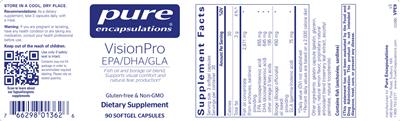
- Form
- Capsule
- Serving Size
- 3 Softgel Capsules
- Servings
- 30 per container
- Container Holds
- 90 Softgel Capsules
What’s in it, whether it interacts with your drugs, its side effects, whether it works, and what our pharmacists would want you to know before you start it.
- What is VisionPro EPA/DHA/GLA?A Fish Oil supplement from Pure Encapsulations with one other active ingredient, in capsule form.
- Active Ingredients Fish Oil concentrate 2871 mgBorage (Borago officinalis) Oil 450 mg Two active ingredients. Each one can interact with drugs or cause side effects on its own, so we check every one. The full Supplement Facts
- Drug Interactions 430 drugs have a documented interaction with this supplement; the most serious is rated moderate. Of those, 264 are single drugs and 166 are combination products (two or more drugs in one), each listed under its own name. Ask your pharmacist first if you take a drug in any of these categories, the most serious of the 11 on record:
- Moderate · 172 drugs
- Moderate · 122 drugs
- Moderate · 87 drugs
- Moderate · 30 drugs
- Possible Side EffectsNausea bothFishy aftertasteUpset stomachFishy breath or burpsBloatingLoose stools +2 moreCombined from its two active ingredients, Fish Oil and Borage. Not studied in this exact product.
- Well documented Why
Does VisionPro EPA/DHA/GLA work?
What It Is Marketed For
Visual comfort and natural tear production
From the claims on the product’s label.
The Closest Use the Research Grades
Fish Oil
There isn’t enough good research to say either way.
Fish Oil has stronger research for other uses:
- Metabolic dysfunction-associated steatotic liver disease (MASLD)
These grades are for the ingredient, not this exact product, and never a promise it will work for you.
And 6 more graded uses, in what the research says- Full Why
- AllergensThe label says it contains fish
- Barcode (UPC)7 66298 01362 6Match it to the barcode on your bottle to be sure this is your product. Not your product? Search for it here
Who Might Consider It
- People looking for visual comfort and natural tear production, which is what it is marketed for. For dry eye, the closest use the research grades, there is not enough good research to say either way.
- People who want it for hypertriglyceridemia, rheumatoid arthritis (RA), metabolic dysfunction-associated steatotic liver disease (MASLD) or another graded use: the other uses with research behind them. See each grade
More Before You Take It Show all three answersHide Its Ingredient Amounts vs. Other Supplements Pregnancy and Breastfeeding The Label’s Directions
-
How do its ingredient amounts compare with other supplements?
- Fish Oil concentrate2871 mgMore than 9 in 10 of the 428 recent Fish Oil products in our database that state an amount; 2,000 mg is the most common.
- Borage (Borago officinalis) Oil450 mgIn the usual range for the 234 recent Borage products in our database that state an amount; 1,000 mg is the most common.
A label’s amount is what the product holds, not a recommended dose.
See each comparison -
Pregnant or breastfeeding?
- Pregnancy and Breastfeeding Fish Oil
- ! When fish oil from dietary sources are consumed in large amounts.
- Pregnancy and Breastfeeding Borage
- ! When products containing hepatotoxic pyrrolizidine alkaloids (PA) are used orally.
-
How does the label say to take it?
“Recommendations: As a dietary supplement, take 3 capsules daily, with a meal.”
The maker’s words. Your pharmacist or doctor may advise differently.
Everything the label says
From the label dated Nov 21, 2018: both of its active ingredients were checked against our records. A summary of what is known, not a grade or a test of the product. How these ratings are computed
Ask Anything About This Supplement
Name a drug you take, or ask about side effects, ingredients or pregnancy.
AI answers come from this label and our own records, never the open internet. AI can make mistakes, so always check with your doctor or pharmacist. How we use AI
Ask the Pharmacist
A licensed pharmacist will answer your question by email — free, usually within 24 hours.
Got it — thank you!
A licensed pharmacist will answer within 24 hours. Keep an eye on your email (worth checking spam, just in case).
What’s Inside VisionPro EPA/DHA/GLA by Pure Encapsulations
Two Active Ingredients, Each Checked on Its Own
A supplement is often several ingredients in one bottle, and each one can interact with drugs or cause side effects on its own. We check every one of them against our records.
Why this rating?
The label gives an exact amount for every one of its two active ingredients, so you know how much of each you get in each serving. This rates what the label tells you, not the quality of the product.
Supplement Facts
| Amount Per Serving | % Daily Value | |
|---|---|---|
| Calories | 30 Calories | † |
| Total Fat | 3 g | 4% |
| Fish Oil concentrate | 2871 mg | † |
| Eicosapentaenoic Acid | 855 mg | † |
| Docosahexaenoic Acid | 645 mg | † |
| Other Omega-3 Fatty Acids | 195 mg | † |
| Borage (Borago officinalis) Oil | 450 mg | † |
| Gamma-Linolenic Acid | 75 mg | † |
Other ingredients: Gelatin Capsule, natural Lemon flavor, Proprietary Natural Antioxidant Blend
† Daily Value not established.
Daily Values for adults and children 4 or more years of age.
As the label prints it, from the NIH Dietary Supplement Label Database.
Each Ingredient and Its Drug Interactions
Tap one for more about it and its full guide. A drug can interact with this supplement through any one of them.
-
Fish Oil concentrate 2871 mg Interacts with 327 drugs
Form on the label: Anchovies, Sardines
Fish oil provides omega-3 fatty acids (EPA and DHA) that are best known for lowering high triglyceride levels.
- The evidence for other heart and health benefits is mixed, and it is generally well tolerated.
- Talk with your pharmacist or doctor before starting it, especially if you take blood thinners or have a fish allergy.
The full Fish Oil guide: uses, dosage and safety Every Fish Oil drug interaction
- Eicosapentaenoic Acid 855 mg
- Docosahexaenoic Acid 645 mg
- Other Omega-3 Fatty Acids 195 mg
-
Borage (Borago officinalis) Oil 450 mg Interacts with 226 drugs
Borage is a Mediterranean herb whose seed oil is rich in gamma-linolenic acid (GLA), an omega-6 fatty acid studied mostly for skin conditions and arthritis with mixed results.
- The plant's leaves and flowers can contain liver-toxic pyrrolizidine alkaloids, so only use products clearly labeled 'PA-free' and talk to your pharmacist or doctor before taking it.
The full Borage guide: uses, dosage and safety Every Borage drug interaction
- Gamma-Linolenic Acid 75 mg
How Much of Each Ingredient Is in It, Compared With Other Supplements
Each bar is an amount that other recent supplements list for the same ingredient. The taller the bar, the more of them state it.
-
2,871 mg in a serving of this product
More than 9 in 10 products
- Most common amount
- 2,000 mg (about 15 in 100 products)
- Most products state
- 430 mg to 2,400 mg
- Compared with
- 428 recent products
-
450 mg in a serving of this product
In the usual range
- Most common amount
- 1,000 mg (about 22 in 100 products)
- Most products state
- 50 mg to 1,200 mg
- Compared with
- 234 recent products
Other Ingredients (Inactive)
The capsule or tablet itself, fillers, coatings and flavors. Not part of the drug interaction check; the allergen check below reads them.
- Gelatin Capsule
- Natural Lemon flavor
- Proprietary Natural Antioxidant Blend
Allergens in VisionPro EPA/DHA/GLA
The label says it contains fish.
Named on this label
- FishThe label says it contains it; in the ingredients: Fish Oil concentrate (Anchovies, Sardines)
- Gelatin (animal-derived)In the ingredients: Gelatin Capsule (Gelatin, Glycerin, Water)
Not named in the ingredients
- Milk
- Egg
- Shellfish
- Tree nuts
- Peanuts
- Wheat or other gluten grains
- Soy
- Sesame
- The label’s allergen statement“Contains fish (anchovies, sardines)”
- Made without, the label says“Gluten-free & Non-GMO”
From the label text and ingredient names on file; we do not test products. With a serious allergy, check your bottle and ask the maker or your pharmacist.
What the Label Says
The maker’s own words, from the label. We do not verify or endorse them.
- Storage
-
“Store in a cool, dry place.”
- General statements
-
“Contents may not fill package in order to accommodate required labeling. Please rely on stated quantity.”
“Scan to learn about our hypoallergenic supplements”
- FDA Statement of Identity
-
“Dietary Supplement”
- General
-
“v3 code: VPE9”
- Formulation
-
“Fish Oil and Borage Oil blend; Supports visual comfort and natural tear production”
The VisionPro EPA/DHA/GLA Label on File
The label scan on file at the NIH Dietary Supplement Label Database, dated November 2018. Always read the label on the bottle you have.
Product Facts
- Brand
- Pure Encapsulations
- Barcode (UPC)
- 766298013626
- Net contents
- 90 Softgel Capsules
- Market status
- On market
- Date entered into DSLD
- Nov 21, 2018
- DSLD ID
- 183296
- Product type
- Fat/fatty Acid
- Supplement form
- Capsule
- Dietary claims / uses
- Nutrient, All Other, Structure/Function
- Intended target group(s)
- Adult (18 - 50 Years), Gluten Free
Is this label outdated? Report a formula or label change and our pharmacy team will review it.
VisionPro EPA/DHA/GLA by Pure Encapsulations Side Effects
Why this rating?
We look for three kinds of safety information on each ingredient: side effects reported in studies, a pregnancy and breastfeeding rating, and a safety write-up from our pharmacy team. All three are on file for each of the two ingredients we could check.
So this rates how much is known, not whether VisionPro EPA/DHA/GLA is right for you.
Reported with Fish Oil and Borage
- Most often
- Nausea, fishy aftertaste, upset stomach, fishy breath or burps, bloating and loose stools
- !Rare but serious
- Atrial fibrillation See details
Side Effects, Ingredient by Ingredient
A supplement’s side effects come from its ingredients. Here is what is reported with each one.
Fish Oil
Most reported
- Fishy aftertaste
- Fishy breath or burps
- Nausea
- Loose stools
Borage
Most reported
- Upset stomach
- Nausea
- Bloating
- Soft stools
VisionPro EPA/DHA/GLA Warnings: Who Should Be Careful
VisionPro EPA/DHA/GLA has two active ingredients, and each can carry warnings of its own. We checked both, and each warning below names the ingredient it comes from. If any of these apply to you, talk to your doctor or pharmacist before you start it.
- Fish Oil2 warnings below
- Borage2 warnings below
-
Bleeding Problems or Surgery
- Fish OilPeople who should be more cautious include those with a fish or shellfish allergy, those with bleeding disorders, and anyone scheduled for surgery, since high doses may affect bleeding.
- Fish OilIf you take blood-thinning medicines or have a medical condition, check with your pharmacist or doctor before starting fish oil.
-
Liver Disease
- BoragePeople with liver disease should be especially cautious or avoid borage entirely.
-
What the Label Warns
- “Warning: If you are pregnant or lactating, have any health condition or are taking any medication, consult your health professional.”
- “Keep out of the reach of children.”
- “Use only if safety seal is intact.”
The maker’s wording, from the product label.
-
Pregnant or Breastfeeding
Each ingredient’s rating for pregnancy and for breastfeeding, and what it covers.
Pregnancy and Breastfeeding The record rates both the same
-
When used orally and appropriately.
Intake of fish oil during pregnancy does not appear to adversely affect the fetus or nursing infant.
5 more points on this rating
- One large clinical trial shows that intake of fish oil from the 24th week of gestation increases the odds of the child having overweight and having metabolic syndrome measurements at age 10 when compared with placebo.
- More research is needed to confirm these findings.
- The adequate intake level of omega-3 fatty acids during pregnancy is 1.4 grams daily; the adequate intake level during lactation is 1.3 grams daily.
- If possible, people who are trying to become pregnant, as well as those who are pregnant or lactating, should avoid swordfish, king mackerel, and tilefish (also called golden bass or golden snapper), as these may contain high levels of methylmercury.
- Pregnant individuals should also limit consumption of other fatty fish to 12 ounces, or about 3-4 servings, per week.
-
When fish oil from dietary sources are consumed in large amounts.
Fatty fish can contain significant amounts of toxins such as mercury, polychlorinated biphenyls (PCBs), dioxin, and dioxin-related compounds.
2 more points on this rating
- If possible, people who are trying to become pregnant, as well as those who are pregnant or lactating, should avoid swordfish, king mackerel, and tilefish (also called golden bass or golden snapper), as these may contain high levels of methylmercury.
- Pregnant individuals should also limit consumption of other fatty fish to 12 ounces, or about 3-4 servings, per week.
Pregnancy and Breastfeeding The record rates both the same
-
When products containing hepatotoxic pyrrolizidine alkaloids (PA) are used orally.
Borage plant parts, such as the leaf, flower, and seed, can contain hepatotoxic PAs.
5 more points on this rating
- Repeated exposure to low concentrations of hepatotoxic PAs can cause severe veno-occlusive disease.
- Hepatotoxic PAs might also be carcinogenic, mutagenic, and teratogenic.
- These constituents are also excreted in breast milk.
- Tell patients to avoid borage preparations that are not certified and labeled as hepatotoxic PA-free.
- There is insufficient reliable information available about the safety of borage seed oil when used orally or topically during pregnancy or lactation.
Ratings and the words beside them are from the Natural Medicines database, which we license.
-
Rare but Serious Side Effects
-
!
Fish Oil
Serious allergic reactions are rare but possible in people allergic to fish.
Orally: Atrial fibrillation. When taken in doses of 3 grams or more daily, there are rare reports of increased risk of bleeding and stroke, as well as immune suppression.
-
!
Borage
More serious concerns come from products that are not PA-free, which could cause liver damage with long-term use.
Orally: Borage plant parts that contain PA constituents can be hepatotoxic.
When to get help: a serious allergic reaction, with trouble breathing or swelling of the face, lips or throat, needs emergency care: call 911. For any other side effect that worries you, call your doctor or pharmacist.
These reports describe each ingredient, not studies of this exact product. Not medical advice: a side effect you notice after starting a supplement is worth a word with your pharmacist or doctor.
VisionPro EPA/DHA/GLA by Pure Encapsulations Drug Interactions
We checked both active ingredients in this supplement against every drug in our records. A drug can interact with it through any one of them.
A moderate interaction on record
2 of 3, on a scale from Minor or none to Major.Why this rating?
We rate this by the most serious interaction on record, not by how many there are. For Borage and Fish Oil, the most serious is rated moderate, which means it calls for caution, and sometimes monitoring or a change in timing or dose. Some involve kinds of drugs where a small change can matter, such as blood thinners and transplant drugs.
431 drugs are on the full list. What matters is whether one you take is on it, so check yours with the interaction checker on this page.
Both of its active ingredients have drug interactions on record: Fish Oil and Borage.
- Interacts with
- 327 drugs
- Most serious
- Moderate
- Most of its records involve Antihypertensive Drugs, Anticoagulant/Antiplatelet Drugs and Contraceptive Drugs.
- Interacts with
- 226 drugs
- Most serious
- Moderate
- Most of its records involve Anticoagulant/Antiplatelet Drugs, Cytochrome P450 3A4 (CYP3A4) Inducers and Phenothiazines.
Why VisionPro EPA/DHA/GLA Interacts, Ingredient by Ingredient
A product interacts through its ingredients. Each card: how many drugs, the most serious rating, and the kinds of drugs it affects most (tap a kind for what it means).
The ingredients driving the most interactions
-
Fish Oil concentrate 327 drugs
Most serious: Moderate9 interaction records on file
The kinds of drugs it affects most
- 172 drugs
- 122 drugs
- 30 drugs
- Platinum Agents 3 drugs
Every Fish Oil drug interaction, 9 records The Fish Oil records cite 157 references, listed in the Fish Oil guide.
-
Borage (Borago officinalis) Oil 226 drugs
Most serious: Moderate3 interaction records on file
The kinds of drugs it affects most
- 122 drugs
- 87 drugs
- Phenothiazines 18 drugs
Every Borage drug interaction, 3 records The Borage records cite 11 references, listed in the Borage guide.
The Breakdown by Severity
Each drug counted once, at its most serious rating. Tap a tile to list those drugs.
Find Your Drug
Type a drug or brand name to see whether it is on the list.
- Only drugs with a documented interaction are listed, the most serious first.
- A drug with no known interaction is not listed, but searching its name tells you so.
- Open a drug to see which ingredient is responsible. Of those, 264 are single drugs and 166 are combination products (two or more drugs in one), each listed under its own name.
-
ApixabanEliquis Moderate
The 2 ingredients responsible:
-
Borage (Borago Officinalis) Oil Moderate Apixaban is in the Anticoagulant/Antiplatelet Drugs category.
Theoretically, borage seed oil may increase the risk of bleeding if used with anticoagulant or antiplatelet drugs.
The full Borage (Borago Officinalis) Oil + Apixaban interaction -
Fish Oil Concentrate Minor Apixaban is in the Anticoagulant/Antiplatelet Drugs category.
Fish oil may have antiplatelet effects and may increase the risk of bleeding if used with anticoagulant or antiplatelet drugs.
The full Fish Oil Concentrate + Apixaban interaction
-
-
WarfarinWarfarin Moderate
The 2 ingredients responsible:
-
Borage (Borago Officinalis) Oil Moderate Warfarin is in the Anticoagulant/Antiplatelet Drugs category.
Theoretically, borage seed oil may increase the risk of bleeding if used with anticoagulant or antiplatelet drugs.
The full Borage (Borago Officinalis) Oil + Warfarin interaction -
Fish Oil Concentrate Minor Warfarin is in the Anticoagulant/Antiplatelet Drugs category.
Fish oil may have antiplatelet effects and may increase the risk of bleeding if used with anticoagulant or antiplatelet drugs.
The full Fish Oil Concentrate + Warfarin interaction
-
-
AmlodipineNorliqva Moderate
The ingredient responsible:
-
Fish Oil Concentrate Moderate Amlodipine is in the Antihypertensive Drugs category.
Theoretically, taking fish oil with antihypertensive drugs might increase the risk of hypotension.
The full Fish Oil Concentrate + Amlodipine interaction
-
-
ClopidogrelPlavix Moderate
The 2 ingredients responsible:
-
Borage (Borago Officinalis) Oil Moderate Clopidogrel is in the Anticoagulant/Antiplatelet Drugs category.
Theoretically, borage seed oil may increase the risk of bleeding if used with anticoagulant or antiplatelet drugs.
The full Borage (Borago Officinalis) Oil + Clopidogrel interaction -
Fish Oil Concentrate Minor Clopidogrel is in the Anticoagulant/Antiplatelet Drugs category.
Fish oil may have antiplatelet effects and may increase the risk of bleeding if used with anticoagulant or antiplatelet drugs.
The full Fish Oil Concentrate + Clopidogrel interaction
-
-
AspirinAngettes 75, ASA, Asaphen, Aspirin, Caprin and 9 more Moderate
The 2 ingredients responsible:
-
Borage (Borago Officinalis) Oil Moderate Aspirin is in the Anticoagulant/Antiplatelet Drugs category.
Theoretically, borage seed oil may increase the risk of bleeding if used with anticoagulant or antiplatelet drugs.
The full Borage (Borago Officinalis) Oil + Aspirin interaction -
Fish Oil Concentrate Minor Aspirin is in the Anticoagulant/Antiplatelet Drugs category.
Fish oil may have antiplatelet effects and may increase the risk of bleeding if used with anticoagulant or antiplatelet drugs.
The full Fish Oil Concentrate + Aspirin interaction
-
-
Losartan PotassiumCozaar Moderate
The ingredient responsible:
-
Fish Oil Concentrate Moderate Losartan Potassium is in the Antihypertensive Drugs category.
Theoretically, taking fish oil with antihypertensive drugs might increase the risk of hypotension.
The full Fish Oil Concentrate + Losartan Potassium interaction
-
-
RivaroxabanXarelto Moderate
The 2 ingredients responsible:
-
Borage (Borago Officinalis) Oil Moderate Rivaroxaban is in the Anticoagulant/Antiplatelet Drugs category.
Theoretically, borage seed oil may increase the risk of bleeding if used with anticoagulant or antiplatelet drugs.
The full Borage (Borago Officinalis) Oil + Rivaroxaban interaction -
Fish Oil Concentrate Minor Rivaroxaban is in the Anticoagulant/Antiplatelet Drugs category.
Fish oil may have antiplatelet effects and may increase the risk of bleeding if used with anticoagulant or antiplatelet drugs.
The full Fish Oil Concentrate + Rivaroxaban interaction
-
-
Warfarin SodiumCoumadin, Panwarfin, Sofarin Moderate
The 2 ingredients responsible:
-
Borage (Borago Officinalis) Oil Moderate Warfarin Sodium is in the Anticoagulant/Antiplatelet Drugs category.
Theoretically, borage seed oil may increase the risk of bleeding if used with anticoagulant or antiplatelet drugs.
The full Borage (Borago Officinalis) Oil + Warfarin Sodium interaction -
Fish Oil Concentrate Minor Warfarin Sodium is in the Anticoagulant/Antiplatelet Drugs category.
Fish oil may have antiplatelet effects and may increase the risk of bleeding if used with anticoagulant or antiplatelet drugs.
The full Fish Oil Concentrate + Warfarin Sodium interaction
-
-
MetoprololLopressor, Toprol XL Moderate
The ingredient responsible:
-
Fish Oil Concentrate Moderate Metoprolol is in the Antihypertensive Drugs category.
Theoretically, taking fish oil with antihypertensive drugs might increase the risk of hypotension.
The full Fish Oil Concentrate + Metoprolol interaction
-
-
IbuprofenAdvil, Arthrofen, Brufen, Brufen Retard, Calodor and 15 more Moderate
The 2 ingredients responsible:
-
Borage (Borago Officinalis) Oil Moderate Ibuprofen is in the Anticoagulant/Antiplatelet Drugs category.
Theoretically, borage seed oil may increase the risk of bleeding if used with anticoagulant or antiplatelet drugs.
The full Borage (Borago Officinalis) Oil + Ibuprofen interaction -
Fish Oil Concentrate Minor Ibuprofen is in the Anticoagulant/Antiplatelet Drugs category.
Fish oil may have antiplatelet effects and may increase the risk of bleeding if used with anticoagulant or antiplatelet drugs.
The full Fish Oil Concentrate + Ibuprofen interaction
-
-
PropranololAngilol, Bedranol SR, Beta Prograne, Half Beta Prograne, Half-Inderal LA and 7 more Moderate
The ingredient responsible:
-
Fish Oil Concentrate Moderate Propranolol is in the Antihypertensive Drugs category.
Theoretically, taking fish oil with antihypertensive drugs might increase the risk of hypotension.
The full Fish Oil Concentrate + Propranolol interaction
-
-
LisinoprilPrinivil, Qbrelis, Zestril Moderate
The ingredient responsible:
-
Fish Oil Concentrate Moderate Lisinopril is in the Antihypertensive Drugs category.
Theoretically, taking fish oil with antihypertensive drugs might increase the risk of hypotension.
The full Fish Oil Concentrate + Lisinopril interaction
-
-
NaproxenAleve, Anaprox, Anaprox DS, Arthroxen, EC-Naprosyn and 8 more Moderate
The 2 ingredients responsible:
-
Borage (Borago Officinalis) Oil Moderate Naproxen is in the Anticoagulant/Antiplatelet Drugs category.
Theoretically, borage seed oil may increase the risk of bleeding if used with anticoagulant or antiplatelet drugs.
The full Borage (Borago Officinalis) Oil + Naproxen interaction -
Fish Oil Concentrate Minor Naproxen is in the Anticoagulant/Antiplatelet Drugs category.
Fish oil may have antiplatelet effects and may increase the risk of bleeding if used with anticoagulant or antiplatelet drugs.
The full Fish Oil Concentrate + Naproxen interaction
-
-
Amlodipine BesylateNorvasc Moderate
The ingredient responsible:
-
Fish Oil Concentrate Moderate Amlodipine Besylate is in the Antihypertensive Drugs category.
Theoretically, taking fish oil with antihypertensive drugs might increase the risk of hypotension.
The full Fish Oil Concentrate + Amlodipine Besylate interaction
-
-
BisoprololZebeta Moderate
The ingredient responsible:
-
Fish Oil Concentrate Moderate Bisoprolol is in the Antihypertensive Drugs category.
Theoretically, taking fish oil with antihypertensive drugs might increase the risk of hypotension.
The full Fish Oil Concentrate + Bisoprolol interaction
-
-
Omega-3 Fatty Acids (prescription Drug)Lovaza Moderate
The 2 ingredients responsible:
-
Borage (Borago Officinalis) Oil Moderate Omega-3 Fatty Acids (prescription Drug) is in the Anticoagulant/Antiplatelet Drugs category.
Theoretically, borage seed oil may increase the risk of bleeding if used with anticoagulant or antiplatelet drugs.
The full Borage (Borago Officinalis) Oil + Omega-3 Fatty Acids (prescription Drug) interaction -
Fish Oil Concentrate Minor Omega-3 Fatty Acids (prescription Drug) is in the Anticoagulant/Antiplatelet Drugs category.
Fish oil may have antiplatelet effects and may increase the risk of bleeding if used with anticoagulant or antiplatelet drugs.
The full Fish Oil Concentrate + Omega-3 Fatty Acids (prescription Drug) interaction
-
-
ValsartanDiovan, Prexxartan Moderate
The ingredient responsible:
-
Fish Oil Concentrate Moderate Valsartan is in the Antihypertensive Drugs category.
Theoretically, taking fish oil with antihypertensive drugs might increase the risk of hypotension.
The full Fish Oil Concentrate + Valsartan interaction
-
-
SpironolactoneAldactone, Carospir, Spiroton Moderate
The ingredient responsible:
-
Fish Oil Concentrate Moderate Spironolactone is in the Antihypertensive Drugs category.
Theoretically, taking fish oil with antihypertensive drugs might increase the risk of hypotension.
The full Fish Oil Concentrate + Spironolactone interaction
-
-
TelmisartanMicardis Moderate
The ingredient responsible:
-
Fish Oil Concentrate Moderate Telmisartan is in the Antihypertensive Drugs category.
Theoretically, taking fish oil with antihypertensive drugs might increase the risk of hypotension.
The full Fish Oil Concentrate + Telmisartan interaction
-
-
MinoxidilLoniten, Minoxidil, Rogaine Moderate
The ingredient responsible:
-
Fish Oil Concentrate Moderate Minoxidil is in the Antihypertensive Drugs category.
Theoretically, taking fish oil with antihypertensive drugs might increase the risk of hypotension.
The full Fish Oil Concentrate + Minoxidil interaction
-
-
TacrolimusAstagraf XL, Envarsus XR, Prograf (capsule), Prograf (injectable), Prograf XL and 1 more Moderate
The ingredient responsible:
-
Fish Oil Concentrate Moderate
Taking fish oil with tacrolimus might increase levels and adverse effects of tacrolimus.
The full Fish Oil Concentrate + Tacrolimus interaction
-
-
Birth Control PillsBirth control pills Moderate
The ingredient responsible:
-
Fish Oil Concentrate Moderate Birth Control Pills is in the Contraceptive Drugs category.
Theoretically, taking fish oil with contraceptive drugs might decrease the triglyceride-lowering effects of fish oil.
The full Fish Oil Concentrate + Birth Control Pills interaction
-
-
DabigatranPradax, Pradaxa Moderate
The 2 ingredients responsible:
-
Borage (Borago Officinalis) Oil Moderate Dabigatran is in the Anticoagulant/Antiplatelet Drugs category.
Theoretically, borage seed oil may increase the risk of bleeding if used with anticoagulant or antiplatelet drugs.
The full Borage (Borago Officinalis) Oil + Dabigatran interaction -
Fish Oil Concentrate Minor Dabigatran is in the Anticoagulant/Antiplatelet Drugs category.
Fish oil may have antiplatelet effects and may increase the risk of bleeding if used with anticoagulant or antiplatelet drugs.
The full Fish Oil Concentrate + Dabigatran interaction
-
-
DexamethasoneDecadron, Dexone, Dextenza, Dexycu, Hemady and 2 more Moderate
The ingredient responsible:
-
Borage (Borago Officinalis) Oil Moderate Dexamethasone is in the Cytochrome P450 3A4 (CYP3A4) Inducers category.
Theoretically, taking borage with drugs that induce CYP3A4 might increase levels of pyrrolizidine alkaloid (PA) toxic metabolites.
The full Borage (Borago Officinalis) Oil + Dexamethasone interaction
-
-
Propranolol HydrochlorideHemangeol Moderate
The ingredient responsible:
-
Fish Oil Concentrate Moderate Propranolol Hydrochloride is in the Antihypertensive Drugs category.
Theoretically, taking fish oil with antihypertensive drugs might increase the risk of hypotension.
The full Fish Oil Concentrate + Propranolol Hydrochloride interaction
-
-
EffientPrasugrel Moderate
The 2 ingredients responsible:
-
Borage (Borago Officinalis) Oil Moderate Effient is in the Anticoagulant/Antiplatelet Drugs category.
Theoretically, borage seed oil may increase the risk of bleeding if used with anticoagulant or antiplatelet drugs.
The full Borage (Borago Officinalis) Oil + Effient interaction -
Fish Oil Concentrate Minor Effient is in the Anticoagulant/Antiplatelet Drugs category.
Fish oil may have antiplatelet effects and may increase the risk of bleeding if used with anticoagulant or antiplatelet drugs.
The full Fish Oil Concentrate + Effient interaction
-
-
LevonorgestrelKyleena, Levonelle 1500, Levonelle One Step, Liletta, Mirena and 3 more Moderate
The ingredient responsible:
-
Fish Oil Concentrate Moderate Levonorgestrel is in the Contraceptive Drugs category.
Theoretically, taking fish oil with contraceptive drugs might decrease the triglyceride-lowering effects of fish oil.
The full Fish Oil Concentrate + Levonorgestrel interaction
-
-
Candesartan CilexetilAmias, Atacand Moderate
The ingredient responsible:
-
Fish Oil Concentrate Moderate Candesartan Cilexetil is in the Antihypertensive Drugs category.
Theoretically, taking fish oil with antihypertensive drugs might increase the risk of hypotension.
The full Fish Oil Concentrate + Candesartan Cilexetil interaction
-
-
Naproxen SodiumMidol Extended Relief Moderate
The 2 ingredients responsible:
-
Borage (Borago Officinalis) Oil Moderate Naproxen Sodium is in the Anticoagulant/Antiplatelet Drugs category.
Theoretically, borage seed oil may increase the risk of bleeding if used with anticoagulant or antiplatelet drugs.
The full Borage (Borago Officinalis) Oil + Naproxen Sodium interaction -
Fish Oil Concentrate Minor Naproxen Sodium is in the Anticoagulant/Antiplatelet Drugs category.
Fish oil may have antiplatelet effects and may increase the risk of bleeding if used with anticoagulant or antiplatelet drugs.
The full Fish Oil Concentrate + Naproxen Sodium interaction
-
-
Diclofenac PotassiumCambia, Cataflam, Cataflam IR, Voltaren Rapide, Voltarol Rapid Moderate
The 2 ingredients responsible:
-
Borage (Borago Officinalis) Oil Moderate Diclofenac Potassium is in the Anticoagulant/Antiplatelet Drugs category.
Theoretically, borage seed oil may increase the risk of bleeding if used with anticoagulant or antiplatelet drugs.
The full Borage (Borago Officinalis) Oil + Diclofenac Potassium interaction -
Fish Oil Concentrate Minor Diclofenac Potassium is in the Anticoagulant/Antiplatelet Drugs category.
Fish oil may have antiplatelet effects and may increase the risk of bleeding if used with anticoagulant or antiplatelet drugs.
The full Fish Oil Concentrate + Diclofenac Potassium interaction
-
Does It Work? VisionPro EPA/DHA/GLA by Pure Encapsulations
How it rates in the research so far, then each ingredient on its own. A grade is the research so far, never an endorsement.
What It Is Marketed For
Visual comfort and natural tear production
From the claims on the product’s label.
Closest match for what it is marketed for
Fish Oil for dry eye
There isn’t enough good research to say either way.
The Evidence, Ingredient by Ingredient
Each card holds our notes on one ingredient, then its uses graded effective, likely effective or possibly effective.
Fish Oil
From our Fish Oil guide
- The strongest evidence for fish oil is for lowering high triglycerides, a type of fat in the blood.
- Higher doses, often in prescription form, can meaningfully reduce triglyceride levels.
Research suggests a benefit for
- Hypertriglyceridemia
- Rheumatoid arthritis (RA), metabolic dysfunction-associated steatotic liver disease (MASLD), dysmenorrhea, cachexia, cyclosporine-induced nephrotoxicity, angioplasty and igA nephropathy
Not counted here: two graded uses are for conditions treated by a doctor or in a hospital (heart failure and HIV/AIDS-related dyslipidemia).
And 1 more graded use, in the Fish Oil guideBorage
From our Borage guide
- Borage is popularly used for several conditions, but solid scientific proof is limited for most of them.
No use is graded effective, likely effective or possibly effective for it yet.
Every graded use, in the Borage guideThe grades are the Natural Medicines database’s, which we license; tap a grade for what it means. They are about each ingredient, not this exact product.
About Pure Encapsulations
Manufacturer and brand details for VisionPro EPA/DHA/GLA, from the product label.
Pure Encapsulations has 811 products in our supplement database, 779 of them on the market, with labels on file since 2012. Our database is built from the NIH’s Dietary Supplement Label Database and our pharmacy team’s own additions, so it covers the labels filed there, not every product the brand sells.
- Name
- Pure Encapsulations
- Street Address
- 490 Boston Post Road
- City
- Sudbury
- State
- MA
- Phone Number
- 1-800-753-2277
- Web Address
- www.PureEncapsulations.com
VisionPro EPA/DHA/GLA by Pure Encapsulations: Common Questions
Does VisionPro EPA/DHA/GLA by Pure Encapsulations interact with any drugs?
What are the side effects of VisionPro EPA/DHA/GLA by Pure Encapsulations?
Who should be careful taking VisionPro EPA/DHA/GLA by Pure Encapsulations?
Can VisionPro EPA/DHA/GLA by Pure Encapsulations affect the liver?
Does VisionPro EPA/DHA/GLA by Pure Encapsulations contain any common allergens?
Is VisionPro EPA/DHA/GLA by Pure Encapsulations gluten free?
How can VisionPro EPA/DHA/GLA by Pure Encapsulations interact with so many drugs?
Where does the information about VisionPro EPA/DHA/GLA by Pure Encapsulations come from?
Written and reviewed by the HelloPharmacist Editorial Team. Our editorial policy
Still Have a Question About VisionPro EPA/DHA/GLA?
Our pharmacists answer drug and supplement questions, free, by email.
Label information is sourced from the NIH Dietary Supplement Label Database and reflects the product version on file; always read your actual product label. This page is for education only and is not a substitute for professional medical advice. Confirm with your pharmacist or doctor before combining supplements and drugs.
Who Reviews This Page
The pharmacist behind it, and how it is checked.
Dr. Brian Staiger, PharmD, BCPS
Clinical pharmacist and founder of HelloPharmacist
A licensed pharmacist for more than 13 years, he built the system behind this page: it reads the label on file, matches each active ingredient to its record in the Natural Medicines database, checks those records against every drug we cover, and our pharmacy team writes the take and the interaction summary from those records.
- 13+ Years in PharmacyRetail and clinical pharmacy, medication safety and healthcare administration.
- Board Certified (BCPS)A pharmacotherapy specialist, certified by the Board of Pharmacy Specialties.
- Herbalist TrainingCertificates in medical ethnobotany, for the herbs and supplements people take.
Where This Page Comes From
VisionPro EPA/DHA/GLA’s label data comes from the NIH Dietary Supplement Label Database; the ingredient interaction data is from the Natural Medicines database, reviewed by our pharmacists.
- NIH Dietary Supplement Label Database (DSLD)
- The official product label on file for this supplement.
- Natural Medicines (Therapeutic Research Center)
- The evidence-graded clinical reference behind the ingredient interaction, evidence and safety records, which we license.
- HelloPharmacist Editorial Team
- Content is reviewed by the HelloPharmacist Editorial Team, the pharmacists on our staff and those we contract. See our data sources and editorial standards for how this information is built and checked.
- The ratings in the Quick Summary
- They summarize available label information, ingredient evidence and known drug-safety records: a summary of what is known, not a grade of the product itself. They do not verify product identity, purity, potency, contamination or manufacturing quality. How these ratings are computed
The References Behind the Interaction Records
Every citation the ingredients’ records rest on is listed in that ingredient’s guide, in context: Fish Oil, 157 references; Borage, 11 references .
Parts of this content are provided by the Therapeutic Research Center, LLC.
DISCLAIMER: Currently this does not check for drug-drug interactions. This is not an all-inclusive comprehensive list of potential interactions and is for informational purposes only. Not all interactions are known or well-reported in the scientific literature, and new interactions are continually being reported. Input is needed from a qualified healthcare provider including a pharmacist before starting any therapy. Application of clinical judgment is necessary.
© 2021 Therapeutic Research Center, LLC
Keep Exploring
- Supplement interaction checkerCheck any supplement or product against your drugs
- Drug–drug interactionsCheck two or more of your drugs against each other
- Browse drugs A to ZEvery drug we have checked against herbs and supplements
- NDC and pricing lookupFind a drug’s NDCs, packaging and costs
- Ask a pharmacistA free, personal answer from our licensed team