
CANDIisolve Ingredients & Drug Interactions
What is this page for?
First and foremost: checking CANDIisolve against your medications. The heart of this page is the interaction checker and the full interaction report — how this product’s ingredients may interact with prescription and over-the-counter medicines you may be taking.
Around that, we add a pharmacist’s high-level view of the product as a whole — what’s inside, the evidence for its stated use, how transparent the label is, and what safety data exists — so you can see the full picture in one place. It’s educational information from our licensed clinical databases and the clinical staff at HelloPharmacist — not medical advice — and we don’t sell or endorse products. Our editorial policy
CANDIisolve is a dietary supplement by Herbally Grounded with 6 active ingredients. Its ingredients are commonly taken for digestion and bloating, muscle soreness and exercise recovery, inflammation and swelling.Based on those ingredients, 40 medications have a known interaction with it, the most serious rated minor. The ingredients most likely to interact are Saccharomyces boulardii. Use the checker below to test your specific medication, or read the full HelloPharmacist Interaction Report.
Check Your Meds Against CANDIisolve by Herbally Grounded
Ask about any prescription or over-the-counter medication and we check it for interactions with CANDIisolve by Herbally Grounded — and tell you which ingredient is responsible.
AI summaries are generated from our interaction database for education only — always confirm with your pharmacist. How we use AI
Ask the Pharmacist
A licensed pharmacist will answer your question by email — free, usually within 24 hours.
Got it — thank you!
A licensed pharmacist will answer within 24 hours. Keep an eye on your email (worth checking spam, just in case).
HelloPharmacist Scorecard of CANDIisolve by Herbally Grounded
Our pharmacy team’s full take, with four database checks built into the cards below — a summary of what is known, not a grade of the product itself.
What’s inside
Low disclosure
CANDIsolve has six active ingredients: five digestive enzymes and one probiotic. The enzymes—Amylase, Protease, Cellulase, Glucoamylase, and Hemicellulase—work together to break down carbohydrates, proteins, and fiber in food.
Saccharomyces boulardii is a beneficial yeast strain that supports digestive and intestinal health. The capsule itself is an inactive ingredient.
Does it work?
Moderate evidence
The evidence on these ingredients comes mainly from Saccharomyces boulardii, which has research behind it. Our data rates it possibly effective for rotaviral diarrhea, travelers' diarrhea, antibiotic-associated diarrhea, necrotizing enterocolitis, Clostridioides difficile infection, and Helicobacter pylori.
The digestive enzymes in this product—Amylase, Protease, Cellulase, Glucoamylase, and Hemicellulase—don't have effectiveness ratings on file in our data, so we can't tell you what the evidence shows for them.
How safe is it?
Well-documented data
Protease is generally well tolerated for most adults but can cause digestive upset or allergic reactions in some people. Saccharomyces boulardii is generally safe for healthy adults but should be avoided by people who are critically ill or have weakened immune systems (immunocompromised), because in rare cases it's caused life-threatening fungal infections in those populations.
Both ingredients carry caution flags for pregnancy and breastfeeding due to limited safety data — talk with your doctor before use if you're pregnant or nursing. Rarely, S. boulardii has caused stomach cramps, gas, nausea, vomiting, or loss of appetite.
Meds to double-check
Minor interactions only
Check your medications if you take antifungals — they may reduce how well the Saccharomyces boulardii in this product works. We couldn't check four of the five enzyme ingredients (Amylase, Cellulase, Glucoamylase, and Hemicellulase) for drug interactions because we hold no data on them.
The bottom line
Scorecard at a glanceFormula with limited ingredient disclosure with some supporting evidence for its stated purpose. Only minor medication interactions are documented, and safety information is well characterized.
CANDIsolve is a digestive enzyme and probiotic blend that might help with diarrhea or digestive support, though the enzyme ingredients lack established evidence in our data. If you take antifungal medications, check them against the tool on this page first.
Avoid this product if you're critically ill or immunocompromised. Talk to your pharmacist before starting if you're pregnant, nursing, or have any concerns.
Educational only — not medical advice; always confirm with your pharmacist. Our editorial policy · How we use AI
Assessment coverage: 2 of 6 active ingredients matched to our full ingredient reviews (monographs). Based on the product label dated Sep 25, 2024.
This Scorecard evaluates available label information, ingredient evidence, and known medication-safety considerations. It does not independently verify product identity, purity, potency, contamination, or manufacturing quality. How these ratings are computed
General information
Key facts about CANDIisolve, straight from the product label.
| Brand | Herbally Grounded |
|---|---|
| Barcode (UPC) | 705105848839 |
| Net contents | 120 Capsule(s) |
| Market status | On market |
| Date entered into DSLD | Sep 25, 2024 |
| DSLD ID | 318504 |
| Product type | Other Combinations |
| Supplement form | Capsule |
| Dietary claims / uses | All Other, Structure/Function |
| Intended target group(s) | Vegetarian, Adult (18 - 50 Years), Women (not pregnant or lactating), Gluten Free, Sugar Free |
Everything in this section is reproduced from the manufacturer’s own product label — it’s the label speaking, not HelloPharmacist. We show it so you can see exactly what the maker states; we don’t verify or endorse those statements.
Supplement Facts
The label details for CANDIisolve by Herbally Grounded, sourced from the NIH Dietary Supplement Label Database.
Supplement Facts
| Ingredient | Amount | % DV |
|---|---|---|
| Amylase | 0 NP | -- |
| Protease | 0 NP | -- |
| Cellulase | 0 NP | -- |
| Glucoamylase | 0 NP | -- |
| Hemicellulase | 0 NP | -- |
| Saccharomyces boulardii | 0 NP | -- |
Other ingredients: Capsule
Tap any ingredient to jump to its full detail below.
These statements are the manufacturer’s wording, reproduced from the product label — the label is saying it, not HelloPharmacist. We don’t verify or endorse them.
Formulation
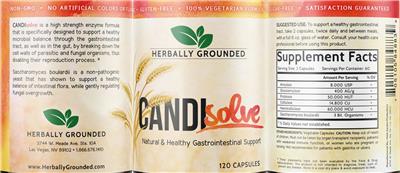
Non-GMO No artificial colors or flavors Gluten-free Sugar-free
100% Vegetarian formula
Natural and healthy gastrointestinal support
Satisfaction Guaranteed
Formula
Candisolve is a high strength enzyme formula that is specifically designed to support a healthy microbial balance through the gastrointestinal tract, as well as in the gut, by breaking down the cell walls of parasitic and fungal organisms, thus disabling their reproduction process.
Saccharomyces boulardii is a non-pathogenic yeast that has shown to support a healthy balance of intestinal flora, while gently regulating fungal overgrowth.
Suggested/Recommended/Usage/Directions
Suggested use: To support a healthy gastrointestinal tract, take 2 capsules, twice daily and between meals, with a full 8 ounce glass of water.
Precautions
Consult you health care professional before using this product.
Caution: Keep out of reach of children.
Must not be taken by organ transplant recipients, patients with weakened immune function, or women who are pregnant or nursing.
Not recommended for patients with gastritis or ulcers.
Storage
Store in a cool dry place and avoid exposure to heat.
FDA Disclaimer Statement
These statements have not been evaluated by the Food and Drug Administration. This product is not intended to diagnose, treat, cure or prevent any disease.
Is this label outdated? Report a formula or label change and our pharmacy team will review it.
CANDIisolve by Herbally Grounded label
The label scan from the NIH Dietary Supplement Label Database. Tap to enlarge.
Label images are published by the NIH Dietary Supplement Label Database for the version of this product on file. Always read your actual product label.
View the full label (PDF)The Ingredients in CANDIisolve by Herbally Grounded
These are the 6 active ingredients this product is made of. Select any to open its full monograph.
Serving size2 Capsule(s) Dosage formCapsule Servings per container60 Amounts shown are per serving.
Most supplement products combine several ingredients, and a medication can interact with the product through any one of them. Each ingredient below shows whether it has known drug interactions.
Amylase
Protease
No knowninteractions
Proteolytic enzymes are proteins that help break down other proteins, and common examples include bromelain (from pineapple), papain (from papaya), tr...
Protease monograph & interactionsCellulase
Glucoamylase
Hemicellulase
Saccharomyces boulardii
Interacts with40 drugs
Saccharomyces boulardii is a beneficial yeast used as a probiotic, with the strongest evidence for preventing and treating certain types of diarrhea,...
Saccharomyces boulardii monograph & interactionsOther (inactive) ingredients: Capsule. These complete the product’s ingredient list but are not active constituents.
CANDIisolve by Herbally Grounded Drug Interactions
HelloPharmacist Interaction Report
CANDIsolve by Herbally Grounded contains six ingredients, and we've found documented interactions with one of them.
Saccharomyces boulardii, a live yeast probiotic in the formula, may interact with antifungal medications (Minor severity). Because S. boulardii is a living organism, antifungals can kill a significant number of these beneficial cells, potentially reducing how well the probiotic works.
Read the full breakdown — every affected drug type, severity by severity
Amylase, Cellulase, Glucoamylase, and Hemicellulase are digestive enzymes, but we don't hold interaction data for any of them — we couldn't check whether they affect medications. Protease, another digestive enzyme in the blend, has been checked and shows no interactions documented in our data.
That's not a guarantee none exist; it means our monograph found none.
Altogether, these interactions span 40 individual medications. Before you start CANDIsolve, use the search tool on this page to check your exact antifungal medication if you take one.
Check your own medications below · Editorial policy · How we use AI
Want to check YOUR meds against CANDIisolve?
Ask about interactions with your drugs in plain English — “Can I take it with lisinopril?” — and we find you the answer in seconds, ingredient by ingredient.
Go to the checkerIngredients driving the most interactions
Individual Drug Interactions
The ingredients in CANDIisolve interact with 40 drugs. Click any drug to see the details.
1 of the 6 ingredients in CANDIisolve interact with drugs. Each result below shows which ingredient is responsible. Saccharomyces boulardii
Amphotericin BAbelcet, AmBisome, Amphocil, Amphocin, Fungizone IV
How Amphotericin B interacts with CANDIisolve — through 1 ingredient. Tap an ingredient for the detail:
Saccharomyces BoulardiiAntifungals Minor
Interaction Summary
Theoretically, taking antifungals with Saccharomyces boulardii might decrease the effectiveness of Saccharomyces boulardii.
Read the full Saccharomyces Boulardii + Amphotericin B interactionAnidulafunginEraxis
How Anidulafungin interacts with CANDIisolve — through 1 ingredient. Tap an ingredient for the detail:
Saccharomyces BoulardiiAntifungals Minor
Interaction Summary
Theoretically, taking antifungals with Saccharomyces boulardii might decrease the effectiveness of Saccharomyces boulardii.
Read the full Saccharomyces Boulardii + Anidulafungin interactionBenzalkonium ChlorideZephiran
How Benzalkonium Chloride interacts with CANDIisolve — through 1 ingredient. Tap an ingredient for the detail:
Saccharomyces BoulardiiAntifungals Minor
Interaction Summary
Theoretically, taking antifungals with Saccharomyces boulardii might decrease the effectiveness of Saccharomyces boulardii.
Read the full Saccharomyces Boulardii + Benzalkonium Chloride interactionBoric AcidBoric Acid, Boric acid ointment
How Boric Acid interacts with CANDIisolve — through 1 ingredient. Tap an ingredient for the detail:
Saccharomyces BoulardiiAntifungals Minor
Interaction Summary
Theoretically, taking antifungals with Saccharomyces boulardii might decrease the effectiveness of Saccharomyces boulardii.
Read the full Saccharomyces Boulardii + Boric Acid interactionButenafineMentax
How Butenafine interacts with CANDIisolve — through 1 ingredient. Tap an ingredient for the detail:
Saccharomyces BoulardiiAntifungals Minor
Interaction Summary
Theoretically, taking antifungals with Saccharomyces boulardii might decrease the effectiveness of Saccharomyces boulardii.
Read the full Saccharomyces Boulardii + Butenafine interactionButoconazoleGynazole
How Butoconazole interacts with CANDIisolve — through 1 ingredient. Tap an ingredient for the detail:
Saccharomyces BoulardiiAntifungals Minor
Interaction Summary
Theoretically, taking antifungals with Saccharomyces boulardii might decrease the effectiveness of Saccharomyces boulardii.
Read the full Saccharomyces Boulardii + Butoconazole interactionCarbol-fuchsinCastellani Paint Modified
How Carbol-fuchsin interacts with CANDIisolve — through 1 ingredient. Tap an ingredient for the detail:
Saccharomyces BoulardiiAntifungals Minor
Interaction Summary
Theoretically, taking antifungals with Saccharomyces boulardii might decrease the effectiveness of Saccharomyces boulardii.
Read the full Saccharomyces Boulardii + Carbol-fuchsin interactionCaspofunginCancidas
How Caspofungin interacts with CANDIisolve — through 1 ingredient. Tap an ingredient for the detail:
Saccharomyces BoulardiiAntifungals Minor
Interaction Summary
Theoretically, taking antifungals with Saccharomyces boulardii might decrease the effectiveness of Saccharomyces boulardii.
Read the full Saccharomyces Boulardii + Caspofungin interactionChlorhexidineBactoShield 2
How Chlorhexidine interacts with CANDIisolve — through 1 ingredient. Tap an ingredient for the detail:
Saccharomyces BoulardiiAntifungals Minor
Interaction Summary
Theoretically, taking antifungals with Saccharomyces boulardii might decrease the effectiveness of Saccharomyces boulardii.
Read the full Saccharomyces Boulardii + Chlorhexidine interactionChloroxineCapitrol
How Chloroxine interacts with CANDIisolve — through 1 ingredient. Tap an ingredient for the detail:
Saccharomyces BoulardiiAntifungals Minor
Interaction Summary
Theoretically, taking antifungals with Saccharomyces boulardii might decrease the effectiveness of Saccharomyces boulardii.
Read the full Saccharomyces Boulardii + Chloroxine interactionCiclopiroxLoprox
How Ciclopirox interacts with CANDIisolve — through 1 ingredient. Tap an ingredient for the detail:
Saccharomyces BoulardiiAntifungals Minor
Interaction Summary
Theoretically, taking antifungals with Saccharomyces boulardii might decrease the effectiveness of Saccharomyces boulardii.
Read the full Saccharomyces Boulardii + Ciclopirox interactionClioquinolVioform
How Clioquinol interacts with CANDIisolve — through 1 ingredient. Tap an ingredient for the detail:
Saccharomyces BoulardiiAntifungals Minor
Interaction Summary
Theoretically, taking antifungals with Saccharomyces boulardii might decrease the effectiveness of Saccharomyces boulardii.
Read the full Saccharomyces Boulardii + Clioquinol interactionClotrimazoleGyne Lotrimin, Mycelex G Vaginal
How Clotrimazole interacts with CANDIisolve — through 1 ingredient. Tap an ingredient for the detail:
Saccharomyces BoulardiiAntifungals Minor
Interaction Summary
Theoretically, taking antifungals with Saccharomyces boulardii might decrease the effectiveness of Saccharomyces boulardii.
Read the full Saccharomyces Boulardii + Clotrimazole interactionEconazoleSpectazole
How Econazole interacts with CANDIisolve — through 1 ingredient. Tap an ingredient for the detail:
Saccharomyces BoulardiiAntifungals Minor
Interaction Summary
Theoretically, taking antifungals with Saccharomyces boulardii might decrease the effectiveness of Saccharomyces boulardii.
Read the full Saccharomyces Boulardii + Econazole interactionFluconazoleDiflucan, Diflucan Injection
How Fluconazole interacts with CANDIisolve — through 1 ingredient. Tap an ingredient for the detail:
Saccharomyces BoulardiiAntifungals Minor
Interaction Summary
Theoretically, taking antifungals with Saccharomyces boulardii might decrease the effectiveness of Saccharomyces boulardii.
Read the full Saccharomyces Boulardii + Fluconazole interactionFlucytosineAncobon, Ancotil
How Flucytosine interacts with CANDIisolve — through 1 ingredient. Tap an ingredient for the detail:
Saccharomyces BoulardiiAntifungals Minor
Interaction Summary
Theoretically, taking antifungals with Saccharomyces boulardii might decrease the effectiveness of Saccharomyces boulardii.
Read the full Saccharomyces Boulardii + Flucytosine interactionGentian Violet (otc Drug)Gentian Violet
How Gentian Violet (otc Drug) interacts with CANDIisolve — through 1 ingredient. Tap an ingredient for the detail:
Saccharomyces BoulardiiAntifungals Minor
Interaction Summary
Theoretically, taking antifungals with Saccharomyces boulardii might decrease the effectiveness of Saccharomyces boulardii.
Read the full Saccharomyces Boulardii + Gentian Violet (otc Drug) interactionGriseofulvinFulvicin PG, Fulvicin-U/F, Grisactin, Grisactin Ultra
How Griseofulvin interacts with CANDIisolve — through 1 ingredient. Tap an ingredient for the detail:
Saccharomyces BoulardiiAntifungals Minor
Interaction Summary
Theoretically, taking antifungals with Saccharomyces boulardii might decrease the effectiveness of Saccharomyces boulardii.
Read the full Saccharomyces Boulardii + Griseofulvin interactionHaloproginHalotex
How Haloprogin interacts with CANDIisolve — through 1 ingredient. Tap an ingredient for the detail:
Saccharomyces BoulardiiAntifungals Minor
Interaction Summary
Theoretically, taking antifungals with Saccharomyces boulardii might decrease the effectiveness of Saccharomyces boulardii.
Read the full Saccharomyces Boulardii + Haloprogin interactionIodine (prescription Drug)Iodine Tincture
How Iodine (prescription Drug) interacts with CANDIisolve — through 1 ingredient. Tap an ingredient for the detail:
Saccharomyces BoulardiiAntifungals Minor
Interaction Summary
Theoretically, taking antifungals with Saccharomyces boulardii might decrease the effectiveness of Saccharomyces boulardii.
Read the full Saccharomyces Boulardii + Iodine (prescription Drug) interactionIodine (topical)Iodine Tincture
How Iodine (topical) interacts with CANDIisolve — through 1 ingredient. Tap an ingredient for the detail:
Saccharomyces BoulardiiAntifungals Minor
Interaction Summary
Theoretically, taking antifungals with Saccharomyces boulardii might decrease the effectiveness of Saccharomyces boulardii.
Read the full Saccharomyces Boulardii + Iodine (topical) interactionIodoquinolYodoxin
How Iodoquinol interacts with CANDIisolve — through 1 ingredient. Tap an ingredient for the detail:
Saccharomyces BoulardiiAntifungals Minor
Interaction Summary
Theoretically, taking antifungals with Saccharomyces boulardii might decrease the effectiveness of Saccharomyces boulardii.
Read the full Saccharomyces Boulardii + Iodoquinol interactionItraconazoleSporanox, Sporanox Injection, Tolsura
How Itraconazole interacts with CANDIisolve — through 1 ingredient. Tap an ingredient for the detail:
Saccharomyces BoulardiiAntifungals Minor
Interaction Summary
Theoretically, taking antifungals with Saccharomyces boulardii might decrease the effectiveness of Saccharomyces boulardii.
Read the full Saccharomyces Boulardii + Itraconazole interactionKetoconazoleNizoral
How Ketoconazole interacts with CANDIisolve — through 1 ingredient. Tap an ingredient for the detail:
Saccharomyces BoulardiiAntifungals Minor
Interaction Summary
Theoretically, taking antifungals with Saccharomyces boulardii might decrease the effectiveness of Saccharomyces boulardii.
Read the full Saccharomyces Boulardii + Ketoconazole interactionMicafunginMycamine
How Micafungin interacts with CANDIisolve — through 1 ingredient. Tap an ingredient for the detail:
Saccharomyces BoulardiiAntifungals Minor
Interaction Summary
Theoretically, taking antifungals with Saccharomyces boulardii might decrease the effectiveness of Saccharomyces boulardii.
Read the full Saccharomyces Boulardii + Micafungin interactionMiconazoleAcorvio, Daktarin, Micatin, Monistat, Zeasorb-AF
How Miconazole interacts with CANDIisolve — through 1 ingredient. Tap an ingredient for the detail:
Saccharomyces BoulardiiAntifungals Minor
Interaction Summary
Theoretically, taking antifungals with Saccharomyces boulardii might decrease the effectiveness of Saccharomyces boulardii.
Read the full Saccharomyces Boulardii + Miconazole interactionMiconazole, Zinc Oxide, PetrolatumVusion
How Miconazole, Zinc Oxide, Petrolatum interacts with CANDIisolve — through 1 ingredient. Tap an ingredient for the detail:
Saccharomyces BoulardiiAntifungals Minor
Interaction Summary
Theoretically, taking antifungals with Saccharomyces boulardii might decrease the effectiveness of Saccharomyces boulardii.
Read the full Saccharomyces Boulardii + Miconazole, Zinc Oxide, Petrolatum interactionNaftifineNaftin
How Naftifine interacts with CANDIisolve — through 1 ingredient. Tap an ingredient for the detail:
Saccharomyces BoulardiiAntifungals Minor
Interaction Summary
Theoretically, taking antifungals with Saccharomyces boulardii might decrease the effectiveness of Saccharomyces boulardii.
Read the full Saccharomyces Boulardii + Naftifine interactionNatamycinNatacyn
How Natamycin interacts with CANDIisolve — through 1 ingredient. Tap an ingredient for the detail:
Saccharomyces BoulardiiAntifungals Minor
Interaction Summary
Theoretically, taking antifungals with Saccharomyces boulardii might decrease the effectiveness of Saccharomyces boulardii.
Read the full Saccharomyces Boulardii + Natamycin interactionNystatinMycostatin, Nilstat
How Nystatin interacts with CANDIisolve — through 1 ingredient. Tap an ingredient for the detail:
Saccharomyces BoulardiiAntifungals Minor
Interaction Summary
Theoretically, taking antifungals with Saccharomyces boulardii might decrease the effectiveness of Saccharomyces boulardii.
Read the full Saccharomyces Boulardii + Nystatin interactionEach ingredient & the kinds of drugs it affects
For each ingredient in CANDIisolve with known interactions, here are the types of medications it can affect. Open any type for the detail — or search your exact drug in the checker above.
Saccharomyces boulardii
Antifungals
Theoretically, taking antifungals with Saccharomyces boulardii might decrease the effectiveness of Saccharomyces boulardii.
S. boulardii is a live yeast. Therefore, simultaneously taking antifungals might kill a significant number of the organisms.
Brand information
Manufacturer and brand details for CANDIisolve, from the product label.
Herbally Grounded
See all Herbally Grounded products- Name
- Herb Garden Productions
- Street Address
- 3744 W Meade Ave. Ste. 11A
- City
- Las Vegas
- State
- NV
- ZipCode
- 89102
- Web Address
- www.herballygrounded.com
CANDIisolve by Herbally Grounded: Common Questions
Does CANDIisolve by Herbally Grounded interact with any medications?
How can one product interact with so many drugs?
Where does this information come from?
Can I take CANDIsolve if I'm on an antifungal medication?
Is CANDIsolve safe during pregnancy or while breastfeeding?
What does the yeast in CANDIsolve actually do?
Can this product cause allergic reactions?
Should I avoid CANDIsolve if I'm critically ill or immunocompromised?
What side effects might I experience?
Written and reviewed by the HelloPharmacist editorial staff. Our editorial policy
Not sure if CANDIisolve is safe with your meds?
Our pharmacists answer your medication & supplement questions — free.
Label information is sourced from the NIH Dietary Supplement Label Database and reflects the product version on file; always read your actual product label. This page is for education only and is not a substitute for professional medical advice. Confirm with your pharmacist or doctor before combining supplements and medications.
The Full Monographs Behind CANDIisolve’s Ingredients
Every ingredient we hold a full HelloPharmacist monograph for — uses, evidence, safety, and the complete interaction list.
Proteolytic Enzymes (proteases)
Proteolytic enzymes are proteins that help break down other proteins, and common examples include bromelain (from pineapple), papain (from papaya), trypsin, chymotrypsin, and pancreatin. Peo...
Read the full Proteolytic Enzymes (proteases) monograph → Herb & supplement monographSaccharomyces Boulardii
Interacts with 40 drugsSaccharomyces boulardii is a beneficial yeast used as a probiotic, with the strongest evidence for preventing and treating certain types of diarrhea, including antibiotic-associated diarrhea...
Read the full Saccharomyces Boulardii monograph →Sources & How We Checked
CANDIisolve's label data comes from the NIH Dietary Supplement Label Database; the ingredient interaction data is from the Natural Medicines database, reviewed by our pharmacists.
- NIH Dietary Supplement Label Database (DSLD) — The official product label on file for this supplement.
- Natural Medicines (Therapeutic Research Center) — Evidence-graded clinical reference behind the ingredient interaction data.
Content is written and reviewed by licensed HelloPharmacist pharmacists. See our data sources and editorial standards for how this information is built and checked.
The 29 references behind this product’s interaction data
Every citation that drives the interaction findings for this product’s ingredients, from the evidence-graded Natural Medicines (TRC Healthcare) database. Open an ingredient to browse its citations — links open the study on PubMed or the publisher’s site.
Proteolytic Enzymes (proteases) 3 references
- Weeks JA, Harper RA, Simon RA, Burdick JD. Assessment of sensitization risk of a laundry pre-spotter containing protease. Cutan Ocul Toxicol. 2011;30(4):272-9. PubMed
- Marquès LI, Lara S, Abós T, Bartolomé B. Occupational rhinitis due to pepsin. J Investig Allergol Clin Immunol. 2006;16(2):136-7. DOI
- Cartier A, Malo JL, Pineau L, Dolovich J. Occupational asthma due to pepsin. J Allergy Clin Immunol. 1984;73(5 Pt 1):574-7. PubMed
See these in context on the Proteolytic Enzymes (proteases) monograph →
Saccharomyces Boulardii 26 references
- Niault M, Thomas F, Prost J, et al. Fungemia due to Saccharomyces species in a patient treated with enteral Saccharomyces boulardii. Clin Infect Dis 1999;28:930.
- Pletinex M, Legein J, Vandenplas Y. Fungemia with Saccharomyces boulardii in a 1-year-old girl with protracted diarrhea. J Pediatr Gastroenterol Nutr 1995;21:113-5. DOI
- Fredenucci I, Chomarat M, Boucaud C, et al. Saccharomyces boulardii fungemia in a patient receiving ultra-levure therapy. Clin Infect Dis 1998;27:222-3.
- Elmer GW, McFarland LV, Surawicz CM, et al. Behaviour of Saccharomyces boulardii in recurrent Clostridium difficile disease patients. Aliment Pharmacol Ther 1999;13:1663-8.
- Lewis SJ, Freedman AR. Review article: the use of biotherapeutic agents in the prevention and treatment of gastrointestinal disease. Aliment Pharmacol Ther 1998;12:807-22. PubMed
- Cesaro S, Chinello P, Rossi L, Zanesco L. Saccharomyces cerevisiae fungemia in a neutropenic patient treated with Saccharomyces boulardii. Support Care Cancer 2000;8:504-5. PubMed
- Hennequin C, Thierry A, Richard GF, et al. Microsatellite typing as a new tool for identification of Saccharomyces cerevisiae strains. J Clin Microbiol 2001;39:551-9.
- Plein K, Hotz J. Therapeutic effects of Saccharomyces boulardii on mild residual symptoms in a stable phase of Crohn's disease with special respect to chronic diarrhea - a pilot study. Z Gastroenterol 1993;31:129-34.
- Borriello SP, Hammes WP, Holzapfel W, et al. Safety of probiotics that contain lactobacilli or bifidobacteria. Clin Infect Dis 2003;36:775-80. PubMed
- Marteau P, Seksik P. Tolerance of probiotics and prebiotics. J Clin Gastroenterol 2004;38:S67-9. PubMed
- Munoz P, Bouza E, Cuenca-Estrella M, et al. Saccharomyces cerevisiae fungemia: an emerging infectious disease. Clin Infect Dis 2005;40:1625-34. PubMed
- Lherm, T., Monet, C., Nougiere, B., Soulier, M., Larbi, D., Le Gall, C., Caen, D., and Malbrunot, C. Seven cases of fungemia with Saccharomyces boulardii in critically ill patients. Intensive Care Med 2002;28(6):797-801. PubMed
- Riquelme, A. J., Calvo, M. A., Guzman, A. M., Depix, M. S., Garcia, P., Perez, C., Arrese, M., and Labarca, J. A. Saccharomyces cerevisiae fungemia after Saccharomyces boulardii treatment in immunocompromised patients. J Clin.Gastroenterol. 2003;36(1):41- PubMed
- Cherifi, S., Robberecht, J., and Miendje, Y. Saccharomyces cerevisiae fungemia in an elderly patient with Clostridium difficile colitis. Acta Clin Belg. 2004;59(4):223-224. PubMed
- Ellouze O, Berthoud V, Mervant M, Parthiot JP, Girard C. Septic shock due to Sacccaromyces boulardii. Med Mal Infect. 2016;46(2):104-105.
- Appel-da-Silva MC, Narvaez GA, Perez LRR, Drehmer L, Lewgoy J. Saccharomyces cerevisiae var. boulardii fungemia following probiotic treatment. Med Mycol Case Rep. 2017;18:15-7. PubMed
- Atici S, Soysal A, Karadeniz Cerit K, et al. Catheter-related Saccharomyces cerevisiae Fungemia Following Saccharomyces boulardii Probiotic Treatment: In a child in intensive care unit and review of the literature. Med Mycol Case Rep. 2017;15:33-35. PubMed
- Martin IW, Tonner R, Trivedi J, et al. Saccharomyces boulardii probiotic-associated fungemia: questioning the safety of this preventive probiotic's use. Diagn Microbiol Infect Dis. 2017;87(3):286-8. PubMed
- Romanio MR, Coraine LA, Maielo VP, Abramczyc ML, Souza RL, Oliveira NF. Saccharomyces cerevisiae fungemia in a pediatric patient after treatment with probiotics. Rev Paul Pediatr 2017;35(3):361-4.
- Roy U, Jessani LG, Rudramurthy SM, et al. Seven cases of Saccharomyces fungaemia related to use of probiotics. Mycoses 2017;60(6):375-380.
- Romanio MR, Coraine LA, Maielo VP, Abramczyc ML, Souza RL, Oliveira NF. Saccharomyces cerevisiae fungemia in a pediatric patient after treatment with probiotics. Rev Paul Pediatr. 2017 Jul-Sep;35(3):361-364. doi: 10.1590/1984-0462/;2017;35;3;00014.
- Flatley EA, Wilde AM, Nailor MD. Saccharomyces boulardii for the prevention of hospital onset Clostridium difficile infection. J Gastrointestin Liver Dis. 2015;24(1):21-4. PubMed
- Ventoulis I, Sarmourli T, Amoiridou P, et al. Bloodstream infection by Saccharomyces cerevisiae in two COVID-19 patients after receiving supplementation of Saccharomyces in the ICU. J Fungi (Basel). 2020;6(3):98. PubMed
- Wombwell E, Bransteitter B, Gillen LR. Incidence of Saccharomyces cerevisiae fungemia in hospitalised patients administered Saccharomyces boulardii probiotic. Mycoses 2021;64(12):1521-1526.
- Rannikko J, Holmberg V, Karppelin M, et al. Fungemia and Other Fungal Infections Associated with Use of Saccharomyces boulardii Probiotic Supplements. Emerg Infect Dis 2021;27(8):2090-6.
- Awoyemi A, Mayerhofer C, Felix AS, et al. Rifaximin or Saccharomyces boulardii in heart failure with reduced ejection fraction: Results from the randomized GutHeart trial. EBioMedicine 2021;70:103511. PubMed
See these in context on the Saccharomyces Boulardii monograph →
Parts of this content are provided by the Therapeutic Research Center, LLC.
DISCLAIMER: Currently this does not check for drug-drug interactions. This is not an all-inclusive comprehensive list of potential interactions and is for informational purposes only. Not all interactions are known or well-reported in the scientific literature, and new interactions are continually being reported. Input is needed from a qualified healthcare provider including a pharmacist before starting any therapy. Application of clinical judgment is necessary.
© 2021 Therapeutic Research Center, LLC