
Daily E by UMZU Ingredients, Side Effects and Drug Interactions
Dietary Supplement Capsule Vitamin
UPC 8 10104 10022 9 Match it to the barcode on your bottle

Medically reviewed by Dr. Brian Staiger, PharmD, BCPS
Also reviewed by the HelloPharmacist Editorial Team
Updated Details about this page
- Label on file from the NIH Dietary Supplement Label Database, dated May 23, 2024.
- The interaction, evidence and safety records come from the Natural Medicines database, which we license, read against this label by our own system; the pharmacy team’s sections are written from those records.
- Dr. Brian Staiger, PharmD, BCPS, is a clinical pharmacist and pharmacotherapy specialist.
- Editorial policy Our sources
AI is used only to summarize verified clinical information, never the open internet. Our AI policy
Summary: The HelloPharmacist Team’s Take
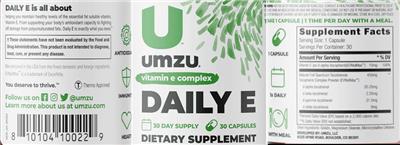
- Form
- Capsule
- Serving Size
- 1 Capsule
- Servings
- 30 per container
- Container Holds
- 30 Capsules
What’s in it, whether it interacts with your drugs, its side effects, whether it works, and what our pharmacists would want you to know before you start it.
- What is Daily E?A tocotrienols supplement from UMZU with one other active ingredient, in capsule form.
- Active Ingredients Vitamin E 15 mgEVNol Full Spectrum Tocotrienol/Tocopherol Complex, Powder 450 mg Two active ingredients. Each one can interact with drugs or cause side effects on its own, so we check every one. The full Supplement Facts
- Drug Interactions 766 drugs have a documented interaction with this supplement; the most serious is rated moderate. Of those, 516 are single drugs and 250 are combination products (two or more drugs in one), each listed under its own name. Ask your pharmacist first if you take a drug in any of these categories, the most serious of the 8 on record:
- Moderate · 645 drugs
- Moderate · 122 drugs
- Moderate · 24 drugs
- Antitumor AntibioticsModerate · 15 drugs
- Possible Side EffectsStomach upsetNauseaHeadache +3 moreFrom the one ingredient we have records for, Tocotrienols. Not studied in this exact product.
- Well documented Why
Does Daily E work?
What It Is Marketed For
Antioxidant, immunity and heart support
From the claims on the product’s label.
The Closest Use the Research Grades
Tocotrienols
The studies lean against a benefit.
Its ingredients have stronger research for other uses:
- Tocotrienols
- Ataxia with vitamin E deficiency (AVED) Vitamin E
- Vitamin E deficiency Vitamin E
- Vitamin E
These grades are for each ingredient, not this exact product, and never a promise it will work for you.
And 7 more graded uses, in what the research says- Full Why
- AllergensNone of its ingredient names point to a major food allergen, and the label text we have carries no allergen statement
- Barcode (UPC)8 10104 10022 9Match it to the barcode on your bottle to be sure this is your product. Not your product? Search for it here
Who Might Consider It
- People looking for antioxidant, immunity and heart support, which is what it is marketed for. For hypercholesterolemia, the closest use the research grades, the studies lean against a benefit.
- People who want tocotrienols, its main ingredient, for diabetes: the use with research behind it. See the grade
- Daily E may suit people looking for a vitamin E supplement who take no medications that interact with it.
Who Should Be Careful
- If you take blood thinners, warfarin, chemotherapy, cyclosporine, selumetinib, or niacin, or you have a bleeding condition, be careful and talk it over with your own doctor or pharmacist first.
- Anyone who is pregnant or breastfeeding should also get personal advice before starting it.
More Before You Take It Show all three answersHide Its Ingredient Amounts vs. Other Supplements Pregnancy and Breastfeeding The Label’s Directions
-
How do its ingredient amounts compare with other supplements?
- Vitamin E15 mgThe most common amount among the 444 recent Vitamin E products in our database that state an amount.
- EVNol Full Spectrum Tocotrienol/Tocopherol Complex, Powder450 mgMore than 9 in 10 of the 250 recent Tocotrienols products in our database that state an amount; 10 mg is the most common.
A label’s amount is what the product holds, not a recommended dose.
See each comparison -
Pregnant or breastfeeding?
- Pregnancy and Breastfeeding Tocotrienols
- Insufficient reliable information available; avoid using.
- Pregnancy Vitamin E
- When used orally and appropriately.
- Breastfeeding Vitamin E
- ! When used orally in amounts that exceed the UL due to increased risk of adverse effects.
-
How does the label say to take it?
“Take 1 capsule 1 time per day with a meal.”
The maker’s words. Your pharmacist or doctor may advise differently.
Everything the label says
From the label dated May 23, 2024: both of its active ingredients were checked against our records. A summary of what is known, not a grade or a test of the product. How these ratings are computed
Ask Anything About This Supplement
Name a drug you take, or ask about side effects, ingredients or pregnancy.
AI answers come from this label and our own records, never the open internet. AI can make mistakes, so always check with your doctor or pharmacist. How we use AI
Ask the Pharmacist
A licensed pharmacist will answer your question by email — free, usually within 24 hours.
Got it — thank you!
A licensed pharmacist will answer within 24 hours. Keep an eye on your email (worth checking spam, just in case).
What’s Inside Daily E by UMZU
Two Active Ingredients, Each Checked on Its Own
A supplement is often several ingredients in one bottle, and each one can interact with drugs or cause side effects on its own. We check every one of them against our records.
Why this rating?
The label gives an exact amount for every one of its two active ingredients, so you know how much of each you get in each serving. This rates what the label tells you, not the quality of the product.
Supplement Facts
| Amount Per Serving | % Daily Value | |
|---|---|---|
| Vitamin E | 15 mg | 100% |
| EVNol Full Spectrum Tocotrienol/Tocopherol Complex, Powder | 450 mg | † |
| D-Alpha-Tocotrienol | 20.25 mg | † |
| D-Beta-Tocotrienol | 2.25 mg | † |
| D-Gamma-Tocotrienol | 31.5 mg | † |
| D-Delta-Tocotrienol | 9 mg | † |
Other ingredients: Gelatin, Magnesium Stearate, Microcrystalline Cellulose
† Daily Value not established.
Daily Values for adults and children 4 or more years of age.
As the label prints it, from the NIH Dietary Supplement Label Database.
Each Ingredient and Its Drug Interactions
Tap one for more about it and its full guide. A drug can interact with this supplement through any one of them.
-
Vitamin E 15 mg Interacts with 766 drugs
Form on the label: EVNolMax
Vitamin E is an essential fat-soluble vitamin and antioxidant that most people get in adequate amounts from a normal diet.
- Supplements can help correct a true deficiency, but high-dose vitamin E has not been clearly proven to prevent heart disease or cancer and may carry risks.
- Talk to your pharmacist or doctor before taking high doses.
The full Vitamin E guide: uses, dosage and safety Every Vitamin E drug interaction
-
EVNol Full Spectrum Tocotrienol/Tocopherol Complex, Powder 450 mg The product also lists an EVNol Full Spectrum Tocotrienol/Tocopherol Complex blend as an ingredient, but we have no detailed information on that blend itself. Interacts with 122 drugs
Tocotrienols are a less common form of vitamin E with strong antioxidant activity studied mostly for cholesterol, liver, and heart health.
- Early research is interesting but far from conclusive, and a standard dose is not established.
- They are generally well tolerated, but talk with your pharmacist or doctor before using them, especially during pregnancy or if you take blood thinners.
The full Tocotrienols guide: uses, dosage and safety Every Tocotrienols drug interaction
- D-Alpha-Tocotrienol 20.25 mg 766 drugs
- D-Beta-Tocotrienol 2.25 mg 766 drugs
- D-Gamma-Tocotrienol 31.5 mg 766 drugs
- D-Delta-Tocotrienol 9 mg 766 drugs
How Much of Each Ingredient Is in It, Compared With Other Supplements
Each bar is an amount that other recent supplements list for the same ingredient. The taller the bar, the more of them state it.
-
15 mg in a serving of this product
The most common amount
- Most common amount
- 15 mg (about 12 in 100 products)
- Most products state
- 5.5 mg to 134 mg
- Compared with
- 444 recent products
-
450 mg in a serving of this product
More than 9 in 10 products
- Most common amount
- 10 mg (about 14 in 100 products)
- Most products state
- 4 mg to 125 mg
- Compared with
- 250 recent products
Other Ingredients (Inactive)
The capsule or tablet itself, fillers, coatings and flavors. Not part of the drug interaction check; the allergen check below reads them.
- Gelatin
- Magnesium Stearate
- Microcrystalline Cellulose
Allergens in Daily E
None of its ingredient names point to a major food allergen, and the label text we have carries no allergen statement.
Named on this label
- Gelatin (animal-derived)In the ingredients: Gelatin
Not named in the ingredients
- Milk
- Egg
- Fish
- Shellfish
- Tree nuts
- Peanuts
- Wheat or other gluten grains
- Soy
- Sesame
From the label text and ingredient names on file; we do not test products. With a serious allergy, check your bottle and ask the maker or your pharmacist.
What the Label Says
The maker’s own words, from the label. We do not verify or endorse them.
- Formulation
-
“Daily E is all about helping you maintain healthy levels of the essential fat soluble vitamin, Vitamin E. From supporting your body's antioxidant capacity to fighting off damage from polyunsaturated fats. Daily E is exactly what you need.”
“Manufactured in the USA from the finest domestic and foreign ingredients.”
2 more from the label
“Antioxidant Immunity Heart”
“Vitamin E complex”
- Brand IP Statement(s)
-
“EVNoMax is a trademark of ExcelVite. UMZU You deserve to thrive.”
- Seals and symbols
-
“T Thermo approved”
- General statements
-
“Follow us on Facebook Instagram Twitter @umzu Learn more about us at umzu.com”
“30 day supply”
- Directions
-
“1 capsule 1x daily with meal”
- Storage
-
“Store in a cool, dry place.”
- FDA Statement of Identity
-
“Dietary Supplement”
The Daily E Label on File
The label scan on file at the NIH Dietary Supplement Label Database, dated May 2024. Always read the label on the bottle you have.
Product Facts
- Brand
- UMZU
- Barcode (UPC)
- 810104100229
- Net contents
- 30 Capsules
- Market status
- On market
- Date entered into DSLD
- May 23, 2024
- DSLD ID
- 309621
- Product type
- Vitamin
- Supplement form
- Capsule
- Dietary claims / uses
- Nutrient, All Other, Structure/Function
- Intended target group(s)
- Adult (18 - 50 Years), Women (not pregnant or lactating)
Is this label outdated? Report a formula or label change and our pharmacy team will review it.
Daily E by UMZU Side Effects
Why this rating?
We look for three kinds of safety information on each ingredient: side effects reported in studies, a pregnancy and breastfeeding rating, and a safety write-up from our pharmacy team. All three are on file for each of the two ingredients we could check.
So this rates how much is known, not whether Daily E is right for you.
Reported with Vitamin E and Tocotrienols
- Most often
- Stomach upset, nausea and headache
- !Rare but serious
- Bleeding, hemorrhagic stroke and cardiovascular complications See details
HelloPharmacist Team Summary: Daily E by UMZU Side Effects
You're likely to find Daily E generally well tolerated, since our data describes vitamin E as generally well tolerated at usual amounts.
- We have no reported side effects for this product, so we have no common side effects to point you to.
- The rare but serious risk to know about is bleeding, including bleeding in the brain (hemorrhagic stroke), which is more of a concern with high doses taken over a long time.
- If you notice unusual bleeding, bruising, or a sudden severe headache, call your doctor right away.
- Please talk with your own doctor or pharmacist before starting if you take blood thinners or have a bleeding condition, and ask about it if you are pregnant or breastfeeding.
Side Effects Reported With Tocotrienols
Vitamin E has side-effect reports, but no list of the most common ones. Read them in the Vitamin E guide
Daily E Warnings: Who Should Be Careful
Daily E has two active ingredients, and each can carry warnings of its own. We checked both, and each warning below names the ingredient it comes from. If any of these apply to you, talk to your doctor or pharmacist before you start it.
- Vitamin E2 warnings below
- Tocotrienols3 warnings below
-
Bleeding Problems or Surgery
- Vitamin EThe concern is mainly with high-dose supplements taken over a long time, which may increase the risk of bleeding and, in some studies, has been linked to other risks.
- TocotrienolsBecause tocotrienols are a form of vitamin E, high intake of vitamin E in general has been linked to an increased risk of bleeding.
- TocotrienolsPeople with bleeding disorders, those taking blood-thinning medicines, or anyone scheduled for surgery should be cautious and check with a healthcare professional.
- TocotrienolsAlways tell your pharmacist or doctor about any supplements you take, especially before surgery or if you have a medical condition.
- Our pharmacists say high-dose, long-term supplements may raise the risk of bleeding and other harms, and that high doses should be avoided unless your doctor directs them.
-
Other Cautions
- Vitamin EPeople with certain health conditions should check with a doctor first.
-
What the Label Warns
- “Warning: Not for use by persons under 18 years old.”
- “Consult a healthcare professional prior to use if you are taking any medications or have any medical conditions.”
- “Do not use if pregnant or nursing.”
- “Keep out of the reach of children.”
- “Do not use if safety seal is damaged of missing.”
The maker’s wording, from the product label.
-
Pregnant or Breastfeeding
Each ingredient’s rating for pregnancy and for breastfeeding, and what it covers.
Pregnancy and Breastfeeding The record rates both the same
-
Insufficient reliable information available; avoid using.
Pregnancy
-
When used orally and appropriately.
The tolerable upper intake level (UL) during pregnancy is 800 mg for those 14-18 years of age and 1000 mg for those 19 years and older.
6 more points on this rating
- However, maternal supplementation is not generally recommended unless dietary vitamin E falls below the RDA.
- No serious adverse effects were reported with oral intake of 400 IU per day starting at weeks 9-22 of pregnancy in healthy patients or those at high risk for pre-eclampsia, or with 600-900 IU daily during the last two months of pregnancy.
- However, some preliminary evidence suggests that taking vitamin E supplements might be harmful when taken in early pregnancy.
- A case-control study found that taking a vitamin E supplement during the first 8 weeks of pregnancy is associated with a 1.7-9-fold increase in odds of congenital heart defects.
- However, the exact amount of vitamin E consumed during pregnancy in this study is unclear.
- Until more is known, advise patients to avoid taking a vitamin E supplement in early pregnancy unless needed for an appropriate medical indication.
Breastfeeding
-
When used orally in amounts that do not exceed the tolerable upper intake level (UL).
The UL during lactation is 800 mg for those 14-18 years of age and 1000 mg for those 19 years and older.
-
When used orally in amounts that exceed the UL due to increased risk of adverse effects.
Ratings and the words beside them are from the Natural Medicines database, which we license.
-
Rare but Serious Side Effects
-
!
Vitamin E
The most serious concern with high doses is an increased risk of bleeding, including, in rare cases, bleeding in the brain (hemorrhagic stroke).
Orally: Bleeding, hemorrhagic stroke, cardiovascular complications.
-
!
Tocotrienols
As with any oil-based supplement, an allergic reaction is possible.
When to get help: a serious allergic reaction, with trouble breathing or swelling of the face, lips or throat, needs emergency care: call 911. For any other side effect that worries you, call your doctor or pharmacist.
These reports describe each ingredient, not studies of this exact product. Not medical advice: a side effect you notice after starting a supplement is worth a word with your pharmacist or doctor.
Daily E by UMZU Drug Interactions
We checked both active ingredients in this supplement against every drug in our records. A drug can interact with it through any one of them.
A moderate interaction on record
2 of 3, on a scale from Minor or none to Major.Why this rating?
We rate this by the most serious interaction on record, not by how many there are. For Vitamin E and Tocotrienols, the most serious is rated moderate, which means it calls for caution, and sometimes monitoring or a change in timing or dose. Some involve kinds of drugs where a small change can matter, such as blood thinners, transplant drugs and cancer treatments.
767 drugs are on the full list. What matters is whether one you take is on it, so check yours with the interaction checker on this page.
Both of its active ingredients have drug interactions on record: Vitamin E and Tocotrienols.
- Interacts with
- 766 drugs
- Most serious
- Moderate
- Warfarin (Coumadin) is also rated Moderate, because more than 400 IU of vitamin E daily may raise INR and bleeding risk.
- Selumetinib (Koselugo) is Moderate as well, since combined daily vitamin E can exceed the upper limit and raise bleeding risk.
- Cyclosporine (Neoral, Sandimmune) is Moderate, because one specific vitamin E form (TPGS) may increase its absorption and levels.
- Interacts with
- 122 drugs
- Most serious
- Minor
- Most of its records involve Anticoagulant/Antiplatelet Drugs.
From the HelloPharmacist Team
Our pharmacy team’s read on the supplement as a whole.
- Daily E from UMZU does interact with some medications, mainly through the tocotrienol and vitamin E content (its four tocotrienol forms plus vitamin E itself).
- The most serious interaction on record is with blood thinners (anticoagulants) and antiplatelet drugs, which may increase the risk of bleeding; the severity rating is Moderate.
- We could not check the EVNol Full Spectrum Tocotrienol/Tocopherol Complex blend, because we have no interaction information for it.
Summarized by the HelloPharmacist pharmacy team from the interaction records below. How it is written How we use AI
Why Daily E Interacts, Ingredient by Ingredient
A product interacts through its ingredients. Each card: how many drugs, the most serious rating, and the kinds of drugs it affects most (tap a kind for what it means).
The ingredients driving the most interactions
-
Vitamin E 766 drugs
Most serious: Moderate8 interaction records on file
The kinds of drugs it affects most
- 645 drugs
- 122 drugs
- 24 drugs
- Antitumor Antibiotics 15 drugs
Every Vitamin E drug interaction, 8 records The Vitamin E records cite 64 references, listed in the Vitamin E guide.
-
EVNol Full Spectrum Tocotrienol/Tocopherol Complex, Powder 122 drugs
Most serious: Minor1 interaction record on file
The kinds of drugs it affects most
- 122 drugs
Every Tocotrienols drug interaction, 1 record The Tocotrienols records cite 4 references, listed in the Tocotrienols guide.
The Breakdown by Severity
Each drug counted once, at its most serious rating. Tap a tile to list those drugs.
Find Your Drug
Type a drug or brand name to see whether it is on the list.
- Only drugs with a documented interaction are listed, the most serious first.
- A drug with no known interaction is not listed, but searching its name tells you so.
- Open a drug to see which ingredient is responsible. Of those, 516 are single drugs and 250 are combination products (two or more drugs in one), each listed under its own name.
-
ApixabanEliquis Moderate
The 2 ingredients responsible:
-
D-Delta-tocotrienol Moderate Apixaban is in these Cytochrome P450 3A4 (CYP3A4) Substrates, Anticoagulant/Antiplatelet Drugs categories.
Theoretically, vitamin E might induce metabolism of CYP3A4, possibly reducing the levels CYP3A4 substrates.
The full D-Delta-tocotrienol + Apixaban interaction -
Evnol Full Spectrum Tocotrienol/Tocopherol Complex, Powder Minor Apixaban is in the Anticoagulant/Antiplatelet Drugs category.
Concomitant use of tocotrienols with anticoagulant or antiplatelet agents might increase the risk of bleeding.
The full Evnol Full Spectrum Tocotrienol/Tocopherol Complex, Powder + Apixaban interaction
-
-
WarfarinWarfarin Moderate
The 2 ingredients responsible:
-
D-Delta-tocotrienol Moderate Warfarin is in these Cytochrome P450 3A4 (CYP3A4) Substrates, Anticoagulant/Antiplatelet Drugs categories.
Theoretically, vitamin E might induce metabolism of CYP3A4, possibly reducing the levels CYP3A4 substrates.
The full D-Delta-tocotrienol + Warfarin interaction -
Evnol Full Spectrum Tocotrienol/Tocopherol Complex, Powder Minor Warfarin is in the Anticoagulant/Antiplatelet Drugs category.
Concomitant use of tocotrienols with anticoagulant or antiplatelet agents might increase the risk of bleeding.
The full Evnol Full Spectrum Tocotrienol/Tocopherol Complex, Powder + Warfarin interaction
-
-
AmlodipineNorliqva Moderate
The ingredient responsible:
-
D-Delta-tocotrienol Moderate Amlodipine is in the Cytochrome P450 3A4 (CYP3A4) Substrates category.
Theoretically, vitamin E might induce metabolism of CYP3A4, possibly reducing the levels CYP3A4 substrates.
The full D-Delta-tocotrienol + Amlodipine interaction
-
-
SertralineZoloft Moderate
The ingredient responsible:
-
D-Delta-tocotrienol Moderate Sertraline is in the Cytochrome P450 3A4 (CYP3A4) Substrates category.
Theoretically, vitamin E might induce metabolism of CYP3A4, possibly reducing the levels CYP3A4 substrates.
The full D-Delta-tocotrienol + Sertraline interaction
-
-
ClopidogrelPlavix Moderate
The 2 ingredients responsible:
-
D-Delta-tocotrienol Moderate Clopidogrel is in these Cytochrome P450 3A4 (CYP3A4) Substrates, Anticoagulant/Antiplatelet Drugs categories.
Theoretically, vitamin E might induce metabolism of CYP3A4, possibly reducing the levels CYP3A4 substrates.
The full D-Delta-tocotrienol + Clopidogrel interaction -
Evnol Full Spectrum Tocotrienol/Tocopherol Complex, Powder Minor Clopidogrel is in the Anticoagulant/Antiplatelet Drugs category.
Concomitant use of tocotrienols with anticoagulant or antiplatelet agents might increase the risk of bleeding.
The full Evnol Full Spectrum Tocotrienol/Tocopherol Complex, Powder + Clopidogrel interaction
-
-
AspirinAngettes 75, ASA, Asaphen, Aspirin, Caprin and 9 more Moderate
The 2 ingredients responsible:
-
D-Delta-tocotrienol Moderate Aspirin is in the Anticoagulant/Antiplatelet Drugs category.
Concomitant use of vitamin E and anticoagulant or antiplatelet agents might increase the risk of bleeding.
The full D-Delta-tocotrienol + Aspirin interaction -
Evnol Full Spectrum Tocotrienol/Tocopherol Complex, Powder Minor Aspirin is in the Anticoagulant/Antiplatelet Drugs category.
Concomitant use of tocotrienols with anticoagulant or antiplatelet agents might increase the risk of bleeding.
The full Evnol Full Spectrum Tocotrienol/Tocopherol Complex, Powder + Aspirin interaction
-
-
EscitalopramLexapro Moderate
The ingredient responsible:
-
D-Delta-tocotrienol Moderate Escitalopram is in the Cytochrome P450 3A4 (CYP3A4) Substrates category.
Theoretically, vitamin E might induce metabolism of CYP3A4, possibly reducing the levels CYP3A4 substrates.
The full D-Delta-tocotrienol + Escitalopram interaction
-
-
Losartan PotassiumCozaar Moderate
The ingredient responsible:
-
D-Delta-tocotrienol Moderate Losartan Potassium is in the Cytochrome P450 3A4 (CYP3A4) Substrates category.
Theoretically, vitamin E might induce metabolism of CYP3A4, possibly reducing the levels CYP3A4 substrates.
The full D-Delta-tocotrienol + Losartan Potassium interaction
-
-
AtorvastatinAtorvaliq Moderate
The ingredient responsible:
-
D-Delta-tocotrienol Moderate Atorvastatin is in the Cytochrome P450 3A4 (CYP3A4) Substrates category.
Theoretically, vitamin E might induce metabolism of CYP3A4, possibly reducing the levels CYP3A4 substrates.
The full D-Delta-tocotrienol + Atorvastatin interaction
-
-
RivaroxabanXarelto Moderate
The 2 ingredients responsible:
-
D-Delta-tocotrienol Moderate Rivaroxaban is in these Cytochrome P450 3A4 (CYP3A4) Substrates, Anticoagulant/Antiplatelet Drugs categories.
Theoretically, vitamin E might induce metabolism of CYP3A4, possibly reducing the levels CYP3A4 substrates.
The full D-Delta-tocotrienol + Rivaroxaban interaction -
Evnol Full Spectrum Tocotrienol/Tocopherol Complex, Powder Minor Rivaroxaban is in the Anticoagulant/Antiplatelet Drugs category.
Concomitant use of tocotrienols with anticoagulant or antiplatelet agents might increase the risk of bleeding.
The full Evnol Full Spectrum Tocotrienol/Tocopherol Complex, Powder + Rivaroxaban interaction
-
-
Warfarin SodiumCoumadin, Panwarfin, Sofarin Moderate
The 2 ingredients responsible:
-
D-Delta-tocotrienol Moderate Warfarin Sodium is in these Cytochrome P450 3A4 (CYP3A4) Substrates, Anticoagulant/Antiplatelet Drugs categories.
Using vitamin E with warfarin might increase the risk of bleeding.
The full D-Delta-tocotrienol + Warfarin Sodium interaction -
Evnol Full Spectrum Tocotrienol/Tocopherol Complex, Powder Minor Warfarin Sodium is in the Anticoagulant/Antiplatelet Drugs category.
Concomitant use of tocotrienols with anticoagulant or antiplatelet agents might increase the risk of bleeding.
The full Evnol Full Spectrum Tocotrienol/Tocopherol Complex, Powder + Warfarin Sodium interaction
-
-
IbuprofenAdvil, Arthrofen, Brufen, Brufen Retard, Calodor and 15 more Moderate
The 2 ingredients responsible:
-
D-Delta-tocotrienol Moderate Ibuprofen is in the Anticoagulant/Antiplatelet Drugs category.
Concomitant use of vitamin E and anticoagulant or antiplatelet agents might increase the risk of bleeding.
The full D-Delta-tocotrienol + Ibuprofen interaction -
Evnol Full Spectrum Tocotrienol/Tocopherol Complex, Powder Minor Ibuprofen is in the Anticoagulant/Antiplatelet Drugs category.
Concomitant use of tocotrienols with anticoagulant or antiplatelet agents might increase the risk of bleeding.
The full Evnol Full Spectrum Tocotrienol/Tocopherol Complex, Powder + Ibuprofen interaction
-
-
TadalafilCialis, Tadliq Moderate
The ingredient responsible:
-
D-Delta-tocotrienol Moderate Tadalafil is in the Cytochrome P450 3A4 (CYP3A4) Substrates category.
Theoretically, vitamin E might induce metabolism of CYP3A4, possibly reducing the levels CYP3A4 substrates.
The full D-Delta-tocotrienol + Tadalafil interaction
-
-
TestosteroneAndrogel, Andropatch, Delatestryl, Intrinsa, Natesto and 4 more Moderate
The ingredient responsible:
-
D-Delta-tocotrienol Moderate Testosterone is in the Cytochrome P450 3A4 (CYP3A4) Substrates category.
Theoretically, vitamin E might induce metabolism of CYP3A4, possibly reducing the levels CYP3A4 substrates.
The full D-Delta-tocotrienol + Testosterone interaction
-
-
PrednisoneCortan, Deltasone, Meticorten, Orasone, Prednicen-M and 3 more Moderate
The ingredient responsible:
-
D-Delta-tocotrienol Moderate Prednisone is in the Cytochrome P450 3A4 (CYP3A4) Substrates category.
Theoretically, vitamin E might induce metabolism of CYP3A4, possibly reducing the levels CYP3A4 substrates.
The full D-Delta-tocotrienol + Prednisone interaction
-
-
AbemaciclibVerzenio Moderate
The ingredient responsible:
-
D-Delta-tocotrienol Moderate Abemaciclib is in the Cytochrome P450 3A4 (CYP3A4) Substrates category.
Theoretically, vitamin E might induce metabolism of CYP3A4, possibly reducing the levels CYP3A4 substrates.
The full D-Delta-tocotrienol + Abemaciclib interaction
-
-
LetrozoleFemara Moderate
The ingredient responsible:
-
D-Delta-tocotrienol Moderate Letrozole is in the Cytochrome P450 3A4 (CYP3A4) Substrates category.
Theoretically, vitamin E might induce metabolism of CYP3A4, possibly reducing the levels CYP3A4 substrates.
The full D-Delta-tocotrienol + Letrozole interaction
-
-
AmitriptylineElavil Moderate
The ingredient responsible:
-
D-Delta-tocotrienol Moderate Amitriptyline is in the Cytochrome P450 3A4 (CYP3A4) Substrates category.
Theoretically, vitamin E might induce metabolism of CYP3A4, possibly reducing the levels CYP3A4 substrates.
The full D-Delta-tocotrienol + Amitriptyline interaction
-
-
ClonazepamCeberclon, Klonopin, Rivotril Moderate
The ingredient responsible:
-
D-Delta-tocotrienol Moderate Clonazepam is in the Cytochrome P450 3A4 (CYP3A4) Substrates category.
Theoretically, vitamin E might induce metabolism of CYP3A4, possibly reducing the levels CYP3A4 substrates.
The full D-Delta-tocotrienol + Clonazepam interaction
-
-
NaproxenAleve, Anaprox, Anaprox DS, Arthroxen, EC-Naprosyn and 8 more Moderate
The 2 ingredients responsible:
-
D-Delta-tocotrienol Moderate Naproxen is in the Anticoagulant/Antiplatelet Drugs category.
Concomitant use of vitamin E and anticoagulant or antiplatelet agents might increase the risk of bleeding.
The full D-Delta-tocotrienol + Naproxen interaction -
Evnol Full Spectrum Tocotrienol/Tocopherol Complex, Powder Minor Naproxen is in the Anticoagulant/Antiplatelet Drugs category.
Concomitant use of tocotrienols with anticoagulant or antiplatelet agents might increase the risk of bleeding.
The full Evnol Full Spectrum Tocotrienol/Tocopherol Complex, Powder + Naproxen interaction
-
-
CitalopramCelexa Moderate
The ingredient responsible:
-
D-Delta-tocotrienol Moderate Citalopram is in the Cytochrome P450 3A4 (CYP3A4) Substrates category.
Theoretically, vitamin E might induce metabolism of CYP3A4, possibly reducing the levels CYP3A4 substrates.
The full D-Delta-tocotrienol + Citalopram interaction
-
-
BuspironeBuSpar Moderate
The ingredient responsible:
-
D-Delta-tocotrienol Moderate Buspirone is in the Cytochrome P450 3A4 (CYP3A4) Substrates category.
Theoretically, vitamin E might induce metabolism of CYP3A4, possibly reducing the levels CYP3A4 substrates.
The full D-Delta-tocotrienol + Buspirone interaction
-
-
OmeprazoleLosec, Prilosec, Zegerid Moderate
The ingredient responsible:
-
D-Delta-tocotrienol Moderate Omeprazole is in the Cytochrome P450 3A4 (CYP3A4) Substrates category.
Theoretically, vitamin E might induce metabolism of CYP3A4, possibly reducing the levels CYP3A4 substrates.
The full D-Delta-tocotrienol + Omeprazole interaction
-
-
QuetiapineDopaquel, Seroquel Moderate
The ingredient responsible:
-
D-Delta-tocotrienol Moderate Quetiapine is in the Cytochrome P450 3A4 (CYP3A4) Substrates category.
Theoretically, vitamin E might induce metabolism of CYP3A4, possibly reducing the levels CYP3A4 substrates.
The full D-Delta-tocotrienol + Quetiapine interaction
-
-
Amlodipine BesylateNorvasc Moderate
The ingredient responsible:
-
D-Delta-tocotrienol Moderate Amlodipine Besylate is in the Cytochrome P450 3A4 (CYP3A4) Substrates category.
Theoretically, vitamin E might induce metabolism of CYP3A4, possibly reducing the levels CYP3A4 substrates.
The full D-Delta-tocotrienol + Amlodipine Besylate interaction
-
-
EstrogenEstrogen Moderate
The ingredient responsible:
-
D-Delta-tocotrienol Moderate Estrogen is in the Cytochrome P450 3A4 (CYP3A4) Substrates category.
Theoretically, vitamin E might induce metabolism of CYP3A4, possibly reducing the levels CYP3A4 substrates.
The full D-Delta-tocotrienol + Estrogen interaction
-
-
PantoprazolePantoloc, Protonix, Protonix IV Moderate
The ingredient responsible:
-
D-Delta-tocotrienol Moderate Pantoprazole is in the Cytochrome P450 3A4 (CYP3A4) Substrates category.
Theoretically, vitamin E might induce metabolism of CYP3A4, possibly reducing the levels CYP3A4 substrates.
The full D-Delta-tocotrienol + Pantoprazole interaction
-
-
Omega-3 Fatty Acids (prescription Drug)Lovaza Moderate
The 2 ingredients responsible:
-
D-Delta-tocotrienol Moderate Omega-3 Fatty Acids (prescription Drug) is in the Anticoagulant/Antiplatelet Drugs category.
Concomitant use of vitamin E and anticoagulant or antiplatelet agents might increase the risk of bleeding.
The full D-Delta-tocotrienol + Omega-3 Fatty Acids (prescription Drug) interaction -
Evnol Full Spectrum Tocotrienol/Tocopherol Complex, Powder Minor Omega-3 Fatty Acids (prescription Drug) is in the Anticoagulant/Antiplatelet Drugs category.
Concomitant use of tocotrienols with anticoagulant or antiplatelet agents might increase the risk of bleeding.
The full Evnol Full Spectrum Tocotrienol/Tocopherol Complex, Powder + Omega-3 Fatty Acids (prescription Drug) interaction
-
-
FinasteridePropecia, Proscar Moderate
The ingredient responsible:
-
D-Delta-tocotrienol Moderate Finasteride is in the Cytochrome P450 3A4 (CYP3A4) Substrates category.
Theoretically, vitamin E might induce metabolism of CYP3A4, possibly reducing the levels CYP3A4 substrates.
The full D-Delta-tocotrienol + Finasteride interaction
-
-
DiazepamDiastat AcuDial, Valium, Valium injection, Valtoco Moderate
The ingredient responsible:
-
D-Delta-tocotrienol Moderate Diazepam is in the Cytochrome P450 3A4 (CYP3A4) Substrates category.
Theoretically, vitamin E might induce metabolism of CYP3A4, possibly reducing the levels CYP3A4 substrates.
The full D-Delta-tocotrienol + Diazepam interaction
-
Does It Work? Daily E by UMZU
How it rates in the research so far, then each ingredient on its own. A grade is the research so far, never an endorsement.
What It Is Marketed For
Antioxidant, immunity and heart support
From the claims on the product’s label.
Closest match for what it is marketed for
Tocotrienols for hypercholesterolemia
The studies lean against a benefit.
The Evidence, Ingredient by Ingredient
Each card holds our notes on one ingredient, then its uses graded effective, likely effective or possibly effective.
Tocotrienols
From our Tocotrienols guide
- Tocotrienols have been studied for several conditions, but for most uses the evidence is limited or preliminary.
- Many studies are small, short, or done in the lab or in animals rather than in large groups of people.
Research suggests a benefit for
- Diabetes
Vitamin E
Our pharmacy team’s notes on Vitamin E
- For vitamin E, its use for vitamin E deficiency and ataxia with vitamin E deficiency (AVED) are rated Effective.
Research suggests a benefit for
- Ataxia with vitamin E deficiency (AVED) and vitamin E deficiency
- Dysmenorrhea, premenstrual syndrome (PMS), exercise-induced muscle damage, tardive dyskinesia, intraventricular hemorrhage and nitrate tolerance
Not counted here: two graded uses are for conditions treated by a doctor or in a hospital (Alzheimer disease and beta-thalassemia).
And 2 more graded uses, in the Vitamin E guideThe grades are the Natural Medicines database’s, which we license; tap a grade for what it means. They are about each ingredient, not this exact product.
About UMZU
Manufacturer and brand details for Daily E, from the product label.
UMZU has 45 products in our supplement database, 33 of them on the market, with labels on file since 2021. Our database is built from the NIH’s Dietary Supplement Label Database and our pharmacy team’s own additions, so it covers the labels filed there, not every product the brand sells.
- Name
- UMZU, LLC
- Street Address
- 6325 Spine Road
- City
- Boulder
- State
- CO
- ZipCode
- 80301
- Web Address
- umzu.com
Daily E by UMZU: Common Questions
Does Daily E by UMZU interact with any drugs?
What are the side effects of Daily E by UMZU?
Who should be careful taking Daily E by UMZU?
How can Daily E by UMZU interact with so many drugs?
Where does the information about Daily E by UMZU come from?
Is Daily E by UMZU safe to take during pregnancy?
Does vitamin E work for Alzheimer disease?
What is vitamin E used for?
Written and reviewed by the HelloPharmacist Editorial Team. Our editorial policy
Still Have a Question About Daily E?
Our pharmacists answer drug and supplement questions, free, by email.
Label information is sourced from the NIH Dietary Supplement Label Database and reflects the product version on file; always read your actual product label. This page is for education only and is not a substitute for professional medical advice. Confirm with your pharmacist or doctor before combining supplements and drugs.
Who Reviews This Page
The pharmacist behind it, and how it is checked.
Dr. Brian Staiger, PharmD, BCPS
Clinical pharmacist and founder of HelloPharmacist
A licensed pharmacist for more than 13 years, he built the system behind this page: it reads the label on file, matches each active ingredient to its record in the Natural Medicines database, checks those records against every drug we cover, and our pharmacy team writes the take and the interaction summary from those records.
- 13+ Years in PharmacyRetail and clinical pharmacy, medication safety and healthcare administration.
- Board Certified (BCPS)A pharmacotherapy specialist, certified by the Board of Pharmacy Specialties.
- Herbalist TrainingCertificates in medical ethnobotany, for the herbs and supplements people take.
Where This Page Comes From
Daily E’s label data comes from the NIH Dietary Supplement Label Database; the ingredient interaction data is from the Natural Medicines database, reviewed by our pharmacists.
- NIH Dietary Supplement Label Database (DSLD)
- The official product label on file for this supplement.
- Natural Medicines (Therapeutic Research Center)
- The evidence-graded clinical reference behind the ingredient interaction, evidence and safety records, which we license.
- HelloPharmacist Editorial Team
- Content is reviewed by the HelloPharmacist Editorial Team, the pharmacists on our staff and those we contract. See our data sources and editorial standards for how this information is built and checked.
- The Pharmacy Team’s Take and Summaries
- Generated from HelloPharmacist’s pharmacist-curated databases and editorial rules. Clinical methodology reviewed by Dr. Brian Staiger, PharmD, BCPS. Last generated Oct 30, 2026. How we use AI
- The ratings in the Quick Summary
- They summarize available label information, ingredient evidence and known drug-safety records: a summary of what is known, not a grade of the product itself. They do not verify product identity, purity, potency, contamination or manufacturing quality. How these ratings are computed
The References Behind the Interaction Records
Every citation the ingredients’ records rest on is listed in that ingredient’s guide, in context: Vitamin E, 64 references; Tocotrienols, 4 references .
Parts of this content are provided by the Therapeutic Research Center, LLC.
DISCLAIMER: Currently this does not check for drug-drug interactions. This is not an all-inclusive comprehensive list of potential interactions and is for informational purposes only. Not all interactions are known or well-reported in the scientific literature, and new interactions are continually being reported. Input is needed from a qualified healthcare provider including a pharmacist before starting any therapy. Application of clinical judgment is necessary.
© 2021 Therapeutic Research Center, LLC
Keep Exploring
- Supplement interaction checkerCheck any supplement or product against your drugs
- Drug–drug interactionsCheck two or more of your drugs against each other
- Browse drugs A to ZEvery drug we have checked against herbs and supplements
- NDC and pricing lookupFind a drug’s NDCs, packaging and costs
- Ask a pharmacistA free, personal answer from our licensed team