
Daily Magnesium by UMZU Ingredients, Side Effects and Drug Interactions
Dietary Supplement Capsule Mineral
UPC 8 50015 51462 3 Match it to the barcode on your bottle

Medically reviewed by Dr. Brian Staiger, PharmD, BCPS
Also reviewed by the HelloPharmacist Editorial Team
Updated Details about this page
- Label on file from the NIH Dietary Supplement Label Database, dated May 23, 2024.
- The interaction, evidence and safety records come from the Natural Medicines database, which we license, read against this label by our own system; the pharmacy team’s sections are written from those records.
- Dr. Brian Staiger, PharmD, BCPS, is a clinical pharmacist and pharmacotherapy specialist.
- Editorial policy Our sources
AI is used only to summarize verified clinical information, never the open internet. Our AI policy
Summary: The HelloPharmacist Team’s Take
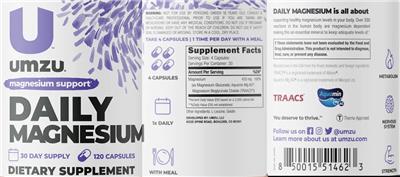
- Form
- Capsule
- Serving Size
- 4 Capsules
- Servings
- 30 per container
- Container Holds
- 120 Capsules
What’s in it, whether it interacts with your drugs, its side effects, whether it works, and what our pharmacists would want you to know before you start it.
- What is Daily Magnesium?A single-ingredient supplement from UMZU, in capsule form.
- Active Ingredients Magnesium 420 mg One active ingredient. We check it for drug interactions and side effects. The full Supplement Facts
- Drug Interactions 298 drugs have a documented interaction with this supplement; the most serious is rated major. Of those, 194 are single drugs and 104 are combination products (two or more drugs in one), each listed under its own name. Ask your pharmacist first if you take a drug in any of these categories, the most serious of the 16 on record:
- Levodopa/
Carbidopa (Sinemet) Major · 6 drugs - Skeletal Muscle RelaxantsModerate · 36 drugs
- Moderate · 23 drugs
- Moderate · 22 drugs
- Levodopa/
- Possible Side EffectsDiarrheaNauseaStomach crampingBloating From its one active ingredient, Magnesium. Not studied in this exact product.
- Well documented Why
Does Daily Magnesium work?
No graded research for the use on its labelWhat It Is Marketed For
Magnesium support
From the claims on the product’s label.
There is no graded research for that use. What it does grade for Magnesium, strongest first:
These grades are for the ingredient, not this exact product, and never a promise it will work for you.
And 4 more graded uses, in what the research says- Full Why
- AllergensNone of its ingredient names point to a major food allergen, and the label text we have carries no allergen statement
- Barcode (UPC)8 50015 51462 3Match it to the barcode on your bottle to be sure this is your product. Not your product? Search for it here
Who Might Consider It
- People looking for magnesium support, which is what it is marketed for. There is no graded research for that use.
- People who want it for constipation, dyspepsia, diabetes or another graded use: the uses with research behind them. See each grade
- Daily Magnesium may suit adults looking for a magnesium supplement at recommended amounts.
Who Should Be Careful
- If you take levodopa/carbidopa, sulfonylureas, quinolone antibiotics, bisphosphonates, or any of the other medications listed, or if you have kidney disease, heart conduction problems, or a bowel condition, be careful.
- Talk it over with your own doctor or pharmacist before you start.
More Before You Take It Show all three answersHide Its Magnesium Amount vs. Other Supplements Pregnancy and Breastfeeding The Label’s Directions
-
How does its Magnesium amount compare with other supplements?
- Magnesium420 mgMore than 9 in 10 of the 502 recent Magnesium products in our database that state an amount; 100 mg is the most common.
A label’s amount is what the product holds, not a recommended dose.
See the Magnesium comparison -
Pregnant or breastfeeding?
- Pregnancy and Breastfeeding
- ! When used orally in excessive doses.
- When used orally and appropriately.
-
How does the label say to take it?
“Take 4 capsules 1 time per day with a meal 4 capsules 1 x daily with meal”
The maker’s words. Your pharmacist or doctor may advise differently.
Everything the label says
From the label dated May 23, 2024: its one active ingredient was checked against our records. A summary of what is known, not a grade or a test of the product. How these ratings are computed
Ask Anything About This Supplement
Name a drug you take, or ask about side effects, ingredients or pregnancy.
AI answers come from this label and our own records, never the open internet. AI can make mistakes, so always check with your doctor or pharmacist. How we use AI
Ask the Pharmacist
A licensed pharmacist will answer your question by email — free, usually within 24 hours.
Got it — thank you!
A licensed pharmacist will answer within 24 hours. Keep an eye on your email (worth checking spam, just in case).
What’s Inside Daily Magnesium by UMZU
One Active Ingredient: Magnesium
Everything this page says about drug interactions and side effects comes from what is known about Magnesium.
Why this rating?
The label gives the exact amount of its one active ingredient, so you know how much you get in each serving. This rates what the label tells you, not the quality of the product.
Supplement Facts
| Amount Per Serving | % Daily Value | |
|---|---|---|
| Magnesium | 420 mg | 100% |
Other ingredients: L-Leucine, Gelatin
Daily Values for adults and children 4 or more years of age.
As the label prints it, from the NIH Dietary Supplement Label Database.
Each Ingredient and Its Drug Interactions
Tap one for more about it and its full guide.
-
Magnesium 420 mg Daily Magnesium contains one active ingredient, magnesium, a mineral. These are non-active components and are not part of the magnesium dose. Interacts with 298 drugs
Form on the label: Aquamin Mg AG, Magnesium Bisglycinate Chelate, Magnesium Gluconate
Magnesium is an essential mineral your body needs for muscles, nerves, blood pressure, and many other functions, and supplements are useful for preventing or correcting deficiency.
- Some other uses, like easing constipation or preventing migraines, have reasonable support, while uses for sleep and anxiety are less proven.
- It is generally safe for most healthy people at recommended amounts, but talk to your pharmacist or doctor before starting, especially if you have kidney problems.
The full Magnesium guide: uses, dosage and safety Every Magnesium drug interaction
How Much Magnesium Is in It, Compared With Other Supplements
Each bar is an amount that other recent supplements list for the same ingredient. The taller the bar, the more of them state it.
-
420 mg in a serving of this product
More than 9 in 10 products
- Most common amount
- 100 mg (about 8 in 100 products)
- Most products state
- 20 mg to 400 mg
- Compared with
- 502 recent products
Other Ingredients (Inactive)
The capsule or tablet itself, fillers, coatings and flavors. Not part of the drug interaction check; the allergen check below reads them.
- L-Leucine
- Gelatin
Allergens in Daily Magnesium
None of its ingredient names point to a major food allergen, and the label text we have carries no allergen statement.
Named on this label
- Gelatin (animal-derived)In the ingredients: Gelatin
Not named in the ingredients
- Milk
- Egg
- Fish
- Shellfish
- Tree nuts
- Peanuts
- Wheat or other gluten grains
- Soy
- Sesame
From the label text and ingredient names on file; we do not test products. With a serious allergy, check your bottle and ask the maker or your pharmacist.
What the Label Says
The maker’s own words, from the label. We do not verify or endorse them.
- General statements
-
“30 day supply”
“Follow us on Facebook Instagram Twitter @umzu Learn more about us at umzu.com”
- FDA Statement of Identity
-
“Dietary Supplement”
- Storage
-
“Store in a cool, dry place.”
- Formulation
-
“Manufactured in the USA from the finest domestic and foreign ingredients. Metabolism Nervous system Strength T Thermo Approved”
“Magnesium support”
“Daily Magnesium is all about supporting healthy magnesium levels in your body. Over 300 reactions in the human body are magnesium dependent making this an essential mineral to keep adequate levels of.”
- Brand IP Statement(s)
-
“TRAACS TRAACS is a registered trademark of Albion”
“Aquamin Mg AG Aquamin Mg AG is a registered trademark of Marigot Ltd.”
“UMZU You Deserve To Thrive”
The Daily Magnesium Label on File
The label scan on file at the NIH Dietary Supplement Label Database, dated May 2024. Always read the label on the bottle you have.
Product Facts
- Brand
- UMZU
- Barcode (UPC)
- 850015514623
- Net contents
- 120 Capsules
- Market status
- On market
- Date entered into DSLD
- May 23, 2024
- DSLD ID
- 309619
- Product type
- Mineral
- Supplement form
- Capsule
- Dietary claims / uses
- Nutrient, All Other, Structure/Function
- Intended target group(s)
- Adult (18 - 50 Years), Women (not pregnant or lactating)
Is this label outdated? Report a formula or label change and our pharmacy team will review it.
Daily Magnesium by UMZU Side Effects
Why this rating?
We look for three kinds of safety information on each ingredient: side effects reported in studies, a pregnancy and breastfeeding rating, and a safety write-up from our pharmacy team. All three are on file for Magnesium.
So this rates how much is known, not whether Daily Magnesium is right for you.
Reported with Magnesium, its active ingredient
- Most often
- Diarrhea, nausea, stomach cramping and bloating
- !Rare but serious
- Reported with Magnesium See details
HelloPharmacist Team Summary: Daily Magnesium by UMZU Side Effects
Magnesium is generally well tolerated, but you may notice diarrhea, stomach cramping, or bloating, which are the reported effects most likely with Daily Magnesium from UMZU.
- Nausea can also occur.
- Rarely, serious effects happen, mostly with very high doses or in people with poor kidney function, so call your doctor right away if you have unusual symptoms.
- Talk with your own doctor or pharmacist before starting if you have kidney disease, heart conduction problems, or a bowel condition.
Side Effects Reported With Magnesium
Daily Magnesium Warnings: Who Should Be Careful
These warnings are for Magnesium, its one active ingredient. If any of these apply to you, talk to your doctor or pharmacist before you start it.
-
Kidney Disease or Kidney Stones
- The biggest safety concern is in people with kidney disease, because damaged kidneys cannot remove extra magnesium, which can build up to dangerous levels.
- If you have kidney problems, do not take magnesium supplements unless your doctor tells you to.
-
Heart Conditions
- People with heart conduction problems or certain bowel conditions should also be cautious.
-
Other Cautions
- There isn't enough data to say more for you personally, so talk with your doctor or pharmacist.
-
What the Label Warns
- “Warning: Not for use by persons under 18 years old. Keep out of the reach of children.”
- “Do not use if pregnant or nursing.”
- “Do not use if safety seal is damaged or missing.”
The maker’s wording, from the product label.
-
Pregnant or Breastfeeding
The rating for pregnancy and for breastfeeding, and what it covers.
Pregnancy and Breastfeeding The record rates both the same
-
When used orally and appropriately.
Magnesium is safe for those pregnant and breast-feeding when used in doses below the tolerable upper intake level (UL) of 350 mg daily.
-
When used orally in excessive doses.
Tell patients to avoid exceeding the tolerable upper intake level (UL) of 350 mg daily.
Taking magnesium orally in higher doses can cause diarrhea.
2 more ratings for Magnesium used another way
This supplement is taken by mouth. These ratings are for Magnesium given another way.
-
When prescription magnesium sulfate is given intramuscularly and intravenously prior to delivery for up to 5 days.
However, due to potential adverse effects associated with intravenous and intramuscular magnesium, use during pregnancy is limited to patients with specific conditions such as severe pre-eclampsia or eclampsia.
5 more points on this rating
- There is some evidence that intravenous magnesium can increase fetal mortality and adversely affect neurological and skeletal development.
- However, a more recent analysis of clinical research shows that increased risk of fetal mortality seems to occur only in the studies where antenatal magnesium is used for tocolysis and not for fetal neuroprotection or pre-eclampsia/eclampsia.
- Furthermore, antenatal magnesium does not seem to be associated with increased risk of necrotizing enterocolitis in preterm infants.
- There is also concern that magnesium increases the risk of maternal adverse events.
- A meta-analysis of clinical research shows that magnesium sulfate might increase the risk of maternal adverse events, especially in Hispanic mothers compared to other racial and ethnic groups.
-
When prescription magnesium sulfate is given intramuscularly and intravenously prior to delivery for longer than 5 days.
Maternal exposure to magnesium for longer than 5-7 days is associated with an increase in neonatal bone abnormalities such as osteopenia and fractures.
The U.S. Food and Drug Administration (FDA) recommends that magnesium injection not be given for longer than 5-7 days.
Our pharmacy team’s notes
- Our pharmacists say supplements should only be used under your doctor's guidance, and for breastfeeding, to check with your doctor first.
Ratings and the words beside them are from the Natural Medicines database, which we license.
The full record, with its sources, in the Magnesium guide -
Rare but Serious Side Effects
-
!
Magnesium
Rare but serious side effects happen mostly with very high doses or in people with poor kidney function.
With toxic doses, loss of reflexes and respiratory depression can occur. High doses in pregnancy can increase risk of neonatal mortality and neurological defects.
When to get help: a serious allergic reaction, with trouble breathing or swelling of the face, lips or throat, needs emergency care: call 911. For any other side effect that worries you, call your doctor or pharmacist.
These reports describe each ingredient, not studies of this exact product. Not medical advice: a side effect you notice after starting a supplement is worth a word with your pharmacist or doctor.
Daily Magnesium by UMZU Drug Interactions
This supplement has one active ingredient, Magnesium, and we checked it against every drug in our records.
A major interaction on record
3 of 3, on a scale from Minor or none to Major.Why this rating?
We rate this by the most serious interaction on record, not by how many there are. For Magnesium, the most serious is rated major, which means the combination is best avoided, or used only under close supervision. Some involve kinds of drugs where a small change can matter, such as blood thinners, diabetes drugs and heart-rhythm drugs.
298 drugs are on the full list. What matters is whether one you take is on it, so check yours with the interaction checker on this page.
Its one active ingredient has drug interactions on record: Magnesium.
Magnesium
- Interacts with
- 298 drugs
- Most serious
- Major
- Daily Magnesium from UMZU does interact with several medications, and every interaction traces back to its magnesium content.
- The most serious is with levodopa/carbidopa (Sinemet), rated Major.
- Magnesium can reduce how much levodopa and carbidopa your body absorbs.
- In one study in healthy volunteers, magnesium oxide lowered levodopa exposure by 35% and carbidopa exposure by 81%.
Show nine more points
- The other interactions are rated Moderate.
- Skeletal muscle relaxants (Moderate) can have stronger, faster effects alongside magnesium.
- Potassium-sparing diuretics (Moderate) can raise magnesium levels.
- Calcium channel blockers (Moderate) may have additive effects.
- Antacids (Moderate) may reduce magnesium's laxative effect.
- Sulfonylureas (Moderate) can be absorbed more, raising the risk of low blood sugar (hypoglycemia).
- Quinolone antibiotics (Moderate) and bisphosphonates (Moderate) can be absorbed less when taken close together with magnesium.
- Magnesium is the only ingredient in this product, and it has documented interactions, so there is no interaction-free ingredient to note.
- To see whether your exact medications are covered, use the search tool on this page, and talk with your own doctor or pharmacist before starting or combining it.
The kinds of drugs it affects most
- 122 drugs
- Skeletal Muscle Relaxants 36 drugs
- 23 drugs
- 22 drugs
Every Magnesium drug interaction, 16 records The Magnesium records cite 84 references, listed in the Magnesium guide.
Summarized by the HelloPharmacist pharmacy team from the interaction records below. How it is written How we use AI
The Breakdown by Severity
Each drug counted once, at its most serious rating. Tap a tile to list those drugs.
Find Your Drug
Type a drug or brand name to see whether it is on the list.
- Only drugs with a documented interaction are listed, the most serious first.
- A drug with no known interaction is not listed, but searching its name tells you so.
- Open a drug to see which ingredient is responsible. Of those, 194 are single drugs and 104 are combination products (two or more drugs in one), each listed under its own name.
-
LevodopaInbrija, Larodopa Major
The ingredient responsible:
-
Magnesium Major
Magnesium can reduce the bioavailability of levodopa/carbidopa.
The full Magnesium + Levodopa interaction
-
-
CarbidopaLodosyn Major
The ingredient responsible:
-
Magnesium Major
Magnesium can reduce the bioavailability of levodopa/carbidopa.
The full Magnesium + Carbidopa interaction
-
-
Carbidopa and LevodopaDhivy, Rytary, Sinemet, Sinemet CR Major
The ingredient responsible:
-
Magnesium Major
Magnesium can reduce the bioavailability of levodopa/carbidopa.
The full Magnesium + Carbidopa and Levodopa interaction
-
-
Benserazide and LevodopaMadopar, Prolopa Major
The ingredient responsible:
-
Magnesium Major
Magnesium can reduce the bioavailability of levodopa/carbidopa.
The full Magnesium + Benserazide and Levodopa interaction
-
-
Levodopa and CarbidopaDuodopa Major
The ingredient responsible:
-
Magnesium Major
Magnesium can reduce the bioavailability of levodopa/carbidopa.
The full Magnesium + Levodopa and Carbidopa interaction
-
-
Carbidopa, Levodopa, and EntacaponeStalevo Major
The ingredient responsible:
-
Magnesium Major
Magnesium can reduce the bioavailability of levodopa/carbidopa.
The full Magnesium + Carbidopa, Levodopa, and Entacapone interaction
-
-
LevothyroxineEltroxin, Estre, Euthyrox, Levo-T, Levolet and 6 more Moderate
The ingredient responsible:
-
Magnesium Moderate
Magnesium might decrease levothyroxine levels by reducing its absorption.
The full Magnesium + Levothyroxine interaction
-
-
AmlodipineNorliqva Moderate
The ingredient responsible:
-
Magnesium Moderate Amlodipine is in the Calcium Channel Blockers category.
Magnesium can have additive effects with calcium channel blockers, although evidence is conflicting.
The full Magnesium + Amlodipine interaction
-
-
DoxycyclineDoryx, Doxy, Doxy-D, Doxycin, Doxycycline Injection and 7 more Moderate
The ingredient responsible:
-
Magnesium Moderate Doxycycline is in the Tetracycline Antibiotics category.
Magnesium decreases absorption of tetracyclines.
The full Magnesium + Doxycycline interaction
-
-
Levothyroxine SodiumErmez, Thyquidity, Tirosint-Sol Moderate
The ingredient responsible:
-
Magnesium Moderate
Magnesium might decrease levothyroxine levels by reducing its absorption.
The full Magnesium + Levothyroxine Sodium interaction
-
-
Amlodipine BesylateNorvasc Moderate
The ingredient responsible:
-
Magnesium Moderate Amlodipine Besylate is in the Calcium Channel Blockers category.
Magnesium can have additive effects with calcium channel blockers, although evidence is conflicting.
The full Magnesium + Amlodipine Besylate interaction
-
-
CiprofloxacinCiloxan, Cipro, Cipro IV, Cipro XR, Ciprobay and 1 more Moderate
The ingredient responsible:
-
Magnesium Moderate Ciprofloxacin is in the Quinolone Antibiotics category.
Magnesium decreases absorption of quinolones.
The full Magnesium + Ciprofloxacin interaction
-
-
SpironolactoneAldactone, Carospir, Spiroton Moderate
The ingredient responsible:
-
Magnesium Moderate Spironolactone is in the Potassium-sparing Diuretics category.
Potassium-sparing diuretics decrease excretion of magnesium, possibly increasing magnesium levels.
The full Magnesium + Spironolactone interaction
-
-
Doxycycline HyclateActiclate, Acticlate Cap, Lymepak Moderate
The ingredient responsible:
-
Magnesium Moderate Doxycycline Hyclate is in the Tetracycline Antibiotics category.
Magnesium decreases absorption of tetracyclines.
The full Magnesium + Doxycycline Hyclate interaction
-
-
Doxycycline MonohydrateErfacea Moderate
The ingredient responsible:
-
Magnesium Moderate Doxycycline Monohydrate is in the Tetracycline Antibiotics category.
Magnesium decreases absorption of tetracyclines.
The full Magnesium + Doxycycline Monohydrate interaction
-
-
DiltiazemAdizem-SR, Adizem-XL, Angitil SR, Angitil XL, Calcicard CR and 24 more Moderate
The ingredient responsible:
-
Magnesium Moderate Diltiazem is in the Calcium Channel Blockers category.
Magnesium can have additive effects with calcium channel blockers, although evidence is conflicting.
The full Magnesium + Diltiazem interaction
-
-
DigoxinDigitek, Lanoxicaps, Lanoxin Moderate
The ingredient responsible:
-
Magnesium Moderate
Magnesium salts may reduce absorption of digoxin.
The full Magnesium + Digoxin interaction
-
-
RocuroniumZemuron Moderate
The ingredient responsible:
-
Magnesium Moderate Rocuronium is in the Skeletal Muscle Relaxants category.
Parenteral magnesium alters the pharmacokinetics of skeletal muscle relaxants, increasing their effects and accelerating the onset of effect.
The full Magnesium + Rocuronium interaction
-
-
RapacuroniumRaplon Moderate
The ingredient responsible:
-
Magnesium Moderate Rapacuronium is in the Skeletal Muscle Relaxants category.
Parenteral magnesium alters the pharmacokinetics of skeletal muscle relaxants, increasing their effects and accelerating the onset of effect.
The full Magnesium + Rapacuronium interaction
-
-
GlipizideGlucotrol, Glucotrol XL Moderate
The ingredient responsible:
-
Magnesium Moderate Glipizide is in the Sulfonylureas category.
Magnesium increases the systemic absorption of sulfonylureas, increasing their effects and side effects.
The full Magnesium + Glipizide interaction
-
-
NifedipineAdalat, Adalat CC, Adalat LA, Adalat PA, Adalat Retard and 16 more Moderate
The ingredient responsible:
-
Magnesium Moderate Nifedipine is in the Calcium Channel Blockers category.
Magnesium can have additive effects with calcium channel blockers, although evidence is conflicting.
The full Magnesium + Nifedipine interaction
-
-
Magnesium Sulfate (prescription Drug)Bilagog, Magnesium Sulfate Moderate
The ingredient responsible:
-
Magnesium Moderate Magnesium Sulfate (prescription Drug) is in the Antacids category.
Use of acid reducers may reduce the laxative effect of magnesium oxide.
The full Magnesium + Magnesium Sulfate (prescription Drug) interaction
-
-
VerapamilCalan, Calan SR, Covera HS, Isoptin, Isoptin SR and 4 more Moderate
The ingredient responsible:
-
Magnesium Moderate Verapamil is in the Calcium Channel Blockers category.
Magnesium can have additive effects with calcium channel blockers, although evidence is conflicting.
The full Magnesium + Verapamil interaction
-
-
Amlodipine BenzoateKaterzia Moderate
The ingredient responsible:
-
Magnesium Moderate Amlodipine Benzoate is in the Calcium Channel Blockers category.
Magnesium can have additive effects with calcium channel blockers, although evidence is conflicting.
The full Magnesium + Amlodipine Benzoate interaction
-
-
Calcium CarbonateAdcal, Adcal-D3, Calcichew, Os-Cal, Tums Moderate
The ingredient responsible:
-
Magnesium Moderate Calcium Carbonate is in the Antacids category.
Use of acid reducers may reduce the laxative effect of magnesium oxide.
The full Magnesium + Calcium Carbonate interaction
-
-
MinocyclineAcnamino MR, Aknemin, Amzeeq, Arestin Miscrosperes, Dynacin and 7 more Moderate
The ingredient responsible:
-
Magnesium Moderate Minocycline is in these Tetracycline Antibiotics, Anticoagulant/Antiplatelet Drugs categories.
Magnesium decreases absorption of tetracyclines.
The full Magnesium + Minocycline interaction
-
-
LevofloxacinLeva-pak, Levaquin, Levaquin Injection Moderate
The ingredient responsible:
-
Magnesium Moderate Levofloxacin is in the Quinolone Antibiotics category.
Magnesium decreases absorption of quinolones.
The full Magnesium + Levofloxacin interaction
-
-
GliclazideDiamicron Moderate
The ingredient responsible:
-
Magnesium Moderate Gliclazide is in the Sulfonylureas category.
Magnesium increases the systemic absorption of sulfonylureas, increasing their effects and side effects.
The full Magnesium + Gliclazide interaction
-
-
PancuroniumPavulon Moderate
The ingredient responsible:
-
Magnesium Moderate Pancuronium is in the Skeletal Muscle Relaxants category.
Parenteral magnesium alters the pharmacokinetics of skeletal muscle relaxants, increasing their effects and accelerating the onset of effect.
The full Magnesium + Pancuronium interaction
-
-
GlyburideAlbert Glyburide, Diabeta, Glycron, Glynase, Glynase PresTab and 2 more Moderate
The ingredient responsible:
-
Magnesium Moderate Glyburide is in the Sulfonylureas category.
Magnesium increases the systemic absorption of sulfonylureas, increasing their effects and side effects.
The full Magnesium + Glyburide interaction
-
Does It Work? Daily Magnesium by UMZU
What the research says so far. A grade is the research so far, never an endorsement.
What It Is Marketed For
Magnesium support
From the claims on the product’s label.
Why this rating?
We hold no graded evidence on that for its ingredients.
What the Research Says About Magnesium
Its uses graded effective, likely effective or possibly effective:
Research suggests a benefit for
- Constipation and dyspepsia
- Diabetes, hypercholesterolemia, metabolic syndrome, osteoporosis and premenstrual syndrome (PMS)
Not counted here: five graded uses are for Magnesium injected or put on the skin (vasospastic angina, asthma, seizures and others), not for a product like this one. Six more are for conditions treated by a doctor or in a hospital (arrhythmia, cerebral palsy, colorectal cancer and others).
Every graded use, in the Magnesium guideThe grades are the Natural Medicines database’s, which we license; tap a grade for what it means. They are about each ingredient, not this exact product.
About UMZU
Manufacturer and brand details for Daily Magnesium, from the product label.
UMZU has 45 products in our supplement database, 33 of them on the market, with labels on file since 2021. Our database is built from the NIH’s Dietary Supplement Label Database and our pharmacy team’s own additions, so it covers the labels filed there, not every product the brand sells.
- Name
- UMZU, LLC
- Street Address
- 6325 Spine Road
- City
- Boulder
- State
- CO
- ZipCode
- 80301
- Web Address
- umzu.com
Daily Magnesium by UMZU: Common Questions
Does Daily Magnesium by UMZU interact with any drugs?
What are the side effects of Daily Magnesium by UMZU?
Who should be careful taking Daily Magnesium by UMZU?
How can Daily Magnesium by UMZU interact with so many drugs?
Where does the information about Daily Magnesium by UMZU come from?
Is Daily Magnesium by UMZU safe to take during pregnancy?
Does magnesium work for constipation?
What is magnesium needed for?
Written and reviewed by the HelloPharmacist Editorial Team. Our editorial policy
Still Have a Question About Daily Magnesium?
Our pharmacists answer drug and supplement questions, free, by email.
Label information is sourced from the NIH Dietary Supplement Label Database and reflects the product version on file; always read your actual product label. This page is for education only and is not a substitute for professional medical advice. Confirm with your pharmacist or doctor before combining supplements and drugs.
Who Reviews This Page
The pharmacist behind it, and how it is checked.
Dr. Brian Staiger, PharmD, BCPS
Clinical pharmacist and founder of HelloPharmacist
A licensed pharmacist for more than 13 years, he built the system behind this page: it reads the label on file, matches each active ingredient to its record in the Natural Medicines database, checks those records against every drug we cover, and our pharmacy team writes the take and the interaction summary from those records.
- 13+ Years in PharmacyRetail and clinical pharmacy, medication safety and healthcare administration.
- Board Certified (BCPS)A pharmacotherapy specialist, certified by the Board of Pharmacy Specialties.
- Herbalist TrainingCertificates in medical ethnobotany, for the herbs and supplements people take.
Where This Page Comes From
Daily Magnesium’s label data comes from the NIH Dietary Supplement Label Database; the ingredient interaction data is from the Natural Medicines database, reviewed by our pharmacists.
- NIH Dietary Supplement Label Database (DSLD)
- The official product label on file for this supplement.
- Natural Medicines (Therapeutic Research Center)
- The evidence-graded clinical reference behind the ingredient interaction, evidence and safety records, which we license.
- HelloPharmacist Editorial Team
- Content is reviewed by the HelloPharmacist Editorial Team, the pharmacists on our staff and those we contract. See our data sources and editorial standards for how this information is built and checked.
- The Pharmacy Team’s Take and Summaries
- Generated from HelloPharmacist’s pharmacist-curated databases and editorial rules. Clinical methodology reviewed by Dr. Brian Staiger, PharmD, BCPS. Last generated Oct 30, 2026. How we use AI
- The ratings in the Quick Summary
- They summarize available label information, ingredient evidence and known drug-safety records: a summary of what is known, not a grade of the product itself. They do not verify product identity, purity, potency, contamination or manufacturing quality. How these ratings are computed
The References Behind the Interaction Records
Every citation the ingredients’ records rest on is listed in that ingredient’s guide, in context: Magnesium, 84 references .
Parts of this content are provided by the Therapeutic Research Center, LLC.
DISCLAIMER: Currently this does not check for drug-drug interactions. This is not an all-inclusive comprehensive list of potential interactions and is for informational purposes only. Not all interactions are known or well-reported in the scientific literature, and new interactions are continually being reported. Input is needed from a qualified healthcare provider including a pharmacist before starting any therapy. Application of clinical judgment is necessary.
© 2021 Therapeutic Research Center, LLC
Keep Exploring
- Supplement interaction checkerCheck any supplement or product against your drugs
- Drug–drug interactionsCheck two or more of your drugs against each other
- Browse drugs A to ZEvery drug we have checked against herbs and supplements
- NDC and pricing lookupFind a drug’s NDCs, packaging and costs
- Ask a pharmacistA free, personal answer from our licensed team