
Eskaloft Ingredients & Drug Interactions
by Nutra BioGenesis
What is this page for?
First and foremost: checking Eskaloft against your medications. The heart of this page is the interaction checker and the full interaction report — how this product’s ingredients may interact with prescription and over-the-counter medicines you may be taking.
Around that, we add a pharmacist’s high-level view of the product as a whole — what’s inside, the evidence for its stated use, how transparent the label is, and what safety data exists — so you can see the full picture in one place. It’s educational information from our licensed clinical databases and the clinical staff at HelloPharmacist — not medical advice — and we don’t sell or endorse products. Our editorial policy
Eskaloft is a dietary supplement by Nutra BioGenesis with 11 active ingredients. Its ingredients are commonly taken for treating or preventing b12 deficiency, pernicious anemia, low energy and fatigue.Based on those ingredients, 1,574 medications have a known interaction with it, the most serious rated major. The ingredients most likely to interact are Rhodiola Root Extract, St. John's Wort Aerial Extract, L-Theanine. Use the checker below to test your specific medication, or read the full HelloPharmacist Interaction Report.
Check Your Meds Against Eskaloft by Nutra BioGenesis
Ask about any prescription or over-the-counter medication and we check it for interactions with Eskaloft by Nutra BioGenesis — and tell you which ingredient is responsible.
AI summaries are generated from our interaction database for education only — always confirm with your pharmacist. How we use AI
Ask the Pharmacist
A licensed pharmacist will answer your question by email — free, usually within 24 hours.
Got it — thank you!
A licensed pharmacist will answer within 24 hours. Keep an eye on your email (worth checking spam, just in case).
HelloPharmacist Scorecard of Eskaloft by Nutra BioGenesis
Our pharmacy team’s full take, with four database checks built into the cards below — a summary of what is known, not a grade of the product itself.
What’s inside
Full disclosure
Eskaloft contains 11 active ingredients formulated to support mood and cognitive function. The product includes vitamin B12 for energy and nervous system support; 5-HTP, a serotonin precursor sometimes used for mood; L-theanine for calm focus; Rhodiola and GABA for stress resilience; N-Acetyl-L-Tyrosine for neurotransmitter synthesis; dimethylaminoethanol (deanol) for brain health; lithium as a mood-supporting mineral; vitamin B6 for brain chemistry; St.
John's wort for mood support; and folic acid for neural and mood support. The product also contains inactive ingredients including gelatin (capsule), ascorbyl palmitate, rice bran extract, and cellulose.
Does it work?
Strong evidence
The evidence for most of these ingredients is mixed or limited. Vitamin B12 is effective for B12 deficiency and certain rare neurological conditions, and likely effective for cyanide poisoning.
5-HTP is rated possibly effective for depression but has insufficient evidence for panic disorder and other conditions. L-Theanine is possibly effective for cognitive function but has insufficient evidence for anxiety, Alzheimer's disease, and other uses.
Rhodiola, GABA, and deanol all have insufficient evidence or are rated likely ineffective for the conditions studied. Lithium has insufficient evidence for most uses in this product's context.
Vitamin B6 is effective for specific vitamin B6 deficiency and certain rare conditions, and likely effective for high homocysteine. St.
John's wort is likely effective for depression and possibly effective for menopausal symptoms, but possibly ineffective for HIV and IBS. Folic acid is effective for folate deficiency and likely effective for preventing neural tube birth defects and treating methotrexate toxicity.
How safe is it?
Well-documented data
The safety profile varies significantly among ingredients. Vitamin B12 is generally very well tolerated with no established upper limit.
5-HTP is generally well tolerated short-term but can cause nausea, diarrhea, drowsiness, and dizziness; at high doses or with rapid increases, gastrointestinal side effects may be dose-dependent. L-Theanine is generally well tolerated in healthy adults short-term but may cause headaches and drowsiness; long-term safety is not well studied.
Rhodiola, GABA, deanol, and St. John's wort are generally well tolerated for short-term use but have insufficient long-term safety data.
Lithium has a narrow safety margin; prescription forms require blood monitoring, and supplement forms are not well studied—it can cause tremor, fatigue, muscle weakness, and weight gain. Vitamin B6 is safe at normal doses but high doses over time can damage nerves (sensory neuropathy), especially above 1,000 mg daily.
Folic acid is generally safe at recommended doses. Regarding pregnancy and breastfeeding: vitamin B12 is considered safe at normal amounts; 5-HTP, L-Theanine, Rhodiola, GABA, deanol, and St.
John's wort lack sufficient safety data and are best avoided; lithium has been linked to birth defects and passes into breast milk; and vitamin B6 and folic acid are often used in pregnancy under medical guidance.
Meds to double-check
Major interaction found
Before taking Eskaloft, double-check if you take any of these medication types: serotonergic drugs like SSRIs or SNRIs (Major risk of serotonin syndrome when combined with lithium and 5-HTP), blood thinners and anticoagulants, digoxin or other heart medications (Major interaction with St. John's wort), seizure medications like phenobarbital and phenytoin (Major interactions with St.
John's wort and Vitamin B6), cancer chemotherapy drugs like irinotecan and docetaxel (Major interactions with St. John's wort), HIV protease inhibitors (Major interaction with St.
John's wort), tacrolimus or other immunosuppressants (Major interaction with St. John's wort), blood pressure medications (Moderate interactions with L-Theanine, Rhodiola, and GABA), diabetes medications (Moderate interaction with Rhodiola), sedatives or sleep aids (Moderate interactions with 5-HTP, L-Theanine, and GABA), and NSAIDs like ibuprofen (Moderate interaction with lithium).
The bottom line
Scorecard at a glanceFully disclosed formula with clinical evidence supporting its stated purpose. Major medication interactions have been identified, and safety information is well characterized.
Eskaloft combines multiple mood and cognitive-support ingredients but carries significant interaction risks, especially with lithium, St. John's wort, and serotonergic medications.
If you take any prescription medications—particularly for heart rhythm, seizures, blood pressure, HIV, cancer, depression, or immune suppression—check your specific drugs with the interaction tool before starting this product. Talk with your pharmacist or doctor about whether this product is right for you.
Educational only — not medical advice; always confirm with your pharmacist. Our editorial policy · How we use AI
Assessment coverage: 10 of 11 active ingredients matched to our full ingredient reviews (monographs). Based on the product label dated Dec 21, 2024.
This Scorecard evaluates available label information, ingredient evidence, and known medication-safety considerations. It does not independently verify product identity, purity, potency, contamination, or manufacturing quality. How these ratings are computed
General information
Key facts about Eskaloft, straight from the product label.
| Brand | Nutra BioGenesis |
|---|---|
| Barcode (UPC) | 812806102822 |
| Net contents | 60 Capsule(s) |
| Market status | On market |
| Date entered into DSLD | Dec 21, 2024 |
| DSLD ID | 322994 |
| Product type | Other Combinations |
| Supplement form | Capsule |
| Dietary claims / uses | Nutrient, All Other, Structure/Function |
| Intended target group(s) | Adult (18 - 50 Years), Women (not pregnant or lactating), Gluten Free |
Everything in this section is reproduced from the manufacturer’s own product label — it’s the label speaking, not HelloPharmacist. We show it so you can see exactly what the maker states; we don’t verify or endorse those statements.
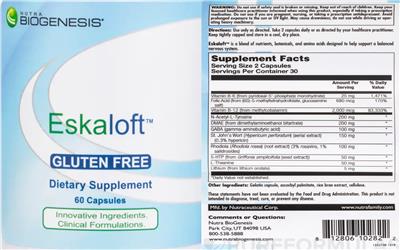
Supplement Facts
The label details for Eskaloft by Nutra BioGenesis, sourced from the NIH Dietary Supplement Label Database.
Supplement Facts
| Ingredient | Amount | % DV |
|---|---|---|
| Vitamin B12 | 2000 mcg | 83333% |
| 5-HTP | 50 mg | -- |
| L-Theanine | 50 mg | -- |
| Rhodiola Root Extract | 100 mg | -- |
| N-Acetyl-L-Tyrosine | 200 mg | -- |
| Gamma Aminobutyric Acid | 100 mg | -- |
| Dimethylaminoethanol Bitartrate | 200 mg | -- |
| Lithium | 5 mg | -- |
| Vitamin B6 | 25 mg | 1471% |
| St. John's Wort Aerial Extract | 150 mg | -- |
| Folic Acid | 680 mcg | 170% |
Other ingredients: Gelatin, Ascorbyl Palmitate, Rice Bran Extract, Cellulose
Tap any ingredient to jump to its full detail below.
These statements are the manufacturer’s wording, reproduced from the product label — the label is saying it, not HelloPharmacist. We don’t verify or endorse them.
Formulation
Gluten free
FDA Statement of Identity
Dietary Supplement
General Statements
Innovative ingredients. Clinical formulations.
Pure formulas
Precautions
Warning: Do not use if safety seal is broken or missing. Avoid prolonged exposure to the sun or UV light. May cause drowsiness; do not use while driving or operating heavy machinery.
Keep out of reach of children.
Keep your licensed healthcare practitioner informed when using this product, especially if taking a prescription medication. Do not use if you are pregnant, nursing, or taking a prescription antidepressant.
Suggested/Recommended/Usage/Directions
Directions: Use only as directed. Take 2 capsules daily or as directed by your healthcare practitioner.
Storage
Keep tightly capped and store in a cool, dry place.
Formula
Eskaloft is a blend of nutrients, botanicals, and amino acids designed to help support a balanced nervous system.
FDA Disclaimer Statement
These statements have not been evaluated by the Food and Drug Administration. This product is not intended to diagnose, treat, cure, or prevent any disease.
Is this label outdated? Report a formula or label change and our pharmacy team will review it.
Eskaloft by Nutra BioGenesis label
The label scan from the NIH Dietary Supplement Label Database. Tap to enlarge.
Label images are published by the NIH Dietary Supplement Label Database for the version of this product on file. Always read your actual product label.
View the full label (PDF)The Ingredients in Eskaloft by Nutra BioGenesis
These are the 11 active ingredients this product is made of. Select any to open its full monograph.
Serving size2 Capsule(s) Dosage formCapsule Servings per container30 Amounts shown are per serving.
Most supplement products combine several ingredients, and a medication can interact with the product through any one of them. Each ingredient below shows whether it has known drug interactions.
Vitamin B12
Interacts with20 drugs
Vitamin B12 (cobalamin) is an essential nutrient your body needs to make red blood cells, keep nerves healthy, and support DNA. Supplements are very h...
Vitamin B12 monograph & interactions5-HTP
Interacts with398 drugs
5-HTP is a compound your body uses to make serotonin, and people take it as a supplement hoping to improve mood, sleep, and headaches. Some early rese...
5-HTP monograph & interactionsL-Theanine
Interacts with565 drugs
Theanine (usually L-theanine) is an amino acid found naturally in tea leaves that many people take to feel calmer and less stressed without strong dro...
L-Theanine monograph & interactionsRhodiola Root Extract
Interacts with1,271 drugs
Rhodiola is an herb traditionally used to fight fatigue and help the body cope with stress. Some small studies suggest it may modestly reduce fatigue...
Rhodiola Root Extract monograph & interactionsN-Acetyl-L-Tyrosine
Gamma Aminobutyric Acid
Interacts with419 drugs
GABA is a calming chemical messenger (neurotransmitter) that your body makes on its own, and it is sold as a supplement for stress, anxiety, and sleep...
Gamma Aminobutyric Acid monograph & interactionsDimethylaminoethanol Bitartrate
Interacts with219 drugs
Deanol (DMAE) is a compound related to choline that is marketed for memory, focus, and mood, but solid human evidence for most of these uses is limite...
Dimethylaminoethanol Bitartrate monograph & interactionsLithium
Interacts with515 drugs
Lithium is a naturally occurring metal that, in prescription form (lithium carbonate or citrate), is an FDA-approved, well-proven treatment for bipola...
Lithium monograph & interactionsVitamin B6
Interacts with210 drugs
Vitamin B6 (pyridoxine) is an essential water-soluble vitamin that your body needs for metabolism, brain function, and making red blood cells. It is b...
Vitamin B6 monograph & interactionsSt. John's Wort Aerial Extract
Interacts with1,143 drugs
St. John's wort is a well-studied herb most often used for mild to moderate depression, and some research suggests it may help with this. However, it...
St. John's Wort Aerial Extract monograph & interactionsFolic Acid
Interacts with40 drugs
Folic acid is the man-made form of vitamin B9 and is one of the most well-studied supplements, especially for preventing serious birth defects when ta...
Folic Acid monograph & interactionsOther (inactive) ingredients: Gelatin, Ascorbyl Palmitate, Rice Bran Extract, Cellulose. These complete the product’s ingredient list but are not active constituents.
Eskaloft by Nutra BioGenesis Drug Interactions
HelloPharmacist Interaction Report
Eskaloft by Nutra BioGenesis contains several ingredients with documented interactions with medications, and the most serious concerns involve lithium and St.
John's wort. Lithium in this product may interact with serotonergic drugs (antidepressants like SSRIs) with Major severity—the combination can mask and increase the risk of serotonin syndrome, a serious condition marked by confusion, agitation, and rapid heart rate.
Lithium also has Major interactions with diuretic drugs and several others that may increase lithium levels to toxic levels, as well as with cancer chemotherapy drugs like irinotecan and docetaxel.
Read the full breakdown — every affected drug type, severity by severity
St. John's wort in this product is a significant concern because it reduces the effectiveness of many medications.
It carries Major interactions with digoxin (a heart medication), phenobarbital and phenytoin (seizure drugs), protease inhibitors (HIV medications), tacrolimus (an immunosuppressant), and irinotecan and docetaxel (cancer drugs). When St.
John's wort is taken with these, your body may metabolize them faster, leaving you with lower drug levels and reduced benefit.
5-HTP and other ingredients in this product have Moderate interactions with CNS depressants (sedatives, sleep aids, pain relievers) and serotonergic drugs—combining them may increase drowsiness or the risk of serotonin syndrome. L-Theanine, Rhodiola, and GABA may lower blood pressure, so they carry Moderate interactions with blood pressure medications.
Rhodiola also interacts with diabetes drugs and several drug-metabolizing enzymes, potentially raising levels of certain medications. Vitamin B6 at high doses may reduce the effect of seizure medications (phenobarbital and phenytoin) and amiodarone (a heart rhythm drug).
Altogether, these interactions span 1,555 individual medications. Given the number and seriousness of these interactions, you should check your exact medications with the tool on this page before taking Eskaloft.
Check your own medications below · Editorial policy · How we use AI
Want to check YOUR meds against Eskaloft?
Ask about interactions with your drugs in plain English — “Can I take it with lisinopril?” — and we find you the answer in seconds, ingredient by ingredient.
Go to the checkerIngredients driving the most interactions
Individual Drug Interactions
The ingredients in Eskaloft interact with 1,574 drugs. Click any drug to see the details.
10 of the 11 ingredients in Eskaloft interact with drugs. Each result below shows which ingredient is responsible. Rhodiola Root Extract St. John's Wort Aerial Extract L-Theanine Lithium Gamma Aminobutyric Acid 5-HTP Dimethylaminoethanol Bitartrate Vitamin B6 Folic Acid Vitamin B12
Ado-trastuzumab EmtansineKadcyla
How Ado-trastuzumab Emtansine interacts with Eskaloft — through 2 ingredients. Tap an ingredient for the detail:
St. John's Wort Aerial ExtractCytochrome P450 3a4 (cyp3a4) Substrates Major
Interaction Summary
St.
Read the full St. John's Wort Aerial Extract + Ado-trastuzumab Emtansine interactionRhodiola Root ExtractCytochrome P450 3a4 (cyp3a4) Substrates Minor
Interaction Summary
Theoretically, rhodiola might increase levels of drugs metabolized by CYP3A4.
Read the full Rhodiola Root Extract + Ado-trastuzumab Emtansine interactionAbemaciclibVerzenio
How Abemaciclib interacts with Eskaloft — through 2 ingredients. Tap an ingredient for the detail:
St. John's Wort Aerial ExtractCytochrome P450 3a4 (cyp3a4) Substrates Major
Rhodiola Root ExtractCytochrome P450 3a4 (cyp3a4) Substrates Minor
Interaction Summary
Theoretically, rhodiola might increase levels of drugs metabolized by CYP3A4.
Read the full Rhodiola Root Extract + Abemaciclib interactionAbiraterone
How Abiraterone interacts with Eskaloft — through 2 ingredients. Tap an ingredient for the detail:
St. John's Wort Aerial ExtractCytochrome P450 3a4 (cyp3a4) Substrates Major
Rhodiola Root ExtractCytochrome P450 3a4 (cyp3a4) Substrates Minor
Interaction Summary
Theoretically, rhodiola might increase levels of drugs metabolized by CYP3A4.
Read the full Rhodiola Root Extract + Abiraterone interactionAbiraterone AcetateYonsa, Zytiga
How Abiraterone Acetate interacts with Eskaloft — through 2 ingredients. Tap an ingredient for the detail:
St. John's Wort Aerial ExtractCytochrome P450 3a4 (cyp3a4) Substrates Major
Interaction Summary
St.
Read the full St. John's Wort Aerial Extract + Abiraterone Acetate interactionRhodiola Root ExtractCytochrome P450 3a4 (cyp3a4) Substrates Minor
Interaction Summary
Theoretically, rhodiola might increase levels of drugs metabolized by CYP3A4.
Read the full Rhodiola Root Extract + Abiraterone Acetate interactionAcalabrutinibCalquence
How Acalabrutinib interacts with Eskaloft — through 2 ingredients. Tap an ingredient for the detail:
St. John's Wort Aerial ExtractP-glycoprotein Substrates, Cytochrome P450 3a4 (cyp3a4) Substrates Major
Rhodiola Root ExtractCytochrome P450 3a4 (cyp3a4) Substrates, P-glycoprotein Substrates Moderate
Interaction Summary
Theoretically, rhodiola might increase levels of drugs metabolized by CYP3A4.
Read the full Rhodiola Root Extract + Acalabrutinib interactionAcetaminophen, Aspirin, CaffeineExcedrin, Excedrin Extra Strength, Excedrin Migraine
How Acetaminophen, Aspirin, Caffeine interacts with Eskaloft — through 3 ingredients. Tap an ingredient for the detail:
St. John's Wort Aerial ExtractCytochrome P450 1a2 (cyp1a2) Substrates, Cytochrome P450 3a4 (cyp3a4) Substrates Major
Interaction Summary
St.
Read the full St. John's Wort Aerial Extract + Acetaminophen, Aspirin, Caffeine interactionLithiumNonsteroidal Anti-inflammatory Drugs (nsaids), Methylxanthines Moderate
Interaction Summary
Theoretically, taking lithium supplements with NSAIDs might increase lithium levels and adverse effects.
Read the full Lithium + Acetaminophen, Aspirin, Caffeine interactionRhodiola Root ExtractCytochrome P450 1a2 (cyp1a2) Substrates, Cytochrome P450 3a4 (cyp3a4) Substrates Minor
Interaction Summary
Theoretically, rhodiola might increase levels of drugs metabolized by CYP1A2.
Read the full Rhodiola Root Extract + Acetaminophen, Aspirin, Caffeine interactionAcetaminophen, Butalbital, CaffeineEsgic, Esgic Plus, Fiogesic, Fioricet, Repan, Tecnal +1 more
How Acetaminophen, Butalbital, Caffeine interacts with Eskaloft — through 3 ingredients. Tap an ingredient for the detail:
St. John's Wort Aerial ExtractCytochrome P450 1a2 (cyp1a2) Substrates, Cytochrome P450 3a4 (cyp3a4) Substrates Major
Interaction Summary
St.
Read the full St. John's Wort Aerial Extract + Acetaminophen, Butalbital, Caffeine interactionLithiumMethylxanthines Moderate
Interaction Summary
Theoretically, taking lithium supplements with methylxanthines might decrease lithium levels.
Read the full Lithium + Acetaminophen, Butalbital, Caffeine interactionRhodiola Root ExtractCytochrome P450 1a2 (cyp1a2) Substrates, Cytochrome P450 3a4 (cyp3a4) Substrates Minor
Interaction Summary
Theoretically, rhodiola might increase levels of drugs metabolized by CYP1A2.
Read the full Rhodiola Root Extract + Acetaminophen, Butalbital, Caffeine interactionAcetaminophen, Butalbital, Caffeine, CodeineEsgic with Codeine, Fioricet w/ Codeine
How Acetaminophen, Butalbital, Caffeine, Codeine interacts with Eskaloft — through 6 ingredients. Tap an ingredient for the detail:
St. John's Wort Aerial ExtractCytochrome P450 3a4 (cyp3a4) Substrates, Cytochrome P450 1a2 (cyp1a2) Substrates Major
5-htpCns Depressants Moderate
Interaction Summary
Theoretically, concomitant use of 5-HTP with medications that cause sedation might have additive effects.
Read the full 5-htp + Acetaminophen, Butalbital, Caffeine, Codeine interactionLithiumMethylxanthines Moderate
Interaction Summary
Theoretically, taking lithium supplements with methylxanthines might decrease lithium levels.
Read the full Lithium + Acetaminophen, Butalbital, Caffeine, Codeine interactionRhodiola Root ExtractCytochrome P450 3a4 (cyp3a4) Substrates, Cytochrome P450 1a2 (cyp1a2) Substrates +1 Minor
Interaction Summary
Theoretically, rhodiola might increase levels of drugs metabolized by CYP3A4.
Read the full Rhodiola Root Extract + Acetaminophen, Butalbital, Caffeine, Codeine interactionGamma Aminobutyric AcidCns Depressants Minor
Interaction Summary
Theoretically, GABA might have additive sedative effects when used in conjunction with CNS depressants.
Read the full Gamma Aminobutyric Acid + Acetaminophen, Butalbital, Caffeine, Codeine interactionL-theanineCns Depressants Minor
Interaction Summary
Theoretically, theanine might have additive sedative effects when used in conjunction with CNS depressants.
Read the full L-theanine + Acetaminophen, Butalbital, Caffeine, Codeine interactionAcetaminophen, Caffeine, Chlorpheniramine, Hydrocodone, PhenylephrineHycomine Compound
How Acetaminophen, Caffeine, Chlorpheniramine, Hydrocodone, Phenylephrine interacts with Eskaloft — through 7 ingredients. Tap an ingredient for the detail:
St. John's Wort Aerial ExtractCytochrome P450 1a2 (cyp1a2) Substrates, Cytochrome P450 3a4 (cyp3a4) Substrates +1 Major
5-htpCns Depressants Moderate
Interaction Summary
Theoretically, concomitant use of 5-HTP with medications that cause sedation might have additive effects.
Read the full 5-htp + Acetaminophen, Caffeine, Chlorpheniramine, Hydrocodone, Phenylephrine interactionLithiumMethylxanthines Moderate
Interaction Summary
Theoretically, taking lithium supplements with methylxanthines might decrease lithium levels.
Read the full Lithium + Acetaminophen, Caffeine, Chlorpheniramine, Hydrocodone, Phenylephrine interactionRhodiola Root ExtractCns Depressants, Cytochrome P450 1a2 (cyp1a2) Substrates +1 Minor
Interaction Summary
Theoretically, rhodiola might increase the risk of adverse effects when taken with CNS depressants.
Read the full Rhodiola Root Extract + Acetaminophen, Caffeine, Chlorpheniramine, Hydrocodone, Phenylephrine interactionGamma Aminobutyric AcidCns Depressants Minor
Interaction Summary
Theoretically, GABA might have additive sedative effects when used in conjunction with CNS depressants.
Read the full Gamma Aminobutyric Acid + Acetaminophen, Caffeine, Chlorpheniramine, Hydrocodone, Phenylephrine interactionDimethylaminoethanol BitartrateAnticholinergic Drugs Minor
Interaction Summary
Theoretically, deanol might decrease the effectiveness of anticholinergic drugs.
Read the full Dimethylaminoethanol Bitartrate + Acetaminophen, Caffeine, Chlorpheniramine, Hydrocodone, Phenylephrine interactionL-theanineCns Depressants Minor
Interaction Summary
Theoretically, theanine might have additive sedative effects when used in conjunction with CNS depressants.
Read the full L-theanine + Acetaminophen, Caffeine, Chlorpheniramine, Hydrocodone, Phenylephrine interactionAcetaminophen, Caffeine, CodeineGesic C15, Gesic C30, Gesic C8, Lenoltec 1, Lenoltec 2, Lenoltec 3 +1 more
How Acetaminophen, Caffeine, Codeine interacts with Eskaloft — through 6 ingredients. Tap an ingredient for the detail:
St. John's Wort Aerial ExtractCytochrome P450 1a2 (cyp1a2) Substrates, Cytochrome P450 3a4 (cyp3a4) Substrates Major
Interaction Summary
St.
Read the full St. John's Wort Aerial Extract + Acetaminophen, Caffeine, Codeine interactionLithiumMethylxanthines Moderate
Interaction Summary
Theoretically, taking lithium supplements with methylxanthines might decrease lithium levels.
Read the full Lithium + Acetaminophen, Caffeine, Codeine interaction5-htpCns Depressants Moderate
Interaction Summary
Theoretically, concomitant use of 5-HTP with medications that cause sedation might have additive effects.
Read the full 5-htp + Acetaminophen, Caffeine, Codeine interactionL-theanineCns Depressants Minor
Interaction Summary
Theoretically, theanine might have additive sedative effects when used in conjunction with CNS depressants.
Read the full L-theanine + Acetaminophen, Caffeine, Codeine interactionRhodiola Root ExtractCytochrome P450 3a4 (cyp3a4) Substrates, Cytochrome P450 1a2 (cyp1a2) Substrates +1 Minor
Interaction Summary
Theoretically, rhodiola might increase levels of drugs metabolized by CYP3A4.
Read the full Rhodiola Root Extract + Acetaminophen, Caffeine, Codeine interactionGamma Aminobutyric AcidCns Depressants Minor
Interaction Summary
Theoretically, GABA might have additive sedative effects when used in conjunction with CNS depressants.
Read the full Gamma Aminobutyric Acid + Acetaminophen, Caffeine, Codeine interactionAcetaminophen, Caffeine, Codeine, SalicylamideCodalan No.1, Codalan No.2, Codalan No.3
How Acetaminophen, Caffeine, Codeine, Salicylamide interacts with Eskaloft — through 6 ingredients. Tap an ingredient for the detail:
St. John's Wort Aerial ExtractCytochrome P450 3a4 (cyp3a4) Substrates, Cytochrome P450 1a2 (cyp1a2) Substrates Major
5-htpCns Depressants Moderate
Interaction Summary
Theoretically, concomitant use of 5-HTP with medications that cause sedation might have additive effects.
Read the full 5-htp + Acetaminophen, Caffeine, Codeine, Salicylamide interactionLithiumMethylxanthines Moderate
Interaction Summary
Theoretically, taking lithium supplements with methylxanthines might decrease lithium levels.
Read the full Lithium + Acetaminophen, Caffeine, Codeine, Salicylamide interactionGamma Aminobutyric AcidCns Depressants Minor
Interaction Summary
Theoretically, GABA might have additive sedative effects when used in conjunction with CNS depressants.
Read the full Gamma Aminobutyric Acid + Acetaminophen, Caffeine, Codeine, Salicylamide interactionRhodiola Root ExtractCns Depressants, Cytochrome P450 1a2 (cyp1a2) Substrates +1 Minor
Interaction Summary
Theoretically, rhodiola might increase the risk of adverse effects when taken with CNS depressants.
Read the full Rhodiola Root Extract + Acetaminophen, Caffeine, Codeine, Salicylamide interactionL-theanineCns Depressants Minor
Interaction Summary
Theoretically, theanine might have additive sedative effects when used in conjunction with CNS depressants.
Read the full L-theanine + Acetaminophen, Caffeine, Codeine, Salicylamide interactionAcetaminophen, Caffeine, DihydrocodeineDHC Plus, Panlor DC, Panlor SS
How Acetaminophen, Caffeine, Dihydrocodeine interacts with Eskaloft — through 6 ingredients. Tap an ingredient for the detail:
St. John's Wort Aerial ExtractCytochrome P450 3a4 (cyp3a4) Substrates, Cytochrome P450 1a2 (cyp1a2) Substrates Major
5-htpCns Depressants Moderate
Interaction Summary
Theoretically, concomitant use of 5-HTP with medications that cause sedation might have additive effects.
Read the full 5-htp + Acetaminophen, Caffeine, Dihydrocodeine interactionLithiumMethylxanthines Moderate
Interaction Summary
Theoretically, taking lithium supplements with methylxanthines might decrease lithium levels.
Read the full Lithium + Acetaminophen, Caffeine, Dihydrocodeine interactionRhodiola Root ExtractCytochrome P450 1a2 (cyp1a2) Substrates, Cns Depressants +1 Minor
Interaction Summary
Theoretically, rhodiola might increase levels of drugs metabolized by CYP1A2.
Read the full Rhodiola Root Extract + Acetaminophen, Caffeine, Dihydrocodeine interactionGamma Aminobutyric AcidCns Depressants Minor
Interaction Summary
Theoretically, GABA might have additive sedative effects when used in conjunction with CNS depressants.
Read the full Gamma Aminobutyric Acid + Acetaminophen, Caffeine, Dihydrocodeine interactionL-theanineCns Depressants Minor
Interaction Summary
Theoretically, theanine might have additive sedative effects when used in conjunction with CNS depressants.
Read the full L-theanine + Acetaminophen, Caffeine, Dihydrocodeine interactionAcetaminophen, Caffeine, IsomethepteneMigralam
How Acetaminophen, Caffeine, Isometheptene interacts with Eskaloft — through 3 ingredients. Tap an ingredient for the detail:
St. John's Wort Aerial ExtractCytochrome P450 1a2 (cyp1a2) Substrates, Cytochrome P450 3a4 (cyp3a4) Substrates Major
LithiumMethylxanthines Moderate
Interaction Summary
Theoretically, taking lithium supplements with methylxanthines might decrease lithium levels.
Read the full Lithium + Acetaminophen, Caffeine, Isometheptene interactionRhodiola Root ExtractCytochrome P450 3a4 (cyp3a4) Substrates, Cytochrome P450 1a2 (cyp1a2) Substrates Minor
Interaction Summary
Theoretically, rhodiola might increase levels of drugs metabolized by CYP3A4.
Read the full Rhodiola Root Extract + Acetaminophen, Caffeine, Isometheptene interactionAcetaminophen, Caffeine, PyrilamineMidol Max Strength Menstrual
How Acetaminophen, Caffeine, Pyrilamine interacts with Eskaloft — through 4 ingredients. Tap an ingredient for the detail:
St. John's Wort Aerial ExtractCytochrome P450 3a4 (cyp3a4) Substrates, Cytochrome P450 1a2 (cyp1a2) Substrates Major
Interaction Summary
St.
Read the full St. John's Wort Aerial Extract + Acetaminophen, Caffeine, Pyrilamine interactionLithiumDiuretic Drugs, Methylxanthines Major
Interaction Summary
Theoretically, taking lithium supplements with loop diuretics might increase lithium levels and adverse effects.
Read the full Lithium + Acetaminophen, Caffeine, Pyrilamine interactionRhodiola Root ExtractCytochrome P450 1a2 (cyp1a2) Substrates, Cytochrome P450 3a4 (cyp3a4) Substrates Minor
Interaction Summary
Theoretically, rhodiola might increase levels of drugs metabolized by CYP1A2.
Read the full Rhodiola Root Extract + Acetaminophen, Caffeine, Pyrilamine interactionDimethylaminoethanol BitartrateAnticholinergic Drugs Minor
Interaction Summary
Theoretically, deanol might decrease the effectiveness of anticholinergic drugs.
Read the full Dimethylaminoethanol Bitartrate + Acetaminophen, Caffeine, Pyrilamine interactionAcetaminophen, Chlorpheniramine Maleate, Dextromethorphan HbrVicks Formula 44M Cough, Cold & Flu Relief
How Acetaminophen, Chlorpheniramine Maleate, Dextromethorphan Hbr interacts with Eskaloft — through 6 ingredients. Tap an ingredient for the detail:
St. John's Wort Aerial ExtractPhotosensitizing Drugs, Cytochrome P450 1a2 (cyp1a2) Substrates +2 Major
Interaction Summary
Theoretically, St.
Read the full St. John's Wort Aerial Extract + Acetaminophen, Chlorpheniramine Maleate, Dextromethorphan Hbr interactionLithiumSerotonergic Drugs Major
Interaction Summary
Theoretically, taking lithium supplements with serotonergic drugs might both mask and increase the risk of serotonin syndrome.
Read the full Lithium + Acetaminophen, Chlorpheniramine Maleate, Dextromethorphan Hbr interaction5-htpSerotonergic Drugs Moderate
Interaction Summary
Combining serotonergic drugs with 5-HTP might cause additive serotonergic effects.
Read the full 5-htp + Acetaminophen, Chlorpheniramine Maleate, Dextromethorphan Hbr interactionDimethylaminoethanol BitartrateAnticholinergic Drugs Minor
Interaction Summary
Theoretically, deanol might decrease the effectiveness of anticholinergic drugs.
Read the full Dimethylaminoethanol Bitartrate + Acetaminophen, Chlorpheniramine Maleate, Dextromethorphan Hbr interactionRhodiola Root ExtractCytochrome P450 1a2 (cyp1a2) Substrates, Cytochrome P450 3a4 (cyp3a4) Substrates Minor
Interaction Summary
Theoretically, rhodiola might increase levels of drugs metabolized by CYP1A2.
Read the full Rhodiola Root Extract + Acetaminophen, Chlorpheniramine Maleate, Dextromethorphan Hbr interactionL-theanineSerotonergic Drugs Minor
Interaction Summary
Clinical studies regarding the effects of L-theanine on serotonin levels are conflicting.
Read the full L-theanine + Acetaminophen, Chlorpheniramine Maleate, Dextromethorphan Hbr interactionAcetaminophen, Chlorpheniramine, Codeine, PhenylephrineColrex
How Acetaminophen, Chlorpheniramine, Codeine, Phenylephrine interacts with Eskaloft — through 7 ingredients. Tap an ingredient for the detail:
LithiumSerotonergic Drugs Major
Interaction Summary
Theoretically, taking lithium supplements with serotonergic drugs might both mask and increase the risk of serotonin syndrome.
Read the full Lithium + Acetaminophen, Chlorpheniramine, Codeine, Phenylephrine interactionSt. John's Wort Aerial ExtractCytochrome P450 1a2 (cyp1a2) Substrates, Serotonergic Drugs +2 Major
5-htpCns Depressants, Serotonergic Drugs Moderate
Interaction Summary
Theoretically, concomitant use of 5-HTP with medications that cause sedation might have additive effects.
Read the full 5-htp + Acetaminophen, Chlorpheniramine, Codeine, Phenylephrine interactionL-theanineSerotonergic Drugs, Cns Depressants Minor
Interaction Summary
Clinical studies regarding the effects of L-theanine on serotonin levels are conflicting.
Read the full L-theanine + Acetaminophen, Chlorpheniramine, Codeine, Phenylephrine interactionRhodiola Root ExtractCytochrome P450 1a2 (cyp1a2) Substrates, Cytochrome P450 3a4 (cyp3a4) Substrates +1 Minor
Interaction Summary
Theoretically, rhodiola might increase levels of drugs metabolized by CYP1A2.
Read the full Rhodiola Root Extract + Acetaminophen, Chlorpheniramine, Codeine, Phenylephrine interactionDimethylaminoethanol BitartrateAnticholinergic Drugs Minor
Interaction Summary
Theoretically, deanol might decrease the effectiveness of anticholinergic drugs.
Read the full Dimethylaminoethanol Bitartrate + Acetaminophen, Chlorpheniramine, Codeine, Phenylephrine interactionGamma Aminobutyric AcidCns Depressants Minor
Interaction Summary
Theoretically, GABA might have additive sedative effects when used in conjunction with CNS depressants.
Read the full Gamma Aminobutyric Acid + Acetaminophen, Chlorpheniramine, Codeine, Phenylephrine interactionAcetaminophen, Chlorpheniramine, DextromethorphanCoricidin II Extra Strength Cold and Flu
How Acetaminophen, Chlorpheniramine, Dextromethorphan interacts with Eskaloft — through 6 ingredients. Tap an ingredient for the detail:
St. John's Wort Aerial ExtractCytochrome P450 3a4 (cyp3a4) Substrates, Cytochrome P450 1a2 (cyp1a2) Substrates +2 Major
LithiumSerotonergic Drugs Major
Interaction Summary
Theoretically, taking lithium supplements with serotonergic drugs might both mask and increase the risk of serotonin syndrome.
Read the full Lithium + Acetaminophen, Chlorpheniramine, Dextromethorphan interaction5-htpSerotonergic Drugs Moderate
Interaction Summary
Combining serotonergic drugs with 5-HTP might cause additive serotonergic effects.
Read the full 5-htp + Acetaminophen, Chlorpheniramine, Dextromethorphan interactionRhodiola Root ExtractCytochrome P450 3a4 (cyp3a4) Substrates, Cytochrome P450 1a2 (cyp1a2) Substrates Minor
Interaction Summary
Theoretically, rhodiola might increase levels of drugs metabolized by CYP3A4.
Read the full Rhodiola Root Extract + Acetaminophen, Chlorpheniramine, Dextromethorphan interactionL-theanineSerotonergic Drugs Minor
Interaction Summary
Clinical studies regarding the effects of L-theanine on serotonin levels are conflicting.
Read the full L-theanine + Acetaminophen, Chlorpheniramine, Dextromethorphan interactionDimethylaminoethanol BitartrateAnticholinergic Drugs Minor
Interaction Summary
Theoretically, deanol might decrease the effectiveness of anticholinergic drugs.
Read the full Dimethylaminoethanol Bitartrate + Acetaminophen, Chlorpheniramine, Dextromethorphan interactionAcetaminophen, Chlorpheniramine, Dextromethorphan HydrobromideCoricidin HBP Maximum Strength Flu
How Acetaminophen, Chlorpheniramine, Dextromethorphan Hydrobromide interacts with Eskaloft — through 6 ingredients. Tap an ingredient for the detail:
St. John's Wort Aerial ExtractPhotosensitizing Drugs, Cytochrome P450 3a4 (cyp3a4) Substrates +2 Major
Interaction Summary
Theoretically, St.
Read the full St. John's Wort Aerial Extract + Acetaminophen, Chlorpheniramine, Dextromethorphan Hydrobromide interactionLithiumSerotonergic Drugs Major
Interaction Summary
Theoretically, taking lithium supplements with serotonergic drugs might both mask and increase the risk of serotonin syndrome.
Read the full Lithium + Acetaminophen, Chlorpheniramine, Dextromethorphan Hydrobromide interaction5-htpSerotonergic Drugs Moderate
Interaction Summary
Combining serotonergic drugs with 5-HTP might cause additive serotonergic effects.
Read the full 5-htp + Acetaminophen, Chlorpheniramine, Dextromethorphan Hydrobromide interactionDimethylaminoethanol BitartrateAnticholinergic Drugs Minor
Interaction Summary
Theoretically, deanol might decrease the effectiveness of anticholinergic drugs.
Read the full Dimethylaminoethanol Bitartrate + Acetaminophen, Chlorpheniramine, Dextromethorphan Hydrobromide interactionRhodiola Root ExtractCytochrome P450 1a2 (cyp1a2) Substrates, Cytochrome P450 3a4 (cyp3a4) Substrates Minor
Interaction Summary
Theoretically, rhodiola might increase levels of drugs metabolized by CYP1A2.
Read the full Rhodiola Root Extract + Acetaminophen, Chlorpheniramine, Dextromethorphan Hydrobromide interactionL-theanineSerotonergic Drugs Minor
Interaction Summary
Clinical studies regarding the effects of L-theanine on serotonin levels are conflicting.
Read the full L-theanine + Acetaminophen, Chlorpheniramine, Dextromethorphan Hydrobromide interactionAcetaminophen, Chlorpheniramine, Dextromethorphan, PhenylpropanolamineMulti Symptom Cold Relief
How Acetaminophen, Chlorpheniramine, Dextromethorphan, Phenylpropanolamine interacts with Eskaloft — through 6 ingredients. Tap an ingredient for the detail:
LithiumSerotonergic Drugs Major
Interaction Summary
Theoretically, taking lithium supplements with serotonergic drugs might both mask and increase the risk of serotonin syndrome.
Read the full Lithium + Acetaminophen, Chlorpheniramine, Dextromethorphan, Phenylpropanolamine interactionSt. John's Wort Aerial ExtractCytochrome P450 1a2 (cyp1a2) Substrates, Photosensitizing Drugs +2 Major
5-htpSerotonergic Drugs Moderate
Interaction Summary
Combining serotonergic drugs with 5-HTP might cause additive serotonergic effects.
Read the full 5-htp + Acetaminophen, Chlorpheniramine, Dextromethorphan, Phenylpropanolamine interactionL-theanineSerotonergic Drugs Minor
Interaction Summary
Clinical studies regarding the effects of L-theanine on serotonin levels are conflicting.
Read the full L-theanine + Acetaminophen, Chlorpheniramine, Dextromethorphan, Phenylpropanolamine interactionRhodiola Root ExtractCytochrome P450 1a2 (cyp1a2) Substrates, Cytochrome P450 3a4 (cyp3a4) Substrates Minor
Interaction Summary
Theoretically, rhodiola might increase levels of drugs metabolized by CYP1A2.
Read the full Rhodiola Root Extract + Acetaminophen, Chlorpheniramine, Dextromethorphan, Phenylpropanolamine interactionDimethylaminoethanol BitartrateAnticholinergic Drugs Minor
Interaction Summary
Theoretically, deanol might decrease the effectiveness of anticholinergic drugs.
Read the full Dimethylaminoethanol Bitartrate + Acetaminophen, Chlorpheniramine, Dextromethorphan, Phenylpropanolamine interactionAcetaminophen, Chlorpheniramine, Dextromethorphan, PseudoephedrineChildren's Tylenol Cold Plus Cough, Tylenol Cold Ex Strength
How Acetaminophen, Chlorpheniramine, Dextromethorphan, Pseudoephedrine interacts with Eskaloft — through 6 ingredients. Tap an ingredient for the detail:
St. John's Wort Aerial ExtractSerotonergic Drugs, Photosensitizing Drugs +2 Major
Interaction Summary
Theoretically, St.
Read the full St. John's Wort Aerial Extract + Acetaminophen, Chlorpheniramine, Dextromethorphan, Pseudoephedrine interactionLithiumSerotonergic Drugs Major
Interaction Summary
Theoretically, taking lithium supplements with serotonergic drugs might both mask and increase the risk of serotonin syndrome.
Read the full Lithium + Acetaminophen, Chlorpheniramine, Dextromethorphan, Pseudoephedrine interaction5-htpSerotonergic Drugs Moderate
Interaction Summary
Combining serotonergic drugs with 5-HTP might cause additive serotonergic effects.
Read the full 5-htp + Acetaminophen, Chlorpheniramine, Dextromethorphan, Pseudoephedrine interactionRhodiola Root ExtractCytochrome P450 3a4 (cyp3a4) Substrates, Cytochrome P450 1a2 (cyp1a2) Substrates Minor
Interaction Summary
Theoretically, rhodiola might increase levels of drugs metabolized by CYP3A4.
Read the full Rhodiola Root Extract + Acetaminophen, Chlorpheniramine, Dextromethorphan, Pseudoephedrine interactionL-theanineSerotonergic Drugs Minor
Interaction Summary
Clinical studies regarding the effects of L-theanine on serotonin levels are conflicting.
Read the full L-theanine + Acetaminophen, Chlorpheniramine, Dextromethorphan, Pseudoephedrine interactionDimethylaminoethanol BitartrateAnticholinergic Drugs Minor
Interaction Summary
Theoretically, deanol might decrease the effectiveness of anticholinergic drugs.
Read the full Dimethylaminoethanol Bitartrate + Acetaminophen, Chlorpheniramine, Dextromethorphan, Pseudoephedrine interactionAcetaminophen, Chlorpheniramine, Guaifenesin, Phenylephrine, SalicylamideRhinogesic GG
How Acetaminophen, Chlorpheniramine, Guaifenesin, Phenylephrine, Salicylamide interacts with Eskaloft — through 6 ingredients. Tap an ingredient for the detail:
St. John's Wort Aerial ExtractCytochrome P450 3a4 (cyp3a4) Substrates, Photosensitizing Drugs +2 Major
LithiumSerotonergic Drugs Major
Interaction Summary
Theoretically, taking lithium supplements with serotonergic drugs might both mask and increase the risk of serotonin syndrome.
Read the full Lithium + Acetaminophen, Chlorpheniramine, Guaifenesin, Phenylephrine, Salicylamide interaction5-htpSerotonergic Drugs Moderate
Interaction Summary
Combining serotonergic drugs with 5-HTP might cause additive serotonergic effects.
Read the full 5-htp + Acetaminophen, Chlorpheniramine, Guaifenesin, Phenylephrine, Salicylamide interactionDimethylaminoethanol BitartrateAnticholinergic Drugs Minor
Interaction Summary
Theoretically, deanol might decrease the effectiveness of anticholinergic drugs.
Read the full Dimethylaminoethanol Bitartrate + Acetaminophen, Chlorpheniramine, Guaifenesin, Phenylephrine, Salicylamide interactionRhodiola Root ExtractCytochrome P450 1a2 (cyp1a2) Substrates, Cytochrome P450 3a4 (cyp3a4) Substrates Minor
Interaction Summary
Theoretically, rhodiola might increase levels of drugs metabolized by CYP1A2.
Read the full Rhodiola Root Extract + Acetaminophen, Chlorpheniramine, Guaifenesin, Phenylephrine, Salicylamide interactionL-theanineSerotonergic Drugs Minor
Interaction Summary
Clinical studies regarding the effects of L-theanine on serotonin levels are conflicting.
Read the full L-theanine + Acetaminophen, Chlorpheniramine, Guaifenesin, Phenylephrine, Salicylamide interactionAcetaminophen, Chlorpheniramine, PhenylephrineAlka-Seltzer PLUS, Histex SR, Protid
How Acetaminophen, Chlorpheniramine, Phenylephrine interacts with Eskaloft — through 6 ingredients. Tap an ingredient for the detail:
LithiumSerotonergic Drugs Major
Interaction Summary
Theoretically, taking lithium supplements with serotonergic drugs might both mask and increase the risk of serotonin syndrome.
Read the full Lithium + Acetaminophen, Chlorpheniramine, Phenylephrine interactionSt. John's Wort Aerial ExtractSerotonergic Drugs, Cytochrome P450 3a4 (cyp3a4) Substrates +2 Major
Interaction Summary
Theoretically, St.
Read the full St. John's Wort Aerial Extract + Acetaminophen, Chlorpheniramine, Phenylephrine interaction5-htpSerotonergic Drugs Moderate
Interaction Summary
Combining serotonergic drugs with 5-HTP might cause additive serotonergic effects.
Read the full 5-htp + Acetaminophen, Chlorpheniramine, Phenylephrine interactionL-theanineSerotonergic Drugs Minor
Interaction Summary
Clinical studies regarding the effects of L-theanine on serotonin levels are conflicting.
Read the full L-theanine + Acetaminophen, Chlorpheniramine, Phenylephrine interactionRhodiola Root ExtractCytochrome P450 1a2 (cyp1a2) Substrates, Cytochrome P450 3a4 (cyp3a4) Substrates Minor
Interaction Summary
Theoretically, rhodiola might increase levels of drugs metabolized by CYP1A2.
Read the full Rhodiola Root Extract + Acetaminophen, Chlorpheniramine, Phenylephrine interactionDimethylaminoethanol BitartrateAnticholinergic Drugs Minor
Interaction Summary
Theoretically, deanol might decrease the effectiveness of anticholinergic drugs.
Read the full Dimethylaminoethanol Bitartrate + Acetaminophen, Chlorpheniramine, Phenylephrine interactionAcetaminophen, Chlorpheniramine, Phenylephrine, SalicylamideRhinogesic, Rhinogesic JR
How Acetaminophen, Chlorpheniramine, Phenylephrine, Salicylamide interacts with Eskaloft — through 6 ingredients. Tap an ingredient for the detail:
St. John's Wort Aerial ExtractCytochrome P450 3a4 (cyp3a4) Substrates, Cytochrome P450 1a2 (cyp1a2) Substrates +2 Major
LithiumSerotonergic Drugs Major
Interaction Summary
Theoretically, taking lithium supplements with serotonergic drugs might both mask and increase the risk of serotonin syndrome.
Read the full Lithium + Acetaminophen, Chlorpheniramine, Phenylephrine, Salicylamide interaction5-htpSerotonergic Drugs Moderate
Interaction Summary
Combining serotonergic drugs with 5-HTP might cause additive serotonergic effects.
Read the full 5-htp + Acetaminophen, Chlorpheniramine, Phenylephrine, Salicylamide interactionRhodiola Root ExtractCytochrome P450 1a2 (cyp1a2) Substrates, Cytochrome P450 3a4 (cyp3a4) Substrates Minor
Interaction Summary
Theoretically, rhodiola might increase levels of drugs metabolized by CYP1A2.
Read the full Rhodiola Root Extract + Acetaminophen, Chlorpheniramine, Phenylephrine, Salicylamide interactionL-theanineSerotonergic Drugs Minor
Interaction Summary
Clinical studies regarding the effects of L-theanine on serotonin levels are conflicting.
Read the full L-theanine + Acetaminophen, Chlorpheniramine, Phenylephrine, Salicylamide interactionDimethylaminoethanol BitartrateAnticholinergic Drugs Minor
Interaction Summary
Theoretically, deanol might decrease the effectiveness of anticholinergic drugs.
Read the full Dimethylaminoethanol Bitartrate + Acetaminophen, Chlorpheniramine, Phenylephrine, Salicylamide interactionAcetaminophen, Chlorpheniramine, PhenylpropanolamineAlumadrine, Conex, Sinadrin Max Strength, Sinulin
How Acetaminophen, Chlorpheniramine, Phenylpropanolamine interacts with Eskaloft — through 6 ingredients. Tap an ingredient for the detail:
St. John's Wort Aerial ExtractCytochrome P450 1a2 (cyp1a2) Substrates, Cytochrome P450 3a4 (cyp3a4) Substrates +2 Major
LithiumSerotonergic Drugs Major
Interaction Summary
Theoretically, taking lithium supplements with serotonergic drugs might both mask and increase the risk of serotonin syndrome.
Read the full Lithium + Acetaminophen, Chlorpheniramine, Phenylpropanolamine interaction5-htpSerotonergic Drugs Moderate
Interaction Summary
Combining serotonergic drugs with 5-HTP might cause additive serotonergic effects.
Read the full 5-htp + Acetaminophen, Chlorpheniramine, Phenylpropanolamine interactionDimethylaminoethanol BitartrateAnticholinergic Drugs Minor
Interaction Summary
Theoretically, deanol might decrease the effectiveness of anticholinergic drugs.
Read the full Dimethylaminoethanol Bitartrate + Acetaminophen, Chlorpheniramine, Phenylpropanolamine interactionRhodiola Root ExtractCytochrome P450 1a2 (cyp1a2) Substrates, Cytochrome P450 3a4 (cyp3a4) Substrates Minor
Interaction Summary
Theoretically, rhodiola might increase levels of drugs metabolized by CYP1A2.
Read the full Rhodiola Root Extract + Acetaminophen, Chlorpheniramine, Phenylpropanolamine interactionL-theanineSerotonergic Drugs Minor
Interaction Summary
Clinical studies regarding the effects of L-theanine on serotonin levels are conflicting.
Read the full L-theanine + Acetaminophen, Chlorpheniramine, Phenylpropanolamine interactionAcetaminophen, Chlorpheniramine, Phenylpropanolamine, OpiumHista-Derfule
How Acetaminophen, Chlorpheniramine, Phenylpropanolamine, Opium interacts with Eskaloft — through 7 ingredients. Tap an ingredient for the detail:
LithiumSerotonergic Drugs Major
Interaction Summary
Theoretically, taking lithium supplements with serotonergic drugs might both mask and increase the risk of serotonin syndrome.
Read the full Lithium + Acetaminophen, Chlorpheniramine, Phenylpropanolamine, Opium interactionSt. John's Wort Aerial ExtractSerotonergic Drugs, Cytochrome P450 1a2 (cyp1a2) Substrates +2 Major
Interaction Summary
Theoretically, St.
Read the full St. John's Wort Aerial Extract + Acetaminophen, Chlorpheniramine, Phenylpropanolamine, Opium interaction5-htpSerotonergic Drugs, Cns Depressants Moderate
Interaction Summary
Combining serotonergic drugs with 5-HTP might cause additive serotonergic effects.
Read the full 5-htp + Acetaminophen, Chlorpheniramine, Phenylpropanolamine, Opium interactionL-theanineSerotonergic Drugs, Cns Depressants Minor
Interaction Summary
Clinical studies regarding the effects of L-theanine on serotonin levels are conflicting.
Read the full L-theanine + Acetaminophen, Chlorpheniramine, Phenylpropanolamine, Opium interactionRhodiola Root ExtractCytochrome P450 3a4 (cyp3a4) Substrates, Cytochrome P450 1a2 (cyp1a2) Substrates +1 Minor
Interaction Summary
Theoretically, rhodiola might increase levels of drugs metabolized by CYP3A4.
Read the full Rhodiola Root Extract + Acetaminophen, Chlorpheniramine, Phenylpropanolamine, Opium interactionDimethylaminoethanol BitartrateAnticholinergic Drugs Minor
Interaction Summary
Theoretically, deanol might decrease the effectiveness of anticholinergic drugs.
Read the full Dimethylaminoethanol Bitartrate + Acetaminophen, Chlorpheniramine, Phenylpropanolamine, Opium interactionGamma Aminobutyric AcidCns Depressants Minor
Interaction Summary
Theoretically, GABA might have additive sedative effects when used in conjunction with CNS depressants.
Read the full Gamma Aminobutyric Acid + Acetaminophen, Chlorpheniramine, Phenylpropanolamine, Opium interactionAcetaminophen, Chlorpheniramine, Phenylpropanolamine, PhenyltoloxamineNorel Plus
How Acetaminophen, Chlorpheniramine, Phenylpropanolamine, Phenyltoloxamine interacts with Eskaloft — through 6 ingredients. Tap an ingredient for the detail:
St. John's Wort Aerial ExtractCytochrome P450 3a4 (cyp3a4) Substrates, Cytochrome P450 1a2 (cyp1a2) Substrates +2 Major
LithiumSerotonergic Drugs Major
Interaction Summary
Theoretically, taking lithium supplements with serotonergic drugs might both mask and increase the risk of serotonin syndrome.
Read the full Lithium + Acetaminophen, Chlorpheniramine, Phenylpropanolamine, Phenyltoloxamine interaction5-htpSerotonergic Drugs Moderate
Interaction Summary
Combining serotonergic drugs with 5-HTP might cause additive serotonergic effects.
Read the full 5-htp + Acetaminophen, Chlorpheniramine, Phenylpropanolamine, Phenyltoloxamine interactionRhodiola Root ExtractCytochrome P450 1a2 (cyp1a2) Substrates, Cytochrome P450 3a4 (cyp3a4) Substrates Minor
Interaction Summary
Theoretically, rhodiola might increase levels of drugs metabolized by CYP1A2.
Read the full Rhodiola Root Extract + Acetaminophen, Chlorpheniramine, Phenylpropanolamine, Phenyltoloxamine interactionL-theanineSerotonergic Drugs Minor
Interaction Summary
Clinical studies regarding the effects of L-theanine on serotonin levels are conflicting.
Read the full L-theanine + Acetaminophen, Chlorpheniramine, Phenylpropanolamine, Phenyltoloxamine interactionDimethylaminoethanol BitartrateAnticholinergic Drugs Minor
Interaction Summary
Theoretically, deanol might decrease the effectiveness of anticholinergic drugs.
Read the full Dimethylaminoethanol Bitartrate + Acetaminophen, Chlorpheniramine, Phenylpropanolamine, Phenyltoloxamine interactionAcetaminophen, Chlorpheniramine, PseudoephedrineAlka-Seltzer PLUS Liquid Gels, Children's Tylenol Cold, Codimal, Comtrex, Extra Strength Tylenol Allergy Sinus, Lorsin +3 more
How Acetaminophen, Chlorpheniramine, Pseudoephedrine interacts with Eskaloft — through 6 ingredients. Tap an ingredient for the detail:
St. John's Wort Aerial ExtractSerotonergic Drugs, Photosensitizing Drugs +2 Major
Interaction Summary
Theoretically, St.
Read the full St. John's Wort Aerial Extract + Acetaminophen, Chlorpheniramine, Pseudoephedrine interactionLithiumSerotonergic Drugs Major
Interaction Summary
Theoretically, taking lithium supplements with serotonergic drugs might both mask and increase the risk of serotonin syndrome.
Read the full Lithium + Acetaminophen, Chlorpheniramine, Pseudoephedrine interaction5-htpSerotonergic Drugs Moderate
Interaction Summary
Combining serotonergic drugs with 5-HTP might cause additive serotonergic effects.
Read the full 5-htp + Acetaminophen, Chlorpheniramine, Pseudoephedrine interactionDimethylaminoethanol BitartrateAnticholinergic Drugs Minor
Interaction Summary
Theoretically, deanol might decrease the effectiveness of anticholinergic drugs.
Read the full Dimethylaminoethanol Bitartrate + Acetaminophen, Chlorpheniramine, Pseudoephedrine interactionRhodiola Root ExtractCytochrome P450 3a4 (cyp3a4) Substrates, Cytochrome P450 1a2 (cyp1a2) Substrates Minor
Interaction Summary
Theoretically, rhodiola might increase levels of drugs metabolized by CYP3A4.
Read the full Rhodiola Root Extract + Acetaminophen, Chlorpheniramine, Pseudoephedrine interactionL-theanineSerotonergic Drugs Minor
Interaction Summary
Clinical studies regarding the effects of L-theanine on serotonin levels are conflicting.
Read the full L-theanine + Acetaminophen, Chlorpheniramine, Pseudoephedrine interactionAcetaminophen, DextromethorphanTylenol Cough Ex Strength
How Acetaminophen, Dextromethorphan interacts with Eskaloft — through 5 ingredients. Tap an ingredient for the detail:
St. John's Wort Aerial ExtractCytochrome P450 3a4 (cyp3a4) Substrates, Serotonergic Drugs +1 Major
Interaction Summary
St.
Read the full St. John's Wort Aerial Extract + Acetaminophen, Dextromethorphan interactionLithiumSerotonergic Drugs Major
Interaction Summary
Theoretically, taking lithium supplements with serotonergic drugs might both mask and increase the risk of serotonin syndrome.
Read the full Lithium + Acetaminophen, Dextromethorphan interaction5-htpSerotonergic Drugs Moderate
Interaction Summary
Combining serotonergic drugs with 5-HTP might cause additive serotonergic effects.
Read the full 5-htp + Acetaminophen, Dextromethorphan interactionRhodiola Root ExtractCytochrome P450 1a2 (cyp1a2) Substrates, Cytochrome P450 3a4 (cyp3a4) Substrates Minor
Interaction Summary
Theoretically, rhodiola might increase levels of drugs metabolized by CYP1A2.
Read the full Rhodiola Root Extract + Acetaminophen, Dextromethorphan interactionL-theanineSerotonergic Drugs Minor
Interaction Summary
Clinical studies regarding the effects of L-theanine on serotonin levels are conflicting.
Read the full L-theanine + Acetaminophen, Dextromethorphan interactionAcetaminophen, Dextromethorphan, Doxylamine, PseudoephedrineVicks NyQuil
How Acetaminophen, Dextromethorphan, Doxylamine, Pseudoephedrine interacts with Eskaloft — through 6 ingredients. Tap an ingredient for the detail:
LithiumSerotonergic Drugs Major
Interaction Summary
Theoretically, taking lithium supplements with serotonergic drugs might both mask and increase the risk of serotonin syndrome.
Read the full Lithium + Acetaminophen, Dextromethorphan, Doxylamine, Pseudoephedrine interactionSt. John's Wort Aerial ExtractCytochrome P450 3a4 (cyp3a4) Substrates, Cytochrome P450 1a2 (cyp1a2) Substrates +1 Major
5-htpSerotonergic Drugs Moderate
Interaction Summary
Combining serotonergic drugs with 5-HTP might cause additive serotonergic effects.
Read the full 5-htp + Acetaminophen, Dextromethorphan, Doxylamine, Pseudoephedrine interactionL-theanineSerotonergic Drugs Minor
Interaction Summary
Clinical studies regarding the effects of L-theanine on serotonin levels are conflicting.
Read the full L-theanine + Acetaminophen, Dextromethorphan, Doxylamine, Pseudoephedrine interactionRhodiola Root ExtractCytochrome P450 1a2 (cyp1a2) Substrates, Cytochrome P450 3a4 (cyp3a4) Substrates Minor
Interaction Summary
Theoretically, rhodiola might increase levels of drugs metabolized by CYP1A2.
Read the full Rhodiola Root Extract + Acetaminophen, Dextromethorphan, Doxylamine, Pseudoephedrine interactionDimethylaminoethanol BitartrateAnticholinergic Drugs Minor
Interaction Summary
Theoretically, deanol might decrease the effectiveness of anticholinergic drugs.
Read the full Dimethylaminoethanol Bitartrate + Acetaminophen, Dextromethorphan, Doxylamine, Pseudoephedrine interactionAcetaminophen, Dextromethorphan, Guaifenesin, PhenylephrineConar-A
How Acetaminophen, Dextromethorphan, Guaifenesin, Phenylephrine interacts with Eskaloft — through 5 ingredients. Tap an ingredient for the detail:
LithiumSerotonergic Drugs Major
Interaction Summary
Theoretically, taking lithium supplements with serotonergic drugs might both mask and increase the risk of serotonin syndrome.
Read the full Lithium + Acetaminophen, Dextromethorphan, Guaifenesin, Phenylephrine interactionSt. John's Wort Aerial ExtractSerotonergic Drugs, Cytochrome P450 3a4 (cyp3a4) Substrates +1 Major
Interaction Summary
Theoretically, St.
Read the full St. John's Wort Aerial Extract + Acetaminophen, Dextromethorphan, Guaifenesin, Phenylephrine interaction5-htpSerotonergic Drugs Moderate
Interaction Summary
Combining serotonergic drugs with 5-HTP might cause additive serotonergic effects.
Read the full 5-htp + Acetaminophen, Dextromethorphan, Guaifenesin, Phenylephrine interactionRhodiola Root ExtractCytochrome P450 3a4 (cyp3a4) Substrates, Cytochrome P450 1a2 (cyp1a2) Substrates Minor
Interaction Summary
Theoretically, rhodiola might increase levels of drugs metabolized by CYP3A4.
Read the full Rhodiola Root Extract + Acetaminophen, Dextromethorphan, Guaifenesin, Phenylephrine interactionL-theanineSerotonergic Drugs Minor
Interaction Summary
Clinical studies regarding the effects of L-theanine on serotonin levels are conflicting.
Read the full L-theanine + Acetaminophen, Dextromethorphan, Guaifenesin, Phenylephrine interactionEach ingredient & the kinds of drugs it affects
For each ingredient in Eskaloft with known interactions, here are the types of medications they can affect. Open any type for the detail — or search your exact drug in the checker above.
Rhodiola Root Extract
Antidiabetes Drugs
Theoretically, taking rhodiola with antidiabetes drugs might increase the risk of hypoglycemia.
In vitro and animal research shows that rhodiola extract can decrease blood glucose due to alpha-glucosidase activity.
Antihypertensive Drugs
Theoretically, taking rhodiola with antihypertensive drugs might increase the risk of hypotension.
In vitro and animal research shows that rhodiola extract inhibits angiotensin-converting enzyme (ACE) and might lower blood pressure.
Cytochrome P450 2C9 (Cyp2C9) Substrates
Theoretically, rhodiola might increase levels of drugs metabolized by CYP2C9.
In vitro research shows that rhodiola inhibits CYP2C9. This effect is highly variable and appears to be dependent on the rhodiola product studied. Also, a clinical study in healthy young males found that taking rhodiola extract 290 mg daily for 14 days reduces the metabolism of losartan, a CYP2C9 substrate, by 21% after 4 hours.
Immunosuppressants
Theoretically, rhodiola use might interfere with immunosuppressive therapy.
In vitro and animal research show that rhodiola has immunostimulatory effects.
Losartan (Cozaar)
Rhodiola might increase the levels and adverse effects of losartan.
A clinical study in healthy young males found that taking rhodiola extract 290 mg daily for 14 days reduces the metabolism of losartan, a CYP2C9 substrate, by 21% after 4 hours.
P-Glycoprotein Substrates
Theoretically, rhodiola might increase levels of P-glycoprotein substrates.
In vitro research shows that rhodiola inhibits P-glycoprotein. Theoretically, using rhodiola with P-glycoprotein substrates might increase drug levels and potentially increase the risk of adverse effects.
Antidepressant Drugs
Theoretically, rhodiola might increase the risk of adverse effects when taken with antidepressants.
A review of adverse event reports in Poland identified cases of tachyarrhythmias, myalgia, arthralgia, gum pain, restless leg syndrome, swallowing disorders, and changes in consciousness when rhodiola was taken in combination with paroxetine, escitalopram, fluoxetine, sertraline, trazodone, and/or duloxetine.
Cns Depressants
Theoretically, rhodiola might increase the risk of adverse effects when taken with CNS depressants.
A review of adverse event reports in Poland identified cases of excessive sedation, myoclonus, hypotension, and hallucinations when rhodiola was taken with haloperidol, diazepam, or alprazolam.
Cytochrome P450 1A2 (Cyp1A2) Substrates
Theoretically, rhodiola might increase levels of drugs metabolized by CYP1A2.
In vitro research shows that rhodiola inhibits CYP1A2. This effect is highly variable and appears to be dependent on the rhodiola product studied. However, a clinical study in healthy young males found that taking rhodiola extract 290 mg daily for 14 days does not inhibit the metabolism of caffeine, a CYP1A2 substrate.
Cytochrome P450 3A4 (Cyp3A4) Substrates
Theoretically, rhodiola might increase levels of drugs metabolized by CYP3A4.
In vitro research shows that rhodiola inhibits CYP3A4. This effect is highly variable and appears to be dependent on the rhodiola product studied. However, a clinical study in healthy young males found that taking rhodiola extract 290 mg daily for 14 days does not inhibit the metabolism of midazolam, a CYP3A4 substrate.
St. John's Wort Aerial Extract
Alprazolam (Xanax)
St. John's wort increases the clearance of alprazolam and decreases its effects.
Alprazolam, which is used as a probe for cytochrome P450 3A4 (CYP3A4) activity, has a two-fold increase in clearance when given with St. John's wort. St. John's wort reduces the half-life of alprazolam from 12.4 hours to 6 hours.
Contraceptive Drugs
St. John's wort increases the clearance of contraceptive drugs and reduces their clinical effects.
Females taking St. John's wort and oral contraceptives concurrently should use an additional or alternative form of birth control. St. John's wort can decrease norethindrone and ethinyl estradiol levels by 13% to 15%, resulting in breakthrough bleeding, irregular menstrual bleeding, or unplanned pregnancy. Bleeding irregularities usually occur within a week of starting St. John's wort and regular cycles usually return when St. John's wort is discontinued. Unplanned pregnancy has occurred with concurrent use of oral contraceptives and St. John's wort extract. St. John's wort is thought to induce the cytochrome P450 1A2 (CYP1A2), 2C9 (CYP2C9), and 3A4 (CYP3A4) enzymes, which are responsible for metabolism of progestins and estrogens in contraceptives.
Cyclosporine (Neoral, Sandimmune)
St. John's wort reduces the levels and clinical effects of cyclosporine.
Concomitant use can decrease plasma cyclosporine levels by 30% to 70%. Using St. John's wort with cyclosporine in patients with heart, kidney, or liver transplants can cause subtherapeutic cyclosporine levels and acute transplant rejection. This interaction has occurred with a St. John's wort extract standardized to 0.3% hypericin and dosed at 300-600 mg per day. Withdrawal of St. John's wort can result in a 64% increase in cyclosporine levels. St. John's wort induces cytochrome P450 3A4 (CYP3A4) and the multi-drug transporter, P-glycoprotein/MDR-1, which increases cyclosporine clearance.
Cytochrome P450 3A4 (Cyp3A4) Substrates
St. John's wort increases the metabolism and reduces the levels of CYP3A4 substrates.
St. John's wort induces CYP3A4 enzymes and increases metabolism of CYP3A4 substrates. Clinically significant interactions have been reported with St. John's wort products containing hyperforin 1 mg or more.
Digoxin (Lanoxin)
St. John's wort reduces the levels and clinical effects of digoxin.
St. John's wort can reduce the bioavailability, serum levels, and therapeutic effects of digoxin. Taking an extract of St. John's wort 900 mg, containing hyperforin 7.5 mg or more, daily for 10-14 days, can reduce serum digoxin levels by 25% in healthy people. St. John's wort is thought to affect the multidrug transporter, P-glycoprotein, which mediates the absorption and elimination of digoxin and other drugs. St. John's wort products providing less than 7.5 mg of hyperforin daily do not appear to affect digoxin levels.
Docetaxel (Taxotere)
St. John's wort reduces the levels and clinical effects of docetaxel.
Clinical research shows that taking a specific St. John's wort product (Hyperiplant, VSM) 300 mg three times daily for 14 days increases docetaxel clearance by about 14%, resulting in decreased plasma concentrations of docetaxel in cancer patients. This is most likely due to induction of cytochrome P450 3A4 (CYP3A4) by St. John's wort.
Imatinib (Gleevec)
St. John's wort reduces the levels and clinical effects of imatinib.
Taking St. John's wort 900 mg daily for 2 weeks reduces the bioavailability and half-life of a single dose of imatinib and decreases its serum levels by 30% in healthy volunteers. This is most likely due to induction of cytochrome P450 3A4 (CYP3A4) by St. John's wort, which increases clearance of imatinib.
Irinotecan (Camptosar)
St. John's wort reduces the levels and clinical effects of irinotecan.
St. John's wort 900 mg daily for 18 days decreases serum levels of irinotecan by at least 50%. Clearance of the active metabolite of irinotecan, SN-38, is also increased, resulting in a 42% decrease in the area under the concentration-time curve. This is thought to be due to induction of cytochrome P450 3A4 (CYP3A4) by St. John's wort.
Mephenytoin (Mesantoin)
St. John's wort reduces the levels and clinical effects of mephenytoin.
Preliminary clinical research in healthy males shows that taking St. John's wort for 14 days induces cytochrome P450 2C19 (CYP2C19) and significantly increases metabolism of mephenytoin (Mesantoin). In people with wild-type 2C19, metabolism was almost 4-fold greater in subjects who received St. John's wort compared to placebo. In contrast, patients with 2C19*2/*2 and *2/*3 genotypes did not demonstrate a similar increase in metabolism.
Non-Nucleoside Reverse Transcriptase Inhibitors (Nnrtis)
St. John's wort decreases the levels and clinical effects of NNRTIs.
St. John's wort increases the oral clearance of nevirapine (Viramune) by 35%. Subtherapeutic concentrations are associated with therapeutic failure, development of viral resistance, and development of drug class resistance. St. John's wort induces intestinal and hepatic cytochrome P450 3A4 (CYP3A4) and intestinal P-glycoprotein/MDR-1, a drug transporter.
Omeprazole (Prilosec)
St. John's wort decreases the levels and clinical effects of omeprazole.
Taking St. John's wort, 300 mg orally three times daily for 14 days, reduces serum concentrations of omeprazole by inducing its metabolism via cytochrome P450 (CYP) 2C19 and 3A4. The reduction of omeprazole serum levels is dependent on CYP2C19 genotype, with reductions up to 50% in extensive metabolizers and 38% in poor metabolizers.
Oxycodone (Oxycontin)
St. John's wort decreases the levels and clinical effects of oxycodone.
St. John's wort can increase oxycodone metabolism by inducing cytochrome P450 3A4 (CYP3A4), reducing plasma levels and analgesic activity.
P-Glycoprotein Substrates
St. John's wort decreases the levels and clinical effects of P-glycoprotein substrates.
St. John's wort induces P-glycoprotein. P-glycoprotein is a carrier mechanism responsible for transporting drugs and other substances across cell membranes. When P-glycoprotein is induced in the gastrointestinal (GI) tract, it can prevent the absorption of some medications. In addition, induction of p-glycoprotein can decrease entry of drugs into the central nervous system (CNS) and decrease access to other sites of action.
Phenobarbital (Luminal)
St. John's wort decreases the levels and clinical effects of phenobarbital.
St. John's wort may increase the metabolism of phenobarbital. Plasma concentrations of phenobarbital should be monitored carefully. The dose of phenobarbital may need to be increased when St. John's wort is started and decreased when it is stopped.
Phenprocoumon (Marcoumar, Others)
St. John's wort decreases the levels and clinical effects of phenprocoumon.
St. John's wort appears to increase the metabolism of phenprocoumon (an anticoagulant that is not available in the US) by increasing the activity of the cytochrome P450 2C9 (CYP2C9) enzyme. This may result in decreases in the anticoagulant effect and international normalized ratio (INR).
Phenytoin (Dilantin)
St. John's wort decreases the levels and clinical effects of phenytoin.
St. John's wort may increase the metabolism of phenytoin. Plasma concentrations of phenytoin should be monitored closely. The dose of phenytoin may need to be increased when St. John's wort is started and decreased when it is stopped.
Protease Inhibitors (Pis)
St. John's wort reduces the levels and clinical effects of PIs.
In healthy volunteers, St. John's wort can reduce the plasma concentrations of indinavir (Crixivan) by inducing cytochrome P450 3A4 (CYP3A4). This might result in treatment failure and viral resistance. St. John's wort also induces P-glycoprotein, which can result in decreased intracellular protease inhibitor concentrations and increased elimination.
Rivaroxaban (Xarelto)
St. John's wort decreases the levels and clinical effects of rivaroxaban.
A small pharmacokinetic study in healthy volunteers shows that taking a single dose of rivaroxaban 20 mg after using a specific St. John's wort extract (Jarsin, Vifor SA) 450 mg orally twice daily for 14 days reduces the bioavailability of rivaroxaban by 24% and reduces rivaroxaban's therapeutic inhibition of factor Xa by 20%.
Tacrolimus (Prograf)
St. John's wort decreases the levels and clinical effects of tacrolimus.
Taking a St. John's wort extract (Jarsin) 600 mg daily significantly decreases tacrolimus serum levels. Dose increases of 60% may be required to maintain therapeutic tacrolimus levels in patients taking St. John's wort. St. John's wort is thought to lower tacrolimus levels by inducing cytochrome P450 3A4 (CYP3A4) enzymes. A small clinical study in healthy adults also shows that taking St. John's wort 300 mg three times daily for 10 days decreases the total systemic exposure to tacrolimus by 27% and 33% after taking a single 5 mg dose of immediate-release or prolonged-release tacrolimus, respectively.
Warfarin (Coumadin)
St. John's wort decreases the levels and clinical effects of warfarin.
Taking St. John's wort significantly increases clearance of warfarin, including both its R- and S-isomers. This is likely due to induction of cytochrome P450 (CYP) 1A2 and CYP3A4. St. John's wort can also significantly decrease International Normalized Ratio (INR) in people taking warfarin. In addition, taking warfarin at the same time as St. John's wort might reduce warfarin bioavailability. When a dried extract is mixed with warfarin in an aqueous medium, up to 30% of warfarin is bound to particles, reducing its absorption.
Aminolevulinic Acid
St. John's wort might have additive phototoxic effects with aminolevulinic acid.
Concomitant use with St. John's wort extract may cause synergistic phototoxicity. Delta-aminolevulinic acid can cause a burning erythematous rash and severe swelling of the face, neck, and hands when taken with St. John's wort.
Bupropion (Wellbutrin)
St. John's wort might reduce the levels and effects of bupropion.
Clinical research shows that taking St. John's wort 325 mg three times daily for 14 days along with bupropion reduces the area under the concentration-time curve by approximately 14% and increases the clearance of bupropion by approximately 20%. This effect is attributed to the induction of cytochrome P450 2B6 (CYP2B6) by St. John's wort.
Clopidogrel (Plavix)
St. John's wort might increase the levels and effects of clopidogrel.
Taking St. John's wort with clopidogrel seems to increase the activity of clopidogrel. In clopidogrel non-responders, taking St. John's wort seems to induce metabolism of clopidogrel to its active metabolite by cytochrome P450 enzymes 3A4 and 2C19. This leads to increased antiplatelet activity. Theoretically, this might lead to an increased risk of bleeding in clopidogrel responders.
Clozapine (Clozaril)
St. John's wort might decrease the levels and clinical effects of clozapine.
A case report describes a female with schizophrenia controlled on clozapine who had a return of symptoms when she started taking St. John's wort. The plasma concentration of clozapine was reduced, likely because its clearance was increased due to induction of the cytochrome P450 enzymes 3A4, 1A2, 2C9, and 2C19 by St. John's wort.
Cytochrome P450 1A2 (Cyp1A2) Substrates
St. John's wort may increase the metabolism and reduce the levels of CYP1A2 substrates.
Clinical and in vitro research shows that St. John's wort induces CYP1A2, but to a lesser extent than CYP3A4.
L-Theanine
Antihypertensive Drugs
Theanine might lower blood pressure, potentiating the effects of antihypertensive drugs.
Animal research shows that theanine can lower blood pressure in spontaneously hypertensive animals. Theoretically, concomitant use of theanine and antihypertensive drugs might potentiate the antihypertensive activity.
Cns Depressants
Theoretically, theanine might have additive sedative effects when used in conjunction with CNS depressants. However, it is unclear if this concern is clinically relevant.
Theoretically, theanine may compete with glutamate and/or increase plasma gamma-aminobutyric acid (GABA) levels, which could cause CNS depression. In one clinical study, some subjects taking oral theanine reported drowsiness.
Serotonergic Drugs
Clinical studies regarding the effects of L-theanine on serotonin levels are conflicting. Some studies suggest it can increase serotonin levels in the brain while others report that it may decrease them. Nevertheless, there have been no reports of l-theanine being a causative agent in serotonergic-related side effects or serotonin syndrome.
Lithium
Diuretic Drugs
Theoretically, taking lithium supplements with loop diuretics might increase lithium levels and adverse effects.
Thiazide diuretics and loop diuretics might reduce lithium excretion, particularly in sodium-restricted patients. If lithium is clinically indicated and other treatment options are unavailable or inadequate in patients using diuretics, lithium treatment can be initiated with extreme caution. Serum lithium should be measured frequently and the doses used should be the lowest dose ordinarily tolerated. It is unclear if this interaction would be clinically significant with the smaller doses found in lithium supplements.
Serotonergic Drugs
Theoretically, taking lithium supplements with serotonergic drugs might both mask and increase the risk of serotonin syndrome.
In a case report, a 67-year-old female with depression and bipolar disorder using lithium in combination with selective serotonin reuptake inhibitors (SSRIs) and other medications developed serotonin syndrome with symptoms of deep tendon hyperreflexia, muscle rigidity, tremor, and hyperthermia. However, agitation, one classical symptom of serotonin syndrome, was lacking. This was thought to be due to masking by lithium toxicity. Lithium can increase serotonin levels, thus, combining serotonergic drugs with lithium might increase the risk of serotonergic side effects including serotonin syndrome and cerebral vasoconstrictive disorders. It is unclear if this interaction would occur with the smaller doses found in lithium supplements.
Ace Inhibitors (Aceis)
Theoretically, taking lithium supplements with ACEIs might increase levels and adverse effects of lithium.
Concomitant administration of ACEIs with lithium may increase lithium concentrations. It is unclear if this interaction would be clinically significant with the smaller doses found in lithium supplements.
Anticonvulsants
Theoretically, taking lithium supplements with anticonvulsants might increase the risk of neurotoxicity.
Drugs such as carbamazepine and phenytoin seem to increase the risk of neurotoxicity. It is unclear if this interaction would occur with the smaller doses found in lithium supplements.
Antipsychotic Drugs
Theoretically, taking lithium supplements with antipsychotic drugs might increase the risk of encephalopathic syndrome.
Encephalopathic syndrome has been reported in multiple patients taking prescription lithium and antipsychotics concomitantly. Symptoms have included weakness and lethargy, fever, confusion, and extrapyramidal symptoms. In some patients, resulting brain damage was irreversible. Although there is no established causal relationship between these symptoms and the combination of lithium and antipsychotic medications, there is a theoretical relationship. It is unclear if this interaction would occur with the smaller doses found in lithium supplements.
Calcium Channel Blockers
Theoretically, taking lithium supplements with calcium channel blockers might reduce lithium levels and might also increase the risk of certain adverse effects.
Calcium channel blockers might reduce lithium concentrations. Monitor lithium levels with concurrent use. Calcium channel blockers might also increase the adverse neurological and gastrointestinal adverse effects of lithium. It is unclear if these interactions would occur with the smaller doses found in lithium supplements.
Methyldopa (Aldomet)
Theoretically, taking lithium supplements with methyldopa might increase the risk of lithium toxicity.
Concurrent use of methyldopa with lithium increases the risk of lithium toxicity. It is unclear if this interaction would be clinically significant with the smaller doses found in lithium supplements.
Methylxanthines
Theoretically, taking lithium supplements with methylxanthines might decrease lithium levels.
Xanthines such as aminophylline, caffeine, and theophylline (Theo-Dur, Theo-24, others) might increase the clearance of lithium. It is unclear if this interaction would be clinically significant with the smaller doses found in lithium supplements.
Nonsteroidal Anti-Inflammatory Drugs (Nsaids)
Theoretically, taking lithium supplements with NSAIDs might increase lithium levels and adverse effects.
NSAIDs can decrease the renal clearance of lithium and increase lithium levels. It is unclear if this interaction would be clinically significant with the smaller doses found in lithium supplements.
Phenothiazines
Theoretically, taking lithium supplements with phenothiazines might decrease the levels and clinical effects of phenothiazines.
Concomitant use of lithium with phenothiazines might reduce lithium concentrations. Lithium might also reduce phenothiazine concentrations, making the pharmacokinetic effect unpredictable. It is unclear if these interactions would occur with the smaller doses found in lithium supplements.
Skeletal Muscle Relaxants
Theoretically, taking lithium supplements with skeletal muscle relaxants might prolong neuromuscular blockade.
Lithium might prolong neuromuscular blockade. It is unclear if this interaction would occur with the smaller doses found in lithium supplements.
Gamma Aminobutyric Acid
Antihypertensive Drugs
Theoretically, taking GABA with antihypertensive drugs might increase the risk of hypotension.
Some clinical research shows that GABA can decrease blood pressure in patients with hypertension.
Cns Depressants
Theoretically, GABA might have additive sedative effects when used in conjunction with CNS depressants. However, it is unclear if this concern is clinically relevant.
Endogenous GABA has well-established relaxant effects and GABA(A) receptors have an established physiological role in sleep. However, the effects of GABA supplements are unclear, as it is unknown whether exogenous GABA crosses the blood-brain barrier. Although there have been limited reports of drowsiness or tiredness with GABA supplements, these effects have not been widely reported in clinical studies. Additionally, intravenous GABA 0.1-1 mg/kg has been shown to induce anxiety in a dose-dependent manner.
5-HTP
Carbidopa (Lodosyn)
Combining 5-HTP and carbidopa can increase the risk of serotonergic side effects.
Carbidopa is sometimes used with 5-HTP to minimize peripheral 5-HTP metabolism and boost the amount that reaches the brain. However, this combination might also increase the risk of some side effects including hypomania, restlessness, rapid speech, anxiety, insomnia, and aggressiveness. Combining carbidopa and 5-HTP might also increase the risk of scleroderma-like skin changes due to elevated serotonin levels.
Cns Depressants
Theoretically, concomitant use of 5-HTP with medications that cause sedation might have additive effects.
In clinical trials, 5-HTP has been associated with drowsiness and somnolence.
Serotonergic Drugs
Combining serotonergic drugs with 5-HTP might cause additive serotonergic effects.
5-HTP can increase serotonin levels and cause serotonergic effects. Theoretically, combining serotonergic drugs with 5-HTP might increase the risk of serotonergic side effects, including serotonin syndrome and cerebral vasoconstrictive disorders. However, serotonin syndrome with 5-HTP has not yet been reported in humans. Monitor patients for signs of serotonin syndrome and other serotonergic side effects if using 5-HTP with serotonergic drugs.
Dimethylaminoethanol Bitartrate
Anticholinergic Drugs
Theoretically, deanol might decrease the effectiveness of anticholinergic drugs.
Deanol is thought to increase acetylcholine levels.
Cholinergic Drugs
Theoretically, deanol might increase the effects and adverse effects of cholinergic drugs.
Deanol is thought to increase acetylcholine levels.
Vitamin B6
Amiodarone (Cordarone)
Theoretically, vitamin B6 might increase the photosensitivity caused by amiodarone.
Despite initial case reports suggesting that pyridoxine may have a protective effect against amiodarone-induced photosensitivity, preliminary clinical research suggests that pyridoxine may actually exacerbate this adverse effect.
Antihypertensive Drugs
Theoretically, vitamin B6 may have additive effects when used with antihypertensive drugs.
Research in hypertensive rats shows that vitamin B6 can decrease systolic blood pressure. Similarly, clinical research in patients with hypertension shows that taking high doses of vitamin B6 may reduce systolic and diastolic blood pressure, possibly by reducing plasma levels of epinephrine and norepinephrine.
Phenobarbital (Luminal)
High doses of vitamin B6 may reduce the levels and clinical effects of phenobarbital.
Preliminary clinical evidence suggests that vitamin B6 200 mg daily can reduce plasma levels of phenobarbital, possibly by increasing metabolism. It is not known whether lower doses have any effect. Advise people taking phenobarbital to avoid high doses of vitamin B6.
Phenytoin (Dilantin)
High doses of vitamin B6 may reduce the levels and clinical effects of phenytoin.
Preliminary clinical evidence suggests that vitamin B6 200 mg daily can reduce plasma levels of phenytoin, possibly by increasing metabolism. It is not known whether lower doses have any effect. Advise people taking phenytoin to avoid high doses of vitamin B6.
Levodopa
Vitamin B6 may increase the metabolism of levodopa when taken alone, but not when taken in conjunction with carbidopa.
Vitamin B6 (pyridoxine) enhances the metabolism of levodopa, reducing its clinical effects. However, this interaction does not occur when carbidopa is used concurrently with levodopa (Sinemet). Therefore, it is not likely to be a problem in most people.
Folic Acid
5-Fluorouracil
Theoretically, high doses of folic acid might increase the toxicity of 5-fluorouracil.
Increases in gastrointestinal side effects of 5-fluorouracil, such as stomatitis and diarrhea, have been described in two clinical studies when leucovorin, a form of folic acid, was administered with 5-fluorouracil.
Capecitabine (Xeloda)
Use of high-dose folic acid might contribute to capecitabine toxicity.
Clinical research suggests that higher serum folate levels are associated with an increased risk for moderate or severe toxicity during capecitabine-based treatment for colorectal cancer. Additionally, in one case report, taking folic acid 15 mg daily might have contributed to increased toxicity, including severe diarrhea, vomiting, edema, hand-foot syndrome, and eventually death, in a patient prescribed capecitabine.
Methotrexate (Trexall, Others)
Folic acid might reduce the efficacy of methotrexate as a cancer treatment when given concurrently.
Methotrexate exerts its cytotoxic effects by preventing conversion of folic acid to the active form needed by cells. There is some evidence that folic acid supplements reduce the efficacy of methotrexate in the treatment of acute lymphoblastic leukemia, and theoretically they could reduce its efficacy in the treatment of other cancers. Advise cancer patients to consult their oncologist before using folic acid supplements. In patients treated with long-term, low-dose methotrexate for rheumatoid arthritis (RA) or psoriasis, folic acid supplements can reduce the incidence of side effects, without reducing efficacy.
Phenobarbital (Luminal)
Folic acid might have antagonistic effects on phenobarbital and increase the risk for seizures.
Folic acid can have direct convulsant activity in some people, reversing the effects of phenobarbital and worsening seizure control. Monitor closely for increased seizure activity.
Phenytoin (Dilantin)
Folic acid might reduce serum levels of phenytoin in some patients.
Folic acid may be a cofactor in phenytoin metabolism. Folic acid, in doses of 1 mg daily or more, can reduce serum levels of phenytoin in some patients. Increases in seizure frequency have been reported. If folic acid supplements are added to established phenytoin therapy, monitor serum phenytoin levels closely. If phenytoin and folic acid are started at the same time and continued together, adverse changes in phenytoin pharmacokinetics are avoided. Note that phenytoin also reduces serum folate levels.
Primidone (Mysoline)
Folic acid might have antagonistic effects on primidone and increase the risk for seizures.
Folic acid can have direct convulsant activity in some people, reversing the effects of primidone and worsening seizure control. Monitor closely for increased seizure activity. Note that primidone also reduces serum folate levels.
Pyrimethamine (Daraprim)
Folic acid might antagonize the effects of pyrimethamine.
Folic acid can antagonize the antiparasitic effects of pyrimethamine against toxoplasmosis and Pneumocystis carinii pneumonia. Folic acid doesn't antagonize the effects of pyrimethamine in the treatment of malaria, because malarial parasites cannot use exogenous folic acid. Use folinic acid as an alternative to folic acid when indicated.
Vitamin B12
Metformin (Glucophage)
Metformin, a common medication used to manage type 2 diabetes, has been associated with lower vitamin B12 levels in some individuals. Prolonged use of metformin can interfere with the absorption of B12 in the digestive system, potentially leading to a deficiency in this essential vitamin.
Brand information
Manufacturer and brand details for Eskaloft, from the product label.
Nutra BioGenesis
- Name
- Nutraceutical Corp.
- Web Address
- www.nutrafamily.com
Eskaloft by Nutra BioGenesis: Common Questions
Does Eskaloft by Nutra BioGenesis interact with any medications?
How can one product interact with so many drugs?
Where does this information come from?
Can I take Eskaloft if I'm pregnant or breastfeeding?
What are the most common side effects?
Is Eskaloft safe to take long-term?
What is 5-HTP and does it really help with mood?
Does this product contain St. John's wort, and should I be concerned?
Why does this product contain lithium, and is it safe?
Written and reviewed by the HelloPharmacist editorial staff. Our editorial policy
Not sure if Eskaloft is safe with your meds?
Our pharmacists answer your medication & supplement questions — free.
Label information is sourced from the NIH Dietary Supplement Label Database and reflects the product version on file; always read your actual product label. This page is for education only and is not a substitute for professional medical advice. Confirm with your pharmacist or doctor before combining supplements and medications.
The Full Monographs Behind Eskaloft’s Ingredients
Every ingredient we hold a full HelloPharmacist monograph for — uses, evidence, safety, and the complete interaction list.
Vitamin B12
Interacts with 20 drugsVitamin B12 (cobalamin) is an essential nutrient your body needs to make red blood cells, keep nerves healthy, and support DNA. Supplements are very helpful for people who are deficient — su...
Read the full Vitamin B12 monograph → Herb & supplement monograph5-htp
Interacts with 398 drugs5-HTP is a compound your body uses to make serotonin, and people take it as a supplement hoping to improve mood, sleep, and headaches. Some early research is promising, but the overall evide...
Read the full 5-htp monograph → Herb & supplement monographTheanine
Interacts with 565 drugsTheanine (usually L-theanine) is an amino acid found naturally in tea leaves that many people take to feel calmer and less stressed without strong drowsiness. Early research suggests it may...
Read the full Theanine monograph → Herb & supplement monographRhodiola
Interacts with 1,271 drugsRhodiola is an herb traditionally used to fight fatigue and help the body cope with stress. Some small studies suggest it may modestly reduce fatigue and improve mood, but the evidence is li...
Read the full Rhodiola monograph → Herb & supplement monographGamma-aminobutyric Acid (gaba)
Interacts with 419 drugsGABA is a calming chemical messenger (neurotransmitter) that your body makes on its own, and it is sold as a supplement for stress, anxiety, and sleep. The science behind oral GABA supplemen...
Read the full Gamma-aminobutyric Acid (gaba) monograph → Herb & supplement monographDeanol
Interacts with 219 drugsDeanol (DMAE) is a compound related to choline that is marketed for memory, focus, and mood, but solid human evidence for most of these uses is limited or mixed. It can cause side effects in...
Read the full Deanol monograph → Herb & supplement monographLithium
Interacts with 515 drugsLithium is a naturally occurring metal that, in prescription form (lithium carbonate or citrate), is an FDA-approved, well-proven treatment for bipolar disorder. Low-dose supplement forms li...
Read the full Lithium monograph → Herb & supplement monographVitamin B6
Interacts with 210 drugsVitamin B6 (pyridoxine) is an essential water-soluble vitamin that your body needs for metabolism, brain function, and making red blood cells. It is best known for helping with pregnancy-rel...
Read the full Vitamin B6 monograph → Herb & supplement monographSt. John's Wort
Interacts with 1,143 drugsSt. John's wort is a well-studied herb most often used for mild to moderate depression, and some research suggests it may help with this. However, it has many serious interactions with presc...
Read the full St. John's Wort monograph → Herb & supplement monographFolic Acid
Interacts with 40 drugsFolic acid is the man-made form of vitamin B9 and is one of the most well-studied supplements, especially for preventing serious birth defects when taken before and during early pregnancy. I...
Read the full Folic Acid monograph →Sources & How We Checked
Eskaloft's label data comes from the NIH Dietary Supplement Label Database; the ingredient interaction data is from the Natural Medicines database, reviewed by our pharmacists.
- NIH Dietary Supplement Label Database (DSLD) — The official product label on file for this supplement.
- Natural Medicines (Therapeutic Research Center) — Evidence-graded clinical reference behind the ingredient interaction data.
Content is written and reviewed by licensed HelloPharmacist pharmacists. See our data sources and editorial standards for how this information is built and checked.
The 374 references behind this product’s interaction data
Every citation that drives the interaction findings for this product’s ingredients, from the evidence-graded Natural Medicines (TRC Healthcare) database. Open an ingredient to browse its citations — links open the study on PubMed or the publisher’s site.
Vitamin B12 30 references
- Food and Nutrition Board, Institute of Medicine. Dietary Reference Intakes for Thiamin, Riboflavin, Niacin, Vitamin B6, Folate, Vitamin B12, Pantothenic Acid, Biotin, and Choline (2000). Washington, DC: National Academy Press, 2000. Available at: http://b
- Hartman TJ, Woodson K, Stolzenberg-Solomon R, et al. Association of the B-vitamins pyridoxal 5'-phosphate (B6), B12, and folate with lung cancer risk in older men. Am J Epidemiol 2001;153:688-94.. DOI
- Jansen T, Romiti R, Kreuter A, Altmeyer P. Rosacea fulminans triggered by high-dose vitamins B6 and B12. J Eur Acad Dermatol Venereol 2001;15:484-5..
- Lange H, Suryapranata H, De Luca G, et al. Folate therapy and in-stent restenosis after coronary stenting. N Engl J Med 2004;350:2673-81. PubMed
- Collin, S. M., Metcalfe, C., Refsum, H., Lewis, S. J., Zuccolo, L., Smith, G. D., Chen, L., Harris, R., Davis, M., Marsden, G., Johnston, C., Lane, J. A., Ebbing, M., Bonaa, K. H., Nygard, O., Ueland, P. M., Grau, M. V., Baron, J. A., Donovan, J. L., Nea
- Geissbuhler, P., Mermillod, B., and Rapin, C. H. Elevated serum vitamin B12 levels associated with CRP as a predictive factor of mortality in palliative care cancer patients: a prospective study over five years. J.Pain Symptom.Manage. 2000;20(2):93-103. PubMed
- Salles, N., Herrmann, F., Sakbani, K., Rapin, C. H., and Sieber, C. High vitamin B12 level: a strong predictor of mortality in elderly inpatients. J Am Geriatr.Soc 2005;53(5):917-918.
- Looker, H. C., Fagot-Campagna, A., Gunter, E. W., Pfeiffer, C. M., Sievers, M. L., Bennett, P. H., Nelson, R. G., Hanson, R. L., and Knowler, W. C. Homocysteine and vitamin B(12) concentrations and mortality rates in type 2 diabetes. Diabetes Metab Res R
- Uhl, W., Nolting, A., Golor, G., Rost, K. L., and Kovar, A. Safety of hydroxocobalamin in healthy volunteers in a randomized, placebo-controlled study. Clin Toxicol (Phila) 2006;44 Suppl 1:17-28. PubMed
- Borron, S. W., Baud, F. J., Barriot, P., Imbert, M., and Bismuth, C. Prospective study of hydroxocobalamin for acute cyanide poisoning in smoke inhalation. Ann Emerg.Med 2007;49(6):794-801, 801. PubMed
- Borron, S. W., Baud, F. J., Megarbane, B., and Bismuth, C. Hydroxocobalamin for severe acute cyanide poisoning by ingestion or inhalation. Am J Emerg.Med 2007;25(5):551-558. PubMed
- Lewis, J. G. Gout, Steatorrhoea, and Megaloblastic Anaemia. Ann Rheum.Dis 1962;21(3):284-286. PubMed
- Tal, S., Shavit, Y., Stern, F., and Malnick, S. Association between vitamin B12 levels and mortality in hospitalized older adults. J Am Geriatr.Soc 2010;58(3):523-526. PubMed
- Baztan, J. J., Gavidia, J. J., Gomez-Pavon, J., Esteve, A., and Ruiperez, I. High vitamin B12 levels and in-hospital mortality. J Am Geriatr.Soc 2010;58(11):2237-2238. PubMed
- Omboni, E., Checchini, M., and Longoni, F. [Hypopotassemia and megaloblastic anemia. Presentation of a case]. Minerva Med 8-31-1987;78(16):1255-1257.
- Aalfs As, Scholvinck LH, Horvath B. Acneiform eruption in a 5-year old due to vitamin B12 supplementation. Eur J Dermatol 2013;23(5):726-7. PubMed
- Balta I, Ozuguz P. Vitamin B12-induced acneiform eruption. Cutan Ocul Toxicol 2014;33(2):94-5. PubMed
- Carman KB, Belgemen T, Yis U. Involuntary movements misdiagnosed as seizure during vitamin B12 treatment. Pediatr Emerg Care 2013;29(11):1223-4. PubMed
- Djuric V, Bogic M, Popadic AP, et al. Anaphylactic reaction to hydroxycobalamin with tolerance to cyanocobalamin. Ann Allergy Asthma Immunol 2012;108(3):207-8. PubMed
- Kartel O, Gulec M, Demirel F, et al. Vitamin B12 allergy and successful desensitization with cyanocobalamin: A case report. Allergol Immunopath (Madr) 2012;40(5):324-5.
- Patiroglu T, Unal E, Yildirim S. Infantile tremor syndrome associated with cobalamin therapy: A case report. Clin Neurol Neurosurg 2013;115(9):1903-5. PubMed
- Schulte S, Barkema LW, Kardaun SH. Long-lasting atypical acneiform eruption with prominent comedones induced by hydroxocobalamin (vitamin B12). J Dtsch Dermatol Ges 2014;12(6):502-3.
- Zanus C, Alberini E, Costa P, et al. Involuntary movements after correction of vitamin B12 deficiency: A video-case report. Epileptic Disord 2012;14(2):174-80. PubMed
- Fanidi A, Carreras-Torres R, Larose TL, et al. Is high vitamin B12 status a cause of lung cancer? Int J Cancer. 2019 Sep 15;145(6):1499-1503. PubMed
- Fujita Y, Mizukami T, Maya Y, et al. Vitamin B12 allergy manifesting as lymphomatoid contact dermatitis. Eur J Dermatol. 2020;30(3):304-305. PubMed
- Dépret F, Hoffmann C, Daoud L, et al. Association between hydroxocobalamin administration and acute kidney injury after smoke inhalation: a multicenter retrospective study. Crit Care. 2019;23(1):421. PubMed
- Khairan P, Sobue T, Eshak ES, et al. Association of dietary intakes of vitamin B12, vitamin B6, folate, and methionine with the risk of esophageal cancer: the Japan Public Health Center-based (JPHC) prospective study. BMC Cancer 2021;21(1):982. PubMed
- Evans J, Pandya A, Ding Y, Qunibi WY. Hydroxocobalamin-Induced Oxalate Nephropathy in a Patient With Smoke Inhalation. Kidney Int Rep 2021;6(8):2228-2231. PubMed
- Lacombe V, Chabrun F, Lacout C, et al. Persistent elevation of plasma vitamin B12 is strongly associated with solid cancer. Sci Rep 2021;11(1):13361. PubMed
- Pegalajar-García MD, Cebolla-Verdugo M, Prados-Carmona Á, Llamas-Segura C, Navarro-Triviño FJ. Systemic allergic dermatitis to cobalt present in cyanocobalamin supplementation. Contact Dermatitis 2023;89(3):203-205. PubMed
5-htp 32 references
- Birdsall TC. 5-Hydroxytryptophan: A Clinically-Effective Serotonin Precursor. Altern Med Rev 1998;3:271-80.
- Michelson D, Page SW, Casey R, et al. An eosinophilia-myalgia syndrome related disorder associated with exposure to L-5-hydroxytryptophan. J Rheumatol 1994;21:2261-5.
- Cangiano C, Ceci F, Cancino A, et al. Eating behavior and adherence to dietary prescriptions in obese adult subjects treated with 5-hydroxytryptophan. Am J Clin Nutr 1992;56:863-7. PubMed
- U.S. Food and Drug Administration. Impurities confirmed in dietary supplement 5-hydroxy-L-tryptophan. FDA Talk Paper, August 31, 1998; T98-48.
- Sternberg EM, Van Woert MH, Young SN, et al. Development of a scleroderma-like illness during therapy with L-5-hydroxytryptophan and carbidopa. N Engl J Med 1980;303:782-7. PubMed
- Poldinger W, Calanchini B, Schwarz W. A functional-dimensional approach to depression: serotonin deficiency as a target syndrome in a comparison of 5-hydroxytryptophan and fluvoxamine. Psychopathology 1991;24:53-81.
- Ribeiro CA. L-5-Hydroxytryptophan in the prophylaxis of chronic tension-type headache: a double-blind, randomized, placebo-controlled study. Headache 2000;40:451-6.
- U. S. Food and Drug Administration, Center for Food Safety and Applied Nutrition, Office of Nutritional Products, Labeling, and Dietary Supplements. Information Paper on L-Tryptophan and 5-hydroxy-L-tryptophan, February 2001.
- Singhal AB, Caviness VS, Begleiter AF, et al. Cerebral vasoconstriction and stroke after use of serotonergic drugs. Neurology 2002;58:130-3. PubMed
- Johnson KL, Klarskov K, Benson LM, et al. Presence of peak X and related compounds: the reported contaminant in case related 5-hydroxy-L-tryptophan associated with eosinophilia-myalgia syndrome. J Rheumatol 1999;26:2714-7.
- Takahashi S, Kondo H, Kato N. Effect of l-5-hydroxytryptophan on brain monoamine metabolism and evaluation of its clinical effect in depressed patients. J Psychiatr Res 1975;12:177-87. PubMed
- Iovieno, N., Dalton, E. D., Fava, M., and Mischoulon, D. Second-tier natural antidepressants: review and critique. J Affect.Disord. 2011;130(3):343-357. PubMed
- den Boer JA, Westenberg HG. Behavioral, neuroendocrine, and biochemical effects of 5-hydroxytryptophan administration in panic disorder. Psychiatry Res 1990;31:267-78. PubMed
- Jangid P, Malik P, Singh P, Sharma M, Gulia AK. Comparative study of efficacy of l-5-hydroxytryptophan and fluoxetine in patients presenting with first depressive episode. Asian J Psychiatr 2013;6:29-34. PubMed
- Ceci F, Cangiano C, Cairella M, et al. The effects of oral 5-hydroxytryptophan administration on feeding behavior in obese adult female subjects. J Neural Transm 1989;76:109-17. PubMed
- Angst J, Woggon B, Schoepf J. The treatment of depression with L-5-hydroxytryptophan versus imipramine. Results of two open and one double-blind study. Arch Psychiatr Nervenkr 1977;224:175-86. DOI
- Titus F, Dávalos A, Alom J, Codina A. 5-Hydroxytryptophan versus methysergide in the prophylaxis of migraine. Randomized clinical trial. Eur Neurol 1986;25:327-9. PubMed
- De Benedittis G, Massei R. Serotonin precursors in chronic primary headache. A double-blind cross-over study with L-5-hydroxytryptophan vs. placebo. J Neurosurg Sci 1985;29:239-48.
- Van Woert, M. H., Rosenbaum, D., Howieson, J., and Bowers, M. B., Jr. Long-term therapy of myoclonus and other neurologic disorders with L-5- hydroxytryptophan and carbidopa. N Engl J Med 1-13-1977;296(2):70-75. PubMed
- Wyatt, R. J., Vaughan, T., Galanter, M., Kaplan, J., and Green, R. Behavioral changes of chronic schizophrenic patients given L-5- hydroxytryptophan. Science 9-22-1972;177(54):1124-1126. PubMed
- Chase, T. N., Ng, L. K., and Watanabe, A. M. Parkinson's disease. Modification by 5-hydroxytryptophan. Neurology 1972;22(5):479-484.
- van Hiele LJ. l-5-Hydroxytryptophan in depression: the first substitution therapy in psychiatry? The treatment of 99 out-patients with 'therapy-resistant' depressions. Neuropsychobiology 1980;6:230-40. PubMed
- Pranzatelli, M. R., Tate, E., Huang, Y., Haas, R. H., Bodensteiner, J., Ashwal, S., and Franz, D. Neuropharmacology of progressive myoclonus epilepsy: response to 5- hydroxy-L-tryptophan. Epilepsia 1995;36(8):783-791. PubMed
- Trouillas P, Serratrice G, Laplane D, et al. Levorotatory form of 5-hydroxytryptophan in Friedreich's ataxia. Results of a double-blind drug-placebo cooperative study. Arch Neurol 1995;52:456-60. PubMed
- Bastard, J., Truelle, J. L., and Emile, J. [Effectiveness of 5 hydroxy-tryptophan in Parkinson's disease]. Nouv Presse Med 9-11-1976;5(29):1836-1837.
- Auffret, M., Comte, H., and Bene, J. Eosinophilia-myalgia syndrome induced by L-5 hydroxytryptophane: about three cases. Fund Clin Pharmacol 2013;Suppl 1(120):poster P2-204.
- Wyatt, R. J., Vaughan, T., Kaplan, J., Galanter, M., and Green, R. 5-Hydroxytryptophan and chronic schizophrenia. In: Barchas J and Usdin E. Serotonin and Behavior. New York: Acedemic Press;1973.
- Das YT, Bagchi M, Bagchi D, Preuss HG. Safety of 5-hydroxy-L-tryptophan. Toxicol Lett 2004;150:111-22. PubMed
- Pardo JV. Mania following addition of hydroxytryptophan to monoamine oxidase inhibitor. Gen Hosp Psychiatry 2012;34(1):102.e13-4. PubMed
- Michelson D, Page SW, Casey R, et al. An eosinophilia-myaligia syndrome related disorder associated with exposure to l-5-hydroxytryptophan. J Rheumatol 1994;21(12):2261-5.
- Yousefzadeh F, Sahebolzamani E, Sadri A, et al. 5-Hydroxytryptophan as adjuvant therapy in treatment of moderate to severe obsessive-compulsive disorder: a double-blind randomized trial with placebo control. Int Clin Psychopharmacol. 2020;35(5):254-262. PubMed
- Maffei ME. 5-Hydroxytryptophan (5-HTP): Natural Occurrence, Analysis, Biosynthesis, Biotechnology, Physiology and Toxicology. Int J Mol Sci. 2020;22(1):181. PubMed
Theanine 6 references
- Yokogoshi H, Kobayashi M. Hypotensive effect of gamma-glutamylethylamide in spontaneously hypertensive rats. Life Sci 1998;62:1065-8.
- Haskell, C. F., Kennedy, D. O., Milne, A. L., Wesnes, K. A., and Scholey, A. B. The effects of L-theanine, caffeine and their combination on cognition and mood. Biol.Psychol. 2008;77(2):113-122. PubMed
- Yokogoshi, H., Kato, Y., Sagesaka, Y. M., Takihara-Matsuura, T., Kakuda, T., and Takeuchi, N. Reduction effect of theanine on blood pressure and brain 5-hydroxyindoles in spontaneously hypertensive rats. Biosci.Biotechnol.Biochem. 1995;59(4):615-618. PubMed
- Lyon MR, Kapoor MP, Juneja LR. The effects of L-theanine (Suntheanine®) on objective sleep quality in boys with attention deficit hyperactivity disorder (ADHD): a randomized, double-blind, placebo-controlled clinical trial. Altern Med Rev. 2011;16(4):348-
- Hidese S, Ota M, Wakabayashi C, et al. Effects of chronic l-theanine administration in patients with major depressive disorder: an open-label study. Acta Neuropsychiatr 2017;29(2):72-9.
- Tsuchiya T, Honda H, Oikawa M, et al. Oral administration of the amino acids cystine and theanine attenuates the adverse events of S-1 adjuvant chemotherapy in gastrointestinal cancer patients. Int J Clin Oncol 2016;21(6):1085-90. PubMed
Rhodiola 13 references
- Kim SH, Hyun SH, Choung SY. Antioxidative effects of Cinnamomi cassiae and Rhodiola rosea extracts in liver of diabetic mice. Biofactors 2006;26:209-19.
- Kwon YI, Jang HD, Shetty K. Evaluation of Rhodiola crenulata and Rhodiola rosea for management of type II diabetes and hypertension. Asia Pac J Clin Nutr 2006;15:425-32.
- Bystritsky A, Kerwin L, Feusner JD. A pilot study of Rhodiola rosea (Rhodax) for generalized anxiety disorder (GAD). J Altern Complement Med 2008;14:175-80.
- Shevtsov VA, Zholus BI, Shervarly VI, et al. A randomized trial of two different doses of a SHR-5 Rhodiola rosea extract versus placebo and control of capacity for mental work. Phytomedicine 2003;10:95-105. PubMed
- Apostolidis E, Kwon YI, Shetty K. Potential of cranberry-based herbal synergies for diabetes and hypertension management. Asia Pac J Clin Nutr 2006;15:433-41.
- Hellum BH, Tosse A, Hoybakk K, et al. Potent in vitro inhibition of CYP3A4 and P-glycoprotein by Rhodiola rosea. Planta Med 2010;76:331-8.
- Skopriska-Rozewska E, Wojcik R, Siwicki AK, et al. The effect of Rhodiola quadrifida extracts on cellular immunity in mice and rats. Pol J Vet Sci 2008;11:105-11.
- Mishra KP, Chanda S, Shukla K, Ganju L. Adjuvant effect of aqueous extract of Rhodiola imbricate rhizome on the immune responses to tetanus toxoid and ovalbumin in rats. Immunopharmacol Immunotoxicol 2010;32:141-6.
- Li HX, Sze SC, Tong Y, Ng TB. Production of Th1- and Th2-dependent cytokines induced by the Chinese medicine herb, Rhodiola algida, on human peripheral blood monocytes. J Ethnopharmacol 2009;123:257-66. PubMed
- Mishra KP, Ganju L, Chanda S, et al. Aqueous extract of Rhodiola imbricate rhizome stimulates Toll-like receptor 4, granzyme-B and Th1 cytokines in vitro. Immunobiology 2009;214:27-31.
- Thu OK, Nilsen OG, Hellum B. In vitro inhibition of cytochrome P-450 activities and quantification of constituents in a selection of commercial Rhodiola rosea products. Pharm Bio. 2016 Dec;54(12):3249-3256.
- Thu OK, Spigset O, Nilsen OG, Hellum B. Effect of commercial Rhodiola rosea on CYP enzyme activity in humans. Eur J Clin Pharmacol. 2016 Mar;72(3):295-300. PubMed
- Woron J, Siwek M. Unwanted effects of psychotropic drug interactions with medicinal products and diet supplements containing plant extracts. Psychiatr Pol 2018;52(6):983-96. PubMed
Gamma-aminobutyric Acid (gaba) 12 references
- Cavagnini F, Invitti C, Pinto M, et al. Effect of acute and repeated administration of gamma aminobutyric acid (GABA) on growth hormone and prolactin secretion in man. Acta Endocrinol (Copenh) 1980;93:149-54.
- Nurnberger JI Jr, Berrettini WH, Simmons-Alling S, et al. Intravenous GABA administration is anxiogenic in man. Psychiatry Res 1986;19:113-7. PubMed
- Gershman RN, Vasilenko MA, Iliushina GG, et al. [Gammalon in the rehabilitation in infantile cerebral palsy]. Pediatr.Akus.Ginekol. 1977;(6):26-7.
- Loeb C, Benassi E, Bo, GP, et al. Preliminary evaluation of the effect of GABA and phosphatidylserine in epileptic patients. Epilepsy Res. 1987;1:209-12 . PubMed
- Inoue K, Shirai T, Ochiai H, et al. Blood-pressure-lowering effect of a novel fermented milk containing gamma-aminobutyric acid (GABA) in mild hypertensives. Eur J Clin Nutr 2003;57:490-95.
- ELLIOTT, K. A. and JASPER, H. H. Gammaaminobutyric acid. Physiol Rev. 1959;39(2):383-406.
- Winsky-Sommerer, R. Role of GABAA receptors in the physiology and pharmacology of sleep. Eur.J.Neurosci. 2009;29(9):1779-1794.
- Meldrum, B. S. GABAergic mechanisms in the pathogenesis and treatment of epilepsy. Br.J.Clin.Pharmacol. 1989;27 Suppl 1:3S-11S. PubMed
- Loeb, C., Marinari, U. M., Benassi, E., Besio, G., Cottalasso, D., Cupello, A., Maffini, M., Mainardi, P., Pronzato, M. A., and Scotto, P. A. Phosphatidylserine increases in vivo the synaptosomal uptake of exogenous GABA in rats. Exp.Neurol. 1988;99(2):4 PubMed
- Melis, G. B., Paoletti, A. M., Mais, V., and Fioretti, P. Interference of dopamine infusion on gamma-amino butyric acid (GABA)-stimulated prolactin increase. J.Endocrinol.Invest 1980;3(4):445-448.
- Boonstra E, de Kleijn R, Colzato LS, Alkemade A, Forstmann BU, Nieuwenhuis S. Neurotransmitters as food supplements: the effects of GABA on brain and behavior. Front Psychol. 2015 Oct 6;6:1520. doi: 10.3389/fpsyg.2015.01520. eCollection 2015. PubMed
- de Bie TH, Witkamp RF, Balvers MG, Jongsma MA. Effects of ?-aminobutyric acid supplementation on glucose control in adults with prediabetes: A double-blind, randomized, placebo-controlled trial. Am J Clin Nutr 2023;118(3):708-719. PubMed
See these in context on the Gamma-aminobutyric Acid (gaba) monograph →
Deanol 15 references
- Davies C, Maidment S, Hanley P, et al. Dimethylaminoethanol (DMAE). HSE. Risk assessment document; EH72/2;1997. (TOXLINE).
- Re O. 2-Dimethylaminoethanol (deanol): a brief review of its clinical efficacy and postulated mechanism of action. Curr Ther Res Clin Exp 1974;16:1238-42.
- Pieralisi G, Ripari P, Vecchiet L. Effects of a standardized ginseng extract combined with dimethylaminoethanol bitartrate, vitamins, minerals, and trace elements on physical performance during exercise. Clin Ther 1991;13:373-82.
- George J, Pridmore S, Aldous D. Double blind controlled trial of deanol in tardive dyskinesia. Aust N Z J Psychiatry 1981;15:68-71. PubMed
- Penovich P, Morgan JP, Kerzner B, et al. Double-blind evaluation of deanol in tardive dyskinesia. JAMA 1978;239:1997-8. DOI
- de Montigny C, Chouinard G, Annable L. Ineffectiveness of deanol in tardive dyskinesia: a placebo controlled study. Psychopharmacology (Berl) 1979;65:219-23. PubMed
- Lindeboom SF, Lakke JP. Deanol and physostigmine in the treatment of L-dopa-induced dyskinesias. Acta Neurol Scand 1978;58:134-8. PubMed
- Jus A, Villeneuve A, Gautier J, et al. Deanol, lithium and placebo in the treatment of tardive dyskinesia. A double-blind crossover study. Neuropsychobiology 1978;4:140-9. PubMed
- Lewis JA, Young R. Deanol and methylphenidate in minimal brain dysfunction. Clin Pharmacol Ther 1975;17:534-40. PubMed
- Fisman M, Mersky H, Helmes E. Double-blind trial of 2-dimethylaminoethanol in Alzheimer's disease. Am J Psychiatry 1981;138:970-2. PubMed
- Ferris SH, Sathananthan G, Gershon S, et al. Senile dementia: treatment with deanol. J Am Geriatr Soc 1977;25:241-4. PubMed
- Haug BA, Holzgraefe M. Orofacial and respiratory tardive dyskinesia: potential side effects of 2-dimethylaminoethanol (deanol)? Eur Neurol 1991;31:423-5. PubMed
- Casey DE. Mood alterations during deanol therapy. Psychopharmacology (Berl) 1979;62:187-91. PubMed
- Sergio W. Use of DMAE (2-dimethylaminoethanol) in the induction of lucid dreams. Med Hypotheses 1988;26:255-7. PubMed
- Osol A, Hoover JE, eds. Remington's Pharmaceutical Science, 15th ed. Easton, PA: Mack Publishing Company, 1975.
Lithium 26 references
- Martindale W. Martindale the Extra Pharmacopoeia. Pharmaceutical Press, 1999.
- McEvoy GK, ed. AHFS Drug Information. Bethesda, MD: American Society of Health-System Pharmacists, 1998.
- Perlis RH, Sachs GS, Lafer B, et al. Effect of abrupt change from standard to low serum levels of lithium: a reanalysis of double-blind lithium maintenance data. Am J Psychiatry 2002;159:1155-9.. PubMed
- Pinelli JM, Symington AJ, Cunningham KA, Paes BA. Case report and review of the perinatal implications of maternal lithium use. Am J Obstet Gynecol 2002;187:245-9.. PubMed
- Sawagashira R, Sasagawa Y, Matsukura M, Takamaru Y. Case of myxedema coma induced by lithium carbonate in a patient with schizophrenia. Psychiatry Clin Neurosci. 2018;72(2):131. PubMed
- Foulser P, Abbasi Y, Mathilakath A, Nilforooshan R. Do not treat the numbers: lithium toxicity. BMJ Case Rep. 2017;2017. pii: bcr-2017-220079. PubMed
- https://www.accessdata.fda.gov/drugsatfda_docs/label/2011/017812s028,018421s027lbl.pdf. Accessed Nov. 21, 2018
- Fornaro M, Maritan E, Ferranti R, et al. Lithium Exposure During Pregnancy and the Postpartum Period: A Systematic Review and Meta-Analysis of Safety and Efficacy Outcomes. Am J Psychiatry. 2020;177(1):76-92. DOI
- Rauf A, Gul S, Nasir M, Arif U, Oyenuga M. A Rare Case of Lithium-induced Partial Nephrogenic Diabetes Insipidus. Cureus. 2020;12(4):e7877. PubMed
- Hanna RM, Hasnain H, Sangalang MD, et al. Three Patients with Lithium-Associated Hyperparathyroidism: Literature Review Regarding Medical and Surgical Management. Case Rep Nephrol Dial. 2019;9(2):108-118. PubMed
- Rana P, Alba Aponte P, Babar G. An Adolescent Female with Bipolar Disorder Presenting with Lithium-Induced Hyperthyroidism. Case Rep Endocrinol. 2020;2020:1283464. PubMed
- Nwabufor PC, Omoniyi ON, Oyibo SO. A Case of Lithium-Associated Hypocalciuric Hypercalcemia. Cureus. 2020;12(9):e10606. PubMed
- Landa E, Wagner S, Makkar A, Liu A, Jung D. An atypical presentation of serotonin syndrome. Cureus. 2021;13(2):e13377. PubMed
- Benjelloun R, Motaib I, Otheman Y. Lithium-associated hypercalcemia presenting with neuropsychiatric manifestations in a patient with bipolar disorder. Case Rep Psychiatry. 2020;2020:6630838. PubMed
- Nombora O, Samico A, Venâncio Â. Lithium-Induced Dysgeusia and Hyposmia: A Case Report and a Literature Review. Clin Neuropharmacol 2023;46(1):31-33. PubMed
- Zhang P, Gandhi H, Kassis N. Lithium-induced nephropathy; One medication with multiple side effects: a case report. BMC Nephrol 2022;23(1):309. PubMed
- Kawada T. Lithium use and the risk of chronic kidney disease. Basic Clin Pharmacol Toxicol 2023;132(4):295-296. PubMed
- Yang Q, Cheng X, Su Z, Sun L, Li M. Electroconvulsive therapy combined with lithium developed reversible pure anomic aphasia: a case report. BMC Psychiatry 2022;22(1):663. PubMed
- Itoh M, Fukuya Y, Endo C, et al. Lithium carbonate-induced Stevens-Johnson syndrome: the first case report. Int J Dermatol 2023;62(3):e165-e167. PubMed
- Ono R, Nishiguchi S, Kitagawa I. Lithium intoxication-associated mild encephalitis/encephalopathy with a reversible splenial lesion: A case report. Bipolar Disord 2022;24(5):551-552. PubMed
- Li JJ, Tan S, Kawashita T, Tagle CA, Farmand F. Central Diabetes Insipidus in the Background of Lithium Use: Consider Central Causes Despite Nephrogenic as the Most Common. Am J Case Rep 2023;24:e939034. PubMed
- Yamada Y, Fujiwara M, Tsujino S, et al. Late-Onset Neutropenia With Clozapine Associated With Lithium Carbonate-Related Hyperthyroidism: A Case Report. J Clin Psychopharmacol 2023;43(1):76-77. PubMed
- Bocchetta A, Ambrosiani L, Sanna F, et al. Renal function at follow-up in a cohort of patients who had shown reduced glomerular filtration rate during long-term treatment with lithium. J Nephrol 2023;36(4):1079-1081. PubMed
- Sarangi A, Javed S, Paul T, Amor W. Lithium-Induced Sinoatrial Node Dysfunction. Cureus 2021;13(7):e16778. PubMed
- Aydin D, Tural Hesapcioglu S, Ceylan MF. Oropharyngeal Dysphagia as a Clinical Presentation of Lithium Intoxication: A Case Report. J Am Acad Child Adolesc Psychiatry 2021;60(12):1443-1445. PubMed
- Sogawa R, Tobita S, Monji A, et al. Deep Vein Thrombosis after Lithium Toxicity: A Report of Two Cases and Literature Review. Case Rep Psychiatry 2021;2021:9934037. PubMed
Vitamin B6 32 references
- Hansten PD, Horn JR. Drug Interactions Analysis and Management. Vancouver, WA: Applied Therapeutics Inc., 1997 and updates.
- Yates AA, Schlicker SA, Suitor CW. Dietary reference intakes: The new basis for recommendations for calcium and related nutrients, B vitamins, and choline. J Am Diet Assoc 1998;98:699-706. PubMed
- Geerling BJ, Dagnelie PC, Badart-Smook A, et al. Diet as a risk factor for the development of ulcerative colitis. Am J Gastroenterol 2000;95:1008-13. PubMed
- South M. Neonatal seizures after pyridoxine use -- reply. Lancet 1999;354:2083. PubMed
- Food and Nutrition Board, Institute of Medicine. Dietary Reference Intakes for Thiamin, Riboflavin, Niacin, Vitamin B6, Folate, Vitamin B12, Pantothenic Acid, Biotin, and Choline (2000). Washington, DC: National Academy Press, 2000. Available at: http://b
- Baxter P, Aicardi J. Neonatal seizures after pyridoxine use. Lancet 1999;354:2082-3. PubMed
- Bendich A, Cohen M. Vitamin B6 safety issues. Ann N Y Acad Sci 1990;585:321-30.
- Schaumburg H, Kaplan J, Windebank A. Sensory neuropathy from pyridoxine abuse. A new megavitamin syndrome. N Engl J Med 1983;309:445-8. PubMed
- Gordon N. Pyridoxine dependency: an update. Dev Med Child Neurol 1997;39:63-5. PubMed
- Lewis PJ. Pain in the hand and wrist. Pyridoxine supplements may help patients with carpal tunnel syndrome. BMJ 1995;310:1534. PubMed
- Kaufman G. Pyridoxine against amiodarone-induced photosensitivity (letter). Lancet 1984;1:51-2. PubMed
- Mulrow JP, Mulrow CD, McKenna WJ. Pyridoxine and amiodarone-induced photosensitivity. Ann Intern Med 1985;103:68-9. PubMed
- Kawada A, Kashima A, Shiraishi H, et al. Pyridoxine-induced photosensitivity and hypophosphatasia. Dermatology 2000;201:356-60.. PubMed
- Vasile A, Goldberg R, Kornberg B. Pyridoxine toxicity: report of a case. J Am Osteopath Assoc 1984;83:790-1. DOI
- Hansson O, Sillanpaa M. Pyridoxine and serum concentration of phenytoin and phenobarbitone. Lancet 1976;1:256. DOI
- Jansen T, Romiti R, Kreuter A, Altmeyer P. Rosacea fulminans triggered by high-dose vitamins B6 and B12. J Eur Acad Dermatol Venereol 2001;15:484-5..
- Chittumma P, Kaewkiattikun K, Wiriyasiriwach B. Comparison of the effectiveness of ginger and vitamin B6 for treatment of nausea and vomiting in early pregnancy: a randomized double-blind controlled trial. J Med Assoc Thai 2007;90:15-20.
- Hatzitolios, A., Iliadis, F., Katsiki, N., and Baltatzi, M. Is the anti-hypertensive effect of dietary supplements via aldehydes reduction evidence based? A systematic review. Clin Exp.Hypertens. 2008;30(7):628-639. PubMed
- Vasdev, S., Ford, C. A., Parai, S., Longerich, L., and Gadag, V. Dietary vitamin B6 supplementation attenuates hypertension in spontaneously hypertensive rats. Mol.Cell Biochem. 1999;200(1-2):155-162.
- de, Vogel S., Dindore, V., van, Engeland M., Goldbohm, R. A., van den Brandt, P. A., and Weijenberg, M. P. Dietary folate, methionine, riboflavin, and vitamin B-6 and risk of sporadic colorectal cancer. J Nutr 2008;138(12):2372-2378. PubMed
- Hagen, I., Nesheim, B. I., and Tuntland, T. No effect of vitamin B-6 against premenstrual tension. A controlled clinical study. Acta Obstet.Gynecol.Scand. 1985;64(8):667-670. PubMed
- Aybak, M., Sermet, A., Ayyildiz, M. O., and Karakilcik, A. Z. Effect of oral pyridoxine hydrochloride supplementation on arterial blood pressure in patients with essential hypertension. Arzneimittelforschung. 1995;45(12):1271-1273.
- Lal, K. J., Dakshinamurti, K., and Thliveris, J. The effect of vitamin B6 on the systolic blood pressure of rats in various animal models of hypertension. J Hypertens. 1996;14(3):355-363. PubMed
- Lauritzen CH, Reuter HD, Repges R, Bohnert K, and Schmidt U. Treatment of premenstrual tension syndrome with Vitex agnus castus. Controlled, double-blind study versus pyridoxine. Phytomed 1997;4(3):183-189. PubMed
- Fonseca VA, Lavery LA, Thethi TK, et al. Metanx in type 2 diabetes with peripheral neuropathy: A randomized trial. Am J Med 2013;126(2):141-9. PubMed
- Hankey GJ, Eikelboom JW, Yi Q, et al. Treatment with B vitamins and incidence of cancer in patients with previous stroke or transient ischemic attack: Results of a randomized placebo-controlled trial. Stroke 2012;43(6):1572-7. PubMed
- Hoyer-Kuhn H, Kohbrok S, Volland R, Franklin J, Hero B, Beck BB, Hoppe B. Vitamin B6 in primary hyperoxaluria I: first prospective trial after 40 years of practice. Clin J Am Soc Nephrol. 2014 Mar;9(3):468-77. PubMed
- Mahmoud A, Tabassum S, Al Enazi S, et al. Amelioration of levetiracetam-induced behavioral side effects by pyridoxine. A randomized double blind controlled study. Pediatr Neurol 2021;119:15-21. PubMed
- Gupta M, Gallante B, Bamberger JN, et al. Prospective randomized evaluation of idiopathic hyperoxaluria treatments. J Endourol 2021;35(12):1844-1851. PubMed
- Li H, Chen M, Liang S, et al. Excessive vitamin B6 during treatment is related to poor prognosis of patients with nasopharyngeal carcinoma: A U-shaped distribution suggests low dose supplement. Clin Nutr 2021;40(4):2293-2300. PubMed
- Tanigawa J, Nabatame S, Tominaga K, et al. High-dose pyridoxine treatment for inherited glycosylphosphatidylinositol deficiency. Brain Dev 2021;43(6):680-687. PubMed
- Committee on Practice Bulletins-Obstetrics. ACOG Practice Bulletin No. 189: Nausea And Vomiting Of Pregnancy. Obstet Gynecol. 2018;131(1):e15-e30. PubMed
St. John's Wort 152 references
- Miller LG. Herbal Medicinals: Selected clinical considerations focusing on known or potential drug-herb interactions. Arch Intern Med 1998;158:2200-11.
- Gulick RM, McAuliffe V, Holden-Wiltse J, et al. Phase I studies of hypericin, the active compound in St. John's Wort, as an antiretroviral agent in HIV-infected adults. AIDS Clinical Trials Group Protocols 150 and 258. Ann Intern Med 1999;130:510-4. PubMed
- O'Breasail AM, Argouarch S. Hypomania and St John's wort. Can J Psychiatry 1998;43:746-7.
- Johne A, Brockmoller J, Bauer S, et al. Pharmacokinetic interaction of digoxin with an herbal extract from St John's wort (Hypericum perforatum). Clin Pharmacol Ther 1999;66:338-45.
- Gordon JB. SSRIs and St. John's Wort: possible toxicity? Am Fam Physician 1998;57:950, 953.
- Golsch S, Vocks E, Rakoski J, et al. [Reversible increase in photosensitivity to UV-B caused by St. John's wort extract]. Hautarzt 1997;48:249-52.
- Bove GM. Acute neuropathy after exposure to sun in a patient treated with St. John's Wort. Lancet 1998;352:1121-2. PubMed
- Brockmoller J, Reum T, Bauer S, et al. Hypericin and pseudohypericin: pharmacokinetics and effects on photosensitivity in humans. Pharmacopsychiatry 1997;30:94-101. PubMed
- Upton R, ed. St. John's wort, Hypericum perforatum: Quality control, analytical and therapeutic monograph. Santa Cruz, CA: American Herbal Pharmacopoeia 1997;1-32.
- Muller WE, Singer A, Wonnemann M, et al. Hyperforin represents the neurotransmitter reuptake inhibiting constituent of hypericum extract. Pharmacopsychiatry 1998;31:16-21.
- Abul-Ezz SR, Barone GW, Gurley BJ, et al. Effect of herbal supplements on cyclosporine blood levels and associated acute rejection. Am Soc of Nephrol Ann Mtg, Toronto, CAN 2000;Oct. 11-16:abstract A3754.
- Piscitelli SC, Burstein AH, Chaitt D, et al. Indinavir concentrations and St John's wort. Lancet 2000;355:547-8. PubMed
- Yue QY, Bergquist C, Gerden B. Safety of St. John's wort (Hypericum perforatum). Lancet 2000;355:576-7. PubMed
- Ruschitzka F, Meier PJ, Turina M, et al. Acute heart transplant rejection due to Saint John's wort. Lancet 2000;355:548-9. PubMed
- Roberts JE, Wang RH, Tan IP, et al. Hypericin (active ingredient in St. John's wort) photo-oxidation of lens proteins. Photochem Photobiol 1999;69:42S.
- Gurley BJ, Barone GW. Herb-drug interaction involving St. John's wort and cyclosporine. AAPS Ann Mtg & Expo Indianapolis, IN:2000;Oct 29- Nov 2: presentation #3443.
- Durr D, Stieger B, Kullak-Ublick GA, et al. St. John's Wort induces intestinal P-glycoprotein/MDR1 and intestinal and hepatic CYP3A4. Clin Pharmacol Ther 2000;68:598-604. PubMed
- Lee A, Minhas R, Ito S, et al. Safety of St. John's wort during breastfeeding. Clin Pharmacol Ther 2000;67:130, abstract PII-64.
- Schneck C. St. John's wort and hypomania. J Clin Psychiatry 1998;59:689. PubMed
- Nierenberg AA, Burt T, Matthews J, et al. Mania associated with St. John's wort. Biol Psychiatry 1999;46:1707-8. PubMed
- Nebel A, Schneider BJ, Baker RA, et al. Potential metabolic interaction between St. John's wort and theophylline. Ann Pharmacother 1999;33:502. PubMed
- Moses EL, Mallinger AG. St. John's wort: Three cases of possible mania induction. J Clin Psychopharmacol 2000;20:115-7. PubMed
- Beckman SE, Sommi RW, Switzer J. Consumer use of St. John's wort: A survey of effectiveness, safety, and tolerability. Pharmacotherapy 2000;20:568-74.
- Peirce A. The American Pharmaceutical Association Practical Guide to Natural Medicines. New York, NY: William Morrow and Co., 1999.
- Mai I, Kruger H, Budde K, et al. Hazardous pharmacokinetic interaction of Saint John's wort (Hypericum perforatum) with the immunosuppressant cyclosporin. Int J Clin Pharmacol Ther 2000;38:500-2. PubMed
- Schempp CM, Muller K, Winghofer B, et al. Single-dose and steady-state administration of Hypericum perfotatum extract (St. John's wort) does not influence skin sensitivity to UV radiation, visible light, and solar-stimulated radiation. Arch Dermatol 2001;
- Schempp CM, Ludtke R, Winghofer B, Simon JC. Effect of topical application of hypericum perforatum extract on skin sensitivity to solar simulated radiation. Photodermatol Photoimmunol Photomed 2000;16:125-8.
- Jacobson JM, Feinman L, Liebes L, et al. Pharmacokinetics, safety, and antiviral effects of hypericin, a derivative of St. John's Wort plant, in patients with chronic hepatitis C virus infection. Antimicrob Agents Chemother 2001;45:517-24. PubMed
- Moschella C, Jaber BL. Interaction between cyclosporine and Hypericum perforatum (St. John's wort) after organ transplantation. Amer J Kidney Dis 2001;38:1105-7. PubMed
- Karliova M, Treichel U, Malago M, et al. Interaction of Hypericum perforatum (SJW) with cyclosporin A metabolism in a patient after liver transplantation. J Hepatol 2000;33:853-5.
- Mandelbaum A, Pertzborn F, Martin-Facklam M, Wiesel M. Unexplained decrease of cyclosporin trough levels in a compliant renal transplant patient. Nephrol Dial Transplant 2000;15:1473-4. PubMed
- Assalian P. Sildenafil for SJW-induced sexual dysfunction. J Sex Marital Ther 2000;26:357-8.
- de Maat M, Hoetelmans R, Mathot R, et al. Drug interaction between St. John's wort and nevirapine. AIDS 2001;15:420-1. PubMed
- Schrader E. Equivalence of St. John's wort extract (Ze 117) and fluoxetine: a randomized, controlled study in mild-moderate depression. Int Clin Psychopharmacol 2000;15:61-8.
- Ernst E, Rand JI, Barnes J, Stevinson C. Adverse effects profile of the herbal antidepressant St. John's wort (Hypericum perforatum L.). Eur J Clin Pharmacol 1998;54:589-94. PubMed
- Shelton RC, Keller MB, Gelenberg A, et al. Effectiveness of St. John's wort in major depression: A randomized, placebo-controlled trial. JAMA 2001;285:1978-86. DOI
- Breidenbach T, Hoffmann MW, Becker T, et al. Drug interaction of St. John's wort with cyclosporin. Lancet 2000;355:1912.
- Brown TM. Acute St. John's wort toxicity. Am J Emerg Med 2000;18:231-2. PubMed
- Kleber E, Obry T, Hippeli S, et al. Biochemical activities of extracts from Hypericum perforatum L. 1st Communication: inhibition of dopamine-beta-hydroxylase. Arzneimittelforschung 1999;49:106-9.
- Barone GW, Gurley BJ, Ketel BL, et al. Drug interaction between St. John's wort and cyclosporin. Ann Pharmacother 2000;34:1013-6.
- Cheng TO. St. John's wort interaction with digoxin [letter]. Arch Intern Med 2000;160:2548. PubMed
- Lane-Brown MM. Photosensitivity associated with herbal preparations of St. John's wort (Hypericum perforatum). Med J Aust 2000;172:302.
- Mathijssen RHJ, Verweij J, De Bruijn P, et al. Modulation of irinotecan (CPT-11) metabolism by St. John's wort in cancer patients. American Association for Cancer Research Annual Meeting, San Francisco, April 2002. Abstract 2443.
- Mai I, Bauer S, Krueger H, et al. Wechselwirkungen von Johaniskraut mit tacrolismus bei nierentransplantierten patienten. Symposium Phytopharmaka VII. Forschung und Klinische Anwendung, Berlin, October, 2001.
- Bhopal JS. St John's wort-induced sexual dysfunction. Can J Psychiatry 2001;46:456-457. PubMed
- Schulz V. Incidence and clinical relevance of the interactions and side effects of Hypericum preparations. Phytomedicine 2001;8:152-60.
- Gorski JC, Hamman MA, Wang Z, et al. The effect of St. John's wort on the efficacy of oral contraceptives (abstract MPI-80). Clin Pharmacol Ther 2001;71:P25.
- Hennessy M, Kelleher D, Spiers JP, et al. St Johns wort increases expression of P-glycoprotein: implications for drug interactions. Br J Clin Pharmacol 2002;53:75-82.
- Parker V, Wong AH, Boon HS, Seeman MV. Adverse reactions to St John's Wort. Can J Psychiatry 2001;46:77-9. PubMed
- Patel S, Robinson R, Burk M. Hypertensive crisis associated with St. John's Wort. Am J Med 2002;112:507-8. PubMed
- Singhal AB, Caviness VS, Begleiter AF, et al. Cerebral vasoconstriction and stroke after use of serotonergic drugs. Neurology 2002;58:130-3. PubMed
- Holme SA, Roberts DL. Erythroderma associated with St John's wort. Br J Dermatol 2000;143:1127-8. PubMed
- Irefin S, Sprung J. A possible cause of cardiovascular collapse during anesthesia: long-term use of St. John's Wort. J Clin Anesth 2000;12:498-9. PubMed
- Calapai G, Crupi A, Firenzuoli F, et al. Serotonin, norepinephrine and dopamine involvement in the antidepressant action of hypericum perforatum. Pharmacopsychiatry 2001;34:45-9. PubMed
- Henderson L, Yue QY, Bergquist C, et al. St John's wort (Hypericum perforatum): drug interactions and clinical outcomes. Br J Clin Pharmacol 2002;54:349-56..
- Mathijssen RH, Verweij J, de Bruijn P, et al. Effects of St. John's wort on irinotecan metabolism. J Natl Cancer Inst 2002;94:1247-9.. PubMed
- Ladner DP, Klein SD, Steiner RA, Walt H. Synergistic toxicity of delta-aminolaevulinic acid-induced protoporphyrin IX used for photodiagnosis and hypericum extract, a herbal antidepressant. Br J Dermatol 2001;144:916-8. PubMed
- Ernst E. St. John's Wort supplements endanger the success of organ transplantation. Arch Surg 2002;137:316-9. PubMed
- Wang Z, Hamman MA, Huang SM, et al. Effect of St. John's wort on the pharmacokinetics of fexofenadine. Clin Pharmacol Ther 2002;71:414-20.. PubMed
- Chan LY, Chiu PY, Lau TK. A study of hypericin-induced teratogenicity during organogenesis using a whole rat embryo culture model. Fertil Steril 2001;76:1073-4. PubMed
- Schwarz UI, Buschel B, Kirch W. Unwanted pregnancy on self-medication with St John's wort despite hormonal contraception. Br J Clin Pharmacol 2003;55:112-3. PubMed
- Logan JL, Ahmed J. Critical hypokalemic renal tubular acidosis due to Sjogren's syndrome: association with the purported immune stimulant echinacea. Clin Rheumatol 2003;22:158-9.
- Mai I, Stormer E, Bauer S, et al. Impact of St John's wort treatment on the pharmacokinetics of tacrolimus and mycophenolic acid in renal transplant patients. Nephrol Dial Transplant 2003;18:819-22.. PubMed
- Groning R, Breitkreutz J, Muller RS. Physico-chemical interactions between extracts of Hypericum perforatum L. and drugs. Eur J Pharm Biopharm 2003;56:231-6.. PubMed
- Sugimoto K, Ohmori M, Tsuruoka S, et al. Different effects of St John's wort on the pharmacokinetics of simvastatin and pravastatin. Clin Pharmacol Ther 2001;70:518-24.. DOI
- Bauer S, Stormer E, Johne A, et al. Alterations in cyclosporin A pharmacokinetics and metabolism during treatment with St John's wort in renal transplant patients. Br J Clin Pharmacol 2003;55:203-11.. PubMed
- Markowitz JS, Donovan JL, DeVane CL, et al. Effect of St. John's wort on drug metabolism by induction of cytochrome P450 3A4 enzyme. JAMA 2003;290:1500-4.. PubMed
- Hypericum Depression Trial Study Group. Effect of Hypericum perforatum (St. John's wort) in major depressive disorder: a randomized controlled trial. JAMA 2002;287:1807-14. PubMed
- Hammerness P, Basch E, Ulbricht C, et al. St. John's wort: a systematic review of adverse effects and drug interactions for the consultation psychiatrist. Psychosomatics 2003;44:271-82. PubMed
- Gurley BJ, Gardner SF, Hubbard MA, et al. Cytochrome P450 phenotypic ratios for predicting herb-drug interactions in humans. Clin Pharmacol Ther 2002;72:276-87.. PubMed
- Foster BC, Vandenhoek S, Hana J, et al. In vitro inhibition of human cytochrome P450-mediated metabolism of marker substrates by natural products. Phytomedicine 2003;10:334-42.. PubMed
- Kim RB. Drugs as P-glycoprotein substrates, inhibitors, and inducers. Drug Metab Rev 2002;34:47-54. PubMed
- Dean AJ, Moses GM, Vernon JM. Suspected withdrawal syndrome after cessation of St. John's wort. Ann Pharmacother 2003;37:150. PubMed
- Morimoto T, Kotegawa T, Tsutsumi K, et al. Effect of St. John's wort on the pharmacokinetics of theophylline in healthy volunteers. J Clin Pharmacol 2004;44:95-101. PubMed
- Pfrunder A, Schiesser M, Gerber S, et al. Interaction of St John's wort with low-dose oral contraceptive therapy: a randomized controlled trial. Br J Clin Pharmacol 2003;56:683-90. PubMed
- Hall SD, Wang Z, Huang SM, et al. The interaction between St John's wort and an oral contraceptive. Clin Pharmacol Ther 2003;74:525-35. PubMed
- Frye RF, Fitzgerald SM, Lagattuta TT, et al. Effect of St. John's wort on imatinib mesylate pharmacokinetics. Clin Pharmacol Ther 2004;76:323-9. PubMed
- Komoroski BJ, Zhang S, Cai H, et al. Induction and inhibition of cytochromes P450 by the St. John's wort constituent hyperforin in human hepatocyte cultures. Drug Metab Dispos 2004;32:512-8. PubMed
- Jiang X, Williams KM, Liauw WS, et al. Effect of St John's wort and ginseng on the pharmacokinetics and pharmacodynamics of warfarin in healthy subjects. Br J Clin Pharmacol 2004;57:592-9. PubMed
- Shimizu K, Nakamura M, Isse K, Nathan PJ. First-episode psychosis after taking an extract of Hypericum perforatum (St John's Wort). Hum Psychopharmacol 2004;19:275-6.
- Szegedi A, Kohnen R, Dienel A, Kieser M. Acute treatment of moderate to severe depression with hypericum extract WS 5570 (St John's wort): randomised controlled double blind non-inferiority trial versus paroxetine. BMJ 2005;330:503. PubMed
- Lau WC, Carville DGM, Guyer KE, et al. St. John's Wort Enhances the Platelet Inhibitory Effect of Clopidogrel in Clopidogrel "Resistant" Healthy Volunteers. American College of Cardiology Annual Meeting, Orlando, FL 2005: Presentation 1043-129.
- Murphy PA, Kern SE, Stanczyk FZ, Westhoff CL. Interaction of St. John's Wort with oral contraceptives: effects on the pharmacokinetics of norethindrone and ethinyl estradiol, ovarian activity and breakthrough bleeding. Contraception 2005;71:402-8. PubMed
- Linde K, Knuppel L. Large-scale observational studies of hypericum extracts in patients with depressive disorders - a systematic review. Phytomedicine 2005;12:148-57. PubMed
- Dasgupta A, Hovanetz M, Olsen M, et al. Drug-herb interaction: effect of St John's wort on bioavailability and metabolism of procainamide in mice. Arch Pathol Lab Med 2007;131:1094-8. PubMed
- Dugoua JJ, Mills E, Perri D, Koren G. Safety and efficacy of St. John's wort (hypericum) during pregnancy and lactation. Can J Clin Pharmacol 2006;13:e268-76.
- Jiang X, Blair EY, McLachlan AJ. Investigation of the effects of herbal medicines on warfarin response in healthy subjects: a population pharmacokinetic-pharmacodynamic modeling approach. J Clin Pharmacol 2006;46:1370-8. PubMed
- Niederhofer H. St. John's wort may diminish methylphenidate's efficacy in treating patients suffering from attention deficit hyperactivity disorder. Med Hypotheses 2007;68:1189. PubMed
- Bell EC, Ravis WR, Lloyd KB, Stokes TJ. Effects of St. John's wort supplementation on ibuprofen pharmacokinetics. Ann Pharmacother 2007;41:229-34. PubMed
- Booth JN, McGwin G. The association between self-reported cataracts and St. John's Wort. Curr Eye Res 2009;34:863-6. PubMed
- Samadi S, Khadivzadeh T, Emami A, et al. The effect of Hypericum perforatum on the wound healing and scar of cesarean. J Altern Complement Med 2010;16:113-7.
- Wang LS, Zhu B, Abd El-Aty A, et al. The influence of St. John's wort on CYP2C19 activity with respect to genotype. J Clin Pharmacol 2004;44:577-81. PubMed
- Weber W, Vander Stoep A, McCarty RL, et al. Hypericum perforatum (St John's wort) for attention-deficit/hyperactivity disorder in children and adolescents: a randomized controlled trial. JAMA 2008;299:2633-41. PubMed
- Lee, A., Minhas, R., Matsuda, N., Lam, M., and Ito, S. The safety of St. John's wort (Hypericum perforatum) during breastfeeding. J Clin Psychiatry 2003;64(8):966-968.
- Eich-Hochli, D., Oppliger, R., Golay, K. P., Baumann, P., and Eap, C. B. Methadone maintenance treatment and St. John's Wort - a case report. Pharmacopsychiatry 2003;36(1):35-37. PubMed
- Smith M, Lin KM, and Zheng YP. PIII-89 an open trial of nifedipine-herb interactions: Nifedipine with St. John's wort, ginseng or ginkgo biloba. Clin Pharm Ther 2001;69:P86.
- Kawaguchi, A., Ohmori, M., Tsuruoka, S., Nishiki, K., Harada, K., Miyamori, I., Yano, R., Nakamura, T., Masada, M., and Fujimura, A. Drug interaction between St John's Wort and quazepam. Br.J.Clin Pharmacol. 2004;58(4):403-410. PubMed
- Dresser, G. K., Schwarz, U. I., Wilkinson, G. R., and Kim, R. B. Coordinate induction of both cytochrome P4503A and MDR1 by St John's wort in healthy subjects. Clin Pharmacol Ther 2003;73(1):41-50. PubMed
- Patel, J., Buddha, B., Dey, S., Pal, D., and Mitra, A. K. In vitro interaction of the HIV protease inhibitor ritonavir with herbal constituents: changes in P-gp and CYP3A4 activity. Am.J.Ther. 2004;11(4):262-277. PubMed
- Xu, H., Williams, K. M., Liauw, W. S., Murray, M., Day, R. O., and McLachlan, A. J. Effects of St John's wort and CYP2C9 genotype on the pharmacokinetics and pharmacodynamics of gliclazide. Br.J.Pharmacol. 2008;153(7):1579-1586.
- Wang, L. S., Zhou, G., Zhu, B., Wu, J., Wang, J. G., Abd El-Aty, A. M., Li, T., Liu, J., Yang, T. L., Wang, D., Zhong, X. Y., and Zhou, H. H. St John's wort induces both cytochrome P450 3A4-catalyzed sulfoxidation and 2C19-dependent hydroxylation of omepr
- Hojo, Y., Echizenya, M., Ohkubo, T., and Shimizu, T. Drug interaction between St John's wort and zolpidem in healthy subjects. J.Clin.Pharm.Ther. 2011;36(6):711-715. PubMed
- Izzo, A. A. and Ernst, E. Interactions between herbal medicines and prescribed drugs: an updated systematic review. Drugs 2009;69(13):1777-1798. PubMed
- Barbenel, D. M., Yusufi, B., O'Shea, D., and Bench, C. J. Mania in a patient receiving testosterone replacement postorchidectomy taking St John's wort and sertraline. J Psychopharmacol 2000;14(1):84-86.
- Ratz, A. E., von Moos, M., and Drewe, J. [St. John's wort: a pharmaceutical with potentially dangerous interactions]. Schweiz Rundsch.Med Prax. 5-10-2001;90(19):843-849.
- Guzelcan, Y., Scholte, W. F., Assies, J., and Becker, H. E. [Mania during the use of a combination preparation with St. John's wort (Hypericum perforatum)]. Ned.Tijdschr.Geneeskd. 10-6-2001;145(40):1943-1945.
- van Gurp, G., Meterissian, G. B., Haiek, L. N., McCusker, J., and Bellavance, F. St John's wort or sertraline? Randomized controlled trial in primary care. Can Fam Physician 2002;48:905-912.
- Lecrubier, Y., Clerc, G., Didi, R., and Kieser, M. Efficacy of St. John's wort extract WS 5570 in major depression: a double-blind, placebo-controlled trial. Am J Psychiatry 2002;159(8):1361-1366. PubMed
- Schempp, C. M., Winghofer, B., Muller, K., Schulte-Monting, J., Mannel, M., Schopf, E., and Simon, J. C. Effect of oral administration of Hypericum perforatum extract (St. John's Wort) on skin erythema and pigmentation induced by UVB, UVA, visible light
- Zullino, D. and Borgeat, F. Hypertension induced by St. John's Wort - a case report. Pharmacopsychiatry 2003;36(1):32. PubMed
- Nanayakkara, P. W., Meijboom, M., and Schouten, J. A. [Suicidal and aggressive thoughts as a result of taking a Hypericum preparation (St. John's wort)]. Ned.Tijdschr.Geneeskd. 6-11-2005;149(24):1347-1349.
- Fava, M., Alpert, J., Nierenberg, A. A., Mischoulon, D., Otto, M. W., Zajecka, J., Murck, H., and Rosenbaum, J. F. A Double-blind, randomized trial of St John's wort, fluoxetine, and placebo in major depressive disorder. J.Clin.Psychopharmacol. 2005;25(5 PubMed
- Gastpar, M., Singer, A., and Zeller, K. Comparative efficacy and safety of a once-daily dosage of hypericum extract STW3-VI and citalopram in patients with moderate depression: a double-blind, randomised, multicentre, placebo-controlled study. Pharmacops PubMed
- Cappuzzo, K. A. Herbal product use in a patient with polypharmacy. Consult Pharm. 2006;21(11):911-915. PubMed
- Papakostas, G. I., Crawford, C. M., Scalia, M. J., and Fava, M. Timing of clinical improvement and symptom resolution in the treatment of major depressive disorder. A replication of findings with the use of a double-blind, placebo-controlled trial of Hyp DOI
- Sardella, A., Lodi, G., Demarosi, F., Tarozzi, M., Canegallo, L., and Carrassi, A. Hypericum perforatum extract in burning mouth syndrome: a randomized placebo-controlled study. J.Oral Pathol.Med. 2008;37(7):395-401.
- Etogo-Asse, F., Boemer, F., Sempoux, C., and Geubel, A. Acute hepatitis with prolonged cholestasis and disappearance of interlobular bile ducts following tibolone and Hypericum perforatum (St. John's wort). Case of drug interaction? Acta Gastroenterol.Be
- Andreescu, C., Mulsant, B. H., and Emanuel, J. E. Complementary and alternative medicine in the treatment of bipolar disorder--a review of the evidence. J.Affect.Disord. 2008;110(1-2):16-26. PubMed
- Kasper, S., Volz, H. P., Moller, H. J., Dienel, A., and Kieser, M. Continuation and long-term maintenance treatment with Hypericum extract WS 5570 after recovery from an acute episode of moderate depression--a double-blind, randomized, placebo controlled
- Al-Akoum, M., Maunsell, E., Verreault, R., Provencher, L., Otis, H., and Dodin, S. Effects of Hypericum perforatum (St. John's wort) on hot flashes and quality of life in perimenopausal women: a randomized pilot trial. Menopause. 2009;16(2):307-314. PubMed
- Brattstrom, A. Long-term effects of St. John's wort (Hypericum perforatum) treatment: a 1-year safety study in mild to moderate depression. Phytomedicine. 2009;16(4):277-283. PubMed
- Canning, S., Waterman, M., Orsi, N., Ayres, J., Simpson, N., and Dye, L. The efficacy of Hypericum perforatum (St John's wort) for the treatment of premenstrual syndrome: a randomized, double-blind, placebo-controlled trial. CNS.Drugs 2010;24(3):207-225. PubMed
- Van Strater, A. C. and Bogers, J. P. Interaction of St John's wort (Hypericum perforatum) with clozapine. Int.Clin.Psychopharmacol. 2012;27(2):121-124. PubMed
- Sultana D, Peindl KS Wisner KL. Rash associated with St. John's wort treatment in premenstrual dysphoric disorder. Arch Women Ment Health 2000;3:99-101. DOI
- Bernd A, Ramirez-Bosca A, Kippenberger S, and et al. Phototoxic effects of Hypericum extract in cultures of human keratinocytes compared with those of psoralen. Photochem Photobiol 1999;2(69):218-221.
- Woelk H, Burkard G, and Grunwald J. Nutzen und Risikobewertung des Hypericum-extraktes LI 160 auf der Basis einer Drug-Monitoring-Studie mit 3250 patienten. Nervenheilkunde 1993;12:308-313.
- Schakau D, Hiller K, Schultz-Zehden W, and et al. Risk/benefit profile of St.John's wort extract: STEI 300 in 2404 patients with various degrees of psychiatric disturbance. Psychopharmakotherapie 1996;3:116-122.
- Laird RD and Webb M. Psychotic episode during use of St John's wort. J Herbal Pharmacother 2001;1(2):81-87. DOI
- Schrader E, Meier B, and Brattstrom A. Hypericum treatment of mild-moderate depression in a placebo-controlled study. A prospective, double-blind, randomized, placebo-controlled, multicentre study. Human Psychopharm 1998;13:163-169. DOI
- Dolton MJ, Mikus G, Weiss J, et al. Understanding variability with voriconazole using a population pharmacokinetic approach: implications for optimal dosing. J Antimicrob Chemother 2014;69(6):1633-41. PubMed
- Goey AK, Meijerman I, Rosing H, et al. The effect of St John's wort on the pharmacokinetics of docetaxel. Clin Pharmacokinet 2014;53(1):103-10. PubMed
- Lei HP, Yu XY, Xie HT, et al. Effect of St. John's wort supplementation on the pharmacokinetics of bupropion in healthy male Chinese volunteers. Xenobiotica 2010;40(4):275-81. PubMed
- Gurok MG, Mermi O, Kilic F, et al. Psychotic episode induced by St. John's wort (Hypericum perforatum): a case report. J Mood Dis 2014;4(1):38-40. DOI
- Yildirim O, Canan F. A case of panic attack induced by St John's wort. Prim Care Companion CNS Disord 2013;15(1). pii: PCC.12l01453. PubMed
- Abdali K, Khajehei M, Tabatabaee HR. Effect of St John's wort on severity, frequency, and duration of hot flashes in premenopausal, perimenopausal and postmenopausal women: a randomized, double-blind, placebo-controlled study. Menopause 2010;17(2):326-31. PubMed
- Trana C, Toth G, Wijns W, Barbato E. St. John's Wort in patients non-responders to clopidogrel undergoing percutaneous coronary intervention: a single-center randomized open-label trial (St. John's Trial). J Cardiovasc Transl Res 2013;6(3):411-4. PubMed
- Agollo MC, Miszputen SJ, Diament J. Hypericum perforatum-induced hepatotoxicity with possible association with copaiba (copaifera langsdorffii desf): a case report. Einstein (Sao Paulo) 2014;12(3):355-7.
- Hohmann N, Maus A, CarlsA, Haefeli WE, Mikus G. St. John's wort treatment in women bears risks beyond pharmacokinetic drug interactions. Arch Toxico. 2016;90(4):1013-15. doi:10.1007/s00204-015-1532-7. PubMed
- Jackson A, D'Avolio A, Moyle G, et al. Pharmacokinetics of the co-administration of boceprevir and St. John's wort to male and female healthy volunteers. J Antimicrob Chemother 2014;69:1911-1915. PubMed
- Jones D. Tourian LT, Margolese H. Possible association of syndrome of Inappropriate secretion of antidiuretic hormone with St. John's wort use. J of Clin Psychopharmacol 2014:34(6):759-60. PubMed
- Soleymani S, Bahramsoltani R, Rahimi R, Abdollahi M. Clinical risks of St John's Wort (Hypericum perforatum) co-administration. Expert Opin Drug Metab Toxicol. 2017;13(10):1047-62.
- Chrubasik-Hausmann S, Vlachojannis J, McLachlan AJ. Understanding drug interactions with St John's wort (Hypericum perforatum L.): impact of hyperforin content. J Pharm Pharmacol. 2018.
- Market C, Kastner IM, Hellwig, et al. The effect of induction of CYP3A4 by St. John's wort on ambrisentan plasma kinetics in volunteers of known CY2C19 genotype. Basic & Clinical Pharmacology & Toxicology 2015;116:423-428.
- Loughren MJ, Kharasch ED, Kelton-Rehkopf MC, Syrjala KL, Shen DD. Influence of St. John's wort on intravenous fentanyl pharmacokinetics, pharmacodynamics, and clinical effects: a randomized clinical trial. Anesthesiology 2020;132(3):491-503. PubMed
- Scholz I, Liakoni E, Hammann F, et al. Effects of Hypericum perforatum (St. John's wort) on the pharmacokinetics and pharmacodynamics of rivaroxaban in humans. Br J Clin Pharmacol. 2020. doi: 10.1111/bcp.14553.
- Fisher KA, Patel P, Abualula S, Concepion L. St. John's Wort-Induced Supraventricular Tachycardia. Cureus. 2021 Apr 7;13(4):e14356. PubMed
- Schäfer W, Wentzell N, Schink T, Haug U. Characterization of pregnancies exposed to St. John's wort and their outcomes: A claims data analysis. Reprod Toxicol. 2021 Jun;102:90-97. PubMed
- Adibelli Z, Karacay I, Demir M, Duran C. St. John's Wort (Hypericum perforatum)-related acute kidney injury. Blood Purif. 2021 Aug 24:1-3. doi: 10.1159/000518349.
- Sarris J, Ravindran A, Yatham LN, et al. Clinician guidelines for the treatment of psychiatric disorders with nutraceuticals and phytoceuticals: The World Federation of Societies of Biological Psychiatry (WFSBP) and Canadian Network for Mood and Anxiety T
- Haron MH, Dale O, Martin K, et al. Evaluation of the Herb-Drug Interaction Potential of Commonly Used Botanicals on the US Market with Regard to PXR- and AhR-Mediated Influences on CYP3A4 and CYP1A2. J Diet Suppl 2022. PubMed
- Pochet S, Lechon AS, Lescrainier C, et al. Herb-anticancer drug interactions in real life based on VigiBase, the WHO global database. Sci Rep 2022;12(1):14178. PubMed
- Gümüs KS, Teegelbekkers A, Sauter M, et al. Effect of Tacrolimus Formulation (Prolonged-Release vs Immediate-Release) on Its Susceptibility to Drug-Drug Interactions with St. John's Wort. Clin Pharmacol Drug Dev 2024. PubMed
Folic Acid 56 references
- McEvoy GK, ed. AHFS Drug Information. Bethesda, MD: American Society of Health-System Pharmacists, 1998.
- Duhra P. Treatment of gastrointestinal symptoms associated with methotrexate therapy for psoriasis. J Am Acad Dermatol 1993;28:466-9. PubMed
- Morgan SL, Baggott JE, Vaughn WH, et al. Supplementation with folic acid during methotrexate therapy for rheumatoid arthritis. A double-blind, placebo-controlled trial. Ann Intern Med 1994;121:833-41. PubMed
- Froscher W, Maier V, Laage M, et al. Folate deficiency, anticonvulsant drugs, and psychiatric morbidity. Clin Neuropharmacol 1995;18:165-82. PubMed
- Lewis DP, Van Dyke DC, Willhite LA, et al. Phenytoin-folic acid interaction. Ann Pharmacother 1995;29:726-35. PubMed
- Berg MJ, Stumbo PJ, Chenard CA, et al. Folic acid improves phenytoin pharmacokinetics. J Am Diet Assoc 1995;95:352-6. PubMed
- Berg MJ, Fincham RW, Ebert BE, et al. Phenytoin pharmacokinetics: Before and after folic acid administration. Epilepsia 1992;33:712-20. PubMed
- Shafer RB, Nuttall FQ. Calcium and folic acid absorption in patients taking anticonvulsant drugs. J Clin Endocrinol Metab 1975;41:1125-9. PubMed
- Leeb BF, Witzmann G, Ogris E, et al. Folic acid and cyanocobalamin levels in serum and erythrocytes during low-dose methotrexate therapy of rheumatoid arthritis and psoriatic arthritis patients. Clin Exp Rheumatol 1995;13:459-63.
- Morgan SL, Baggott JE, Lee JY, Alarcón GS. Folic acid supplementation prevents deficient blood folate levels and hyperhomocysteinemia during longterm, low dose methotrexate therapy for rheumatoid arthritis: implications for cardiovascular disease preventi
- Dijkmans BA. Folate supplementation and methotrexate. Br J Rheumatol 1995;34:1172-4. PubMed
- Segal S, Kaminski S. Drug-nutrient interactions. American Druggist 1996 Jul;42-8.
- Lambie DG, Johnson RH. Drugs and folate metabolism. Drugs 1985;30:145-55. PubMed
- Amer College of Rheumatology ad hoc committee on clinical guidelines. Guidelines for monitoring drug therapy in rheumatoid arthritis. Arthritis Rheum 1996;39:723-31. DOI
- Suitor CW, Bailey LB. Dietary folate equivalents: interpretation and application. J Am Diet Assoc 2000;100:88-94. PubMed
- Food and Nutrition Board, Institute of Medicine. Dietary Reference Intakes for Thiamin, Riboflavin, Niacin, Vitamin B6, Folate, Vitamin B12, Pantothenic Acid, Biotin, and Choline (2000). Washington, DC: National Academy Press, 2000. Available at: http://b
- Sandoval M, Charbonnet RM, Okuhama NN, et al. Cat's claw inhibits TNFalpha production and scavenges free radicals: role in cytoprotection. Free Radic Biol Med 2000;29:71-78.
- Antony AC. Megaloblastic Anemias. In: Hoffman R, Benz Jr EJ, Shattil SJ, et al. Hematology: Basic Principles and Practice. 3rd ed. New York, NY: Churchill Livingstone 2000: 451-79.
- Reynolds EH. Neurological aspects of folate and vitamin B12 metabolism. Clin Haematol 1976;5:661-96. DOI
- Reynolds EH. Folate metabolism and anticonvulsant therapy. Proc R Soc Med 1974;67:68.
- Ortiz Z, Shea B, Suarez Almazor M, et al. Folic acid and folinic acid for reducing side effects in patients receiving methotrexate for rheumatoid arthritis (Cochrane Review). Cochrane Database Syst Rev 2000;2:CD000951. PubMed
- Van Delden C, Hirschel B. Folinic acid supplements to pyrimethamine-sulfadiazine for Toxoplasma encephalitis are associated with better outcome (letter). J Infect Dis 1996;173:1294-5. PubMed
- Schroder H, Clausen N, Ostergard E, Pressler T. Folic acid supplements in vitamin tablets: a determinant of hematological drug tolerance in maintenance therapy of childhood acute lymphoblastic leukemia. Ped Hematol Oncol 1986;3:241-7. PubMed
- Lange H, Suryapranata H, De Luca G, et al. Folate therapy and in-stent restenosis after coronary stenting. N Engl J Med 2004;350:2673-81. PubMed
- Morris MC, Evans DA, Bienias JL, et al. Dietary folate and vitamin B12 intake and cognitive decline among community-dwelling older persons. Arch Neurol 2005;62:641-5. PubMed
- Bonaa KH, Njolstad I, Ueland PM, et al. NORVIT: Homocysteine lowering and cardiovascular events after acute myocardial infarction. N Enlg J Med 2006;354:1578-88. PubMed
- Lawson KA, Wright ME, Subar A, et al. Multivitamin use and risk of prostate cancer in the National Institutes of Health-AARP Diet and Health Study. J Natl Cancer Inst 2007;99:754-64. PubMed
- Figueiredo JC, Grau MV, Haile RW, et al. Folic acid and risk of prostate cancer: Results from a randomized clinical trial. J Natl Cancer Inst 2009;101:432-5. PubMed
- Clippe C, Freyer G, Milano G, Trillet-Lenoir V. Lethal toxicity of capecitabine due to abusive folic acid prescription. Clin Oncol (R Coll Radiol) 2003;15:299-300. PubMed
- Bedford Laboratories. Leucovorin calcium [package insert]. Bedford, OH. September 2008. Available at: http://www.bedfordlabs.com/BedfordLabsWeb/products/inserts/LCV-P02.pdf.
- Ebbing M, Bonaa KH, Nygard O, et al. Cancer incidence and mortality after treatment with folic acid and vitamin B12. JAMA 2009;302:2119-26.
- Haberg, S. E., London, S. J., Stigum, H., Nafstad, P., and Nystad, W. Folic acid supplements in pregnancy and early childhood respiratory health. Arch Dis.Child 2009;94(3):180-184. PubMed
- Whitrow, M. J., Moore, V. M., Rumbold, A. R., and Davies, M. J. Effect of supplemental folic acid in pregnancy on childhood asthma: a prospective birth cohort study. Am J Epidemiol. 12-15-2009;170(12):1486-1493. PubMed
- Collin, S. M., Metcalfe, C., Refsum, H., Lewis, S. J., Zuccolo, L., Smith, G. D., Chen, L., Harris, R., Davis, M., Marsden, G., Johnston, C., Lane, J. A., Ebbing, M., Bonaa, K. H., Nygard, O., Ueland, P. M., Grau, M. V., Baron, J. A., Donovan, J. L., Nea
- Baggott, J. E., Oster, R. A., and Tamura, T. Meta-analysis of cancer risk in folic acid supplementation trials. Cancer Epidemiol. 2012;36(1):78-81. PubMed
- Fonseca VA, Lavery LA, Thethi TK, et al. Metanx in type 2 diabetes with peripheral neuropathy: A randomized trial. Am J Med 2013;126(2):141-9. PubMed
- Hankey GJ, Eikelboom JW, Yi Q, et al. Treatment with B vitamins and incidence of cancer in patients with previous stroke or transient ischemic attack: Results of a randomized placebo-controlled trial. Stroke 2012;43(6):1572-7. PubMed
- Taneja S, Strand TA, Kumar T, et al. Folic acid and vitamin B-12 supplementation and common infections in 6-30-mo-old children in India: a randomized placebo-controlled trial. Am J Clin Nutr 2013;98(3):731-7. PubMed
- van Wijngaarden JP, Swart KM, Enneman AW, et al. Effect of daily vitamin B-12 and folic acid supplementation on fracture incidence in elderly individuals with an elevated plasma homocysteine concentration: B-PROOF, a randomized controlled trial. Am J Clin
- Qin X, Fan F, Cui Y, Chen F, Chen Y, Cheng X, Li Y, Wang B, Xu X, Xu X, Huo Y, Wang X. Folic acid supplementation with and without vitamin B6 and revascularization risk: a meta-analysis of randomized controlled trials. Clin Nutr. 2014;33(4):603-12. PubMed
- Crider KS, Cordero AM, Qi YP, Mulinare J, Dowling NF, Berry RJ. Prenatal folic acid and risk of asthma in children: a systematic review and meta-analysis. Am J Clin Nutr. 2013;98(5):1272-81. PubMed
- Matsubara S, Imai K, Murayama K, Higashizawa T. Severe liver dysfunction during nausea and vomiting of pregnancy: folic acid supplement as a suggested culprit. J Obstet Gynaecol. 2012;32(7):701-2. PubMed
- Qin X, Cui Y, Shen L, Sun N, Zhang Y, Li J, Xu X, Wang B, Xu X, Huo Y, Wang X. Folic acid supplementation and cancer risk: a meta-analysis of randomized controlled trials. Int J Cancer. 2013 1;133(5):1033-41. PubMed
- Tio M, Andrici J, Cox MR, Eslick GD. Folate intake and the risk of prostate cancer: a systematic review and meta-analysis. Prostate Cancer Prostatic Dis. 2014;17(3):213-9. PubMed
- Tomaszewski JJ, Richman EL, Sadetsky N, O'Keefe DS, Carroll PR, Davies BJ, Chan JM. Impact of folate intake on prostate cancer recurrence following definitive therapy: data from CaPSURE. J Urol. 2014;191(4):971-6. PubMed
- Valera-Gran D, García de la Hera M, Navarrete-Muñoz EM, Fernandez-Somoano A, Tardón A, Julvez J, Forns J, Lertxundi N, Ibarluzea JM, Murcia M, Rebagliato M, Vioque J; Infancia y Medio Ambiente (INMA) Project. Folic acid supplements during pregnancy and ch
- Van Der Woude DA, De Vries J, Van Wijk EM, Verzijl JM, Pijnenborg JM. A randomized controlled trial examining the addition of folic acid to iron supplementation in the treatment of postpartum anemia. Int J Gynaecol Obstet. 2014;126(2):101-5. PubMed
- Vila-Nova C, Wehby GL, Queirós FC, Chakraborty H, Félix TM, Goco N, Moore J, Gewehr EV, Lins L, Affonso CM, Murray JC. Periconceptional use of folic acid and risk of miscarriage - findings of the Oral Cleft Prevention Program in Brazil. J Perinat Med. 201 PubMed
- Vollset SE, Clarke R, Lewington S, Ebbing M, Halsey J, Lonn E, Armitage J, Manson JE, Hankey GJ, Spence JD, Galan P, Bønaa KH, Jamison R, Gaziano JM, Guarino P, Baron JA, Logan RF, Giovannucci EL, den Heijer M, Ueland PM, Bennett D, Collins R, Peto R; B-V
- Wehby GL, Félix TM, Goco N, Richieri-Costa A, Chakraborty H, Souza J, Pereira R, Padovani C, Moretti-Ferreira D, Murray JC. High dosage folic acid supplementation, oral cleft recurrence and fetal growth. Int J Environ Res Public Health. 2013 4;10(2):590-6 PubMed
- Fanidi A, Carreras-Torres R, Larose TL, et al. Is high vitamin B12 status a cause of lung cancer? Int J Cancer. 2019 Sep 15;145(6):1499-1503. PubMed
- Liu J, Li Z, Ye R, Liu J, Ren A. Periconceptional folic acid supplementation and risk of parent-reported asthma in children at 4-6 years of age. ERJ Open Res. 2020;6(1):00250-2019. PubMed
- Houghton LA, Sherwood KL, Pawlosky R, Ito S, O'Connor DL. [6S]-5-Methyltetrahydrofolate is at least as effective as folic acid in preventing a decline in blood folate concentrations during lactation. Am J Clin Nutr. 2006 Apr;83(4):842-50. PubMed
- Houghton LA, Yang J, O'Connor DL. Unmetabolized folic acid and total folate concentrations in breast milk are unaffected by low-dose folate supplements. Am J Clin Nutr. 2009 Jan;89(1):216-20. PubMed
- Chan SL, Chan AWH, Mo F, et al. Association Between Serum Folate Level and Toxicity of Capecitabine During Treatment for Colorectal Cancer. Oncologist. 2018 Dec;23(12):1436-1445. PubMed
- Sarris J, Ravindran A, Yatham LN, et al. Clinician guidelines for the treatment of psychiatric disorders with nutraceuticals and phytoceuticals: The World Federation of Societies of Biological Psychiatry (WFSBP) and Canadian Network for Mood and Anxiety T
Parts of this content are provided by the Therapeutic Research Center, LLC.
DISCLAIMER: Currently this does not check for drug-drug interactions. This is not an all-inclusive comprehensive list of potential interactions and is for informational purposes only. Not all interactions are known or well-reported in the scientific literature, and new interactions are continually being reported. Input is needed from a qualified healthcare provider including a pharmacist before starting any therapy. Application of clinical judgment is necessary.
© 2021 Therapeutic Research Center, LLC