
Formula H Ingredients & Drug Interactions
What is this page for?
First and foremost: checking Formula H against your medications. The heart of this page is the interaction checker and the full interaction report — how this product’s ingredients may interact with prescription and over-the-counter medicines you may be taking.
Around that, we add a pharmacist’s high-level view of the product as a whole — what’s inside, the evidence for its stated use, how transparent the label is, and what safety data exists — so you can see the full picture in one place. It’s educational information from our licensed clinical databases and the clinical staff at HelloPharmacist — not medical advice — and we don’t sell or endorse products. Our editorial policy
Formula H is a dietary supplement by Health Concerns with 9 active ingredients. Its ingredients are commonly taken for menopause symptoms, menstrual cramps and irregular periods, premenstrual syndrome (pms).Based on those ingredients, 1,203 medications have a known interaction with it, the most serious rated major. The ingredients most likely to interact are Phellodendron, White Peony, Rehmannia. Use the checker below to test your specific medication, or read the full HelloPharmacist Interaction Report.
Check Your Meds Against Formula H by Health Concerns
Ask about any prescription or over-the-counter medication and we check it for interactions with Formula H by Health Concerns — and tell you which ingredient is responsible.
AI summaries are generated from our interaction database for education only — always confirm with your pharmacist. How we use AI
Ask the Pharmacist
A licensed pharmacist will answer your question by email — free, usually within 24 hours.
Got it — thank you!
A licensed pharmacist will answer within 24 hours. Keep an eye on your email (worth checking spam, just in case).
HelloPharmacist Scorecard of Formula H by Health Concerns
Our pharmacy team’s full take, with four database checks built into the cards below — a summary of what is known, not a grade of the product itself.
What’s inside
Low disclosure
Formula H contains nine ingredients. The active ones are Tang Kuei (Dong Quai), White Peony, Lonicera (Honeysuckle), Pulsatilla, Sophora (Pagoda Tree), Rehmannia, Phellodendron, Sanguisorba, and Fraxinus (Ash).
One ingredient — a proprietary blend — lists its components separately on the label. The formula also contains inactive ingredients: vegetable gum, silicon dioxide, stearic acid, and cellulose (a binder and filler).
Does it work?
Moderate evidence
The evidence for Formula H's ingredients is limited. Rehmannia is possibly effective for chronic kidney disease, but for all other uses listed — including iron deficiency anemia, osteoporosis, heart disease, migraines, and eczema — the data in our records shows insufficient evidence to rate how well these ingredients work.
That doesn't mean they don't work; it means high-quality human studies aren't yet available to confirm their effects.
How safe is it?
Well-documented data
Dong Quai is generally well tolerated but may cause burping and flatulence. It can increase your skin's sensitivity to sunlight, so protect yourself from sun exposure.
Peony taken orally is usually well tolerated for short-term use, though some people report stomach upset — abdominal bloating, loss of appetite, diarrhea, nausea — and diarrhea occurred in 5% of trial participants taking high doses. Honeysuckle is often used as a tea with few reported problems, though rare cases of skin reactions and allergic eruptions have been documented.
Pulsatilla in this product should be properly dried or diluted; the fresh plant is toxic. Phellodendron, rehmannia, sophora, and fraxinus lack detailed safety data in humans.
Dong Quai contains compounds that are carcinogenic, but whether they're present in amounts that pose a real cancer risk with long-term use is unknown.
Meds to double-check
Major interaction found
Check your medications against this list before starting: blood thinners like warfarin and other anticoagulants or antiplatelet drugs (major risk with Dong Quai; moderate with other ingredients); antihypertensive drugs for high blood pressure; antidiabetes medications; clozapine and other drugs metabolized by liver enzymes CYP1A2, CYP2D6, CYP2C9, or CYP3A4; metformin; caffeine supplements; and CNS depressants like sedatives.
The bottom line
Scorecard at a glanceFormula with limited ingredient disclosure with some supporting evidence behind its ingredients' uses. Major medication interactions have been identified, and safety information is well characterized.
If you take warfarin, blood thinners, blood pressure medications, diabetes drugs, or certain psychiatric medications, talk with your pharmacist before using this formula — the interaction risks are real. The evidence for what Formula H treats is thin, so ask yourself whether you actually need it.
Pregnant women and those breastfeeding should avoid this product; several ingredients may harm the fetus or nursing infant.
Educational only — not medical advice; always confirm with your pharmacist. Our editorial policy · How we use AI
Assessment coverage: 8 of 9 active ingredients matched to our full ingredient reviews (monographs). Based on the product label dated Sep 25, 2013.
This Scorecard evaluates available label information, ingredient evidence, and known medication-safety considerations. It does not independently verify product identity, purity, potency, contamination, or manufacturing quality. How these ratings are computed
General information
Key facts about Formula H, straight from the product label.
| Brand | Health Concerns |
|---|---|
| Net contents | 90 Tablet(s) |
| Market status | Off market |
| Date entered into DSLD | Sep 25, 2013 |
| DSLD ID | 25541 |
| Product type | Botanical |
| Supplement form | Tablet Or Pill |
| Dietary claims / uses | All Other |
| Intended target group(s) | Adult (18 - 50 Years) |
Everything in this section is reproduced from the manufacturer’s own product label — it’s the label speaking, not HelloPharmacist. We show it so you can see exactly what the maker states; we don’t verify or endorse those statements.
Supplement Facts
The label details for Formula H by Health Concerns, sourced from the NIH Dietary Supplement Label Database.
Supplement Facts
| Ingredient | Amount | % DV |
|---|---|---|
| Tang Kuei | 0 Not Present | -- |
| White Peony | 0 Not Present | -- |
| Lonicera | 0 Not Present | -- |
| Proprietary Blend (Herb/Botanical) | 2250 mg | -- |
| Pulsatilla | 0 Not Present | -- |
| Sophora | 0 Not Present | -- |
| Rehmannia | 0 Not Present | -- |
| Phellodendron | 0 Not Present | -- |
| Sanguisorba | 0 Not Present | -- |
| Fraxinus | 0 Not Present | -- |
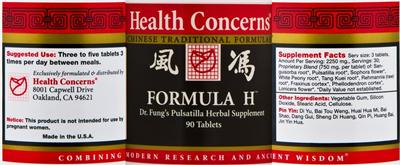
Other ingredients: Vegetable Gum, Silicon Dioxide, Stearic Acid, Cellulose
Tap any ingredient to jump to its full detail below.
These statements are the manufacturer’s wording, reproduced from the product label — the label is saying it, not HelloPharmacist. We don’t verify or endorse them.
General Statements
Made in the U.S.A.
Pin Yin: Di Yu, Bai Tou Weng, Huai Hua Mi, Bai Shao, Dang Gui, Sheng Di Huang, Qin Pi, Huang Bai, Jin Yin Hua.
FDA Statement of Identity
Dr. Fung's Pulsatilla Herbal Supplement
Suggested/Recommended/Usage/Directions
Suggested Use: Three to five tablets 3 times per day between meals.
Precautions
Notice: This product is not intended for use by pregnant women.
Brand IP Statement(s)
CHINESE TRADITIONAL FORMULAS(TM)
COMBINING MODERN RESEARCH AND ANCIENT WISDOM(R)
Is this label outdated? Report a formula or label change and our pharmacy team will review it.
Formula H by Health Concerns label
The label scan from the NIH Dietary Supplement Label Database. Tap to enlarge.
Label images are published by the NIH Dietary Supplement Label Database for the version of this product on file. Always read your actual product label.
View the full label (PDF)The Ingredients in Formula H by Health Concerns
These are the 9 active ingredients this product is made of. Select any to open its full monograph.
Serving size3 Tablet(s) Dosage formTablet Or Pill Servings per container30 Amounts shown are per serving.
Most supplement products combine several ingredients, and a medication can interact with the product through any one of them. Each ingredient below shows whether it has known drug interactions.
Proprietary Blend (Herb/Botanical)
- › Tang Kuei
- › White Peony
- › Lonicera
- › Pulsatilla
- › Sophora
- › Rehmannia
- › Phellodendron
- › Sanguisorba
- › Fraxinus
Other (inactive) ingredients: Vegetable Gum, Silicon Dioxide, Stearic Acid, Cellulose. These complete the product’s ingredient list but are not active constituents.
Formula H by Health Concerns Drug Interactions
HelloPharmacist Interaction Report
Formula H by Health Concerns contains nine ingredients, several of which interact with medications.
The most serious interaction is with warfarin (a blood thinner). Dong Quai, one of the active ingredients, may increase warfarin's anticoagulant effects and raise your bleeding risk — case reports show this can happen within weeks of starting the supplement.
Read the full breakdown — every affected drug type, severity by severity
Several ingredients in this formula may affect how your liver processes medications. Peony and phellodendron can theoretically increase levels of drugs broken down by CYP1A2, CYP3A4, and CYP2D6 enzymes — including clozapine and other psychiatric or heart medications.
Phellodendron may also raise blood pressure medication effects, lower blood sugar too much when combined with diabetes drugs, and increase metformin's side effects.
Dong Quai, peony, honeysuckle, and phellodendron all may increase bleeding risk with blood thinners and antiplatelet drugs beyond warfarin. Rehmannia may lower blood pressure too far or cause low blood sugar (hypoglycemia) with diabetes medications.
Rehmannia and ash seed (fraxinus) can theoretically lower blood pressure or blood sugar when combined with their respective medications. One ingredient, sanguisorba, we could not check.
Altogether, these interactions span 1,189 individual medications. Use the medication checker below to verify your exact prescriptions before starting.
Check your own medications below · Editorial policy · How we use AI
Want to check YOUR meds against Formula H?
Ask about interactions with your drugs in plain English — “Can I take it with lisinopril?” — and we find you the answer in seconds, ingredient by ingredient.
Go to the checkerIngredients driving the most interactions
Individual Drug Interactions
The ingredients in Formula H interact with 1,203 drugs. Click any drug to see the details.
7 of the 9 ingredients in Formula H interact with drugs. Each result below shows which ingredient is responsible. Phellodendron White Peony Rehmannia Fraxinus Tang Kuei Lonicera Sophora
WarfarinWarfarin
How Warfarin interacts with Formula H — through 4 ingredients. Tap an ingredient for the detail:
Tang KueiAnticoagulant/antiplatelet Drugs, Warfarin (coumadin) Major
Interaction Summary
Theoretically, dong quai may increase the risk of bleeding when used with anticoagulant or antiplatelet drugs; however, research is conflicting.
Read the full Tang Kuei + Warfarin interactionWhite PeonyCytochrome P450 3a4 (cyp3a4) Substrates, Anticoagulant/antiplatelet Drugs +1 Moderate
Interaction Summary
Theoretically, use of peony may increase the levels and clinical effects of drugs metabolized by CYP3A4.
Read the full White Peony + Warfarin interactionLoniceraAnticoagulant/antiplatelet Drugs Moderate
Interaction Summary
Theoretically, honeysuckle might increase the risk of bleeding when taken with anticoagulant or antiplatelet drugs.
Read the full Lonicera + Warfarin interactionPhellodendronAnticoagulant/antiplatelet Drugs, Cytochrome P450 2c9 (cyp2c9) Substrates +1 Moderate
Interaction Summary
Theoretically, phellodendron might increase the risk of bleeding when used with anticoagulant or antiplatelet drugs.
Read the full Phellodendron + Warfarin interactionWarfarin SodiumCoumadin, Panwarfin, Sofarin
How Warfarin Sodium interacts with Formula H — through 4 ingredients. Tap an ingredient for the detail:
Tang KueiWarfarin (coumadin), Anticoagulant/antiplatelet Drugs Major
Interaction Summary
Dong quai may increase the risk of bleeding when used with warfarin.
Read the full Tang Kuei + Warfarin Sodium interactionPhellodendronCytochrome P450 3a4 (cyp3a4) Substrates, Cytochrome P450 2c9 (cyp2c9) Substrates +1 Moderate
Interaction Summary
Theoretically, phellodendron might increase serum levels of drugs metabolized by CYP3A4.
Read the full Phellodendron + Warfarin Sodium interactionWhite PeonyCytochrome P450 1a2 (cyp1a2) Substrates, Cytochrome P450 3a4 (cyp3a4) Substrates +1 Moderate
Interaction Summary
Theoretically, use of peony may increase the levels and clinical effects of drugs metabolized by CYP1A2.
Read the full White Peony + Warfarin Sodium interactionLoniceraAnticoagulant/antiplatelet Drugs Moderate
Interaction Summary
Theoretically, honeysuckle might increase the risk of bleeding when taken with anticoagulant or antiplatelet drugs.
Read the full Lonicera + Warfarin Sodium interactionAdo-trastuzumab EmtansineKadcyla
How Ado-trastuzumab Emtansine interacts with Formula H — through 2 ingredients. Tap an ingredient for the detail:
White PeonyCytochrome P450 3a4 (cyp3a4) Substrates Moderate
Interaction Summary
Theoretically, use of peony may increase the levels and clinical effects of drugs metabolized by CYP3A4.
Read the full White Peony + Ado-trastuzumab Emtansine interactionPhellodendronCytochrome P450 3a4 (cyp3a4) Substrates Moderate
Interaction Summary
Theoretically, phellodendron might increase serum levels of drugs metabolized by CYP3A4.
Read the full Phellodendron + Ado-trastuzumab Emtansine interactionAbciximabReoPro
How Abciximab interacts with Formula H — through 4 ingredients. Tap an ingredient for the detail:
PhellodendronAnticoagulant/antiplatelet Drugs Moderate
Interaction Summary
Theoretically, phellodendron might increase the risk of bleeding when used with anticoagulant or antiplatelet drugs.
Read the full Phellodendron + Abciximab interactionLoniceraAnticoagulant/antiplatelet Drugs Moderate
Interaction Summary
Theoretically, honeysuckle might increase the risk of bleeding when taken with anticoagulant or antiplatelet drugs.
Read the full Lonicera + Abciximab interactionTang KueiAnticoagulant/antiplatelet Drugs Moderate
Interaction Summary
Theoretically, dong quai may increase the risk of bleeding when used with anticoagulant or antiplatelet drugs; however, research is conflicting.
Read the full Tang Kuei + Abciximab interactionWhite PeonyAnticoagulant/antiplatelet Drugs Moderate
Interaction Summary
Theoretically, combining peony with anticoagulant or antiplatelet drugs might increase the risk of bleeding.
Read the full White Peony + Abciximab interactionAbemaciclibVerzenio
How Abemaciclib interacts with Formula H — through 2 ingredients. Tap an ingredient for the detail:
White PeonyCytochrome P450 3a4 (cyp3a4) Substrates Moderate
Interaction Summary
Theoretically, use of peony may increase the levels and clinical effects of drugs metabolized by CYP3A4.
Read the full White Peony + Abemaciclib interactionPhellodendronCytochrome P450 3a4 (cyp3a4) Substrates Moderate
Interaction Summary
Theoretically, phellodendron might increase serum levels of drugs metabolized by CYP3A4.
Read the full Phellodendron + Abemaciclib interactionAbiraterone
How Abiraterone interacts with Formula H — through 2 ingredients. Tap an ingredient for the detail:
PhellodendronCytochrome P450 3a4 (cyp3a4) Substrates Moderate
Interaction Summary
Theoretically, phellodendron might increase serum levels of drugs metabolized by CYP3A4.
Read the full Phellodendron + Abiraterone interactionWhite PeonyCytochrome P450 3a4 (cyp3a4) Substrates Moderate
Interaction Summary
Theoretically, use of peony may increase the levels and clinical effects of drugs metabolized by CYP3A4.
Read the full White Peony + Abiraterone interactionAbiraterone AcetateYonsa, Zytiga
How Abiraterone Acetate interacts with Formula H — through 2 ingredients. Tap an ingredient for the detail:
White PeonyCytochrome P450 3a4 (cyp3a4) Substrates Moderate
Interaction Summary
Theoretically, use of peony may increase the levels and clinical effects of drugs metabolized by CYP3A4.
Read the full White Peony + Abiraterone Acetate interactionPhellodendronCytochrome P450 3a4 (cyp3a4) Substrates Moderate
Interaction Summary
Theoretically, phellodendron might increase serum levels of drugs metabolized by CYP3A4.
Read the full Phellodendron + Abiraterone Acetate interactionAbrocitinibCibinqo
How Abrocitinib interacts with Formula H — through 4 ingredients. Tap an ingredient for the detail:
Tang KueiAnticoagulant/antiplatelet Drugs Moderate
Interaction Summary
Theoretically, dong quai may increase the risk of bleeding when used with anticoagulant or antiplatelet drugs; however, research is conflicting.
Read the full Tang Kuei + Abrocitinib interactionPhellodendronAnticoagulant/antiplatelet Drugs, Cytochrome P450 2c9 (cyp2c9) Substrates Moderate
Interaction Summary
Theoretically, phellodendron might increase the risk of bleeding when used with anticoagulant or antiplatelet drugs.
Read the full Phellodendron + Abrocitinib interactionWhite PeonyAnticoagulant/antiplatelet Drugs Moderate
Interaction Summary
Theoretically, combining peony with anticoagulant or antiplatelet drugs might increase the risk of bleeding.
Read the full White Peony + Abrocitinib interactionLoniceraAnticoagulant/antiplatelet Drugs Moderate
Interaction Summary
Theoretically, honeysuckle might increase the risk of bleeding when taken with anticoagulant or antiplatelet drugs.
Read the full Lonicera + Abrocitinib interactionAcalabrutinibCalquence
How Acalabrutinib interacts with Formula H — through 2 ingredients. Tap an ingredient for the detail:
White PeonyCytochrome P450 3a4 (cyp3a4) Substrates Moderate
Interaction Summary
Theoretically, use of peony may increase the levels and clinical effects of drugs metabolized by CYP3A4.
Read the full White Peony + Acalabrutinib interactionPhellodendronCytochrome P450 3a4 (cyp3a4) Substrates Moderate
Interaction Summary
Theoretically, phellodendron might increase serum levels of drugs metabolized by CYP3A4.
Read the full Phellodendron + Acalabrutinib interactionAcarboseGlucobay, Prandase, Precose
How Acarbose interacts with Formula H — through 3 ingredients. Tap an ingredient for the detail:
RehmanniaAntidiabetes Drugs Moderate
Interaction Summary
Theoretically, rehmannia might increase the risk of hypoglycemia when taken with antidiabetes drugs.
Read the full Rehmannia + Acarbose interactionPhellodendronAntidiabetes Drugs Moderate
Interaction Summary
Theoretically, phellodendron may increase the risk of hypoglycemia when taken with antidiabetes drugs.
Read the full Phellodendron + Acarbose interactionFraxinusAntidiabetes Drugs Moderate
Interaction Summary
Theoretically, concomitant use with antidiabetes drugs might affect glucose control and increase the risk of hypoglycemia.
Read the full Fraxinus + Acarbose interactionAcebutololRhotral, Sectral
How Acebutolol interacts with Formula H — through 3 ingredients. Tap an ingredient for the detail:
FraxinusAntihypertensive Drugs Moderate
Interaction Summary
Theoretically, concomitant use of ash seed with antihypertensive drugs might have additive blood pressure lowering effects.
Read the full Fraxinus + Acebutolol interactionPhellodendronAntihypertensive Drugs Moderate
Interaction Summary
Theoretically, phellodendron might have additive effects with antihypertensive drugs.
Read the full Phellodendron + Acebutolol interactionRehmanniaAntihypertensive Drugs Moderate
Interaction Summary
Theoretically, rehmannia might increase the risk of hypotension when taken with antihypertensive drugs.
Read the full Rehmannia + Acebutolol interactionAcenocoumarolSintrom
How Acenocoumarol interacts with Formula H — through 4 ingredients. Tap an ingredient for the detail:
PhellodendronAnticoagulant/antiplatelet Drugs Moderate
Interaction Summary
Theoretically, phellodendron might increase the risk of bleeding when used with anticoagulant or antiplatelet drugs.
Read the full Phellodendron + Acenocoumarol interactionWhite PeonyAnticoagulant/antiplatelet Drugs Moderate
Interaction Summary
Theoretically, combining peony with anticoagulant or antiplatelet drugs might increase the risk of bleeding.
Read the full White Peony + Acenocoumarol interactionLoniceraAnticoagulant/antiplatelet Drugs Moderate
Interaction Summary
Theoretically, honeysuckle might increase the risk of bleeding when taken with anticoagulant or antiplatelet drugs.
Read the full Lonicera + Acenocoumarol interactionTang KueiAnticoagulant/antiplatelet Drugs Moderate
Interaction Summary
Theoretically, dong quai may increase the risk of bleeding when used with anticoagulant or antiplatelet drugs; however, research is conflicting.
Read the full Tang Kuei + Acenocoumarol interactionAcepromazineAtravet
How Acepromazine interacts with Formula H — through 1 ingredient. Tap an ingredient for the detail:
PhellodendronCns Depressants Moderate
Interaction Summary
Theoretically, phellodendron might increase the sedative effects of CNS depressants.
Read the full Phellodendron + Acepromazine interactionAcetaminophenChildren's Tylenol, Children's Tylenol Meltaways, Tylenol, Tylenol Ex Strength
How Acetaminophen interacts with Formula H — through 1 ingredient. Tap an ingredient for the detail:
White PeonyCytochrome P450 1a2 (cyp1a2) Substrates Moderate
Interaction Summary
Theoretically, use of peony may increase the levels and clinical effects of drugs metabolized by CYP1A2.
Read the full White Peony + Acetaminophen interactionAcetaminophen, AspirinGemnisyn
How Acetaminophen, Aspirin interacts with Formula H — through 4 ingredients. Tap an ingredient for the detail:
White PeonyCytochrome P450 1a2 (cyp1a2) Substrates, Anticoagulant/antiplatelet Drugs Moderate
Interaction Summary
Theoretically, use of peony may increase the levels and clinical effects of drugs metabolized by CYP1A2.
Read the full White Peony + Acetaminophen, Aspirin interactionTang KueiAnticoagulant/antiplatelet Drugs Moderate
Interaction Summary
Theoretically, dong quai may increase the risk of bleeding when used with anticoagulant or antiplatelet drugs; however, research is conflicting.
Read the full Tang Kuei + Acetaminophen, Aspirin interactionLoniceraAnticoagulant/antiplatelet Drugs Moderate
Interaction Summary
Theoretically, honeysuckle might increase the risk of bleeding when taken with anticoagulant or antiplatelet drugs.
Read the full Lonicera + Acetaminophen, Aspirin interactionPhellodendronAnticoagulant/antiplatelet Drugs Moderate
Interaction Summary
Theoretically, phellodendron might increase the risk of bleeding when used with anticoagulant or antiplatelet drugs.
Read the full Phellodendron + Acetaminophen, Aspirin interactionAcetaminophen, Aspirin, CaffeineExcedrin, Excedrin Extra Strength, Excedrin Migraine
How Acetaminophen, Aspirin, Caffeine interacts with Formula H — through 5 ingredients. Tap an ingredient for the detail:
PhellodendronAnticoagulant/antiplatelet Drugs, Cytochrome P450 3a4 (cyp3a4) Substrates Moderate
Interaction Summary
Theoretically, phellodendron might increase the risk of bleeding when used with anticoagulant or antiplatelet drugs.
Read the full Phellodendron + Acetaminophen, Aspirin, Caffeine interactionLoniceraAnticoagulant/antiplatelet Drugs Moderate
Interaction Summary
Theoretically, honeysuckle might increase the risk of bleeding when taken with anticoagulant or antiplatelet drugs.
Read the full Lonicera + Acetaminophen, Aspirin, Caffeine interactionTang KueiAnticoagulant/antiplatelet Drugs Moderate
Interaction Summary
Theoretically, dong quai may increase the risk of bleeding when used with anticoagulant or antiplatelet drugs; however, research is conflicting.
Read the full Tang Kuei + Acetaminophen, Aspirin, Caffeine interactionWhite PeonyCytochrome P450 3a4 (cyp3a4) Substrates, Cytochrome P450 1a2 (cyp1a2) Substrates +1 Moderate
Interaction Summary
Theoretically, use of peony may increase the levels and clinical effects of drugs metabolized by CYP3A4.
Read the full White Peony + Acetaminophen, Aspirin, Caffeine interactionSophoraCaffeine Moderate
Interaction Summary
Theoretically, pagoda tree might reduce the clearance of caffeine.
Read the full Sophora + Acetaminophen, Aspirin, Caffeine interactionAcetaminophen, Brompheniramine, PhenylpropanolamineDimetapp Cold and Flu
How Acetaminophen, Brompheniramine, Phenylpropanolamine interacts with Formula H — through 1 ingredient. Tap an ingredient for the detail:
White PeonyCytochrome P450 1a2 (cyp1a2) Substrates Moderate
Interaction Summary
Theoretically, use of peony may increase the levels and clinical effects of drugs metabolized by CYP1A2.
Read the full White Peony + Acetaminophen, Brompheniramine, Phenylpropanolamine interactionAcetaminophen, ButalbitalAxocet, Bancap, Bucet, Butex Forte, Esgic CF, Orbivan CF +5 more
How Acetaminophen, Butalbital interacts with Formula H — through 1 ingredient. Tap an ingredient for the detail:
White PeonyCytochrome P450 1a2 (cyp1a2) Substrates Moderate
Interaction Summary
Theoretically, use of peony may increase the levels and clinical effects of drugs metabolized by CYP1A2.
Read the full White Peony + Acetaminophen, Butalbital interactionAcetaminophen, Butalbital, CaffeineEsgic, Esgic Plus, Fiogesic, Fioricet, Repan, Tecnal +1 more
How Acetaminophen, Butalbital, Caffeine interacts with Formula H — through 3 ingredients. Tap an ingredient for the detail:
White PeonyCytochrome P450 1a2 (cyp1a2) Substrates, Cytochrome P450 3a4 (cyp3a4) Substrates Moderate
Interaction Summary
Theoretically, use of peony may increase the levels and clinical effects of drugs metabolized by CYP1A2.
Read the full White Peony + Acetaminophen, Butalbital, Caffeine interactionSophoraCaffeine Moderate
Interaction Summary
Theoretically, pagoda tree might reduce the clearance of caffeine.
Read the full Sophora + Acetaminophen, Butalbital, Caffeine interactionPhellodendronCytochrome P450 3a4 (cyp3a4) Substrates Moderate
Interaction Summary
Theoretically, phellodendron might increase serum levels of drugs metabolized by CYP3A4.
Read the full Phellodendron + Acetaminophen, Butalbital, Caffeine interactionAcetaminophen, Butalbital, Caffeine, CodeineEsgic with Codeine, Fioricet w/ Codeine
How Acetaminophen, Butalbital, Caffeine, Codeine interacts with Formula H — through 3 ingredients. Tap an ingredient for the detail:
PhellodendronCytochrome P450 3a4 (cyp3a4) Substrates, Cns Depressants +1 Moderate
Interaction Summary
Theoretically, phellodendron might increase serum levels of drugs metabolized by CYP3A4.
Read the full Phellodendron + Acetaminophen, Butalbital, Caffeine, Codeine interactionSophoraCaffeine Moderate
Interaction Summary
Theoretically, pagoda tree might reduce the clearance of caffeine.
Read the full Sophora + Acetaminophen, Butalbital, Caffeine, Codeine interactionWhite PeonyCytochrome P450 1a2 (cyp1a2) Substrates, Cytochrome P450 3a4 (cyp3a4) Substrates Moderate
Interaction Summary
Theoretically, use of peony may increase the levels and clinical effects of drugs metabolized by CYP1A2.
Read the full White Peony + Acetaminophen, Butalbital, Caffeine, Codeine interactionAcetaminophen, Butalbital, CodeineBancap w/ Codeine
How Acetaminophen, Butalbital, Codeine interacts with Formula H — through 2 ingredients. Tap an ingredient for the detail:
White PeonyCytochrome P450 1a2 (cyp1a2) Substrates Moderate
Interaction Summary
Theoretically, use of peony may increase the levels and clinical effects of drugs metabolized by CYP1A2.
Read the full White Peony + Acetaminophen, Butalbital, Codeine interactionPhellodendronCytochrome P450 2d6 (cyp2d6) Substrates, Cns Depressants Moderate
Interaction Summary
Theoretically, phellodendron might increase serum levels of drugs metabolized by CYP2D6.
Read the full Phellodendron + Acetaminophen, Butalbital, Codeine interactionAcetaminophen, Butalbital, Codeine PhosphatePhrenilin #3
How Acetaminophen, Butalbital, Codeine Phosphate interacts with Formula H — through 2 ingredients. Tap an ingredient for the detail:
PhellodendronCns Depressants, Cytochrome P450 2d6 (cyp2d6) Substrates Moderate
Interaction Summary
Theoretically, phellodendron might increase the sedative effects of CNS depressants.
Read the full Phellodendron + Acetaminophen, Butalbital, Codeine Phosphate interactionWhite PeonyCytochrome P450 1a2 (cyp1a2) Substrates Moderate
Interaction Summary
Theoretically, use of peony may increase the levels and clinical effects of drugs metabolized by CYP1A2.
Read the full White Peony + Acetaminophen, Butalbital, Codeine Phosphate interactionAcetaminophen, Caffeine, Chlorpheniramine, Hydrocodone, PhenylephrineHycomine Compound
How Acetaminophen, Caffeine, Chlorpheniramine, Hydrocodone, Phenylephrine interacts with Formula H — through 3 ingredients. Tap an ingredient for the detail:
White PeonyCytochrome P450 1a2 (cyp1a2) Substrates, Cytochrome P450 3a4 (cyp3a4) Substrates Moderate
Interaction Summary
Theoretically, use of peony may increase the levels and clinical effects of drugs metabolized by CYP1A2.
Read the full White Peony + Acetaminophen, Caffeine, Chlorpheniramine, Hydrocodone, Phenylephrine interactionSophoraCaffeine Moderate
Interaction Summary
Theoretically, pagoda tree might reduce the clearance of caffeine.
Read the full Sophora + Acetaminophen, Caffeine, Chlorpheniramine, Hydrocodone, Phenylephrine interactionPhellodendronCytochrome P450 2d6 (cyp2d6) Substrates, Cns Depressants +1 Moderate
Interaction Summary
Theoretically, phellodendron might increase serum levels of drugs metabolized by CYP2D6.
Read the full Phellodendron + Acetaminophen, Caffeine, Chlorpheniramine, Hydrocodone, Phenylephrine interactionAcetaminophen, Caffeine, CodeineGesic C15, Gesic C30, Gesic C8, Lenoltec 1, Lenoltec 2, Lenoltec 3 +1 more
How Acetaminophen, Caffeine, Codeine interacts with Formula H — through 3 ingredients. Tap an ingredient for the detail:
PhellodendronCytochrome P450 3a4 (cyp3a4) Substrates, Cns Depressants +1 Moderate
Interaction Summary
Theoretically, phellodendron might increase serum levels of drugs metabolized by CYP3A4.
Read the full Phellodendron + Acetaminophen, Caffeine, Codeine interactionWhite PeonyCytochrome P450 3a4 (cyp3a4) Substrates, Cytochrome P450 1a2 (cyp1a2) Substrates Moderate
Interaction Summary
Theoretically, use of peony may increase the levels and clinical effects of drugs metabolized by CYP3A4.
Read the full White Peony + Acetaminophen, Caffeine, Codeine interactionSophoraCaffeine Moderate
Interaction Summary
Theoretically, pagoda tree might reduce the clearance of caffeine.
Read the full Sophora + Acetaminophen, Caffeine, Codeine interactionAcetaminophen, Caffeine, Codeine, SalicylamideCodalan No.1, Codalan No.2, Codalan No.3
How Acetaminophen, Caffeine, Codeine, Salicylamide interacts with Formula H — through 3 ingredients. Tap an ingredient for the detail:
SophoraCaffeine Moderate
Interaction Summary
Theoretically, pagoda tree might reduce the clearance of caffeine.
Read the full Sophora + Acetaminophen, Caffeine, Codeine, Salicylamide interactionWhite PeonyCytochrome P450 3a4 (cyp3a4) Substrates, Cytochrome P450 1a2 (cyp1a2) Substrates Moderate
Interaction Summary
Theoretically, use of peony may increase the levels and clinical effects of drugs metabolized by CYP3A4.
Read the full White Peony + Acetaminophen, Caffeine, Codeine, Salicylamide interactionPhellodendronCytochrome P450 2d6 (cyp2d6) Substrates, Cns Depressants +1 Moderate
Interaction Summary
Theoretically, phellodendron might increase serum levels of drugs metabolized by CYP2D6.
Read the full Phellodendron + Acetaminophen, Caffeine, Codeine, Salicylamide interactionAcetaminophen, Caffeine, DihydrocodeineDHC Plus, Panlor DC, Panlor SS
How Acetaminophen, Caffeine, Dihydrocodeine interacts with Formula H — through 3 ingredients. Tap an ingredient for the detail:
PhellodendronCytochrome P450 3a4 (cyp3a4) Substrates, Cns Depressants +1 Moderate
Interaction Summary
Theoretically, phellodendron might increase serum levels of drugs metabolized by CYP3A4.
Read the full Phellodendron + Acetaminophen, Caffeine, Dihydrocodeine interactionWhite PeonyCytochrome P450 1a2 (cyp1a2) Substrates, Cytochrome P450 3a4 (cyp3a4) Substrates Moderate
Interaction Summary
Theoretically, use of peony may increase the levels and clinical effects of drugs metabolized by CYP1A2.
Read the full White Peony + Acetaminophen, Caffeine, Dihydrocodeine interactionSophoraCaffeine Moderate
Interaction Summary
Theoretically, pagoda tree might reduce the clearance of caffeine.
Read the full Sophora + Acetaminophen, Caffeine, Dihydrocodeine interactionAcetaminophen, Caffeine, IsomethepteneMigralam
How Acetaminophen, Caffeine, Isometheptene interacts with Formula H — through 3 ingredients. Tap an ingredient for the detail:
White PeonyCytochrome P450 3a4 (cyp3a4) Substrates, Cytochrome P450 1a2 (cyp1a2) Substrates Moderate
Interaction Summary
Theoretically, use of peony may increase the levels and clinical effects of drugs metabolized by CYP3A4.
Read the full White Peony + Acetaminophen, Caffeine, Isometheptene interactionSophoraCaffeine Moderate
Interaction Summary
Theoretically, pagoda tree might reduce the clearance of caffeine.
Read the full Sophora + Acetaminophen, Caffeine, Isometheptene interactionPhellodendronCytochrome P450 3a4 (cyp3a4) Substrates Moderate
Interaction Summary
Theoretically, phellodendron might increase serum levels of drugs metabolized by CYP3A4.
Read the full Phellodendron + Acetaminophen, Caffeine, Isometheptene interactionAcetaminophen, Caffeine, PyrilamineMidol Max Strength Menstrual
How Acetaminophen, Caffeine, Pyrilamine interacts with Formula H — through 3 ingredients. Tap an ingredient for the detail:
PhellodendronCytochrome P450 3a4 (cyp3a4) Substrates Moderate
Interaction Summary
Theoretically, phellodendron might increase serum levels of drugs metabolized by CYP3A4.
Read the full Phellodendron + Acetaminophen, Caffeine, Pyrilamine interactionSophoraCaffeine Moderate
Interaction Summary
Theoretically, pagoda tree might reduce the clearance of caffeine.
Read the full Sophora + Acetaminophen, Caffeine, Pyrilamine interactionWhite PeonyCytochrome P450 3a4 (cyp3a4) Substrates, Cytochrome P450 1a2 (cyp1a2) Substrates Moderate
Interaction Summary
Theoretically, use of peony may increase the levels and clinical effects of drugs metabolized by CYP3A4.
Read the full White Peony + Acetaminophen, Caffeine, Pyrilamine interactionAcetaminophen, Chlorpheniramine Maleate, Dextromethorphan HbrVicks Formula 44M Cough, Cold & Flu Relief
How Acetaminophen, Chlorpheniramine Maleate, Dextromethorphan Hbr interacts with Formula H — through 2 ingredients. Tap an ingredient for the detail:
White PeonyCytochrome P450 1a2 (cyp1a2) Substrates, Cytochrome P450 3a4 (cyp3a4) Substrates Moderate
Interaction Summary
Theoretically, use of peony may increase the levels and clinical effects of drugs metabolized by CYP1A2.
Read the full White Peony + Acetaminophen, Chlorpheniramine Maleate, Dextromethorphan Hbr interactionPhellodendronDextromethorphan (robitussin Dm, Others), Cytochrome P450 3a4 (cyp3a4) Substrates +1 Moderate
Interaction Summary
Theoretically, phellodendron may increase serum levels of dextromethorphan.
Read the full Phellodendron + Acetaminophen, Chlorpheniramine Maleate, Dextromethorphan Hbr interactionAcetaminophen, Chlorpheniramine, Codeine, PhenylephrineColrex
How Acetaminophen, Chlorpheniramine, Codeine, Phenylephrine interacts with Formula H — through 2 ingredients. Tap an ingredient for the detail:
PhellodendronCytochrome P450 2d6 (cyp2d6) Substrates, Cytochrome P450 3a4 (cyp3a4) Substrates +1 Moderate
Interaction Summary
Theoretically, phellodendron might increase serum levels of drugs metabolized by CYP2D6.
Read the full Phellodendron + Acetaminophen, Chlorpheniramine, Codeine, Phenylephrine interactionWhite PeonyCytochrome P450 1a2 (cyp1a2) Substrates, Cytochrome P450 3a4 (cyp3a4) Substrates Moderate
Interaction Summary
Theoretically, use of peony may increase the levels and clinical effects of drugs metabolized by CYP1A2.
Read the full White Peony + Acetaminophen, Chlorpheniramine, Codeine, Phenylephrine interactionEach ingredient & the kinds of drugs it affects
For each ingredient in Formula H with known interactions, here are the types of medications they can affect. Open any type for the detail — or search your exact drug in the checker above.
Phellodendron
Anticoagulant/Antiplatelet Drugs
Theoretically, phellodendron might increase the risk of bleeding when used with anticoagulant or antiplatelet drugs.
Phellodendron contains berberine. In vitro and in vivo research suggest that berberine can inhibit platelet aggregation. Theoretically, phellodendron might also inhibit platelet aggregation.
Antidiabetes Drugs
Theoretically, phellodendron may increase the risk of hypoglycemia when taken with antidiabetes drugs.
Phellodendron contains berberine. Clinical research shows that berberine may lower blood glucose levels. Theoretically, phellodendron might also lower blood glucose levels.
Antihypertensive Drugs
Theoretically, phellodendron might have additive effects with antihypertensive drugs.
Phellodendron contains berberine. Animal research suggests that berberine can have hypotensive effects. Also, a clinical study suggests that taking berberine in combination with amlodipine can lower systolic and diastolic blood pressure when compared with amlodipine alone. Theoretically, phellodendron might also reduce blood pressure.
Cns Depressants
Theoretically, phellodendron might increase the sedative effects of CNS depressants.
Phellodendron contains berberine. Animal research suggests that berberine may have sedative effects. Theoretically, phellodendron might also have CNS depressants effects.
Cyclosporine (Neoral, Sandimmune)
Theoretically, phellodendron might increase blood levels of cyclosporine.
Phellodendron contains berberine. Preliminary clinical research shows that berberine can reduce metabolism of cyclosporine and increase serum levels, likely through inhibition of cytochrome P450 3A4 (CYP3A4), which metabolizes cyclosporine. Theoretically, phellodendron might also reduce the metabolism of cyclosporine.
Cytochrome P450 2C9 (Cyp2C9) Substrates
Theoretically, phellodendron might increase serum levels of drugs metabolized by CYP2C9.
Phellodendron contains berberine. Preliminary clinical research shows that berberine can inhibit CYP2C9. Theoretically, phellodendron might also inhibit CYP2C9.
Cytochrome P450 2D6 (Cyp2D6) Substrates
Theoretically, phellodendron might increase serum levels of drugs metabolized by CYP2D6.
Phellodendron contains berberine. In vitro research and preliminary clinical evidence show that berberine can inhibit CYP2D6. Theoretically, phellodendron might also inhibit CYP2D6.
Cytochrome P450 3A4 (Cyp3A4) Substrates
Theoretically, phellodendron might increase serum levels of drugs metabolized by CYP3A4.
Phellodendron contains berberine. In vitro research and preliminary clinical research show that berberine moderately inhibits CYP3A4. Theoretically, phellodendron might also inhibit CYP3A4.
Dextromethorphan (Robitussin Dm, Others)
Theoretically, phellodendron may increase serum levels of dextromethorphan.
Phellodendron contains berberine. Preliminary clinical research shows that berberine can inhibit cytochrome P450 2D6 (CYP2D6) activity and reduce the metabolism of dextromethorphan. Theoretically, phellodendron may also inhibit the metabolism of dextromethorphan.
Losartan (Cozaar)
Theoretically, phellodendron might reduce the therapeutic effects of losartan by decreasing its conversion to its active form.
Phellodendron contains berberine. Preliminary clinical research suggests that berberine can inhibit cytochrome P450 2C9 (CYP2C9) activity and reduce metabolism of losartan. Theoretically, phellodendron might also inhibit the metabolism of losartan.
Metformin (Glucophage)
Theoretically, phellodendron might increase the therapeutic and adverse effects of metformin.
Phellodendron contains berberine. In vitro and animal studies show that berberine can increase the systemic exposure and half-life of metformin, potentially increasing metformin's effects and side effects. This interaction seems to be most apparent when berberine is administered 2 hours prior to metformin. Taking berberine and metformin at the same time does not appear to increase systemic exposure to metformin. It is unclear if phellodendron might have this same effect.
Midazolam (Versed)
Theoretically, phellodendron might reduce metabolism of midazolam, which might increase the risk of severe adverse effects.
Phellodendron contains berberine. Preliminary clinical research shows that berberine can inhibit cytochrome P450 3A4 (CYP3A4) activity and reduce metabolism of midazolam. Theoretically, phellodendron might also inhibit the metabolism of midazolam.
Pentobarbital (Nembutal)
Theoretically, phellodendron might increase the sedative effect of pentobarbital.
Phellodendron contains berberine. Animal research shows that berberine can prolong pentobarbital-induced sleeping time. Theoretically, phellodendron might increase the sedative effects of pentobarbital.
Tacrolimus (Prograf)
Theoretically, phellodendron might increase blood levels of tacrolimus.
Phellodendron contains berberine. In a 16-year-old patient with idiopathic nephrotic syndrome who was being treated with tacrolimus 6.5 mg twice daily, intake of berberine 200 mg three times daily increased the blood concentration of tacrolimus from 8 to 22 ng/mL. Following a reduction of the tacrolimus dose to 3 mg daily, blood levels of tacrolimus decreased to 12 ng/mL. It is unclear if phellodendron might have this same effect.
White Peony
Anticoagulant/Antiplatelet Drugs
Theoretically, combining peony with anticoagulant or antiplatelet drugs might increase the risk of bleeding.
In vitro research suggests that peony might have antiplatelet, anticoagulant, and antithrombotic effects.
Clozapine (Clozaril)
Theoretically, peony might increase the levels and clinical effects of clozapine.
In vitro research shows that peony suppresses the metabolism of clozapine via weak-to-moderate inhibitory effects on cytochromes P450 (CYP) 1A2 and CYP3A4. This effect has not been reported in humans.
Contraceptive Drugs
Theoretically, peony might interfere with contraceptive drugs due to competition for estrogen receptors.
In vitro and animal research shows that peony extract has estrogenic activity. Concomitant use might also increase the risk for estrogen-related adverse effects.
Cytochrome P450 1A2 (Cyp1A2) Substrates
Theoretically, use of peony may increase the levels and clinical effects of drugs metabolized by CYP1A2.
In vitro research shows that peony suppresses the metabolism of clozapine via weak-to-moderate inhibitory effects on CYP1A2 and CYP3A4. This effect has not been reported in humans.
Cytochrome P450 3A4 (Cyp3A4) Substrates
Theoretically, use of peony may increase the levels and clinical effects of drugs metabolized by CYP3A4.
In vitro research shows that peony suppresses the metabolism of clozapine via weak-to-moderate inhibitory effects on CYP1A2 and CYP3A4. This effect has not been reported in humans.
Estrogens
Theoretically, concomitant use of large amounts of peony might interfere with hormone replacement therapy and/or increase the risk for estrogen-related adverse effects.
In vitro and animal research shows that peony extract has estrogenic activity. Theoretically, peony might compete for estrogen receptors and/or cause additive estrogenic effects.
Phenytoin (Dilantin)
Theoretically, peony might reduce the levels and clinical effects of phenytoin.
Animal research shows that taking peony root reduces levels of phenytoin. Some researchers suggest that peony root might affect cytochrome P450 (CYP) 2C9, which metabolizes phenytoin. However, preliminary research in humans shows that peony root does not alter levels of losartan (Cozaar), which is also metabolized by CYP2C9.
Rehmannia
Antidiabetes Drugs
Theoretically, rehmannia might increase the risk of hypoglycemia when taken with antidiabetes drugs.
Animal research shows that rehmannia may have hypoglycemic effects.
Antihypertensive Drugs
Theoretically, rehmannia might increase the risk of hypotension when taken with antihypertensive drugs.
Animal research shows that rehmannia may have hypotensive effects. Laboratory research shows that formulations of dried and processed rehmannia root inhibit angiotensin-converting enzyme (ACE).
Fraxinus
Antidiabetes Drugs
Theoretically, concomitant use with antidiabetes drugs might affect glucose control and increase the risk of hypoglycemia. Dose adjustments to diabetes medications might be necessary. Animal research shows that ash seed/fruit extract reduces fasting levels of glucose. Although clinical research in patients without diabetes shows that ash seed/fruit extract does not significantly affect blood glucose levels, insulin levels, or homeostatic model of insulin resistance (HOMA-IR), it may lower the incremental glucose area under the curve and decrease 2-hour blood glucose following an oral glucose tolerance test. Ash seed/fruit extract has not been evaluated in patients with diabetes. Until more is known, use cautiously in patients taking antidiabetes drugs.
Some antidiabetes drugs include glimepiride (Amaryl), glyburide (DiaBeta, Glynase PresTab, Micronase), insulin, metformin (Glucophage), pioglitazone (Actos), rosiglitazone (Avandia), and others.
Antihypertensive Drugs
Theoretically, concomitant use of ash seed with antihypertensive drugs might have additive blood pressure lowering effects. Animal research shows that ash seed extract can decrease blood pressure. This effect has not been evaluated in humans. Until more is known, use cautiously in patients taking antihypertensive drugs.
Some antihypertensive drugs include nifedipine (Adalat, Procardia), verapamil (Calan, Isoptin, Verelan), diltiazem (Cardizem), isradipine (DynaCirc), felodipine (Plendil), amlodipine (Norvasc), and others.
Tang Kuei
Warfarin (Coumadin)
Dong quai may increase the risk of bleeding when used with warfarin.
Case reports suggest that concomitant use of dong quai with warfarin can increase the anticoagulant effects of warfarin and increase the risk of bleeding. In one case, after 4 weeks of taking dong quai 565 mg once or twice daily, the international normalized ratio (INR) increased to 4.9. The INR normalized 4 weeks after discontinuation of dong quai.
Anticoagulant/Antiplatelet Drugs
Theoretically, dong quai may increase the risk of bleeding when used with anticoagulant or antiplatelet drugs; however, research is conflicting.
Animal studies suggest that dong quai has antithrombin activity and inhibits platelet aggregation due to its coumarin components. Additionally, some case reports in humans suggest that dong quai can increase the anticoagulant effects of warfarin. However, clinical research in healthy adults shows that taking 1 gram of dong quai root daily for 3 weeks does not significantly inhibit platelet aggregation or cause bleeding. Until more is known, use dong quai with caution in patients taking antiplatelet/anticoagulant drugs.
Estrogens
Theoretically, dong quai may reduce the effects of estrogens.
Dong quai has estrogenic effects. Theoretically, concomitant use of large amounts of dong quai might interfere with hormone replacement therapy due to competition for estrogen receptors.
Lonicera
Anticoagulant/Antiplatelet Drugs
Theoretically, honeysuckle might increase the risk of bleeding when taken with anticoagulant or antiplatelet drugs.
In vitro research shows that polyphenols extracted from honeysuckle can inhibit platelet aggregation.
Sophora
Caffeine
Theoretically, pagoda tree might reduce the clearance of caffeine.
Pagoda tree contains genistein. Taking genistein 1 gram daily for 14 days seems to inhibit caffeine clearance and metabolism in healthy females. This effect has been attributed to inhibition of the cytochrome P450 1A2 (CYP1A2) enzyme, which is involved in caffeine metabolism. It is unclear if this effect occurs with the lower amounts of genistein found in pagoda tree.
Brand information
Manufacturer and brand details for Formula H, from the product label.
Health Concerns
See all Health Concerns products- Name
- Health Concerns
- Street Address
- 8001 Capwell Drive
- City
- Oakland
- State
- CA
- ZipCode
- 94621
Formula H by Health Concerns: Common Questions
Does Formula H by Health Concerns interact with any medications?
How can one product interact with so many drugs?
Where does this information come from?
Can I take Formula H if I'm pregnant or breastfeeding?
What are the most common side effects?
Does this product actually work for what it's supposed to treat?
Will Dong Quai make me more sensitive to the sun?
Why does the product have so many interactions with medications?
Is pulsatilla in this product dangerous if it's fresh?
Written and reviewed by the HelloPharmacist editorial staff. Our editorial policy
Not sure if Formula H is safe with your meds?
Our pharmacists answer your medication & supplement questions — free.
Label information is sourced from the NIH Dietary Supplement Label Database and reflects the product version on file; always read your actual product label. This page is for education only and is not a substitute for professional medical advice. Confirm with your pharmacist or doctor before combining supplements and medications.
The Full Monographs Behind Formula H’s Ingredients
Every ingredient we hold a full HelloPharmacist monograph for — uses, evidence, safety, and the complete interaction list.
Dong Quai
Interacts with 163 drugsDong Quai is a traditional Chinese herb often called "female ginseng" and is mostly used for menstrual and menopausal complaints. High-quality scientific evidence that it works for these use...
Read the full Dong Quai monograph → Herb & supplement monographPeony
Interacts with 813 drugsPeony root is a traditional Chinese medicine herb often used for menstrual problems, cramps, and inflammation, frequently as part of combination formulas. Human evidence for most uses is lim...
Read the full Peony monograph → Herb & supplement monographHoneysuckle
Interacts with 122 drugsHoneysuckle, especially Japanese honeysuckle flower (Lonicera japonica), is a staple of traditional Chinese medicine used mainly for colds, sore throat, and inflammation. Modern human eviden...
Read the full Honeysuckle monograph → Herb & supplement monographPulsatilla
Pulsatilla is a flowering plant in the buttercup family that is most often used today in homeopathic (highly diluted) preparations. The fresh plant is toxic and irritating, so it must never...
Read the full Pulsatilla monograph → Herb & supplement monographPagoda Tree
Interacts with 29 drugsPagoda Tree (Styphnolobium japonicum, also called the Japanese pagoda tree) is a traditional Asian medicinal plant best known as a natural source of the flavonoid rutin. While it has a long...
Read the full Pagoda Tree monograph → Herb & supplement monographRehmannia
Interacts with 258 drugsRehmannia is a root used for centuries in Traditional Chinese Medicine, often to 'tonify' the kidneys and support energy or blood health. Human evidence for most modern uses is limited, so i...
Read the full Rehmannia monograph → Herb & supplement monographPhellodendron
Interacts with 1,162 drugsPhellodendron is a traditional Chinese medicine bark (Huang Bai) that contains berberine and other plant compounds with antimicrobial and anti-inflammatory activity in lab studies. Human evi...
Read the full Phellodendron monograph → Herb & supplement monographAsh
Interacts with 258 drugsAsh (Fraxinus excelsior and related species) is a tree whose leaves, bark, and seeds have a long history in folk medicine for arthritis, fever, and fluid retention. Solid human evidence is l...
Read the full Ash monograph →Sources & How We Checked
Formula H's label data comes from the NIH Dietary Supplement Label Database; the ingredient interaction data is from the Natural Medicines database, reviewed by our pharmacists.
- NIH Dietary Supplement Label Database (DSLD) — The official product label on file for this supplement.
- Natural Medicines (Therapeutic Research Center) — Evidence-graded clinical reference behind the ingredient interaction data.
Content is written and reviewed by licensed HelloPharmacist pharmacists. See our data sources and editorial standards for how this information is built and checked.
The 70 references behind this product’s interaction data
Every citation that drives the interaction findings for this product’s ingredients, from the evidence-graded Natural Medicines (TRC Healthcare) database. Open an ingredient to browse its citations — links open the study on PubMed or the publisher’s site.
Dong Quai 19 references
- Hirata JD, Swiersz LM, Zell B, et al. Does dong quai have estrogenic effects in postmenopausal women? A double-blind, placebo-controlled trial. Fertil Steril 1997;68:981-6. PubMed
- Page RL II, Lawrence JD. Potentiation of warfarin by dong quai. Pharmacotherapy 1999;19:870-6. PubMed
- Heck AM, DeWitt BA, Lukes AL. Potential interactions between alternative therapies and warfarin. Am J Health Syst Pharm 2000;57:1221-7. DOI
- Eagon PK, Elm MS, Hunter DS, et al. Medicinal herbs: modulation of estrogen action. Era of Hope Mtg, Dept Defense; Breast Cancer Res Prog, Atlanta, GA 2000;Jun 8-11.
- Dr. Duke's Phytochemical and Ethnobotanical Databases. Available at: http://www.ars-grin.gov/duke/.
- Amato P, Christophe S, Mellon PL. Estrogenic activity of herbs commonly used as remedies for menopausal symptoms. Menopause 2002;9:145-50. PubMed
- Shi M, Chang L, He G. [Stimulating action of Carthamus tinctorius L., Angelica sinensis (Oliv.) Diels and Leonurus sibiricus L. on the uterus]. Zhongguo Zhong Yao Za Zhi 1995;20:173-5, 192.
- Hoult JR, Paya M. Pharmacological and biochemical actions of simple coumarins: natural products with therapeutic potential. Gen Pharmacol 1996;27:713-22.. PubMed
- Cheong JL, Bucknall R. Retinal vein thrombosis associated with a herbal phytoestrogen preparation in a susceptible patient. Postgrad Med J 2005;81:266-7.. PubMed
- Chang CJ, Chiu JH, Tseng LM, et al. Modulation of HER2 expression by ferulic acid on human breast cancer MCF7 cells. Eur J Clin Invest 2006;36:588-96. PubMed
- Chuang CH, Doyle P, Wang JD, et al. Herbal medicines used during the first trimester and major congenital malformations: an analysis of data from a pregnancy cohort study. Drug Saf 2006;29:537-48. PubMed
- Lau CBS, Ho TCY, Chan TWL, Kim SCF. Use of dong quai (Angelica sinensis) to treat peri- and postmenopausal symptoms in women with breast cancer: is it appropriate? Menopause 2005;12:734-40.
- Ellis GR, Stephens MR. Untitled (photograph and a brief case report). BMJ 1999;319:650.
- Nambiar, S., Schwartz, R. H., and Constantino, A. Hypertension in mother and baby linked to ingestion of Chinese herbal medicine. West J Med 1999;171(3):152.
- Lee, S. K., Cho, H. K., Cho, S. H., Kim, S. S., Nahm, D. H., and Park, H. S. Occupational asthma and rhinitis caused by multiple herbal agents in a pharmacist. Ann.Allergy Asthma Immunol. 2001;86(4):469-474. PubMed
- Xu, J. and Li, G. [Observation on short-term effects of Angelica injection on chronic obstructive pulmonary disease patients with pulmonary hypertension]. Zhongguo Zhong Xi Yi Jie He Za Zhi 2000;20(3):187-189.
- Scott, G. N. and Elmer, G. W. Update on natural product--drug interactions. Am J Health Syst.Pharm 2-15-2002;59(4):339-347. PubMed
- Circosta, C., Pasquale, R. D., Palumbo, D. R., Samperi, S., and Occhiuto, F. Estrogenic activity of standardized extract of Angelica sinensis. Phytother.Res. 2006;20(8):665-669.
- Fung FY, Wong WH, Ang SK, et al. A randomized, double-blind, placebo- controlled study on the anti-haemostatic effects of Curcuma longa, Angelica sinensis and Panax ginseng. Phytomedicine. 2017;32:88-96. PubMed
Peony 15 references
- Chen LC, Chou MH, Lin MF, Yang LL. Effects of Paeoniae Radix, a traditional Chinese medicine, on the pharmacokinetics of phenytoin. J Clin Pharm Ther 2001;26:271-8. PubMed
- Guo TL, Zhou XW. [Clinical observations on the treatment of the gestational hypertension syndrome with Angelica and Paeonia powder]. Zhong Xi Yi Jie He Za Zhi 1986;6:714-6, 707.
- Xie HJ, Yasar U, Sandberg M, Rane A. Paeoniae Radix, a traditional Chinese medicine, and CYP2C9 activity. J Clin Pharm Ther 2002;27:229-30. . PubMed
- Harada M, Suzuki M, Ozaki Y. Effect of Japanese Angelica root and peony root on uterine contraction in the rabbit in situ. J Pharmacobiodyn 1984;7:304-11. PubMed
- Anon. Monograph. Peony (Paeonia spp). Alt Med Rev 2001;6:495-9.
- Bruynzeel DP. Contact Dermatitis Due to Paeonia (Peony). Contact Dermatitis 1989; 20:152-3..
- Bian, X., Xu, Y., Zhu, L., Gao, P., Liu, X., Liu, S., Qian, M., Gai, M., Yang, J., and Wu, Y. Prevention of maternal-fetal blood group incompatibility with traditional Chinese herbal medicine. Chin Med J (Engl.) 1998;111(7):585-587.
- Wong, A. L. and Chan, T. Y. Interaction between warfarin and the herbal product quilinggao. Ann Pharmacother 2003;37(6):836-838.
- Cai Y, Yuan Q, Xu K, et al. Assessment of the therapeutic effect of total glycosides of peony for juvenile idiopathic arthritis: a systematic review and meta-analysis. Evid Based Complement Alternat Med 2016;2016:8292486.
- Koo YK, Kim JM, Koo JY, et al. Platelet anti-aggregatory and blood anti-coagulant effects of compounds isolated from Paeonia lactiflora and Paeonia suffruticosa. Pharmazie 2010;65(8):624-8.
- Wang W, Tian DD, Zheng B, et al. Peony-glycyrrhiza decoction, an herbal preparation, inhibits clozapine metabolism via cytochrome P450s, but not flavin-containing monooxygenase in in vitro models. Drug Metab Dispos 2015;43(7):1147-53. PubMed
- Zhou Y, Jin L, Kong F, et al. Clinical and immunological consequences of total glucosides of paeony treatment in Sjögren's syndrome: A randomized controlled pilot trial. Int Immunopharmacol. 2016 Oct;39:314-319. doi: 10.1016/j.intimp.2016.08.006. PubMed
- Zhu Q, Qi X, Wu Y, Wang K. Clinical study of total glucosides of paeony for the treatment of diabetic kidney disease in patients with diabetes mellitus. Int Urol Nephrol. 2016 Nov;48(11):1873-1880. doi: 10.1007/s11255-016-1345-5. PubMed
- Xu Y, Li X, Chen T, et al. Radix Paeoniae Alba increases serum estrogen level and up-regulates estrogen receptor expression in uterus and vagina of immature/ovariectomized mice. Phytother Res. 2019;33(1):117-29. [RETRACTED].
- Liu X, Li X, Li X, et al. The efficacy and safety of total glucosides of peony in the treatment of primary Sjögren's syndrome: a multi-center, randomized, double-blinded, placebo-controlled clinical trial. Clin Rheumatol. 2019;38(3):657-64. Erratum i
Honeysuckle 3 references
- Chang WC, Hsu FL. Inhibition of platelet activation and endothelial cell injury by polyphenolic compounds isolated from Lonicera japonica Thunb. Prostaglandins Leukot Essent Fatty Acids 1992;45:307-12. PubMed
- Webster RM. Honeysuckle contact dermatitis. Cutis 1993;51:424.
- Zhou LF, Lu R. Compound-honeysuckle-induced drug eruption with special manifestations: A case report. World J Clin Cases 2022;10(22):8018-8024. PubMed
Pulsatilla 3 references
- Blumenthal M, ed. The Complete German Commission E Monographs: Therapeutic Guide to Herbal Medicines. Trans. S. Klein. Boston, MA: American Botanical Council, 1998.
- Newall CA, Anderson LA, Philpson JD. Herbal Medicine: A Guide for Healthcare Professionals. London, UK: The Pharmaceutical Press, 1996.
- Brinker F. Herb Contraindications and Drug Interactions. 2nd ed. Sandy, OR: Eclectic Medical Publications, 1998.
Pagoda Tree 2 references
- Gruenwald J, Brendler T, Jaenicke C. PDR for Herbal Medicines. 1st ed. Montvale, NJ: Medical Economics Company, Inc., 1998.
- Chen, Y., Xiao, C. Q., He, Y. J., Chen, B. L., Wang, G., Zhou, G., Zhang, W., Tan, Z. R., Cao, S., Wang, L. P., and Zhou, H. H. Genistein alters caffeine exposure in healthy female volunteers. Eur.J Clin.Pharmacol. 2011;67(4):347-353. PubMed
Rehmannia 3 references
- Zhang R, Zhou J, Jia Z, et al. Hypoglycemic effect of Rehmannia glutinosa oligosaccharide in hyperglycemic and alloxan-induced diabetic rats and its mechanism. J Ethnopharmacol 2004;90:39-43. PubMed
- Zhang RX, Li MX, Jia ZP. Rehmannia glutinosa: review of botany, chemistry and pharmacology. J Ethnopharmacol 2008;117(2):199-214. PubMed
- Chao CH, Hsu JL, Chen MF, et al. Anti-hypertensive effects of Radix Rehmanniae and its active ingredients. Nat Prod Res. 2020;34(11):1547-1552.
Phellodendron 22 references
- Chan E. Displacement of bilirubin from albumin by berberine. Biol Neonate 1993;63:201-8. PubMed
- Janbaz KH, Gilani AH. Studies on preventive and curative effects of berberine on chemical-induced hepatotoxicity in rodents. Fitoterapia 2000;71:25-33.. PubMed
- Wu X, Li Q, Xin H, Yu A, Zhong M. Effects of berberine on the blood concentration of cyclosporin A in renal transplanted recipients: clinical and pharmacokinetic study. Eur J Clin Pharmacol 2005;61:567-72. PubMed
- Garrison R, Chambliss WG. Effect of a proprietary Magnolia and Phellodendron extract on weight management: a pilot, double-blind, placebo-controlled clinical trial. Altern Ther Health Med 2006;12:50-4.
- Zhang Y, Li X, Zou D, et al. Treatment of type 2 diabetes and dyslipidemia with the natural plant alkaloid berberine. J Clin Endocrinol Metab 2008;93:2559-65. PubMed
- Budzinski JW, Foster BC, Vandenhoek S, Arnason JT. An in vitro evaluation of human cytochrome P450 3A4 inhibition by selected commercial herbal extracts and tinctures. Phytomedicine 2000;7:273-82. PubMed
- Chatterjee P, Franklin MR. Human cytochrome p450 inhibition and metabolic-intermediate complex formation by goldenseal extract and its methylenedioxyphenyl components. Drug Metab Dispos 2003;31:1391-7. PubMed
- Shanbhag, S. M., Kulkarni, H. J., and Gaitonde, B. B. Pharmacological actions of berberine on the central nervous system. Jpn.J Pharmacol 1970;20(4):482-487. PubMed
- Wu, J. F. and Liu, T. P. [Effects of berberine on platelet aggregation and plasma levels of TXB2 and 6-keto-PGF1 alpha in rats with reversible middle cerebral artery occlusion]. Yao Xue.Xue.Bao. 1995;30(2):98-102.
- Peng, W. H., Hsieh, M. T., and Wu, C. R. Effect of long-term administration of berberine on scopolamine-induced amnesia in rats. Jpn J Pharmacol 1997;74(3):261-266. DOI
- Sabir M and Bhide NK. Study of some pharmacological actions of berberine. Ind J Physiol & Pharmac 1971;15(3):111-132.
- Tripathi YB and Shukla SD. Berberis artistata inhibits PAF induced aggregation of rabbit platelets. Phytotherapy Research 1996;10:628-630.
- Yin, J., Xing, H., and Ye, J. Efficacy of berberine in patients with type 2 diabetes mellitus. Metabolism 2008;57(5):712-717. PubMed
- Zhang, H., Wei, J., Xue, R., Wu, J. D., Zhao, W., Wang, Z. Z., Wang, S. K., Zhou, Z. X., Song, D. Q., Wang, Y. M., Pan, H. N., Kong, W. J., and Jiang, J. D. Berberine lowers blood glucose in type 2 diabetes mellitus patients through increasing insulin re
- Guo, Y., Chen, Y., Tan, Z. R., Klaassen, C. D., and Zhou, H. H. Repeated administration of berberine inhibits cytochromes P450 in humans. Eur J Clin Pharmacol 2012;68(2):213-217. PubMed
- Wei, W., Zhao, H., Wang, A., Sui, M., Liang, K., Deng, H., Ma, Y., Zhang, Y., Zhang, H., and Guan, Y. A clinical study on the short-term effect of berberine in comparison to metformin on the metabolic characteristics of women with polycystic ovary syndro
- Hermann, R. and von, Richter O. Clinical evidence of herbal drugs as perpetrators of pharmacokinetic drug interactions. Planta Med 2012;78(13):1458-1477. PubMed
- Chun YT, Yip TT, Lau KL, and et al. A biochemical study on the hypotensive effect of berberine in rats. Gen Pharmac 1979;10:177-182. PubMed
- Hou Q, Han W, Fu X. Pharmacokinetic interaction between tacrolimus and berberine in a child with idiopathic nephrotic syndrome. Eur J Clin Pharmacol 2013;69(10):1861-2. PubMed
- Lan J, Zhao Y, Dong F, et al. Meta-analysis of the effect and safety of berberine in the treatment of type 2 diabetes mellitus, hyperlipemia and hypertension. J Ethnopharmacol. 2015;161:69-81. PubMed
- Kalman DS, Feldman S, Feldman R, et al. Effect of a proprietary magnolia and phellodendron extract on stress levels in healthy women: a pilot, double-blind, placebo-controlled clinical trial. Nutr J 2008;7:11.
- Lyu Y, Zhang Y, Yang M, et al. Pharmacokinetic interactions between metformin and berberine in rats: Role of oral administration sequences and microbiota. Life Sci. 2019;235:116818. PubMed
Ash 3 references
- Zulet MA, Navas-Carretero S, Lara y Sánchez D, et al. A Fraxinus excelsior L. seeds/fruits extract benefits glucose homeostasis and adiposity related markers in elderly overweight/obese subjects: a longitudinal, randomized, crossover, double-blind,
- Montó F, Arce C, Noguera MA, et al. Action of an extract from the seeds of Fraxinus excelsior L. on metabolic disorders in hypertensive and obese animal models. Food Funct. 2014;5(4):786-96. PubMed
- Visen P, Saraswat B, Visen A, et al. Acute effects of Fraxinus excelsior L. seed extract on postprandial glycemia and insulin secretion on healthy volunteers. J Ethnopharmacol. 2009;126(2):226-32. PubMed
Parts of this content are provided by the Therapeutic Research Center, LLC.
DISCLAIMER: Currently this does not check for drug-drug interactions. This is not an all-inclusive comprehensive list of potential interactions and is for informational purposes only. Not all interactions are known or well-reported in the scientific literature, and new interactions are continually being reported. Input is needed from a qualified healthcare provider including a pharmacist before starting any therapy. Application of clinical judgment is necessary.
© 2021 Therapeutic Research Center, LLC