
HB Pressure Tonic Ingredients & Drug Interactions
by Herbs Etc.
What is this page for?
First and foremost: checking HB Pressure Tonic against your medications. The heart of this page is the interaction checker and the full interaction report — how this product’s ingredients may interact with prescription and over-the-counter medicines you may be taking.
Around that, we add a pharmacist’s high-level view of the product as a whole — what’s inside, the evidence for its stated use, how transparent the label is, and what safety data exists — so you can see the full picture in one place. It’s educational information from our licensed clinical databases and the clinical staff at HelloPharmacist — not medical advice — and we don’t sell or endorse products. Our editorial policy
HB Pressure Tonic is a dietary supplement by Herbs Etc. with 10 active ingredients. Its ingredients are commonly taken for heart failure symptoms, high blood pressure, chest pain (angina).Based on those ingredients, 1,400 medications have a known interaction with it, the most serious rated major. The ingredients most likely to interact are Siberian Eleuthero root extract, Passionflower Herb Extract, Fresh, Dandelion Leaf Extract, Fresh. Use the checker below to test your specific medication, or read the full HelloPharmacist Interaction Report.
Check Your Meds Against HB Pressure Tonic by Herbs Etc.
Ask about any prescription or over-the-counter medication and we check it for interactions with HB Pressure Tonic by Herbs Etc. — and tell you which ingredient is responsible.
AI summaries are generated from our interaction database for education only — always confirm with your pharmacist. How we use AI
Ask the Pharmacist
A licensed pharmacist will answer your question by email — free, usually within 24 hours.
Got it — thank you!
A licensed pharmacist will answer within 24 hours. Keep an eye on your email (worth checking spam, just in case).
HelloPharmacist Scorecard of HB Pressure Tonic by Herbs Etc.
Our pharmacy team’s full take, with four database checks built into the cards below — a summary of what is known, not a grade of the product itself.
What’s inside
Low disclosure
HB Pressure Tonic contains 10 herbal ingredients. The main active components are two hawthorn extracts—hawthorn berry extract and hawthorn flower/leaf extract—along with yarrow flower top extract, Siberian eleuthero root extract, passionflower herb extract, linden flower extract, skullcap herb extract, prickly ash bark extract, European mistletoe leaf/twig extract, and dandelion leaf extract.
The liquid also contains alcohol, purified water, and glycerin as inactive ingredients.
Does it work?
Moderate evidence
The evidence we hold does not establish how well these ingredients work for the purposes you might use this product. Hawthorn's effectiveness for angina, anxiety, heart rhythm problems, atherosclerosis, cardiovascular disease, and cognitive function all carries a rating of insufficient reliable evidence.
Yarrow, linden, and skullcap similarly lack established evidence for their respective uses. Siberian eleuthero is rated possibly effective for genital herpes, and passionflower is rated possibly effective for insomnia and pre-procedural anxiety.
European mistletoe is rated possibly ineffective for melanoma and head and neck cancer. Dandelion lacks established evidence for joint pain, swelling, or pain relief.
If you're taking this to support heart health or manage a specific condition, talk with your pharmacist about what the current evidence shows.
How safe is it?
Well-documented data
The hawthorn extracts are generally well tolerated in studies, but because this product is meant for blood pressure support, anyone with a heart condition needs medical supervision while using it. Hawthorn rarely causes multiorgan allergic reactions with acute kidney failure, and in clinical trials of heart patients some experienced heart palpitations, irregular heartbeat, or circulation problems—though these are uncommon.
Siberian eleuthero is generally well tolerated short-term; the most common side effects are diarrhea, indigestion, headache, nausea, and hives, though nervousness and anxiety have been reported, especially at higher doses. Passionflower commonly causes drowsiness, dizziness, and confusion.
Skullcap can cause sedation and cognitive impairment at higher doses, and mild digestive upset in some users. Yarrow applied to skin can cause allergic skin reactions.
Dandelion is generally well tolerated but may cause diarrhea, heartburn, and stomach upset; people allergic to ragweed or related plants may react to it. Linden and European mistletoe are less well studied; European mistletoe is toxic if swallowed raw and should only be used under medical supervision.
Meds to double-check
Major interaction found
Before taking this product, double-check with your pharmacist if you take any of the following: nitrates or PDE-5 inhibitors (blood pressure medications, especially for erectile dysfunction)—Major concern; blood pressure drugs (beta-blockers, calcium channel blockers), blood thinners or antiplatelet drugs, digoxin, or blood sugar medications—Moderate concern; sedating drugs (sleeping pills, anti-anxiety medications); lithium; potassium-sparing diuretics; fluoroquinolone antibiotics; immunosuppressants; or drugs that are metabolized by your liver's CYP enzymes. If you are unsure whether your medication falls into any of these groups, ask your pharmacist to check the product against your complete medication list.
The bottom line
Scorecard at a glanceFormula with limited ingredient disclosure with some supporting evidence for its stated purpose. Major medication interactions have been identified, and safety information is well characterized.
This is a multi-ingredient herbal blend that interacts with many common medications, particularly heart drugs, blood thinners, and medications you take by mouth. If you have heart disease, take blood pressure medication, blood thinners, or digoxin, check your specific medications with the tool on this page before starting.
Most of these herbs are generally well tolerated short-term but lack strong evidence for their effectiveness. Talk to your pharmacist before using this product, especially if you're pregnant, breastfeeding, or have a diagnosed heart condition.
Educational only — not medical advice; always confirm with your pharmacist. Our editorial policy · How we use AI
Assessment coverage: 10 of 10 active ingredients matched to our full ingredient reviews (monographs). Based on the product label dated Mar 25, 2025.
This Scorecard evaluates available label information, ingredient evidence, and known medication-safety considerations. It does not independently verify product identity, purity, potency, contamination, or manufacturing quality. How these ratings are computed
General information
Key facts about HB Pressure Tonic, straight from the product label.
| Brand | Herbs Etc. |
|---|---|
| Barcode (UPC) | 765704115015 |
| Net contents | 1 Fluid Ounce(s); 30 Milliliter(s) |
| Market status | On market |
| Date entered into DSLD | Mar 25, 2025 |
| DSLD ID | 320835 |
| Product type | Botanical |
| Supplement form | Liquid |
| Dietary claims / uses | All Other, Structure/Function |
| Intended target group(s) | Vegan, Vegetarian, Adult (18 - 50 Years), Women (not pregnant or lactating), Gluten Free, Dairy Free |
Everything in this section is reproduced from the manufacturer’s own product label — it’s the label speaking, not HelloPharmacist. We show it so you can see exactly what the maker states; we don’t verify or endorse those statements.
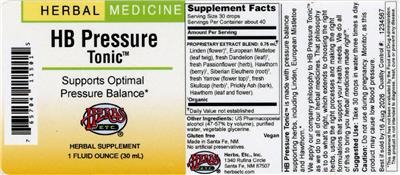
Supplement Facts
The label details for HB Pressure Tonic by Herbs Etc., sourced from the NIH Dietary Supplement Label Database.
Supplement Facts
| Ingredient | Amount | % DV |
|---|---|---|
| Hawthorn Berry Extract | 0 NP | -- |
| Proprietary Extract Blend | 0.75 mL | -- |
| Hawthorn Flower, Leaf Extract | 0 NP | -- |
| Yarrow Flower Top Extract, Fresh | 0 NP | -- |
| Siberian Eleuthero root extract | 0 NP | -- |
| Passionflower Herb Extract, Fresh | 0 NP | -- |
| Linden Flower Extract | 0 NP | -- |
| Skullcap Herb Extract, Fresh | 0 NP | -- |
| Prickly Ash Bark Extract | 0 NP | -- |
| European Mistletoe Leaf Twig Extract | 0 NP | -- |
| Dandelion Leaf Extract, Fresh | 0 NP | -- |
Other ingredients: Alcohol, Water, Purified, Glycerin
Tap any ingredient to jump to its full detail below.
These statements are the manufacturer’s wording, reproduced from the product label — the label is saying it, not HelloPharmacist. We don’t verify or endorse them.
Formulation
Herbal medicine Supports optimal pressure balance
Gluten free
Vegan
Made in Santa Fe, NM.
No artificial preservatives.
FDA Statement of Identity
Herbal Supplement
Formula
HB Pressure Tonic is made with pressure balance supporting herbs, including Linden, European Mistletoe and Hawthorn.
General Statements
We apply our company philosophy to HB Pressure Tonic, as we do to all of our herbal medicines. That philosophy is to do what's right, which extends to choosing the right herbs, using the right processes and making the right formulations that support your health needs. We do all of this to bring you herbal medicines made right.
Suggested/Recommended/Usage/Directions
Suggested use: Take 30 drops in water three times a day.
Precautions
Caution: Do no use during pregnancy.
Monitor, as this product may cause low blood pressure.
FDA Disclaimer Statement
This statement has not been evaluated by the Food and Drug Administration. This product is not intended to diagnose, treat, cure or prevent any disease.
Is this label outdated? Report a formula or label change and our pharmacy team will review it.
HB Pressure Tonic by Herbs Etc. label
The label scan from the NIH Dietary Supplement Label Database. Tap to enlarge.
Label images are published by the NIH Dietary Supplement Label Database for the version of this product on file. Always read your actual product label.
View the full label (PDF)The Ingredients in HB Pressure Tonic by Herbs Etc.
These are the 10 active ingredients this product is made of. Select any to open its full monograph.
Serving size30 Drop(s) Dosage formLiquid Servings per container40 Amounts shown are per serving.
Most supplement products combine several ingredients, and a medication can interact with the product through any one of them. Each ingredient below shows whether it has known drug interactions.
Proprietary Extract Blend
- › Hawthorn Berry Extract
- › Hawthorn Flower, Leaf Extract
- › Yarrow Flower Top Extract, Fresh
- › Siberian Eleuthero root extract
- › Passionflower Herb Extract, Fresh
- › Linden Flower Extract
- › Skullcap Herb Extract, Fresh
- › Prickly Ash Bark Extract
- › European Mistletoe Leaf Twig Extract
- › Dandelion Leaf Extract, Fresh
Other (inactive) ingredients: Alcohol, Water, Purified, Glycerin. These complete the product’s ingredient list but are not active constituents.
HB Pressure Tonic by Herbs Etc. Drug Interactions
HelloPharmacist Interaction Report
HB Pressure Tonic by Herbs Etc. contains multiple ingredients with documented interactions with medications, some serious.
The hawthorn extracts (both berry and flower/leaf) carry Major-severity interactions with nitrates and phosphodiesterase-5 inhibitors (PDE-5 inhibitors, used for erectile dysfunction). Hawthorn may cause additive blood vessel relaxation and dangerous drops in blood pressure when combined with these drugs.
Read the full breakdown — every affected drug type, severity by severity
The hawthorn in this product also interacts at Moderate severity with blood pressure medications (beta-blockers and calcium channel blockers), blood thinners and antiplatelet drugs, and digoxin (a heart medication). Siberian eleuthero interacts with multiple drug-metabolizing pathways (CYP1A2, CYP2C9, CYP2D6 substrates) and with P-glycoprotein substrates, immunosuppressants, blood sugar medications, and digoxin—all at Moderate severity.
Dandelion leaf interacts with potassium-sparing diuretics, blood sugar drugs, blood thinners, fluoroquinolone antibiotics, and lithium at Moderate severity. Passionflower and skullcap both interact with sedating drugs (CNS depressants) at Moderate severity.
Yarrow interacts with lithium (Moderate), linden with lithium (Moderate), and European mistletoe with blood pressure medications and immunosuppressants (both Moderate). Passionflower also has Minor interactions with certain drug-transport and enzyme systems.
Altogether, these interactions span 1,370 individual medications.
We could not check Prickly Ash Bark Extract for interactions. Use the medication checker on this page to verify your exact drugs before taking this product.
Check your own medications below · Editorial policy · How we use AI
Want to check YOUR meds against HB Pressure Tonic?
Ask about interactions with your drugs in plain English — “Can I take it with lisinopril?” — and we find you the answer in seconds, ingredient by ingredient.
Go to the checkerIngredients driving the most interactions
Individual Drug Interactions
The ingredients in HB Pressure Tonic interact with 1,400 drugs. Click any drug to see the details.
9 of the 10 ingredients in HB Pressure Tonic interact with drugs. Each result below shows which ingredient is responsible. Siberian Eleuthero root extract Passionflower Herb Extract, Fresh Dandelion Leaf Extract, Fresh European Mistletoe Leaf Twig Extract Skullcap Herb Extract, Fresh Hawthorn Berry Extract Prickly Ash Bark Extract Yarrow Flower Top Extract, Fresh Linden Flower Extract
AvanafilStendra
How Avanafil interacts with HB Pressure Tonic — through 3 ingredients. Tap an ingredient for the detail:
Hawthorn Flower, Leaf ExtractPhosphodiesterase-5 Inhibitors Major
Interaction Summary
Theoretically, concomitant use might result in additive vasodilation and hypotension.
Read the full Hawthorn Flower, Leaf Extract + Avanafil interactionPassionflower Herb Extract, FreshCytochrome P450 3a4 (cyp3a4) Substrates Minor
Interaction Summary
Theoretically, passion flower might decrease the effects of CYP3A4 substrates.
Read the full Passionflower Herb Extract, Fresh + Avanafil interactionSiberian Eleuthero Root ExtractCytochrome P450 3a4 (cyp3a4) Substrates Minor
Interaction Summary
Theoretically, eleuthero might increase levels of drugs metabolized by CYP3A4.
Read the full Siberian Eleuthero Root Extract + Avanafil interactionFinasteride, TadalafilEntadfi
How Finasteride, Tadalafil interacts with HB Pressure Tonic — through 3 ingredients. Tap an ingredient for the detail:
Hawthorn Flower, Leaf ExtractPhosphodiesterase-5 Inhibitors Major
Interaction Summary
Theoretically, concomitant use might result in additive vasodilation and hypotension.
Read the full Hawthorn Flower, Leaf Extract + Finasteride, Tadalafil interactionPassionflower Herb Extract, FreshCytochrome P450 3a4 (cyp3a4) Substrates Minor
Interaction Summary
Theoretically, passion flower might decrease the effects of CYP3A4 substrates.
Read the full Passionflower Herb Extract, Fresh + Finasteride, Tadalafil interactionSiberian Eleuthero Root ExtractCytochrome P450 3a4 (cyp3a4) Substrates Minor
Interaction Summary
Theoretically, eleuthero might increase levels of drugs metabolized by CYP3A4.
Read the full Siberian Eleuthero Root Extract + Finasteride, Tadalafil interactionGlyceryl TrinitrateNitronal
How Glyceryl Trinitrate interacts with HB Pressure Tonic — through 1 ingredient. Tap an ingredient for the detail:
Hawthorn Flower, Leaf ExtractNitrates Major
Interaction Summary
Theoretically, concomitant use might cause additive coronary vasodilatory effects.
Read the full Hawthorn Flower, Leaf Extract + Glyceryl Trinitrate interactionIsosorbide DinitrateAngitak, Cedocard Retard, Isoket, Isoket Retard, Isordil
How Isosorbide Dinitrate interacts with HB Pressure Tonic — through 1 ingredient. Tap an ingredient for the detail:
Hawthorn Flower, Leaf ExtractNitrates Major
Interaction Summary
Theoretically, concomitant use might cause additive coronary vasodilatory effects.
Read the full Hawthorn Flower, Leaf Extract + Isosorbide Dinitrate interactionIsosorbide Dinitrate, HydralazineBiDil
How Isosorbide Dinitrate, Hydralazine interacts with HB Pressure Tonic — through 2 ingredients. Tap an ingredient for the detail:
Hawthorn Flower, Leaf ExtractNitrates Major
Interaction Summary
Theoretically, concomitant use might cause additive coronary vasodilatory effects.
Read the full Hawthorn Flower, Leaf Extract + Isosorbide Dinitrate, Hydralazine interactionEuropean Mistletoe Leaf Twig ExtractAntihypertensive Drugs Moderate
Interaction Summary
Theoretically, European mistletoe might increase the risk of hypotension when taken with antihypertensive drugs.
Read the full European Mistletoe Leaf Twig Extract + Isosorbide Dinitrate, Hydralazine interactionIsosorbide MononitrateAngeze, Angeze SR, Chemydur 60XL, Dynamin, Elantan, Elantan LA +13 more
How Isosorbide Mononitrate interacts with HB Pressure Tonic — through 1 ingredient. Tap an ingredient for the detail:
Hawthorn Flower, Leaf ExtractNitrates Major
Interaction Summary
Theoretically, concomitant use might cause additive coronary vasodilatory effects.
Read the full Hawthorn Flower, Leaf Extract + Isosorbide Mononitrate interactionMacitentan, TadalafilOpsynvi
How Macitentan, Tadalafil interacts with HB Pressure Tonic — through 4 ingredients. Tap an ingredient for the detail:
Hawthorn Flower, Leaf ExtractPhosphodiesterase-5 Inhibitors Major
Interaction Summary
Theoretically, concomitant use might result in additive vasodilation and hypotension.
Read the full Hawthorn Flower, Leaf Extract + Macitentan, Tadalafil interactionSiberian Eleuthero Root ExtractCytochrome P450 2c9 (cyp2c9) Substrates, Cytochrome P450 3a4 (cyp3a4) Substrates Moderate
Interaction Summary
Theoretically, eleuthero might increase levels of drugs metabolized by CYP2C9.
Read the full Siberian Eleuthero Root Extract + Macitentan, Tadalafil interactionEuropean Mistletoe Leaf Twig ExtractAntihypertensive Drugs Moderate
Interaction Summary
Theoretically, European mistletoe might increase the risk of hypotension when taken with antihypertensive drugs.
Read the full European Mistletoe Leaf Twig Extract + Macitentan, Tadalafil interactionPassionflower Herb Extract, FreshCytochrome P450 3a4 (cyp3a4) Substrates Minor
Interaction Summary
Theoretically, passion flower might decrease the effects of CYP3A4 substrates.
Read the full Passionflower Herb Extract, Fresh + Macitentan, Tadalafil interactionNicorandilAprior, Dancor, Ikorel, Sigmart, Zynicor
How Nicorandil interacts with HB Pressure Tonic — through 1 ingredient. Tap an ingredient for the detail:
Hawthorn Flower, Leaf ExtractNitrates Major
Interaction Summary
Theoretically, concomitant use might cause additive coronary vasodilatory effects.
Read the full Hawthorn Flower, Leaf Extract + Nicorandil interactionNitroglycerinGonitro, Nitro Time, Nitro-Bid, Nitrocine Timecaps, Nitrogard, Nitrogard SR +7 more
How Nitroglycerin interacts with HB Pressure Tonic — through 1 ingredient. Tap an ingredient for the detail:
Hawthorn Flower, Leaf ExtractNitrates Major
Interaction Summary
Theoretically, concomitant use might cause additive coronary vasodilatory effects.
Read the full Hawthorn Flower, Leaf Extract + Nitroglycerin interactionPentaerythritol TetranitratePeritrate, Peritrate SA
How Pentaerythritol Tetranitrate interacts with HB Pressure Tonic — through 1 ingredient. Tap an ingredient for the detail:
Hawthorn Flower, Leaf ExtractNitrates Major
Interaction Summary
Theoretically, concomitant use might cause additive coronary vasodilatory effects.
Read the full Hawthorn Flower, Leaf Extract + Pentaerythritol Tetranitrate interactionSildenafilRevatio
How Sildenafil interacts with HB Pressure Tonic — through 3 ingredients. Tap an ingredient for the detail:
Hawthorn Flower, Leaf ExtractPhosphodiesterase-5 Inhibitors Major
Interaction Summary
Theoretically, concomitant use might result in additive vasodilation and hypotension.
Read the full Hawthorn Flower, Leaf Extract + Sildenafil interactionSiberian Eleuthero Root ExtractCytochrome P450 3a4 (cyp3a4) Substrates, Cytochrome P450 2c9 (cyp2c9) Substrates Moderate
Interaction Summary
Theoretically, eleuthero might increase levels of drugs metabolized by CYP3A4.
Read the full Siberian Eleuthero Root Extract + Sildenafil interactionPassionflower Herb Extract, FreshCytochrome P450 3a4 (cyp3a4) Substrates Minor
Interaction Summary
Theoretically, passion flower might decrease the effects of CYP3A4 substrates.
Read the full Passionflower Herb Extract, Fresh + Sildenafil interactionSildenafil CitrateViagra
How Sildenafil Citrate interacts with HB Pressure Tonic — through 3 ingredients. Tap an ingredient for the detail:
Hawthorn Flower, Leaf ExtractPhosphodiesterase-5 Inhibitors Major
Interaction Summary
Theoretically, concomitant use might result in additive vasodilation and hypotension.
Read the full Hawthorn Flower, Leaf Extract + Sildenafil Citrate interactionSiberian Eleuthero Root ExtractCytochrome P450 2c9 (cyp2c9) Substrates, Cytochrome P450 3a4 (cyp3a4) Substrates Moderate
Interaction Summary
Theoretically, eleuthero might increase levels of drugs metabolized by CYP2C9.
Read the full Siberian Eleuthero Root Extract + Sildenafil Citrate interactionPassionflower Herb Extract, FreshCytochrome P450 3a4 (cyp3a4) Substrates Minor
Interaction Summary
Theoretically, passion flower might decrease the effects of CYP3A4 substrates.
Read the full Passionflower Herb Extract, Fresh + Sildenafil Citrate interactionTadalafilCialis, Tadliq
How Tadalafil interacts with HB Pressure Tonic — through 3 ingredients. Tap an ingredient for the detail:
Hawthorn Flower, Leaf ExtractPhosphodiesterase-5 Inhibitors Major
Interaction Summary
Theoretically, concomitant use might result in additive vasodilation and hypotension.
Read the full Hawthorn Flower, Leaf Extract + Tadalafil interactionSiberian Eleuthero Root ExtractCytochrome P450 3a4 (cyp3a4) Substrates Minor
Interaction Summary
Theoretically, eleuthero might increase levels of drugs metabolized by CYP3A4.
Read the full Siberian Eleuthero Root Extract + Tadalafil interactionPassionflower Herb Extract, FreshCytochrome P450 3a4 (cyp3a4) Substrates Minor
Interaction Summary
Theoretically, passion flower might decrease the effects of CYP3A4 substrates.
Read the full Passionflower Herb Extract, Fresh + Tadalafil interactionVardenafilLevitra, Staxyn
How Vardenafil interacts with HB Pressure Tonic — through 3 ingredients. Tap an ingredient for the detail:
Hawthorn Flower, Leaf ExtractPhosphodiesterase-5 Inhibitors Major
Interaction Summary
Theoretically, concomitant use might result in additive vasodilation and hypotension.
Read the full Hawthorn Flower, Leaf Extract + Vardenafil interactionSiberian Eleuthero Root ExtractCytochrome P450 3a4 (cyp3a4) Substrates Minor
Interaction Summary
Theoretically, eleuthero might increase levels of drugs metabolized by CYP3A4.
Read the full Siberian Eleuthero Root Extract + Vardenafil interactionPassionflower Herb Extract, FreshCytochrome P450 3a4 (cyp3a4) Substrates Minor
Interaction Summary
Theoretically, passion flower might decrease the effects of CYP3A4 substrates.
Read the full Passionflower Herb Extract, Fresh + Vardenafil interaction6-mercaptopurinePurinethol
How 6-mercaptopurine interacts with HB Pressure Tonic — through 2 ingredients. Tap an ingredient for the detail:
Siberian Eleuthero Root ExtractImmunosuppressants Moderate
Interaction Summary
Theoretically, eleuthero might interfere with immunosuppressive drugs because of its immunostimulant activity.
Read the full Siberian Eleuthero Root Extract + 6-mercaptopurine interactionEuropean Mistletoe Leaf Twig ExtractImmunosuppressants Moderate
Interaction Summary
Theoretically, European mistletoe might decrease the effectiveness of immunosuppressants.
Read the full European Mistletoe Leaf Twig Extract + 6-mercaptopurine interactionAbciximabReoPro
How Abciximab interacts with HB Pressure Tonic — through 3 ingredients. Tap an ingredient for the detail:
Siberian Eleuthero Root ExtractAnticoagulant/antiplatelet Drugs Moderate
Interaction Summary
Theoretically, eleuthero may have antiplatelet effects and may increase the risk of bleeding if used with anticoagulant or antiplatelet drugs.
Read the full Siberian Eleuthero Root Extract + Abciximab interactionDandelion Leaf Extract, FreshAnticoagulant/antiplatelet Drugs Moderate
Interaction Summary
Theoretically, taking dandelion root along with anticoagulant or antiplatelet drugs might increase the risk of bruising and bleeding.
Read the full Dandelion Leaf Extract, Fresh + Abciximab interactionHawthorn Flower, Leaf ExtractAnticoagulant/antiplatelet Drugs Moderate
Interaction Summary
Theoretically, hawthorn may increase the risk of bleeding if used with anticoagulant or antiplatelet drugs.
Read the full Hawthorn Flower, Leaf Extract + Abciximab interactionAbrocitinibCibinqo
How Abrocitinib interacts with HB Pressure Tonic — through 4 ingredients. Tap an ingredient for the detail:
Siberian Eleuthero Root ExtractAnticoagulant/antiplatelet Drugs, Immunosuppressants +1 Moderate
Interaction Summary
Theoretically, eleuthero may have antiplatelet effects and may increase the risk of bleeding if used with anticoagulant or antiplatelet drugs.
Read the full Siberian Eleuthero Root Extract + Abrocitinib interactionHawthorn Flower, Leaf ExtractAnticoagulant/antiplatelet Drugs Moderate
Interaction Summary
Theoretically, hawthorn may increase the risk of bleeding if used with anticoagulant or antiplatelet drugs.
Read the full Hawthorn Flower, Leaf Extract + Abrocitinib interactionDandelion Leaf Extract, FreshAnticoagulant/antiplatelet Drugs Moderate
Interaction Summary
Theoretically, taking dandelion root along with anticoagulant or antiplatelet drugs might increase the risk of bruising and bleeding.
Read the full Dandelion Leaf Extract, Fresh + Abrocitinib interactionEuropean Mistletoe Leaf Twig ExtractImmunosuppressants Moderate
Interaction Summary
Theoretically, European mistletoe might decrease the effectiveness of immunosuppressants.
Read the full European Mistletoe Leaf Twig Extract + Abrocitinib interactionAcalabrutinibCalquence
How Acalabrutinib interacts with HB Pressure Tonic — through 2 ingredients. Tap an ingredient for the detail:
Siberian Eleuthero Root ExtractP-glycoprotein Substrates, Cytochrome P450 3a4 (cyp3a4) Substrates Moderate
Interaction Summary
Theoretically, eleuthero might increase levels of P-glycoprotein substrates.
Read the full Siberian Eleuthero Root Extract + Acalabrutinib interactionPassionflower Herb Extract, FreshCytochrome P450 3a4 (cyp3a4) Substrates Minor
Interaction Summary
Theoretically, passion flower might decrease the effects of CYP3A4 substrates.
Read the full Passionflower Herb Extract, Fresh + Acalabrutinib interactionAcarboseGlucobay, Prandase, Precose
How Acarbose interacts with HB Pressure Tonic — through 2 ingredients. Tap an ingredient for the detail:
Dandelion Leaf Extract, FreshAntidiabetes Drugs Moderate
Interaction Summary
Theoretically, dandelion might increase the risk for hypoglycemia when used with antidiabetes drugs.
Read the full Dandelion Leaf Extract, Fresh + Acarbose interactionSiberian Eleuthero Root ExtractAntidiabetes Drugs Moderate
Interaction Summary
Theoretically, eleuthero might have additive effects when used with antidiabetes drugs.
Read the full Siberian Eleuthero Root Extract + Acarbose interactionAcebutololRhotral, Sectral
How Acebutolol interacts with HB Pressure Tonic — through 2 ingredients. Tap an ingredient for the detail:
European Mistletoe Leaf Twig ExtractAntihypertensive Drugs Moderate
Interaction Summary
Theoretically, European mistletoe might increase the risk of hypotension when taken with antihypertensive drugs.
Read the full European Mistletoe Leaf Twig Extract + Acebutolol interactionHawthorn Flower, Leaf ExtractBeta-blockers Moderate
Interaction Summary
Theoretically, concomitant use might cause additive effects on blood pressure and heart rate.
Read the full Hawthorn Flower, Leaf Extract + Acebutolol interactionAcenocoumarolSintrom
How Acenocoumarol interacts with HB Pressure Tonic — through 3 ingredients. Tap an ingredient for the detail:
Hawthorn Flower, Leaf ExtractAnticoagulant/antiplatelet Drugs Moderate
Interaction Summary
Theoretically, hawthorn may increase the risk of bleeding if used with anticoagulant or antiplatelet drugs.
Read the full Hawthorn Flower, Leaf Extract + Acenocoumarol interactionDandelion Leaf Extract, FreshAnticoagulant/antiplatelet Drugs Moderate
Interaction Summary
Theoretically, taking dandelion root along with anticoagulant or antiplatelet drugs might increase the risk of bruising and bleeding.
Read the full Dandelion Leaf Extract, Fresh + Acenocoumarol interactionSiberian Eleuthero Root ExtractAnticoagulant/antiplatelet Drugs Moderate
Interaction Summary
Theoretically, eleuthero may have antiplatelet effects and may increase the risk of bleeding if used with anticoagulant or antiplatelet drugs.
Read the full Siberian Eleuthero Root Extract + Acenocoumarol interactionAcepromazineAtravet
How Acepromazine interacts with HB Pressure Tonic — through 2 ingredients. Tap an ingredient for the detail:
Skullcap Herb Extract, FreshCns Depressants Moderate
Interaction Summary
Theoretically, skullcap can have additive effects when used with other CNS depressants.
Read the full Skullcap Herb Extract, Fresh + Acepromazine interactionPassionflower Herb Extract, FreshCns Depressants Moderate
Interaction Summary
Concomitant use of passion flower with sedative drugs might cause additive effects and side effects.
Read the full Passionflower Herb Extract, Fresh + Acepromazine interactionAcetaminophenChildren's Tylenol, Children's Tylenol Meltaways, Tylenol, Tylenol Ex Strength
How Acetaminophen interacts with HB Pressure Tonic — through 2 ingredients. Tap an ingredient for the detail:
Dandelion Leaf Extract, FreshGlucuronidated Drugs, Cytochrome P450 1a2 (cyp1a2) Substrates Moderate
Interaction Summary
Theoretically, dandelion might increase the clearance of drugs that are UDP-glucuronosyltransferase substrates.
Read the full Dandelion Leaf Extract, Fresh + Acetaminophen interactionSiberian Eleuthero Root ExtractCytochrome P450 1a2 (cyp1a2) Substrates Moderate
Interaction Summary
Theoretically, eleuthero might increase levels of drugs metabolized by CYP1A2.
Read the full Siberian Eleuthero Root Extract + Acetaminophen interactionAcetaminophen, AspirinGemnisyn
How Acetaminophen, Aspirin interacts with HB Pressure Tonic — through 3 ingredients. Tap an ingredient for the detail:
Siberian Eleuthero Root ExtractCytochrome P450 1a2 (cyp1a2) Substrates, Anticoagulant/antiplatelet Drugs Moderate
Interaction Summary
Theoretically, eleuthero might increase levels of drugs metabolized by CYP1A2.
Read the full Siberian Eleuthero Root Extract + Acetaminophen, Aspirin interactionDandelion Leaf Extract, FreshCytochrome P450 1a2 (cyp1a2) Substrates, Anticoagulant/antiplatelet Drugs +1 Moderate
Interaction Summary
Theoretically, dandelion might increase levels of drugs metabolized by CYP1A2.
Read the full Dandelion Leaf Extract, Fresh + Acetaminophen, Aspirin interactionHawthorn Flower, Leaf ExtractAnticoagulant/antiplatelet Drugs Moderate
Interaction Summary
Theoretically, hawthorn may increase the risk of bleeding if used with anticoagulant or antiplatelet drugs.
Read the full Hawthorn Flower, Leaf Extract + Acetaminophen, Aspirin interactionAcetaminophen, Aspirin, CaffeineExcedrin, Excedrin Extra Strength, Excedrin Migraine
How Acetaminophen, Aspirin, Caffeine interacts with HB Pressure Tonic — through 4 ingredients. Tap an ingredient for the detail:
Hawthorn Flower, Leaf ExtractAnticoagulant/antiplatelet Drugs Moderate
Interaction Summary
Theoretically, hawthorn may increase the risk of bleeding if used with anticoagulant or antiplatelet drugs.
Read the full Hawthorn Flower, Leaf Extract + Acetaminophen, Aspirin, Caffeine interactionDandelion Leaf Extract, FreshGlucuronidated Drugs, Cytochrome P450 1a2 (cyp1a2) Substrates +1 Moderate
Interaction Summary
Theoretically, dandelion might increase the clearance of drugs that are UDP-glucuronosyltransferase substrates.
Read the full Dandelion Leaf Extract, Fresh + Acetaminophen, Aspirin, Caffeine interactionSiberian Eleuthero Root ExtractCytochrome P450 1a2 (cyp1a2) Substrates, Cytochrome P450 3a4 (cyp3a4) Substrates +1 Moderate
Interaction Summary
Theoretically, eleuthero might increase levels of drugs metabolized by CYP1A2.
Read the full Siberian Eleuthero Root Extract + Acetaminophen, Aspirin, Caffeine interactionPassionflower Herb Extract, FreshCytochrome P450 3a4 (cyp3a4) Substrates Minor
Interaction Summary
Theoretically, passion flower might decrease the effects of CYP3A4 substrates.
Read the full Passionflower Herb Extract, Fresh + Acetaminophen, Aspirin, Caffeine interactionAcetaminophen, Brompheniramine, PhenylpropanolamineDimetapp Cold and Flu
How Acetaminophen, Brompheniramine, Phenylpropanolamine interacts with HB Pressure Tonic — through 2 ingredients. Tap an ingredient for the detail:
Dandelion Leaf Extract, FreshCytochrome P450 1a2 (cyp1a2) Substrates, Glucuronidated Drugs Moderate
Interaction Summary
Theoretically, dandelion might increase levels of drugs metabolized by CYP1A2.
Read the full Dandelion Leaf Extract, Fresh + Acetaminophen, Brompheniramine, Phenylpropanolamine interactionSiberian Eleuthero Root ExtractCytochrome P450 1a2 (cyp1a2) Substrates Moderate
Interaction Summary
Theoretically, eleuthero might increase levels of drugs metabolized by CYP1A2.
Read the full Siberian Eleuthero Root Extract + Acetaminophen, Brompheniramine, Phenylpropanolamine interactionAcetaminophen, ButalbitalAxocet, Bancap, Bucet, Butex Forte, Esgic CF, Orbivan CF +5 more
How Acetaminophen, Butalbital interacts with HB Pressure Tonic — through 2 ingredients. Tap an ingredient for the detail:
Siberian Eleuthero Root ExtractCytochrome P450 1a2 (cyp1a2) Substrates Moderate
Interaction Summary
Theoretically, eleuthero might increase levels of drugs metabolized by CYP1A2.
Read the full Siberian Eleuthero Root Extract + Acetaminophen, Butalbital interactionDandelion Leaf Extract, FreshGlucuronidated Drugs, Cytochrome P450 1a2 (cyp1a2) Substrates Moderate
Interaction Summary
Theoretically, dandelion might increase the clearance of drugs that are UDP-glucuronosyltransferase substrates.
Read the full Dandelion Leaf Extract, Fresh + Acetaminophen, Butalbital interactionAcetaminophen, Butalbital, CaffeineEsgic, Esgic Plus, Fiogesic, Fioricet, Repan, Tecnal +1 more
How Acetaminophen, Butalbital, Caffeine interacts with HB Pressure Tonic — through 3 ingredients. Tap an ingredient for the detail:
Dandelion Leaf Extract, FreshCytochrome P450 1a2 (cyp1a2) Substrates, Glucuronidated Drugs Moderate
Interaction Summary
Theoretically, dandelion might increase levels of drugs metabolized by CYP1A2.
Read the full Dandelion Leaf Extract, Fresh + Acetaminophen, Butalbital, Caffeine interactionSiberian Eleuthero Root ExtractCytochrome P450 1a2 (cyp1a2) Substrates, Cytochrome P450 3a4 (cyp3a4) Substrates Moderate
Interaction Summary
Theoretically, eleuthero might increase levels of drugs metabolized by CYP1A2.
Read the full Siberian Eleuthero Root Extract + Acetaminophen, Butalbital, Caffeine interactionPassionflower Herb Extract, FreshCytochrome P450 3a4 (cyp3a4) Substrates Minor
Interaction Summary
Theoretically, passion flower might decrease the effects of CYP3A4 substrates.
Read the full Passionflower Herb Extract, Fresh + Acetaminophen, Butalbital, Caffeine interactionAcetaminophen, Butalbital, Caffeine, CodeineEsgic with Codeine, Fioricet w/ Codeine
How Acetaminophen, Butalbital, Caffeine, Codeine interacts with HB Pressure Tonic — through 4 ingredients. Tap an ingredient for the detail:
Siberian Eleuthero Root ExtractCytochrome P450 3a4 (cyp3a4) Substrates, Cytochrome P450 2d6 (cyp2d6) Substrates +1 Moderate
Interaction Summary
Theoretically, eleuthero might increase levels of drugs metabolized by CYP3A4.
Read the full Siberian Eleuthero Root Extract + Acetaminophen, Butalbital, Caffeine, Codeine interactionSkullcap Herb Extract, FreshCns Depressants Moderate
Interaction Summary
Theoretically, skullcap can have additive effects when used with other CNS depressants.
Read the full Skullcap Herb Extract, Fresh + Acetaminophen, Butalbital, Caffeine, Codeine interactionPassionflower Herb Extract, FreshCytochrome P450 3a4 (cyp3a4) Substrates, Cns Depressants Moderate
Interaction Summary
Theoretically, passion flower might decrease the effects of CYP3A4 substrates.
Read the full Passionflower Herb Extract, Fresh + Acetaminophen, Butalbital, Caffeine, Codeine interactionDandelion Leaf Extract, FreshCytochrome P450 1a2 (cyp1a2) Substrates, Glucuronidated Drugs Moderate
Interaction Summary
Theoretically, dandelion might increase levels of drugs metabolized by CYP1A2.
Read the full Dandelion Leaf Extract, Fresh + Acetaminophen, Butalbital, Caffeine, Codeine interactionAcetaminophen, Butalbital, CodeineBancap w/ Codeine
How Acetaminophen, Butalbital, Codeine interacts with HB Pressure Tonic — through 4 ingredients. Tap an ingredient for the detail:
Passionflower Herb Extract, FreshCns Depressants Moderate
Interaction Summary
Concomitant use of passion flower with sedative drugs might cause additive effects and side effects.
Read the full Passionflower Herb Extract, Fresh + Acetaminophen, Butalbital, Codeine interactionDandelion Leaf Extract, FreshCytochrome P450 1a2 (cyp1a2) Substrates, Glucuronidated Drugs Moderate
Interaction Summary
Theoretically, dandelion might increase levels of drugs metabolized by CYP1A2.
Read the full Dandelion Leaf Extract, Fresh + Acetaminophen, Butalbital, Codeine interactionSiberian Eleuthero Root ExtractCytochrome P450 1a2 (cyp1a2) Substrates, Cytochrome P450 2d6 (cyp2d6) Substrates Moderate
Interaction Summary
Theoretically, eleuthero might increase levels of drugs metabolized by CYP1A2.
Read the full Siberian Eleuthero Root Extract + Acetaminophen, Butalbital, Codeine interactionSkullcap Herb Extract, FreshCns Depressants Moderate
Interaction Summary
Theoretically, skullcap can have additive effects when used with other CNS depressants.
Read the full Skullcap Herb Extract, Fresh + Acetaminophen, Butalbital, Codeine interactionEach ingredient & the kinds of drugs it affects
For each ingredient in HB Pressure Tonic with known interactions, here are the types of medications they can affect. Open any type for the detail — or search your exact drug in the checker above.
Siberian Eleuthero root extract
Anticoagulant/Antiplatelet Drugs
Theoretically, eleuthero may have antiplatelet effects and may increase the risk of bleeding if used with anticoagulant or antiplatelet drugs.
In vitro and animal research shows that a constituent of eleuthero, dihydroxybenzoic acid, appears to inhibit platelet aggregation. Concomitant use with anticoagulant or antiplatelet drugs might increase the risk of bleeding. This effect has not been reported in humans.
Antidiabetes Drugs
Theoretically, eleuthero might have additive effects when used with antidiabetes drugs.
Animal research suggests that certain constituents of eleuthero have hypoglycemic activity in both healthy and diabetic animals. A small study in adults with type 2 diabetes also shows that taking eleuthero for 3 months can lower blood glucose levels. However, one very small study in healthy individuals shows that taking powdered eleuthero 3 grams, 40 minutes prior to a 75-gram oral glucose tolerance test, significantly increases postprandial blood glucose levels when compared with placebo. These contradictory findings might be due to patient-specific variability and variability in active ingredient ratios.
Cytochrome P450 1A2 (Cyp1A2) Substrates
Theoretically, eleuthero might increase levels of drugs metabolized by CYP1A2.
In vitro and animal research suggest that standardized extracts of eleuthero inhibit CYP1A2. This effect has not been reported in humans.
Cytochrome P450 2C9 (Cyp2C9) Substrates
Theoretically, eleuthero might increase levels of drugs metabolized by CYP2C9.
In vitro and animal research suggest that standardized extracts of eleuthero might inhibit CYP2C9. This effect has not been reported in humans.
Digoxin (Lanoxin)
Eleuthero might increase serum digoxin levels and increase the risk of side effects.
In one case report, a 74-year-old male who was stabilized on digoxin presented with an elevated serum digoxin level after starting an eleuthero supplement, without symptoms of toxicity. After stopping the supplement, serum digoxin levels returned to normal. It is not clear whether this was due to a pharmacokinetic interaction or to interference with the digoxin assay. Although the product was found to be free of digoxin and digitoxin, it was not tested for other contaminants.
Immunosuppressants
Theoretically, eleuthero might interfere with immunosuppressive drugs because of its immunostimulant activity.
Animal and in vitro research shows that eleuthero extracts have immunomodulatory effects, including increasing cellular and humoral activity.
P-Glycoprotein Substrates
Theoretically, eleuthero might increase levels of P-glycoprotein substrates.
In vitro research suggests that eleuthero can inhibit the multi-drug transporter protein, P-glycoprotein. However, it is too soon to tell if this is clinically important. This interaction has not been reported in humans.
Cytochrome P450 2D6 (Cyp2D6) Substrates
Theoretically, eleuthero might increase levels of drugs metabolized by CYP2D6.
In vitro and animal research suggest that standardized extracts of eleuthero might inhibit CYP2D6. However, research in healthy human volunteers has found that taking eleuthero 485 mg twice daily for 14 days does not inhibit CYP2D6 drug metabolism.
Cytochrome P450 3A4 (Cyp3A4) Substrates
Theoretically, eleuthero might increase levels of drugs metabolized by CYP3A4.
In vitro and animal research suggest that standardized extracts of eleuthero might inhibit CYP3A4. However, research in healthy human volunteers has found that taking eleuthero 485 mg twice daily for 14 days does not inhibit CYP3A4 drug metabolism.
Organic Anion-Transporting Polypeptide Substrates (Oatp)
Theoretically, eleuthero might decrease levels of drugs metabolized by OATP.
In vitro research suggests that eleuthero inhibits OATP2B1, which might reduce the bioavailability of oral drugs that are substrates of OATP2B1. Due to the weak inhibitory effect identified in this study, this interaction is not likely to be clinically significant.
Passionflower Herb Extract, Fresh
Cns Depressants
Concomitant use of passion flower with sedative drugs might cause additive effects and side effects.
Research in animals and humans shows that passion flower has sedative effects which can be additive when used with sedative medications like lorazepam.
Cytochrome P450 3A4 (Cyp3A4) Substrates
Theoretically, passion flower might decrease the effects of CYP3A4 substrates.
In vitro research suggests that passion flower can induce CYP3A4 enzymes, albeit to a much lower degree than rifampin, a known CYP3A4 inducer.
Organic Anion-Transporting Polypeptide Substrates (Oatp)
Theoretically, passion flower might reduce the bioavailability of OATP2B1 and OATP1A2 substrates.
In vitro research shows that the passion flower constituents apigenin and vitexin inhibit OATP2B1 and OATP1A2. This inhibition may be dose-dependent. One specific high-flavonoid passion flower extract (Valverde) seems to inhibit OATP2B1 and OATP1A2, while another extract with a lower flavonoid concentration (Arkocaps) shows less potent inhibition. OATPs are responsible for the uptake of drugs and other compounds into the body; however, the specific activities of OATP2B1 and OATP1A2 are not well characterized.
Dandelion Leaf Extract, Fresh
Anticoagulant/Antiplatelet Drugs
Theoretically, taking dandelion root along with anticoagulant or antiplatelet drugs might increase the risk of bruising and bleeding.
In vitro research suggests that dandelion root inhibits platelet aggregation.
Antidiabetes Drugs
Theoretically, dandelion might increase the risk for hypoglycemia when used with antidiabetes drugs.
Laboratory research suggests that dandelion extract may have moderate alpha-glucosidase inhibitor activity and might also increase insulin secretion. Also, in a case report, a 58-year-old woman with type 2 diabetes who was being treated with insulin developed hypoglycemia 2 weeks after beginning to eat salads containing dandelion.
Cytochrome P450 1A2 (Cyp1A2) Substrates
Theoretically, dandelion might increase levels of drugs metabolized by CYP1A2.
Laboratory research suggests that dandelion might inhibit CYP1A2. So far, this interaction has not been reported in humans. However, until more is known, watch for an increase in the levels of drugs metabolized by CYP1A2 in patients taking dandelion.
Glucuronidated Drugs
Theoretically, dandelion might increase the clearance of drugs that are UDP-glucuronosyltransferase substrates.
There is some preliminary evidence that dandelion might induce UDP-glucuronosyltransferase, a phase II enzyme.
Lithium
Theoretically, through diuretic effects, dandelion might reduce excretion and increase levels of lithium.
Animal research suggests that dandelion has diuretic properties. As diuretics can increase serum lithium levels, the dose of lithium might need to be decreased when taken with dandelion.
Potassium-Sparing Diuretics
Theoretically, dandelion might increase the risk of hyperkalemia when taken with potassium-sparing diuretics.
Dandelion contains significant amounts of potassium.
Quinolone Antibiotics
Theoretically, dandelion might lower fluoroquinolone levels.
Animal research shows that dandelion reduces absorption of ciprofloxacin and can lower levels by 73%. However, this effect has not been reported in humans.
European Mistletoe Leaf Twig Extract
Antihypertensive Drugs
Theoretically, European mistletoe might increase the risk of hypotension when taken with antihypertensive drugs.
Animal research suggests that European mistletoe extracts have hypotensive effects.
Immunosuppressants
Theoretically, European mistletoe might decrease the effectiveness of immunosuppressants.
Clinical and in vitro studies suggest that European mistletoe might have immunostimulant effects.
Skullcap Herb Extract, Fresh
Cns Depressants
Theoretically, skullcap can have additive effects when used with other CNS depressants.
Animal and clinical research suggests that skullcap can cause sedation and cognitive impairment.
Hawthorn Berry Extract
Nitrates
Theoretically, concomitant use might cause additive coronary vasodilatory effects.
Some evidence shows that hawthorn might lower blood pressure due to vasodilatory effects.
Phosphodiesterase-5 Inhibitors
Theoretically, concomitant use might result in additive vasodilation and hypotension.
Hawthorn might inhibit PDE-5 and cause vasodilation.
Anticoagulant/Antiplatelet Drugs
Theoretically, hawthorn may increase the risk of bleeding if used with anticoagulant or antiplatelet drugs.
In vitro and animal research shows that hawthorn can inhibit platelet aggregation. However, its effect in humans is unclear. One observational study shows that patients taking hawthorn shortly before undergoing coronary artery bypass graft (CABG) surgery or valve replacement surgery have a 10% incidence of postoperative bleeding, compared with 1% in those who never consumed hawthorn extract. However, clinical research shows that taking a specific preparation of dried hawthorn leaves and flowers (Crataesor, Soria Natural Lab) 800 mg three times daily for 15 days does not affect platelet aggregation or levels of thromboxane B2, the metabolite of thromboxane A2, in healthy humans.
Beta-Blockers
Theoretically, concomitant use might cause additive effects on blood pressure and heart rate.
Some evidence shows that hawthorn might lower blood pressure and heart rate.
Calcium Channel Blockers
Theoretically, concomitant use might cause additive coronary vasodilation and hypotensive effects.
Some evidence shows that hawthorn might lower blood pressure due to vasodilatory effects.
Digoxin (Lanoxin)
Theoretically, hawthorn might potentiate the effects and adverse effects of digoxin.
Hawthorn appears to improve cardiac output; however, hawthorn does not appear to affect digoxin pharmacokinetics. Case reports suggest that at least one species of hawthorn root extract (Crataegus mexicana) may produce adverse effects similar to digoxin and can cross-react with digoxin assays, leading to falsely elevated plasma digoxin levels.
Prickly Ash Bark Extract
Antacids
Theoretically, northern prickly ash might decrease the effectiveness of antacids.
There are reports that northern prickly ash increases stomach acid.
H2-Blockers
Theoretically, northern prickly ash might decrease the effectiveness of H2-blockers.
There are reports that northern prickly ash increases stomach acid.
Proton Pump Inhibitors (Ppis)
Theoretically, northern prickly ash might decrease the effectiveness of PPIs.
There are reports that northern prickly ash increases stomach acid.
Yarrow Flower Top Extract, Fresh
Lithium
Theoretically, taking yarrow with lithium might increase the levels and adverse effects of lithium.
Animal research shows that yarrow has diuretic activity. Theoretically, due to these potential diuretic effects, yarrow might reduce excretion and increase levels of lithium. The dose of lithium might need to be decreased.
Linden Flower Extract
Lithium
Theoretically, due to its potential diuretic effects, linden might increase the effects and adverse effects of lithium.
Linden is thought to have diuretic properties. The dose of lithium might need to be decreased.
Brand information
Manufacturer and brand details for HB Pressure Tonic, from the product label.
Herbs Etc.
- Name
- Herbs, Etc., Inc.
- Street Address
- 1340 Rufina Circle
- City
- Santa Fe
- State
- NM
- ZipCode
- 87507
- Web Address
- www.herbsetc.com
HB Pressure Tonic by Herbs Etc.: Common Questions
Does HB Pressure Tonic by Herbs Etc. interact with any medications?
How can one product interact with so many drugs?
Where does this information come from?
What is hawthorn, and why is it in this product?
Will this make me drowsy?
Can I take this if I'm pregnant or breastfeeding?
What are the most common side effects I might notice?
Is this product 'natural' or 'safe'?
What does 'proprietary extract blend' mean on the label?
Written and reviewed by the HelloPharmacist editorial staff. Our editorial policy
Not sure if HB Pressure Tonic is safe with your meds?
Our pharmacists answer your medication & supplement questions — free.
Label information is sourced from the NIH Dietary Supplement Label Database and reflects the product version on file; always read your actual product label. This page is for education only and is not a substitute for professional medical advice. Confirm with your pharmacist or doctor before combining supplements and medications.
The Full Monographs Behind HB Pressure Tonic’s Ingredients
Every ingredient we hold a full HelloPharmacist monograph for — uses, evidence, safety, and the complete interaction list.
Hawthorn
Interacts with 191 drugsHawthorn is a plant traditionally used for heart-related complaints, and some studies suggest it may modestly help symptoms of mild heart failure when added to standard care. However, the ev...
Read the full Hawthorn monograph → Herb & supplement monographYarrow
Interacts with 1 drugYarrow is a traditional herb long used for wounds, digestive complaints, and colds, but high-quality human studies are very limited, so its benefits are not well proven. It is generally used...
Read the full Yarrow monograph → Herb & supplement monographEleuthero
Interacts with 1,140 drugsEleuthero is an herb traditionally used as an 'adaptogen' to fight fatigue, boost energy, and help the body handle stress. The scientific evidence behind these uses is limited and mixed, so...
Read the full Eleuthero monograph → Herb & supplement monographPassion Flower
Interacts with 836 drugsPassion flower is a traditional calming herb that many people use for anxiety and sleep. Early studies hint it may help with mild anxiety and restlessness, but the evidence is limited and mo...
Read the full Passion Flower monograph → Herb & supplement monographLinden
Interacts with 1 drugLinden (also called lime flower) is a traditional herbal tea long used to calm nerves, ease cold symptoms, and support restful sleep. Strong human evidence for these uses is lacking, but the...
Read the full Linden monograph → Herb & supplement monographSkullcap
Interacts with 248 drugsAmerican skullcap is an herb traditionally used to calm anxiety and promote relaxation, but solid human evidence is very limited. It is generally considered relatively safe for short-term us...
Read the full Skullcap monograph → Herb & supplement monographNorthern Prickly Ash
Interacts with 36 drugsNorthern Prickly Ash is a North American shrub whose bark and berries have a long history in folk medicine, especially for toothache, joint pain, and sluggish digestion. Modern scientific ev...
Read the full Northern Prickly Ash monograph → Herb & supplement monographEuropean Mistletoe
Interacts with 293 drugsEuropean mistletoe is a parasitic plant most studied as an injectable extract used alongside conventional cancer care in some European countries, mainly to improve quality of life rather tha...
Read the full European Mistletoe monograph → Herb & supplement monographDandelion
Interacts with 457 drugsDandelion is a common plant used in food and traditional medicine, often promoted as a natural 'water pill' and digestive aid. Human evidence for these uses is very limited, so its benefits...
Read the full Dandelion monograph →Sources & How We Checked
HB Pressure Tonic's label data comes from the NIH Dietary Supplement Label Database; the ingredient interaction data is from the Natural Medicines database, reviewed by our pharmacists.
- NIH Dietary Supplement Label Database (DSLD) — The official product label on file for this supplement.
- Natural Medicines (Therapeutic Research Center) — Evidence-graded clinical reference behind the ingredient interaction data.
Content is written and reviewed by licensed HelloPharmacist pharmacists. See our data sources and editorial standards for how this information is built and checked.
The 145 references behind this product’s interaction data
Every citation that drives the interaction findings for this product’s ingredients, from the evidence-graded Natural Medicines (TRC Healthcare) database. Open an ingredient to browse its citations — links open the study on PubMed or the publisher’s site.
Hawthorn 25 references
- Tauchert M. Efficacy and safety of crataegus extract WS 1442 in comparison with placebo in patients with chronic stable New York Heart Association class-III heart failure. Am Heart J 2002;143:910-5. PubMed
- Pittler MH, Schmidt K, Ernst E. Hawthorn extract for treating chronic heart failure: meta-analysis of randomized trials. Am J Med 2003;114:665-74.. PubMed
- Chang Q, Zuo Z, Harrison F, Chow MS. Hawthorn. J Clin Pharmacol 2002;42:605-12.
- Holubarsch CJ, Colucci WS, Meinertz T, et al. The efficacy and safety of Crataegus extract WS 1442 in patients with heart failure: the SPICE trial. Eur J Heart Fail 2008;10:1255-63. PubMed
- Pittler MH, Guo R, and Ernst E. Hawthorn extract for treating chronic heart failure. Cochrane.Database.Syst Rev 2008:CD005312. PubMed
- Zick SM, Vautaw BM, Gillespie B, Aaronson KD. Hawthorn Extract Randomized Blinded Chronic Heart Failure (HERB CHF) trial. Eur J Heart Fail. 2009;11:990-99. PubMed
- Werner NS, Duschek S, and Schandry R. D-camphor-crataegus berry extract combination increases blood pressure and cognitive functioning in the elderly - a randomized, placebo controlled double blind study. Phytomedicine. 2009;16:1077-82. PubMed
- Dalli E, Colomer E, Tormos MC, et al. Crataegus laevigata decreases neutrophil elastase and has hypolipidemic effect: a randomized, double-blind, placebo-controlled trial. Phytomedicine. 6-15-2011;18:769-75. PubMed
- Maek-a-nantawat W, Phonrat B, Dhitavat J, et al. Safety and efficacy of CKBM-A01, a Chinese herbal medicine, among asymptomatic HIV patients. Southeast Asian J Trop.Med Public Health 2009;40:494-501.
- Asher GN, Viera AJ, Weaver MA, et al. Effect of hawthorn standardized extract on flow mediated dilation in prehypertensive and mildly hypertensive adults: a randomized, controlled cross-over trial. BMC.Complement Altern.Med 2012;12:26. PubMed
- Walker AF, Marakis G, Simpson E, et al. Hypotensive effects of hawthorn for patients with diabetes taking prescription drugs: a randomised controlled trial. Br J Gen.Pract 2006;56:437-43.
- Daniele C, Mazzanti G, Pittler MH, et al. Adverse-event profile of Crataegus spp.: a systematic review. Drug Saf 2006;29:523-35. PubMed
- Tankanow R, Tamer HR, Streetman DS, et al. Interaction study between digoxin and a preparation of hawthorn (Crataegus oxyacantha). J.Clin.Pharmacol. 2003;43:637-42. DOI
- Tauchert, M., Gildor, A., and Lipinski, J. [High-dose Crataegus extract WS 1442 in the treatment of NYHA stage II heart failure]. Herz 1999;24(6):465-474.
- Horoz, M., Gok, E., Genctoy, G., Ozcan, T., Olmaz, R., Akca, M., Kiykim, A., and Gurses, I. Crataegus orientalis associated multiorgan hypersensitivity reaction and acute renal failure. Intern.Med 2008;47(23):2039-2042. PubMed
- Dalli, E., Valles, J., Cosin-Sales, J., Santos, M. T., Moscardo, A., Milara, J., and Sotillo, J. F. Effects of hawthorn (Crataegus laevigata) on platelet aggregation in healthy volunteers. Thromb.Res 2011;128(4):398-400. PubMed
- Rogov VD. [Toxiderma due to the fruits of the hawthorn]. Vestn Dermatol Venerol 1984;7(7):46-47.
- Loew D, Albrecht M, and Podzuweit H. Efficacy and tolerability of a Hawthorn preparation in patients with heart failure Stage I and II according to NYHA - a surveillance study. Phytomedicine 1996;3(Suppl 1):92.
- Rababa'h AM, Altarabsheh SE, Haddad O, Deo SV, Obeidat Y, Al-Azzam S. Hawthorn Herb Increases the Risk of Bleeding after Cardiac Surgery: An Evidence-Based Approach. Heart Surg Forum 2016;19(4):E175-9. PubMed
- Shatoor AS, Soliman H, Al-Hashem F, Gamal BE, Othman A, El-Menshaw N. Effect of hawthorn (Crataegus aronia syn. Azarolus (L)) on platelet function in albino wistar rats. Thromb Res 2012;130(1):75-80. PubMed
- Vibes J, Lasserre B, Gleye J, Declume C. Inhibition of thromboxane A2 biosynthesis in vitro by the main components of Crataegus oxyacantha (hawthorn) flower heads. Prostaglandins Leukot Essent Fatty Acids 1994;50(4):173-5. PubMed
- Rogers KL, Grice ID, Griffiths LR. Inhibition of platelet aggregation and 5-HT release by extracts of Australian plants used traditionally as headache treatments. Eur J Pharm Sci 2000;9(4):355-63. PubMed
- Zhou CC, Huang XX, Gao PY, et al. Two new compounds from Crataegus pinnatifida and their antithrombotic activities. J Asian Nat Prod Res 2014;16(2):169-74.
- Palmer KG, Lebin JA, Cronin MT, Mazor SS, Burns RA. Crataegus mexicana (Tejocote) Exposure Associated with Cardiotoxicity and a Falsely Elevated Digoxin Level. J Med Toxicol. 2019;15(4):295-298. PubMed
- Espinosa J, Bassett R, Lucerna A, Finn D. Hawthorne root (Crataegus mexicana) toxicity. Am J Emerg Med. 2024;78:242.e5-242.e6. PubMed
Yarrow 8 references
- McGuffin M, Hobbs C, Upton R, Goldberg A, eds. American Herbal Products Association's Botanical Safety Handbook. Boca Raton, FL: CRC Press, LLC 1997.
- Uter, W., Nohle, M., Randerath, B., and Schwanitz, H. J. Occupational contact urticaria and late-phase bronchial asthma caused by compositae pollen in a florist. Am J Contact Dermat. 2001;12(3):182-184. DOI
- Schempp, C. M., Schopf, E., and Simon, J. C. [Plant-induced toxic and allergic dermatitis (phytodermatitis)]. Hautarzt 2002;53(2):93-97.
- Jovanovic, M., Poljacki, M., Duran, V., Vujanovic, L., Sente, R., and Stojanovic, S. Contact allergy to Compositae plants in patients with atopic dermatitis. Med Pregl. 2004;57(5-6):209-218. PubMed
- Becker LC, Bergfeld WF, Belsito DV, et al. Safety assessment of Achillea millefolium as used in cosmetics. Int J Toxicol. 2016;35(3 suppl):5S-15S.
- Zakeri S, Esmaeilzadeh S, Gorji N, Memariani Z, Moeini R, Bijani A. The effect of Achillea millefolium L. on vulvovaginal candidiasis compared with clotrimazole: A randomized controlled trial. Complement Ther Med. 2020;52:102483. PubMed
- de Souza P, Crestani S, da Silva Rde C, et al. Involvement of bradykinin and prostaglandins in the diuretic effects of Achillea millefolium L. (Asteraceae). J Ethnopharmacol. 2013 Aug 26;149(1):157-61. PubMed
- Miranzadeh S, Adib-Hajbaghery M, Soleymanpoor L, Ehsani M. Effect of adding the herb Achillea millefolium on mouthwash on chemotherapy induced oral mucositis in cancer patients: A double-blind randomized controlled trial. Eur J Oncol Nurs. 2015;19(3):207- PubMed
Eleuthero 24 references
- McGuffin M, Hobbs C, Upton R, Goldberg A, eds. American Herbal Products Association's Botanical Safety Handbook. Boca Raton, FL: CRC Press, LLC 1997.
- McRae S. Elevated serum digoxin levels in a patient taking digoxin and Siberian ginseng. CMAJ 1996;155:293-5.
- Awang DVC. Siberian ginseng toxicity may be case of mistaken identity (letter). CMAJ 1996;155:1237.
- Mills S, Bone K. Principles and Practice of Phytotherapy. London: Churchill Livingstone, 2000.
- Harkey MR, Henderson GL, Zhou L, et al. Effects of Siberian ginseng (Eleutherococcus senticosus) on c-DNA-expressed P450 drug metabolizing enzymes. Alt Ther 2001;7:S14.
- Hikino H, Takahashi M, Otake K, Konno C. Isolation and hypoglycemic activity of eleutherans A, B, C, D, E, F, and G: glycans of Eleutherococcus senticosus roots. J Nat Prod 1986;49:293-7. PubMed
- Yun-Choi HS, Kim JH, Lee JR. Potential inhibitors of platelet aggregation from plant sources, III. J Nat Prod 1987;50:1059-64. PubMed
- Donovan JL, DeVane CL, Chavin KD, et al. Siberian Ginseng (Eleutheroccus senticosus) Effects on CYP2D6 and CYP3A4 Activity in Normal Volunteers. Drug Metab Dispos 2003;31:519-22.. PubMed
- Hartz AJ, Bentler S, Noyes R et al. Randomized controlled trial of Siberian ginseng for chronic fatigue. Psychol Med 2004;34:51-61. PubMed
- Sievenpiper JL, Arnason JT, Leiter LA, Vuksan V. Decreasing, null and increasing effects of eight popular types of ginseng on acute postprandial glycemic indices in healthy humans: the role of ginsenosides. J Am Coll Nutr 2004;23:248-58. PubMed
- Dasgupta A, Wu S, Actor J, et al. Effect of Asian and Siberian ginseng on serum digoxin measurement by five digoxin immunoassays. Significant variation in digoxin-like immunoreactivity among commercial ginsengs. Am J Clin Pathol 2003;119:298-303. DOI
- Takahashi T, Kaku T, Sato T, et al. Effects of Acanthopanax senticosus HARMS extract on drug transport in human intestinal cell line Caco-2. J Nat Med. 2010;64(1):55-62. PubMed
- Fuchikami H, Satoh H, Tsujimoto M, Ohdo S, Ohtani H, Sawada Y. Effects of herbal extracts on the function of human organic anion-transporting polypeptide OATP-B. Drug Metab Dispos 2006;34:577-82. PubMed
- Friedman, J. A., Taylor, S. A., McDermott, W., and Alikhani, P. Multifocal and recurrent subarachnoid hemorrhage due to an herbal supplement containing natural coumarins. Neurocrit.Care 2007;7(1):76-80. PubMed
- Molokovskii, D. S., Davydov, V. V., and Tiulenev, V. V. [The action of adaptogenic plant preparations in experimental alloxan diabetes]. Probl.Endokrinol.(Mosk) 1989;35(6):82-87.
- Schmolz, M. W., Sacher, F., and Aicher, B. The synthesis of Rantes, G-CSF, IL-4, IL-5, IL-6, IL-12 and IL-13 in human whole-blood cultures is modulated by an extract from Eleutherococcus senticosus L. roots. Phytother.Res 2001;15(3):268-270.
- Huang, D. B., Ran, R. Z., and Yu, Z. F. [Effect of Acanthopanax senticosus injection on the activities of human tumor necrosis factor and natural killer cell in blood in the patients with lung cancer]. Zhongguo Zhong.Yao Za Zhi. 2005;30(8):621-624.
- Niu, H. S., Hsu, F. L., Liu, I. M., and Cheng, J. T. Increase of beta-endorphin secretion by syringin, an active principle of Eleutherococcus senticosus, to produce antihyperglycemic action in type 1-like diabetic rats. Horm.Metab Res 2007;39(12):894-898
- Watanabe, K., Kamata, K., Sato, J., and Takahashi, T. Fundamental studies on the inhibitory action of Acanthopanax senticosus Harms on glucose absorption. J Ethnopharmacol. 10-28-2010;132(1):193-199. PubMed
- Bazaz'ian, G. G., Liapina, L. A., Pastorova, V. E., and Zvereva, E. G. [Effect of Eleutherococcus on the functional status of the anticoagulation system in older animals]. Fiziol.Zh.SSSR Im I.M.Sechenova 1987;73(10):1390-1395.
- Kaloeva, Z. D. [Effect of the glycosides of Eleutherococcus senticosus on the hemodynamic indices of children with hypotensive states]. Farmakol.Toksikol. 1986;49(5):73.
- Martinez, B. and Staba, E. J. The physiological effects of Aralia, Panax and Eleutherococcus on exercised rats. Jpn J Pharmacol 1984;35(2):79-85. DOI
- Medon, P. J., Thompson, E. B., and Farnsworth, N. R. Hypoglycemic effect and toxicity of Eleutherococcus senticosus following acute and chronic administration in mice. Zhongguo Yao Li Xue.Bao. 1981;2(4):281-285.
- Freye E, GLeske J. Siberian ginseng results in beneficial effects on glucose metabolism in diabetes type 2 patients: a double blind placebo-controlled study in comparison to panax ginseng. Int J Clin Nutr. 2013;1(1):11-17.
Passion Flower 19 references
- Newall CA, Anderson LA, Philpson JD. Herbal Medicine: A Guide for Healthcare Professionals. London, UK: The Pharmaceutical Press, 1996.
- The Review of Natural Products by Facts and Comparisons. St. Louis, MO: Wolters Kluwer Co., 1999.
- Fisher AA, Purcell P, Le Couteur DG. Toxicity of Passiflora incarnata L. J Toxicol Clin Toxicol 2000;38:63-6.
- Akhondzadeh S, Naghavi HR, Shayeganpour A, et al. Passionflower in the treatment of generalized anxiety: a pilot double-blind randomized controlled trial with oxazepam. J Clin Pharm Ther 2001;26:363-7. PubMed
- Farnsworth N, Bingel A, Cordell G, et al. Potential value of plants as sources of new antifertility agents I. J Pharm Sci 1975;64:535-98. DOI
- Mori A, Hasegawa K, Murasaki M, et al. Clinical evaluation of Passiflamin (passiflora extract) on neurosis - multicenter double blind study in comparison with mexazolam. Rinsho Hyoka (Clinical Evaluation) 1993;21:383-440.
- Miyasaka LS, Atallah AN, Soares BG. Passiflora for anxiety disorder. Cochrane Database Syst Rev 2007;(1):CD004518. DOI
- Speroni E., Minghetti A. Neuropharmacological activity of extracts from Passiflora incarnata. Planta Med. 1988;54:488-91.
- Capasso A., Sorrentino L. Pharmacological studies on the sedative and hypnotic effect of Kava kava and Passiflora extracts combination. Phytomedicine. 2005;12:39-45. PubMed
- Carrasco MC, Vallejo JR, Pardo-de-Santayana M, et al. Interactions of Valeriana officinalis L. and Passiflora incarnata L. in a patient treated with lorazepam. Phytother Res. 2009 Dec;23:1795-6.
- Smith, G. W., Chalmers, T. M., and Nuki, G. Vasculitis associated with herbal preparation containing Passiflora extract. Br J Rheumatol. 1993;32(1):87-88.
- Soulimani, R., Younos, C., Jarmouni, S., Bousta, D., Misslin, R., and Mortier, F. Behavioural effects of Passiflora incarnata L. and its indole alkaloid and flavonoid derivatives and maltol in the mouse. J Ethnopharmacol. 1997;57(1):11-20. PubMed
- Nojoumi M, Ghaeli P, Salimi S, Sharifi A, Raisi F. Effects of Passion Flower Extract, as an Add-On Treatment to Sertraline, on Reaction Time in Patients ?with Generalized Anxiety Disorder: A Double-Blind Placebo-Controlled Study. Iran J Psychiatry. 2016;1
- Rokhtabnak F, Ghodraty MR, Kholdebarin A, et al. Comparing the Effect of Preoperative Administration of Melatonin and Passiflora incarnata on Postoperative Cognitive Disorders in Adult Patients Undergoing Elective Surgery. Anesth Pain Med. 2016;7(1):e4123 PubMed
- Dantas LP, de Oliveira-Ribeiro A, de Almeida-Souza LM, Groppo FC. Effects of passiflora incarnata and midazolam for control of anxiety in patients undergoing dental extraction. Med Oral Patol Oral Cir Bucal. 2017;22(1):e95-e101. PubMed
- Ozturk Z, Kalayci CC. Pregnancy outcomes in psychiatric patients treated with passiflora incarnata. Complement Ther Med. 2018 Feb;36:30-32. PubMed
- da Cunha RS, Amorim KS, Gercina AC, et al. Herbal medicines as anxiolytics prior to third molar surgical extraction. A randomized controlled clinical trial. Clin Oral Investig. 2020. PubMed
- Schäfer AM, Gilgen PM, Spirgi C, et al. Constituents of Passiflora incarnata, but Not of Valeriana officinalis, Interact with the Organic Anion Transporting Polypeptides (OATP)2B1 and OATP1A2. Planta Med. 2021. PubMed
- Mazzari ALDA, Lacerda MG, Milton FA, et al. In vitro effects of European and Latin-American medicinal plants in CYP3A4 gene expression, glutathione levels, and P-glycoprotein activity. Front Pharmacol 2022;13:826395. PubMed
Linden 2 references
- Newall CA, Anderson LA, Philpson JD. Herbal Medicine: A Guide for Healthcare Professionals. London, UK: The Pharmaceutical Press, 1996.
- McGuffin M, Hobbs C, Upton R, Goldberg A, eds. American Herbal Products Association's Botanical Safety Handbook. Boca Raton, FL: CRC Press, LLC 1997.
Skullcap 3 references
- Wolfson P, Hoffmann DL. An investigation into the efficacy of Scutellaria lateriflora in healthy volunteers. Altern Ther Health Med 2003;9:74-8.
- Awad, R., Arnason, J. T., Trudeau, V., Bergeron, C., Budzinski, J. W., Foster, B. C., and Merali, Z. Phytochemical and biological analysis of skullcap (Scutellaria lateriflora L.): a medicinal plant with anxiolytic properties. Phytomedicine. 2003;10(8):6 PubMed
- Brock C, Whitehouse J, Tewfik I, Towell T. American skullcap (Scutellaria lateriflora): a randomised, double-blind placebo-controlled crossover study of its effects on mood in healthy volunteers. Phytother Res 2014;28(5):692-8.
Northern Prickly Ash 2 references
- McGuffin M, Hobbs C, Upton R, Goldberg A, eds. American Herbal Products Association's Botanical Safety Handbook. Boca Raton, FL: CRC Press, LLC 1997.
- Brinker F. Herb Contraindications and Drug Interactions. 2nd ed. Sandy, OR: Eclectic Medical Publications, 1998.
See these in context on the Northern Prickly Ash monograph →
European Mistletoe 35 references
- Wichtl MW. Herbal Drugs and Phytopharmaceuticals. Ed. N.M. Bisset. Stuttgart: Medpharm GmbH Scientific Publishers, 1994.
- Gruenwald J, Brendler T, Jaenicke C. PDR for Herbal Medicines. 1st ed. Montvale, NJ: Medical Economics Company, Inc., 1998.
- Brinker F. Herb Contraindications and Drug Interactions. 2nd ed. Sandy, OR: Eclectic Medical Publications, 1998.
- Harvey J, Colin-Jones DG. Mistletoe hepatitis. Br Med J (Clin Res Ed) 1981;282:186-7.
- Natl Cancer Inst. Mistletoe (PDQ). CancerNet. www.cancernet.nci.nih.gov/cam/mistletoe.htm#7 (Accessed 30 March 2001).
- Kaegi E. Unconventional therapies for cancer: 3. Iscador. Task Force on Alternative Therapies of the Canadian Breast Cancer Research Initiative. CMAJ 1998;158:1157-9.
- Grossarth-Matichek R, Kiene H, Baumgartner SM, Ziegler R. Use of Iscador, an extract of European mistletoe (Viscum album), in cancer treatment: prospective nonrandomized and randomized matched-pair studies nested within a cohort study. Altern Ther Health
- Huber R, Barth H, Schmitt-Graff A, Klein R. Hypereosinophilia induced by high-dose intratumoral and peritumoral mistletoe application to a patient with pancreatic carcinoma. J Altern Complement Med 2000;6:305-10. PubMed
- Timoshenko AV, Cherenkevich SN, Gabius HJ. Viscum album agglutinin-induced aggregation of blood cells and the lectin effects on neutrophil function. Biomed Pharmacother 1995;49:153-8.. PubMed
- Bussing A, Regnery A, Schweizer K. Effects of Viscum album L. on cyclophosphamide-treated peripheral blood mononuclear cells in vitro: sister chromatid exchanges and activation/proliferation marker expression. Cancer Lett 1995;94:199-205.. PubMed
- Deliorman D, Calis I, Ergun F. A new acyclic monoterpene glucoside from Viscum album ssp. album. Fitoterapia 2001;72:101-5. PubMed
- Finall AI, McIntosh SA, Thompson WD. Subcutaneous inflammation mimicking metastatic malignancy induced by injection of mistletoe extract. BMJ 2006;333:1293-4. PubMed
- Bauer C, Oppel T, Rueff F, Przybilla B. Anaphylaxis to viscotoxins of mistletoe (Viscum album) extracts. Ann Allergy Asthma Immunol 2005;94:86-9. PubMed
- Schoffski P, Breidenbach I, Krauter J, et al. Weekly 24 h infusion of aviscumine (rViscumin): A phase I study in patients with solid tumours. Eur J Cancer 2005;41:1431-8.
- Chernyshov VP, Omelchenko LI, Heusser P, and et al. Immunomodulatory actions of Viscum album (Iscador) in children with recurrent respiratory disease as a result of the Chernobyl nuclear accident. Complementary Therapies in Medicine 1997;5(3):141-146. DOI
- Chernyshov, V. P., Heusser, P., Omelchenko, L. I., Chernyshova, L. I., Vodyanik, M. A., Vykhovanets, E. V., Galazyuk, L. V., Pochinok, T. V., Gaiday, N. V., Gumenyuk, M. E., Zelinsky, G. M., Schaefermeyer, H., and Schaefermeyer, G. Immunomodulatory and cl
- Kim HJ, Kim H, Ahn JH, Suk JH. Liver injury induced by herbal extracts containing mistletoe and kudzu. J Altern Complement Med 2015;21(3):180-5. PubMed
- Kienle GS, Grugel R, Kiene H. Safety of higher dosages of Viscum album L. in animals and humans--systematic review of immune changes and safety parameters. BMC Complement Altern Med. 2011 Aug 28;11:72. PubMed
- Schad F, Atxner J, Buchwald D, Happe A, Popp S, Kröz M, Matthes H. Intratumoral Mistletoe (Viscum album L) Therapy in Patients With Unresectable Pancreas Carcinoma: A Retrospective Analysis. Integr Cancer Ther. 2014 Jul;13(4):332-40.
- Steele ML, Axtner J, Happe A, Kröz M, Matthes H, Schad F. Adverse Drug Reactions and Expected Effects to Therapy with Subcutaneous Mistletoe Extracts (Viscum album L.) in Cancer Patients. Evid Based Complement Alternat Med. 2014;2014:724258.
- Steele ML, Axtner J, Happe A, Kröz M, Matthes H, Schad F. Safety of Intravenous Application of Mistletoe (Viscum album L.) Preparations in Oncology: An Observational Study. Evid Based Complement Alternat Med. 2014;2014:236310.
- von Schoen-Angerer T, Wilkens J, Kienle GS, Kiene H, Vagedes J. High-Dose Viscum album Extract Treatment in the Prevention of Recurrent Bladder Cancer: A Retrospective Case Series. Perm J. 2015 Fall;19(4):76-83.
- Nazaruk J, Orlikowski P. Phytochemical profile and therapeutic potential of Viscum album L. Nat Prod Res. 2016;30(4):373-85.
- Bussing A, Stumpf C, Troger W, Schietzel M. Course of mitogen-stimulated T lymphocytes in cancer patients treated with Viscum album extracts. Anticancer Res. 2007 Jul-Aug;27(4C):2903-10.
- Noh D, Park JS, Lee DY. Acute respiratory distress syndrome after Viscum album pleurodesis for primary spontaneous pneumothorax. Koren J THorac Cariodvasc Surg. 2017 Feb;50(1):64-67.
- Schad F, Axtner J, Kroz M, Matthes H, Steele ML. Safety of combined treatment with monoclonal antibodies and Viscum album L preparations. Integr Cancer Ther. 2018 Mar;17(1):41-51.
- Thronicke A, Steele ML, Grah C, Matthes B, Schad F. Clinical safety of combined therapy of immune checkpoint inhibitors and Viscum album L. therapy in patients with advanced or metastatic cancer. BMC Complement Altern Med. 2017 Dec 13;17(1):534. PubMed
- Khan T, Ali S, Qayyum R, Hussain I, Wahid F, Shah AJ. Intestinal and vascular smooth muscle relaxant effect of Viscum album explains its medicinal use in hyperactive gut disorders and hypertension. BMC Complement Altern Med. 2016 Jul 27;16:251. PubMed
- Cho SJ, Kim SW, Chang JW. Acute pneumonitis consequent on pleurodesis with Viscum album extract: severe chest images but benign clinical course. Multidiscip Respir Med. 2014 Nov 27;9(1):61. PubMed
- Steele ML, Axtner J, Happe A, Kroz M, Matthes H, Schad F. Use and safety of intratumoral application of European mistletoe (Visum album L) preparations in oncology. Integr Cancer Ther. 2015 Mar;14(2):140-8.
- Zuzak TJ, Wasmuth A, Bernitzki S, Schwermer M, Längler A. Safety of high-dose intravenous mistletoe therapy in pediatric cancer patients: A case series. Complement Ther Med. 2018;40:198-202. PubMed
- Kim JD, Choi JW, Park HO, et al. Chemical pleurodesis with Viscum album L. extract for secondary spontaneous pneumothorax in elderly patients. J Thorac Dis 2020;12(10):5440-5445. PubMed
- Baek JH, Jeon Y, Han KW, Jung DH, Kim KO. Effect of mistletoe extract on tumor response in neoadjuvant chemoradiotherapy for rectal cancer: a cohort study. World J Surg Oncol 2021;19(1):178. PubMed
- Casetti F, Rafei-Shamsabadi D, Müller S. Grade II-anaphylaxis after subcutaneous injection of mistletoe extract. Contact Dermatitis 2021;85(4):462-5.
- Cogo E, Elsayed M, Bhardwaj S, et al. Mistletoe Extracts during the Oncological Perioperative Period: A Systematic Review and Meta-Analysis of Human Randomized Controlled Trials. Curr Oncol 2023;30(9):8196-8219. PubMed
Dandelion 27 references
- Maliakal PP, Wanwimolruk S. Effect of herbal teas on hepatic drug metabolizing enzymes in rats. J Pharm Pharmacol 2001;53:1323-9. PubMed
- Williams CA, Goldstone F, Greenham J. Flavonoids, cinnamic acids and coumarins from the different tissues and medicinal preparations of Taraxacum officinale. Phytochemistry 1996;42:121-7. PubMed
- Hussain Z, Waheed A, Qureshi RA, et al. The effect of medicinal plants of Islamabad and Murree region of Pakistan on insulin secretion from INS-1 cells. Phytother Res 2004;18:73-7. PubMed
- Racz-Kotilla E, Racz G, Solomon A. The action of Taraxacum officinale extracts on the body weight and diuresis of laboratory animals. Planta Med 1974;26:212-7. PubMed
- Zhu M, Wong PY, Li RC. Effects of taraxacum mongolicum on the bioavailability and disposition of ciprofloxacin in rats. J Pharm Sci 1999;88:632-4. PubMed
- Jovanovic M, Mimica-Dukic N, Poljacki M, Boza P. Erythema multiforme due to contact with weeds: a recurrence after patch testing. Contact Dermatitis 2003;48:17-25. PubMed
- Chivato T, Juan F, Montoro A, Laguna R. Anaphylaxis induced by ingestion of a pollen compound. J Investig Allergol Clin Immunol 1996;6:208-9.
- Cohen SH, Yunginger JW, Rosenberg N, Fink JN. Acute allergic reaction after composite pollen ingestion. J Allergy Clin Immunol 1979;64:270-4. PubMed
- Lovell CR, Rowan M. Dandelion dermatitis. Contact Dermatitis 1991;25:185-8. PubMed
- Agarwal SC, Crook JR, Pepper CB. Herbal remedies -- how safe are they? A case report of polymorphic ventricular tachycardia/ventricular fibrillation induced by herbal medication used for obesity. Int J Cardiol 2006;106:260-1. PubMed
- Martín-Muñoz MF, Bartolome B, Caminoa M, et al. Bee pollen: a dangerous food for allergic children. Identification of responsible allergens. Allergol Immunopathol (Madr) 2010;38:263-5. PubMed
- Neef H, Cilli F, Declerck PJ, et al. Platelet anti-aggregating activity of Taraxacum officinale Weber. Phytotherapy Research 1996;10:s138-s140.
- Cuzzolin L, Zaffani S, and Benoni G. Safety implications regarding use of phytomedicines. Eur.J Clin Pharmacol. 2006;62:37-42. PubMed
- Posadzki, P., Watson, L. K., and Ernst, E. Adverse effects of herbal medicines: an overview of systematic reviews. Clin Med 2013;13(1):7-12. PubMed
- Wakelin, S. H., Marren, P., Young, E., and Shaw, S. Compositae sensitivity and chronic hand dermatitis in a seven-year-old boy. Br J Dermatol 1997;137(2):289-291. PubMed
- Ingber, A. Seasonal allergic contact dermatitis from Taraxacum officinale (dandelion) in an Israeli florist. Contact Dermatitis 2000;43(1):49.
- Rodriguez, B., Rodriguez, A., de Barrio, M., Tornero, P., and Baeza, M. L. Asthma induced by canary food mix. Allergy Asthma Proc. 2003;24(4):265-268.
- Syhaieva, I. A. [Efficiency of specific immunotherapy in treatment of patients with seasonal allergic rhinitis]. Lik.Sprava. 2006;(1-2):51-53.
- Catania, M. A., Oteri, A., Caiello, P., Russo, A., Salvo, F., Giustini, E. S., Caputi, A. P., and Polimeni, G. Hemorrhagic cystitis induced by an herbal mixture. South.Med.J. 2010;103(1):90-92. PubMed
- Goksu, E., Eken, C., Karadeniz, O., and Kucukyilmaz, O. First report of hypoglycemia secondary to dandelion (Taraxacum officinale) ingestion. Am J Emerg.Med 2010;28(1):111-112. PubMed
- Fernandez-Gonzalez, D., Gonzalez-Parrado, Z., Vega-Maray, A. M., Valencia-Barrera, R. M., Camazon-Izquierdo, B., De, Nuntiis P., and Mandrioli, P. Platanus pollen allergen, Pla a 1: quantification in the atmosphere and influence on a sensitizing populati
- Liang, K. L., Su, M. C., Shiao, J. Y., Wu, S. H., Li, Y. H., and Jiang, R. S. Role of pollen allergy in Taiwanese patients with allergic rhinitis. J Formos.Med Assoc. 2010;109(12):879-885. PubMed
- Yang, Y., Zhao, Y., Wang, C. S., Wang, X. D., and Zhang, L. [Prevalence of sensitization to aeroallergens in 10 030 patients with allergic rhinitis]. Zhonghua Er.Bi Yan.Hou Tou.Jing.Wai Ke Za Zhi 2011;46(11):914-920.
- Davies, M. G. and Kersey, P. J. Contact allergy to yarrow and dandelion. Contact Dermatitis 1986;14(4):256-257. PubMed
- Collins JM and Miller DR. Dandelion green bezoar following antrectomy and vagotomy - case report. J Kansas Med Soc 1966;67(6):303-304.
- Moriarty B, Pinney JH, Owen-Casey MP, Rustin MH, Deroide F, Laing C, Davenport A. Digital necrosis from dandelion tea. Br J Dermatol. 2013 Jul;169(1):227-30. PubMed
- Onal S, Timur S, Okutucu B, Zihnioglu F. Inhibition of alphaglucosidase by aqueous extracts of some potent antidiabetic medicinal herbs. Prep Biochem Biotechnol 2005;35:29-36.
Parts of this content are provided by the Therapeutic Research Center, LLC.
DISCLAIMER: Currently this does not check for drug-drug interactions. This is not an all-inclusive comprehensive list of potential interactions and is for informational purposes only. Not all interactions are known or well-reported in the scientific literature, and new interactions are continually being reported. Input is needed from a qualified healthcare provider including a pharmacist before starting any therapy. Application of clinical judgment is necessary.
© 2021 Therapeutic Research Center, LLC