
Mega-Mag 400 mg by Trace Minerals Ingredients, Side Effects and Drug Interactions
Dietary Supplement Liquid Mineral
UPC 8 78941 00025 6 Match it to the barcode on your bottle

Medically reviewed by Dr. Brian Staiger, PharmD, BCPS
Also reviewed by the HelloPharmacist Editorial Team
Updated Details about this page
- Label on file from the NIH Dietary Supplement Label Database, dated Dec 21, 2024.
- The interaction, evidence and safety records come from the Natural Medicines database, which we license, read against this label by our own system; the pharmacy team’s sections are written from those records.
- Dr. Brian Staiger, PharmD, BCPS, is a clinical pharmacist and pharmacotherapy specialist.
- Editorial policy Our sources
AI is used only to summarize verified clinical information, never the open internet. Our AI policy
Summary: The HelloPharmacist Team’s Take
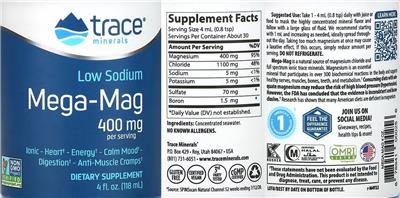
- Form
- Liquid
- Serving Size
- 1 mL
- Servings
- 30 per container
- Container Holds
- 4 Fluid Ounces; 118 mL
What’s in it, whether it interacts with your drugs, its side effects, whether it works, and what our pharmacists would want you to know before you start it.
- What is Mega-Mag 400 mg?A supplement from Trace Minerals with six active ingredients, in liquid form.
- Active Ingredients Magnesium 400 mgChloride 1100 mgSodium 5 mgPotassium 5 mgSulfate 70 mgBoron 1.5 mg Six active ingredients. Each one can interact with drugs or cause side effects on its own, so we check every one. The full Supplement Facts
- Drug Interactions 470 drugs have a documented interaction with this supplement; the most serious is rated major. Of those, 315 are single drugs and 155 are combination products (two or more drugs in one), each listed under its own name. Based on the 5 of its 6 ingredients we could check. Ask your pharmacist first if you take a drug in any of these categories, the most serious of the 25 on record:
- Levodopa/
Carbidopa (Sinemet) Major · 6 drugs - Moderate · 172 drugs
- Skeletal Muscle RelaxantsModerate · 36 drugs
- Moderate · 23 drugs
- Levodopa/
- Possible Side EffectsNausea 2 ingredientsDiarrheaStomach upsetDryness, redness, or peeling of the skinAnorexiaItching or mild burning +12 moreReported for four of its six active ingredients. Not studied in this exact product.
- Well documented Why
Does Mega-Mag 400 mg work?
What It Is Marketed For
- Heart
- Energy
- Calm mood
- Digestion
- Anti-muscle cramps
From the claims on the product’s label.
The Closest Use the Research Grades
Magnesium
Strong studies support it.
Its ingredients have research behind other uses too:
- Magnesium
- Potassium
- Boron deficiency Boron
- Potassium
- Amphotericin B nephrotoxicity Sodium
- Magnesium
These grades are for each ingredient, not this exact product, and never a promise it will work for you.
And 5 more graded uses, in what the research says- Full Why
- AllergensNone of its ingredient names point to a major food allergen
- Barcode (UPC)8 78941 00025 6Match it to the barcode on your bottle to be sure this is your product. Not your product? Search for it here
Who Might Consider It
- People looking for heart, energy, calm mood, digestion, anti-muscle cramps, which is what it is marketed for. The closest use the research grades is constipation, rated Effective.
- People who want it for dyspepsia, hypertension, boron deficiency, kidney stones (nephrolithiasis) or another graded use: the other uses with research behind them. See each grade
- This product may suit adults looking for a combined mineral supplement after reviewing the details with their own healthcare provider.
Who Should Be Careful
- People with kidney disease, heart or blood pressure conditions, or those who are pregnant or breastfeeding should be especially careful.
- Anyone taking levodopa/carbidopa, blood pressure medicines, or other drugs listed here should talk it over with their own doctor or pharmacist before starting.
More Before You Take It Show both answersHide Pregnancy and Breastfeeding The Label’s Directions
-
Pregnant or breastfeeding?
- Pregnancy and Breastfeeding Magnesium
- ! When used orally in excessive doses.
- Pregnancy and Breastfeeding Sodium
- ! When used orally in higher doses.
- Pregnancy and Breastfeeding Boron
- ! When used orally in doses exceeding the UL.
-
How does the label say to take it?
“Suggested use: Take 1-4 mL (0.8 tsp) daily with juice or food to mask the highly concentrated mineral flavor and follow with a large glass of fluid. …”
The maker’s words. Your pharmacist or doctor may advise differently.
Everything the label says
From the label dated Dec 21, 2024: 5 of its 6 active ingredients were checked against our records; the other one is not in them yet. A summary of what is known, not a grade or a test of the product. How these ratings are computed
Ask Anything About This Supplement
Name a drug you take, or ask about side effects, ingredients or pregnancy.
AI answers come from this label and our own records, never the open internet. AI can make mistakes, so always check with your doctor or pharmacist. How we use AI
Ask the Pharmacist
A licensed pharmacist will answer your question by email — free, usually within 24 hours.
Got it — thank you!
A licensed pharmacist will answer within 24 hours. Keep an eye on your email (worth checking spam, just in case).
What’s Inside Mega-Mag 400 mg by Trace Minerals
Six Active Ingredients, Each Checked on Its Own
A supplement is often several ingredients in one bottle, and each one can interact with drugs or cause side effects on its own. We check every one of them against our records.
Why this rating?
The label gives an exact amount for every one of its six active ingredients, so you know how much of each you get in each serving. This rates what the label tells you, not the quality of the product.
Supplement Facts
| Amount Per Serving | % Daily Value | |
|---|---|---|
| Magnesium | 400 mg | 95% |
| Chloride | 1100 mg | 48% |
| Sodium | 5 mg | 1% |
| Potassium | 5 mg | 1% |
| Sulfate | 70 mg | † |
| Boron | 1.5 mg | † |
Other ingredients: concentrated Seawater
† Daily Value not established.
Daily Values for adults and children 4 or more years of age.
As the label prints it, from the NIH Dietary Supplement Label Database.
Each Ingredient and Its Drug Interactions
Tap one for more about it and its full guide. A drug can interact with this supplement through any one of them.
Sodium is needed in small amounts, and potassium and magnesium are minerals that our data links to uses such as low potassium (hypokalemia), constipation, and low magnesium (hypomagnesemia).
- Boron is linked to boron deficiency, and sulfate comes from sulfur, which is used topically for skin and scalp conditions.
-
Magnesium 400 mg Interacts with 298 drugs
Magnesium is an essential mineral your body needs for muscles, nerves, blood pressure, and many other functions, and supplements are useful for preventing or correcting deficiency.
- Some other uses, like easing constipation or preventing migraines, have reasonable support, while uses for sleep and anxiety are less proven.
- It is generally safe for most healthy people at recommended amounts, but talk to your pharmacist or doctor before starting, especially if you have kidney problems.
The full Magnesium guide: uses, dosage and safety Every Magnesium drug interaction
-
Chloride 1100 mg Our data does not describe chloride's role in this product. We know this ingredient, but hold no drug interaction record for it yet, so it was not checked
-
Sodium 5 mg Interacts with 205 drugs
Sodium is an essential mineral and electrolyte your body needs to balance fluids, support nerves, and help muscles work.
- Most people in modern diets get more than enough—often too much—from food, so supplements are rarely needed except for specific medical reasons like dehydration or low blood sodium.
- Talk to your doctor or pharmacist before deliberately adding sodium, especially if you have high blood pressure, heart, or kidney problems.
The full Sodium guide: uses, dosage and safety Every Sodium drug interaction
-
Potassium 5 mg Interacts with 62 drugs
Potassium is an essential mineral your body needs for nerve signals, muscle function, and a steady heartbeat, and most people get enough from a balanced diet rich in fruits and vegetables.
- Potassium supplements can help when blood levels are truly low, but too much potassium can be dangerous, especially for people with kidney problems.
- Always talk with your pharmacist or doctor before taking a potassium supplement.
The full Potassium guide: uses, dosage and safety Every Potassium drug interaction
-
Sulfate 70 mg No known drug interactions
Sulfur is a mineral used mainly in topical skin products for acne, rosacea, dandruff, and certain skin infections, and has a long history in dermatology.
- Topical sulfur is generally well tolerated but can be drying and smelly; oral sulfur supplements like MSM are taken for joint pain, though the evidence is limited.
- Talk with your pharmacist or doctor before starting any sulfur product.
-
Boron 1.5 mg No known drug interactions
Boron is a trace mineral found in many plant foods and sold as a supplement, mainly promoted for bone, joint, and hormone health.
- The human evidence for most of these uses is limited or preliminary, and most people get enough boron from a normal diet.
- It appears generally safe in low amounts, but high doses can be toxic, so check with your pharmacist or doctor before using it.
Other Ingredients (Inactive)
The capsule or tablet itself, fillers, coatings and flavors. Not part of the drug interaction check; the allergen check below reads them.
- Concentrated Seawater
Allergens in Mega-Mag 400 mg
None of its ingredient names point to a major food allergen.
Not named in the ingredients
- Milk
- Egg
- Fish
- Shellfish
- Tree nuts
- Peanuts
- Wheat or other gluten grains
- Soy
- Sesame
- Made without, the label says“No known allergens. · Gluten free”
- Made without, the label says“Certified Vegan”
From the label text and ingredient names on file; we do not test products. With a serious allergy, check your bottle and ask the maker or your pharmacist.
What the Label Says
The maker’s own words, from the label. We do not verify or endorse them.
- Formulation
-
“Ionic - Heart - Energy - Calm Mood - Digestion - Anti-muscle cramps”
“Non GMO Project Verified nongmoproject.org”
7 more from the label
“No known allergens. Gluten free”
“Consuming diets with adequate magnesium may reduce the risk of high blood pressure (hypertension). However, the FDA has concluded that the evidence is inconsistent and inconclusive.”
“OMRI Listed For Organic Use”
“Low sodium Mega-Mag 400 mg per serving”
“Mega-Mag is a natural source of magnesium chloride and full spectrum ionic trace minerals. Magnesium is an essential mineral that participates in over 300 biochemical reactions in the body and supports healthy nerves, muscles, bones, teeth, and metabolism.”
“Kosher RCC”
“Crescent M Certified Halal Islamic Food and Nutrition Council of America”
- Seals and symbols
-
“Non GMO Project Verified nongmoproject.org”
“Feel the Difference Guarantee Kosher RCC Crescent M Certified Halal Islamic Food and Nutrition Council of America OMRI Listed For Organic Use Proudly Made in the USA”
- FDA Statement of Identity
-
“Dietary Supplement”
- Directions
-
“Suggested use: Take 1-4 mL (0.8 tsp) daily with juice or food to mask the highly concentrated mineral flavor and follow with a large glass of fluid. We recommend starting with 1 mL and increasing as needed, ideally spread throughout the day. Taking too much magnesium at once may cause a laxative effect. If this occurs, simply reduce amount per serving.”
- Storage
-
“Do not refrigerate.”
- General statements
-
“Research has shown that many American diets are deficient in magnesium.”
“America's #1 liquid magnesium brand Learn more Join us on social media! Giveaways, recipes, health tips & more! Source: SPINSscan Natural Channel 52 weeks ending 7/12/20.”
The Mega-Mag 400 mg Label on File
The label scan on file at the NIH Dietary Supplement Label Database, dated December 2024. Always read the label on the bottle you have.
Product Facts
- Brand
- Trace Minerals
- Barcode (UPC)
- 878941000256
- Net contents
- 4 Fluid Ounces; 118 mL
- Market status
- On market
- Date entered into DSLD
- Dec 21, 2024
- DSLD ID
- 322519
- Product type
- Mineral
- Supplement form
- Liquid
- Dietary claims / uses
- Nutrient, All Other, Qualified Health, Structure/Function
- Intended target group(s)
- Vegan, Vegetarian, Adult (18 - 50 Years), Kosher, Organic, No Allergies
Is this label outdated? Report a formula or label change and our pharmacy team will review it.
Mega-Mag 400 mg by Trace Minerals Side Effects
Why this rating?
We look for three kinds of safety information on each ingredient: side effects reported in studies, a pregnancy and breastfeeding rating, and a safety write-up from our pharmacy team. All three are on file for each of the five ingredients we could check.
So this rates how much is known, not whether Mega-Mag 400 mg is right for you.
Reported with five of its ingredients
- Most often
- Nausea; diarrhea; stomach upset; Dryness, redness, or peeling of the skin; anorexia; and itching or mild burning
- !Rare but serious
- Worsened cardiovascular disease and high blood pressure See details
HelloPharmacist Team Summary of Side Effects
You are likely to find this product generally well tolerated, though the magnesium and potassium in it can upset your stomach.
- The side effects you are most likely to notice are diarrhea, nausea, stomach cramping, and bloating from magnesium, along with stomach upset, gas, and vomiting from potassium.
- The sulfate (sulfur) component may cause skin dryness, itching, or a rotten-egg smell.
- The rare but serious effect to know about is high blood potassium, which can affect heart rhythm, so call your doctor right away if you notice irregular heartbeat or unusual weakness.
- Anyone with kidney disease, heart problems, or who is pregnant or breastfeeding should talk with their own doctor or pharmacist before starting.
Side Effects, Ingredient by Ingredient
A supplement’s side effects come from its ingredients. Here is what is reported with each one.
Magnesium
Most reported
- Diarrhea
- Nausea
- Stomach cramping
- Bloating
Potassium
Most reported
- Stomach upset
- Nausea
- Vomiting
- Gas
Sulfur
Most reported
- Dryness, redness, or peeling of the skin
- Itching or mild burning
- An unpleasant rotten-egg or sulfur smell
- Staining of clothing or skin (with some products)
Boron
Most reported
- Anorexia
- Dermatitis
- Erythema
- Indigestion
From the Natural Medicines database, which we license.
Every reported effect, in the Boron guideSodium has side-effect reports on file, but no list of the most common ones. Read them in the Sodium guide
Mega-Mag 400 mg Warnings: Who Should Be Careful
Mega-Mag 400 mg has six active ingredients, and each can carry warnings of its own. We checked the five in our ingredient guides, and each warning below names the ingredient it comes from. Chloride is not in our guides yet, so ask your pharmacist about it. If any of these apply to you, talk to your doctor or pharmacist before you start it.
- Magnesium4 warnings below
- Sodium3 warnings below
- Potassium3 warnings below
- Sulfur3 warnings below
- Boron3 warnings below
- ChlorideNot in our guides yet
-
Blood Pressure
- SodiumYou should be especially cautious with added sodium if you have high blood pressure, heart failure, kidney disease, or liver disease, or if your doctor has told you to follow a low-salt diet.
- PotassiumPeople who should be especially careful or avoid potassium supplements unless a doctor directs them include those with kidney disease, people taking certain blood pressure or heart medicines that raise potassium, and those with conditions affecting adrenal or hormone function.
-
Kidney Disease or Kidney Stones
- MagnesiumThe biggest safety concern is in people with kidney disease, because damaged kidneys cannot remove extra magnesium, which can build up to dangerous levels.
- MagnesiumIf you have kidney problems, do not take magnesium supplements unless your doctor tells you to.
- SulfurPeople with kidney problems, or those who take many medications, should be especially careful and check with a healthcare provider before use.
- BoronPeople with kidney problems should be especially careful, because the kidneys clear boron from the body.
Show 2 more
- MagnesiumMagnesium is generally well tolerated, and its main risks are most likely with very high doses or poor kidney function.
- PotassiumPotassium is generally well tolerated, but supplements can raise blood potassium to dangerous levels, especially with kidney disease.
-
Heart Conditions
- MagnesiumPeople with heart conduction problems or certain bowel conditions should also be cautious.
-
Children
- SulfurUse only with guidance from your healthcare provider, and avoid applying sulfur products to the breast or nipple area where a baby could ingest them.
-
Other Cautions
- PotassiumSupplements are different and require more caution, because they can raise blood potassium quickly.
- SulfurPeople with sensitive skin should test a small area first.
- BoronHowever, boron can be toxic at high doses, so it should not be taken in large amounts.
- BoronStaying within that limit is important, and you should not take more than the product label recommends without medical advice.
-
What the Label Warns
- “Taking too much magnesium at once may cause a laxative effect. If this occurs, simply reduce amount per serving.”
The maker’s wording, from the product label.
-
Pregnant or Breastfeeding
Each ingredient’s rating for pregnancy and for breastfeeding, and what it covers.
Pregnancy and Breastfeeding The record rates both the same
-
When used orally and appropriately.
Magnesium is safe for those pregnant and breast-feeding when used in doses below the tolerable upper intake level (UL) of 350 mg daily.
-
When used orally in excessive doses.
Tell patients to avoid exceeding the tolerable upper intake level (UL) of 350 mg daily.
Taking magnesium orally in higher doses can cause diarrhea.
2 more ratings for Magnesium used another way
This supplement is taken by mouth. These ratings are for Magnesium given another way.
-
When prescription magnesium sulfate is given intramuscularly and intravenously prior to delivery for up to 5 days.
However, due to potential adverse effects associated with intravenous and intramuscular magnesium, use during pregnancy is limited to patients with specific conditions such as severe pre-eclampsia or eclampsia.
5 more points on this rating
- There is some evidence that intravenous magnesium can increase fetal mortality and adversely affect neurological and skeletal development.
- However, a more recent analysis of clinical research shows that increased risk of fetal mortality seems to occur only in the studies where antenatal magnesium is used for tocolysis and not for fetal neuroprotection or pre-eclampsia/eclampsia.
- Furthermore, antenatal magnesium does not seem to be associated with increased risk of necrotizing enterocolitis in preterm infants.
- There is also concern that magnesium increases the risk of maternal adverse events.
- A meta-analysis of clinical research shows that magnesium sulfate might increase the risk of maternal adverse events, especially in Hispanic mothers compared to other racial and ethnic groups.
-
When prescription magnesium sulfate is given intramuscularly and intravenously prior to delivery for longer than 5 days.
Maternal exposure to magnesium for longer than 5-7 days is associated with an increase in neonatal bone abnormalities such as osteopenia and fractures.
The U.S. Food and Drug Administration (FDA) recommends that magnesium injection not be given for longer than 5-7 days.
Pregnancy and Breastfeeding The record rates both the same
-
When used orally and appropriately.
Sodium is safe in amounts that do not exceed the CDRR intake level of 2.3 grams daily.
-
When used orally in higher doses.
Higher intake can cause hypertension.
Also, both the highest and the lowest pre-pregnancy sodium quintile intakes are associated with an increased risk of hypertensive disorders of pregnancy, including gestational hypertension and pre-eclampsia, and the delivery of small for gestational age (SGA) infants when compared to the middle intake quintile.
Show 3 more ingredients
Pregnancy and Breastfeeding The record rates both the same
-
When used orally and appropriately.
Boron is safe in amounts that do not exceed the UL during pregnancy or lactation, which is 20 mg daily in those 19-50 years of age or 17 mg daily for those 14-18 years of age.
-
When used orally in doses exceeding the UL.
Higher doses might impair growth and cause adverse effects in the developing fetus.
1 more rating for Boron used another way
This supplement is taken by mouth. This rating is for Boron given another way.
-
When used vaginally.
Intravaginal boric acid has been associated with a 2.7- to 2.8-fold increased risk of birth defects when used during the first 4 months of pregnancy.
Pregnancy and Breastfeeding The record rates both the same
-
When used orally in dietary amounts of 40-80 mEq daily.
A tolerable upper intake level (UL) has not been established for healthy individuals.
Pregnancy and Breastfeeding The record rates both the same
-
When applied topically and appropriately, short-term.
Topical products containing sulfur in concentrations up to 6% have been safely applied nightly for up to 6 nights.
There is insufficient reliable information available about the safety of sulfur when used orally; avoid using.
Our pharmacy team’s notes
- SulfurSulfate has possibly safe pregnancy data but limited information overall, and there is not enough data to say how chloride affects pregnancy.
- Pregnancy and breastfeeding data varies by ingredient.
Ratings and the words beside them are from the Natural Medicines database, which we license.
-
Rare but Serious Side Effects
-
!
Magnesium
Rare but serious side effects happen mostly with very high doses or in people with poor kidney function.
With toxic doses, loss of reflexes and respiratory depression can occur. High doses in pregnancy can increase risk of neonatal mortality and neurological defects.
-
!
Sodium
Rarely, a sudden large intake of salt—or a rapid change in blood sodium during treatment—can be very serious and even life-threatening.
Sodium is well tolerated in moderation, but high intake is linked to high blood pressure and heart strain, and rare severe reactions include worsened heart, blood pressure, or kidney disease.
Orally: Worsened cardiovascular disease, hypertension, kidney disease.
-
!
Potassium
The most serious risk is high blood potassium (hyperkalemia).
High potassium levels can cause arrhythmia, heart block, hypotension, and mental confusion.
-
!
Sulfur
Serious reactions are uncommon.
-
!
Boron
Very high or toxic amounts of boron can lead to more serious problems such as headache, restlessness, tremors, and other signs of poisoning.
When to get help: a serious allergic reaction, with trouble breathing or swelling of the face, lips or throat, needs emergency care: call 911. For any other side effect that worries you, call your doctor or pharmacist.
These reports describe each ingredient, not studies of this exact product. Not medical advice: a side effect you notice after starting a supplement is worth a word with your pharmacist or doctor.
Mega-Mag 400 mg by Trace Minerals Drug Interactions
We checked all six active ingredients in this supplement against every drug in our records. A drug can interact with it through any one of them. Chloride is not in our interaction records yet.
A major interaction on record
3 of 3, on a scale from Minor or none to Major.Why this rating?
We rate this by the most serious interaction on record, not by how many there are. For Potassium, Magnesium and Sodium, the most serious is rated major, which means the combination is best avoided, or used only under close supervision. Some involve kinds of drugs where a small change can matter, such as blood thinners, diabetes drugs and heart-rhythm drugs.
470 drugs are on the full list. What matters is whether one you take is on it, so check yours with the interaction checker on this page.
Three of its six active ingredients have drug interactions on record: Magnesium, Sodium and Potassium. We have no interaction records for Chloride, Sulfur and Boron.
- Interacts with
- 298 drugs
- Most serious
- Major
- The most serious interaction is rated Major: magnesium can reduce how much levodopa and carbidopa (Sinemet) your body absorbs, so the drug may work less well.
- Magnesium can raise the effects of sulfonylureas, including low blood sugar (hypoglycemia) risk, and can reduce absorption of quinolones and bisphosphonates.
- Interacts with
- 205 drugs
- Most serious
- Moderate
- Sodium can blunt blood pressure drugs and affect lithium levels.
- Interacts with
- 62 drugs
- Most serious
- Moderate
- Potassium adds to the risk of high blood potassium with ACE inhibitors, ARBs, and potassium-sparing diuretics.
From the HelloPharmacist Team
Here is how the interactions add up across the whole label.
- Mega-Mag 400 mg by Trace Minerals does interact with several medications, through its sodium, potassium, and magnesium content.
- Other interactions are rated Moderate.
- They cover blood pressure medicines (antihypertensives, ACE inhibitors, ARBs, and calcium channel blockers), potassium-sparing diuretics, lithium, corticosteroids, sulfonylureas, quinolone antibiotics, bisphosphonates, skeletal muscle relaxants, antacids, didanosine, sodium phosphates, tolvaptan, and other sodium-containing drugs.
Summarized by the HelloPharmacist pharmacy team from the interaction records below. How it is written How we use AI
Why Mega-Mag 400 mg Interacts, Ingredient by Ingredient
A product interacts through its ingredients. Each card: how many drugs, the most serious rating, and the kinds of drugs it affects most (tap a kind for what it means).
The ingredients driving the most interactions
-
Magnesium 298 drugs
Most serious: Major16 interaction records on file
The kinds of drugs it affects most
- 122 drugs
- Skeletal Muscle Relaxants 36 drugs
- 23 drugs
- 22 drugs
Every Magnesium drug interaction, 16 records The Magnesium records cite 84 references, listed in the Magnesium guide.
-
Sodium 205 drugs
Most serious: Moderate7 interaction records on file
The kinds of drugs it affects most
- 172 drugs
- 23 drugs
- Sodium-containing Drugs 7 drugs
- Sodium Phosphates 2 drugs
Every Sodium drug interaction, 7 records The Sodium records cite 43 references, listed in the Sodium guide.
-
Potassium 62 drugs
Most serious: Moderate3 interaction records on file
The kinds of drugs it affects most
- 23 drugs
- 23 drugs
- 17 drugs
Every Potassium drug interaction, 3 records The Potassium records cite 12 references, listed in the Potassium guide.
The Breakdown by Severity
Each drug counted once, at its most serious rating. Tap a tile to list those drugs.
Find Your Drug
Type a drug or brand name to see whether it is on the list.
- Only drugs with a documented interaction are listed, the most serious first.
- A drug with no known interaction is not listed, but searching its name tells you so.
- Open a drug to see which ingredient is responsible. Of those, 315 are single drugs and 155 are combination products (two or more drugs in one), each listed under its own name.
-
LevodopaInbrija, Larodopa Major
The ingredient responsible:
-
Magnesium Major
Magnesium can reduce the bioavailability of levodopa/carbidopa.
The full Magnesium + Levodopa interaction
-
-
CarbidopaLodosyn Major
The ingredient responsible:
-
Magnesium Major
Magnesium can reduce the bioavailability of levodopa/carbidopa.
The full Magnesium + Carbidopa interaction
-
-
Carbidopa and LevodopaDhivy, Rytary, Sinemet, Sinemet CR Major
The ingredient responsible:
-
Magnesium Major
Magnesium can reduce the bioavailability of levodopa/carbidopa.
The full Magnesium + Carbidopa and Levodopa interaction
-
-
Benserazide and LevodopaMadopar, Prolopa Major
The ingredient responsible:
-
Magnesium Major
Magnesium can reduce the bioavailability of levodopa/carbidopa.
The full Magnesium + Benserazide and Levodopa interaction
-
-
Levodopa and CarbidopaDuodopa Major
The ingredient responsible:
-
Magnesium Major
Magnesium can reduce the bioavailability of levodopa/carbidopa.
The full Magnesium + Levodopa and Carbidopa interaction
-
-
Carbidopa, Levodopa, and EntacaponeStalevo Major
The ingredient responsible:
-
Magnesium Major
Magnesium can reduce the bioavailability of levodopa/carbidopa.
The full Magnesium + Carbidopa, Levodopa, and Entacapone interaction
-
-
LevothyroxineEltroxin, Estre, Euthyrox, Levo-T, Levolet and 6 more Moderate
The ingredient responsible:
-
Magnesium Moderate
Magnesium might decrease levothyroxine levels by reducing its absorption.
The full Magnesium + Levothyroxine interaction
-
-
AmlodipineNorliqva Moderate
The 2 ingredients responsible:
-
Magnesium Moderate Amlodipine is in the Calcium Channel Blockers category.
Magnesium can have additive effects with calcium channel blockers, although evidence is conflicting.
The full Magnesium + Amlodipine interaction -
Sodium Moderate Amlodipine is in the Antihypertensive Drugs category.
Theoretically, a high intake of dietary sodium might reduce the effectiveness of antihypertensive drugs.
The full Sodium + Amlodipine interaction
-
-
Losartan PotassiumCozaar Moderate
The 2 ingredients responsible:
-
Potassium Moderate Losartan Potassium is in the Angiotensin Receptor Blockers (ARBs) category.
Using ARBs with high doses of potassium increases the risk of hyperkalemia.
The full Potassium + Losartan Potassium interaction -
Sodium Moderate Losartan Potassium is in the Antihypertensive Drugs category.
Theoretically, a high intake of dietary sodium might reduce the effectiveness of antihypertensive drugs.
The full Sodium + Losartan Potassium interaction
-
-
MetoprololLopressor, Toprol XL Moderate
The ingredient responsible:
-
Sodium Moderate Metoprolol is in the Antihypertensive Drugs category.
Theoretically, a high intake of dietary sodium might reduce the effectiveness of antihypertensive drugs.
The full Sodium + Metoprolol interaction
-
-
PrednisoneCortan, Deltasone, Meticorten, Orasone, Prednicen-M and 3 more Moderate
The ingredient responsible:
-
Sodium Moderate Prednisone is in the Corticosteroids category.
Concomitant use of mineralocorticoids and some glucocorticoids with sodium supplements might increase the risk of hypernatremia.
The full Sodium + Prednisone interaction
-
-
PropranololAngilol, Bedranol SR, Beta Prograne, Half Beta Prograne, Half-Inderal LA and 7 more Moderate
The ingredient responsible:
-
Sodium Moderate Propranolol is in the Antihypertensive Drugs category.
Theoretically, a high intake of dietary sodium might reduce the effectiveness of antihypertensive drugs.
The full Sodium + Propranolol interaction
-
-
LisinoprilPrinivil, Qbrelis, Zestril Moderate
The 2 ingredients responsible:
-
Potassium Moderate Lisinopril is in the ACE Inhibitors (ACEIs) category.
Using ACEIs with high doses of potassium increases the risk of hyperkalemia.
The full Potassium + Lisinopril interaction -
Sodium Moderate Lisinopril is in the Antihypertensive Drugs category.
Theoretically, a high intake of dietary sodium might reduce the effectiveness of antihypertensive drugs.
The full Sodium + Lisinopril interaction
-
-
DoxycyclineDoryx, Doxy, Doxy-D, Doxycin, Doxycycline Injection and 7 more Moderate
The ingredient responsible:
-
Magnesium Moderate Doxycycline is in the Tetracycline Antibiotics category.
Magnesium decreases absorption of tetracyclines.
The full Magnesium + Doxycycline interaction
-
-
Amlodipine BesylateNorvasc Moderate
The 2 ingredients responsible:
-
Magnesium Moderate Amlodipine Besylate is in the Calcium Channel Blockers category.
Magnesium can have additive effects with calcium channel blockers, although evidence is conflicting.
The full Magnesium + Amlodipine Besylate interaction -
Sodium Moderate Amlodipine Besylate is in the Antihypertensive Drugs category.
Theoretically, a high intake of dietary sodium might reduce the effectiveness of antihypertensive drugs.
The full Sodium + Amlodipine Besylate interaction
-
-
Levothyroxine SodiumErmez, Thyquidity, Tirosint-Sol Moderate
The ingredient responsible:
-
Magnesium Moderate
Magnesium might decrease levothyroxine levels by reducing its absorption.
The full Magnesium + Levothyroxine Sodium interaction
-
-
CiprofloxacinCiloxan, Cipro, Cipro IV, Cipro XR, Ciprobay and 1 more Moderate
The ingredient responsible:
-
Magnesium Moderate Ciprofloxacin is in the Quinolone Antibiotics category.
Magnesium decreases absorption of quinolones.
The full Magnesium + Ciprofloxacin interaction
-
-
BisoprololZebeta Moderate
The ingredient responsible:
-
Sodium Moderate Bisoprolol is in the Antihypertensive Drugs category.
Theoretically, a high intake of dietary sodium might reduce the effectiveness of antihypertensive drugs.
The full Sodium + Bisoprolol interaction
-
-
Candesartan CilexetilAmias, Atacand Moderate
The 2 ingredients responsible:
-
Sodium Moderate Candesartan Cilexetil is in the Antihypertensive Drugs category.
Theoretically, a high intake of dietary sodium might reduce the effectiveness of antihypertensive drugs.
The full Sodium + Candesartan Cilexetil interaction -
Potassium Moderate Candesartan Cilexetil is in the Angiotensin Receptor Blockers (ARBs) category.
Using ARBs with high doses of potassium increases the risk of hyperkalemia.
The full Potassium + Candesartan Cilexetil interaction
-
-
DexamethasoneDecadron, Dexone, Dextenza, Dexycu, Hemady and 2 more Moderate
The ingredient responsible:
-
Sodium Moderate Dexamethasone is in the Corticosteroids category.
Concomitant use of mineralocorticoids and some glucocorticoids with sodium supplements might increase the risk of hypernatremia.
The full Sodium + Dexamethasone interaction
-
-
SpironolactoneAldactone, Carospir, Spiroton Moderate
The 3 ingredients responsible:
-
Potassium Moderate Spironolactone is in the Potassium-sparing Diuretics category.
Concomitant use increases the risk of hyperkalemia.
The full Potassium + Spironolactone interaction -
Magnesium Moderate Spironolactone is in the Potassium-sparing Diuretics category.
Potassium-sparing diuretics decrease excretion of magnesium, possibly increasing magnesium levels.
The full Magnesium + Spironolactone interaction -
Sodium Moderate Spironolactone is in the Antihypertensive Drugs category.
Theoretically, a high intake of dietary sodium might reduce the effectiveness of antihypertensive drugs.
The full Sodium + Spironolactone interaction
-
-
MinoxidilLoniten, Minoxidil, Rogaine Moderate
The ingredient responsible:
-
Sodium Moderate Minoxidil is in the Antihypertensive Drugs category.
Theoretically, a high intake of dietary sodium might reduce the effectiveness of antihypertensive drugs.
The full Sodium + Minoxidil interaction
-
-
ValsartanDiovan, Prexxartan Moderate
The 2 ingredients responsible:
-
Potassium Moderate Valsartan is in the Angiotensin Receptor Blockers (ARBs) category.
Using ARBs with high doses of potassium increases the risk of hyperkalemia.
The full Potassium + Valsartan interaction -
Sodium Moderate Valsartan is in the Antihypertensive Drugs category.
Theoretically, a high intake of dietary sodium might reduce the effectiveness of antihypertensive drugs.
The full Sodium + Valsartan interaction
-
-
TelmisartanMicardis Moderate
The 2 ingredients responsible:
-
Sodium Moderate Telmisartan is in the Antihypertensive Drugs category.
Theoretically, a high intake of dietary sodium might reduce the effectiveness of antihypertensive drugs.
The full Sodium + Telmisartan interaction -
Potassium Moderate Telmisartan is in the Angiotensin Receptor Blockers (ARBs) category.
Using ARBs with high doses of potassium increases the risk of hyperkalemia.
The full Potassium + Telmisartan interaction
-
-
Doxycycline HyclateActiclate, Acticlate Cap, Lymepak Moderate
The ingredient responsible:
-
Magnesium Moderate Doxycycline Hyclate is in the Tetracycline Antibiotics category.
Magnesium decreases absorption of tetracyclines.
The full Magnesium + Doxycycline Hyclate interaction
-
-
Propranolol HydrochlorideHemangeol Moderate
The ingredient responsible:
-
Sodium Moderate Propranolol Hydrochloride is in the Antihypertensive Drugs category.
Theoretically, a high intake of dietary sodium might reduce the effectiveness of antihypertensive drugs.
The full Sodium + Propranolol Hydrochloride interaction
-
-
AcetazolamideAk-Zol, Diamox Moderate
The ingredient responsible:
-
Sodium Moderate Acetazolamide is in the Antihypertensive Drugs category.
Theoretically, a high intake of dietary sodium might reduce the effectiveness of antihypertensive drugs.
The full Sodium + Acetazolamide interaction
-
-
HydrochlorothiazideAquazide, Aquazide H, Esidrix, HCTZ, Hydro and 4 more Moderate
The ingredient responsible:
-
Sodium Moderate Hydrochlorothiazide is in the Antihypertensive Drugs category.
Theoretically, a high intake of dietary sodium might reduce the effectiveness of antihypertensive drugs.
The full Sodium + Hydrochlorothiazide interaction
-
-
PrednisoloneCortalone, Delta Cortef, Pred Forte, Prednisolone, Solupred and 1 more Moderate
The ingredient responsible:
-
Sodium Moderate Prednisolone is in the Corticosteroids category.
Concomitant use of mineralocorticoids and some glucocorticoids with sodium supplements might increase the risk of hypernatremia.
The full Sodium + Prednisolone interaction
-
-
CarvedilolCoreg, Coreg CR Moderate
The ingredient responsible:
-
Sodium Moderate Carvedilol is in the Antihypertensive Drugs category.
Theoretically, a high intake of dietary sodium might reduce the effectiveness of antihypertensive drugs.
The full Sodium + Carvedilol interaction
-
Does It Work? Mega-Mag 400 mg by Trace Minerals
How it rates in the research so far, then each ingredient on its own. A grade is the research so far, never an endorsement.
What It Is Marketed For
- Heart
- Energy
- Calm mood
- Digestion
- Anti-muscle cramps
From the claims on the product’s label.
Closest match for what it is marketed for
Magnesium for constipation
Strong studies support it.
Three uses we did not count
- Arrhythmia, myocardial infarction (MI) and congestive heart failure (CHF): they are treated by a doctor or in a hospital.
Our pharmacy team’s notes on this supplement
- Chloride has no effectiveness data.
The Evidence, Ingredient by Ingredient
Each card holds our notes on one ingredient, then its uses graded effective, likely effective or possibly effective.
Magnesium
From our Magnesium guide
- The strongest reason to take magnesium is to prevent or correct a deficiency.
- People at higher risk include those with poorly controlled diabetes, long-term alcohol use, certain digestive diseases, or those taking medicines that lower magnesium.
Research suggests a benefit for
- Constipation (the use on its label) and dyspepsia
- Diabetes, hypercholesterolemia, metabolic syndrome, osteoporosis and premenstrual syndrome (PMS)
Not counted here: five graded uses are for Magnesium injected or put on the skin (vasospastic angina, asthma, seizures and others), not for a product like this one. Six more are for conditions treated by a doctor or in a hospital (arrhythmia, cerebral palsy, colorectal cancer and others).
Every graded use, in the Magnesium guideSulfur
From our Sulfur guide
- Sulfur has a long history in dermatology, and there is some clinical support for a few skin uses.
Not counted here: two graded uses are for Sulfur injected or put on the skin (scabies and dandruff), not for a product like this one.
Every graded use, in the Sulfur guideSodium
Our pharmacy team’s notes on Sodium
- Its ratings for bipolar disorder and congestive heart failure show insufficient reliable evidence to rate.
Research suggests a benefit for
- Amphotericin B nephrotoxicity
Not counted here: one graded use is for Sodium injected or put on the skin (cystic fibrosis), not for a product like this one.
Every graded use, in the Sodium guidePotassium
From our Potassium guide
- This can happen with certain water pills (diuretics), prolonged vomiting or diarrhea, or some medical conditions.
Research suggests a benefit for
- Hypertension and kidney stones (nephrolithiasis)
- Cardiovascular disease (CVD)
Not counted here: two graded uses are for conditions treated by a doctor or in a hospital (hypokalemia and stroke).
Every graded use, in the Potassium guideBoron
From our Boron guide
- Boron is popularly used for several conditions, but for most of them the evidence in humans is limited or preliminary.
Research suggests a benefit for
- Boron deficiency
Not counted here: two graded uses are for Boron injected or put on the skin (radiation dermatitis and vaginal candidiasis), not for a product like this one.
Every graded use, in the Boron guideThe grades are the Natural Medicines database’s, which we license; tap a grade for what it means. They are about each ingredient, not this exact product.
About Trace Minerals
Manufacturer and brand details for Mega-Mag 400 mg, from the product label.
Trace Minerals has 72 products in our supplement database, all of them on the market, with labels on file since 2022. Our database is built from the NIH’s Dietary Supplement Label Database and our pharmacy team’s own additions, so it covers the labels filed there, not every product the brand sells.
- Name
- Trace Minerals
- Street Address
- P.O. Box 429
- City
- Roy
- State
- UT
- ZipCode
- 84067
- Phone Number
- (801) 731-6051
- Web Address
- www.traceminerals.com
Mega-Mag 400 mg by Trace Minerals: Common Questions
Does Mega-Mag 400 mg by Trace Minerals interact with any drugs?
What are the side effects of Mega-Mag 400 mg by Trace Minerals?
Who should be careful taking Mega-Mag 400 mg by Trace Minerals?
Can Mega-Mag 400 mg by Trace Minerals affect the kidneys?
Does Mega-Mag 400 mg by Trace Minerals contain any common allergens?
Is Mega-Mag 400 mg by Trace Minerals gluten free?
How can Mega-Mag 400 mg by Trace Minerals interact with so many drugs?
Where does the information about Mega-Mag 400 mg by Trace Minerals come from?
Can I take Mega-Mag 400 mg by Trace Minerals while pregnant?
What is the magnesium in Mega-Mag 400 mg by Trace Minerals used for?
Does boron help with athletic performance?
Does sulfur help with the common cold?
Written and reviewed by the HelloPharmacist Editorial Team. Our editorial policy
Still Have a Question About Mega-Mag 400 mg?
Our pharmacists answer drug and supplement questions, free, by email.
Label information is sourced from the NIH Dietary Supplement Label Database and reflects the product version on file; always read your actual product label. This page is for education only and is not a substitute for professional medical advice. Confirm with your pharmacist or doctor before combining supplements and drugs.
Who Reviews This Page
The pharmacist behind it, and how it is checked.
Dr. Brian Staiger, PharmD, BCPS
Clinical pharmacist and founder of HelloPharmacist
A licensed pharmacist for more than 13 years, he built the system behind this page: it reads the label on file, matches each active ingredient to its record in the Natural Medicines database, checks those records against every drug we cover, and our pharmacy team writes the take and the interaction summary from those records.
- 13+ Years in PharmacyRetail and clinical pharmacy, medication safety and healthcare administration.
- Board Certified (BCPS)A pharmacotherapy specialist, certified by the Board of Pharmacy Specialties.
- Herbalist TrainingCertificates in medical ethnobotany, for the herbs and supplements people take.
Where This Page Comes From
Mega-Mag 400 mg’s label data comes from the NIH Dietary Supplement Label Database; the ingredient interaction data is from the Natural Medicines database, reviewed by our pharmacists.
- NIH Dietary Supplement Label Database (DSLD)
- The official product label on file for this supplement.
- Natural Medicines (Therapeutic Research Center)
- The evidence-graded clinical reference behind the ingredient interaction, evidence and safety records, which we license.
- HelloPharmacist Editorial Team
- Content is reviewed by the HelloPharmacist Editorial Team, the pharmacists on our staff and those we contract. See our data sources and editorial standards for how this information is built and checked.
- The Pharmacy Team’s Take and Summaries
- Generated from HelloPharmacist’s pharmacist-curated databases and editorial rules. Clinical methodology reviewed by Dr. Brian Staiger, PharmD, BCPS. Last generated Oct 31, 2026. How we use AI
- The ratings in the Quick Summary
- They summarize available label information, ingredient evidence and known drug-safety records: a summary of what is known, not a grade of the product itself. They do not verify product identity, purity, potency, contamination or manufacturing quality. How these ratings are computed
The References Behind the Interaction Records
Every citation the ingredients’ records rest on is listed in that ingredient’s guide, in context: Magnesium, 84 references; Sodium, 43 references; Potassium, 12 references; Sulfur, 17 references; Boron, 6 references .
Parts of this content are provided by the Therapeutic Research Center, LLC.
DISCLAIMER: Currently this does not check for drug-drug interactions. This is not an all-inclusive comprehensive list of potential interactions and is for informational purposes only. Not all interactions are known or well-reported in the scientific literature, and new interactions are continually being reported. Input is needed from a qualified healthcare provider including a pharmacist before starting any therapy. Application of clinical judgment is necessary.
© 2021 Therapeutic Research Center, LLC
Keep Exploring
- Supplement interaction checkerCheck any supplement or product against your drugs
- Drug–drug interactionsCheck two or more of your drugs against each other
- Browse drugs A to ZEvery drug we have checked against herbs and supplements
- NDC and pricing lookupFind a drug’s NDCs, packaging and costs
- Ask a pharmacistA free, personal answer from our licensed team