
Memory Formula by GNC 50 Plus Ingredients, Side Effects and Drug Interactions
Dietary Supplement Softgel Capsule Other Combinations

Medically reviewed by Dr. Brian Staiger, PharmD, BCPS
Also reviewed by the HelloPharmacist Editorial Team
Updated Details about this page
- Label on file from the NIH Dietary Supplement Label Database, dated Oct 26, 2011.
- The interaction, evidence and safety records come from the Natural Medicines database, which we license, read against this label by our own system; the pharmacy team’s sections are written from those records.
- Dr. Brian Staiger, PharmD, BCPS, is a clinical pharmacist and pharmacotherapy specialist.
- Editorial policy Our sources
AI is used only to summarize verified clinical information, never the open internet. Our AI policy
Summary: The HelloPharmacist Team’s Take
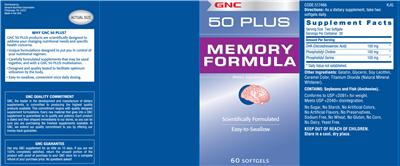
- Form
- Softgel Capsule
- Serving Size
- 2 Softgels
- Servings
- 30 per container
- Container Holds
- 60 Softgels
What’s in it, whether it interacts with your drugs, its side effects, whether it works, and what our pharmacists would want you to know before you start it.
- What is Memory Formula?A supplement from GNC 50 Plus with three active ingredients, in softgel form.
- Active Ingredients Docosahexaenoic Acid 100 mgPhosphatidyl Choline 100 mgPhosphatidyl Serine 100 mg Three active ingredients. Each one can interact with drugs or cause side effects on its own, so we check every one. The full Supplement Facts
- Drug Interactions 219 drugs have a documented interaction with this supplement; the most serious is rated moderate. Of those, 103 are single drugs and 116 are combination products (two or more drugs in one), each listed under its own name. Based on the 2 of its 3 ingredients we could check. Ask your pharmacist first if you take a drug in any of these categories:
- Moderate · 195 drugs
- Moderate · 25 drugs
- Possible Side EffectsUpset stomach bothDiarrhea or loose stoolsTrouble sleepingBloating or gas Combined from the ingredients we have records for, Phosphatidylcholine and Phosphatidylserine. Not studied in this exact product.
- Well documented Why
Does Memory Formula work?
What It Is Marketed For
Memory support
From the claims on the product’s label.
The Closest Use the Research Grades
Age-related cognitive decline Phosphatidylserine
Some studies support it, but the evidence isn’t conclusive.
Its ingredients have research behind other uses too:
- Phosphatidylcholine
These grades are for each ingredient, not this exact product, and never a promise it will work for you.
What the research says- Full Why
- AllergensThe label says it contains fish and soy
Who Might Consider It
- People looking for memory support, which is what it is marketed for. The closest use the research grades is age-related cognitive decline, rated Possibly Effective.
- People who want it for ulcerative colitis: the other use with research behind it. See the grade
Who Should Be Careful
- If you are pregnant, breastfeeding, have a bleeding disorder, are preparing for surgery, have a soy allergy, or have a liver or digestive condition, be careful and talk it over with your own doctor or pharmacist first.
- If you take medication that affects acetylcholine, confirm with your own doctor or pharmacist before combining them.
More Before You Take It Show all three answersHide Its Ingredient Amounts vs. Other Supplements Pregnancy and Breastfeeding The Label’s Directions
-
How do its ingredient amounts compare with other supplements?
- Docosahexaenoic Acid100 mgNot compared yet.
- Phosphatidyl Choline100 mgLess than most of the 387 recent Phosphatidylcholine products in our database that state an amount; 150 mg is the most common.
- Phosphatidyl Serine100 mgThe most common amount among the 394 recent Phosphatidylserine products in our database that state an amount.
We compare an amount once at least 10 recent products in our database state one for that ingredient. A label’s amount is what the product holds, not a recommended dose.
See each comparison -
Pregnant or breastfeeding?
- Pregnancy Phosphatidylcholine
- ! Choline is needed in pregnancy, but supplement safety beyond food sources is not well studied; check with your doctor.
- Breastfeeding Phosphatidylcholine
- Insufficient reliable information available; avoid using.
- Pregnancy and Breastfeeding Phosphatidylserine
- Insufficient reliable information available; avoid using.
-
How does the label say to take it?
“Directions: As a dietary supplement, take two softgels daily.”
The maker’s words. Your pharmacist or doctor may advise differently.
Everything the label says
From the label dated Oct 26, 2011: 2 of its 3 active ingredients were checked against our records; the other one is not in them yet. A summary of what is known, not a grade or a test of the product. How these ratings are computed
Ask Anything About This Supplement
Name a drug you take, or ask about side effects, ingredients or pregnancy.
AI answers come from this label and our own records, never the open internet. AI can make mistakes, so always check with your doctor or pharmacist. How we use AI
Ask the Pharmacist
A licensed pharmacist will answer your question by email — free, as soon as they can.
Got it — thank you!
A licensed pharmacist will answer as soon as they can. Keep an eye on your email (worth checking spam, just in case).
What’s Inside Memory Formula by GNC 50 Plus
Three Active Ingredients, Each Checked on Its Own
A supplement is often several ingredients in one bottle, and each one can interact with drugs or cause side effects on its own. We check every one of them against our records.
Why this rating?
The label gives an exact amount for every one of its three active ingredients, so you know how much of each you get in each serving. This rates what the label tells you, not the quality of the product.
Supplement Facts
| Amount Per Serving | % Daily Value | |
|---|---|---|
| Docosahexaenoic Acid | 100 mg | † |
| Phosphatidyl Choline | 100 mg | † |
| Phosphatidyl Serine | 100 mg | † |
Other ingredients: Gelatin, Glycerin, Soy Lecithin, Caramel color, Titanium Dioxide
† Daily Value not established.
Daily Values for adults and children 4 or more years of age.
As the label prints it, from the NIH Dietary Supplement Label Database.
Each Ingredient and Its Drug Interactions
Tap one for more about it and its full guide. A drug can interact with this supplement through any one of them.
GNC 50 Plus Memory Formula contains three active ingredients: docosahexaenoic acid (DHA), phosphatidyl serine, and phosphatidyl choline.
- Our data describes phosphatidyl serine as thought to increase acetylcholine levels, and phosphatidyl choline as a source of choline, a nutrient your body needs.
- We have no description of DHA's role, so we can't tell you what it is meant to do in this product.
-
Docosahexaenoic Acid 100 mg We know this ingredient, but hold no drug interaction record for it yet, so it was not checked
-
Phosphatidyl Choline 100 mg No known drug interactions
Phosphatidylcholine is a phospholipid that is part of every cell membrane and a source of choline.
- People take it for liver, brain, and gut health, but solid human evidence is limited for most uses.
- It is generally well tolerated, but talk to your pharmacist or doctor before starting it.
The full Phosphatidylcholine guide: uses, dosage and safety
-
Phosphatidyl Serine 100 mg Interacts with 219 drugs
Phosphatidylserine is a natural fat-like compound found in cell membranes, especially in the brain, and it is sold mainly to support memory and thinking.
- Some research suggests possible benefits for age-related memory problems, but the evidence is limited and far from conclusive.
- It is generally well tolerated, but check with your pharmacist or doctor before using it, especially during pregnancy or breastfeeding.
The full Phosphatidylserine guide: uses, dosage and safety Every Phosphatidylserine drug interaction
How Much of Each Ingredient Is in It, Compared With Other Supplements
Each bar is an amount that other recent supplements list for the same ingredient. The taller the bar, the more of them state it.
-
100 mg in a serving of this product
Less than most products
- Most common amount
- 150 mg (about 12 in 100 products)
- Most products state
- 20 mg to 1,000 mg
- Compared with
- 387 recent products
-
100 mg in a serving of this product
The most common amount
- Most common amount
- 100 mg (about 46 in 100 products)
- Most products state
- 15 mg to 300 mg
- Compared with
- 394 recent products
Other Ingredients (Inactive)
The capsule or tablet itself, fillers, coatings and flavors. Not part of the drug interaction check; the allergen check below reads them.
- Gelatin
- Glycerin
- Soy Lecithin
- Caramel color
- Titanium Dioxide
Allergens in Memory Formula
The label says it contains fish and soy.
Named on this label
- FishThe label says it contains it
- SoyThe label says it contains it; in the ingredients: Soy Lecithin
- Gelatin (animal-derived)In the ingredients: Gelatin
Not named in the ingredients
- Milk
- Egg
- Shellfish
- Tree nuts
- Peanuts
- Wheat or other gluten grains
- Sesame
- The label’s allergen statement“CONTAINS: Soybeans and Fish (Anchovies).”
- Made without, the label says“No sugar, No Starch, No Artificial Colors, No Artificial Flavors, No Preservatives, No Sodium, No Wheat, No Gluten, No Corn, No Dairy, Yeast Free.”
From the label text and ingredient names on file; we do not test products. With a serious allergy, check your bottle and ask the maker or your pharmacist.
What the Label Says
The maker’s own words, from the label. We do not verify or endorse them.
- Storage
-
“Store in a cool, dry place.”
- General statements
-
“ACTUAL SIZE”
“CODE 517466 KJG”
7 more from the label
“Conforms to USP <2091> for weight. Meets USP <2040> disintegration.”
“Easy-to-Swallow”
“GNC GUARANTEE Use any GNC supplement for as little as 10 days. If you are not 100% completely satisfied, return the unused portion of the product with proof of purchase to your GNC store for a complete refund of your purchase price. No questions asked!”
“GNC QUALITY COMMITMENT GNC, the leader in the development and manufacture of dietary supplements, is committed to producing the highest quality products available. This commitment begins with quality designed supplement formulations. Every raw material that goes into a GNC supplement is guaranteed as to quality and potency. Each product is dated and then shipped immediately to our stores, so you can be sure you are purchasing the freshest supplements available. At GNC, we extend our quality commitment to you by offering our money-back guarantee.”
“Made in the USA”
“Scientifically Formulated”
“WHY GNC 50 PLUS? GNC 50 PLUS products are scientifically designed to address your changing nutritional needs and specific health concerns. -Unique formulations designed to put you in control of your nutritional regimen. -Carefully formulated supplements that may be used together, and with a GNC 50 PLUS multivitamin. -Designed and quality tested to facilitate optimum utilization by the body. -Easy-to-swallow, convenient once daily dosing.”
The Memory Formula Label on File
The label scan on file at the NIH Dietary Supplement Label Database, dated October 2011. Always read the label on the bottle you have.
Product Facts
- Brand
- GNC 50 Plus
- Net contents
- 60 Softgels
- Market status
- On market
- Date entered into DSLD
- Oct 26, 2011
- DSLD ID
- 1637
- Product type
- Other Combinations
- Supplement form
- Softgel Capsule
- Dietary claims / uses
- All Other
- Intended target group(s)
- Adult (18 - 50 Years)
Is this label outdated? Report a formula or label change and our pharmacy team will review it.
Memory Formula by GNC 50 Plus Side Effects
Why this rating?
We look for three kinds of safety information on each ingredient: side effects reported in studies, a pregnancy and breastfeeding rating, and a safety write-up from our pharmacy team. All three are on file for each of the two ingredients we could check.
So this rates how much is known, not whether Memory Formula is right for you.
Reported with Phosphatidylcholine and Phosphatidylserine
- Most often
- Upset stomach, diarrhea or loose stools, trouble sleeping and bloating or gas
- !Rare but serious
- Reported with Phosphatidylcholine and Phosphatidylserine See details
HelloPharmacist Team Summary: Memory Formula by GNC 50 Plus Side Effects
Most people tolerate Memory Formula from GNC 50 Plus reasonably well, based on the studies we have, though supplement quality can vary.
- The side effects you are most likely to notice are gas or bloating and an upset stomach or nausea, which can come from either phosphatidyl choline or phosphatidyl serine.
- Trouble sleeping is also reported with phosphatidyl serine, and insomnia is more likely at the 600 mg dose.
- Serious side effects are not commonly reported, but if you notice something unusual, call your doctor.
- If you have a bleeding disorder, are preparing for surgery, have a soy allergy, or have a liver or digestive condition, talk with your own doctor or pharmacist before starting.
Side Effects, Ingredient by Ingredient
A supplement’s side effects come from its ingredients. Here is what is reported with each one.
Phosphatidylcholine
Most reported
- Nausea or upset stomach
- Diarrhea or loose stools
- Bloating or gas
Phosphatidylserine
Most reported
- Upset stomach
- Trouble sleeping
Memory Formula Warnings: Who Should Be Careful
Memory Formula has three active ingredients, and each can carry warnings of its own. We checked the two in our ingredient guides, and each warning below names the ingredient it comes from. Docosahexaenoic Acid is not in our guides yet, so ask your pharmacist about it. If any of these apply to you, talk to your doctor or pharmacist before you start it.
- Phosphatidylcholine1 warning below
- Phosphatidylserine3 warnings below
- Docosahexaenoic AcidNot in our guides yet
-
Bleeding Problems or Surgery
- PhosphatidylserineAnyone with a bleeding disorder or who is preparing for surgery should talk with a healthcare provider before use.
-
Liver Disease
- PhosphatidylcholinePeople with existing medical conditions, including liver or digestive disorders, should check with a healthcare provider before using PC supplements.
-
Allergies
- PhosphatidylserinePeople with soy allergy should check the source, since many products are made from soy; sunflower-based versions may be an alternative.
-
Children
- PhosphatidylserineAlways talk with a pharmacist or doctor before giving it to a child.
-
What the Label Warns
- “KEEP OUT OF REACH OF CHILDREN.”
The maker’s wording, from the product label.
-
Pregnant or Breastfeeding
Each ingredient’s rating for pregnancy and for breastfeeding, and what it covers.
Pregnancy
-
Choline is needed in pregnancy, but supplement safety beyond food sources is not well studied; check with your doctor.
Breastfeeding
-
Insufficient reliable information available; avoid using.
Pregnancy and Breastfeeding The record rates both the same
-
Insufficient reliable information available; avoid using.
Our pharmacy team’s notes
- Our pharmacists advise avoiding it during pregnancy because there isn't enough safety information, and advise avoiding it while breastfeeding as well.
- Choline is needed in pregnancy, but supplement safety beyond food sources is not well studied, so talk with your doctor.
- Breastfeeding data is limited, so speak with your healthcare provider first.
Ratings and the words beside them are from the Natural Medicines database, which we license. Where it has no rating, the rating and note are our pharmacy team’s.
-
Rare but Serious Side Effects
-
!
Phosphatidylcholine
Serious reactions are uncommon.
-
!
Phosphatidylserine
Serious side effects are not commonly reported, but because supplements are not tightly regulated, product quality can vary.
When to get help: a serious allergic reaction, with trouble breathing or swelling of the face, lips or throat, needs emergency care: call 911. For any other side effect that worries you, call your doctor or pharmacist.
These reports describe each ingredient, not studies of this exact product. Not medical advice: a side effect you notice after starting a supplement is worth a word with your pharmacist or doctor.
Memory Formula by GNC 50 Plus Drug Interactions
We checked all three active ingredients in this supplement against every drug in our records. A drug can interact with it through any one of them. Docosahexaenoic Acid is not in our interaction records yet.
A moderate interaction on record
2 of 3, on a scale from Minor or none to Major.Why this rating?
We rate this by the most serious interaction on record, not by how many there are. For Phosphatidylserine, the most serious is rated moderate, which means it calls for caution, and sometimes monitoring or a change in timing or dose.
219 drugs are on the full list. What matters is whether one you take is on it, so check yours with the interaction checker on this page.
One of its three active ingredients has drug interactions on record: Phosphatidylserine. We have no interaction records for Docosahexaenoic Acid and Phosphatidylcholine.
Phosphatidylserine
- Interacts with
- 219 drugs
- Most serious
- Moderate
- GNC 50 Plus Memory Formula can interact with some medications, mainly through its phosphatidyl serine content, which is the only ingredient with documented interactions.
- Phosphatidyl serine is thought to raise acetylcholine levels, a brain chemical messenger, and that can work against or add to certain drugs.
- The most serious interaction on record is Moderate, with anticholinergic drugs.
- The two drug types affected are anticholinergic drugs and cholinergic drugs, each rated Moderate.
Show five more points
- Theoretically, phosphatidyl serine might reduce how well anticholinergic drugs work, and it might add to the effects of cholinergic drugs.
- These effects are theoretical, so ask your own doctor or pharmacist how they apply to you.
- Phosphatidyl choline was checked, and no interactions were found, though that does not guarantee none exist.
- We could not check docosahexaenoic acid (DHA) because we have no interaction information for it.
- Search your exact medications with the search tool on this page before you start.
The kinds of drugs it affects most
- 195 drugs
- 25 drugs
Every Phosphatidylserine drug interaction, 2 records The Phosphatidylserine records cite 9 references, listed in the Phosphatidylserine guide.
Summarized by the HelloPharmacist pharmacy team from the interaction records below. How it is written How we use AI
The Breakdown by Severity
Each drug counted once, at its most serious rating. Tap a tile to list those drugs.
- 0 Major None found
- 219
- 0 Minor None found
Find Your Drug
Type a drug or brand name to see whether it is on the list.
- Only drugs with a documented interaction are listed, the most serious first.
- A drug with no known interaction is not listed, but searching its name tells you so.
- Open a drug to see which ingredient is responsible. Of those, 103 are single drugs and 116 are combination products (two or more drugs in one), each listed under its own name.
-
PhenobarbitalLuminal, Phenobarbital, Solfoton Moderate
The ingredient responsible:
-
Phosphatidyl Serine Moderate Phenobarbital is in the Anticholinergic Drugs category.
Theoretically, phosphatidylserine might decrease the effectiveness anticholinergic drugs.
The full Phosphatidyl Serine + Phenobarbital interaction
-
-
Disopyramide PhosphateNorpace, Norpace CR Moderate
The ingredient responsible:
-
Phosphatidyl Serine Moderate Disopyramide Phosphate is in the Anticholinergic Drugs category.
Theoretically, phosphatidylserine might decrease the effectiveness anticholinergic drugs.
The full Phosphatidyl Serine + Disopyramide Phosphate interaction
-
-
DemecariumHumorsol Moderate
The ingredient responsible:
-
Phosphatidyl Serine Moderate Demecarium is in the Cholinergic Drugs category.
Theoretically, phosphatidylserine might have additive effects with cholinergic drugs.
The full Phosphatidyl Serine + Demecarium interaction
-
-
Tiotropium BromideSpiriva Respimat Moderate
The ingredient responsible:
-
Phosphatidyl Serine Moderate Tiotropium Bromide is in the Anticholinergic Drugs category.
Theoretically, phosphatidylserine might decrease the effectiveness anticholinergic drugs.
The full Phosphatidyl Serine + Tiotropium Bromide interaction
-
-
TacrineCognex Moderate
The ingredient responsible:
-
Phosphatidyl Serine Moderate Tacrine is in the Cholinergic Drugs category.
Theoretically, phosphatidylserine might have additive effects with cholinergic drugs.
The full Phosphatidyl Serine + Tacrine interaction
-
-
AcepromazineAtravet Moderate
The ingredient responsible:
-
Phosphatidyl Serine Moderate Acepromazine is in the Anticholinergic Drugs category.
Theoretically, phosphatidylserine might decrease the effectiveness anticholinergic drugs.
The full Phosphatidyl Serine + Acepromazine interaction
-
-
DesipramineDesipramine, Norpramin, Pertofrane Moderate
The ingredient responsible:
-
Phosphatidyl Serine Moderate Desipramine is in the Anticholinergic Drugs category.
Theoretically, phosphatidylserine might decrease the effectiveness anticholinergic drugs.
The full Phosphatidyl Serine + Desipramine interaction
-
-
CarbacholCarbastat Moderate
The ingredient responsible:
-
Phosphatidyl Serine Moderate Carbachol is in the Cholinergic Drugs category.
Theoretically, phosphatidylserine might have additive effects with cholinergic drugs.
The full Phosphatidyl Serine + Carbachol interaction
-
-
ClomipramineAnafranil, Anafranil SR Moderate
The ingredient responsible:
-
Phosphatidyl Serine Moderate Clomipramine is in the Anticholinergic Drugs category.
Theoretically, phosphatidylserine might decrease the effectiveness anticholinergic drugs.
The full Phosphatidyl Serine + Clomipramine interaction
-
-
BiperidenAkineton, Akineton Injection Moderate
The ingredient responsible:
-
Phosphatidyl Serine Moderate Biperiden is in the Anticholinergic Drugs category.
Theoretically, phosphatidylserine might decrease the effectiveness anticholinergic drugs.
The full Phosphatidyl Serine + Biperiden interaction
-
-
PerphenazineTrilafon Moderate
The ingredient responsible:
-
Phosphatidyl Serine Moderate Perphenazine is in the Anticholinergic Drugs category.
Theoretically, phosphatidylserine might decrease the effectiveness anticholinergic drugs.
The full Phosphatidyl Serine + Perphenazine interaction
-
-
TriflupromazineVesprin Moderate
The ingredient responsible:
-
Phosphatidyl Serine Moderate Triflupromazine is in the Anticholinergic Drugs category.
Theoretically, phosphatidylserine might decrease the effectiveness anticholinergic drugs.
The full Phosphatidyl Serine + Triflupromazine interaction
-
-
SuccinylcholineAnectine, Quelicin Moderate
The ingredient responsible:
-
Phosphatidyl Serine Moderate Succinylcholine is in the Cholinergic Drugs category.
Theoretically, phosphatidylserine might have additive effects with cholinergic drugs.
The full Phosphatidyl Serine + Succinylcholine interaction
-
-
AmifampridineRuzurgi Moderate
The ingredient responsible:
-
Phosphatidyl Serine Moderate Amifampridine is in the Cholinergic Drugs category.
Theoretically, phosphatidylserine might have additive effects with cholinergic drugs.
The full Phosphatidyl Serine + Amifampridine interaction
-
-
Tridihexethyl ChloridePathilon Moderate
The ingredient responsible:
-
Phosphatidyl Serine Moderate Tridihexethyl Chloride is in the Anticholinergic Drugs category.
Theoretically, phosphatidylserine might decrease the effectiveness anticholinergic drugs.
The full Phosphatidyl Serine + Tridihexethyl Chloride interaction
-
-
Solifenacin SuccinateVesicare Moderate
The ingredient responsible:
-
Phosphatidyl Serine Moderate Solifenacin Succinate is in the Anticholinergic Drugs category.
Theoretically, phosphatidylserine might decrease the effectiveness anticholinergic drugs.
The full Phosphatidyl Serine + Solifenacin Succinate interaction
-
-
ScopolamineScopace, Scopolamine Injection, Transderm Scop Moderate
The ingredient responsible:
-
Phosphatidyl Serine Moderate Scopolamine is in the Anticholinergic Drugs category.
Theoretically, phosphatidylserine might decrease the effectiveness anticholinergic drugs.
The full Phosphatidyl Serine + Scopolamine interaction
-
-
GalantamineRazadyne, Reminyl Moderate
The ingredient responsible:
-
Phosphatidyl Serine Moderate Galantamine is in the Cholinergic Drugs category.
Theoretically, phosphatidylserine might have additive effects with cholinergic drugs.
The full Phosphatidyl Serine + Galantamine interaction
-
-
BuclizineBucladin-S Softab Moderate
The ingredient responsible:
-
Phosphatidyl Serine Moderate Buclizine is in the Anticholinergic Drugs category.
Theoretically, phosphatidylserine might decrease the effectiveness anticholinergic drugs.
The full Phosphatidyl Serine + Buclizine interaction
-
-
MeclizineAntivert, Medivert, Ru-Vert M Moderate
The ingredient responsible:
-
Phosphatidyl Serine Moderate Meclizine is in the Anticholinergic Drugs category.
Theoretically, phosphatidylserine might decrease the effectiveness anticholinergic drugs.
The full Phosphatidyl Serine + Meclizine interaction
-
-
ProchlorperazineCompazine, Prochlor Moderate
The ingredient responsible:
-
Phosphatidyl Serine Moderate Prochlorperazine is in the Anticholinergic Drugs category.
Theoretically, phosphatidylserine might decrease the effectiveness anticholinergic drugs.
The full Phosphatidyl Serine + Prochlorperazine interaction
-
-
TripelennaminePBZ, PBZ-SR Moderate
The ingredient responsible:
-
Phosphatidyl Serine Moderate Tripelennamine is in the Anticholinergic Drugs category.
Theoretically, phosphatidylserine might decrease the effectiveness anticholinergic drugs.
The full Phosphatidyl Serine + Tripelennamine interaction
-
-
OxybutyninAnturol, Ditropan, Ditropan XL, Gelnique, Oxybutynin and 1 more Moderate
The ingredient responsible:
-
Phosphatidyl Serine Moderate Oxybutynin is in the Anticholinergic Drugs category.
Theoretically, phosphatidylserine might decrease the effectiveness anticholinergic drugs.
The full Phosphatidyl Serine + Oxybutynin interaction
-
-
ImipramineTofranil, Tofranil PM Moderate
The ingredient responsible:
-
Phosphatidyl Serine Moderate Imipramine is in the Anticholinergic Drugs category.
Theoretically, phosphatidylserine might decrease the effectiveness anticholinergic drugs.
The full Phosphatidyl Serine + Imipramine interaction
-
-
RivastigmineExelon, Exelon Patch Moderate
The ingredient responsible:
-
Phosphatidyl Serine Moderate Rivastigmine is in the Cholinergic Drugs category.
Theoretically, phosphatidylserine might have additive effects with cholinergic drugs.
The full Phosphatidyl Serine + Rivastigmine interaction
-
-
AtropineSal-Tropine Moderate
The ingredient responsible:
-
Phosphatidyl Serine Moderate Atropine is in the Anticholinergic Drugs category.
Theoretically, phosphatidylserine might decrease the effectiveness anticholinergic drugs.
The full Phosphatidyl Serine + Atropine interaction
-
-
CyclizineMarezine Moderate
The ingredient responsible:
-
Phosphatidyl Serine Moderate Cyclizine is in the Anticholinergic Drugs category.
Theoretically, phosphatidylserine might decrease the effectiveness anticholinergic drugs.
The full Phosphatidyl Serine + Cyclizine interaction
-
-
TrihexyphenidylArtane, Artane Sequels, Trihex Moderate
The ingredient responsible:
-
Phosphatidyl Serine Moderate Trihexyphenidyl is in the Anticholinergic Drugs category.
Theoretically, phosphatidylserine might decrease the effectiveness anticholinergic drugs.
The full Phosphatidyl Serine + Trihexyphenidyl interaction
-
-
PropanthelinePro-Banthine, Propanthel Moderate
The ingredient responsible:
-
Phosphatidyl Serine Moderate Propantheline is in the Anticholinergic Drugs category.
Theoretically, phosphatidylserine might decrease the effectiveness anticholinergic drugs.
The full Phosphatidyl Serine + Propantheline interaction
-
-
LoxapineAdasuve, Loxitane Moderate
The ingredient responsible:
-
Phosphatidyl Serine Moderate Loxapine is in the Anticholinergic Drugs category.
Theoretically, phosphatidylserine might decrease the effectiveness anticholinergic drugs.
The full Phosphatidyl Serine + Loxapine interaction
-
Does It Work? Memory Formula by GNC 50 Plus
How it rates in the research so far, then each ingredient on its own. A grade is the research so far, never an endorsement.
What It Is Marketed For
Memory support
From the claims on the product’s label.
Closest match for what it is marketed for
Phosphatidylserine for age-related cognitive decline
Some studies support it, but the evidence isn’t conclusive.
Our pharmacy team’s notes on this supplement
- Evidence for premenstrual syndrome, exercise-induced muscle soreness, and ADHD is insufficient to rate.
- We have no effectiveness rating for DHA, so its benefit for memory is not established.
The Evidence, Ingredient by Ingredient
Each card holds our notes on one ingredient, then its uses graded effective, likely effective or possibly effective.
Phosphatidylcholine
From our Phosphatidylcholine guide
- Phosphatidylcholine is popular, but for most uses the human evidence is limited or mixed.
Research suggests a benefit for
- Ulcerative colitis
Phosphatidylserine
From our Phosphatidylserine guide
- Phosphatidylserine is best known for its possible role in brain and memory health.
- Some studies in older adults with age-related memory complaints have suggested modest benefits, but many of these studies were small, older, or used the bovine-brain form that is no longer sold.
Research suggests a benefit for
- Age-related cognitive decline (the use on its label)
Not counted here: one graded use is for a condition treated by a doctor or in a hospital (Alzheimer disease).
Every graded use, in the Phosphatidylserine guideThe grades are the Natural Medicines database’s, which we license; tap a grade for what it means. They are about each ingredient, not this exact product.
About GNC 50 Plus
Manufacturer and brand details for Memory Formula, from the product label.
GNC 50 Plus has 2 products in our supplement database, 1 of them on the market, with labels on file since 2011. Our database is built from the NIH’s Dietary Supplement Label Database and our pharmacy team’s own additions, so it covers the labels filed there, not every product the brand sells.
- Name
- General Nutrition Corporation
- City
- Pittsburgh
- State
- PA
- ZipCode
- 15222
Memory Formula by GNC 50 Plus: Common Questions
Does Memory Formula by GNC 50 Plus interact with any drugs?
What are the side effects of Memory Formula by GNC 50 Plus?
Who should be careful taking Memory Formula by GNC 50 Plus?
Does Memory Formula by GNC 50 Plus contain any common allergens?
Is Memory Formula by GNC 50 Plus gluten free?
How can Memory Formula by GNC 50 Plus interact with so many drugs?
Where does the information about Memory Formula by GNC 50 Plus come from?
Is Memory Formula by GNC 50 Plus safe to take during pregnancy?
Does Memory Formula by GNC 50 Plus work for memory?
What does DHA do in Memory Formula by GNC 50 Plus?
Can phosphatidyl serine cause trouble sleeping?
Is there a soy concern with Memory Formula by GNC 50 Plus?
Written and reviewed by the HelloPharmacist Editorial Team. Our editorial policy
Still Have a Question About Memory Formula?
Our pharmacists answer drug and supplement questions, free, by email.
Label information is sourced from the NIH Dietary Supplement Label Database and reflects the product version on file; always read your actual product label. This page is for education only and is not a substitute for professional medical advice. Confirm with your pharmacist or doctor before combining supplements and drugs.
Who Reviews This Page
The pharmacist behind it, and how it is checked.
Dr. Brian Staiger, PharmD, BCPS
Clinical pharmacist and founder of HelloPharmacist
A licensed pharmacist for more than 13 years, he built the system behind this page: it reads the label on file, matches each active ingredient to its record in the Natural Medicines database, checks those records against every drug we cover, and our pharmacy team writes the take and the interaction summary from those records.
- 13+ Years in PharmacyRetail and clinical pharmacy, medication safety and healthcare administration.
- Board Certified (BCPS)A pharmacotherapy specialist, certified by the Board of Pharmacy Specialties.
- Herbalist TrainingCertificates in medical ethnobotany, for the herbs and supplements people take.
Where This Page Comes From
Memory Formula’s label data comes from the NIH Dietary Supplement Label Database; the ingredient interaction data is from the Natural Medicines database, reviewed by our pharmacists.
- NIH Dietary Supplement Label Database (DSLD)
- The official product label on file for this supplement.
- Natural Medicines (Therapeutic Research Center)
- The evidence-graded clinical reference behind the ingredient interaction, evidence and safety records, which we license.
- HelloPharmacist Editorial Team
- Content is reviewed by the HelloPharmacist Editorial Team, the pharmacists on our staff and those we contract. See our data sources and editorial standards for how this information is built and checked.
- The Pharmacy Team’s Take and Summaries
- Generated from HelloPharmacist’s pharmacist-curated databases and editorial rules. Clinical methodology reviewed by Dr. Brian Staiger, PharmD, BCPS. Last generated Oct 31, 2026. How we use AI
- The ratings in the Quick Summary
- They summarize available label information, ingredient evidence and known drug-safety records: a summary of what is known, not a grade of the product itself. They do not verify product identity, purity, potency, contamination or manufacturing quality. How these ratings are computed
The References Behind the Interaction Records
Every citation the ingredients’ records rest on is listed in that ingredient’s guide, in context: Phosphatidylcholine, 15 references; Phosphatidylserine, 9 references .
Parts of this content are provided by the Therapeutic Research Center, LLC.
DISCLAIMER: Currently this does not check for drug-drug interactions. This is not an all-inclusive comprehensive list of potential interactions and is for informational purposes only. Not all interactions are known or well-reported in the scientific literature, and new interactions are continually being reported. Input is needed from a qualified healthcare provider including a pharmacist before starting any therapy. Application of clinical judgment is necessary.
© 2021 Therapeutic Research Center, LLC
Keep Exploring
- Supplement interaction checkerCheck any supplement or product against your drugs
- Drug–drug interactionsCheck two or more of your drugs against each other
- Browse drugs A to ZEvery drug we have checked against herbs and supplements
- NDC and pricing lookupFind a drug’s NDCs, packaging and costs
- Ask a pharmacistA free, personal answer from our licensed team