
Prostability by Pacific BioLogic Ingredients, Side Effects and Drug Interactions
Dietary Supplement Capsule Other Combinations
Prostability by Pacific BioLogic is a dietary supplement with nine active ingredients: 7 plant ingredients such as Cinnamomum cassia, Paeonia lactiflora and Prunus persica, 1 fat or oil and 1 other. It is marketed for prostate health.
UPC 0 65367 40199 0 Match it to the barcode on your bottle

Medically reviewed by Dr. Brian Staiger, PharmD, BCPS
Also reviewed by the HelloPharmacist Editorial Team
Updated Details about this page
- Label on file from the NIH Dietary Supplement Label Database, dated Dec 26, 2020.
- The interaction, evidence and safety records come from the Natural Medicines database, which we license, read against this label by our own system; the pharmacy team’s sections are written from those records.
- Dr. Brian Staiger, PharmD, BCPS, is a clinical pharmacist and pharmacotherapy specialist.
- Editorial policy Our sources
AI is used only to summarize verified clinical information, never the open internet. Our AI policy
Summary: The HelloPharmacist Team’s Take
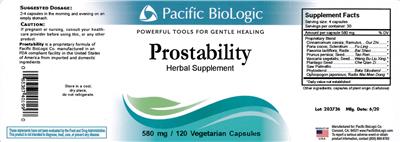
This summary is for Prostability by Pacific BioLogic
- Form
- Capsule
- Serving Size
- 2 Capsules
- Servings
- 30 per container
- Container Holds
- 120 Vegetarian Capsules
- What is Prostability?A supplement from Pacific BioLogic with nine active ingredients, in capsule form.
- Active Ingredients 7 plant ingredients such as Cinnamomum cassia, Paeonia lactiflora and Prunus persica, 1 fat or oil and 1 other: Cinnamomum cassiaPoria cocosPaeonia lactifloraPrunus persicaVaccaria segetalisPlantagoSaw PalmettoPhytosterolOphiopogon japonicus Nine active ingredients. Each one can interact with drugs or cause side effects on its own, so we check every one. The full Supplement Facts
- Drug Interactions 1,275 drugs have a documented interaction with this supplement; the most serious is rated moderate. Of those, 875 are single drugs and 400 are combination products (two or more drugs in one), each listed under its own name. Based on the 4 of its 9 ingredients we could check. Ask your pharmacist first if you take a drug in any of these categories, the most serious of the 12 on record:
- Moderate · 645 drugs
- Moderate · 372 drugs
- Moderate · 248 drugs
- Moderate · 195 drugs
- Possible Side EffectsNausea 2 ingredientsStomach upset 2 ingredientsDigestive upsetDry mouthIncreased urinationDiarrhea +2 moreCombined from the ingredients we have records for, Poria Mushroom, Peony and Saw Palmetto. Not studied in this exact product.
- Well documented Why
Does Prostability work?
What It Is Marketed For
Prostate health
From the claims on the product’s label.
The Closest Use the Research Grades
Transurethral resection of the prostate (TURP) Saw Palmetto
Some studies support it, but the evidence isn’t conclusive.
These grades are for the ingredient, not this exact product, and never a promise it will work for you.
What the research says- AllergensNone of its ingredient names point to a major food allergen, and the label text we have carries no allergen statement
- Barcode (UPC)0 65367 40199 0Match it to the barcode on your bottle to be sure this is your product. Not your product? Search for it here
Who Might Consider It
- People looking for prostate health, which is what it is marketed for. The closest use the research grades is transurethral resection of the prostate (TURP), rated Possibly Effective. See the grade
Who Should Be Careful
- Prostability is marketed for prostate health, and its strongest research is for saw palmetto, which is possibly effective for one prostate surgery and possibly ineffective for enlarged prostate.
- It may be worth discussing with your own doctor if you are looking into prostate support and are not pregnant or breastfeeding.
- If you take blood thinners, hormonal birth control, estrogens, sedatives, or diabetes medicines, talk it over with your own doctor or pharmacist first.
More Before You Take It Show both answersHide Pregnancy and Breastfeeding The Label’s Directions
-
Pregnant or breastfeeding?
- Pregnancy and Breastfeeding Saw Palmetto
- ! When used orally.
- Pregnancy Peony
- ! When used orally.
- Breastfeeding Peony
- Insufficient reliable information available; avoid using.
- Pregnancy and Breastfeeding Poria Mushroom
- Insufficient reliable information available; avoid using.
-
How does the label say to take it?
“Suggested Dosage: 2-4 capsules in the morning and evening on an empty stomach.”
The maker’s words. Your pharmacist or doctor may advise differently.
Everything the label says
A Note From the HelloPharmacist Team
Saw palmetto carries most of what Prostability is marketed for, with the strongest research for prostate health, rated possibly effective for transurethral resection of the prostate (TURP) and possibly ineffective for enlarged prostate. The side effects most worth knowing are stomach upset and nausea, which may come from saw palmetto or peony, along with dizziness from saw palmetto. The most serious interaction is saw palmetto with blood thinners such as warfarin, which may raise the chance of bleeding.
From the label dated Dec 26, 2020: 4 of its 9 active ingredients were checked against our records; the other five are not in them yet. A summary of what is known, not a grade or a test of the product. How these ratings are computed
Ask Anything About This Supplement
Name a drug you take, or ask about side effects, ingredients or pregnancy.
There’s a lot of information about this supplement on this page! Ask anything in plain English for a quick answer drawn from it.
AI answers come from this label and our own records, never the open internet. AI can make mistakes, so always check with your doctor or pharmacist. How we use AI
Ask the Pharmacist
A licensed pharmacist will answer your question by email — free, as soon as they can.
Got it — thank you!
A licensed pharmacist will answer as soon as they can. Keep an eye on your email (worth checking spam, just in case).
What’s Inside Prostability by Pacific BioLogic
Nine Active Ingredients
In the order the label lists them, each with its own card below.
The label gives an exact amount for 0 of its 9 active ingredients. Nine are inside one proprietary blend, “Proprietary Blend”, and the label gives one total for it, not how much of each ingredient is in it.
- 0 state an exact amount
- 9 have no amount of their own
- Proprietary Blend 580 mg in total · 9 ingredients, no amount for each
This rates what the label tells you, not the quality of the product.
Supplement Facts
| Amount Per Serving | % Daily Value | |
|---|---|---|
| Proprietary Blend | 580 mg | † |
| Cinnamomum cassia | † | |
| Poria cocos | † | |
| Paeonia lactiflora | † | |
| Prunus persica | † | |
| Vaccaria segetalis | † | |
| Plantago | † | |
| Saw Palmetto | † | |
| Phytosterol | † | |
| Ophiopogon japonicus | † | |
Other ingredients: Capsules of plant origin
† Daily Value not established.
Daily Values for adults and children 4 or more years of age.
As the label prints it, from the NIH Dietary Supplement Label Database.
Each Ingredient and Its Drug Interactions
Tap one for more about it and its full guide. A drug can interact with this supplement through any one of them.
What is known is what they are studied for, which is covered below.
- The only inactive item listed is plant-origin capsules.
-
Proprietary Blend 580 mg Their amounts are not listed on the label because they sit inside a proprietary blend, and the label does not explain what each one does. Nine ingredients inside it, each checked on its own
- Cinnamomum cassia 444 drugs
- Poria cocos 417 drugs
- Paeonia lactiflora 813 drugs
- Prunus persica
- Vaccaria segetalis
- Plantago
- Saw Palmetto 174 drugs
- Phytosterol
- Ophiopogon japonicus
Other Ingredients (Inactive)
The capsule or tablet itself, fillers, coatings and flavors. Not part of the drug interaction check; the allergen check below reads them.
- Capsules of plant origin
Allergens in Prostability
None of its ingredient names point to a major food allergen, and the label text we have carries no allergen statement.
Not named in the ingredients
- Milk
- Egg
- Fish
- Shellfish
- Tree nuts
- Peanuts
- Wheat or other gluten grains
- Soy
- Sesame
From the label text and ingredient names on file; we do not test products. With a serious allergy, check your bottle and ask the maker or your pharmacist.
What the Label Says
The maker’s own words, from the label. We do not verify or endorse them.
- Formulation
-
“Prostability is a proprietary formula of Pacific BioLogic Co. manufactured in an FDA compliant facility in the United States of America from imported and domestic ingredients”
- Storage
-
“Store in a cool, dry place, do not refrigerate.”
- General statements
-
“Powerful tools for gentle healing”
“580 mg”
- FDA Statement of Identity
-
“Herbal Supplement”
- Seals and symbols
-
“Product of USA”
The Prostability Label on File
The label scan on file at the NIH Dietary Supplement Label Database, dated December 2020. Always read the label on the bottle you have.
Product Facts
- Brand
- Pacific BioLogic
- Barcode (UPC)
- 065367401990
- Net contents
- 120 Vegetarian Capsules
- Market status
- On market
- Date entered into DSLD
- Dec 26, 2020
- DSLD ID
- 241836
- Product type
- Other Combinations
- Supplement form
- Capsule
- Dietary claims / uses
- All Other, Structure/Function
- Intended target group(s)
- Adult (18 - 50 Years)
Is this label outdated? Report a formula or label change and our pharmacy team will review it.
HelloPharmacist Score Prostability by Pacific BioLogic
Up to 10 points for research, amount, label and outside testing. Not a safety rating. How this one adds up
Not Scored Yet
We can check only 4 of its 9 active ingredients.
It gets a score once we can check it. That says nothing about the product itself.
What’s inside itIts drug interactionsIts possible side effects
Prostability by Pacific BioLogic Side Effects
Why this rating?
We look for three kinds of safety information on each ingredient: side effects reported in studies, a pregnancy and breastfeeding rating, and a safety write-up from our pharmacy team. All three are on file for each of the four ingredients we could check.
So this rates how much is known, not whether Prostability is right for you.
Reported with four of its ingredients
- Most often
- Nausea, stomach upset, digestive upset, dry mouth, increased urination and diarrhea
- !Rare but serious
- Reported with Cassia Cinnamon, Poria Mushroom, Peony and Saw Palmetto See details
HelloPharmacist Team Summary: Prostability by Pacific BioLogic Side Effects
Prostability is generally well tolerated in the research on its ingredients, though side effects are not well documented for every ingredient.
- The ones you are most likely to notice are stomach upset and nausea, which are reported with saw palmetto and peony, along with dizziness and headache from saw palmetto.
- Poria may cause dry mouth or more frequent urination.
- If you feel dizzy, see how it affects you before driving.
- Rare but serious liver or pancreas problems have been linked to saw palmetto, so if you suspect one, call your doctor.
Side Effects, Ingredient by Ingredient
A supplement’s side effects come from its ingredients. Here is what is reported with each one.
Poria Mushroom
Most reported
- Digestive upset
- Dry mouth
- Increased urination
Peony
Most reported
- Stomach upset
- Nausea
- Diarrhea
Saw Palmetto
Most reported
- Stomach upset
- Nausea
- Dizziness
- Headache
Cassia Cinnamon has side-effect reports, but no list of the most common ones. Read them in the Cassia Cinnamon guide
Prostability Warnings: Who Should Be Careful
HelloPharmacist Team Summary: Prostability by Pacific BioLogic Warnings
Pregnant or breastfeeding readers need the most care, since saw palmetto and peony are best avoided in pregnancy and saw palmetto is best avoided while breastfeeding.
- If you have an upcoming surgery, a bleeding disorder, or a hormone-sensitive condition, peony may affect blood clotting or hormone activity, so it calls for extra care.
- People with liver disease should be especially careful with cassia cinnamon, and people with diabetes should monitor their blood sugar.
- Anyone with low blood pressure, dehydration, or a kidney or chronic health condition should be cautious with poria.
- Talk it over with your own doctor or pharmacist before starting.
Prostability has nine active ingredients, and each can carry warnings of its own. We checked the four in our ingredient guides, and each warning below names the ingredient it comes from. Prunus persica, Vaccaria segetalis and Plantago and two more are not in our guides yet, so ask your pharmacist about them.
- Cassia Cinnamon2 warnings below
- Poria Mushroom2 warnings below
- Peony3 warnings below
- Saw Palmetto1 warning below
- Prunus persicaNot in our guides yet
- Vaccaria segetalisNot in our guides yet
- PlantagoNot in our guides yet
- PhytosterolNot in our guides yet
- Ophiopogon japonicusNot in our guides yet
-
Bleeding Problems or Surgery
- PeonyPeople with bleeding disorders or who are scheduled for surgery should be cautious, since some sources suggest peony may affect blood clotting.
-
Diabetes or Low Blood Sugar
- Cassia CinnamonPeople with diabetes who take blood-sugar-lowering medicine should monitor their levels and check with a pharmacist before adding cinnamon supplements.
-
Blood Pressure
- Poria MushroomPeople with low blood pressure, those who are dehydrated, or anyone taking water pills (diuretics) should be cautious because poria may have a mild fluid-removing effect.
-
Liver Disease
- Cassia CinnamonPeople with liver disease should be especially careful and should talk to a healthcare provider before using cinnamon supplements.
-
Kidney Disease or Kidney Stones
- Poria MushroomIf you have kidney problems or any chronic health condition, check with your doctor or pharmacist first.
-
Hormone-Sensitive Conditions
- PeonyThose with hormone-sensitive conditions should talk to a doctor first, because peony may influence hormone activity.
-
If You Take Other Drugs
- PeonyAlways check with a pharmacist or doctor before using peony, especially if you have a health condition or take other medicines.
-
Other Cautions
- Saw PalmettoStill, it should be used with care, and you should talk to your doctor or pharmacist first.
-
What the Label Warns
- “Caution: If pregnant or nursing, consult your healthcare provider before using this, or any other product.”
- “To report a serious adverse event or obtain product information, contact (800) 869-8783”
The maker’s wording, from the product label.
-
Pregnant or Breastfeeding
Each ingredient’s rating for pregnancy and for breastfeeding, and what it covers.
Pregnancy and Breastfeeding The record rates both the same
-
When used orally.
Saw palmetto has hormonal activity; avoid using.
Pregnancy
-
When used orally.
Preliminary research suggests that peony can cause uterine contractions.
2 more points on this rating
- However, other preliminary research suggests a combination of peony and angelica with or without motherwort, banksias rose, and ligustica, might be safe.
- Until more is known, avoid use.
Breastfeeding
-
Insufficient reliable information available; avoid using.
Show 2 more ingredients
Pregnancy and Breastfeeding The record rates both the same
-
Insufficient reliable information available; avoid using.
Pregnancy and Breastfeeding The record rates both the same
-
When consumed in amounts commonly found in foods.
There is insufficient reliable information available about the safety of cassia cinnamon when used in medicinal amounts during pregnancy and breast-feeding.
Stay on the safe side and stick to food amounts.
Our pharmacy team’s notes
- In pregnancy, saw palmetto is rated likely unsafe and peony is rated possibly unsafe, so both are best avoided.
- Cassia cinnamon is rated likely safe in pregnancy, but our pharmacists advise avoiding medicinal or high-dose supplement amounts.
- For breastfeeding, saw palmetto is also best avoided, while not enough is known about peony, poria, or cassia cinnamon, so talk with your doctor or pharmacist.
Ratings and the words beside them are from the Natural Medicines database, which we license.
-
Rare but Serious Side Effects
-
!
Cassia Cinnamon
Some people may have mouth or lip irritation, an allergic reaction, or stomach upset.
-
!
Poria Mushroom
Poria is usually well tolerated, and serious side effects are uncommon in traditional use.
-
!
Peony
As with any herbal product, allergic reactions are possible.
-
!
Saw Palmetto
Rare reports have linked saw palmetto to liver or pancreas problems, though a direct cause is not well established.
Rare reports have linked it to liver or pancreas problems, though a direct cause is not well established.
When to get help: a serious allergic reaction, with trouble breathing or swelling of the face, lips or throat, needs emergency care: call 911. For any other side effect that worries you, call your doctor or pharmacist.
These reports describe each ingredient, not studies of this exact product. Not medical advice: a side effect you notice after starting a supplement is worth a word with your pharmacist or doctor.
Prostability by Pacific BioLogic Drug Interactions
We checked all nine active ingredients in this supplement against every drug in our records. A drug can interact with it through any one of them. Five of them are not in our interaction records yet.
A moderate interaction on record
2 of 3, on a scale from Minor or none to Major.Why this rating?
We rate this by the most serious interaction on record, not by how many there are. For Peony, Poria Mushroom, Saw Palmetto and Cassia Cinnamon, the most serious is rated moderate, which means it calls for caution, and sometimes monitoring or a change in timing or dose. Some involve kinds of drugs where a small change can matter, such as blood thinners and diabetes drugs.
1,276 drugs are on the full list. What matters is whether one you take is on it, so check yours with the interaction checker on this page.
From the HelloPharmacist Team
Looking at the supplement as a whole rather than one ingredient at a time:
- Prostability by Pacific BioLogic can interact with some medications through its saw palmetto, peony, poria mushroom, and cassia cinnamon content.
- The most serious interaction on record is saw palmetto and peony with blood thinners (anticoagulants), which may increase the risk of bleeding.
- Moderate: blood thinners (anticoagulants) and antiplatelet drugs, where saw palmetto and peony may raise bleeding risk.
Four of its nine active ingredients have drug interactions on record: Cassia Cinnamon, Poria Mushroom, Peony and Saw Palmetto.
- Interacts with
- 444 drugs
- Most serious
- Moderate
- Moderate: liver-stressing drugs (hepatotoxic drugs), where large doses of cassia cinnamon may add to the risk, and antidiabetes drugs, where cassia cinnamon may add to blood-sugar lowering and dose adjustments might be needed.
- Interacts with
- 813 drugs
- Most serious
- Moderate
- Moderate: clozapine (an antipsychotic) and some medicines the liver breaks down (CYP3A4 and CYP1A2 substrates), where peony may raise their levels, and phenytoin (a seizure medicine), where peony may lower its levels.
- Interacts with
- 417 drugs
- Most serious
- Moderate
- Most of its records involve CNS Depressants, Anticholinergic Drugs and Cholinergic Drugs.
- Interacts with
- 174 drugs
- Most serious
- Moderate
- Most of its records involve Anticoagulant/Antiplatelet Drugs, Estrogens and Contraceptive Drugs.
Summarized by the HelloPharmacist pharmacy team from the interaction records below. How it is written How we use AI
Why Prostability Interacts, Ingredient by Ingredient
A product interacts through its ingredients. Each card: how many drugs, the most serious rating, and the kinds of drugs it affects most (tap a kind for what it means).
The ingredients driving the most interactions
-
Paeonia lactiflora 813 drugs
Most serious: Moderate7 interaction records on file
The kinds of drugs it affects most
- 645 drugs
- 186 drugs
- 122 drugs
- 41 drugs
Every Peony drug interaction, 7 records The Peony records cite 15 references, listed in the Peony guide.
-
Cinnamomum cassia 444 drugs
Most serious: Moderate2 interaction records on file
The kinds of drugs it affects most
- 372 drugs
- 86 drugs
Every Cassia Cinnamon drug interaction, 2 records The Cassia Cinnamon records cite 20 references, listed in the Cassia Cinnamon guide.
-
Poria cocos 417 drugs
Most serious: Moderate3 interaction records on file
The kinds of drugs it affects most
- 248 drugs
- 195 drugs
- 25 drugs
Every Poria Mushroom drug interaction, 3 records The Poria Mushroom records cite 3 references, listed in the Poria Mushroom guide.
-
Saw Palmetto 174 drugs
Most serious: Moderate3 interaction records on file
The kinds of drugs it affects most
- 122 drugs
- 41 drugs
- 30 drugs
Every Saw Palmetto drug interaction, 3 records The Saw Palmetto records cite 22 references, listed in the Saw Palmetto guide.
The Breakdown by Severity
Each drug counted once, at its most serious rating. Tap a tile to list those drugs.
- 0 Major None found
- 1,275
- 0 Minor None found
Find Your Drug
Type a drug or brand name to see whether it is on the list.
- Only drugs with a documented interaction are listed, the most serious first.
- A drug with no known interaction is not listed, but searching its name tells you so.
- Open a drug to see which ingredient is responsible. Of those, 875 are single drugs and 400 are combination products (two or more drugs in one), each listed under its own name.
-
DofetilideTikosyn Moderate
The ingredient responsible:
-
Paeonia Lactiflora Moderate Dofetilide is in the Cytochrome P450 3A4 (CYP3A4) Substrates category.
Theoretically, use of peony may increase the levels and clinical effects of drugs metabolized by CYP3A4.
The full Paeonia Lactiflora + Dofetilide interaction
-
-
MethimazoleTapazole Moderate
The ingredient responsible:
-
Cinnamomum Cassia Moderate Methimazole is in the Hepatotoxic Drugs category.
Theoretically, large doses of cassia cinnamon might cause additive effects when used with hepatotoxic drugs.
The full Cinnamomum Cassia + Methimazole interaction
-
-
Codeine SulfateCodeine Sulfate Moderate
The ingredient responsible:
-
Poria Cocos Moderate Codeine Sulfate is in the CNS Depressants category.
Theoretically, taking poria mushroom extract may enhance the therapeutic and adverse effects of sedatives.
The full Poria Cocos + Codeine Sulfate interaction
-
-
AcetohexamideDymelor Moderate
The ingredient responsible:
-
Cinnamomum Cassia Moderate Acetohexamide is in these Antidiabetes Drugs, Hepatotoxic Drugs categories.
Theoretically, cassia cinnamon may have additive effects with antidiabetes drugs.
The full Cinnamomum Cassia + Acetohexamide interaction
-
-
AnagrelideAgrylin Moderate
The 2 ingredients responsible:
-
Paeonia Lactiflora Moderate Anagrelide is in these Anticoagulant/Antiplatelet Drugs, Cytochrome P450 1A2 (CYP1A2) Substrates categories.
Theoretically, combining peony with anticoagulant or antiplatelet drugs might increase the risk of bleeding.
The full Paeonia Lactiflora + Anagrelide interaction -
Saw Palmetto Moderate Anagrelide is in the Anticoagulant/Antiplatelet Drugs category.
Saw palmetto might increase the risk of bleeding with anticoagulant or antiplatelet drugs.
The full Saw Palmetto + Anagrelide interaction
-
-
Aripiprazole LauroxilAristada, Aristada Initio Kit Moderate
The 2 ingredients responsible:
-
Poria Cocos Moderate Aripiprazole Lauroxil is in the CNS Depressants category.
Theoretically, taking poria mushroom extract may enhance the therapeutic and adverse effects of sedatives.
The full Poria Cocos + Aripiprazole Lauroxil interaction -
Paeonia Lactiflora Moderate Aripiprazole Lauroxil is in the Cytochrome P450 3A4 (CYP3A4) Substrates category.
Theoretically, use of peony may increase the levels and clinical effects of drugs metabolized by CYP3A4.
The full Paeonia Lactiflora + Aripiprazole Lauroxil interaction
-
-
DapagliflozinFarxiga Moderate
The ingredient responsible:
-
Cinnamomum Cassia Moderate Dapagliflozin is in the Antidiabetes Drugs category.
Theoretically, cassia cinnamon may have additive effects with antidiabetes drugs.
The full Cinnamomum Cassia + Dapagliflozin interaction
-
-
AvanafilStendra Moderate
The ingredient responsible:
-
Paeonia Lactiflora Moderate Avanafil is in the Cytochrome P450 3A4 (CYP3A4) Substrates category.
Theoretically, use of peony may increase the levels and clinical effects of drugs metabolized by CYP3A4.
The full Paeonia Lactiflora + Avanafil interaction
-
-
HydrocortisoneAlkindi Sprinkle, Alphaderm, Calmurid HC, Carmol HC cream, Cortef and 9 more Moderate
The ingredient responsible:
-
Paeonia Lactiflora Moderate Hydrocortisone is in the Cytochrome P450 3A4 (CYP3A4) Substrates category.
Theoretically, use of peony may increase the levels and clinical effects of drugs metabolized by CYP3A4.
The full Paeonia Lactiflora + Hydrocortisone interaction
-
-
Insulin (rdna)Actrapid, Humalog, Humalog Mix 75/25, Humulin 50/50, Humulin 70/30 and 9 more Moderate
The ingredient responsible:
-
Cinnamomum Cassia Moderate Insulin (rdna) is in the Antidiabetes Drugs category.
Theoretically, cassia cinnamon may have additive effects with antidiabetes drugs.
The full Cinnamomum Cassia + Insulin (rdna) interaction
-
-
AcenocoumarolSintrom Moderate
The 2 ingredients responsible:
-
Saw Palmetto Moderate Acenocoumarol is in the Anticoagulant/Antiplatelet Drugs category.
Saw palmetto might increase the risk of bleeding with anticoagulant or antiplatelet drugs.
The full Saw Palmetto + Acenocoumarol interaction -
Paeonia Lactiflora Moderate Acenocoumarol is in the Anticoagulant/Antiplatelet Drugs category.
Theoretically, combining peony with anticoagulant or antiplatelet drugs might increase the risk of bleeding.
The full Paeonia Lactiflora + Acenocoumarol interaction
-
-
TerbinafineLamisil Moderate
The ingredient responsible:
-
Cinnamomum Cassia Moderate Terbinafine is in the Hepatotoxic Drugs category.
Theoretically, large doses of cassia cinnamon might cause additive effects when used with hepatotoxic drugs.
The full Cinnamomum Cassia + Terbinafine interaction
-
-
AllopurinolCaplenal, Cosuric, Rimapurinol, Zyloprim, Zyloric Moderate
The ingredient responsible:
-
Cinnamomum Cassia Moderate Allopurinol is in the Hepatotoxic Drugs category.
Theoretically, large doses of cassia cinnamon might cause additive effects when used with hepatotoxic drugs.
The full Cinnamomum Cassia + Allopurinol interaction
-
-
PazopanibVotrient Moderate
The 3 ingredients responsible:
-
Paeonia Lactiflora Moderate Pazopanib is in these Cytochrome P450 3A4 (CYP3A4) Substrates, Anticoagulant/Antiplatelet Drugs categories.
Theoretically, use of peony may increase the levels and clinical effects of drugs metabolized by CYP3A4.
The full Paeonia Lactiflora + Pazopanib interaction -
Cinnamomum Cassia Moderate Pazopanib is in the Hepatotoxic Drugs category.
Theoretically, large doses of cassia cinnamon might cause additive effects when used with hepatotoxic drugs.
The full Cinnamomum Cassia + Pazopanib interaction -
Saw Palmetto Moderate Pazopanib is in the Anticoagulant/Antiplatelet Drugs category.
Saw palmetto might increase the risk of bleeding with anticoagulant or antiplatelet drugs.
The full Saw Palmetto + Pazopanib interaction
-
-
AmiodaroneCordarone, Pacerone Moderate
The 2 ingredients responsible:
-
Cinnamomum Cassia Moderate Amiodarone is in the Hepatotoxic Drugs category.
Theoretically, large doses of cassia cinnamon might cause additive effects when used with hepatotoxic drugs.
The full Cinnamomum Cassia + Amiodarone interaction -
Paeonia Lactiflora Moderate Amiodarone is in the Cytochrome P450 3A4 (CYP3A4) Substrates category.
Theoretically, use of peony may increase the levels and clinical effects of drugs metabolized by CYP3A4.
The full Paeonia Lactiflora + Amiodarone interaction
-
-
DapsoneAczone, Avlosulfon, Dapsone Moderate
The 2 ingredients responsible:
-
Cinnamomum Cassia Moderate Dapsone is in the Hepatotoxic Drugs category.
Theoretically, large doses of cassia cinnamon might cause additive effects when used with hepatotoxic drugs.
The full Cinnamomum Cassia + Dapsone interaction -
Paeonia Lactiflora Moderate Dapsone is in the Cytochrome P450 3A4 (CYP3A4) Substrates category.
Theoretically, use of peony may increase the levels and clinical effects of drugs metabolized by CYP3A4.
The full Paeonia Lactiflora + Dapsone interaction
-
-
MethylprednisoloneMedrol, Medrol Dosepak Moderate
The ingredient responsible:
-
Paeonia Lactiflora Moderate Methylprednisolone is in the Cytochrome P450 3A4 (CYP3A4) Substrates category.
Theoretically, use of peony may increase the levels and clinical effects of drugs metabolized by CYP3A4.
The full Paeonia Lactiflora + Methylprednisolone interaction
-
-
Trazodone HclTrazorel Moderate
The 2 ingredients responsible:
-
Paeonia Lactiflora Moderate Trazodone Hcl is in the Cytochrome P450 3A4 (CYP3A4) Substrates category.
Theoretically, use of peony may increase the levels and clinical effects of drugs metabolized by CYP3A4.
The full Paeonia Lactiflora + Trazodone Hcl interaction -
Cinnamomum Cassia Moderate Trazodone Hcl is in the Hepatotoxic Drugs category.
Theoretically, large doses of cassia cinnamon might cause additive effects when used with hepatotoxic drugs.
The full Cinnamomum Cassia + Trazodone Hcl interaction
-
-
Methotrexate SodiumXatmep Moderate
The ingredient responsible:
-
Cinnamomum Cassia Moderate Methotrexate Sodium is in the Hepatotoxic Drugs category.
Theoretically, large doses of cassia cinnamon might cause additive effects when used with hepatotoxic drugs.
The full Cinnamomum Cassia + Methotrexate Sodium interaction
-
-
AprepitantCinvanti, Emend Moderate
The ingredient responsible:
-
Paeonia Lactiflora Moderate Aprepitant is in the Cytochrome P450 3A4 (CYP3A4) Substrates category.
Theoretically, use of peony may increase the levels and clinical effects of drugs metabolized by CYP3A4.
The full Paeonia Lactiflora + Aprepitant interaction
-
-
VerapamilCalan, Calan SR, Covera HS, Isoptin, Isoptin SR and 4 more Moderate
The 2 ingredients responsible:
-
Paeonia Lactiflora Moderate Verapamil is in these Cytochrome P450 1A2 (CYP1A2) Substrates, Cytochrome P450 3A4 (CYP3A4) Substrates categories.
Theoretically, use of peony may increase the levels and clinical effects of drugs metabolized by CYP1A2.
The full Paeonia Lactiflora + Verapamil interaction -
Cinnamomum Cassia Moderate Verapamil is in the Hepatotoxic Drugs category.
Theoretically, large doses of cassia cinnamon might cause additive effects when used with hepatotoxic drugs.
The full Cinnamomum Cassia + Verapamil interaction
-
-
CyclosporineCequa, Ciclosporine, Gengraf, Neoral, Sandimmune and 2 more Moderate
The 2 ingredients responsible:
-
Cinnamomum Cassia Moderate Cyclosporine is in the Hepatotoxic Drugs category.
Theoretically, large doses of cassia cinnamon might cause additive effects when used with hepatotoxic drugs.
The full Cinnamomum Cassia + Cyclosporine interaction -
Paeonia Lactiflora Moderate Cyclosporine is in the Cytochrome P450 3A4 (CYP3A4) Substrates category.
Theoretically, use of peony may increase the levels and clinical effects of drugs metabolized by CYP3A4.
The full Paeonia Lactiflora + Cyclosporine interaction
-
-
ClindamycinCleocin, Cleocin T Gel, ClindaMax, Clindesse, Dalacin C Moderate
The ingredient responsible:
-
Paeonia Lactiflora Moderate Clindamycin is in the Cytochrome P450 3A4 (CYP3A4) Substrates category.
Theoretically, use of peony may increase the levels and clinical effects of drugs metabolized by CYP3A4.
The full Paeonia Lactiflora + Clindamycin interaction
-
-
CyclobenzaprineCyclobenzaprine, Cycloprine, Flexeril Moderate
The ingredient responsible:
-
Paeonia Lactiflora Moderate Cyclobenzaprine is in these Cytochrome P450 1A2 (CYP1A2) Substrates, Cytochrome P450 3A4 (CYP3A4) Substrates categories.
Theoretically, use of peony may increase the levels and clinical effects of drugs metabolized by CYP1A2.
The full Paeonia Lactiflora + Cyclobenzaprine interaction
-
-
FluvoxamineLuvox Moderate
The ingredient responsible:
-
Paeonia Lactiflora Moderate Fluvoxamine is in the Cytochrome P450 1A2 (CYP1A2) Substrates category.
Theoretically, use of peony may increase the levels and clinical effects of drugs metabolized by CYP1A2.
The full Paeonia Lactiflora + Fluvoxamine interaction
-
-
Valproic AcidDepacon, Depakene, Valproate Moderate
The 2 ingredients responsible:
-
Poria Cocos Moderate Valproic Acid is in the CNS Depressants category.
Theoretically, taking poria mushroom extract may enhance the therapeutic and adverse effects of sedatives.
The full Poria Cocos + Valproic Acid interaction -
Cinnamomum Cassia Moderate Valproic Acid is in the Hepatotoxic Drugs category.
Theoretically, large doses of cassia cinnamon might cause additive effects when used with hepatotoxic drugs.
The full Cinnamomum Cassia + Valproic Acid interaction
-
-
Diclofenac PotassiumCambia, Cataflam, Cataflam IR, Voltaren Rapide, Voltarol Rapid Moderate
The 3 ingredients responsible:
-
Saw Palmetto Moderate Diclofenac Potassium is in the Anticoagulant/Antiplatelet Drugs category.
Saw palmetto might increase the risk of bleeding with anticoagulant or antiplatelet drugs.
The full Saw Palmetto + Diclofenac Potassium interaction -
Cinnamomum Cassia Moderate Diclofenac Potassium is in the Hepatotoxic Drugs category.
Theoretically, large doses of cassia cinnamon might cause additive effects when used with hepatotoxic drugs.
The full Cinnamomum Cassia + Diclofenac Potassium interaction -
Paeonia Lactiflora Moderate Diclofenac Potassium is in the Anticoagulant/Antiplatelet Drugs category.
Theoretically, combining peony with anticoagulant or antiplatelet drugs might increase the risk of bleeding.
The full Paeonia Lactiflora + Diclofenac Potassium interaction
-
-
MacitentanOpsumit Moderate
The 2 ingredients responsible:
-
Cinnamomum Cassia Moderate Macitentan is in the Hepatotoxic Drugs category.
Theoretically, large doses of cassia cinnamon might cause additive effects when used with hepatotoxic drugs.
The full Cinnamomum Cassia + Macitentan interaction -
Paeonia Lactiflora Moderate Macitentan is in the Cytochrome P450 3A4 (CYP3A4) Substrates category.
Theoretically, use of peony may increase the levels and clinical effects of drugs metabolized by CYP3A4.
The full Paeonia Lactiflora + Macitentan interaction
-
-
TenecteplaseTNKase Moderate
The 2 ingredients responsible:
-
Saw Palmetto Moderate Tenecteplase is in the Anticoagulant/Antiplatelet Drugs category.
Saw palmetto might increase the risk of bleeding with anticoagulant or antiplatelet drugs.
The full Saw Palmetto + Tenecteplase interaction -
Paeonia Lactiflora Moderate Tenecteplase is in the Anticoagulant/Antiplatelet Drugs category.
Theoretically, combining peony with anticoagulant or antiplatelet drugs might increase the risk of bleeding.
The full Paeonia Lactiflora + Tenecteplase interaction
-
-
ZolpidemAmbien CR, Intermezzo, Sublinox Moderate
The 2 ingredients responsible:
-
Poria Cocos Moderate Zolpidem is in the CNS Depressants category.
Theoretically, taking poria mushroom extract may enhance the therapeutic and adverse effects of sedatives.
The full Poria Cocos + Zolpidem interaction -
Paeonia Lactiflora Moderate Zolpidem is in the Cytochrome P450 3A4 (CYP3A4) Substrates category.
Theoretically, use of peony may increase the levels and clinical effects of drugs metabolized by CYP3A4.
The full Paeonia Lactiflora + Zolpidem interaction
-
Does It Work? Prostability by Pacific BioLogic
What the research says for what it is marketed for, then its ingredients’ other uses and each ingredient on its own. A grade is the research so far, never an endorsement.
What the Research Supports
First for what it is marketed for, then the other uses its ingredients are graded for, strongest research first.
Marketed for prostate health
- Transurethral resection of the prostate (TURP) Saw Palmetto
HelloPharmacist Team Summary: Does Prostability by Pacific BioLogic Work?
It is marketed for prostate health.
- Saw palmetto has the strongest research in this area, rated possibly effective for transurethral resection of the prostate (TURP), a surgery on the prostate, and possibly ineffective for benign prostatic hyperplasia (an enlarged prostate).
- Its research for chronic prostatitis, pelvic pain, and urinary symptoms is rated insufficient reliable evidence to rate, so the evidence is too thin to judge.
- The other ingredients are rated insufficient reliable evidence for their own uses, so there isn't enough research to know whether they help.
- These grades apply to each ingredient on its own, not to this combination.
The Evidence, Ingredient by Ingredient
The detail behind the list above: our notes on each ingredient and its graded uses.
Cassia Cinnamon
From our Cassia Cinnamon guide
- The most studied use is blood sugar support in people with type 2 diabetes or prediabetes.
- Some small studies suggest cinnamon may slightly lower fasting blood sugar, but results are inconsistent and the effect, when present, is usually modest.
No use is graded effective, likely effective or possibly effective for it yet.
Every graded use, in the Cassia Cinnamon guidePoria Mushroom
From our Poria Mushroom guide
- Poria is traditionally used for fluid retention and swelling, mild digestive problems such as poor appetite or loose stools, and for calming the mind to support sleep.
- It is also used as part of formulas meant to support the immune system and general wellness.
No use is graded effective, likely effective or possibly effective for it yet.
Every graded use, in the Poria Mushroom guidePeony
From our Peony guide
- People use peony for a wide range of reasons, but the scientific evidence behind most of these uses is limited, preliminary, or based mainly on laboratory and animal research.
No use is graded effective, likely effective or possibly effective for it yet.
Every graded use, in the Peony guideSaw Palmetto
From our Saw Palmetto guide
- The most studied use of saw palmetto is for benign prostatic hyperplasia (BPH), a common condition in which the prostate enlarges and causes urinary symptoms like a weak stream, dribbling, or needing to urinate often or at night.
Research suggests a benefit for
- Transurethral resection of the prostate (TURP) (the use on its label)
The grades are the Natural Medicines database’s, which we license; tap a grade for what it means. They are about each ingredient, not this exact product.
About Pacific BioLogic
Manufacturer and brand details for Prostability, from the product label.
Pacific BioLogic has 46 products in our supplement database, all of them on the market, with labels on file since 2019. Our database is built from the NIH’s Dietary Supplement Label Database and our pharmacy team’s own additions, so it covers the labels filed there, not every product the brand sells.
- Name
- Pacific BioLogic Co.
- City
- Concord
- State
- CA
- ZipCode
- 94521
- Phone Number
- 800 869-8783
- Web Address
- www.pacificbiologic.com
Prostability by Pacific BioLogic: Common Questions
Does Prostability by Pacific BioLogic interact with any drugs?
What are the side effects of Prostability by Pacific BioLogic?
Who should be careful taking Prostability by Pacific BioLogic?
Can Prostability by Pacific BioLogic affect the liver?
How can Prostability by Pacific BioLogic interact with so many drugs?
Where does the information about Prostability by Pacific BioLogic come from?
Can I take Prostability by Pacific BioLogic during pregnancy?
Does Prostability by Pacific BioLogic help an enlarged prostate?
What is the cassia cinnamon in Prostability by Pacific BioLogic for?
Written and reviewed by the HelloPharmacist Editorial Team. Our editorial policy
Still Have a Question About Prostability?
Our pharmacists answer drug and supplement questions, free, by email.
Label information is sourced from the NIH Dietary Supplement Label Database and reflects the product version on file; always read your actual product label. This page is for education only and is not a substitute for professional medical advice. Confirm with your pharmacist or doctor before combining supplements and drugs.
Who Reviews This Page
The pharmacist behind it, and how it is checked.
Dr. Brian Staiger, PharmD, BCPS
Clinical pharmacist and founder of HelloPharmacist
A licensed pharmacist for more than 13 years, he built the system behind this page: it reads the label on file, matches each active ingredient to its record in the Natural Medicines database, checks those records against every drug we cover, and our pharmacy team writes the take and the interaction summary from those records.
- 13+ Years in PharmacyRetail and clinical pharmacy, medication safety and healthcare administration.
- Board Certified (BCPS)A pharmacotherapy specialist, certified by the Board of Pharmacy Specialties.
- Herbalist TrainingCertificates in medical ethnobotany, for the herbs and supplements people take.
Where This Page Comes From
Prostability’s label data comes from the NIH Dietary Supplement Label Database; the ingredient interaction data is from the Natural Medicines database, reviewed by our pharmacists.
- NIH Dietary Supplement Label Database (DSLD)
- The official product label on file for this supplement.
- Natural Medicines (Therapeutic Research Center)
- The evidence-graded clinical reference behind the ingredient interaction, evidence and safety records, which we license.
- HelloPharmacist Editorial Team
- Content is reviewed by the HelloPharmacist Editorial Team, the pharmacists on our staff and those we contract. See our data sources and editorial standards for how this information is built and checked.
- The Pharmacy Team’s Take and Summaries
- Generated from HelloPharmacist’s pharmacist-curated databases and editorial rules. Clinical methodology reviewed by Dr. Brian Staiger, PharmD, BCPS. Last generated Nov 27, 2026. How we use AI
- The ratings in the Quick Summary
- They summarize available label information, ingredient evidence and known drug-safety records: a summary of what is known, not a grade of the product itself. They do not verify product identity, purity, potency, contamination or manufacturing quality. How these ratings are computed
The References Behind the Interaction Records
Every citation the ingredients’ records rest on is listed in that ingredient’s guide, in context: Cassia Cinnamon, 20 references; Poria Mushroom, 3 references; Peony, 15 references; Saw Palmetto, 22 references .
Parts of this content are provided by the Therapeutic Research Center, LLC.
DISCLAIMER: Currently this does not check for drug-drug interactions. This is not an all-inclusive comprehensive list of potential interactions and is for informational purposes only. Not all interactions are known or well-reported in the scientific literature, and new interactions are continually being reported. Input is needed from a qualified healthcare provider including a pharmacist before starting any therapy. Application of clinical judgment is necessary.
© 2021 Therapeutic Research Center, LLC
Keep Exploring
- Supplement interaction checkerCheck any supplement or product against your drugs
- Drug–drug interactionsCheck two or more of your drugs against each other
- Browse drugs A to ZEvery drug we have checked against herbs and supplements
- NDC and pricing lookupFind a drug’s NDCs, packaging and costs
- Ask a pharmacistA free, personal answer from our licensed team