
Skin Bone Repair Ingredients & Drug Interactions
What is this page for?
First and foremost: checking Skin Bone Repair against your medications. The heart of this page is the interaction checker and the full interaction report — how this product’s ingredients may interact with prescription and over-the-counter medicines you may be taking.
Around that, we add a pharmacist’s high-level view of the product as a whole — what’s inside, the evidence for its stated use, how transparent the label is, and what safety data exists — so you can see the full picture in one place. It’s educational information from our licensed clinical databases and the clinical staff at HelloPharmacist — not medical advice — and we don’t sell or endorse products. Our editorial policy
Skin Bone Repair is a dietary supplement by Earth Friend Herb Co. with 23 active ingredients. Its ingredients are commonly taken for intestinal parasites and worms, digestive complaints, antimicrobial and antifungal support.Based on those ingredients, 2,209 medications have a known interaction with it, the most serious rated major. The ingredients most likely to interact are Marshmallow, Plantain, Acacia. Use the checker below to test your specific medication, or read the full HelloPharmacist Interaction Report.
Check Your Meds Against Skin Bone Repair by Earth Friend Herb Co.
Ask about any prescription or over-the-counter medication and we check it for interactions with Skin Bone Repair by Earth Friend Herb Co. — and tell you which ingredient is responsible.
AI summaries are generated from our interaction database for education only — always confirm with your pharmacist. How we use AI
Ask the Pharmacist
A licensed pharmacist will answer your question by email — free, usually within 24 hours.
Got it — thank you!
A licensed pharmacist will answer within 24 hours. Keep an eye on your email (worth checking spam, just in case).
HelloPharmacist Scorecard of Skin Bone Repair by Earth Friend Herb Co.
Our pharmacy team’s full take, with four database checks built into the cards below — a summary of what is known, not a grade of the product itself.
What’s inside
Low disclosure
Skin Bone Repair contains 23 ingredients, of which the active herbal components are black walnut (appears twice in the formula), goldenseal, blessed thistle, wormwood, asafoetida, plantain, burdock (appears twice), white oak, lobelia, quassia, chamomile, calendula, mullein, horsetail grass, yellow dock, marshmallow, white pond lily, black cohosh, and chickweed. The product also holds inactive ingredients—alcohol and glycerin—which serve as preservatives and solvents in the liquid formula.
Does it work?
Strong evidence
The evidence for these ingredients in a bone and skin repair product is largely insufficient. Most ingredients—including black walnut, goldenseal, blessed thistle, wormwood, burdock, lobelia, quassia, calendula, mullein, horsetail, white pond lily, and chickweed—lack reliable evidence to rate their effectiveness for skin or bone conditions.
Black cohosh is possibly effective for menopausal symptoms, but that's unrelated to the product's stated purpose. No strong data support this formula's use for skin or bone repair.
How safe is it?
Well-documented data
Black walnut, goldenseal, blessed thistle, wormwood, asafoetida, burdock, lobelia, quassia, yellow dock, and black cohosh all carry pregnancy warnings—either likely unsafe or possibly unsafe. Goldenseal and asafoetida are specifically unsafe while breastfeeding; several others advise against it due to lack of data.
Lobelia can be toxic, causing nausea, vomiting, tremors, and serious effects at higher doses. Yellow dock contains oxalates and can cause kidney stones with raw plant material.
Horsetail contains thiaminase, which with prolonged use can cause thiamine deficiency. Black walnut may cause gastrointestinal upset, throat irritation, skin discoloration, and tree nut allergic reactions—a major food allergen.
Goldenseal may cause digestive upset, headache, and constipation. Several ingredients (blessed thistle, calendula, mullein, burdock) can trigger allergic reactions in people sensitive to the ragweed family.
Meds to double-check
Major interaction found
Before taking this product, double-check any medications you take for heart rhythm or heart failure (digoxin, Lanoxin), water pills or diuretics, blood thinners (warfarin, Coumadin, aspirin, Plavix), blood pressure drugs, diabetes medications, mood drugs or antidepressants, antiretrovirals for HIV, liver-toxic medications, or drugs your liver breaks down (ask your pharmacist which ones). Stop and verify with your pharmacist if you take lithium.
The bottom line
Scorecard at a glanceFormula with limited ingredient disclosure with strong clinical evidence behind its ingredients' uses. Major medication interactions have been identified, and safety information is well characterized.
This product is not suitable during pregnancy or breastfeeding. If you take any prescription medications—especially for heart rhythm, blood pressure, blood clotting, diabetes, or depression—check with your pharmacist before using it; the interaction list is long and serious.
Even if you're not on medications, some ingredients carry real toxicity risks with prolonged use. Consider talking to your pharmacist about whether this formula is right for your goals.
Educational only — not medical advice; always confirm with your pharmacist. Our editorial policy · How we use AI
Assessment coverage: 23 of 23 active ingredients matched to our full ingredient reviews (monographs). Based on the product label dated Jan 23, 2025.
This Scorecard evaluates available label information, ingredient evidence, and known medication-safety considerations. It does not independently verify product identity, purity, potency, contamination, or manufacturing quality. How these ratings are computed
General information
Key facts about Skin Bone Repair, straight from the product label.
| Brand | Earth Friend Herb Co. |
|---|---|
| Net contents | 1 Fluid Ounce; 30 mL |
| Market status | On market |
| Date entered into DSLD | Jan 23, 2025 |
| DSLD ID | 323607 |
| Product type | Botanical |
| Supplement form | Liquid |
| Dietary claims / uses | All Other |
| Intended target group(s) | Adult (18 - 50 Years), Women (not pregnant or lactating) |
Everything in this section is reproduced from the manufacturer’s own product label — it’s the label speaking, not HelloPharmacist. We show it so you can see exactly what the maker states; we don’t verify or endorse those statements.
Supplement Facts
The label details for Skin Bone Repair by Earth Friend Herb Co., sourced from the NIH Dietary Supplement Label Database.
Supplement Facts
| Ingredient | Amount | % DV |
|---|---|---|
| Black Walnut | 0 NP | -- |
| Goldenseal | 0 NP | -- |
| Irish Moss | 0 NP | -- |
| Blessed Thistle | 0 NP | -- |
| Black Walnut | 0 NP | -- |
| Wormwood | 0 NP | -- |
| Asafoetida | 0 NP | -- |
| Plantain | 0 NP | -- |
| Burdock | 0 NP | -- |
| White Oak | 0 NP | -- |
| Acacia | 0 NP | -- |
| Lobelia | 0 NP | -- |
| Quassia | 0 NP | -- |
| Chamomile | 0 NP | -- |
| Calendula | 0 NP | -- |
| Mullein | 0 NP | -- |
| Horsetail Grass | 0 NP | -- |
| Burdock | 0 NP | -- |
| Yellow Dock | 0 NP | -- |
| Marshmallow | 0 NP | -- |
| White Pond Lily | 0 NP | -- |
| Black Cohosh | 0 NP | -- |
| Chickweed | 0 NP | -- |
Other ingredients: Alcohol, Glycerin
Tap any ingredient to jump to its full detail below.
These statements are the manufacturer’s wording, reproduced from the product label — the label is saying it, not HelloPharmacist. We don’t verify or endorse them.
Suggested/Recommended/Usage/Directions
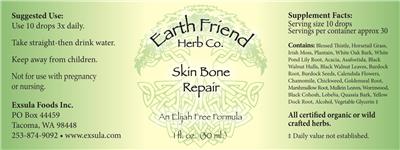
Suggested Use: Use 10 drops 3x daily. Take straight-then drink water.
Precautions
Keep away from children.
Not for use with pregnancy or nursing.
General Statements
An Elijah Free formula
Formulation
All certified organic or wild crafted herbs.
Is this label outdated? Report a formula or label change and our pharmacy team will review it.
Skin Bone Repair by Earth Friend Herb Co. label
The label scan from the NIH Dietary Supplement Label Database. Tap to enlarge.
Label images are published by the NIH Dietary Supplement Label Database for the version of this product on file. Always read your actual product label.
View the full label (PDF)The Ingredients in Skin Bone Repair by Earth Friend Herb Co.
These are the 23 active ingredients this product is made of. Select any to open its full monograph.
Serving size10 Drop(s) Dosage formLiquid Servings per container30 Amounts shown are per serving.
Most supplement products combine several ingredients, and a medication can interact with the product through any one of them. Each ingredient below shows whether it has known drug interactions.
Black Walnut
No knowninteractions
Black walnut is a tree whose green hulls are traditionally used as a natural antiparasitic and digestive remedy, but solid human evidence for these us...
Black Walnut monograph & interactionsGoldenseal
Interacts with1,237 drugs
Goldenseal is a popular North American herb that contains berberine, a compound studied for antimicrobial effects. However, strong human evidence for...
Goldenseal monograph & interactionsIrish Moss
Interacts with22 drugs
Sea moss is a type of red seaweed that is naturally rich in iodine and several minerals, and it is popular as a 'whole-food' supplement. Strong human...
Irish Moss monograph & interactionsBlessed Thistle
Interacts with36 drugs
Blessed thistle is a bitter herb traditionally used to stimulate appetite and ease mild digestive complaints. High-quality human studies are lacking,...
Blessed Thistle monograph & interactionsBlack Walnut
No knowninteractions
Black walnut is a tree whose green hulls are traditionally used as a natural antiparasitic and digestive remedy, but solid human evidence for these us...
Black Walnut monograph & interactionsWormwood
Interacts with889 drugs
Sweet Annie (Artemisia annua) is the source of artemisinin, a compound used in prescription antimalarial drugs. While the purified drug is well studie...
Wormwood monograph & interactionsAsafoetida
Interacts with289 drugs
Asafoetida is a strong-smelling plant resin used widely as a spice and in traditional medicine, mainly for digestive complaints. Solid human evidence...
Asafoetida monograph & interactionsPlantain
Interacts with2,025 drugs
Black psyllium is a soluble-fiber supplement made from the seeds of a Plantago plant, used mostly to ease constipation and support digestive health. I...
Plantain monograph & interactionsBurdock
Interacts with122 drugs
Burdock is a traditional herb most often used for skin problems and as a so-called 'blood purifier,' but high-quality human studies are lacking and mo...
Burdock monograph & interactionsWhite Oak
No knowninteractions
White oak bark is a traditional herbal remedy rich in tannins, used mostly as a tea or skin wash for diarrhea, sore throat, and minor skin problems. S...
White Oak monograph & interactionsAcacia
Interacts with2,022 drugs
Gum arabic is a soluble dietary fiber from the acacia tree that is widely used as a safe food additive and is sometimes taken as a supplement for dige...
Acacia monograph & interactionsLobelia
Interacts with1 drug
Lobelia is a traditional herb once used for breathing problems and to help people quit smoking, but reliable evidence supporting these uses is lacking...
Lobelia monograph & interactionsQuassia
Interacts with198 drugs
Quassia is a tropical wood known for its very bitter taste, traditionally used as a digestive bitter and as a folk remedy for parasites and head lice....
Quassia monograph & interactionsChamomile
Interacts with960 drugs
German chamomile is a widely used herbal remedy taken mainly as a tea for calming, sleep, and digestive complaints. Early research suggests possible b...
Chamomile monograph & interactionsCalendula
Interacts with248 drugs
Calendula is a flowering plant whose petals are used mainly in skin creams, oils, and ointments to soothe minor irritation and support wound healing....
Calendula monograph & interactionsMullein
Interacts with122 drugs
Mullein is a traditional herbal remedy most often used as a tea or syrup to soothe coughs, sore throats, and respiratory irritation. High-quality huma...
Mullein monograph & interactionsHorsetail Grass
Interacts with188 drugs
Horsetail is a traditional herb most often used as a mild diuretic and for hair, nail, and bone support, but high-quality human evidence is limited. I...
Horsetail Grass monograph & interactionsBurdock
Interacts with122 drugs
Burdock is a traditional herb most often used for skin problems and as a so-called 'blood purifier,' but high-quality human studies are lacking and mo...
Burdock monograph & interactionsYellow Dock
Interacts with78 drugs
Yellow dock is a traditional herb used mostly as a mild laxative and a digestive and skin tonic. Good-quality human studies are lacking, so its benefi...
Yellow Dock monograph & interactionsMarshmallow
Interacts with2,040 drugs
Marshmallow root is a traditional herb rich in soothing, gel-like fibers called mucilage, which is why it has long been used for coughs, sore throats,...
Marshmallow monograph & interactionsWhite Pond Lily
No knowninteractions
White Lily (Lilium candidum) is a flowering plant used mostly in traditional skin care, where its bulb- or flower-infused oils are applied for minor s...
White Pond Lily monograph & interactionsBlack Cohosh
Interacts with652 drugs
Black cohosh is a North American plant most often used to ease menopause symptoms like hot flashes, but the research is mixed and far from settled. It...
Black Cohosh monograph & interactionsChickweed
No knowninteractions
Chickweed is a common edible wild plant traditionally used on the skin for itching and minor irritation, and taken as a tea or tincture for various co...
Chickweed monograph & interactionsOther (inactive) ingredients: Alcohol, Glycerin. These complete the product’s ingredient list but are not active constituents.
Skin Bone Repair by Earth Friend Herb Co. Drug Interactions
HelloPharmacist Interaction Report
Skin Bone Repair by Earth Friend Herb Co. contains multiple ingredients with documented interactions with medications.
The most serious concern is yellow dock, which carries major-level interactions with diuretic drugs and digoxin (a heart medication). Yellow dock can cause potassium loss when used long-term or in large amounts, which compounds the potassium-depleting effect of diuretics and increases the risk of digoxin toxicity.
Read the full breakdown — every affected drug type, severity by severity
Several other ingredients interact with common medication categories at moderate severity. Goldenseal affects blood pressure medications (antihypertensive drugs), blood thinners (anticoagulants and antiplatelet drugs), diabetes medications, and drugs metabolized by your liver's cytochrome P450 enzymes—specifically CYP2D6, CYP2C9, and CYP3A4.
Horsetail carries similar liver-enzyme interactions, plus concerns with diabetes medications, diuretics, lithium, and HIV antiretrovirals. Wormwood (listed as Sweet Annie) may alter drugs metabolized by CYP3A4 and CYP2B6, and theoretically affects liver-toxic drugs.
Black cohosh interacts with liver function, estrogen therapy, blood pressure and heart medications, cancer drugs, and serotonergic antidepressants. Asafoetida affects blood pressure and blood thinner medications.
Marshmallow may interact with lithium and affect how your body absorbs oral medications taken at the same time.
Minor interactions are documented with blessed thistle, quassia, calendula, and mullein—mostly affecting stomach acid medications (H2-blockers, antacids, PPIs) or blood thinners. We could not check Irish moss, plantain, acacia, or chamomile for interactions; no data are on file for those ingredients.
Altogether, these interactions span 2,180 individual medications. Run your complete medication list through the interaction checker below before you start this product.
Check your own medications below · Editorial policy · How we use AI
Want to check YOUR meds against Skin Bone Repair?
Ask about interactions with your drugs in plain English — “Can I take it with lisinopril?” — and we find you the answer in seconds, ingredient by ingredient.
Go to the checkerIngredients driving the most interactions
Individual Drug Interactions
The ingredients in Skin Bone Repair interact with 2,209 drugs. Click any drug to see the details.
17 of the 23 ingredients in Skin Bone Repair interact with drugs. Each result below shows which ingredient is responsible. Marshmallow Plantain Acacia Goldenseal Chamomile Wormwood Black Cohosh Asafoetida Calendula Quassia Horsetail Grass Burdock Mullein Yellow Dock Blessed Thistle Irish Moss Lobelia
Acetaminophen, Caffeine, PyrilamineMidol Max Strength Menstrual
How Acetaminophen, Caffeine, Pyrilamine interacts with Skin Bone Repair — through 10 ingredients. Tap an ingredient for the detail:
Yellow DockDiuretic Drugs Major
Interaction Summary
Theoretically, yellow dock might increase the risk of hypokalemia when taken with diuretics.
Read the full Yellow Dock + Acetaminophen, Caffeine, Pyrilamine interactionGoldensealCytochrome P450 3a4 (cyp3a4) Substrates, Cytochrome P450 2e1 (cyp2e1) Substrates Moderate
Interaction Summary
Goldenseal might increase serum levels of drugs metabolized by CYP3A4.
Read the full Goldenseal + Acetaminophen, Caffeine, Pyrilamine interactionAcaciaOral Drugs Moderate
Interaction Summary
Theoretically, gum arabic can alter the absorption of oral drugs due to its fiber content.
Read the full Acacia + Acetaminophen, Caffeine, Pyrilamine interactionWormwoodCytochrome P450 3a4 (cyp3a4) Substrates, Hepatotoxic Drugs Moderate
Interaction Summary
Sweet Annie may alter plasma levels and clinical effects of drugs metabolized by CYP3A4.
Read the full Wormwood + Acetaminophen, Caffeine, Pyrilamine interactionQuassiaDiuretic Drugs Moderate
Interaction Summary
Overuse of quassia might compound diuretic-induced potassium loss.
Read the full Quassia + Acetaminophen, Caffeine, Pyrilamine interactionChamomileCytochrome P450 3a4 (cyp3a4) Substrates, Cytochrome P450 1a2 (cyp1a2) Substrates Moderate
Interaction Summary
Theoretically, German chamomile might inhibit CYP3A4 and increase levels of drugs metabolized by these enzymes.
Read the full Chamomile + Acetaminophen, Caffeine, Pyrilamine interactionBlack CohoshHepatotoxic Drugs Moderate
Interaction Summary
Theoretically, taking black cohosh with hepatotoxic drugs may increase the risk of liver damage.
Read the full Black Cohosh + Acetaminophen, Caffeine, Pyrilamine interactionHorsetail GrassDiuretic Drugs Moderate
Interaction Summary
Theoretically, taking horsetail with diuretic drugs might increase potassium loss and the risk of hypokalemia.
Read the full Horsetail Grass + Acetaminophen, Caffeine, Pyrilamine interactionMarshmallowOral Drugs Minor
Interaction Summary
Theoretically, mucilage in marshmallow might impair absorption of oral drugs.
Read the full Marshmallow + Acetaminophen, Caffeine, Pyrilamine interactionPlantainOral Drugs Minor
Interaction Summary
Theoretically, psyllium might increase, decrease, or have no effect on the absorption of oral drugs.
Read the full Plantain + Acetaminophen, Caffeine, Pyrilamine interactionAcetaminophen, Pamabrom, PyrilamineMidol Max Strength PMS, Pamprin, Pamprin ES
How Acetaminophen, Pamabrom, Pyrilamine interacts with Skin Bone Repair — through 10 ingredients. Tap an ingredient for the detail:
Yellow DockDiuretic Drugs Major
Interaction Summary
Theoretically, yellow dock might increase the risk of hypokalemia when taken with diuretics.
Read the full Yellow Dock + Acetaminophen, Pamabrom, Pyrilamine interactionAcaciaOral Drugs Moderate
Interaction Summary
Theoretically, gum arabic can alter the absorption of oral drugs due to its fiber content.
Read the full Acacia + Acetaminophen, Pamabrom, Pyrilamine interactionQuassiaDiuretic Drugs Moderate
Interaction Summary
Overuse of quassia might compound diuretic-induced potassium loss.
Read the full Quassia + Acetaminophen, Pamabrom, Pyrilamine interactionWormwoodHepatotoxic Drugs Moderate
Interaction Summary
Theoretically, concomitant use might have additive adverse hepatotoxic effects.
Read the full Wormwood + Acetaminophen, Pamabrom, Pyrilamine interactionGoldensealCytochrome P450 2e1 (cyp2e1) Substrates Moderate
Interaction Summary
Theoretically, goldenseal might increase serum levels of drugs metabolized by CYP2E1.
Read the full Goldenseal + Acetaminophen, Pamabrom, Pyrilamine interactionBlack CohoshHepatotoxic Drugs Moderate
Interaction Summary
Theoretically, taking black cohosh with hepatotoxic drugs may increase the risk of liver damage.
Read the full Black Cohosh + Acetaminophen, Pamabrom, Pyrilamine interactionHorsetail GrassDiuretic Drugs Moderate
Interaction Summary
Theoretically, taking horsetail with diuretic drugs might increase potassium loss and the risk of hypokalemia.
Read the full Horsetail Grass + Acetaminophen, Pamabrom, Pyrilamine interactionMarshmallowOral Drugs Minor
Interaction Summary
Theoretically, mucilage in marshmallow might impair absorption of oral drugs.
Read the full Marshmallow + Acetaminophen, Pamabrom, Pyrilamine interactionChamomileCytochrome P450 1a2 (cyp1a2) Substrates Minor
Interaction Summary
Theoretically, German chamomile might inhibit CYP1A2 and increase levels of drugs metabolized by these enzymes.
Read the full Chamomile + Acetaminophen, Pamabrom, Pyrilamine interactionPlantainOral Drugs Minor
Interaction Summary
Theoretically, psyllium might increase, decrease, or have no effect on the absorption of oral drugs.
Read the full Plantain + Acetaminophen, Pamabrom, Pyrilamine interactionAcetazolamideAk-Zol, Diamox
How Acetazolamide interacts with Skin Bone Repair — through 10 ingredients. Tap an ingredient for the detail:
Yellow DockDiuretic Drugs Major
Interaction Summary
Theoretically, yellow dock might increase the risk of hypokalemia when taken with diuretics.
Read the full Yellow Dock + Acetazolamide interactionChamomileCns Depressants Moderate
Interaction Summary
Theoretically, German chamomile might have additive effects when used with CNS depressants.
Read the full Chamomile + Acetazolamide interactionGoldensealCns Depressants, Antihypertensive Drugs Moderate
Interaction Summary
Theoretically, goldenseal might increase the sedative effects of CNS depressants.
Read the full Goldenseal + Acetazolamide interactionHorsetail GrassDiuretic Drugs Moderate
Interaction Summary
Theoretically, taking horsetail with diuretic drugs might increase potassium loss and the risk of hypokalemia.
Read the full Horsetail Grass + Acetazolamide interactionQuassiaDiuretic Drugs Moderate
Interaction Summary
Overuse of quassia might compound diuretic-induced potassium loss.
Read the full Quassia + Acetazolamide interactionAcaciaOral Drugs Moderate
Interaction Summary
Theoretically, gum arabic can alter the absorption of oral drugs due to its fiber content.
Read the full Acacia + Acetazolamide interactionAsafoetidaAntihypertensive Drugs Moderate
Interaction Summary
Evidence from animal research suggests that asafoetida has hypotensive effects.
Read the full Asafoetida + Acetazolamide interactionMarshmallowOral Drugs Minor
Interaction Summary
Theoretically, mucilage in marshmallow might impair absorption of oral drugs.
Read the full Marshmallow + Acetazolamide interactionPlantainOral Drugs Minor
Interaction Summary
Theoretically, psyllium might increase, decrease, or have no effect on the absorption of oral drugs.
Read the full Plantain + Acetazolamide interactionCalendulaCns Depressants Minor
Interaction Summary
Theoretically, calendula might have additive effects when used with CNS depressants, although this appears to be unlikely.
Read the full Calendula + Acetazolamide interactionAmiloride, HydrochlorothiazideAmil-Co, Amilzide, Moduret 25, Moduretic
How Amiloride, Hydrochlorothiazide interacts with Skin Bone Repair — through 8 ingredients. Tap an ingredient for the detail:
Yellow DockDiuretic Drugs Major
Interaction Summary
Theoretically, yellow dock might increase the risk of hypokalemia when taken with diuretics.
Read the full Yellow Dock + Amiloride, Hydrochlorothiazide interactionGoldensealAntihypertensive Drugs Moderate
Interaction Summary
Theoretically, goldenseal might increase the risk of hypotension when taken with antihypertensive drugs.
Read the full Goldenseal + Amiloride, Hydrochlorothiazide interactionHorsetail GrassDiuretic Drugs Moderate
Interaction Summary
Theoretically, taking horsetail with diuretic drugs might increase potassium loss and the risk of hypokalemia.
Read the full Horsetail Grass + Amiloride, Hydrochlorothiazide interactionAcaciaOral Drugs Moderate
Interaction Summary
Theoretically, gum arabic can alter the absorption of oral drugs due to its fiber content.
Read the full Acacia + Amiloride, Hydrochlorothiazide interactionAsafoetidaAntihypertensive Drugs Moderate
Interaction Summary
Evidence from animal research suggests that asafoetida has hypotensive effects.
Read the full Asafoetida + Amiloride, Hydrochlorothiazide interactionQuassiaDiuretic Drugs Moderate
Interaction Summary
Overuse of quassia might compound diuretic-induced potassium loss.
Read the full Quassia + Amiloride, Hydrochlorothiazide interactionPlantainOral Drugs Minor
Interaction Summary
Theoretically, psyllium might increase, decrease, or have no effect on the absorption of oral drugs.
Read the full Plantain + Amiloride, Hydrochlorothiazide interactionMarshmallowOral Drugs Minor
Interaction Summary
Theoretically, mucilage in marshmallow might impair absorption of oral drugs.
Read the full Marshmallow + Amiloride, Hydrochlorothiazide interactionAmmonium ChlorideAmmonium Chloride
How Ammonium Chloride interacts with Skin Bone Repair — through 8 ingredients. Tap an ingredient for the detail:
Yellow DockDiuretic Drugs Major
Interaction Summary
Theoretically, yellow dock might increase the risk of hypokalemia when taken with diuretics.
Read the full Yellow Dock + Ammonium Chloride interactionHorsetail GrassDiuretic Drugs Moderate
Interaction Summary
Theoretically, taking horsetail with diuretic drugs might increase potassium loss and the risk of hypokalemia.
Read the full Horsetail Grass + Ammonium Chloride interactionAsafoetidaAntihypertensive Drugs Moderate
Interaction Summary
Evidence from animal research suggests that asafoetida has hypotensive effects.
Read the full Asafoetida + Ammonium Chloride interactionAcaciaOral Drugs Moderate
Interaction Summary
Theoretically, gum arabic can alter the absorption of oral drugs due to its fiber content.
Read the full Acacia + Ammonium Chloride interactionGoldensealAntihypertensive Drugs Moderate
Interaction Summary
Theoretically, goldenseal might increase the risk of hypotension when taken with antihypertensive drugs.
Read the full Goldenseal + Ammonium Chloride interactionQuassiaDiuretic Drugs Moderate
Interaction Summary
Overuse of quassia might compound diuretic-induced potassium loss.
Read the full Quassia + Ammonium Chloride interactionMarshmallowOral Drugs Minor
Interaction Summary
Theoretically, mucilage in marshmallow might impair absorption of oral drugs.
Read the full Marshmallow + Ammonium Chloride interactionPlantainOral Drugs Minor
Interaction Summary
Theoretically, psyllium might increase, decrease, or have no effect on the absorption of oral drugs.
Read the full Plantain + Ammonium Chloride interactionAtenolol, ChlortalidoneAtenixCo, Tenoret 50, Totaretic
How Atenolol, Chlortalidone interacts with Skin Bone Repair — through 8 ingredients. Tap an ingredient for the detail:
Yellow DockDiuretic Drugs Major
Interaction Summary
Theoretically, yellow dock might increase the risk of hypokalemia when taken with diuretics.
Read the full Yellow Dock + Atenolol, Chlortalidone interactionQuassiaDiuretic Drugs Moderate
Interaction Summary
Overuse of quassia might compound diuretic-induced potassium loss.
Read the full Quassia + Atenolol, Chlortalidone interactionAcaciaOral Drugs Moderate
Interaction Summary
Theoretically, gum arabic can alter the absorption of oral drugs due to its fiber content.
Read the full Acacia + Atenolol, Chlortalidone interactionGoldensealAntihypertensive Drugs Moderate
Interaction Summary
Theoretically, goldenseal might increase the risk of hypotension when taken with antihypertensive drugs.
Read the full Goldenseal + Atenolol, Chlortalidone interactionHorsetail GrassDiuretic Drugs Moderate
Interaction Summary
Theoretically, taking horsetail with diuretic drugs might increase potassium loss and the risk of hypokalemia.
Read the full Horsetail Grass + Atenolol, Chlortalidone interactionAsafoetidaAntihypertensive Drugs Moderate
Interaction Summary
Evidence from animal research suggests that asafoetida has hypotensive effects.
Read the full Asafoetida + Atenolol, Chlortalidone interactionPlantainOral Drugs Minor
Interaction Summary
Theoretically, psyllium might increase, decrease, or have no effect on the absorption of oral drugs.
Read the full Plantain + Atenolol, Chlortalidone interactionMarshmallowOral Drugs Minor
Interaction Summary
Theoretically, mucilage in marshmallow might impair absorption of oral drugs.
Read the full Marshmallow + Atenolol, Chlortalidone interactionAtenolol, ChlorthalidoneTenoretic
How Atenolol, Chlorthalidone interacts with Skin Bone Repair — through 8 ingredients. Tap an ingredient for the detail:
Yellow DockDiuretic Drugs Major
Interaction Summary
Theoretically, yellow dock might increase the risk of hypokalemia when taken with diuretics.
Read the full Yellow Dock + Atenolol, Chlorthalidone interactionAsafoetidaAntihypertensive Drugs Moderate
Interaction Summary
Evidence from animal research suggests that asafoetida has hypotensive effects.
Read the full Asafoetida + Atenolol, Chlorthalidone interactionAcaciaOral Drugs Moderate
Interaction Summary
Theoretically, gum arabic can alter the absorption of oral drugs due to its fiber content.
Read the full Acacia + Atenolol, Chlorthalidone interactionQuassiaDiuretic Drugs Moderate
Interaction Summary
Overuse of quassia might compound diuretic-induced potassium loss.
Read the full Quassia + Atenolol, Chlorthalidone interactionHorsetail GrassDiuretic Drugs Moderate
Interaction Summary
Theoretically, taking horsetail with diuretic drugs might increase potassium loss and the risk of hypokalemia.
Read the full Horsetail Grass + Atenolol, Chlorthalidone interactionGoldensealAntihypertensive Drugs Moderate
Interaction Summary
Theoretically, goldenseal might increase the risk of hypotension when taken with antihypertensive drugs.
Read the full Goldenseal + Atenolol, Chlorthalidone interactionPlantainOral Drugs Minor
Interaction Summary
Theoretically, psyllium might increase, decrease, or have no effect on the absorption of oral drugs.
Read the full Plantain + Atenolol, Chlorthalidone interactionMarshmallowOral Drugs Minor
Interaction Summary
Theoretically, mucilage in marshmallow might impair absorption of oral drugs.
Read the full Marshmallow + Atenolol, Chlorthalidone interactionAzilsartan, ChlorthalidoneEdarbyclor
How Azilsartan, Chlorthalidone interacts with Skin Bone Repair — through 9 ingredients. Tap an ingredient for the detail:
Yellow DockDiuretic Drugs Major
Interaction Summary
Theoretically, yellow dock might increase the risk of hypokalemia when taken with diuretics.
Read the full Yellow Dock + Azilsartan, Chlorthalidone interactionAcaciaOral Drugs Moderate
Interaction Summary
Theoretically, gum arabic can alter the absorption of oral drugs due to its fiber content.
Read the full Acacia + Azilsartan, Chlorthalidone interactionGoldensealAntihypertensive Drugs, Cytochrome P450 2c9 (cyp2c9) Substrates Moderate
Interaction Summary
Theoretically, goldenseal might increase the risk of hypotension when taken with antihypertensive drugs.
Read the full Goldenseal + Azilsartan, Chlorthalidone interactionHorsetail GrassDiuretic Drugs Moderate
Interaction Summary
Theoretically, taking horsetail with diuretic drugs might increase potassium loss and the risk of hypokalemia.
Read the full Horsetail Grass + Azilsartan, Chlorthalidone interactionAsafoetidaAntihypertensive Drugs Moderate
Interaction Summary
Evidence from animal research suggests that asafoetida has hypotensive effects.
Read the full Asafoetida + Azilsartan, Chlorthalidone interactionChamomileCytochrome P450 2c9 (cyp2c9) Substrates Moderate
Interaction Summary
Theoretically, German chamomile might inhibit CYP2C9 and increase levels of drugs metabolized by these enzymes.
Read the full Chamomile + Azilsartan, Chlorthalidone interactionQuassiaDiuretic Drugs Moderate
Interaction Summary
Overuse of quassia might compound diuretic-induced potassium loss.
Read the full Quassia + Azilsartan, Chlorthalidone interactionPlantainOral Drugs Minor
Interaction Summary
Theoretically, psyllium might increase, decrease, or have no effect on the absorption of oral drugs.
Read the full Plantain + Azilsartan, Chlorthalidone interactionMarshmallowOral Drugs Minor
Interaction Summary
Theoretically, mucilage in marshmallow might impair absorption of oral drugs.
Read the full Marshmallow + Azilsartan, Chlorthalidone interactionBenazepril, HydrochlorothiazideLotensin HCT
How Benazepril, Hydrochlorothiazide interacts with Skin Bone Repair — through 8 ingredients. Tap an ingredient for the detail:
Yellow DockDiuretic Drugs Major
Interaction Summary
Theoretically, yellow dock might increase the risk of hypokalemia when taken with diuretics.
Read the full Yellow Dock + Benazepril, Hydrochlorothiazide interactionAsafoetidaAntihypertensive Drugs Moderate
Interaction Summary
Evidence from animal research suggests that asafoetida has hypotensive effects.
Read the full Asafoetida + Benazepril, Hydrochlorothiazide interactionAcaciaOral Drugs Moderate
Interaction Summary
Theoretically, gum arabic can alter the absorption of oral drugs due to its fiber content.
Read the full Acacia + Benazepril, Hydrochlorothiazide interactionGoldensealAntihypertensive Drugs Moderate
Interaction Summary
Theoretically, goldenseal might increase the risk of hypotension when taken with antihypertensive drugs.
Read the full Goldenseal + Benazepril, Hydrochlorothiazide interactionHorsetail GrassDiuretic Drugs Moderate
Interaction Summary
Theoretically, taking horsetail with diuretic drugs might increase potassium loss and the risk of hypokalemia.
Read the full Horsetail Grass + Benazepril, Hydrochlorothiazide interactionQuassiaDiuretic Drugs Moderate
Interaction Summary
Overuse of quassia might compound diuretic-induced potassium loss.
Read the full Quassia + Benazepril, Hydrochlorothiazide interactionPlantainOral Drugs Minor
Interaction Summary
Theoretically, psyllium might increase, decrease, or have no effect on the absorption of oral drugs.
Read the full Plantain + Benazepril, Hydrochlorothiazide interactionMarshmallowOral Drugs Minor
Interaction Summary
Theoretically, mucilage in marshmallow might impair absorption of oral drugs.
Read the full Marshmallow + Benazepril, Hydrochlorothiazide interactionBendroflumethiazideAprinox, Naturetin, Neo-NaClex
How Bendroflumethiazide interacts with Skin Bone Repair — through 8 ingredients. Tap an ingredient for the detail:
Yellow DockDiuretic Drugs Major
Interaction Summary
Theoretically, yellow dock might increase the risk of hypokalemia when taken with diuretics.
Read the full Yellow Dock + Bendroflumethiazide interactionHorsetail GrassDiuretic Drugs Moderate
Interaction Summary
Theoretically, taking horsetail with diuretic drugs might increase potassium loss and the risk of hypokalemia.
Read the full Horsetail Grass + Bendroflumethiazide interactionGoldensealAntihypertensive Drugs Moderate
Interaction Summary
Theoretically, goldenseal might increase the risk of hypotension when taken with antihypertensive drugs.
Read the full Goldenseal + Bendroflumethiazide interactionAcaciaOral Drugs Moderate
Interaction Summary
Theoretically, gum arabic can alter the absorption of oral drugs due to its fiber content.
Read the full Acacia + Bendroflumethiazide interactionAsafoetidaAntihypertensive Drugs Moderate
Interaction Summary
Evidence from animal research suggests that asafoetida has hypotensive effects.
Read the full Asafoetida + Bendroflumethiazide interactionQuassiaDiuretic Drugs Moderate
Interaction Summary
Overuse of quassia might compound diuretic-induced potassium loss.
Read the full Quassia + Bendroflumethiazide interactionPlantainOral Drugs Minor
Interaction Summary
Theoretically, psyllium might increase, decrease, or have no effect on the absorption of oral drugs.
Read the full Plantain + Bendroflumethiazide interactionMarshmallowOral Drugs Minor
Interaction Summary
Theoretically, mucilage in marshmallow might impair absorption of oral drugs.
Read the full Marshmallow + Bendroflumethiazide interactionBendroflumethiazide, NadololCorzide
How Bendroflumethiazide, Nadolol interacts with Skin Bone Repair — through 8 ingredients. Tap an ingredient for the detail:
Yellow DockDiuretic Drugs Major
Interaction Summary
Theoretically, yellow dock might increase the risk of hypokalemia when taken with diuretics.
Read the full Yellow Dock + Bendroflumethiazide, Nadolol interactionAsafoetidaAntihypertensive Drugs Moderate
Interaction Summary
Evidence from animal research suggests that asafoetida has hypotensive effects.
Read the full Asafoetida + Bendroflumethiazide, Nadolol interactionAcaciaOral Drugs Moderate
Interaction Summary
Theoretically, gum arabic can alter the absorption of oral drugs due to its fiber content.
Read the full Acacia + Bendroflumethiazide, Nadolol interactionHorsetail GrassDiuretic Drugs Moderate
Interaction Summary
Theoretically, taking horsetail with diuretic drugs might increase potassium loss and the risk of hypokalemia.
Read the full Horsetail Grass + Bendroflumethiazide, Nadolol interactionGoldensealAntihypertensive Drugs Moderate
Interaction Summary
Theoretically, goldenseal might increase the risk of hypotension when taken with antihypertensive drugs.
Read the full Goldenseal + Bendroflumethiazide, Nadolol interactionQuassiaDiuretic Drugs Moderate
Interaction Summary
Overuse of quassia might compound diuretic-induced potassium loss.
Read the full Quassia + Bendroflumethiazide, Nadolol interactionMarshmallowOral Drugs Minor
Interaction Summary
Theoretically, mucilage in marshmallow might impair absorption of oral drugs.
Read the full Marshmallow + Bendroflumethiazide, Nadolol interactionPlantainOral Drugs Minor
Interaction Summary
Theoretically, psyllium might increase, decrease, or have no effect on the absorption of oral drugs.
Read the full Plantain + Bendroflumethiazide, Nadolol interactionBendroflumethiazide, PotassiumCentyl K, Neo-NaClex-K
How Bendroflumethiazide, Potassium interacts with Skin Bone Repair — through 6 ingredients. Tap an ingredient for the detail:
Yellow DockDiuretic Drugs Major
Interaction Summary
Theoretically, yellow dock might increase the risk of hypokalemia when taken with diuretics.
Read the full Yellow Dock + Bendroflumethiazide, Potassium interactionHorsetail GrassDiuretic Drugs Moderate
Interaction Summary
Theoretically, taking horsetail with diuretic drugs might increase potassium loss and the risk of hypokalemia.
Read the full Horsetail Grass + Bendroflumethiazide, Potassium interactionQuassiaDiuretic Drugs Moderate
Interaction Summary
Overuse of quassia might compound diuretic-induced potassium loss.
Read the full Quassia + Bendroflumethiazide, Potassium interactionAcaciaOral Drugs Moderate
Interaction Summary
Theoretically, gum arabic can alter the absorption of oral drugs due to its fiber content.
Read the full Acacia + Bendroflumethiazide, Potassium interactionPlantainOral Drugs Minor
Interaction Summary
Theoretically, psyllium might increase, decrease, or have no effect on the absorption of oral drugs.
Read the full Plantain + Bendroflumethiazide, Potassium interactionMarshmallowOral Drugs Minor
Interaction Summary
Theoretically, mucilage in marshmallow might impair absorption of oral drugs.
Read the full Marshmallow + Bendroflumethiazide, Potassium interactionBendroflumethiazide, Rauwolfia SerpentinaRauzide
How Bendroflumethiazide, Rauwolfia Serpentina interacts with Skin Bone Repair — through 8 ingredients. Tap an ingredient for the detail:
Yellow DockDiuretic Drugs Major
Interaction Summary
Theoretically, yellow dock might increase the risk of hypokalemia when taken with diuretics.
Read the full Yellow Dock + Bendroflumethiazide, Rauwolfia Serpentina interactionHorsetail GrassDiuretic Drugs Moderate
Interaction Summary
Theoretically, taking horsetail with diuretic drugs might increase potassium loss and the risk of hypokalemia.
Read the full Horsetail Grass + Bendroflumethiazide, Rauwolfia Serpentina interactionAcaciaOral Drugs Moderate
Interaction Summary
Theoretically, gum arabic can alter the absorption of oral drugs due to its fiber content.
Read the full Acacia + Bendroflumethiazide, Rauwolfia Serpentina interactionAsafoetidaAntihypertensive Drugs Moderate
Interaction Summary
Evidence from animal research suggests that asafoetida has hypotensive effects.
Read the full Asafoetida + Bendroflumethiazide, Rauwolfia Serpentina interactionQuassiaDiuretic Drugs Moderate
Interaction Summary
Overuse of quassia might compound diuretic-induced potassium loss.
Read the full Quassia + Bendroflumethiazide, Rauwolfia Serpentina interactionGoldensealAntihypertensive Drugs Moderate
Interaction Summary
Theoretically, goldenseal might increase the risk of hypotension when taken with antihypertensive drugs.
Read the full Goldenseal + Bendroflumethiazide, Rauwolfia Serpentina interactionPlantainOral Drugs Minor
Interaction Summary
Theoretically, psyllium might increase, decrease, or have no effect on the absorption of oral drugs.
Read the full Plantain + Bendroflumethiazide, Rauwolfia Serpentina interactionMarshmallowOral Drugs Minor
Interaction Summary
Theoretically, mucilage in marshmallow might impair absorption of oral drugs.
Read the full Marshmallow + Bendroflumethiazide, Rauwolfia Serpentina interactionBenzthiazideExna
How Benzthiazide interacts with Skin Bone Repair — through 8 ingredients. Tap an ingredient for the detail:
Yellow DockDiuretic Drugs Major
Interaction Summary
Theoretically, yellow dock might increase the risk of hypokalemia when taken with diuretics.
Read the full Yellow Dock + Benzthiazide interactionAcaciaOral Drugs Moderate
Interaction Summary
Theoretically, gum arabic can alter the absorption of oral drugs due to its fiber content.
Read the full Acacia + Benzthiazide interactionAsafoetidaAntihypertensive Drugs Moderate
Interaction Summary
Evidence from animal research suggests that asafoetida has hypotensive effects.
Read the full Asafoetida + Benzthiazide interactionHorsetail GrassDiuretic Drugs Moderate
Interaction Summary
Theoretically, taking horsetail with diuretic drugs might increase potassium loss and the risk of hypokalemia.
Read the full Horsetail Grass + Benzthiazide interactionQuassiaDiuretic Drugs Moderate
Interaction Summary
Overuse of quassia might compound diuretic-induced potassium loss.
Read the full Quassia + Benzthiazide interactionGoldensealAntihypertensive Drugs Moderate
Interaction Summary
Theoretically, goldenseal might increase the risk of hypotension when taken with antihypertensive drugs.
Read the full Goldenseal + Benzthiazide interactionMarshmallowOral Drugs Minor
Interaction Summary
Theoretically, mucilage in marshmallow might impair absorption of oral drugs.
Read the full Marshmallow + Benzthiazide interactionPlantainOral Drugs Minor
Interaction Summary
Theoretically, psyllium might increase, decrease, or have no effect on the absorption of oral drugs.
Read the full Plantain + Benzthiazide interactionBisoprolol, HydrochlorothiazideZiac
How Bisoprolol, Hydrochlorothiazide interacts with Skin Bone Repair — through 10 ingredients. Tap an ingredient for the detail:
Yellow DockDiuretic Drugs Major
Interaction Summary
Theoretically, yellow dock might increase the risk of hypokalemia when taken with diuretics.
Read the full Yellow Dock + Bisoprolol, Hydrochlorothiazide interactionChamomileCytochrome P450 2d6 (cyp2d6) Substrates Moderate
Interaction Summary
Theoretically, German chamomile might inhibit CYP2D6 and increase levels of drugs metabolized by these enzymes.
Read the full Chamomile + Bisoprolol, Hydrochlorothiazide interactionGoldensealAntihypertensive Drugs, Cytochrome P450 2d6 (cyp2d6) Substrates Moderate
Interaction Summary
Theoretically, goldenseal might increase the risk of hypotension when taken with antihypertensive drugs.
Read the full Goldenseal + Bisoprolol, Hydrochlorothiazide interactionHorsetail GrassDiuretic Drugs Moderate
Interaction Summary
Theoretically, taking horsetail with diuretic drugs might increase potassium loss and the risk of hypokalemia.
Read the full Horsetail Grass + Bisoprolol, Hydrochlorothiazide interactionBlack CohoshCytochrome P450 2d6 (cyp2d6) Substrates Moderate
Interaction Summary
Some research suggests that black cohosh might inhibit CYP2D6, but there is conflicting evidence.
Read the full Black Cohosh + Bisoprolol, Hydrochlorothiazide interactionQuassiaDiuretic Drugs Moderate
Interaction Summary
Overuse of quassia might compound diuretic-induced potassium loss.
Read the full Quassia + Bisoprolol, Hydrochlorothiazide interactionAsafoetidaAntihypertensive Drugs Moderate
Interaction Summary
Evidence from animal research suggests that asafoetida has hypotensive effects.
Read the full Asafoetida + Bisoprolol, Hydrochlorothiazide interactionAcaciaOral Drugs Moderate
Interaction Summary
Theoretically, gum arabic can alter the absorption of oral drugs due to its fiber content.
Read the full Acacia + Bisoprolol, Hydrochlorothiazide interactionPlantainOral Drugs Minor
Interaction Summary
Theoretically, psyllium might increase, decrease, or have no effect on the absorption of oral drugs.
Read the full Plantain + Bisoprolol, Hydrochlorothiazide interactionMarshmallowOral Drugs Minor
Interaction Summary
Theoretically, mucilage in marshmallow might impair absorption of oral drugs.
Read the full Marshmallow + Bisoprolol, Hydrochlorothiazide interactionBumetanideBurinex
How Bumetanide interacts with Skin Bone Repair — through 8 ingredients. Tap an ingredient for the detail:
Yellow DockDiuretic Drugs Major
Interaction Summary
Theoretically, yellow dock might increase the risk of hypokalemia when taken with diuretics.
Read the full Yellow Dock + Bumetanide interactionQuassiaDiuretic Drugs Moderate
Interaction Summary
Overuse of quassia might compound diuretic-induced potassium loss.
Read the full Quassia + Bumetanide interactionGoldensealAntihypertensive Drugs Moderate
Interaction Summary
Theoretically, goldenseal might increase the risk of hypotension when taken with antihypertensive drugs.
Read the full Goldenseal + Bumetanide interactionHorsetail GrassDiuretic Drugs Moderate
Interaction Summary
Theoretically, taking horsetail with diuretic drugs might increase potassium loss and the risk of hypokalemia.
Read the full Horsetail Grass + Bumetanide interactionAsafoetidaAntihypertensive Drugs Moderate
Interaction Summary
Evidence from animal research suggests that asafoetida has hypotensive effects.
Read the full Asafoetida + Bumetanide interactionAcaciaOral Drugs Moderate
Interaction Summary
Theoretically, gum arabic can alter the absorption of oral drugs due to its fiber content.
Read the full Acacia + Bumetanide interactionMarshmallowOral Drugs Minor
Interaction Summary
Theoretically, mucilage in marshmallow might impair absorption of oral drugs.
Read the full Marshmallow + Bumetanide interactionPlantainOral Drugs Minor
Interaction Summary
Theoretically, psyllium might increase, decrease, or have no effect on the absorption of oral drugs.
Read the full Plantain + Bumetanide interactionBumetanide, PotassiumBurinex K
How Bumetanide, Potassium interacts with Skin Bone Repair — through 6 ingredients. Tap an ingredient for the detail:
Yellow DockDiuretic Drugs Major
Interaction Summary
Theoretically, yellow dock might increase the risk of hypokalemia when taken with diuretics.
Read the full Yellow Dock + Bumetanide, Potassium interactionAcaciaOral Drugs Moderate
Interaction Summary
Theoretically, gum arabic can alter the absorption of oral drugs due to its fiber content.
Read the full Acacia + Bumetanide, Potassium interactionQuassiaDiuretic Drugs Moderate
Interaction Summary
Overuse of quassia might compound diuretic-induced potassium loss.
Read the full Quassia + Bumetanide, Potassium interactionHorsetail GrassDiuretic Drugs Moderate
Interaction Summary
Theoretically, taking horsetail with diuretic drugs might increase potassium loss and the risk of hypokalemia.
Read the full Horsetail Grass + Bumetanide, Potassium interactionMarshmallowOral Drugs Minor
Interaction Summary
Theoretically, mucilage in marshmallow might impair absorption of oral drugs.
Read the full Marshmallow + Bumetanide, Potassium interactionPlantainOral Drugs Minor
Interaction Summary
Theoretically, psyllium might increase, decrease, or have no effect on the absorption of oral drugs.
Read the full Plantain + Bumetanide, Potassium interactionCaffeine, Potassium Salicylate, SalicylamideTrim-Elim
How Caffeine, Potassium Salicylate, Salicylamide interacts with Skin Bone Repair — through 9 ingredients. Tap an ingredient for the detail:
Yellow DockDiuretic Drugs Major
Interaction Summary
Theoretically, yellow dock might increase the risk of hypokalemia when taken with diuretics.
Read the full Yellow Dock + Caffeine, Potassium Salicylate, Salicylamide interactionAcaciaOral Drugs Moderate
Interaction Summary
Theoretically, gum arabic can alter the absorption of oral drugs due to its fiber content.
Read the full Acacia + Caffeine, Potassium Salicylate, Salicylamide interactionGoldensealCytochrome P450 3a4 (cyp3a4) Substrates Moderate
Interaction Summary
Goldenseal might increase serum levels of drugs metabolized by CYP3A4.
Read the full Goldenseal + Caffeine, Potassium Salicylate, Salicylamide interactionChamomileCytochrome P450 3a4 (cyp3a4) Substrates, Cytochrome P450 1a2 (cyp1a2) Substrates Moderate
Interaction Summary
Theoretically, German chamomile might inhibit CYP3A4 and increase levels of drugs metabolized by these enzymes.
Read the full Chamomile + Caffeine, Potassium Salicylate, Salicylamide interactionWormwoodCytochrome P450 3a4 (cyp3a4) Substrates Moderate
Interaction Summary
Sweet Annie may alter plasma levels and clinical effects of drugs metabolized by CYP3A4.
Read the full Wormwood + Caffeine, Potassium Salicylate, Salicylamide interactionQuassiaDiuretic Drugs Moderate
Interaction Summary
Overuse of quassia might compound diuretic-induced potassium loss.
Read the full Quassia + Caffeine, Potassium Salicylate, Salicylamide interactionHorsetail GrassDiuretic Drugs Moderate
Interaction Summary
Theoretically, taking horsetail with diuretic drugs might increase potassium loss and the risk of hypokalemia.
Read the full Horsetail Grass + Caffeine, Potassium Salicylate, Salicylamide interactionMarshmallowOral Drugs Minor
Interaction Summary
Theoretically, mucilage in marshmallow might impair absorption of oral drugs.
Read the full Marshmallow + Caffeine, Potassium Salicylate, Salicylamide interactionPlantainOral Drugs Minor
Interaction Summary
Theoretically, psyllium might increase, decrease, or have no effect on the absorption of oral drugs.
Read the full Plantain + Caffeine, Potassium Salicylate, Salicylamide interactionCandesartan Cilexetil, HydrochlorothiazideAtacand HCT
How Candesartan Cilexetil, Hydrochlorothiazide interacts with Skin Bone Repair — through 8 ingredients. Tap an ingredient for the detail:
Yellow DockDiuretic Drugs Major
Interaction Summary
Theoretically, yellow dock might increase the risk of hypokalemia when taken with diuretics.
Read the full Yellow Dock + Candesartan Cilexetil, Hydrochlorothiazide interactionGoldensealAntihypertensive Drugs Moderate
Interaction Summary
Theoretically, goldenseal might increase the risk of hypotension when taken with antihypertensive drugs.
Read the full Goldenseal + Candesartan Cilexetil, Hydrochlorothiazide interactionQuassiaDiuretic Drugs Moderate
Interaction Summary
Overuse of quassia might compound diuretic-induced potassium loss.
Read the full Quassia + Candesartan Cilexetil, Hydrochlorothiazide interactionHorsetail GrassDiuretic Drugs Moderate
Interaction Summary
Theoretically, taking horsetail with diuretic drugs might increase potassium loss and the risk of hypokalemia.
Read the full Horsetail Grass + Candesartan Cilexetil, Hydrochlorothiazide interactionAcaciaOral Drugs Moderate
Interaction Summary
Theoretically, gum arabic can alter the absorption of oral drugs due to its fiber content.
Read the full Acacia + Candesartan Cilexetil, Hydrochlorothiazide interactionAsafoetidaAntihypertensive Drugs Moderate
Interaction Summary
Evidence from animal research suggests that asafoetida has hypotensive effects.
Read the full Asafoetida + Candesartan Cilexetil, Hydrochlorothiazide interactionMarshmallowOral Drugs Minor
Interaction Summary
Theoretically, mucilage in marshmallow might impair absorption of oral drugs.
Read the full Marshmallow + Candesartan Cilexetil, Hydrochlorothiazide interactionPlantainOral Drugs Minor
Interaction Summary
Theoretically, psyllium might increase, decrease, or have no effect on the absorption of oral drugs.
Read the full Plantain + Candesartan Cilexetil, Hydrochlorothiazide interactionCaptopril, HydrochlorothiazideAcezide, Capozide
How Captopril, Hydrochlorothiazide interacts with Skin Bone Repair — through 8 ingredients. Tap an ingredient for the detail:
Yellow DockDiuretic Drugs Major
Interaction Summary
Theoretically, yellow dock might increase the risk of hypokalemia when taken with diuretics.
Read the full Yellow Dock + Captopril, Hydrochlorothiazide interactionGoldensealAntihypertensive Drugs Moderate
Interaction Summary
Theoretically, goldenseal might increase the risk of hypotension when taken with antihypertensive drugs.
Read the full Goldenseal + Captopril, Hydrochlorothiazide interactionHorsetail GrassDiuretic Drugs Moderate
Interaction Summary
Theoretically, taking horsetail with diuretic drugs might increase potassium loss and the risk of hypokalemia.
Read the full Horsetail Grass + Captopril, Hydrochlorothiazide interactionQuassiaDiuretic Drugs Moderate
Interaction Summary
Overuse of quassia might compound diuretic-induced potassium loss.
Read the full Quassia + Captopril, Hydrochlorothiazide interactionAcaciaOral Drugs Moderate
Interaction Summary
Theoretically, gum arabic can alter the absorption of oral drugs due to its fiber content.
Read the full Acacia + Captopril, Hydrochlorothiazide interactionAsafoetidaAntihypertensive Drugs Moderate
Interaction Summary
Evidence from animal research suggests that asafoetida has hypotensive effects.
Read the full Asafoetida + Captopril, Hydrochlorothiazide interactionPlantainOral Drugs Minor
Interaction Summary
Theoretically, psyllium might increase, decrease, or have no effect on the absorption of oral drugs.
Read the full Plantain + Captopril, Hydrochlorothiazide interactionMarshmallowOral Drugs Minor
Interaction Summary
Theoretically, mucilage in marshmallow might impair absorption of oral drugs.
Read the full Marshmallow + Captopril, Hydrochlorothiazide interactionChlorothiazideDiuril
How Chlorothiazide interacts with Skin Bone Repair — through 8 ingredients. Tap an ingredient for the detail:
Yellow DockDiuretic Drugs Major
Interaction Summary
Theoretically, yellow dock might increase the risk of hypokalemia when taken with diuretics.
Read the full Yellow Dock + Chlorothiazide interactionHorsetail GrassDiuretic Drugs Moderate
Interaction Summary
Theoretically, taking horsetail with diuretic drugs might increase potassium loss and the risk of hypokalemia.
Read the full Horsetail Grass + Chlorothiazide interactionGoldensealAntihypertensive Drugs Moderate
Interaction Summary
Theoretically, goldenseal might increase the risk of hypotension when taken with antihypertensive drugs.
Read the full Goldenseal + Chlorothiazide interactionAcaciaOral Drugs Moderate
Interaction Summary
Theoretically, gum arabic can alter the absorption of oral drugs due to its fiber content.
Read the full Acacia + Chlorothiazide interactionAsafoetidaAntihypertensive Drugs Moderate
Interaction Summary
Evidence from animal research suggests that asafoetida has hypotensive effects.
Read the full Asafoetida + Chlorothiazide interactionQuassiaDiuretic Drugs Moderate
Interaction Summary
Overuse of quassia might compound diuretic-induced potassium loss.
Read the full Quassia + Chlorothiazide interactionPlantainOral Drugs Minor
Interaction Summary
Theoretically, psyllium might increase, decrease, or have no effect on the absorption of oral drugs.
Read the full Plantain + Chlorothiazide interactionMarshmallowOral Drugs Minor
Interaction Summary
Theoretically, mucilage in marshmallow might impair absorption of oral drugs.
Read the full Marshmallow + Chlorothiazide interactionChlorothiazide, MethyldopaAldochlor, Aldoclor 150, Aldoclor 250
How Chlorothiazide, Methyldopa interacts with Skin Bone Repair — through 10 ingredients. Tap an ingredient for the detail:
Yellow DockDiuretic Drugs Major
Interaction Summary
Theoretically, yellow dock might increase the risk of hypokalemia when taken with diuretics.
Read the full Yellow Dock + Chlorothiazide, Methyldopa interactionWormwoodHepatotoxic Drugs Moderate
Interaction Summary
Theoretically, concomitant use might have additive adverse hepatotoxic effects.
Read the full Wormwood + Chlorothiazide, Methyldopa interactionQuassiaDiuretic Drugs Moderate
Interaction Summary
Overuse of quassia might compound diuretic-induced potassium loss.
Read the full Quassia + Chlorothiazide, Methyldopa interactionHorsetail GrassDiuretic Drugs Moderate
Interaction Summary
Theoretically, taking horsetail with diuretic drugs might increase potassium loss and the risk of hypokalemia.
Read the full Horsetail Grass + Chlorothiazide, Methyldopa interactionBlack CohoshHepatotoxic Drugs Moderate
Interaction Summary
Theoretically, taking black cohosh with hepatotoxic drugs may increase the risk of liver damage.
Read the full Black Cohosh + Chlorothiazide, Methyldopa interactionAsafoetidaAntihypertensive Drugs Moderate
Interaction Summary
Evidence from animal research suggests that asafoetida has hypotensive effects.
Read the full Asafoetida + Chlorothiazide, Methyldopa interactionAcaciaOral Drugs Moderate
Interaction Summary
Theoretically, gum arabic can alter the absorption of oral drugs due to its fiber content.
Read the full Acacia + Chlorothiazide, Methyldopa interactionGoldensealAntihypertensive Drugs Moderate
Interaction Summary
Theoretically, goldenseal might increase the risk of hypotension when taken with antihypertensive drugs.
Read the full Goldenseal + Chlorothiazide, Methyldopa interactionPlantainOral Drugs Minor
Interaction Summary
Theoretically, psyllium might increase, decrease, or have no effect on the absorption of oral drugs.
Read the full Plantain + Chlorothiazide, Methyldopa interactionMarshmallowOral Drugs Minor
Interaction Summary
Theoretically, mucilage in marshmallow might impair absorption of oral drugs.
Read the full Marshmallow + Chlorothiazide, Methyldopa interactionChlorothiazide, ReserpineDiupres
How Chlorothiazide, Reserpine interacts with Skin Bone Repair — through 8 ingredients. Tap an ingredient for the detail:
Yellow DockDiuretic Drugs Major
Interaction Summary
Theoretically, yellow dock might increase the risk of hypokalemia when taken with diuretics.
Read the full Yellow Dock + Chlorothiazide, Reserpine interactionGoldensealAntihypertensive Drugs Moderate
Interaction Summary
Theoretically, goldenseal might increase the risk of hypotension when taken with antihypertensive drugs.
Read the full Goldenseal + Chlorothiazide, Reserpine interactionQuassiaDiuretic Drugs Moderate
Interaction Summary
Overuse of quassia might compound diuretic-induced potassium loss.
Read the full Quassia + Chlorothiazide, Reserpine interactionHorsetail GrassDiuretic Drugs Moderate
Interaction Summary
Theoretically, taking horsetail with diuretic drugs might increase potassium loss and the risk of hypokalemia.
Read the full Horsetail Grass + Chlorothiazide, Reserpine interactionAcaciaOral Drugs Moderate
Interaction Summary
Theoretically, gum arabic can alter the absorption of oral drugs due to its fiber content.
Read the full Acacia + Chlorothiazide, Reserpine interactionAsafoetidaAntihypertensive Drugs Moderate
Interaction Summary
Evidence from animal research suggests that asafoetida has hypotensive effects.
Read the full Asafoetida + Chlorothiazide, Reserpine interactionPlantainOral Drugs Minor
Interaction Summary
Theoretically, psyllium might increase, decrease, or have no effect on the absorption of oral drugs.
Read the full Plantain + Chlorothiazide, Reserpine interactionMarshmallowOral Drugs Minor
Interaction Summary
Theoretically, mucilage in marshmallow might impair absorption of oral drugs.
Read the full Marshmallow + Chlorothiazide, Reserpine interactionChlorthalidoneHygroton, Thalitone
How Chlorthalidone interacts with Skin Bone Repair — through 8 ingredients. Tap an ingredient for the detail:
Yellow DockDiuretic Drugs Major
Interaction Summary
Theoretically, yellow dock might increase the risk of hypokalemia when taken with diuretics.
Read the full Yellow Dock + Chlorthalidone interactionQuassiaDiuretic Drugs Moderate
Interaction Summary
Overuse of quassia might compound diuretic-induced potassium loss.
Read the full Quassia + Chlorthalidone interactionAcaciaOral Drugs Moderate
Interaction Summary
Theoretically, gum arabic can alter the absorption of oral drugs due to its fiber content.
Read the full Acacia + Chlorthalidone interactionAsafoetidaAntihypertensive Drugs Moderate
Interaction Summary
Evidence from animal research suggests that asafoetida has hypotensive effects.
Read the full Asafoetida + Chlorthalidone interactionGoldensealAntihypertensive Drugs Moderate
Interaction Summary
Theoretically, goldenseal might increase the risk of hypotension when taken with antihypertensive drugs.
Read the full Goldenseal + Chlorthalidone interactionHorsetail GrassDiuretic Drugs Moderate
Interaction Summary
Theoretically, taking horsetail with diuretic drugs might increase potassium loss and the risk of hypokalemia.
Read the full Horsetail Grass + Chlorthalidone interactionPlantainOral Drugs Minor
Interaction Summary
Theoretically, psyllium might increase, decrease, or have no effect on the absorption of oral drugs.
Read the full Plantain + Chlorthalidone interactionMarshmallowOral Drugs Minor
Interaction Summary
Theoretically, mucilage in marshmallow might impair absorption of oral drugs.
Read the full Marshmallow + Chlorthalidone interactionChlorthalidone, ClonidineClorpres, Combipres
How Chlorthalidone, Clonidine interacts with Skin Bone Repair — through 8 ingredients. Tap an ingredient for the detail:
Yellow DockDiuretic Drugs Major
Interaction Summary
Theoretically, yellow dock might increase the risk of hypokalemia when taken with diuretics.
Read the full Yellow Dock + Chlorthalidone, Clonidine interactionQuassiaDiuretic Drugs Moderate
Interaction Summary
Overuse of quassia might compound diuretic-induced potassium loss.
Read the full Quassia + Chlorthalidone, Clonidine interactionHorsetail GrassDiuretic Drugs Moderate
Interaction Summary
Theoretically, taking horsetail with diuretic drugs might increase potassium loss and the risk of hypokalemia.
Read the full Horsetail Grass + Chlorthalidone, Clonidine interactionAsafoetidaAntihypertensive Drugs Moderate
Interaction Summary
Evidence from animal research suggests that asafoetida has hypotensive effects.
Read the full Asafoetida + Chlorthalidone, Clonidine interactionAcaciaOral Drugs Moderate
Interaction Summary
Theoretically, gum arabic can alter the absorption of oral drugs due to its fiber content.
Read the full Acacia + Chlorthalidone, Clonidine interactionGoldensealAntihypertensive Drugs Moderate
Interaction Summary
Theoretically, goldenseal might increase the risk of hypotension when taken with antihypertensive drugs.
Read the full Goldenseal + Chlorthalidone, Clonidine interactionMarshmallowOral Drugs Minor
Interaction Summary
Theoretically, mucilage in marshmallow might impair absorption of oral drugs.
Read the full Marshmallow + Chlorthalidone, Clonidine interactionPlantainOral Drugs Minor
Interaction Summary
Theoretically, psyllium might increase, decrease, or have no effect on the absorption of oral drugs.
Read the full Plantain + Chlorthalidone, Clonidine interactionCryptenamine, MethyclothiazideDiutensen
How Cryptenamine, Methyclothiazide interacts with Skin Bone Repair — through 8 ingredients. Tap an ingredient for the detail:
Yellow DockDiuretic Drugs Major
Interaction Summary
Theoretically, yellow dock might increase the risk of hypokalemia when taken with diuretics.
Read the full Yellow Dock + Cryptenamine, Methyclothiazide interactionAcaciaOral Drugs Moderate
Interaction Summary
Theoretically, gum arabic can alter the absorption of oral drugs due to its fiber content.
Read the full Acacia + Cryptenamine, Methyclothiazide interactionAsafoetidaAntihypertensive Drugs Moderate
Interaction Summary
Evidence from animal research suggests that asafoetida has hypotensive effects.
Read the full Asafoetida + Cryptenamine, Methyclothiazide interactionQuassiaDiuretic Drugs Moderate
Interaction Summary
Overuse of quassia might compound diuretic-induced potassium loss.
Read the full Quassia + Cryptenamine, Methyclothiazide interactionHorsetail GrassDiuretic Drugs Moderate
Interaction Summary
Theoretically, taking horsetail with diuretic drugs might increase potassium loss and the risk of hypokalemia.
Read the full Horsetail Grass + Cryptenamine, Methyclothiazide interactionGoldensealAntihypertensive Drugs Moderate
Interaction Summary
Theoretically, goldenseal might increase the risk of hypotension when taken with antihypertensive drugs.
Read the full Goldenseal + Cryptenamine, Methyclothiazide interactionPlantainOral Drugs Minor
Interaction Summary
Theoretically, psyllium might increase, decrease, or have no effect on the absorption of oral drugs.
Read the full Plantain + Cryptenamine, Methyclothiazide interactionMarshmallowOral Drugs Minor
Interaction Summary
Theoretically, mucilage in marshmallow might impair absorption of oral drugs.
Read the full Marshmallow + Cryptenamine, Methyclothiazide interactionCyclothiazideAnhydron, Fluidil
How Cyclothiazide interacts with Skin Bone Repair — through 8 ingredients. Tap an ingredient for the detail:
Yellow DockDiuretic Drugs Major
Interaction Summary
Theoretically, yellow dock might increase the risk of hypokalemia when taken with diuretics.
Read the full Yellow Dock + Cyclothiazide interactionHorsetail GrassDiuretic Drugs Moderate
Interaction Summary
Theoretically, taking horsetail with diuretic drugs might increase potassium loss and the risk of hypokalemia.
Read the full Horsetail Grass + Cyclothiazide interactionAsafoetidaAntihypertensive Drugs Moderate
Interaction Summary
Evidence from animal research suggests that asafoetida has hypotensive effects.
Read the full Asafoetida + Cyclothiazide interactionQuassiaDiuretic Drugs Moderate
Interaction Summary
Overuse of quassia might compound diuretic-induced potassium loss.
Read the full Quassia + Cyclothiazide interactionGoldensealAntihypertensive Drugs Moderate
Interaction Summary
Theoretically, goldenseal might increase the risk of hypotension when taken with antihypertensive drugs.
Read the full Goldenseal + Cyclothiazide interactionAcaciaOral Drugs Moderate
Interaction Summary
Theoretically, gum arabic can alter the absorption of oral drugs due to its fiber content.
Read the full Acacia + Cyclothiazide interactionMarshmallowOral Drugs Minor
Interaction Summary
Theoretically, mucilage in marshmallow might impair absorption of oral drugs.
Read the full Marshmallow + Cyclothiazide interactionPlantainOral Drugs Minor
Interaction Summary
Theoretically, psyllium might increase, decrease, or have no effect on the absorption of oral drugs.
Read the full Plantain + Cyclothiazide interactionDeserpidine, HydrochlorothiazideOreticyl, Oreticyl Forte
How Deserpidine, Hydrochlorothiazide interacts with Skin Bone Repair — through 8 ingredients. Tap an ingredient for the detail:
Yellow DockDiuretic Drugs Major
Interaction Summary
Theoretically, yellow dock might increase the risk of hypokalemia when taken with diuretics.
Read the full Yellow Dock + Deserpidine, Hydrochlorothiazide interactionGoldensealAntihypertensive Drugs Moderate
Interaction Summary
Theoretically, goldenseal might increase the risk of hypotension when taken with antihypertensive drugs.
Read the full Goldenseal + Deserpidine, Hydrochlorothiazide interactionHorsetail GrassDiuretic Drugs Moderate
Interaction Summary
Theoretically, taking horsetail with diuretic drugs might increase potassium loss and the risk of hypokalemia.
Read the full Horsetail Grass + Deserpidine, Hydrochlorothiazide interactionQuassiaDiuretic Drugs Moderate
Interaction Summary
Overuse of quassia might compound diuretic-induced potassium loss.
Read the full Quassia + Deserpidine, Hydrochlorothiazide interactionAsafoetidaAntihypertensive Drugs Moderate
Interaction Summary
Evidence from animal research suggests that asafoetida has hypotensive effects.
Read the full Asafoetida + Deserpidine, Hydrochlorothiazide interactionAcaciaOral Drugs Moderate
Interaction Summary
Theoretically, gum arabic can alter the absorption of oral drugs due to its fiber content.
Read the full Acacia + Deserpidine, Hydrochlorothiazide interactionPlantainOral Drugs Minor
Interaction Summary
Theoretically, psyllium might increase, decrease, or have no effect on the absorption of oral drugs.
Read the full Plantain + Deserpidine, Hydrochlorothiazide interactionMarshmallowOral Drugs Minor
Interaction Summary
Theoretically, mucilage in marshmallow might impair absorption of oral drugs.
Read the full Marshmallow + Deserpidine, Hydrochlorothiazide interactionDeserpidine, MethyclothiazideEnduronyl, Enduronyl Forte
How Deserpidine, Methyclothiazide interacts with Skin Bone Repair — through 8 ingredients. Tap an ingredient for the detail:
Yellow DockDiuretic Drugs Major
Interaction Summary
Theoretically, yellow dock might increase the risk of hypokalemia when taken with diuretics.
Read the full Yellow Dock + Deserpidine, Methyclothiazide interactionAcaciaOral Drugs Moderate
Interaction Summary
Theoretically, gum arabic can alter the absorption of oral drugs due to its fiber content.
Read the full Acacia + Deserpidine, Methyclothiazide interactionHorsetail GrassDiuretic Drugs Moderate
Interaction Summary
Theoretically, taking horsetail with diuretic drugs might increase potassium loss and the risk of hypokalemia.
Read the full Horsetail Grass + Deserpidine, Methyclothiazide interactionGoldensealAntihypertensive Drugs Moderate
Interaction Summary
Theoretically, goldenseal might increase the risk of hypotension when taken with antihypertensive drugs.
Read the full Goldenseal + Deserpidine, Methyclothiazide interactionAsafoetidaAntihypertensive Drugs Moderate
Interaction Summary
Evidence from animal research suggests that asafoetida has hypotensive effects.
Read the full Asafoetida + Deserpidine, Methyclothiazide interactionQuassiaDiuretic Drugs Moderate
Interaction Summary
Overuse of quassia might compound diuretic-induced potassium loss.
Read the full Quassia + Deserpidine, Methyclothiazide interactionMarshmallowOral Drugs Minor
Interaction Summary
Theoretically, mucilage in marshmallow might impair absorption of oral drugs.
Read the full Marshmallow + Deserpidine, Methyclothiazide interactionPlantainOral Drugs Minor
Interaction Summary
Theoretically, psyllium might increase, decrease, or have no effect on the absorption of oral drugs.
Read the full Plantain + Deserpidine, Methyclothiazide interactionDigoxinDigitek, Lanoxicaps, Lanoxin
How Digoxin interacts with Skin Bone Repair — through 6 ingredients. Tap an ingredient for the detail:
Yellow DockDigoxin (lanoxin) Major
Interaction Summary
Theoretically, yellow dock might increase the risk of digoxin toxicity when used long-term or in large amount.
Read the full Yellow Dock + Digoxin interactionAcaciaOral Drugs Moderate
Interaction Summary
Theoretically, gum arabic can alter the absorption of oral drugs due to its fiber content.
Read the full Acacia + Digoxin interactionQuassiaDigoxin (lanoxin) Moderate
Interaction Summary
Theoretically, concomitant use with cardiac medications might increase the risk of therapeutic and adverse effects.
Read the full Quassia + Digoxin interactionGoldensealP-glycoprotein Substrates, Digoxin (lanoxin) Moderate
Interaction Summary
Theoretically, goldenseal might increase or decrease serum levels of P-glycoprotein (P-gp) substrates.
Read the full Goldenseal + Digoxin interactionPlantainOral Drugs, Digoxin (lanoxin) Minor
Interaction Summary
Theoretically, psyllium might increase, decrease, or have no effect on the absorption of oral drugs.
Read the full Plantain + Digoxin interactionMarshmallowOral Drugs Minor
Interaction Summary
Theoretically, mucilage in marshmallow might impair absorption of oral drugs.
Read the full Marshmallow + Digoxin interactionEach ingredient & the kinds of drugs it affects
For each ingredient in Skin Bone Repair with known interactions, here are the types of medications they can affect. Open any type for the detail — or search your exact drug in the checker above.
Marshmallow
Lithium
Theoretically, due to potential diuretic effects, marshmallow might reduce excretion and increase levels of lithium.
Marshmallow is thought to have diuretic properties. To avoid lithium toxicity, the dose of lithium might need to be decreased when used with marshmallow.
Anticoagulant/Antiplatelet Drugs
Theoretically, marshmallow flower might have antiplatelet effects.
Animal research suggests that marshmallow flower extract has antiplatelet effects. However, the root and leaf of marshmallow, not the flower, are the plant parts most commonly found in dietary supplements. Theoretically, use of marshmallow flower with anticoagulant/antiplatelet drugs can have additive effects, and might increase the risk for bleeding in some patients.
Oral Drugs
Theoretically, mucilage in marshmallow might impair absorption of oral drugs.
Marshmallow contains mucilage which can affect oral drug absorption. To avoid changes in absorption, take marshmallow 30-60 minutes after oral medications.
Plantain
Carbamazepine (Tegretol)
Theoretically, black psyllium might reduce the effects of carbamazepine and increase the risk for convulsions.
Theoretically, black psyllium might reduce carbamazepine absorption. A preliminary study using blond psyllium reported decreased carbamazepine bioavailability due to binding of the drug to psyllium, as well as reduction of available fluid in the gut for dissolution of the drug. This interaction may also occur with black psyllium.
Lithium
Theoretically, taking black psyllium at the same time as lithium might reduce lithium absorption.
The fiber in black psyllium might reduce lithium absorption and plasma levels. Some case reports describe a reduction in plasma lithium levels with concomitant administration of blond psyllium. This was reversed when psyllium was stopped. This interaction may also occur with black psyllium.
Metformin (Glucophage)
Theoretically, black psyllium might increase the therapeutic and adverse effects of metformin.
Animal research shows that concurrent consumption of blond psyllium with metformin slows and increases the absorption of metformin. This interaction may also occur with black psyllium. To avoid changes in absorption, take psyllium 30-60 minutes after metformin.
Olanzapine (Zyprexa)
Theoretically, taking black psyllium at the same time as olanzapine might reduce olanzapine absorption.
The fiber in black psyllium might decrease the absorption of olanzapine. A single case report describes a reduction in the effectiveness of olanzapine when it was concomitantly administered with an unspecified type of psyllium 3 grams orally twice daily. This effect was reversed when psyllium was stopped.
Digoxin (Lanoxin)
Theoretically, taking black psyllium at the same time as digoxin might reduce digoxin absorption and decrease digoxin levels.
Psyllium might bind digoxin in the gut. However, some clinical evidence suggests that psyllium does not impact digoxin absorption.
Ethinyl Estradiol
Theoretically, taking black psyllium at the same time as ethinyl estradiol might alter levels of estradiol.
Concurrent use of blond psyllium with ethinyl estradiol results in a slight increase in the extent of ethinyl estradiol absorption and a slower rate of absorption. This is unlikely to be clinically significant.
Oral Drugs
Theoretically, psyllium might increase, decrease, or have no effect on the absorption of oral drugs.
Psyllium seems to have variable effects on drug absorption. To avoid changes in absorption, take psyllium 30-60 minutes after oral medications. Animal research shows that blond psyllium delays and increases the absorption of metformin and ethinyl estradiol. Case reports and animal research suggest that blond psyllium might reduce absorption of lithium, digoxin, olanzapine, and carbamazepine. Finally, some pharmacokinetic studies show that psyllium does not affect the absorption of levothyroxine or warfarin. Although many of these studies evaluated blond psyllium, the fiber content in black psyllium may have similar effects.
Acacia
Amoxicillin (Amoxil, Trimox)
Gum arabic can reduce the absorption of amoxicillin.
A small study in healthy volunteers shows that taking amoxicillin and gum arabic concurrently significantly reduces the absorption of amoxicillin. Separate doses of amoxicillin from gum arabic by at least 2 hours.
Oral Drugs
Theoretically, gum arabic can alter the absorption of oral drugs due to its fiber content.
Gum arabic has been used as a suspending osmotic agent in drug formulations. It might improve bioavailability of water-insoluble drugs like naproxen, but reduce absorption of polar drugs like amoxicillin. To avoid changes in absorption, take gum arabic 30-60 minutes after oral medications.
Goldenseal
Anticoagulant/Antiplatelet Drugs
Theoretically, goldenseal might increase the risk of bleeding when used with anticoagulant or antiplatelet drugs.
Goldenseal contains berberine. In vitro and animal research shows that berberine can inhibit platelet aggregation. However, this effect has not been reported in humans.
Antidiabetes Drugs
Theoretically, goldenseal might increase the risk of hypoglycemia when used with antidiabetes drugs.
Goldenseal contains berberine. Clinical research shows that berberine can lower blood glucose levels. However, this effect has not been reported with goldenseal.
Antihypertensive Drugs
Theoretically, goldenseal might increase the risk of hypotension when taken with antihypertensive drugs.
Goldenseal contains berberine. Animal research shows that berberine can have hypotensive effects. Also, an analysis of clinical research shows that taking berberine in combination with amlodipine can lower systolic and diastolic blood pressure when compared with amlodipine alone. However, this effect has not been reported with goldenseal.
Cns Depressants
Theoretically, goldenseal might increase the sedative effects of CNS depressants.
Goldenseal contains berberine. Animal research shows that berberine can have sedative effects. However, this effect has not been reported in humans.
Cytochrome P450 2C9 (Cyp2C9) Substrates
Theoretically, goldenseal might increase serum levels of drugs metabolized by CYP2C9.
In vitro research shows that goldenseal root extract can modestly inhibit CYP2C9. This effect may be due to its alkaloid constituents, hydrastine and berberine. However, this effect has not been reported in humans.
Cytochrome P450 2D6 (Cyp2D6) Substrates
Goldenseal might increase serum levels of drugs metabolized by CYP2D6.
Clinical and in vitro research shows that goldenseal can significantly inhibit CYP2D6 enzymes, potentially increasing levels of drugs metabolized by CYP2D6.
Cytochrome P450 2E1 (Cyp2E1) Substrates
Theoretically, goldenseal might increase serum levels of drugs metabolized by CYP2E1.
In vitro research shows that goldenseal root extract can inhibit the activity of CYP2E1. However, this effect has not been reported in humans.
Cytochrome P450 3A4 (Cyp3A4) Substrates
Goldenseal might increase serum levels of drugs metabolized by CYP3A4.
Most clinical and in vitro research shows that goldenseal inhibits CYP3A4 enzyme activity and increases serum levels of CYP3A4 substrates, such as midazolam. However, in one small clinical study, goldenseal did not affect the levels of indinavir, a CYP3A4 substrate, in healthy volunteers. This is likely due to the fact that indinavir has a high oral bioavailability, making it an inadequate probe for CYP3A4 interactions and/or that it is primarily metabolized by hepatic CYP3A, while goldenseal has more potential to inhibit intestinal CYP3A enzyme activity. Both goldenseal extract and its isolated constituents berberine and hydrastine inhibit CYP3A, with hydrastine possibly having more inhibitory potential than berberine.
Dextromethorphan (Robitussin Dm, Others)
Theoretically, goldenseal might increase serum levels of dextromethorphan.
Goldenseal contains berberine. A small clinical study shows that berberine can inhibit cytochrome P450 2D6 (CYP2D6) activity and reduce the metabolism of dextromethorphan.
Digoxin (Lanoxin)
Goldenseal might increase serum levels of digoxin, although this effect is unlikely to be clinically significant.
Clinical research shows that goldenseal modestly increases digoxin peak levels by about 14% in healthy volunteers. However, goldenseal does not seem to affect other pharmacokinetic parameters such as area under the curve (AUC). This suggests that goldenseal does not cause a clinically significant interaction with digoxin. Digoxin is a P-glycoprotein substrate. Some evidence suggests that goldenseal constituents might affect P-glycoprotein; however, it is unclear whether these constituents inhibit or induce P-glycoprotein.
Losartan (Cozaar)
Theoretically, goldenseal might decrease the conversion of losartan to its active form.
Goldenseal contains berberine. A small clinical study shows that berberine inhibits cytochrome P450 2C9 (CYP2C9) activity and reduces the metabolism of losartan. However, this effect has not been reported with goldenseal.
Metformin (Glucophage)
Theoretically, goldenseal might reduce blood levels of metformin.
In vitro research shows that goldenseal extract decreases the bioavailability of metformin, likely by interfering with transport, intestinal permeability, or other processes involved in metformin absorption. It is unclear which, if any, of metformin's transporters are inhibited by goldenseal. Goldenseal does not appear to alter the clearance or half-life of metformin.
P-Glycoprotein Substrates
Theoretically, goldenseal might increase or decrease serum levels of P-glycoprotein (P-gp) substrates.
There is conflicting evidence about the effect of goldenseal on P-gp. In vitro research suggests that berberine, a constituent of goldenseal, modestly inhibits P-gp efflux. Other evidence suggests that berberine induces P-gp. In healthy volunteers, goldenseal modestly increases peak levels of the P-gp substrate digoxin by about 14%. However, it does not seem to affect other pharmacokinetic parameters such as area under the curve (AUC). This suggests that goldenseal is not a potent inhibitor of P-gp-mediated drug efflux. Until more is known, goldenseal should be used cautiously with P-gp substrates.
Pentobarbital (Nembutal)
Theoretically, goldenseal might increase the sedative effects of pentobarbital.
Animal research shows that berberine, a constituent of goldenseal, can prolong pentobarbital-induced sleeping time. However, this effect has not been reported with goldenseal.
Tacrolimus (Prograf)
Theoretically, goldenseal might increase serum levels of tacrolimus.
Goldenseal contains berberine. In a 16-year-old patient with idiopathic nephrotic syndrome who was being treated with tacrolimus 6.5 mg twice daily, intake of berberine 200 mg three times daily increased the blood concentration of tacrolimus from 8 to 22 ng/mL. Following a reduction of tacrolimus dosing to 3 mg daily, blood levels of tacrolimus decreased to 12 ng/mL.
Oseltamivir (Tamiflu)
Theoretically, goldenseal might reduce the therapeutic effects of oseltamivir by decreasing its conversion to its active form.
In vitro evidence suggests that goldenseal reduces the formation of the active compound from the prodrug oseltamivir. The mechanism of action and clinical relevance is unclear.
Chamomile
Cns Depressants
Theoretically, German chamomile might have additive effects when used with CNS depressants.
German chamomile has mild sedative effects. Theoretically, concomitant use with drugs with sedative properties can cause additive effects and side effects.
Contraceptive Drugs
Theoretically, large amounts of German chamomile might reduce the effectiveness of oral contraceptives.
In vitro, German chamomile has demonstrated antiestrogenic activity. Theoretically, concomitant use of large amounts of German chamomile might interfere with contraceptive drugs through competition for estrogen receptors.
Cytochrome P450 2C9 (Cyp2C9) Substrates
Theoretically, German chamomile might inhibit CYP2C9 and increase levels of drugs metabolized by these enzymes.
In vitro evidence shows that German chamomile might inhibit CYP2C9. So far, this interaction has not been reported in humans. However, there might be an increase in the levels of drugs metabolized by CYP2C9 in patients taking German chamomile.
Cytochrome P450 2D6 (Cyp2D6) Substrates
Theoretically, German chamomile might inhibit CYP2D6 and increase levels of drugs metabolized by these enzymes.
In vitro evidence shows that German chamomile might inhibit CYP2D6. So far, this interaction has not been reported in humans. However, there might be an increase in the levels of drugs metabolized by CYP2D6 in patients taking German chamomile.
Cytochrome P450 3A4 (Cyp3A4) Substrates
Theoretically, German chamomile might inhibit CYP3A4 and increase levels of drugs metabolized by these enzymes.
In vitro evidence shows that German chamomile might inhibit CYP3A4. So far, this interaction has not been reported in humans. However, there might be an increase in the levels of drugs metabolized by CYP3A4 in patients taking German chamomile.
Estrogens
Theoretically, large amounts of German chamomile might reduce the effectiveness of estrogens.
In vitro, German chamomile has demonstrated antiestrogenic activity. Theoretically, large amounts of German chamomile might interfere with hormone replacement therapy through competition for estrogen receptors.
Tamoxifen (Nolvadex)
Theoretically, large amounts of German chamomile might interfere with the activity of tamoxifen.
In vitro, German chamomile has demonstrated antiestrogenic activity.
Warfarin (Coumadin)
German chamomile might increase the effects of warfarin and increase the risk of bleeding.
In one case, a 70-year-old female taking warfarin developed retroperitoneal hematoma and bilateral recti muscle bleeding along with an INR of 7.9 following ingestion of German chamomile tea 4-5 cups daily and use of a topical chamomile-based lotion applied 4-5 times daily.
Cytochrome P450 1A2 (Cyp1A2) Substrates
Theoretically, German chamomile might inhibit CYP1A2 and increase levels of drugs metabolized by these enzymes.
In vitro and animal research shows that German chamomile might inhibit CYP1A2. So far, this interaction has not been reported in humans. However, there might be an increase in the levels of drugs metabolized by CYP1A2 in patients taking German chamomile.
Wormwood
Cytochrome P450 2B6 (Cyp2B6) Substrates
Sweet Annie may alter plasma levels and clinical effects of drugs metabolized by CYP2B6.
In vitro research shows that the Sweet Annie constituent artemisinin induces CYP2B6, possibly increasing CYP2B6 activity by 1.6-fold. However, Sweet Annie extract seems to inhibit the activity of CYP2B6 in vitro, suggesting that other constituents of Sweet Annie play a role in its effects on the overall activity of this enzyme. More information is needed to determine whether taking Sweet Annie extract affects the metabolism of CYP2B6 substrates.
Cytochrome P450 3A4 (Cyp3A4) Substrates
Sweet Annie may alter plasma levels and clinical effects of drugs metabolized by CYP3A4.
In vitro research shows that the Sweet Annie constituent artemisinin induces CYP3A4, possibly increasing CYP3A4 activity by 1.9-fold. However, Sweet Annie extract seems to inhibit the activity of CYP3A4 in vitro, suggesting that other constituents of Sweet Annie play a role in its effects on the overall activity of this enzyme. More information is needed to determine whether taking Sweet Annie extract affects the metabolism of CYP3A4 substrates.
Hepatotoxic Drugs
Theoretically, concomitant use might have additive adverse hepatotoxic effects.
There is some concern that Sweet Annie can adversely affect the liver.
Black Cohosh
Atorvastatin (Lipitor)
Taking black cohosh with atorvastatin might increase the risk for elevated liver function tests.
In one case report, a patient taking atorvastatin (Lipitor) developed significantly elevated liver function enzymes after starting black cohosh 100 mg four times daily. Liver enzymes returned to normal when black cohosh was discontinued. It is unclear whether the elevated liver enzymes were due to black cohosh itself or an interaction between atorvastatin and black cohosh.
Cisplatin (Platinol-Aq)
Theoretically, black cohosh may reduce the clinical effects of cisplatin.
Animal research suggests that black cohosh might decrease the cytotoxic effect of cisplatin on breast cancer cells.
Cytochrome P450 2D6 (Cyp2D6) Substrates
Some research suggests that black cohosh might inhibit CYP2D6, but there is conflicting evidence.
Some clinical research suggests that black cohosh might modestly inhibit CYP2D6 and increase levels of drugs metabolized by this enzyme. However, contradictory clinical research shows a specific black cohosh product (Remifemin, Enzymatic Therapy) 40 mg twice daily does not significantly inhibit metabolism of a CYP2D6 substrate in healthy study volunteers. Until more is known, use black cohosh cautiously in patients taking drugs metabolized by CYP2D6.
Estrogens
Theoretically, black cohosh may alter the effects of estrogen therapy.
Some research suggests that black cohosh has estrogenic effects. This may enhance or inhibit the effects of estrogen therapy.
Hepatotoxic Drugs
Theoretically, taking black cohosh with hepatotoxic drugs may increase the risk of liver damage.
There is concern that black cohosh might be linked to cases of liver failure and autoimmune hepatitis.
Serotonergic Drugs
Combining serotonergic drugs with black cohosh might cause additive serotonergic effects.
Black cohosh might increase the risk of serotonin syndrome when combined with other serotonergic drugs. Black cohosh acts as an agonist at several serotonin receptor subtypes and might interact with other serotonergic medications. In one case, a 55-year-old female who had been on stable treatment with sertraline 50 mg and duloxetine 60 mg daily developed serotonin syndrome after taking black cohosh extract 40 mg daily for 3 days.
Organic Anion-Transporting Polypeptide Substrates (Oatp)
Black cohosh may inhibit one form of OATP, OATP2B1, which could reduce the bioavailability and clinical effects of OATP2B1 substrates.
In vitro research shows that black cohosh modestly inhibits OATP2B1. OATPs are expressed in the small intestine and liver and are responsible for the uptake of drugs and other compounds into the body. Inhibition of OATP may reduce the bioavailability of oral drugs that are substrates of OATP.
Asafoetida
Anticoagulant/Antiplatelet Drugs
Theoretically, asafoetida might increase the risk of bleeding when used concomitantly with anticoagulant/antiplatelet drugs. Some anticoagulant/antiplatelet drugs include aspirin, clopidogrel (Plavix), diclofenac (Voltaren, Cataflam, others), ibuprofen (Advil, Motrin, others), naproxen (Anaprox, Naprosyn, others), dalteparin (Fragmin), enoxaparin (Lovenox), heparin, warfarin (Coumadin), and others.
Antihypertensive Drugs
Evidence from animal research suggests that asafoetida has hypotensive effects. Theoretically, concomitant use may increase therapeutic effects of antihypertensive therapy due to hypotensive activity of asafoetida. Some antihypertensive drugs include captopril (Capoten), enalapril (Vasotec), losartan (Cozaar), valsartan (Diovan), diltiazem (Cardizem), Amlodipine (Norvasc), hydrochlorothiazide (HydroDiuril), furosemide (Lasix), and many others.
Calendula
Cns Depressants
Theoretically, calendula might have additive effects when used with CNS depressants, although this appears to be unlikely.
Although some animal research has suggested that a saponoside constituent in calendula may have sedative effects, calendula has been used for over 30 years without reports of sedation in humans.
Quassia
Antidiabetes Drugs
In animals, quassia extract reduced levels of fasting glucose. Theoretically, quassia might have additive effects when used with antidiabetes drugs. This might increase the risk of hypoglycemia in some patients. Monitor blood glucose levels closely.
Some antidiabetes drugs include glimepiride (Amaryl), glyburide (DiaBeta, Glynase PresTab, Micronase), insulin, metformin (Glucophage), pioglitazone (Actos), rosiglitazone (Avandia), and others.
Digoxin (Lanoxin)
Theoretically, concomitant use with cardiac medications might increase the risk of therapeutic and adverse effects.
Diuretic Drugs
Overuse of quassia might compound diuretic-induced potassium loss. There is some concern that people taking quassia along with potassium depleting diuretics might have an increased risk for hypokalemia. Initiation of potassium supplementation or an increase in potassium supplement dose may be necessary for some patients.
Some diuretics that can deplete potassium include chlorothiazide (Diuril), chlorthalidone (Thalitone), furosemide (Lasix), and hydrochlorothiazide (HCTZ, Hydrodiuril, Microzide), and others.
Antacids
Theoretically, due to reports that quassia increases stomach acid, quassia might decrease the effectiveness of antacids.
H2-Blockers
Theoretically, due to reports that quassia increases stomach acid, quassia might decrease the effectiveness of H2-blockers. The H2 blockers include cimetidine (Tagamet), ranitidine (Zantac), nizatidine (Axid), and famotidine (Pepcid).
Proton Pump Inhibitors (Ppis)
Theoretically, due to reports that quassia increases stomach acid, quassia might decrease the effectiveness of PPIs. PPIs include omeprazole (Prilosec), lansoprazole (Prevacid), rabeprazole (Aciphex), pantoprazole (Protonix), and esomeprazole (Nexium).
Horsetail Grass
Antidiabetes Drugs
Theoretically, taking horsetail with antidiabetes drugs might increase the risk of hypoglycemia.
Equisetum myriochaetum has demonstrated hypoglycemic activity in clinical research. In an animal diabetic model, Equisetum giganteum had hypoglycemic effects. It is unclear whether other horsetail species have hypoglycemic effects.
Diuretic Drugs
Theoretically, taking horsetail with diuretic drugs might increase potassium loss and the risk of hypokalemia.
Laboratory research shows that various species of horsetail have diuretic properties. Due to its diuretic effects, there has been concern that taking horsetail along with potassium-depleting diuretics might increase the risk for hypokalemia. However, pharmacokinetic research in humans shows that taking horsetail 900 mg daily for 4 days does not affect urinary excretion of electrolytes, including potassium and sodium, despite having a diuretic effect similar to taking hydrochlorothiazide 25 mg daily. It is unclear if taking horsetail for a longer duration would affect electrolyte levels. Until more is known, use with caution.
Efavirenz (Sustiva)
Theoretically, horsetail might decrease the levels and clinical effects of efavirenz.
In two case reports, patients were found to have detectable viral loads when taking horsetail-containing supplements along with an antiretroviral regimen that included efavirenz. In one case, the antiretroviral regimen included zidovudine, lamivudine, and efavirenz; in the other case, the regimen consisted of emtricitabine, tenofovir disoproxil fumarate, and efavirenz. One month after discontinuing horsetail, the viral loads became undetectable in both cases. The exact mechanism of this interaction is unknown. It is also unclear if this interaction is specific to efavirenz or if it is related to various components of antiretroviral therapy.
Lithium
Theoretically, horsetail might increase the levels and adverse effects of lithium.
Animal research suggests that horsetail has diuretic properties. Theoretically, due to these potential diuretic effects, horsetail might reduce excretion and increase levels of lithium. The dose of lithium might need to be decreased.
Nucleoside Reverse Transcriptase Inhibitors (Nrtis)
Theoretically, horsetail might decrease the levels and clinical effects of NRTIs.
In two case reports, patients were found to have detectable viral loads when taking horsetail-containing supplements along with an antiretroviral therapy. In one case, the antiretroviral regimen included zidovudine, lamivudine, and efavirenz; in the other case, the regimen consisted of emtricitabine, tenofovir disoproxil fumarate, and efavirenz. One month after discontinuing the supplement, the viral loads became undetectable in both cases. The exact mechanism of these interactions is unknown. It is also unclear if these interactions are specific to NRTIs or if they are related to various components of antiretroviral therapy.
Burdock
Anticoagulant/Antiplatelet Drugs
Theoretically, taking burdock with anticoagulant or antiplatelet drugs might increase the risk of bleeding.
In vitro research shows that lignans from burdock reduce rabbit platelet aggregation by inhibiting platelet activating factor. This interaction has not been reported in humans.
Mullein
Anticoagulant/Antiplatelet Drugs
Lab tests on extracts from different parts of common and dense-flowered mullein plants show that they do have some blood-thinning effects, as they increase the time it takes for blood to clot. This is likely due to at least one of the known constituents of muellein, triterpenoid saponins. However, the effects appear to be mild and results have been inconsistent. Extracts from different plant parts have been show to have varying anticoagulant strengths, with water-based ones being more potent than alcohol-based extracts.
Yellow Dock
Digoxin (Lanoxin)
Theoretically, yellow dock might increase the risk of digoxin toxicity when used long-term or in large amount.
When yellow dock is used chronically or in large amounts, hypokalemia may occur. This might increase the toxic effects of digoxin.
Diuretic Drugs
Theoretically, yellow dock might increase the risk of hypokalemia when taken with diuretics.
When yellow dock is used chronically or in large amounts, hypokalemia may occur, and overuse of yellow dock might compound diuretic-induced potassium loss.
Warfarin (Coumadin)
Theoretically, the laxative effects of yellow dock might increase the effects of warfarin, including the risk of bleeding.
The anthraquinones in yellow dock have a mild stimulant laxative effect. Consuming excessive amounts can cause diarrhea. Diarrhea can increase the effects of warfarin, increase international normalized ratio (INR), and increase the risk of bleeding.
Blessed Thistle
Antacids
Theoretically, blessed thistle might decrease the effectiveness of antacids.
There are reports that blessed thistle increases stomach acid.
H2-Blockers
Theoretically, blessed thistle might decrease the effectiveness of H2-blockers.
There are reports that blessed thistle increases stomach acid.
Proton Pump Inhibitors (Ppis)
Theoretically, blessed thistle might decrease the effectiveness of PPIs.
There are reports that blessed thistle increases stomach acid.
Irish Moss
Amiodarone (Cordarone)
Theoretically, combining sea moss with amiodarone might cause excessively high iodine levels.
Amiodarone contains 37.3% iodine and can increase iodine levels. Concomitant use with sea moss, which contains approximately 4-7 mcg of iodine per gram, might increase the risk of adverse effects from iodine, including altered thyroid function.
Antithyroid Drugs
Due to its iodine content, sea moss might alter the effects of antithyroid drugs.
Sea moss contains approximately 4-7 mcg of iodine per gram. Iodine in high doses has been reported to cause both hyperthyroidism and hypothyroidism, depending on the individual's past medical history. Taking sea moss could theoretically alter the effects of antithyroid drugs.
Thyroid Hormone
Due to its iodine content, sea moss might alter the effects of thyroid hormone.
Sea moss contains approximately 4-7 mcg of iodine per gram. Iodine in high doses has been reported to cause both hyperthyroidism and hypothyroidism, depending on the individual's past medical history. Taking sea moss could theoretically alter the effects of thyroid hormone.
Lobelia
Lithium
Lobelia is thought to have diuretic properties. Theoretically, due to these potential diuretic effects, lobelia might reduce excretion and increase levels of lithium. The dose of lithium might need to be decreased.
Brand information
Manufacturer and brand details for Skin Bone Repair, from the product label.
Earth Friend Herb Co.
See all Earth Friend Herb Co. products- Name
- Exsula Foods Inc.
- Street Address
- PO Box 44459
- City
- Tacoma
- State
- WA
- ZipCode
- 98448
- Phone Number
- 253-874-9092
- Web Address
- www.exsula.com
Skin Bone Repair by Earth Friend Herb Co.: Common Questions
Does Skin Bone Repair by Earth Friend Herb Co. interact with any medications?
How can one product interact with so many drugs?
Where does this information come from?
Is this safe during pregnancy?
Can I take this while breastfeeding?
What does black walnut do in this formula?
Will this actually help skin or bones heal?
What are the most serious side effects I should watch for?
Can I use this with my heart or blood pressure medication?
Written and reviewed by the HelloPharmacist editorial staff. Our editorial policy
Not sure if Skin Bone Repair is safe with your meds?
Our pharmacists answer your medication & supplement questions — free.
Label information is sourced from the NIH Dietary Supplement Label Database and reflects the product version on file; always read your actual product label. This page is for education only and is not a substitute for professional medical advice. Confirm with your pharmacist or doctor before combining supplements and medications.
The Full Monographs Behind Skin Bone Repair’s Ingredients
Every ingredient we hold a full HelloPharmacist monograph for — uses, evidence, safety, and the complete interaction list.
Black Walnut
Black walnut is a tree whose green hulls are traditionally used as a natural antiparasitic and digestive remedy, but solid human evidence for these uses is lacking. It contains a compound ca...
Read the full Black Walnut monograph → Herb & supplement monographGoldenseal
Interacts with 1,237 drugsGoldenseal is a popular North American herb that contains berberine, a compound studied for antimicrobial effects. However, strong human evidence for its many traditional uses is largely lac...
Read the full Goldenseal monograph → Herb & supplement monographSea Moss
Interacts with 22 drugsSea moss is a type of red seaweed that is naturally rich in iodine and several minerals, and it is popular as a 'whole-food' supplement. Strong human evidence for most of its health claims i...
Read the full Sea Moss monograph → Herb & supplement monographBlessed Thistle
Interacts with 36 drugsBlessed thistle is a bitter herb traditionally used to stimulate appetite and ease mild digestive complaints. High-quality human studies are lacking, so its benefits are not well proven. It...
Read the full Blessed Thistle monograph → Herb & supplement monographSweet Annie
Interacts with 889 drugsSweet Annie (Artemisia annua) is the source of artemisinin, a compound used in prescription antimalarial drugs. While the purified drug is well studied for malaria, the herb itself as a supp...
Read the full Sweet Annie monograph → Herb & supplement monographAsafoetida
Interacts with 289 drugsAsafoetida is a strong-smelling plant resin used widely as a spice and in traditional medicine, mainly for digestive complaints. Solid human evidence for its medicinal benefits is limited, t...
Read the full Asafoetida monograph → Herb & supplement monographBlack Psyllium
Interacts with 2,025 drugsBlack psyllium is a soluble-fiber supplement made from the seeds of a Plantago plant, used mostly to ease constipation and support digestive health. It is best known and most studied for rel...
Read the full Black Psyllium monograph → Herb & supplement monographBurdock
Interacts with 122 drugsBurdock is a traditional herb most often used for skin problems and as a so-called 'blood purifier,' but high-quality human studies are lacking and most claims are not well proven. It is wid...
Read the full Burdock monograph → Herb & supplement monographWhite Oak
White oak bark is a traditional herbal remedy rich in tannins, used mostly as a tea or skin wash for diarrhea, sore throat, and minor skin problems. Solid human evidence is very limited, and...
Read the full White Oak monograph → Herb & supplement monographGum Arabic
Interacts with 2,022 drugsGum arabic is a soluble dietary fiber from the acacia tree that is widely used as a safe food additive and is sometimes taken as a supplement for digestive health and as a prebiotic. Early s...
Read the full Gum Arabic monograph → Herb & supplement monographLobelia
Interacts with 1 drugLobelia is a traditional herb once used for breathing problems and to help people quit smoking, but reliable evidence supporting these uses is lacking. It can be toxic in higher amounts, cau...
Read the full Lobelia monograph → Herb & supplement monographQuassia
Interacts with 198 drugsQuassia is a tropical wood known for its very bitter taste, traditionally used as a digestive bitter and as a folk remedy for parasites and head lice. Human evidence for these uses is limite...
Read the full Quassia monograph → Herb & supplement monographGerman Chamomile
Interacts with 960 drugsGerman chamomile is a widely used herbal remedy taken mainly as a tea for calming, sleep, and digestive complaints. Early research suggests possible benefits for mild anxiety and some skin o...
Read the full German Chamomile monograph → Herb & supplement monographCalendula
Interacts with 248 drugsCalendula is a flowering plant whose petals are used mainly in skin creams, oils, and ointments to soothe minor irritation and support wound healing. Some early research is promising for ski...
Read the full Calendula monograph → Herb & supplement monographMullein
Interacts with 122 drugsMullein is a traditional herbal remedy most often used as a tea or syrup to soothe coughs, sore throats, and respiratory irritation. High-quality human studies are lacking, so its benefits a...
Read the full Mullein monograph → Herb & supplement monographHorsetail
Interacts with 188 drugsHorsetail is a traditional herb most often used as a mild diuretic and for hair, nail, and bone support, but high-quality human evidence is limited. It can cause thiamine (vitamin B1) loss w...
Read the full Horsetail monograph → Herb & supplement monographYellow Dock
Interacts with 78 drugsYellow dock is a traditional herb used mostly as a mild laxative and a digestive and skin tonic. Good-quality human studies are lacking, so its benefits are largely unproven, and its natural...
Read the full Yellow Dock monograph → Herb & supplement monographMarshmallow
Interacts with 2,040 drugsMarshmallow root is a traditional herb rich in soothing, gel-like fibers called mucilage, which is why it has long been used for coughs, sore throats, and stomach irritation. Evidence for th...
Read the full Marshmallow monograph → Herb & supplement monographWhite Lily
White Lily (Lilium candidum) is a flowering plant used mostly in traditional skin care, where its bulb- or flower-infused oils are applied for minor skin problems and soothing. Good-quality...
Read the full White Lily monograph → Herb & supplement monographBlack Cohosh
Interacts with 652 drugsBlack cohosh is a North American plant most often used to ease menopause symptoms like hot flashes, but the research is mixed and far from settled. It is generally well tolerated for short-t...
Read the full Black Cohosh monograph → Herb & supplement monographChickweed
Chickweed is a common edible wild plant traditionally used on the skin for itching and minor irritation, and taken as a tea or tincture for various complaints. Solid human studies are lackin...
Read the full Chickweed monograph →Sources & How We Checked
Skin Bone Repair's label data comes from the NIH Dietary Supplement Label Database; the ingredient interaction data is from the Natural Medicines database, reviewed by our pharmacists.
- NIH Dietary Supplement Label Database (DSLD) — The official product label on file for this supplement.
- Natural Medicines (Therapeutic Research Center) — Evidence-graded clinical reference behind the ingredient interaction data.
Content is written and reviewed by licensed HelloPharmacist pharmacists. See our data sources and editorial standards for how this information is built and checked.
The 237 references behind this product’s interaction data
Every citation that drives the interaction findings for this product’s ingredients, from the evidence-graded Natural Medicines (TRC Healthcare) database. Open an ingredient to browse its citations — links open the study on PubMed or the publisher’s site.
Black Walnut 3 references
- Blumenthal M, ed. The Complete German Commission E Monographs: Therapeutic Guide to Herbal Medicines. Trans. S. Klein. Boston, MA: American Botanical Council, 1998.
- McGuffin M, Hobbs C, Upton R, Goldberg A, eds. American Herbal Products Association's Botanical Safety Handbook. Boca Raton, FL: CRC Press, LLC 1997.
- Food and Drug Administration. Food Allergen Labeling and Consumer Protection Act of 2004 (FALCPA); Public Law 108-282, Title II. Accessed on May 19, 2021. Available at: https://www.fda.gov/food/food-allergensgluten-free-guidance-documents-regulatory-infor
Goldenseal 34 references
- Chan E. Displacement of bilirubin from albumin by berberine. Biol Neonate 1993;63:201-8. PubMed
- Budzinski JW, Foster BC, Vandenhoek S, Arnason JT. An in vitro evaluation of human cytochrome P450 3A4 inhibition by selected commercial herbal extracts and tinctures. Phytomedicine 2000;7:273-82. PubMed
- Sandhu RS, Prescilla RP, Simonelli TM, Edwards DJ. Influence of goldenseal root on the pharmacokinetics of indinavir. J Clin Pharmacol 2003;43:1283-8.. PubMed
- Janbaz KH, Gilani AH. Studies on preventive and curative effects of berberine on chemical-induced hepatotoxicity in rodents. Fitoterapia 2000;71:25-33.. PubMed
- Gurley BJ, Gardner SF, Hubbard MA, et al. In vivo effects of goldenseal, kava kava, black cohosh, and valerian on human cytochrome P450 1A2, 2D6, 2E1, and 3A4/5 phenotypes. Clin Pharmacol Ther 2005;77:415-26. PubMed
- Gurley BJ, Swain A, Barone GW, et al. Effect of goldenseal (Hydrastis canadensis) and kava kava (Piper methysticum) supplementation on digoxin pharmacokinetics in humans. Drug Metab Dispos 2007;35:240-5. PubMed
- Gurley BJ, Swain A, Hubbard MA, et al. Clinical assessement of CYP2D6-mediated herb-drug interactions in humans: Effects of milk-thistle, black cohosh, goldenseal, kava kava, St. John's wort, and Echinacea. Mol Nutr Food Res 2008;52:755-63.
- Zhang Y, Li X, Zou D, et al. Treatment of type 2 diabetes and dyslipidemia with the natural plant alkaloid berberine. J Clin Endocrinol Metab 2008;93:2559-65. PubMed
- Chatterjee P, Franklin MR. Human cytochrome p450 inhibition and metabolic-intermediate complex formation by goldenseal extract and its methylenedioxyphenyl components. Drug Metab Dispos 2003;31:1391-7. PubMed
- Choudhry, V. P., Sabir, M., and Bhide, V. N. Berberine in giardiasis. Indian Pediatr. 1972;9(3):143-146.
- Shanbhag, S. M., Kulkarni, H. J., and Gaitonde, B. B. Pharmacological actions of berberine on the central nervous system. Jpn.J Pharmacol 1970;20(4):482-487. PubMed
- Wu, J. F. and Liu, T. P. [Effects of berberine on platelet aggregation and plasma levels of TXB2 and 6-keto-PGF1 alpha in rats with reversible middle cerebral artery occlusion]. Yao Xue.Xue.Bao. 1995;30(2):98-102.
- Peng, W. H., Hsieh, M. T., and Wu, C. R. Effect of long-term administration of berberine on scopolamine-induced amnesia in rats. Jpn J Pharmacol 1997;74(3):261-266. DOI
- Sharda DC. Berberine in the treatment of diarrhoea of infancy and childhood. J Indian M A 1970;54(1):22-24.
- Sabir M and Bhide NK. Study of some pharmacological actions of berberine. Ind J Physiol & Pharmac 1971;15(3):111-132.
- Tripathi YB and Shukla SD. Berberis artistata inhibits PAF induced aggregation of rabbit platelets. Phytotherapy Research 1996;10:628-630.
- Zhang, Y., Li, X., Zou, D., Liu, W., Yang, J., Zhu, N., Huo, L., Wang, M., Hong, J., Wu, P., Ren, G., and Ning, G. Treatment of type 2 diabetes and dyslipidemia with the natural plant alkaloid berberine. J Clin Endocrinol.Metab 2008;93(7):2559-2565. PubMed
- Yin, J., Xing, H., and Ye, J. Efficacy of berberine in patients with type 2 diabetes mellitus. Metabolism 2008;57(5):712-717. PubMed
- Zhang, H., Wei, J., Xue, R., Wu, J. D., Zhao, W., Wang, Z. Z., Wang, S. K., Zhou, Z. X., Song, D. Q., Wang, Y. M., Pan, H. N., Kong, W. J., and Jiang, J. D. Berberine lowers blood glucose in type 2 diabetes mellitus patients through increasing insulin re
- Guo, Y., Chen, Y., Tan, Z. R., Klaassen, C. D., and Zhou, H. H. Repeated administration of berberine inhibits cytochromes P450 in humans. Eur J Clin Pharmacol 2012;68(2):213-217. PubMed
- Wei, W., Zhao, H., Wang, A., Sui, M., Liang, K., Deng, H., Ma, Y., Zhang, Y., Zhang, H., and Guan, Y. A clinical study on the short-term effect of berberine in comparison to metformin on the metabolic characteristics of women with polycystic ovary syndro
- Meng, S., Wang, L. S., Huang, Z. Q., Zhou, Q., Sun, Y. G., Cao, J. T., Li, Y. G., and Wang, C. Q. Berberine ameliorates inflammation in patients with acute coronary syndrome following percutaneous coronary intervention. Clin Exp.Pharmacol Physiol 2012;39 PubMed
- Chun YT, Yip TT, Lau KL, and et al. A biochemical study on the hypotensive effect of berberine in rats. Gen Pharmac 1979;10:177-182. PubMed
- Sevior, D. K., Hokkanen, J., Tolonen, A., Abass, K., Tursas, L., Pelkonen, O., and Ahokas, J. T. Rapid screening of commercially available herbal products for the inhibition of major human hepatic cytochrome P450 enzymes using the N-in-one cocktail. Xeno PubMed
- Bhowmick, S. K., Hundley, O. T., and Rettig, K. R. Severe hypernatremia and hyperosmolality exacerbated by an herbal preparation in a patient with diabetic ketoacidosis. Clin Pediatr (Phila) 2007;46(9):831-834. PubMed
- Gurley BJ, et al. Supplementation with goldenseal (Hydrastis canadensis), but not kava kava (Piper methysticum), inhibits human CYP3A activitiy In Vivo. Clin Pharmacol Ther. 2008;83(1):61-69.
- Dong H, Zhao Y, Zhao L, Lu F. The effects of berberine on blood lipids: a systemic review and meta-analysis of randomized controlled trials. Planta Med 2013;79(6):437-46. PubMed
- Hou Q, Han W, Fu X. Pharmacokinetic interaction between tacrolimus and berberine in a child with idiopathic nephrotic syndrome. Eur J Clin Pharmacol 2013;69(10):1861-2. PubMed
- Lan J, Zhao Y, Dong F, et al. Meta-analysis of the effect and safety of berberine in the treatment of type 2 diabetes mellitus, hyperlipemia and hypertension. J Ethnopharmacol. 2015;161:69-81. PubMed
- Jalloh MA, Gregory PJ, Hein D, et al. Dietary supplement interactions with antiretrovirals: a systematic review. Int J STD AIDS. 2017 Jan;28(1):4-15. PubMed
- Yamaura K, Shimada M, Nakayama N, Ueno K. Protective effects of goldenseal (Hydrastis canadensis L.) on acetaminophen-induced hepatotoxicity through inhibition of CYP2E1 in rats. Pharmacognosy Res. 2011;3(4):250-5. PubMed
- Nguyen JT, Tian DD, Tanna RS, et al. Assessing transporter-mediated natural product-drug interactions via in vitro-in vivo extrapolation: clinical evaluation with a probe cocktail. Clin Pharmacol Ther 2021;109(5):1342-52.
- Liu R, Tam TW, Mao J, et al. The effect of natural health products and traditional medicines on the activity of human hepatic microsomal-mediated metabolism of oseltamivir. J Pharm Pharm Sci 2010;13(1):43-55. PubMed
- Nguyen JT, Tian DD, Tanna RS, et al. An Integrative Approach to Elucidate Mechanisms Underlying the Pharmacokinetic Goldenseal-Midazolam Interaction: Application of In Vitro Assays and Physiologically Based Pharmacokinetic Models to Understand Clinical Ob
Sea Moss 3 references
- Darias-Rosales J, Rubio C, Gutiérrez ÁJ, Paz S, Hardisson A. Risk assessment of iodine intake from the consumption of red seaweeds (Palmaria palmata and Chondrus crispus). Environ Sci Pollut Res Int 2020;27(36):45737-45741. PubMed
- U.S. Department of Agriculture (USDA). Agricultural Research Service. FoodData Central. Seaweed, irishmoss, raw. April 2019. Available at: https://fdc.nal.usda.gov/fdc-app.html#/food-details/168456/nutrients. Accessed Aug. 30, 2022.
- Palmieri B, Vadalà M, Laurino C. Clinical effects of overwintered-stressed Chondrus Crispus and non-overwintered-stressed Chondrus crispus dietary supplementations. Asian J Med Sci. 2018; 9(6): 7-13. DOI
Blessed Thistle 2 references
- McGuffin M, Hobbs C, Upton R, Goldberg A, eds. American Herbal Products Association's Botanical Safety Handbook. Boca Raton, FL: CRC Press, LLC 1997.
- Brinker F. Herb Contraindications and Drug Interactions. 2nd ed. Sandy, OR: Eclectic Medical Publications, 1998.
Sweet Annie 11 references
- Mueller MS, Karhagomba IB, Hirt HM, Wemakor E. The potential of Artemisia annua L. as a locally produced remedy for malaria in the tropics: agricultural, chemical and clinical aspects. J Ethnopharmacol 2000;73:487-93. PubMed
- Rath K, Taxis K, Walz G, et al. Pharmacokinetic study of artemisinin after oral intake of a traditional preparation of Artemisia annua L. (annual wormwood). Am J Trop Med Hyg 2004;70:128-32. DOI
- Centers for Disease Control and Prevention (CDC). Hepatitis temporally associated with an herbal supplement containing artemisinin-Washington, 2008. MMWR Morb Mortal Wkly Rep 2009;58:854-8.
- Xing J, Kirby BJ, Whittington D, et al. Evaluation of P450 inhibition and induction by artemisinin antimalarials in human liver microsomes and primary human hepatocytes. Drug Metabl Dispos 2012;40(9):1757-64. PubMed
- Savage RL, Hill GR, Barnes J, Kenyon SH, Tatley MV. Suspected hepatotoxicity with a supercritical carbon dioxide extract of Artemisia annua in grapeseed oil used in New Zealand. Front Pharmacol. 2019;10:1448. PubMed
- Ruperti-Repilado FJ, Haefliger S, Rehm S, et al. Danger of herbal tea: a case of acute cholestatic hepatitis due to Artemisia annua tea. Front Med (Lausanne). 2019;6:221. PubMed
- Yang J, Shen Z, Liu L, et al. Clinical efficacy and safety of Artesimia annua-Sublingual immunotherapy in seasonal allergic rhinitis patients based on different intervention time. Int Arch Allergy Immunol 2022;183(8):852-859.
- Kane NF, Kiani BH, Desrosiers MR, Towler MJ, Weathers PJ. Artemisia extracts differ from artemisinin effects on human hepatic CYP450s 2B6 and 3A4 in vitro. J Ethnopharmacol 2022. DOI
- Feng Y, Cao Y, Liu Y, et al. Clinical efficacy and safety of coseasonal initiation of Artemisia annua sublingual immunotherapy on patients with Artemisia-induced rhinoconjunctivitis. Am J Otolaryngol 2023;44(5):103942. PubMed
- Yang J, Wang W, Shen Z, et al. Efficacy and safety of Artemisia annua sublingual immunotherapy in patients with seasonal allergic rhinoconjunctivitis over two pollen seasons. Eur Arch Otorhinolaryngol. 2023;280(11):4939-4947. PubMed
- Shen Z, Zhang P, Kang W, et al. Clinical efficacy in one-year treatment with Artemisia annua-SLIT drops in monosensitized and polysensitized individuals. Am J Otolaryngol 2023;44(6):104002. PubMed
Asafoetida 4 references
- Newall CA, Anderson LA, Philpson JD. Herbal Medicine: A Guide for Healthcare Professionals. London, UK: The Pharmaceutical Press, 1996.
- Gruenwald J, Brendler T, Jaenicke C. PDR for Herbal Medicines. 1st ed. Montvale, NJ: Medical Economics Company, Inc., 1998.
- Fatehi, M., Farifteh, F., and Fatehi-Hassanabad, Z. Antispasmodic and hypotensive effects of Ferula asafoetida gum extract. J Ethnopharmacol 2004;91(2-3):321-324. PubMed
- Al-Qahtani S, Abusham S, Alhelali I. Severe methemoglobinemia secondary to Ferula asafoetida ingestion in an infant: a case report. Saudi J Med Med Sci 2020;8(1):56-9. PubMed
Black Psyllium 18 references
- McGuffin M, Hobbs C, Upton R, Goldberg A, eds. American Herbal Products Association's Botanical Safety Handbook. Boca Raton, FL: CRC Press, LLC 1997.
- Gruenwald J, Brendler T, Jaenicke C. PDR for Herbal Medicines. 1st ed. Montvale, NJ: Medical Economics Company, Inc., 1998.
- Covington TR, et al. Handbook of Nonprescription Drugs. 11th ed. Washington, DC: American Pharmaceutical Association, 1996.
- Etman M. Effect of a bulk forming laxative on the bioavailablility of carbamazepine in man. Drug Dev Ind Pharm 1995;21:1901-6.
- Perlman BB. Interaction between lithium salts and ispaghula husk. Lancet 1990;335:416.
- Vaswani SK, Hamilton RG, Valentine MD, Adkinson NF. Psyllium laxative-induced anaphylaxis, asthma, and rhinitis. Allergy 1996;51:266-8. PubMed
- Lantner RR, Espiritu BR, Zumerchik P, Tobin MC. Anaphylaxis following ingestion of a psyllium-containing cereal. JAMA 1990;264:2534-6. DOI
- Kaplan MJ. Anaphylactic reaction to "Heartwise." N Engl J Med 1990;323:1072-3. DOI
- Nordstrom M, Melander A, Robertsson E, Steen B. Influence of wheat bran and of a bulk-forming ispaghula cathartic on the bioavailability of digoxin in geriatric in-patients. Drug Nutr Interact 1987;5:67-9..
- Robinson DS, Benjamin DM, McCormack JJ. Interaction of warfarin and nonsystemic gastrointestinal drugs. Clin Pharmacol Ther 1971;12:491-5. PubMed
- Garcia JJ, Fernandez N, Diez MJ, et al. Influence of two dietary fibers in the oral bioavailability and other pharmacokinetic parameters of ethinyloestradiol. Contraception 2000;62:253-7. PubMed
- Fernandez N, Lopez C, Díez R, et al. Drug interactions with the dietary fiber Plantago ovata husk. Expert Opin Drug Metab Toxicol 2012;8(11):1377-86.
- Semen plantaginis in: WHO Monographs on Selected Medicinal Plants, volume 1. World Health Organization, Geneva, 1999. Available at http://apps.who.int/medicinedocs/en/d/Js2200e/. Accessed November 26, 1026.
- Code of Federal Regulations, Title 21 (21CFR 101.17). Food labeling warning, notice, and safe handling statements. Available at www.ecfr.gov/cgi-bin/text-idx?SID=20f647d3b74161501f46564b915b4048&mc=true&node=se21.2.101_117&rgn=div8. Accessed December 3, 2
- Code of Federal Regulations, Title 21 (21CFR 201.319). Specific labeling requirements - water-soluble gums, hydrophilic gums, and hydrophilic mucilloids. Available at www.accessdata.fda.gov/scripts/cdrh/cfdocs/cfcfr/CFRSearch.cfm?fr=201.319. Accessed Dece
- Diez R, Garcia JJ, Diez MJ, Sierra M, Sahagun AM, Fernandez N. Influence of Plantago ovata husk (dietary fiber) on the bioavailability and other pharmacokinetic parameters of metformin in diabetic rabbits. BMC Complement Altern Med. 2017 Jun 7;17(1):298. PubMed
- Chiu AC, Sherman SI. Effects of pharmacological fiber supplements on levothyroxine absorption. Thyroid. 1998;8(8):667-71. PubMed
- Merrick C, Madden CA, Capurso NA. A Case of Blunted Orally Disintegrating Olanzapine Effect Due to Coadministered Psyllium. J Clin Psychiatry 2021;82(2):20cr13633. PubMed
Burdock 11 references
- Iwakami S, Wu JB, Ebizuka Y, Sankawa U. Platelet activating factor (PAF) antagonists contained in medicinal plants: lignans and sesquiterpenes. Chem Pharm Bull (Tokyo) 1992;40:1196-8. PubMed
- Sasaki Y, Kimura Y, Tsunoda T, Tagami H. Anaphylaxis due to burdock. Int J Dermatol 2003;42:472-3. PubMed
- Rhoads PM, Tong TG, Banner W Jr, Anderson R. Anticholinergic poisonings associated with commercial burdock root tea. J Toxicol Clin Toxicol 1984-85;22:581-4. PubMed
- Rodriguez P, Blanco J, Juste S, et al. Allergic contact dermatitis due to burdock (Arctium lappa). Contact Dermatitis 1995;33:134-5.
- Kassler, W. J., Blanc, P., and Greenblatt, R. The use of medicinal herbs by human immunodeficiency virus-infected patients. Arch Intern Med 1991;151(11):2281-2288. DOI
- Chan, Y. S., Cheng, L. N., Wu, J. H., Chan, E., Kwan, Y. W., Lee, S. M., Leung, G. P., Yu, P. H., and Chan, S. W. A review of the pharmacological effects of Arctium lappa (burdock). Inflammopharmacology. 2011;19(5):245-254. PubMed
- Breed, F. B. and Kuwabara, T. Burdock ophthalmia. Arch Ophthalmol 1966;75(1):16-20.
- Bryson, P. D., Watanabe, A. S., Rumack, B. H., and Murphy, R. C. Burdock root tea poisoning. Case report involving a commercial preparation. JAMA 5-19-1978;239(20):2157. DOI
- <p>Fletcher GF<span>, </span>Cantwell JD. Burdock root tea poisoning. JAMA <span>1978 Oct 6;240(15):1586.</span></p> DOI
- Latif A, Fichadiya H, Abid F, Capo G. Herbal Teas and Thrombocytopenia: A Curious Case of Yellow Dock and Burdock-Induced Thrombocytopenia. Eur J Case Rep Intern Med 2022;9(3):003247. PubMed
- Niazi B, Ahmed K, Ahmed M, Ali S, Song K, Elias S. Drug-Induced Liver Injury from Herbal Liver Detoxification Tea. Case Rep Gastroenterol 2022;16(3):612-617. PubMed
White Oak 2 references
Gum Arabic 8 references
- Jensen CD, Spiller GA, Gates JE, et al. The effect of acacia gum and a water-soluble dietary fiber mixture on blood lipids in humans. J Am Coll Nutr 1993;12:147-54. PubMed
- Eltayeb IB, Awad AI, Elderbi MA, Shadad SA. Effect of gum arabic on the absorption of a single oral dose of amoxicillin in healthy Sudanese volunteers. J Antimicrob Chemother 2004;54:577-8. PubMed
- Babiker R, Merghani TH, Elmusharaf K, et al. Effects of gum Arabic ingestion on body mass index and body fat percentage in healthy adult females: two-arm randomized, placebo controlled, double-blind trial. Nutr J 2012;11:111. PubMed
- Babiker R, Elmusharaf K, Keogh MB, Banaga AS, Saeed AM. Metabolic effect of gum Arabic (Acacia senegal) in patients with type 2 diabetes mellitus (T2DM): randomized, placebo controlled double blind trial. Functional Foods in Health and Disease. 2017;7(3): DOI
- Beneke CE, Viljoen AM, Hamman JH. Polymeric plant-derived excipients in drug delivery. Molecules. 2009;14(7):2602-20. PubMed
- Ali NE, Kaddam LA, Alkarib SY, et al. Gum Arabic (Acacia Senegal) Augmented Total Antioxidant Capacity and Reduced C-Reactive Protein among Haemodialysis Patients in Phase II Trial. Int J Nephrol. 2020;2020:7214673.
- Mortensen A, Aguilar F, Crebelli R, et al. Re-evaluation of acacia gum (E 414) as a food additive. EFSA J. 2017;15(4):e04741. PubMed
- Larson R, Nelson C, Korczak R, et al. Acacia Gum Is Well Tolerated While Increasing Satiety and Lowering Peak Blood Glucose Response in Healthy Human Subjects. Nutrients 2021;13(2):618. PubMed
Lobelia 6 references
- Newall CA, Anderson LA, Philpson JD. Herbal Medicine: A Guide for Healthcare Professionals. London, UK: The Pharmaceutical Press, 1996.
- Leung AY, Foster S. Encyclopedia of Common Natural Ingredients Used in Food, Drugs and Cosmetics. 2nd ed. New York, NY: John Wiley & Sons, 1996.
- McGuffin M, Hobbs C, Upton R, Goldberg A, eds. American Herbal Products Association's Botanical Safety Handbook. Boca Raton, FL: CRC Press, LLC 1997.
- McChargue DE, Collins FL Jr, Cohen LM. Effect of non-nicotinic moist snuff replacement and lobeline on withdrawal symptoms during 48-h smokeless tobacco deprivation. Nicotine Tob Res 2002;4:195-200. PubMed
- Stead LF, Hughes JR. Lobeline for smoking cessation. Cochrane Database Syst Rev 2000;2:CD000124. PubMed
- Plakun, A. L., Ambrus, J., Bross, I., Graham, S., Levin, M. L., and Ross, C. A. Clinical factors in smoking withdrawal: preliminary report. Am J Public Health Nations.Health 1966;56(3):434-441. PubMed
Quassia 8 references
- Newall CA, Anderson LA, Philpson JD. Herbal Medicine: A Guide for Healthcare Professionals. London, UK: The Pharmaceutical Press, 1996.
- Robbers JE, Speedie MK, Tyler VE. Pharmacognosy and Pharmacobiotechnology. Baltimore, MD: Williams & Wilkins, 1996.
- Gruenwald J, Brendler T, Jaenicke C. PDR for Herbal Medicines. 1st ed. Montvale, NJ: Medical Economics Company, Inc., 1998.
- Brinker F. Herb Contraindications and Drug Interactions. 2nd ed. Sandy, OR: Eclectic Medical Publications, 1998.
- Jensen O, Nielsen AO, Bjerregaard P. Pediculosis capitis treated with quassia tincture. Acta Derm Venereol 1978;58:557-9. DOI
- Diehl C, Ferrari A. Efficacy of topical 4% Quassia amara gel in facial seborrheic dermatitis:a randomized, double-blind, comparative study. J Drugs Dermatol. 2013;12(3):312-5.
- Ferrari A, Diehl C. Evaluation of the efficacy and tolerance of a topical gel with 4% quassia extract in the treatment of rosacea. J Clin Pharmacol. 2012;52(1):84-8. PubMed
- Husain GM, Singh PN, Singh RK, Kumar V. Antidiabetic activity of standardized extract of Quassia amara in nicotinamide-streptozotocin-induced diabetic rats. Phytother Res. 2011;25(12):1806-12.
German Chamomile 15 references
- Subiza J, Subiza JL, Hinojosa M, et al. Anaphylactic reaction after the ingestion of chamomile tea; a study of cross-reactivity with other composite pollens. J Allergy Clin Immunol 1989;84:353-8. PubMed
- Budzinski JW, Foster BC, Vandenhoek S, Arnason JT. An in vitro evaluation of human cytochrome P450 3A4 inhibition by selected commercial herbal extracts and tinctures. Phytomedicine 2000;7:273-82. PubMed
- Viola H, Wasowski C, Levi de Stein M, et al. Apigenin, a component of Matricaria recutita flowers, is a central benzodiazepine receptors-ligand with anxiolytic effects. Planta Med 1995;61:213-6.
- van Ketel WG. Allergy to Matricaria chamomilla. Contact Dermatitis 1982;8:143. PubMed
- van Ketel WG. Allergy to Matricaria chamomilla. Contact Dermatitis 1987;16:50-1. PubMed
- Hormann HP, Korting HC. Evidence for the efficacy and safety of topical herbal drugs in dermatology: part I: anti-inflammatory agents. Phytomedicine 1994;1:161-71. PubMed
- Avallone R, Zanoli P, Puia G, et al. Pharmacological profile of apigenin, a flavonoid isolated from Matricaria chamomilla. Biochem Pharmacol 2000;59:1387-94. PubMed
- Kassi E, Papoutsi Z, Fokialakis N, et al. Greek plant extracts exhibit selective estrogen receptor modulator (SERM)-like properties. J Agric Food Chem 2004;52:6956-61. PubMed
- Maliakal PP, Wanwimolruk S. Effect of herbal teas on hepatic drug metabolizing enzymes in rats. J Pharm Pharmacol 2001;53:1323-9. PubMed
- Segal R, Pilote L. Warfarin interaction with Matricaria chamomilla. CMAJ 2006;174:1281-2. PubMed
- Loggia RD, Traversa U, Scarcia V, et al. Depressive effects of Chamomilla recutita (L.) Rausch, tubular flowers, on central nervous system in mice. Pharmacol Res Commun 1982;14(2):153-162. PubMed
- Ganzera M, Schneider P, Stuppner H. Inhibitory effects of the essential oil of chamomile (Matricaria recutita L.) and its major constituents on human cytochrome P450 enzymes. Life Sci 2006;78(8):856-861. PubMed
- Benito P, Rodríguez-Perez R, García F, Juste S, Moneo I, Caballero ML. Occupational allergic rhinoconjunctivitis induced by Matricaria chamomilla with tolerance of chamomile tea. J Investig Allergol Clin Immunol. 2014;24(5):369-70. No abstract available.
- Braga FT, Santos AC, Bueno PC, et al. Use of Chamomilla recutita in the prevention and treatment of oral mucositis in patients undergoing hematopoietic stem cell transplantation: a randomized, controlled, phase II clinical trial. Cancer Nurs 2015;38(4):32 PubMed
- Sarris J, Ravindran A, Yatham LN, et al. Clinician guidelines for the treatment of psychiatric disorders with nutraceuticals and phytoceuticals: The World Federation of Societies of Biological Psychiatry (WFSBP) and Canadian Network for Mood and Anxiety T
Calendula 9 references
- Newall CA, Anderson LA, Philpson JD. Herbal Medicine: A Guide for Healthcare Professionals. London, UK: The Pharmaceutical Press, 1996.
- Reider N, Komericki P, Hausen BM, et al. The seamy side of natural medicines: contact sensitization to arnica (Arnica montana L.) and marigold (Calendula officinalis L.). Contact Dermatitis 2001;45:269-72..
- Gol'dman II. [Anaphylactic shock after gargling with an infusion of Calendula]. Klin Med (Mosk) 1974;52:142-3.
- Paulsen E. Contact sensitization from Compositae-containing herbal remedies and cosmetics. Contact Dermatitis 2002;47:189-98. PubMed
- Bojadjiev C. On the sedative and hypotensive effect of preparations from the plant Calendula officinalis. Nauch Trud Visshi Med Inst Sof 1964;43:15-20.
- Samochowiec L. Pharmacological study of saponosides from Aralia mandshurica Rupr. et Maxim and Calendula officinalis L. Herba Pol. 1983;29:151-155.
- Madisetti M, Kelechi TJ, Mueller M, Amella EJ, Prentice MA. Feasibility, acceptability, and tolerability of RGN107 in the palliative wound care management of chronic wound symptoms. J Wound Care. 2017;26(Sup1):S25-S34. PubMed
- Final Assessment report on Calendula officinalis L., flos. European Medicines Agency: Committee on Herbal Medicinal Products (HMPC). 2018. EMA/HMPC/603409/2017. Available at: https://www.ema.europa.eu/en/documents/herbal-report/final-assessment-report-cal
- Puaratanaarunkon T, Washrawirul C, Chuenboonngarm N, Noppakun N, Asawanonda P, Kumtornrut C. Efficacy and safety of a facial serum containing snail secretion filtrate, Calendula officinalis, and Glycyrrhiza glaba root extract in the treatment of maskne: A
Mullein 2 references
- Castro AI, Carmona JB, Gonzales FG, Nestar OB. Occupational airborne dermatitis from gordolobo (Verbascum densiflorum). Contact Dermatitis 2006;55(5):301.
- Flores Echaiz C, Al Ali A, Cao AQ, Sasseville D. Simultaneous contact dermatitis caused by Asteraceae and Verbascum thapsus. Contact Dermatitis 2017;76(5):316-8.
Horsetail 14 references
- Sudan BJ. Seborrhoeic dermatitis induced by nicotine of horsetails (Equisetum arvense L.). Contact Dermatitis 1985;13:201-2.
- Perez Gutierrez RM, Laguna GY, Walkowski A. Diuretic activity of Mexican equisetum. J Ethnopharmacol 1985;14:269-72. PubMed
- Lemus I, Garcia R, Erazo S, et al. Diuretic activity of an Equisetum bogotense tea (Platero herb): evaluation in healthy volunteers. J Ethnopharmacol 1996;54:55-8. PubMed
- Revilla MC, Andrade-Cetto A, Islas S, Wiedenfeld H. Hypoglycemic effect of Equisetum myriochaetum aerial parts on type 2 diabetic patients. J Ethnopharmacol 2002;81:117-20. PubMed
- Tiktinskii, O. L. and Bablumian, I. A. [Therapeutic action of Java tea and field horsetail in uric acid diathesis]. Urol.Nefrol.(Mosk) 1983;3(1):47-50.
- Henderson JA, Evans EV, and McIntosh RA. The antithiamine action of Equisetum. J Amer Vet Med Assoc 1952;120:375-378.
- Carneiro DM, Freire RC, Honório TC, Zoghaib I, Cardoso FF, Tresvenzol LM, de Paula JR, Sousa AL, Jardim PC, da Cunha LC. Randomized, Double-Blind Clinical Trial to Assess the Acute Diuretic Effect of Equisetum arvense (Field Horsetail) in Healthy Voluntee
- Klnçalp S, Ekiz F, Basar Ö, Coban S, Yüksel O. Equisetum arvense (Field Horsetail)-induced liver injury. Eur J Gastroenterol Hepatol. 2012 Feb;24(2):213-4. PubMed
- Ortega García JA, Angulo MG, Sobrino-Najul EJ, Soldin OP, Mira AP, Martínez-Salcedo E, Claudio L. Prenatal exposure of a girl with autism spectrum disorder to 'horsetail' (Equisetum arvense) herbal remedy and alcohol: a case report. J Med Case Rep. 2011 M PubMed
- Cordova E, Morganti L, Rodriguez C. Possible Drug-Herb Interaction between Herbal Supplement Containing Horsetail (Equisetum arvense) and Antiretroviral Drugs. J Int Assoc Provid AIDS Care. 2017;16(1):11-13.
- García Gavilán MD, Moreno García AM, Rosales Zabal JM, Navarro Jarabo JM, Sánchez Cantos A. Case of drug-induced acute pancreatitis produced by horsetail infusions. Rev Esp Enferm Dig. 2017 Apr;109(4):301-304. PubMed
- Vieira GT, de Oliveira TT, Carneiro MAA, et al. Antidiabetic effect of Equisetum giganteum L. extract on alloxan-diabetic rabbit. J Ethnopharmacol. 2020;260:112898. PubMed
- Health Canada. Organism-Equisetum arvense. Available at: http://webprod.hc-sc.gc.ca/nhpid-bdipsn/ingredReq.do?id=6117&lang=eng. Accessed 21-July 2021.
- Bates D, Duong TB, Kheyson S, Moore K. Hyponatremia Secondary to Decreased Oral Intake and SIADH and Possibly Exacerbated by Horsetail (Equisetum arvense). Can J Hosp Pharm 2021;74(4):386-389. PubMed
Yellow Dock 8 references
- Newall CA, Anderson LA, Philpson JD. Herbal Medicine: A Guide for Healthcare Professionals. London, UK: The Pharmaceutical Press, 1996.
- Foster S, Tyler VE. Tyler's Honest Herbal: A Sensible Guide to the Use of Herbs and Related Remedies. 3rd ed., Binghamton, NY: Haworth Herbal Press, 1993.
- The Review of Natural Products by Facts and Comparisons. St. Louis, MO: Wolters Kluwer Co., 1999.
- McGuffin M, Hobbs C, Upton R, Goldberg A, eds. American Herbal Products Association's Botanical Safety Handbook. Boca Raton, FL: CRC Press, LLC 1997.
- Ellenhorn MJ, et al. Ellenhorn's Medical Toxicology: Diagnoses and Treatment of Human Poisoning. 2nd ed. Baltimore, MD: Williams & Wilkins, 1997.
- Gruenwald J, Brendler T, Jaenicke C. PDR for Herbal Medicines. 1st ed. Montvale, NJ: Medical Economics Company, Inc., 1998.
- Brinker F. Herb Contraindications and Drug Interactions. 2nd ed. Sandy, OR: Eclectic Medical Publications, 1998.
- Latif A, Fichadiya H, Abid F, Capo G. Herbal Teas and Thrombocytopenia: A Curious Case of Yellow Dock and Burdock-Induced Thrombocytopenia. Eur J Case Rep Intern Med 2022;9(3):003247. PubMed
Marshmallow 5 references
- Monographs on the medicinal uses of plant drugs. Exeter, UK: European Scientific Co-op Phytother, 1997.
- Leung AY, Foster S. Encyclopedia of Common Natural Ingredients Used in Food, Drugs and Cosmetics. 2nd ed. New York, NY: John Wiley & Sons, 1996.
- McGuffin M, Hobbs C, Upton R, Goldberg A, eds. American Herbal Products Association's Botanical Safety Handbook. Boca Raton, FL: CRC Press, LLC 1997.
- Brinker F. Herb Contraindications and Drug Interactions. 2nd ed. Sandy, OR: Eclectic Medical Publications, 1998.
- Hage-Sleiman R, Mroueh M, Daher CF. Pharmacological evaluation of aqueous extract of Althaea officinalis flower grown in Lebanon. Pharm Biol 2011;49(3):327-33.
White Lily 2 references
Black Cohosh 68 references
- McFarlin BL, Gibson MH, O'Rear J, Harman P. A national survey of herbal preparation use by nurse-midwives for labor stimulation. Review of the literature and recommendations for practice. J Nurse Midwifery 1999;44:205-16. PubMed
- Whiting PW, Clouston A, Kerlin P. Black cohosh and other herbal remedies associated with acute hepatitis. Med J Aust 2002;177:440-3. PubMed
- Pepping J. Black cohosh: Cimicifuga racemosa. Am J Health Syst Pharm 1999;56:1400-2. PubMed
- Liske E. Therapeutic efficacy and safety of Cimicifuga racemosa for gynecologic disorders. Adv Ther 1998;15:45-53.
- Kruse SO, Lohning A, Pauli GF, et al. Fukiic and piscidic acid esters from the rhizome of Cimicifuga racemosa and the in vitro estrogenic activity of fukinolic acid. Planta Med 1999;65:763-4.
- Jacobson JS, Troxel AB, Evans J, et al. Randomized trial of black cohosh for the treatment of hot flashes among women with a history of breast cancer. J Clin Oncol 2001;19:2739-45. PubMed
- Gunn TR, Wright IM. The use of black and blue cohosh in labour. N Z Med J 1996;109:410-1.
- Baillie N, Rasmussen P. Black and blue cohosh in labour. N Z Med J 1997;110:20-1.
- Lontos S, Jones RM, Angus PW, Gow PJ. Acute liver failure associated with the use of herbal preparations containing black cohosh. Med J Aust 2003;179:390-1.. DOI
- Wuttke W, Seidlova-Wuttke D, Gorkow C. The Cimicifuga preparation BNO 1055 vs. conjugated estrogens in a double-blind placebo-controlled study: effects on menopause symptoms and bone markers. Maturitas 2003;44:S67-77. PubMed
- Huntley A, Ernst E. A systematic review of the safety of black cohosh. Menopause 2003;10:58-64.. DOI
- Cohen SM, O'Connor AM, Hart J, et al. Autoimmune hepatitis associated with the use of black cohosh: a case study. Menopause 2004;11:575-7. PubMed
- Vitetta L, Thomsen M, Sali A. Black cohosh and other herbal remedies associated with acute hepatitis. Med J Aust 2003;178:411-2.. PubMed
- Thomsen M, Vitetta L, Schmidt M, Sali A. Acute liver failure associated with the use of herbal preparations containing black cohosh. Med J Aust 2004;180:598-600.. DOI
- Cohen B, Schardt D. Center for Science in the Public Interest. Letter to Food and Drug Administration. Commissioner Mark McClellan, MD, PhD. March 4, 2004.
- Seidlova-Wuttke D, Hesse O, Jarry H, et al. Evidence for selective estrogen receptor modulator activity in a black cohosh (Cimicifuga racemosa) extract: comparison with estradiol-17beta. Eur J Endocrinol 2003;149:351-62. PubMed
- Rockwell S, Liu Y, Higgins SA. Alteration of the effects of cancer therapy agents on breast cancer cells by the herbal medicine black cohosh. Breast Cancer Res Treat 2005;90:233-9. PubMed
- Levitsky J, Alli TA, Wisecarver J, Sorrell MF. Fulminant liver failure associated with the use of black cohosh. Dig Dis Sci 2005;50:538-9. PubMed
- Cheong JL, Bucknall R. Retinal vein thrombosis associated with a herbal phytoestrogen preparation in a susceptible patient. Postgrad Med J 2005;81:266-7.. PubMed
- Nappi RE, Malavasi B, Brundu B, Facchinetti F. Efficacy of Cimicifuga racemosa on climacteric complaints: a randomized study versus low-dose transdermal estradiol. Gynecol Endocrinol 2005;20:30-5.
- Gurley BJ, Gardner SF, Hubbard MA, et al. In vivo effects of goldenseal, kava kava, black cohosh, and valerian on human cytochrome P450 1A2, 2D6, 2E1, and 3A4/5 phenotypes. Clin Pharmacol Ther 2005;77:415-26. PubMed
- Minciullo PL, Saija A, Patafi M, et al. Muscle damage induced by black cohosh (Cimicifuga racemosa). Phytomedicine 2006;13:115-8. PubMed
- Wuttke W, Gorkow C, Seidlova-Wuttke D. Effects of black cohosh (Cimicifuga racemosa) on bone turnover, vaginal mucosa, and various blood parameters in postmenopausal women: a double-blind, placebo-controlled, and conjugated estrogens-controlled study. Men PubMed
- MHRA. Black cohosh (Cimicifuga racemosa) - risk of liver problems. Herbal Safety News July 2006. Available at: http://www.mhra.gov.uk/home/idcplg?IdcService=SS_GET_PAGE&useSecondary= true&ssDocName=CON2024131&ssTargetNodeId=663.
- Dugoua JJ, Seely D, Perri D, et al. Safety and efficacy of black cohosh (cimicifuga racemosa) during pregnancy and lactation. Can J Clin Pharmacol 2006;13:e257-61.
- Raus K, Brucker C, Gorkow C, Wuttke W. First-time proof of endometrial safety of the special black cohosh extract (Actaea or Cimicifuga racemosa extract) CR BNO 1055. Menopause 2006;13:678-91. PubMed
- Lynch CR, Folkers ME, Hutson WR. Fulminant hepatic failure associated with the use of black cohosh: a case report. Liver Transpl 2006;12:989-92. PubMed
- Bai W, Henneicke-von Zepelin HH, Wang S, et al. Efficacy and tolerability of a medicinal product containing an isopropanolic black cohosh extract in Chinese women with menopausal symptoms: A randomized, double blind, parallel-controlled study versus tibol
- Meyer S, Vogt T, Obermann EC, et al. Cutaneous pseudolymphoma induced by Cimicifuga racemosa. Dermatology 2007;214:94-6.
- Gori L, Firenzuoli F. Is black cohosh a hepatotoxic medicinal herb? Forsch Komplementarmed 2007;14:109-10. PubMed
- Assessment of case reports connected to herbal medicinal products containing cimicifugae racemosa rhizoma (black cohosh, root). Doc. Ref. EMEA/269259/2006. Available at: www.emea.eu.int/pdfs/human/hmpc/26925806en.pdf (Accessed 30 November 2007).
- Chung DJ, Kim HY, Park KH, et al. Black cohosh and St. John's wort (GYNO-Plus) for climacteric symptoms. Yonsei Med J 2007;48:289-94. PubMed
- Chow ECY, Teo M, Ring JA, Chen JW. Liver failure associated with the use of black cohosh for menopausal symptoms. Med J Aust 2008;188:420-2. PubMed
- Mahady GB, Low Dog T, Barrett ML, et al. United States Pharmacopeia review of the black cohosh case reports of hepatotoxicity. Menopause 2008;15:628-38. PubMed
- Hepatotoxicity with black cohosh. Australian Adv Drug Reactions Bull 2006;25:6. Available at: www.tga.gov.au/adr/aadrb/aadr0604.htm#a1.
- Dunbar K, Solga SF. Black cohosh, safety, and public awareness. Liver Int 2007;27:1017. PubMed
- Patel NM, Derkits RM. Possible increase in liver enzymes secondary to atorvastatin and black cohosh administration. J Pharm Pract 2007;20:341-6. DOI
- Joy D, Joy J, Duane P. Black cohosh: a cause of abnormal postmenopausal liver function tests. Climacteric 2008;11:84-8. PubMed
- Australian Adverse Drug Reactions Advisory Committee. Black cohosh and liver toxicity - an update. Aust Adv Drug Reactions Bull 2007;26:11.
- Gurley BJ, Swain A, Hubbard MA, et al. Clinical assessement of CYP2D6-mediated herb-drug interactions in humans: Effects of milk-thistle, black cohosh, goldenseal, kava kava, St. John's wort, and Echinacea. Mol Nutr Food Res 2008;52:755-63.
- Spangler L, Newton KM, Grothaus LC, et al. The effects of black cohosh therapies on lipids, fibrinogen, glucose and insulin. Maturitas 2007;57:195-204. PubMed
- Teschke R, Bahre R, Genthner A, et al. Suspected black cohosh hepatotoxicity - challenges and pitfalls of causality assessment. Maturitas 2009;63:302-14. PubMed
- Brasky TM, Lampe JW, Potter JD, et al. Specialty supplements and breast cancer risk in the VITamins And Lifestyle (VITAL) cohort. Cancer Epidemiol Biomarkers Prev 2010;19:1696-708. PubMed
- Fuchikami H, Satoh H, Tsujimoto M, Ohdo S, Ohtani H, Sawada Y. Effects of herbal extracts on the function of human organic anion-transporting polypeptide OATP-B. Drug Metab Dispos 2006;34:577-82. PubMed
- Vermes G, Bánhidy F, Acs N. The effects of remifemin on subjective symptoms of menopause. Adv Ther 2005;22:148-54. PubMed
- Nuntanakorn, P., Jiang, B., Einbond, L. S., Yang, H., Kronenberg, F., Weinstein, I. B., and Kennelly, E. J. Polyphenolic constituents of Actaea racemosa. J Nat Prod 2006;69(3):314-318.
- Oktem M, Eroglu D, Karahan HB, Taskintuna N, Kuscu E, Zeyneloglu HB. Black cohosh and fluoxetine in the treatment of postmenopausal symptoms: a prospective, randomized trial. Adv Ther 2007;24:448-61. PubMed
- Briese V, Stammwitz U, Friede M, Henneicke-von Zepelin HH. Black cohosh with or without St. John's wort for symptom-specific climacteric treatment--results of a large-scale, controlled, observational study. Maturitas 2007;57:405-14. PubMed
- Naser, B. and Liske, E. Liver failure associated with the use of black cohosh for menopausal symptoms. Med J Aust. 1-19-2009;190(2):99. PubMed
- van de Meerendonk, H. W., van Hunsel, F. P., and van der Wiel, H. E. [Autoimmune hepatitis induced by Actaea racemosa. Side affects of an herb extract]. Ned.Tijdschr.Geneeskd. 2-7-2009;153(6):246-249.
- Wong, V. C., Lim, C. E., Luo, X., and Wong, W. S. Current alternative and complementary therapies used in menopause. Gynecol.Endocrinol. 2009;25(3):166-174. PubMed
- Pierard, S., Coche, J. C., Lanthier, P., Dekoninck, X., Lanthier, N., Rahier, J., and Geubel, A. P. Severe hepatitis associated with the use of black cohosh: a report of two cases and an advice for caution. Eur J Gastroenterol Hepatol. 2009;21(8):941-945 PubMed
- Vannacci, A., Lapi, F., Gallo, E., Vietri, M., Toti, M., Menniti-Ippolito, F., Raschetti, R., Firenzuoli, F., and Mugelli, A. A case of hepatitis associated with long-term use of Cimicifuga racemosa. Altern.Ther Health Med 2009;15(3):62-63.
- Zimmermann, R., Witte, A., Voll, R. E., Strobel, J., and Frieser, M. Coagulation activation and fluid retention associated with the use of black cohosh: a case study. Climacteric. 2010;13(2):187-191. PubMed
- Amsterdam JD, Yao Y, Mao JJ, Soeller I, Rockwell K, Shults J. Randomized, double-blind, placebo-controlled trial of Cimicifuga racemosa (black cohosh) in women with anxiety disorder due to menopause. J Clin Psychopharmacol 2009;29:478-83. PubMed
- Bai WP, Wang SY, Liu JL, Geng L, Hu LN, Zhang ZL, Chen SL, Zheng SR. [Efficacy and safety of remifemin compared to tibolone for controlling of perimenopausal symptoms]. Zhonghua Fu Chan Ke Za Zhi 2009;44:597-600.
- McKenzie, S. C. and Rahman, A. Bradycardia in a patient taking black cohosh. Med J Aust. 10-18-2010;193(8):479-481. PubMed
- Stolze H. [An alternative to treat menopausal complaints]. Gynecologie 1982;1:14-16.
- Guzman G, Kallwitz ER, Wojewoda C, et al. Liver Injury with Features Mimicking Autoimmune Hepatitis following the Use of Black Cohosh. Case Rep Med. 2009;2009:918156. PubMed
- Enbom ET, Le MD, Oesterich L, Rutgers J, French SW. Mechanism of hepatotoxicity due to black cohosh (Cimicifuga racemosa): histological, immunohistochemical and electron microscopy analysis of two liver biopsies with clinical correlation. Exp Mol Pathol. PubMed
- Sen A. Orobuccolingual dyskinesia after long-term use of black cohosh and ginseng. J Neuropsychiatry Clin Neurosci 2013 Fall;25(4):E50. PubMed
- Hoban CL, Byard RW, Musgrave IF. Analysis of spontaneous adverse drug reactions to echinacea, valerian, black cohosh and ginkgo in Australia from 2000 to 2015. J Integr Med. 2019;17(5):338-343. PubMed
- Pkhaladze L, Davidova N, Khomasuridze A, Shengelia R, Panossian AG. Actaea racemosa L. is more effective in combination with Rhodiola rosea L. for relief of menopausal symptoms: a randomized, double-blind, placebo-controlled study. Pharmaceuticals (Basel) PubMed
- Yalçin M, Oguz A, Bestepe EE, Saglam NGU, Ergelen M. Black cohosh associated mania in a patient with unipolar depression. Int J Psychiatry Med 2020 Sep 21:91217420961185. doi: 10.1177/0091217420961185. PubMed
- Brar HS, Marathi R. Case of cholestatic drug-induced liver injury (DILI) associated with black cohosh. BMJ Case Rep 2021;14(5):e240408. PubMed
- Castelo-Branco C, Navarro C, Beltrán E, Losa F, Camacho M; on the behalf of the Natural Products Study Group of the Spanish Menopause Society. Black cohosh efficacy and safety for menopausal symptoms. The Spanish Menopause Society statement. Gynecol Endoc PubMed
- Trant AA, Chagpar A, Wei W, et al. The Effect of Black Cohosh on Ki67 expression and Tumor Volume: A Pilot Study of Ductal Carcinoma in Situ Patients. Integr Cancer Ther 2022;21:15347354221137290. PubMed
- Dernbach MR, Carpenter JE, Shah N, Carter GB. Black Cohosh Interactions with Prescription Medications Associated with Serotonin Toxicity and Rhabdomyolysis: A Case Report. J Emerg Med 2024;66(5):e592-e596. PubMed
Chickweed 4 references
- McGuffin M, Hobbs C, Upton R, Goldberg A, eds. American Herbal Products Association's Botanical Safety Handbook. Boca Raton, FL: CRC Press, LLC 1997.
- Jovanovic M, Mimica-Dukic N, Poljacki M, Boza P. Erythema multiforme due to contact with weeds: a recurrence after patch testing. Contact Dermatitis 2003;48:17-25. PubMed
- Jovanovic, M., Poljacki, M., Mimica-Dukic, N., Boza, P., Vujanovic, Lj, Duran, V., and Stojanovic, S. Sesquiterpene lactone mix patch testing supplemented with dandelion extract in patients with allergic contact dermatitis, atopic dermatitis and non-alle
- Poljacki, M., Jovanovic, M., Boza, P., Mimica-Dukic, N., Petrovic, A., and Novovic, Z. [Is Vojvodina a risk area for contact weed allergies?]. Med Pregl. 2005;58(3-4):123-126. PubMed
Parts of this content are provided by the Therapeutic Research Center, LLC.
DISCLAIMER: Currently this does not check for drug-drug interactions. This is not an all-inclusive comprehensive list of potential interactions and is for informational purposes only. Not all interactions are known or well-reported in the scientific literature, and new interactions are continually being reported. Input is needed from a qualified healthcare provider including a pharmacist before starting any therapy. Application of clinical judgment is necessary.
© 2021 Therapeutic Research Center, LLC