
Vitamin D 2500 IU by Wellness Resources Ingredients, Side Effects and Drug Interactions
Dietary Supplement Capsule Vitamin
Vitamin D 2500 IU by Wellness Resources is a single-ingredient Vitamin D supplement. It is marketed for bone, immune, brain and cardiovascular health.

Medically reviewed by Dr. Brian Staiger, PharmD, BCPS
Also reviewed by the HelloPharmacist Editorial Team
Updated Details about this page
- Label on file from the NIH Dietary Supplement Label Database, dated Feb 23, 2025.
- The interaction, evidence and safety records come from the Natural Medicines database, which we license, read against this label by our own system; the pharmacy team’s sections are written from those records.
- Dr. Brian Staiger, PharmD, BCPS, is a clinical pharmacist and pharmacotherapy specialist.
- Editorial policy Our sources
AI is used only to summarize verified clinical information, never the open internet. Our AI policy
Summary: The HelloPharmacist Team’s Take
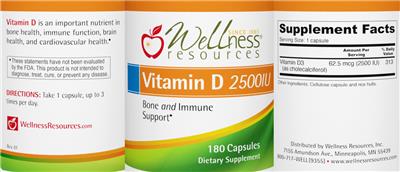
This summary is for Vitamin D 2500 IU by Wellness Resources
- Form
- Capsule
- Serving Size
- 1 Capsule
- Servings
- 180 per container
- Container Holds
- 180 Capsules
- What is Vitamin D 2500 IU?A single-ingredient supplement from Wellness Resources, in capsule form.
- Active Ingredients Vitamin D3 62.5 mcg One active ingredient. We check it for drug interactions and side effects. The full Supplement Facts
- Drug Interactions 717 drugs have a documented interaction with this supplement; the most serious is rated moderate. Of those, 443 are single drugs and 274 are combination products (two or more drugs in one), each listed under its own name. Ask your pharmacist first if you take a drug in any of these categories, the most serious of the 8 on record:
- Moderate · 56 drugs
- AluminumModerate · 14 drugs
- Atorvastatin (Lipitor)Moderate · 3 drugs
- Calcipotriene (Dovonex)Moderate · 2 drugs
- Well documented Why
Does Vitamin D 2500 IU work?
What It Is Marketed For
Bone, immune, brain and cardiovascular health
From the claims on the product’s label.
The Closest Use the Research Grades
Good studies support it.
Vitamin D has stronger research for other uses:
- Rickets
- Osteomalacia
These grades are for the ingredient, not this exact product, and never a promise it will work for you.
And 5 more graded uses, in what the research says- AllergensNone of its ingredient names point to a major food allergen, and the label text we have carries no allergen statement
Who Might Consider It
- People looking for bone, immune, brain and cardiovascular health, which is what it is marketed for. The closest use the research grades is osteoporosis, rated Likely Effective.
- People who want it for rickets, vitamin D deficiency, osteomalacia or another graded use: the other uses with research behind them. See each grade
- This supplement may be worth considering if you are looking for vitamin D for bone health, since that is where the research is strongest.
Who Should Be Careful
- If you have high blood calcium, kidney disease, kidney stones, or sarcoidosis, or if you are pregnant, be careful and talk it over with your own doctor or pharmacist first.
- If you take any of the medicines listed on this page, have your doctor or pharmacist confirm whether this supplement is right for you.
More Before You Take It Show all three answersHide Its Vitamin D3 Amount vs. Other Supplements Pregnancy and Breastfeeding The Label’s Directions
-
How does its Vitamin D3 amount compare with other supplements?
- Vitamin D362.5 mcgMore than most of the 461 recent Vitamin D products in our database that state an amount; 50 mcg is the most common.
A label’s amount is what the product holds, not a recommended dose.
See the Vitamin D3 comparison -
Pregnant or breastfeeding?
- Pregnancy
- ! When used orally in excessive amounts.
- When used orally and appropriately.
- Breastfeeding
- ! When used orally in excessive amounts.
- When used orally and appropriately.
-
How does the label say to take it?
“Directions: Take 1 capsule, up to 3 times per day.”
The maker’s words. Your pharmacist or doctor may advise differently.
Everything the label says
A Note From the HelloPharmacist Team
It is marketed for bone, immune, brain and cardiovascular health, and the research is strongest for bone, with vitamin D rated effective for osteomalacia, rickets and vitamin D deficiency. The research is weaker for the other uses, with cardiovascular disease and fractures rated possibly ineffective. The most serious interaction is with digoxin, a heart rhythm medicine, where high-dose vitamin D may raise the risk of dangerous heart rhythm problems.
From the label dated Feb 23, 2025: its one active ingredient was checked against our records. A summary of what is known, not a grade or a test of the product. How these ratings are computed
Ask Anything About This Supplement
Name a drug you take, or ask about side effects, ingredients or pregnancy.
There’s a lot of information about this supplement on this page! Ask anything in plain English for a quick answer drawn from it.
AI answers come from this label and our own records, never the open internet. AI can make mistakes, so always check with your doctor or pharmacist. How we use AI
Ask the Pharmacist
A licensed pharmacist will answer your question by email — free, as soon as they can.
Got it — thank you!
A licensed pharmacist will answer as soon as they can. Keep an eye on your email (worth checking spam, just in case).
What’s Inside Vitamin D 2500 IU by Wellness Resources
One Active Ingredient: Vitamin D3
Why this rating?
The label gives the exact amount of its one active ingredient, so you know how much you get in each serving. This rates what the label tells you, not the quality of the product.
Supplement Facts
| Amount Per Serving | % Daily Value | |
|---|---|---|
| Vitamin D3 | 62.5 mcg | 313% |
Other ingredients: Cellulose, Rice hull
Daily Values for adults and children 4 or more years of age.
As the label prints it, from the NIH Dietary Supplement Label Database.
Each Ingredient and Its Drug Interactions
Tap one for more about it and its full guide.
-
Vitamin D3 62.5 mcg This supplement has one active ingredient, vitamin D3, and it is the ingredient the research on this page is about. Vitamin D is the nutrient your body uses for bone health, and the research for bone-related uses is the strongest for this ingredient. Interacts with 717 drugs
Form on the label: Cholecalciferol
Vitamin D is a fat-soluble vitamin that helps your body absorb calcium and is important for healthy bones, muscles, and immune function.
- Many people, especially those with low sun exposure, benefit from supplementation, but more is not always better and very high doses can be harmful.
- Ask your pharmacist or doctor whether a blood test and supplement make sense for you.
The full Vitamin D guide: uses, dosage and safety Every Vitamin D drug interaction
How Much Vitamin D Is in It, Compared With Other Supplements
Each bar is an amount that other recent supplements list for the same ingredient. The taller the bar, the more of them state it.
-
62.5 mcg in a serving of this product
More than most products
- Most common amount
- 50 mcg (about 18 in 100 products)
- Most products state
- 5 mcg to 125 mcg
- Compared with
- 461 recent products
Other Ingredients (Inactive)
The capsule or tablet itself, fillers, coatings and flavors. Not part of the drug interaction check; the allergen check below reads them.
- Cellulose
- Rice hull
Allergens in Vitamin D 2500 IU
None of its ingredient names point to a major food allergen, and the label text we have carries no allergen statement.
Not named in the ingredients
- Milk
- Egg
- Fish
- Shellfish
- Tree nuts
- Peanuts
- Wheat or other gluten grains
- Soy
- Sesame
From the label text and ingredient names on file; we do not test products. With a serious allergy, check your bottle and ask the maker or your pharmacist.
What the Label Says
The maker’s own words, from the label. We do not verify or endorse them.
- Brand IP Statement(s)
-
“Wellness resources since 1985”
- Formulation
-
“Bone and immune support”
“Vitamin D is an important nutrient in bone health, immune function, brain health, and cardiovascular health.”
- FDA Statement of Identity
-
“Dietary Supplement”
The Vitamin D 2500 IU Label on File
The label scan on file at the NIH Dietary Supplement Label Database, dated February 2025. Always read the label on the bottle you have.
Product Facts
- Brand
- Wellness Resources
- Net contents
- 180 Capsules
- Market status
- On market
- Date entered into DSLD
- Feb 23, 2025
- DSLD ID
- 320660
- Product type
- Vitamin
- Supplement form
- Capsule
- Dietary claims / uses
- Nutrient, All Other, Structure/Function
- Intended target group(s)
- Adult (18 - 50 Years)
Is this label outdated? Report a formula or label change and our pharmacy team will review it.
HelloPharmacist Score Vitamin D 2500 IU by Wellness Resources
Up to 10 points for research, amount, label and outside testing. Not a safety rating. How this one adds up
for osteoporosis
It is marketed for bone, immune, brain and cardiovascular health, which our pharmacists count as osteoporosis. Good research suggests vitamin D helps with osteoporosis. That research is for vitamin D taken with calcium, and this product has none.
- Research3 of 5 points
- Amount2 of 2 points
- Label2 of 2 points
- Outside testing0 of 1 point
for rickets
Strong research shows vitamin D helps with rickets. It is marketed for bone, immune, brain and cardiovascular health, not for this.
- Research5 of 5 points
- Amount2 of 2 points
- Label2 of 2 points
- Outside testing0 of 1 point
for vitamin D deficiency
Strong research shows vitamin D helps with vitamin D deficiency. It is marketed for bone, immune, brain and cardiovascular health, not for this.
- Research5 of 5 points
- Amount2 of 2 points
- Label2 of 2 points
- Outside testing0 of 1 point
for osteomalacia
Strong research shows vitamin D helps with osteomalacia. It is marketed for bone, immune, brain and cardiovascular health, not for this.
- Research5 of 5 points
- Amount2 of 2 points
- Label2 of 2 points
- Outside testing0 of 1 point
for corticosteroid-induced osteoporosis
Good research suggests vitamin D helps with corticosteroid-induced osteoporosis. It is marketed for bone, immune, brain and cardiovascular health, not for this.
- Research5 of 5 points
- Amount2 of 2 points
- Label2 of 2 points
- Outside testing0 of 1 point
for allergic rhinitis (hay fever)
Some research suggests vitamin D may help with allergic rhinitis (hay fever). It is marketed for bone, immune, brain and cardiovascular health, not for this.
- Research4 of 5 points
- Amount2 of 2 points
- Label2 of 2 points
- Outside testing0 of 1 point
Moderate drug interactions. The score does not count drug interactions. Check them against any drugs you take. See them
What Are You Taking It For?
Tap a reason and the score changes to match. Each one uses this product’s own amount, label and testing.
There is too little research to score vitamin D for diabetes, obesity, high cholesterol, athletic performance, back pain, depression, upper respiratory tract infection (URTI) and osteoarthritis, so they are not in the list.
How It Earns Its 7
Score: 7 out of 10. Supported for osteoporosis.
Good research on vitamin D for osteoporosis.
Graded “Likely Effective” in the Natural Medicines database, which we license. Vitamin D's grade for osteoporosis is for vitamin D taken with calcium, and this product has none, so research counts for at most 3 of 5 points.
3 of 5 points
Amount
Its 62.5 mcg is a normal amount: most of the 461 vitamin D products in our database that state an amount hold 5 mcg to 125 mcg.
2 of 2 points
Label
It states the amount of its one active ingredient.
2 of 2 points
Outside testing
We found no mark from an outside testing program, such as USP Verified or NSF Certified, on the label we have on file.
0 of 1 point
Strong research on vitamin D for rickets.
Graded “Effective” in the Natural Medicines database, which we license.
5 of 5 points
Amount
Its 62.5 mcg is a normal amount: most of the 461 vitamin D products in our database that state an amount hold 5 mcg to 125 mcg.
2 of 2 points
Label
It states the amount of its one active ingredient.
2 of 2 points
Outside testing
We found no mark from an outside testing program, such as USP Verified or NSF Certified, on the label we have on file.
0 of 1 point
Strong research on vitamin D for vitamin D deficiency.
Graded “Effective” in the Natural Medicines database, which we license.
5 of 5 points
Amount
Its 62.5 mcg is a normal amount: most of the 461 vitamin D products in our database that state an amount hold 5 mcg to 125 mcg.
2 of 2 points
Label
It states the amount of its one active ingredient.
2 of 2 points
Outside testing
We found no mark from an outside testing program, such as USP Verified or NSF Certified, on the label we have on file.
0 of 1 point
Strong research on vitamin D for osteomalacia.
Graded “Effective” in the Natural Medicines database, which we license.
5 of 5 points
Amount
Its 62.5 mcg is a normal amount: most of the 461 vitamin D products in our database that state an amount hold 5 mcg to 125 mcg.
2 of 2 points
Label
It states the amount of its one active ingredient.
2 of 2 points
Outside testing
We found no mark from an outside testing program, such as USP Verified or NSF Certified, on the label we have on file.
0 of 1 point
Good research on vitamin D for corticosteroid-induced osteoporosis.
Graded “Likely Effective” in the Natural Medicines database, which we license.
5 of 5 points
Amount
Its 62.5 mcg is a normal amount: most of the 461 vitamin D products in our database that state an amount hold 5 mcg to 125 mcg.
2 of 2 points
Label
It states the amount of its one active ingredient.
2 of 2 points
Outside testing
We found no mark from an outside testing program, such as USP Verified or NSF Certified, on the label we have on file.
0 of 1 point
Some research on vitamin D for allergic rhinitis (hay fever).
Graded “Possibly Effective” in the Natural Medicines database, which we license.
4 of 5 points
Amount
Its 62.5 mcg is a normal amount: most of the 461 vitamin D products in our database that state an amount hold 5 mcg to 125 mcg.
2 of 2 points
Label
It states the amount of its one active ingredient.
2 of 2 points
Outside testing
We found no mark from an outside testing program, such as USP Verified or NSF Certified, on the label we have on file.
0 of 1 point
Where It Sits on the Vitamin D Shelf
The 122 vitamin d products we have scored so far, lined up by their scores. The dark bottle is this one. Each bottle stands for up to 4 products. Tap a score to see the products on it.
13 vitamin d products score 7 out of 10
- Vitamin D3 Depot 140 mcg by Body Attack Sports Nutrition
- Vitamin D3 10,000 IU by Pure Naturals
- Vitamin D3 5000 IU by SuperSmart
- Vitamin D3 250 mcg (10,000 IU) by Sports Research
- Vitamin D3 1000 IU by SuperSmart
- Vegan D3 5000 IU by SuperSmart
- Liquid D3 125 mcg by Windmill Natural Vitamins
- Liposomal Vitamin D3 10,000 IU by Dr. Mercola
- Vitamin D3 5,000 IU by Pure Naturals
- Vitamin D3 1000 IU (25 mcg) by MegaFood
- Liquid D3 10,000 IU by DaVinci Laboratories
- D-1000 by Karuna
And 1 more.
58 vitamin d products score 9 out of 10
- Vitamin D 2500 IU by Wellness Resources this one
- Vitamin D3 62.5 mcg (2,500 IU) by Country Life
- Vitamin D3 50 mcg (2000 IU) by Bluebonnet
- Vitamin D3 4000 IU by BioCare
- Vitamin D3 25 mcg (1000 IU) by Country Life
- Vitamin D3 25 mcg (1,000 IU) by Carlson
- Vitamin D3 2,500 IU (62.5 mcg) by Carlson
- Vitamin D3 2,000 IU (50 mcg) by Carlson
- Vitamin D3 125 mcg (5,000 IU) by NatureWise
- Vitamin D3 125 mcg (5,000 IU) by Carlson
- Vitamin D3 1000 IU by BioCare
- Vitamin D3 100 mcg (4,000 IU) by Carlson
And 46 more.
33 vitamin d products score 8 out of 10
- Vitamin D3 5000 IU by Logos Nutritionals
- Vitamin D3 125 mcg Orange by Celebrate
- Vitamin D3 125 mcg (5,000 IU) by NewtonEverett
- Vitamin D-3 in Sunflower Oil 25 mcg Liquid Naturally Unflavored by Solaray
- Vitamin D 2000 IU by Wonder Laboratories
- High Potency Vitamin D-3 250 mcg by Solaray
- High Potency Vitamin D-3 1,000 IU by Butterfly Express
- D3-5000 by DNA Dynamic Nutritional Associates
- Vitamin D3 Spray 500 IU Orange by KidStar
- Vitamin D3 Powder 50 mg by BulkSupplements.com
- Vitamin D3 Powder 50 mg by BulkSupplements.com
- Vitamin D3 Drops by Absolute Nutrition
And 21 more.
10 vitamin d products score 4 out of 10
- Vitamin D3 1,250 mcg by Celebrate
- D3 5,000 by XYMOGEN
- A & D 3,000 mcg RAE (10,000 IU) & 10 mcg (400 IU) by Carlson
- Vitamin D-3 50,000 IU by NOW
- High-Potency D3 2000 IU by Altrum
- D3 Cholecalciferol 25 mcg by Windmill
- D3 Cholecalciferol 10 mcg (400 IU) by Windmill
- D3 5,000 by XYMOGEN
- Vitamin D3 1,000 IU by DaVinci Laboratories
- Gluten Support Micellized D3 1,200 IU by NuMedica
3 vitamin d products score 3 out of 10
- D3-XYM by U.S. Enzymes
- D3 Cholecalciferol 250 mcg (10,000 IU) by Windmill
- D3 10,000 + K by Metagenics
4 vitamin d products score 10 out of 10
1 vitamin d product scores 2 out of 10
- D3 50,000 by XYMOGEN
This One Next to Most Vitamin D Products
| What | This one | Most of the other 121 |
|---|---|---|
| What it is marketed for | Osteoporosis | Osteoporosis (69 of 71) |
| How much vitamin d | 0.06 mg a serving | 0.03 mg to 0.13 mg |
| Form | Cholecalciferol | Cholecalciferol |
| The label | Every amount stated | Every amount stated on 119 of 121 |
| Outside testing seal | None on file | 4 of 121 have one |
| Score | 7, Supported | 8 to 9 |
Other Vitamin D Products Marketed for Osteoporosis
Vitamin D 2500 IU by Wellness Resources Side Effects
Why this rating?
We look for three kinds of safety information on each ingredient: side effects reported in studies, a pregnancy and breastfeeding rating, and a safety write-up from our pharmacy team. All three are on file for Vitamin D.
So this rates how much is known, not whether Vitamin D 2500 IU is right for you.
Reported with Vitamin D, its active ingredient
- !Rare but serious
- Reported with Vitamin D See details
What Our Pharmacy Team Says
HelloPharmacist Team Summary: Vitamin D 2500 IU by Wellness Resources Side Effects
Vitamin D is generally well tolerated at recommended doses, so most people are not expected to notice problems.
- The main concern is that very high amounts can raise calcium levels, which can be serious.
- If you have symptoms of high calcium, such as unusual thirst, nausea, or confusion, call your doctor promptly.
- No side effects have been reported specifically for this product.
Vitamin D has side-effect reports, but no list of the most common ones. Read them in the Vitamin D guide
Vitamin D 2500 IU Warnings: Who Should Be Careful
HelloPharmacist Team Summary: Vitamin D 2500 IU by Wellness Resources Warnings
People who are pregnant should be particularly careful, since vitamin D is rated possibly unsafe in pregnancy.
- People with high blood calcium, kidney disease, kidney stones, or sarcoidosis are also advised to take care, and the vitamin D in this supplement can add to calcium levels.
- If you fall into any of these groups, talk it over with your own doctor or pharmacist before starting.
These warnings are for Vitamin D, its one active ingredient.
-
Kidney Disease or Kidney Stones
- People with certain conditions should be careful, including those with high blood calcium, kidney disease, kidney stones, or sarcoidosis.
-
Children
- In children, too much may slow growth, and in adults it can cause bone thinning.
-
Other Cautions
- If you have any of these, talk to your doctor before supplementing.
-
Pregnant or Breastfeeding
The rating for pregnancy and for breastfeeding, and what it covers.
Pregnancy
-
When used orally and appropriately.
Vitamin D is safe when used in doses below the tolerable upper intake level (UL) of 4000 IU (100 mcg) daily.
-
When used orally in excessive amounts.
Tell patients not to use doses above the tolerable upper intake level (UL) of 4000 IU (100 mcg) daily.
Hypercalcemia during pregnancy due to excessive vitamin D intake can lead to several fetal adverse effects, including suppression of parathyroid hormone, hypocalcemia, tetany, seizures, aortic valve stenosis, retinopathy, and mental and/or physical developmental delay.
Breastfeeding
-
When used orally and appropriately.
Vitamin D is safe when used in doses below the tolerable upper intake level (UL) of 4000 IU (100 mcg) daily.
-
When used orally in excessive amounts.
Tell patients not to use doses above the tolerable upper intake level (UL) of 4000 IU (100 mcg) daily.
Our pharmacy team’s notes
- In pregnancy, vitamin D is rated possibly unsafe, so it is best avoided unless your own doctor advises otherwise.
- It is rated likely safe while breastfeeding.
- Because pregnancy ratings can vary, talk through your individual situation with your own doctor or pharmacist.
Ratings and the words beside them are from the Natural Medicines database, which we license.
The full record, with its sources, in the Vitamin D guide -
Rare but Serious Side Effects
-
!
Vitamin D
In severe cases, very high calcium can harm the kidneys and heart.
Excess vitamin D can lead to high blood calcium, and in rare cases it can also cause kidney problems and anemia.
Orally or intramuscularly: Excessive doses can lead to vitamin D toxicity with symptoms of hypercalcemia, and also sometimes azotemia and anemia.
When to get help: a serious allergic reaction, with trouble breathing or swelling of the face, lips or throat, needs emergency care: call 911. For any other side effect that worries you, call your doctor or pharmacist.
These reports describe each ingredient, not studies of this exact product. Not medical advice: a side effect you notice after starting a supplement is worth a word with your pharmacist or doctor.
Vitamin D 2500 IU by Wellness Resources Drug Interactions
This supplement has one active ingredient, Vitamin D3, and we checked it against every drug in our records.
A moderate interaction on record
2 of 3, on a scale from Minor or none to Major.Why this rating?
We rate this by the most serious interaction on record, not by how many there are. For Vitamin D, the most serious is rated moderate, which means it calls for caution, and sometimes monitoring or a change in timing or dose. Some involve kinds of drugs where a small change can matter, such as heart-rhythm drugs.
718 drugs are on the full list. What matters is whether one you take is on it, so check yours with the interaction checker on this page.
Its one active ingredient has drug interactions on record: Vitamin D.
Vitamin D
- Interacts with
- 717 drugs
- Most serious
- Moderate
- Wellness Resources' Vitamin D 2500 IU interacts with several kinds of medication through its vitamin D3 content.
- The most serious interaction, rated Moderate, is with digoxin (Lanoxin), a heart medicine: high-dose vitamin D can raise calcium levels, which may increase the risk of dangerous heart rhythm problems.
- Digoxin is one of several Moderate-rated interactions.
- High-dose vitamin D may reduce the effectiveness of verapamil and diltiazem (calcium channel blockers used for irregular heartbeat), also rated Moderate.
Show seven more points
- Thiazide diuretics (water pills) may raise calcium levels further, rated Moderate.
- Atorvastatin (a statin cholesterol medicine) may be absorbed less well when taken with vitamin D, rated Moderate.
- Vitamin D may also increase aluminum absorption, a concern mainly in people with kidney failure, rated Moderate.
- Calcipotriene (a psoriasis treatment) may add to calcium levels, rated Moderate.
- The only Minor-rated interaction is with medicines the liver breaks down, which vitamin D may affect.
- No ingredient in this product is documented as having no interactions, so every checked ingredient has at least one listed.
- To check your exact medications, use the search tool on this page.
The kinds of drugs it affects most
- 645 drugs
- 56 drugs
- Aluminum 14 drugs
- Atorvastatin (Lipitor) 3 drugs
Every Vitamin D drug interaction, 8 records The Vitamin D records cite 25 references, listed in the Vitamin D guide.
Summarized by the HelloPharmacist pharmacy team from the interaction records below. How it is written How we use AI
The Breakdown by Severity
Each drug counted once, at its most serious rating. Tap a tile to list those drugs.
Find Your Drug
Type a drug or brand name to see whether it is on the list.
- Only drugs with a documented interaction are listed, the most serious first.
- A drug with no known interaction is not listed, but searching its name tells you so.
- Open a drug to see which ingredient is responsible. Of those, 443 are single drugs and 274 are combination products (two or more drugs in one), each listed under its own name.
-
AtorvastatinAtorvaliq Moderate
The ingredient responsible:
-
Vitamin D3 Moderate Atorvastatin is in the Cytochrome P450 3A4 (CYP3A4) Substrates category.
Vitamin D might induce CYP3A4 enzymes and reduce the bioavailability of CYP3A4 substrates.
The full Vitamin D3 + Atorvastatin interaction
-
-
Atorvastatin CalciumLipitor Moderate
The ingredient responsible:
-
Vitamin D3 Moderate Atorvastatin Calcium is in the Cytochrome P450 3A4 (CYP3A4) Substrates category.
Vitamin D might reduce absorption of atorvastatin.
The full Vitamin D3 + Atorvastatin Calcium interaction
-
-
HydrochlorothiazideAquazide, Aquazide H, Esidrix, HCTZ, Hydro and 4 more Moderate
The ingredient responsible:
-
Vitamin D3 Moderate Hydrochlorothiazide is in the Thiazide Diuretics category.
Theoretically, taking thiazide diuretics and high-dose vitamin D can increase the risk of hypercalcemia.
The full Vitamin D3 + Hydrochlorothiazide interaction
-
-
DiltiazemAdizem-SR, Adizem-XL, Angitil SR, Angitil XL, Calcicard CR and 24 more Moderate
The ingredient responsible:
-
Vitamin D3 Moderate Diltiazem is in the Cytochrome P450 3A4 (CYP3A4) Substrates category.
Theoretically, hypercalcemia induced by high-dose vitamin D can reduce the therapeutic effects of diltiazem for arrhythmia.
The full Vitamin D3 + Diltiazem interaction
-
-
Fish Oil TriglyceridesOmegaven Moderate
The ingredient responsible:
-
Vitamin D3 Moderate Fish Oil Triglycerides is in the Aluminum category.
Vitamin D might increase aluminum absorption and toxicity, but this has only been reported in people with renal failure.
The full Vitamin D3 + Fish Oil Triglycerides interaction
-
-
DigoxinDigitek, Lanoxicaps, Lanoxin Moderate
The ingredient responsible:
-
Vitamin D3 Moderate
Theoretically, hypercalcemia induced by high-dose vitamin D can increase the risk of arrhythmia from digoxin.
The full Vitamin D3 + Digoxin interaction
-
-
VerapamilCalan, Calan SR, Covera HS, Isoptin, Isoptin SR and 4 more Moderate
The ingredient responsible:
-
Vitamin D3 Moderate Verapamil is in the Cytochrome P450 3A4 (CYP3A4) Substrates category.
Hypercalcemia induced by high-dose vitamin D can reduce the therapeutic effects of verapamil for arrhythmia.
The full Vitamin D3 + Verapamil interaction
-
-
PolythiazideRenese Moderate
The ingredient responsible:
-
Vitamin D3 Moderate Polythiazide is in the Thiazide Diuretics category.
Theoretically, taking thiazide diuretics and high-dose vitamin D can increase the risk of hypercalcemia.
The full Vitamin D3 + Polythiazide interaction
-
-
IndapamideLozide, Lozol Moderate
The ingredient responsible:
-
Vitamin D3 Moderate Indapamide is in the Thiazide Diuretics category.
Theoretically, taking thiazide diuretics and high-dose vitamin D can increase the risk of hypercalcemia.
The full Vitamin D3 + Indapamide interaction
-
-
ChlorothiazideDiuril Moderate
The ingredient responsible:
-
Vitamin D3 Moderate Chlorothiazide is in the Thiazide Diuretics category.
Theoretically, taking thiazide diuretics and high-dose vitamin D can increase the risk of hypercalcemia.
The full Vitamin D3 + Chlorothiazide interaction
-
-
ChlorthalidoneHygroton, Thalitone Moderate
The ingredient responsible:
-
Vitamin D3 Moderate Chlorthalidone is in the Thiazide Diuretics category.
Theoretically, taking thiazide diuretics and high-dose vitamin D can increase the risk of hypercalcemia.
The full Vitamin D3 + Chlorthalidone interaction
-
-
HydroflumethiazideSaluron Moderate
The ingredient responsible:
-
Vitamin D3 Moderate Hydroflumethiazide is in the Thiazide Diuretics category.
Theoretically, taking thiazide diuretics and high-dose vitamin D can increase the risk of hypercalcemia.
The full Vitamin D3 + Hydroflumethiazide interaction
-
-
BendroflumethiazideAprinox, Naturetin, Neo-NaClex Moderate
The ingredient responsible:
-
Vitamin D3 Moderate Bendroflumethiazide is in the Thiazide Diuretics category.
Theoretically, taking thiazide diuretics and high-dose vitamin D can increase the risk of hypercalcemia.
The full Vitamin D3 + Bendroflumethiazide interaction
-
-
Aluminum HydroxideAlu-Cap, Amphojel, Gaviscon Moderate
The ingredient responsible:
-
Vitamin D3 Moderate
Vitamin D might increase aluminum absorption and toxicity, but this has only been reported in people with renal failure.
The full Vitamin D3 + Aluminum Hydroxide interaction
-
-
BenzthiazideExna Moderate
The ingredient responsible:
-
Vitamin D3 Moderate Benzthiazide is in the Thiazide Diuretics category.
Theoretically, taking thiazide diuretics and high-dose vitamin D can increase the risk of hypercalcemia.
The full Vitamin D3 + Benzthiazide interaction
-
-
CyclothiazideAnhydron, Fluidil Moderate
The ingredient responsible:
-
Vitamin D3 Moderate Cyclothiazide is in the Thiazide Diuretics category.
Theoretically, taking thiazide diuretics and high-dose vitamin D can increase the risk of hypercalcemia.
The full Vitamin D3 + Cyclothiazide interaction
-
-
TrichlormethiazideAq 4B Aquazide, Marazide II, Metahydrin, Naqua Moderate
The ingredient responsible:
-
Vitamin D3 Moderate Trichlormethiazide is in the Thiazide Diuretics category.
Theoretically, taking thiazide diuretics and high-dose vitamin D can increase the risk of hypercalcemia.
The full Vitamin D3 + Trichlormethiazide interaction
-
-
MethyclothiazideAquatensen, Enduron Moderate
The ingredient responsible:
-
Vitamin D3 Moderate Methyclothiazide is in the Thiazide Diuretics category.
Theoretically, taking thiazide diuretics and high-dose vitamin D can increase the risk of hypercalcemia.
The full Vitamin D3 + Methyclothiazide interaction
-
-
Aluminum ChlorideAluminum Chloride, Anhydrol Forte, Driclor, Drysol Moderate
The ingredient responsible:
-
Vitamin D3 Moderate
Vitamin D might increase aluminum absorption and toxicity, but this has only been reported in people with renal failure.
The full Vitamin D3 + Aluminum Chloride interaction
-
-
CalcipotrieneDovonex Moderate
The ingredient responsible:
-
Vitamin D3 Moderate
Taking calcipotriene with vitamin D increases the risk for hypercalcemia.
The full Vitamin D3 + Calcipotriene interaction
-
-
Dihydroxyaluminum Sodium CarbonateRolaids Moderate
The ingredient responsible:
-
Vitamin D3 Moderate Dihydroxyaluminum Sodium Carbonate is in the Aluminum category.
Vitamin D might increase aluminum absorption and toxicity, but this has only been reported in people with renal failure.
The full Vitamin D3 + Dihydroxyaluminum Sodium Carbonate interaction
-
-
MetolazoneDiulo, Mykrox, Zaroxolyn Moderate
The ingredient responsible:
-
Vitamin D3 Moderate Metolazone is in the Thiazide Diuretics category.
Theoretically, taking thiazide diuretics and high-dose vitamin D can increase the risk of hypercalcemia.
The full Vitamin D3 + Metolazone interaction
-
-
Hydrochlorothiazide and Losartan PotassiumHyzaar Moderate
The ingredient responsible:
-
Vitamin D3 Moderate Hydrochlorothiazide and Losartan Potassium is in these Thiazide Diuretics, Cytochrome P450 3A4 (CYP3A4) Substrates categories.
Theoretically, taking thiazide diuretics and high-dose vitamin D can increase the risk of hypercalcemia.
The full Vitamin D3 + Hydrochlorothiazide and Losartan Potassium interaction
-
-
Hydrochlorothiazide and LisinoprilPrinzide, Zestoretic Moderate
The ingredient responsible:
-
Vitamin D3 Moderate Hydrochlorothiazide and Lisinopril is in the Thiazide Diuretics category.
Theoretically, taking thiazide diuretics and high-dose vitamin D can increase the risk of hypercalcemia.
The full Vitamin D3 + Hydrochlorothiazide and Lisinopril interaction
-
-
Aluminum Hydroxide, Aspirin, and Magnesium HydroxideAscriptin Moderate
The ingredient responsible:
-
Vitamin D3 Moderate
Vitamin D might increase aluminum absorption and toxicity, but this has only been reported in people with renal failure.
The full Vitamin D3 + Aluminum Hydroxide, Aspirin, and Magnesium Hydroxide interaction
-
-
Aluminum Hydroxide, Aspirin, Codeine Phosphate, and Magnesium HydroxideAscriptin Codeine #2 Moderate
The ingredient responsible:
-
Vitamin D3 Moderate
Vitamin D might increase aluminum absorption and toxicity, but this has only been reported in people with renal failure.
The full Vitamin D3 + Aluminum Hydroxide, Aspirin, Codeine Phosphate, and Magnesium Hydroxide interaction
-
-
Hydrochlorothiazide and ValsartanDiovan HCT Moderate
The ingredient responsible:
-
Vitamin D3 Moderate Hydrochlorothiazide and Valsartan is in the Thiazide Diuretics category.
Theoretically, taking thiazide diuretics and high-dose vitamin D can increase the risk of hypercalcemia.
The full Vitamin D3 + Hydrochlorothiazide and Valsartan interaction
-
-
Candesartan Cilexetil and HydrochlorothiazideAtacand HCT Moderate
The ingredient responsible:
-
Vitamin D3 Moderate Candesartan Cilexetil and Hydrochlorothiazide is in the Thiazide Diuretics category.
Theoretically, taking thiazide diuretics and high-dose vitamin D can increase the risk of hypercalcemia.
The full Vitamin D3 + Candesartan Cilexetil and Hydrochlorothiazide interaction
-
-
Aspirin, Aluminum Hydroxide, Codeine Phosphate, and Magnesium HydroxideAscriptin Codeine #3 Moderate
The ingredient responsible:
-
Vitamin D3 Moderate Aspirin, Aluminum Hydroxide, Codeine Phosphate, and Magnesium Hydroxide is in the Aluminum category.
Vitamin D might increase aluminum absorption and toxicity, but this has only been reported in people with renal failure.
The full Vitamin D3 + Aspirin, Aluminum Hydroxide, Codeine Phosphate, and Magnesium Hydroxide interaction
-
-
Hydrochlorothiazide and PropranololInderide Moderate
The ingredient responsible:
-
Vitamin D3 Moderate Hydrochlorothiazide and Propranolol is in the Thiazide Diuretics category.
Theoretically, taking thiazide diuretics and high-dose vitamin D can increase the risk of hypercalcemia.
The full Vitamin D3 + Hydrochlorothiazide and Propranolol interaction
-
Does It Work? Vitamin D 2500 IU by Wellness Resources
What the research says so far. A grade is the research so far, never an endorsement.
HelloPharmacist Team Summary: Does Vitamin D 2500 IU by Wellness Resources Work?
It is marketed to support bone, immune, brain and cardiovascular health.
- The research is strongest for bone: vitamin D is rated effective for osteomalacia, rickets and vitamin D deficiency, and likely effective for osteoporosis.
- For cardiovascular disease and fractures, the research is rated possibly ineffective, and for cognitive function, immune-related upper respiratory infections, and cholesterol problems, there isn't enough reliable evidence to rate it.
- Keep in mind these grades apply to vitamin D on its own, not to this specific combination.
What the Research Says About Vitamin D
Its uses graded effective, likely effective or possibly effective:
Research suggests a benefit for
- Rickets, vitamin D deficiency and osteomalacia
- Osteoporosis (the use on its label) and corticosteroid-induced osteoporosis
- Allergic rhinitis (hay fever), coronavirus disease 2019 (COVID-19) and dental caries
Not counted here: one graded use is for Vitamin D injected or put on the skin (psoriasis), not for a product like this one. Five more are for conditions treated by a doctor or in a hospital (heart failure, hyperparathyroidism-related bone loss, familial hypophosphatemia and others).
And 1 more graded use, in the Vitamin D guideThe grades are the Natural Medicines database’s, which we license; tap a grade for what it means. They are about each ingredient, not this exact product.
About Wellness Resources
Manufacturer and brand details for Vitamin D 2500 IU, from the product label.
Wellness Resources has 25 products in our supplement database, all of them on the market, with labels on file since 2021. Our database is built from the NIH’s Dietary Supplement Label Database and our pharmacy team’s own additions, so it covers the labels filed there, not every product the brand sells.
- Name
- Wellness Resources, Inc.
- Street Address
- 7155 Amundson Ave.
- City
- Minneapolis
- State
- MN
- ZipCode
- 55439
- Phone Number
- 800-717-9355
- Web Address
- www.wellnessresources.com
Vitamin D 2500 IU by Wellness Resources: Common Questions
Does Vitamin D 2500 IU by Wellness Resources interact with any drugs?
What are the side effects of Vitamin D 2500 IU by Wellness Resources?
Who should be careful taking Vitamin D 2500 IU by Wellness Resources?
Can Vitamin D 2500 IU by Wellness Resources affect the kidneys?
How can Vitamin D 2500 IU by Wellness Resources interact with so many drugs?
Where does the information about Vitamin D 2500 IU by Wellness Resources come from?
Is Vitamin D 2500 IU by Wellness Resources effective for bone health?
Is Vitamin D 2500 IU by Wellness Resources safe to take during pregnancy?
Can I take Vitamin D 2500 IU by Wellness Resources while breastfeeding?
What inactive ingredients are in Vitamin D 2500 IU by Wellness Resources?
Written and reviewed by the HelloPharmacist Editorial Team. Our editorial policy
Still Have a Question About Vitamin D 2500 IU?
Our pharmacists answer drug and supplement questions, free, by email.
Label information is sourced from the NIH Dietary Supplement Label Database and reflects the product version on file; always read your actual product label. This page is for education only and is not a substitute for professional medical advice. Confirm with your pharmacist or doctor before combining supplements and drugs.
Who Reviews This Page
The pharmacist behind it, and how it is checked.
Dr. Brian Staiger, PharmD, BCPS
Clinical pharmacist and founder of HelloPharmacist
A licensed pharmacist for more than 13 years, he built the system behind this page: it reads the label on file, matches each active ingredient to its record in the Natural Medicines database, checks those records against every drug we cover, and our pharmacy team writes the take and the interaction summary from those records.
- 13+ Years in PharmacyRetail and clinical pharmacy, medication safety and healthcare administration.
- Board Certified (BCPS)A pharmacotherapy specialist, certified by the Board of Pharmacy Specialties.
- Herbalist TrainingCertificates in medical ethnobotany, for the herbs and supplements people take.
Where This Page Comes From
Vitamin D 2500 IU’s label data comes from the NIH Dietary Supplement Label Database; the ingredient interaction data is from the Natural Medicines database, reviewed by our pharmacists.
- NIH Dietary Supplement Label Database (DSLD)
- The official product label on file for this supplement.
- Natural Medicines (Therapeutic Research Center)
- The evidence-graded clinical reference behind the ingredient interaction, evidence and safety records, which we license.
- HelloPharmacist Editorial Team
- Content is reviewed by the HelloPharmacist Editorial Team, the pharmacists on our staff and those we contract. See our data sources and editorial standards for how this information is built and checked.
- The Pharmacy Team’s Take and Summaries
- Generated from HelloPharmacist’s pharmacist-curated databases and editorial rules. Clinical methodology reviewed by Dr. Brian Staiger, PharmD, BCPS. Last generated Nov 28, 2026. How we use AI
- The ratings in the Quick Summary
- They summarize available label information, ingredient evidence and known drug-safety records: a summary of what is known, not a grade of the product itself. They do not verify product identity, purity, potency, contamination or manufacturing quality. How these ratings are computed
The References Behind the Interaction Records
Every citation the ingredients’ records rest on is listed in that ingredient’s guide, in context: Vitamin D, 25 references .
Parts of this content are provided by the Therapeutic Research Center, LLC.
DISCLAIMER: Currently this does not check for drug-drug interactions. This is not an all-inclusive comprehensive list of potential interactions and is for informational purposes only. Not all interactions are known or well-reported in the scientific literature, and new interactions are continually being reported. Input is needed from a qualified healthcare provider including a pharmacist before starting any therapy. Application of clinical judgment is necessary.
© 2021 Therapeutic Research Center, LLC
Keep Exploring
- Supplement interaction checkerCheck any supplement or product against your drugs
- Drug–drug interactionsCheck two or more of your drugs against each other
- Browse drugs A to ZEvery drug we have checked against herbs and supplements
- NDC and pricing lookupFind a drug’s NDCs, packaging and costs
- Ask a pharmacistA free, personal answer from our licensed team