
AM Packet Ingredients & Drug Interactions
What is this page for?
First and foremost: checking AM Packet against your medications. The heart of this page is the interaction checker and the full interaction report — how this product’s ingredients may interact with prescription and over-the-counter medicines you may be taking.
Around that, we add a pharmacist’s high-level view of the product as a whole — what’s inside, the evidence for its stated use, how transparent the label is, and what safety data exists — so you can see the full picture in one place. It’s educational information from our licensed clinical databases and the clinical staff at HelloPharmacist — not medical advice — and we don’t sell or endorse products. Our editorial policy
AM Packet is a dietary supplement by Nature's Sunshine with 18 active ingredients. Its ingredients are commonly taken for eye and vision health, skin health and acne, immune support.Based on those ingredients, 1,715 medications have a known interaction with it, the most serious rated major. The ingredients most likely to interact are Asian Ginseng Root Extract, Chinese Licorice Root Extract, Ginger Rhizome Extract. Use the checker below to test your specific medication, or read the full HelloPharmacist Interaction Report.
Check Your Meds Against AM Packet by Nature's Sunshine
Ask about any prescription or over-the-counter medication and we check it for interactions with AM Packet by Nature's Sunshine — and tell you which ingredient is responsible.
AI summaries are generated from our interaction database for education only — always confirm with your pharmacist. How we use AI
Ask the Pharmacist
A licensed pharmacist will answer your question by email — free, usually within 24 hours.
Got it — thank you!
A licensed pharmacist will answer within 24 hours. Keep an eye on your email (worth checking spam, just in case).
HelloPharmacist Scorecard of AM Packet by Nature's Sunshine
Our pharmacy team’s full take, with four database checks built into the cards below — a summary of what is known, not a grade of the product itself.
What’s inside
Low disclosure
AM Packet contains 19 active ingredients blended across several proprietary formulas and extracts. The standout ingredients are vitamins (A and C), N-acetyl cysteine (an amino acid), choline (a nutrient), and inositol (a carbohydrate).
The rest are plant extracts: Asian ginseng root, licorice root, peony root, dong quai root, bitter orange fruit, ginger rhizome, dandelion, bupleurum root, cassia twig, poria mushroom, Baikal skullcap, and atractylodes rhizome — many of which are traditional Chinese herbs. Milk thistle seed extract, Milk Thistle Combination, and Liver Balance TCM proprietary blends are also included.
We could not check Silymarin and Typhonium Rhizome Extract due to absent interaction data. The inactive ingredients are cellulose, stearic acid, gelatin, water, magnesium stearate, maltodextrin, and silicon dioxide.
Does it work?
Not established
The evidence for individual ingredients varies widely. Vitamin A is effective for vitamin A deficiency and possibly effective for oral leukoplakia, aging skin, measles, ulcerative colitis, and bronchopulmonary dysplasia.
Vitamin C is effective for vitamin C deficiency and possibly effective for anemia of chronic disease, atrial fibrillation, cataracts, and exercise-induced respiratory infections. Ginger is possibly effective for pregnancy-induced nausea and vomiting, dysmenorrhea, and osteoarthritis.
Inositol is possibly effective for polycystic ovary syndrome, metabolic syndrome, and preterm labor. N-acetyl cysteine is effective for acetaminophen poisoning, atelectasis, and bronchial diagnostic studies, and possibly effective for bronchitis.
Asian ginseng is possibly effective for erectile dysfunction, sexual arousal, influenza, cognitive function, and multiple sclerosis–related fatigue. Licorice is possibly effective for atopic dermatitis and canker sores.
Choline, peony, dong quai, bitter orange, dandelion, bupleurum, cassia, poria mushroom, Baikal skullcap, and atractylodes all show insufficient reliable evidence for their proposed uses or have been rated possibly ineffective for what the packet may claim to support.
How safe is it?
Well-documented data
Most ingredients here are generally well tolerated at normal doses. Vitamin A, however, is toxic at high doses — it builds up in the body and can cause liver damage, headaches, skin problems, and in severe cases, brain swelling and death.
Vitamin C at very high doses (above 2 grams daily) can cause kidney stones, diarrhea, and nausea. Choline at doses above 3.5 grams daily has caused fishy body odor, diarrhea, and gastrointestinal upset.
N-acetyl cysteine is well tolerated at typical doses but at very high doses (over 30 grams daily) can cause diarrhea, nausea, and blood clotting issues. Asian ginseng's most common side effect is insomnia, and long-term safety is unclear.
Licorice at high doses or long-term use can cause serious mineral imbalances due to its glycyrrhizin content. Bitter orange contains stimulants that can raise blood pressure and heart rate, especially with caffeine.
Ginger is generally safe but at doses above 5 grams daily increases the risk of side effects. Bupleurum has rare but serious lung and liver concerns.
Regarding pregnancy and breastfeeding: vitamin A at high doses should be avoided (birth defect risk); vitamin C in normal amounts is likely safe but high-dose supplements should be avoided; choline is likely safe in pregnancy and appears important; inositol is possibly safe in pregnancy but should be supervised; N-acetyl cysteine is possibly safe in pregnancy; Asian ginseng should be avoided; licorice should be avoided; dong quai should be avoided; bitter orange should be avoided; ginger is likely or possibly safe; and dandelion, bupleurum, Baikal skullcap, and atractylodes have insufficient data — discuss with your doctor or pharmacist before use in pregnancy or while breastfeeding.
Meds to double-check
Major interaction found
Before taking AM Packet, double-check these medication types with your doctor or pharmacist. Blood thinners and antiplatelet drugs (warfarin, aspirin, clopidogrel, and others) — especially warfarin with dong quai (major risk).
Intravenous or transdermal nitroglycerin — stop or check with your provider if you take either form due to N-acetyl cysteine. Blood pressure medications (ACE inhibitors, beta-blockers, calcium channel blockers, and others) — N-acetyl cysteine and Baikal skullcap may lower pressure further.
Diabetes medications (insulin, metformin, sulfonylureas, and others) — multiple ingredients may increase low blood sugar risk. Stimulant drugs, thyroid medication (levothyroxine), cancer drugs, liver-metabolizing substrates, and heart rhythm drugs all warrant a check.
Altogether, these interactions span 1,714 individual medications.
The bottom line
Scorecard at a glanceFormula with limited ingredient disclosure with no established evidence rating for its marketed use. Major medication interactions have been identified, and safety information is well characterized.
This is a complex herbal and vitamin formula best suited for people exploring traditional liver-support ingredients under professional guidance — not for self-treatment of any disease. If you take blood thinners, blood pressure drugs, diabetes medication, heart rhythm drugs, or any prescription at all, you need to check every one against this product's ingredients before starting.
Talk with your own doctor or pharmacist about whether AM Packet fits your health goals and medications.
Educational only — not medical advice; always confirm with your pharmacist. Our editorial policy · How we use AI
Assessment coverage: 17 of 19 active ingredients matched to our full ingredient reviews (monographs). Based on the product label dated Aug 22, 2024.
This Scorecard evaluates available label information, ingredient evidence, and known medication-safety considerations. It does not independently verify product identity, purity, potency, contamination, or manufacturing quality. How these ratings are computed
General information
Key facts about AM Packet, straight from the product label.
| Brand | Nature's Sunshine |
|---|---|
| Net contents | 30 Packet(s); 60 Tablet(s); 30 Capsule(s) |
| Market status | On market |
| Date entered into DSLD | Aug 22, 2024 |
| DSLD ID | 313089 |
| Product type | Other Combinations |
| Supplement form | Other (e.g. Tea Bag) |
| Dietary claims / uses | All Other, Structure/Function |
| Intended target group(s) | Adult (18 - 50 Years) |
Everything in this section is reproduced from the manufacturer’s own product label — it’s the label speaking, not HelloPharmacist. We show it so you can see exactly what the maker states; we don’t verify or endorse those statements.
Supplement Facts
The label details for AM Packet by Nature's Sunshine, sourced from the NIH Dietary Supplement Label Database.
Supplement Facts
| Ingredient | Amount | % DV |
|---|---|---|
| Vitamin A | 4200 mcg RAE | 467% |
| Vitamin C | 480 mg | 533% |
| Choline | 44 mg | 8% |
| Milk Thistle Seed Extract | 350 mg | -- |
| Inositol | 110 mg | -- |
| N-Acetyl Cysteine | 0 NP | -- |
| Asian Ginseng Root Extract | 0 NP | -- |
| Chinese Licorice Root Extract | 0 NP | -- |
| Milk Thistle Combination Proprietary blend | 410 mg | -- |
| Liver Balance TCM Proprietary Blend | 425 mg | -- |
| Chinese Peony Root Without Bark Extract | 0 NP | -- |
| Dong Quai Root Extract | 0 NP | -- |
| Young Bitter Orange Fruit Extract | 0 NP | -- |
| Silymarin | 280 mg | -- |
| Ginger Rhizome Extract | 0 NP | -- |
| Dandelion | 0 NP | -- |
| Bupleurum Root Extract | 0 NP | -- |
| Typhonium Rhizome Extract | 0 NP | -- |
| Cassia Twig Extract | 0 NP | -- |
| Hoelen Sclerotium Extract | 0 NP | -- |
| Scute Root Extract | 0 NP | -- |
| Atractylodes Rhizome Extract | 0 NP | -- |
Other ingredients: Cellulose, Stearic Acid, Gelatin, Water, Magnesium Stearate, Maltodextrin, Silicon Dioxide
Tap any ingredient to jump to its full detail below.
These statements are the manufacturer’s wording, reproduced from the product label — the label is saying it, not HelloPharmacist. We don’t verify or endorse them.
Suggested/Recommended/Usage/Directions
Recommended use: Take the contents of one AM packet with breakfast; take the contents of one PM packet with your evening meal. Follow this pattern for 30 days.
Precautions
Pregnant or lactating women should consult their health care provider prior to taking this supplement. Warning: Do not take this product if you are taking prescription medication without first consulting a health care professional. Consult a health care practitioner before taking this supplement if you are currently on any anti-coagulant (blood thinning) therapy.
This carton was sealed for your protection. Do not use if seal is missing or damaged.
Formulation
Nature's Sunshine uses natural source materials that are subject to color variation.
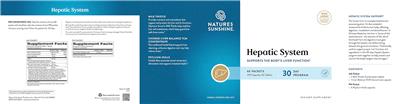
Supports the body's liver function Hepatic system support
Guaranteed pure
Traditionally used to support proper liver function, the ingredients in this 30-day Hepatic System program work together to help protect and nourish the body's largest internal organ.
FDA Disclaimer Statement
These statements have not been evaluated by the Food and Drug Administration. This product is not intended to diagnose, treat, cure, or prevent any disease.
General Statements
Please recycle this carton. We are committed to you and our planet. Scan QR code to learn more.
New look! Same great product
The human liver is a complex biochemical processing plant. It's the metabolic mastermind of the human body, affecting digestion, metabolism and detoxification. In Chinese medicine, the liver is "home of the wood element", the element of life. All of the blood from the digestive tract goes through the hepatic vein before being allowed into general circulation.
Contents AM Packet 2 Milk thistle combination tablets 1 Liver balance TCM concentrate capsule
30 day program
Formula
Milk Thistle Provides nutrients and antioxidants that support and protect the liver and its functions. Silymarin found in Milk thistle helps stabilize liver cell membranes, which helps guard liver cells from toxins. Chinese Liver Balance TCM Concentrate This traditional herbal blend supports liver cleansing, enhances digestion and may help reduce stress.
Brand IP Statement(s)
Nature's Sunshine Herbal experts since 1972
FDA Statement of Identity
Dietary Supplement
Is this label outdated? Report a formula or label change and our pharmacy team will review it.
AM Packet by Nature's Sunshine label
The label scan from the NIH Dietary Supplement Label Database. Tap to enlarge.
Label images are published by the NIH Dietary Supplement Label Database for the version of this product on file. Always read your actual product label.
View the full label (PDF)The Ingredients in AM Packet by Nature's Sunshine
These are the 18 active ingredients this product is made of. Select any to open its full monograph.
Serving size1 AM Packet(s) Dosage formOther (e.g. Tea Bag) Servings per container30 Amounts shown are per serving.
Most supplement products combine several ingredients, and a medication can interact with the product through any one of them. Each ingredient below shows whether it has known drug interactions.
Vitamin A
Interacts with389 drugs
Vitamin A is an essential nutrient important for vision, skin, immune function, and growth. Most people get enough from a balanced diet, and supplemen...
Vitamin A monograph & interactionsVitamin C
Interacts with207 drugs
Vitamin C (ascorbic acid) is an essential nutrient your body needs but cannot make, so you must get it from food or supplements. It's important for im...
Vitamin C monograph & interactionsCholine
Interacts with16 drugs
Choline is an essential nutrient your body needs for liver function, brain health, and nerve signaling, and many people get enough from foods like egg...
Choline monograph & interactionsMilk Thistle Seed Extract
Interacts with955 drugs
Milk thistle is a popular herbal supplement most often used for liver health, and its main active component is a group of compounds called silymarin....
Milk Thistle Seed Extract monograph & interactions- › Silymarin
Inositol
Interacts with86 drugs
Inositol is a sugar alcohol made naturally in the body and found in many foods, and it is sold as a supplement (often myo-inositol) mainly for PCOS, m...
Inositol monograph & interactionsMilk Thistle Combination Proprietary blend
Interacts with955 drugs
Milk thistle is a popular herbal supplement most often used for liver health, and its main active component is a group of compounds called silymarin....
Milk Thistle Combination Proprietary blend monograph & interactionsLiver Balance TCM Proprietary Blend
- › Asian Ginseng Root Extract
- › Chinese Licorice Root Extract
- › Chinese Peony Root Without Bark Extract
- › Dong Quai Root Extract
- › Young Bitter Orange Fruit Extract
- › Ginger Rhizome Extract
- › Bupleurum Root Extract
- › Typhonium Rhizome Extract
- › Cassia Twig Extract
- › Hoelen Sclerotium Extract
- › Scute Root Extract
- › Atractylodes Rhizome Extract
Other (inactive) ingredients: Cellulose, Stearic Acid, Gelatin, Water, Magnesium Stearate, Maltodextrin, Silicon Dioxide. These complete the product’s ingredient list but are not active constituents.
AM Packet by Nature's Sunshine Drug Interactions
HelloPharmacist Interaction Report
AM Packet by Nature's Sunshine contains 19 ingredients, of which we checked 16 for interactions — we couldn't check Silymarin or Typhonium Rhizome Extract due to absent data.
Through its vitamin A, vitamin C, N-acetyl cysteine, Asian ginseng, licorice, peony, dong quai, bitter orange, ginger, dandelion, bupleurum, cassia, poria mushroom, Baikal skullcap, and atractylodes content, this packet interacts with a number of medications. The most serious interaction is with N-acetyl cysteine and intravenous or transdermal nitroglycerin — concomitant use can cause severe low blood pressure (hypotension) and severe headaches.
Read the full breakdown — every affected drug type, severity by severity
Blood thinners (anticoagulants) and antiplatelet drugs are affected by multiple ingredients here. Vitamin A, vitamin C, N-acetyl cysteine, peony, dong quai, ginger, dandelion, bupleurum, Baikal skullcap, and atractylodes all carry moderate-severity concerns — some may increase bleeding risk, while others have conflicting research.
Dong quai with warfarin is major severity and carries a particularly high risk of bleeding based on case reports. Similarly, warfarin interactions also appear with vitamin A, vitamin C, licorice, ginger, and potentially others.
Drugs for blood sugar control (antidiabetes drugs) show moderate interactions with inositol, Asian ginseng, bitter orange, ginger, dandelion, bupleurum, cassia, and Baikal skullcap — all theoretically raising the risk of low blood sugar (hypoglycemia). Blood pressure medications (antihypertensives) interact moderately with N-acetyl cysteine and Baikal skullcap.
Several other drug types are affected: stimulant drugs with bitter orange; certain cancer medications with vitamin C and ginger; liver-metabolizing enzymes with Asian ginseng, licorice, peony, bitter orange, dandelion, and Baikal skullcap; thyroid medication with vitamin C; and heart rhythm drugs with bitter orange.
Although we have no interaction data for Silymarin, Milk Thistle Seed Extract (listed as a blend container), and Typhonium Rhizome Extract, the ingredients we could check account for a substantial list of affected medications. Check your exact prescriptions with the interaction search tool below before taking this product.
Check your own medications below · Editorial policy · How we use AI
Want to check YOUR meds against AM Packet?
Ask about interactions with your drugs in plain English — “Can I take it with lisinopril?” — and we find you the answer in seconds, ingredient by ingredient.
Go to the checkerIngredients driving the most interactions
Individual Drug Interactions
The ingredients in AM Packet interact with 1,715 drugs. Click any drug to see the details.
16 of the 18 ingredients in AM Packet interact with drugs. Each result below shows which ingredient is responsible. Asian Ginseng Root Extract Chinese Licorice Root Extract Ginger Rhizome Extract Young Bitter Orange Fruit Extract Milk Thistle Seed Extract Scute Root Extract Chinese Peony Root Without Bark Extract Atractylodes Rhizome Extract Cassia Twig Extract Hoelen Sclerotium Extract Vitamin A Bupleurum Root Extract Vitamin C Dong Quai Root Extract Inositol Choline
AcitretinSoriatane
How Acitretin interacts with AM Packet — through 1 ingredient. Tap an ingredient for the detail:
Vitamin ARetinoids Major
Interaction Summary
Concomitant use of retinoids with vitamin A supplements might produce supratherapeutic vitamin A levels.
Read the full Vitamin A + Acitretin interactionAlitretinoinPanretin
How Alitretinoin interacts with AM Packet — through 1 ingredient. Tap an ingredient for the detail:
Vitamin ARetinoids Major
Interaction Summary
Concomitant use of retinoids with vitamin A supplements might produce supratherapeutic vitamin A levels.
Read the full Vitamin A + Alitretinoin interactionAmphetamineAdensys XR-ODT, Adzenys ER, Dyanavel XR, Mydayis
How Amphetamine interacts with AM Packet — through 2 ingredients. Tap an ingredient for the detail:
Young Bitter Orange Fruit ExtractStimulant Drugs, Monoamine Oxidase Inhibitors (maois) +1 Major
Interaction Summary
Theoretically, bitter orange might increase the risk of hypertension and adverse cardiovascular effects when taken with stimulant drugs.
Read the full Young Bitter Orange Fruit Extract + Amphetamine interactionAsian Ginseng Root ExtractCytochrome P450 2d6 (cyp2d6) Substrates, Stimulant Drugs +1 Moderate
Interaction Summary
Theoretically, Panax ginseng might increase levels of drugs metabolized by CYP2D6.
Read the full Asian Ginseng Root Extract + Amphetamine interactionBexaroteneTargretin
How Bexarotene interacts with AM Packet — through 8 ingredients. Tap an ingredient for the detail:
Vitamin ARetinoids Major
Interaction Summary
Concomitant use of retinoids with vitamin A supplements might produce supratherapeutic vitamin A levels.
Read the full Vitamin A + Bexarotene interactionGinger Rhizome ExtractCytochrome P450 3a4 (cyp3a4) Substrates Moderate
Interaction Summary
Ginger might increase or decrease the levels of CYP3A4 substrates.
Read the full Ginger Rhizome Extract + Bexarotene interactionAsian Ginseng Root ExtractCytochrome P450 3a4 (cyp3a4) Substrates Moderate
Interaction Summary
Theoretically, Panax ginseng might increase or decrease levels of drugs metabolized by CYP3A4.
Read the full Asian Ginseng Root Extract + Bexarotene interactionChinese Peony Root Without Bark ExtractCytochrome P450 3a4 (cyp3a4) Substrates Moderate
Interaction Summary
Theoretically, use of peony may increase the levels and clinical effects of drugs metabolized by CYP3A4.
Read the full Chinese Peony Root Without Bark Extract + Bexarotene interactionYoung Bitter Orange Fruit ExtractCytochrome P450 3a4 (cyp3a4) Substrates Moderate
Interaction Summary
Bitter orange might increase levels of drugs metabolized by CYP3A4.
Read the full Young Bitter Orange Fruit Extract + Bexarotene interactionChinese Licorice Root ExtractCytochrome P450 3a4 (cyp3a4) Substrates Moderate
Interaction Summary
Theoretically, licorice might increase or decrease levels of drugs metabolized by CYP3A4.
Read the full Chinese Licorice Root Extract + Bexarotene interactionAtractylodes Rhizome ExtractCytochrome P450 3a4 (cyp3a4) Substrates Minor
Interaction Summary
Theoretically, atractylodes might increase the levels of CYP3A4 substrates.
Read the full Atractylodes Rhizome Extract + Bexarotene interactionMilk Thistle Combination Proprietary BlendCytochrome P450 3a4 (cyp3a4) Substrates Minor
Interaction Summary
It is unclear if milk thistle inhibits CYP3A4; research is conflicting.
Read the full Milk Thistle Combination Proprietary Blend + Bexarotene interactionHalobetasol Propionate,tazaroteneDuobrii
How Halobetasol Propionate,tazarotene interacts with AM Packet — through 1 ingredient. Tap an ingredient for the detail:
Vitamin ARetinoids Major
Interaction Summary
Concomitant use of retinoids with vitamin A supplements might produce supratherapeutic vitamin A levels.
Read the full Vitamin A + Halobetasol Propionate,tazarotene interactionIsocarboxazidMarplan
How Isocarboxazid interacts with AM Packet — through 2 ingredients. Tap an ingredient for the detail:
Young Bitter Orange Fruit ExtractMonoamine Oxidase Inhibitors (maois) Major
Interaction Summary
Theoretically, taking MAOIs with synephrine-containing bitter orange preparations might increase the hypertensive effects of synephrine, potentially leading to hypertensive crisis.
Read the full Young Bitter Orange Fruit Extract + Isocarboxazid interactionAsian Ginseng Root ExtractMonoamine Oxidase Inhibitors (maois) Moderate
Interaction Summary
Theoretically, Panax ginseng can interfere with MAOI therapy.
Read the full Asian Ginseng Root Extract + Isocarboxazid interactionIsotretinoinAbsorica, Accutane, Amnesteem, Claravis, Roaccutane, Sotret
How Isotretinoin interacts with AM Packet — through 2 ingredients. Tap an ingredient for the detail:
Vitamin ARetinoids Major
Interaction Summary
Concomitant use of retinoids with vitamin A supplements might produce supratherapeutic vitamin A levels.
Read the full Vitamin A + Isotretinoin interactionChinese Licorice Root ExtractCytochrome P450 2c8 (cyp2c8) Substrates Moderate
Interaction Summary
Theoretically, licorice might increase levels of drugs metabolized by CYP2C8.
Read the full Chinese Licorice Root Extract + Isotretinoin interactionMidazolamNayzilam, Seizalam, Versed
How Midazolam interacts with AM Packet — through 9 ingredients. Tap an ingredient for the detail:
Young Bitter Orange Fruit ExtractMidazolam (versed), Cytochrome P450 3a4 (cyp3a4) Substrates Major
Interaction Summary
Bitter orange might increase blood levels of midazolam.
Read the full Young Bitter Orange Fruit Extract + Midazolam interactionAsian Ginseng Root ExtractCytochrome P450 3a4 (cyp3a4) Substrates, Midazolam (versed) Moderate
Interaction Summary
Theoretically, Panax ginseng might increase or decrease levels of drugs metabolized by CYP3A4.
Read the full Asian Ginseng Root Extract + Midazolam interactionGinger Rhizome ExtractCytochrome P450 3a4 (cyp3a4) Substrates Moderate
Interaction Summary
Ginger might increase or decrease the levels of CYP3A4 substrates.
Read the full Ginger Rhizome Extract + Midazolam interactionChinese Licorice Root ExtractCytochrome P450 3a4 (cyp3a4) Substrates, Midazolam (versed) Moderate
Interaction Summary
Theoretically, licorice might increase or decrease levels of drugs metabolized by CYP3A4.
Read the full Chinese Licorice Root Extract + Midazolam interactionHoelen Sclerotium ExtractCns Depressants Moderate
Interaction Summary
Theoretically, taking poria mushroom extract may enhance the therapeutic and adverse effects of sedatives.
Read the full Hoelen Sclerotium Extract + Midazolam interactionChinese Peony Root Without Bark ExtractCytochrome P450 3a4 (cyp3a4) Substrates Moderate
Interaction Summary
Theoretically, use of peony may increase the levels and clinical effects of drugs metabolized by CYP3A4.
Read the full Chinese Peony Root Without Bark Extract + Midazolam interactionAtractylodes Rhizome ExtractCytochrome P450 3a4 (cyp3a4) Substrates Minor
Interaction Summary
Theoretically, atractylodes might increase the levels of CYP3A4 substrates.
Read the full Atractylodes Rhizome Extract + Midazolam interactionMilk Thistle Combination Proprietary BlendCytochrome P450 3a4 (cyp3a4) Substrates Minor
Interaction Summary
It is unclear if milk thistle inhibits CYP3A4; research is conflicting.
Read the full Milk Thistle Combination Proprietary Blend + Midazolam interactionScute Root ExtractCns Depressants Minor
Interaction Summary
Theoretically, Baikal skullcap might cause additive therapeutic and adverse effects when used concomitantly with drugs with sedative properties.
Read the full Scute Root Extract + Midazolam interactionMoclobemideManerix, Moclobemide
How Moclobemide interacts with AM Packet — through 4 ingredients. Tap an ingredient for the detail:
Young Bitter Orange Fruit ExtractMonoamine Oxidase Inhibitors (maois) Major
Interaction Summary
Theoretically, taking MAOIs with synephrine-containing bitter orange preparations might increase the hypertensive effects of synephrine, potentially leading to hypertensive crisis.
Read the full Young Bitter Orange Fruit Extract + Moclobemide interactionChinese Licorice Root ExtractCytochrome P450 2c19 (cyp2c19) Substrates Moderate
Interaction Summary
Theoretically, licorice might increase levels of drugs metabolized by CYP2C19.
Read the full Chinese Licorice Root Extract + Moclobemide interactionAsian Ginseng Root ExtractMonoamine Oxidase Inhibitors (maois) Moderate
Interaction Summary
Theoretically, Panax ginseng can interfere with MAOI therapy.
Read the full Asian Ginseng Root Extract + Moclobemide interactionScute Root ExtractCytochrome P450 2c19 (cyp2c19) Substrates Moderate
Interaction Summary
Theoretically, Baikal skullcap might increase levels of drugs metabolized by CYP2C19 enzymes.
Read the full Scute Root Extract + Moclobemide interactionNitroglycerinGonitro, Nitro Time, Nitro-Bid, Nitrocine Timecaps, Nitrogard, Nitrogard SR +7 more
How Nitroglycerin interacts with AM Packet — through 1 ingredient. Tap an ingredient for the detail:
N-acetyl CysteineNitroglycerin Major
Interaction Summary
N-acetyl cysteine can increase the risk for hypotension and headaches when taken with intravenous or transdermal nitroglycerin.
Read the full N-acetyl Cysteine + Nitroglycerin interactionOzanimod HydrochlorideZeposia
How Ozanimod Hydrochloride interacts with AM Packet — through 6 ingredients. Tap an ingredient for the detail:
Young Bitter Orange Fruit ExtractQt Interval-prolonging Drugs, Monoamine Oxidase Inhibitors (maois) Major
Interaction Summary
Theoretically, bitter orange might have an additive effect when combined with drugs that prolong the QT interval, potentially increasing the risk of ventricular arrhythmias.
Read the full Young Bitter Orange Fruit Extract + Ozanimod Hydrochloride interactionVitamin AHepatotoxic Drugs Moderate
Interaction Summary
Theoretically, taking high doses of vitamin A in combination with other potentially hepatotoxic drugs might increase the risk of liver disease.
Read the full Vitamin A + Ozanimod Hydrochloride interactionBupleurum Root ExtractImmunosuppressants Moderate
Interaction Summary
Theoretically, bupleurum might decrease the effects of immunosuppressants.
Read the full Bupleurum Root Extract + Ozanimod Hydrochloride interactionChinese Licorice Root ExtractCytochrome P450 2c8 (cyp2c8) Substrates Moderate
Interaction Summary
Theoretically, licorice might increase levels of drugs metabolized by CYP2C8.
Read the full Chinese Licorice Root Extract + Ozanimod Hydrochloride interactionCassia Twig ExtractHepatotoxic Drugs Moderate
Interaction Summary
Theoretically, large doses of cassia cinnamon might cause additive effects when used with hepatotoxic drugs.
Read the full Cassia Twig Extract + Ozanimod Hydrochloride interactionAsian Ginseng Root ExtractMonoamine Oxidase Inhibitors (maois), Immunosuppressants +1 Moderate
Interaction Summary
Theoretically, Panax ginseng can interfere with MAOI therapy.
Read the full Asian Ginseng Root Extract + Ozanimod Hydrochloride interactionPhenelzine SulfateNardil
How Phenelzine Sulfate interacts with AM Packet — through 4 ingredients. Tap an ingredient for the detail:
Young Bitter Orange Fruit ExtractMonoamine Oxidase Inhibitors (maois) Major
Interaction Summary
Theoretically, taking MAOIs with synephrine-containing bitter orange preparations might increase the hypertensive effects of synephrine, potentially leading to hypertensive crisis.
Read the full Young Bitter Orange Fruit Extract + Phenelzine Sulfate interactionHoelen Sclerotium ExtractCns Depressants Moderate
Interaction Summary
Theoretically, taking poria mushroom extract may enhance the therapeutic and adverse effects of sedatives.
Read the full Hoelen Sclerotium Extract + Phenelzine Sulfate interactionAsian Ginseng Root ExtractMonoamine Oxidase Inhibitors (maois) Moderate
Interaction Summary
Theoretically, Panax ginseng can interfere with MAOI therapy.
Read the full Asian Ginseng Root Extract + Phenelzine Sulfate interactionScute Root ExtractCns Depressants Minor
Interaction Summary
Theoretically, Baikal skullcap might cause additive therapeutic and adverse effects when used concomitantly with drugs with sedative properties.
Read the full Scute Root Extract + Phenelzine Sulfate interactionRasagilineAzilect
How Rasagiline interacts with AM Packet — through 8 ingredients. Tap an ingredient for the detail:
Young Bitter Orange Fruit ExtractMonoamine Oxidase Inhibitors (maois) Major
Interaction Summary
Theoretically, taking MAOIs with synephrine-containing bitter orange preparations might increase the hypertensive effects of synephrine, potentially leading to hypertensive crisis.
Read the full Young Bitter Orange Fruit Extract + Rasagiline interactionChinese Peony Root Without Bark ExtractCytochrome P450 1a2 (cyp1a2) Substrates Moderate
Interaction Summary
Theoretically, use of peony may increase the levels and clinical effects of drugs metabolized by CYP1A2.
Read the full Chinese Peony Root Without Bark Extract + Rasagiline interactionScute Root ExtractCytochrome P450 1a2 (cyp1a2) Substrates Moderate
Interaction Summary
Theoretically, Baikal skullcap may increase levels of drugs metabolized by CYP1A2 enzymes.
Read the full Scute Root Extract + Rasagiline interactionDandelionCytochrome P450 1a2 (cyp1a2) Substrates Moderate
Interaction Summary
Theoretically, dandelion might increase levels of drugs metabolized by CYP1A2.
Read the full Dandelion + Rasagiline interactionAsian Ginseng Root ExtractMonoamine Oxidase Inhibitors (maois) Moderate
Interaction Summary
Theoretically, Panax ginseng can interfere with MAOI therapy.
Read the full Asian Ginseng Root Extract + Rasagiline interactionAtractylodes Rhizome ExtractCytochrome P450 1a2 (cyp1a2) Substrates Minor
Interaction Summary
Theoretically, atractylodes might decrease the levels of CYP1A2 substrates.
Read the full Atractylodes Rhizome Extract + Rasagiline interactionGinger Rhizome ExtractCytochrome P450 1a2 (cyp1a2) Substrates Minor
Interaction Summary
Theoretically, ginger might increase the levels of CYP1A2 substrates.
Read the full Ginger Rhizome Extract + Rasagiline interactionChinese Licorice Root ExtractCytochrome P450 1a2 (cyp1a2) Substrates Minor
Interaction Summary
Theoretically, licorice might decrease the levels and clinical effects of CYP1A2 substrates.
Read the full Chinese Licorice Root Extract + Rasagiline interactionSafinamide MesylateXadago
How Safinamide Mesylate interacts with AM Packet — through 2 ingredients. Tap an ingredient for the detail:
Young Bitter Orange Fruit ExtractMonoamine Oxidase Inhibitors (maois) Major
Interaction Summary
Theoretically, taking MAOIs with synephrine-containing bitter orange preparations might increase the hypertensive effects of synephrine, potentially leading to hypertensive crisis.
Read the full Young Bitter Orange Fruit Extract + Safinamide Mesylate interactionAsian Ginseng Root ExtractMonoamine Oxidase Inhibitors (maois) Moderate
Interaction Summary
Theoretically, Panax ginseng can interfere with MAOI therapy.
Read the full Asian Ginseng Root Extract + Safinamide Mesylate interactionSelegilineCarbex, Eldepryl, Emsam, Zelapar
How Selegiline interacts with AM Packet — through 2 ingredients. Tap an ingredient for the detail:
Young Bitter Orange Fruit ExtractMonoamine Oxidase Inhibitors (maois) Major
Interaction Summary
Theoretically, taking MAOIs with synephrine-containing bitter orange preparations might increase the hypertensive effects of synephrine, potentially leading to hypertensive crisis.
Read the full Young Bitter Orange Fruit Extract + Selegiline interactionAsian Ginseng Root ExtractMonoamine Oxidase Inhibitors (maois), Selegiline (eldepryl) Moderate
Interaction Summary
Theoretically, Panax ginseng can interfere with MAOI therapy.
Read the full Asian Ginseng Root Extract + Selegiline interactionTazaroteneArazlo, Avage, Fabior, Tazorotene, Zorac
How Tazarotene interacts with AM Packet — through 1 ingredient. Tap an ingredient for the detail:
Vitamin ARetinoids Major
Interaction Summary
Concomitant use of retinoids with vitamin A supplements might produce supratherapeutic vitamin A levels.
Read the full Vitamin A + Tazarotene interactionTranylcypromineParnate
How Tranylcypromine interacts with AM Packet — through 2 ingredients. Tap an ingredient for the detail:
Young Bitter Orange Fruit ExtractMonoamine Oxidase Inhibitors (maois) Major
Interaction Summary
Theoretically, taking MAOIs with synephrine-containing bitter orange preparations might increase the hypertensive effects of synephrine, potentially leading to hypertensive crisis.
Read the full Young Bitter Orange Fruit Extract + Tranylcypromine interactionAsian Ginseng Root ExtractMonoamine Oxidase Inhibitors (maois) Moderate
Interaction Summary
Theoretically, Panax ginseng can interfere with MAOI therapy.
Read the full Asian Ginseng Root Extract + Tranylcypromine interactionTretinoinAltreno, Renova, Retin-A, Vesanoid
How Tretinoin interacts with AM Packet — through 2 ingredients. Tap an ingredient for the detail:
Vitamin ARetinoids Major
Interaction Summary
Concomitant use of retinoids with vitamin A supplements might produce supratherapeutic vitamin A levels.
Read the full Vitamin A + Tretinoin interactionChinese Licorice Root ExtractCytochrome P450 2c8 (cyp2c8) Substrates Moderate
Interaction Summary
Theoretically, licorice might increase levels of drugs metabolized by CYP2C8.
Read the full Chinese Licorice Root Extract + Tretinoin interactionTretinoin, Benzoyl PeroxideTwyneo
How Tretinoin, Benzoyl Peroxide interacts with AM Packet — through 2 ingredients. Tap an ingredient for the detail:
Vitamin ARetinoids Major
Interaction Summary
Concomitant use of retinoids with vitamin A supplements might produce supratherapeutic vitamin A levels.
Read the full Vitamin A + Tretinoin, Benzoyl Peroxide interactionChinese Licorice Root ExtractCytochrome P450 2c8 (cyp2c8) Substrates Moderate
Interaction Summary
Theoretically, licorice might increase levels of drugs metabolized by CYP2C8.
Read the full Chinese Licorice Root Extract + Tretinoin, Benzoyl Peroxide interactionWarfarinWarfarin
How Warfarin interacts with AM Packet — through 14 ingredients. Tap an ingredient for the detail:
Dong Quai Root ExtractAnticoagulant/antiplatelet Drugs, Warfarin (coumadin) Major
Interaction Summary
Theoretically, dong quai may increase the risk of bleeding when used with anticoagulant or antiplatelet drugs; however, research is conflicting.
Read the full Dong Quai Root Extract + Warfarin interactionAtractylodes Rhizome ExtractCytochrome P450 3a4 (cyp3a4) Substrates, Cytochrome P450 1a2 (cyp1a2) Substrates +1 Moderate
Interaction Summary
Theoretically, atractylodes might increase the levels of CYP3A4 substrates.
Read the full Atractylodes Rhizome Extract + Warfarin interactionMilk Thistle Combination Proprietary BlendCytochrome P450 3a4 (cyp3a4) Substrates, Warfarin (coumadin) +1 Moderate
Interaction Summary
It is unclear if milk thistle inhibits CYP3A4; research is conflicting.
Read the full Milk Thistle Combination Proprietary Blend + Warfarin interactionBupleurum Root ExtractAnticoagulant/antiplatelet Drugs Moderate
Interaction Summary
Theoretically, bupleurum might increase the risk of bleeding when taken with anticoagulant or antiplatelet drugs.
Read the full Bupleurum Root Extract + Warfarin interactionYoung Bitter Orange Fruit ExtractCytochrome P450 3a4 (cyp3a4) Substrates Moderate
Interaction Summary
Bitter orange might increase levels of drugs metabolized by CYP3A4.
Read the full Young Bitter Orange Fruit Extract + Warfarin interactionVitamin AWarfarin (coumadin) Moderate
Interaction Summary
Theoretically, high doses of vitamin A could increase the risk of bleeding with warfarin.
Read the full Vitamin A + Warfarin interactionAsian Ginseng Root ExtractCytochrome P450 3a4 (cyp3a4) Substrates, Anticoagulant/antiplatelet Drugs +1 Moderate
Interaction Summary
Theoretically, Panax ginseng might increase or decrease levels of drugs metabolized by CYP3A4.
Read the full Asian Ginseng Root Extract + Warfarin interactionN-acetyl CysteineAnticoagulant/antiplatelet Drugs Moderate
Interaction Summary
Theoretically, N-acetyl cysteine might increase the risk of bleeding when taken with anticoagulant or antiplatelet drugs.
Read the full N-acetyl Cysteine + Warfarin interactionVitamin CWarfarin (coumadin) Moderate
Interaction Summary
High-dose vitamin C might reduce the levels and effectiveness of warfarin.
Read the full Vitamin C + Warfarin interactionChinese Peony Root Without Bark ExtractAnticoagulant/antiplatelet Drugs, Cytochrome P450 3a4 (cyp3a4) Substrates +1 Moderate
Interaction Summary
Theoretically, combining peony with anticoagulant or antiplatelet drugs might increase the risk of bleeding.
Read the full Chinese Peony Root Without Bark Extract + Warfarin interactionScute Root ExtractCytochrome P450 1a2 (cyp1a2) Substrates, Cytochrome P450 2c19 (cyp2c19) Substrates +1 Moderate
Interaction Summary
Theoretically, Baikal skullcap may increase levels of drugs metabolized by CYP1A2 enzymes.
Read the full Scute Root Extract + Warfarin interactionChinese Licorice Root ExtractCytochrome P450 1a2 (cyp1a2) Substrates, Cytochrome P450 2c8 (cyp2c8) Substrates +4 Moderate
Interaction Summary
Theoretically, licorice might decrease the levels and clinical effects of CYP1A2 substrates.
Read the full Chinese Licorice Root Extract + Warfarin interactionGinger Rhizome ExtractCytochrome P450 2c9 (cyp2c9) Substrates, Anticoagulant/antiplatelet Drugs +3 Moderate
Interaction Summary
Theoretically, ginger might increase the levels of CYP2C9 substrates.
Read the full Ginger Rhizome Extract + Warfarin interactionDandelionCytochrome P450 1a2 (cyp1a2) Substrates, Anticoagulant/antiplatelet Drugs Moderate
Interaction Summary
Theoretically, dandelion might increase levels of drugs metabolized by CYP1A2.
Read the full Dandelion + Warfarin interactionWarfarin SodiumCoumadin, Panwarfin, Sofarin
How Warfarin Sodium interacts with AM Packet — through 14 ingredients. Tap an ingredient for the detail:
Dong Quai Root ExtractWarfarin (coumadin), Anticoagulant/antiplatelet Drugs Major
Interaction Summary
Dong quai may increase the risk of bleeding when used with warfarin.
Read the full Dong Quai Root Extract + Warfarin Sodium interactionChinese Licorice Root ExtractCytochrome P450 2c19 (cyp2c19) Substrates, Cytochrome P450 2c9 (cyp2c9) Substrates +4 Moderate
Interaction Summary
Theoretically, licorice might increase levels of drugs metabolized by CYP2C19.
Read the full Chinese Licorice Root Extract + Warfarin Sodium interactionDandelionCytochrome P450 1a2 (cyp1a2) Substrates, Anticoagulant/antiplatelet Drugs Moderate
Interaction Summary
Theoretically, dandelion might increase levels of drugs metabolized by CYP1A2.
Read the full Dandelion + Warfarin Sodium interactionAsian Ginseng Root ExtractWarfarin (coumadin), Anticoagulant/antiplatelet Drugs +1 Moderate
Interaction Summary
Panax ginseng might affect the clearance of warfarin.
Read the full Asian Ginseng Root Extract + Warfarin Sodium interactionN-acetyl CysteineAnticoagulant/antiplatelet Drugs Moderate
Interaction Summary
Theoretically, N-acetyl cysteine might increase the risk of bleeding when taken with anticoagulant or antiplatelet drugs.
Read the full N-acetyl Cysteine + Warfarin Sodium interactionAtractylodes Rhizome ExtractAnticoagulant/antiplatelet Drugs, Cytochrome P450 1a2 (cyp1a2) Substrates +1 Moderate
Interaction Summary
Theoretically, atractylodes might increase the risk of bleeding when used concomitantly with anticoagulant and antiplatelet drugs.
Read the full Atractylodes Rhizome Extract + Warfarin Sodium interactionVitamin CWarfarin (coumadin) Moderate
Interaction Summary
High-dose vitamin C might reduce the levels and effectiveness of warfarin.
Read the full Vitamin C + Warfarin Sodium interactionVitamin AWarfarin (coumadin) Moderate
Interaction Summary
Theoretically, high doses of vitamin A could increase the risk of bleeding with warfarin.
Read the full Vitamin A + Warfarin Sodium interactionYoung Bitter Orange Fruit ExtractCytochrome P450 3a4 (cyp3a4) Substrates Moderate
Interaction Summary
Bitter orange might increase levels of drugs metabolized by CYP3A4.
Read the full Young Bitter Orange Fruit Extract + Warfarin Sodium interactionBupleurum Root ExtractAnticoagulant/antiplatelet Drugs Moderate
Interaction Summary
Theoretically, bupleurum might increase the risk of bleeding when taken with anticoagulant or antiplatelet drugs.
Read the full Bupleurum Root Extract + Warfarin Sodium interactionMilk Thistle Combination Proprietary BlendWarfarin (coumadin), Cytochrome P450 2c9 (cyp2c9) Substrates +1 Moderate
Interaction Summary
Theoretically, milk thistle might increase the effects of warfarin.
Read the full Milk Thistle Combination Proprietary Blend + Warfarin Sodium interactionScute Root ExtractAnticoagulant/antiplatelet Drugs, Cytochrome P450 2c19 (cyp2c19) Substrates +1 Moderate
Interaction Summary
Theoretically, Baikal skullcap might increase the risk of bleeding when used concomitantly with anticoagulant and antiplatelet drugs.
Read the full Scute Root Extract + Warfarin Sodium interactionGinger Rhizome ExtractAnticoagulant/antiplatelet Drugs, Cytochrome P450 2c9 (cyp2c9) Substrates +3 Moderate
Interaction Summary
Ginger may have antiplatelet effects and may increase the risk of bleeding if used with anticoagulant or antiplatelet drugs.
Read the full Ginger Rhizome Extract + Warfarin Sodium interactionChinese Peony Root Without Bark ExtractCytochrome P450 1a2 (cyp1a2) Substrates, Anticoagulant/antiplatelet Drugs +1 Moderate
Interaction Summary
Theoretically, use of peony may increase the levels and clinical effects of drugs metabolized by CYP1A2.
Read the full Chinese Peony Root Without Bark Extract + Warfarin Sodium interactionEtretinateTegison
How Etretinate interacts with AM Packet — through 1 ingredient. Tap an ingredient for the detail:
Vitamin ARetinoids Major
Interaction Summary
Concomitant use of retinoids with vitamin A supplements might produce supratherapeutic vitamin A levels.
Read the full Vitamin A + Etretinate interaction6-mercaptopurinePurinethol
How 6-mercaptopurine interacts with AM Packet — through 4 ingredients. Tap an ingredient for the detail:
Cassia Twig ExtractHepatotoxic Drugs Moderate
Interaction Summary
Theoretically, large doses of cassia cinnamon might cause additive effects when used with hepatotoxic drugs.
Read the full Cassia Twig Extract + 6-mercaptopurine interactionAsian Ginseng Root ExtractImmunosuppressants Moderate
Interaction Summary
Theoretically, Panax ginseng use might interfere with immunosuppressive therapy.
Read the full Asian Ginseng Root Extract + 6-mercaptopurine interactionVitamin AHepatotoxic Drugs Moderate
Interaction Summary
Theoretically, taking high doses of vitamin A in combination with other potentially hepatotoxic drugs might increase the risk of liver disease.
Read the full Vitamin A + 6-mercaptopurine interactionBupleurum Root ExtractImmunosuppressants Moderate
Interaction Summary
Theoretically, bupleurum might decrease the effects of immunosuppressants.
Read the full Bupleurum Root Extract + 6-mercaptopurine interactionAdo-trastuzumab EmtansineKadcyla
How Ado-trastuzumab Emtansine interacts with AM Packet — through 7 ingredients. Tap an ingredient for the detail:
Chinese Licorice Root ExtractCytochrome P450 3a4 (cyp3a4) Substrates Moderate
Interaction Summary
Theoretically, licorice might increase or decrease levels of drugs metabolized by CYP3A4.
Read the full Chinese Licorice Root Extract + Ado-trastuzumab Emtansine interactionYoung Bitter Orange Fruit ExtractCytochrome P450 3a4 (cyp3a4) Substrates Moderate
Interaction Summary
Bitter orange might increase levels of drugs metabolized by CYP3A4.
Read the full Young Bitter Orange Fruit Extract + Ado-trastuzumab Emtansine interactionChinese Peony Root Without Bark ExtractCytochrome P450 3a4 (cyp3a4) Substrates Moderate
Interaction Summary
Theoretically, use of peony may increase the levels and clinical effects of drugs metabolized by CYP3A4.
Read the full Chinese Peony Root Without Bark Extract + Ado-trastuzumab Emtansine interactionGinger Rhizome ExtractCytochrome P450 3a4 (cyp3a4) Substrates Moderate
Interaction Summary
Ginger might increase or decrease the levels of CYP3A4 substrates.
Read the full Ginger Rhizome Extract + Ado-trastuzumab Emtansine interactionAsian Ginseng Root ExtractCytochrome P450 3a4 (cyp3a4) Substrates Moderate
Interaction Summary
Theoretically, Panax ginseng might increase or decrease levels of drugs metabolized by CYP3A4.
Read the full Asian Ginseng Root Extract + Ado-trastuzumab Emtansine interactionMilk Thistle Combination Proprietary BlendCytochrome P450 3a4 (cyp3a4) Substrates Minor
Interaction Summary
It is unclear if milk thistle inhibits CYP3A4; research is conflicting.
Read the full Milk Thistle Combination Proprietary Blend + Ado-trastuzumab Emtansine interactionAtractylodes Rhizome ExtractCytochrome P450 3a4 (cyp3a4) Substrates Minor
Interaction Summary
Theoretically, atractylodes might increase the levels of CYP3A4 substrates.
Read the full Atractylodes Rhizome Extract + Ado-trastuzumab Emtansine interactionAbacavir Sulfate, Dolutegravir, LamivudineTriumeq
How Abacavir Sulfate, Dolutegravir, Lamivudine interacts with AM Packet — through 2 ingredients. Tap an ingredient for the detail:
Cassia Twig ExtractHepatotoxic Drugs Moderate
Interaction Summary
Theoretically, large doses of cassia cinnamon might cause additive effects when used with hepatotoxic drugs.
Read the full Cassia Twig Extract + Abacavir Sulfate, Dolutegravir, Lamivudine interactionVitamin AHepatotoxic Drugs Moderate
Interaction Summary
Theoretically, taking high doses of vitamin A in combination with other potentially hepatotoxic drugs might increase the risk of liver disease.
Read the full Vitamin A + Abacavir Sulfate, Dolutegravir, Lamivudine interactionAbacavir, LamivudineEpzicom
How Abacavir, Lamivudine interacts with AM Packet — through 2 ingredients. Tap an ingredient for the detail:
Vitamin AHepatotoxic Drugs Moderate
Interaction Summary
Theoretically, taking high doses of vitamin A in combination with other potentially hepatotoxic drugs might increase the risk of liver disease.
Read the full Vitamin A + Abacavir, Lamivudine interactionCassia Twig ExtractHepatotoxic Drugs Moderate
Interaction Summary
Theoretically, large doses of cassia cinnamon might cause additive effects when used with hepatotoxic drugs.
Read the full Cassia Twig Extract + Abacavir, Lamivudine interactionAbciximabReoPro
How Abciximab interacts with AM Packet — through 9 ingredients. Tap an ingredient for the detail:
Bupleurum Root ExtractAnticoagulant/antiplatelet Drugs Moderate
Interaction Summary
Theoretically, bupleurum might increase the risk of bleeding when taken with anticoagulant or antiplatelet drugs.
Read the full Bupleurum Root Extract + Abciximab interactionAsian Ginseng Root ExtractAnticoagulant/antiplatelet Drugs Moderate
Interaction Summary
Although Panax ginseng has shown antiplatelet effects in the laboratory, it is unlikely to increase the risk of bleeding if used with anticoagulant or antiplatelet drugs.
Read the full Asian Ginseng Root Extract + Abciximab interactionN-acetyl CysteineAnticoagulant/antiplatelet Drugs Moderate
Interaction Summary
Theoretically, N-acetyl cysteine might increase the risk of bleeding when taken with anticoagulant or antiplatelet drugs.
Read the full N-acetyl Cysteine + Abciximab interactionAtractylodes Rhizome ExtractAnticoagulant/antiplatelet Drugs Moderate
Interaction Summary
Theoretically, atractylodes might increase the risk of bleeding when used concomitantly with anticoagulant and antiplatelet drugs.
Read the full Atractylodes Rhizome Extract + Abciximab interactionGinger Rhizome ExtractAnticoagulant/antiplatelet Drugs Moderate
Interaction Summary
Ginger may have antiplatelet effects and may increase the risk of bleeding if used with anticoagulant or antiplatelet drugs.
Read the full Ginger Rhizome Extract + Abciximab interactionScute Root ExtractAnticoagulant/antiplatelet Drugs Moderate
Interaction Summary
Theoretically, Baikal skullcap might increase the risk of bleeding when used concomitantly with anticoagulant and antiplatelet drugs.
Read the full Scute Root Extract + Abciximab interactionDong Quai Root ExtractAnticoagulant/antiplatelet Drugs Moderate
Interaction Summary
Theoretically, dong quai may increase the risk of bleeding when used with anticoagulant or antiplatelet drugs; however, research is conflicting.
Read the full Dong Quai Root Extract + Abciximab interactionChinese Peony Root Without Bark ExtractAnticoagulant/antiplatelet Drugs Moderate
Interaction Summary
Theoretically, combining peony with anticoagulant or antiplatelet drugs might increase the risk of bleeding.
Read the full Chinese Peony Root Without Bark Extract + Abciximab interactionDandelionAnticoagulant/antiplatelet Drugs Moderate
Interaction Summary
Theoretically, taking dandelion root along with anticoagulant or antiplatelet drugs might increase the risk of bruising and bleeding.
Read the full Dandelion + Abciximab interactionAbemaciclibVerzenio
How Abemaciclib interacts with AM Packet — through 7 ingredients. Tap an ingredient for the detail:
Chinese Licorice Root ExtractCytochrome P450 3a4 (cyp3a4) Substrates Moderate
Interaction Summary
Theoretically, licorice might increase or decrease levels of drugs metabolized by CYP3A4.
Read the full Chinese Licorice Root Extract + Abemaciclib interactionGinger Rhizome ExtractCytochrome P450 3a4 (cyp3a4) Substrates Moderate
Interaction Summary
Ginger might increase or decrease the levels of CYP3A4 substrates.
Read the full Ginger Rhizome Extract + Abemaciclib interactionChinese Peony Root Without Bark ExtractCytochrome P450 3a4 (cyp3a4) Substrates Moderate
Interaction Summary
Theoretically, use of peony may increase the levels and clinical effects of drugs metabolized by CYP3A4.
Read the full Chinese Peony Root Without Bark Extract + Abemaciclib interactionAsian Ginseng Root ExtractCytochrome P450 3a4 (cyp3a4) Substrates Moderate
Interaction Summary
Theoretically, Panax ginseng might increase or decrease levels of drugs metabolized by CYP3A4.
Read the full Asian Ginseng Root Extract + Abemaciclib interactionYoung Bitter Orange Fruit ExtractCytochrome P450 3a4 (cyp3a4) Substrates Moderate
Interaction Summary
Bitter orange might increase levels of drugs metabolized by CYP3A4.
Read the full Young Bitter Orange Fruit Extract + Abemaciclib interactionMilk Thistle Combination Proprietary BlendCytochrome P450 3a4 (cyp3a4) Substrates Minor
Interaction Summary
It is unclear if milk thistle inhibits CYP3A4; research is conflicting.
Read the full Milk Thistle Combination Proprietary Blend + Abemaciclib interactionAtractylodes Rhizome ExtractCytochrome P450 3a4 (cyp3a4) Substrates Minor
Interaction Summary
Theoretically, atractylodes might increase the levels of CYP3A4 substrates.
Read the full Atractylodes Rhizome Extract + Abemaciclib interactionAbiraterone
How Abiraterone interacts with AM Packet — through 9 ingredients. Tap an ingredient for the detail:
Young Bitter Orange Fruit ExtractCytochrome P450 3a4 (cyp3a4) Substrates Moderate
Interaction Summary
Bitter orange might increase levels of drugs metabolized by CYP3A4.
Read the full Young Bitter Orange Fruit Extract + Abiraterone interactionAsian Ginseng Root ExtractCytochrome P450 3a4 (cyp3a4) Substrates Moderate
Interaction Summary
Theoretically, Panax ginseng might increase or decrease levels of drugs metabolized by CYP3A4.
Read the full Asian Ginseng Root Extract + Abiraterone interactionChinese Licorice Root ExtractCytochrome P450 3a4 (cyp3a4) Substrates Moderate
Interaction Summary
Theoretically, licorice might increase or decrease levels of drugs metabolized by CYP3A4.
Read the full Chinese Licorice Root Extract + Abiraterone interactionCassia Twig ExtractHepatotoxic Drugs Moderate
Interaction Summary
Theoretically, large doses of cassia cinnamon might cause additive effects when used with hepatotoxic drugs.
Read the full Cassia Twig Extract + Abiraterone interactionChinese Peony Root Without Bark ExtractCytochrome P450 3a4 (cyp3a4) Substrates Moderate
Interaction Summary
Theoretically, use of peony may increase the levels and clinical effects of drugs metabolized by CYP3A4.
Read the full Chinese Peony Root Without Bark Extract + Abiraterone interactionVitamin AHepatotoxic Drugs Moderate
Interaction Summary
Theoretically, taking high doses of vitamin A in combination with other potentially hepatotoxic drugs might increase the risk of liver disease.
Read the full Vitamin A + Abiraterone interactionGinger Rhizome ExtractCytochrome P450 3a4 (cyp3a4) Substrates Moderate
Interaction Summary
Ginger might increase or decrease the levels of CYP3A4 substrates.
Read the full Ginger Rhizome Extract + Abiraterone interactionMilk Thistle Combination Proprietary BlendCytochrome P450 3a4 (cyp3a4) Substrates Minor
Interaction Summary
It is unclear if milk thistle inhibits CYP3A4; research is conflicting.
Read the full Milk Thistle Combination Proprietary Blend + Abiraterone interactionAtractylodes Rhizome ExtractCytochrome P450 3a4 (cyp3a4) Substrates Minor
Interaction Summary
Theoretically, atractylodes might increase the levels of CYP3A4 substrates.
Read the full Atractylodes Rhizome Extract + Abiraterone interactionAbiraterone AcetateYonsa, Zytiga
How Abiraterone Acetate interacts with AM Packet — through 9 ingredients. Tap an ingredient for the detail:
Chinese Licorice Root ExtractCytochrome P450 3a4 (cyp3a4) Substrates Moderate
Interaction Summary
Theoretically, licorice might increase or decrease levels of drugs metabolized by CYP3A4.
Read the full Chinese Licorice Root Extract + Abiraterone Acetate interactionAsian Ginseng Root ExtractCytochrome P450 3a4 (cyp3a4) Substrates Moderate
Interaction Summary
Theoretically, Panax ginseng might increase or decrease levels of drugs metabolized by CYP3A4.
Read the full Asian Ginseng Root Extract + Abiraterone Acetate interactionYoung Bitter Orange Fruit ExtractCytochrome P450 3a4 (cyp3a4) Substrates Moderate
Interaction Summary
Bitter orange might increase levels of drugs metabolized by CYP3A4.
Read the full Young Bitter Orange Fruit Extract + Abiraterone Acetate interactionGinger Rhizome ExtractCytochrome P450 3a4 (cyp3a4) Substrates Moderate
Interaction Summary
Ginger might increase or decrease the levels of CYP3A4 substrates.
Read the full Ginger Rhizome Extract + Abiraterone Acetate interactionVitamin AHepatotoxic Drugs Moderate
Interaction Summary
Theoretically, taking high doses of vitamin A in combination with other potentially hepatotoxic drugs might increase the risk of liver disease.
Read the full Vitamin A + Abiraterone Acetate interactionCassia Twig ExtractHepatotoxic Drugs Moderate
Interaction Summary
Theoretically, large doses of cassia cinnamon might cause additive effects when used with hepatotoxic drugs.
Read the full Cassia Twig Extract + Abiraterone Acetate interactionChinese Peony Root Without Bark ExtractCytochrome P450 3a4 (cyp3a4) Substrates Moderate
Interaction Summary
Theoretically, use of peony may increase the levels and clinical effects of drugs metabolized by CYP3A4.
Read the full Chinese Peony Root Without Bark Extract + Abiraterone Acetate interactionAtractylodes Rhizome ExtractCytochrome P450 3a4 (cyp3a4) Substrates Minor
Interaction Summary
Theoretically, atractylodes might increase the levels of CYP3A4 substrates.
Read the full Atractylodes Rhizome Extract + Abiraterone Acetate interactionMilk Thistle Combination Proprietary BlendCytochrome P450 3a4 (cyp3a4) Substrates Minor
Interaction Summary
It is unclear if milk thistle inhibits CYP3A4; research is conflicting.
Read the full Milk Thistle Combination Proprietary Blend + Abiraterone Acetate interactionEach ingredient & the kinds of drugs it affects
For each ingredient in AM Packet with known interactions, here are the types of medications they can affect. Open any type for the detail — or search your exact drug in the checker above.
Asian Ginseng Root Extract
Anticoagulant/Antiplatelet Drugs
Although Panax ginseng has shown antiplatelet effects in the laboratory, it is unlikely to increase the risk of bleeding if used with anticoagulant or antiplatelet drugs.
In vitro evidence suggests that ginsenoside constituents in Panax ginseng might decrease platelet aggregation. However, research in humans suggests that ginseng does not affect platelet aggregation. Animal research indicates low oral bioavailability of Rb1 and rapid elimination of Rg1, which might explain the discrepancy between in vitro and human research. Until more is known, use with caution in patients concurrently taking anticoagulant or antiplatelet drugs.
Antidiabetes Drugs
Theoretically, taking Panax ginseng with antidiabetes drugs might increase the risk of hypoglycemia.
Clinical research suggests that Panax ginseng might decrease blood glucose levels. Monitor blood glucose levels closely.
Caffeine
Theoretically, taking Panax ginseng with caffeine might increase the risk of adverse stimulant effects.
Panax ginseng has been shown to have stimulant effects. Theoretically, caffeine might have an additive effect on the stimulant effects of Panax ginseng.
Cytochrome P450 2D6 (Cyp2D6) Substrates
Theoretically, Panax ginseng might increase levels of drugs metabolized by CYP2D6. However, research is conflicting.
There is some evidence that Panax ginseng can inhibit the CYP2D6 enzyme by approximately 6%. In addition, in animal research, Panax ginseng inhibits the metabolism of dextromethorphan, a drug metabolized by CYP2D6, by a small amount. However, contradictory research suggests Panax ginseng might not inhibit CYP2D6. Until more is known, use Panax ginseng cautiously in patients taking drugs metabolized by these enzymes.
Cytochrome P450 3A4 (Cyp3A4) Substrates
Theoretically, Panax ginseng might increase or decrease levels of drugs metabolized by CYP3A4.
Panax ginseng may affect the clearance of drugs metabolized by CYP3A4. One such drug is imatinib. Inhibition of CYP3A4 was believed to be responsible for a case of imatinib-induced hepatotoxicity. In contrast, Panax ginseng has been shown to increase the clearance of midazolam, another drug metabolized by CYP3A4. Clinical research shows that Panax ginseng can reduce midazolam area under the curve by 44%, maximum plasma concentration by 26%, and time to reach maximum plasma concentration by 29%. Midazolam metabolism was also increased in animals given Panax ginseng. Until more is known, use Panax ginseng cautiously in combination with CYP3A4 substrates.
Estrogens
Theoretically, concomitant use of large amounts of Panax ginseng might interfere with hormone replacement therapy.
Laboratory research and some case reports suggest that Panax ginseng can have estrogenic effects due to competition for estrogen receptors. The estrogenic activity is attributed to the ginsenoside constituents of Panax ginseng.
Furosemide (Lasix)
Theoretically, Panax ginseng might reduce the effects of furosemide.
There is some concern that Panax ginseng might contribute to furosemide resistance. There is one case of resistance to furosemide diuresis in a patient taking a germanium-containing ginseng product.
Imatinib (Gleevec)
Theoretically, Panax ginseng might increase the effects and adverse effects of imatinib.
A case of imatinib-induced hepatotoxicity has been reported for a 26-year-old male with chronic myelogenous leukemia stabilized on imatinib for 7 years. The patient took imatinib 400 mg along with a Panax ginseng-containing energy drink daily for 3 months. Since imatinib-associated hepatotoxicity typically occurs within 2 years of initiating therapy, it is believed that Panax ginseng affected imatinib toxicity though inhibition of cytochrome P450 3A4. CYP3A4 is the primary enzyme involved in imatinib metabolism.
Immunosuppressants
Theoretically, Panax ginseng use might interfere with immunosuppressive therapy.
Panax ginseng might have immune system stimulating properties.
Insulin
Theoretically, taking Panax ginseng with insulin might increase the risk of hypoglycemia.
Clinical research suggests that Panax ginseng might decrease blood glucose levels. Insulin dose adjustments might be necessary in patients taking Panax ginseng; use with caution.
Midazolam (Versed)
Theoretically, Panax ginseng may increase the clearance of midazolam.
Midazolam is metabolized by cytochrome P450 3A4 (CYP3A4). Clinical research suggests that Panax ginseng can reduce midazolam area under the curve by 44%, maximum plasma concentration by 26%, and time to reach maximum plasma concentration by 29%. Midazolam metabolism was also increased in animals given Panax ginseng.
Monoamine Oxidase Inhibitors (Maois)
Theoretically, Panax ginseng can interfere with MAOI therapy.
Concomitant use of Panax ginseng with phenelzine (Nardil) is associated with insomnia, headache, tremors, and hypomania.
Nifedipine (Procardia)
Theoretically, taking Panax ginseng with nifedipine might increase serum levels of nifedipine and the risk of hypotension.
Preliminary clinical research shows that concomitant use can increase serum levels of nifedipine in healthy volunteers. This might cause the blood pressure lowering effects of nifedipine to be increased when taken concomitantly with Panax ginseng.
Qt Interval-Prolonging Drugs
Theoretically, Panax ginseng has an additive effect with drugs that prolong the QT interval and potentially increase the risk of ventricular arrhythmias. However, research is conflicting.
Clinical research shows that short-term use of Panax ginseng can increase the QT interval. However, no changes in QT interval have been identified with prolonged use.
Raltegravir (Isentress)
Theoretically, taking Panax ginseng with raltegravir might increase the risk of liver toxicity.
A case report suggests that concomitant use of Panax ginseng with raltegravir can increase serum levels of raltegravir, resulting in elevated liver enzymes levels.
Selegiline (Eldepryl)
Theoretically, Panax ginseng might increase or decrease levels of selegiline, possibly altering the effects and side effects of selegiline.
Animal research shows that taking selegiline with a low dose of Panax ginseng extract (1 gram/kg) reduces selegiline bioavailability, while taking a high dose of Panax ginseng extract (3 grams/kg) increases selegiline bioavailability. More research is needed to confirm these effects.
Stimulant Drugs
Theoretically, taking Panax ginseng with stimulant drugs might increase the risk of adverse stimulant effects.
Panax ginseng has been shown to have stimulant effects.
Warfarin (Coumadin)
Panax ginseng might affect the clearance of warfarin. However, this interaction appears to be unlikely.
There has been a single case report of decreased effectiveness of warfarin in a patient who also took Panax ginseng. However, it is questionable whether Panax ginseng was the cause of this decrease in warfarin effectiveness. Some research in humans and animals suggests that Panax ginseng does not affect the pharmacokinetics of warfarin. However, other research in humans suggests that Panax ginseng might modestly increase the clearance of the S-warfarin isomer. More evidence is needed to determine whether Panax ginseng causes a significant interaction with warfarin.
Fexofenadine (Allegra)
Theoretically, Panax ginseng might decrease blood levels of oral or intravenous fexofenadine.
Animal research suggests that taking Panax ginseng in combination with oral or intravenous fexofenadine may reduce the bioavailability of fexofenadine. Some scientists have attributed this effect to the ability of Panax ginseng to increase the expression of P-glycoprotein.
Lopinavir/Ritonavir (Kaletra)
Although Panax ginseng has demonstrated variable effects on cytochrome P450 3A4 (CYP3A4), which metabolizes lopinavir, Panax ginseng is unlikely to alter levels of lopinavir/ritonavir.
Lopinavir is metabolized by CYP3A4 and is administered with the CYP3A4 inhibitor ritonavir to increase its plasma concentrations. Panax ginseng has shown variable effects on CYP3A4 activity in humans. However, taking Panax ginseng (Vitamer Laboratories) 500 mg twice daily for 14 days did not alter the pharmacokinetics of lopinavir/ritonavir in 12 healthy volunteers.
Chinese Licorice Root Extract
Antihypertensive Drugs
Theoretically, licorice might reduce the effects of antihypertensive drugs.
In human research, licorice increases blood pressure in a dose-dependent manner.
Cisplatin (Platinol-Aq)
Theoretically, licorice might reduce the effects of cisplatin.
In animal research, licorice diminished the therapeutic efficacy of cisplatin.
Corticosteroids
Theoretically, concomitant use of licorice and corticosteroids might increase the side effects of corticosteroids.
Case reports suggest that concomitant use of licorice and oral corticosteroids, such as hydrocortisone, can potentiate the duration of activity and increase blood levels of corticosteroids. Additionally, in one case report, a patient with neurogenic orthostatic hypertension stabilized on fludrocortisone 0.1 mg twice daily developed pseudohyperaldosteronism after recent consumption of large amounts of black licorice.
Cytochrome P450 2B6 (Cyp2B6) Substrates
Theoretically, licorice might increase levels of drugs metabolized by CYP2B6.
In vitro research shows that licorice extract and glabridin, a licorice constituent, inhibit CYP2B6 isoenzymes. Licorice extract from the species G. uralensis seems to inhibit CYP2B6 isoenzymes to a greater degree than G. glabra extract in vitro. Theoretically, these species of licorice might increase levels of drugs metabolized by CYP2B6; however, these interactions have not yet been reported in humans.
Cytochrome P450 2C19 (Cyp2C19) Substrates
Theoretically, licorice might increase levels of drugs metabolized by CYP2C19.
In vitro, licorice extracts from the species G. glabra and G. uralensis inhibit CYP2C19 isoenzymes in vitro. Theoretically, these species of licorice might increase levels of drugs metabolized by CYP2C19; however, this interaction has not yet been reported in humans.
Cytochrome P450 2C8 (Cyp2C8) Substrates
Theoretically, licorice might increase levels of drugs metabolized by CYP2C8.
In vitro, licorice extract from the species G. glabra and G. uralensis inhibits CYP2C8 isoenzymes. Theoretically, these species of licorice might increase levels of drugs metabolized by CYP2C8; however, this interaction has not yet been reported in humans.
Cytochrome P450 2C9 (Cyp2C9) Substrates
Theoretically, licorice might increase or decrease levels of drugs metabolized by CYP2C9.
There is conflicting evidence about the effect of licorice on CYP2C9 enzyme activity. In vitro research shows that extracts from the licorice species G. glabra and G. uralensis moderately inhibit CYP2C9 isoenzymes. However, evidence from an animal model shows that licorice extract from the species G. uralensis can induce hepatic CYP2C9 activity. Until more is known, licorice should be used cautiously in people taking CYP2C9 substrates.
Cytochrome P450 3A4 (Cyp3A4) Substrates
Theoretically, licorice might increase or decrease levels of drugs metabolized by CYP3A4.
Pharmacokinetic research shows that the licorice constituent glycyrrhizin, taken in a dosage of 150 mg orally twice daily for 14 days, modestly decreases the area under the concentration-time curve of midazolam by about 20%. Midazolam is a substrate of CYP3A4, suggesting that glycyrrhizin modestly induces CYP3A4 activity. Animal research also shows that licorice extract from the species G. uralensis induces CYP3A4 activity. However, licorice extract from G. glabra species appear to inhibit CYP3A4-induced metabolism of testosterone in vitro. It is thought that the G. glabra inhibits CYP3A4 due to its constituent glabridin, which is a moderate CYP3A4 inhibitor in vitro and not present in other licorice species. Until more is known, licorice should be used cautiously in people taking CYP3A4 substrates.
Digoxin (Lanoxin)
Theoretically, concomitant use of licorice with digoxin might increase the risk of cardiac toxicity.
Overuse or misuse of licorice with cardiac glycoside therapy might increase the risk of cardiac toxicity due to potassium loss.
Diuretic Drugs
Theoretically, concomitant use of licorice with diuretic drugs might increase the risk of hypokalemia.
Overuse of licorice might compound diuretic-induced potassium loss. In one case report, a 72-year-old male with a past medical history of hypertension, type 2 diabetes, hyperlipidemia, arrhythmia, stroke, and hepatic dysfunction was hospitalized with severe hypokalemia and uncontrolled hypertension due to pseudohyperaldosteronism. This was thought to be provoked by concomitant daily consumption of a product containing 225 mg of glycyrrhizin, a constituent of licorice, and hydrochlorothiazide 12.5 mg for 1 month.
Estrogens
Theoretically, licorice might increase or decrease the effects of estrogen therapy.
Theoretically, licorice might interfere with estrogen therapy due to estrogenic and anti-estrogenic effects.
Loop Diuretics
Theoretically, loop diuretics might increase the mineralocorticoid effects of licorice.
Theoretically, loop diuretics might enhance the mineralocorticoid effects of licorice by inhibiting the enzyme that converts cortisol to cortisone; however, bumetanide (Bumex) does not appear to have this effect.
Midazolam (Versed)
Theoretically, licorice might decrease levels of midazolam.
In humans, the licorice constituent glycyrrhizin appears to moderately induce the metabolism of midazolam. This is likely due to induction of cytochrome P450 3A4 by licorice. Until more is known, licorice should be used cautiously in people taking midazolam.
P-Glycoprotein Substrates
Theoretically, licorice might decrease the absorption of P-glycoprotein substrates.
In vitro research shows that licorice can increase P-glycoprotein activity.
Paclitaxel (Abraxane, Onxol)
Theoretically, licorice might decrease plasma levels and clinical effects of paclitaxel.
Multiple doses of licorice taken concomitantly with paclitaxel might reduce the effectiveness of paclitaxel. Animal research shows that licorice 3 grams/kg given orally for 14 days before intravenous administration of paclitaxel decreases the exposure to paclitaxel and increases its clearance. Theoretically, this occurs because licorice induces cytochrome P450 3A4 enzymes, which metabolize paclitaxel. Notably, a single dose of licorice did not affect exposure or clearance of paclitaxel.
Warfarin (Coumadin)
Theoretically, licorice might decrease plasma levels and clinical effects of warfarin.
Licorice seems to increase metabolism and decrease levels of warfarin in animal models. This is likely due to induction of cytochrome P450 2C9 (CYP2C9) metabolism by licorice. Advise patients taking warfarin to avoid taking licorice.
Cytochrome P450 1A2 (Cyp1A2) Substrates
Theoretically, licorice might decrease the levels and clinical effects of CYP1A2 substrates.
In vitro research shows that licorice induces CYP1A2 enzymes.
Methotrexate (Trexall, Others)
Theoretically, licorice might increase levels of methotrexate.
Animal research suggests that intravenous administration of glycyrrhizin, a licorice constituent, and high-dose methotrexate may delay methotrexate excretion and increase systemic exposure, leading to transient elevations in liver enzymes and total bilirubin. This interaction has not yet been reported in humans.
Ginger Rhizome Extract
Anticoagulant/Antiplatelet Drugs
Ginger may have antiplatelet effects and may increase the risk of bleeding if used with anticoagulant or antiplatelet drugs. However, research is conflicting.
Laboratory research suggests that ginger inhibits thromboxane synthetase and decreases platelet aggregation. However, this has not been demonstrated unequivocally in humans, with mixed results from clinical trials. Theoretically, excessive amounts of ginger might increase the risk of bleeding when used with anticoagulant/antiplatelet drugs.
Antidiabetes Drugs
Theoretically, taking ginger with antidiabetes drugs might increase the risk of hypoglycemia.
Animal and human research suggests that ginger might increase insulin levels and/or decrease blood glucose levels.
Cytochrome P450 3A4 (Cyp3A4) Substrates
Ginger might increase or decrease the levels of CYP3A4 substrates.
In vitro research and some case reports suggest that ginger inhibits CYP3A4 activity. Three case reports from the World Health Organization (WHO) adverse drug reaction database describe increased toxicity in patients taking ginger and cancer medications that are CYP3A4 substrates (imatinib, dabrafenib, and crizotinib). However, the causality of this interaction is unclear due to the presence of multiple interacting drugs and routes of administration.
Conversely, other in vitro research suggests that ginger induces CYP3A4 activity, leading to reduced levels of CYP3A4 substrates. However, this interaction has not been reported in humans.
Losartan (Cozaar)
Theoretically, ginger might increase levels of losartan and the risk of hypotension.
In animal research, ginger increased the levels and hypotensive effects of a single dose of losartan. It is not clear if ginger alters the concentration or effects of losartan when taken continuously. Additionally, this interaction has not been shown in humans.
Nifedipine (Procardia)
Ginger may have antiplatelet effects and increase the risk of bleeding if used with nifedipine.
Clinical research shows that combined treatment with ginger 1 gram plus nifedipine 10 mg significantly inhibits platelet aggregation when compared to nifedipine or ginger alone.
P-Glycoprotein Substrates
Ginger might increase the absorption and blood levels of P-glycoprotein (P-gp) substrates.
In vitro research and case reports suggest that ginger inhibits drug efflux by P-gp, potentially increasing absorption and serum levels of P-gp substrates. Two case reports from the World Health Organization (WHO) adverse drug reaction database describe increased toxicity in patients taking ginger and cancer medications that are P-gp substrates (trametinib, crizotinib). However, the causality of this interaction is unclear due to the presence of multiple interacting drugs and routes of administration.
Phenprocoumon (Marcoumar, Others)
Ginger might increase the risk of bleeding with phenprocoumon.
Phenprocoumon, a warfarin-related anticoagulant, might increase the international normalized ratio (INR) when taken with ginger. There is one case report of a 76-year-old woman with a stable INR on phenprocoumon that increased to greater than 10 when she began consuming dried ginger and ginger tea.
Warfarin (Coumadin)
Ginger might increase the risk of bleeding with warfarin.
Laboratory research suggests that ginger might inhibit thromboxane synthetase and decrease platelet aggregation. In one case report, ginger increased the INR when taken with phenprocoumon, which has similar pharmacological effects as warfarin. In another case report, ginger increased the INR when taken with a combination of warfarin, hydrochlorothiazide, and acetaminophen. A longitudinal analysis suggests that taking ginger increases the risk of bleeding in patients taking warfarin for at least 4 months. However, research in healthy people suggests that ginger has no effect on INR, or the pharmacokinetics or pharmacodynamics of warfarin. Until more is known, monitor INRs closely in patients taking large amounts of ginger.
Calcium Channel Blockers
Theoretically, taking ginger with calcium channel blockers might increase the risk of hypotension.
Some animal and in vitro research suggests that ginger has hypotensive and calcium channel-blocking effects. Another animal study shows that concomitant administration of ginger and the calcium channel blocker amlodipine leads to greater reductions in blood pressure when compared with amlodipine alone.
Cyclosporine (Neoral, Sandimmune)
Theoretically, when taken prior to cyclosporine, ginger might decrease cyclosporine levels.
In an animal model, ginger juice taken 2 hours prior to cyclosporine administration reduced the maximum concentration and area under the curve of cyclosporine by 51% and 40%, respectively. This effect was not observed when ginger juice and cyclosporine were administered at the same time.
Cytochrome P450 1A2 (Cyp1A2) Substrates
Theoretically, ginger might increase the levels of CYP1A2 substrates.
In vitro research shows that ginger inhibits CYP1A2 activity. However, this interaction has not been reported in humans.
Cytochrome P450 2B6 (Cyp2B6) Substrates
Theoretically, ginger might increase the levels of CYP2B6 substrates.
In vitro research shows that ginger inhibits CYP2B6 activity. However, this interaction has not been reported in humans.
Cytochrome P450 2C9 (Cyp2C9) Substrates
Theoretically, ginger might increase the levels of CYP2C9 substrates.
In vitro research shows that ginger inhibits CYP2C9 activity. However, this interaction has not been reported in humans.
Metronidazole (Flagyl)
Theoretically, ginger might increase levels of metronidazole.
In an animal model, ginger increased the absorption and plasma half-life of metronidazole. In addition, the elimination rate and clearance of metronidazole was significantly reduced.
Young Bitter Orange Fruit Extract
Midazolam (Versed)
Bitter orange might increase blood levels of midazolam.
One small clinical study shows that bitter orange juice can increase midazolam levels, likely through inhibition of cytochrome P450 3A4 (CYP3A4). Theoretically, bitter orange might increase the risk of midazolam-related adverse effects.
Monoamine Oxidase Inhibitors (Maois)
Theoretically, taking MAOIs with synephrine-containing bitter orange preparations might increase the hypertensive effects of synephrine, potentially leading to hypertensive crisis.
Bitter orange contains tyramine, octopamine, and synephrine, which are MAO substrates.
Antidiabetes Drugs
Theoretically, bitter orange might increase the risk of hypoglycemia when taken with antidiabetes drugs.
Some clinical research shows that drinking a tea containing bitter orange and Indian snakeroot reduces fasting and postprandial glucose levels in patients with type 2 diabetes who are using antidiabetes drugs. However, it is unclear if these effects are due to bitter orange, Indian snakeroot, or the combination. An animal study also shows that p-synephrine in combination with gliclazide , a sulfonylurea, causes an additional 20% to 44% decrease in glucose levels when compared with gliclazide alone.
Caffeine
Bitter orange might increase blood pressure and heart rate when taken with caffeine.
Small clinical studies show that taking bitter orange in combination with caffeine can increase blood pressure and heart rate in otherwise healthy normotensive adults. Theoretically, this might increase the risk of serious cardiovascular adverse effects.
Colchicine
Bitter orange might affect colchicine levels.
Colchicine is a substrate of P-glycoprotein and cytochrome P450 3A4 (CYP3A4). Bitter orange has been reported to inhibit CYP3A4 and increase levels of CYP3A4 substrates. However, one small clinical study in healthy adults shows that drinking bitter orange juice 240 mL twice daily for 4 days and taking a single dose of colchicine 0.6 mg on the 4th day decreases colchicine peak serum levels by 24%, time to peak serum level by 1 hour, and overall exposure to colchicine by 20%. The clinical significance of this finding is unclear.
Cytochrome P450 3A4 (Cyp3A4) Substrates
Bitter orange might increase levels of drugs metabolized by CYP3A4.
Small clinical studies suggest that single or multiple doses of freshly squeezed bitter orange juice 200-240 mL can inhibit CYP3A4 metabolism of drugs, causing increased drug levels and potentially increasing the risk of adverse effects. However, the extent of the effect of bitter orange on CYP3A4-mediated drug interactions is unknown. Some evidence suggests that bitter orange selectively inhibits intestinal CYP3A4, but not hepatic CYP3A4. Its effect on P-glycoprotein, which strongly overlaps with CYP3A4 interactions, is unclear. One small clinical study shows that drinking 8 ounces of freshly squeezed bitter orange juice has no effect on cyclosporine, which seems to be more dependent on hepatic CYP3A4 and P-glycoprotein than intestinal CYP3A4.
Dextromethorphan (Robitussin Dm, Others)
Bitter orange might increase blood levels of dextromethorphan.
One small clinical study shows that bitter orange juice increases dextromethorphan levels, likely through cytochrome P450 3A4 (CYP3A4) inhibition. Theoretically, bitter orange might increase the risk for dextromethorphan-related adverse effects.
Felodipine (Plendil)
Bitter orange might increase blood levels of felodipine.
One small clinical study shows that bitter orange juice increases felodipine levels, likely through cytochrome P450 3A4 (CYP3A4) inhibition. Theoretically, bitter orange might increase the risk for felodipine-related adverse effects.
Indinavir (Crixivan)
Bitter orange might increase blood levels of indinavir.
One small clinical study shows that bitter orange juice slightly increases indinavir levels, but this effect is likely to be clinically insignificant. Bitter orange selectively inhibits intestinal cytochrome P450 3A4 (CYP3A4); however, the metabolism of indinavir seems to be more dependent on hepatic CYP3A4. The effect of bitter orange on other protease inhibitors has not been studied.
Qt Interval-Prolonging Drugs
Theoretically, bitter orange might have an additive effect when combined with drugs that prolong the QT interval, potentially increasing the risk of ventricular arrhythmias.
One case report suggests that taking bitter orange in combination with other stimulants such as caffeine might prolong the QT interval in some patients.
Sildenafil (Viagra)
Bitter orange juice might increase blood levels of sildenafil.
A small clinical study in healthy adult males shows that drinking freshly squeezed bitter orange juice 250 mL daily for 3 days and taking a single dose of sildenafil 50 mg on the 3rd day increases the peak plasma concentration of sildenafil by 18% and the overall exposure to sildenafil by 44%. Theoretically, this may be due to inhibition of cytochrome P450 3A4 by bitter orange.
Stimulant Drugs
Theoretically, bitter orange might increase the risk of hypertension and adverse cardiovascular effects when taken with stimulant drugs.
Bitter orange appears to have stimulant effects.
Cytochrome P450 2D6 (Cyp2D6) Substrates
Theoretically, bitter orange might increase levels of drug metabolized by CYP2D6.
In vitro research shows that octopamine, a constituent of bitter orange, weakly inhibits CYP2D6 enzymes. This effect has not been reported in humans.
Milk Thistle Seed Extract
Antidiabetes Drugs
Taking milk thistle with antidiabetes drugs may increase the risk of hypoglycemia.
Clinical research shows that milk thistle extract, alone or along with tree turmeric extract, can lower blood glucose levels and glycated hemoglobin (HbA1c) in patients with type 2 diabetes, including those already taking antidiabetes drugs. Additionally, animal research shows that milk thistle extract increases the metformin maximum plasma concentration and area under the curve and decreases the renal clearance of metformin, due to inhibition of the multi-drug and toxin extrusion protein 1 (MATE1) renal tubular transport protein.
Cytochrome P450 2B6 (Cyp2B6) Substrates
Theoretically, milk thistle might inhibit CYP2B6.
An in vitro study shows that silybin, a constituent of milk thistle, binds to and noncompetitively inhibits CYP2B6. Additionally, silybin might downregulate the expression of CYP2B6 by decreasing mRNA and protein levels.
Glucuronidated Drugs
Theoretically, milk thistle might affect the clearance of drugs that undergo glucuronidation.
Laboratory research shows that milk thistle constituents inhibit uridine diphosphoglucuronosyl transferase (UGT), the major phase 2 enzyme that is responsible for glucuronidation. Theoretically, this could decrease the clearance and increase levels of glucuronidated drugs. Other laboratory research suggests that a milk thistle extract of silymarin might inhibit beta-glucuronidase, although the significance of this effect is unclear.
Ledipasvir
Theoretically, milk thistle might increase the levels and clinical effects of ledipasvir.
Animal research in rats shows that milk thistle increases the area under the curve (AUC) for ledipasvir and slows its elimination.
Morphine
Theoretically, concomitant use of milk thistle with morphine might affect serum levels of morphine and either increase or decrease its effects.
Animal research shows that milk thistle reduces serum levels of morphine by up to 66%. In contrast, laboratory research shows that milk thistle constituents inhibit uridine diphosphoglucuronosyl transferase (UGT), the major phase 2 enzyme that is responsible for glucuronidation. Theoretically, this could decrease the clearance and increase morphine levels. The effect of taking milk thistle on morphine metabolism in humans is not known.
Raloxifene (Evista)
Theoretically, milk thistle might decrease the clearance and increase levels of raloxifene.
Laboratory research suggests that the milk thistle constituents silibinin and silymarin inhibit the glucuronidation of raloxifene in the intestines.
Sirolimus (Rapamune)
Milk thistle might decrease the clearance of sirolimus.
Pharmacokinetic research shows that a milk thistle extract of silymarin decreases the apparent clearance of sirolimus in hepatically impaired renal transplant patients. It is unclear if this interaction occurs in patients without hepatic impairment.
Sofosbuvir (Solvaldi)
Theoretically, milk thistle might decrease the levels and clinical effects of sofosbuvir.
Animal research in rats shows that milk thistle reduces the metabolism of sofosbuvir, as well as the hepatic uptake of its active metabolite.
Tamoxifen (Nolvadex)
Theoretically, the milk thistle constituent silibinin might increase tamoxifen levels and interfere with its conversion to an active metabolite.
Animal research suggests that the milk thistle constituent silibinin might increase plasma levels of tamoxifen and alter its conversion to an active metabolite. The mechanism appears to involve inhibition of pre-systemic metabolism of tamoxifen by cytochrome P450 (CYP) 2C9 and CYP3A4, and inhibition of P-glycoprotein-mediated efflux of tamoxifen into the intestine for excretion. Whether this interaction occurs in humans is not known.
Warfarin (Coumadin)
Theoretically, milk thistle might increase the effects of warfarin.
In one case report, a man stabilized on warfarin experienced an increase in INR from 2.64 to 4.12 after taking a combination product containing milk thistle 200 mg daily, as well as dandelion, wild yam, niacinamide, and vitamin B12. Levels returned to normal after stopping the supplement. Although a direct correlation between milk thistle and the change in INR cannot be confirmed, some in vitro research suggests that milk thistle might inhibit cytochrome P450 2C9 (CYP2C9), an enzyme involved in the metabolism of various drugs, including warfarin.
Cytochrome P450 2C9 (Cyp2C9) Substrates
It is unclear if milk thistle inhibits CYP2C9; research is conflicting.
In vitro research suggests that milk thistle might inhibit CYP2C9. Additionally, 3 case reports from the World Health Organization (WHO) adverse drug reaction database describe increased toxicity in patients taking milk thistle and cancer medications that are CYP2C9 substrates, including imatinib and capecitabine. However, contradictory clinical research shows that milk thistle extract does not inhibit CYP2C9 or significantly affect levels of the CYP2C9 substrate tolbutamide. Differences in results could be due to differences in dosages or formulations utilized.
Cytochrome P450 3A4 (Cyp3A4) Substrates
It is unclear if milk thistle inhibits CYP3A4; research is conflicting.
While laboratory research shows conflicting results, pharmacokinetic research shows that taking milk thistle extract 420-1350 mg daily does not significantly affect the metabolism of the CYP3A4 substrates irinotecan, midazolam, or indinavir. However, 8 case reports from the World Health Organization (WHO) adverse drug reaction database describe increased toxicity in patients taking milk thistle and cancer medications that are CYP3A4 substrates, including gefitinib, sorafenib, doxorubicin, and vincristine.
Estrogens
Theoretically, milk thistle might interfere with estrogen therapy through competition for estrogen receptors.
Animal research suggests that a milk thistle extract of silymarin binds to estrogen receptor beta.
Hmg-Coa Reductase Inhibitors ("Statins")
Theoretically, milk thistle might interfere with statin therapy by decreasing the activity of organic anion transporting polypeptide 1B1 (OATB1B1) and inhibiting breast cancer resistance protein (BCRP).
Preliminary evidence suggests that a milk thistle extract of silymarin can decrease the activity of the OATP1B1, which transports HMG-CoA reductase inhibitors into the liver to their site of action, and animal research shows this increases the maximum plasma concentration of pitavastatin and pravastatin. The silibinin component also inhibits BCRP, which transports statins from the liver into the bile for excretion. However, in a preliminary study in healthy males, silymarin 140 mg three times daily had no effect on the pharmacokinetics of a single 10 mg dose of rosuvastatin.
Indinavir (Crixivan)
Theoretically, milk thistle may induce cytochrome P450 3A4 (CYP3A4) enzymes and increase the metabolism of indinavir; however, results are conflicting.
One pharmacokinetic study shows that taking milk thistle (Standardized Milk Thistle, General Nutrition Corp.) 175 mg three times daily in combination with multiple doses of indinavir 800 mg every 8 hours decreases the mean trough levels of indinavir by 25%. However, results from the same pharmacokinetic study show that milk thistle does not affect the overall exposure to indinavir. Furthermore, two other pharmacokinetic studies show that taking specific milk thistle extract (Legalon, Rottapharm Madaus; Thisilyn, Nature's Way) 160-450 mg every 8 hours in combination with multiple doses of indinavir 800 mg every 8 hours does not reduce levels of indinavir.
Organic Anion-Transporting Polypeptide Substrates (Oatp)
Milk thistle may inhibit one form of OATP, OATP-B1, which could reduce the bioavailability and clinical effects of OATP-B1 substrates.
In vitro research shows that milk thistle inhibits OATP-B1. Two case reports from the World Health Organization (WHO) adverse drug reaction database describe increased toxicity in patients taking milk thistle and cancer medications that are OATP substrates, including sorafenib and methotrexate. OATPs are expressed in the small intestine and liver and are responsible for the uptake of drugs and other compounds into the body. Inhibition of OATP may reduce the bioavailability of oral drugs that are substrates of OATP.
P-Glycoprotein Substrates
Theoretically, milk thistle might increase the absorption of P-glycoprotein substrates. However, this effect does not seem to be clinically significant.
In vitro research shows that milk thistle can inhibit P-glycoprotein activity and 1 case report from the World Health Organization (WHO) adverse drug reaction database describes increased abdominal pain in a patient taking milk thistle and the cancer medication vincristine, a P-glycoprotein substrate, though this patient was also taking methotrexate. However, a small pharmacokinetic study in healthy volunteers shows that taking milk thistle (Enzymatic Therapy Inc.) 900 mg, standardized to 80% silymarin, in 3 divided doses daily for 14 days does not affect absorption of digoxin, a P-glycoprotein substrate.
Scute Root Extract
Anticoagulant/Antiplatelet Drugs
Theoretically, Baikal skullcap might increase the risk of bleeding when used concomitantly with anticoagulant and antiplatelet drugs.
Preliminary clinical research suggests that taking capsules containing a combination of astragalus, goldthread, and Baikal skullcap daily for 4 weeks inhibits platelet aggregation; the effect seems to be similar to that of aspirin 50 mg daily. It is unclear if this effect is due to Baikal skullcap, other ingredients, or the combination.
Antidiabetes Drugs
Theoretically, concomitant use of Baikal skullcap with antidiabetes drugs might enhance blood glucose lowering effects.
Baicalein, a constituent of Baikal skullcap, has alpha-glucosidase inhibitory activity in vitro. Animal research also suggests that Baikal skullcap enhances the antidiabetic effects of metformin. However, in a small human study, taking Baikal skullcap extract did not enhance the antidiabetic effects of metformin, although it did modestly lower glucose levels during an oral glucose tolerance test (OGTT). Until more is known, use cautiously.
Antihypertensive Drugs
Theoretically, concomitant use of Baikal skullcap with antihypertensive drugs might have additive effects and increase the risk of hypotension.
Animal research suggests that baicalein, a constituent of Baikal skullcap, might lower blood pressure.
Antithyroid Drugs
Theoretically, concomitant use of Baikal skullcap and antithyroid drugs may result in additive activity and increase the risk of hypothyroidism.
In an animal hyperthyroid model, Baikal skullcap improved levels of triiodothyronine (T3), thyroxine (T4), and thyroid stimulating hormone (TSH). The clinical significance of this effect is unclear.
Cytochrome P450 1A2 (Cyp1A2) Substrates
Theoretically, Baikal skullcap may increase levels of drugs metabolized by CYP1A2 enzymes.
In vitro evidence suggests that constituents of Baikal skullcap inhibit the activity of CYP1A2. This effect has not been reported in humans.
Cytochrome P450 2C19 (Cyp2C19) Substrates
Theoretically, Baikal skullcap might increase levels of drugs metabolized by CYP2C19 enzymes.
In vitro evidence suggest that wogonin, a constituent of Baikal skullcap, modestly inhibits the activity of CYP2C19 enzymes. This effect has not been reported in humans.
Estrogens
Theoretically, concomitant use of large amounts of Baikal skullcap might interfere with hormone replacement therapy, due to competition for estrogen receptors.
In vitro evidence suggests that Baikal skullcap has estrogenic activity.
Lithium
Theoretically, Baikal skullcap might reduce lithium excretion and increase serum levels of lithium.
Baikal skullcap is thought to have diuretic properties, which may reduce lithium excretion. The dose of lithium might need to be decreased.
Alcohol (Ethanol)
Theoretically, Baikal skullcap might potentiate the sedative effects of alcohol.
In vitro and animal research suggests that Baikal skullcap binds to GABA-A receptors and causes sedation. Theoretically, Baikal skullcap might potentiate the sedative effects of alcohol. Preliminary clinical research has not identified clinically relevant sedation after use of Baikal skullcap; however, a thorough evaluation of safety outcomes has not been conducted.
Cns Depressants
Theoretically, Baikal skullcap might cause additive therapeutic and adverse effects when used concomitantly with drugs with sedative properties.
In vitro and animal research suggests that Baikal skullcap binds to GABA-A receptors and causes sedation. Theoretically, Baikal skullcap might cause additive therapeutic and adverse effects when used concomitantly with drugs with sedative properties. Preliminary clinical research has not identified clinically relevant sedation after use of Baikal skullcap; however, a thorough evaluation of safety outcomes has not been conducted.
Organic Anion-Transporting Polypeptide Substrates (Oatp)
Theoretically, Baikal skullcap might alter the levels and clinical effects of OATP substrates.
Some pharmacokinetic research shows that baicalin, a constituent of Baikal skullcap, can decrease plasma levels of rosuvastatin. The mechanism is thought to involve stimulation of the activity of the organic anion-transporting polypeptide 1B1 (OATP1B1), which transports rosuvastatin into the liver. This decreases plasma levels of the drug, but increases levels at the site of action in the liver. The degree to which rosuvastatin levels are affected depends on the OATP1B1 haplotype of the individual. Baikal skullcap might also affect other OATP1B1 substrates.
P-Glycoprotein Substrates
Theoretically, Baikal skullcap might increase levels of drugs transported by P-glycoprotein.
In vitro and animal research suggests that baicalein, oroxylin A, and wogonin, constituents of Baikal skullcap, can inhibit P-glycoprotein. This effect has not been reported in humans.
Chinese Peony Root Without Bark Extract
Anticoagulant/Antiplatelet Drugs
Theoretically, combining peony with anticoagulant or antiplatelet drugs might increase the risk of bleeding.
In vitro research suggests that peony might have antiplatelet, anticoagulant, and antithrombotic effects.
Clozapine (Clozaril)
Theoretically, peony might increase the levels and clinical effects of clozapine.
In vitro research shows that peony suppresses the metabolism of clozapine via weak-to-moderate inhibitory effects on cytochromes P450 (CYP) 1A2 and CYP3A4. This effect has not been reported in humans.
Contraceptive Drugs
Theoretically, peony might interfere with contraceptive drugs due to competition for estrogen receptors.
In vitro and animal research shows that peony extract has estrogenic activity. Concomitant use might also increase the risk for estrogen-related adverse effects.
Cytochrome P450 1A2 (Cyp1A2) Substrates
Theoretically, use of peony may increase the levels and clinical effects of drugs metabolized by CYP1A2.
In vitro research shows that peony suppresses the metabolism of clozapine via weak-to-moderate inhibitory effects on CYP1A2 and CYP3A4. This effect has not been reported in humans.
Cytochrome P450 3A4 (Cyp3A4) Substrates
Theoretically, use of peony may increase the levels and clinical effects of drugs metabolized by CYP3A4.
In vitro research shows that peony suppresses the metabolism of clozapine via weak-to-moderate inhibitory effects on CYP1A2 and CYP3A4. This effect has not been reported in humans.
Estrogens
Theoretically, concomitant use of large amounts of peony might interfere with hormone replacement therapy and/or increase the risk for estrogen-related adverse effects.
In vitro and animal research shows that peony extract has estrogenic activity. Theoretically, peony might compete for estrogen receptors and/or cause additive estrogenic effects.
Phenytoin (Dilantin)
Theoretically, peony might reduce the levels and clinical effects of phenytoin.
Animal research shows that taking peony root reduces levels of phenytoin. Some researchers suggest that peony root might affect cytochrome P450 (CYP) 2C9, which metabolizes phenytoin. However, preliminary research in humans shows that peony root does not alter levels of losartan (Cozaar), which is also metabolized by CYP2C9.
Atractylodes Rhizome Extract
Anticoagulant/Antiplatelet Drugs
Theoretically, atractylodes might increase the risk of bleeding when used concomitantly with anticoagulant and antiplatelet drugs.
Laboratory research suggests that atractylenolides II and III, constituents of atractylodes, reduce platelet activation. So far, this has not been shown in humans.
Aromatase Inhibitors
Theoretically, atractylodes may have an additive effect when used with other aromatase inhibitors.
Laboratory research suggests that atractylodes and its constituents exhibit aromatase inhibitor effects.
Hexobarbital
Theoretically, taking atractylodes may prolong the therapeutic and adverse effects of hexobarbital.
In animals, atractylodes has been shown to prolong the effects of hexobarbital. These effects have not been shown in humans.
Cytochrome P450 1A2 (Cyp1A2) Substrates
Theoretically, atractylodes might decrease the levels of CYP1A2 substrates.
In animals, atractylodes administered at high doses has been shown to induce CYP1A2 activity. This effect has not been shown in humans.
Cytochrome P450 3A4 (Cyp3A4) Substrates
Theoretically, atractylodes might increase the levels of CYP3A4 substrates.
In animals, atractylodes administered at high doses has been shown to inhibit CYP3A1 activity, which is a homolog to the human CYP3A4 enzyme. This effect has not been shown in humans.
Cassia Twig Extract
Antidiabetes Drugs
Theoretically, cassia cinnamon may have additive effects with antidiabetes drugs.
Cassia cinnamon may lower blood glucose levels, and have additive effects in patients treated with antidiabetic agents. Dose adjustments to diabetes medications might be necessary.
Hepatotoxic Drugs
Theoretically, large doses of cassia cinnamon might cause additive effects when used with hepatotoxic drugs.
There is some concern that ingesting large amounts of cassia cinnamon for an extended duration might cause hepatotoxicity in some people. Cassia cinnamon contains coumarin, which can cause hepatotoxicity in animal models. In humans, very high doses of coumarin from 50-7000 mg/day can result in hepatotoxicity that resolves when coumarin use is discontinued. Lower amounts might also cause liver problems in sensitive people, such as those with liver disease or those taking potentially hepatotoxic agents.
Hoelen Sclerotium Extract
Anticholinergic Drugs
Theoretically, poria mushroom might decrease the clinical effects of anticholinergic drugs.
In animal research, poria mushroom essential oil reduces acetylcholinesterase activity. This interaction has not been shown in humans.
Cholinergic Drugs
Theoretically, poria mushroom might have additive effects when used with cholinergic drugs.
In animal research, poria mushroom essential oil reduces acetylcholinesterase activity. This interaction has not been shown in humans.
Cns Depressants
Theoretically, taking poria mushroom extract may enhance the therapeutic and adverse effects of sedatives.
Animal research shows that poria mushroom extract has sedative properties. This interaction has not been shown in humans.
Vitamin A
Retinoids
Concomitant use of retinoids with vitamin A supplements might produce supratherapeutic vitamin A levels.
Retinoids, which are vitamin A derivatives, could have additive toxic effects when taken with vitamin A supplements.
Hepatotoxic Drugs
Theoretically, taking high doses of vitamin A in combination with other potentially hepatotoxic drugs might increase the risk of liver disease.
The tolerable upper intake level (UL) is the highest level of intake that is likely to pose no risk of adverse effects. Doses of vitamin A above the UL can cause hepatotoxicity, ranging from elevated liver enzymes to liver failure.
Tetracycline Antibiotics
Theoretically, taking tetracycline antibiotics with high doses of vitamin A can increase the risk of pseudotumor cerebri.
Benign intracranial hypertension (pseudotumor cerebri) can occur with tetracyclines and with acute or chronic vitamin A toxicity. Case reports suggest that taking tetracyclines and vitamin A concurrently can increase the risk of this condition. Avoid high doses of vitamin A in people taking tetracyclines chronically.
Warfarin (Coumadin)
Theoretically, high doses of vitamin A could increase the risk of bleeding with warfarin.
Vitamin A toxicity is associated with hemorrhage and hypoprothrombinemia, possibly due to vitamin K antagonism. Advise patients taking warfarin to avoid doses of vitamin A above the tolerable upper intake level of 10,000 IU/day for adults.
Bupleurum Root Extract
Anticoagulant/Antiplatelet Drugs
Theoretically, bupleurum might increase the risk of bleeding when taken with anticoagulant or antiplatelet drugs.
In vitro research suggests that saikosaponins, constituents of bupleurum, can inhibit platelet aggregation.
Antidiabetes Drugs
Theoretically, bupleurum might decrease the effects of antidiabetes drugs.
Animal research suggests that saikosaponins, constituents of bupleurum, can increase blood glucose.
Immunosuppressants
Theoretically, bupleurum might decrease the effects of immunosuppressants.
In vitro and animal research suggests that bupleurum might stimulate immune function.
Vitamin C
Alkylating Agents
Theoretically, antioxidant effects of vitamin C might reduce the effectiveness of alkylating agents.
The use of antioxidants like vitamin C during chemotherapy is controversial. There is concern that antioxidants could reduce the activity of chemotherapy drugs that generate free radicals, such as cyclophosphamide, chlorambucil, carmustine, busulfan, and thiotepa. In contrast, some researchers theorize that antioxidants might make chemotherapy more effective by reducing oxidative stress that could interfere with apoptosis (cell death) of cancer cells. More evidence is needed to determine what effect, if any, antioxidants such as vitamin C have on chemotherapy.
Aluminum
Vitamin C can increase the amount of aluminum absorbed from aluminum compounds.
Research in animals and humans shows that vitamin C increases aluminum absorption, theoretically by chelating aluminum and keeping it in solution where it is available for absorption. In people with normal renal function, urinary excretion of aluminum will likely increase, making aluminum retention and toxicity unlikely. Patients with renal failure who take aluminum-containing compounds such as phosphate binders should avoid vitamin C supplements in doses above the recommended dietary allowances.
Antitumor Antibiotics
Theoretically, the antioxidant effects of vitamin C might reduce the effectiveness of antitumor antibiotics.
The use of antioxidants like vitamin C during chemotherapy is controversial. There is concern that antioxidants could reduce the activity of chemotherapy drugs which generate free radicals, such as doxorubicin. In contrast, some researchers theorize that antioxidants might make chemotherapy more effective by reducing oxidative stress that could interfere with apoptosis (cell death) of cancer cells. More evidence is needed to determine what effects, if any, antioxidants such as vitamin C have on chemotherapy.
Estrogens
Vitamin C might increase blood levels of estrogens.
Increases in plasma estrogen levels of up to 55% occur under some circumstances when vitamin C is taken concurrently with oral contraceptives or hormone replacement therapy, including topical products. It is suggested that vitamin C prevents oxidation of estrogen in the tissues, regenerates oxidized estrogen, and reduces sulfate conjugation of estrogen in the gut wall. When tissue levels of vitamin C are high, these processes are already maximized and supplemental vitamin C does not have any effect on estrogen levels. Increases in plasma estrogen levels may occur when patients who are deficient in vitamin C take supplements. Monitor these patients for estrogen-related side effects.
Fluphenazine (Prolixin)
Theoretically, vitamin C might decrease levels of fluphenazine.
In one patient there was a clinically significant decrease in fluphenazine levels when vitamin C (500 mg twice daily) was started. The mechanism is not known, and there is no further data to confirm this interaction.
Indinavir (Crixivan)
Vitamin C can modestly reduce indinavir levels.
One pharmacokinetic study shows that taking vitamin C 1 gram orally once daily along with indinavir 800 mg orally three times daily reduces the area under the concentration-time curve of indinavir by 14%. The mechanism of this interaction is unknown, but it is unlikely to be clinically significant in most patients. The effect of higher doses of vitamin C on indinavir levels is unknown.
Levothyroxine (Synthroid, Others)
Vitamin C can increase levothyroxine absorption.
Two clinical studies in adults with poorly controlled hypothyroidism show that swallowing levothyroxine with a glass of water containing vitamin C 500-1000 mg in solution reduces thyroid stimulating hormone (TSH) levels and increases thyroxine (T4) levels when compared with taking levothyroxine alone. This suggests that vitamin C increases the oral absorption of levothyroxine, possibly due to a reduction in pH.
Warfarin (Coumadin)
High-dose vitamin C might reduce the levels and effectiveness of warfarin.
Vitamin C in high doses may cause diarrhea and possibly reduce warfarin absorption. There are reports of two people who took up to 16 grams daily of vitamin C and had a reduction in prothrombin time. Lower doses of 5-10 grams daily can also reduce warfarin absorption. In many cases, this does not seem to be clinically significant. However, a case of warfarin resistance has been reported for a patient who took vitamin C 500 mg twice daily. Cessation of vitamin C supplementation resulted in a rapid increase in international normalized ratio (INR). Tell patients taking warfarin to avoid taking vitamin C in excessively high doses (greater than 10 grams daily). Lower doses may be safe, but the anticoagulation activity of warfarin should be monitored. Patients who are stabilized on warfarin while taking vitamin C should avoid adjusting vitamin C dosage to prevent the possibility of warfarin resistance.
Acetaminophen (Tylenol, Others)
High-dose vitamin C might slightly prolong the clearance of acetaminophen.
A small pharmacokinetic study in healthy volunteers shows that taking high-dose vitamin C (3 grams) 1.5 hours after taking acetaminophen 1 gram slightly increases the apparent half-life of acetaminophen from around 2.3 hours to 3.1 hours. Ascorbic acid competitively inhibits sulfate conjugation of acetaminophen. However, to compensate, elimination of acetaminophen glucuronide and unconjugated acetaminophen increases. This effect is not likely to be clinically significant.
Aspirin
Acidification of the urine by vitamin C might increase aspirin levels.
It has been suggested that acidification of the urine by vitamin C could increase reabsorption of salicylates by the renal tubules, and increase plasma salicylate levels. However, short-term use of up to 6 grams daily of vitamin C does not seem to affect urinary pH or salicylate excretion, suggesting this interaction is not clinically significant.
Choline Magnesium Trisalicylate (Trilisate)
Acidification of the urine by vitamin C might increase choline magnesium trisalicylate levels.
It has been suggested that acidification of the urine by vitamin C could increase reabsorption of salicylates by the renal tubules, and increase plasma salicylate levels. However, short-term use of up to 6 grams daily of vitamin C does not seem to affect urinary pH or salicylate excretion, suggesting this interaction probably is not clinically significant.
Niacin
Vitamin C might decrease the beneficial effects of niacin on high-density lipoprotein (HDL) cholesterol levels.
A combination of niacin and simvastatin (Zocor) effectively raises HDL cholesterol levels in patients with coronary disease and low HDL levels. Clinical research shows that taking a combination of antioxidants (vitamin C, vitamin E, beta-carotene, and selenium) along with niacin and simvastatin (Zocor) attenuates this rise in HDL, specifically the HDL-2 and apolipoprotein A1 fractions, by more than 50% in patients with coronary disease. It is not known whether this adverse effect is due to a single antioxidant such as vitamin C, or to the combination. It also is not known whether it will occur in other patient populations.
Salsalate (Disalcid)
Acidification of the urine by vitamin C might increase salsalate levels.
It has been suggested that acidification of the urine by vitamin C could increase reabsorption of salicylates by the renal tubules, and increase plasma salicylate levels. However, short-term use of up to 6 grams/day vitamin C does not seem to affect urinary pH or salicylate excretion, suggesting this interaction probably is not clinically significant.
Dong Quai Root Extract
Warfarin (Coumadin)
Dong quai may increase the risk of bleeding when used with warfarin.
Case reports suggest that concomitant use of dong quai with warfarin can increase the anticoagulant effects of warfarin and increase the risk of bleeding. In one case, after 4 weeks of taking dong quai 565 mg once or twice daily, the international normalized ratio (INR) increased to 4.9. The INR normalized 4 weeks after discontinuation of dong quai.
Anticoagulant/Antiplatelet Drugs
Theoretically, dong quai may increase the risk of bleeding when used with anticoagulant or antiplatelet drugs; however, research is conflicting.
Animal studies suggest that dong quai has antithrombin activity and inhibits platelet aggregation due to its coumarin components. Additionally, some case reports in humans suggest that dong quai can increase the anticoagulant effects of warfarin. However, clinical research in healthy adults shows that taking 1 gram of dong quai root daily for 3 weeks does not significantly inhibit platelet aggregation or cause bleeding. Until more is known, use dong quai with caution in patients taking antiplatelet/anticoagulant drugs.
Estrogens
Theoretically, dong quai may reduce the effects of estrogens.
Dong quai has estrogenic effects. Theoretically, concomitant use of large amounts of dong quai might interfere with hormone replacement therapy due to competition for estrogen receptors.
Inositol
Antidiabetes Drugs
Theoretically, taking inositol with antidiabetes drugs might increase the risk of hypoglycemia.
Clinical research shows that inositol lowers blood glucose levels and glycated hemoglobin (HbA1c) levels in patients with diabetes.
Choline
Atropine
Theoretically, choline might decrease the effects of atropine in the brain.
Animal research shows that administering choline one hour before administering atropine can attenuate atropine-induced decreases in brain levels of acetylcholine. Theoretically, concomitant use of choline and atropine may decrease the effects of atropine.
Brand information
Manufacturer and brand details for AM Packet, from the product label.
Nature's Sunshine
See all Nature's Sunshine products- Name
- Nature's Sunshine Products, Inc
- City
- Spanish Fork
- State
- Utah
- ZipCode
- 84660
- Phone Number
- 1-800-223-8225
- Web Address
- www.naturessunshine.com
AM Packet by Nature's Sunshine: Common Questions
Does AM Packet by Nature's Sunshine interact with any medications?
How can one product interact with so many drugs?
Where does this information come from?
Can I take AM Packet if I'm on warfarin?
Does this product contain milk thistle?
Is vitamin A in this packet safe during pregnancy?
Will this help with my liver health?
What side effects should I watch for?
Can I take this if I have diabetes?
Written and reviewed by the HelloPharmacist editorial staff. Our editorial policy
Not sure if AM Packet is safe with your meds?
Our pharmacists answer your medication & supplement questions — free.
Label information is sourced from the NIH Dietary Supplement Label Database and reflects the product version on file; always read your actual product label. This page is for education only and is not a substitute for professional medical advice. Confirm with your pharmacist or doctor before combining supplements and medications.
The Full Monographs Behind AM Packet’s Ingredients
Every ingredient we hold a full HelloPharmacist monograph for — uses, evidence, safety, and the complete interaction list.
Vitamin A
Interacts with 389 drugsVitamin A is an essential nutrient important for vision, skin, immune function, and growth. Most people get enough from a balanced diet, and supplements are mainly useful for correcting a tr...
Read the full Vitamin A monograph → Herb & supplement monographVitamin C
Interacts with 207 drugsVitamin C (ascorbic acid) is an essential nutrient your body needs but cannot make, so you must get it from food or supplements. It's important for immune function, collagen, and acts as an...
Read the full Vitamin C monograph → Herb & supplement monographCholine
Interacts with 16 drugsCholine is an essential nutrient your body needs for liver function, brain health, and nerve signaling, and many people get enough from foods like eggs, meat, and fish. Supplements may help...
Read the full Choline monograph → Herb & supplement monographMilk Thistle
Interacts with 955 drugsMilk thistle is a popular herbal supplement most often used for liver health, and its main active component is a group of compounds called silymarin. While it is generally well tolerated, th...
Read the full Milk Thistle monograph → Herb & supplement monographInositol
Interacts with 86 drugsInositol is a sugar alcohol made naturally in the body and found in many foods, and it is sold as a supplement (often myo-inositol) mainly for PCOS, mood, and metabolic concerns. The stronge...
Read the full Inositol monograph → Herb & supplement monographN-acetyl Cysteine (nac)
Interacts with 294 drugsN-acetyl cysteine (NAC) is a supplement form of the amino acid cysteine and a building block for the antioxidant glutathione. It has well-established prescription uses for acetaminophen over...
Read the full N-acetyl Cysteine (nac) monograph → Herb & supplement monographDandelion
Interacts with 457 drugsDandelion is a common plant used in food and traditional medicine, often promoted as a natural 'water pill' and digestive aid. Human evidence for these uses is very limited, so its benefits...
Read the full Dandelion monograph → Herb & supplement monographPanax Ginseng
Interacts with 1,132 drugsPanax ginseng is a popular traditional herb used to boost energy, ease stress, and support overall wellness, though scientific evidence is mixed and mostly preliminary. It is generally well...
Read the full Panax Ginseng monograph → Herb & supplement monographLicorice
Interacts with 1,041 drugsLicorice root is a traditional remedy used for sore throats, coughs, and digestive complaints, but solid human evidence is limited for most uses. Regular licorice contains glycyrrhizin, whic...
Read the full Licorice monograph → Herb & supplement monographPeony
Interacts with 813 drugsPeony root is a traditional Chinese medicine herb often used for menstrual problems, cramps, and inflammation, frequently as part of combination formulas. Human evidence for most uses is lim...
Read the full Peony monograph → Herb & supplement monographDong Quai
Interacts with 163 drugsDong Quai is a traditional Chinese herb often called "female ginseng" and is mostly used for menstrual and menopausal complaints. High-quality scientific evidence that it works for these use...
Read the full Dong Quai monograph → Herb & supplement monographBitter Orange
Interacts with 959 drugsBitter orange is a citrus fruit whose extracts contain synephrine, a mild stimulant often added to weight-loss and energy supplements. Evidence that it works for weight loss or performance i...
Read the full Bitter Orange monograph → Herb & supplement monographGinger
Interacts with 1,008 drugsGinger is a widely used culinary spice with a long history in traditional medicine, and it has the strongest evidence for helping with nausea and vomiting, including from motion sickness, pr...
Read the full Ginger monograph → Herb & supplement monographBupleurum
Interacts with 327 drugsBupleurum (Chai Hu) is a root used in traditional Chinese medicine, usually as part of multi-herb formulas, for liver, digestive, and fever-related complaints. High-quality human evidence fo...
Read the full Bupleurum monograph → Herb & supplement monographCassia Cinnamon
Interacts with 444 drugsCassia cinnamon is the common, inexpensive cinnamon used in cooking, and it is also taken as a supplement, most often for blood sugar support. The evidence for its health benefits is mixed a...
Read the full Cassia Cinnamon monograph → Herb & supplement monographPoria Mushroom
Interacts with 417 drugsPoria mushroom (Fu Ling) is a fungus long used in Traditional Chinese Medicine, mainly as a mild diuretic and digestive and calming aid. Modern scientific evidence in humans is very limited,...
Read the full Poria Mushroom monograph → Herb & supplement monographBaikal Skullcap
Interacts with 948 drugsBaikal skullcap is a traditional Chinese herb (Huang Qin) used for inflammation, allergies, and infections, with active compounds like baicalin and baicalein studied mostly in the lab. Human...
Read the full Baikal Skullcap monograph → Herb & supplement monographAtractylodes
Interacts with 803 drugsAtractylodes is a root used for centuries in traditional Chinese, Japanese, and Thai medicine, mostly for digestive complaints and fatigue, often as part of multi-herb formulas. Modern resea...
Read the full Atractylodes monograph →Sources & How We Checked
AM Packet's label data comes from the NIH Dietary Supplement Label Database; the ingredient interaction data is from the Natural Medicines database, reviewed by our pharmacists.
- NIH Dietary Supplement Label Database (DSLD) — The official product label on file for this supplement.
- Natural Medicines (Therapeutic Research Center) — Evidence-graded clinical reference behind the ingredient interaction data.
Content is written and reviewed by licensed HelloPharmacist pharmacists. See our data sources and editorial standards for how this information is built and checked.
The 675 references behind this product’s interaction data
Every citation that drives the interaction findings for this product’s ingredients, from the evidence-graded Natural Medicines (TRC Healthcare) database. Open an ingredient to browse its citations — links open the study on PubMed or the publisher’s site.
Vitamin A 31 references
- McEvoy GK, ed. AHFS Drug Information. Bethesda, MD: American Society of Health-System Pharmacists, 1998.
- Griffiths JK. The vitamin A paradox. J Pediatr 2000;137:604-7.. PubMed
- Hardman JG, Limbird LL, Molinoff PB, eds. Goodman and Gillman's The Pharmacological Basis of Therapeutics, 9th ed. New York, NY: McGraw-Hill, 1996.
- Hansten PD, Horn JR. Drug Interactions Analysis and Management. Vancouver, WA: Applied Therapeutics Inc., 1997 and updates.
- FDA Talk Paper. Vitamin A and birth defects (T95-56). Food and Drug Administration, U.S. Department of Health and Human Services, Rockville, MD. October 6, 1995.
- Russell RM. The vitamin A spectrum: from deficiency to toxicity. Am J Clin Nutr 2000;71:878-84. PubMed
- Food and Nutrition Board, Institute of Medicine. Dietary Reference Intakes for Vitamin A, Vitamin K, Arsenic, Boron, Chromium, Copper, Iodine, Iron, Manganese, Molybdenum, Nickel, Silicon, Vanadium, and Zinc. Washington, DC: National Academy Press, 2002.
- Feskanich D, Singh V, Willett WC, Colditz GA. Vitamin A intake and hip fractures among postmenopausal women. JAMA 2002;287:47-54. PubMed
- Melhus H, Michaelsson K, Kindmark A, et al. Excessive dietary intake of vitamin A is associated with reduced bone mineral density and increased risk for hip fracture. Ann Intern Med 1998;129:770-8. PubMed
- Michaelsson K, Lithell H, Vessby B, Melhus H. Serum retinol levels and the risk of fracture. N Engl J Med 2003;348:287-94.. PubMed
- Botterweck AA, van den Brandt PA, Goldbohm RA. Vitamins, carotenoids, dietary fiber, and the risk of gastric carcinoma: results from a prospective study after 6.3 years of follow-up. Cancer 2000;88:737-48.. DOI
- Meyskens FL Jr, Graham V, Chvapil M, et al. A phase I trial of beta-all-trans-retinoic acid delivered via a collagen sponge and a cervical cap for mild or moderate intraepithelial cervical neoplasia. J Natl Cancer Inst 1983;71:921-5..
- Hathcock JN, Hattan DG, Jenkins MY, et al. Evaluation of vitamin A toxicity. Am J Clin Nutr 1990;52:183-202.. PubMed
- Walters BN, Gubbay SS. Tetracycline and benign intracranial hypertension: report of five cases. Br Med J 1981;282:19-20.. PubMed
- Pearson MG, Littlewood SM, Bowden AN. Tetracycline and benign intracranial hypertension (letter). Br Med J 1981;282:568-9.. PubMed
- Azais-Braesco V, Pascal G. Vitamin A in pregnancy: requirements and safety limits. Am J Clin Nutr 2000;71:1325S-33S. PubMed
- Smedts HP, de Vries JH, Rakhshandehroo M, et al. High maternal vitamin E intake by diet or supplements is associated with congenital heart defects in the offspring. BJOG 2009;116:416-23. PubMed
- Grotto, I., Mimouni, M., Gdalevich, M., and Mimouni, D. Vitamin A supplementation and childhood morbidity from diarrhea and respiratory infections: a meta-analysis. J Pediatr 2003;142(3):297-304. PubMed
- Mahalanabis, D., Lahiri, M., Paul, D., Gupta, S., Gupta, A., Wahed, M. A., and Khaled, M. A. Randomized, double-blind, placebo-controlled clinical trial of the efficacy of treatment with zinc or vitamin A in infants and young children with severe acute l
- Long, K. Z., Montoya, Y., Hertzmark, E., Santos, J. I., and Rosado, J. L. A double-blind, randomized, clinical trial of the effect of vitamin A and zinc supplementation on diarrheal disease and respiratory tract infections in children in Mexico City, Mex
- Fritz, H., Kennedy, D., Fergusson, D., Fernandes, R., Doucette, S., Cooley, K., Seely, A., Sagar, S., Wong, R., and Seely, D. Vitamin A and retinoid derivatives for lung cancer: a systematic review and meta analysis. PLoS.One. 2011;6(6):e21107. PubMed
- Mayo-Wilson, E., Imdad, A., Herzer, K., Yakoob, M. Y., and Bhutta, Z. A. Vitamin A supplements for preventing mortality, illness, and blindness in children aged under 5: systematic review and meta-analysis. BMJ 2011;343:d5094. PubMed
- Mazumder S, Taneja S, Bhatia K, Yoshida S, Kaur J, Dube B, Toteja GS, Bahl R, Fontaine O, Martines J, Bhandari N; Neovita India Study Group. Efficacy of early neonatal supplementation with vitamin A to reduce mortality in infancy in Haryana, India (Neovit
- Baineni R, Gulati R, Delhi CK. Vitamin A toxicity presenting as bone pain. Arch Dis Child. 2017;102(6):556-8. PubMed
- Darlow BA, Graham PJ, Rojas-Reyes MX. Vitamin A supplementation to prevent mortality and short- and long-term morbidity in very low birth weight infants. Cochrane Database Syst Rev. 2016;(8):CD000501. PubMed
- Haider BA, Sharma R, Bhutta ZA. Neonatal vitamin A supplementation for the prevention of mortality and morbidity in term neonates in low and middle income countries. Cochrane Database Syst Rev. 2017;2:CD006980. PubMed
- Mohammad YM, Raslan IR, Al-Hussain FA. Idiopathic Intracranial Hypertension Induced by Topical Application of Vitamin A. J Neuroophthalmol. 2016;36(4):412-3. PubMed
- Masnadi Shirazi K, Nikniaz Z, Masnadi Shirazi A, Rohani M. Vitamin A supplementation decreases disease activity index in patients with ulcerative colitis: A randomized controlled clinical trial. Complement Ther Med. 2018 Dec;41:215-219. PubMed
- Ding Y, Hu P, Yang Y, et al. Impact of maternal daily oral low-dose vitamin A supplementation on the mother-infant pair: a randomised placebo-controlled trial in China. Nutrients 2021;13(7):2370. PubMed
- Knapik JJ, Hoedebecke SS. Vitamin A and bone fractures: systematic review and meta-analysis. J Spec Oper Med 2021;21(2):100-7. PubMed
- Imdad A, Mayo-Wilson E, Haykal MR, et al. Vitamin A supplementation for preventing morbidity and mortality in children from six months to five years of age. Cochrane Database Syst Rev 2022;3(3):CD008524. PubMed
Vitamin C 51 references
- McEvoy GK, ed. AHFS Drug Information. Bethesda, MD: American Society of Health-System Pharmacists, 1998.
- Back DJ, Breckenridge AM, MacIver M, et al. Interaction of ethinyloestradiol with ascorbic acid in man. Br Med J (Clin Res Ed) 1981;282:1516.
- Morris JC, Beeley L, Ballantine N. Interaction of ethinyloestradiol with ascorbic acid in man [letter]. Br Med J (Clin Res Ed) 1981;283:503.
- Labriola D, Livingston R. Possible interactions between dietary antioxidants and chemotherapy. Oncology 1999;13:1003-8.
- Dwyer JH, Merz NB, Shirocre AM, et al. Progression of early atherosclerosis and intake of vitamin C and vitamin E from supplements and food. The Los Angeles Atherosclerosis Study. 41st Annual Conference on Cardiovascular Disease Epidemiology and Prevent
- Levine M, Rumsey SC, Daruwala R, et al. Criteria and recommendations for vitamin C intake. JAMA 1999;281:1415-23. PubMed
- Hansten PD, Horn JR. Drug Interactions Analysis and Management. Vancouver, WA: Applied Therapeutics Inc., 1997 and updates.
- Segal S, Kaminski S. Drug-nutrient interactions. American Druggist 1996 Jul;42-8.
- Food and Nutrition Board, Institute of Medicine. Dietary Reference Intakes for Vitamin C, Vitamin E, Selenium, and Carotenoids. Washington, DC: National Academy Press, 2000. Available at: http://www.nap.edu/books/0309069351/html/.
- Houston JB, Levy G. Drug biotransformation interactions in man VI: Acetaminophen and ascorbic acid. J Pharm Sci 1976;65:1218-21. PubMed
- Brown BG, Zhao XQ, Chait A, et al. Simvastatin and niacin, antioxidant vitamins, or the combination for the prevention of coronary disease. N Engl J Med 2001;345:1583-93. DOI
- Rosenthal G. Interaction of ascorbic acid and warfarin. JAMA 1971;215:1671. DOI
- Hume R, Johnstone JM, Weyers E. Interaction of ascorbic acid and warfarin. JAMA 1972;219:1479. DOI
- Smith EC, Skalski RJ, Johnson GC, Rossi GV. Interaction of ascorbic acid and warfarin. JAMA 1972;221:1166. DOI
- Traxer O, Huet B, Poindexter J, et al. Effect of ascorbic acid consumption on urinary stone risk factors. J Urol 2003;170:397-401.. PubMed
- Domingo JL, Gomez M, Llobet JM, Richart C. Effect of ascorbic acid on gastrointestinal aluminum absorption (letter). Lancet 1991;338:1467.
- Domingo JL, Gomez M, Llobet JM, Corbella J. Influence of some dietary constituents on aluminum absorption and retention in rats. Kidney Int 1991;39:598-601. PubMed
- Partridge NA, Regnier FE, White JL, Hem SL. Influence of dietary constituents on intestinal absorption of aluminum. Kidney Int 1989;35:1413-7. PubMed
- Mc Leod DC, Nahata MC. Inefficacy of ascorbic acid as a urinary acidifier (letter). N Engl J Med 1977;296:1413. DOI
- Hansten PD, Hayton WL. Effect of antacid and ascorbic acid on serum salicylate concentration. J Clin Pharmacol 1980;20:326-31. PubMed
- Dysken MW, Cumming RJ, Channon RA, Davis JM. Drug interaction between ascorbic acid and fluphenazine. JAMA 1979;241:2008. DOI
- Vihtamaki T, Parantainen J, Koivisto AM, et al. Oral ascorbic acid increases plasma oestradiol during postmenopausal hormone replacement therapy. Maturitas 2002;42:129-35. PubMed
- Slain D, Amsden JR, Khakoo RA, et al. Effect of high-dose vitamin C on the steady-state pharmacokinetics of the protease inhibitor indinavir in healthy volunteers. Pharmacotherapy 2005;25:165-70. PubMed
- Cheung MC, Zhao XQ, Chait A, et al. Antioxidant supplements block the response of HDL to simvastatin-niacin therapy in patients with coronary artery disease and low HDL. Arterioscler Thromb Vasc Biol 2001;21:1320-6. PubMed
- Feetam CL, Leach RH, Meynell MJ. Lack of a clinically important interaction between warfarin and ascorbic acid. Toxicol Appl Pharmacol 1975;31:544-7. PubMed
- Weintraub M, Griner PF. Warfarin and ascorbic acid: lack of evidence for a drug interaction. Toxicol Appl Pharmacol 1974;28:53-6. PubMed
- Lee DH, Folsom AR, Harnack L, et al. Does supplemental vitamin C increase cardiovascular disease risk in women with diabetes? Am J Clin Nutr 2004;80:1194-200. PubMed
- Taylor EN, Stampfer MJ, Curhan GC. Dietary factors and the risk of incident kidney stones in men: new insights after 14 years of follow-up. J Am Soc Nephrol 2004;15:3225-32. PubMed
- Ward NC, Hodgson JM, Croft KD, et al. The combination of vitamin C and grape-seed polyphenols increases blood pressure: a randomized, double-blind, placebo-controlled trial. J Hypertens 2005;23:427-34.. PubMed
- Prasad KN. Rationale for using high-dose multiple dietary antioxidants as an adjunct to radiation therapy and chemotherapy. J Nutr 2004;134:3182S-3S. PubMed
- Conklin KA. Cancer chemotherapy and antioxidants. J Nutr 2004;134:3201S-3204S. PubMed
- Fairweather-Tait S, Hickson K, McGaw B, et al. Orange juice enhances aluminium absorption from antacid preparation. Eur J Clin Nutr. 1994;48(1):71-3.
- Gruenwald, J., Graubaum, H. J., Busch, R., and Bentley, C. Safety and tolerance of ester-C compared with regular ascorbic acid. Adv.Ther. 2006;23(1):171-178.
- Rahimi, R., Nikfar, S., Rezaie, A., and Abdollahi, M. A meta-analysis on the efficacy and safety of combined vitamin C and E supplementation in preeclamptic women. Hypertens.Pregnancy. 2009;28(4):417-434. PubMed
- Einerson, B., Nathorn, C., Kitiyakara, C., Sirada, M., and Thamlikitkul, V. The efficacy of ascorbic acid in suboptimal responsive anemic hemodialysis patients receiving erythropoietin: a meta-analysis. J Med.Assoc.Thai. 2011;94 Suppl 1:S134-S146.
- Li, G., Li, L., Yu, C., and Chen, L. Effect of vitamins C and E supplementation on Helicobacter pylori eradication: a meta-analysis. Br.J Nutr 2011;106(11):1632-1637.
- Chen X, Shen L, Gu X, et al. High-dose supplementation with vitamin C--induced pediatric urolithiasis: the first case report in a child and literature review. Urology. 2014;84(4):922-4. PubMed
- Sattar A, Willman JE, Kolluri R. Possible warfarin resistance due to interaction with ascorbic acid: case report and literature review. Am J Health Syst Pharm. 2013;70(9):782-6. PubMed
- Yaich S, Chaabouni Y, Charfeddine K, et al. Secondary oxalosis due to excess vitamin C intake: a cause of graft loss in a renal transplant recipient. Saudi J Kidney Dis Transpl. 2014;25(1):113-6. PubMed
- Jalloh MA, Gregory PJ, Hein D, et al. Dietary supplement interactions with antiretrovirals: a systematic review. Int J STD AIDS. 2017 Jan;28(1):4-15. PubMed
- Rumbold A, Ota E, Nagata C, Shahrook S, Crowther CA. Vitamin C supplementation in pregnancy. Cochrane Database Syst Rev. 2015;(9):CD004072. PubMed
- Seo MS, Kim JK, Shim JY. High-dose vitamin C promotes regression of multiple pulmonary metastases originating from hepatocellular carcinoma. Yonsei Med J. 2015;56(5):1449-52. PubMed
- Skelin M, Lucijanic T, Amidzic Klaric D, et al. Factors Affecting Gastrointestinal Absorption of Levothyroxine: A Review. Clin Ther. 2017 Feb;39(2):378-403. PubMed
- Jiang K, Tang K, Liu H, Xu H, Ye Z, Chen Z. Ascorbic acid supplements and kidney stones incidence among men and women: a systematic review and meta-analysis. Urol J. 2019;16(2):115-120.
- Thomas S, Patel D, Bittel B, et al. Effect of High-Dose Zinc and Ascorbic Acid Supplementation vs Usual Care on Symptom Length and Reduction Among Ambulatory Patients With SARS-CoV-2 Infection: The COVID A to Z Randomized Clinical Trial. JAMA Netw Open. 2 PubMed
- Giffen MA, McLemore JL. Hyperoxalosis Secondary to Intravenous Vitamin C Administration as a Non-Allopathic Treatment for Cancer. Acad Forensic Pathol 2019;9(1-2):118-126. PubMed
- Maike A, Sturgill D, Gallan A. Oxalate Nephropathy in a Renal Transplant Recipient After Receiving High Dose Ascorbic Acid. Am J Med Sci 2021. PubMed
- Shen ZY, Chen YR, Wang MC, Chang SS. High-dose vitamin C-induced acute oxalate nephropathy in a renal transplant recipient: a case report and literature review. Asian J Surg 2022. PubMed
- Yanase F, Spano S, Maeda A, et al. Mega-dose sodium ascorbate: a pilot, single-dose, physiological effect, double-blind, randomized, controlled trial. Crit Care 2023;27(1):371. PubMed
- Sharma Y, Sumanadasa S, Shahi R, et al. Efficacy and safety of vitamin C supplementation in the treatment of community-acquired pneumonia: a systematic review and meta-analysis with trial sequential analysis. Sci Rep 2024;14(1):11846. PubMed
- Pejcic AV, Petrovic NZ, Djordjic MD, Milosavljevic MN. Vitamin C Levels in Pregnant Women and the Efficacy of Vitamin C Supplements in Preventing Premature Rupture of Membranes: A Systematic Review and Meta-Analysis. Balkan Med J 2024;41(4):248-260. PubMed
Choline 14 references
- Yates AA, Schlicker SA, Suitor CW. Dietary reference intakes: The new basis for recommendations for calcium and related nutrients, B vitamins, and choline. J Am Diet Assoc 1998;98:699-706. PubMed
- Cho E, Willett WC, Colditz GA, et al. Dietary choline and betaine and the risk of distal colorectal adenoma in women. J Natl Cancer Inst 2007;99:1224-31. PubMed
- Schmidt, C., Abicht, A., Krampfl, K., Voss, W., Stucka, R., Mildner, G., Petrova, S., Schara, U., Mortier, W., Bufler, J., Huebner, A., and Lochmuller, H. Congenital myasthenic syndrome due to a novel missense mutation in the gene encoding choline acetyl
- Tamminga, C., Smith, R. C., Chang, S., Haraszti, J. S., and Davis, J. M. Depression associated with oral choline. Lancet 10-23-1976;2(7991):905. PubMed
- Wood, J. L. and Allison, R. G. Effects of consumption of choline and lecithin on neurological and cardiovascular systems. Fed.Proc. 1982;41(14):3015-3021.
- Growdon, J. H. and Gelenberg, A. J. Choline and lecithin administration to patients with tardive dyskinesia. Trans.Am.Neurol.Assoc. 1978;103:95-99.
- Smith, C. M., Swash, M., Exton-Smith, A. N., Phillips, M. J., Overstall, P. W., Piper, M. E., and Bailey, M. R. Choline therapy in Alzheimer's disease. Lancet 8-5-1978;2(8084):318. PubMed
- Morrison, L. M. and W. F. Gonzales. Choline in coronary atherosclerosis. Amer.Heart J. 1950;39:729.
- Christie, J. G. Blackburn 1. M. Glen A. I. M. Zeisel S. Shering A. & Yates C. M. Effects of choline and lecithin on CSF choline levels and on cognitive functioning in patients with presenile dementia of the Alzheimer type. Nutrition and the brain 1979;5
- Sidhu N, Davies S, Nadarajah A, et al. Oral choline supplementation for postoperative pain. Br J Anaesth 2013;111(2):249-55. PubMed
- Wozniak JR, Fuglestad AJ, Eckerle JK, et al. Choline supplementation in children with fetal alcohol spectrum disorders has high feasibility and tolerability. Nutr Res. 2013;33(11):897-904. PubMed
- Wozniak JR, Fuglestad AJ, Eckerle JK, et al. Choline supplementation in children with fetal alcohol disorders: a randomized, double-blind, placebo-controlled trial. Am J Clin Nutr. 2015;102(5): 1113-25.
- Ross RG, Hunter SK, McCarthy L, et al. Perinatal choline effects on neonatal pathophysiology related to later schizophrenia risk. Am J Psychiatry. 2013;170(3):290-8. PubMed
- Food and Nutrition Board, Institute of Medicine. Choline. Dietary Reference Intakes: Thiamin, Riboflavin, Niacin, Vitamin B-6, Vitamin B-12, Pantothenic Acid, Biotin, and Choline. Washington D.C.: National Academy Press; 1998:390-422.
Milk Thistle 69 references
- Ferenci P, Dragosics B, Dittrich H, et al. Randomized controlled trial of silymarin treatment in patients with cirrhosis of the liver. J Hepatol 1989;9:105-13. PubMed
- Anon. Milk thistle: Effects on liver disease and cirrhosis and clinical adverse effects. Summary, Evidence Report/Technology Assessment: Number 21, September 2000. Agency for Healthcare Research and Quality, Rockville, MD. Available at: http://www.ahrq.g
- Beckmann-Knopp S, Rietbrock S, Weyhenmeyer R, et al. Inhibitory effects of silibinin on cytochrome P-450 enzymes in human liver microsomes. Pharmacol Toxicol 2000;86:250-6. PubMed
- Venkataramanan R, Ramachandran V, Komoroski BJ, et al. Milk thistle, a herbal supplement, decreases the activity of CYP3A4 and uridine diphosphoglucuronosyl transferase in human hepatocyte cultures. Drug Metab Dispos 2000;28:1270-3. DOI
- Kim DH, Jin YH, Park JB, Kobashi K. Silymarin and its components are inhibitors of beta-glucuronidase. Biol Pharm Bull 1994;17:443-5. PubMed
- Pares A, Planas R, Torres M, et al. Effects of silymarin in alcoholic patients with cirrhosis of the liver: results of a controlled, double-blind, randomized and multicenter trial. J Hepatol 1998;28:615-21. PubMed
- Piscitelli SC, Formentini E, Burstein AH, et al. Effect of milk thistle on the pharmacokinetics of indinavir in healthy volunteers. Pharmacotherapy 2002;22:551-6. PubMed
- Boerth J, Strong KM. The clinical utility of milk thistle (Silybum marianum) in cirrhosis of the liver. J Herb Pharmacother 2002;2:11-7.
- Tanamly MD, Tadros F, Labeeb S, et al. Randomised double-blinded trial evaluating silymarin for chronic hepatitis C in an Egyptian village: study description and 12-month results. Dig Liver Dis 2004;36:752-9. PubMed
- Gurley BJ, Gardner SF, Hubbard MA, et al. In vivo assessment of botanical supplementation on human cytochrome P450 phenotypes: Citrus aurantium, Echinacea purpurea, milk thistle, and saw palmetto. Clin Pharmacol Ther 2004;76:428-40. .
- Huseini HF, Larijani B, Heshmat R, et al. The efficacy of Silybum marianum (L.) Gaertn. (silymarin) in the treatment of type II diabetes: a randomized, double-blind, placebo-controlled, clinical trial. Phytother Res 2006;20;1036-9.
- Deng JW, Shon JH, Shin HJ, et al. Effect of silymarin supplement on the pharmacokinetics of rosuvastatin. Pharm Res 2008;25:1807-14. PubMed
- Kim CS, Choi SJ, Park CY, et al. Effects of silybinin on the pharmacokinetics of tamoxifen and its active metabolite, 4-hydroxytamoxifen in rats. Anticancer Res 2010;30:79-85.
- Sridar C, Goosen TC, Kent UM, et al. Silybin inactivates cytochromes P450 3A4 and 2C9 and inhibits major hepatic glucuronosyltransferases. Drug Metab Dispos 2004;32:587-94. PubMed
- van Erp NP, Baker SD, Zhao M, et al. Effect of milk thistle (Silybum marianum) on the pharmacokinetics of irinotecan. Clin Cancer Res 2005;11:7800-6.
- Budzinski JW, Trudeau VL, Drouin CE, et al. Modulation of human cytochrome P450 3A4 (CYP3A4) and P-glycoprotein (P-gp) in Caco-2 cell monolayers by selected commercial-source milk thistle and goldenseal products. Can J Physiol Pharmacol 2007;85:966-78.
- Doehmer J, Weiss G, McGregor GP, Appel K. Assessment of a dry extract from milk thistle (Silybum marianum) for interference with human liver cytochrome-P450 activities. Toxicol In Vitro 2011;25:21-7. PubMed
- Jiao Z, Shi XJ, Li ZD, et al. Population pharmacokinetics of sirolimus in de novo Chinese adult renal transplant patients. Br.J.Clin.Pharmacol. 2009;68(1):47-60.
- Gurley, B. J., Barone, G. W., Williams, D. K., Carrier, J., Breen, P., Yates, C. R., Song, P. F., Hubbard, M. A., Tong, Y., and Cheboyina, S. Effect of milk thistle (Silybum marianum) and black cohosh (Cimicifuga racemosa) supplementation on digoxin phar
- Allain, H., Schuck, S., Lebreton, S., Strenge-Hesse, A., Braun, W., Gandon, J. M., and Brissot, P. Aminotransferase levels and silymarin in de novo tacrine-treated patients with Alzheimer's disease. Dement.Geriatr.Cogn Disord. 1999;10(3):181-185. PubMed
- Angulo, P., Patel, T., Jorgensen, R. A., Therneau, T. M., and Lindor, K. D. Silymarin in the treatment of patients with primary biliary cirrhosis with a suboptimal response to ursodeoxycholic acid. Hepatology 2000;32(5):897-900. PubMed
- Bean, P. The use of alternative medicine in the treatment of hepatitis C. Am.Clin.Lab 2002;21(4):19-21.
- Hussain, S. A. Silymarin as an adjunct to glibenclamide therapy improves long-term and postprandial glycemic control and body mass index in type 2 diabetes. J.Med.Food 2007;10(3):543-547. PubMed
- El-Kamary, S. S., Shardell, M. D., Abdel-Hamid, M., Ismail, S., El-Ateek, M., Metwally, M., Mikhail, N., Hashem, M., Mousa, A., Aboul-Fotouh, A., El-Kassas, M., Esmat, G., and Strickland, G. T. A randomized controlled trial to assess the safety and effic
- Gharagozloo, M., Moayedi, B., Zakerinia, M., Hamidi, M., Karimi, M., Maracy, M., and Amirghofran, Z. Combined therapy of silymarin and desferrioxamine in patients with beta-thalassemia major: a randomized double-blind clinical trial. Fundam.Clin.Pharmaco
- Ladas, E. J., Kroll, D. J., Oberlies, N. H., Cheng, B., Ndao, D. H., Rheingold, S. R., and Kelly, K. M. A randomized, controlled, double-blind, pilot study of milk thistle for the treatment of hepatotoxicity in childhood acute lymphoblastic leukemia (ALL PubMed
- Sayyah, M., Boostani, H., Pakseresht, S., and Malayeri, A. Comparison of Silybum marianum (L.) Gaertn. with fluoxetine in the treatment of Obsessive-Compulsive Disorder. Prog.Neuropsychopharmacol.Biol.Psychiatry 3-17-2010;34(2):362-365. PubMed
- Flaig, T. W., Glode, M., Gustafson, D., van, Bokhoven A., Tao, Y., Wilson, S., Su, L. J., Li, Y., Harrison, G., Agarwal, R., Crawford, E. D., Lucia, M. S., and Pollak, M. A study of high-dose oral silybin-phytosome followed by prostatectomy in patients w
- Ramirez-Santos, A., Perez-Bustillo, A., Gonzalez-Sixto, B., Suarez-Amor, O., and Rodriguez-Prieto, M. A. [Acute generalized exanthematous pustulosis due to milk thistle (Silybum marianum) tea]. Actas Dermosifiliogr. 2011;102(9):744-745. DOI
- Loguercio C, Andreone P, Brisc C, et al. Silybin combined with phosphatidylcholine and vitamin E in patients with nonalcoholic fatty liver disease: a randomized controlled trial. Free Radic Biol Med 2012;52(9):1658-65. PubMed
- Yakoot, M. and Salem, A. Spirulina platensis versus silymarin in the treatment of chronic hepatitis C virus infection. A pilot randomized, comparative clinical trial. BMC.Gastroenterol. 2012;12:32. PubMed
- Fallahzadeh, M. K., Dormanesh, B., Sagheb, M. M., Roozbeh, J., Vessal, G., Pakfetrat, M., Daneshbod, Y., Kamali-Sarvestani, E., and Lankarani, K. B. Effect of addition of silymarin to renin-angiotensin system inhibitors on proteinuria in type 2 diabetic
- Fried, M. W., Navarro, V. J., Afdhal, N., Belle, S. H., Wahed, A. S., Hawke, R. L., Doo, E., Meyers, C. M., and Reddy, K. R. Effect of silymarin (milk thistle) on liver disease in patients with chronic hepatitis C unsuccessfully treated with interferon t
- Fallah Huseini, H., Larijani, B., Fakhrzadeh, H., Rajabi Pour, B., Akhondzadeh, S., Toliat, T., and Heshmat, R. The clinical trial of Silybum Marianum seed extract (Silymarin) on type II diabetic patients with hyperlipidemia. Iran J.Diabetes Lipid Disord
- Mironets VI, Krasovskaia EA, and Polishchuk II. [A case of urticaria during Carsil treatment]. Vrach Delo 1990;7:86-87.
- Velussi M, Cernigoi AM, Viezzoli L, and et al. Silymarin reduces hyperinsulinemia, malondialdehyde levels, and daily insulin need in cirrhotic diabetic patients. Curr Ther Res 1993;53(5):533-545. DOI
- Marcelli R, Bizzoni P, Conte D, and et al. Randomized controlled study of the efficacy and tolerability of a short course of IdB 1016 in the treatment of chronic persistent hepatitis. Eur Bull Drug Res 1992;1(3):131-135.
- Vailati A, Aristia L, Sozze E, and et al. Randomized open study of the dose-effect relationship of a short course of IdB 1016 in patients with viral or alcoholic hepatitis. Fitoterapia 1993;64(3):219-228.
- Marena C and Lampertico M. Preliminary clinical development of silipide: a new complex of silybin in toxic liver disorders. Planta Med 1991;57(2):A124-A125. DOI
- Grungreiff K, Albrecht M, and Strenge-Hesse A. Benefit of medicinal liver therapy in general practice. Med Welt 1995;46:222-227.
- Frerick F, Kuhn U, and Strenge-Hesse A. Silymarin--ein Phytopharmakon zur Behandlung toxischen Leberschaden: Anwendungsbeobachtung bei 2169 Patienten. Kassenarzt 1990;33:36-41.
- Schuppan D, Strosser W, Burkard G, and et al. Influence of Legalon(TM) 140 on the metabolism of collagen in patients with chronic liver disease--Review by measurement of PIIINP-values. Zeitschrift fur Allgemeinmedizin 1998;74:577-584.
- Studlar M. Die Behandlung chronischer Leberkrankungen mit Silymarin und B-Vitaminen. Therapiewoche 1985;35:3375-3378.
- Anon. Adverse reaction: milk thistle-associated toxicity. Nurse Drug Alert 1999;23(7):51.
- Gufford BT, Chen G, Vergara AG, et al. Milk Thistle Constituents Inhibit Raloxifene Intestinal Glucuronidation: A Potential Clinically Relevant Natural Product-Drug Interaction. Drug Metab Dispos. 2015;43(9):1353-9. PubMed
- El-Shitany NA, Hegazy S, El-Desoky K. Evidences for antiosteoporotic and selective estrogen receptor modulator activity of silymarin compared with ethinylestradiol in ovariectomized rats. Phytomedicine. 2010;17(2):116-25. PubMed
- Seidlová-Wuttke D, Becker T, Christoffel V, Jarry H, Wuttke W. Silymarin is a selective estrogen receptor beta (ERbeta) agonist and has estrogenic effects in the metaphysis of the femur but no or antiestrogenic effects in the uterus of ovariectomized (ovx
- Jalloh MA, Gregory PJ, Hein D, et al. Dietary supplement interactions with antiretrovirals: a systematic review. Int J STD AIDS. 2017 Jan;28(1):4-15. PubMed
- Derosa G, Romano D, D'Angelo A, Maffioli P. Berberis aristata/Silybum marianum fixed combination (Berberol(®)) effects on lipid profile in dyslipidemic patients intolerant to statins at high dosages: a randomized, placebo-controlled, clinical trial. Phyto PubMed
- Luangchosiri C, Thakkinstian A, Chitphuk S, Stitchantrakul W, Petraksa S, Sobhonslidsuk A. A double-blinded randomized controlled trial of silymarin for the prevention of antituberculosis drug-induced liver injury. BMC Complement Altern Med. 2015;15:334. PubMed
- Kawaguchi-Suzuki M, Frye RF, Zhu HJ, et al. The effects of milk thistle (Silybum marianum) on human cytochrome P450 activity. Drug Metab Dispos. 2014;42(10):1611-6. PubMed
- Rastegarpanah M, Malekzadeh R, Vahedi H, et al. A randomized, double blinded, placebo-controlled clinical trial of silymarin in ulcerative colitis. Chin J Integr Med. 2015;21(12):902-6. PubMed
- Di Pierro F, Bellone I, Rapacioli G, Putignano P. Clinical role of a fixed combination of standardized Berberis aristata and Silybum marianum extracts in diabetic and hypercholesterolemic patients intolerant to statins. Diabetes Metab Syndr Obes. 2015;8:8 PubMed
- Di Pierro F, Villanova N, Agostini F, Marzocchi R, Soverini V, Marchesini G. Pilot study on the additive effects of berberine and oral type 2 diabetes agents for patients with suboptimal glycemic control. Diabetes Metab Syndr Obes. 2012;5:213-7. PubMed
- Guarino G, Strollo F, Carbone L, et al. Bioimpedance analysis, metabolic effects and safety of the association Berberis aristata/Bilybum marianum: a 52-week double-blind, placebo-controlled study in obese patients with type 2 diabetes. J Biol Regul Homeos
- Ebrahimpour-Koujan S, Gargari BP, Mobasseri M, Valizadeh H, Asghari-Jafarabadi M. Lower glycemic indices and lipid profile among type 2 diabetes mellitus patients who received novel dose of Silybum marianum (L.) Gaertn. (silymarin) extract supplement: A T
- Lash DB, Ward S. CYP2C9-mediated warfarin and milk thistle interaction. J Clin Pharm Ther. 2019. PubMed
- Malekshah RE, Khaleghian A. Influence of Silybum marianum on morphine addicted rats, biochemical parameters and molecular simulation studies on µ-opioid receptor. Drug Res (Stuttg). 2019;69(11):630-638. PubMed
- Soleymani S, Ayati MH, Mansourzadeh MJ, Namazi N, Zargaran A. The effects of Silymarin on the features of cardiometabolic syndrome in adults: A systematic review and meta-analysis. Phytother Res. 2022 Jan 11. doi: 10.1002/ptr.7364. PubMed
- Gamissans M, Expósito-Serrano V, López-Llunell C, Valdivieso L, Garbayo-Salmons P. Bullous pemphigoid triggered by Silybum marianum: an unexpected side effect of an herbal remedy. Int J Dermatol. 2021 Aug 7. doi: 10.1111/ijd.15822. PubMed
- Aboras SI, Korany MA, El-Yazbi AF, Ragab MAA, Abdine HH. In-depth investigation of the Silymarin effect on the pharmacokinetic parameters of sofosbuvir, GS-331007 and ledipasvir in rat plasma using LC-MS. Biomed Chromatogr 2022;36(9):e5427. PubMed
- Wattanakrai P, Nimmannitya K. A Randomized, Double-Blind, Split-Face Study of Topical Silymarin vs 2% Hydroquinone Cream in Melasmas. J Drugs Dermatol 2022;21(12):1304-1310. PubMed
- Pochet S, Lechon AS, Lescrainier C, et al. Herb-anticancer drug interactions in real life based on VigiBase, the WHO global database. Sci Rep 2022;12(1):14178. PubMed
- Zhang W, Zhang Y, Wen C, Jiang X, Wang L. In vitro Assessment of the Effects of Silybin on CYP2B6-mediated Metabolism. Planta Med 2023. PubMed
- Bechtold BJ, Lynch KD, Oyanna VO, et al. Rifampin- and Silymarin-Mediated Pharmacokinetic Interactions of Exogenous and Endogenous Substrates in a Transgenic OATP1B Mouse Model. Mol Pharm 2024;21(5):2284-2297. PubMed
- Mohammadi S, Asbaghi O, Afrisham R, et al. Impacts of Supplementation with Silymarin on Cardiovascular Risk Factors: A Systematic Review and Dose-Response Meta-Analysis. Antioxidants (Basel) 2024;13(4):390. PubMed
- Rustamzadeh A, Sadigh N, Vahabi Z, et al. Effects silymarin and rosuvastatin on amyloid-carriers level in dyslipidemic Alzheimer's patients: A double-blind placebo-controlled randomized clinical trial. IBRO Neurosci Rep 2024;17:108-121. PubMed
- Fatemi Shandiz A, Karimi G, Dayyani M, Hosseini S, Elyasi S. Evaluation of oral silymarin formulation efficacy in prevention of doxorubicin induced hepatotoxicity in patients with non-metastatic breast cancer. J Oncol Pharm Pract 2024. PubMed
- Duan X, Bai W, Hu J, et al. Inhibitory effect of flavonoids on multidrug and toxin extrusion protein 1 function: Implications for food/herb-drug interaction and drug-induced kidney injury. J Appl Toxicol 2024;44(9):1388-1402. PubMed
Inositol 14 references
- Palatnik A, Frolov K, Fux M, Benjamin J. Double-blind, controlled, crossover trial of inositol versus fluvoxamine for the treatment of panic disorder. J Clin Psychopharmacol 2001;21:335-9.. PubMed
- Allan SJ, Kavanagh GM, Herd RM, Savin JA. The effect of inositol supplements on the psoriasis of patients taking lithium: a randomized, placebo-controlled trial. Br J Dermatol 2004;150:966-9. PubMed
- Machado-Vieira R, Viale CI, Kapczinski F. Mania associated with an energy drink: the possible role of caffeine, taurine, and inositol. Can J Psychiatry 2001;46:454-5. PubMed
- Kamenov Z, Kolarov G, Gateva A, Carlomagno G, Genazzani AD. Ovulation induction with myo-inositol alone and in combination with clomiphene citrate in polycystic ovarian syndrome patients with insulin resistance. Gynecol Endocrinol 2015;31(2):131-5. PubMed
- Matarrelli B, Vitacolonna E, D'Angelo M, et al. Effect of dietary myo-inositol supplementation in pregnancy on the incidence of maternal gestational diabetes mellitus and fetal outcomes: a randomized controlled trial. J Matern Fetal Neonatal Med 2013;26(1 PubMed
- Mukai T, Kishi T, Matsuda Y, Iwata N. A meta-analysis of inositol for depression and anxiety disorders. Hum Psychopharmacol 2014;29(1):55-63. PubMed
- Farren M, Daly N, McKeating A, Kinsley B, Turner MJ, Daly S. The Prevention of Gestational Diabetes Mellitus With Antenatal Oral Inositol Supplementation: A Randomized Controlled Trial. Diabetes Care. 2017;40(6):759-63. PubMed
- Zheng X, Liu Z, Zhang Y, et al. Relationship Between Myo-Inositol Supplementary and Gestational Diabetes Mellitus: A Meta-Analysis. Medicine (Baltimore). 2015;94(42):e1604. PubMed
- Crawford TJ, Crowther CA, Alsweiler J, Brown J. Antenatal dietary supplementation with myo-inositol in women during pregnancy for preventing gestational diabetes. Cochrane Database Syst Rev. 2015;(12):CD011507. PubMed
- Maurizi AR, Menduni M, Del Toro R, et al. A pilot study of D-chiro-inositol plus folic acid in overweight patients with type 1 diabetes. Acta Diabetol. 2017;54(4):361-65. PubMed
- Leppink EW, Redden SA, Grant JE. A double-blind, placebo-controlled study of inositol in trichotillomania. Int Clin Psychopharmacol. 2017;32(2):107-14. PubMed
- Lam S, Mandrekar SJ, Gesthalter Y. A Randomized Phase IIb Trial of myo-Inositol in Smokers with Bronchial Dysplasia. Cancer Prev Res (Phila). 2016;9(12):906-14.
- Wozniak J, Faraone SV, Chan J, et al. A randomized clinical trial of high eicosapentaenoic acid omega-3 fatty acids and inositol as monotherapy and in combination in the treatment of pediatric bipolar spectrum disorders: a pilot study. J Clin Psychiatry. PubMed
- Vitale SG, Corrado F, Caruso S, et al. Myo-inositol supplementation to prevent gestational diabetes in overweight non-obese women: bioelectrical impedance analysis, metabolic aspects, obstetric and neonatal outcomes - a randomized and open-label, placebo-
N-acetyl Cysteine (nac) 86 references
- Ellenhorn MJ, et al. Ellenhorn's Medical Toxicology: Diagnoses and Treatment of Human Poisoning. 2nd ed. Baltimore, MD: Williams & Wilkins, 1997.
- Jepsen S, Hansen AB. The influence of N-acetylcysteine on the measurement of prothrombin time and activated partial thromboplastin time in healthy subjects. Scand J Clin Lab Invest 1994;54:543-7. PubMed
- van Zandwijk N, Dalesio O, Pastorino U, et al. EUROSCAN, a randomized trial of vitamin A and N-acetylcysteine in patients with head and neck cancer or lung cancer. For the European Organization for Research and Treatment of Cancer Head and Neck and Lung C DOI
- Horowitz RS, Dart RC, Jarvie DR, et al. Placental transfer of N-acetylcysteine following human maternal acetaminophen toxicity. J Toxicol Clin Toxicol 1997;35:447-51.
- Bailey B, McGuigan MA. Management of anaphylactoid reactions to intravenous N-acetylcysteine. Ann Emerg Med 1998;31:710-5. PubMed
- Spiller HA, Krenzelok EP, Grande GA, et al. A prospective evaluation of the effect of activated charcoal before oral N-acetylcysteine in acetaminophen overdose. Ann Emerg Med 1994;23:519-23. PubMed
- Ardissino D, Merlini PA, Savonitto S, et al. Effect of transdermal nitroglycerin or N-acetylcysteine, or both, in the long-term treatment of unstable angina pectoris. J Am Coll Cardiol 1997;29:941-7. PubMed
- Horowitz JD, Henry CA, Syrjanen ML, et al. Nitroglycerine/N-acetylcysteine in the management of unstable angina pectoris. Eur Heart J 1988;9:95-100. PubMed
- Louwerse ES, Weverling GJ, Bossuyt PM, et al. Randomized, double-blind, controlled trial of acetylcysteine in amyotrophic lateral sclerosis. Arch Neurol 1995;52:559-64. PubMed
- Wiklund O, Fager G, Andersson A, et al. N-acetylcysteine treatment lowers plasma homocysteine but not serum lipoprotein(a) levels. Atherosclerosis 1996;119:99-106. PubMed
- De Flora S, Grassi C, Carati L. Attenuation of influenza-like symptomatology and improvement of cell-mediated immunity with long-term N-acetylcysteine treatment. Eur Respir J 1997;10:1535-41. PubMed
- Iversen HK. N-acetylcysteine enhances nitroglycerin-induced headache and cranial arterial responses. Clin Pharmacol Ther 1992;52:125-33. PubMed
- Behr J, Maier K, Degenkolb B, et al. Antioxidative and clinical effects of high-dose N-acetylcysteine in fibrosing alveolitis. Adjunctive therapy to maintenance immunosuppression. Am J Respir Crit Care Med 1997;156:1897-901.
- Tenenbein PK, Sitar DS, Tenenbein M. Interaction between N-acetylcysteine and activated charcoal: implications for the treatment of acetaminophen poisoning. Pharmacotherapy 2001;21:1331-6.
- Arstall MA, Yang J, Stafford I, et al. N-acetylcysteine in combination with nitroglycerin and streptokinase for the treatment of evolving acute myocardial infarction. Safety and biochemical effects. Circulation 1995;92:2855-62.
- Estensen RD, Levy M, Klopp SJ, et al. N-acetylcysteine suppression of the proliferative index in the colon of patients with previous adenomatous colonic polyps. Cancer Lett 1999;147:109-14. PubMed
- Pela R, Calcagni AM, Subiaco S, et al. N-acetylcysteine reduces the exacerbation rate in patients with moderate to severe COPD. Respiration 1999;66:495-500.. PubMed
- Oldemeyer JB, Biddle WP, Wurdeman RL, et al. Acetylcysteine in the prevention of contrast-induced nephropathy after coronary angiography. Am Heart J 2003;146:E23. . PubMed
- Ekins BR, Ford DC, Thompson MI, et al. The effect of activated charcoal on N-acetylcysteine absorption in normal subjects. Am J Emerg Med. 1987;5(6):483-7. PubMed
- Chamberlain JM, Gorman RL, Oderda GM, Klein-Schwartz W, Klein BL. Use of activated charcoal in a simulated poisoning with acetaminophen: a new loading dose for N-acetylcysteine? Ann Emerg Med. 1993;22(9):1398-402. PubMed
- Renzi FP, Donovan JW, Martin TG, Morgan L, Harrison EF. Concomitant use of activated charcoal and N-acetylcysteine. Ann Emerg Med. 1985;14(6):568-72. DOI
- North DS, Peterson RG, Krenzelok EP. Effect of activated charcoal administration on acetylcysteine serum levels in humans. Am J Hosp Pharm. 1981;38(7):1022-4. DOI
- Loscalzo J. N-Acetylcysteine potentiates inhibition of platelet aggregation by nitroglycerin. J Clin Invest. 1985;76(2):703-8. PubMed
- Ruiz FJ, Salom MG, Inglés AC, et al. N-acetyl-L-cysteine potentiates depressor response to captopril and enalaprilat in SHRs. Am J Physiol. 1994;267(3 Pt 2):R767-72. PubMed
- Deharo E, Barkan D, Krugliak M, Golenser J, Ginsburg H. Potentiation of the antimalarial action of chloroquine in rodent malaria by drugs known to reduce cellular glutathione levels. Biochem Pharmacol. 2003;66(5):809-17. PubMed
- Buckley, N. A., Whyte, I. M., O'Connell, D. L., and Dawson, A. H. Oral or intravenous N-acetylcysteine: which is the treatment of choice for acetaminophen (paracetamol) poisoning? J Toxicol.Clin Toxicol. 1999;37(6):759-767.
- Sunman, W., Hughes, A. D., and Sever, P. S. Anaphylactoid response to intravenous acetylcysteine. Lancet 5-16-1992;339(8803):1231-1232. PubMed
- Reynard, K., Riley, A., and Walker, B. E. Respiratory arrest after N-acetylcysteine for paracetamol overdose. Lancet 9-12-1992;340(8820):675. PubMed
- BERNSTEIN, I. L. and AUSDENMOORE, R. W. IATROGENIC BRONCHOSPASM OCCURRING DURING CLINICAL TRIALS OF A NEW MUCOLYTIC AGENT, ACETYLCYSTEINE. Dis.Chest 1964;46:469-473. PubMed
- REAS, H. W. THE USE OF N-ACETYLCYSTEINE IN THE TREATMENT OF CYSTIC FIBROSIS. J Pediatr 1964;65:542-557. PubMed
- Bibi, H., Seifert, B., Oullette, M., and Belik, J. Intratracheal N-acetylcysteine use in infants with chronic lung disease. Acta Paediatr. 1992;81(4):335-339. PubMed
- Jepsen, S., Herlevsen, P., Knudsen, P., Bud, M. I., and Klausen, N. O. Antioxidant treatment with N-acetylcysteine during adult respiratory distress syndrome: a prospective, randomized, placebo-controlled study. Crit Care Med 1992;20(7):918-923. PubMed
- Roes, E. M., Raijmakers, M. T., Boo, T. M., Zusterzeel, P. L., Merkus, H. M., Peters, W. H., and Steegers, E. A. Oral N-acetylcysteine administration does not stabilise the process of established severe preeclampsia. Eur.J Obstet.Gynecol.Reprod.Biol 2006
- Spiller, H. A., Winter, M. L., Klein-Schwartz, W., and Bangh, S. A. Efficacy of activated charcoal administered more than four hours after acetaminophen overdose. J Emerg.Med 2006;30(1):1-5. PubMed
- Tirouvanziam, R., Conrad, C. K., Bottiglieri, T., Herzenberg, L. A., Moss, R. B., and Herzenberg, L. A. High-dose oral N-acetylcysteine, a glutathione prodrug, modulates inflammation in cystic fibrosis. Proc Natl.Acad.Sci U.S.A 3-21-2006;103(12):4628-463
- Niemi, T. T., Munsterhjelm, E., Poyhia, R., Hynninen, M. S., and Salmenpera, M. T. The effect of N-acetylcysteine on blood coagulation and platelet function in patients undergoing open repair of abdominal aortic aneurysm. Blood Coagul.Fibrinolysis 2006;1 PubMed
- Komisarof, J. A., Gilkey, G. M., Peters, D. M., Koudelka, C. W., Meyer, M. M., and Smith, S. M. N-acetylcysteine for patients with prolonged hypotension as prophylaxis for acute renal failure (NEPHRON). Crit Care Med 2007;35(2):435-441. PubMed
- Grimble, G. K. Adverse gastrointestinal effects of arginine and related amino acids. J Nutr 2007;137(6 Suppl 2):1693S-1701S. PubMed
- Berk, M., Copolov, D. L., Dean, O., Lu, K., Jeavons, S., Schapkaitz, I., Anderson-Hunt, M., and Bush, A. I. N-acetyl cysteine for depressive symptoms in bipolar disorder--a double-blind randomized placebo-controlled trial. Biol Psychiatry 9-15-2008;64(6) PubMed
- Shahin, A. Y., Hassanin, I. M., Ismail, A. M., Kruessel, J. S., and Hirchenhain, J. Effect of oral N-acetyl cysteine on recurrent preterm labor following treatment for bacterial vaginosis. Int J Gynaecol.Obstet. 2009;104(1):44-48. PubMed
- Nigwekar, S. U. and Kandula, P. N-acetylcysteine in cardiovascular-surgery-associated renal failure: a meta-analysis. Ann Thorac.Surg 2009;87(1):139-147. PubMed
- Sandilands, E. A. and Bateman, D. N. Adverse reactions associated with acetylcysteine. Clin Toxicol.(Phila) 2009;47(2):81-88. PubMed
- Wijeysundera, D. N., Karkouti, K., Rao, V., Granton, J. T., Chan, C. T., Raban, R., Carroll, J., Poonawala, H., and Beattie, W. S. N-acetylcysteine is associated with increased blood loss and blood product utilization during cardiac surgery. Crit Care Me PubMed
- Holdiness, M. R. Clinical pharmacokinetics of N-acetylcysteine. Clin Pharmacokinet. 1991;20(2):123-134. PubMed
- Dawson, A. H., Henry, D. A., and McEwen, J. Adverse reactions to N-acetylcysteine during treatment for paracetamol poisoning. Med J Aust. 3-20-1989;150(6):329-331.
- Rasmussen, J. B. and Glennow, C. Reduction in days of illness after long-term treatment with N-acetylcysteine controlled-release tablets in patients with chronic bronchitis. Eur.Respir.J 1988;1(4):351-355. DOI
- Walters, M. T., Rubin, C. E., Keightley, S. J., Ward, C. D., and Cawley, M. I. A double-blind, cross-over, study of oral N-acetylcysteine in Sjogren's syndrome. Scand J Rheumatol.Suppl 1986;61:253-258.
- Cato, A., Goldstein, I., and Millman, M. A double-blind parallel study of acetylcysteine-isoproterenol and saline-isoproterenol in patients with chronic obstructive lung disease. J Int Med Res 1977;5(3):175-183. PubMed
- Parr, G. D. and Huitson, A. Oral Fabrol (oral N-acetyl-cysteine) in chronic bronchitis. Br.J.Dis.Chest 1987;81(4):341-348.
- Dano, G. Bronchospasm caused by acetylcysteine in children with bronchial asthma. Acta Allergol. 1971;26(3):181-190. DOI
- Howatt, W. F. and DeMuth, G. R. A double-blind study of the use of acetylcysteine in patients with cystic fibrosis. Univ Mich.Med Cent.J 1966;32(2):82-85.
- Millman, M. and Grundon, W. Use of acetylcysteine in bronchial asthma and emphysema. J Asthma Res 1969;6(4):199-209. PubMed
- Vale, J. A. and Wheeler, D. C. Anaphylactoid reaction to acetylcysteine. Lancet 10-30-1982;2(8305):988.
- Mant, T. G., Tempowski, J. H., Volans, G. N., and Talbot, J. C. Adverse reactions to acetylcysteine and effects of overdose. Br Med J (Clin Res Ed) 7-28-1984;289(6439):217-219. PubMed
- Myers, C., Bonow, R., Palmeri, S., Jenkins, J., Corden, B., Locker, G., Doroshow, J., and Epstein, S. A randomized controlled trial assessing the prevention of doxorubicin cardiomyopathy by N-acetylcysteine. Semin.Oncol 1983;10(1 Suppl 1):53-55.
- Miller, L. F. and Rumack, B. H. Clinical safety of high oral doses of acetylcysteine. Semin.Oncol 1983;10(1 Suppl 1):76-85.
- Boman, G., Backer, U., Larsson, S., Melander, B., and Wahlander, L. Oral acetylcysteine reduces exacerbation rate in chronic bronchitis: report of a trial organized by the Swedish Society for Pulmonary Diseases. Eur J Respir.Dis 1983;64(6):405-415.
- Tattersall, A. B., Bridgman, K. M., and Huitson, A. Irish general practice study of acetylcysteine (Fabrol) in chronic bronchitis. J Int Med Res 1984;12(2):96-101. PubMed
- Jackson, I. M., Barnes, J., and Cooksey, P. Efficacy and tolerability of oral acetylcysteine (Fabrol) in chronic bronchitis: a double-blind placebo controlled study. J Int Med Res 1984;12(3):198-206. PubMed
- Ho, S. W. and Beilin, L. J. Asthma associated with N-acetylcysteine infusion and paracetamol poisoning: report of two cases. Br Med J (Clin Res Ed) 9-24-1983;287(6396):876-877. PubMed
- Vale, J. A. and Buckley, B. M. Asthma associated with N-acetylcysteine infusion and paracetamol poisoning. Br Med J (Clin Res Ed) 10-22-1983;287(6400):1223. PubMed
- Bateman, D. N., Woodhouse, K. W., and Rawlins, M. D. Adverse reactions to N-acetylcysteine. Hum Toxicol. 1984;3(5):393-398. PubMed
- Gervais, S., Lussier-Labelle, F., and Beaudet, G. Anaphylactoid reaction to acetylcysteine. Clin Pharm 1984;3(6):586-587.
- Tattersall, A. B., Bridgman, K. M., and Huitson, A. Acetylcysteine (Fabrol) in chronic bronchitis--a study in general practice. J Int Med Res 1983;11(5):279-284. PubMed
- Casola, G. and vanSonnenberg, E. Skin damage from acetylcysteine leak during percutaneous abscess drainage. Radiology 1984;152(1):233. PubMed
- Aylward, M., Maddock, J., and Dewland, P. Clinical evaluation of acetylcysteine in the treatment of patients with chronic obstructive bronchitis: a balanced double-blind trial with placebo control. Eur.J Respir.Dis.Suppl 1980;111:81-89.
- Long-term oral acetylcysteine in chronic bronchitis. a double-blind controlled study. Eur.J Respir.Dis.Suppl 1980;111:93-108.
- Chan, T. Y. and Critchley, J. A. Adverse reactions to intravenous N-acetylcysteine in Chinese patients with paracetamol (acetaminophen) poisoning. Hum Exp.Toxicol. 1994;13(8):542-544. PubMed
- Hansen, N. C., Skriver, A., Brorsen-Riis, L., Balslov, S., Evald, T., Maltbaek, N., Gunnersen, G., Garsdal, P., Sander, P., Pedersen, J. Z., and . Orally administered N-acetylcysteine may improve general well-being in patients with mild chronic bronchiti
- Reid, M. B., Stokic, D. S., Koch, S. M., Khawli, F. A., and Leis, A. A. N-acetylcysteine inhibits muscle fatigue in humans. J Clin Invest 1994;94(6):2468-2474. PubMed
- Chirkov, Y. Y. and Horowitz, J. D. N-Acetylcysteine potentiates nitroglycerin-induced reversal of platelet aggregation. J Cardiovasc.Pharmacol 1996;28(3):375-380. PubMed
- Hershkovitz, E., Shorer, Z., Levitas, A., and Tal, A. Status epilepticus following intravenous N-acetylcysteine therapy. Isr.J Med Sci 1996;32(11):1102-1104.
- Stavem, K. [Anaphylactic reaction to N-acetylcysteine after poisoning with paracetamol]. Tidsskr.Nor Laegeforen. 5-30-1997;117(14):2038-2039.
- Walton, N. G., Mann, T. A., and Shaw, K. M. Anaphylactoid reaction to N-acetylcysteine. Lancet 12-15-1979;2(8155):1298. PubMed
- Perry, H. E. and Shannon, M. W. Efficacy of oral versus intravenous N-acetylcysteine in acetaminophen overdose: results of an open-label, clinical trial. J Pediatr 1998;132(1):149-152. PubMed
- Kory, R. C., Hirsch, S. R., and Giraldo, J. Nebulization of N-acetylcysteine combined with a bronchodilator in patients with chronic bronchitis. A controlled study. Chest 1968;54(6):504-509. PubMed
- Nahir, A. M., Scharf, J. M., and Szargel, R. Effects of oral N-acetylcysteine on both ocular and oral manifestations of Sjogren's Syndrome. Curr Ther Res 1989;46:187-192.
- Charley, G., Dean, B. S., and Krenzelok, E. P. Oral N-acetylcysteine-induced urticaria: a case report. Vet.Hum Toxicol. 1987;29:477.
- Jenkins DD, Wiest DB, Mulvihill DM, et al. Fetal and neonatal effects of N-acetylcysteine when used for neuroprotection in maternal chorioamnionitis. J Pediatr. 2016 Jan;168:67-76.e6. PubMed
- Costa DLC, Diniz JB, Requena G, et al. Randomized double-blind, placebo-controlled trial of N-acetylcysteine augmentation for treatment-resistant obsessive-compulsive disorder. J Clin Psychiatry. 2017 Jul;78(7):e799-e773.
- Kranzer K, Elamin WF, Cox H, Seddon JA, Ford N, Drobniewski F. A systematic review and meta-analysis of the efficacy and safety of N-acetylcysteine in preventing aminoglycoside-induced ototoxicity: implications for the treatment of multidrug-resistant TB.
- Wang W, Zhang Y, Liu Y, Xu L, Shi D. Severe chest pain due to N-acetylcysteine-induced esophagitis. Case Rep Med. 2019;2019:8057259.
- Li F, Welling MC, Johnson JA, et al. N-acetylcysteine for pediatric obsessive-compulsive disorder: A small pilot study. J Child Adolesc Psychopharmacol. 2020;30(1):32-37. PubMed
- Monti DA, Zabrecky G, Leist TP, et al. N-acetyl cysteine administration is associated with increased cerebral glucose metabolism in patients with multiple sclerosis: An exploratory study. Front Neurol. 2020;11:88. PubMed
- Gray KM, Carpenter MJ, Baker NL, et al. A double-blind randomized controlled trial of N-acetylcysteine in cannabis-dependent adolescents. Am J Psychiatry. 2012;169(8):805-12.
- Sarris J, Byrne G, Castle D, et al. N-acetyl cysteine (NAC) augmentation in the treatment of obsessive-compulsive disorder: A phase III, 20-week, double-blind, randomized, placebo-controlled trial. Prog Neuropsychopharmacol Biol Psychiatry 2022;117:110550 PubMed
See these in context on the N-acetyl Cysteine (nac) monograph →
Panax Ginseng 66 references
- Scaglione F, Cattaneo G, Alessandria M, Cogo R. Efficacy and safety of the standardized Ginseng extract G115 for potentiating vaccination against the influenza syndrome and protection against the common cold. Drugs Exp Clin Res 1996;22:65-72.
- Palmer BV, Montgomery AC, Monteiro JC, et al. Gin Seng and mastalgia [letter]. BMJ 1978;1:1284. PubMed
- Hopkins MP, Androff L, Benninghoff AS. Ginseng face cream and unexplained vaginal bleeding. Am J Obstet Gynecol 1988;159:1121-2. PubMed
- Greenspan EM. Ginseng and vaginal bleeding [letter]. JAMA 1983;249:2018.
- Gonzalez-Seijo JC, Ramos YM, Lastra I. Manic episode and ginseng: Report of a possible case. J Clin Psychopharmacol 1995;15:447-8.
- Dega H, Laporte JL, Frances C, et al. Ginseng as a cause of Stevens-Johnson syndrome. Lancet 1996;347:1344.
- Hamid S, Rojter S, Vierling J. Protracted cholestatic hepatitis after the use of Prostata. Ann Intern Med 1997;127:169-70.
- Shader RI, Greenblatt DJ. Phenelzine and the dream machine-ramblings and reflections. J Clin Psychopharmacol 1985;5:65. PubMed
- Jones BD, Runikis AM. Interaction of ginseng with phenelzine. J Clin Psychopharmacol 1987;7:201-2. PubMed
- Janetzky K, Morreale AP. Probable interaction between warfarin and ginseng. Am J Health Syst Pharm 1997;54:692-3. PubMed
- Becker BN. Ginseng-induced diuretic resistance. JAMA 1996;276:606-7. PubMed
- Gurley BJ, Gardner SF, Hubbard MA. Clinical assessment of potential cytochrome P450-mediated herb-drug interactions. AAPS Ann Mtg & Expo Indianapolis, IN: 2000; Oct 29 - Nov 2:presentation #3460.
- Park HJ, Lee JH, Song YB, Park KH. Effects of dietary supplementation of lipophilic fraction from Panax ginseng on cGMP and cAMP in rat platelets and on blood coagulation. Biol Pharm Bull 1996;19:1434-9. PubMed
- Zhu M, Chan KW, Ng LS, et al. Possible influences of ginseng on the pharmacodynamics of warfarin in rats. J Pharm Pharmacol 1999;51:175-80.
- Choi HK, Jung GW, Moon KH, et al. Clinical study of SS-Cream in patients with lifelong premature ejaculation. Urology 2000;55:257-61. PubMed
- Shin HR, Kim JY, Yun TK, et al. The cancer-preventive potential of Panax ginseng: a review of human and experimental evidence. Cancer Causes Control 2000;11:565-76. PubMed
- Siegel RK. Ginseng Abuse Syndrome. JAMA 1979;241:1614-5. DOI
- Palop-Larrea V, Gonzalvez-Perales JL, Catalan-Oliver C, et al. Metrorrhagia and ginseng. Ann Pharmacother 2000;34:1347-8. PubMed
- Caron MF, Hotsko AL, Robertson S, et al. Electrocardiographic and hemodynamic effects of Panax ginseng. Ann Pharmacother 2002;36:758-63..
- Eagon PK, Elm MS, Hunter DS, et al. Medicinal herbs: modulation of estrogen action. Era of Hope Mtg, Dept Defense; Breast Cancer Res Prog, Atlanta, GA 2000;Jun 8-11.
- Chan LY, Chiu PY, Lau TK. An in-vitro study of ginsenoside Rb(1)-induced teratogenicity using a whole rat embryo culture model. Hum Reprod 2003;18:2166-8..
- Gurley BJ, Gardner SF, Hubbard MA, et al. Cytochrome P450 phenotypic ratios for predicting herb-drug interactions in humans. Clin Pharmacol Ther 2002;72:276-87.. PubMed
- Wiklund IK, Mattsson LA, Lindgren R, et al. Effects of a standardized ginseng extract on quality of life and physiological parameters in symptomatic postmenopausal women: a double-blind, placebo-controlled trial. Int J Clin Pharmacol Res 1999;19:89-99..
- Hammond TG, Whitworth JA. Adverse reactions to ginseng [letter]. Med J Aust 1981;1:492.. PubMed
- Punnonen R, Lukola A. Oestrogen-like effect of ginseng. Br Med J 1980;281:1110.. PubMed
- Lee YJ, Jin YR, Lim WC, et al. Ginsenoside-Rb1 acts as a weak phytoestrogen in MCF-7 human breast cancer cells. Arch Pharm Res 2003;26:58-63.. PubMed
- Xu QF, Fang XL, Chen DF. Pharmacokinetics and bioavailability of ginsenoside Rb1 and Rg1 from Panax notoginseng in rats. J Ethnopharmacol 2003;84:187-92. PubMed
- Jiang X, Williams KM, Liauw WS, et al. Effect of St John's wort and ginseng on the pharmacokinetics and pharmacodynamics of warfarin in healthy subjects. Br J Clin Pharmacol 2004;57:592-9. PubMed
- Yun YP, Do JH, Ko SR, et al. Effects of Korean red ginseng and its mixed prescription on the high molecular weight dextran-induced blood stasis in rats and human platelet aggregation. J Ethnopharmacol 2001;77:259-64. PubMed
- Wiwanikit V, Taungjarwinai W. A case report of suspected ginseng allergy. Medscape General Medicine 6 (3), 2004. Available at: www.medscape.com/viewarticle/482833 (Accessed 17 September 2004).
- Kabalak AA, Soyal OB, Urfalioglu A, et al. Menometrorrhagia and tachyarrhythmia after using oral and topical ginseng. J Womens Health (Larchmt) 2004;13:830-3. PubMed
- Jiang X, Blair EY, McLachlan AJ. Investigation of the effects of herbal medicines on warfarin response in healthy subjects: a population pharmacokinetic-pharmacodynamic modeling approach. J Clin Pharmacol 2006;46:1370-8. PubMed
- Lee SH, Ahn YM, Ahn SY, et al. Interaction between warfarin and Panax ginseng in ischemic stroke patients. J Altern Complement Med 2008;14:715-721.
- Smith M, Lin KM, and Zheng YP. PIII-89 an open trial of nifedipine-herb interactions: Nifedipine with St. John's wort, ginseng or ginkgo biloba. Clin Pharm Ther 2001;69:P86.
- Mateo-Carrasco, H., Galvez-Contreras, M. C., Fernandez-Gines, F. D., and Nguyen, T. V. Elevated liver enzymes resulting from an interaction between Raltegravir and Panax ginseng: a case report and brief review. Drug Metabol.Drug Interact. 2012;27(3):171-1
- Oh, K. J., Chae, M. J., Lee, H. S., Hong, H. D., and Park, K. Effects of Korean red ginseng on sexual arousal in menopausal women: placebo-controlled, double-blind crossover clinical study. J Sex Med 2010;7(4 Pt 1):1469-1477. PubMed
- Kim, T. H., Jeon, S. H., Hahn, E. J., Paek, K. Y., Park, J. K., Youn, N. Y., and Lee, H. L. Effects of tissue-cultured mountain ginseng (Panax ginseng CA Meyer) extract on male patients with erectile dysfunction. Asian J Androl 2009;11(3):356-361. PubMed
- Hu, Z., Yang, X., Ho, P. C., Chan, S. Y., Heng, P. W., Chan, E., Duan, W., Koh, H. L., and Zhou, S. Herb-drug interactions: a literature review. Drugs 2005;65(9):1239-1282. PubMed
- Zhang, R., Jie, J., Zhou, Y., Cao, Z., and Li, W. Long-term effects of Panax ginseng on disposition of fexofenadine in rats in vivo. Am J Chin Med 2009;37(4):657-667.
- Lee, Y. H., Lee, B. K., Choi, Y. J., Yoon, I. K., Chang, B. C., and Gwak, H. S. Interaction between warfarin and Korean red ginseng in patients with cardiac valve replacement. Int J Cardiol. 11-19-2010;145(2):275-276. PubMed
- Liu, P., Yin, H., Xu, Y., Zhang, Z., Chen, K., and Li, Y. Effects of ginsenoside Rg1 on postimplantation rat and mouse embryos cultured in vitro. Toxicol In Vitro 2006;20(2):234-238. PubMed
- Liu, P., Xu, Y., Yin, H., Wang, J., Chen, K., and Li, Y. Developmental toxicity research of ginsenoside Rb1 using a whole mouse embryo culture model. Birth Defects Res B Dev Reprod Toxicol 2005;74(2):207-209. PubMed
- Gurley, B. J., Gardner, S. F., Hubbard, M. A., Williams, D. K., Gentry, W. B., Cui, Y., and Ang, C. Y. Clinical assessment of effects of botanical supplementation on cytochrome P450 phenotypes in the elderly: St John's wort, garlic oil, Panax ginseng and DOI
- Wesnes KA, Faleni RA, Hefting NR, and et al. The cognitive, subjective, and physical effects of a Ginkgo biloba/Panax ginseng combination in healthy volunteers with neurasthenic complaints. Psychopharmacol Bull 1997;33(4):677-683.
- Martínez-Mir I, Rubio E, Morales-Olivas FJ, Palop-Larrea V. Transient ischemic attack secondary to hypertensive crisis related to Panax ginseng. Ann Pharmacother 2004;38(11):1970.
- Kakisaka Y, Ohara T, Tozawa H, Sato S, Katayama S, Suzuki T, Hino-Fukuyo N, Kure S. Panax ginseng: a newly identified cause of gynecomastia. Tohoku J Exp Med 2012;228(2):143-5. PubMed
- Malati CY, Robertson SM, Hunt JD, Chairez C, Alfaro RM, Kovacs JA, Penzak SR. Influence of Panax ginseng on cytochrome P450 (CYP)3A and P-glycoprotein (P-gp) activity in healthy participants. J Clin Pharmacol 2012;52(6):932-9.
- Sen A. Orobuccolingual dyskinesia after long-term use of black cohosh and ginseng. J Neuropsychiatry Clin Neurosci 2013 Fall;25(4):E50. PubMed
- Oh MR, Park SH, Kim SY, Back HI, Kim MG, Jeon JY, Ha KC, Na WT, Cha YS, Park BH, Park TS, Chae SW. Postprandial glucose-lowering effects of fermented red ginseng in subjects with impaired fasting glucose or type 2 diabetes: a randomized, double-blind, pla
- Kim HG, Cho JH, Yoo SR, Lee JS, Han JM, Lee NH, Ahn YC, Son CG. Antifatigue effects of Panax ginseng C.A. Meyer: a randomised, double-blind, placebo-controlled trial. PLoS One 2013;8(4):e61271. PubMed
- Rhee MY, Kim YS, Bae JH, Nah DY, Kim YK, Lee MM, Kim HY. Effect of Korean red ginseng on arterial stiffness in subjects with hypertension. J Altern Complement Med 2011;17(1):45-9.
- Bilgi N, Bell K, Ananthakrishnan AN, Atallah E. Imatinib and Panax ginseng: a potential interaction resulting in liver toxicity. Ann Pharmacother 2010;44(5):926-8.
- Jalloh MA, Gregory PJ, Hein D, et al. Dietary supplement interactions with antiretrovirals: a systematic review. Int J STD AIDS. 2017 Jan;28(1):4-15. PubMed
- Shah SA, Occiano A, Nguyen TA, et al. Electrocardiographic and blood pressure effects of energy drinks and panax ginseng in healthy volunteers: a randomized clinical trial. Int J Cardiol. 2016 Sep 1;218:318-23. PubMed
- Yang L, Li CL, Tsai TH. Preclinical Herb-Drug Pharmacokinetic Interaction of Panax ginseng Extract and Selegiline in Freely Moving Rats. ACS Omega. 2020;5(9):4682-4688.
- Shen L, Gwak SR, Joo JC, et al. Effectiveness and safety of Panax ginseng extract on hepatic dysfunction: A randomized, double-blind, placebo-controlled clinical trial. Evid Based Complement Alternat Med. 2020;2020:2689565.
- Kim Y, Jo JJ, Cho P, et al. Characterization of red ginseng-drug interaction by CYP3A activity increased in high dose administration in mice. Biopharm Drug Dispos. 2020;41(7):295-306. PubMed
- Bessell E, Fuller NR, Markovic TP, et al. Effects of a-cyclodextrin on cholesterol control and hydrolyzed ginseng extract on glycemic control in people with prediabetes: a randomized clinical trial. JAMA Netw Open 2020 Nov 2;3(11):e2023491.
- Lee SR, Hur K, Cho S. Subcorneal pustular dermatosis as a cause of pityriasis amiantacea in a young child. JAAD Case Rep 2021;18:40-44. PubMed
- Liu J, Chang D, Cordato D, et al. A pilot randomized controlled trial of WeiNaoKang (SaiLuoTong) in treating vascular dementia. Aging Med (Milton). 2022;5(4):246-256. PubMed
- Shin D, Yoon BI, Bang S, et al. Safety and Efficacy Assessment of Red Ginseng Oil (RXGIN) in Men with Lower Urinary Tract Symptoms in a Randomized, Double-Blind, Placebo-Controlled Trial. World J Mens Health 2023. PubMed
- Shin MB, Kim SA, Lee S, et al. Pharmacokinetic Comparison of Ginsenosides between Fermented and Non-Fermented Red Ginseng in Healthy Volunteers. Pharmaceutics 2022;14(12):2807. PubMed
- Gao J, Shi J, Ma X, et al. Effects of ginseng berry saponins from panax ginseng on glucose metabolism of patients with prediabetes: A randomized, double-blinded, placebo-controlled, crossover trial. Phytomedicine 2024;132:155842. PubMed
- Cho SK, Song YJ, Han JY, Kim HW, Nam E, Sung YK. Effectiveness of Korean Red Ginseng on fatigue in patients with rheumatic diseases: a randomized, double-blind, placebo-controlled study. Korean J Intern Med 2024;39(4):680-690. PubMed
- Arabi SM, Shahraki-Jazinaki M, Nayyerabadi M, et al. The Effect of Ginseng Supplementation on Lipid Profile: GRADE-assessed Systematic Review and Dose-response Meta-analysis of Randomized Controlled Trials. Curr Pharm Des 2024;30(26):2047-205. PubMed
- Zeng X, Zhou X, Zhang A, et al. Pityriasis Rosea-Like Eruption following anti-fatigue traditional herbs: Aconitum carmichaelii Debx and Panax Ginseng suspected. BMC Complement Med Ther 2024;24(1):248. PubMed
Licorice 92 references
- Farese RV Jr, Biglieri EG, Shackleton CH, et al. Licorice-induced hypermineralocorticoidism. N Engl J Med 1991;325:1223-7. PubMed
- Sigurjonsdottir HA, Ragnarsson J, Franzson L, Sigurdsson G. Is blood pressure commonly raised by moderate consumption of liquorice? J Hum Hypertens 1995;9:345-8.
- Armanini D, Lewicka S, Pratesi C, et al. Further studies on the mechanism of the mineralocorticoid action of licorice in humans. J Endocrinol Invest 1996;19:624-9. PubMed
- Zhang YD, Lorenzo B, Reidenberg MM. Inhibition of 11 beta hydroxysteroid dehydrogenase obtained from guinea pig kidney by furosemide, naringenin and some other compounds. J Steroid Biochem Mol Biol 1994;49:81-5.
- Strandberg TE, Jarvenpaa AL, Vanhanen H, McKeigue PM. Birth outcome in relation to licorice consumption during pregnancy. Am J Epidemiol 2001;153:1085-8. PubMed
- Sigurjonsdottir HA, Franzson L, Manhem K, et al. Liquorice-induced rise in blood pressure: a linear dose-response relationship. J Hum Hypertens 2001;15:549-52. PubMed
- Amato P, Christophe S, Mellon PL. Estrogenic activity of herbs commonly used as remedies for menopausal symptoms. Menopause 2002;9:145-50. PubMed
- Kent UM, Aviram M, Rosenblat M, Hollenberg PF. The licorice root derived isoflavan glabridin inhibits the activities of human cytochrome P450S 3A4, 2B6, and 2C9. Drug Metab Dispos 2002;30:709-15.. PubMed
- Yoshida S, Takayama Y. Licorice-induced hypokalemia as a treatable cause of dropped head syndrome. Clin Neurol Neurosurg 2003;105:286-7.. PubMed
- Strandberg TE, Andersson S, Jarvenpaa AL, et al. Preterm birth and licorice consumption during pregnancy. Am J Epidemiol 2002;156:803-5.. PubMed
- Hussain RM. The sweet cake that reaches parts other cakes can't! Postgrad Med J 2003;79:115-6.. PubMed
- Morris DJ, Davis E, Latif SA. Licorice, tobacco chewing, and hypertension. N Engl J Med 1990;322:849-50. PubMed
- Quinkler M, Stewart PM. Hypertension and the cortisol-cortisone shuttle. J Clin Endocrinol Metab 2003;88:2384-92. PubMed
- Westman EC, Guthrie GP. Licorice, tobacco chewing, and hypertension. N Engl J Med 1990;322:850. PubMed
- Mu Y, Zhang J, Zhang S, et al. Traditional Chinese medicines Wu Wei Zi (Schisandra chinensis Baill) and Gan Cao (Glycyrrhiza uralensis Fisch) activate pregnane X receptor and increase warfarin clearance in rats. J Pharmacol Exp Ther 2006;316:1369-77. PubMed
- Yasue H, Itoh T, Mizuno Y, Harada E. Severe hypokalemia, rhabdomyolysis, muscle paralysis, and respiratory impairment in a hypertensive patient taking herbal medicines containing licorice. Intern Med 2007;46:575-8. PubMed
- Brayley J, Jones J. Life-threatening hypokalemia associated with excessive licorice ingestion (letter). Am J Psychiatry 1994;151:617-8. PubMed
- de Klerk GJ, Nieuwenhuis G, Beutler JJ. Hypokalaemia and hypertension associated with use of liquorice flavoured chewing gum. BMJ 1997;314:731-2.
- Dellow EL, Unwin RJ, Honour JW. Pontefract cakes can be bad for you: refractory hypertension and liquorice excess. Nephol Dial Transplant 1999;14:218-20. PubMed
- Elinav E, Chajek-Shaul T. Licorice consumption causing severe hypokalemic paralysis. Mayo Clin Proc 2003;78:767-8. PubMed
- Eriksson JW, Carlberg B, Hillom V. Life-threatening ventricular tachycardia due to liquorice-induced hypokalemia. J Intern Med 1999;245:307-10.
- Janse A, van Iersel M, Hoefnagels WH, Olde Rikker MG. The old lady who liked liquorice: hypertension due to chronic intoxication in a memory-impaired patient. Neth J Med 2005;63:149-50.
- Lin SH, Yang SS, Chau T, Halperin ML. An unusual cause of hypokalemic paralysis: chronic licorice ingestion. Am J Med Sci 2003;325:153-6. PubMed
- van den Bosch AE, van der Klooster JM, Zuidgeest DM, et al. Severe hypokalemic paralysis and rhabdomyolysis due to ingestion of liquorice. Neth J Med 2005;63:146-8.
- van Uum SH. Liquorice and hypertension. Neth J Med 2005;63:119-20.
- Russo S, Mastropasqua M, Mosetti MA, et al. Low doses of liquorice can induce hypertension encephalopathy. Am J Nephrol 2000;20:145-8. PubMed
- Stormer FC, Reistad R, Alexander J. Glycyrrhizic acid in liquorice - evaluation of health hazard. Food Chem Toxicol 1993;31:303-12. PubMed
- Sontia B, Mooney J, Gaudet L, Touyz RM. Pseudohyperaldosteronism, liquorice, and hypertension. J Clin Hypertens (Greenwich) 2008;10:153-7. PubMed
- Francini-Pesenti F, Puato M, Piccoli A, Brocadello F. Liquorice-induced hypokalaemia and water retention in the absence of hypertension. Phytother Res 2008;22:563-5. PubMed
- Lapi F, Gallo E, Bernasconi S, et al. Myopathies associated with red yeast rice and liquorice: spontaneous reports from the Italian Surveillance System of Natural Health Products. Br J Clin Pharmacol 2008;66:572-4. PubMed
- Chen MF, Shimada F, Kato H, Yano S, Kanaoka M. Effect of glycyrrhizin on the pharmacokinetics of prednisolone following low dosage of prednisolone hemisuccinate. Endocrinol Jpn 1990;37:331-41. PubMed
- Teelucksingh S, Mackie AD, Burt D, McIntyre MA, Brett L, Edwards CR. Potentiation of hydrocortisone activity in skin by glycyrrhetinic acid. Lancet 1990;335(8697):1060-3. PubMed
- Heidemann HT, Kreuzfelder E. Hypokalemic rhabdomyolysis with myoglobinuria due to licorice ingestion and diuretic treatment. Klin Wochenschr 1983;61:303-5. PubMed
- Hukkanen J, Ukkola O, Savolainen MJ. Effects of low-dose liquorice alone or in combination with hydrochlorothiazide on the plasma potassium in healthy volunteers. Blood Press 2009;18:192-5. PubMed
- Bisogni V, Rossi GP, Calò LA. Apparent mineralcorticoid excess syndrome, an often forgotten or unrecognized cause of hypokalemia and hypertension: case report and appraisal of the pathophysiology. Blood Press. 2014 Jun;23(3):189-92. PubMed
- Dehours E, Vallé B, Rougé-Bugat ME, Florent B, Bounes V, Franchitto N. Suspected hypokalaemia following liquorice ingestion on board ship. J Telemed Telecare. 2013 Jun;19(4):227-8. PubMed
- Kormann R, Languille E, Amiot HM, Hertig A. Dying for a cup of tea. BMJ Case Rep. 2012 Oct 19;2012. PubMed
- Panduranga P, Al-Rawahi N. Licorice-induced severe hypokalemia with recurrent torsade de pointes. Ann Noninvasive Electrocardiol. 2013 Nov;18(6):593-6. PubMed
- Räikkönen K, Seckl JR, Heinonen K, Pyhälä R, Feldt K, Jones A, Pesonen AK, Phillips DI, Lahti J, Järvenpää AL, Eriksson JG, Matthews KA, Strandberg TE, Kajantie E. Maternal prenatal licorice consumption alters hypothalamic-pituitary-adrenocortical axis fu
- Robles BJ, Sandoval AR, Dardon JD, Blas CA. Lethal liquorice lollies (liquorice abuse causing pseudohyperaldosteronism). BMJ Case Rep. 2013 Sep 19;2013. PubMed
- Chamberlain, J. J. and Abolnik, I. Z. Pulmonary edema following a licorice binge. West J Med 1997;167(3):184-185.
- Barrella, M., Lauria, G., Quatrale, R., and Paolino, E. Hypokaliemic rhabdomyolysis associated with liquorice ingestion: report of an atypical case. Ital.J Neurol.Sci 1997;18(4):217-220. PubMed
- Fugh-Berman, A. Herb-drug interactions. Lancet 2000;355(9198):134-138. PubMed
- Hasegawa, J., Suyama, Y., Kinugawa, T., Morisawa, T., and Kishimoto, Y. Echocardiographic findings of the heart resembling dilated cardiomyopathy during hypokalemic myopathy due to licorice-induced pseudoaldosteronism. Cardiovasc.Drugs Ther 1998;12(6):59 PubMed
- van Rossum, T. G., Vulto, A. G., Hop, W. C., Brouwer, J. T., Niesters, H. G., and Schalm, S. W. Intravenous glycyrrhizin for the treatment of chronic hepatitis C: a double-blind, randomized, placebo-controlled phase I/II trial. J Gastroenterol Hepatol 199 PubMed
- Lozano, P., Flores, D., Martinez, S., Artigues, I., Rimbau, E. M., and Gomez, F. Upper limb ischemia induced by chronic licorice ingestion. J Cardiovasc.Surg (Torino) 2000;41(4):631-632.
- Brouwers, A. J. and van der, Meulen J. ['Licorice hypertension' also caused by licorice tea]. Ned.Tijdschr Geneeskd. 4-14-2001;145(15):744-747.
- van Rossum, T. G., Vulto, A. G., Hop, W. C., and Schalm, S. W. Glycyrrhizin-induced reduction of ALT in European patients with chronic hepatitis C. Am J Gastroenterol 2001;96(8):2432-2437. PubMed
- Sigurjonsdottir, H. A., Manhem, K., Axelson, M., and Wallerstedt, S. Subjects with essential hypertension are more sensitive to the inhibition of 11 beta-HSD by liquorice. J Hum Hypertens 2003;17(2):125-131.
- Shintani, S., Murase, H., Tsukagoshi, H., and Shiigai, T. Glycyrrhizin (licorice)-induced hypokalemic myopathy. Report of 2 cases and review of the literature. Eur Neurol 1992;32(1):44-51. PubMed
- Chen, M. F., Shimada, F., Kato, H., Yano, S., and Kanaoka, M. Effect of oral administration of glycyrrhizin on the pharmacokinetics of prednisolone. Endocrinol Jpn 1991;38(2):167-174. PubMed
- Lee, C. K., Park, K. K., Lim, S. S., Park, J. H., and Chung, W. Y. Effects of the licorice extract against tumor growth and cisplatin-induced toxicity in a mouse xenograft model of colon cancer. Biol Pharm Bull 2007;30(11):2191-2195. PubMed
- Isaia, G. C., Pellissetto, C., Ravazzoli, M., and Tamone, C. Acute adrenal crisis and hypercalcemia in a patient assuming high liquorice doses. Minerva Med 2008;99(1):91-94.
- Bocker, D. and Breithardt, G. [Induction of arrhythmia by licorice abuse]. Z Kardiol 1991;80(6):389-391.
- Tacconi, P., Paribello, A., Cannas, A., and Marrosu, M. G. Carpal tunnel syndrome triggered by excessive licorice consumption. J Peripher.Nerv.Syst. 2009;14(1):64-65. PubMed
- Tu, J. H., He, Y. J., Chen, Y., Fan, L., Zhang, W., Tan, Z. R., Huang, Y. F., Guo, D., Hu, D. L., Wang, D., and Hong-Hao Zhou. Effect of glycyrrhizin on the activity of CYP3A enzyme in humans. Eur J Clin Pharmacol 2010;66(8):805-810. PubMed
- Goultschin, J., Palmon, S., Shapira, L., Brayer, L., and Gedalia, I. Effect of glycyrrhizin-containing toothpaste on dental plaque reduction and gingival health in humans. A pilot study. J Clin Periodontol 1991;18(3):210-212. PubMed
- Scali, M., Pratesi, C., Zennaro, M. C., Zampollo, V., and Armanini, D. Pseudohyperaldosteronism from liquorice-containing laxatives. J Endocrinol Invest 1990;13(10):847-848. PubMed
- Chatterjee, N., Domoto-Reilly, K., Fecci, P. E., Schwamm, L. H., and Singhal, A. B. Licorice-associated reversible cerebral vasoconstriction with PRES. Neurology 2010;75(21):1939-1941. PubMed
- Imtiaz, K. E. Sweet root, bitter pill: liquorice-induced hyperaldosteronism. QJM 2011;104(12):1093-1095. PubMed
- van Beers, E. J., Stam, J., and van den Bergh, W. M. Licorice consumption as a cause of posterior reversible encephalopathy syndrome: a case report. Crit Care 2011;15(1):R64. PubMed
- MacKenzie, M. A., Hoefnagels, W. H., Jansen, R. W., Benraad, T. J., and Kloppenborg, P. W. The influence of glycyrrhetinic acid on plasma cortisol and cortisone in healthy young volunteers. J Clin Endocrinol Metab 1990;70(6):1637-1643. PubMed
- Bardhan, K. D., Cumberland, D. C., Dixon, R. A., and Holdsworth, C. D. Clinical trial of deglycyrrhizinised liquorice in gastric ulcer. Gut 1978;19(9):779-782. PubMed
- Koster, M. and David, G. K. Reversible severe hypertension due to licorice ingestion. N Engl J Med 1968;278(25):1381-1383. PubMed
- Corse, F. M., Galgani, S., Gasparini, C., Giacanelli, M., and Piazza, G. Acute hypokalemic myopathy due to chronic licorice ingestion: report of a case. Ital J Neurol Sci 1983;4(4):493-497. PubMed
- Berlango Jimenez A., Jimenez Murillo L., Montero Perez F. J., Munoz Avila J. A., Torres Murillo J., and Calderon de la Barca Gazquez J. M. [Acute rhabdomyolysis and tetraparesis secondary to hypokalemia due to ingested licorice]. An Med Interna 1995;12(1)
- Bernardi, M., D'Intino, P. E., Trevisani, F., Cantelli-Forti, G., Raggi, M. A., Turchetto, E., and Gasbarrini, G. Effects of prolonged ingestion of graded doses of licorice by healthy volunteers. Life Sci 1994;55(11):863-872. PubMed
- van der Zwan A. Hypertension encephalopathy after liquorice ingestion. Clin Neurol Neurosurg 1993;95(1):35-37. PubMed
- Werner, S., Brismar, K., and Olsson, S. Hyperprolactinaemia and liquorice. Lancet 2-10-1979;1(8111):319.
- Nishioka, K. and Seguchi, T. Contact allergy due to oil-soluble licorice extracts in cosmetic products. Contact Dermatitis 1999;40(1):56. PubMed
- Yoshino T, Yanagawa T, Watanabe K. Risk factors for pseudoaldosteronism with rhabdomyolysis caused by consumption of drugs containing licorice and differences between incidence of these conditions in Japan and other countries: case report and literature r
- Li G, Simmler C, Chen L, et al. Cytochrome P450 inhibition by three licorice species and fourteen licorice constituents. Eur J Pharm Sci. 2017;109:182-190. PubMed
- Li J, Fan X, Wang Q. Hypertensive crisis with 2 target organ impairment induced by glycyrrhizin: a case report. Medicine (Baltimore) 2018;97(11):e0073. PubMed
- Foster CA, Church KS, Poddar M, Van Uum SH, Spaic T. Licorice-induced hypertension: a case of pseudohyperaldosteronism due to jelly bean ingestion. Postgrad Med 2017;129(3):329-31. PubMed
- Gallacher SD, Tsokolas G, Dimitropoulos I. Liquorice-induced apparent mineralocorticoid excess presenting in the emergency department. Clin Med (Lond) 2017;17(1):43-5. PubMed
- Dai DW, Singh I, Hershman JM. Lozenge-induced hypermineralcorticoid state--a unique case of licorice lozenges resulting in hypertension and hypokalemia. J Clin Hypertens (Greenwich) 2016;18(2):159-60.
- O'Connell K, Kinsella J, McMahon C, Holian J, O'Riordan S. Posterior reversible encephalopathy syndrome (PRES) associated with liquorice consumption. Ir J Med Sci 2016;185(4):945-7. PubMed
- Hataya Y, Oba A, Yamashita T, Komatsu Y. Hyponatremia in an elderly patient due to isolated hypoaldosteronism occurring after licorice withdrawal. Intern Med 2017;56(2):175-9. PubMed
- Ha Y, Wang T, Li J, et al. Herb-Drug Interaction Potential of Licorice Extract and Paclitaxel: A Pharmacokinetic Study in Rats. Eur J Drug Metab Pharmacokinet. 2020;45(2):257-264. PubMed
- Edelman ER, Butala NM, Avery LL, Lundquist AL, Dighe AS. Case 30-2020: A 54-Year-Old Man with Sudden Cardiac Arrest. N Engl J Med. 2020;383(13):1263-1275. PubMed
- Wang H, Dong L, Qu F, et al. Effects of glycyrrhizin on the pharmacokinetics of nobiletin in rats and its potential mechanism. Pharm Biol. 2020 Dec;58(1):352-356. PubMed
- Attou R, Redant S, Honore PM, Preseau T, Hantson P, De Bels D. Liquorice intoxication can lead to cardiac arrest! Case Rep Emerg Med. 2020;2020:3727682. PubMed
- Benge E, Shah P, Yamaguchi L, Josef V. Trick or Treat? Licorice-Induced Hypokalemia: A Case Report. Cureus 2020;12(11):e11656. PubMed
- Abe K, Higurashi T, Takahashi M, et al. Concomitant Use of High-dose Methotrexate and Glycyrrhizin Affects Pharmacokinetics of Methotrexate, Resulting in Hepatic Toxicity. In Vivo 2021;35(4):2163-2169. PubMed
- Awad N, Makar G, Burroughs V, Ravi P, Burroughs SR. Licorice-induced apparent mineralocorticoid excess causing persistent hypertension and hypokalemia. Acta Endocrinol (Buchar) 2020;16(4):508-510. PubMed
- Patel P, Aknouk M, Dawson A, et al. How Much Is Too Much? Exploring Pseudohyperaldosteronism in Glycyrrhizic Acid Toxicity From Chronic Licorice Root Consumption. Cureus 2021;13(7):e16454. PubMed
- Fan ZJ, Liu JM, Li XX, et al. Glycyrrhizin-Induced Pseudohyperaldosteronism: A Case Report. Chin J Integr Med 2022. PubMed
- Gatica-Ortega ME, Pastor-Nieto MA. Allergic contact dermatitis to Glycyrrhiza inflata root extract in an anti-acne cosmetic product. Contact Dermatitis 2021;85(4):454-455.
- Wang JB, Huang A, Wang Y, et al. Corticosteroid plus glycyrrhizin therapy for chronic drug- or herb-induced liver injury achieves biochemical and histological improvements: a randomised open-label trial. Aliment Pharmacol Ther 2022;55(10):1297-1310. PubMed
- Puaratanaarunkon T, Washrawirul C, Chuenboonngarm N, Noppakun N, Asawanonda P, Kumtornrut C. Efficacy and safety of a facial serum containing snail secretion filtrate, Calendula officinalis, and Glycyrrhiza glaba root extract in the treatment of maskne: A
- Haron MH, Dale O, Martin K, et al. Evaluation of the Herb-Drug Interaction Potential of Commonly Used Botanicals on the US Market with Regard to PXR- and AhR-Mediated Influences on CYP3A4 and CYP1A2. J Diet Suppl 2022. PubMed
- Han EJ, Park JS. Lethal Arrhythmia Induced by Licorice. J Korean Med Sci 2023;38(12):e107. PubMed
Peony 15 references
- Chen LC, Chou MH, Lin MF, Yang LL. Effects of Paeoniae Radix, a traditional Chinese medicine, on the pharmacokinetics of phenytoin. J Clin Pharm Ther 2001;26:271-8. PubMed
- Guo TL, Zhou XW. [Clinical observations on the treatment of the gestational hypertension syndrome with Angelica and Paeonia powder]. Zhong Xi Yi Jie He Za Zhi 1986;6:714-6, 707.
- Xie HJ, Yasar U, Sandberg M, Rane A. Paeoniae Radix, a traditional Chinese medicine, and CYP2C9 activity. J Clin Pharm Ther 2002;27:229-30. . PubMed
- Harada M, Suzuki M, Ozaki Y. Effect of Japanese Angelica root and peony root on uterine contraction in the rabbit in situ. J Pharmacobiodyn 1984;7:304-11. PubMed
- Anon. Monograph. Peony (Paeonia spp). Alt Med Rev 2001;6:495-9.
- Bruynzeel DP. Contact Dermatitis Due to Paeonia (Peony). Contact Dermatitis 1989; 20:152-3..
- Bian, X., Xu, Y., Zhu, L., Gao, P., Liu, X., Liu, S., Qian, M., Gai, M., Yang, J., and Wu, Y. Prevention of maternal-fetal blood group incompatibility with traditional Chinese herbal medicine. Chin Med J (Engl.) 1998;111(7):585-587.
- Wong, A. L. and Chan, T. Y. Interaction between warfarin and the herbal product quilinggao. Ann Pharmacother 2003;37(6):836-838.
- Cai Y, Yuan Q, Xu K, et al. Assessment of the therapeutic effect of total glycosides of peony for juvenile idiopathic arthritis: a systematic review and meta-analysis. Evid Based Complement Alternat Med 2016;2016:8292486.
- Koo YK, Kim JM, Koo JY, et al. Platelet anti-aggregatory and blood anti-coagulant effects of compounds isolated from Paeonia lactiflora and Paeonia suffruticosa. Pharmazie 2010;65(8):624-8.
- Wang W, Tian DD, Zheng B, et al. Peony-glycyrrhiza decoction, an herbal preparation, inhibits clozapine metabolism via cytochrome P450s, but not flavin-containing monooxygenase in in vitro models. Drug Metab Dispos 2015;43(7):1147-53. PubMed
- Zhou Y, Jin L, Kong F, et al. Clinical and immunological consequences of total glucosides of paeony treatment in Sjögren's syndrome: A randomized controlled pilot trial. Int Immunopharmacol. 2016 Oct;39:314-319. doi: 10.1016/j.intimp.2016.08.006. PubMed
- Zhu Q, Qi X, Wu Y, Wang K. Clinical study of total glucosides of paeony for the treatment of diabetic kidney disease in patients with diabetes mellitus. Int Urol Nephrol. 2016 Nov;48(11):1873-1880. doi: 10.1007/s11255-016-1345-5. PubMed
- Xu Y, Li X, Chen T, et al. Radix Paeoniae Alba increases serum estrogen level and up-regulates estrogen receptor expression in uterus and vagina of immature/ovariectomized mice. Phytother Res. 2019;33(1):117-29. [RETRACTED].
- Liu X, Li X, Li X, et al. The efficacy and safety of total glucosides of peony in the treatment of primary Sjögren's syndrome: a multi-center, randomized, double-blinded, placebo-controlled clinical trial. Clin Rheumatol. 2019;38(3):657-64. Erratum i
Dong Quai 19 references
- Hirata JD, Swiersz LM, Zell B, et al. Does dong quai have estrogenic effects in postmenopausal women? A double-blind, placebo-controlled trial. Fertil Steril 1997;68:981-6. PubMed
- Page RL II, Lawrence JD. Potentiation of warfarin by dong quai. Pharmacotherapy 1999;19:870-6. PubMed
- Heck AM, DeWitt BA, Lukes AL. Potential interactions between alternative therapies and warfarin. Am J Health Syst Pharm 2000;57:1221-7. DOI
- Eagon PK, Elm MS, Hunter DS, et al. Medicinal herbs: modulation of estrogen action. Era of Hope Mtg, Dept Defense; Breast Cancer Res Prog, Atlanta, GA 2000;Jun 8-11.
- Dr. Duke's Phytochemical and Ethnobotanical Databases. Available at: http://www.ars-grin.gov/duke/.
- Amato P, Christophe S, Mellon PL. Estrogenic activity of herbs commonly used as remedies for menopausal symptoms. Menopause 2002;9:145-50. PubMed
- Shi M, Chang L, He G. [Stimulating action of Carthamus tinctorius L., Angelica sinensis (Oliv.) Diels and Leonurus sibiricus L. on the uterus]. Zhongguo Zhong Yao Za Zhi 1995;20:173-5, 192.
- Hoult JR, Paya M. Pharmacological and biochemical actions of simple coumarins: natural products with therapeutic potential. Gen Pharmacol 1996;27:713-22.. PubMed
- Cheong JL, Bucknall R. Retinal vein thrombosis associated with a herbal phytoestrogen preparation in a susceptible patient. Postgrad Med J 2005;81:266-7.. PubMed
- Chang CJ, Chiu JH, Tseng LM, et al. Modulation of HER2 expression by ferulic acid on human breast cancer MCF7 cells. Eur J Clin Invest 2006;36:588-96. PubMed
- Chuang CH, Doyle P, Wang JD, et al. Herbal medicines used during the first trimester and major congenital malformations: an analysis of data from a pregnancy cohort study. Drug Saf 2006;29:537-48. PubMed
- Lau CBS, Ho TCY, Chan TWL, Kim SCF. Use of dong quai (Angelica sinensis) to treat peri- and postmenopausal symptoms in women with breast cancer: is it appropriate? Menopause 2005;12:734-40.
- Ellis GR, Stephens MR. Untitled (photograph and a brief case report). BMJ 1999;319:650.
- Nambiar, S., Schwartz, R. H., and Constantino, A. Hypertension in mother and baby linked to ingestion of Chinese herbal medicine. West J Med 1999;171(3):152.
- Lee, S. K., Cho, H. K., Cho, S. H., Kim, S. S., Nahm, D. H., and Park, H. S. Occupational asthma and rhinitis caused by multiple herbal agents in a pharmacist. Ann.Allergy Asthma Immunol. 2001;86(4):469-474. PubMed
- Xu, J. and Li, G. [Observation on short-term effects of Angelica injection on chronic obstructive pulmonary disease patients with pulmonary hypertension]. Zhongguo Zhong Xi Yi Jie He Za Zhi 2000;20(3):187-189.
- Scott, G. N. and Elmer, G. W. Update on natural product--drug interactions. Am J Health Syst.Pharm 2-15-2002;59(4):339-347. PubMed
- Circosta, C., Pasquale, R. D., Palumbo, D. R., Samperi, S., and Occhiuto, F. Estrogenic activity of standardized extract of Angelica sinensis. Phytother.Res. 2006;20(8):665-669.
- Fung FY, Wong WH, Ang SK, et al. A randomized, double-blind, placebo- controlled study on the anti-haemostatic effects of Curcuma longa, Angelica sinensis and Panax ginseng. Phytomedicine. 2017;32:88-96. PubMed
Bitter Orange 47 references
- Penzak SR, Jann MW, Cold JA, et al. Seville (sour) orange juice: synephrine content and cardiovascular effects in normotensive adults. J Clin Pharmacol 2001;41:1059-63. PubMed
- Electronic Code of Federal Regulations. Title 21. Part 182 -- Substances Generally Recognized As Safe. Available at: https://www.accessdata.fda.gov/scripts/cdrh/cfdocs/cfcfr/CFRSearch.cfm?CFRPart=182
- Calapai G, Firenzuoli F, Saitta A, et al. Antiobesity and cardiovascular toxic effects of Citrus aurantium extracts in the rat: A preliminary report. Fitoterapia 1999;70:586-92. DOI
- Keogh AM, Baron DW. Sympathomimetic abuse and coronary artery spasm. Br Med J 1985;291:940.
- Malhotra S, Bailey DG, Paine MF, Watkins PB. Seville orange juice-felodipine interaction: comparison with dilute grapefruit juice and involvement of furocoumarins. Clin Pharmacol Ther 2001;69:14-23. PubMed
- Pellati F, Benvenuti S, Melegari M, Firenzuoli F. Determination of adrenergic agonists from extracts and herbal products of Citrus aurantium L. var. amara by LC. J Pharm Biomed Anal 2002;29:1113-9. . PubMed
- Colker CM, Kalman DS, Torina GC, et al. Effects of Citrus aurantium extract, caffeine, and St. John's wort on body fat loss, lipid levels, and mood states in overweight healthy adults. Curr Ther Res 1999;60:145-153. DOI
- Penzak SR, Acosta EP, Turner M, et al. Effect of Seville orange juice and grapefruit juice on indinavir pharmacokinetics. J Clin Pharmacol 2002;42:1165-70. PubMed
- Edwards DJ, Fitzsimmons ME, Schuetz EG, et al. 6',7'-Dihydroxybergamottin in grapefruit juice and Seville orange juice: effects on cyclosporine disposition, enterocyte CYP3A4, and P-glycoprotein. Clin Pharmacol Ther 1999;65:237-44. PubMed
- Di Marco MP, Edwards DJ, Wainer IW, Ducharme MP. The effect of grapefruit juice and seville orange juice on the pharmacokinetics of dextromethorphan: the role of gut CYP3A and P-glycoprotein. Life Sci 2002;71:1149-60. PubMed
- Visentin V, Morin N, Fontana E, et al. Dual action of octopamine on glucose transport into adipocytes: inhibition via beta3-adrenoceptor activation and stimulation via oxidation by amine oxidases. J Pharmacol Exp Ther 2001;299:96-104.
- Nykamp DL, Fackih MN, Compton AL. Possible association of acute lateral-wall myocardial infarction and bitter orange supplement. Ann Pharmacother 2004;38:812-6. PubMed
- Fugh-Berman A, Myers A. Citrus aurantium, an ingredient of dietary supplements marketed for weight loss: Current status of clinical and basic Research. Exp Biol Med 2004;229:698-704.
- Suzuki O, Matsumoto T, Oya M, Katsumata Y. Oxidation of synephrine by type A and type B monoamine oxidase. Experientia 1979;35:1283-4. PubMed
- Nasir JM, Durning SJ, Ferguson M, et al. Exercise-induced syncope associated with QT prolongation and ephedra-free Xenadrine. Mayo Clin Proc 2004;79:1059-62.. PubMed
- Firenzuoli F, Gori L, Galapai C. Adverse reaction to an adrenergic herbal extract (Citrus aurantium). Phytomedicine 2005;12:247-8. PubMed
- Bouchard NC, Howland MA, Greller HA, et al. Ischemic stroke associated with use of an ephedra-free dietary supplement containing synephrine. Mayo Clin Proc 2005;80:541-5. PubMed
- Haller CA, Benowitz NL, Jacob P 3rd. Hemodynamic effects of ephedra-free weight-loss supplements in humans. Am J Med 2005;118:998-1003.. PubMed
- Bui LT, Nguyen DT, Ambrose PJ. Blood pressure and heart rate effects following a single dose of bitter orange. Ann Pharmacother 2006;40:53-7. PubMed
- Min B, Cios D, Kluger J, White CM. Absence of QTc-interval-prolonging or hemodynamic effects of a single dose of bitter-orange extract in healthy subjects. Pharmacotherapy 2005;25:1719-24. PubMed
- Gange CA, Madias C, Felix-Getzik EM, et al. Variant angina associated with bitter orange in a dietary supplement. Mayo Clin Proc 2006;81:545-8. PubMed
- Jordan S, Murty M, Pilon K. Products containing bitter orange or synephrine: suspected cardiovascular adverse reactions. Canadian Adverse Reaction Newsletter 2004;14:3-4.
- Burke J, Seda G, Allen D, Knee TS. A case of severe exercise-induced rhabdomyolysis associated with a weight loss dietary supplement. Mil Med 2007;172:656-8. PubMed
- Gray, S. and Woolf, A. D. Citrus aurantium used for weight loss by an adolescent with anorexia nervosa. J Adolesc.Health 2005;37(5):414-415. PubMed
- Haller, C. A., Duan, M., Jacob, P., III, and Benowitz, N. Human pharmacology of a performance-enhancing dietary supplement under resting and exercise conditions. Br J Clin Pharmacol 2008;65(6):833-840. PubMed
- Thomas, J. E., Munir, J. A., McIntyre, P. Z., and Ferguson, M. A. STEMI in a 24-year-old man after use of a synephrine-containing dietary supplement: a case report and review of the literature. Tex.Heart Inst.J 2009;36(6):586-590.
- Campbell-Tofte, J. I., Molgaard, P., Josefsen, K., Abdallah, Z., Hansen, S. H., Cornett, C., Mu, H., Richter, E. A., Petersen, H. W., Norregaard, J. C., and Winther, K. Randomized and double-blinded pilot clinical study of the safety and anti-diabetic ef
- Seifert, J. G., Nelson, A., Devonish, J., Burke, E. R., and Stohs, S. J. Effect of acute administration of an herbal preparation on blood pressure and heart rate in humans. Int J Med Sci 2011;8(3):192-197. PubMed
- Stohs, S. J., Preuss, H. G., Keith, S. C., Keith, P. L., Miller, H., and Kaats, G. R. Effects of p-synephrine alone and in combination with selected bioflavonoids on resting metabolism, blood pressure, heart rate and self-reported mood changes. Int J Med
- Wason, S., DiGiacinto, J. L., and Davis, M. W. Effects of grapefruit and Seville orange juices on the pharmacokinetic properties of colchicine in healthy subjects. Clin Ther 2012;34(10):2161-2173. PubMed
- Kaats, G. R., Miller, H., Preuss, H. G., and Stohs, S. J. A 60day double-blind, placebo-controlled safety study involving Citrus aurantium (bitter orange) extract. Food Chem Toxicol. 2013;55:358-362.
- Calapai, G., Firenzuoli, F., Saitta, A., Squadrito, F. R., Arlotta, M., Costantino, G., and Inferrera, G. Antiobesity and cardiovascular toxic effects of Citrus aurantium extracts in the rat: a preliminary report. Fitoterapia 12-1-1999;70(6):586-592. DOI
- Colker, C., Kalman, D., and Torina, G. Effects of Citrus aurantium extract, caffeine, and St. John's Wort on body fat loss, lipid levels, and mood states in overweight healthy adults. Curr Ther Res 1999;60:145-153. DOI
- Shara M, Stohs SJ. Safety evaluation of Bitter orange extract (p-synephrine) in healthy volunteers. J.Amer.Coll.Nutr. 2011;30:358.
- Lynch B. Review of the safety of p-synephrine and caffeine. Intertek-Cantox Report, 2013;1-20.
- Smith TB, Staub BA, Natarajan GM, et al. Acute myocardial infarction associated with dietary supplements containing 1,3-dimethylamylamine and Citrus aurantium. Tex Heart Inst J 2014;41(1):70-2. PubMed
- Shara M, Stohs SJ, Mukattash TL. Cardiovascular safety of oral p-synephrine (bitter orange) in healthy subjects: a randomized placebo-controlled cross-over clinical trial. Phytother Res. 2016;30(5):842-7.
- Liu Y, Santillo MF. Cytochrome P450 2D6 and 3A4 enzyme inhibition by amine stimulants in dietary supplements. Drug Test Anal. 2016;8(3-4):307-10. PubMed
- Abdelkawy KS, Donia AM, Turner RB, Elbarbry F. Effects of Lemon and Seville Orange Juices on the Pharmacokinetic Properties of Sildenafil in Healthy Subjects. Drugs R D. 2016 Sep;16(3):271-278. PubMed
- Gutiérrez-Hellín J, Salinero JJ, Abían-Vicen J, Areces F, Lara B, Gallo C, et al. Acute consumption of p-synephrine does not enhance performance in sprint athletes.J. Appl Physiol Nutr Metab. 2016;41(1):63-9. doi: 10.1139/apnm-2015-0299.
- Jung YP, Earnest CP, Koozehchian M, et al. Effects of ingesting a pre-workout dietary supplement with and without synephrine for 8 weeks on training adaptations in resistance-trained males. J Int Soc Sports Nutr. 2017;3;14:1. doi: 10.1186/s12970-016-0158- PubMed
- Jung YP, Earnest CP, Koozehchian M, et al. Effects of acute ingestion of a pre-workout dietary supplement with and without synephrine on resting energy expenditure, cognitive function and exercise performance. J Int Soc Sports Nutr. 2017;14:3. doi: 10.118
- Vatsavai LK, Kilari EK. Interaction of p-synephrine on the pharmacodynamic and pharmacokinetics of gliclazide in animal models. J Ayurveda Integr Med 2017; S0975-9476(16)30487-9. doi: 10.1016/j.jaim.2017.04.010.
- Ratamess NA, Bush JA, Stohs SJ, et al. Acute cardiovascular effects of bitter orange extract (p-synephrine) consumed alone and in combination with caffeine in human subjects: A placebo-controlled, double-blind study. Phytother Res. 2018;32(1):94-102.
- Gutiérrez-Hellín J, Ruiz-Moreno C, Del Coso J. Acute p-synephrine ingestion increases whole-body fat oxidation during 1-h of cycling at Fatmax. Eur J Nutr. 2019 Nov 5. PubMed
- Karimzadeh Z, Azizzadeh Forouzi M, Tajadini H, Ahmadinejad M, Roy C, Dehghan M. Effects of lavender and Citrus aurantium on pain of conscious intensive care unit patients: a parallel randomized placebo-controlled trial. J Integr Med 2021:S2095-4964(21)000 PubMed
- Koncz D, Tóth B, Bahar MA, Roza O, Csupor D. The Safety and Efficacy of Citrus aurantium (Bitter Orange) Extracts and p-Synephrine: A Systematic Review and Meta-Analysis. Nutrients 2022;14(19):4019. PubMed
Ginger 64 references
- Fischer-Rasmussen W, Kjaer SK, Dahl C, Asping U. Ginger treatment of hyperemesis gravidarum. Eur J Obstet Gynecol Reprod Biol 1991;38:19-24. PubMed
- Jewell D, Young G. Interventions for nausea and vomiting in early pregnancy. Cochrane Database Syst Rev 2000;(2):CD000145. PubMed
- Vutyavanich T, Kraisarin T, Ruangsri R. Ginger for nausea and vomiting in pregnancy: randomized, double-masked, placebo-controlled trial. Obstet Gynecol 2001;97:577-82. DOI
- Backon J. Ginger in preventing nausea and vomiting of pregnancy; a caveat due to its thromboxane synthetase activity and effect on testosterone binding. Eur J Obstet Gynecol Reprod Biol 1991;42:163-4. PubMed
- Srivastava KC. Effect of onion and ginger consumption on platelet thromboxane production in humans. Prostaglandins Leukot Essent Fatty Acids 1989;35:183-5. PubMed
- Stewart JJ, Wood MJ, Wood CD, Mims ME. Effects of ginger on motion sickness susceptibility and gastric function. Pharmacology 1991;42:111-20. PubMed
- Smith C, Crowther C, Willson K, et al. A randomized controlled trial of ginger to treat nausea and vomiting in pregnancy. Obstet Gynecol 2004;103:639-45. PubMed
- Portnoi G, Chng LA, Karimi-Tabesh L, et al. Prospective comparative study of the safety and effectiveness of ginger for the treatment of nausea and vomiting in pregnancy. Am J Obstet Gynecol 2003;189:1374-7.. PubMed
- Wigler I, Grotto I, Caspi D, Yaron M. The effects of Zintona EC (a ginger extract) on symptomatic gonarthritis. Osteoarthritis Cartilage 2003;11:783-9. PubMed
- Ghayur MN, Gilani AH. Ginger lowers blood pressure through blockade of voltage-dependent calcium channels. J Cardiovasc Pharmacol 2005;45:74-80. PubMed
- Thomson M, Al-Qattan KK, Al-Sawan SM, et al. The use of ginger (Zingiber officinale Rosc.) as a potential anti-inflammatory and antithrombotic agent. Prostaglandins Leukot Essent Fatty Acids 2002;67:475-8. PubMed
- Kanerva L, Estlander T, Jolanki R. Occupational allergic contact dermatitis from spices. Contact Dermatitis 1996;35:157-62. PubMed
- Akhani SP, Vishwakarma SL, Goyal RK. Anti-diabetic activity of Zingiber officinale in streptozotocin-induced type I diabetic rats. J Pharm Pharmacol 2004;56:101-5.
- Kruth P, Brosi E, Fux R, et al. Ginger-associated overanticoagulation by phenprocoumon. Ann Pharmacother 2004;38:257-60. PubMed
- Jiang X, Williams KM, Liauw WS, et al. Effect of ginkgo and ginger on the pharmacokinetics and pharmacodynamics of warfarin in healthy subjects. Br J Clin Pharmacol 2005;59:425-32. PubMed
- Borrelli F, Capasso R, Aviello G, et al. Effectiveness and safety of ginger in the treatment of pregnancy-induced nausea and vomiting. Obstet Gynecol 2005;105:849-56. PubMed
- Smith C, Crowther C, Wilson K et al. A randomized controlled trial of ginger to treat nausea and vomiting in pregnancy. Obstet Gynecol 2004;103:639-45. PubMed
- Jiang X, Blair EY, McLachlan AJ. Investigation of the effects of herbal medicines on warfarin response in healthy subjects: a population pharmacokinetic-pharmacodynamic modeling approach. J Clin Pharmacol 2006;46:1370-8. PubMed
- Chittumma P, Kaewkiattikun K, Wiriyasiriwach B. Comparison of the effectiveness of ginger and vitamin B6 for treatment of nausea and vomiting in early pregnancy: a randomized double-blind controlled trial. J Med Assoc Thai 2007;90:15-20.
- Ozgoli G, Goli M, Moattar F. Comparison of effects of ginger, mefenamic acid, and ibuprofen on pain in women with primary dysmenorrhea. J Altern Complement Med 2009;15:129-32. PubMed
- Black CD, Herring MP, Hurley DJ, O'Connor PJ. Ginger (Zingiber officinale) reduces muscle pain caused by eccentric exercise. J Pain 2010;11:894-903. PubMed
- Heitmann K, Nordeng H, Holst L. Safety of ginger use in pregnancy: results from a large population-based cohort study. Eur J Clin Pharmacol 2012 Jun 17. PubMed
- Ryan JL, Heckler CE, Roscoe JA, et al. Ginger (Zingiber officinale) reduces acute chemotherapy-induced nausea: a URCC CCOP study of 576 patients. Support Care Cancer. 2012;20:1479-89. PubMed
- Backon J. Ginger as an antiemetic: possible side effects due to its thromboxane synthetase activity. Anaesthesia. 1991;46(8):705-6.. PubMed
- Abebe W. Herbal medication: potential for adverse interactions with analgesic drugs. J Clin Pharm Ther. 2002;27:391-401. PubMed
- Argento A, Tiraferri E, Marzaloni M. [Oral anticoagulants and medicinal plants. An emerging interaction]. Ann Ital Med Int. 2000;15:139-43.
- Young HY, Liao JC, Chang YS, et al. Synergistic effect of ginger and nifedipine on human platelet aggregation: a study in hypertensive patients and normal volunteers. Am J Chin Med. 2006;34:545-51. PubMed
- Greenway FL, Liu Z, Martin CK, et al. Safety and efficacy of NT, an herbal supplement, in treating human obesity. Int J Obes (Lond). 2006;30:1737-41. PubMed
- Shalansky S, Lynd L, Richardson K, et al. Risk of warfarin-related bleeding events and supratherapeutic international normalized ratios associated with complementary and alternative medicine: a longitudinal analysis. Pharmacotherapy. 2007;27:1237-47. PubMed
- Lesho EP, Saullo L, Udvari-Nagy S. A 76-year-old woman with erratic anticoagulation. Cleve Clin J Med. 2004;71:651-6. PubMed
- Okonta JM, Uboh M, Obonga WO. Herb-Drug Interaction: A Case Study of Effect of Ginger on the Pharmacokinetic of Metronidazole in Rabbit. Indian Journal of Pharmaceutical Sciences (India) 2008;70(230):232. PubMed
- Chiang HM, Chao PD, Hsiu SL, et al. Ginger significantly decreased the oral bioavailability of cyclosporine in rats. Am J Chin Med. 2006;34:845-55. PubMed
- Bhandari U, Kanojia R, Pillai KK. Effect of ethanolic extract of Zingiber officinale on dyslipidaemia in diabetic rats. J Ethnopharmacol. 2005;97:227-30. PubMed
- Ojewole JA. Analgesic, antiinflammatory and hypoglycaemic effects of ethanol extract of Zingiber officinale (Roscoe) rhizomes (Zingiberaceae) in mice and rats. Phytother Res. 2006;20:764-72.
- Al-Amin ZM, Thomson M, Al-Qattan KK, et al. Anti-diabetic and hypolipidaemic properties of ginger (Zingiber officinale) in streptozotocin-induced diabetic rats. Br J Nutr. 2006;96:660-6.
- Islam MS, Choi H. Comparative effects of dietary ginger (Zingiber officinale) and garlic (Allium sativum) investigated in a type 2 diabetes model of rats. J Med Food. 2008;11:152-9.
- Cady RK, Goldstein J, Nett R, et al. A double-blind placebo-controlled pilot study of sublingual feverfew and ginger (LipiGesic M) in the treatment of migraine. Headache 2011;51:1078-86.
- Futrell, J. M. and Rietschel, R. L. Spice allergy evaluated by results of patch tests. Cutis 1993;52(5):288-290.
- Sripramote, M. and Lekhyananda, N. A randomized comparison of ginger and vitamin B6 in the treatment of nausea and vomiting of pregnancy. J Med Assoc.Thai. 2003;86(9):846-853.
- Lohsiriwat, S., Rukkiat, M., Chaikomin, R., and Leelakusolvong, S. Effect of ginger on lower esophageal sphincter pressure. J.Med.Assoc.Thai. 2010;93(3):366-372.
- Liu, P. H. and Ho, H. L. Ginger and drug bezoar induced small bowel obstruction. J R.Coll.Surg.Edinb. 1983;28(6):397-398.
- Maghbooli M, Golipour F, Moghimi Esfandabadi A, Yousefi M. Comparison between the efficacy of ginger and sumatriptan in the ablative treatment of the common migraine. Phytother Res 2014;28(3):412-5. PubMed
- Mahluji S, Attari VE, Mobasseri M, Payahoo L, Ostadrahimi A, Golzari SE. Effects of ginger (Zingiber officinale) on plasma glucose level, HbA1c and insulin sensitivity in type 2 diabetic patients. Int J Food Sci Nutr 2013;64(6):682-6.
- Mozaffari-Khosravi H, Talaei B, Jalali BA, Najarzadeh A, Mozayan MR. The effect of ginger powder supplementation on insulin resistance and glycemic indices in patients with type 2 diabetes: a randomized, double-blind, placebo-controlled trial. Complement PubMed
- Paramdeep G. Efficacy and tolerability of ginger (Zingiber officinale) in patients of osteoarthritis of knee. Indian J Physiol Pharmacol 2013;57(2):177-83.
- Rahnama P, Montazeri A, Huseini HF, Kianbakht S, Naseri M. Effect of Zingiber officinale R. rhizomes (ginger) on pain relief in primary dysmenorrhea: a placebo randomized trial. BMC Complement Altern Med 2012;12:92. PubMed
- Viljoen E, Visser J, Koen N, Musekiwa A. A systematic review and meta-analysis of the effect and safety of ginger in the treatment of pregnancy-associated nausea and vomiting. Nutr J 2014;13:20. PubMed
- Bartels EM, Folmer VN, Bliddal H, et al. Efficacy and safety of ginger in osteoarthritis patients: a meta-analysis of randomized placebo-controlled trials. Osteoarthritis Cartilage. 2015;23(1):13-21. PubMed
- Choi JS, Han JY, Ahn HK, et al. Assessment of fetal and neonatal outcomes in the offspring of women who had been treated with dried ginger (Zingiberis rhizoma siccus) for a variety of illnesses during pregnancy. J Obstet Gynaecol. 2015;35(2):125-30.
- Marx W, McKavanagh D, McCarthy AL, Bird R, Ried K, Chan A, Isenring L. The effect of ginger (Zingiber officinale) on platelet aggregation: A systematic literature review. PLoS One. 2015;10(10):e0141119. PubMed
- Crichton M, Marshall S, Marx W, McCarthy AL, Isenring E. Efficacy of ginger (Zingiber officinale) in ameliorating chemotherapy-induced nausea and vomiting and chemotherapy-related outcomes: A systematic review update and meta-analysis. J Acad Nutr Diet. 2 PubMed
- Martins LB, Rodrigues AMDS, Monteze NM, et al. Double-blind placebo-controlled randomized clinical trial of ginger (Zingiber officinale Rosc.) in the prophylactic treatment of migraine. Cephalalgia. 2020;40(1):88-95.
- Martins LB, Rodrigues AMDS, Rodrigues DF, Dos Santos LC, Teixeira AL, Ferreira AVM. Double-blind placebo-controlled randomized clinical trial of ginger (Zingiber officinale Rosc.) addition in migraine acute treatment. Cephalalgia. 2019;39(1):68-76.
- Ahad A, Raish M, Bin Jardan YA, Alam MA, Al-Mohizea AM, Al-Jenoobi FI. Effect of Hibiscus sabdariffa and Zingiber officinale on the antihypertensive activity and pharmacokinetic of losartan in hypertensive rats. Xenobiotica. 2020:1-11.
- Okuhira H, Nakatani Y, Furukawa F, Kanazawa N. Anaphylaxis to ginger induced by herbal medicine. Allergol Int. 2020;69(1):159-160. PubMed
- Yamprasert R, Chanvimalueng W, Mukkasombut N, Itharat A. Ginger extract versus Loratadine in the treatment of allergic rhinitis: a randomized controlled trial. BMC Complement Med Ther. 2020;20(1):116. PubMed
- Ebrahimzadeh A, Ebrahimzadeh A, Mirghazanfari SM, Hazrati E, Hadi S, Milajerdi A. The effect of ginger supplementation on metabolic profiles in patients with type 2 diabetes mellitus: a systematic review and meta-analysis of randomized controlled trials. PubMed
- Alam MA, Bin Jardan YA, Alzenaidy B, et al. Effect of Hibiscus sabdariffa and Zingiber officinale on pharmacokinetics and pharmacodynamics of amlodipine. J Pharm Pharmacol 2021;73(9):1151-60.
- Akbarzadeh E, Heydari M, Atarzadeh F, Jaladat AM. Chronic dysuria following ginger (Zingiber officinale) use: a case report. Galen Med J 2018;7:e1086. DOI
- Haron MH, Dale O, Martin K, et al. Evaluation of the Herb-Drug Interaction Potential of Commonly Used Botanicals on the US Market with Regard to PXR- and AhR-Mediated Influences on CYP3A4 and CYP1A2. J Diet Suppl 2022. PubMed
- Rostamkhani H, Veisi P, Niknafs B, Jafarabadi MA, Ghoreishi Z. The effect of zingiber officinale on prooxidant-antioxidant balance and glycemic control in diabetic patients with ESRD undergoing hemodialysis: a double-blind randomized control trial. BMC Co PubMed
- Husain I, Dale OR, Idrisi M, et al. Evaluation of the Herb-Drug Interaction (HDI) Potential of Zingiber officinale and Its Major Phytoconstituents. J Agric Food Chem. 2023;71(19):7521-7534.
- Committee on Practice Bulletins-Obstetrics. ACOG Practice Bulletin No. 189: Nausea And Vomiting Of Pregnancy. Obstet Gynecol. 2018;131(1):e15-e30. PubMed
- Pochet S, Lechon AS, Lescrainier C, et al. Herb-anticancer drug interactions in real life based on VigiBase, the WHO global database. Sci Rep 2022;12(1):14178. PubMed
Dandelion 27 references
- Maliakal PP, Wanwimolruk S. Effect of herbal teas on hepatic drug metabolizing enzymes in rats. J Pharm Pharmacol 2001;53:1323-9. PubMed
- Williams CA, Goldstone F, Greenham J. Flavonoids, cinnamic acids and coumarins from the different tissues and medicinal preparations of Taraxacum officinale. Phytochemistry 1996;42:121-7. PubMed
- Hussain Z, Waheed A, Qureshi RA, et al. The effect of medicinal plants of Islamabad and Murree region of Pakistan on insulin secretion from INS-1 cells. Phytother Res 2004;18:73-7. PubMed
- Racz-Kotilla E, Racz G, Solomon A. The action of Taraxacum officinale extracts on the body weight and diuresis of laboratory animals. Planta Med 1974;26:212-7. PubMed
- Zhu M, Wong PY, Li RC. Effects of taraxacum mongolicum on the bioavailability and disposition of ciprofloxacin in rats. J Pharm Sci 1999;88:632-4. PubMed
- Jovanovic M, Mimica-Dukic N, Poljacki M, Boza P. Erythema multiforme due to contact with weeds: a recurrence after patch testing. Contact Dermatitis 2003;48:17-25. PubMed
- Chivato T, Juan F, Montoro A, Laguna R. Anaphylaxis induced by ingestion of a pollen compound. J Investig Allergol Clin Immunol 1996;6:208-9.
- Cohen SH, Yunginger JW, Rosenberg N, Fink JN. Acute allergic reaction after composite pollen ingestion. J Allergy Clin Immunol 1979;64:270-4. PubMed
- Lovell CR, Rowan M. Dandelion dermatitis. Contact Dermatitis 1991;25:185-8. PubMed
- Agarwal SC, Crook JR, Pepper CB. Herbal remedies -- how safe are they? A case report of polymorphic ventricular tachycardia/ventricular fibrillation induced by herbal medication used for obesity. Int J Cardiol 2006;106:260-1. PubMed
- Martín-Muñoz MF, Bartolome B, Caminoa M, et al. Bee pollen: a dangerous food for allergic children. Identification of responsible allergens. Allergol Immunopathol (Madr) 2010;38:263-5. PubMed
- Neef H, Cilli F, Declerck PJ, et al. Platelet anti-aggregating activity of Taraxacum officinale Weber. Phytotherapy Research 1996;10:s138-s140.
- Cuzzolin L, Zaffani S, and Benoni G. Safety implications regarding use of phytomedicines. Eur.J Clin Pharmacol. 2006;62:37-42. PubMed
- Posadzki, P., Watson, L. K., and Ernst, E. Adverse effects of herbal medicines: an overview of systematic reviews. Clin Med 2013;13(1):7-12. PubMed
- Wakelin, S. H., Marren, P., Young, E., and Shaw, S. Compositae sensitivity and chronic hand dermatitis in a seven-year-old boy. Br J Dermatol 1997;137(2):289-291. PubMed
- Ingber, A. Seasonal allergic contact dermatitis from Taraxacum officinale (dandelion) in an Israeli florist. Contact Dermatitis 2000;43(1):49.
- Rodriguez, B., Rodriguez, A., de Barrio, M., Tornero, P., and Baeza, M. L. Asthma induced by canary food mix. Allergy Asthma Proc. 2003;24(4):265-268.
- Syhaieva, I. A. [Efficiency of specific immunotherapy in treatment of patients with seasonal allergic rhinitis]. Lik.Sprava. 2006;(1-2):51-53.
- Catania, M. A., Oteri, A., Caiello, P., Russo, A., Salvo, F., Giustini, E. S., Caputi, A. P., and Polimeni, G. Hemorrhagic cystitis induced by an herbal mixture. South.Med.J. 2010;103(1):90-92. PubMed
- Goksu, E., Eken, C., Karadeniz, O., and Kucukyilmaz, O. First report of hypoglycemia secondary to dandelion (Taraxacum officinale) ingestion. Am J Emerg.Med 2010;28(1):111-112. PubMed
- Fernandez-Gonzalez, D., Gonzalez-Parrado, Z., Vega-Maray, A. M., Valencia-Barrera, R. M., Camazon-Izquierdo, B., De, Nuntiis P., and Mandrioli, P. Platanus pollen allergen, Pla a 1: quantification in the atmosphere and influence on a sensitizing populati
- Liang, K. L., Su, M. C., Shiao, J. Y., Wu, S. H., Li, Y. H., and Jiang, R. S. Role of pollen allergy in Taiwanese patients with allergic rhinitis. J Formos.Med Assoc. 2010;109(12):879-885. PubMed
- Yang, Y., Zhao, Y., Wang, C. S., Wang, X. D., and Zhang, L. [Prevalence of sensitization to aeroallergens in 10 030 patients with allergic rhinitis]. Zhonghua Er.Bi Yan.Hou Tou.Jing.Wai Ke Za Zhi 2011;46(11):914-920.
- Davies, M. G. and Kersey, P. J. Contact allergy to yarrow and dandelion. Contact Dermatitis 1986;14(4):256-257. PubMed
- Collins JM and Miller DR. Dandelion green bezoar following antrectomy and vagotomy - case report. J Kansas Med Soc 1966;67(6):303-304.
- Moriarty B, Pinney JH, Owen-Casey MP, Rustin MH, Deroide F, Laing C, Davenport A. Digital necrosis from dandelion tea. Br J Dermatol. 2013 Jul;169(1):227-30. PubMed
- Onal S, Timur S, Okutucu B, Zihnioglu F. Inhibition of alphaglucosidase by aqueous extracts of some potent antidiabetic medicinal herbs. Prep Biochem Biotechnol 2005;35:29-36.
Bupleurum 17 references
- Kobashi Y, Nakajima M, Niki Y, Matsushima T. [A case of acute eosinophilic pneumonia due to Sho-saiko-to]. Nippon Kyobu Shikkan Gakkai Zasshi 1997;35:1372-7.
- Wada Y, Kubo M. [Acute lymphoblastic leukemia complicated by type C hepatitis during treatment and further by acute interstitial pneumonia due to sho-saiko-to in 7-year-old]. Arerugi 1997;46:1148-55.
- Sato A, Toyoshima M, Kondo A, et al. [Pneumonitis induced by the herbal medicine Sho-saiko-to in Japan]. Nippon Kyobu Shikkan Gakkai Zasshi 1997;35:391-5.
- Daibo A, Yoshida Y, Kitazawa S, et al. [A case of pneumonitis and hepatic injury caused by a herbal drug (sho-saiko-to)]. Nippon Kyobu Shikkan Gakkai Zasshi 1992;30:1583-8.
- Sugiyama H, Nagai M, Kotajima F, et al. [A case of interstitial pneumonia with chronic hepatitis C following interferon-alfa and sho-saiko-to therapy]. Arerugi 1995;44:711-4.
- Ishizaki T, Sasaki F, Ameshima S, et al. Pneumonitis during interferon and/or herbal drug therapy in patients with chronic active hepatitis. Eur Respir J 1996;9:2691-6. PubMed
- Nakagawa A, Yamaguchi T, Takao T, Amano H. [Five cases of drug induced pneumonitis due to Sho-saiko-to or interferon-alpha or both]. Nippon Kyobu Shikkan Gakkai Zasshi 1995;33:1361-6.
- Miyazaki E, Ando M, Ih K, et al. [Pulmonary edema associated with the Chinese medicine shosaikoto]. Nihon Kokyuki Gakkai Zasshi 1998;36:776-80.
- Matsumoto T, Yamada H. Regulation of immune complexes binding of macrophages by pectic polysaccharide from Bupleurum falcatum L.: pharmacological evidence for the requirement of intracellular calcium/calmodulin on Fc receptor up-regulation by bupleuran 2
- Hattori T, Ito M, Suzuki Y. [Studies on antinephritic effects of plant components in rats (1). Effects of saikosaponins original-type anti-GBM nephritis in rats and its mechanisms]. Nippon Yakurigaku Zasshi 1991;97:13-21. PubMed
- Chang WC, Hsu FL. Inhibition of platelet activation and endothelial cell injury by flavan-3-ol and saikosaponin compounds. Prostaglandins Leukot Essent Fatty Acids 1991;44:51-6. PubMed
- Kato M, Pu MY, Isobe K, et al. Characterization of the immunoregulatory action of saikosaponin-d. Cell Immunol 1994;159:15-25. PubMed
- Ushio Y, Oda Y, Abe H. Effect of saikosaponin on the immune responses in mice. Int J Immunopharmacol 1991;13:501-8. PubMed
- Hirayama, C., Okumura, M., Tanikawa, K., and et al. A multicenter randomized controlled clinical trial of Shosaiko-to in chronic active hepatitis. Gastroenterol Jpn 1989;24(6):715-719. PubMed
- Hiai S, Yokoyama H, Nagasawa T, and et al. Stimulation of the pituitary-adrenocortical axis by saikosaponin of Bupleuri radix. Chemical and Pharmaceutical Bulletin (Tokyo) 1981;29(2):495-499. PubMed
- Yokoyama H, Hiai S, and Oura H. Chemical structures and corticosterone secretion-inducing activities of saikosaponins. Chem Pharm Bull (Tokyo) 1981;29(2):500-504. PubMed
- Sugiyama H, Nagai M, Kotajima F, and et al. [A case of interstitial pneumonia with chronic hepatitis C following interferon-alfa and sho-saiko-to therapy]. Arerugi 1995;44(7):711-714.
Cassia Cinnamon 20 references
- Electronic Code of Federal Regulations. Title 21. Part 182 -- Substances Generally Recognized As Safe. Available at: https://www.accessdata.fda.gov/scripts/cdrh/cfdocs/cfcfr/CFRSearch.cfm?CFRPart=182
- Khan A, Safdar M, Ali Khan M, et al. Cinnamon improves glucose and lipids of people with type 2 diabetes. Diabetes Care 2003;26:3215-8. PubMed
- De Benito V, Alzaga R. Occupational allergic contact dermatitis from cassia (Chinese cinnamon) as a flavouring agent in coffee. Contact Dermatitis 1999;40:165. PubMed
- Drake TE, Maibach HI. Allergic contact dermatitis and stomatitis caused by a cinnamic aldehyde-flavored toothpaste. Arch Dermatol 1976;112:202-3.
- Press release. Cinnamon capsules to reduce blood sugar are medicinal products! Efficacy has not been scientifically proven - some products contain high levels of coumarin. Federal Institute of Risk Assessment (BfM), Germany, November 11, 2006. Available a
- Felter SP, Vassallo JD, Carlton BD, Daston GP. A safety assessment of coumarin taking into account species-specificity of toxicokinetics. Food Chem Toxicol 2006;44:462-75. PubMed
- Crawford P. Effectiveness of cinnamon for lowering hemoglobin A1C in patients with type 2 diabetes: a randomized, controlled trial. J Am Board Fam Med 2009;22:507-12. PubMed
- Akilen, R., Tsiami, A., Devendra, D., and Robinson, N. Glycated haemoglobin and blood pressure-lowering effect of cinnamon in multi-ethnic Type 2 diabetic patients in the UK: a randomized, placebo-controlled, double-blind clinical trial. Diabet.Med. 2010; PubMed
- Lu T, Sheng H Wu J Cheng Y Zhu J Chen Y. Cinnamon extract improves fasting blood glucose and glycosylated hemoglobin level in Chinese patients with type 2 diabetes. Nutr Res. 2012;32(6):408-412. PubMed
- Choi, J., Lee, K. T., Ka, H., Jung, W. T., Jung, H. J., and Park, H. J. Constituents of the essential oil of the Cinnamomum cassia stem bark and the biological properties. Arch Pharm Res 2001;24(5):418-423.
- Altschuler JA, Casella SJ, MacKenzie TA, Curtis KM. The effect of cinnamon on A1C among adolescents with type 1 diabetes. Diabetes Care 2007;30(4):813-6. PubMed
- Stoecker BR, Zhan Z, Luo R, et al. Cinnamon extract lowers blood glucose in hyperglycemic subjects. FASEB J. 2010;22:722.1 (Abstract only). DOI
- Admani S, Hill H, Jacob SE. Cinnamon Sugar Scrub Dermatitis: "Natural" Is Not Always Best. Pediatr Dermatol. 2017;34(1):e42-e43. PubMed
- Isaac-Renton M, Li MK, Parsons LM. Cinnamon spice and everything not nice: many features of intraoral allergy to cinnamic aldehyde. Dermatitis. 2015;26(3):116-21. PubMed
- Vandersall A, Katta R. Eyelid dermatitis as a manifestation of systemic contact dermatitis to cinnamon. Dermatitis. 2015 Jul-Aug;26(4):189. PubMed
- Wickenberg J, Lindstedt S, Nilsson J, Hlebowicz J. Cassia cinnamon does not change the insulin sensitivity or the liver enzymes in subjects with impaired glucose tolerance. Nutr J 2014 Sep 24;13:96. PubMed
- Brancheau D, Patel B, Zughaib M. Do cinnamon supplements cause acute hepatitis? Am J Case Rep 2015;16:250-4. PubMed
- Shekarchizadeh-Esfahani P, Heydarpour F, Izadi F, Jalili C. The effect of cinnamon supplementation on liver enzymes in adults: A systematic review and meta-analysis of randomized controlled trials. Complement Ther Med 2021;58:102699. PubMed
- Bernaola J, Valverde-Monge M, Otal-Buesa M, Cullen D, Heras-Mendaza F. Cinnamon allergic contact cheilitis. Contact Dermatitis 2023;88(5):418-419. PubMed
- Patel K, Howard M, Tate B. Cheilitis caused by allergic contact dermatitis to cinnamon in chai tea: A case report. Contact Dermatitis 2023;88(3):239-240. PubMed
Poria Mushroom 3 references
- McGuffin M, Hobbs C, Upton R, Goldberg A, eds. American Herbal Products Association's Botanical Safety Handbook. Boca Raton, FL: CRC Press, LLC 1997.
- Kim H, Park I, Park K, Park S, Kim YI, Park BG. The positive effects of Poria cocos extract on quality of sleep in insomnia rat models. Int J Environ Res Public Health 2022;19(11):6629. PubMed
- Lv Q, Di X, Bian B, Li K, Guo J. Neuroprotective effects of Poria cocos (Agaricomycetes) essential oil on Aß1-40-induced learning and memory deficit in rats. Int J Med Mushrooms 2022;24(10):73-82.
Baikal Skullcap 34 references
- Huang KC. The pharmacology of Chinese herbs. 2nd ed. New York, NY: CRC Press LLC. 1999;385-6, 400-1.
- Hui KM, Wang XH, Xue H. Interaction of flavones from the roots of Scutellaria baicalensis with the benzodiazepine site. Planta Med 2000;66:91-3.
- Liao JF, Wang HH, Chen MC, et al. Benzodiazepine binding site-interactive flavones from Scutellaria baicalensis root. Planta Med 1998;64:571-2.
- Nishioka T, Kawabata J, Aoyama Y. Baicalein, an alpha-glucosidase inhibitor from Scutellaria baicalensis. J Nat Prod 1998;61:1413-5.
- Zhang CZ, Wang SX, Zhang Y, et al. In vitro estrogenic activities of Chinese medicinal plants traditionally used for the management of menopausal symptoms. J Ethnopharmacol 2005;98:295-300. PubMed
- Fan L, Zhang W, Guo D, et al. The effect of herbal medicine baicalin on pharmacokinetics of rosuvastatin, substrate of organic anion-transporting polypeptide 1B1. Clin Pharmacol Ther 2007;83:471-6. PubMed
- Chen C, Mireles RJ, Campbell SD, et al. Differential interaction of 3-hydroxy-3-methylglutaryl-CoA reductase inhibitors with ABCB1, ABCC2, and OATP1B1. Drug Metab Dispos 2005;33:537-46. PubMed
- Pasanen MK, Fredrikson H, Neuvonen PJ, Niemi M. Different effects of SLCO1B1 polymorphism on the pharmacokinetics of atorvastatin and rosuvastatin. Clin Pharmacol Ther 2007;82:726-33. PubMed
- Konig J, Seithel A, Gradhand U, Fromm MF. Pharmacogenomics of human OATP transporters. Naunyn-Schmiedeberg Arch Pharmacol 2006;372:432-43. PubMed
- Chalasani N, Vuppalanchi R, Navarro V, et al. Acute liver injury due to flavocoxid (Limbrel), a medical food for osteoarthritis: a case series. Ann Intern Med 2012;156:857-60. PubMed
- Reichenbach S, Juni P. Medical food and food supplements: not always as safe as generally assumed. Ann Intern Med 2012;156:894-5. PubMed
- Huang, W. M., Yan, J., and Xu, J. [Clinical and experimental study on inhibitory effect of sanhuang mixture on platelet aggregation]. Zhongguo Zhong.Xi.Yi.Jie.He.Za Zhi. 1995;15(8):465-467.
- Kim, B. R., Kim, D. H., Park, R., Kwon, K. B., Ryu, D. G., Kim, Y. C., Kim, N. Y., Jeong, S., Kang, B. K., and Kim, K. S. Effect of an extract of the root of Scutellaria baicalensis and its flavonoids on aflatoxin B1 oxidizing cytochrome P450 enzymes. Pl PubMed
- Lee, Y., Yeo, H., Liu, S. H., Jiang, Z., Savizky, R. M., Austin, D. J., and Cheng, Y. C. Increased anti-P-glycoprotein activity of baicalein by alkylation on the A ring. J Med Chem 10-21-2004;47(22):5555-5566. PubMed
- Huang, Y., Tsang, S. Y., Yao, X., and Chen, Z. Y. Biological properties of baicalein in cardiovascular system. Curr Drug Targets.Cardiovasc.Haematol.Disord 2005;5(2):177-184. PubMed
- Lee, E., Enomoto, R., Suzuki, C., Ohno, M., Ohashi, T., Miyauchi, A., Tanimoto, E., Maeda, K., Hirano, H., Yokoi, T., and Sugahara, C. Wogonin, a plant flavone, potentiates etoposide-induced apoptosis in cancer cells. Ann N Y Acad Sci 2007;1095:521-526. PubMed
- Waisundara, V. Y., Hsu, A., Huang, D., and Tan, B. K. Scutellaria baicalensis enhances the anti-diabetic activity of metformin in streptozotocin-induced diabetic Wistar rats. Am J Chin Med 2008;36(3):517-540.
- Go, W. J., Ryu, J. H., Qiang, F., and Han, H. K. Evaluation of the flavonoid oroxylin A as an inhibitor of P-glycoprotein-mediated cellular efflux. J Nat Prod 2009;72(9):1616-1619. PubMed
- Linnebur, S. A., Rapacchietta, O. C., and Vejar, M. Hepatotoxicity associated with chinese skullcap contained in Move Free Advanced dietary supplement: two case reports and review of the literature. Pharmacotherapy 2010;30(7):750, 258e-750, 262e. PubMed
- Enomoto, R., Koshiba, C., Suzuki, C., and Lee, E. Wogonin potentiates the antitumor action of etoposide and ameliorates its adverse effects. Cancer Chemother.Pharmacol 2011;67(5):1063-1072. PubMed
- Chang, H. H., Yi, P. L., Cheng, C. H., Lu, C. Y., Hsiao, Y. T., Tsai, Y. F., Li, C. L., and Chang, F. C. Biphasic effects of baicalin, an active constituent of Scutellaria baicalensis Georgi, in the spontaneous sleep-wake regulation. J Ethnopharmacol. 5- PubMed
- Li, T., Li, N., Guo, Q., Ji, H., Zhao, D., Xie, S., Li, X., Qiu, Z., Han, D., Chen, X., and You, Q. Inhibitory effects of wogonin on catalytic activity of cytochrome P450 enzyme in human liver microsomes. Eur J Drug Metab Pharmacokinet. 6-29-2011; PubMed
- Lin H, Zhou J, Lin K, et al. Efficacy of Scutellaria baicalensis for the treatment of hand, foot, and mouth disease associated with encephalitis in patients infected with EV71: a multicenter, retrospective analysis. Biomed Res Int 2016;2016:5697571.
- Papafragkakis C, Ona MA, Reddy M, Anand S. Acute hepatitis after ingestion of a preparation of Chinese skullcap and black catechu for joint pain. Case Reports Heptal 2016;2016:4356749. PubMed
- Kim M, Lee BC. Therapeutic effect of Scutellaria baicalensis on L-thyroxine-induced hyperthyroidism rats. Evid Based Complement Alternat Med. 2019;2019:3239649.
- Braude MR, Bassily R. Drug-induced liver injury secondary to Scutellaria baicalensis (Chinese skullcap). Intern Med J. 2019;49(4):544-546. PubMed
- Shin NR, Gu N, Choi HS, Kim H. Combined effects of Scutellaria baicalensis with metformin on glucose tolerance of patients with type 2 diabetes via gut microbiota modulation. Am J Physiol Endocrinol Metab. 2020;318(1):E52-E61.
- Li WJ, Bao J, Zheng DC, et al. Treatments of Peyronie's disease with Scutellaria baicalensis and surgery according to the disease course: a single-center retrospective study of 261 patients. Ann Palliat Med. 2021 Mar;10(3):2979-2989. PubMed
- Adam T, Bursztejn AC, Schmutz JL. Facial eczema from a sunscreen: Scutellaria baicalensis, a novel allergen beginning to attract attention. Contact Dermatitis. 2020 Apr;82(4):253-254.
- Luna-Bastante L, Gatica-Ortega ME, Pastor-Nieto MA, et al. Allergic contact dermatitis to Tinosorb S, Scutellaria baicalensis, and other emerging allergens in cosmetics. Contact Dermatitis. 2020 May;82(5):307-309.
- US Food and Drug Administration (FDA). FDA Alerts Consumers About Potentially Life-Threatening Health Problems Linked to Limbrel. December 19, 2017. Available at: https://www.fda.gov/food/alerts-advisories-safety-information/fda-alerts-consumers-about-pot
- Li L, Gao H, Lou K, et al. Safety, tolerability, and pharmacokinetics of oral baicalein tablets in healthy Chinese subjects: A single-center, randomized, double-blind, placebo-controlled multiple-ascending-dose study. Clin Transl Sci 2021;14(5):2017-2024. PubMed
- Badaoui A. Allergic contact dermatitis to resveratrol and Scutellaria baicalensis root extract in a cosmetic product. Contact Dermatitis 2022.
- Nogami T, Arai M. Incidence of Herb-induced Liver Injury Caused by Kampo Formulae Containing Scutellariae Radix. Tokai J Exp Clin Med 2022;47(3):94-98.
Atractylodes 6 references
- Liu Y, Jia Z, Dong L, et al. A randomized pilot study of atractylenolide I on gastric cancer cachexia patients. Evid Based Complement Alternat Med 2008;5:337-44. PubMed
- Chen Y, Yang W, Guo L, Wu X, Zhang T, Liu J, Zhang J. Atractylodes lactone compounds inhibit platelet activation. Platelets. 2017 Mar;28(2):194-202. PubMed
- Jiang H, Shi J, Li Y. Screening for compounds with aromatase inhibiting activities from Atractylodes macrocephala Koidz. Molecules. 2011 Apr 14;16(4):3146-51. PubMed
- Koonrungsesomboon N, Na-Bangchang K, Karbwang J. Therapeutic potential and pharmacological activities of Atractylodes lancea (Thunb.) DC. Asian Pac J Trop Med. 2014 Jun;7(6):421-8. PubMed
- Li L, Tang LY, Man GC, Yeung BH, Lau CB, Leung PC, Wang CC. Potential reproductive toxicity of Largehead Atractylodes Rhizome, the most commonly used Chinese medicine for threatened miscarriage. Hum Reprod. 2011 Dec;26(12):3280-8. PubMed
- Muhamad N, Plengsuriyakarn T, Na-Bangchang K. Atractylodes lancea for cholangiocarcinoma: Modulatory effects on CYP1A2 and CYP3A1 and pharmacokinetics in rats and biodistribution in mice. PLoS One 2022;17(11):e0277614. PubMed
Parts of this content are provided by the Therapeutic Research Center, LLC.
DISCLAIMER: Currently this does not check for drug-drug interactions. This is not an all-inclusive comprehensive list of potential interactions and is for informational purposes only. Not all interactions are known or well-reported in the scientific literature, and new interactions are continually being reported. Input is needed from a qualified healthcare provider including a pharmacist before starting any therapy. Application of clinical judgment is necessary.
© 2021 Therapeutic Research Center, LLC