
Ashwagandha by Herb Pharm Ingredients, Side Effects and Drug Interactions
Dietary Supplement Liquid Botanical
Ashwagandha by Herb Pharm is a single-ingredient ashwagandha supplement. It is marketed for vitality.
UPC 0 90700 03398 9 Match it to the barcode on your bottle

Medically reviewed by Dr. Brian Staiger, PharmD, BCPS
Also reviewed by the HelloPharmacist Editorial Team
Updated Details about this page
- Label on file from the NIH Dietary Supplement Label Database, dated Aug 22, 2025.
- The interaction, evidence and safety records come from the Natural Medicines database, which we license, read against this label by our own system; the pharmacy team’s sections are written from those records.
- Dr. Brian Staiger, PharmD, BCPS, is a clinical pharmacist and pharmacotherapy specialist.
- Editorial policy Our sources
AI is used only to summarize verified clinical information, never the open internet. Our AI policy
Summary: The HelloPharmacist Team’s Take
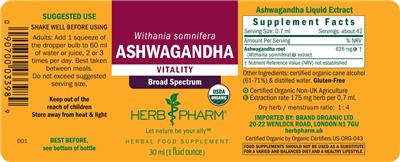
This summary is for Ashwagandha by Herb Pharm
- Form
- Liquid
- Serving Size
- 0.7 mL
- Servings
- 42 per container
- Container Holds
- 30 mL; 1 Fluid Ounce
- What is Ashwagandha?A single-ingredient supplement from Herb Pharm, in liquid form. It is marketed for vitality.
- Active Ingredients Ashwagandha Root Extract 626 mg One active ingredient. We check it for drug interactions and side effects. The full Supplement Facts
- Drug Interactions 1,373 drugs have a documented interaction with this supplement; the most serious is rated moderate. Of those, 958 are single drugs and 415 are combination products (two or more drugs in one), each listed under its own name. Ask your pharmacist first if you take a drug in any of these categories, the most serious of the 10 on record:
- Moderate · 372 drugs
- Moderate · 248 drugs
- Moderate · 172 drugs
- Moderate · 121 drugs
- Possible Side EffectsUpset stomach, nausea, or diarrheaDrowsiness or sleepinessHeadache +7 moreFrom its one active ingredient, Ashwagandha. Not studied in this exact product.
- Well documented Why
Does Ashwagandha work?
It is not marketed for one specific use, so this is what Ashwagandha has been studied for, strongest research first:
These grades are for the ingredient, not this exact product, and never a promise it will work for you.
What the research says- AllergensNone of its ingredient names point to a major food allergen
- Barcode (UPC)0 90700 03398 9Match it to the barcode on your bottle to be sure this is your product. Not your product? Search for it here
Who Might Consider It
- People who want it for insomnia, stress or generalized anxiety disorder (GAD): the uses with research behind them. See each grade
- Ashwagandha may be worth considering if you are looking for support with stress, sleep, or anxiety, and the evidence for those uses is rated possibly effective.
Who Should Be Careful
- Be careful if you take sedatives, blood pressure or diabetes medicines, thyroid hormone, or immune-suppressing drugs, or if you are pregnant or breastfeeding.
- Talk it over with your own doctor or pharmacist before you start.
More Before You Take It Show all three answersHide Its Ashwagandha Root Extract Amount vs. Other Supplements Pregnancy and Breastfeeding The Label’s Directions
-
How does its Ashwagandha Root Extract amount compare with other supplements?
- Ashwagandha Root Extract626 mgMore than most of the 344 recent Ashwagandha products in our database that state an amount; 600 mg is the most common.
A label’s amount is what the product holds, not a recommended dose.
See the Ashwagandha Root Extract comparison -
Pregnant or breastfeeding?
- Pregnancy
- There is insufficient reliable information available about the safety of oral ashwagandha when used during pregnancy.
- Breastfeeding
- Insufficient reliable information available; avoid using.
-
How does the label say to take it?
“Suggested use Shake well before using Adults: Add 1 squeeze of the dropper bulb to 60ml of water or juice, 2 or 3 times per day. Best taken between meals.”
The maker’s words. Your pharmacist or doctor may advise differently.
Everything the label says
From the label dated Aug 22, 2025: its one active ingredient was checked against our records. A summary of what is known, not a grade or a test of the product. How these ratings are computed
Ask Anything About This Supplement
Name a drug you take, or ask about side effects, ingredients or pregnancy.
There’s a lot of information about this supplement on this page! Ask anything in plain English for a quick answer drawn from it.
AI answers come from this label and our own records, never the open internet. AI can make mistakes, so always check with your doctor or pharmacist. How we use AI
Ask the Pharmacist
A licensed pharmacist will answer your question by email — free, as soon as they can.
Got it — thank you!
A licensed pharmacist will answer as soon as they can. Keep an eye on your email (worth checking spam, just in case).
What’s Inside Ashwagandha by Herb Pharm
One Active Ingredient: Ashwagandha Root Extract
Why this rating?
The label gives the exact amount of its one active ingredient, so you know how much you get in each serving. This rates what the label tells you, not the quality of the product.
Supplement Facts
| Amount Per Serving | % Daily Value | |
|---|---|---|
| Ashwagandha Root Extract | 626 mg | † |
Other ingredients: Cane Alcohol, Water, Distilled
† Daily Value not established.
Daily Values for adults and children 4 or more years of age.
As the label prints it, from the NIH Dietary Supplement Label Database.
Each Ingredient and Its Drug Interactions
Tap one for more about it and its full guide.
-
Ashwagandha Root Extract 626 mg Interacts with 1,373 drugs
Ashwagandha is an Ayurvedic herb most often taken to help with stress, anxiety, and sleep, and some small studies suggest it may help, though the evidence is still limited.
- It is generally well tolerated for short-term use in healthy adults, but it should be avoided in pregnancy and used cautiously by people with thyroid or liver problems.
- Talk with your pharmacist or doctor before starting it.
The full Ashwagandha guide: uses, dosage and safety Every Ashwagandha drug interaction
How Much Ashwagandha Is in It, Compared With Other Supplements
Each bar is an amount that other recent supplements list for the same ingredient. The taller the bar, the more of them state it.
-
626 mg in a serving of this product
More than most products
- Most common amount
- 600 mg (about 11 in 100 products)
- Most products state
- 65 mg to 600 mg
- Compared with
- 344 recent products
Other Ingredients (Inactive)
The capsule or tablet itself, fillers, coatings and flavors. Not part of the drug interaction check; the allergen check below reads them.
- Cane Alcohol
- Water, Distilled
Allergens in Ashwagandha
None of its ingredient names point to a major food allergen.
Not named in the ingredients
- Milk
- Egg
- Fish
- Shellfish
- Tree nuts
- Peanuts
- Wheat or other gluten grains
- Soy
- Sesame
- Made without, the label says“Gluten-free”
From the label text and ingredient names on file; we do not test products. With a serious allergy, check your bottle and ask the maker or your pharmacist.
What the Label Says
The maker’s own words, from the label. We do not verify or endorse them.
- Storage
-
“Store away from heat & light”
- Formulation
-
“Vitality Broad spectrum”
“USDA Organic”
3 more from the label
“Certified organic by Organic Certifiers US-ORG-043”
“Withania somnifera”
“Ashwagandha liquid extract”
- Seals and symbols
-
“USDA Organic”
- FDA Statement of Identity
-
“Herbal Food Supplement”
- Brand IP Statement(s)
-
“Herb Pharm Let nature be your ally”
The Ashwagandha Label on File
The label scan on file at the NIH Dietary Supplement Label Database, dated August 2025. Always read the label on the bottle you have.
Product Facts
- Brand
- Herb Pharm
- Barcode (UPC)
- 090700033989
- Net contents
- 30 mL; 1 Fluid Ounce
- Market status
- On market
- Date entered into DSLD
- Aug 22, 2025
- DSLD ID
- 336901
- Product type
- Botanical
- Supplement form
- Liquid
- Dietary claims / uses
- All Other, Structure/Function
- Intended target group(s)
- Adult (18 - 50 Years), Organic, Gluten Free
Is this label outdated? Report a formula or label change and our pharmacy team will review it.
HelloPharmacist Score Ashwagandha by Herb Pharm
Up to 10 points for research, amount, label and outside testing. Not a safety rating. How this one adds up
for generalized anxiety disorder (GAD)
It is not marketed for one specific use. Some research suggests ashwagandha may help with generalized anxiety disorder (GAD), its best-researched use.
- Research4 of 5 points
- Amount2 of 2 points
- Label2 of 2 points
- Outside testing0 of 1 point
for insomnia
Some research suggests ashwagandha may help with insomnia. It is marketed for vitality, not for this.
- Research4 of 5 points
- Amount2 of 2 points
- Label2 of 2 points
- Outside testing0 of 1 point
for stress
Some research suggests ashwagandha may help with stress. It is marketed for vitality, not for this.
- Research4 of 5 points
- Amount2 of 2 points
- Label2 of 2 points
- Outside testing0 of 1 point
Moderate drug interactions. The score does not count drug interactions. Check them against any drugs you take. See them
What Are You Taking It For?
Tap a reason and the score changes to match. Each one uses this product’s own amount, label and testing.
There is too little research to score ashwagandha for diabetes, high cholesterol, athletic performance, back pain, depression, osteoarthritis, rheumatoid arthritis (RA) and asthma, so they are not in the list.
How It Earns Its 8
Score: 8 out of 10. Preliminary for generalized anxiety disorder (GAD).
Some research on ashwagandha for generalized anxiety disorder (GAD).
Graded “Possibly Effective” in the Natural Medicines database, which we license. With no one use named, research counts for at most 4 of 5 points: at least half of its active ingredients (1 of 1) have research behind them.
4 of 5 points
Amount
Its 626 mg is a normal amount: most of the 344 ashwagandha products in our database that state an amount hold 65 mg to 600 mg.
2 of 2 points
Label
It states the amount of its one active ingredient.
2 of 2 points
Outside testing
We found no mark from an outside testing program, such as USP Verified or NSF Certified, on the label we have on file.
0 of 1 point
Some research on ashwagandha for insomnia.
Graded “Possibly Effective” in the Natural Medicines database, which we license.
4 of 5 points
Amount
Its 626 mg is a normal amount: most of the 344 ashwagandha products in our database that state an amount hold 65 mg to 600 mg.
2 of 2 points
Label
It states the amount of its one active ingredient.
2 of 2 points
Outside testing
We found no mark from an outside testing program, such as USP Verified or NSF Certified, on the label we have on file.
0 of 1 point
Some research on ashwagandha for stress.
Graded “Possibly Effective” in the Natural Medicines database, which we license.
4 of 5 points
Amount
Its 626 mg is a normal amount: most of the 344 ashwagandha products in our database that state an amount hold 65 mg to 600 mg.
2 of 2 points
Label
It states the amount of its one active ingredient.
2 of 2 points
Outside testing
We found no mark from an outside testing program, such as USP Verified or NSF Certified, on the label we have on file.
0 of 1 point
Where It Sits on the Ashwagandha Shelf
The 152 ashwagandha products we have scored so far, lined up by their scores. The dark bottle is this one. Each bottle stands for up to 5 products. Tap a score to see the products on it.
73 ashwagandha products score 8 out of 10
- Ashwagandha by Herb Pharm this one
- Recovery Tonic by True Botanica
- Organic Ashwagandha Whole Plant Extract Paste 2.5% by Materia Organica
- Organic Ashwagandha Tablets 2025 mg by NB NaturoBliss
- Organic Ashwagandha Root Extract Powder by Materia Organica
- KSM-66 Ashwagandha by NOW
- KSM-66 600 mg by Jacked Factory Essential Series
- Ashwagandha Extra Strength by Futurebiotics
- Ashwagandha 470 mg by Solaray
- Ashwagandha 35 by XYMOGEN
- Ashwagandha by Solaray
- Super Ashwagandha by SuperSmart
And 61 more.
45 ashwagandha products score 7 out of 10
- Paneer Phool / Berries by Vedic Herbs
- Ashwagandha Roots by Vedic Herbs
- Ashwagandha Panchang by Vedic Herbs
- Ashwagandha Alcohol-Free by Herb Pharm
- Premium Ashwagandha 1600 mg by Nutrivein
- Organic Ashwagandha by Success Chemistry
- Organic Ashwagandha by Sun God Medicinals Ra Herbals
- Ashwagandha with Withanolides 1500 mg Strawberry Flavor by Safrel
- Ashwagandha Extra Strength by Built By Nature
- Ashwagandha by Antler Farms
- Ashwagandha by ProCaps Laboratories
- ProCell by APOPTOSIS Nutraceuticals
And 33 more.
19 ashwagandha products score 4 out of 10
- Lipo Ashwagandha by Lotus Blooming Herbs
- Ashwagandha by FINAFLEX
- Ashwagandha 300 mg by Cooper Complete
- Pure Organic Ashwagandha Max 2400 mg by Warrior Strong Wellness
- Organic Ashwagandha by Herbally Grounded
- Aswagandha by Red Moon Herbs
- Ashwagandha Extract by Eclectic Herb
- Ashwagandha Extract by Herbs SRA
- Ashwagandha 450 mg by Natures Plus Herbal Actives
- Withania Som. Ashwagandha by Wise Woman Herbals
- Tulsi Ashwagandha by Organic India
- Tulsi Ashwagandha by Organic India
And 7 more.
7 ashwagandha products score 3 out of 10
- Ashwagandha Tincture by Doctor Morse's Healing Herbs
- Ashwagandha 2000 mg by NutraChamps
- Ashwagandha Extract Tonic by Omica Organics
- Ashwagandha by Karuna
- Extra Strength Ashwagandha 3,000 mg by Nature's Truth
- Ashwagandha Ghee by Pure Indian Foods
- Ashwagandha+ by Paradise Ayur-Pro Rx
1 ashwagandha product scores 0 out of 10
- Ashwagahdha Alcohol Free by Brainchild Nutritionals
4 ashwagandha products score 6 out of 10
- Organic Ashwagandha by Five Flavors Herbs
- Ashwagandha for Stress by NatureWise
- Ashwagandha Gummy by Natural Smart Health
- Premium Ashwagandha 1325 mg by Further Food
1 ashwagandha product scores 9 out of 10
- Concentrated Superfood Ashwagandha by New Chapter
2 ashwagandha products score 2 out of 10
- XFit Trainer Tropical Punch by MHP Maximum Human Performance
- XFit Trainer Citrus Lime by MHP Maximum Human Performance
This One Next to Most Ashwagandha Products
| What | This one | Most of the other 151 |
|---|---|---|
| What it is marketed for | No one use | Stress (61 of 64) |
| How much ashwagandha | 626 mg a serving | 300 mg to 1,200 mg |
| Form | Not named | Many forms |
| The label | Every amount stated | Every amount stated on 132 of 151 |
| Outside testing seal | None on file | 3 of 151 have one |
| Score | 8, Preliminary | 7 to 8 |
Ashwagandha by Herb Pharm Side Effects
Why this rating?
We look for three kinds of safety information on each ingredient: side effects reported in studies, a pregnancy and breastfeeding rating, and a safety write-up from our pharmacy team. All three are on file for Ashwagandha.
So this rates how much is known, not whether Ashwagandha is right for you.
Reported with Ashwagandha, its active ingredient
- Most often
- Upset stomach, nausea, or diarrhea; drowsiness or sleepiness; and headache
- !Rare but serious
- Liver problems, possible changes in thyroid function and hepatic encephalopathy See details
HelloPharmacist Team Summary: Ashwagandha by Herb Pharm Side Effects
You will likely find ashwagandha generally well tolerated for short-term use in healthy adults, though long-term safety data are limited.
- The side effects you are most likely to notice are an upset stomach, drowsiness, and headache.
- If you feel drowsy, see how it affects you before you drive.
- The rare but serious effects are liver problems and changes in thyroid function, so call your doctor right away if you notice yellowing skin, dark urine, or unusual thyroid symptoms.
- Talk with your own doctor or pharmacist before starting if you have a thyroid condition, an autoimmune condition, or surgery planned, or if you are pregnant or breastfeeding.
Side Effects Reported With Ashwagandha
Ashwagandha Warnings: Who Should Be Careful
These warnings are for Ashwagandha, its one active ingredient. If any of these apply to you, talk to your doctor or pharmacist before you start it.
-
Bleeding Problems or Surgery
- People with autoimmune conditions or those scheduled for surgery should also check with their doctor first.
-
Thyroid Conditions
- Use caution if you have a thyroid condition, since ashwagandha may affect thyroid hormone levels.
-
What the Label Warns
- “Do not exceed suggested serving size.”
- “Keep out of the reach of children.”
- “Food supplements should not be used as a substitute for a varied and balanced diet and a healthy lifestyle.”
The maker’s wording, from the product label.
-
Pregnant or Breastfeeding
The rating for pregnancy and for breastfeeding, and what it covers.
Pregnancy
-
There is insufficient reliable information available about the safety of oral ashwagandha when used during pregnancy.
Historically, ashwagandha has been linked to abortifacient effects; however, there are no reliable case reports of harm in pregnancy.
2 more points on this rating
- Although one clinical study in pregnant females in their second trimester reported no adverse events with use of ashwagandha 300 mg twice daily for 12 weeks, abortifacient activity, developmental outcomes, and fetal toxicity were not assessed.
- Until more is known about the safety of ashwagandha, avoid using during pregnancy.
Breastfeeding
-
Insufficient reliable information available; avoid using.
Our pharmacy team’s notes
- Our pharmacists advise against using it during pregnancy, since it is traditionally thought to risk miscarriage.
- Our pharmacists also advise against it while breastfeeding, because there is not enough safety information.
Ratings and the words beside them are from the Natural Medicines database, which we license.
The full record, with its sources, in the Ashwagandha guide -
Rare but Serious Side Effects
-
!
Ashwagandha
Rare but serious effects include liver problems and possible changes in thyroid function.
Orally: Some case reports raise concerns about acute hepatitis, acute liver failure, hepatic encephalopathy, the need for liver transplantation, and death due to liver failure with ashwagandha treatment.
When to get help: a serious allergic reaction, with trouble breathing or swelling of the face, lips or throat, needs emergency care: call 911. For any other side effect that worries you, call your doctor or pharmacist.
These reports describe each ingredient, not studies of this exact product. Not medical advice: a side effect you notice after starting a supplement is worth a word with your pharmacist or doctor.
Ashwagandha by Herb Pharm Drug Interactions
This supplement has one active ingredient, Ashwagandha Root Extract, and we checked it against every drug in our records.
A moderate interaction on record
2 of 3, on a scale from Minor or none to Major.Why this rating?
We rate this by the most serious interaction on record, not by how many there are. For Ashwagandha, the most serious is rated moderate, which means it calls for caution, and sometimes monitoring or a change in timing or dose. Some involve kinds of drugs where a small change can matter, such as transplant drugs and diabetes drugs.
1,374 drugs are on the full list. What matters is whether one you take is on it, so check yours with the interaction checker on this page.
Its one active ingredient has drug interactions on record: Ashwagandha.
Ashwagandha
- Interacts with
- 1,373 drugs
- Most serious
- Moderate
- The most serious one we list is with liver-harming drugs (hepatotoxic drugs), rated Moderate, where it may increase the risk of liver damage.
- The other drug types, all rated Moderate, are sedating drugs (CNS depressants) such as barbiturates, where sedation may be stronger, and benzodiazepines (anxiety and sleep medicines), where the sedative effects may add up.
- Blood pressure medicines (antihypertensive drugs) may lower blood pressure further, and diabetes medicines (antidiabetes drugs) may raise the risk of low blood sugar (hypoglycemia).
- Immune-suppressing drugs (immunosuppressants) may work less well, and thyroid hormone may have stronger effects and adverse effects.
Show two more points
- Drugs cleared by the liver enzyme CYP1A2 (CYP1A2 substrates) may be less effective, rated Minor.
- Use the search tool on this page to check your exact medications.
The kinds of drugs it affects most
- 645 drugs
- 372 drugs
- 248 drugs
- 186 drugs
Every Ashwagandha drug interaction, 10 records The Ashwagandha records cite 32 references, listed in the Ashwagandha guide.
Summarized by the HelloPharmacist pharmacy team from the interaction records below. How it is written How we use AI
The Breakdown by Severity
Each drug counted once, at its most serious rating. Tap a tile to list those drugs.
Find Your Drug
Type a drug or brand name to see whether it is on the list.
- Only drugs with a documented interaction are listed, the most serious first.
- A drug with no known interaction is not listed, but searching its name tells you so.
- Open a drug to see which ingredient is responsible. Of those, 958 are single drugs and 415 are combination products (two or more drugs in one), each listed under its own name.
-
LevothyroxineEltroxin, Estre, Euthyrox, Levo-T, Levolet and 6 more Moderate
The ingredient responsible:
-
Ashwagandha Root Extract Moderate Levothyroxine is in the Thyroid Hormone category.
Ashwagandha might increase the effects and adverse effects of thyroid hormone.
The full Ashwagandha Root Extract + Levothyroxine interaction
-
-
AmlodipineNorliqva Moderate
The ingredient responsible:
-
Ashwagandha Root Extract Moderate Amlodipine is in these Antihypertensive Drugs, Cytochrome P450 3A4 (CYP3A4) Substrates categories.
Theoretically, taking ashwagandha with antihypertensive drugs might increase the risk of hypotension.
The full Ashwagandha Root Extract + Amlodipine interaction
-
-
RosuvastatinCrestor, Ezallor Moderate
The ingredient responsible:
-
Ashwagandha Root Extract Moderate Rosuvastatin is in the Hepatotoxic Drugs category.
Theoretically, taking ashwagandha with hepatotoxic drugs might increase the risk of liver damage.
The full Ashwagandha Root Extract + Rosuvastatin interaction
-
-
Losartan PotassiumCozaar Moderate
The ingredient responsible:
-
Ashwagandha Root Extract Moderate Losartan Potassium is in these Antihypertensive Drugs, Cytochrome P450 3A4 (CYP3A4) Substrates categories.
Theoretically, taking ashwagandha with antihypertensive drugs might increase the risk of hypotension.
The full Ashwagandha Root Extract + Losartan Potassium interaction
-
-
AtorvastatinAtorvaliq Moderate
The ingredient responsible:
-
Ashwagandha Root Extract Moderate Atorvastatin is in these Cytochrome P450 3A4 (CYP3A4) Substrates, Hepatotoxic Drugs categories.
Theoretically, ashwagandha might decrease the levels and clinical effects of CYP3A4 substrates.
The full Ashwagandha Root Extract + Atorvastatin interaction
-
-
MetforminGlucophage, Metformin Moderate
The ingredient responsible:
-
Ashwagandha Root Extract Moderate Metformin is in the Antidiabetes Drugs category.
Theoretically, taking ashwagandha with antidiabetes drugs might increase the risk of hypoglycemia.
The full Ashwagandha Root Extract + Metformin interaction
-
-
MetoprololLopressor, Toprol XL Moderate
The ingredient responsible:
-
Ashwagandha Root Extract Moderate Metoprolol is in the Antihypertensive Drugs category.
Theoretically, taking ashwagandha with antihypertensive drugs might increase the risk of hypotension.
The full Ashwagandha Root Extract + Metoprolol interaction
-
-
TirzepatideMounjaro, Zepbound Moderate
The ingredient responsible:
-
Ashwagandha Root Extract Moderate Tirzepatide is in the Antidiabetes Drugs category.
Theoretically, taking ashwagandha with antidiabetes drugs might increase the risk of hypoglycemia.
The full Ashwagandha Root Extract + Tirzepatide interaction
-
-
SemaglutideOzempic, Rybelsus, Wegovy Moderate
The ingredient responsible:
-
Ashwagandha Root Extract Moderate Semaglutide is in the Antidiabetes Drugs category.
Theoretically, taking ashwagandha with antidiabetes drugs might increase the risk of hypoglycemia.
The full Ashwagandha Root Extract + Semaglutide interaction
-
-
TestosteroneAndrogel, Andropatch, Delatestryl, Intrinsa, Natesto and 4 more Moderate
The ingredient responsible:
-
Ashwagandha Root Extract Moderate Testosterone is in these Hepatotoxic Drugs, Cytochrome P450 3A4 (CYP3A4) Substrates categories.
Theoretically, taking ashwagandha with hepatotoxic drugs might increase the risk of liver damage.
The full Ashwagandha Root Extract + Testosterone interaction
-
-
AmoxicillinAmix, Amoram, Amoxident, Amoxil Capsules, Amoxil Injection and 4 more Moderate
The ingredient responsible:
-
Ashwagandha Root Extract Moderate Amoxicillin is in the Hepatotoxic Drugs category.
Theoretically, taking ashwagandha with hepatotoxic drugs might increase the risk of liver damage.
The full Ashwagandha Root Extract + Amoxicillin interaction
-
-
PrednisoneCortan, Deltasone, Meticorten, Orasone, Prednicen-M and 3 more Moderate
The ingredient responsible:
-
Ashwagandha Root Extract Moderate Prednisone is in these Cytochrome P450 3A4 (CYP3A4) Substrates, Immunosuppressants categories.
Theoretically, ashwagandha might decrease the levels and clinical effects of CYP3A4 substrates.
The full Ashwagandha Root Extract + Prednisone interaction
-
-
AcetaminophenChildren's Tylenol, Children's Tylenol Meltaways, Tylenol, Tylenol Ex Strength Moderate
The ingredient responsible:
-
Ashwagandha Root Extract Moderate Acetaminophen is in these Hepatotoxic Drugs, Cytochrome P450 1A2 (CYP1A2) Substrates categories.
Theoretically, taking ashwagandha with hepatotoxic drugs might increase the risk of liver damage.
The full Ashwagandha Root Extract + Acetaminophen interaction
-
-
PregabalinLyrica, Lyrica CR Moderate
The ingredient responsible:
-
Ashwagandha Root Extract Moderate Pregabalin is in the CNS Depressants category.
Theoretically, taking ashwagandha might increase the sedative effects of CNS depressants.
The full Ashwagandha Root Extract + Pregabalin interaction
-
-
MethotrexateOtrexup, Rasuvo, Reditrex, Rheumatrex Moderate
The ingredient responsible:
-
Ashwagandha Root Extract Moderate Methotrexate is in the Hepatotoxic Drugs category.
Theoretically, taking ashwagandha with hepatotoxic drugs might increase the risk of liver damage.
The full Ashwagandha Root Extract + Methotrexate interaction
-
-
PropranololAngilol, Bedranol SR, Beta Prograne, Half Beta Prograne, Half-Inderal LA and 7 more Moderate
The ingredient responsible:
-
Ashwagandha Root Extract Moderate Propranolol is in these Cytochrome P450 1A2 (CYP1A2) Substrates, Antihypertensive Drugs categories.
Theoretically, ashwagandha might decrease the levels and clinical effects of CYP1A2 substrates.
The full Ashwagandha Root Extract + Propranolol interaction
-
-
AmitriptylineElavil Moderate
The ingredient responsible:
-
Ashwagandha Root Extract Moderate Amitriptyline is in these Cytochrome P450 3A4 (CYP3A4) Substrates, Cytochrome P450 1A2 (CYP1A2) Substrates, CNS Depressants and 1 more categories.
Theoretically, ashwagandha might decrease the levels and clinical effects of CYP3A4 substrates.
The full Ashwagandha Root Extract + Amitriptyline interaction
-
-
LisinoprilPrinivil, Qbrelis, Zestril Moderate
The ingredient responsible:
-
Ashwagandha Root Extract Moderate Lisinopril is in the Antihypertensive Drugs category.
Theoretically, taking ashwagandha with antihypertensive drugs might increase the risk of hypotension.
The full Ashwagandha Root Extract + Lisinopril interaction
-
-
LamotrigineLamictal Moderate
The ingredient responsible:
-
Ashwagandha Root Extract Moderate Lamotrigine is in the CNS Depressants category.
Theoretically, taking ashwagandha might increase the sedative effects of CNS depressants.
The full Ashwagandha Root Extract + Lamotrigine interaction
-
-
ClonazepamCeberclon, Klonopin, Rivotril Moderate
The ingredient responsible:
-
Ashwagandha Root Extract Moderate Clonazepam is in these Cytochrome P450 3A4 (CYP3A4) Substrates, CNS Depressants, Benzodiazepines categories.
Theoretically, ashwagandha might decrease the levels and clinical effects of CYP3A4 substrates.
The full Ashwagandha Root Extract + Clonazepam interaction
-
-
DoxycyclineDoryx, Doxy, Doxy-D, Doxycin, Doxycycline Injection and 7 more Moderate
The ingredient responsible:
-
Ashwagandha Root Extract Moderate Doxycycline is in the Hepatotoxic Drugs category.
Theoretically, taking ashwagandha with hepatotoxic drugs might increase the risk of liver damage.
The full Ashwagandha Root Extract + Doxycycline interaction
-
-
GabapentinGralise, Neurontin Moderate
The ingredient responsible:
-
Ashwagandha Root Extract Moderate Gabapentin is in the CNS Depressants category.
Theoretically, taking ashwagandha might increase the sedative effects of CNS depressants.
The full Ashwagandha Root Extract + Gabapentin interaction
-
-
Levothyroxine SodiumErmez, Thyquidity, Tirosint-Sol Moderate
The ingredient responsible:
-
Ashwagandha Root Extract Moderate Levothyroxine Sodium is in the Thyroid Hormone category.
Ashwagandha might increase the effects and adverse effects of thyroid hormone.
The full Ashwagandha Root Extract + Levothyroxine Sodium interaction
-
-
Amlodipine BesylateNorvasc Moderate
The ingredient responsible:
-
Ashwagandha Root Extract Moderate Amlodipine Besylate is in these Antihypertensive Drugs, Cytochrome P450 3A4 (CYP3A4) Substrates categories.
Theoretically, taking ashwagandha with antihypertensive drugs might increase the risk of hypotension.
The full Ashwagandha Root Extract + Amlodipine Besylate interaction
-
-
DuloxetineCymbalta, Drizalma Sprinkle, Irenka Moderate
The ingredient responsible:
-
Ashwagandha Root Extract Moderate Duloxetine is in these Hepatotoxic Drugs, Serotonergic Drugs categories.
Theoretically, taking ashwagandha with hepatotoxic drugs might increase the risk of liver damage.
The full Ashwagandha Root Extract + Duloxetine interaction
-
-
Thyroid HormoneEtwon Moderate
The ingredient responsible:
-
Ashwagandha Root Extract Moderate
Ashwagandha might increase the effects and adverse effects of thyroid hormone.
The full Ashwagandha Root Extract + Thyroid Hormone interaction
-
-
CiprofloxacinCiloxan, Cipro, Cipro IV, Cipro XR, Ciprobay and 1 more Moderate
The ingredient responsible:
-
Ashwagandha Root Extract Moderate Ciprofloxacin is in the Hepatotoxic Drugs category.
Theoretically, taking ashwagandha with hepatotoxic drugs might increase the risk of liver damage.
The full Ashwagandha Root Extract + Ciprofloxacin interaction
-
-
BisoprololZebeta Moderate
The ingredient responsible:
-
Ashwagandha Root Extract Moderate Bisoprolol is in the Antihypertensive Drugs category.
Theoretically, taking ashwagandha with antihypertensive drugs might increase the risk of hypotension.
The full Ashwagandha Root Extract + Bisoprolol interaction
-
-
AlprazolamNiravam, Xanax Moderate
The ingredient responsible:
-
Ashwagandha Root Extract Moderate Alprazolam is in these Benzodiazepines, Cytochrome P450 3A4 (CYP3A4) Substrates, CNS Depressants categories.
Theoretically, taking ashwagandha might increase the sedative effects of benzodiazepines.
The full Ashwagandha Root Extract + Alprazolam interaction
-
-
DiazepamDiastat AcuDial, Valium, Valium injection, Valtoco Moderate
The ingredient responsible:
-
Ashwagandha Root Extract Moderate Diazepam is in these Benzodiazepines, Cytochrome P450 3A4 (CYP3A4) Substrates, Cytochrome P450 1A2 (CYP1A2) Substrates and 1 more categories.
Theoretically, taking ashwagandha might increase the sedative effects of benzodiazepines.
The full Ashwagandha Root Extract + Diazepam interaction
-
Does It Work? Ashwagandha by Herb Pharm
What the research says so far. A grade is the research so far, never an endorsement.
HelloPharmacist Team Summary: Does Ashwagandha by Herb Pharm Work?
Ashwagandha is rated possibly effective for insomnia, generalized anxiety disorder (GAD), and stress.
- It is rated insufficient reliable evidence to rate for tobacco and nicotine dependence, so the evidence there is not established.
What the Research Says About Ashwagandha
Its uses graded effective, likely effective or possibly effective:
Research suggests a benefit for
- Insomnia, stress and generalized anxiety disorder (GAD)
The grades are the Natural Medicines database’s, which we license; tap a grade for what it means. They are about each ingredient, not this exact product.
About Herb Pharm
Manufacturer and brand details for Ashwagandha, from the product label.
Herb Pharm has 702 products in our supplement database, 650 of them on the market, with labels on file since 2013. Our database is built from the NIH’s Dietary Supplement Label Database and our pharmacy team’s own additions, so it covers the labels filed there, not every product the brand sells.
- Name
- Brand Organic LTD
- Street Address
- 20-22 Wenlock Road
- City
- London
- ZipCode
- N1 7GU
- Web Address
- herbpharm.uk
Ashwagandha by Herb Pharm: Common Questions
Does Ashwagandha by Herb Pharm interact with any drugs?
What are the side effects of Ashwagandha by Herb Pharm?
Who should be careful taking Ashwagandha by Herb Pharm?
Can Ashwagandha by Herb Pharm affect the liver?
Does Ashwagandha by Herb Pharm contain any common allergens?
Is Ashwagandha by Herb Pharm gluten free?
How can Ashwagandha by Herb Pharm interact with so many drugs?
Where does the information about Ashwagandha by Herb Pharm come from?
Is Ashwagandha by Herb Pharm safe to take during pregnancy?
Does Ashwagandha by Herb Pharm work for stress?
What is Ashwagandha by Herb Pharm used for?
Written and reviewed by the HelloPharmacist Editorial Team. Our editorial policy
Still Have a Question About Ashwagandha?
Our pharmacists answer drug and supplement questions, free, by email.
Label information is sourced from the NIH Dietary Supplement Label Database and reflects the product version on file; always read your actual product label. This page is for education only and is not a substitute for professional medical advice. Confirm with your pharmacist or doctor before combining supplements and drugs.
Who Reviews This Page
The pharmacist behind it, and how it is checked.
Dr. Brian Staiger, PharmD, BCPS
Clinical pharmacist and founder of HelloPharmacist
A licensed pharmacist for more than 13 years, he built the system behind this page: it reads the label on file, matches each active ingredient to its record in the Natural Medicines database, checks those records against every drug we cover, and our pharmacy team writes the take and the interaction summary from those records.
- 13+ Years in PharmacyRetail and clinical pharmacy, medication safety and healthcare administration.
- Board Certified (BCPS)A pharmacotherapy specialist, certified by the Board of Pharmacy Specialties.
- Herbalist TrainingCertificates in medical ethnobotany, for the herbs and supplements people take.
Where This Page Comes From
Ashwagandha’s label data comes from the NIH Dietary Supplement Label Database; the ingredient interaction data is from the Natural Medicines database, reviewed by our pharmacists.
- NIH Dietary Supplement Label Database (DSLD)
- The official product label on file for this supplement.
- Natural Medicines (Therapeutic Research Center)
- The evidence-graded clinical reference behind the ingredient interaction, evidence and safety records, which we license.
- HelloPharmacist Editorial Team
- Content is reviewed by the HelloPharmacist Editorial Team, the pharmacists on our staff and those we contract. See our data sources and editorial standards for how this information is built and checked.
- The Pharmacy Team’s Take and Summaries
- Generated from HelloPharmacist’s pharmacist-curated databases and editorial rules. Clinical methodology reviewed by Dr. Brian Staiger, PharmD, BCPS. Last generated Oct 31, 2026. How we use AI
- The ratings in the Quick Summary
- They summarize available label information, ingredient evidence and known drug-safety records: a summary of what is known, not a grade of the product itself. They do not verify product identity, purity, potency, contamination or manufacturing quality. How these ratings are computed
The References Behind the Interaction Records
Every citation the ingredients’ records rest on is listed in that ingredient’s guide, in context: Ashwagandha, 32 references .
Parts of this content are provided by the Therapeutic Research Center, LLC.
DISCLAIMER: Currently this does not check for drug-drug interactions. This is not an all-inclusive comprehensive list of potential interactions and is for informational purposes only. Not all interactions are known or well-reported in the scientific literature, and new interactions are continually being reported. Input is needed from a qualified healthcare provider including a pharmacist before starting any therapy. Application of clinical judgment is necessary.
© 2021 Therapeutic Research Center, LLC
Keep Exploring
- Supplement interaction checkerCheck any supplement or product against your drugs
- Drug–drug interactionsCheck two or more of your drugs against each other
- Browse drugs A to ZEvery drug we have checked against herbs and supplements
- NDC and pricing lookupFind a drug’s NDCs, packaging and costs
- Ask a pharmacistA free, personal answer from our licensed team