
Phoenix Fat Burner by Legion Ingredients, Side Effects and Drug Interactions
Dietary Supplement Capsule Other Combinations
UPC 6 53341 67441 8 Match it to the barcode on your bottle

Medically reviewed by Dr. Brian Staiger, PharmD, BCPS
Also reviewed by the HelloPharmacist Editorial Team
Updated Details about this page
- Label on file from the NIH Dietary Supplement Label Database, dated Jul 27, 2021.
- The interaction, evidence and safety records come from the Natural Medicines database, which we license, read against this label by our own system; the pharmacy team’s sections are written from those records.
- Dr. Brian Staiger, PharmD, BCPS, is a clinical pharmacist and pharmacotherapy specialist.
- Editorial policy Our sources
AI is used only to summarize verified clinical information, never the open internet. Our AI policy
Summary: The HelloPharmacist Team’s Take
- Form
- Capsule
- Serving Size
- 3 Veggie Capsules
- Servings
- 30 per container
- Container Holds
- 90 Capsules
What’s in it, whether it interacts with your drugs, its side effects, whether it works, and what our pharmacists would want you to know before you start it.
- What is Phoenix Fat Burner?A supplement from Legion with eleven active ingredients, in capsule form.
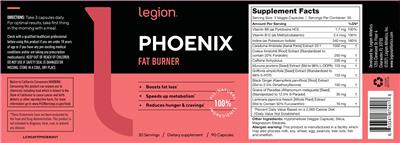
- Active Ingredients 2 vitamins, 1 mineral, 6 plant ingredients such as Caralluma Fimbriata, Coleus forskohlii and Mucuna pruriens and 2 others: Vitamin B6 1.7 mgVitamin B12 2.4 mcgIodine 240 mcgCaralluma Fimbriata extract 1000 mgColeus forskohlii extract 250 mgCaffeine Anhydrous 200 mgMucuna pruriens extract 153 mgGriffonia simplicifolia extract 153 mgBlack Ginger extract 100 mgGrains of Paradise 30 mgLaminaria japonica Aresch extract 16 mg Eleven active ingredients. Each one can interact with drugs or cause side effects on its own, so we check every one. The full Supplement Facts
- Drug Interactions 1,451 drugs have a documented interaction with this supplement; the most serious is rated major. Of those, 987 are single drugs and 464 are combination products (two or more drugs in one), each listed under its own name. Ask your pharmacist first if you take a drug in any of these categories, the most serious of the 74 on record:
- Major · 22 drugs
- Major · 9 drugs
- EphedrineMajor · 8 drugs
- Major · 7 drugs
- Possible Side EffectsHeartburn 5 ingredientsHeadache 4 ingredientsNausea 4 ingredientsStomach upset 4 ingredientsGas 3 ingredientsStomach pain 2 ingredients +25 moreReported for nine of its eleven active ingredients. Not studied in this exact product.
- Well documented Why
Does Phoenix Fat Burner work?
What It Is Marketed For
- Fat burning
- Metabolism
- Appetite support
From the claims on the product’s label.
The Closest Use the Research Grades
Caffeine
Some studies support it, but the evidence isn’t conclusive.
Its ingredients have stronger research for other uses:
- Vitamin B6 deficiency Vitamin B6
- Caffeine
- Radiation exposure Iodine
- Mental alertness Caffeine
- Hyperhomocysteinemia Vitamin B6
- Iodine deficiency Iodine
These grades are for each ingredient, not this exact product, and never a promise it will work for you.
And 14 more graded uses, in what the research says- Full Why
- AllergensNone of its ingredient names point to a major food allergen
- Barcode (UPC)6 53341 67441 8Match it to the barcode on your bottle to be sure this is your product. Not your product? Search for it here
Who Might Consider It
- People looking for fat burning, metabolism and appetite support, which is what it is marketed for. The closest use the research grades is obesity, rated Possibly Effective.
- People who want it for vitamin B6 deficiency, athletic performance, radiation exposure, mental alertness or another graded use: the other uses with research behind them. See each grade
- Adults who tolerate caffeine and take no interacting medicines may want to read the details closely before deciding.
Who Should Be Careful
- People on heart or blood pressure medicines, blood thinners, thyroid drugs, antidepressants, seizure drugs, or diabetes drugs should be especially careful.
- Anyone who is pregnant or breastfeeding should also talk it over with their own doctor or pharmacist before starting.
More Before You Take It Show both answersHide Pregnancy and Breastfeeding The Label’s Directions
-
Pregnant or breastfeeding?
- Pregnancy Cowhage
- ! Not enough safety data and its dopamine effects make it best avoided during pregnancy.
- Breastfeeding Cowhage
- Insufficient reliable information available; avoid using.
- Pregnancy Laminaria
- ! When used orally due to potential hormonal effects; avoid using.
- Breastfeeding Laminaria
- ! When used orally because of potential toxicity.
- Pregnancy Vitamin B6
- ! When used orally in excessive doses.
- Breastfeeding Vitamin B6
- When used orally in doses not exceeding the tolerable upper intake level (UL) of vitamin B6 in the form of pyridoxine 80 mg daily for those aged 14-18 years and 100 mg daily for those 19 years and older.
-
How does the label say to take it?
“Directions: Take 3 capsules daily. For optimal results, take first thing in the morning with a meal.”
The maker’s words. Your pharmacist or doctor may advise differently.
Everything the label says
From the label dated Jul 27, 2021: all eleven of its active ingredients were checked against our records. A summary of what is known, not a grade or a test of the product. How these ratings are computed
Ask Anything About This Supplement
Name a drug you take, or ask about side effects, ingredients or pregnancy.
AI answers come from this label and our own records, never the open internet. AI can make mistakes, so always check with your doctor or pharmacist. How we use AI
Ask the Pharmacist
A licensed pharmacist will answer your question by email — free, usually within 24 hours.
Got it — thank you!
A licensed pharmacist will answer within 24 hours. Keep an eye on your email (worth checking spam, just in case).
What’s Inside Phoenix Fat Burner by Legion
Eleven Active Ingredients, Each Checked on Its Own
A supplement is often several ingredients in one bottle, and each one can interact with drugs or cause side effects on its own. We check every one of them against our records.
- Vitamin B6Drug interactions on record, most serious: Moderate
- Vitamin B12No drug interactions on record
- IodineDrug interactions on record, most serious: Moderate
- Caralluma Fimbriata extractNo drug interactions on record
- Coleus forskohlii extractDrug interactions on record, most serious: Major
- Caffeine AnhydrousDrug interactions on record, most serious: Major
- Mucuna pruriens extractDrug interactions on record, most serious: Major
- Griffonia simplicifolia extractDrug interactions on record, most serious: Moderate
And 3 more, each with its own card below.
Why this rating?
The label gives an exact amount for every one of its eleven active ingredients, so you know how much of each you get in each serving. This rates what the label tells you, not the quality of the product.
Supplement Facts
| Amount Per Serving | % Daily Value | |
|---|---|---|
| Vitamin B6 | 1.7 mg | 100% |
| Vitamin B12 | 2.4 mcg | 100% |
| Iodine | 240 mcg | 160% |
| Caralluma Fimbriata extract | 1000 mg | † |
| Coleus forskohlii extract | 250 mg | † |
| Caffeine Anhydrous | 200 mg | † |
| Mucuna pruriens extract | 153 mg | † |
| Griffonia simplicifolia extract | 153 mg | † |
| Black Ginger extract | 100 mg | † |
| Grains of Paradise | 30 mg | † |
| Laminaria japonica Aresch extract | 16 mg | † |
Other ingredients: Hypromellose, Silica, Magnesium Stearate
† Daily Value not established.
Daily Values for adults and children 4 or more years of age.
As the label prints it, from the NIH Dietary Supplement Label Database.
Each Ingredient and Its Drug Interactions
Tap one for more about it and its full guide. A drug can interact with this supplement through any one of them.
Phoenix Fat Burner contains 11 active ingredients.
- The blend also includes coleus forskohlii extract, cowhage (mucuna pruriens) extract, which contains levodopa, griffonia extract, which contains 5-HTP, and black ginger extract.
- Vitamins B6 and B12 are included, and iodine and laminaria japonica extract (kelp) supply iodine.
Show 1 more point
- Caralluma fimbriata extract and grains of paradise complete the list.
-
Vitamin B6 1.7 mg Interacts with 210 drugs
Form on the label: Pyridoxine Hydrochloride
Vitamin B6 (pyridoxine) is an essential water-soluble vitamin that your body needs for metabolism, brain function, and making red blood cells.
- It is best known for helping with pregnancy-related nausea and may help some people with PMS, but taking very high doses for long periods can cause nerve damage.
- Get most of your B6 from food, and check with a pharmacist or doctor before taking high-dose supplements.
The full Vitamin B6 guide: uses, dosage and safety Every Vitamin B6 drug interaction
-
Vitamin B12 2.4 mcg Interacts with 20 drugs
Form on the label: Methylcobalamin
Vitamin B12 (cobalamin) is an essential nutrient your body needs to make red blood cells, keep nerves healthy, and support DNA.
- Supplements are very helpful for people who are deficient — such as vegans, older adults, and those with absorption problems — but taking extra B12 when you are not deficient is unlikely to boost energy or health.
- Talk to your pharmacist or doctor if you think you may be low.
The full Vitamin B12 guide: uses, dosage and safety Every Vitamin B12 drug interaction
-
Iodine 240 mcg Interacts with 23 drugs
Form on the label: Potassium Iodide
Iodine is an essential mineral your body needs to make thyroid hormones, and most people get enough from iodized salt, dairy, and seafood.
- Supplements help when you are truly deficient, but taking too much can harm the thyroid, so high-dose products should only be used under medical supervision.
The full Iodine guide: uses, dosage and safety Every Iodine drug interaction
-
Caralluma Fimbriata extract 1000 mg No known drug interactions
Caralluma fimbriata is an edible succulent plant from India that is marketed mainly as an appetite suppressant and weight-loss aid.
- Some small studies suggest it may modestly reduce appetite or waist size, but the overall evidence is limited and not strong.
- Talk to your pharmacist or doctor before trying it, and avoid it during pregnancy and breastfeeding.
-
Coleus forskohlii extract 250 mg Interacts with 917 drugs
Form on the label: Forskolin
Coleus is a plant from the mint family whose root contains a compound called forskolin, often marketed for weight loss, asthma, and heart health.
- While early lab and small human studies are interesting, solid proof that Coleus supplements help any of these conditions is limited.
- Talk to your pharmacist or doctor before using it, especially if you have heart problems or low blood pressure.
The full Coleus guide: uses, dosage and safety Every Coleus drug interaction
-
Caffeine Anhydrous 200 mg The main stimulant is caffeine anhydrous. Interacts with 655 drugs
Caffeine is a natural stimulant found in coffee, tea, and many other plants and products.
- In moderate amounts it can boost alertness and reduce tiredness for most healthy adults, but too much can cause jitteriness, a racing heart, and sleep problems.
- Pregnant women and people with heart conditions or anxiety should be especially careful and check with a doctor or pharmacist.
The full Caffeine guide: uses, dosage and safety Every Caffeine drug interaction
-
Mucuna pruriens extract 153 mg Interacts with 193 drugs
Form on the label: L-Dopa
Cowhage (Mucuna pruriens) is a tropical legume best known as a natural source of L-dopa, the compound the body turns into dopamine.
- It is most studied for Parkinson's disease symptoms and male fertility, but evidence is still limited and the L-dopa content makes it potentially powerful and risky—talk to your doctor or pharmacist before using it.
The full Cowhage guide: uses, dosage and safety Every Cowhage drug interaction
-
Griffonia simplicifolia extract 153 mg Interacts with 317 drugs
Form on the label: 5-HTP
Griffonia simplicifolia is a West African shrub whose seeds are a natural source of 5-HTP, a building block of the brain chemical serotonin.
- Some people use it for mood, sleep, and appetite, but high-quality human evidence is limited, and it should not replace prescribed treatment.
- Talk with your pharmacist or doctor before using it, especially if you take medicines that affect serotonin.
The full Griffonia Simplicifolia guide: uses, dosage and safety Every Griffonia Simplicifolia drug interaction
-
Black Ginger extract 100 mg Interacts with 1,008 drugs
Form on the label: Dimethoxyflavone
Ginger is a widely used culinary spice with a long history in traditional medicine, and it has the strongest evidence for helping with nausea and vomiting, including from motion sickness, pregnancy, and chemotherapy.
- It is generally safe in food and supplement amounts for most people, though it may cause mild stomach upset.
- Talk with your pharmacist or doctor before using ginger supplements, especially if you are pregnant, have a bleeding disorder, or take other medicines.
The full Ginger guide: uses, dosage and safety Every Ginger drug interaction
-
Grains of Paradise 30 mg No known drug interactions
Form on the label: 6-Paradol
Grains of paradise is a West African spice in the ginger family that people use for digestion, as a spice, and more recently in supplements aimed at metabolism.
- Early human research suggests it may slightly increase the burning of brown fat, but the evidence is preliminary and not strong enough to recommend it for weight loss.
- It is generally considered safe as a food spice, but talk to your pharmacist or doctor before using concentrated supplements.
-
Laminaria japonica Aresch extract 16 mg Interacts with 69 drugs
Form on the label: Fucoxanthin
Laminaria is a type of brown seaweed (kelp) that is very rich in iodine and is also used in medical settings as a natural cervical dilator.
- Because its iodine content can be high and variable, supplements may upset thyroid function, so it should be used cautiously and under professional guidance.
- Always talk with your pharmacist or doctor before using kelp products, especially if you have a thyroid condition.
The full Laminaria guide: uses, dosage and safety Every Laminaria drug interaction
Other Ingredients (Inactive)
The capsule or tablet itself, fillers, coatings and flavors. Not part of the drug interaction check; the allergen check below reads them.
- Hypromellose
- Silica
- Magnesium Stearate
Allergens in Phoenix Fat Burner
None of its ingredient names point to a major food allergen.
Not named in the ingredients
- Milk
- Egg
- Fish
- Shellfish
- Tree nuts
- Peanuts
- Wheat or other gluten grains
- Soy
- Sesame
- The label’s allergen statement“Allergen Warning: This product is manufactured in a facility which may also process milk, soy, wheat, egg, peanuts, tree nuts, fish and shellfish.”
From the label text and ingredient names on file; we do not test products. With a serious allergy, check your bottle and ask the maker or your pharmacist.
What the Label Says
The maker’s own words, from the label. We do not verify or endorse them.
- Storage
-
“Store in a cool, dry place.”
- Formulation
-
“Fat burner Boosts fat loss Speeds up metabolism Reduces hunger & cravings”
“100% all natural ingredients”
- General statements
-
“30 Servings”
“Please recycle”
- FDA Statement of Identity
-
“Dietary Supplement”
- Brand IP Statement(s)
-
“2021, Legion Athletics, Inc.”
The Phoenix Fat Burner Label on File
The label scan on file at the NIH Dietary Supplement Label Database, dated July 2021. Always read the label on the bottle you have.
Product Facts
Is this label outdated? Report a formula or label change and our pharmacy team will review it.
Phoenix Fat Burner by Legion Side Effects
Why this rating?
We look for three kinds of safety information on each ingredient: side effects reported in studies, a pregnancy and breastfeeding rating, and a safety write-up from our pharmacy team. Of the eleven ingredients we could check, ten have side-effect reports, all eleven have a pregnancy rating and all eleven have a safety write-up.
So this rates how much is known, not whether Phoenix Fat Burner is right for you.
Reported with eleven of its ingredients
- Most often
- Heartburn, headache, nausea, stomach upset, gas and stomach pain
- !Rare but serious
- Sensory neuropathy (high doses), liver cirrhosis and hypersensitivity reactions such as anaphylaxis See details
HelloPharmacist Team Summary of Side Effects
The ingredients in Phoenix Fat Burner are generally well tolerated in the studies we have.
- The side effects you are most likely to notice are an upset stomach, heartburn, or gas, which several of the ingredients can cause, plus jitteriness or trouble sleeping from the caffeine.
- A rare but serious concern is serotonin syndrome, linked to the 5-HTP in griffonia, which can bring agitation, a fast heartbeat, or confusion; if you notice these, call your doctor right away.
- If you have heart problems, high blood pressure, a thyroid condition, a seizure disorder, or are pregnant or breastfeeding, talk with your own doctor or pharmacist before starting.
Side Effects, Ingredient by Ingredient
A supplement’s side effects come from its ingredients. Here is what is reported with each one.
Vitamin B6
Most reported
- Abdominal pain
- Allergic reactions
- Headache
- Heartburn
- Loss of appetite
- Nausea
- Somnolence
- Vomiting
From the Natural Medicines database, which we license.
Every reported effect, in the Vitamin B6 guideIodine
Most reported
- Metallic taste in the mouth
- Stomach upset, nausea, or diarrhea
- Burning in the mouth, throat, or stomach with strong liquid forms
- Headache
Caralluma
Most reported
- Upset stomach
- Constipation
- Gas
- Stomach pain
Coleus
Most reported
- Low blood pressure
- Fast or irregular heartbeat
- Flushing
- Headache
Caffeine
Most reported
- Feeling jittery, nervous, or anxious
- Racing or pounding heartbeat
- Trouble sleeping
- Upset stomach or heartburn
Cowhage
Most reported
- Nausea
- Vomiting
- Stomach upset
- Headache
Griffonia Simplicifolia
Most reported
- Nausea
- Heartburn
- Stomach pain
- Gas
Ginger
Most reported
- Heartburn
- Stomach discomfort
- Gas
- Burping
Grains Of Paradise
Most reported
- Stomach upset
- Heartburn
- Peppery nature
Vitamin B12 and Laminaria have side-effect reports on file, but no list of the most common ones. Read them in each guide: Vitamin B12, Laminaria.
Phoenix Fat Burner Warnings: Who Should Be Careful
Phoenix Fat Burner has eleven active ingredients, and each can carry warnings of its own. We checked all eleven, and each warning below names the ingredient it comes from. If any of these apply to you, talk to your doctor or pharmacist before you start it.
- Vitamin B62 warnings below
- Vitamin B121 warning below
- Iodine2 warnings below
- Caralluma2 warnings below
- Coleus3 warnings below
- Caffeine2 warnings below
- Cowhage3 warnings below
- Griffonia Simplicifolia2 warnings below
- Ginger2 warnings below
- Grains Of Paradise3 warnings below
- Laminaria3 warnings below
-
Bleeding Problems or Surgery
- Vitamin B12Older adults, people with stomach or bowel conditions, those who have had weight-loss or stomach surgery, and people on long-term acid-reducing medicines may absorb B12 poorly and should ask about testing.
- ColeusPeople with bleeding disorders or those scheduled for surgery should also use caution, as forskolin may affect blood clotting.
- GingerUse extra caution if you have a bleeding disorder or are scheduled for surgery, since ginger may slightly affect blood clotting.
- LaminariaPeople with thyroid disorders, those scheduled for surgery, and anyone with kidney problems should talk to a healthcare provider before using kelp.
-
Diabetes or Low Blood Sugar
- CarallumaPeople with diabetes, digestive conditions, or any chronic illness should check with a healthcare provider first.
-
Blood Pressure
- ColeusBecause forskolin can lower blood pressure and may affect the heart, people with low blood pressure, heart disease, or those taking blood pressure or heart medicines should be especially careful and check with a healthcare provider first.
- CaffeineBe cautious if you: have heart problems, high blood pressure, an irregular heartbeat, anxiety, panic attacks, trouble sleeping, stomach ulcers, or seizure disorders.
- CowhageThis means it can affect blood pressure, mood, and the nervous system.
-
Kidney Disease or Kidney Stones
- Vitamin B6People with kidney problems or other chronic conditions should talk to a clinician before using supplements.
-
Gallbladder Problems
- GingerPeople with gallstones should also check with a doctor, because ginger can increase the flow of bile.
-
Heart Conditions
- CowhagePeople with Parkinson's disease, psychiatric conditions, heart problems, or those already taking dopamine-related medicines should only use it under medical supervision.
-
Thyroid Conditions
- IodinePeople with existing thyroid conditions such as Hashimoto's disease, Graves' disease, thyroid nodules, or thyroid cancer should be especially careful and only take iodine under a doctor's guidance.
- IodineAlways talk to a pharmacist or doctor before starting an iodine supplement, especially if you take high doses or have a thyroid condition.
- LaminariaToo much iodine can trigger either an underactive or overactive thyroid, and can be especially risky for people who already have thyroid disease.
-
Allergies
- Grains Of ParadisePeople with a known allergy to ginger or related spices should be careful, since grains of paradise is in the same plant family.
-
Children
- CaffeineChildren and teens should limit caffeine.
-
If You Take Other Drugs
- CarallumaAs with any supplement, talk to your pharmacist or doctor before starting, especially if you take prescription medicines or have a medical condition.
- CowhageAlways talk with your pharmacist or doctor before starting cowhage, especially if you take any prescription medicines or have a chronic health condition.
- Griffonia SimplicifoliaUse extra caution if you have a mental health condition, take any medicine that affects serotonin, or have a history of serotonin-related problems.
-
Other Cautions
- Vitamin B6Avoid high doses.
- Grains Of ParadiseThe safety of concentrated supplements and extracts taken regularly is not well studied, so caution is reasonable.
- LaminariaSome seaweed may also absorb heavy metals such as arsenic from ocean water, which is another reason to choose products carefully and avoid large daily doses.
-
What the Label Warns
- “Check with a qualified healthcare professional before using this product if you are under 18 years of age or if you have any pre-existing medical conditions and/or are taking any prescription medication(s).”
- “Check with a qualified healthcare professional before using this product if you are under 18 years of age or if you have any pre-existing medical conditions and/or are taking any prescription medication(s). Keep out of reach of children.”
- “Do not use if safety seal is damaged or missing.”
- “Notice to California Consumers: Warning: Consuming this product can expose you to chemicals including lead which is known to the State of California to cause cncer and birth defects or other reproductive harm. For more information go to www.P65Warnings.ca.gov/food.”
The maker’s wording, from the product label.
-
Pregnant or Breastfeeding
Each ingredient’s rating for pregnancy and for breastfeeding, and what it covers.
Pregnancy
-
Not enough safety data and its dopamine effects make it best avoided during pregnancy.
Breastfeeding
-
Insufficient reliable information available; avoid using.
Pregnancy
-
When used orally due to potential hormonal effects; avoid using.
2 more ratings for Laminaria used another way
This supplement is taken by mouth. These ratings are for Laminaria given another way.
-
When used intravaginally for cervical ripening; there is an increased risk of parental and neonatal infection.
-
When used intravaginally to induce labor; use has been associated with endometriosis, neonatal sepsis, fetal hypoxia, and intrauterine death.
Breastfeeding
-
When used orally because of potential toxicity.
Show 9 more ingredients
Pregnancy
-
When used orally and appropriately.
A special sustained-release product providing vitamin B6 (pyridoxine) 75 mg daily is FDA-approved for use in pregnancy.
3 more points on this rating
- Vitamin B6 (pyridoxine) is also considered a first-line treatment for nausea and vomiting in pregnancy by the American College of Obstetrics and Gynecology.
- However, it should not be used long-term or without medical supervision and close monitoring.
- The tolerable upper intake level (UL) refers to vitamin B6 in the form of pyridoxine and is 80 mg daily for those aged 14-18 years and 100 mg daily for 19 years and older.
-
When used orally in excessive doses.
There is some concern that high-dose maternal vitamin B6 (pyridoxine) can cause neonatal seizures.
Breastfeeding
-
When used orally in doses not exceeding the tolerable upper intake level (UL) of vitamin B6 in the form of pyridoxine 80 mg daily for those aged 14-18 years and 100 mg daily for those 19 years and older.
The recommended dietary allowance (RDA) in lactating women is 2 mg daily.
There is insufficient reliable information available about the safety of vitamin B6 when used in higher doses in breast-feeding women.
Pregnancy and Breastfeeding The record rates both the same
-
When used orally and appropriately.
Iodine is safe in amounts that do not exceed the tolerable upper intake level (UL) of 1100 mcg daily in those 18 years and older or 900 mcg daily in those 14-18 years of age.
Iodine needs increase during pregnancy and lactation and adequate intakes should begin as soon as a patient is aware of the pregnancy, or earlier in areas of potential deficiency.
-
When used orally in doses exceeding the UL.
Higher intake can cause thyroid dysfunction.
2 more points on this rating
- Also, higher intakes during pregnancy cause increased iodine levels in breast milk and infant blood samples.
- Higher iodine intake during pregnancy has also been associated with an increased risk of congenital hypothyroidism and reduced mental and physical development in the offspring.
1 more rating for Iodine used another way
This supplement is taken by mouth. This rating is for Iodine given another way.
-
When used topically as a 2% solution.
Iodine is an FDA-approved prescription product.
Pregnancy
-
When used orally.
Evidence from animal research suggests that high doses of coleus can inhibit embryo implantation and/or delay fetal development; avoid using.
Breastfeeding
-
Insufficient reliable information available; avoid using.
Pregnancy
-
When used orally in amounts commonly found in foods.
Intakes of caffeine should be monitored during pregnancy.
10 more points on this rating
- Caffeine crosses the human placenta, but is not considered a teratogen.
- Fetal blood and tissue levels are similar to maternal concentrations.
- The use of caffeine during pregnancy is controversial; however, moderate consumption has not been associated with clinically important adverse fetal effects.
- In some studies consuming amounts over 200 mg daily is associated with a significantly increased risk of miscarriage.
- This increased risk seems to occur in those with genotypes that confer a slow rate of caffeine metabolism.
- According to a review by Health Canada, and a subsequent large meta-analysis conducted in the US, up to 300 mg daily can be consumed during pregnancy without an increased risk of spontaneous abortion, stillbirth, preterm birth, fetal growth retardation, or congenital malformations.
- However, observational research in a Norwegian cohort found that caffeine consumption is associated with a 16% increased odds of the baby being born small for gestational age when compared with no consumption.
- The same Norwegian cohort found that low to moderate caffeine consumption during pregnancy is not associated with changes in neurodevelopment in children up to 8 years of age.
- Advise patients to keep caffeine consumption below 300 mg daily during pregnancy.
- This is similar to the amount of caffeine in about 3 cups of coffee or tea.
-
When used orally in amounts over 300 mg daily.
Caffeine crosses the placenta, producing fetal blood concentrations similar to maternal levels.
8 more points on this rating
- Consumption of caffeine in amounts over 300 mg daily is associated with a significantly increased risk of miscarriage in some studies.
- Advise patients to keep caffeine consumption below 300 mg daily during pregnancy.
- This is similar to the amount of caffeine in about 3 cups of coffee or tea.
- Additionally, high doses of caffeine throughout pregnancy have resulted in symptoms of caffeine withdrawal in newborn infants.
- High doses of caffeine have also been associated with spontaneous abortion, premature delivery, and low birth weight.
- In a cohort of mother/infant pairs with a median maternal plasma caffeine level of 168.5 ng/mL (range 29.5-650.5 ng/mL) during pregnancy, birth weights and lengths were lower in the 4th quartile of caffeine intake compared with the 1st.
- By age 7, heights and weights were lower by 1.5 cm and 1.1 kg respectively.
- In another cohort of mother/infant pairs with higher maternal pregnancy plasma caffeine levels, median 625.5 ng/mL (range 86.2 to 1994.7 ng/mL), heights at age 8 were 2.2 cm lower, but there was no difference in weights.
Breastfeeding
-
When used orally in amounts commonly found in foods.
Caffeine intake should be closely monitored while breast-feeding.
During lactation, breast milk concentrations of caffeine are thought to be approximately 50% of serum concentrations and caffeine peaks in breastmilk approximately 1-2 hours after consumption.
-
When used orally in large amounts.
Caffeine is excreted slowly in infants and may accumulate.
Caffeine can cause sleep disturbances, irritability, and increased bowel activity in breast-fed infants exposed to caffeine.
Pregnancy and Breastfeeding The record rates both the same
-
Insufficient reliable information available; avoid using.
Pregnancy and Breastfeeding The record rates both the same
-
Insufficient reliable information available; avoid using.
Pregnancy and Breastfeeding The record rates both the same
-
Insufficient reliable information available; avoid using.
Pregnancy
-
When used orally in amounts that do not exceed the recommended dietary allowance (RDA).
The RDA for vitamin B12 during pregnancy is 2.6 mcg daily.
There is insufficient reliable information available about the safety of larger amounts of vitamin B12 during pregnancy.
Breastfeeding
-
When used orally in amounts that do not exceed the recommended dietary allowance (RDA).
The RDA of vitamin B12 during lactation is 2.8 mcg daily.
There is insufficient reliable information available about the safety of larger amounts of vitamin B12 while breastfeeding.
Pregnancy
-
When consumed in the amounts typically found in foods.
Ginger is considered a first-line nonpharmacological treatment option for nausea in pregnancy by the American College of Obstetrics and Gynecology (ACOG).
However, it should not be used long-term or without medical supervision and close monitoring.
-
When used for medicinal purposes.
Despite some early reports of adverse effects and one observational study suggesting that taking dried ginger and other herbal supplements during the first 20 weeks of pregnancy marginally increased the chance of stillbirth, most research shows that ginger is unlikely to cause harm to the baby.
3 more points on this rating
- The risk for major malformations in infants of parents who took ginger when pregnant does not appear to be higher than the baseline rate of 1% to 3%.
- Also, other research suggests that ginger intake during various trimesters does not significantly affect the risk of spontaneous abortion, congenital malformations, stillbirth, perinatal death, preterm birth, low birth weight, or low Apgar scores.
- Ginger use has been associated with an increase in non-severe vaginal bleeding, including spotting, after week 17 of pregnancy.
Breastfeeding
-
When consumed in the amounts typically found in foods.
There is insufficient reliable information available about the safety of ginger when used for medicinal purposes; avoid amounts greater than those found in foods.
Our pharmacy team’s notes
- Vitamin B12Vitamin B12 is rated likely safe in pregnancy and lactation.
- IodineIodine is rated likely safe and possibly unsafe in pregnancy, and excess can pass into breast milk.
- CaffeineCaffeine is rated possibly safe and possibly unsafe in pregnancy, and possibly safe in lactation.
- GingerGinger is rated likely safe and possibly safe in pregnancy, and likely safe in lactation.
- LaminariaLaminaria is rated possibly unsafe, likely unsafe, and unsafe in pregnancy, so it is best avoided.
- Pregnancy and breastfeeding data differ by ingredient.
- For coleus, caralluma, cowhage, griffonia, and grains of paradise, our pharmacists advise avoiding use in pregnancy or while breastfeeding because there isn't enough safety data.
- Caralluma's and grains of paradise's pregnancy listings are blank.
Ratings and the words beside them are from the Natural Medicines database, which we license. Where it has no rating, the rating and note are our pharmacy team’s.
-
Rare but Serious Side Effects
-
!
Vitamin B6
Orally or by injection: Sensory neuropathy (high doses).
Orally: Liver cirrhosis, hepatocellular carcinoma (high doses of pyridoxal-5'-phosphate).
-
!
Vitamin B12
Serious allergic reactions are rare but possible; signs include rash, swelling, or trouble breathing, which need emergency care.
-
!
Iodine
More serious effects from too much iodine include thyroid problems (either overactive or underactive thyroid), thyroid swelling, and rarely allergic reactions.
Hypersensitivity reactions such as anaphylaxis and angioedema.
-
!
Caralluma
Serious side effects have not been commonly reported in studies, but because long-term and large-scale data are limited, unexpected reactions are possible.
-
!
Caffeine
Serious effects are rare but can happen with very high doses.
Orally: Stroke has been reported rarely.
-
!
Cowhage
Higher doses may cause more serious effects such as abnormal movements, confusion, fast or irregular heartbeat, or agitation.
-
!
Griffonia Simplicifolia
A rare but serious concern with 5-HTP-containing products is serotonin syndrome (symptoms can include agitation, fast heartbeat, sweating, muscle twitching, and confusion), especially when combined with other agents that raise serotonin.
-
!
Ginger
Rarely, some people may have an allergic reaction.
-
!
Grains Of Paradise
Allergic reactions are possible, especially in people sensitive to ginger or other spices in the same family.
-
!
Laminaria
Allergic reactions are possible.
Orally: Arsenic poisoning.
When to get help: a serious allergic reaction, with trouble breathing or swelling of the face, lips or throat, needs emergency care: call 911. For any other side effect that worries you, call your doctor or pharmacist.
These reports describe each ingredient, not studies of this exact product. Not medical advice: a side effect you notice after starting a supplement is worth a word with your pharmacist or doctor.
Phoenix Fat Burner by Legion Drug Interactions
We checked all eleven active ingredients in this supplement against every drug in our records. A drug can interact with it through any one of them.
A major interaction on record
3 of 3, on a scale from Minor or none to Major.Why this rating?
We rate this by the most serious interaction on record, not by how many there are. For Iodine, Laminaria, Vitamin B12, Vitamin B6 and Ginger, the most serious is rated major, which means the combination is best avoided, or used only under close supervision. Some involve kinds of drugs where a small change can matter, such as blood thinners, transplant drugs and diabetes drugs.
1,452 drugs are on the full list. What matters is whether one you take is on it, so check yours with the interaction checker on this page.
Nine of its eleven active ingredients have drug interactions on record. The ones below matter most. We have no interaction records for Caralluma and Grains Of Paradise.
- Interacts with
- 655 drugs
- Most serious
- Major
- The most serious interaction is caffeine with ephedrine-type drugs, rated Major, which can increase stimulant effects and the risk of serious problems such as high blood pressure.
- Interacts with
- 1,008 drugs
- Most serious
- Moderate
- Most of its records involve Cytochrome P450 3A4 (CYP3A4) Substrates, P-glycoprotein Substrates and Cytochrome P450 1A2 (CYP1A2) Substrates.
- Interacts with
- 917 drugs
- Most serious
- Major
- Most of its records involve Cytochrome P450 3A4 (CYP3A4) Substrates, Antihypertensive Drugs and Anticoagulant/Antiplatelet Drugs.
Show three more ingredients
- Interacts with
- 317 drugs
- Most serious
- Moderate
- Most of its records involve CNS Depressants, Antidepressant Drugs and Dextromethorphan (Robitussin DM, others).
- Interacts with
- 210 drugs
- Most serious
- Moderate
- Most of its records involve Antihypertensive Drugs, Phenobarbital (Luminal) and Phenytoin (Dilantin).
- Interacts with
- 193 drugs
- Most serious
- Major
- Most of its records involve Antidiabetes Drugs, Antipsychotic Drugs and Anesthesia.
And three more ingredients with records, each in the cards below.
From the HelloPharmacist Team
A few things worth knowing about the supplement as a whole.
- Phoenix Fat Burner from Legion does interact with several medications, through its vitamin B6, iodine, caffeine, vitamin B12, coleus, cowhage (mucuna), griffonia, ginger, and laminaria content.
- Other Major-rated interactions involve nitrates and calcium channel blockers (coleus), methyldopa, MAO inhibitors, and levodopa (cowhage).
- Moderate-rated interactions cover blood thinners such as warfarin and antiplatelet drugs (coleus, ginger), diabetes medicines (cowhage, ginger), thyroid medicines and amiodarone (iodine, laminaria), antidepressants and other serotonin-raising drugs (griffonia), and seizure medicines (vitamin B6, caffeine).
Summarized by the HelloPharmacist pharmacy team from the interaction records below. How it is written How we use AI
Why Phoenix Fat Burner Interacts, Ingredient by Ingredient
A product interacts through its ingredients. Each card: how many drugs, the most serious rating, and the kinds of drugs it affects most (tap a kind for what it means).
The ingredients driving the most interactions
-
Black Ginger extract 1,008 drugs
Most serious: Moderate14 interaction records on file
The kinds of drugs it affects most
- 645 drugs
- 202 drugs
- 186 drugs
- 122 drugs
Every Ginger drug interaction, 14 records The Ginger records cite 65 references, listed in the Ginger guide.
-
Coleus forskohlii extract 917 drugs
Most serious: Major7 interaction records on file
The kinds of drugs it affects most
- 645 drugs
- 172 drugs
- 122 drugs
- 112 drugs
Every Coleus drug interaction, 7 records The Coleus records cite 16 references, listed in the Coleus guide.
-
Caffeine Anhydrous 655 drugs
Most serious: Major41 interaction records on file
The kinds of drugs it affects most
- 172 drugs
- 122 drugs
- 90 drugs
- 86 drugs
Every Caffeine drug interaction, 41 records The Caffeine records cite 235 references, listed in the Caffeine guide.
-
Griffonia simplicifolia extract 317 drugs
Most serious: Moderate8 interaction records on file
The kinds of drugs it affects most
- 248 drugs
- 41 drugs
- Dextromethorphan (Robitussin DM, others) 30 drugs
- 9 drugs
Every Griffonia Simplicifolia drug interaction, 8 records The Griffonia Simplicifolia records cite 22 references, listed in the Griffonia Simplicifolia guide.
-
Vitamin B6 210 drugs
Most serious: Moderate5 interaction records on file
The kinds of drugs it affects most
- 172 drugs
- Phenobarbital (Luminal) 28 drugs
- Phenytoin (Dilantin) 5 drugs
- 5 drugs
Every Vitamin B6 drug interaction, 5 records The Vitamin B6 records cite 33 references, listed in the Vitamin B6 guide.
-
Mucuna pruriens extract 193 drugs
Most serious: Major8 interaction records on file
The kinds of drugs it affects most
- 86 drugs
- 45 drugs
- Anesthesia 31 drugs
- 13 drugs
Every Cowhage drug interaction, 8 records The Cowhage records cite 12 references, listed in the Cowhage guide.
-
Laminaria japonica Aresch extract 69 drugs
Most serious: Moderate6 interaction records on file
The kinds of drugs it affects most
- 23 drugs
- 23 drugs
- 16 drugs
- Antithyroid Drugs 5 drugs
Every Laminaria drug interaction, 6 records The Laminaria records cite 9 references, listed in the Laminaria guide.
-
Iodine 23 drugs
Most serious: Moderate4 interaction records on file
The kinds of drugs it affects most
- 16 drugs
- Antithyroid Drugs 5 drugs
- Amiodarone (Cordarone) 1 drug
- 1 drug
Every Iodine drug interaction, 4 records The Iodine records cite 29 references, listed in the Iodine guide.
-
Vitamin B12 20 drugs
Most serious: Minor1 interaction record on file
The kinds of drugs it affects most
- 20 drugs
Every Vitamin B12 drug interaction, 1 record The Vitamin B12 records cite 34 references, listed in the Vitamin B12 guide.
The Breakdown by Severity
Each drug counted once, at its most serious rating. Tap a tile to list those drugs.
Find Your Drug
Type a drug or brand name to see whether it is on the list.
- Only drugs with a documented interaction are listed, the most serious first.
- A drug with no known interaction is not listed, but searching its name tells you so.
- Open a drug to see which ingredient is responsible. Of those, 987 are single drugs and 464 are combination products (two or more drugs in one), each listed under its own name.
-
AmlodipineNorliqva Major
The 3 ingredients responsible:
-
Coleus Forskohlii Extract Major Amlodipine is in these Calcium Channel Blockers, Cytochrome P450 3A4 (CYP3A4) Substrates, Antihypertensive Drugs categories.
Theoretically, combining coleus with calcium channel blockers might increase the coronary vasodilatory effects.
The full Coleus Forskohlii Extract + Amlodipine interaction -
Vitamin B6 Moderate Amlodipine is in the Antihypertensive Drugs category.
Theoretically, vitamin B6 may have additive effects when used with antihypertensive drugs.
The full Vitamin B6 + Amlodipine interaction -
Black Ginger Extract Moderate Amlodipine is in these Calcium Channel Blockers, Cytochrome P450 3A4 (CYP3A4) Substrates categories.
Theoretically, taking ginger with calcium channel blockers might increase the risk of hypotension.
The full Black Ginger Extract + Amlodipine interaction
-
-
AmphetamineAdensys XR-ODT, Adzenys ER, Dyanavel XR, Mydayis Major
The 3 ingredients responsible:
-
Mucuna Pruriens Extract Major Amphetamine is in the Monoamine Oxidase Inhibitors (MAOIs) category.
Theoretically, concomitant use of cowhage and non-selective MAOIs might increase the risk of hypertensive crisis.
The full Mucuna Pruriens Extract + Amphetamine interaction -
Caffeine Anhydrous Moderate Amphetamine is in these Monoamine Oxidase Inhibitors (MAOIs), Stimulant Drugs categories.
Theoretically, concomitant use might increase the risk of a hypertensive crisis.
The full Caffeine Anhydrous + Amphetamine interaction -
Griffonia Simplicifolia Extract Moderate Amphetamine is in the Monoamine Oxidase Inhibitors (MAOIs) category.
Theoretically, taking Griffonia simplicifolia seed extract with MAOIs might increase the risk of serotonergic adverse effects, such as serotonin syndrome and cerebral vasoconstrictive disorders such as Call-Fleming syndrome.
The full Griffonia Simplicifolia Extract + Amphetamine interaction
-
-
Amlodipine BesylateNorvasc Major
The 3 ingredients responsible:
-
Coleus Forskohlii Extract Major Amlodipine Besylate is in these Calcium Channel Blockers, Antihypertensive Drugs, Cytochrome P450 3A4 (CYP3A4) Substrates categories.
Theoretically, combining coleus with calcium channel blockers might increase the coronary vasodilatory effects.
The full Coleus Forskohlii Extract + Amlodipine Besylate interaction -
Black Ginger Extract Moderate Amlodipine Besylate is in these Cytochrome P450 3A4 (CYP3A4) Substrates, Calcium Channel Blockers categories.
Ginger might increase or decrease the levels of CYP3A4 substrates.
The full Black Ginger Extract + Amlodipine Besylate interaction -
Vitamin B6 Moderate Amlodipine Besylate is in the Antihypertensive Drugs category.
Theoretically, vitamin B6 may have additive effects when used with antihypertensive drugs.
The full Vitamin B6 + Amlodipine Besylate interaction
-
-
DiltiazemAdizem-SR, Adizem-XL, Angitil SR, Angitil XL, Calcicard CR and 24 more Major
The 4 ingredients responsible:
-
Coleus Forskohlii Extract Major Diltiazem is in these Calcium Channel Blockers, Cytochrome P450 3A4 (CYP3A4) Substrates, Antihypertensive Drugs categories.
Theoretically, combining coleus with calcium channel blockers might increase the coronary vasodilatory effects.
The full Coleus Forskohlii Extract + Diltiazem interaction -
Black Ginger Extract Moderate Diltiazem is in these P-glycoprotein Substrates, Cytochrome P450 3A4 (CYP3A4) Substrates, Calcium Channel Blockers categories.
Ginger might increase the absorption and blood levels of P-glycoprotein (P-gp) substrates.
The full Black Ginger Extract + Diltiazem interaction -
Vitamin B6 Moderate Diltiazem is in the Antihypertensive Drugs category.
Theoretically, vitamin B6 may have additive effects when used with antihypertensive drugs.
The full Vitamin B6 + Diltiazem interaction -
Caffeine Anhydrous Minor Diltiazem is in the Cytochrome P450 1A2 (CYP1A2) Inhibitors category.
Theoretically, concomitant use might increase the levels and adverse effects of caffeine.
The full Caffeine Anhydrous + Diltiazem interaction
-
-
LevodopaInbrija, Larodopa Major
The 2 ingredients responsible:
-
Mucuna Pruriens Extract Major
Concomitant use can increase the risk of levodopa-related adverse effects.
The full Mucuna Pruriens Extract + Levodopa interaction -
Vitamin B6 Minor
Vitamin B6 may increase the metabolism of levodopa when taken alone, but not when taken in conjunction with carbidopa.
The full Vitamin B6 + Levodopa interaction
-
-
Amlodipine BenzoateKaterzia Major
The 3 ingredients responsible:
-
Coleus Forskohlii Extract Major Amlodipine Benzoate is in these Antihypertensive Drugs, Calcium Channel Blockers, Cytochrome P450 3A4 (CYP3A4) Substrates categories.
Theoretically, combining coleus with antihypertensive drugs might cause additive blood pressure lowering effects and increase the risk of hypotension.
The full Coleus Forskohlii Extract + Amlodipine Benzoate interaction -
Black Ginger Extract Moderate Amlodipine Benzoate is in these Cytochrome P450 3A4 (CYP3A4) Substrates, Calcium Channel Blockers categories.
Ginger might increase or decrease the levels of CYP3A4 substrates.
The full Black Ginger Extract + Amlodipine Benzoate interaction -
Vitamin B6 Moderate Amlodipine Benzoate is in the Antihypertensive Drugs category.
Theoretically, vitamin B6 may have additive effects when used with antihypertensive drugs.
The full Vitamin B6 + Amlodipine Benzoate interaction
-
-
NifedipineAdalat, Adalat CC, Adalat LA, Adalat PA, Adalat Retard and 16 more Major
The 3 ingredients responsible:
-
Coleus Forskohlii Extract Major Nifedipine is in these Antihypertensive Drugs, Cytochrome P450 3A4 (CYP3A4) Substrates, Calcium Channel Blockers categories.
Theoretically, combining coleus with antihypertensive drugs might cause additive blood pressure lowering effects and increase the risk of hypotension.
The full Coleus Forskohlii Extract + Nifedipine interaction -
Black Ginger Extract Moderate Nifedipine is in these Calcium Channel Blockers, Cytochrome P450 3A4 (CYP3A4) Substrates categories.
Theoretically, taking ginger with calcium channel blockers might increase the risk of hypotension.
The full Black Ginger Extract + Nifedipine interaction -
Vitamin B6 Moderate Nifedipine is in the Antihypertensive Drugs category.
Theoretically, vitamin B6 may have additive effects when used with antihypertensive drugs.
The full Vitamin B6 + Nifedipine interaction
-
-
VerapamilCalan, Calan SR, Covera HS, Isoptin, Isoptin SR and 4 more Major
The 4 ingredients responsible:
-
Coleus Forskohlii Extract Major Verapamil is in these Calcium Channel Blockers, Antihypertensive Drugs, Cytochrome P450 3A4 (CYP3A4) Substrates categories.
Theoretically, combining coleus with calcium channel blockers might increase the coronary vasodilatory effects.
The full Coleus Forskohlii Extract + Verapamil interaction -
Black Ginger Extract Moderate Verapamil is in these Cytochrome P450 3A4 (CYP3A4) Substrates, Calcium Channel Blockers, Cytochrome P450 1A2 (CYP1A2) Substrates and 1 more categories.
Ginger might increase or decrease the levels of CYP3A4 substrates.
The full Black Ginger Extract + Verapamil interaction -
Vitamin B6 Moderate Verapamil is in the Antihypertensive Drugs category.
Theoretically, vitamin B6 may have additive effects when used with antihypertensive drugs.
The full Vitamin B6 + Verapamil interaction -
Caffeine Anhydrous Moderate
Theoretically, verapamil might increase the levels and adverse effects of caffeine.
The full Caffeine Anhydrous + Verapamil interaction
-
-
Amlodipine BesilateIstin Major
The 3 ingredients responsible:
-
Coleus Forskohlii Extract Major Amlodipine Besilate is in these Calcium Channel Blockers, Cytochrome P450 3A4 (CYP3A4) Substrates, Antihypertensive Drugs categories.
Theoretically, combining coleus with calcium channel blockers might increase the coronary vasodilatory effects.
The full Coleus Forskohlii Extract + Amlodipine Besilate interaction -
Vitamin B6 Moderate Amlodipine Besilate is in the Antihypertensive Drugs category.
Theoretically, vitamin B6 may have additive effects when used with antihypertensive drugs.
The full Vitamin B6 + Amlodipine Besilate interaction -
Black Ginger Extract Moderate Amlodipine Besilate is in these Calcium Channel Blockers, Cytochrome P450 3A4 (CYP3A4) Substrates categories.
Theoretically, taking ginger with calcium channel blockers might increase the risk of hypotension.
The full Black Ginger Extract + Amlodipine Besilate interaction
-
-
NitroglycerinGonitro, Nitro Time, Nitro-Bid, Nitrocine Timecaps, Nitrogard and 8 more Major
The ingredient responsible:
-
Coleus Forskohlii Extract Major Nitroglycerin is in the Nitrates category.
Theoretically, combining coleus with nitrates might increase the coronary vasodilatory effects.
The full Coleus Forskohlii Extract + Nitroglycerin interaction
-
-
Isosorbide DinitrateAngitak, Cedocard Retard, Isoket, Isoket Retard, Isordil Major
The ingredient responsible:
-
Coleus Forskohlii Extract Major Isosorbide Dinitrate is in the Nitrates category.
Theoretically, combining coleus with nitrates might increase the coronary vasodilatory effects.
The full Coleus Forskohlii Extract + Isosorbide Dinitrate interaction
-
-
Glyceryl TrinitrateNitronal Major
The ingredient responsible:
-
Coleus Forskohlii Extract Major Glyceryl Trinitrate is in the Nitrates category.
Theoretically, combining coleus with nitrates might increase the coronary vasodilatory effects.
The full Coleus Forskohlii Extract + Glyceryl Trinitrate interaction
-
-
Lercanidipine HydrochlorideZanidip Major
The 3 ingredients responsible:
-
Coleus Forskohlii Extract Major Lercanidipine Hydrochloride is in these Antihypertensive Drugs, Calcium Channel Blockers, Cytochrome P450 3A4 (CYP3A4) Substrates categories.
Theoretically, combining coleus with antihypertensive drugs might cause additive blood pressure lowering effects and increase the risk of hypotension.
The full Coleus Forskohlii Extract + Lercanidipine Hydrochloride interaction -
Vitamin B6 Moderate Lercanidipine Hydrochloride is in the Antihypertensive Drugs category.
Theoretically, vitamin B6 may have additive effects when used with antihypertensive drugs.
The full Vitamin B6 + Lercanidipine Hydrochloride interaction -
Black Ginger Extract Moderate Lercanidipine Hydrochloride is in these Cytochrome P450 3A4 (CYP3A4) Substrates, Calcium Channel Blockers categories.
Ginger might increase or decrease the levels of CYP3A4 substrates.
The full Black Ginger Extract + Lercanidipine Hydrochloride interaction
-
-
MethyldopaAldomet, Methyldopa Major
The 3 ingredients responsible:
-
Mucuna Pruriens Extract Major
Theoretically, concomitant use of cowhage and methyldopa might increase the risk of hypotension.
The full Mucuna Pruriens Extract + Methyldopa interaction -
Vitamin B6 Moderate Methyldopa is in the Antihypertensive Drugs category.
Theoretically, vitamin B6 may have additive effects when used with antihypertensive drugs.
The full Vitamin B6 + Methyldopa interaction -
Coleus Forskohlii Extract Moderate Methyldopa is in the Antihypertensive Drugs category.
Theoretically, combining coleus with antihypertensive drugs might cause additive blood pressure lowering effects and increase the risk of hypotension.
The full Coleus Forskohlii Extract + Methyldopa interaction
-
-
BepridilVascor Major
The 2 ingredients responsible:
-
Coleus Forskohlii Extract Major Bepridil is in these Cytochrome P450 3A4 (CYP3A4) Substrates, Calcium Channel Blockers categories.
Theoretically, taking coleus might decrease serum levels of drugs metabolized by CYP3A4.
The full Coleus Forskohlii Extract + Bepridil interaction -
Black Ginger Extract Moderate Bepridil is in these Calcium Channel Blockers, Cytochrome P450 3A4 (CYP3A4) Substrates categories.
Theoretically, taking ginger with calcium channel blockers might increase the risk of hypotension.
The full Black Ginger Extract + Bepridil interaction
-
-
FelodipinePlendil, Renedil Major
The 3 ingredients responsible:
-
Coleus Forskohlii Extract Major Felodipine is in these Cytochrome P450 3A4 (CYP3A4) Substrates, Calcium Channel Blockers, Antihypertensive Drugs categories.
Theoretically, taking coleus might decrease serum levels of drugs metabolized by CYP3A4.
The full Coleus Forskohlii Extract + Felodipine interaction -
Black Ginger Extract Moderate Felodipine is in these Calcium Channel Blockers, Cytochrome P450 3A4 (CYP3A4) Substrates categories.
Theoretically, taking ginger with calcium channel blockers might increase the risk of hypotension.
The full Black Ginger Extract + Felodipine interaction -
Vitamin B6 Moderate Felodipine is in the Antihypertensive Drugs category.
Theoretically, vitamin B6 may have additive effects when used with antihypertensive drugs.
The full Vitamin B6 + Felodipine interaction
-
-
NisoldipineSular Major
The 3 ingredients responsible:
-
Coleus Forskohlii Extract Major Nisoldipine is in these Calcium Channel Blockers, Cytochrome P450 3A4 (CYP3A4) Substrates, Antihypertensive Drugs categories.
Theoretically, combining coleus with calcium channel blockers might increase the coronary vasodilatory effects.
The full Coleus Forskohlii Extract + Nisoldipine interaction -
Black Ginger Extract Moderate Nisoldipine is in these Calcium Channel Blockers, Cytochrome P450 3A4 (CYP3A4) Substrates categories.
Theoretically, taking ginger with calcium channel blockers might increase the risk of hypotension.
The full Black Ginger Extract + Nisoldipine interaction -
Vitamin B6 Moderate Nisoldipine is in the Antihypertensive Drugs category.
Theoretically, vitamin B6 may have additive effects when used with antihypertensive drugs.
The full Vitamin B6 + Nisoldipine interaction
-
-
Safinamide MesylateXadago Major
The 3 ingredients responsible:
-
Mucuna Pruriens Extract Major Safinamide Mesylate is in the Monoamine Oxidase Inhibitors (MAOIs) category.
Theoretically, concomitant use of cowhage and non-selective MAOIs might increase the risk of hypertensive crisis.
The full Mucuna Pruriens Extract + Safinamide Mesylate interaction -
Caffeine Anhydrous Moderate Safinamide Mesylate is in the Monoamine Oxidase Inhibitors (MAOIs) category.
Theoretically, concomitant use might increase the risk of a hypertensive crisis.
The full Caffeine Anhydrous + Safinamide Mesylate interaction -
Griffonia Simplicifolia Extract Moderate Safinamide Mesylate is in the Monoamine Oxidase Inhibitors (MAOIs) category.
Theoretically, taking Griffonia simplicifolia seed extract with MAOIs might increase the risk of serotonergic adverse effects, such as serotonin syndrome and cerebral vasoconstrictive disorders such as Call-Fleming syndrome.
The full Griffonia Simplicifolia Extract + Safinamide Mesylate interaction
-
-
NicorandilAprior, Dancor, Ikorel, Sigmart, Zynicor Major
The ingredient responsible:
-
Coleus Forskohlii Extract Major Nicorandil is in the Nitrates category.
Theoretically, combining coleus with nitrates might increase the coronary vasodilatory effects.
The full Coleus Forskohlii Extract + Nicorandil interaction
-
-
NitrendipineCardif Major
The 2 ingredients responsible:
-
Coleus Forskohlii Extract Major Nitrendipine is in these Cytochrome P450 3A4 (CYP3A4) Substrates, Calcium Channel Blockers categories.
Theoretically, taking coleus might decrease serum levels of drugs metabolized by CYP3A4.
The full Coleus Forskohlii Extract + Nitrendipine interaction -
Black Ginger Extract Moderate Nitrendipine is in these Cytochrome P450 3A4 (CYP3A4) Substrates, Calcium Channel Blockers categories.
Ginger might increase or decrease the levels of CYP3A4 substrates.
The full Black Ginger Extract + Nitrendipine interaction
-
-
Isosorbide MononitrateAngeze, Angeze SR, Chemydur 60XL, Dynamin, Elantan and 14 more Major
The ingredient responsible:
-
Coleus Forskohlii Extract Major Isosorbide Mononitrate is in the Nitrates category.
Theoretically, combining coleus with nitrates might increase the coronary vasodilatory effects.
The full Coleus Forskohlii Extract + Isosorbide Mononitrate interaction
-
-
RasagilineAzilect Major
The 4 ingredients responsible:
-
Mucuna Pruriens Extract Major Rasagiline is in the Monoamine Oxidase Inhibitors (MAOIs) category.
Theoretically, concomitant use of cowhage and non-selective MAOIs might increase the risk of hypertensive crisis.
The full Mucuna Pruriens Extract + Rasagiline interaction -
Caffeine Anhydrous Moderate Rasagiline is in the Monoamine Oxidase Inhibitors (MAOIs) category.
Theoretically, concomitant use might increase the risk of a hypertensive crisis.
The full Caffeine Anhydrous + Rasagiline interaction -
Griffonia Simplicifolia Extract Moderate Rasagiline is in the Monoamine Oxidase Inhibitors (MAOIs) category.
Theoretically, taking Griffonia simplicifolia seed extract with MAOIs might increase the risk of serotonergic adverse effects, such as serotonin syndrome and cerebral vasoconstrictive disorders such as Call-Fleming syndrome.
The full Griffonia Simplicifolia Extract + Rasagiline interaction -
Black Ginger Extract Minor Rasagiline is in the Cytochrome P450 1A2 (CYP1A2) Substrates category.
Theoretically, ginger might increase the levels of CYP1A2 substrates.
The full Black Ginger Extract + Rasagiline interaction
-
-
IsocarboxazidMarplan Major
The 3 ingredients responsible:
-
Mucuna Pruriens Extract Major Isocarboxazid is in the Monoamine Oxidase Inhibitors (MAOIs) category.
Theoretically, concomitant use of cowhage and non-selective MAOIs might increase the risk of hypertensive crisis.
The full Mucuna Pruriens Extract + Isocarboxazid interaction -
Caffeine Anhydrous Moderate Isocarboxazid is in the Monoamine Oxidase Inhibitors (MAOIs) category.
Theoretically, concomitant use might increase the risk of a hypertensive crisis.
The full Caffeine Anhydrous + Isocarboxazid interaction -
Griffonia Simplicifolia Extract Moderate Isocarboxazid is in these Antidepressant Drugs, Monoamine Oxidase Inhibitors (MAOIs) categories.
Theoretically, taking Griffonia simplicifolia seed extract with antidepressant drugs might increase the risk of serotonergic adverse effects, such as serotonin syndrome and cerebral vasoconstrictive disorders such as Call-Fleming syndrome.
The full Griffonia Simplicifolia Extract + Isocarboxazid interaction
-
-
MoclobemideManerix, Moclobemide Major
The 3 ingredients responsible:
-
Mucuna Pruriens Extract Major Moclobemide is in the Monoamine Oxidase Inhibitors (MAOIs) category.
Theoretically, concomitant use of cowhage and non-selective MAOIs might increase the risk of hypertensive crisis.
The full Mucuna Pruriens Extract + Moclobemide interaction -
Griffonia Simplicifolia Extract Moderate Moclobemide is in these Antidepressant Drugs, Monoamine Oxidase Inhibitors (MAOIs) categories.
Theoretically, taking Griffonia simplicifolia seed extract with antidepressant drugs might increase the risk of serotonergic adverse effects, such as serotonin syndrome and cerebral vasoconstrictive disorders such as Call-Fleming syndrome.
The full Griffonia Simplicifolia Extract + Moclobemide interaction -
Caffeine Anhydrous Moderate Moclobemide is in the Monoamine Oxidase Inhibitors (MAOIs) category.
Theoretically, concomitant use might increase the risk of a hypertensive crisis.
The full Caffeine Anhydrous + Moclobemide interaction
-
-
IsradipineDynacirc CR Major
The 3 ingredients responsible:
-
Coleus Forskohlii Extract Major Isradipine is in these Antihypertensive Drugs, Calcium Channel Blockers, Cytochrome P450 3A4 (CYP3A4) Substrates categories.
Theoretically, combining coleus with antihypertensive drugs might cause additive blood pressure lowering effects and increase the risk of hypotension.
The full Coleus Forskohlii Extract + Isradipine interaction -
Vitamin B6 Moderate Isradipine is in the Antihypertensive Drugs category.
Theoretically, vitamin B6 may have additive effects when used with antihypertensive drugs.
The full Vitamin B6 + Isradipine interaction -
Black Ginger Extract Moderate Isradipine is in these Calcium Channel Blockers, Cytochrome P450 3A4 (CYP3A4) Substrates categories.
Theoretically, taking ginger with calcium channel blockers might increase the risk of hypotension.
The full Black Ginger Extract + Isradipine interaction
-
-
SelegilineCarbex, Eldepryl, Emsam, Zelapar Major
The 3 ingredients responsible:
-
Mucuna Pruriens Extract Major Selegiline is in the Monoamine Oxidase Inhibitors (MAOIs) category.
Theoretically, concomitant use of cowhage and non-selective MAOIs might increase the risk of hypertensive crisis.
The full Mucuna Pruriens Extract + Selegiline interaction -
Caffeine Anhydrous Moderate Selegiline is in the Monoamine Oxidase Inhibitors (MAOIs) category.
Theoretically, concomitant use might increase the risk of a hypertensive crisis.
The full Caffeine Anhydrous + Selegiline interaction -
Griffonia Simplicifolia Extract Moderate Selegiline is in these Antidepressant Drugs, Monoamine Oxidase Inhibitors (MAOIs) categories.
Theoretically, taking Griffonia simplicifolia seed extract with antidepressant drugs might increase the risk of serotonergic adverse effects, such as serotonin syndrome and cerebral vasoconstrictive disorders such as Call-Fleming syndrome.
The full Griffonia Simplicifolia Extract + Selegiline interaction
-
-
LevamlodipineConjupri Major
The 3 ingredients responsible:
-
Coleus Forskohlii Extract Major Levamlodipine is in these Antihypertensive Drugs, Cytochrome P450 3A4 (CYP3A4) Substrates, Calcium Channel Blockers categories.
Theoretically, combining coleus with antihypertensive drugs might cause additive blood pressure lowering effects and increase the risk of hypotension.
The full Coleus Forskohlii Extract + Levamlodipine interaction -
Black Ginger Extract Moderate Levamlodipine is in these Calcium Channel Blockers, Cytochrome P450 3A4 (CYP3A4) Substrates categories.
Theoretically, taking ginger with calcium channel blockers might increase the risk of hypotension.
The full Black Ginger Extract + Levamlodipine interaction -
Vitamin B6 Moderate Levamlodipine is in the Antihypertensive Drugs category.
Theoretically, vitamin B6 may have additive effects when used with antihypertensive drugs.
The full Vitamin B6 + Levamlodipine interaction
-
-
Ozanimod HydrochlorideZeposia Major
The 3 ingredients responsible:
-
Mucuna Pruriens Extract Major Ozanimod Hydrochloride is in the Monoamine Oxidase Inhibitors (MAOIs) category.
Theoretically, concomitant use of cowhage and non-selective MAOIs might increase the risk of hypertensive crisis.
The full Mucuna Pruriens Extract + Ozanimod Hydrochloride interaction -
Caffeine Anhydrous Moderate Ozanimod Hydrochloride is in the Monoamine Oxidase Inhibitors (MAOIs) category.
Theoretically, concomitant use might increase the risk of a hypertensive crisis.
The full Caffeine Anhydrous + Ozanimod Hydrochloride interaction -
Griffonia Simplicifolia Extract Moderate Ozanimod Hydrochloride is in the Monoamine Oxidase Inhibitors (MAOIs) category.
Theoretically, taking Griffonia simplicifolia seed extract with MAOIs might increase the risk of serotonergic adverse effects, such as serotonin syndrome and cerebral vasoconstrictive disorders such as Call-Fleming syndrome.
The full Griffonia Simplicifolia Extract + Ozanimod Hydrochloride interaction
-
-
NicardipineCardene, Cardene IV, Cardene SR Major
The 3 ingredients responsible:
-
Coleus Forskohlii Extract Major Nicardipine is in these Cytochrome P450 3A4 (CYP3A4) Substrates, Calcium Channel Blockers, Antihypertensive Drugs categories.
Theoretically, taking coleus might decrease serum levels of drugs metabolized by CYP3A4.
The full Coleus Forskohlii Extract + Nicardipine interaction -
Black Ginger Extract Moderate Nicardipine is in these Cytochrome P450 3A4 (CYP3A4) Substrates, Calcium Channel Blockers categories.
Ginger might increase or decrease the levels of CYP3A4 substrates.
The full Black Ginger Extract + Nicardipine interaction -
Vitamin B6 Moderate Nicardipine is in the Antihypertensive Drugs category.
Theoretically, vitamin B6 may have additive effects when used with antihypertensive drugs.
The full Vitamin B6 + Nicardipine interaction
-
-
Pentaerythritol TetranitratePeritrate, Peritrate SA Major
The ingredient responsible:
-
Coleus Forskohlii Extract Major Pentaerythritol Tetranitrate is in the Nitrates category.
Theoretically, combining coleus with nitrates might increase the coronary vasodilatory effects.
The full Coleus Forskohlii Extract + Pentaerythritol Tetranitrate interaction
-
Does It Work? Phoenix Fat Burner by Legion
How it rates in the research so far, then each ingredient on its own. A grade is the research so far, never an endorsement.
What It Is Marketed For
- Fat burning
- Metabolism
- Appetite support
From the claims on the product’s label.
Closest match for what it is marketed for
Caffeine for obesity
Some studies support it, but the evidence isn’t conclusive.
One use we did not count
- Obesity: the research is for the ingredient used a different way than this product, such as by injection.
Our pharmacy team’s notes on this supplement
- Our effectiveness ratings are per ingredient, and we have none for the blend as a whole.
- Vitamins B6 and B12 are rated effective for their deficiencies.
- Coleus, cowhage, and griffonia have insufficient reliable evidence to rate for their listed uses, and laminaria is rated the same for most of its uses.
The Evidence, Ingredient by Ingredient
Each card holds our notes on one ingredient, then its uses graded effective, likely effective or possibly effective.
Caralluma
Our pharmacy team’s notes on Caralluma
- Caralluma is rated possibly ineffective for obesity.
No use is graded effective, likely effective or possibly effective for it yet.
Every graded use, in the Caralluma guideColeus
From our Coleus guide
- Coleus is most often marketed today as a weight loss aid.
- A few small studies have looked at forskolin and body composition, but the results are mixed and the studies are small.
No use is graded effective, likely effective or possibly effective for it yet.
Every graded use, in the Coleus guideCaffeine
From our Caffeine guide
- Alertness and fatigue: There is good evidence that caffeine can help you feel more awake and reduce the feeling of being tired, at least for a while.
- This is its most well-known and supported use.
Research suggests a benefit for
- Athletic performance and mental alertness
- Obesity (the use on its label), diabetes, memory and postdural puncture headache
Not counted here: one graded use is for Caffeine injected or put on the skin (bronchopulmonary dysplasia), not for a product like this one. Two more are for conditions treated by a doctor or in a hospital (neonatal apnea and postoperative headache).
Every graded use, in the Caffeine guideCowhage
From our Cowhage guide
- People use cowhage for several reasons, but the strength of the evidence varies a lot.
No use is graded effective, likely effective or possibly effective for it yet.
Every graded use, in the Cowhage guideGriffonia Simplicifolia
From our Griffonia Simplicifolia guide
- People most often take Griffonia simplicifolia (as a source of 5-HTP) for low mood, anxiety, trouble sleeping, appetite control, and headaches.
- These uses are based on the idea that raising serotonin may help with these conditions.
No use is graded effective, likely effective or possibly effective for it yet.
Every graded use, in the Griffonia Simplicifolia guideGinger
Our pharmacy team’s notes on Ginger
- Ginger is rated possibly effective for pregnancy-related nausea, dysmenorrhea, and osteoarthritis, and possibly ineffective for exercise-induced muscle soreness.
Research suggests a benefit for
- Osteoarthritis, dysmenorrhea and pregnancy-induced nausea and vomiting
Grains Of Paradise
Our pharmacy team’s notes on Grains Of Paradise
- Grains of paradise has no effectiveness ratings.
No use is graded effective, likely effective or possibly effective for it yet.
Every graded use, in the Grains Of Paradise guideLaminaria
From our Laminaria guide
- People use Laminaria for several reasons, but the strength of the evidence varies widely.
No use is graded effective, likely effective or possibly effective for it yet.
Every graded use, in the Laminaria guideVitamin B6
From our Vitamin B6 guide
- Morning sickness (nausea and vomiting in pregnancy): This is one of the better-supported uses.
- Vitamin B6 is commonly recommended by doctors, sometimes combined with the medication doxylamine, to help reduce nausea.
Research suggests a benefit for
- Vitamin B6 deficiency
- Hyperhomocysteinemia
- Premenstrual syndrome (PMS), kidney stones (nephrolithiasis), pregnancy-induced nausea and vomiting and antipsychotic-induced hyperprolactinemia
Not counted here: one graded use is for Vitamin B6 injected or put on the skin (pyridoxine-dependent epilepsy), not for a product like this one. One more is for a condition treated by a doctor or in a hospital (sideroblastic anemia).
Every graded use, in the Vitamin B6 guideIodine
From our Iodine guide
- The strongest and best-proven use of iodine is to prevent and treat iodine deficiency.
- When people do not get enough iodine, supplements clearly help restore healthy thyroid function and support normal brain development in children.
Research suggests a benefit for
- Radiation exposure and iodine deficiency
- Periodontitis, fibrocystic breast disease, thyroid nodules and thyroid storm
Not counted here: four graded uses are for Iodine injected or put on the skin (venous leg ulcers, diabetic foot ulcers, conjunctivitis and others), not for a product like this one. One more is for a condition treated by a doctor or in a hospital (postoperative infection).
Every graded use, in the Iodine guideVitamin B12
From our Vitamin B12 guide
- The strongest and clearest use of B12 is to treat and prevent B12 deficiency.
- When a person is truly low, replacing B12 can correct anemia, reverse certain nerve symptoms (like tingling or numbness), and improve fatigue caused by the deficiency.
Research suggests a benefit for
- Vitamin B12 deficiency
- Canker sores and hyperhomocysteinemia
Not counted here: three graded uses are for Vitamin B12 injected or put on the skin (imerslund-Grasbeck disease, cyanide poisoning and postherpetic neuralgia), not for a product like this one.
Every graded use, in the Vitamin B12 guideThe grades are the Natural Medicines database’s, which we license; tap a grade for what it means. They are about each ingredient, not this exact product.
About Legion
Manufacturer and brand details for Phoenix Fat Burner, from the product label.
Legion has 23 products in our supplement database, 22 of them on the market, with labels on file since 2021. Our database is built from the NIH’s Dietary Supplement Label Database and our pharmacy team’s own additions, so it covers the labels filed there, not every product the brand sells.
- Name
- Legion Athletics
- Street Address
- 1255 Cleveland St. Floor 4
- City
- Clearwater
- State
- FL
- ZipCode
- 33755
- Web Address
- www.legionathletics.com
Phoenix Fat Burner by Legion: Common Questions
Does Phoenix Fat Burner by Legion interact with any drugs?
What are the side effects of Phoenix Fat Burner by Legion?
Who should be careful taking Phoenix Fat Burner by Legion?
Can Phoenix Fat Burner by Legion affect the liver?
Can Phoenix Fat Burner by Legion affect the kidneys?
How can Phoenix Fat Burner by Legion interact with so many drugs?
Where does the information about Phoenix Fat Burner by Legion come from?
Is Phoenix Fat Burner by Legion safe to take during pregnancy?
Does the caffeine in this cause jitteriness or trouble sleeping?
Does Phoenix Fat Burner by Legion work for weight loss?
What is griffonia in Phoenix Fat Burner by Legion for?
Does ginger help with nausea in pregnancy?
Written and reviewed by the HelloPharmacist Editorial Team. Our editorial policy
Still Have a Question About Phoenix Fat Burner?
Our pharmacists answer drug and supplement questions, free, by email.
Label information is sourced from the NIH Dietary Supplement Label Database and reflects the product version on file; always read your actual product label. This page is for education only and is not a substitute for professional medical advice. Confirm with your pharmacist or doctor before combining supplements and drugs.
Who Reviews This Page
The pharmacist behind it, and how it is checked.
Dr. Brian Staiger, PharmD, BCPS
Clinical pharmacist and founder of HelloPharmacist
A licensed pharmacist for more than 13 years, he built the system behind this page: it reads the label on file, matches each active ingredient to its record in the Natural Medicines database, checks those records against every drug we cover, and our pharmacy team writes the take and the interaction summary from those records.
- 13+ Years in PharmacyRetail and clinical pharmacy, medication safety and healthcare administration.
- Board Certified (BCPS)A pharmacotherapy specialist, certified by the Board of Pharmacy Specialties.
- Herbalist TrainingCertificates in medical ethnobotany, for the herbs and supplements people take.
Where This Page Comes From
Phoenix Fat Burner’s label data comes from the NIH Dietary Supplement Label Database; the ingredient interaction data is from the Natural Medicines database, reviewed by our pharmacists.
- NIH Dietary Supplement Label Database (DSLD)
- The official product label on file for this supplement.
- Natural Medicines (Therapeutic Research Center)
- The evidence-graded clinical reference behind the ingredient interaction, evidence and safety records, which we license.
- HelloPharmacist Editorial Team
- Content is reviewed by the HelloPharmacist Editorial Team, the pharmacists on our staff and those we contract. See our data sources and editorial standards for how this information is built and checked.
- The Pharmacy Team’s Take and Summaries
- Generated from HelloPharmacist’s pharmacist-curated databases and editorial rules. Clinical methodology reviewed by Dr. Brian Staiger, PharmD, BCPS. Last generated Oct 30, 2026. How we use AI
- The ratings in the Quick Summary
- They summarize available label information, ingredient evidence and known drug-safety records: a summary of what is known, not a grade of the product itself. They do not verify product identity, purity, potency, contamination or manufacturing quality. How these ratings are computed
The References Behind the Interaction Records
Every citation the ingredients’ records rest on is listed in that ingredient’s guide, in context: Vitamin B6, 33 references; Vitamin B12, 34 references; Iodine, 29 references; Caralluma, 1 reference; Coleus, 16 references; Caffeine, 235 references; Cowhage, 12 references; Griffonia Simplicifolia, 22 references; Ginger, 65 references; Grains Of Paradise, 2 references; Laminaria, 9 references .
Parts of this content are provided by the Therapeutic Research Center, LLC.
DISCLAIMER: Currently this does not check for drug-drug interactions. This is not an all-inclusive comprehensive list of potential interactions and is for informational purposes only. Not all interactions are known or well-reported in the scientific literature, and new interactions are continually being reported. Input is needed from a qualified healthcare provider including a pharmacist before starting any therapy. Application of clinical judgment is necessary.
© 2021 Therapeutic Research Center, LLC
Keep Exploring
- Supplement interaction checkerCheck any supplement or product against your drugs
- Drug–drug interactionsCheck two or more of your drugs against each other
- Browse drugs A to ZEvery drug we have checked against herbs and supplements
- NDC and pricing lookupFind a drug’s NDCs, packaging and costs
- Ask a pharmacistA free, personal answer from our licensed team