
Phosphatidylserine Memory Ultimate Complex by NusaPure Ingredients, Side Effects and Drug Interactions
Dietary Supplement Capsule Other Combinations

Medically reviewed by Dr. Brian Staiger, PharmD, BCPS
Also reviewed by the HelloPharmacist Editorial Team
Updated Details about this page
- Label on file from the NIH Dietary Supplement Label Database, dated Jul 25, 2024.
- The interaction, evidence and safety records come from the Natural Medicines database, which we license, read against this label by our own system; the pharmacy team’s sections are written from those records.
- Dr. Brian Staiger, PharmD, BCPS, is a clinical pharmacist and pharmacotherapy specialist.
- Editorial policy Our sources
AI is used only to summarize verified clinical information, never the open internet. Our AI policy
Summary: The HelloPharmacist Team’s Take
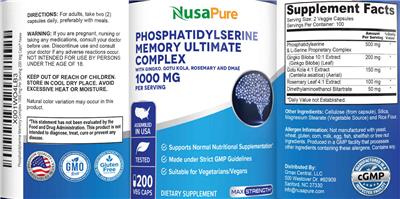
- Form
- Capsule
- Serving Size
- 2 Veggie Capsules
- Servings
- 100 per container
- Container Holds
- 200 Veg Caps
What’s in it, whether it interacts with your drugs, its side effects, whether it works, and what our pharmacists would want you to know before you start it.
- What it isA phosphatidylserine supplement from NusaPure with four other active ingredients, in capsule form.
- Active Ingredients Phosphatidylserine & L-Serine Proprietary Complex 500 mgGinkgo biloba Leaf Extract 200 mgGotu Kola aerial extract 150 mgRosemary Leaf Extract 100 mgDimethylaminoethanol Bitartrate 50 mg Five active ingredients. Each one can interact with drugs or cause side effects on its own, so we check every one. The full Supplement Facts
- Drug Interactions 1,511 drugs have a documented interaction with this supplement; the most serious is rated major. Of those, 1,058 are single drugs and 453 are combination products (two or more drugs in one), each listed under its own name. Ask your pharmacist first if you take a drug in any of these categories, the most serious of the 30 on record:
- TalinololMajor · 1 drug
- Moderate · 645 drugs
- Moderate · 418 drugs
- Moderate · 372 drugs
- Possible Side EffectsHeadache 3 ingredientsUpset stomach 3 ingredientsNausea 2 ingredientsTrouble sleeping 2 ingredientsGastrointestinal distressIncluding abdominal pain +13 moreReported for all five of its active ingredients. Not studied in this exact product.
- Well documented Why
Does Phosphatidylserine Memory Ultimate Complex work?
What It Is Marketed For
Memory support
From the claims on the product’s label.
The Closest Use the Research Grades
Age-related cognitive decline Phosphatidylserine
Some studies support it, but the evidence isn’t conclusive.
Its ingredients have research behind other uses too:
- Ginkgo
- Gotu Kola
- Rosemary
- Ginkgo
- Ginkgo
These grades are for each ingredient, not this exact product, and never a promise it will work for you.
And 2 more graded uses, in what the research says- Full Why
- AllergensThe label says it contains soy
Who Might Consider It
- People looking for memory support, which is what it is marketed for. The closest use the research grades is age-related cognitive decline, rated Possibly Effective.
- People who want it for anxiety, venous insufficiency, memory, schizophrenia or another graded use: the other uses with research behind them. See each grade
- This complex may be worth discussing if you're looking for memory or cognitive support, though the evidence varies by ingredient.
Who Should Be Careful
- If you take blood thinners, diabetes medications, sedatives, or other interacting drugs, or if you're pregnant, breastfeeding, or have liver or bleeding problems, talk it over with your own doctor or pharmacist before you start.
More Before You Take It Show both answersHide Pregnancy and Breastfeeding The Label’s Directions
-
Pregnant or breastfeeding?
- Pregnancy and Breastfeeding Phosphatidylserine
- Insufficient reliable information available; avoid using.
- Pregnancy Serine
- ! There is not enough safety data on supplemental serine in pregnancy, so it is best avoided unless your doctor advises it.
- Breastfeeding Serine
- Insufficient reliable information available.
- Pregnancy Ginkgo
- ! When used orally.
- Breastfeeding Ginkgo
- Insufficient reliable information available; avoid using.
-
How does the label say to take it?
“Directions: For adults, take two (2) capsules daily, preferably with meals.”
The maker’s words. Your pharmacist or doctor may advise differently.
Everything the label says
From the label dated Jul 25, 2024: all five of its active ingredients were checked against our records. A summary of what is known, not a grade or a test of the product. How these ratings are computed
Ask Anything About This Supplement
Name a drug you take, or ask about side effects, ingredients or pregnancy.
AI answers come from this label and our own records, never the open internet. AI can make mistakes, so always check with your doctor or pharmacist. How we use AI
Ask the Pharmacist
A licensed pharmacist will answer your question by email — free, usually within 24 hours.
Got it — thank you!
A licensed pharmacist will answer within 24 hours. Keep an eye on your email (worth checking spam, just in case).
What’s Inside Phosphatidylserine Memory Ultimate Complex by NusaPure
Five Active Ingredients, Each Checked on Its Own
A supplement is often several ingredients in one bottle, and each one can interact with drugs or cause side effects on its own. We check every one of them against our records.
- Phosphatidylserine & L-Serine Proprietary ComplexDrug interactions on record, most serious: Moderate
- Ginkgo biloba Leaf ExtractDrug interactions on record, most serious: Major
- Gotu Kola aerial extractDrug interactions on record, most serious: Moderate
- Rosemary Leaf ExtractDrug interactions on record, most serious: Moderate
- Dimethylaminoethanol BitartrateNo drug interactions on record
Why this rating?
The label gives an exact amount for every one of its five active ingredients, so you know how much of each you get in each serving. This rates what the label tells you, not the quality of the product.
Supplement Facts
| Amount Per Serving | % Daily Value | |
|---|---|---|
| Phosphatidylserine & L-Serine Proprietary Complex | 500 mg | † |
| Phosphatidylserine | † | |
| L-Serine | † | |
| Ginkgo biloba Leaf Extract | 200 mg | † |
| Gotu Kola aerial extract | 150 mg | † |
| Rosemary Leaf Extract | 100 mg | † |
| Dimethylaminoethanol Bitartrate | 50 mg | † |
Other ingredients: Cellulose, Silica, Magnesium Stearate, Rice Flour
† Daily Value not established.
Daily Values for adults and children 4 or more years of age.
As the label prints it, from the NIH Dietary Supplement Label Database.
Each Ingredient and Its Drug Interactions
Tap one for more about it and its full guide. A drug can interact with this supplement through any one of them.
The six active ingredients are L-serine (an amino acid), ginkgo biloba leaf extract, phosphatidylserine, rosemary leaf extract, dimethylaminoethanol bitartrate (deanol), and gotu kola aerial extract, plus a phosphatidylserine and L-serine proprietary complex that is listed by its components.
- The product's name points to memory support, and the ingredient data we have relates mainly to cognitive, memory, and brain-related uses.
- The inactive other ingredients are cellulose, silica, magnesium stearate, and rice flour.
-
Phosphatidylserine & L-Serine Proprietary Complex 500 mg Interacts with 219 drugs
Phosphatidylserine is a natural fat-like compound found in cell membranes, especially in the brain, and it is sold mainly to support memory and thinking.
- Some research suggests possible benefits for age-related memory problems, but the evidence is limited and far from conclusive.
- It is generally well tolerated, but check with your pharmacist or doctor before using it, especially during pregnancy or breastfeeding.
The full Phosphatidylserine guide: uses, dosage and safety Every Phosphatidylserine drug interaction
- Phosphatidylserine 219 drugs
- L-Serine
-
Ginkgo biloba Leaf Extract 200 mg Interacts with 1,267 drugs
Ginkgo is one of the world's most popular herbal supplements, mostly taken to support memory and circulation.
- The evidence for these uses is mixed and generally weak, and it is not proven to prevent memory loss or dementia.
- It is usually well tolerated in healthy adults, but it can thin the blood, so talk to your pharmacist or doctor before using it.
The full Ginkgo guide: uses, dosage and safety Every Ginkgo drug interaction
-
Gotu Kola aerial extract 150 mg Interacts with 581 drugs
Gotu kola is a traditional Ayurvedic and Asian herb that people use for wound healing, circulation, skin problems, and as a calming or memory-supporting herb.
- Some early studies suggest possible benefits for vein health and skin, but the overall evidence is limited and not strong.
- Talk to your pharmacist or doctor before using it, especially if you are pregnant, breastfeeding, or have liver problems.
The full Gotu Kola guide: uses, dosage and safety Every Gotu Kola drug interaction
-
Rosemary Leaf Extract 100 mg Interacts with 372 drugs
Rosemary is a fragrant Mediterranean herb that is safe and flavorful in normal food amounts.
- Some early research suggests possible benefits for memory, mood, and hair growth, but the evidence is limited and far from conclusive.
- Concentrated supplements and the essential oil should be used carefully, and the essential oil should never be swallowed.
The full Rosemary guide: uses, dosage and safety Every Rosemary drug interaction
-
Dimethylaminoethanol Bitartrate 50 mg Interacts with 219 drugs
Deanol (DMAE) is a compound related to choline that is marketed for memory, focus, and mood, but solid human evidence for most of these uses is limited or mixed.
- It can cause side effects in some people, and it should be avoided in pregnancy and breastfeeding because its safety is not established.
- Talk to your pharmacist or doctor before trying it.
The full Deanol guide: uses, dosage and safety Every Deanol drug interaction
Other Ingredients (Inactive)
The capsule or tablet itself, fillers, coatings and flavors. Not part of the drug interaction check; the allergen check below reads them.
- Cellulose
- Silica
- Magnesium Stearate
- Rice Flour
Allergens in Phosphatidylserine Memory Ultimate Complex
The label says it contains soy.
Named on this label
- SoyThe label says it contains it
Not named in the ingredients
- Milk
- Egg
- Fish
- Shellfish
- Tree nuts
- Peanuts
- Wheat or other gluten grains
- Sesame
- The label’s allergen statement“Allergen information: Not manufactured with yeast, wheat, gluten, corn, milk, egg, fish, shellfish or tree nut ingredients. Produced in a GMP facility that processes other ingredients containing these allergens. Contains soy.”
- Made without, the label says“Gluten free”
- Made without, the label says“Allergen information: Not manufactured with yeast, wheat, gluten, corn, milk, egg, fish, shellfish or tree nut ingredients. · GMO free Made with Non-GMO ingredients”
From the label text and ingredient names on file; we do not test products. With a serious allergy, check your bottle and ask the maker or your pharmacist.
What the Label Says
The maker’s own words, from the label. We do not verify or endorse them.
- General statements
-
“New”
- Storage
-
“Store in cool dry place. Avoid excessive heat or moisture.”
- Formulation
-
“Natural color variation may occur in this product.”
“Assembled in USA Tested Supports normal nutritional supplementation Made under strict GMP guidelines Max strength”
3 more from the label
“Suitable for vegetarians/vegans”
“Allergen information: Not manufactured with yeast, wheat, gluten, corn, milk, egg, fish, shellfish or tree nut ingredients. GMO free Made with Non-GMO ingredients”
“Phosphatidylserine Memory Ultimate Complex with gingko, gotu kola, rosemary and DMAE 1000 mg per serving”
- Seals and symbols
-
“Premium Quality Assembled in USA GMO free Made with Non-GMO ingredients Gluten free FDA Registered Facility”
“Manufactured in a cGMP inspected facility”
- FDA Statement of Identity
-
“Dietary Supplement”
The Phosphatidylserine Memory Ultimate Complex Label on File
The label scan on file at the NIH Dietary Supplement Label Database, dated July 2024. Always read the label on the bottle you have.
Product Facts
- Brand
- NusaPure
- Barcode (UPC)
- X001WO4LB3
- Net contents
- 200 Veg Caps
- Market status
- On market
- Date entered into DSLD
- Jul 25, 2024
- DSLD ID
- 307379
- Product type
- Other Combinations
- Supplement form
- Capsule
- Dietary claims / uses
- Nutrient, All Other, Structure/Function
- Intended target group(s)
- Vegan, Vegetarian, Adult (18 - 50 Years), Gluten Free, Dairy Free
Is this label outdated? Report a formula or label change and our pharmacy team will review it.
Phosphatidylserine Memory Ultimate Complex by NusaPure Side Effects
Why this rating?
We look for three kinds of safety information on each ingredient: side effects reported in studies, a pregnancy and breastfeeding rating, and a safety write-up from our pharmacy team. All three are on file for each of the six ingredients we could check.
So this rates how much is known, not whether Phosphatidylserine Memory Ultimate Complex is right for you.
Reported with six of its ingredients
- Most often
- Headache, upset stomach, nausea, trouble sleeping, gastrointestinal distress and including abdominal pain
- !Rare but serious
- Seizures with high doses of L-serine, irregular heartbeat and bleeding See details
HelloPharmacist Team Summary of Side Effects
If you're deciding whether to start NusaPure's Phosphatidylserine Memory Ultimate Complex, know that its ingredients are generally well tolerated, though side effects tend to rise with dose.
- The ones you're most likely to notice are upset stomach, headache, and trouble sleeping, with upset stomach linked to phosphatidylserine and L-serine and sleep trouble linked to phosphatidylserine and deanol.
- Dizziness, drowsiness, and constipation or diarrhea have also been reported.
- The rare but serious concern is increased bleeding from ginkgo, so call your doctor if you notice unusual bruising or bleeding.
- Talk with your doctor or pharmacist before starting, especially if you take blood thinners, have seizure, bleeding, or liver problems, or are pregnant or breastfeeding, and if dizziness or drowsiness appears, see how it affects you before driving.
Side Effects, Ingredient by Ingredient
A supplement’s side effects come from its ingredients. Here is what is reported with each one.
Phosphatidylserine
Most reported
- Upset stomach
- Trouble sleeping
Serine
Most reported
- Gastrointestinal distress
- Including abdominal pain
- Bloating
- Dyspepsia
- Loss of appetite
- Nausea
From the Natural Medicines database, which we license.
Every reported effect, in the Serine guideGinkgo
Most reported
- Headache
- Upset stomach or nausea
- Dizziness
- Constipation or diarrhea
Gotu Kola
Most reported
- Upset stomach
- Nausea
- Headache
- Drowsiness
Deanol
Most reported
- Headache
- Trouble sleeping
- Vivid dreams
- Muscle tension
Rosemary has side-effect reports on file, but no list of the most common ones. Read them in the Rosemary guide
Phosphatidylserine Memory Ultimate Complex Warnings: Who Should Be Careful
Phosphatidylserine Memory Ultimate Complex has six active ingredients, and each can carry warnings of its own. We checked all six, and each warning below names the ingredient it comes from. If any of these apply to you, talk to your doctor or pharmacist before you start it.
- Phosphatidylserine3 warnings below
- Serine3 warnings below
- Ginkgo3 warnings below
- Gotu Kola3 warnings below
- Rosemary3 warnings below
- Deanol2 warnings below
-
Bleeding Problems or Surgery
- PhosphatidylserineAnyone with a bleeding disorder or who is preparing for surgery should talk with a healthcare provider before use.
- RosemaryThose with bleeding disorders or who are scheduled for surgery should also use caution with concentrated products.
- GinkgoGinkgo carries a bleeding concern, and cardiac arrhythmias have been reported with it.
-
Liver Disease
- SerinePeople with kidney or liver problems should be especially careful, since these organs handle amino acids, and they should check with a doctor first.
- Gotu KolaThere have been reports of liver problems linked to gotu kola in some people.
- Gotu KolaBecause of this, people with liver disease or a history of liver problems should be especially careful and talk to a doctor first.
- Gotu KolaAvoid combining it with other things that can stress the liver, including alcohol.
- Concentrated rosemary extracts need caution, and gotu kola has liver concerns reported in some people.
-
Seizure Disorders
- GinkgoPeople with a history of seizures should be careful, as some reports suggest ginkgo could lower the seizure threshold, especially if a product is contaminated with ginkgo seeds.
- RosemaryPeople with seizure disorders should be cautious, as high doses of rosemary or its oil have been associated with seizures.
- DeanolPeople with seizure disorders, bipolar disorder, or other mental health conditions should be especially cautious, as stimulating supplements can sometimes worsen symptoms.
-
Allergies
- PhosphatidylserinePeople with soy allergy should check the source, since many products are made from soy; sunflower-based versions may be an alternative.
-
Children
- PhosphatidylserineAlways talk with a pharmacist or doctor before giving it to a child.
- SerineThe same caution applies to children.
- GinkgoNever eat raw or roasted ginkgo seeds (nuts), which can be toxic, especially in children.
-
If You Take Other Drugs
- DeanolAlways check with your pharmacist or doctor before starting deanol, especially if you take other medicines or have a health condition.
-
Other Cautions
- SerineAnyone with a metabolic disorder should only use serine under medical supervision.
- RosemaryConcentrated supplements, large medicinal doses, and the undiluted essential oil are different and require more caution.
-
What the Label Warns
- “Warning: If you are pregnant, nursing or taking any medications, consult your doctor before use.”
- “Discontinue use and consult your doctor if any adverse reactions occur.”
- “Not intended for use by persons under the age of 18. Keep out of reach of children.”
The maker’s wording, from the product label.
-
Pregnant or Breastfeeding
Each ingredient’s rating for pregnancy and for breastfeeding, and what it covers.
Pregnancy and Breastfeeding The record rates both the same
-
Insufficient reliable information available; avoid using.
Pregnancy
-
There is not enough safety data on supplemental serine in pregnancy, so it is best avoided unless your doctor advises it.
Breastfeeding
-
Insufficient reliable information available.
Animal research in lactating mice shows that dietary L-serine transfers to milk and increases free L-serine while decreasing glutamic acid, L-alanine, D-alanine, and taurine levels in milk.
3 more points on this rating
- However, this does not affect serine levels in the offspring.
- It is unknown what effect supplemental serine may have in humans.
- Avoid using in amounts greater than those found in food.
Show 4 more ingredients
Pregnancy
-
When used orally.
There is concern that ginkgo might have labor-inducing and hormonal effects.
2 more points on this rating
- There is also concern that the antiplatelet effects of ginkgo could prolong bleeding time if taken around the time of labor and delivery.
- Theoretically, ginkgo might adversely affect pregnancy outcome; avoid using during pregnancy.
Breastfeeding
-
Insufficient reliable information available; avoid using.
Pregnancy
-
When used orally in medicinal amounts.
Rosemary might have uterine and menstrual flow stimulant effects, and might increase metabolism of estradiol and estrone; avoid using.
There is insufficient reliable information available about the safety of rosemary when used topically during pregnancy.
Breastfeeding
-
There is insufficient reliable information available about the safety of using rosemary in medicinal amounts during lactation; avoid using.
Pregnancy
-
When used topically and appropriately.
There is insufficient reliable information available about the safety gotu kola when used orally during pregnancy; avoid using.
Breastfeeding
-
Insufficient reliable information available; avoid using.
Pregnancy and Breastfeeding The record rates both the same
-
Insufficient reliable information available; avoid using.
Our pharmacy team’s notes
- Gotu KolaGotu kola is rated possibly safe in pregnancy, but its safety notes still advise avoiding it because safety data is limited.
- In pregnancy, ginkgo and rosemary are both rated possibly unsafe, and their safety data advises against them.
- The safety notes for L-serine, phosphatidylserine, and deanol also advise avoiding them during pregnancy or breastfeeding unless your doctor advises otherwise.
Ratings and the words beside them are from the Natural Medicines database, which we license. Where it has no rating, the rating and note are our pharmacy team’s.
-
Rare but Serious Side Effects
-
!
Phosphatidylserine
Serious side effects are not commonly reported, but because supplements are not tightly regulated, product quality can vary.
-
!
Serine
Orally: Seizures with high doses of L-serine.
-
!
Ginkgo
More serious but rare concerns include increased bleeding or bruising.
Orally: Arrhythmia, bleeding, Stevens-Johnson syndrome.
-
!
Gotu Kola
The most serious concern is rare reports of liver injury.
Orally: Hepatotoxicity.
-
!
Rosemary
Taking large amounts of rosemary or its extracts may cause stomach upset, nausea, or, in rare cases, more serious effects.
When to get help: a serious allergic reaction, with trouble breathing or swelling of the face, lips or throat, needs emergency care: call 911. For any other side effect that worries you, call your doctor or pharmacist.
These reports describe each ingredient, not studies of this exact product. Not medical advice: a side effect you notice after starting a supplement is worth a word with your pharmacist or doctor.
Phosphatidylserine Memory Ultimate Complex by NusaPure Drug Interactions
We checked all five active ingredients in this supplement against every drug in our records. A drug can interact with it through any one of them.
A major interaction on record
3 of 3, on a scale from Minor or none to Major.Why this rating?
We rate this by the most serious interaction on record, not by how many there are. For Rosemary, Ginkgo, Deanol, Gotu Kola and Phosphatidylserine, the most serious is rated major, which means the combination is best avoided, or used only under close supervision. Some involve kinds of drugs where a small change can matter, such as blood thinners, seizure drugs and transplant drugs.
1,512 drugs are on the full list. What matters is whether one you take is on it, so check yours with the interaction checker on this page.
All five of its active ingredients have drug interactions on record: Phosphatidylserine, Ginkgo, Gotu Kola, Rosemary and Deanol.
- Interacts with
- 1,267 drugs
- Most serious
- Major
- The most serious is ginkgo with talinolol (Major): ginkgo seems to increase blood levels of talinolol, which can raise how much of that drug is in your body.
- Ginkgo also carries Moderate interactions with simvastatin, alprazolam (Xanax), trazodone, efavirenz, rosiglitazone, and tacrolimus, mostly through changes in drug levels.
- Interacts with
- 581 drugs
- Most serious
- Moderate
- Gotu kola carries Moderate interactions with CNS depressants (sedatives) and hepatotoxic drugs (medications that can stress the liver).
- Interacts with
- 372 drugs
- Most serious
- Moderate
- Rosemary has a Minor interaction with drugs cleared by the liver enzyme CYP1A2; lab research suggests it speeds up that enzyme, but this hasn't been reported in humans.
Show two more ingredients
- Interacts with
- 219 drugs
- Most serious
- Moderate
- Most of its records involve Anticholinergic Drugs and Cholinergic Drugs.
- Interacts with
- 219 drugs
- Most serious
- Minor
- Most of its records involve Anticholinergic Drugs and Cholinergic Drugs.
From the HelloPharmacist Team
Here is how the interactions add up across the whole label.
- NusaPure's Phosphatidylserine Memory Ultimate Complex can interact with medications through its ginkgo, phosphatidylserine, rosemary, deanol, and gotu kola content.
- Moderate interactions include warfarin (ginkgo may increase bleeding risk), other blood thinners and antiplatelet drugs (rosemary may increase bleeding risk), aspirin and other salicylate pain relievers (rosemary contains salicylates, so effects may add up), and antidiabetes drugs (rosemary may raise the risk of low blood sugar, hypoglycemia).
- Anticholinergic drugs (Moderate for phosphatidylserine, Minor for deanol) and cholinergic drugs (Moderate for phosphatidylserine, Minor for deanol) may also be affected, since both ingredients are thought to raise acetylcholine.
Summarized by the HelloPharmacist pharmacy team from the interaction records below. How it is written How we use AI
Why Phosphatidylserine Memory Ultimate Complex Interacts, Ingredient by Ingredient
A product interacts through its ingredients. Each card: how many drugs, the most serious rating, and the kinds of drugs it affects most (tap a kind for what it means).
The ingredients driving the most interactions
-
Ginkgo biloba Leaf Extract 1,267 drugs
Most serious: Major23 interaction records on file
The kinds of drugs it affects most
- 645 drugs
- 418 drugs
- 202 drugs
- 186 drugs
Every Ginkgo drug interaction, 23 records The Ginkgo records cite 97 references, listed in the Ginkgo guide.
-
Gotu Kola aerial extract 581 drugs
Most serious: Moderate2 interaction records on file
The kinds of drugs it affects most
- 372 drugs
- 248 drugs
Every Gotu Kola drug interaction, 2 records The Gotu Kola records cite 18 references, listed in the Gotu Kola guide.
-
Rosemary Leaf Extract 372 drugs
Most serious: Moderate6 interaction records on file
The kinds of drugs it affects most
- 186 drugs
- 122 drugs
- 86 drugs
- 35 drugs
Every Rosemary drug interaction, 6 records The Rosemary records cite 20 references, listed in the Rosemary guide.
-
Phosphatidylserine & L-Serine Proprietary Complex 219 drugs
Most serious: Moderate2 interaction records on file
The kinds of drugs it affects most
- 195 drugs
- 25 drugs
Every Phosphatidylserine drug interaction, 2 records The Phosphatidylserine records cite 9 references, listed in the Phosphatidylserine guide.
-
Dimethylaminoethanol Bitartrate 219 drugs
Most serious: Minor2 interaction records on file
The kinds of drugs it affects most
- 195 drugs
- 25 drugs
Every Deanol drug interaction, 2 records The Deanol records cite 15 references, listed in the Deanol guide.
The Breakdown by Severity
Each drug counted once, at its most serious rating. Tap a tile to list those drugs.
Find Your Drug
Type a drug or brand name to see whether it is on the list.
- Only drugs with a documented interaction are listed, the most serious first.
- A drug with no known interaction is not listed, but searching its name tells you so.
- Open a drug to see which ingredient is responsible. Of those, 1,058 are single drugs and 453 are combination products (two or more drugs in one), each listed under its own name.
-
TalinololTalinolol Major
The ingredient responsible:
-
Ginkgo Biloba Leaf Extract Major
Taking ginkgo with talinolol seems to increase blood levels of talinolol.
The full Ginkgo Biloba Leaf Extract + Talinolol interaction
-
-
ApixabanEliquis Moderate
The 2 ingredients responsible:
-
Ginkgo Biloba Leaf Extract Moderate Apixaban is in these Cytochrome P450 3A4 (CYP3A4) Substrates, Anticoagulant/Antiplatelet Drugs, P-glycoprotein Substrates categories.
Theoretically, ginkgo might decrease levels of drugs metabolized by CYP3A4.
The full Ginkgo Biloba Leaf Extract + Apixaban interaction -
Rosemary Leaf Extract Moderate Apixaban is in the Anticoagulant/Antiplatelet Drugs category.
Theoretically, rosemary may increase the risk of bleeding if used with anticoagulant or antiplatelet drugs.
The full Rosemary Leaf Extract + Apixaban interaction
-
-
WarfarinWarfarin Moderate
The 2 ingredients responsible:
-
Ginkgo Biloba Leaf Extract Moderate Warfarin is in these Anticoagulant/Antiplatelet Drugs, Cytochrome P450 2C9 (CYP2C9) Substrates, Cytochrome P450 2C19 (CYP2C19) Substrates and 2 more categories.
Ginkgo has been shown to increase the risk of bleeding in some people when taken with warfarin.
The full Ginkgo Biloba Leaf Extract + Warfarin interaction -
Rosemary Leaf Extract Moderate Warfarin is in these Anticoagulant/Antiplatelet Drugs, Cytochrome P450 1A2 (CYP1A2) Substrates categories.
Theoretically, rosemary may increase the risk of bleeding if used with anticoagulant or antiplatelet drugs.
The full Rosemary Leaf Extract + Warfarin interaction
-
-
AmlodipineNorliqva Moderate
The ingredient responsible:
-
Ginkgo Biloba Leaf Extract Moderate Amlodipine is in the Cytochrome P450 3A4 (CYP3A4) Substrates category.
Theoretically, ginkgo might decrease levels of drugs metabolized by CYP3A4.
The full Ginkgo Biloba Leaf Extract + Amlodipine interaction
-
-
SertralineZoloft Moderate
The ingredient responsible:
-
Ginkgo Biloba Leaf Extract Moderate Sertraline is in these Seizure Threshold Lowering Drugs, Cytochrome P450 3A4 (CYP3A4) Substrates categories.
Theoretically, taking ginkgo with drugs that lower the seizure threshold might increase the risk for convulsions.
The full Ginkgo Biloba Leaf Extract + Sertraline interaction
-
-
ClopidogrelPlavix Moderate
The 2 ingredients responsible:
-
Ginkgo Biloba Leaf Extract Moderate Clopidogrel is in these Anticoagulant/Antiplatelet Drugs, Cytochrome P450 2C9 (CYP2C9) Substrates, Cytochrome P450 3A4 (CYP3A4) Substrates and 1 more categories.
Ginkgo has been shown to increase the risk of bleeding in some people when taken with warfarin.
The full Ginkgo Biloba Leaf Extract + Clopidogrel interaction -
Rosemary Leaf Extract Moderate Clopidogrel is in these Cytochrome P450 1A2 (CYP1A2) Substrates, Anticoagulant/Antiplatelet Drugs categories.
Theoretically, rosemary might decrease the levels and clinical effects of CYP1A2 substrates.
The full Rosemary Leaf Extract + Clopidogrel interaction
-
-
EscitalopramLexapro Moderate
The ingredient responsible:
-
Ginkgo Biloba Leaf Extract Moderate Escitalopram is in these Cytochrome P450 3A4 (CYP3A4) Substrates, Cytochrome P450 2C19 (CYP2C19) Substrates categories.
Theoretically, ginkgo might decrease levels of drugs metabolized by CYP3A4.
The full Ginkgo Biloba Leaf Extract + Escitalopram interaction
-
-
RosuvastatinCrestor, Ezallor Moderate
The ingredient responsible:
-
Gotu Kola Aerial Extract Moderate Rosuvastatin is in the Hepatotoxic Drugs category.
Theoretically, taking gotu kola with hepatotoxic drugs might have additive adverse effects.
The full Gotu Kola Aerial Extract + Rosuvastatin interaction
-
-
AspirinAngettes 75, ASA, Asaphen, Aspirin, Caprin and 9 more Moderate
The 2 ingredients responsible:
-
Ginkgo Biloba Leaf Extract Moderate Aspirin is in the Anticoagulant/Antiplatelet Drugs category.
Ginkgo has been shown to increase the risk of bleeding in some people when taken with warfarin.
The full Ginkgo Biloba Leaf Extract + Aspirin interaction -
Rosemary Leaf Extract Moderate Aspirin is in the Anticoagulant/Antiplatelet Drugs category.
Theoretically, rosemary may increase the risk of bleeding if used with anticoagulant or antiplatelet drugs.
The full Rosemary Leaf Extract + Aspirin interaction
-
-
Losartan PotassiumCozaar Moderate
The ingredient responsible:
-
Ginkgo Biloba Leaf Extract Moderate Losartan Potassium is in these Cytochrome P450 3A4 (CYP3A4) Substrates, Cytochrome P450 2C9 (CYP2C9) Substrates categories.
Theoretically, ginkgo might decrease levels of drugs metabolized by CYP3A4.
The full Ginkgo Biloba Leaf Extract + Losartan Potassium interaction
-
-
AtorvastatinAtorvaliq Moderate
The 2 ingredients responsible:
-
Ginkgo Biloba Leaf Extract Moderate Atorvastatin is in the Cytochrome P450 3A4 (CYP3A4) Substrates category.
Theoretically, ginkgo might decrease the levels and clinical effects of atorvastatin.
The full Ginkgo Biloba Leaf Extract + Atorvastatin interaction -
Gotu Kola Aerial Extract Moderate Atorvastatin is in the Hepatotoxic Drugs category.
Theoretically, taking gotu kola with hepatotoxic drugs might have additive adverse effects.
The full Gotu Kola Aerial Extract + Atorvastatin interaction
-
-
RivaroxabanXarelto Moderate
The 2 ingredients responsible:
-
Rosemary Leaf Extract Moderate Rivaroxaban is in the Anticoagulant/Antiplatelet Drugs category.
Theoretically, rosemary may increase the risk of bleeding if used with anticoagulant or antiplatelet drugs.
The full Rosemary Leaf Extract + Rivaroxaban interaction -
Ginkgo Biloba Leaf Extract Moderate Rivaroxaban is in these P-glycoprotein Substrates, Cytochrome P450 3A4 (CYP3A4) Substrates, Anticoagulant/Antiplatelet Drugs categories.
Theoretically, taking ginkgo with P-glycoprotein substrates might increase the levels and adverse effects of these substrates.
The full Ginkgo Biloba Leaf Extract + Rivaroxaban interaction
-
-
TirzepatideMounjaro, Zepbound Moderate
The 2 ingredients responsible:
-
Ginkgo Biloba Leaf Extract Moderate Tirzepatide is in the Antidiabetes Drugs category.
Theoretically, taking ginkgo with antidiabetes drugs might alter the response to antidiabetes drugs.
The full Ginkgo Biloba Leaf Extract + Tirzepatide interaction -
Rosemary Leaf Extract Moderate Tirzepatide is in the Antidiabetes Drugs category.
Theoretically, taking rosemary with antidiabetes drugs might increase the risk of hypoglycemia.
The full Rosemary Leaf Extract + Tirzepatide interaction
-
-
MetforminGlucophage, Metformin Moderate
The 2 ingredients responsible:
-
Ginkgo Biloba Leaf Extract Moderate Metformin is in the Antidiabetes Drugs category.
Theoretically, taking ginkgo with antidiabetes drugs might alter the response to antidiabetes drugs.
The full Ginkgo Biloba Leaf Extract + Metformin interaction -
Rosemary Leaf Extract Moderate Metformin is in the Antidiabetes Drugs category.
Theoretically, taking rosemary with antidiabetes drugs might increase the risk of hypoglycemia.
The full Rosemary Leaf Extract + Metformin interaction
-
-
Warfarin SodiumCoumadin, Panwarfin, Sofarin Moderate
The 2 ingredients responsible:
-
Ginkgo Biloba Leaf Extract Moderate Warfarin Sodium is in these Cytochrome P450 1A2 (CYP1A2) Substrates, Cytochrome P450 2C9 (CYP2C9) Substrates, Cytochrome P450 3A4 (CYP3A4) Substrates and 2 more categories.
Theoretically, ginkgo might increase levels of drugs metabolized by CYP1A2.
The full Ginkgo Biloba Leaf Extract + Warfarin Sodium interaction -
Rosemary Leaf Extract Moderate Warfarin Sodium is in these Cytochrome P450 1A2 (CYP1A2) Substrates, Anticoagulant/Antiplatelet Drugs categories.
Theoretically, rosemary might decrease the levels and clinical effects of CYP1A2 substrates.
The full Rosemary Leaf Extract + Warfarin Sodium interaction
-
-
MetoprololLopressor, Toprol XL Moderate
The ingredient responsible:
-
Ginkgo Biloba Leaf Extract Moderate Metoprolol is in the Seizure Threshold Lowering Drugs category.
Theoretically, taking ginkgo with drugs that lower the seizure threshold might increase the risk for convulsions.
The full Ginkgo Biloba Leaf Extract + Metoprolol interaction
-
-
MethylphenidateAptensio XR, Concerta, Cotempla XR-ODT, Jornay PM, Metadate and 8 more Moderate
The ingredient responsible:
-
Ginkgo Biloba Leaf Extract Moderate Methylphenidate is in the Seizure Threshold Lowering Drugs category.
Theoretically, taking ginkgo with drugs that lower the seizure threshold might increase the risk for convulsions.
The full Ginkgo Biloba Leaf Extract + Methylphenidate interaction
-
-
IbuprofenAdvil, Arthrofen, Brufen, Brufen Retard, Calodor and 15 more Moderate
The 2 ingredients responsible:
-
Ginkgo Biloba Leaf Extract Moderate Ibuprofen is in these Cytochrome P450 2C9 (CYP2C9) Substrates, Anticoagulant/Antiplatelet Drugs categories.
Theoretically, ginkgo might increase levels of drugs metabolized by CYP2C9.
The full Ginkgo Biloba Leaf Extract + Ibuprofen interaction -
Rosemary Leaf Extract Moderate Ibuprofen is in the Anticoagulant/Antiplatelet Drugs category.
Theoretically, rosemary may increase the risk of bleeding if used with anticoagulant or antiplatelet drugs.
The full Rosemary Leaf Extract + Ibuprofen interaction
-
-
SemaglutideOzempic, Rybelsus, Wegovy Moderate
The 2 ingredients responsible:
-
Rosemary Leaf Extract Moderate Semaglutide is in the Antidiabetes Drugs category.
Theoretically, taking rosemary with antidiabetes drugs might increase the risk of hypoglycemia.
The full Rosemary Leaf Extract + Semaglutide interaction -
Ginkgo Biloba Leaf Extract Moderate Semaglutide is in the Antidiabetes Drugs category.
Theoretically, taking ginkgo with antidiabetes drugs might alter the response to antidiabetes drugs.
The full Ginkgo Biloba Leaf Extract + Semaglutide interaction
-
-
IvermectinMectizan, Sklice, Soolantra, Stromectol Moderate
The ingredient responsible:
-
Ginkgo Biloba Leaf Extract Moderate Ivermectin is in the P-glycoprotein Substrates category.
Theoretically, taking ginkgo with P-glycoprotein substrates might increase the levels and adverse effects of these substrates.
The full Ginkgo Biloba Leaf Extract + Ivermectin interaction
-
-
TadalafilCialis, Tadliq Moderate
The ingredient responsible:
-
Ginkgo Biloba Leaf Extract Moderate Tadalafil is in the Cytochrome P450 3A4 (CYP3A4) Substrates category.
Theoretically, ginkgo might decrease levels of drugs metabolized by CYP3A4.
The full Ginkgo Biloba Leaf Extract + Tadalafil interaction
-
-
FluoxetineProzac, Sarafem Moderate
The ingredient responsible:
-
Ginkgo Biloba Leaf Extract Moderate Fluoxetine is in these Cytochrome P450 2C9 (CYP2C9) Substrates, Seizure Threshold Lowering Drugs categories.
Theoretically, ginkgo might increase levels of drugs metabolized by CYP2C9.
The full Ginkgo Biloba Leaf Extract + Fluoxetine interaction
-
-
PrednisoneCortan, Deltasone, Meticorten, Orasone, Prednicen-M and 3 more Moderate
The ingredient responsible:
-
Ginkgo Biloba Leaf Extract Moderate Prednisone is in these Cytochrome P450 3A4 (CYP3A4) Substrates, P-glycoprotein Substrates categories.
Theoretically, ginkgo might decrease levels of drugs metabolized by CYP3A4.
The full Ginkgo Biloba Leaf Extract + Prednisone interaction
-
-
AmoxicillinAmix, Amoram, Amoxident, Amoxil Capsules, Amoxil Injection and 4 more Moderate
The 2 ingredients responsible:
-
Gotu Kola Aerial Extract Moderate Amoxicillin is in the Hepatotoxic Drugs category.
Theoretically, taking gotu kola with hepatotoxic drugs might have additive adverse effects.
The full Gotu Kola Aerial Extract + Amoxicillin interaction -
Ginkgo Biloba Leaf Extract Moderate Amoxicillin is in the Seizure Threshold Lowering Drugs category.
Theoretically, taking ginkgo with drugs that lower the seizure threshold might increase the risk for convulsions.
The full Ginkgo Biloba Leaf Extract + Amoxicillin interaction
-
-
TestosteroneAndrogel, Andropatch, Delatestryl, Intrinsa, Natesto and 4 more Moderate
The 2 ingredients responsible:
-
Gotu Kola Aerial Extract Moderate Testosterone is in the Hepatotoxic Drugs category.
Theoretically, taking gotu kola with hepatotoxic drugs might have additive adverse effects.
The full Gotu Kola Aerial Extract + Testosterone interaction -
Ginkgo Biloba Leaf Extract Moderate Testosterone is in the Cytochrome P450 3A4 (CYP3A4) Substrates category.
Theoretically, ginkgo might decrease levels of drugs metabolized by CYP3A4.
The full Ginkgo Biloba Leaf Extract + Testosterone interaction
-
-
AmphetamineAdensys XR-ODT, Adzenys ER, Dyanavel XR, Mydayis Moderate
The ingredient responsible:
-
Ginkgo Biloba Leaf Extract Moderate Amphetamine is in the Seizure Threshold Lowering Drugs category.
Theoretically, taking ginkgo with drugs that lower the seizure threshold might increase the risk for convulsions.
The full Ginkgo Biloba Leaf Extract + Amphetamine interaction
-
-
AcetaminophenChildren's Tylenol, Children's Tylenol Meltaways, Tylenol, Tylenol Ex Strength Moderate
The 3 ingredients responsible:
-
Gotu Kola Aerial Extract Moderate Acetaminophen is in the Hepatotoxic Drugs category.
Theoretically, taking gotu kola with hepatotoxic drugs might have additive adverse effects.
The full Gotu Kola Aerial Extract + Acetaminophen interaction -
Ginkgo Biloba Leaf Extract Moderate Acetaminophen is in the Cytochrome P450 1A2 (CYP1A2) Substrates category.
Theoretically, ginkgo might increase levels of drugs metabolized by CYP1A2.
The full Ginkgo Biloba Leaf Extract + Acetaminophen interaction -
Rosemary Leaf Extract Minor Acetaminophen is in the Cytochrome P450 1A2 (CYP1A2) Substrates category.
Theoretically, rosemary might decrease the levels and clinical effects of CYP1A2 substrates.
The full Rosemary Leaf Extract + Acetaminophen interaction
-
-
AbemaciclibVerzenio Moderate
The ingredient responsible:
-
Ginkgo Biloba Leaf Extract Moderate Abemaciclib is in the Cytochrome P450 3A4 (CYP3A4) Substrates category.
Theoretically, ginkgo might decrease levels of drugs metabolized by CYP3A4.
The full Ginkgo Biloba Leaf Extract + Abemaciclib interaction
-
-
MethotrexateOtrexup, Rasuvo, Reditrex, Rheumatrex Moderate
The 2 ingredients responsible:
-
Gotu Kola Aerial Extract Moderate Methotrexate is in the Hepatotoxic Drugs category.
Theoretically, taking gotu kola with hepatotoxic drugs might have additive adverse effects.
The full Gotu Kola Aerial Extract + Methotrexate interaction -
Ginkgo Biloba Leaf Extract Moderate Methotrexate is in the Seizure Threshold Lowering Drugs category.
Theoretically, taking ginkgo with drugs that lower the seizure threshold might increase the risk for convulsions.
The full Ginkgo Biloba Leaf Extract + Methotrexate interaction
-
-
PregabalinLyrica, Lyrica CR Moderate
The ingredient responsible:
-
Gotu Kola Aerial Extract Moderate Pregabalin is in the CNS Depressants category.
Theoretically, taking gotu kola might increase the sedative effects of CNS depressants.
The full Gotu Kola Aerial Extract + Pregabalin interaction
-
Does It Work? Phosphatidylserine Memory Ultimate Complex by NusaPure
How it rates in the research so far, then each ingredient on its own. A grade is the research so far, never an endorsement.
What It Is Marketed For
Memory support
From the claims on the product’s label.
Closest match for what it is marketed for
Phosphatidylserine for age-related cognitive decline
Some studies support it, but the evidence isn’t conclusive.
Three uses we did not count
- Dementia, Alzheimer disease and chemotherapy-related cognitive impairment: they are treated by a doctor or in a hospital.
Our pharmacy team’s notes on this supplement
- Ratings differ by ingredient.
- We hold no effectiveness ratings for the proprietary complex as a whole, and the evidence for many other listed uses is insufficient to rate.
The Evidence, Ingredient by Ingredient
Each card holds our notes on one ingredient, then its uses graded effective, likely effective or possibly effective.
Phosphatidylserine
From our Phosphatidylserine guide
- Phosphatidylserine is best known for its possible role in brain and memory health.
- Some studies in older adults with age-related memory complaints have suggested modest benefits, but many of these studies were small, older, or used the bovine-brain form that is no longer sold.
Research suggests a benefit for
- Age-related cognitive decline (the use on its label)
Not counted here: one graded use is for a condition treated by a doctor or in a hospital (Alzheimer disease).
Every graded use, in the Phosphatidylserine guideGinkgo
From our Ginkgo guide
- Ginkgo is widely marketed for memory and brain function, but the research is mixed.
Research suggests a benefit for
- Anxiety, schizophrenia, premenstrual syndrome (PMS), vertigo and tardive dyskinesia
Not counted here: one graded use is for Ginkgo injected or put on the skin (hearing loss), not for a product like this one. Two more are for conditions treated by a doctor or in a hospital (dementia and stroke).
Every graded use, in the Ginkgo guideGotu Kola
From our Gotu Kola guide
- Gotu kola is used for many conditions, but for most of them the scientific evidence is limited, preliminary, or mixed.
- It is important to be honest that traditional use does not prove an herb works.
Research suggests a benefit for
- Venous insufficiency
Not counted here: one graded use is for Gotu Kola injected or put on the skin (burns), not for a product like this one.
Every graded use, in the Gotu Kola guideRosemary
From our Rosemary guide
- People use rosemary for many reasons, but for most of them the scientific evidence is limited or preliminary.
Research suggests a benefit for
- Memory
Deanol
From our Deanol guide
- Deanol is popularly used for memory, concentration, mood, and ADHD-type symptoms, and topically for skin firmness.
- However, the human evidence behind these uses is generally weak, mixed, or outdated.
No use is graded effective, likely effective or possibly effective for it yet.
Every graded use, in the Deanol guideSerine
From our Serine guide
- Serine plays many roles in the body, but that does not mean taking it as a supplement treats specific health problems.
- For most popular uses, the evidence is limited or preliminary.
Research suggests a benefit for
- Schizophrenia
The grades are the Natural Medicines database’s, which we license; tap a grade for what it means. They are about each ingredient, not this exact product.
About NusaPure
Manufacturer and brand details for Phosphatidylserine Memory Ultimate Complex, from the product label.
NusaPure has 175 products in our supplement database, 170 of them on the market, with labels on file since 2020. Our database is built from the NIH’s Dietary Supplement Label Database and our pharmacy team’s own additions, so it covers the labels filed there, not every product the brand sells.
- Name
- Gmax Central, LLC
- Street Address
- 500 Westover Dr. #92909
- City
- Sanford
- State
- NC
- ZipCode
- 27330
Phosphatidylserine Memory Ultimate Complex by NusaPure: Common Questions
Does Phosphatidylserine Memory Ultimate Complex by NusaPure interact with any drugs?
What are the side effects of Phosphatidylserine Memory Ultimate Complex by NusaPure?
Who should be careful taking Phosphatidylserine Memory Ultimate Complex by NusaPure?
Can Phosphatidylserine Memory Ultimate Complex by NusaPure affect the liver?
Does Phosphatidylserine Memory Ultimate Complex by NusaPure contain any common allergens?
Is Phosphatidylserine Memory Ultimate Complex by NusaPure gluten free?
How can Phosphatidylserine Memory Ultimate Complex by NusaPure interact with so many drugs?
Where does the information about Phosphatidylserine Memory Ultimate Complex by NusaPure come from?
Is Phosphatidylserine Memory Ultimate Complex by NusaPure complex recommended during pregnancy?
Does phosphatidylserine help with memory?
What is the ginkgo in Phosphatidylserine Memory Ultimate Complex by NusaPure for?
Can deanol help with Alzheimer's?
Written and reviewed by the HelloPharmacist Editorial Team. Our editorial policy
Still Have a Question About Phosphatidylserine Memory Ultimate Complex?
Our pharmacists answer drug and supplement questions, free, by email.
Label information is sourced from the NIH Dietary Supplement Label Database and reflects the product version on file; always read your actual product label. This page is for education only and is not a substitute for professional medical advice. Confirm with your pharmacist or doctor before combining supplements and drugs.
Who Reviews This Page
The pharmacist behind it, and how it is checked.
Dr. Brian Staiger, PharmD, BCPS
Clinical pharmacist and founder of HelloPharmacist
A licensed pharmacist for more than 13 years, he built the system behind this page: it reads the label on file, matches each active ingredient to its record in the Natural Medicines database, checks those records against every drug we cover, and our pharmacy team writes the take and the interaction summary from those records.
- 13+ Years in PharmacyRetail and clinical pharmacy, medication safety and healthcare administration.
- Board Certified (BCPS)A pharmacotherapy specialist, certified by the Board of Pharmacy Specialties.
- Herbalist TrainingCertificates in medical ethnobotany, for the herbs and supplements people take.
Where This Page Comes From
Phosphatidylserine Memory Ultimate Complex’s label data comes from the NIH Dietary Supplement Label Database; the ingredient interaction data is from the Natural Medicines database, reviewed by our pharmacists.
- NIH Dietary Supplement Label Database (DSLD)
- The official product label on file for this supplement.
- Natural Medicines (Therapeutic Research Center)
- The evidence-graded clinical reference behind the ingredient interaction, evidence and safety records, which we license.
- HelloPharmacist Editorial Team
- Content is reviewed by the HelloPharmacist Editorial Team, the pharmacists on our staff and those we contract. See our data sources and editorial standards for how this information is built and checked.
- The Pharmacy Team’s Take and Summaries
- Generated from HelloPharmacist’s pharmacist-curated databases and editorial rules. Clinical methodology reviewed by Dr. Brian Staiger, PharmD, BCPS. Last generated Oct 31, 2026. How we use AI
- The ratings in the Quick Summary
- They summarize available label information, ingredient evidence and known drug-safety records: a summary of what is known, not a grade of the product itself. They do not verify product identity, purity, potency, contamination or manufacturing quality. How these ratings are computed
The References Behind the Interaction Records
Every citation the ingredients’ records rest on is listed in that ingredient’s guide, in context: Phosphatidylserine, 9 references; Serine, 3 references; Ginkgo, 97 references; Gotu Kola, 18 references; Rosemary, 20 references; Deanol, 15 references .
Parts of this content are provided by the Therapeutic Research Center, LLC.
DISCLAIMER: Currently this does not check for drug-drug interactions. This is not an all-inclusive comprehensive list of potential interactions and is for informational purposes only. Not all interactions are known or well-reported in the scientific literature, and new interactions are continually being reported. Input is needed from a qualified healthcare provider including a pharmacist before starting any therapy. Application of clinical judgment is necessary.
© 2021 Therapeutic Research Center, LLC
Keep Exploring
- Supplement interaction checkerCheck any supplement or product against your drugs
- Drug–drug interactionsCheck two or more of your drugs against each other
- Browse drugs A to ZEvery drug we have checked against herbs and supplements
- NDC and pricing lookupFind a drug’s NDCs, packaging and costs
- Ask a pharmacistA free, personal answer from our licensed team