
PX Pro Xanthine by FINAFLEX Ingredients, Side Effects and Drug Interactions
Dietary Supplement Capsule Other Combinations
UPC 6 89466 30779 5 Match it to the barcode on your bottle

Medically reviewed by Dr. Brian Staiger, PharmD, BCPS
Also reviewed by the HelloPharmacist Editorial Team
Updated Details about this page
- Label on file from the NIH Dietary Supplement Label Database, dated Jul 25, 2024.
- The interaction, evidence and safety records come from the Natural Medicines database, which we license, read against this label by our own system; the pharmacy team’s sections are written from those records.
- Dr. Brian Staiger, PharmD, BCPS, is a clinical pharmacist and pharmacotherapy specialist.
- Editorial policy Our sources
AI is used only to summarize verified clinical information, never the open internet. Our AI policy
Summary: The HelloPharmacist Team’s Take
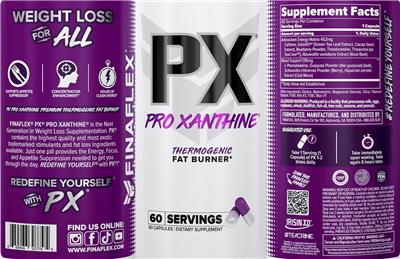
- Form
- Capsule
- Serving Size
- 1 Capsule
- Servings
- 60 per container
- Container Holds
- 60 Capsules
What’s in it, whether it interacts with your drugs, its side effects, whether it works, and what our pharmacists would want you to know before you start it.
- What is PX Pro Xanthine?A supplement from FINAFLEX with ten active ingredients, in capsule form.
- Active Ingredients 5 plant ingredients such as Blueberry, Rauwolfia vomitoria root bark and Guayusa, 1 amino acid and 4 others: CaffeineIrisinXDBlueberry, PowderTheobromineTeaCrineRauwolfia vomitoria root bark extractL-PhenylalanineGuayusa, PowderSchisandra Chinensis, PowderClub Moss Extract Ten active ingredients. Each one can interact with drugs or cause side effects on its own, so we check every one. The full Supplement Facts
- Drug Interactions 1,437 drugs have a documented interaction with this supplement; the most serious is rated major. Of those, 976 are single drugs and 461 are combination products (two or more drugs in one), each listed under its own name. Based on the 7 of its 10 ingredients we could check. Ask your pharmacist first if you take a drug in any of these categories, the most serious of the 64 on record:
- EphedrineMajor · 8 drugs
- Major · 5 drugs
- Moderate · 645 drugs
- Moderate · 248 drugs
- Possible Side EffectsHeartburn 3 ingredientsNausea 3 ingredientsTrouble sleeping 3 ingredientsAnxiety 2 ingredientsHeadache 2 ingredientsJitteriness 2 ingredients +13 moreCombined from seven of its ten active ingredients. Not studied in this exact product.
- Well documented Why
Does PX Pro Xanthine work?
What It Is Marketed For
- Weight loss
- Appetite control
- Focus
- Energy
From the claims on the product’s label.
The Closest Use the Research Grades
Mental alertness Caffeine
Good studies support it.
Its ingredients have research behind other uses too:
- Caffeine
- Cardiovascular disease (CVD) Cocoa
- Phenylalanine
- Caffeine
These grades are for each ingredient, not this exact product, and never a promise it will work for you.
And 3 more graded uses, in what the research says- Low Why
- AllergensNone of its ingredient names point to a major food allergen
- Barcode (UPC)6 89466 30779 5Match it to the barcode on your bottle to be sure this is your product. Not your product? Search for it here
Who Might Consider It
- People looking for weight loss, appetite control, focus and energy, which is what it is marketed for. The closest use the research grades is mental alertness, rated Likely Effective.
- People who want it for athletic performance, cardiovascular disease (CVD), vitiligo, diabetes or another graded use: the other uses with research behind them. See each grade
- This product may interest adults who are comfortable with caffeine-containing supplements and who are not taking any medications from the lists above.
Who Should Be Careful
- Be careful if you have PKU, Parkinson disease, a heart condition, high blood pressure, anxiety, or a seizure disorder, or if you are pregnant or breastfeeding.
- Talk it over with your own doctor or pharmacist before you start, especially if you take any prescription medicine.
More Before You Take It Show both answersHide Pregnancy and Breastfeeding The Label’s Directions
-
Pregnant or breastfeeding?
- Pregnancy Theacrine
- ! Not enough safety data, so avoid use during pregnancy.
- Breastfeeding Theacrine
- ! Not enough safety data, so avoid use while breastfeeding.
- Pregnancy Phenylalanine
- ! When L-phenylalanine is consumed in amounts typically found in foods by pregnant patients with high serum phenylalanine concentrations, such as those with phenylketonuria (PKU).
- Breastfeeding Phenylalanine
- When L-phenylalanine is consumed in amounts typically found in foods by breast-feeding patients with normal phenylalanine metabolism.
- Pregnancy Caffeine
- ! When used orally in amounts over 300 mg daily.
- Breastfeeding Caffeine
- ! When used orally in large amounts.
-
How does the label say to take it?
“Suggested use: Take 1 serving (1 capsule) of PX 1-2 times daily. Take immediately upon waking. Take again 6 hours later.”
The maker’s words. Your pharmacist or doctor may advise differently.
Everything the label says
From the label dated Jul 25, 2024: 7 of its 10 active ingredients were checked against our records; the other three are not in them yet. A summary of what is known, not a grade or a test of the product. How these ratings are computed
Ask Anything About This Supplement
Name a drug you take, or ask about side effects, ingredients or pregnancy.
AI answers come from this label and our own records, never the open internet. AI can make mistakes, so always check with your doctor or pharmacist. How we use AI
Ask the Pharmacist
A licensed pharmacist will answer your question by email — free, as soon as they can.
Got it — thank you!
A licensed pharmacist will answer as soon as they can. Keep an eye on your email (worth checking spam, just in case).
What’s Inside PX Pro Xanthine by FINAFLEX
Ten Active Ingredients, Each Checked on Its Own
A supplement is often several ingredients in one bottle, and each one can interact with drugs or cause side effects on its own. We check every one of them against our records.
- CaffeineDrug interactions on record, most serious: Major
- IrisinXDNot in our interaction records yet
- Blueberry, PowderNo drug interactions on record
- TheobromineDrug interactions on record, most serious: Moderate
- TeaCrineDrug interactions on record, most serious: Moderate
- Rauwolfia vomitoria root bark extractNot in our interaction records yet
- L-PhenylalanineDrug interactions on record, most serious: Major
- Guayusa, PowderNot in our interaction records yet
And 2 more, each with its own card below.
The label gives an exact amount for 0 of its 10 active ingredients. Ten are inside two proprietary blends, and the label gives one total for each, not how much of each ingredient is in it.
- 0 state an exact amount
- 10 have no amount of their own
- Antioxidant Energy Matrix 452 mg in total · 6 ingredients, no amount for each
- Mood Support 135 mg in total · 4 ingredients, no amount for each
This rates what the label tells you, not the quality of the product.
Supplement Facts
| Amount Per Serving | % Daily Value | |
|---|---|---|
| Antioxidant Energy Matrix | 452 mg | † |
| Caffeine | † | |
| IrisinXD | † | |
| Blueberry, Powder | † | |
| Theobromine | † | |
| TeaCrine | † | |
| Rauwolfia vomitoria root bark extract | † | |
| Mood Support | 135 mg | † |
| L-Phenylalanine | † | |
| Guayusa, Powder | † | |
| Schisandra Chinensis, Powder | † | |
| Club Moss Extract | † | |
Other ingredients: Gelatin, Maltodextrin, Magnesium Stearate, Silica, Titanium Dioxide, FD&C RED #3, FD&C Blue #1
† Daily Value not established.
Daily Values for adults and children 4 or more years of age.
As the label prints it, from the NIH Dietary Supplement Label Database.
Each Ingredient and Its Drug Interactions
Tap one for more about it and its full guide. A drug can interact with this supplement through any one of them.
PX Pro Xanthine contains 10 active ingredients.
- The ones we have information on include phenylalanine, theacrine (TeaCrine), theobromine from cocoa, blueberry powder, caffeine, schisandra powder, and club moss extract.
- Caffeine is the best-known stimulant here, and cocoa adds caffeine-related compounds of its own.
Show 1 more point
- The Antioxidant Energy Matrix and Mood Support blends contain ingredients we cannot break out from this data, and we have no information on Rauwolfia vomitoria root bark extract, IrisinXD, or Guayusa powder.
-
Antioxidant Energy Matrix 452 mg Six ingredients inside it, each checked on its own
- Caffeine 655 drugs
- IrisinXD
- Blueberry, Powder 88 drugs
- Theobromine 661 drugs
- TeaCrine 248 drugs
- Rauwolfia vomitoria root bark extract
-
Mood Support 135 mg Four ingredients inside it, each checked on its own
- L-Phenylalanine 16 drugs
- Guayusa, Powder
- Schisandra Chinensis, Powder 804 drugs
- Club Moss Extract 219 drugs
Other Ingredients (Inactive)
The capsule or tablet itself, fillers, coatings and flavors. Not part of the drug interaction check; the allergen check below reads them.
- Gelatin
- Maltodextrin
- Magnesium Stearate
- Silica
- Titanium Dioxide
- FD&C RED #3
- FD&C Blue #1
Allergens in PX Pro Xanthine
None of its ingredient names point to a major food allergen.
Named on this label
- Gelatin (animal-derived)In the ingredients: Gelatin
Not named in the ingredients
- Milk
- Egg
- Fish
- Shellfish
- Tree nuts
- Peanuts
- Wheat or other gluten grains
- Soy
- Sesame
- The label’s allergen statement“Allergen warning: Produced in a facility that processes milk, eggs, soybeans, wheat, shellfish, fish oil, tree nuts, sesame, and peanuts.”
From the label text and ingredient names on file; we do not test products. With a serious allergy, check your bottle and ask the maker or your pharmacist.
What the Label Says
The maker’s own words, from the label. We do not verify or endorse them.
- Formulation
-
“Weight loss for all Supports appetite suppression Concentration enhancement Hours of clean energy Finaflex PX Pro Xanthine is the next generation in weight loss supplementation. Just one pill provides the energy, focus, and appetite suppression needed to get you through the day. Redefine yourself with PX!”
“Thermogenic fat burner”
2 more from the label
“PX Pro Xanthine premium thermogenic fat burner PX contains the highest quality and most exotic trademarked stimulants and fat loss ingredients available.”
“Irisin XD Teacrine”
- Brand IP Statement(s)
-
“Redefine Yourself with PX”
“IrisinXD is a registered trademark of Finaflex. TeaCrine is a registered trademark & protected by Patents Pending, Serial No. 61/903,362; under exclusive global distribution by Compound Solutions, Inc.”
- General statements
-
“Find us online: Instagram Facebook Tiktok YouTube www.finaflex.com”
“Join the Finaflex Family”
- FDA Statement of Identity
-
“Dietary Supplement”
- Seals and symbols
-
“GMP Certified Good Manufacturing Practice Certified U.S.A. Made Domestic & Imported Material FDA Registered Facility”
- Storage
-
“Sold by capsule count, not volume. Store under cool, dry conditions, ideally 50-80 degrees F.”
The PX Pro Xanthine Label on File
The label scan on file at the NIH Dietary Supplement Label Database, dated July 2024. Always read the label on the bottle you have.
Product Facts
- Brand
- FINAFLEX
- Barcode (UPC)
- 689466307795
- Net contents
- 60 Capsules
- Market status
- On market
- Date entered into DSLD
- Jul 25, 2024
- DSLD ID
- 317868
- Product type
- Other Combinations
- Supplement form
- Capsule
- Dietary claims / uses
- All Other, Structure/Function
- Intended target group(s)
- Adult (18 - 50 Years), Women (not pregnant or lactating)
Is this label outdated? Report a formula or label change and our pharmacy team will review it.
PX Pro Xanthine by FINAFLEX Side Effects
Why this rating?
We look for three kinds of safety information on each ingredient: side effects reported in studies, a pregnancy and breastfeeding rating, and a safety write-up from our pharmacy team. Of the seven ingredients we could check, six have side-effect reports, six have a pregnancy rating and all seven have a safety write-up.
So this rates how much is known, not whether PX Pro Xanthine is right for you.
Reported with seven of its ingredients
- Most often
- Heartburn, nausea, trouble sleeping, anxiety, headache and jitteriness
- !Rare but serious
- Fast heart rate See details
HelloPharmacist Team Summary: PX Pro Xanthine by FINAFLEX Side Effects
The side effects reported with PX Pro Xanthine from FINAFLEX include heartburn or upset stomach, jitteriness or nervousness, headache, trouble sleeping, and a racing or pounding heartbeat.
- Several of these tend to come from the caffeine and cocoa content, while heartburn and stomach upset are also reported with schisandra and phenylalanine.
- Serious reactions are described as rare, but a buildup of phenylalanine can cause serious harm, including brain damage, so call your doctor right away if you notice severe or unusual symptoms.
- If you have PKU, a heart condition, or anxiety, or if you are pregnant, breastfeeding, or taking prescription medication, talk with your own doctor or pharmacist before starting.
Side Effects, Ingredient by Ingredient
A supplement’s side effects come from its ingredients. Here is what is reported with each one.
Caffeine
Most reported
- Feeling jittery, nervous, or anxious
- Racing or pounding heartbeat
- Trouble sleeping
- Upset stomach or heartburn
Blueberry
Most reported
- Gas
- Bloating
- Loose stools
Cocoa
Most reported
- Jitteriness
- Fast heartbeat
- Anxiety
- Trouble sleeping
Theacrine
Most reported
- Headache
- Trouble sleeping
- Jitteriness
- Faster heartbeat
Phenylalanine
Most reported
- Nausea
- Heartburn
- Headache
- Anxiety
Schisandra
Most reported
- Heartburn or stomach upset
- Decreased appetite
- Nausea or stomach pain
- Skin rash (uncommon)
Clubmoss
Most reported
- Stomach upset
- Nausea
- Skin irritation
PX Pro Xanthine Warnings: Who Should Be Careful
PX Pro Xanthine has ten active ingredients, and each can carry warnings of its own. We checked the seven in our ingredient guides, and each warning below names the ingredient it comes from. IrisinXD, Rauwolfia vomitoria root bark extract and Guayusa, Powder are not in our guides yet, so ask your pharmacist about them. If any of these apply to you, talk to your doctor or pharmacist before you start it.
- Caffeine2 warnings below
- Blueberry2 warnings below
- Cocoa3 warnings below
- Theacrine3 warnings below
- Phenylalanine4 warnings below
- Schisandra2 warnings below
- Clubmoss2 warnings below
- IrisinXDNot in our guides yet
- Rauwolfia vomitoria root bark extractNot in our guides yet
- Guayusa, PowderNot in our guides yet
-
Bleeding Problems or Surgery
- BlueberryIf you have a medical condition or take medicine that affects blood sugar or blood clotting, talk with your pharmacist or doctor before using blueberry supplements.
- SchisandraPeople scheduled for surgery and those taking prescription medicines should also check with a pharmacist before use.
-
Diabetes or Low Blood Sugar
- CocoaChocolate products are often high in sugar, fat, and calories, which can be a concern for people managing weight, diabetes, or heart disease.
-
Blood Pressure
- CaffeineBe cautious if you: have heart problems, high blood pressure, an irregular heartbeat, anxiety, panic attacks, trouble sleeping, stomach ulcers, or seizure disorders.
- TheacrineBecause it acts like a stimulant, people with heart problems, high blood pressure, anxiety, or those sensitive to caffeine should be cautious and check with a healthcare provider first.
- PhenylalanineAnyone with high blood pressure should also use caution.
-
Liver Disease
- SchisandraUse extra caution and talk to a healthcare provider if you have liver disease, acid reflux or stomach ulcers, epilepsy, or a condition affected by hormones.
-
Kidney Disease or Kidney Stones
- ClubmossPeople with kidney problems, heart conditions, or other chronic illnesses should be especially careful and check with a healthcare provider first.
-
Heart Conditions
- CocoaBecause cocoa contains caffeine and theobromine, people who are sensitive to stimulants, who have heart rhythm problems, anxiety, or trouble sleeping should be cautious, especially with large amounts.
-
Mental Health Conditions
- PhenylalaninePeople with certain mental health conditions, including schizophrenia or a history of mania, should be cautious because phenylalanine affects brain chemistry.
-
Allergies
- BlueberryPeople with allergies to blueberries or related berries should avoid them.
-
Children
- CaffeineChildren and teens should limit caffeine.
- TheacrineChildren and teens should also avoid stimulant supplements unless directed by a doctor.
- ClubmossChildren and older adults should not use clubmoss without medical guidance.
-
Other Cautions
- CocoaAvoid concentrated cocoa supplements unless your doctor approves.
- TheacrineAvoid combining it with other stimulants unless a professional says it is okay.
- PhenylalaninePeople with phenylketonuria (PKU) must avoid phenylalanine.
- PhenylalaninePhenylalanine's safety note is a caution: it is generally tolerated in food amounts, but supplements should be used carefully and not by people with PKU (phenylketonuria, a condition in which phenylalanine builds up).
-
What the Label Warns
- “Warning: Keep out of reach of children. Intended for healthy adults over 18.”
- “Do not use if pregnant or nursing. Consult a doctor or medical authority before use if you have a medical condition, a family history of health problems, or if you take other medicines or supplements.”
- “Do not exceed serving size. Stop use if you have a bad reaction. Stop use after 8 weeks. Stop use 2 weeks before surgery. Do not combine with caffeine, stimulants, or alcohol. Consumer accepts all liability if used inconsistent with label. Do not discard desiccant. California Prop 64 Warning: Lead- Cancer and Reproductive Harm www.P65Warnings.ca.gov”
- “200mg Caffeine per serving. Phenylketonurics: contains phenylalanine.”
The maker’s wording, from the product label.
-
Pregnant or Breastfeeding
Each ingredient’s rating for pregnancy and for breastfeeding, and what it covers.
Pregnancy
-
Not enough safety data, so avoid use during pregnancy.
Breastfeeding
-
Not enough safety data, so avoid use while breastfeeding.
Pregnancy
-
When L-phenylalanine is consumed in amounts typically found in foods by pregnant patients with normal phenylalanine metabolism.
-
When L-phenylalanine is consumed in amounts typically found in foods by pregnant patients with high serum phenylalanine concentrations, such as those with phenylketonuria (PKU).
Serum levels of phenylalanine greater than 360 micromol/L increase the risk of birth defects.
3 more points on this rating
- Experts recommend that patients with high phenylalanine serum concentrations follow a low phenylalanine diet for at least 20 weeks prior to conception to decrease the risk for birth defects.
- There is insufficient reliable information available about the safety of L-phenylalanine when taken by mouth in large doses during pregnancy; avoid using.
- There is insufficient reliable information available about the safety of oral D-phenylalanine during pregnancy; avoid using.
Breastfeeding
-
When L-phenylalanine is consumed in amounts typically found in foods by breast-feeding patients with normal phenylalanine metabolism.
There is insufficient reliable information available about the safety of L-phenylalanine when taken by mouth in medicinal amounts during lactation; avoid using.
There is insufficient reliable information available about the safety of oral D-phenylalanine during lactation; avoid using.
Show 5 more ingredients
Pregnancy
-
When used orally in amounts commonly found in foods.
Intakes of caffeine should be monitored during pregnancy.
10 more points on this rating
- Caffeine crosses the human placenta, but is not considered a teratogen.
- Fetal blood and tissue levels are similar to maternal concentrations.
- The use of caffeine during pregnancy is controversial; however, moderate consumption has not been associated with clinically important adverse fetal effects.
- In some studies consuming amounts over 200 mg daily is associated with a significantly increased risk of miscarriage.
- This increased risk seems to occur in those with genotypes that confer a slow rate of caffeine metabolism.
- According to a review by Health Canada, and a subsequent large meta-analysis conducted in the US, up to 300 mg daily can be consumed during pregnancy without an increased risk of spontaneous abortion, stillbirth, preterm birth, fetal growth retardation, or congenital malformations.
- However, observational research in a Norwegian cohort found that caffeine consumption is associated with a 16% increased odds of the baby being born small for gestational age when compared with no consumption.
- The same Norwegian cohort found that low to moderate caffeine consumption during pregnancy is not associated with changes in neurodevelopment in children up to 8 years of age.
- Advise patients to keep caffeine consumption below 300 mg daily during pregnancy.
- This is similar to the amount of caffeine in about 3 cups of coffee or tea.
-
When used orally in amounts over 300 mg daily.
Caffeine crosses the placenta, producing fetal blood concentrations similar to maternal levels.
8 more points on this rating
- Consumption of caffeine in amounts over 300 mg daily is associated with a significantly increased risk of miscarriage in some studies.
- Advise patients to keep caffeine consumption below 300 mg daily during pregnancy.
- This is similar to the amount of caffeine in about 3 cups of coffee or tea.
- Additionally, high doses of caffeine throughout pregnancy have resulted in symptoms of caffeine withdrawal in newborn infants.
- High doses of caffeine have also been associated with spontaneous abortion, premature delivery, and low birth weight.
- In a cohort of mother/infant pairs with a median maternal plasma caffeine level of 168.5 ng/mL (range 29.5-650.5 ng/mL) during pregnancy, birth weights and lengths were lower in the 4th quartile of caffeine intake compared with the 1st.
- By age 7, heights and weights were lower by 1.5 cm and 1.1 kg respectively.
- In another cohort of mother/infant pairs with higher maternal pregnancy plasma caffeine levels, median 625.5 ng/mL (range 86.2 to 1994.7 ng/mL), heights at age 8 were 2.2 cm lower, but there was no difference in weights.
Breastfeeding
-
When used orally in amounts commonly found in foods.
Caffeine intake should be closely monitored while breast-feeding.
During lactation, breast milk concentrations of caffeine are thought to be approximately 50% of serum concentrations and caffeine peaks in breastmilk approximately 1-2 hours after consumption.
-
When used orally in large amounts.
Caffeine is excreted slowly in infants and may accumulate.
Caffeine can cause sleep disturbances, irritability, and increased bowel activity in breast-fed infants exposed to caffeine.
Pregnancy
-
When used orally in moderate amounts.
However, due to the caffeine content of cocoa preparations, intake should be closely monitored during pregnancy to ensure moderate consumption.
8 more points on this rating
- Fetal blood concentrations of caffeine approximate maternal concentrations.
- Some research has found that intrauterine exposure to even modest amounts of caffeine, based on maternal blood levels during the first trimester, is associated with a shorter stature in children ages 4-8 years.
- While many cocoa products contain only small amounts of caffeine (about 2-35 mg per serving), unsweetened, dry cocoa powder can contain up to 198 mg of caffeine per cup.
- According to a review by Health Canada, and a subsequent large meta-analysis conducted in the US, doses of up to 300 mg daily can be consumed during pregnancy without an increased risk of spontaneous abortion, still birth, preterm birth, fetal growth retardation, or congenital malformations.
- To be on the safe side, cocoa should be used in amounts that provide less than 300 mg of caffeine daily.
- Keep in mind that only the amount of ADDED caffeine must be stated on product labels.
- The amount of caffeine found in ingredients such as cocoa, which naturally contains caffeine, does not need to be provided.
- This can make it difficult to determine the total amount of caffeine in a given product.
-
When used orally in large amounts.
Caffeine found in cocoa crosses the placenta producing fetal blood concentrations similar to maternal levels.
10 more points on this rating
- Consumption of caffeine in amounts over 300 mg daily is associated with a significantly increased risk of miscarriage in some studies.
- Additionally, high intake of caffeine during pregnancy have been associated with premature delivery, low birth weight, and loss of the fetus.
- While many cocoa products contain only small amounts of caffeine (about 2-35 mg per serving), unsweetened, dry cocoa powder can contain up to 198 mg of caffeine per cup.
- To be on the safe side, cocoa should be used in amounts that provide less than 300 mg of caffeine daily.
- Keep in mind that only the amount of ADDED caffeine must be stated on product labels.
- The amount of caffeine found in ingredients such as cocoa, which naturally contains caffeine, does not need to be provided.
- This can make it difficult to determine the total amount of caffeine in a given product.
- Cocoa and dark chocolate products worldwide also contain heavy metals such as lead and cadmium.
- In the US, one ounce (approximately 28 grams) of most commercially available dark chocolate products tested contained levels of lead and/or cadmium above the maximum allowable dose level for California, with cadmium levels generally increasing with the percentage of cocoa.
- Large doses or excessive intake of cocoa should be avoided during pregnancy.
Breastfeeding
-
When used in moderate amounts or in amounts commonly found in foods.
Due to the caffeine content of cocoa preparations, intake should be closely monitored while breastfeeding.
5 more points on this rating
- During lactation, breast milk concentrations of caffeine are thought to be approximately 50% of serum concentrations.
- Moderate consumption of cocoa would likely result in very small amounts of caffeine exposure to a nursing infant.
- Keep in mind that only the amount of ADDED caffeine must be stated on product labels.
- The amount of caffeine found in ingredients such as cocoa, which naturally contains caffeine, does not need to be provided.
- This can make it difficult to determine the total amount of caffeine in a given product.
-
When used orally in large amounts.
Consumption of excess chocolate (16 oz per day) may cause irritability and increased bowel activity in the infant.
3 more points on this rating
- Cocoa and dark chocolate products worldwide also contain heavy metals such as lead and cadmium.
- In the US, one ounce (approximately 28 grams) of most commercially available dark chocolate products tested contained levels of lead and/or cadmium above the maximum allowable dose level for California, with cadmium levels generally increasing with the percentage of cocoa.
- Large doses or excessive intake of cocoa should be avoided during lactation.
Pregnancy
-
When used orally.
Some evidence suggests schisandra fruit is a uterine stimulant.
Breastfeeding
-
Insufficient reliable information available; avoid using.
Pregnancy and Breastfeeding The record rates both the same
-
When used orally; avoid using.
Pregnancy and Breastfeeding The record rates both the same
-
When used orally in amounts commonly found in foods.
There is insufficient reliable information available about the safety of blueberry for medicinal use; avoid using.
Our pharmacy team’s notes
- SchisandraSchisandra is rated possibly unsafe in pregnancy, and our pharmacists advise avoiding it while breastfeeding.
- Our pharmacists advise avoiding supplement doses in pregnancy and while breastfeeding.
- Caffeine is rated both possibly safe and possibly unsafe in pregnancy.
Ratings and the words beside them are from the Natural Medicines database, which we license. Where it has no rating, the rating and note are our pharmacy team’s.
-
Rare but Serious Side Effects
-
!
Caffeine
Serious effects are rare but can happen with very high doses.
Orally: Stroke has been reported rarely.
-
!
Blueberry
Allergic reactions are uncommon but possible.
-
!
Cocoa
Allergic reactions to cocoa are uncommon but possible.
Orally: Tachycardia.
-
!
Theacrine
Serious side effects have not been clearly described in the small studies available, but the lack of long-term data means rare risks cannot be ruled out.
-
!
Phenylalanine
Buildup can cause serious harm, including brain damage.
-
!
Schisandra
Serious reactions are rare.
-
!
Clubmoss
Allergic reactions are possible in sensitive people.
When to get help: a serious allergic reaction, with trouble breathing or swelling of the face, lips or throat, needs emergency care: call 911. For any other side effect that worries you, call your doctor or pharmacist.
These reports describe each ingredient, not studies of this exact product. Not medical advice: a side effect you notice after starting a supplement is worth a word with your pharmacist or doctor.
PX Pro Xanthine by FINAFLEX Drug Interactions
We checked all ten active ingredients in this supplement against every drug in our records. A drug can interact with it through any one of them. IrisinXD, Rauwolfia vomitoria root bark extract and Guayusa, Powder are not in our interaction records yet.
A major interaction on record
3 of 3, on a scale from Minor or none to Major.Why this rating?
We rate this by the most serious interaction on record, not by how many there are. For Clubmoss, Schisandra, Phenylalanine, Cocoa and Caffeine, the most serious is rated major, which means the combination is best avoided, or used only under close supervision. Some involve kinds of drugs where a small change can matter, such as blood thinners, transplant drugs and diabetes drugs.
1,438 drugs are on the full list. What matters is whether one you take is on it, so check yours with the interaction checker on this page.
Seven of its ten active ingredients have drug interactions on record. The ones below matter most. We have no interaction records for IrisinXD, Rauwolfia vomitoria root bark extract and Guayusa, Powder.
- Interacts with
- 16 drugs
- Most serious
- Major
- The most serious interaction is rated Major: phenylalanine can reduce how well levodopa works, which may worsen tremor, stiffness, and on-off episodes in people with Parkinson disease.
- Interacts with
- 804 drugs
- Most serious
- Moderate
- Most of its records involve Cytochrome P450 3A4 (CYP3A4) Substrates, P-glycoprotein Substrates and Cytochrome P450 2C9 (CYP2C9) Substrates.
- Interacts with
- 661 drugs
- Most serious
- Moderate
- Most of its records involve Antihypertensive Drugs, Stimulant Drugs and Anticoagulant/Antiplatelet Drugs.
Show three more ingredients
- Interacts with
- 655 drugs
- Most serious
- Major
- Most of its records involve Stimulant Drugs, Anticoagulant/Antiplatelet Drugs and Cytochrome P450 1A2 (CYP1A2) Inhibitors.
- Interacts with
- 248 drugs
- Most serious
- Moderate
- Most of its records involve CNS Depressants.
- Interacts with
- 219 drugs
- Most serious
- Moderate
- Most of its records involve Anticholinergic Drugs, Cholinergic Drugs and Acetylcholinesterase (AChE) Inhibitors.
And one more ingredient with records, each in the cards below.
From the HelloPharmacist Team
Looking at the supplement as a whole rather than one ingredient at a time:
- PX Pro Xanthine from FINAFLEX does interact with several medications, through its phenylalanine, theacrine, cocoa (theobromine), blueberry, caffeine, schisandra, and club moss content.
- Caffeine also carries a Major rating with ephedrine, where the combination can raise the risk of serious stimulant effects such as high blood pressure, heart attack, stroke, and seizures.
- Moderate-rated types include warfarin and other blood thinners (anticoagulants), tacrolimus, midazolam, voriconazole, sedatives such as pentobarbital and phenobarbital, and blood pressure medicines (antihypertensives).
Summarized by the HelloPharmacist pharmacy team from the interaction records below. How it is written How we use AI
Why PX Pro Xanthine Interacts, Ingredient by Ingredient
A product interacts through its ingredients. Each card: how many drugs, the most serious rating, and the kinds of drugs it affects most (tap a kind for what it means).
The ingredients driving the most interactions
-
Schisandra Chinensis, Powder 804 drugs
Most serious: Moderate12 interaction records on file
The kinds of drugs it affects most
- 645 drugs
- 202 drugs
- 112 drugs
- 72 drugs
Every Schisandra drug interaction, 12 records The Schisandra records cite 26 references, listed in the Schisandra guide.
-
Theobromine 661 drugs
Most serious: Moderate37 interaction records on file
The kinds of drugs it affects most
- 172 drugs
- 172 drugs
- 122 drugs
- 90 drugs
Every Cocoa drug interaction, 37 records The Cocoa records cite 119 references, listed in the Cocoa guide.
-
Caffeine 655 drugs
Most serious: Major41 interaction records on file
The kinds of drugs it affects most
- 172 drugs
- 122 drugs
- 90 drugs
- 86 drugs
Every Caffeine drug interaction, 41 records The Caffeine records cite 235 references, listed in the Caffeine guide.
-
TeaCrine 248 drugs
Most serious: Moderate1 interaction record on file
The kinds of drugs it affects most
- 248 drugs
Every Theacrine drug interaction, 1 record The Theacrine records cite 1 reference, listed in the Theacrine guide.
-
Club Moss Extract 219 drugs
Most serious: Moderate3 interaction records on file
The kinds of drugs it affects most
- 195 drugs
- 25 drugs
- Acetylcholinesterase (AChE) Inhibitors 17 drugs
Every Clubmoss drug interaction, 3 records The Clubmoss records cite 3 references, listed in the Clubmoss guide.
-
Blueberry, Powder 88 drugs
Most serious: Minor3 interaction records on file
The kinds of drugs it affects most
- 86 drugs
- Buspirone (BuSpar) 1 drug
- Flurbiprofen (Ansaid, others) 1 drug
Every Blueberry drug interaction, 3 records The Blueberry records cite 7 references, listed in the Blueberry guide.
-
L-Phenylalanine 16 drugs
Most serious: Major3 interaction records on file
The kinds of drugs it affects most
- 9 drugs
- 5 drugs
- Baclofen 2 drugs
Every Phenylalanine drug interaction, 3 records The Phenylalanine records cite 23 references, listed in the Phenylalanine guide.
The Breakdown by Severity
Each drug counted once, at its most serious rating. Tap a tile to list those drugs.
Find Your Drug
Type a drug or brand name to see whether it is on the list.
- Only drugs with a documented interaction are listed, the most serious first.
- A drug with no known interaction is not listed, but searching its name tells you so.
- Open a drug to see which ingredient is responsible. Of those, 976 are single drugs and 461 are combination products (two or more drugs in one), each listed under its own name.
-
LevodopaInbrija, Larodopa Major
The ingredient responsible:
-
L-Phenylalanine Major
Phenylalanine, especially in high doses, can reduce the effectiveness of levodopa.
The full L-Phenylalanine + Levodopa interaction
-
-
Carbidopa and LevodopaDhivy, Rytary, Sinemet, Sinemet CR Major
The ingredient responsible:
-
L-Phenylalanine Major Carbidopa and Levodopa is in the Levodopa category.
Phenylalanine, especially in high doses, can reduce the effectiveness of levodopa.
The full L-Phenylalanine + Carbidopa and Levodopa interaction
-
-
Ephedrine, Phenobarbital, Potassium Iodide, and TheophyllineMudrane, Quadrinal Major
The 3 ingredients responsible:
-
Caffeine Major It contains phenobarbital and ephedrine, the drugs these records are about. Ephedrine, Phenobarbital, Potassium Iodide, and Theophylline is in these Stimulant Drugs, Theophylline categories.
Theoretically, concomitant use might increase stimulant adverse effects.
The full Caffeine + Ephedrine, Phenobarbital, Potassium Iodide, and Theophylline interaction -
Theobromine Moderate It contains phenobarbital and ephedrine, the drugs these records are about. Ephedrine, Phenobarbital, Potassium Iodide, and Theophylline is in these Theophylline, Stimulant Drugs categories.
Theoretically, cocoa might increase the levels and adverse effects of theophylline.
The full Theobromine + Ephedrine, Phenobarbital, Potassium Iodide, and Theophylline interaction -
Teacrine Moderate Ephedrine, Phenobarbital, Potassium Iodide, and Theophylline is in the CNS Depressants category.
Theoretically, theacrine might alter the effects of CNS depressants.
The full Teacrine + Ephedrine, Phenobarbital, Potassium Iodide, and Theophylline interaction
-
-
Benserazide and LevodopaMadopar, Prolopa Major
The ingredient responsible:
-
L-Phenylalanine Major Benserazide and Levodopa is in the Levodopa category.
Phenylalanine, especially in high doses, can reduce the effectiveness of levodopa.
The full L-Phenylalanine + Benserazide and Levodopa interaction
-
-
Ephedrine, Guaifenesin, Phenobarbital, and TheophyllineMudrane GG Major
The 3 ingredients responsible:
-
Caffeine Major It contains ephedrine and phenobarbital, the drugs these records are about. Ephedrine, Guaifenesin, Phenobarbital, and Theophylline is in these Stimulant Drugs, Theophylline categories.
Theoretically, concomitant use might increase the risk for stimulant adverse effects.
The full Caffeine + Ephedrine, Guaifenesin, Phenobarbital, and Theophylline interaction -
Teacrine Moderate Ephedrine, Guaifenesin, Phenobarbital, and Theophylline is in the CNS Depressants category.
Theoretically, theacrine might alter the effects of CNS depressants.
The full Teacrine + Ephedrine, Guaifenesin, Phenobarbital, and Theophylline interaction -
Theobromine Moderate It contains phenobarbital and ephedrine, the drugs these records are about. Ephedrine, Guaifenesin, Phenobarbital, and Theophylline is in these Theophylline, Stimulant Drugs categories.
Theoretically, cocoa might increase the levels and adverse effects of theophylline.
The full Theobromine + Ephedrine, Guaifenesin, Phenobarbital, and Theophylline interaction
-
-
Ephedrine, Phenobarbital, and TheophyllineTedral Major
The 3 ingredients responsible:
-
Caffeine Major It contains phenobarbital and ephedrine, the drugs these records are about. Ephedrine, Phenobarbital, and Theophylline is in these Stimulant Drugs, Theophylline categories.
Theoretically, caffeine might reduce the effects of phenobarbital and increase the risk for convulsions.
The full Caffeine + Ephedrine, Phenobarbital, and Theophylline interaction -
Teacrine Moderate Ephedrine, Phenobarbital, and Theophylline is in the CNS Depressants category.
Theoretically, theacrine might alter the effects of CNS depressants.
The full Teacrine + Ephedrine, Phenobarbital, and Theophylline interaction -
Theobromine Moderate It contains phenobarbital and ephedrine, the drugs these records are about. Ephedrine, Phenobarbital, and Theophylline is in these Theophylline, Stimulant Drugs categories.
Theoretically, cocoa might increase the levels and adverse effects of theophylline.
The full Theobromine + Ephedrine, Phenobarbital, and Theophylline interaction
-
-
Dyphylline, Ephedrine, Guaifenesin, and PhenobarbitalLufyllin-EPG Major
The 3 ingredients responsible:
-
Caffeine Major It contains phenobarbital, the drug this record is about. Dyphylline, Ephedrine, Guaifenesin, and Phenobarbital is in these Stimulant Drugs, Ephedrine categories.
Theoretically, concomitant use might increase stimulant adverse effects.
The full Caffeine + Dyphylline, Ephedrine, Guaifenesin, and Phenobarbital interaction -
Theobromine Moderate It contains phenobarbital, the drug this record is about. Dyphylline, Ephedrine, Guaifenesin, and Phenobarbital is in these Ephedrine, Stimulant Drugs categories.
Theoretically, cocoa might reduce the effects of phenobarbital and increase the risk for convulsions.
The full Theobromine + Dyphylline, Ephedrine, Guaifenesin, and Phenobarbital interaction -
Teacrine Moderate Dyphylline, Ephedrine, Guaifenesin, and Phenobarbital is in the CNS Depressants category.
Theoretically, theacrine might alter the effects of CNS depressants.
The full Teacrine + Dyphylline, Ephedrine, Guaifenesin, and Phenobarbital interaction
-
-
Levodopa and CarbidopaDuodopa Major
The ingredient responsible:
-
L-Phenylalanine Major
Phenylalanine, especially in high doses, can reduce the effectiveness of levodopa.
The full L-Phenylalanine + Levodopa and Carbidopa interaction
-
-
Carbetapentane Tannate, Chlorpheniramine Tannate, Ephedrine Tannate, and Phenylephrine TannateQuadratuss, Ry Tuss, Rynatuss, Tri Tannate Plus Major
The 4 ingredients responsible:
-
Caffeine Major Carbetapentane Tannate, Chlorpheniramine Tannate, Ephedrine Tannate, and Phenylephrine Tannate is in these Ephedrine, Stimulant Drugs categories.
Theoretically, concomitant use might increase the risk for stimulant adverse effects.
The full Caffeine + Carbetapentane Tannate, Chlorpheniramine Tannate, Ephedrine Tannate, and Phenylephrine Tannate interaction -
Club Moss Extract Moderate Carbetapentane Tannate, Chlorpheniramine Tannate, Ephedrine Tannate, and Phenylephrine Tannate is in the Anticholinergic Drugs category.
Evidence from in vitro research suggests that clubmoss extract can inhibit acetylcholinesterase activity.
The full Club Moss Extract + Carbetapentane Tannate, Chlorpheniramine Tannate, Ephedrine Tannate, and Phenylephrine Tannate interaction -
Theobromine Moderate Carbetapentane Tannate, Chlorpheniramine Tannate, Ephedrine Tannate, and Phenylephrine Tannate is in these Stimulant Drugs, Ephedrine categories.
Theoretically, concomitant use might increase stimulant adverse effects.
The full Theobromine + Carbetapentane Tannate, Chlorpheniramine Tannate, Ephedrine Tannate, and Phenylephrine Tannate interaction -
Schisandra Chinensis, Powder Moderate Carbetapentane Tannate, Chlorpheniramine Tannate, Ephedrine Tannate, and Phenylephrine Tannate is in the Cytochrome P450 3A4 (CYP3A4) Substrates category.
Schisandra can increase the levels and clinical effects of drugs metabolized by CYP3A4.
The full Schisandra Chinensis, Powder + Carbetapentane Tannate, Chlorpheniramine Tannate, Ephedrine Tannate, and Phenylephrine Tannate interaction
-
-
Aminophylline, Amobarbital, and EphedrineAmesec Major
The 3 ingredients responsible:
-
Caffeine Major Aminophylline, Amobarbital, and Ephedrine is in these Ephedrine, Stimulant Drugs categories.
Theoretically, concomitant use might increase the risk for stimulant adverse effects.
The full Caffeine + Aminophylline, Amobarbital, and Ephedrine interaction -
Teacrine Moderate Aminophylline, Amobarbital, and Ephedrine is in the CNS Depressants category.
Theoretically, theacrine might alter the effects of CNS depressants.
The full Teacrine + Aminophylline, Amobarbital, and Ephedrine interaction -
Theobromine Moderate Aminophylline, Amobarbital, and Ephedrine is in these Stimulant Drugs, Ephedrine categories.
Theoretically, concomitant use might increase stimulant adverse effects.
The full Theobromine + Aminophylline, Amobarbital, and Ephedrine interaction
-
-
Ephedrine, Hydroxyzine, and TheophyllineAmi Rax, Marax Major
The 3 ingredients responsible:
-
Caffeine Major It contains ephedrine, the drug this record is about. Ephedrine, Hydroxyzine, and Theophylline is in these Stimulant Drugs, Theophylline categories.
Theoretically, concomitant use might increase stimulant adverse effects.
The full Caffeine + Ephedrine, Hydroxyzine, and Theophylline interaction -
Theobromine Moderate It contains ephedrine, the drug this record is about. Ephedrine, Hydroxyzine, and Theophylline is in these Theophylline, Stimulant Drugs categories.
Theoretically, cocoa might increase the levels and adverse effects of theophylline.
The full Theobromine + Ephedrine, Hydroxyzine, and Theophylline interaction -
Club Moss Extract Moderate Ephedrine, Hydroxyzine, and Theophylline is in the Anticholinergic Drugs category.
Evidence from in vitro research suggests that clubmoss extract can inhibit acetylcholinesterase activity.
The full Club Moss Extract + Ephedrine, Hydroxyzine, and Theophylline interaction
-
-
Carbidopa, Levodopa, and EntacaponeStalevo Major
The ingredient responsible:
-
L-Phenylalanine Major Carbidopa, Levodopa, and Entacapone is in the Levodopa category.
Phenylalanine, especially in high doses, can reduce the effectiveness of levodopa.
The full L-Phenylalanine + Carbidopa, Levodopa, and Entacapone interaction
-
-
Ephedrine and Guaifenesin (otc Drug)Ephedrine Formula 400, Ephedrine Plus Tabs Major
The 2 ingredients responsible:
-
Caffeine Major Ephedrine and Guaifenesin (otc Drug) is in the Stimulant Drugs category.
Theoretically, concomitant use might increase stimulant adverse effects.
The full Caffeine + Ephedrine and Guaifenesin (otc Drug) interaction -
Theobromine Moderate Ephedrine and Guaifenesin (otc Drug) is in the Stimulant Drugs category.
Theoretically, concomitant use might increase the risk for stimulant adverse effects.
The full Theobromine + Ephedrine and Guaifenesin (otc Drug) interaction
-
-
ApixabanEliquis Moderate
The 3 ingredients responsible:
-
Caffeine Moderate Apixaban is in the Anticoagulant/Antiplatelet Drugs category.
Theoretically, caffeine may increase the risk of bleeding if used with anticoagulant or antiplatelet drugs.
The full Caffeine + Apixaban interaction -
Schisandra Chinensis, Powder Moderate Apixaban is in these P-glycoprotein Substrates, Cytochrome P450 3A4 (CYP3A4) Substrates categories.
Schisandra might increase the levels and clinical effects of P-glycoprotein substrates.
The full Schisandra Chinensis, Powder + Apixaban interaction -
Theobromine Moderate Apixaban is in the Anticoagulant/Antiplatelet Drugs category.
Theoretically, cocoa may increase the risk of bleeding if used with anticoagulant or antiplatelet drugs.
The full Theobromine + Apixaban interaction
-
-
WarfarinWarfarin Moderate
The 3 ingredients responsible:
-
Schisandra Chinensis, Powder Moderate Warfarin is in these Cytochrome P450 3A4 (CYP3A4) Substrates, Cytochrome P450 2C19 (CYP2C19) Substrates, Cytochrome P450 2C9 (CYP2C9) Substrates categories.
Schisandra can increase the levels and clinical effects of drugs metabolized by CYP3A4.
The full Schisandra Chinensis, Powder + Warfarin interaction -
Theobromine Moderate Warfarin is in the Anticoagulant/Antiplatelet Drugs category.
Theoretically, cocoa may increase the risk of bleeding if used with anticoagulant or antiplatelet drugs.
The full Theobromine + Warfarin interaction -
Caffeine Moderate Warfarin is in the Anticoagulant/Antiplatelet Drugs category.
Theoretically, caffeine may increase the risk of bleeding if used with anticoagulant or antiplatelet drugs.
The full Caffeine + Warfarin interaction
-
-
AmlodipineNorliqva Moderate
The 2 ingredients responsible:
-
Schisandra Chinensis, Powder Moderate Amlodipine is in the Cytochrome P450 3A4 (CYP3A4) Substrates category.
Schisandra can increase the levels and clinical effects of drugs metabolized by CYP3A4.
The full Schisandra Chinensis, Powder + Amlodipine interaction -
Theobromine Moderate Amlodipine is in the Antihypertensive Drugs category.
Theoretically, taking cocoa with antihypertensive drugs might increase the risk of hypotension.
The full Theobromine + Amlodipine interaction
-
-
SertralineZoloft Moderate
The ingredient responsible:
-
Schisandra Chinensis, Powder Moderate Sertraline is in the Cytochrome P450 3A4 (CYP3A4) Substrates category.
Schisandra can increase the levels and clinical effects of drugs metabolized by CYP3A4.
The full Schisandra Chinensis, Powder + Sertraline interaction
-
-
ClopidogrelPlavix Moderate
The 3 ingredients responsible:
-
Schisandra Chinensis, Powder Moderate Clopidogrel is in these Cytochrome P450 3A4 (CYP3A4) Substrates, Cytochrome P450 2C9 (CYP2C9) Substrates categories.
Schisandra can increase the levels and clinical effects of drugs metabolized by CYP3A4.
The full Schisandra Chinensis, Powder + Clopidogrel interaction -
Caffeine Moderate Clopidogrel is in the Anticoagulant/Antiplatelet Drugs category.
Theoretically, caffeine may increase the risk of bleeding if used with anticoagulant or antiplatelet drugs.
The full Caffeine + Clopidogrel interaction -
Theobromine Moderate Clopidogrel is in the Anticoagulant/Antiplatelet Drugs category.
Theoretically, cocoa may increase the risk of bleeding if used with anticoagulant or antiplatelet drugs.
The full Theobromine + Clopidogrel interaction
-
-
AspirinAngettes 75, ASA, Asaphen, Aspirin, Caprin and 9 more Moderate
The 2 ingredients responsible:
-
Caffeine Moderate Aspirin is in the Anticoagulant/Antiplatelet Drugs category.
Theoretically, caffeine may increase the risk of bleeding if used with anticoagulant or antiplatelet drugs.
The full Caffeine + Aspirin interaction -
Theobromine Moderate Aspirin is in the Anticoagulant/Antiplatelet Drugs category.
Theoretically, cocoa may increase the risk of bleeding if used with anticoagulant or antiplatelet drugs.
The full Theobromine + Aspirin interaction
-
-
Losartan PotassiumCozaar Moderate
The 2 ingredients responsible:
-
Schisandra Chinensis, Powder Moderate Losartan Potassium is in these Cytochrome P450 2C9 (CYP2C9) Substrates, Cytochrome P450 3A4 (CYP3A4) Substrates categories.
Theoretically, schisandra might decrease the levels and clinical effects of CYP2C9 substrates.
The full Schisandra Chinensis, Powder + Losartan Potassium interaction -
Theobromine Moderate Losartan Potassium is in the Antihypertensive Drugs category.
Theoretically, taking cocoa with antihypertensive drugs might increase the risk of hypotension.
The full Theobromine + Losartan Potassium interaction
-
-
EscitalopramLexapro Moderate
The 3 ingredients responsible:
-
Theobromine Moderate Escitalopram is in the Cytochrome P450 1A2 (CYP1A2) Inhibitors category.
Theoretically, concomitant use might increase the levels and adverse effects of caffeine.
The full Theobromine + Escitalopram interaction -
Schisandra Chinensis, Powder Moderate Escitalopram is in these Cytochrome P450 2C19 (CYP2C19) Substrates, Cytochrome P450 3A4 (CYP3A4) Substrates categories.
Theoretically, schisandra might increase the levels and clinical effects of CYP2C19 substrates.
The full Schisandra Chinensis, Powder + Escitalopram interaction -
Caffeine Minor Escitalopram is in the Cytochrome P450 1A2 (CYP1A2) Inhibitors category.
Theoretically, concomitant use might increase the levels and adverse effects of caffeine.
The full Caffeine + Escitalopram interaction
-
-
AtorvastatinAtorvaliq Moderate
The ingredient responsible:
-
Schisandra Chinensis, Powder Moderate Atorvastatin is in the Cytochrome P450 3A4 (CYP3A4) Substrates category.
Schisandra can increase the levels and clinical effects of drugs metabolized by CYP3A4.
The full Schisandra Chinensis, Powder + Atorvastatin interaction
-
-
Warfarin SodiumCoumadin, Panwarfin, Sofarin Moderate
The 3 ingredients responsible:
-
Schisandra Chinensis, Powder Moderate Warfarin Sodium is in these Cytochrome P450 2C19 (CYP2C19) Substrates, Cytochrome P450 2C9 (CYP2C9) Substrates, Cytochrome P450 3A4 (CYP3A4) Substrates categories.
Theoretically, schisandra might increase the levels and clinical effects of CYP2C19 substrates.
The full Schisandra Chinensis, Powder + Warfarin Sodium interaction -
Theobromine Moderate Warfarin Sodium is in the Anticoagulant/Antiplatelet Drugs category.
Theoretically, cocoa may increase the risk of bleeding if used with anticoagulant or antiplatelet drugs.
The full Theobromine + Warfarin Sodium interaction -
Caffeine Moderate Warfarin Sodium is in the Anticoagulant/Antiplatelet Drugs category.
Theoretically, caffeine may increase the risk of bleeding if used with anticoagulant or antiplatelet drugs.
The full Caffeine + Warfarin Sodium interaction
-
-
RivaroxabanXarelto Moderate
The 3 ingredients responsible:
-
Caffeine Moderate Rivaroxaban is in the Anticoagulant/Antiplatelet Drugs category.
Theoretically, caffeine may increase the risk of bleeding if used with anticoagulant or antiplatelet drugs.
The full Caffeine + Rivaroxaban interaction -
Schisandra Chinensis, Powder Moderate Rivaroxaban is in these P-glycoprotein Substrates, Cytochrome P450 3A4 (CYP3A4) Substrates categories.
Schisandra might increase the levels and clinical effects of P-glycoprotein substrates.
The full Schisandra Chinensis, Powder + Rivaroxaban interaction -
Theobromine Moderate Rivaroxaban is in the Anticoagulant/Antiplatelet Drugs category.
Theoretically, cocoa may increase the risk of bleeding if used with anticoagulant or antiplatelet drugs.
The full Theobromine + Rivaroxaban interaction
-
-
MetoprololLopressor, Toprol XL Moderate
The ingredient responsible:
-
Theobromine Moderate Metoprolol is in the Antihypertensive Drugs category.
Theoretically, taking cocoa with antihypertensive drugs might increase the risk of hypotension.
The full Theobromine + Metoprolol interaction
-
-
MethylphenidateAptensio XR, Concerta, Cotempla XR-ODT, Jornay PM, Metadate and 8 more Moderate
The 2 ingredients responsible:
-
Theobromine Moderate Methylphenidate is in the Stimulant Drugs category.
Theoretically, concomitant use might increase stimulant adverse effects.
The full Theobromine + Methylphenidate interaction -
Caffeine Moderate Methylphenidate is in the Stimulant Drugs category.
Theoretically, concomitant use might increase stimulant adverse effects.
The full Caffeine + Methylphenidate interaction
-
-
TadalafilCialis, Tadliq Moderate
The ingredient responsible:
-
Schisandra Chinensis, Powder Moderate Tadalafil is in the Cytochrome P450 3A4 (CYP3A4) Substrates category.
Schisandra can increase the levels and clinical effects of drugs metabolized by CYP3A4.
The full Schisandra Chinensis, Powder + Tadalafil interaction
-
-
IbuprofenAdvil, Arthrofen, Brufen, Brufen Retard, Calodor and 15 more Moderate
The 3 ingredients responsible:
-
Caffeine Moderate Ibuprofen is in the Anticoagulant/Antiplatelet Drugs category.
Theoretically, caffeine may increase the risk of bleeding if used with anticoagulant or antiplatelet drugs.
The full Caffeine + Ibuprofen interaction -
Schisandra Chinensis, Powder Moderate Ibuprofen is in the Cytochrome P450 2C9 (CYP2C9) Substrates category.
Theoretically, schisandra might decrease the levels and clinical effects of CYP2C9 substrates.
The full Schisandra Chinensis, Powder + Ibuprofen interaction -
Theobromine Moderate Ibuprofen is in the Anticoagulant/Antiplatelet Drugs category.
Theoretically, cocoa may increase the risk of bleeding if used with anticoagulant or antiplatelet drugs.
The full Theobromine + Ibuprofen interaction
-
-
IvermectinMectizan, Sklice, Soolantra, Stromectol Moderate
The ingredient responsible:
-
Schisandra Chinensis, Powder Moderate Ivermectin is in the P-glycoprotein Substrates category.
Schisandra might increase the levels and clinical effects of P-glycoprotein substrates.
The full Schisandra Chinensis, Powder + Ivermectin interaction
-
-
TestosteroneAndrogel, Andropatch, Delatestryl, Intrinsa, Natesto and 4 more Moderate
The ingredient responsible:
-
Schisandra Chinensis, Powder Moderate Testosterone is in the Cytochrome P450 3A4 (CYP3A4) Substrates category.
Schisandra can increase the levels and clinical effects of drugs metabolized by CYP3A4.
The full Schisandra Chinensis, Powder + Testosterone interaction
-
Does It Work? PX Pro Xanthine by FINAFLEX
How it rates in the research so far, then each ingredient on its own. A grade is the research so far, never an endorsement.
What It Is Marketed For
- Weight loss
- Appetite control
- Focus
- Energy
From the claims on the product’s label.
Closest match for what it is marketed for
Caffeine for mental alertness
Good studies support it.
Our pharmacy team’s notes on this supplement
- For the uses we rate, caffeine has the strongest record in this product.
- Phenylalanine is possibly effective for vitiligo and possibly ineffective for ADHD, and blueberry is possibly ineffective for hypertension.
- Theacrine and schisandra are rated insufficient reliable evidence to rate for their listed uses, and club moss has no ratings.
- These ratings describe specific uses and are not a guarantee for you.
The Evidence, Ingredient by Ingredient
Each card holds our notes on one ingredient, then its uses graded effective, likely effective or possibly effective.
Caffeine
From our Caffeine guide
- Alertness and fatigue: There is good evidence that caffeine can help you feel more awake and reduce the feeling of being tired, at least for a while.
- This is its most well-known and supported use.
Research suggests a benefit for
- Mental alertness (the use on its label) and athletic performance
- Diabetes, obesity, memory and postdural puncture headache
Not counted here: one graded use is for Caffeine injected or put on the skin (bronchopulmonary dysplasia), not for a product like this one. Two more are for conditions treated by a doctor or in a hospital (neonatal apnea and postoperative headache).
Every graded use, in the Caffeine guideBlueberry
From our Blueberry guide
- Blueberries are valued mostly as a nutrient-rich food.
- They provide vitamin C, fiber, and plant compounds called anthocyanins, which give them their deep color and antioxidant properties.
No use is graded effective, likely effective or possibly effective for it yet.
Every graded use, in the Blueberry guideCocoa
Our pharmacy team’s notes on Cocoa
- Cocoa is possibly effective for cardiovascular disease but possibly ineffective for age-related cognitive decline and stretch marks.
Research suggests a benefit for
- Cardiovascular disease (CVD)
Theacrine
From our Theacrine guide
- People most often use theacrine for energy, focus, mood, and exercise performance.
- The idea is that it works somewhat like caffeine but may cause less of the "crash" or tolerance buildup.
No use is graded effective, likely effective or possibly effective for it yet.
Every graded use, in the Theacrine guidePhenylalanine
From our Phenylalanine guide
- For most uses, the scientific evidence is limited, mixed, or preliminary.
- More high-quality research is needed before phenylalanine can be recommended for any specific condition.
Research suggests a benefit for
- Vitiligo
Schisandra
From our Schisandra guide
- People use schisandra for many reasons, but for most of these the scientific evidence in humans is limited, preliminary, or unclear.
- Much of what we know comes from laboratory studies, animal research, or small human trials.
No use is graded effective, likely effective or possibly effective for it yet.
Every graded use, in the Schisandra guideClubmoss
From our Clubmoss guide
- Clubmoss has traditionally been used for bladder and kidney problems, digestive complaints, skin irritation and chafing, and respiratory issues.
- In homeopathy, very diluted "Lycopodium" preparations are promoted for many different conditions.
No use is graded effective, likely effective or possibly effective for it yet.
Every graded use, in the Clubmoss guideThe grades are the Natural Medicines database’s, which we license; tap a grade for what it means. They are about each ingredient, not this exact product.
About FINAFLEX
Manufacturer and brand details for PX Pro Xanthine, from the product label.
FINAFLEX has 89 products in our supplement database, all of them on the market, with labels on file since 2014. Our database is built from the NIH’s Dietary Supplement Label Database and our pharmacy team’s own additions, so it covers the labels filed there, not every product the brand sells.
- Name
- FINAFLEX
- Street Address
- 3615 Francis Cir Ste 100
- City
- Alpharetta
- State
- GA
- ZipCode
- 30004
- Phone Number
- 888.678.7629
- Web Address
- FINAFLEX.com
PX Pro Xanthine by FINAFLEX: Common Questions
Does PX Pro Xanthine by FINAFLEX interact with any drugs?
What are the side effects of PX Pro Xanthine by FINAFLEX?
Who should be careful taking PX Pro Xanthine by FINAFLEX?
Can PX Pro Xanthine by FINAFLEX affect the kidneys?
How can PX Pro Xanthine by FINAFLEX interact with so many drugs?
Where does the information about PX Pro Xanthine by FINAFLEX come from?
Can I take PX Pro Xanthine by FINAFLEX while pregnant?
Does theacrine work for energy or focus?
Does caffeine help with mental alertness?
What inactive ingredients are in PX Pro Xanthine by FINAFLEX?
Written and reviewed by the HelloPharmacist Editorial Team. Our editorial policy
Still Have a Question About PX Pro Xanthine?
Our pharmacists answer drug and supplement questions, free, by email.
Label information is sourced from the NIH Dietary Supplement Label Database and reflects the product version on file; always read your actual product label. This page is for education only and is not a substitute for professional medical advice. Confirm with your pharmacist or doctor before combining supplements and drugs.
Who Reviews This Page
The pharmacist behind it, and how it is checked.
Dr. Brian Staiger, PharmD, BCPS
Clinical pharmacist and founder of HelloPharmacist
A licensed pharmacist for more than 13 years, he built the system behind this page: it reads the label on file, matches each active ingredient to its record in the Natural Medicines database, checks those records against every drug we cover, and our pharmacy team writes the take and the interaction summary from those records.
- 13+ Years in PharmacyRetail and clinical pharmacy, medication safety and healthcare administration.
- Board Certified (BCPS)A pharmacotherapy specialist, certified by the Board of Pharmacy Specialties.
- Herbalist TrainingCertificates in medical ethnobotany, for the herbs and supplements people take.
Where This Page Comes From
PX Pro Xanthine’s label data comes from the NIH Dietary Supplement Label Database; the ingredient interaction data is from the Natural Medicines database, reviewed by our pharmacists.
- NIH Dietary Supplement Label Database (DSLD)
- The official product label on file for this supplement.
- Natural Medicines (Therapeutic Research Center)
- The evidence-graded clinical reference behind the ingredient interaction, evidence and safety records, which we license.
- HelloPharmacist Editorial Team
- Content is reviewed by the HelloPharmacist Editorial Team, the pharmacists on our staff and those we contract. See our data sources and editorial standards for how this information is built and checked.
- The Pharmacy Team’s Take and Summaries
- Generated from HelloPharmacist’s pharmacist-curated databases and editorial rules. Clinical methodology reviewed by Dr. Brian Staiger, PharmD, BCPS. Last generated Oct 30, 2026. How we use AI
- The ratings in the Quick Summary
- They summarize available label information, ingredient evidence and known drug-safety records: a summary of what is known, not a grade of the product itself. They do not verify product identity, purity, potency, contamination or manufacturing quality. How these ratings are computed
The References Behind the Interaction Records
Every citation the ingredients’ records rest on is listed in that ingredient’s guide, in context: Caffeine, 235 references; Blueberry, 7 references; Cocoa, 119 references; Theacrine, 1 reference; Phenylalanine, 23 references; Schisandra, 26 references; Clubmoss, 3 references .
Parts of this content are provided by the Therapeutic Research Center, LLC.
DISCLAIMER: Currently this does not check for drug-drug interactions. This is not an all-inclusive comprehensive list of potential interactions and is for informational purposes only. Not all interactions are known or well-reported in the scientific literature, and new interactions are continually being reported. Input is needed from a qualified healthcare provider including a pharmacist before starting any therapy. Application of clinical judgment is necessary.
© 2021 Therapeutic Research Center, LLC
Keep Exploring
- Supplement interaction checkerCheck any supplement or product against your drugs
- Drug–drug interactionsCheck two or more of your drugs against each other
- Browse drugs A to ZEvery drug we have checked against herbs and supplements
- NDC and pricing lookupFind a drug’s NDCs, packaging and costs
- Ask a pharmacistA free, personal answer from our licensed team