
Spirulina 500 mg by Swanson Ingredients, Side Effects and Drug Interactions
Dietary Supplement Capsule Botanical With Nutrients
Spirulina 500 mg by Swanson is a Blue-green Algae supplement with two other active ingredients: Vitamin A and Vitamin K. It is marketed for immune system and cardiovascular health support.
UPC 0 87614 02948 1 Match it to the barcode on your bottle

Medically reviewed by Dr. Brian Staiger, PharmD, BCPS
Also reviewed by the HelloPharmacist Editorial Team
Updated Details about this page
- Label on file from the NIH Dietary Supplement Label Database, dated Jul 25, 2024.
- The interaction, evidence and safety records come from the Natural Medicines database, which we license, read against this label by our own system; the pharmacy team’s sections are written from those records.
- Dr. Brian Staiger, PharmD, BCPS, is a clinical pharmacist and pharmacotherapy specialist.
- Editorial policy Our sources
AI is used only to summarize verified clinical information, never the open internet. Our AI policy
Summary: The HelloPharmacist Team’s Take
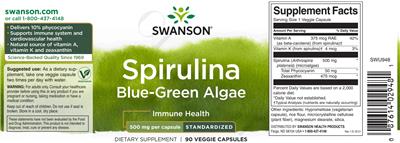
This summary is for Spirulina 500 mg by Swanson
- Form
- Capsule
- Serving Size
- 1 Veggie Capsule
- Servings
- 90 per container
- Container Holds
- 90 Veggie Capsules
- What is Spirulina 500 mg?A Blue-green Algae supplement from Swanson with two other active ingredients, in capsule form.
- Active Ingredients Vitamin A 375 mcg RAEVitamin K 4 mcgSpirulina 500 mg Three active ingredients. Each one can interact with drugs or cause side effects on its own, so we check every one. The full Supplement Facts
- Drug Interactions 664 drugs have a documented interaction with this supplement; the most serious is rated major. Of those, 455 are single drugs and 209 are combination products (two or more drugs in one), each listed under its own name. Ask your pharmacist first if you take a drug in any of these categories, the most serious of the 7 on record:
- RetinoidsMajor · 9 drugs
- Major · 2 drugs
- Moderate · 372 drugs
- Moderate · 122 drugs
- Possible Side EffectsDiarrhea bothNausea bothStomach upset bothHeadache Combined from the ingredients we have records for, Vitamin K and Blue-green Algae. Not studied in this exact product.
- Well documented Why
Does Spirulina 500 mg work?
What It Is Marketed For
Immune system and cardiovascular health support
From the claims on the product’s label.
The Closest Use the Research Grades
Blue-green Algae
Some studies support it, but the evidence isn’t conclusive.
Its ingredients have research behind other uses too:
- Vitamin A
- Vitamin K
- Zeaxanthin
- Night vision Vitamin A
These grades are for each ingredient, not this exact product, and never a promise it will work for you.
What the research says- AllergensNone of its ingredient names point to a major food allergen
- Barcode (UPC)0 87614 02948 1Match it to the barcode on your bottle to be sure this is your product. Not your product? Search for it here
Who Might Consider It
- People looking for immune system and cardiovascular health support, which is what it is marketed for. The closest use the research grades is hypertension, rated Possibly Effective.
- People who want it for ulcerative colitis, osteoporosis, age-related macular degeneration (AMD) or night vision: the other uses with research behind them. See each grade
- This product may suit adults who want a supplement for one of the rated uses of its ingredients, such as vitamin K for osteoporosis or zeaxanthin for macular degeneration.
Who Should Be Careful
- Anyone taking warfarin, retinoids, antidiabetes drugs, liver-affecting medicines, or tetracycline antibiotics should be especially careful.
- Please talk it over with your own doctor or pharmacist before starting, particularly if you are pregnant, breastfeeding, or have liver disease.
More Before You Take It Show all three answersHide Its Ingredient Amounts vs. Other Supplements Pregnancy and Breastfeeding The Label’s Directions
-
How do its ingredient amounts compare with other supplements?
- Vitamin A375 mcg RAENot compared yet.
- Vitamin K4 mcgLess than 9 in 10 of the 499 recent Vitamin K products in our database that state an amount; 120 mcg is the most common.
- Spirulina500 mgMore than most of the 186 recent Blue-green Algae products in our database that state an amount; 100 mg is the most common.
We compare an amount once at least 10 recent products in our database state one for that ingredient. A label’s amount is what the product holds, not a recommended dose.
See each comparison -
Pregnant or breastfeeding?
- Pregnancy and Breastfeeding Blue-green Algae
- Insufficient reliable information available; avoid using.
- Pregnancy and Breastfeeding Vitamin A
- ! When used orally or intramuscularly in excessive doses.
- Pregnancy and Breastfeeding Vitamin K
- When used orally in amounts that do not exceed the daily adequate intake level (AI).
-
How does the label say to take it?
“Suggested Use: As a dietary supplement, take one veggie capsule two times per day with water.”
The maker’s words. Your pharmacist or doctor may advise differently.
Everything the label says
From the label dated Jul 25, 2024: all three of its active ingredients were checked against our records. A summary of what is known, not a grade or a test of the product. How these ratings are computed
Ask Anything About This Supplement
Name a drug you take, or ask about side effects, ingredients or pregnancy.
There’s a lot of information about this supplement on this page! Ask anything in plain English for a quick answer drawn from it.
AI answers come from this label and our own records, never the open internet. AI can make mistakes, so always check with your doctor or pharmacist. How we use AI
Ask the Pharmacist
A licensed pharmacist will answer your question by email — free, as soon as they can.
Got it — thank you!
A licensed pharmacist will answer as soon as they can. Keep an eye on your email (worth checking spam, just in case).
What’s Inside Spirulina 500 mg by Swanson
Why this rating?
The label gives an exact amount for every one of its three active ingredients, so you know how much of each you get in each serving. This rates what the label tells you, not the quality of the product.
Supplement Facts
| Amount Per Serving | % Daily Value | |
|---|---|---|
| Vitamin A | 375 mcg RAE | 42% |
| Vitamin K | 4 mcg | 3% |
| Spirulina | 500 mg | † |
| Total Phycocyanin | 50 mg | † |
| Zeaxanthin | 475 mcg | † |
Other ingredients: Hypromellose, Rice Flour, Microcrystalline Cellulose, Magnesium Stearate, Silica
† Daily Value not established.
Daily Values for adults and children 4 or more years of age.
As the label prints it, from the NIH Dietary Supplement Label Database.
Each Ingredient and Its Drug Interactions
Tap one for more about it and its full guide. A drug can interact with this supplement through any one of them.
The active ingredients listed are zeaxanthin, vitamin A, and vitamin K, along with Total Phycocyanin and a Spirulina group entry.
- Zeaxanthin is a carotenoid, a plant pigment, and it has been linked to age-related macular degeneration (AMD).
- Vitamin A and vitamin K are fat-soluble vitamins; vitamin K's role in clotting factors is why it matters for people on warfarin.
-
Vitamin A 375 mcg RAE Interacts with 389 drugs
Form on the label: Beta-Carotene
Vitamin A is an essential nutrient important for vision, skin, immune function, and growth.
- Most people get enough from a balanced diet, and supplements are mainly useful for correcting a true deficiency.
- Because vitamin A is fat-soluble and can build up to harmful levels, more is not better, and high doses are especially risky in pregnancy.
The full Vitamin A guide: uses, dosage and safety Every Vitamin A drug interaction
-
Vitamin K 4 mcg Interacts with 2 drugs
Form on the label: Spirulina
Vitamin K is an essential nutrient your body needs for normal blood clotting and to support healthy bones.
- Most people get enough from food, but supplements are sometimes used for deficiency or bone and heart health, where evidence is mixed.
- If you take a blood thinner, talk to your pharmacist or doctor before changing your vitamin K intake.
The full Vitamin K guide: uses, dosage and safety Every Vitamin K drug interaction
-
Spirulina 500 mg We have no detailed role information for Total Phycocyanin or the Spirulina group entry. Interacts with 327 drugs
Form on the label: Arthrospira platensis
Blue-green algae are nutrient-rich aquatic microorganisms (such as spirulina and Klamath Lake algae) taken as a supplement for energy, nutrition, and general wellness.
- Evidence for most health claims is limited, and some products can be contaminated with toxins or heavy metals, so quality testing matters.
- Talk to your pharmacist or doctor before using, especially during pregnancy or breastfeeding.
The full Blue-green Algae guide: uses, dosage and safety Every Blue-green Algae drug interaction
- Total Phycocyanin 50 mg
- Zeaxanthin 475 mcg 86 drugs
How Much of Each Ingredient Is in It, Compared With Other Supplements
Each bar is an amount that other recent supplements list for the same ingredient. The taller the bar, the more of them state it.
-
4 mcg in a serving of this product
Less than 9 in 10 products
- Most common amount
- 120 mcg (about 11 in 100 products)
- Most products state
- 20 mcg to 200 mcg
- Compared with
- 499 recent products
-
500 mg in a serving of this product
More than most products
- Most common amount
- 100 mg (about 22 in 100 products)
- Most products state
- 30 mg to 1,000 mg
- Compared with
- 186 recent products
Other Ingredients (Inactive)
The capsule or tablet itself, fillers, coatings and flavors. Not part of the drug interaction check; the allergen check below reads them.
- Hypromellose
- Rice Flour
- Microcrystalline Cellulose
- Magnesium Stearate
- Silica
Allergens in Spirulina 500 mg
None of its ingredient names point to a major food allergen.
Not named in the ingredients
- Milk
- Egg
- Fish
- Shellfish
- Tree nuts
- Peanuts
- Wheat or other gluten grains
- Soy
- Sesame
- Made without, the label says“Vegetarian”
From the label text and ingredient names on file; we do not test products. With a serious allergy, check your bottle and ask the maker or your pharmacist.
What the Label Says
The maker’s own words, from the label. We do not verify or endorse them.
- General statements
-
“Science-Backed Quality Since 1969”
- Formulation
-
“Standardized Immune health”
“Delivers 10% phycocyanin Natural source of vitamin A, vitamin K and zeaxanthin”
2 more from the label
“Supports immune system and cardiovascular health”
“Spirulina 500 mg per capsule Blue-Green algae”
- Storage
-
“Store in a cool, dry place.”
- FDA Statement of Identity
-
“Dietary Supplement”
The Spirulina 500 mg Label on File
The label scan on file at the NIH Dietary Supplement Label Database, dated July 2024. Always read the label on the bottle you have.
Product Facts
- Brand
- Swanson
- Barcode (UPC)
- 087614029481
- Net contents
- 90 Veggie Capsules
- Market status
- On market
- Date entered into DSLD
- Jul 25, 2024
- DSLD ID
- 308752
- Product type
- Botanical With Nutrients
- Supplement form
- Capsule
- Dietary claims / uses
- Nutrient, All Other, Structure/Function
- Intended target group(s)
- Vegetarian, Adult (18 - 50 Years)
Is this label outdated? Report a formula or label change and our pharmacy team will review it.
HelloPharmacist Score Spirulina 500 mg by Swanson
Up to 10 points for research, amount, label and outside testing. Not a safety rating. How this one adds up
for high blood pressure
It is marketed for immune system and cardiovascular health support. There is no graded research on that exact use, so we scored the closest one: some research suggests Blue-green algae may help with high blood pressure.
- Research3 of 5 points
- Amount2 of 2 points
- Label2 of 2 points
- Outside testing0 of 1 point
Major drug interactions. The score does not count drug interactions. Check them against any drugs you take. See them
There is too little research to score Blue-green algae for diabetes, obesity, unhealthy cholesterol levels, athletic performance, depression, cardiovascular disease (CVD), attention deficit-hyperactivity disorder (ADHD) and wound healing.
How It Earns Its 7
Score: 7 out of 10. Preliminary for high blood pressure.
Research
Some research on Blue-green algae for high blood pressure.
Graded “Possibly Effective” in the Natural Medicines database, which we license. A related use, not the one it is marketed for, counts for at most 3 of 5 research points.
3 of 5 points
Amount
Its 500 mg is a normal amount: most of the 186 Blue-green algae products in our database that state an amount hold 30 mg to 1,000 mg.
2 of 2 points
Label
It states the amount of all three of its active ingredients.
2 of 2 points
Outside testing
We found no mark from an outside testing program, such as USP Verified or NSF Certified, on the label we have on file.
0 of 1 point
Where It Sits on the Blue-green Algae Shelf
The 106 blue-green algae products we have scored so far, lined up by their scores. The dark bottle is this one. Each bottle stands for up to 3 products. Tap a score to see the products on it.
31 blue-green algae products score 4 out of 10
- Spirulina 500 mg by Swanson
- Body by New Earth
- Wild Algae Blend by New Earth
- Wild Algae Blend by New Earth
- Spirulina Micro-Algae 760 mg by Nature's Way
- Mind by New Earth
- Mind by New Earth
- Mind by New Earth
- Body by New Earth
- Body by New Earth
- Organic Spirulina by Herbally Grounded
- Mind by New Earth
And 19 more.
54 blue-green algae products score 8 out of 10
- Klamath AFA 2000 mg by SuperSmart
- Spirulina 360 mg by Jane Health
- Spirulina by Dr. Rico Perez
- California Spirulina by Healths Harmony
- AFA by Naturgin Products USA
- Organic Spirulina 1 g Unflavored by Nutricost Organic
- California Spirulina by Healths Harmony
- Super Xanthin by Purium
- Spirulina Tablets 500 mg by Stakich
- Spirulina Organic 500 mg by BIOVEA
- Spirulina Natural Blue Green Algae 500 mg by Martin Avenue Pharmacy
- Spirulina Blue Green Algae 500 mg by CHK Nutrition
And 42 more.
3 blue-green algae products score 6 out of 10
- Spirulina by BRI Nutrition
- Spirulina by BRI Nutrition
- Organic Spirulina by Herbadiet
3 blue-green algae products score 3 out of 10
- Spirulina by Good State
- Spirulina 1500 mg by Evlution Nutrition
- Spirul-EZ by Douglas Laboratories
15 blue-green algae products score 7 out of 10
- Spirulina 500 mg by Swanson this one
- Spirulina 8 g by Nutricost
- Spirulina 750 mg by Solgar
- Spirulina 500 mg by Puritan's Pride
- Spirulina 500 mg by Mountain Meadow Herbs
- Spirulina 500 mg by Vitamin World
- Spirulina (Arthrospira Platensis) by Hard Rhino
- Spirulina by Pure Herbs
- Spirulina by Pure Herbs
- Spirulina by BioAnue
- Spirulina by BioAnue
- Spirulina by ZHOU
And 3 more.
This One Next to Most Blue-green Algae Products
| What | This one | Most of the other 105 |
|---|---|---|
| What it is marketed for | No one use | Stress (3 of 5) |
| How much blue-green algae | 500 mg a serving | 500 mg to 1,000 mg |
| Form | Arthrospira Platensis | Arthrospira Platensis |
| The label | Every amount stated | Every amount stated on 103 of 105 |
| Outside testing seal | None on file | 0 of 105 have one |
| Score | 7, Preliminary | 4 to 8 |
Spirulina 500 mg by Swanson Side Effects
Why this rating?
We look for three kinds of safety information on each ingredient: side effects reported in studies, a pregnancy and breastfeeding rating, and a safety write-up from our pharmacy team. Of the four ingredients we could check, three have side-effect reports, all four have a pregnancy rating and all four have a safety write-up.
So this rates how much is known, not whether Spirulina 500 mg is right for you.
Reported with four of its ingredients
- Most often
- Diarrhea, nausea, stomach upset and headache
- !Rare but serious
- Reported with Vitamin A, Blue-green Algae and Zeaxanthin See details
HelloPharmacist Team Summary: Spirulina 500 mg by Swanson Side Effects
You will likely find this product generally well tolerated, though its ingredients are not all covered.
- The side effects you are most likely to notice are nausea, diarrhea, and stomach upset, which are reported with vitamin K.
- Very high single doses of vitamin A can cause severe headache, blurred vision, and vomiting, so if these happen, call your doctor right away.
- Please talk with your own doctor or pharmacist before starting, especially if you smoke, have liver disease, drink alcohol heavily, or take blood thinners.
Side Effects, Ingredient by Ingredient
A supplement’s side effects come from its ingredients. Here is what is reported with each one.
Vitamin K
Most reported
- Diarrhea
- Nausea
- Stomach upset
From the Natural Medicines database, which we license.
Every reported effect, in the Vitamin K guideBlue-green Algae
Most reported
- Nausea
- Stomach upset
- Diarrhea
- Headache
Vitamin A has side-effect reports, but no list of the most common ones. Read them in the Vitamin A guide
Spirulina 500 mg Warnings: Who Should Be Careful
Spirulina 500 mg has four active ingredients, and each can carry warnings of its own. We checked all four, and each warning below names the ingredient it comes from. If any of these apply to you, talk to your doctor or pharmacist before you start it.
- Vitamin A2 warnings below
- Vitamin K2 warnings below
- Blue-green Algae3 warnings below
- Zeaxanthin3 warnings below
-
Bleeding Problems or Surgery
- Vitamin KPeople taking blood-thinning medication should be especially careful and consistent with their vitamin K intake, and should always speak with their doctor or pharmacist first.
- Vitamin KPeople with liver disease or bleeding disorders should also get medical advice before using supplements.
-
Liver Disease
- Vitamin APeople with liver disease, those who drink alcohol heavily, and people taking other vitamin A-related medicines should be especially careful and talk with a clinician first.
- Blue-green AlgaePeople with autoimmune conditions, liver disease, or a metabolic disorder called phenylketonuria (PKU) should be especially cautious and check with a doctor first.
-
Children
- Blue-green AlgaeChildren should not take these supplements unless a healthcare provider recommends it.
-
Other Cautions
- Vitamin AWhen in doubt, choose food sources and your prenatal vitamin, and check with a pharmacist or doctor.
- ZeaxanthinPeople who smoke or have smoked should be careful with high-dose carotenoid supplements in general, because some research with a different carotenoid (beta-carotene) raised concerns about lung cancer risk in smokers.
- ZeaxanthinIf you smoke, talk to your doctor or pharmacist before taking carotenoid supplements.
- ZeaxanthinTo be safe, it is best to use caution and check with your healthcare provider before taking a supplement.
-
What the Label Warns
- “Warning: For adults only. Keep out of reach of children.”
- “Consult your healthcare provider before using this or any product if you are pregnant or nursing, taking medication or have a medical condition.”
- “Do not use if seal is broken.”
The maker’s wording, from the product label.
-
Pregnant or Breastfeeding
Each ingredient’s rating for pregnancy and for breastfeeding, and what it covers.
Pregnancy and Breastfeeding The record rates both the same
-
Insufficient reliable information available; avoid using.
Some blue-green algae products, specifically those of the species Aphanizomenon flos-aquae, have been found to contain low amounts of beta-methylamino-L-alanine (BMAA).
BMAA is associated with neurodegenerative diseases, and breast milk has been shown to be a potential source of BMAA exposure in infants.
Pregnancy and Breastfeeding The record rates both the same
-
When used orally or intramuscularly and appropriately.
Vitamin A, as pre-formed vitamin A (retinol or retinyl ester), is safe during pregnancy and lactation when used in doses less than 10,000 IU (3000 mcg) per day in adults 19 years of age and older and 2800 mcg daily in those 14-18 years of age.
4 more points on this rating
- Vitamin A is available in two different forms: pre-formed vitamin A (retinol or retinyl ester) and provitamin A (carotenoids).
- The safety concerns associated with high vitamin A intake occur with pre-formed vitamin A only.
- Some supplements contain vitamin A in both pre-formed and provitamin A forms.
- For these supplements, the amount of pre-formed vitamin A should be used as the reference amount to determine safety.
-
When used orally or intramuscularly in excessive doses.
Daily intake of greater than 10,000 IU (3000 mcg) can cause fetal malformations.
4 more points on this rating
- Excessive dietary intake of vitamin A has also been associated with teratogenicity.
- The first trimester of pregnancy seems to be the critical period for susceptibility to vitamin A-associated birth defects such as craniofacial abnormalities and abnormalities of the central nervous system.
- Pregnant patients should monitor their intake of pre-formed vitamin A (retinol or retinyl ester).
- This form of vitamin A is found in several foods including animal products, particularly fish and animal liver, some fortified breakfast cereals, and dietary supplements.
Show 2 more ingredients
Pregnancy and Breastfeeding The record rates both the same
-
When used orally in amounts that do not exceed the daily adequate intake level (AI).
A tolerable upper intake level for vitamin K in pregnancy and lactation has not been set.
Pregnancy and Breastfeeding The record rates both the same
-
When used orally and appropriately in amounts found in foods.
Zeaxanthin is found in breast milk and levels correlate with infant status.
2 more points on this rating
- Supplementation during pregnancy increases zeaxanthin levels in cord blood and infant skin.
- There is insufficient reliable information available about the safety of supplemental zeaxanthin.
Ratings and the words beside them are from the Natural Medicines database, which we license.
-
Rare but Serious Side Effects
-
!
Vitamin A
Very high single doses can cause more sudden symptoms like severe headache, blurred vision, and vomiting.
Vitamin A can build up in the body and cause toxicity, and high single doses can cause severe headache, blurred vision, and vomiting.
Orally: In very high doses, vitamin A can cause pseudotumor cerebri, pain, liver toxicity, coma, and even death.
-
!
Blue-green Algae
More serious problems are usually linked to contaminated products.
-
!
Zeaxanthin
Zeaxanthin is usually well tolerated, and serious side effects are uncommon at typical supplement amounts.
-
!
Our pharmacy team on Spirulina 500 mg
Zeaxanthin is generally well tolerated at typical supplement amounts, and serious side effects are uncommon at those amounts.
When to get help: a serious allergic reaction, with trouble breathing or swelling of the face, lips or throat, needs emergency care: call 911. For any other side effect that worries you, call your doctor or pharmacist.
These reports describe each ingredient, not studies of this exact product. Not medical advice: a side effect you notice after starting a supplement is worth a word with your pharmacist or doctor.
Spirulina 500 mg by Swanson Drug Interactions
We checked all three active ingredients in this supplement against every drug in our records. A drug can interact with it through any one of them.
A major interaction on record
3 of 3, on a scale from Minor or none to Major.Why this rating?
We rate this by the most serious interaction on record, not by how many there are. For Blue-green Algae, Vitamin A, Vitamin K and Zeaxanthin, the most serious is rated major, which means the combination is best avoided, or used only under close supervision. Some involve kinds of drugs where a small change can matter, such as blood thinners, transplant drugs and diabetes drugs.
665 drugs are on the full list. What matters is whether one you take is on it, so check yours with the interaction checker on this page.
From the HelloPharmacist Team
Here is how the interactions add up across the whole label.
- Spirulina 500 mg by Swanson does interact with some medications, and the most serious finding involves warfarin, a blood thinner (anticoagulant).
- Its vitamin A and zeaxanthin content also carry documented interactions, so vitamin A, vitamin K, and zeaxanthin are each relevant here.
- Zeaxanthin is linked to antidiabetes drugs (Moderate), where it may increase the risk of low blood sugar (hypoglycemia).
All three of its active ingredients have drug interactions on record: Vitamin A, Vitamin K and Blue-green Algae.
- Interacts with
- 389 drugs
- Most serious
- Major
- Vitamin A is linked to retinoids (vitamin A-derived medicines, Major), where combined use may produce excessive vitamin A levels, and to hepatotoxic drugs (medicines that can strain the liver, Moderate), which may raise the risk of liver disease.
- It is also linked to tetracycline antibiotics (Moderate), where high doses may increase the risk of pseudotumor cerebri (raised pressure around the brain), and to warfarin (Moderate), where high doses may increase bleeding risk.
- Interacts with
- 2 drugs
- Most serious
- Major
- Its vitamin K content can reduce warfarin's anticoagulant effect, a Major interaction.
- Interacts with
- 327 drugs
- Most serious
- Moderate
- We could not check Total Phycocyanin or the Spirulina group entry because we have no interaction information for them, so we cannot tell you whether they interact with anything.
Summarized by the HelloPharmacist pharmacy team from the interaction records below. How it is written How we use AI
Why Spirulina 500 mg Interacts, Ingredient by Ingredient
A product interacts through its ingredients. Each card: how many drugs, the most serious rating, and the kinds of drugs it affects most (tap a kind for what it means).
The ingredients driving the most interactions
-
Vitamin A 389 drugs
Most serious: Major4 interaction records on file
The kinds of drugs it affects most
- 372 drugs
- 20 drugs
- Retinoids 9 drugs
- 2 drugs
Every Vitamin A drug interaction, 4 records The Vitamin A records cite 31 references, listed in the Vitamin A guide.
-
Spirulina 327 drugs
Most serious: Moderate3 interaction records on file
The kinds of drugs it affects most
- 122 drugs
- 121 drugs
- 86 drugs
Every Blue-green Algae drug interaction, 3 records The Blue-green Algae records cite 22 references, listed in the Blue-green Algae guide.
-
Vitamin K 2 drugs
Most serious: Major1 interaction record on file
The kinds of drugs it affects most
- 2 drugs
Every Vitamin K drug interaction, 1 record The Vitamin K records cite 13 references, listed in the Vitamin K guide.
The Breakdown by Severity
Each drug counted once, at its most serious rating. Tap a tile to list those drugs.
Find Your Drug
Type a drug or brand name to see whether it is on the list.
- Only drugs with a documented interaction are listed, the most serious first.
- A drug with no known interaction is not listed, but searching its name tells you so.
- Open a drug to see which ingredient is responsible. Of those, 455 are single drugs and 209 are combination products (two or more drugs in one), each listed under its own name.
-
WarfarinWarfarin Major
The 3 ingredients responsible:
-
Vitamin K Major
Vitamin K can antagonize and reverse the therapeutic effects of warfarin.
The full Vitamin K + Warfarin interaction -
Spirulina Moderate Warfarin is in the Anticoagulant/Antiplatelet Drugs category.
Theoretically, spirulina blue-green algae might increase the risk of bleeding if used with other anticoagulant or antiplatelet drugs.
The full Spirulina + Warfarin interaction -
Vitamin A Moderate
Theoretically, high doses of vitamin A could increase the risk of bleeding with warfarin.
The full Vitamin A + Warfarin interaction
-
-
Warfarin SodiumCoumadin, Panwarfin, Sofarin Major
The 3 ingredients responsible:
-
Vitamin K Major
Vitamin K can antagonize and reverse the therapeutic effects of warfarin.
The full Vitamin K + Warfarin Sodium interaction -
Vitamin A Moderate
Theoretically, high doses of vitamin A could increase the risk of bleeding with warfarin.
The full Vitamin A + Warfarin Sodium interaction -
Spirulina Moderate Warfarin Sodium is in the Anticoagulant/Antiplatelet Drugs category.
Theoretically, spirulina blue-green algae might increase the risk of bleeding if used with other anticoagulant or antiplatelet drugs.
The full Spirulina + Warfarin Sodium interaction
-
-
IsotretinoinAbsorica, Accutane, Amnesteem, Claravis, Roaccutane and 1 more Major
The ingredient responsible:
-
Vitamin A Major Isotretinoin is in the Retinoids category.
Concomitant use of retinoids with vitamin A supplements might produce supratherapeutic vitamin A levels.
The full Vitamin A + Isotretinoin interaction
-
-
BexaroteneTargretin Major
The ingredient responsible:
-
Vitamin A Major Bexarotene is in the Retinoids category.
Concomitant use of retinoids with vitamin A supplements might produce supratherapeutic vitamin A levels.
The full Vitamin A + Bexarotene interaction
-
-
AcitretinSoriatane Major
The ingredient responsible:
-
Vitamin A Major Acitretin is in the Retinoids category.
Concomitant use of retinoids with vitamin A supplements might produce supratherapeutic vitamin A levels.
The full Vitamin A + Acitretin interaction
-
-
TretinoinAltreno, Renova, Retin-A, Vesanoid Major
The ingredient responsible:
-
Vitamin A Major Tretinoin is in the Retinoids category.
Concomitant use of retinoids with vitamin A supplements might produce supratherapeutic vitamin A levels.
The full Vitamin A + Tretinoin interaction
-
-
AlitretinoinPanretin Major
The ingredient responsible:
-
Vitamin A Major Alitretinoin is in the Retinoids category.
Concomitant use of retinoids with vitamin A supplements might produce supratherapeutic vitamin A levels.
The full Vitamin A + Alitretinoin interaction
-
-
TazaroteneArazlo, Avage, Fabior, Tazorotene, Zorac Major
The ingredient responsible:
-
Vitamin A Major Tazarotene is in the Retinoids category.
Concomitant use of retinoids with vitamin A supplements might produce supratherapeutic vitamin A levels.
The full Vitamin A + Tazarotene interaction
-
-
EtretinateTegison Major
The ingredient responsible:
-
Vitamin A Major Etretinate is in the Retinoids category.
Concomitant use of retinoids with vitamin A supplements might produce supratherapeutic vitamin A levels.
The full Vitamin A + Etretinate interaction
-
-
Tretinoin and Benzoyl PeroxideTwyneo Major
The ingredient responsible:
-
Vitamin A Major Tretinoin and Benzoyl Peroxide is in the Retinoids category.
Concomitant use of retinoids with vitamin A supplements might produce supratherapeutic vitamin A levels.
The full Vitamin A + Tretinoin and Benzoyl Peroxide interaction
-
-
Halobetasol Propionate and tazaroteneDuobrii Major
The ingredient responsible:
-
Vitamin A Major Halobetasol Propionate and tazarotene is in the Retinoids category.
Concomitant use of retinoids with vitamin A supplements might produce supratherapeutic vitamin A levels.
The full Vitamin A + Halobetasol Propionate and tazarotene interaction
-
-
ApixabanEliquis Moderate
The ingredient responsible:
-
Spirulina Moderate Apixaban is in the Anticoagulant/Antiplatelet Drugs category.
Theoretically, spirulina blue-green algae might increase the risk of bleeding if used with other anticoagulant or antiplatelet drugs.
The full Spirulina + Apixaban interaction
-
-
ClopidogrelPlavix Moderate
The ingredient responsible:
-
Spirulina Moderate Clopidogrel is in the Anticoagulant/Antiplatelet Drugs category.
Theoretically, spirulina blue-green algae might increase the risk of bleeding if used with other anticoagulant or antiplatelet drugs.
The full Spirulina + Clopidogrel interaction
-
-
RosuvastatinCrestor, Ezallor Moderate
The ingredient responsible:
-
Vitamin A Moderate Rosuvastatin is in the Hepatotoxic Drugs category.
Theoretically, taking high doses of vitamin A in combination with other potentially hepatotoxic drugs might increase the risk of liver disease.
The full Vitamin A + Rosuvastatin interaction
-
-
AspirinAngettes 75, ASA, Asaphen, Aspirin, Caprin and 9 more Moderate
The ingredient responsible:
-
Spirulina Moderate Aspirin is in the Anticoagulant/Antiplatelet Drugs category.
Theoretically, spirulina blue-green algae might increase the risk of bleeding if used with other anticoagulant or antiplatelet drugs.
The full Spirulina + Aspirin interaction
-
-
AtorvastatinAtorvaliq Moderate
The ingredient responsible:
-
Vitamin A Moderate Atorvastatin is in the Hepatotoxic Drugs category.
Theoretically, taking high doses of vitamin A in combination with other potentially hepatotoxic drugs might increase the risk of liver disease.
The full Vitamin A + Atorvastatin interaction
-
-
RivaroxabanXarelto Moderate
The ingredient responsible:
-
Spirulina Moderate Rivaroxaban is in the Anticoagulant/Antiplatelet Drugs category.
Theoretically, spirulina blue-green algae might increase the risk of bleeding if used with other anticoagulant or antiplatelet drugs.
The full Spirulina + Rivaroxaban interaction
-
-
MetforminGlucophage, Metformin Moderate
The 2 ingredients responsible:
-
Spirulina Moderate Metformin is in the Antidiabetes Drugs category.
Theoretically, taking blue-green algae with antidiabetes drugs might increase the risk of hypoglycemia.
The full Spirulina + Metformin interaction -
Zeaxanthin Moderate Metformin is in the Antidiabetes Drugs category.
Theoretically, taking zeaxanthin with antidiabetes drugs might increase the risk of hypoglycemia.
The full Zeaxanthin + Metformin interaction
-
-
TirzepatideMounjaro, Zepbound Moderate
The 2 ingredients responsible:
-
Zeaxanthin Moderate Tirzepatide is in the Antidiabetes Drugs category.
Theoretically, taking zeaxanthin with antidiabetes drugs might increase the risk of hypoglycemia.
The full Zeaxanthin + Tirzepatide interaction -
Spirulina Moderate Tirzepatide is in the Antidiabetes Drugs category.
Theoretically, taking blue-green algae with antidiabetes drugs might increase the risk of hypoglycemia.
The full Spirulina + Tirzepatide interaction
-
-
IbuprofenAdvil, Arthrofen, Brufen, Brufen Retard, Calodor and 15 more Moderate
The ingredient responsible:
-
Spirulina Moderate Ibuprofen is in the Anticoagulant/Antiplatelet Drugs category.
Theoretically, spirulina blue-green algae might increase the risk of bleeding if used with other anticoagulant or antiplatelet drugs.
The full Spirulina + Ibuprofen interaction
-
-
SemaglutideOzempic, Rybelsus, Wegovy Moderate
The 2 ingredients responsible:
-
Zeaxanthin Moderate Semaglutide is in the Antidiabetes Drugs category.
Theoretically, taking zeaxanthin with antidiabetes drugs might increase the risk of hypoglycemia.
The full Zeaxanthin + Semaglutide interaction -
Spirulina Moderate Semaglutide is in the Antidiabetes Drugs category.
Theoretically, taking blue-green algae with antidiabetes drugs might increase the risk of hypoglycemia.
The full Spirulina + Semaglutide interaction
-
-
TestosteroneAndrogel, Andropatch, Delatestryl, Intrinsa, Natesto and 4 more Moderate
The ingredient responsible:
-
Vitamin A Moderate Testosterone is in the Hepatotoxic Drugs category.
Theoretically, taking high doses of vitamin A in combination with other potentially hepatotoxic drugs might increase the risk of liver disease.
The full Vitamin A + Testosterone interaction
-
-
AmoxicillinAmix, Amoram, Amoxident, Amoxil Capsules, Amoxil Injection and 4 more Moderate
The ingredient responsible:
-
Vitamin A Moderate Amoxicillin is in the Hepatotoxic Drugs category.
Theoretically, taking high doses of vitamin A in combination with other potentially hepatotoxic drugs might increase the risk of liver disease.
The full Vitamin A + Amoxicillin interaction
-
-
PrednisoneCortan, Deltasone, Meticorten, Orasone, Prednicen-M and 3 more Moderate
The ingredient responsible:
-
Spirulina Moderate Prednisone is in the Immunosuppressants category.
Theoretically, concurrent use of blue-green algae might interfere with immunosuppressive therapy.
The full Spirulina + Prednisone interaction
-
-
AcetaminophenChildren's Tylenol, Children's Tylenol Meltaways, Tylenol, Tylenol Ex Strength Moderate
The ingredient responsible:
-
Vitamin A Moderate Acetaminophen is in the Hepatotoxic Drugs category.
Theoretically, taking high doses of vitamin A in combination with other potentially hepatotoxic drugs might increase the risk of liver disease.
The full Vitamin A + Acetaminophen interaction
-
-
MethotrexateOtrexup, Rasuvo, Reditrex, Rheumatrex Moderate
The ingredient responsible:
-
Vitamin A Moderate Methotrexate is in the Hepatotoxic Drugs category.
Theoretically, taking high doses of vitamin A in combination with other potentially hepatotoxic drugs might increase the risk of liver disease.
The full Vitamin A + Methotrexate interaction
-
-
NaproxenAleve, Anaprox, Anaprox DS, Arthroxen, EC-Naprosyn and 8 more Moderate
The ingredient responsible:
-
Spirulina Moderate Naproxen is in the Anticoagulant/Antiplatelet Drugs category.
Theoretically, spirulina blue-green algae might increase the risk of bleeding if used with other anticoagulant or antiplatelet drugs.
The full Spirulina + Naproxen interaction
-
-
DoxycyclineDoryx, Doxy, Doxy-D, Doxycin, Doxycycline Injection and 7 more Moderate
The ingredient responsible:
-
Vitamin A Moderate Doxycycline is in these Tetracycline Antibiotics, Hepatotoxic Drugs categories.
Theoretically, taking tetracycline antibiotics with high doses of vitamin A can increase the risk of pseudotumor cerebri.
The full Vitamin A + Doxycycline interaction
-
-
DuloxetineCymbalta, Drizalma Sprinkle, Irenka Moderate
The ingredient responsible:
-
Vitamin A Moderate Duloxetine is in the Hepatotoxic Drugs category.
Theoretically, taking high doses of vitamin A in combination with other potentially hepatotoxic drugs might increase the risk of liver disease.
The full Vitamin A + Duloxetine interaction
-
-
Omega-3 Fatty Acids (prescription Drug)Lovaza Moderate
The ingredient responsible:
-
Spirulina Moderate Omega-3 Fatty Acids (prescription Drug) is in the Anticoagulant/Antiplatelet Drugs category.
Theoretically, spirulina blue-green algae might increase the risk of bleeding if used with other anticoagulant or antiplatelet drugs.
The full Spirulina + Omega-3 Fatty Acids (prescription Drug) interaction
-
Does It Work? Spirulina 500 mg by Swanson
What the research says for what it is marketed for, then its ingredients’ other uses and each ingredient on its own. A grade is the research so far, never an endorsement.
What the Research Supports
First for what it is marketed for, then the other uses its ingredients are graded for, strongest research first.
Marketed for immune system and cardiovascular health support
- Blue-green Algae
Other uses its ingredients are graded for
- Vitamin A
- Night vision Vitamin A
- Vitamin K
- Zeaxanthin
HelloPharmacist Team Summary: Does Spirulina 500 mg by Swanson Work?
Zeaxanthin is rated Possibly Effective for age-related macular degeneration.
- Its ratings for age-related cognitive decline, Alzheimer disease, asthma, bladder cancer, and breast cancer are Insufficient Reliable Evidence To Rate.
- We have no effectiveness ratings for Total Phycocyanin or the Spirulina group entry.
The Evidence, Ingredient by Ingredient
The detail behind the list above: our notes on each ingredient and its graded uses.
Blue-green Algae
From our Blue-green Algae guide
- People use blue-green algae for many reasons, including general nutrition, more energy, antioxidant support, immune health, cholesterol and blood sugar control, and weight management.
- It is important to know that popular use does not mean a benefit is proven.
Research suggests a benefit for
- Hypertension (the use on its label)
Vitamin A
From our Vitamin A guide
- The strongest, best-supported use of vitamin A is correcting or preventing a deficiency.
- In people who are truly low in vitamin A, supplementing clearly helps prevent problems like night blindness and supports normal growth and immune function.
Research suggests a benefit for
- Vitamin A deficiency
- Ulcerative colitis and night vision
Not counted here: three graded uses are for Vitamin A injected or put on the skin (aging skin, bronchopulmonary dysplasia and wrinkled skin), not for a product like this one. Four more are for conditions treated by a doctor or in a hospital (measles, oral leukoplakia, postpartum complications and others).
Every graded use, in the Vitamin A guideVitamin K
From our Vitamin K guide
- Blood clotting: Vitamin K is clearly essential for normal blood clotting.
- People who do not have enough may bleed or bruise more easily.
Research suggests a benefit for
- Vitamin K-dependent clotting factors deficiency (VKCFD)
- Osteoporosis
Not counted here: three graded uses are for conditions treated by a doctor or in a hospital (hemorrhagic disease, hypoprothrombinemia and warfarin anticoagulation).
Every graded use, in the Vitamin K guideZeaxanthin
From our Zeaxanthin guide
- The best-studied use of zeaxanthin is for age-related macular degeneration (AMD).
- Large eye-health research projects have tested zeaxanthin together with lutein and other nutrients (like vitamins C and E, zinc, and copper).
Research suggests a benefit for
- Age-related macular degeneration (AMD)
The grades are the Natural Medicines database’s, which we license; tap a grade for what it means. They are about each ingredient, not this exact product.
About Swanson
Manufacturer and brand details for Spirulina 500 mg, from the product label.
Swanson has 747 products in our supplement database, 746 of them on the market, with labels on file since 2012. Our database is built from the NIH’s Dietary Supplement Label Database and our pharmacy team’s own additions, so it covers the labels filed there, not every product the brand sells.
- Name
- Swanson Health Products
- City
- Fargo
- State
- ND
- ZipCode
- 58104
- Phone Number
- 1-800-437-4148
- Web Address
- swanson.com
Spirulina 500 mg by Swanson: Common Questions
Does Spirulina 500 mg by Swanson interact with any drugs?
What are the side effects of Spirulina 500 mg by Swanson?
Who should be careful taking Spirulina 500 mg by Swanson?
Can Spirulina 500 mg by Swanson affect the liver?
Does Spirulina 500 mg by Swanson contain any common allergens?
How can Spirulina 500 mg by Swanson interact with so many drugs?
Where does the information about Spirulina 500 mg by Swanson come from?
Is Spirulina 500 mg by Swanson safe to take during pregnancy?
What is zeaxanthin used for?
Does vitamin K work for osteoporosis?
Is Total Phycocyanin effective or safe?
Written and reviewed by the HelloPharmacist Editorial Team. Our editorial policy
Still Have a Question About Spirulina 500 mg?
Our pharmacists answer drug and supplement questions, free, by email.
Label information is sourced from the NIH Dietary Supplement Label Database and reflects the product version on file; always read your actual product label. This page is for education only and is not a substitute for professional medical advice. Confirm with your pharmacist or doctor before combining supplements and drugs.
Who Reviews This Page
The pharmacist behind it, and how it is checked.
Dr. Brian Staiger, PharmD, BCPS
Clinical pharmacist and founder of HelloPharmacist
A licensed pharmacist for more than 13 years, he built the system behind this page: it reads the label on file, matches each active ingredient to its record in the Natural Medicines database, checks those records against every drug we cover, and our pharmacy team writes the take and the interaction summary from those records.
- 13+ Years in PharmacyRetail and clinical pharmacy, medication safety and healthcare administration.
- Board Certified (BCPS)A pharmacotherapy specialist, certified by the Board of Pharmacy Specialties.
- Herbalist TrainingCertificates in medical ethnobotany, for the herbs and supplements people take.
Where This Page Comes From
Spirulina 500 mg’s label data comes from the NIH Dietary Supplement Label Database; the ingredient interaction data is from the Natural Medicines database, reviewed by our pharmacists.
- NIH Dietary Supplement Label Database (DSLD)
- The official product label on file for this supplement.
- Natural Medicines (Therapeutic Research Center)
- The evidence-graded clinical reference behind the ingredient interaction, evidence and safety records, which we license.
- HelloPharmacist Editorial Team
- Content is reviewed by the HelloPharmacist Editorial Team, the pharmacists on our staff and those we contract. See our data sources and editorial standards for how this information is built and checked.
- The Pharmacy Team’s Take and Summaries
- Generated from HelloPharmacist’s pharmacist-curated databases and editorial rules. Clinical methodology reviewed by Dr. Brian Staiger, PharmD, BCPS. Last generated Oct 31, 2026. How we use AI
- The ratings in the Quick Summary
- They summarize available label information, ingredient evidence and known drug-safety records: a summary of what is known, not a grade of the product itself. They do not verify product identity, purity, potency, contamination or manufacturing quality. How these ratings are computed
The References Behind the Interaction Records
Every citation the ingredients’ records rest on is listed in that ingredient’s guide, in context: Vitamin A, 31 references; Vitamin K, 13 references; Blue-green Algae, 22 references; Zeaxanthin, 5 references .
Parts of this content are provided by the Therapeutic Research Center, LLC.
DISCLAIMER: Currently this does not check for drug-drug interactions. This is not an all-inclusive comprehensive list of potential interactions and is for informational purposes only. Not all interactions are known or well-reported in the scientific literature, and new interactions are continually being reported. Input is needed from a qualified healthcare provider including a pharmacist before starting any therapy. Application of clinical judgment is necessary.
© 2021 Therapeutic Research Center, LLC
Keep Exploring
- Supplement interaction checkerCheck any supplement or product against your drugs
- Drug–drug interactionsCheck two or more of your drugs against each other
- Browse drugs A to ZEvery drug we have checked against herbs and supplements
- NDC and pricing lookupFind a drug’s NDCs, packaging and costs
- Ask a pharmacistA free, personal answer from our licensed team