
Vitamin C-400 by Innate Response Formulas Ingredients, Side Effects and Drug Interactions
Dietary Supplement Tablet or Pill Other Combinations
Vitamin C-400 by Innate Response Formulas is a Vitamin C supplement with nine other active ingredients. It is marketed for immune and cellular health.
UPC 0 51494 40017 3 Match it to the barcode on your bottle

Medically reviewed by Dr. Brian Staiger, PharmD, BCPS
Also reviewed by the HelloPharmacist Editorial Team
Updated Details about this page
- Label on file from the NIH Dietary Supplement Label Database, dated Jun 24, 2019.
- The interaction, evidence and safety records come from the Natural Medicines database, which we license, read against this label by our own system; the pharmacy team’s sections are written from those records.
- Dr. Brian Staiger, PharmD, BCPS, is a clinical pharmacist and pharmacotherapy specialist.
- Editorial policy Our sources
AI is used only to summarize verified clinical information, never the open internet. Our AI policy
Summary: The HelloPharmacist Team’s Take
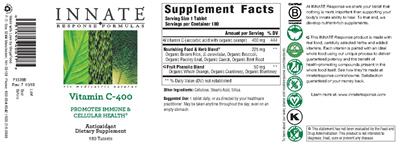
This summary is for Vitamin C-400 by Innate Response Formulas
- Form
- Tablet or Pill
- Serving Size
- 1 Tablet
- Servings
- 180 per container
- Container Holds
- 180 Tablets
- What is Vitamin C-400?A Vitamin C supplement from Innate Response Formulas with nine other active ingredients, in tablet form.
- Active Ingredients 1 vitamin, 8 plant ingredients such as organic Brown Rice, organic Broccoli and organic Parsley and 1 other: Vitamin C 400 mgorganic Brown RiceS. cerevisiaeorganic Broccoliorganic Parsleyorganic Carrotorganic Beetorganic whole Orangeorganic Cranberryorganic Blueberry Ten active ingredients. Each one can interact with drugs or cause side effects on its own, so we check every one. The full Supplement Facts
- Drug Interactions 1,233 drugs have a documented interaction with this supplement; the most serious is rated major. Of those, 843 are single drugs and 390 are combination products (two or more drugs in one), each listed under its own name. Based on the 9 of its 10 ingredients we could check. Ask your pharmacist first if you take a drug in any of these categories, the most serious of the 39 on record:
- Major · 47 drugs
- Major · 9 drugs
- Celiprolol (Celicard)Major · 1 drug
- Ivermectin (Stromectol, others)Major · 1 drug
- Possible Side EffectsUpset stomach 3 ingredientsBloating 2 ingredientsDiarrhea 2 ingredientsGas 2 ingredientsNausea 2 ingredientsPink urine +19 moreCombined from six of its ten active ingredients. Not studied in this exact product.
- Well documented Why
Does Vitamin C-400 work?
What It Is Marketed For
Immune and cellular health
From the claims on the product’s label.
The Closest Use the Research Grades
Respiratory tract infections Vitamin C
There isn’t enough good research to say either way.
Its ingredients have stronger research for other uses:
- Vitamin C deficiency Vitamin C
- Vitamin C
- Vitamin C
- Brewer's Yeast
- Beet
- Cranberry
These grades are for each ingredient, not this exact product, and never a promise it will work for you.
And 3 more graded uses, in what the research says- AllergensNone of its ingredient names point to a major food allergen
- Barcode (UPC)0 51494 40017 3Match it to the barcode on your bottle to be sure this is your product. Not your product? Search for it here
Who Might Consider It
- People looking for immune and cellular health, which is what it is marketed for. For respiratory tract infections, the closest use the research grades, there is not enough good research to say either way.
- People who want Vitamin C, its main ingredient, for vitamin C deficiency, hypercholesterolemia, hypertension or another graded use: the uses with research behind it. See each grade
- This product may suit adults who want vitamin C and whole-food ingredients and who aren't taking any medication on the interaction list.
Who Should Be Careful
- Anyone taking MAOIs, warfarin or other blood thinners, diabetes medicines, lithium, or thyroid medicine, or anyone with a history of kidney stones, should be careful.
- Talk it over with your own doctor or pharmacist before starting, especially if you're pregnant or breastfeeding.
More Before You Take It Show both answersHide Pregnancy and Breastfeeding The Label’s Directions
-
Pregnant or breastfeeding?
- Pregnancy and Breastfeeding Vitamin C
- ! When used orally in excessive doses.
- Pregnancy Parsley
- ! When used orally in medicinal amounts.
- Breastfeeding Parsley
- Insufficient reliable information available; avoid using.
- Pregnancy Beet
- ! Beet as a food is fine, but concentrated supplements lack safety data, so use caution.
- Breastfeeding Beet
- There is insufficient reliable information available about the safety of beets used medicinally during pregnancy and breast-feeding.
-
How does the label say to take it?
“Suggested use: 1 tablet daily, or as directed by your healthcare practitioner. May be taken anytime throughout the day, even on an empty stomach.”
The maker’s words. Your pharmacist or doctor may advise differently.
Everything the label says
From the label dated Jun 24, 2019: 9 of its 10 active ingredients were checked against our records; the other one is not in them yet. A summary of what is known, not a grade or a test of the product. How these ratings are computed
Ask Anything About This Supplement
Name a drug you take, or ask about side effects, ingredients or pregnancy.
There’s a lot of information about this supplement on this page! Ask anything in plain English for a quick answer drawn from it.
AI answers come from this label and our own records, never the open internet. AI can make mistakes, so always check with your doctor or pharmacist. How we use AI
Ask the Pharmacist
A licensed pharmacist will answer your question by email — free, as soon as they can.
Got it — thank you!
A licensed pharmacist will answer as soon as they can. Keep an eye on your email (worth checking spam, just in case).
What’s Inside Vitamin C-400 by Innate Response Formulas
Ten Active Ingredients
In the order the label lists them, each with its own card below.
The label gives an exact amount for 1 of its 10 active ingredients. The other nine are inside two proprietary blends, and the label gives one total for each, not how much of each ingredient is in it.
- 1 state an exact amount
- 9 have no amount of their own
- Nourishing Food & Herb Blend 225 mg in total · 6 ingredients, no amount for each
- Fruit Phenolic Blend 50 mg in total · 3 ingredients, no amount for each
This rates what the label tells you, not the quality of the product.
Supplement Facts
| Amount Per Serving | % Daily Value | |
|---|---|---|
| Vitamin C | 400 mg | 444% |
| Nourishing Food & Herb Blend | 225 mg | † |
| organic Brown Rice | † | |
| S. cerevisiae | † | |
| organic Broccoli | † | |
| organic Parsley | † | |
| organic Carrot | † | |
| organic Beet | † | |
| Fruit Phenolic Blend | 50 mg | † |
| organic whole Orange | † | |
| organic Cranberry | † | |
| organic Blueberry | † | |
Other ingredients: Cellulose, Stearic Acid, Silica
† Daily Value not established.
Daily Values for adults and children 4 or more years of age.
As the label prints it, from the NIH Dietary Supplement Label Database.
Each Ingredient and Its Drug Interactions
Tap one for more about it and its full guide. A drug can interact with this supplement through any one of them.
cerevisiae), and parsley, plus two ingredient blends, Fruit Phenolic Blend and Nourishing Food & Herb Blend, whose individual components aren't listed here.
- Beet's color comes from betanin, broccoli's effects are linked to glucosinolates, and parsley contains apiole, a constituent that can be toxic at high doses.
-
Vitamin C 400 mg Interacts with 207 drugs
Form on the label: organic Orange
Vitamin C (ascorbic acid) is an essential nutrient your body needs but cannot make, so you must get it from food or supplements.
- It's important for immune function, collagen, and acts as an antioxidant, but taking large doses doesn't prevent colds for most people and may cause stomach upset.
- Most people get enough from a balanced diet, so check with your pharmacist or doctor before taking high-dose supplements.
The full Vitamin C guide: uses, dosage and safety Every Vitamin C drug interaction
-
Nourishing Food & Herb Blend 225 mg Six ingredients inside it, each checked on its own
- Organic Brown Rice
- S. cerevisiae 136 drugs
- Organic Broccoli 187 drugs
- Organic Parsley 443 drugs
- Organic Carrot
- Organic Beet 863 drugs
-
Fruit Phenolic Blend 50 mg Three ingredients inside it, each checked on its own
- Organic whole Orange 247 drugs
- Organic Cranberry 714 drugs
- Organic Blueberry 88 drugs
Other Ingredients (Inactive)
The capsule or tablet itself, fillers, coatings and flavors. Not part of the drug interaction check; the allergen check below reads them.
- Cellulose
- Stearic Acid
- Silica
Allergens in Vitamin C-400
None of its ingredient names point to a major food allergen.
Not named in the ingredients
- Milk
- Egg
- Fish
- Shellfish
- Tree nuts
- Peanuts
- Wheat or other gluten grains
- Soy
- Sesame
- Made without, the label says“Non GMO · Glyphosate Residue Free detoxproject.org · Tested 125+ No Pesticides & Herbicides · Tested Gluten Free · Dairy Free Soy Free”
- Made without, the label says“Certified Vegan vegan.org”
From the label text and ingredient names on file; we do not test products. With a serious allergy, check your bottle and ask the maker or your pharmacist.
What the Label Says
The maker’s own words, from the label. We do not verify or endorse them.
- General statements
-
“Please recycle”
“vis medicatrix naturae”
3 more from the label
“Promotes immune and cellular health”
“At INNATE Response we share your belief that nothing is more important than supporting your body's innate ability to heal. To that end, we develop nutrient-rich supplements.”
“Satisfaction guaranteed or your money back. Learn more at www.innateresponse.com”
- FDA Statement of Identity
-
“Antioxidant Dietary Supplement”
- Seals and symbols
-
“To learn more about our seals, please visit innateresponse.com/standards. Certified B Corporation Non GMO Glyphosate Residue Free detoxproject.org Tested 125+ No Pesticides & Herbicides Tested Gluten Free Certified Vegan vegan.org OK Kosher Dairy Free Soy Free”
- Formulation
-
“Non GMO Glyphosate Residue Free detoxproject.org Tested 125+ No Pesticides & Herbicides Tested Gluten Free Dairy Free Soy Free”
“This INNATE Response product is made with real food, carefully selected herbs and added vitamins. Each vitamin is paired with an ideal whole food using our unique process to deliver guaranteed potency and the benefit of health-promoting compounds present in the whole food itself. See how they're made at innateresponse.com/showme.”
“OK Kosher”
The Vitamin C-400 Label on File
The label scan on file at the NIH Dietary Supplement Label Database, dated June 2019. Always read the label on the bottle you have.
Product Facts
- Brand
- Innate Response Formulas
- Barcode (UPC)
- 051494400173
- Net contents
- 180 Tablets
- Market status
- On market
- Date entered into DSLD
- Jun 24, 2019
- DSLD ID
- 203744
- Product type
- Other Combinations
- Supplement form
- Tablet or Pill
- Dietary claims / uses
- All Other, Structure/Function
- Intended target group(s)
- Vegan, Vegetarian, Adult (18 - 50 Years), Kosher, Gluten Free, Dairy Free
Is this label outdated? Report a formula or label change and our pharmacy team will review it.
HelloPharmacist Score Vitamin C-400 by Innate Response Formulas
Up to 10 points for research, amount, label and outside testing. Not a safety rating. How this one adds up
for respiratory tract infections
It is marketed for immune and cellular health. There is no graded research on that exact use, so we scored the closest one: there is too little good research to say whether vitamin C helps with respiratory tract infections.
- Research0 of 5 points
- Amount2 of 2 points
- Label0 of 2 points
- Outside testing0 of 1 point
for vitamin C deficiency
Strong research shows vitamin C helps with vitamin C deficiency. It is marketed for immune and cellular health, not for this.
- Research5 of 5 points
- Amount2 of 2 points
- Label0 of 2 points
- Outside testing0 of 1 point
for high cholesterol
Some research suggests vitamin C may help with high cholesterol. It is marketed for immune and cellular health, not for this.
- Research4 of 5 points
- Amount2 of 2 points
- Label0 of 2 points
- Outside testing0 of 1 point
for high blood pressure
Some research suggests vitamin C may help with high blood pressure. It is marketed for immune and cellular health, not for this.
- Research4 of 5 points
- Amount2 of 2 points
- Label0 of 2 points
- Outside testing0 of 1 point
for cataracts
Some research suggests vitamin C may help with cataracts. It is marketed for immune and cellular health, not for this.
- Research4 of 5 points
- Amount2 of 2 points
- Label0 of 2 points
- Outside testing0 of 1 point
for exercise-induced respiratory infections
Some research suggests vitamin C may help with exercise-induced respiratory infections. It is marketed for immune and cellular health, not for this.
- Research4 of 5 points
- Amount2 of 2 points
- Label0 of 2 points
- Outside testing0 of 1 point
Major drug interactions. The score does not count drug interactions. Check them against any drugs you take. See them
What Are You Taking It For?
Tap a reason and the score changes to match. Each one uses this product’s own amount, label and testing.
There is too little research to score vitamin C for diabetes, athletic performance, pain (acute), depression, osteoarthritis, exercise-induced asthma, autism spectrum disorder and wound healing, so they are not in the list.
How It Earns Its 2
Score: 2 out of 10. Unproven for respiratory tract infections.
Too little research on vitamin C for respiratory tract infections.
Graded “Insufficient Reliable Evidence to Rate” in the Natural Medicines database, which we license. A related use, not the one it is marketed for, counts for at most 3 of 5 research points.
0 of 5 points
Amount
Its 400 mg is a normal amount: most of the 580 vitamin C products in our database that state an amount hold 27 mg to 500 mg.
2 of 2 points
Label
It states the amount of one of its ten active ingredients; nine are inside blends that give only a total.
0 of 2 points
Outside testing
We found no mark from an outside testing program, such as USP Verified or NSF Certified, on the label we have on file.
0 of 1 point
Strong research on vitamin C for vitamin C deficiency.
Graded “Effective” in the Natural Medicines database, which we license.
5 of 5 points
Amount
Its 400 mg is a normal amount: most of the 580 vitamin C products in our database that state an amount hold 27 mg to 500 mg.
2 of 2 points
Label
It states the amount of one of its ten active ingredients; nine are inside blends that give only a total.
0 of 2 points
Outside testing
We found no mark from an outside testing program, such as USP Verified or NSF Certified, on the label we have on file.
0 of 1 point
Some research on vitamin C for high cholesterol.
Graded “Possibly Effective” in the Natural Medicines database, which we license.
4 of 5 points
Amount
Its 400 mg is a normal amount: most of the 580 vitamin C products in our database that state an amount hold 27 mg to 500 mg.
2 of 2 points
Label
It states the amount of one of its ten active ingredients; nine are inside blends that give only a total.
0 of 2 points
Outside testing
We found no mark from an outside testing program, such as USP Verified or NSF Certified, on the label we have on file.
0 of 1 point
Some research on vitamin C for high blood pressure.
Graded “Possibly Effective” in the Natural Medicines database, which we license.
4 of 5 points
Amount
Its 400 mg is a normal amount: most of the 580 vitamin C products in our database that state an amount hold 27 mg to 500 mg.
2 of 2 points
Label
It states the amount of one of its ten active ingredients; nine are inside blends that give only a total.
0 of 2 points
Outside testing
We found no mark from an outside testing program, such as USP Verified or NSF Certified, on the label we have on file.
0 of 1 point
Some research on vitamin C for cataracts.
Graded “Possibly Effective” in the Natural Medicines database, which we license.
4 of 5 points
Amount
Its 400 mg is a normal amount: most of the 580 vitamin C products in our database that state an amount hold 27 mg to 500 mg.
2 of 2 points
Label
It states the amount of one of its ten active ingredients; nine are inside blends that give only a total.
0 of 2 points
Outside testing
We found no mark from an outside testing program, such as USP Verified or NSF Certified, on the label we have on file.
0 of 1 point
Some research on vitamin C for exercise-induced respiratory infections.
Graded “Possibly Effective” in the Natural Medicines database, which we license.
4 of 5 points
Amount
Its 400 mg is a normal amount: most of the 580 vitamin C products in our database that state an amount hold 27 mg to 500 mg.
2 of 2 points
Label
It states the amount of one of its ten active ingredients; nine are inside blends that give only a total.
0 of 2 points
Outside testing
We found no mark from an outside testing program, such as USP Verified or NSF Certified, on the label we have on file.
0 of 1 point
Where It Sits on the Vitamin C Shelf
The 99 vitamin c products we have scored so far, lined up by their scores. The dark bottle is this one. Each bottle stands for up to 2 products. Tap a score to see the products on it.
25 vitamin c products score 7 out of 10
- Vitamin C with Rose Hips & Acerola 500 mg by Solaray
- Liposomal Vitamin C 1000 mg by MegaFood
- C-500 mg by Swanson
- C-500 500 mg by Swanson
- Buffered Vitamin C with Rose Hips & Acerola 500 mg by Solaray
- Beta Glucan 10 mg with Vitamin C by Solaray
- Vitamin C 1050 mg Maximum Strength Fruit Flavors by Lifeable
- Vitamin C 1000 by Neurobiologix
- Vitamin C 1,000 mg by Geri-Care
- Liposomal Vitamin C by Premium Certified
- Dynamic Liposomal Vitamin C by Stonehenge Health
- C 500 Ascorbic Acid by Windmill
And 13 more.
19 vitamin c products score 3 out of 10
- Vitamin C 2000 mg by American Standard Supplements
- Vitamin C 1000 by BioCare
- C-Gels by Carlson
- Buffered Vitamin C 800 mg by Solaray
- B Complex + Vitamin C Gummies Strawberry Flavor by Lifeable
- Vitamin C with Bioflavonoids 1,000 mg by Nature's Way
- Vitamin C with Bioflavonoids 1,000 mg by Nature's Way
- Vitamin C Rosehip Complex by BioCare
- Vitamin C Crystals by Country Life
- Vitamin C 1000 mg by Nature's Lab
- Vitamin C 1000 mg by up&up
- Liposomal Vitamin C by Bluebonnet
And 7 more.
22 vitamin c products score 6 out of 10
- Vitamin C 1000 mg Plus Rose Hips by Sunshine Naturals
- Vitamin C 1,000 mg by Carlson
- Vitality C by AN American Nutriceuticals
- Buffered Super Bio Vitamin C 1000 mg by Solaray
- Vitamin C with Bioflavonoids 1,000 mg by Nature's Way
- Vitamin C 1000 mg with Rose Hips by Nature's Way
- Vitamin C 1000 mg by NutraMedix
- Vitamin C 1000 mg by Bluebonnet
- Vitamin C 1000 mg by Bluebonnet
- Sustained Release C1000 Ascorbic Acid by Windmill
- Buffered Vitamin C 1000 by Vinco
- Buffered C Crystals by Bluebonnet
And 10 more.
13 vitamin c products score 4 out of 10
- Vitamin C & Bioflavonoids 1:1 Ratio by Solaray
- Vitamin C+ by Zemvelo
- Super Stress B-Complex with Vitamin C by Swanson
- Buffered Vitamin C 500 mg by Solaray
- Ascorbic Acid by Thorne
- Adrenal Cocktail + Wholefood Vitamin C by Jigsaw Health
- Adrenal Cocktail + Wholefood Vitamin C by Jigsaw Health
- Vitapas C Liposomal by Pascoe
- Vitamin C 250 mg Tangerine by KidStar
- Collagen Vitamin C+ Unflavored Powder by Codeage
- Adrenal Cocktail + Wholefood Vitamin C by Jigsaw Health
- Vitamin C Orange by Swanson
And 1 more.
16 vitamin c products score 8 out of 10
- Kakadu Plum by Smidge
- Esterfied C by DNA Dynamic Nutritional Associates
- Vitamin C with Flavonoids by Thorne
- Vitamin C Extended Release by Nutrilite
- Vitamin C Extended Release by Nutrilite
- Vitamin C Extended Release by Nutrilite
- Vitamin C 500 Complex by ProCaps
- Vitamin C 250 mg by Kirkman
- Vitamin C by Life Extension
- Collagen + Vitamin C Gummies 100 mg Strawberry Flavor by Lifeable
- Buffered Vitamin C 500 mg by Country Life
- Acerola Vitamin C 250 mg Chewable Natural Orange Flavor by Wonder Laboratories
And 4 more.
3 vitamin c products score 5 out of 10
- Chewable Vitamin C by Dr. Berg
- Vitamin C Chewables 500 mg Natural Cherry Flavor by Solaray
- Vitamin C 1,000 mg plus Herbs by Wonder Laboratories
1 vitamin c product scores 2 out of 10
- Vitamin C-400 by Innate Response Formulas this one
This One Next to Most Vitamin C Products
| What | This one | Most of the other 98 |
|---|---|---|
| What it is marketed for | No one use | Osteoarthritis (4 of 10) |
| How much vitamin c | 400 mg a serving | 500 mg to 1,000 mg |
| Form | Organic Orange | Ascorbic Acid |
| The label | Some amounts not given | Every amount stated on 90 of 98 |
| Outside testing seal | None on file | 8 of 98 have one |
| Score | 2, Unproven | 4 to 7 |
Vitamin C-400 by Innate Response Formulas Side Effects
Why this rating?
We look for three kinds of safety information on each ingredient: side effects reported in studies, a pregnancy and breastfeeding rating, and a safety write-up from our pharmacy team. All three are on file for each of the nine ingredients we could check.
So this rates how much is known, not whether Vitamin C-400 is right for you.
Reported with nine of its ingredients
- Most often
- Upset stomach, bloating, diarrhea, gas, nausea and pink urine
- !Rare but serious
- Orally, hallucinations and hemolytic anemia See details
HelloPharmacist Team Summary: Vitamin C-400 by Innate Response Formulas Side Effects
Vitamin C-400 from Innate Response Formulas is generally well tolerated, but most people notice digestive effects first.
- The side effects you're most likely to notice are gas, bloating, and loose stools, which are reported with this product, along with upset stomach, which can come from its vitamin C.
- Serious reactions are rare, but allergic reactions are possible, and high-dose vitamin C can raise the risk of kidney stones, so call your doctor if you notice a serious reaction.
- Talk with your own doctor or pharmacist before starting if you have a history of kidney stones, take blood thinners or MAOIs, or are pregnant or breastfeeding.
Side Effects, Ingredient by Ingredient
A supplement’s side effects come from its ingredients. Here is what is reported with each one.
Vitamin C
Most reported
- Upset stomach, nausea, or stomach cramps
- Diarrhea
- Heartburn
- Headache
Brewer's Yeast
Most reported
- Gas
- Bloating
- Stomach discomfort
Parsley
Most reported
- Stomach upset
- Increased urination
Beet
Most reported
- Pink urine
- Sometimes red stools after eating beets
Cranberry
Most reported
- Stomach upset
- Diarrhea
- Nausea
Blueberry
Most reported
- Gas
- Bloating
- Loose stools
Broccoli, Carrot and Sweet Orange have side-effect reports, but no list of the most common ones. Read them in each guide: Broccoli, Carrot, Sweet Orange.
Vitamin C-400 Warnings: Who Should Be Careful
Vitamin C-400 has ten active ingredients, and each can carry warnings of its own. We checked the nine in our ingredient guides, and each warning below names the ingredient it comes from. organic Brown Rice is not in our guides yet, so ask your pharmacist about it. If any of these apply to you, talk to your doctor or pharmacist before you start it.
- Vitamin C4 warnings below
- Brewer's Yeast2 warnings below
- Broccoli3 warnings below
- Parsley2 warnings below
- Carrot2 warnings below
- Beet2 warnings below
- Sweet Orange2 warnings below
- Cranberry3 warnings below
- Blueberry2 warnings below
- organic Brown RiceNot in our guides yet
-
Bleeding Problems or Surgery
- BlueberryIf you have a medical condition or take medicine that affects blood sugar or blood clotting, talk with your pharmacist or doctor before using blueberry supplements.
-
Diabetes or Low Blood Sugar
- CranberryPeople with diabetes should choose unsweetened products, because cranberry juice cocktails can be high in added sugar.
-
Blood Pressure
- BeetPeople with low blood pressure should be aware that beets may lower it further.
-
Kidney Disease or Kidney Stones
- Vitamin CVery high doses (often several grams a day) are more likely to cause side effects and may raise the risk of kidney stones in some people.
- Vitamin CPeople with kidney disease, a history of kidney stones, or a condition called hemochromatosis (iron overload) should be cautious and talk to a doctor before taking high doses.
- ParsleyPeople with kidney disease should be cautious because of parsley's potential diuretic effect and its content of oxalates, which may matter for those prone to kidney stones.
- BeetPeople with a history of kidney stones may want to be careful, because beets contain oxalates, which can contribute to certain types of stones.
Show 2 more
- CranberryUse extra caution if you have a history of kidney stones, since cranberry contains oxalate and large amounts may not be ideal for stone-prone people.
- Vitamin CVitamin C is generally well tolerated at normal amounts, but high doses are more likely to cause side effects such as upset stomach, diarrhea, heartburn, and kidney stones in some people.
-
Stomach or Bowel Problems
- Brewer's YeastPeople with inflammatory bowel disease such as Crohn's disease may also react to yeast and should check with their doctor.
- Sweet OrangePeople with citrus allergies, acid reflux, or sensitive stomachs may want to limit acidic citrus.
-
Thyroid Conditions
- BroccoliPeople with thyroid problems may want to be mindful, since very large amounts of cruciferous vegetables contain compounds (goitrogens) that could affect the thyroid, especially if iodine intake is low.
-
Allergies
- Brewer's YeastIf you have a known yeast allergy, you should avoid it.
- CarrotPeople who are allergic to plants in the carrot family (such as celery, parsley, or mugwort pollen) may also react to carrots.
- BlueberryPeople with allergies to blueberries or related berries should avoid them.
-
Other Cautions
- Vitamin CPeople with a rare condition called G6PD deficiency should also use caution with very high doses.
- BroccoliThe safety of concentrated extracts is not established, so caution is advised.
- Sweet OrangeOrange essential oil is for external or aromatherapy use and should not be swallowed unless a qualified professional advises it.
- CranberryAs always, if you have UTI symptoms such as burning, urgency, fever, or back pain, see a healthcare provider rather than relying on cranberry alone.
-
Pregnant or Breastfeeding
Each ingredient’s rating for pregnancy and for breastfeeding, and what it covers.
Pregnancy and Breastfeeding The record rates both the same
-
When used orally and appropriately.
-
When used orally in excessive doses.
Tell patients over age 19 not to use doses exceeding the UL of 2000 mg daily when pregnant or breast-feeding and for those 14-18 years of age not to use doses exceeding 1800 mg daily when pregnant or breast-feeding.
2 more points on this rating
- Higher doses can cause osmotic diarrhea and gastrointestinal upset.
- Large doses of vitamin C during pregnancy can also cause newborn scurvy; avoid using.
Pregnancy
-
When used orally in medicinal amounts.
Parsley has been used orally as an abortifacient and to stimulate menstrual flow.
Population evidence suggests that maternal intake of An-Tai-Yin, an herbal combination product containing parsley and dong quai, during the first trimester increases the risk of congenital malformations of the musculoskeletal system, connective tissue, and eyes.
Breastfeeding
-
Insufficient reliable information available; avoid using.
Show 7 more ingredients
Pregnancy
-
Beet as a food is fine, but concentrated supplements lack safety data, so use caution.
Breastfeeding
-
There is insufficient reliable information available about the safety of beets used medicinally during pregnancy and breast-feeding.
Pregnancy and Breastfeeding The record rates both the same
-
Insufficient reliable information available; avoid using.
Pregnancy and Breastfeeding The record rates both the same
-
When used orally in food amounts.
There is insufficient reliable information available about the safety of broccoli when used in medicinal amounts during pregnancy and lactation; avoid using.
Pregnancy and Breastfeeding The record rates both the same
-
When used orally in amounts commonly found in food.
Carrot essential oil, extracts, and food additives have Generally Recognized as Safe (GRAS) status in the US.
There is insufficient reliable information available about the safety of carrot when used in medicinal amounts during pregnancy and lactation.
Pregnancy and Breastfeeding The record rates both the same
-
When sweet orange juice or fruit is used orally in amounts commonly found in foods.
Pregnancy and Breastfeeding The record rates both the same
-
When consumed in amounts commonly found in the diet.
There is insufficient reliable information available about the safety of cranberry when used therapeutically during pregnancy or lactation; avoid using.
Pregnancy and Breastfeeding The record rates both the same
-
When used orally in amounts commonly found in foods.
There is insufficient reliable information available about the safety of blueberry for medicinal use; avoid using.
Our pharmacy team’s notes
- ParsleyParsley is rated Likely Unsafe in pregnancy, so our pharmacists advise against it.
- Blueberry, broccoli, carrot, and cranberry are rated Likely Safe in pregnancy.
- Pregnancy data isn’t available for brewer's yeast, beet, or the other ingredients, and lactation data is missing for several.
Ratings and the words beside them are from the Natural Medicines database, which we license. Where it has no rating, the rating and note are our pharmacy team’s.
-
Rare but Serious Side Effects
-
!
Vitamin C
Rare but more serious concerns with very high or long-term high doses include kidney stones and, in people with iron-overload conditions, too much iron buildup.
Orally: There have been rare case reports of carotid inner wall thickening after large doses of vitamin C.
-
!
Brewer's Yeast
Allergic reactions are possible, ranging from skin rash to more serious reactions.
Orally: There is concern that brewer's yeast may cause fungemia in some people. It may also cause anaphylaxis in sensitive individuals.
-
!
Broccoli
Allergic reactions to broccoli are uncommon but possible.
-
!
Parsley
Some people can have allergic reactions, and parsley may make the skin more sensitive to sunlight (photosensitivity), leading to rashes after sun exposure.
Orally, Hallucinations, hemolytic anemia, hypotension, hepatic impairment, kidney impairment, nephrotic syndrome, paralysis, and thrombocytopenia purpura when taken in very high doses (200 grams parsley oil or 10 grams or more of parsley's apiole or myristicin constituents).
-
!
Carrot
Some people may have an allergic reaction, especially those sensitive to related plants or certain pollens.
-
!
Beet
Orally: Hypocalcemia and kidney damage when ingested in large amounts.
-
!
Sweet Orange
Allergic reactions to citrus are possible but uncommon.
-
!
Blueberry
Allergic reactions are uncommon but possible.
-
!
Our pharmacy team on Vitamin C-400
Allergic reactions, including anaphylaxis, have been reported with brewer's yeast, carrot, and parsley.
When to get help: a serious allergic reaction, with trouble breathing or swelling of the face, lips or throat, needs emergency care: call 911. For any other side effect that worries you, call your doctor or pharmacist.
These reports describe each ingredient, not studies of this exact product. Not medical advice: a side effect you notice after starting a supplement is worth a word with your pharmacist or doctor.
Vitamin C-400 by Innate Response Formulas Drug Interactions
We checked all ten active ingredients in this supplement against every drug in our records. A drug can interact with it through any one of them. organic Brown Rice is not in our interaction records yet.
A major interaction on record
3 of 3, on a scale from Minor or none to Major.Why this rating?
We rate this by the most serious interaction on record, not by how many there are. For Beet, Brewer's Yeast, Parsley, Sweet Orange and Cranberry, the most serious is rated major, which means the combination is best avoided, or used only under close supervision. Some involve kinds of drugs where a small change can matter, such as blood thinners, cancer treatments and diabetes drugs.
1,234 drugs are on the full list. What matters is whether one you take is on it, so check yours with the interaction checker on this page.
From the HelloPharmacist Team
What matters most when you look at everything in the bottle at once.
- Vitamin C-400 from Innate Response Formulas can interact with several medications, through its brewer's yeast, parsley, vitamin C, cranberry, blueberry, beet, and broccoli content.
- Several other interactions are rated Moderate.
- Parsley, cranberry, and high-dose vitamin C can each affect warfarin (a blood thinner), and parsley may add to the bleeding risk of anticoagulant and antiplatelet drugs.
Eight of its ten active ingredients have drug interactions on record. The ones below matter most. We have no interaction records for organic Brown Rice and Carrot.
- Interacts with
- 136 drugs
- Most serious
- Major
- The most serious interaction is rated Major: brewer's yeast may raise the risk of hypertension, including a hypertensive crisis, when taken with MAOIs (monoamine oxidase inhibitors), because it contains tyramine.
- Interacts with
- 863 drugs
- Most serious
- Moderate
- Most of its records involve Cytochrome P450 3A4 (CYP3A4) Substrates, Cytochrome P450 1A2 (CYP1A2) Substrates and Antihypertensive Drugs.
- Interacts with
- 714 drugs
- Most serious
- Moderate
- Most of its records involve Cytochrome P450 3A4 (CYP3A4) Substrates, Cytochrome P450 2C9 (CYP2C9) Substrates and Diclofenac (Voltaren, others).
Show three more ingredients
- Interacts with
- 443 drugs
- Most serious
- Moderate
- Most of its records involve Cytochrome P450 1A2 (CYP1A2) Substrates, Anticoagulant/Antiplatelet Drugs and Antidiabetes Drugs.
- Interacts with
- 247 drugs
- Most serious
- Major
- Most of its records involve P-glycoprotein Substrates, Organic Anion-transporting Polypeptide Substrates (OATP) and Quinolone Antibiotics.
- Interacts with
- 207 drugs
- Most serious
- Moderate
- Most of its records involve Acetaminophen (Tylenol, others), Estrogens and Aspirin.
And two more ingredients with records, each in the cards below.
Summarized by the HelloPharmacist pharmacy team from the interaction records below. How it is written How we use AI
Why Vitamin C-400 Interacts, Ingredient by Ingredient
A product interacts through its ingredients. Each card: how many drugs, the most serious rating, and the kinds of drugs it affects most (tap a kind for what it means).
The ingredients driving the most interactions
-
organic Beet 863 drugs
Most serious: Moderate3 interaction records on file
The kinds of drugs it affects most
- 645 drugs
- 186 drugs
- 172 drugs
Every Beet drug interaction, 3 records The Beet records cite 11 references, listed in the Beet guide.
-
organic Cranberry 714 drugs
Most serious: Moderate7 interaction records on file
The kinds of drugs it affects most
- 645 drugs
- 112 drugs
- Diclofenac (Voltaren, others) 5 drugs
- Atorvastatin (Lipitor) 3 drugs
Every Cranberry drug interaction, 7 records The Cranberry records cite 34 references, listed in the Cranberry guide.
-
organic Parsley 443 drugs
Most serious: Moderate8 interaction records on file
The kinds of drugs it affects most
- 186 drugs
- 122 drugs
- 86 drugs
- 75 drugs
Every Parsley drug interaction, 8 records The Parsley records cite 21 references, listed in the Parsley guide.
-
organic whole Orange 247 drugs
Most serious: Major7 interaction records on file
The kinds of drugs it affects most
- 202 drugs
- 47 drugs
- 21 drugs
- Fexofenadine (Allegra) 2 drugs
Every Sweet Orange drug interaction, 7 records The Sweet Orange records cite 17 references, listed in the Sweet Orange guide.
-
Vitamin C 207 drugs
Most serious: Moderate13 interaction records on file
The kinds of drugs it affects most
- 69 drugs
- 41 drugs
- 35 drugs
- 24 drugs
Every Vitamin C drug interaction, 13 records The Vitamin C records cite 51 references, listed in the Vitamin C guide.
-
organic Broccoli 187 drugs
Most serious: Moderate2 interaction records on file
The kinds of drugs it affects most
- 186 drugs
- 1 drug
Every Broccoli drug interaction, 2 records The Broccoli records cite 5 references, listed in the Broccoli guide.
-
S. cerevisiae 136 drugs
Most serious: Major4 interaction records on file
The kinds of drugs it affects most
- 86 drugs
- Antifungals 40 drugs
- 9 drugs
- 1 drug
Every Brewer's Yeast drug interaction, 4 records The Brewer's Yeast records cite 7 references, listed in the Brewer's Yeast guide.
-
organic Blueberry 88 drugs
Most serious: Minor3 interaction records on file
The kinds of drugs it affects most
- 86 drugs
- Buspirone (BuSpar) 1 drug
- Flurbiprofen (Ansaid, others) 1 drug
Every Blueberry drug interaction, 3 records The Blueberry records cite 7 references, listed in the Blueberry guide.
The Breakdown by Severity
Each drug counted once, at its most serious rating. Tap a tile to list those drugs.
Find Your Drug
Type a drug or brand name to see whether it is on the list.
- Only drugs with a documented interaction are listed, the most serious first.
- A drug with no known interaction is not listed, but searching its name tells you so.
- Open a drug to see which ingredient is responsible. Of those, 843 are single drugs and 390 are combination products (two or more drugs in one), each listed under its own name.
-
AtorvastatinAtorvaliq Major
The 3 ingredients responsible:
-
Organic Whole Orange Major Atorvastatin is in the Organic Anion-transporting Polypeptide Substrates (OATP) category.
Consuming sweet orange juice can decrease oral absorption of OATP substrates.
The full Organic Whole Orange + Atorvastatin interaction -
Organic Cranberry Moderate Atorvastatin is in the Cytochrome P450 3A4 (CYP3A4) Substrates category.
Theoretically, cranberry might increase the levels and adverse effects of CYP3A4 substrates.
The full Organic Cranberry + Atorvastatin interaction -
Organic Beet Moderate Atorvastatin is in the Cytochrome P450 3A4 (CYP3A4) Substrates category.
Theoretically, beet might increase the levels of CYP3A4 substrates.
The full Organic Beet + Atorvastatin interaction
-
-
IvermectinMectizan, Sklice, Soolantra, Stromectol Major
The ingredient responsible:
-
Organic Whole Orange Major Ivermectin is in the P-glycoprotein Substrates category.
Sweet orange juice seems to modulate P-glycoprotein (P-gp), which might affect the blood levels of P-gp substrates.
The full Organic Whole Orange + Ivermectin interaction
-
-
AmphetamineAdensys XR-ODT, Adzenys ER, Dyanavel XR, Mydayis Major
The ingredient responsible:
-
S. Cerevisiae Major Amphetamine is in the Monoamine Oxidase Inhibitors (MAOIs) category.
Theoretically, taking brewer's yeast with MAOIs might increase the risk of hypertension.
The full S. Cerevisiae + Amphetamine interaction
-
-
MethotrexateOtrexup, Rasuvo, Reditrex, Rheumatrex Major
The ingredient responsible:
-
Organic Whole Orange Major Methotrexate is in the Organic Anion-transporting Polypeptide Substrates (OATP) category.
Consuming sweet orange juice can decrease oral absorption of OATP substrates.
The full Organic Whole Orange + Methotrexate interaction
-
-
CiprofloxacinCiloxan, Cipro, Cipro IV, Cipro XR, Ciprobay and 1 more Major
The ingredient responsible:
-
Organic Whole Orange Major Ciprofloxacin is in these Organic Anion-transporting Polypeptide Substrates (OATP), Quinolone Antibiotics categories.
Consuming sweet orange juice can decrease oral absorption of OATP substrates.
The full Organic Whole Orange + Ciprofloxacin interaction
-
-
Atorvastatin CalciumLipitor Major
The 3 ingredients responsible:
-
Organic Whole Orange Major Atorvastatin Calcium is in the Organic Anion-transporting Polypeptide Substrates (OATP) category.
Consuming sweet orange juice can decrease oral absorption of OATP substrates.
The full Organic Whole Orange + Atorvastatin Calcium interaction -
Organic Cranberry Moderate Atorvastatin Calcium is in the Cytochrome P450 3A4 (CYP3A4) Substrates category.
Theoretically, cranberry might increase levels and adverse effects of atorvastatin.
The full Organic Cranberry + Atorvastatin Calcium interaction -
Organic Beet Moderate Atorvastatin Calcium is in the Cytochrome P450 3A4 (CYP3A4) Substrates category.
Theoretically, beet might increase the levels of CYP3A4 substrates.
The full Organic Beet + Atorvastatin Calcium interaction
-
-
SimvastatinZocor Major
The 3 ingredients responsible:
-
Organic Whole Orange Major Simvastatin is in the Organic Anion-transporting Polypeptide Substrates (OATP) category.
Consuming sweet orange juice can decrease oral absorption of OATP substrates.
The full Organic Whole Orange + Simvastatin interaction -
Organic Cranberry Moderate Simvastatin is in the Cytochrome P450 3A4 (CYP3A4) Substrates category.
Theoretically, cranberry might increase the levels and adverse effects of CYP3A4 substrates.
The full Organic Cranberry + Simvastatin interaction -
Organic Beet Moderate Simvastatin is in the Cytochrome P450 3A4 (CYP3A4) Substrates category.
Theoretically, beet might increase the levels of CYP3A4 substrates.
The full Organic Beet + Simvastatin interaction
-
-
Methotrexate SodiumXatmep Major
The ingredient responsible:
-
Organic Whole Orange Major Methotrexate Sodium is in the Organic Anion-transporting Polypeptide Substrates (OATP) category.
Consuming sweet orange juice can decrease oral absorption of OATP substrates.
The full Organic Whole Orange + Methotrexate Sodium interaction
-
-
GlyburideAlbert Glyburide, Diabeta, Glycron, Glynase, Glynase PresTab and 2 more Major
The 5 ingredients responsible:
-
Organic Whole Orange Major Glyburide is in the Organic Anion-transporting Polypeptide Substrates (OATP) category.
Consuming sweet orange juice can decrease oral absorption of OATP substrates.
The full Organic Whole Orange + Glyburide interaction -
Organic Parsley Moderate Glyburide is in the Antidiabetes Drugs category.
Theoretically, parsley might increase the risk of hypoglycemia when taken with antidiabetes drugs.
The full Organic Parsley + Glyburide interaction -
S. Cerevisiae Moderate Glyburide is in the Antidiabetes Drugs category.
Taking brewer's yeast with antidiabetes drugs might increase the risk of hypoglycemia.
The full S. Cerevisiae + Glyburide interaction -
Organic Blueberry Minor Glyburide is in the Antidiabetes Drugs category.
Theoretically, blueberries or blueberry leaf extracts might increase the risk of hypoglycemia when taken with antidiabetes drugs.
The full Organic Blueberry + Glyburide interaction -
Organic Cranberry Minor Glyburide is in the Cytochrome P450 2C9 (CYP2C9) Substrates category.
Theoretically, cranberry might increase the levels and adverse effects of CYP2C9 substrates.
The full Organic Cranberry + Glyburide interaction
-
-
LevofloxacinLeva-pak, Levaquin, Levaquin Injection Major
The ingredient responsible:
-
Organic Whole Orange Major Levofloxacin is in these Organic Anion-transporting Polypeptide Substrates (OATP), Quinolone Antibiotics categories.
Consuming sweet orange juice can decrease oral absorption of OATP substrates.
The full Organic Whole Orange + Levofloxacin interaction
-
-
TorsemideDemadex, Soaanz Major
The 4 ingredients responsible:
-
Organic Whole Orange Major Torsemide is in the Organic Anion-transporting Polypeptide Substrates (OATP) category.
Consuming sweet orange juice can decrease oral absorption of OATP substrates.
The full Organic Whole Orange + Torsemide interaction -
Organic Parsley Moderate Torsemide is in the Diuretic Drugs category.
Theoretically, parsley might enhance or interfere with the effects of diuretic drugs.
The full Organic Parsley + Torsemide interaction -
Organic Beet Minor Torsemide is in the Antihypertensive Drugs category.
Beet and beetroot contain nitrates, which can cause vasodilation, potentially leading to lower blood pressure.
The full Organic Beet + Torsemide interaction -
Organic Cranberry Minor Torsemide is in the Cytochrome P450 2C9 (CYP2C9) Substrates category.
Theoretically, cranberry might increase the levels and adverse effects of CYP2C9 substrates.
The full Organic Cranberry + Torsemide interaction
-
-
Simvastatin/ezetimibeVytorin Major
The 3 ingredients responsible:
-
Organic Whole Orange Major Simvastatin/ezetimibe is in the Organic Anion-transporting Polypeptide Substrates (OATP) category.
Consuming sweet orange juice can decrease oral absorption of OATP substrates.
The full Organic Whole Orange + Simvastatin/ezetimibe interaction -
Organic Beet Moderate Simvastatin/ezetimibe is in the Cytochrome P450 3A4 (CYP3A4) Substrates category.
Theoretically, beet might increase the levels of CYP3A4 substrates.
The full Organic Beet + Simvastatin/ezetimibe interaction -
Organic Cranberry Moderate Simvastatin/ezetimibe is in the Cytochrome P450 3A4 (CYP3A4) Substrates category.
Theoretically, cranberry might increase the levels and adverse effects of CYP3A4 substrates.
The full Organic Cranberry + Simvastatin/ezetimibe interaction
-
-
FexofenadineAllegra Major
The 3 ingredients responsible:
-
Organic Whole Orange Major Fexofenadine is in these Organic Anion-transporting Polypeptide Substrates (OATP), P-glycoprotein Substrates categories.
Consuming sweet orange juice can decrease oral absorption of OATP substrates.
The full Organic Whole Orange + Fexofenadine interaction -
Organic Cranberry Moderate Fexofenadine is in the Cytochrome P450 3A4 (CYP3A4) Substrates category.
Theoretically, cranberry might increase the levels and adverse effects of CYP3A4 substrates.
The full Organic Cranberry + Fexofenadine interaction -
Organic Beet Moderate Fexofenadine is in the Cytochrome P450 3A4 (CYP3A4) Substrates category.
Theoretically, beet might increase the levels of CYP3A4 substrates.
The full Organic Beet + Fexofenadine interaction
-
-
CeliprololCelicard Major
The 2 ingredients responsible:
-
Organic Whole Orange Major Celiprolol is in these P-glycoprotein Substrates, Organic Anion-transporting Polypeptide Substrates (OATP) categories.
Sweet orange juice seems to modulate P-glycoprotein (P-gp), which might affect the blood levels of P-gp substrates.
The full Organic Whole Orange + Celiprolol interaction -
Organic Beet Minor Celiprolol is in the Antihypertensive Drugs category.
Beet and beetroot contain nitrates, which can cause vasodilation, potentially leading to lower blood pressure.
The full Organic Beet + Celiprolol interaction
-
-
Pravastatin SodiumPravachol Major
The ingredient responsible:
-
Organic Whole Orange Major Pravastatin Sodium is in the Organic Anion-transporting Polypeptide Substrates (OATP) category.
Consuming sweet orange juice can decrease oral absorption of OATP substrates.
The full Organic Whole Orange + Pravastatin Sodium interaction
-
-
BosentanTracleer Major
The 3 ingredients responsible:
-
Organic Whole Orange Major Bosentan is in the Organic Anion-transporting Polypeptide Substrates (OATP) category.
Consuming sweet orange juice can decrease oral absorption of OATP substrates.
The full Organic Whole Orange + Bosentan interaction -
Organic Beet Moderate Bosentan is in these Antihypertensive Drugs, Cytochrome P450 3A4 (CYP3A4) Substrates categories.
Beet and beetroot contain nitrates, which can cause vasodilation, potentially leading to lower blood pressure.
The full Organic Beet + Bosentan interaction -
Organic Cranberry Moderate Bosentan is in these Cytochrome P450 2C9 (CYP2C9) Substrates, Cytochrome P450 3A4 (CYP3A4) Substrates categories.
Theoretically, cranberry might increase the levels and adverse effects of CYP2C9 substrates.
The full Organic Cranberry + Bosentan interaction
-
-
LovastatinAltocor, Mevacor Major
The 3 ingredients responsible:
-
Organic Whole Orange Major Lovastatin is in the Organic Anion-transporting Polypeptide Substrates (OATP) category.
Consuming sweet orange juice can decrease oral absorption of OATP substrates.
The full Organic Whole Orange + Lovastatin interaction -
Organic Cranberry Moderate Lovastatin is in the Cytochrome P450 3A4 (CYP3A4) Substrates category.
Theoretically, cranberry might increase the levels and adverse effects of CYP3A4 substrates.
The full Organic Cranberry + Lovastatin interaction -
Organic Beet Moderate Lovastatin is in the Cytochrome P450 3A4 (CYP3A4) Substrates category.
Theoretically, beet might increase the levels of CYP3A4 substrates.
The full Organic Beet + Lovastatin interaction
-
-
RifampinRifadin, Rifadin Injection, Rimactane, Rofactor Major
The 3 ingredients responsible:
-
Organic Whole Orange Major Rifampin is in the Organic Anion-transporting Polypeptide Substrates (OATP) category.
Consuming sweet orange juice can decrease oral absorption of OATP substrates.
The full Organic Whole Orange + Rifampin interaction -
Organic Beet Moderate Rifampin is in the Cytochrome P450 3A4 (CYP3A4) Substrates category.
Theoretically, beet might increase the levels of CYP3A4 substrates.
The full Organic Beet + Rifampin interaction -
Organic Cranberry Moderate Rifampin is in the Cytochrome P450 3A4 (CYP3A4) Substrates category.
Theoretically, cranberry might increase the levels and adverse effects of CYP3A4 substrates.
The full Organic Cranberry + Rifampin interaction
-
-
MoxifloxacinAvelox Major
The ingredient responsible:
-
Organic Whole Orange Major Moxifloxacin is in these Organic Anion-transporting Polypeptide Substrates (OATP), Quinolone Antibiotics categories.
Consuming sweet orange juice can decrease oral absorption of OATP substrates.
The full Organic Whole Orange + Moxifloxacin interaction
-
-
Nalidixic AcidNegGram Major
The ingredient responsible:
-
Organic Whole Orange Major Nalidixic Acid is in these Organic Anion-transporting Polypeptide Substrates (OATP), Quinolone Antibiotics categories.
Consuming sweet orange juice can decrease oral absorption of OATP substrates.
The full Organic Whole Orange + Nalidixic Acid interaction
-
-
RasagilineAzilect Major
The 4 ingredients responsible:
-
S. Cerevisiae Major Rasagiline is in the Monoamine Oxidase Inhibitors (MAOIs) category.
Theoretically, taking brewer's yeast with MAOIs might increase the risk of hypertension.
The full S. Cerevisiae + Rasagiline interaction -
Organic Parsley Moderate Rasagiline is in the Cytochrome P450 1A2 (CYP1A2) Substrates category.
Theoretically, parsley might increase serum levels of CYP1A2 substrates.
The full Organic Parsley + Rasagiline interaction -
Organic Broccoli Moderate Rasagiline is in the Cytochrome P450 1A2 (CYP1A2) Substrates category.
Theoretically, broccoli might reduce the levels and effects of drugs metabolized by CYP1A2.
The full Organic Broccoli + Rasagiline interaction -
Organic Beet Minor Rasagiline is in the Cytochrome P450 1A2 (CYP1A2) Substrates category.
Theoretically, beet might decrease the levels and clinical effects of CYP1A2 substrates.
The full Organic Beet + Rasagiline interaction
-
-
EtoposideEtopophos, VePesid, VP16 Major
The 3 ingredients responsible:
-
Organic Whole Orange Major Etoposide is in these P-glycoprotein Substrates, Organic Anion-transporting Polypeptide Substrates (OATP) categories.
Sweet orange juice seems to modulate P-glycoprotein (P-gp), which might affect the blood levels of P-gp substrates.
The full Organic Whole Orange + Etoposide interaction -
Organic Cranberry Moderate Etoposide is in the Cytochrome P450 3A4 (CYP3A4) Substrates category.
Theoretically, cranberry might increase the levels and adverse effects of CYP3A4 substrates.
The full Organic Cranberry + Etoposide interaction -
Organic Beet Moderate Etoposide is in the Cytochrome P450 3A4 (CYP3A4) Substrates category.
Theoretically, beet might increase the levels of CYP3A4 substrates.
The full Organic Beet + Etoposide interaction
-
-
FluvastatinLescol, Lescol XL Major
The 2 ingredients responsible:
-
Organic Whole Orange Major Fluvastatin is in the Organic Anion-transporting Polypeptide Substrates (OATP) category.
Consuming sweet orange juice can decrease oral absorption of OATP substrates.
The full Organic Whole Orange + Fluvastatin interaction -
Organic Cranberry Minor Fluvastatin is in the Cytochrome P450 2C9 (CYP2C9) Substrates category.
Theoretically, cranberry might increase the levels and adverse effects of CYP2C9 substrates.
The full Organic Cranberry + Fluvastatin interaction
-
-
PaclitaxelAbraxane, Taxol Major
The 3 ingredients responsible:
-
Organic Whole Orange Major Paclitaxel is in these Organic Anion-transporting Polypeptide Substrates (OATP), P-glycoprotein Substrates categories.
Consuming sweet orange juice can decrease oral absorption of OATP substrates.
The full Organic Whole Orange + Paclitaxel interaction -
Organic Beet Moderate Paclitaxel is in the Cytochrome P450 3A4 (CYP3A4) Substrates category.
Theoretically, beet might increase the levels of CYP3A4 substrates.
The full Organic Beet + Paclitaxel interaction -
Organic Cranberry Moderate Paclitaxel is in the Cytochrome P450 3A4 (CYP3A4) Substrates category.
Theoretically, cranberry might increase the levels and adverse effects of CYP3A4 substrates.
The full Organic Cranberry + Paclitaxel interaction
-
-
EnoxacinPenetrex Major
The ingredient responsible:
-
Organic Whole Orange Major Enoxacin is in these Organic Anion-transporting Polypeptide Substrates (OATP), Quinolone Antibiotics categories.
Consuming sweet orange juice can decrease oral absorption of OATP substrates.
The full Organic Whole Orange + Enoxacin interaction
-
-
OfloxacinFloxin, Floxin Injection, Floxin Otic, Oflox Major
The ingredient responsible:
-
Organic Whole Orange Major Ofloxacin is in these Organic Anion-transporting Polypeptide Substrates (OATP), Quinolone Antibiotics categories.
Consuming sweet orange juice can decrease oral absorption of OATP substrates.
The full Organic Whole Orange + Ofloxacin interaction
-
-
IrinotecanCamptosar, Onivyde Major
The 3 ingredients responsible:
-
Organic Whole Orange Major Irinotecan is in the Organic Anion-transporting Polypeptide Substrates (OATP) category.
Consuming sweet orange juice can decrease oral absorption of OATP substrates.
The full Organic Whole Orange + Irinotecan interaction -
Organic Beet Moderate Irinotecan is in the Cytochrome P450 3A4 (CYP3A4) Substrates category.
Theoretically, beet might increase the levels of CYP3A4 substrates.
The full Organic Beet + Irinotecan interaction -
Organic Cranberry Moderate Irinotecan is in the Cytochrome P450 3A4 (CYP3A4) Substrates category.
Theoretically, cranberry might increase the levels and adverse effects of CYP3A4 substrates.
The full Organic Cranberry + Irinotecan interaction
-
-
Safinamide MesylateXadago Major
The ingredient responsible:
-
S. Cerevisiae Major Safinamide Mesylate is in the Monoamine Oxidase Inhibitors (MAOIs) category.
Theoretically, taking brewer's yeast with MAOIs might increase the risk of hypertension.
The full S. Cerevisiae + Safinamide Mesylate interaction
-
-
SparfloxacinZagam Major
The ingredient responsible:
-
Organic Whole Orange Major Sparfloxacin is in these P-glycoprotein Substrates, Organic Anion-transporting Polypeptide Substrates (OATP), Quinolone Antibiotics categories.
Sweet orange juice seems to modulate P-glycoprotein (P-gp), which might affect the blood levels of P-gp substrates.
The full Organic Whole Orange + Sparfloxacin interaction
-
-
SelegilineCarbex, Eldepryl, Emsam, Zelapar Major
The ingredient responsible:
-
S. Cerevisiae Major Selegiline is in the Monoamine Oxidase Inhibitors (MAOIs) category.
Theoretically, taking brewer's yeast with MAOIs might increase the risk of hypertension.
The full S. Cerevisiae + Selegiline interaction
-
Does It Work? Vitamin C-400 by Innate Response Formulas
What its ingredients have research behind, strongest first, then each ingredient on its own. A grade is the research so far, never an endorsement.
What the Research Supports
Each use one or more of its ingredients is graded for, strongest research first.
- Vitamin C deficiency Vitamin C
- Vitamin C
- Vitamin C
- Vitamin C
- Exercise-induced respiratory infections Vitamin C
- Brewer's Yeast
- Beet
- Exercise-induced muscle soreness Beet
- Cranberry
HelloPharmacist Team Summary: Does Vitamin C-400 by Innate Response Formulas Work?
Ratings are specific to each ingredient.
- Blueberry is rated possibly ineffective for hypertension, and beet is rated possibly ineffective for COPD (chronic obstructive pulmonary disease).
- Most other listed uses, including all of parsley's, have insufficient reliable evidence to rate, so the evidence for them isn't established.
The Evidence, Ingredient by Ingredient
The detail behind the list above: our notes on each ingredient and its graded uses.
Vitamin C
From our Vitamin C guide
- Preventing and treating scurvy: This is the clearest, best-proven use.
- Scurvy is a disease caused by vitamin C deficiency.
Research suggests a benefit for
- Vitamin C deficiency
- Hypercholesterolemia, hypertension, cataracts and exercise-induced respiratory infections
Not counted here: two graded uses are for Vitamin C injected or put on the skin (wrinkled skin and laser skin resurfacing), not for a product like this one. Seven more are for conditions treated by a doctor or in a hospital (anemia of chronic disease, atrial fibrillation, nitrate tolerance and others).
Every graded use, in the Vitamin C guideBrewer's Yeast
From our Brewer's Yeast guide
- People take brewer's yeast for many reasons, but the strength of the evidence varies a lot.
Research suggests a benefit for
- Irritable bowel syndrome (IBS)
Broccoli
From our Broccoli guide
- Broccoli is a healthy food that provides fiber, vitamin C, vitamin K, folate, and beneficial plant compounds.
- Diets high in vegetables, including cruciferous vegetables like broccoli, are linked with better overall health.
Not counted here: one graded use is for a condition treated by a doctor or in a hospital (colorectal cancer).
Every graded use, in the Broccoli guideParsley
From our Parsley guide
- Parsley is popularly used as a natural diuretic (a "water pill") to ease bloating and fluid retention, and for urinary or bladder discomfort.
- It is also used for upset stomach, gas, and to freshen breath.
No use is graded effective, likely effective or possibly effective for it yet.
Every graded use, in the Parsley guideCarrot
From our Carrot guide
- The strongest reason to eat carrots is simply good nutrition.
- They reliably provide beta-carotene, fiber, potassium, and other nutrients as part of a healthy diet.
Research suggests a benefit for
- Vitamin A deficiency
Beet
From our Beet guide
- Blood pressure: This is the most studied use.
- Some research suggests that beetroot juice may cause a small, short-term drop in blood pressure, likely from its nitrate content.
Research suggests a benefit for
- Athletic performance and exercise-induced muscle soreness
Sweet Orange
From our Sweet Orange guide
- People use sweet orange for many reasons, but the strength of the evidence varies a lot depending on the use.
No use is graded effective, likely effective or possibly effective for it yet.
Every graded use, in the Sweet Orange guideCranberry
From our Cranberry guide
- The main reason people use cranberry is to prevent urinary tract infections (UTIs), especially in women who get them often.
- Research here is moderate but mixed.
Research suggests a benefit for
- Urinary tract infections (UTIs)
Blueberry
From our Blueberry guide
- Blueberries are valued mostly as a nutrient-rich food.
- They provide vitamin C, fiber, and plant compounds called anthocyanins, which give them their deep color and antioxidant properties.
No use is graded effective, likely effective or possibly effective for it yet.
Every graded use, in the Blueberry guideThe grades are the Natural Medicines database’s, which we license; tap a grade for what it means. They are about each ingredient, not this exact product.
About Innate Response Formulas
Manufacturer and brand details for Vitamin C-400, from the product label.
Innate Response Formulas has 117 products in our supplement database, 116 of them on the market, with labels on file since 2012. Our database is built from the NIH’s Dietary Supplement Label Database and our pharmacy team’s own additions, so it covers the labels filed there, not every product the brand sells.
- Name
- MegaFood
- Street Address
- P.O. Box 5244
- City
- Manchester
- State
- NH
- ZipCode
- 03108
- Phone Number
- 800-634-6342
- Web Address
- www.innateresponse.com
Vitamin C-400 by Innate Response Formulas: Common Questions
Does Vitamin C-400 by Innate Response Formulas interact with any drugs?
What are the side effects of Vitamin C-400 by Innate Response Formulas?
Who should be careful taking Vitamin C-400 by Innate Response Formulas?
Can Vitamin C-400 by Innate Response Formulas affect the kidneys?
Is Vitamin C-400 by Innate Response Formulas gluten free?
How can Vitamin C-400 by Innate Response Formulas interact with so many drugs?
Where does the information about Vitamin C-400 by Innate Response Formulas come from?
Can I take Vitamin C-400 by Innate Response Formulas during pregnancy?
What is the vitamin C in Vitamin C-400 by Innate Response Formulas used for?
Does the cranberry in Vitamin C-400 by Innate Response Formulas help with UTIs?
Why might Vitamin C-400 by Innate Response Formulas cause gas or bloating?
Can parsley cause allergic reactions?
Written and reviewed by the HelloPharmacist Editorial Team. Our editorial policy
Still Have a Question About Vitamin C-400?
Our pharmacists answer drug and supplement questions, free, by email.
Label information is sourced from the NIH Dietary Supplement Label Database and reflects the product version on file; always read your actual product label. This page is for education only and is not a substitute for professional medical advice. Confirm with your pharmacist or doctor before combining supplements and drugs.
Who Reviews This Page
The pharmacist behind it, and how it is checked.
Dr. Brian Staiger, PharmD, BCPS
Clinical pharmacist and founder of HelloPharmacist
A licensed pharmacist for more than 13 years, he built the system behind this page: it reads the label on file, matches each active ingredient to its record in the Natural Medicines database, checks those records against every drug we cover, and our pharmacy team writes the take and the interaction summary from those records.
- 13+ Years in PharmacyRetail and clinical pharmacy, medication safety and healthcare administration.
- Board Certified (BCPS)A pharmacotherapy specialist, certified by the Board of Pharmacy Specialties.
- Herbalist TrainingCertificates in medical ethnobotany, for the herbs and supplements people take.
Where This Page Comes From
Vitamin C-400’s label data comes from the NIH Dietary Supplement Label Database; the ingredient interaction data is from the Natural Medicines database, reviewed by our pharmacists.
- NIH Dietary Supplement Label Database (DSLD)
- The official product label on file for this supplement.
- Natural Medicines (Therapeutic Research Center)
- The evidence-graded clinical reference behind the ingredient interaction, evidence and safety records, which we license.
- HelloPharmacist Editorial Team
- Content is reviewed by the HelloPharmacist Editorial Team, the pharmacists on our staff and those we contract. See our data sources and editorial standards for how this information is built and checked.
- The Pharmacy Team’s Take and Summaries
- Generated from HelloPharmacist’s pharmacist-curated databases and editorial rules. Clinical methodology reviewed by Dr. Brian Staiger, PharmD, BCPS. Last generated Oct 30, 2026. How we use AI
- The ratings in the Quick Summary
- They summarize available label information, ingredient evidence and known drug-safety records: a summary of what is known, not a grade of the product itself. They do not verify product identity, purity, potency, contamination or manufacturing quality. How these ratings are computed
The References Behind the Interaction Records
Every citation the ingredients’ records rest on is listed in that ingredient’s guide, in context: Vitamin C, 51 references; Brewer's Yeast, 7 references; Broccoli, 5 references; Parsley, 21 references; Carrot, 14 references; Beet, 11 references; Sweet Orange, 17 references; Cranberry, 34 references; Blueberry, 7 references .
Parts of this content are provided by the Therapeutic Research Center, LLC.
DISCLAIMER: Currently this does not check for drug-drug interactions. This is not an all-inclusive comprehensive list of potential interactions and is for informational purposes only. Not all interactions are known or well-reported in the scientific literature, and new interactions are continually being reported. Input is needed from a qualified healthcare provider including a pharmacist before starting any therapy. Application of clinical judgment is necessary.
© 2021 Therapeutic Research Center, LLC
Keep Exploring
- Supplement interaction checkerCheck any supplement or product against your drugs
- Drug–drug interactionsCheck two or more of your drugs against each other
- Browse drugs A to ZEvery drug we have checked against herbs and supplements
- NDC and pricing lookupFind a drug’s NDCs, packaging and costs
- Ask a pharmacistA free, personal answer from our licensed team