
Vitamin D3 1000 by ProCaps Ingredients, Side Effects and Drug Interactions
Dietary Supplement Capsule Other Combinations
UPC 460234 Match it to the barcode on your bottle

Medically reviewed by Dr. Brian Staiger, PharmD, BCPS
Also reviewed by the HelloPharmacist Editorial Team
Updated Details about this page
- Label on file from the NIH Dietary Supplement Label Database, dated Jun 25, 2025.
- The interaction, evidence and safety records come from the Natural Medicines database, which we license, read against this label by our own system; the pharmacy team’s sections are written from those records.
- Dr. Brian Staiger, PharmD, BCPS, is a clinical pharmacist and pharmacotherapy specialist.
- Editorial policy Our sources
AI is used only to summarize verified clinical information, never the open internet. Our AI policy
Summary: The HelloPharmacist Team’s Take
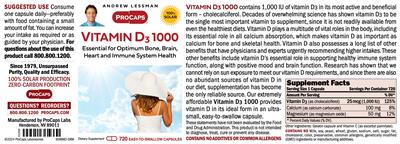
- Form
- Capsule
- Serving Size
- 1 Capsule
- Servings
- 720 per container
- Container Holds
- 720 Easy-To-Swallow Capsules
What’s in it, whether it interacts with your drugs, its side effects, whether it works, and what our pharmacists would want you to know before you start it.
- What is Vitamin D3 1000?A Vitamin D supplement from ProCaps with two other active ingredients, in capsule form.
- Active Ingredients Vitamin D3 25 mcgCalcium 100 mgMagnesium 50 mg Three active ingredients. Each one can interact with drugs or cause side effects on its own, so we check every one. The full Supplement Facts
- Drug Interactions 936 drugs have a documented interaction with this supplement; the most serious is rated major. Of those, 605 are single drugs and 331 are combination products (two or more drugs in one), each listed under its own name. Ask your pharmacist first if you take a drug in any of these categories, the most serious of the 30 on record:
- Levodopa/
Carbidopa (Sinemet) Major · 6 drugs - Dolutegravir (Tivicay)Major · 3 drugs
- Elvitegravir (Vitekta)Major · 3 drugs
- Ceftriaxone (Rocephin)Major · 1 drug
- Levodopa/
- Possible Side EffectsBloating bothConstipationDiarrheaGasNauseaStomach cramping Combined from the ingredients we have records for, Calcium and Magnesium. Not studied in this exact product.
- Well documented Why
Does Vitamin D3 1000 work?
What It Is Marketed For
Bone, brain, heart and immune system health
From the claims on the product’s label.
The Closest Use the Research Grades
Osteomalacia Vitamin D
Strong studies support it.
Its ingredients have research behind other uses too:
- Rickets Vitamin D
- Vitamin D
- Calcium
- Magnesium
- Magnesium
- Calcium
These grades are for each ingredient, not this exact product, and never a promise it will work for you.
And 20 more graded uses, in what the research says- Full Why
- AllergensNone of its ingredient names point to a major food allergen
- Barcode (UPC)460234Match it to the barcode on your bottle to be sure this is your product. Not your product? Search for it here
Who Might Consider It
- People looking for bone, brain, heart and immune system health, which is what it is marketed for. The closest use the research grades is osteomalacia, rated Effective.
- People who want Vitamin D, its main ingredient, for rickets, vitamin D deficiency or another graded use: the uses with research behind it. See each grade
- This product may suit adults who want calcium, vitamin D3, and magnesium in these amounts for a condition rated effective.
Who Should Be Careful
- Anyone taking HIV medicines, levodopa, heart rhythm drugs, thyroid medicine, or diabetes drugs should be careful.
- If you have kidney disease, kidney stones, or parathyroid problems, talk it over with your own doctor or pharmacist before starting.
More Before You Take It Show all three answersHide Its Ingredient Amounts vs. Other Supplements Pregnancy and Breastfeeding The Label’s Directions
-
How do its ingredient amounts compare with other supplements?
- Vitamin D325 mcgIn the usual range for the 461 recent Vitamin D products in our database that state an amount; 50 mcg is the most common.
- Calcium100 mgIn the usual range for the 502 recent Calcium products in our database that state an amount; 60 mg is the most common.
- Magnesium50 mgLess than most of the 502 recent Magnesium products in our database that state an amount; 100 mg is the most common.
A label’s amount is what the product holds, not a recommended dose.
See each comparison -
Pregnant or breastfeeding?
- Pregnancy Vitamin D
- ! When used orally in excessive amounts.
- Breastfeeding Vitamin D
- ! When used orally in excessive amounts.
- Pregnancy and Breastfeeding Calcium
- ! When used orally in excessive doses.
- Pregnancy and Breastfeeding Magnesium
- ! When used orally in excessive doses.
-
How does the label say to take it?
“Suggested Use Consume one capsule daily—preferably with food containing a small amount of fat. You can increase your daily intake as required or as guided by your physician.”
The maker’s words. Your pharmacist or doctor may advise differently.
Everything the label says
From the label dated Jun 25, 2025: all three of its active ingredients were checked against our records. A summary of what is known, not a grade or a test of the product. How these ratings are computed
Ask Anything About This Supplement
Name a drug you take, or ask about side effects, ingredients or pregnancy.
AI answers come from this label and our own records, never the open internet. AI can make mistakes, so always check with your doctor or pharmacist. How we use AI
Ask the Pharmacist
A licensed pharmacist will answer your question by email — free, as soon as they can.
Got it — thank you!
A licensed pharmacist will answer as soon as they can. Keep an eye on your email (worth checking spam, just in case).
What’s Inside Vitamin D3 1000 by ProCaps
Three Active Ingredients, Each Checked on Its Own
A supplement is often several ingredients in one bottle, and each one can interact with drugs or cause side effects on its own. We check every one of them against our records.
Why this rating?
The label gives an exact amount for every one of its three active ingredients, so you know how much of each you get in each serving. This rates what the label tells you, not the quality of the product.
Supplement Facts
| Amount Per Serving | % Daily Value | |
|---|---|---|
| Vitamin D3 | 25 mcg | 125% |
| Calcium | 100 mg | 8% |
| Magnesium | 50 mg | 12% |
Other ingredients: Gelatin, Vitamin C
Daily Values for adults and children 4 or more years of age.
As the label prints it, from the NIH Dietary Supplement Label Database.
Each Ingredient and Its Drug Interactions
Tap one for more about it and its full guide. A drug can interact with this supplement through any one of them.
Vitamin D3 1000 by ProCaps has three active ingredients: calcium, vitamin D3, and magnesium.
- Calcium is rated effective for conditions including low blood calcium (hypocalcemia), kidney failure, and bone thinning caused by corticosteroids, and vitamin D3 as effective for conditions including rickets, osteomalacia (softened bones), and hypoparathyroidism.
-
Vitamin D3 25 mcg Interacts with 717 drugs
Form on the label: Cholecalciferol
Vitamin D is a fat-soluble vitamin that helps your body absorb calcium and is important for healthy bones, muscles, and immune function.
- Many people, especially those with low sun exposure, benefit from supplementation, but more is not always better and very high doses can be harmful.
- Ask your pharmacist or doctor whether a blood test and supplement make sense for you.
The full Vitamin D guide: uses, dosage and safety Every Vitamin D drug interaction
-
Calcium 100 mg Interacts with 168 drugs
Form on the label: Calcium Carbonate
Calcium is an essential mineral your body needs for strong bones, nerve signaling, and muscle function, and supplements can help fill gaps when diet falls short.
- Most people do best getting calcium from food, and supplements should be used at the lowest dose needed.
- Talk to your pharmacist or doctor before starting, especially if you have kidney problems or take other medicines.
The full Calcium guide: uses, dosage and safety Every Calcium drug interaction
-
Magnesium 50 mg Magnesium is rated effective for low magnesium (hypomagnesemia), constipation, and dyspepsia (indigestion). Interacts with 298 drugs
Form on the label: Magnesium Oxide
Magnesium is an essential mineral your body needs for muscles, nerves, blood pressure, and many other functions, and supplements are useful for preventing or correcting deficiency.
- Some other uses, like easing constipation or preventing migraines, have reasonable support, while uses for sleep and anxiety are less proven.
- It is generally safe for most healthy people at recommended amounts, but talk to your pharmacist or doctor before starting, especially if you have kidney problems.
The full Magnesium guide: uses, dosage and safety Every Magnesium drug interaction
How Much of Each Ingredient Is in It, Compared With Other Supplements
Each bar is an amount that other recent supplements list for the same ingredient. The taller the bar, the more of them state it.
-
25 mcg in a serving of this product
In the usual range
- Most common amount
- 50 mcg (about 18 in 100 products)
- Most products state
- 5 mcg to 125 mcg
- Compared with
- 461 recent products
-
100 mg in a serving of this product
In the usual range
- Most common amount
- 60 mg (about 5 in 100 products)
- Most products state
- 27 mg to 500 mg
- Compared with
- 502 recent products
-
50 mg in a serving of this product
Less than most products
- Most common amount
- 100 mg (about 8 in 100 products)
- Most products state
- 20 mg to 400 mg
- Compared with
- 502 recent products
Other Ingredients (Inactive)
The capsule or tablet itself, fillers, coatings and flavors. Not part of the drug interaction check; the allergen check below reads them.
- Gelatin
- Vitamin C
Allergens in Vitamin D3 1000
None of its ingredient names point to a major food allergen.
Named on this label
- Gelatin (animal-derived)In the ingredients: Gelatin
Not named in the ingredients
- Milk
- Egg
- Fish
- Shellfish
- Tree nuts
- Peanuts
- Wheat or other gluten grains
- Soy
- Sesame
- Made without, the label says“Contains no additives or common allergens · Contains no milk, soy, yeast, wheat, gluten, sodium, salt, sugar, fat, cholesterol, color, preservative, common allergens, genetically modified (GMO) ingredients or manufacturing additives.”
From the label text and ingredient names on file; we do not test products. With a serious allergy, check your bottle and ask the maker or your pharmacist.
What the Label Says
The maker’s own words, from the label. We do not verify or endorse them.
- General statements
-
“For questions about the use of this product call 800.800.1200. Questions? reorders? 800.800.1200 www.procaps.com Andrew Lessman”
- Formulation
-
“Since 1979, unsurpassed purity, quality and efficacy. 100% solar production zero-carbon footprint”
“100% solar Essential for optimum bone, brain, heart and immune system health”
2 more from the label
“Contains no additives or common allergens Contains no milk, soy, yeast, wheat, gluten, sodium, salt, sugar, fat, cholesterol, color, preservative, common allergens, genetically modified (GMO) ingredients or manufacturing additives.”
“Vitamin D3 1000 contains 1,000 IU of vitamin D3 in its most active and beneficial form – cholecalciferol. Decades of overwhelming science has shown vitamin D3 to be the single most important vitamin to supplement, since it is not readily available from even the healthiest diets. Vitamin D plays a multitude of vital roles in the body, including its essential role in all calcium absorption, which makes vitamin D as important as calcium for bone and skeletal health. Vitamin D also possesses a long list of other benefits that have physicians and experts urgently recommending higher intakes. These other benefits include vitamin D’s essential role in supporting healthy immune system function, along with positive mood and brain function. Research has shown that we cannot rely on sun exposure to meet our vitamin D requirements, and since there are also no abundant sources of vitamin D in our diet, supplementation has become the only reliable source. Our extremely affordable Vitamin D3 1000 provides vitamin D in its ideal form in an ultrasmall, easy-to-swallow capsule.”
- Brand IP Statement(s)
-
“Copyright 2024 ProCaps Laboratories”
- FDA Statement of Identity
-
“Dietary Supplement”
The Vitamin D3 1000 Label on File
The label scan on file at the NIH Dietary Supplement Label Database, dated June 2025. Always read the label on the bottle you have.
Product Facts
- Brand
- ProCaps
- Barcode (UPC)
- 460234
- Net contents
- 720 Easy-To-Swallow Capsules
- Market status
- On market
- Date entered into DSLD
- Jun 25, 2025
- DSLD ID
- 331618
- Product type
- Other Combinations
- Supplement form
- Capsule
- Dietary claims / uses
- Nutrient, All Other, Structure/Function
- Intended target group(s)
- Adult (18 - 50 Years), No Allergies, Gluten Free, Dairy Free, Sugar Free
Is this label outdated? Report a formula or label change and our pharmacy team will review it.
Vitamin D3 1000 by ProCaps Side Effects
Why this rating?
We look for three kinds of safety information on each ingredient: side effects reported in studies, a pregnancy and breastfeeding rating, and a safety write-up from our pharmacy team. All three are on file for each of the three ingredients we could check.
So this rates how much is known, not whether Vitamin D3 1000 is right for you.
Reported with Vitamin D, Calcium and Magnesium
- Most often
- Bloating, constipation, diarrhea, gas, nausea and stomach cramping
- !Rare but serious
- Reported with Vitamin D, Calcium and Magnesium See details
HelloPharmacist Team Summary: Vitamin D3 1000 by ProCaps Side Effects
Calcium and magnesium in Vitamin D3 1000 by ProCaps are generally well tolerated at recommended amounts, and vitamin D3 is also described as well tolerated.
- The side effects you are most likely to notice are constipation and gas or bloating from the calcium, and diarrhea or stomach cramping from the magnesium.
- The rare but serious effects are kidney stones and high blood calcium (hypercalcemia), so if you notice nausea, confusion, excessive thirst, frequent urination, or an irregular heartbeat, call your doctor.
- If you have kidney disease, kidney stones, parathyroid problems, or heart conduction problems, talk with your own doctor or pharmacist before starting.
Side Effects, Ingredient by Ingredient
A supplement’s side effects come from its ingredients. Here is what is reported with each one.
Calcium
Most reported
- Constipation
- Gas
- Bloating
Magnesium
Most reported
- Diarrhea
- Nausea
- Stomach cramping
- Bloating
Vitamin D has side-effect reports, but no list of the most common ones. Read them in the Vitamin D guide
Vitamin D3 1000 Warnings: Who Should Be Careful
Vitamin D3 1000 has three active ingredients, and each can carry warnings of its own. We checked all three, and each warning below names the ingredient it comes from. If any of these apply to you, talk to your doctor or pharmacist before you start it.
- Vitamin D2 warnings below
- Calcium3 warnings below
- Magnesium3 warnings below
-
Kidney Disease or Kidney Stones
- Vitamin DPeople with certain conditions should be careful, including those with high blood calcium, kidney disease, kidney stones, or sarcoidosis.
- CalciumTaking very high amounts over a long time can raise the risk of kidney stones in some people and may cause too much calcium in the blood.
- CalciumPeople with kidney disease, kidney stones, parathyroid problems, or high blood calcium should talk with a doctor before taking calcium supplements.
- MagnesiumThe biggest safety concern is in people with kidney disease, because damaged kidneys cannot remove extra magnesium, which can build up to dangerous levels.
- MagnesiumIf you have kidney problems, do not take magnesium supplements unless your doctor tells you to.
-
Heart Conditions
- CalciumSome research has raised questions about whether high-dose calcium supplements could affect heart health, so it is wise to avoid taking more than you need and to favor calcium from food when possible.
- MagnesiumPeople with heart conduction problems or certain bowel conditions should also be cautious.
-
Other Cautions
- Vitamin DIf you have any of these, talk to your doctor before supplementing.
-
Pregnant or Breastfeeding
Each ingredient’s rating for pregnancy and for breastfeeding, and what it covers.
Pregnancy
-
When used orally and appropriately.
Vitamin D is safe when used in doses below the tolerable upper intake level (UL) of 4000 IU (100 mcg) daily.
-
When used orally in excessive amounts.
Tell patients not to use doses above the tolerable upper intake level (UL) of 4000 IU (100 mcg) daily.
Hypercalcemia during pregnancy due to excessive vitamin D intake can lead to several fetal adverse effects, including suppression of parathyroid hormone, hypocalcemia, tetany, seizures, aortic valve stenosis, retinopathy, and mental and/or physical developmental delay.
Breastfeeding
-
When used orally and appropriately.
Vitamin D is safe when used in doses below the tolerable upper intake level (UL) of 4000 IU (100 mcg) daily.
-
When used orally in excessive amounts.
Tell patients not to use doses above the tolerable upper intake level (UL) of 4000 IU (100 mcg) daily.
Pregnancy and Breastfeeding The record rates both the same
-
When used orally and appropriately.
The World Health Organization (WHO) recommends prescribing oral calcium supplementation 1.5-2 grams daily during pregnancy to those with low dietary calcium intake to prevent pre-eclampsia.
-
When used orally in excessive doses.
The Institute of Medicine sets the same daily tolerable upper intake level (UL) for calcium according to age independent of pregnancy status: 9-18 years, 3000 mg; 19-50 years, 2500 mg.
2 more points on this rating
- Doses over these amounts might increase the risk of neonatal hypocalcemia-induced seizures possibly caused by transient neonatal hypoparathyroidism in the setting of excessive calcium supplementation during pregnancy, especially during the third trimester.
- Neonatal hypocalcemia is a risk factor for neonatal seizures.
Pregnancy and Breastfeeding The record rates both the same
-
When used orally and appropriately.
Magnesium is safe for those pregnant and breast-feeding when used in doses below the tolerable upper intake level (UL) of 350 mg daily.
-
When used orally in excessive doses.
Tell patients to avoid exceeding the tolerable upper intake level (UL) of 350 mg daily.
Taking magnesium orally in higher doses can cause diarrhea.
2 more ratings for Magnesium used another way
This supplement is taken by mouth. These ratings are for Magnesium given another way.
-
When prescription magnesium sulfate is given intramuscularly and intravenously prior to delivery for up to 5 days.
However, due to potential adverse effects associated with intravenous and intramuscular magnesium, use during pregnancy is limited to patients with specific conditions such as severe pre-eclampsia or eclampsia.
5 more points on this rating
- There is some evidence that intravenous magnesium can increase fetal mortality and adversely affect neurological and skeletal development.
- However, a more recent analysis of clinical research shows that increased risk of fetal mortality seems to occur only in the studies where antenatal magnesium is used for tocolysis and not for fetal neuroprotection or pre-eclampsia/eclampsia.
- Furthermore, antenatal magnesium does not seem to be associated with increased risk of necrotizing enterocolitis in preterm infants.
- There is also concern that magnesium increases the risk of maternal adverse events.
- A meta-analysis of clinical research shows that magnesium sulfate might increase the risk of maternal adverse events, especially in Hispanic mothers compared to other racial and ethnic groups.
-
When prescription magnesium sulfate is given intramuscularly and intravenously prior to delivery for longer than 5 days.
Maternal exposure to magnesium for longer than 5-7 days is associated with an increase in neonatal bone abnormalities such as osteopenia and fractures.
The U.S. Food and Drug Administration (FDA) recommends that magnesium injection not be given for longer than 5-7 days.
Ratings and the words beside them are from the Natural Medicines database, which we license.
-
Rare but Serious Side Effects
-
!
Vitamin D
In severe cases, very high calcium can harm the kidneys and heart.
Orally or intramuscularly: Excessive doses can lead to vitamin D toxicity with symptoms of hypercalcemia, and also sometimes azotemia and anemia.
-
!
Calcium
Taking too much calcium can lead to more serious problems such as kidney stones or high blood calcium (hypercalcemia), which can cause nausea, confusion, excessive thirst, frequent urination, and an irregular heartbeat.
Its common effects are belching, constipation, diarrhea, gas, and stomach upset, and rare case reports raise concerns about calciphylaxis and kidney stones.
Orally: Case reports have raised concerns about calciphylaxis and kidney stones.
-
!
Magnesium
Rare but serious side effects happen mostly with very high doses or in people with poor kidney function.
Magnesium is generally well tolerated, and rare but serious effects are mostly linked to very high doses or poor kidney function.
With toxic doses, loss of reflexes and respiratory depression can occur. High doses in pregnancy can increase risk of neonatal mortality and neurological defects.
When to get help: a serious allergic reaction, with trouble breathing or swelling of the face, lips or throat, needs emergency care: call 911. For any other side effect that worries you, call your doctor or pharmacist.
These reports describe each ingredient, not studies of this exact product. Not medical advice: a side effect you notice after starting a supplement is worth a word with your pharmacist or doctor.
Vitamin D3 1000 by ProCaps Drug Interactions
We checked all three active ingredients in this supplement against every drug in our records. A drug can interact with it through any one of them.
A major interaction on record
3 of 3, on a scale from Minor or none to Major.Why this rating?
We rate this by the most serious interaction on record, not by how many there are. For Calcium, Vitamin D and Magnesium, the most serious is rated major, which means the combination is best avoided, or used only under close supervision. Some involve kinds of drugs where a small change can matter, such as blood thinners, diabetes drugs and heart-rhythm drugs.
937 drugs are on the full list. What matters is whether one you take is on it, so check yours with the interaction checker on this page.
All three of its active ingredients have drug interactions on record: Vitamin D, Calcium and Magnesium.
- Interacts with
- 717 drugs
- Most serious
- Moderate
- Rated Minor: vitamin D3 may affect CYP3A4 substrates, drugs the liver clears through that enzyme.
- Interacts with
- 168 drugs
- Most serious
- Major
- The most serious interaction is calcium reducing levels of dolutegravir (Tivicay), an HIV medicine, which our data rates Major.
- Research suggests calcium carbonate can lower dolutegravir levels by almost 40%, so our pharmacists advise taking dolutegravir 2 hours before or 6 hours after calcium.
- Interacts with
- 298 drugs
- Most serious
- Major
- Most of its records involve Anticoagulant/Antiplatelet Drugs, Skeletal Muscle Relaxants and Potassium-sparing Diuretics.
From the HelloPharmacist Team
Here is how the interactions add up across the whole label.
- Vitamin D3 1000 by ProCaps interacts with a number of medication types, through its calcium, vitamin D3, and magnesium content.
- Also rated Major: calcium with elvitegravir (another HIV medicine), calcium with ceftriaxone (an antibiotic, where the concern is intravenous calcium rather than capsules), and magnesium with levodopa/carbidopa (Sinemet) for Parkinson's disease, which can reduce levodopa absorption.
- Rated Moderate: calcium with raltegravir (HIV), levothyroxine (thyroid hormone), and sotalol (heart rhythm); vitamin D3 with thiazide diuretics (water pills), verapamil, diltiazem, digoxin (heart medicines), atorvastatin (cholesterol), and aluminum; calcipotriene (a psoriasis treatment) with both calcium and vitamin D3; magnesium with skeletal muscle relaxants, potassium-sparing diuretics, calcium channel blockers, antacids, sulfonylureas (diabetes), quinolone antibiotics, and bisphosphonates (bone medicines).
Summarized by the HelloPharmacist pharmacy team from the interaction records below. How it is written How we use AI
Why Vitamin D3 1000 Interacts, Ingredient by Ingredient
A product interacts through its ingredients. Each card: how many drugs, the most serious rating, and the kinds of drugs it affects most (tap a kind for what it means).
The ingredients driving the most interactions
-
Vitamin D3 717 drugs
Most serious: Moderate8 interaction records on file
The kinds of drugs it affects most
- 645 drugs
- 56 drugs
- Aluminum 14 drugs
- Atorvastatin (Lipitor) 3 drugs
Every Vitamin D drug interaction, 8 records The Vitamin D records cite 25 references, listed in the Vitamin D guide.
-
Magnesium 298 drugs
Most serious: Major16 interaction records on file
The kinds of drugs it affects most
- 122 drugs
- Skeletal Muscle Relaxants 36 drugs
- 23 drugs
- 22 drugs
Every Magnesium drug interaction, 16 records The Magnesium records cite 84 references, listed in the Magnesium guide.
-
Calcium 168 drugs
Most serious: Major18 interaction records on file
The kinds of drugs it affects most
- 56 drugs
- 22 drugs
- 21 drugs
- 20 drugs
Every Calcium drug interaction, 18 records The Calcium records cite 62 references, listed in the Calcium guide.
The Breakdown by Severity
Each drug counted once, at its most serious rating. Tap a tile to list those drugs.
Find Your Drug
Type a drug or brand name to see whether it is on the list.
- Only drugs with a documented interaction are listed, the most serious first.
- A drug with no known interaction is not listed, but searching its name tells you so.
- Open a drug to see which ingredient is responsible. Of those, 605 are single drugs and 331 are combination products (two or more drugs in one), each listed under its own name.
-
LevodopaInbrija, Larodopa Major
The ingredient responsible:
-
Magnesium Major
Magnesium can reduce the bioavailability of levodopa/carbidopa.
The full Magnesium + Levodopa interaction
-
-
CeftriaxoneRocephin Major
The ingredient responsible:
-
Calcium Major
Co-administration of intravenous calcium and ceftriaxone can result in precipitation of a ceftriaxone-calcium salt in the lungs and kidneys.
The full Calcium + Ceftriaxone interaction
-
-
DolutegravirTivicay Major
The ingredient responsible:
-
Calcium Major
Calcium seems to reduce levels of dolutegravir.
The full Calcium + Dolutegravir interaction
-
-
ElvitegravirVitekta Major
The 2 ingredients responsible:
-
Calcium Major
Calcium seems to reduce levels of elvitegravir.
The full Calcium + Elvitegravir interaction -
Vitamin D3 Minor Elvitegravir is in the Cytochrome P450 3A4 (CYP3A4) Substrates category.
Vitamin D might induce CYP3A4 enzymes and reduce the bioavailability of CYP3A4 substrates.
The full Vitamin D3 + Elvitegravir interaction
-
-
CarbidopaLodosyn Major
The ingredient responsible:
-
Magnesium Major
Magnesium can reduce the bioavailability of levodopa/carbidopa.
The full Magnesium + Carbidopa interaction
-
-
Carbidopa and LevodopaDhivy, Rytary, Sinemet, Sinemet CR Major
The ingredient responsible:
-
Magnesium Major
Magnesium can reduce the bioavailability of levodopa/carbidopa.
The full Magnesium + Carbidopa and Levodopa interaction
-
-
Cobicistat, Elvitegravir, Emtricitabine, and Tenofovir Alafenamide FumarateGenvoya Major
The 3 ingredients responsible:
-
Calcium Major It contains elvitegravir, the drug this record is about.
Calcium seems to reduce levels of elvitegravir.
The full Calcium + Cobicistat, Elvitegravir, Emtricitabine, and Tenofovir Alafenamide Fumarate interaction -
Magnesium Moderate
Magnesium might decrease levels of bictegravir/emtricitabine/tenofovir alafenamide by reducing its absorption.
The full Magnesium + Cobicistat, Elvitegravir, Emtricitabine, and Tenofovir Alafenamide Fumarate interaction -
Vitamin D3 Minor Cobicistat, Elvitegravir, Emtricitabine, and Tenofovir Alafenamide Fumarate is in the Cytochrome P450 3A4 (CYP3A4) Substrates category.
Vitamin D might induce CYP3A4 enzymes and reduce the bioavailability of CYP3A4 substrates.
The full Vitamin D3 + Cobicistat, Elvitegravir, Emtricitabine, and Tenofovir Alafenamide Fumarate interaction
-
-
Benserazide and LevodopaMadopar, Prolopa Major
The ingredient responsible:
-
Magnesium Major
Magnesium can reduce the bioavailability of levodopa/carbidopa.
The full Magnesium + Benserazide and Levodopa interaction
-
-
Elvitegravir, Cobicistat, Emtricitabine, and Tenofovir Disoproxil FumarateStribild Major
The 3 ingredients responsible:
-
Calcium Major It contains elvitegravir, the drug this record is about.
Calcium seems to reduce levels of elvitegravir.
The full Calcium + Elvitegravir, Cobicistat, Emtricitabine, and Tenofovir Disoproxil Fumarate interaction -
Magnesium Moderate
Magnesium might decrease levels of bictegravir/emtricitabine/tenofovir alafenamide by reducing its absorption.
The full Magnesium + Elvitegravir, Cobicistat, Emtricitabine, and Tenofovir Disoproxil Fumarate interaction -
Vitamin D3 Minor Elvitegravir, Cobicistat, Emtricitabine, and Tenofovir Disoproxil Fumarate is in the Cytochrome P450 3A4 (CYP3A4) Substrates category.
Vitamin D might induce CYP3A4 enzymes and reduce the bioavailability of CYP3A4 substrates.
The full Vitamin D3 + Elvitegravir, Cobicistat, Emtricitabine, and Tenofovir Disoproxil Fumarate interaction
-
-
Levodopa and CarbidopaDuodopa Major
The ingredient responsible:
-
Magnesium Major
Magnesium can reduce the bioavailability of levodopa/carbidopa.
The full Magnesium + Levodopa and Carbidopa interaction
-
-
Carbidopa, Levodopa, and EntacaponeStalevo Major
The ingredient responsible:
-
Magnesium Major
Magnesium can reduce the bioavailability of levodopa/carbidopa.
The full Magnesium + Carbidopa, Levodopa, and Entacapone interaction
-
-
Dolutegravir and RilpivirineJuluca Major
The 2 ingredients responsible:
-
Calcium Major
Calcium seems to reduce levels of dolutegravir.
The full Calcium + Dolutegravir and Rilpivirine interaction -
Vitamin D3 Minor Dolutegravir and Rilpivirine is in the Cytochrome P450 3A4 (CYP3A4) Substrates category.
Vitamin D might induce CYP3A4 enzymes and reduce the bioavailability of CYP3A4 substrates.
The full Vitamin D3 + Dolutegravir and Rilpivirine interaction
-
-
Dolutegravir, Emtricitabine, and Tenofovir AlafenamideDolutegravir, Emtricitabine, Tenofovir Alafenamide Major
The 2 ingredients responsible:
-
Calcium Major It contains dolutegravir, the drug this record is about.
Calcium seems to reduce levels of dolutegravir.
The full Calcium + Dolutegravir, Emtricitabine, and Tenofovir Alafenamide interaction -
Magnesium Moderate
Magnesium might decrease levels of bictegravir/emtricitabine/tenofovir alafenamide by reducing its absorption.
The full Magnesium + Dolutegravir, Emtricitabine, and Tenofovir Alafenamide interaction
-
-
LevothyroxineEltroxin, Estre, Euthyrox, Levo-T, Levolet and 6 more Moderate
The 2 ingredients responsible:
-
Calcium Moderate
Calcium seems to reduce the absorption and effectiveness of levothyroxine.
The full Calcium + Levothyroxine interaction -
Magnesium Moderate
Magnesium might decrease levothyroxine levels by reducing its absorption.
The full Magnesium + Levothyroxine interaction
-
-
AmlodipineNorliqva Moderate
The 3 ingredients responsible:
-
Magnesium Moderate Amlodipine is in the Calcium Channel Blockers category.
Magnesium can have additive effects with calcium channel blockers, although evidence is conflicting.
The full Magnesium + Amlodipine interaction -
Calcium Minor Amlodipine is in the Calcium Channel Blockers category.
Intravenous calcium may decrease the effects of calcium channel blockers; oral calcium is unlikely to have this effect.
The full Calcium + Amlodipine interaction -
Vitamin D3 Minor Amlodipine is in the Cytochrome P450 3A4 (CYP3A4) Substrates category.
Vitamin D might induce CYP3A4 enzymes and reduce the bioavailability of CYP3A4 substrates.
The full Vitamin D3 + Amlodipine interaction
-
-
AtorvastatinAtorvaliq Moderate
The ingredient responsible:
-
Vitamin D3 Moderate Atorvastatin is in the Cytochrome P450 3A4 (CYP3A4) Substrates category.
Vitamin D might induce CYP3A4 enzymes and reduce the bioavailability of CYP3A4 substrates.
The full Vitamin D3 + Atorvastatin interaction
-
-
DoxycyclineDoryx, Doxy, Doxy-D, Doxycin, Doxycycline Injection and 7 more Moderate
The 2 ingredients responsible:
-
Calcium Moderate Doxycycline is in the Tetracycline Antibiotics category.
Calcium seems to reduce the absorption of tetracycline antibiotics.
The full Calcium + Doxycycline interaction -
Magnesium Moderate Doxycycline is in the Tetracycline Antibiotics category.
Magnesium decreases absorption of tetracyclines.
The full Magnesium + Doxycycline interaction
-
-
Levothyroxine SodiumErmez, Thyquidity, Tirosint-Sol Moderate
The 2 ingredients responsible:
-
Magnesium Moderate
Magnesium might decrease levothyroxine levels by reducing its absorption.
The full Magnesium + Levothyroxine Sodium interaction -
Calcium Moderate
Calcium seems to reduce the absorption and effectiveness of levothyroxine.
The full Calcium + Levothyroxine Sodium interaction
-
-
Amlodipine BesylateNorvasc Moderate
The 3 ingredients responsible:
-
Magnesium Moderate Amlodipine Besylate is in the Calcium Channel Blockers category.
Magnesium can have additive effects with calcium channel blockers, although evidence is conflicting.
The full Magnesium + Amlodipine Besylate interaction -
Calcium Minor Amlodipine Besylate is in the Calcium Channel Blockers category.
Intravenous calcium may decrease the effects of calcium channel blockers; oral calcium is unlikely to have this effect.
The full Calcium + Amlodipine Besylate interaction -
Vitamin D3 Minor Amlodipine Besylate is in the Cytochrome P450 3A4 (CYP3A4) Substrates category.
Vitamin D might induce CYP3A4 enzymes and reduce the bioavailability of CYP3A4 substrates.
The full Vitamin D3 + Amlodipine Besylate interaction
-
-
CiprofloxacinCiloxan, Cipro, Cipro IV, Cipro XR, Ciprobay and 1 more Moderate
The 2 ingredients responsible:
-
Calcium Moderate Ciprofloxacin is in the Quinolone Antibiotics category.
Calcium seems to reduce the absorption of quinolone antibiotics.
The full Calcium + Ciprofloxacin interaction -
Magnesium Moderate Ciprofloxacin is in the Quinolone Antibiotics category.
Magnesium decreases absorption of quinolones.
The full Magnesium + Ciprofloxacin interaction
-
-
SpironolactoneAldactone, Carospir, Spiroton Moderate
The ingredient responsible:
-
Magnesium Moderate Spironolactone is in the Potassium-sparing Diuretics category.
Potassium-sparing diuretics decrease excretion of magnesium, possibly increasing magnesium levels.
The full Magnesium + Spironolactone interaction
-
-
Atorvastatin CalciumLipitor Moderate
The ingredient responsible:
-
Vitamin D3 Moderate Atorvastatin Calcium is in the Cytochrome P450 3A4 (CYP3A4) Substrates category.
Vitamin D might reduce absorption of atorvastatin.
The full Vitamin D3 + Atorvastatin Calcium interaction
-
-
Lithium Carbonate (prescription Drug)Eskalith, Lithium Carbonate Moderate
The ingredient responsible:
-
Calcium Moderate
Theoretically, concomitant use of calcium and lithium may increase this risk of hypercalcemia.
The full Calcium + Lithium Carbonate (prescription Drug) interaction
-
-
Doxycycline HyclateActiclate, Acticlate Cap, Lymepak Moderate
The 2 ingredients responsible:
-
Magnesium Moderate Doxycycline Hyclate is in the Tetracycline Antibiotics category.
Magnesium decreases absorption of tetracyclines.
The full Magnesium + Doxycycline Hyclate interaction -
Calcium Moderate Doxycycline Hyclate is in the Tetracycline Antibiotics category.
Calcium seems to reduce the absorption of tetracycline antibiotics.
The full Calcium + Doxycycline Hyclate interaction
-
-
HydrochlorothiazideAquazide, Aquazide H, Esidrix, HCTZ, Hydro and 4 more Moderate
The 2 ingredients responsible:
-
Calcium Moderate Hydrochlorothiazide is in the Thiazide Diuretics category.
Taking calcium along with thiazides might increase the risk of hypercalcemia and renal failure.
The full Calcium + Hydrochlorothiazide interaction -
Vitamin D3 Moderate Hydrochlorothiazide is in the Thiazide Diuretics category.
Theoretically, taking thiazide diuretics and high-dose vitamin D can increase the risk of hypercalcemia.
The full Vitamin D3 + Hydrochlorothiazide interaction
-
-
Doxycycline MonohydrateErfacea Moderate
The 2 ingredients responsible:
-
Calcium Moderate Doxycycline Monohydrate is in the Tetracycline Antibiotics category.
Calcium seems to reduce the absorption of tetracycline antibiotics.
The full Calcium + Doxycycline Monohydrate interaction -
Magnesium Moderate Doxycycline Monohydrate is in the Tetracycline Antibiotics category.
Magnesium decreases absorption of tetracyclines.
The full Magnesium + Doxycycline Monohydrate interaction
-
-
Magnesium Sulfate (prescription Drug)Bilagog, Magnesium Sulfate Moderate
The ingredient responsible:
-
Magnesium Moderate Magnesium Sulfate (prescription Drug) is in the Antacids category.
Use of acid reducers may reduce the laxative effect of magnesium oxide.
The full Magnesium + Magnesium Sulfate (prescription Drug) interaction
-
-
GlipizideGlucotrol, Glucotrol XL Moderate
The ingredient responsible:
-
Magnesium Moderate Glipizide is in the Sulfonylureas category.
Magnesium increases the systemic absorption of sulfonylureas, increasing their effects and side effects.
The full Magnesium + Glipizide interaction
-
-
DigoxinDigitek, Lanoxicaps, Lanoxin Moderate
The 3 ingredients responsible:
-
Vitamin D3 Moderate
Theoretically, hypercalcemia induced by high-dose vitamin D can increase the risk of arrhythmia from digoxin.
The full Vitamin D3 + Digoxin interaction -
Calcium Moderate
Using intravenous calcium with digoxin might increase the risk of fatal cardiac arrhythmias.
The full Calcium + Digoxin interaction -
Magnesium Moderate
Magnesium salts may reduce absorption of digoxin.
The full Magnesium + Digoxin interaction
-
-
DiltiazemAdizem-SR, Adizem-XL, Angitil SR, Angitil XL, Calcicard CR and 24 more Moderate
The 3 ingredients responsible:
-
Calcium Moderate Diltiazem is in the Calcium Channel Blockers category.
Intravenous calcium may decrease the effects of calcium channel blockers; oral calcium is unlikely to have this effect.
The full Calcium + Diltiazem interaction -
Vitamin D3 Moderate Diltiazem is in the Cytochrome P450 3A4 (CYP3A4) Substrates category.
Theoretically, hypercalcemia induced by high-dose vitamin D can reduce the therapeutic effects of diltiazem for arrhythmia.
The full Vitamin D3 + Diltiazem interaction -
Magnesium Moderate Diltiazem is in the Calcium Channel Blockers category.
Magnesium can have additive effects with calcium channel blockers, although evidence is conflicting.
The full Magnesium + Diltiazem interaction
-
Does It Work? Vitamin D3 1000 by ProCaps
How it rates in the research so far, then each ingredient on its own. A grade is the research so far, never an endorsement.
What It Is Marketed For
Bone, brain, heart and immune system health
From the claims on the product’s label.
Closest match for what it is marketed for
Vitamin D for osteomalacia
Strong studies support it.
Our pharmacy team’s notes on this supplement
- Our data rates each ingredient for specific conditions, not for general wellness.
- If you are considering this product for one of these conditions, talk with your own doctor or pharmacist about whether it fits your situation.
The Evidence, Ingredient by Ingredient
Each card holds our notes on one ingredient, then its uses graded effective, likely effective or possibly effective.
Vitamin D
From our Vitamin D guide
- The strongest and clearest reason to take vitamin D is to prevent or correct a deficiency.
- People with low blood levels can develop soft or weak bones (rickets in children, osteomalacia in adults), and supplements clearly help in these cases.
Research suggests a benefit for
- Osteomalacia (the use on its label), rickets and vitamin D deficiency
- Osteoporosis and corticosteroid-induced osteoporosis
- Allergic rhinitis (hay fever), coronavirus disease 2019 (COVID-19) and dental caries
Not counted here: one graded use is for Vitamin D injected or put on the skin (psoriasis), not for a product like this one. Four more are for conditions treated by a doctor or in a hospital (heart failure, familial hypophosphatemia, renal osteodystrophy and others).
And 2 more graded uses, in the Vitamin D guideCalcium
From our Calcium guide
- Calcium is most strongly supported for preventing and treating calcium deficiency and for supporting bone health.
- Getting enough calcium, often along with vitamin D, is widely recommended to help maintain bone strength and lower the risk of bone thinning (osteoporosis), especially in older adults and postmenopausal women.
Research suggests a benefit for
- Dyspepsia
- Osteoporosis, premenstrual syndrome (PMS), corticosteroid-induced osteoporosis and hyperparathyroidism
- Pregnancy-induced hypertension, rickets and osteomalacia
Not counted here: one graded use is for Calcium injected or put on the skin (hyperkalemia), not for a product like this one. Four more are for conditions treated by a doctor or in a hospital (colorectal cancer, hypocalcemia, pre-eclampsia and others).
And 2 more graded uses, in the Calcium guideMagnesium
From our Magnesium guide
- The strongest reason to take magnesium is to prevent or correct a deficiency.
- People at higher risk include those with poorly controlled diabetes, long-term alcohol use, certain digestive diseases, or those taking medicines that lower magnesium.
Research suggests a benefit for
- Constipation and dyspepsia
- Diabetes, hypercholesterolemia, metabolic syndrome, osteoporosis and premenstrual syndrome (PMS)
Not counted here: five graded uses are for Magnesium injected or put on the skin (vasospastic angina, asthma, seizures and others), not for a product like this one. Six more are for conditions treated by a doctor or in a hospital (arrhythmia, cerebral palsy, colorectal cancer and others).
Every graded use, in the Magnesium guideThe grades are the Natural Medicines database’s, which we license; tap a grade for what it means. They are about each ingredient, not this exact product.
About ProCaps
Manufacturer and brand details for Vitamin D3 1000, from the product label.
ProCaps has 134 products in our supplement database, 123 of them on the market, with labels on file since 2020. Our database is built from the NIH’s Dietary Supplement Label Database and our pharmacy team’s own additions, so it covers the labels filed there, not every product the brand sells.
- Name
- ProCaps Labs
- City
- Henderson
- State
- NV
- ZipCode
- 89011
- Phone Number
- 800.800.1200
- Web Address
- ProCaps.com
Vitamin D3 1000 by ProCaps: Common Questions
Does Vitamin D3 1000 by ProCaps interact with any drugs?
What are the side effects of Vitamin D3 1000 by ProCaps?
Who should be careful taking Vitamin D3 1000 by ProCaps?
Can Vitamin D3 1000 by ProCaps affect the kidneys?
Does Vitamin D3 1000 by ProCaps contain any common allergens?
Is Vitamin D3 1000 by ProCaps gluten free?
How can Vitamin D3 1000 by ProCaps interact with so many drugs?
Where does the information about Vitamin D3 1000 by ProCaps come from?
Is vitamin D3 in Vitamin D3 1000 by ProCaps used for anything specific?
Can I take Vitamin D3 1000 by ProCaps during pregnancy?
Does magnesium work for constipation?
What are the inactive ingredients?
Written and reviewed by the HelloPharmacist Editorial Team. Our editorial policy
Still Have a Question About Vitamin D3 1000?
Our pharmacists answer drug and supplement questions, free, by email.
Label information is sourced from the NIH Dietary Supplement Label Database and reflects the product version on file; always read your actual product label. This page is for education only and is not a substitute for professional medical advice. Confirm with your pharmacist or doctor before combining supplements and drugs.
Who Reviews This Page
The pharmacist behind it, and how it is checked.
Dr. Brian Staiger, PharmD, BCPS
Clinical pharmacist and founder of HelloPharmacist
A licensed pharmacist for more than 13 years, he built the system behind this page: it reads the label on file, matches each active ingredient to its record in the Natural Medicines database, checks those records against every drug we cover, and our pharmacy team writes the take and the interaction summary from those records.
- 13+ Years in PharmacyRetail and clinical pharmacy, medication safety and healthcare administration.
- Board Certified (BCPS)A pharmacotherapy specialist, certified by the Board of Pharmacy Specialties.
- Herbalist TrainingCertificates in medical ethnobotany, for the herbs and supplements people take.
Where This Page Comes From
Vitamin D3 1000’s label data comes from the NIH Dietary Supplement Label Database; the ingredient interaction data is from the Natural Medicines database, reviewed by our pharmacists.
- NIH Dietary Supplement Label Database (DSLD)
- The official product label on file for this supplement.
- Natural Medicines (Therapeutic Research Center)
- The evidence-graded clinical reference behind the ingredient interaction, evidence and safety records, which we license.
- HelloPharmacist Editorial Team
- Content is reviewed by the HelloPharmacist Editorial Team, the pharmacists on our staff and those we contract. See our data sources and editorial standards for how this information is built and checked.
- The Pharmacy Team’s Take and Summaries
- Generated from HelloPharmacist’s pharmacist-curated databases and editorial rules. Clinical methodology reviewed by Dr. Brian Staiger, PharmD, BCPS. Last generated Oct 31, 2026. How we use AI
- The ratings in the Quick Summary
- They summarize available label information, ingredient evidence and known drug-safety records: a summary of what is known, not a grade of the product itself. They do not verify product identity, purity, potency, contamination or manufacturing quality. How these ratings are computed
The References Behind the Interaction Records
Every citation the ingredients’ records rest on is listed in that ingredient’s guide, in context: Vitamin D, 25 references; Calcium, 62 references; Magnesium, 84 references .
Parts of this content are provided by the Therapeutic Research Center, LLC.
DISCLAIMER: Currently this does not check for drug-drug interactions. This is not an all-inclusive comprehensive list of potential interactions and is for informational purposes only. Not all interactions are known or well-reported in the scientific literature, and new interactions are continually being reported. Input is needed from a qualified healthcare provider including a pharmacist before starting any therapy. Application of clinical judgment is necessary.
© 2021 Therapeutic Research Center, LLC
Keep Exploring
- Supplement interaction checkerCheck any supplement or product against your drugs
- Drug–drug interactionsCheck two or more of your drugs against each other
- Browse drugs A to ZEvery drug we have checked against herbs and supplements
- NDC and pricing lookupFind a drug’s NDCs, packaging and costs
- Ask a pharmacistA free, personal answer from our licensed team